Introduction
Banana is the most economically important fruit crop for small-scale production in India and elsewhere (Tiwari et al. Reference Tiwari, Thapa, Gautam and Shrestha2006). It is the second-most important fruit crop in India next to mango. Its affordability, year-round availability, range of varieties, taste, and nutritional and medicinal value make it a favourite fruit for many people. Many insect pests cause significant yield losses in banana, among which the banana stem weevil, Odoiporus longicollis Olivier (Coleoptera: Curculionidae), is an important insect pest of plantains and bananas in both tropical and sub-tropical regions (Biswas et al. Reference Biswas, Banerjee and Bandyopadhyay2015). The female O. longicollis deposits eggs in the plant’s leaf sheath, and the emerging grubs create tunnels in the leaf sheath that cause snapping, withering, plant toppling, no flowering, premature fruit development, and reduced bunch weight. The yield loss in susceptible cultivars, such as Nendran and others, is based on the growth stage of a crop at which the pest attack occurs and the level of the control measures (Sivakumar et al. Reference Sivakumar, Jiji and Sheela2014; Chowdhury Reference Chowdhury2015). The control of O. longicollis is a difficult and complicated issue due to the insect’s hidden life; thus, farmers depend on many insecticides for its control (Padmanaban et al. Reference Padmanaban, Selvarajan, Kandasamy and Balasubrmanian2002b). Most of these insecticides have adverse effects, including residues, resistance, and resurgence of insect pests, and unwanted impacts on natural enemies, nontarget organisms, and humans (Desneux et al. Reference Desneux, Decourtye and Delpuech2007; Boopathi and Pathak Reference Boopathi and Pathak2011; Boopathi et al. Reference Boopathi, Karuppuchamy, Singh, Kalyanasundaram, Mohankumar and Ravi2015, Reference Boopathi, Singh, Ravi and Manju2016, Reference Boopathi, Meena, Ravi and Thirunavukarasu2017, Reference Boopathi, Singh, Dutta, Dayal, Singh and Chowdhury2020a, Reference Boopathi, Singh, Dutta, Dayal, Singh and Chowdhury2020b). Therefore, an effective and eco-friendly method for the management of O. longicollis is required.
Even though the efficacy of many natural enemies against O. longicollis has been reported, the problems regarding their mass culture, viability, and storage, which prevent their widespread use, remain unsolved (Anitha et al. Reference Anitha, Nair and Mathai1998; Padmanaban et al. Reference Padmanaban, Rajeswari and Sathiamoorthy2002a). The use of banana stem (pseudostem) traps to monitor and manage O. longicollis is yet ineffective due to it attracting a limited number of adults (Koppenhofer et al. Reference Koppenhofer, Reddy and Sikora1994), its labour intensiveness (Gold et al. Reference Gold, Okech and Nokoe2002), fast desiccation, and the unavailability of trapping materials. Because the large-scale deployment of the above-mentioned control practice using the banana stem trap is not feasible and no candidate biological control agents for the management of O. longicollis have yet been reported, the use of the semiochemical-based mass trapping technique may be a possible technique for O. longicollis management.
The aggregation pheromone of O. longicollis, 2-methyl-4-heptanol, was identified and evaluated using the banana stem tissue under open field conditions (Gunawardena and Dissanayake Reference Gunawardena and Dissanayake2000). Traps containing the host plant extract and 2-methyl-4-heptanol blend attracted more weevils than 2-methyl-4-heptanol or the host plant extract individually (Palanichamy et al. Reference Palanichamy, Padmanaban, Mohamed and Mustaffa2011a, Reference Palanichamy, Padmanaban, Mohamed and Mustaffa2011b). Because an effective semiochemical-based trapping method for the control of O. longicollis is urgently required, the present study was conducted to improve the trapping techniques for the control of the pest and to develop an understanding of the ecology of this pest pheromone.
Materials and methods
Culture of Odoiporus longicollis
A colony of O. longicollis was raised from field-collected adults and grubs. In the case of adults, they were brought to the laboratory and placed in a plastic perforated tub (40 cm height × 30 cm diameter). Holes were made both in the lid for ease in air circulation and in the tub bottom for draining water accumulated in the banana stem and filled with banana stem pieces (cultivar Nendran). Banana stem pieces were changed when partially dried.
Each grub was maintained separately in a small plastic perforated tub (14 cm height × 20 cm diameter) with a small piece of the leaf sheath. The banana leaf sheath was replaced periodically until the grubs were pupated. The date of emergence was noted on the container. At 25 ± 1 °C, with a 12 light:12 dark photoperiod, and 65%–70% relative humidity, adults and grubs were maintained in the laboratory. Weevil sexes were segregated, based on the characteristics of the rostrum (Dutt and Maiti Reference Dutt and Maiti1972).
Semiochemicals and the host plant extract
Forty-seven host plant volatile chemicals from various chemical classes (gas chromatography grade) – 10 fatty acid derivatives, five benzene derivatives, and 32 terpene derivatives – were selected for the electroantennogram assay (Table 1). These plant volatiles were chosen based on their presence in banana stem and isomeric forms, and their attraction to other insects has been reported (Ndiege et al. Reference Ndiege, Budenberg, Lwande and Hassanali1991; Gunawardena and Dissanayake Reference Gunawardena and Dissanayake2000). The host plant extract was made by soaking 100 g of banana stem pieces (cultivar Nendran) in hexane and keeping them in a shaker overnight to facilitate extraction. The supernatant fluid was carefully decanted into a clean glass container and evaporated to 1 mL (equivalent to 10 µL/g) using a rotary evaporator (Heidolph Instruments, Schwabach, Germany; Palanichamy et al. Reference Palanichamy, Padmanaban, Mohamed and Mustaffa2011b).
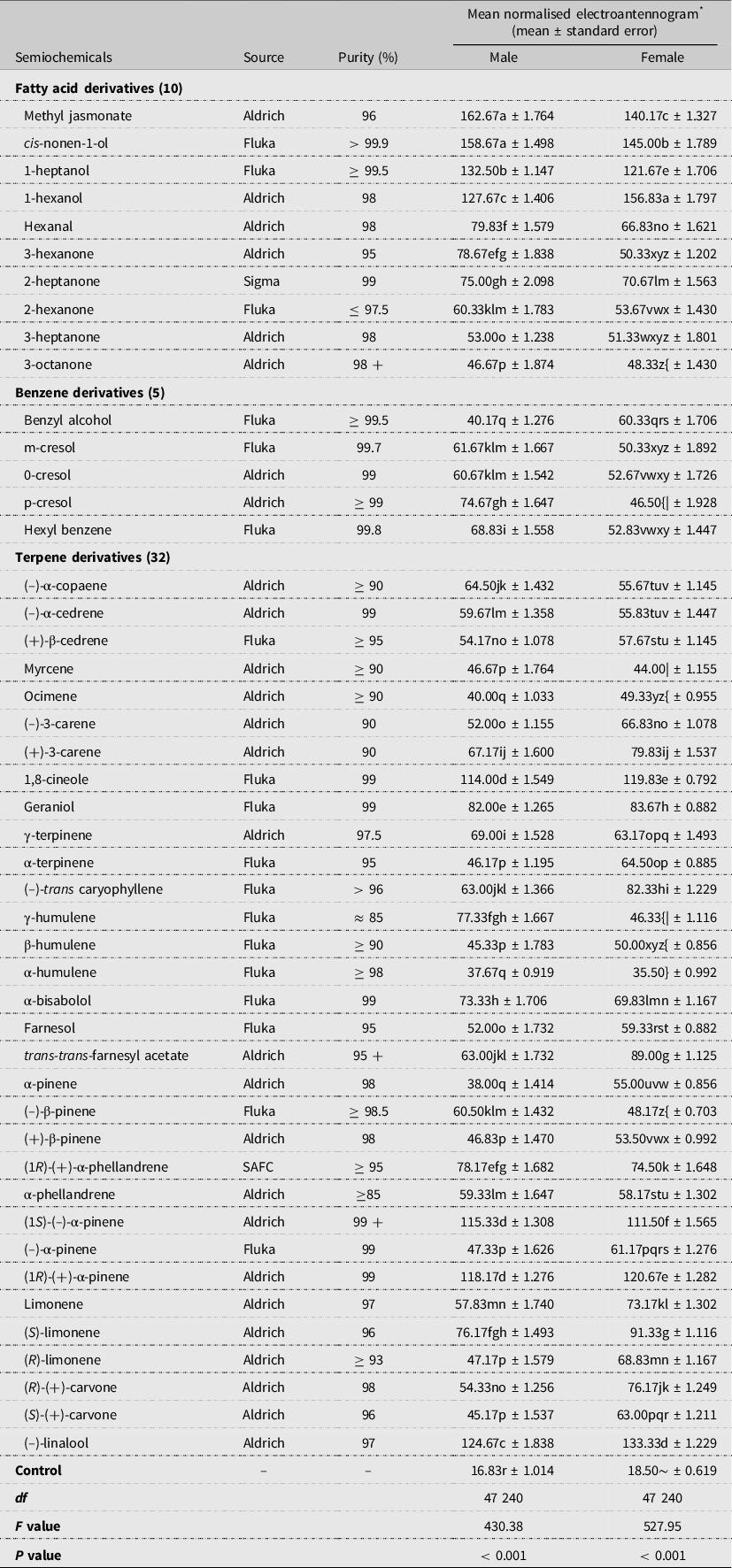
Electroantennogram responses of male and female adults of Odoiporus longicollis to different classes of semiochemicals.

* The means in columns indicated by the same letter and calculated by Tukey’s honestly significant difference test are not significantly different at P ≤ 0.001 (N = 6).
Determination of appropriate doses of selected semiochemicals for electroantennogram responses
Fourteen semiochemicals, including 3-heptanone, 1-hexanol, 2-hexanone, methyl jasmonate, benzyl alcohol, 0-cresol, (–)-α-cedrene, myrcene, 1,8-cineole, γ-humulene, (–)-α-pinene, (1R)-(+)-α-phellandrene, limonene, and (S)-(+)-carvone, were randomly selected from the different chemical classes and diluted (v/v) in hexane (from log 1 to 5 dilution). Electroantennogram recordings then were obtained to determine the appropriate concentration at which the electroantennogram amplitude of the O. longicollis antennae against semiochemicals occurs at between-sex distinguishable levels and to ensure the adequate recovery of the receptor. The (Z)-3-Hexen-1-ol at log 3 dilution (v/v) in hexane was used as the standard (Van Tol and Visser Reference Van Tol and Visser2002).
Electroantennogram recording
The electroantennogram apparatus (Syntech, Hilversum, The Netherlands) was used to record the responses of male and female antennae against stimuli consisting of various chemicals (N = 47) that belong to three major classes and a control. Microscissors were used to excise the antennae of the adults at the base, and weevils of less than 20 days old were used throughout the study. Each isolated antenna was mounted using a few drops of spectra gel between the two electrically conductive steel electrodes. The empty stimulus cartridge was filled with filter paper strips (0.5 × 3.0 cm) that were already impregnated with 10 µL of a chemical or hexane (control) after the solvent evaporated. The antenna was continuously bathed in a constant humidified and filtered airflow, except when the stimulation was applied. A three-minute interval was given between two recordings of the stimulus to activate the antenna and subsequently recover the receptor. The stimulus was randomly sent to the antenna, and the female and male antennae were exposed to each stimulus and the control six times. The actual electroantennogram responses were relative and expressed as a percentage of response to the standard, (Z)-3-Hexen-1-ol (Van Tol and Visser Reference Van Tol and Visser2002).
Y-Tube olfactometer bioassay
The Y-tube olfactometer (Airflow Pvt. Ltd., Chennai, Tamil Nadu, India) was used to study the behavioural responses of both male and female O. longicollis to active electroantennogram compounds (Fig. 1). With a stem of 45 cm, arms 7.5 cm long at a 60° angle, and a 2.0-cm internal diameter, the olfactometer consists of two odour-emitting chambers (one for the reference or control and the other for the test). An air supply unit (Syntech) consisting of a pump and a flow meter was used to draw air into the humidifier chamber through an activated charcoal filter (Syntech supplied the ready-made cartridge), which ensured a supply of pure air. Semiochemicals and the control were the various stimuli used for this experiment. A piece of filter paper (2 × 0.4 cm; Whatman No. 1) placed in one arm against the airflow and the control with a similar quantity of high-pressure liquid chromatography-grade hexane placed in another arm were used with the volatile stimulus (10 µL). In the test chamber, five O. longicollis were introduced into the Y-tube at five-minute intervals and allowed to choose between the test odour and the control. For each experiment, 20 insects were used. Fresh semiochemicals and hexane filter papers were replaced after every five weevils. In each experiment, the preference (choice) of the weevils was observed. The number of weevils actively selecting the control or the sample in the olfactometer was considered when determining the preference. The preference was measured in percentage using the formula originally developed by Hori (Reference Hori2007) and Prasuna et al. (Reference Prasuna, Jyothi, Prasad, Yadav and Padmanaban2008).
 $${\text{Percent}}{\mkern 1mu} {\text{preference}} = \;\frac{{{\text{Number of adults attracted to the test chamber}} - {\text{Number of adults attracted to the control}}}}{{{\text{Total number of adults released}} - {\text{Number of nonresponding adults}}\;}} \times 100$$
Schematic of the glass Y-tube olfactometer used to evaluate the responses of adult Odoiporus longicollis to semiochemical volatiles. The adults were put in the test/control chamber from which they moved to the Y-intersection and entered one of the Y-arms. The airflow path is shown by arrows. For details, see the Materials and methods section.

Each experiment was repeated six times, and the olfactometer arm was flipped 180° to decrease position biases after assessing 20 weevils. All weevils were removed after each test, and the olfactometer was washed and rinsed thoroughly with acetone, then dried completely in an oven before being used for the next experiment.
Field evaluation of the semiochemical-based trapping method
Two field experiments were carried out to evaluate different semiochemical-based trapping methods for the control of O. longicollis in two different cultivars (Virupakshi and Monthan) in two different geographical regions (lower Pulney Hills, Dindigul, Tamil Nadu, India (10° 18' 32" N and 77° 38' 53" E, 1400 m above mean sea level) and Thanjavur, Tamil Nadu, India (10° 52' 28" N and 79° 00' 21" E, 60 m above mean sea level)), respectively. The locations were chosen carefully after a transect survey of banana plantations with 20% infestations of O. longicollis. The experiments were laid out using a randomised complete block design, with nine treatments and six replications during January and February 2017. In the lower Pulney Hills, average daily temperatures ranged between 16.5 and 23.6 ºC, with 65.0%–70.0% relative humidity and no rainfall observed throughout the observation period. In Thanjavur, average daily temperatures ranged between 25.1 and 31.7 ºC, with 61.0%–66.0% relative humidity and no rainfall observed throughout the observation period.
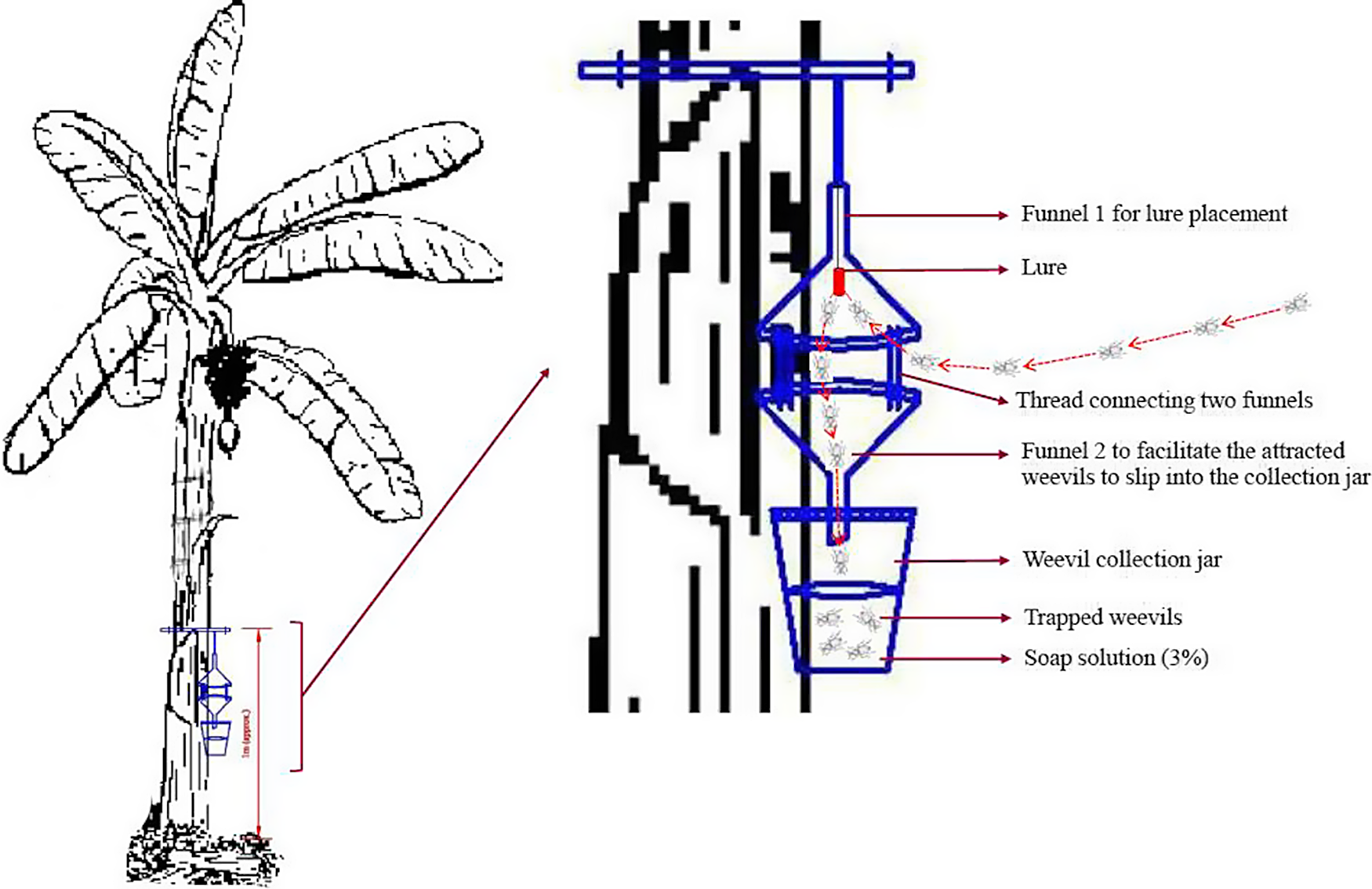
In both experiments, 2-mL plastic vials were filled separately with semiochemicals (at log 3 dilution and based on the dose–response relationship) and the host plant extract, as well as with 50 mg of antioxidant butylated hydroxytoluene (lure). Polypropylene twine was used to hang the lures inside the funnel traps. Plastic funnel traps were used to ensure the effectiveness of different treatments in attracting adult weevils (Fig. 2). The traps, which consisted of two white funnels of the same size (12 cm diameter × 8 cm length), were positioned close to each other, with a gap of approximately 2 cm. A 100-mL plastic screw-capped container was used to hold soap water up to the mark of 3 cm from the bottom to retain trapped weevils. A 2-cm-wide hole was made on the screw cap to insert the stem of the lower funnel. Each assembled trap was tied to a wooden stick that was approximately 30 cm long, and the stick was tied around the banana stem at approximately 1 m above the ground. The treatments in plastic vials, as described above, were placed in each trap. The distance between each trap was 10 m, with a 5-m gap inside the plantation boundary from the roadside.
The design of the funnel trap used to evaluate the semiochemical-based trapping method for Odoiporus longicollis under open field conditions. For details, see the Materials and methods section.

In both experiments, the banana stem trap was used to compare the efficacy of the customised plastic funnel trap. The stem was divided into two sections of 30-cm pieces, and each section was called a trap. One hundred banana stem traps per hectare were placed in the field with the cut ends facing the ground. The traps were checked manually every day for trapped weevils, which were then killed.
The O. longicollis catches were collected from each trap (both kinds) twice a week, then sexed, and the captured weevils were removed from the traps and properly disposed of. Each semiochemical lure was weighed and checked separately for longevity while recording the weevil catches, and trap maintenance was carried out regularly.
Data analysis
Data analysis was performed using the Gómez and Gómez (Reference Gómez and Gómez1984) method with SAS Software, version 9.3 (Statistical Analysis System 2011). The analysis of variance was performed on the original values of the preference of male and female O. longicollis for electroantennogram-active chemicals and the electroantennogram responses to various semiochemicals by male and female O. longicollis. The field evaluation of the semiochemical-based trapping method was carried out in a randomised complete block design. The mean values of the treatments in the above-mentioned experiments, as well as of the field experiment on the semiochemical-based trapping method, were estimated and separated by Tukey’s honestly significant difference test at P < 0.05.
Results
Determination of appropriate doses of selected semiochemicals for electroantennogram responses
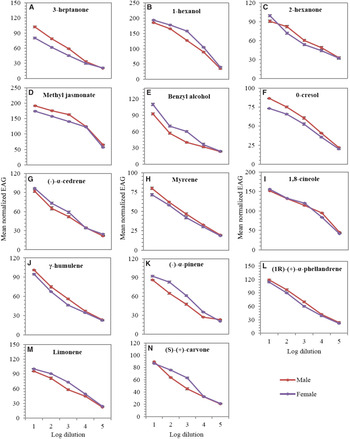
The appropriate doses to which each sex responded were determined via the electroantennogram responses to the semiochemicals (N = 14) selected from the different chemical classes (Fig. 3). Overstimulation occurred at log 1 and 2 dilutions, and the responses could not be distinguished between sexes. Both males and females responded equally to lower dilutions (log 4 and 5), and their responses were distinguishable. Only at log 3 dilution (0.1%) did the sexes show relatively distinguishable electroantennogram responses to all semiochemicals (N = 14). Therefore, log 3 dilution was chosen for both the electroantennogram recording studies and the bioassay studies. The electroantennogram responses (the dose–response relationship) of the selected 14 semiochemicals increased greatly from log 5 to 1 in both male and female antennae of O. longicollis.
Determination of the appropriate dose of selected semiochemicals (N = 14) for electroantennogram (EAG) responses (mean ± standard error) of male and female adults of Odoiporus longicollis.

Electroantennogram recording
Electroantennogram responses in both male and female O. longicollis are presented in Table 1. The analysis showed that the alcohol-containing compounds and acetate elicited stronger electroantennogram responses than aldehyde and ketones did. All tested compounds evoked a higher percentage of electroantennogram responses than the control did. The electrophysiological reactions of both female and male O. longicollis to 47 semiochemicals revealed that only eight compounds – 1-hexanol, 1-heptanol, methyl jasmonate, cis-3-Nonen-1-o1, (–)-linalool, (1R)-(+)-α-pinene, (1S)-(–)-α-pinene, and 1, 8-cineole – were electroantennogram active. In males, methyl jasmonate elicited the highest percentage of electroantennogram responses, followed by cis-3-Nonen-1-o1, whereas in females, 1-hexanol elicited a higher percentage of electroantennogram responses, followed by cis-3-Nonen-1-o1 and methyl jasmonate.
Y-Tube olfactometer bioassay
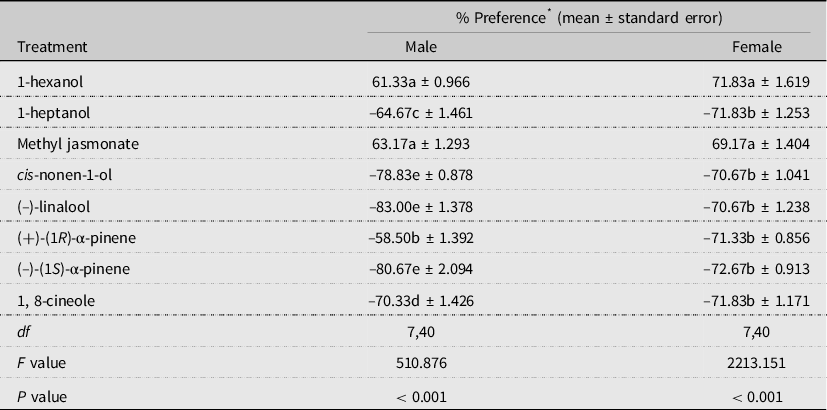
Significant differences among tested semiochemicals (N = 8) expressed in the percent preferences of both male and female adults of O. longicollis were observed (Table 2). The highest percent preferences by the male adults were for methyl jasmonate (63.14) and 1-hexanol (61.33). The highest percent preferences by the female were also observed for 1-hexanol (71.83) and methyl jasmonate (69.17). The numbers of males and females moving towards test chambers containing 1-heptanol, cis-Nonen-1-ol, (–)-linalool, (1R)-(+)-α-pinene, (1S)-(+)-α-pinene, and 1, 8-cineole were lower than those for the control. Therefore, the preference for such compounds resulted in negative values.
The percent preference of male and female adults of Odoiporus longicollis to electroantennogram-active chemicals in the Y-tube olfactometer.

* The means in columns indicated by the same letter and calculated by Tukey’s honestly significant difference test are not significantly different at P ≤ 0.001 (N = 6); ns – nonsignificant. Negative (preference) values indicate a higher preference of weevils to control/reference than other treatments.
Field evaluation of the semiochemical-based trapping method
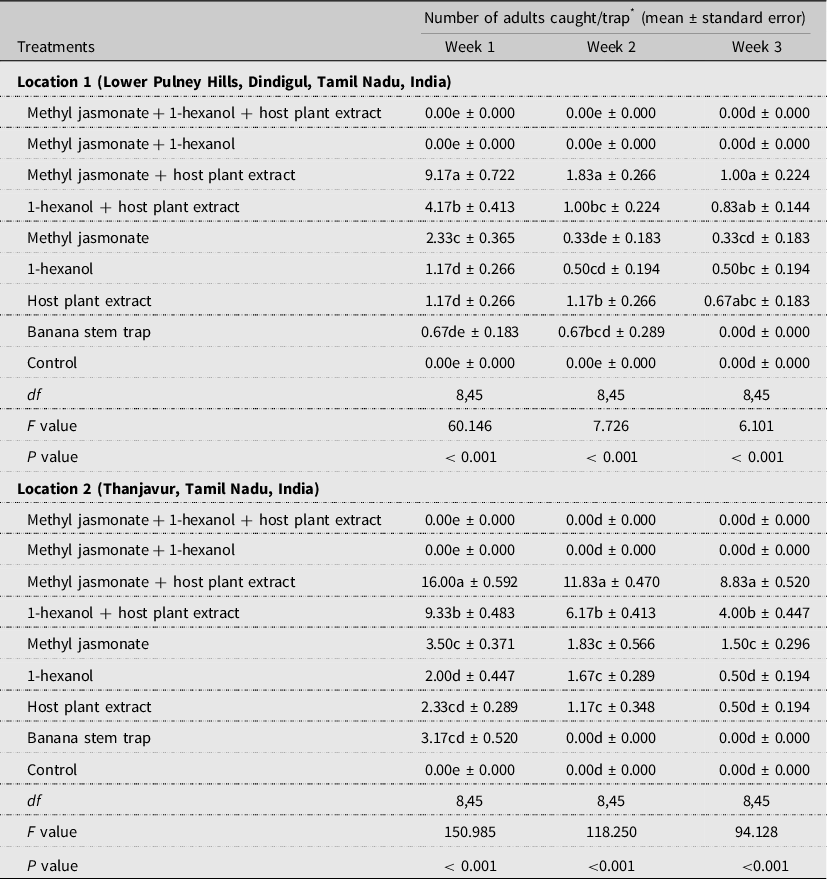
The evaluation of semiochemicals for the trapping method tested in the lower Pulney Hills showed that the methyl jasmonate + host plant extract combination captured significantly more adults than did other treatments during the first, second, and third weeks. During the first and second weeks, 7.8 and 1.8 times more weevils were captured, respectively, by methyl jasmonate + host plant extract than by the host plant extract alone. Similarly, in Thanjavur, the methyl jasmonate + host plant extract captured more weevils than did the other treatments; approximately 6.8, 10.0, and 1.9 more weevils were captured compared to the host plant extract alone during the first, second, and third weeks, respectively (Table 3).
The mean number of adult Odoiporus longicollis caught in semiochemical-based funnel traps in two geographical regions of Tamil Nadu, India.

* The means in columns indicated by the same letter and calculated by Tukey’s honestly significant difference test are not significantly different at P ≤ 0.001 (N = 6).
Weevil captures were higher in Thanjavur than in the lower Pulney Hills site. At both locations, the control (the trap without a lure) attracted no weevils. Analysis of male and female weevil counts for treatments of methyl jasmonate + host plant extract and 1-hexanol + host plant extract in both field trials revealed that the captures were female-dominated both in Thanjavur (1:1.26) and in the lower Pulney Hills (1:1.32).
Discussion
At present, banana stem trapping is the only method employed to monitor O. longicollis in banana plantations, and no measures other than chemical control – that is, no measures that are environmentally friendly – are available for the management of the weevil (Irulandi et al. Reference Irulandi, Aiyanathan and Bhuvaneswari2012). In earlier studies, fresh or fermented plant tissue, either alone or in combination with pheromone, was used as a semiochemical for monitoring and controlling the coleopteran pests (Giblin-Davis et al. Reference Giblin-Davis, Pena and Duncan1994; Tinzaara et al. Reference Tinzaara, Gold, Dicke, Huis and Ragama2007). The antennae of male and female O. longicollis reacted to a broad range of volatile compounds belonging to various chemical groups, including derivatives of fatty acids, benzene, and terpenoids. Compounds that evoked strong electroantennogram responses, including 1-hexanol, 1-heptanol, methyl jasmonate, linalool, (+)-(1R)-α-pinene, (–)-(1S)-α-pinene, cis-Nonen-1-ol, and 1, 8-cineole, might play important roles in insect host selection, and 1, 8-cineole has previously been reported to be electrophysiologically and behaviourally active in Cosmopolites sordidus (Germar) (Coleoptera: Curculionidae), an important banana root borer. In general, both sexes of O. longicollis exhibited broad overlap in their electroantennogram responses to individual plant volatile compounds, and there was no clear-cut distinction between sexes. For example, methyl jasmonate, cis-Nonen-1-ol, and 1-heptanol elicited strong electroantennogram responses in males, whereas 1-hexanol evoked a larger response in females, even though these compounds belong to the fatty acid derivatives. Similarly, linalool, (1R)-(+)-α-pinene, and (1S)-(–)-α-pinene elicited strong electroantennogram responses in female O. longicollis, whereas 1, 8-cineole evoked a larger electroantennogram response in males.
The amplitude of some volatile chemicals decreased when the concentration of the compound also decreased from log 1 to 2 until a certain point (the threshold level). At higher concentrations such as log 1 and 2 dilutions, the saturation of the antenna occurs, indicating the corresponding level of inhibition or repellence. Similarly, at lower concentrations such as log 5 and 4, the overlapping of electroantennogram responses was recorded. Van Tol and Visser (Reference Van Tol and Visser2002) had reported dose dependency in many pests. Ndiege et al. (Reference Ndiege, Budenberg, Lwande and Hassanali1991) identified many terpene compounds, including α-cedrene, α-copaene, α-cubebene, α-humulene, α-pinene, β-myrcene, β- caryophyllene, β-pinene, limonene, and 1, 8-cineole, in the banana stem. We also tested these volatiles in our study and found that 1, 8-cineole elicited a greater electroantennogram response in the O. longicollis antennae. The electroantennogram and a behaviourally active compound, methyl jasmonate, were identified as the vital cellular regulators that mediate particular defence responses against biotic and abiotic stresses. This phytohormone also acts as a signal in plant–herbivore and plant–plant interactions (Cheong et al. Reference Cheong, Chang, Gupta, Wang, Zhu and Luan2002), whereas 1-hexanol, which is released by many plant parts (e.g., blueberry buds and flowers), was electroantennogram active in Anthonomus musculus Say (Coleoptera: Curculionidae) and may be used in the host location.
The results of the present field study showed that the lures baited with the host plant extract were active throughout the experimental period (three weeks), whereas the banana stem trap was found active only for two weeks in the lower Pulney Hills and for one week in Thanjavur. Similar results were observed when sugarcane was added as the food bait with Rhynchophorus palmarum (Linnaeus) (Coleoptera: Curculionidae) pheromone, which was effective for only two weeks. Because the host plant extract actively attracted the weevils for a longer duration, the host plant extract may have a more practical application in the monitoring of O. longicollis compared to the banana stem trap. In general, the host plant extract and some semiochemicals, including methyl jasmonate and 1-hexanol, individually attracted fewer weevils. The addition of the host plant extract to methyl jasmonate and 1-hexanol enhanced weevil capture and more than doubled the weevil capture during the first week of the trial in the lower Pulney Hills and throughout the trial in Thanjavur. This indicates a synergistic effect of the host plant extract on methyl jasmonate that was greater than on 1-hexanol. Moreover, the decayed banana stem and its extracts gradually attracted a higher percentage of weevils, and extracts of the one-week decayed banana stem treatment attracted 1.4 times more O. longicollis weevils than decayed banana stem pieces did (Sahayaraj and Kombiah Reference Sahayaraj and Kombiah2009). The results of the present study and previous studies confirm that the host plant extract can be used as an efficient synergist to increase O. longicollis captures with semiochemicals such as methyl jasmonate and 1-hexanol. This is the first report of methyl jasmonate used as an attractant for this pest.
In terms of sex ratios, weevil captures in both the lower Pulney Hills and Thanjavur were female-biased. Tinzaara et al. (Reference Tinzaara, Gold, Dicke, Huis and Ragama2008) reported a sex ratio (male:female) of 1:1.17 to 1:4.40 in pheromone-baited traps. This may be due to the greater activity of female weevils, which migrate in search of oviposition sites for mating (Tinzaara et al. Reference Tinzaara, Gold, Dicke, Huis and Ragama2008). The female-dominated captures are important in terms of weevil management, as O. longicollis females lay eggs that hatch into grubs that inflict greater damage to crops.
Economic thresholds were not available for trap catches in O. longicollis in India and other countries. The results of the present study reveal that the population level of O. longicollis was medium to low in the Pulney Hills and high to medium in Thanjavur for methyl jasmonate + host plant extract. The threshold captures by individual semiochemicals, the host plant extract, and the banana stem trap were low. Because the host plant extract had a greater synergistic effect on attracting the weevils in combination with either methyl jasmonate or 1-hexanol, these semiochemicals, along with the host plant extract, could be included in the integrated pest management programme for monitoring and controlling O. longicollis. However, further research is required to identify the specific molecule or group of molecules from the host plant extract that is responsible for the synergism in order to develop an efficient semiochemical-based lure for monitoring and controlling this pest. Further research is also required to develop a device for the controlled release of semiochemicals and to determine whether the reduction in the weevil population would increase the bunch weight. This is the first report in developing a highly economical trapping lure for this devastating banana pest.
Acknowledgements
Lead author S. Palanichamy thanks the Director, ICAR-National Research Centre for Banana, Thayanur Post, Thogamalai Road, Tiruchirappalli-620 102, Tamil Nadu, India for providing facilities. The authors thank GRT Garden administrators and employees at Sembirankulam (Kodaikanal, Dindigul, Tamil Nadu, India) and Mr. Sundaram, Maharajapuram, Thirukkattupalli, Thanjavur, Tamil Nadu, India for granting permission to use banana plantations for field evaluation.