Introduction
Caring for a relative with dementia is considered a chronically stressful situation (Vitaliano et al., Reference Vitaliano, Zhang and Scanlan2003) that has negative consequences for the caregivers psychological and physical health (Pinquart and Sörensen, Reference Pinquart and Sörensen2003; Mausbach et al., Reference Mausbach2010), including guilt feelings, a common and disabling emotion frequently suffered by this population (Gonyea et al., Reference Gonyea, Paris and Saxe Zerden2008; Losada et al., Reference Losada, Márquez-González, Peñacoba and Romero-Moreno2010a).
Kugler and Jones (Reference Kugler and Jones1992) described guilt as the dysphoric feeling associated with the recognition that one has violated a personally relevant moral or social standard. In studies focused on caregivers, it has been described as the perception of having violated (or being able to violate) a moral or social standard related to the care of the relative, both in terms of thought and action (Gonyea et al., Reference Gonyea, Paris and Saxe Zerden2008). Even though guilt seems to be a relevant theme for dementia caregivers from different cultural backgrounds (Roach et al., Reference Roach, Laidlaw, Gillanders and Quinn2013), the number of studies aimed at analyzing the effects of guilt in caregiving is limited (Martin et al., Reference Martin, Gilbert, McEwan and Irons2006; Romero-Moreno et al., Reference Romero-Moreno2014), and it has been said that “research into clinical assessment of and intervention for maladaptive guilt is in its infancy” (Roach et al., Reference Roach, Laidlaw, Gillanders and Quinn2013; p. 2009). The available studies suggest that guilt in dementia caregivers is significantly associated with higher levels of distress, depressive symptoms, anxiety, and burden in dementia caregivers providing care in the community (Martin et al., Reference Martin, Gilbert, McEwan and Irons2006; Gonyea et al., Reference Gonyea, Paris and Saxe Zerden2008; Losada et al., Reference Losada, Márquez-González, Peñacoba and Romero-Moreno2010a; Roach et al., Reference Roach, Laidlaw, Gillanders and Quinn2013) and in nursing homes (You and Tak, Reference You and Tak2014). More specifically, Gonyea et al. (Reference Gonyea, Paris and Saxe Zerden2008) found in a sample of 142 dementia caregivers that around 65% of adult daughters experienced feelings of guilt related to their caregiver role. In another study, Romero-Moreno et al. (Reference Romero-Moreno2014) analyzed the role of guilt as a moderator in the relationship between the frequency of leisure and depressive symptomatology in a sample of dementia caregivers. The results demonstrated a moderator effect of guilt feelings in this relationship, but only in daughters. Daughter caregivers with high levels of guilt may thus be especially vulnerable to suffering emotional distress (Romero-Moreno et al., Reference Romero-Moreno2014).
Drawing upon the sociocultural stress and coping model (Knight and Sayegh, Reference Knight and Sayegh2010), the relationship between caregiving stressors and distress-related variables such as feelings of guilt is influenced by many different variables, which may increase or minimize the negative impact of the caregiving situation on caregivers’ psychological and physical health. Among these modulating variables, caregiver-specific psychological resources may reduce caregivers vulnerability to feelings of guilt. These resources include coping strategies and cultural values (e.g. motives for care) that have been found to have a significant impact on caregiver distress (Dilworth-Anderson et al., Reference Dilworth-Anderson, Williams and Gibson2002; Romero-Moreno et al., Reference Romero-Moreno, Márquez-González, Losada and López2011; Sayegh and Knight, Reference Sayegh and Knight2013). Research focused on analyzing the effects of psychological resources on caregivers’ feelings of guilt is scarce, and studies are needed that allow the identification of potential resources preventing the emergence of these uncomfortable feelings.
One of the many variables involved in the caregiver stress process is personal values (Knight and Sayegh, Reference Knight and Sayegh2010). These have been considered as global directions for life, chosen, desired, and verbally constructed (Hayes et al., Reference Hayes, Strosahl and Wilson1999, p. 206) that give meaning, direction, and purpose to the individual's behavior (Paez-Blarrina et al., Reference Páez-Blarrina, Gutiérrez-Martínez, Valdivia-Salas and Luciano-Soriano2006). The commitment to personal values can be described as the degree to which a person is living in accordance with the most important values in their lives (Wilson et al., Reference Wilson, Sandoz, Kitchens and Roberts2010). In non-clinical populations, being engaged with personal values is negatively associated with experiential avoidance or the tendency to control or avoid the occurrence of negative and uncomfortable internal events (Hayes et al., Reference Hayes, Strosahl and Wilson1999). Also, commitment to personal values has been negatively linked with cognitive fusion – or the tendency to believe in the literal content of thoughts and feelings (Romero-Moreno et al., Reference Romero-Moreno, Gallego-Alberto, Márquez-González and Losada2016) – anxiety, stress, depression, and somatization (Smout et al., Reference Smout, Davies, Burns and Christie2014; Trindade et al., Reference Trindade, Ferreira, Pinto-Gouveia and Nooren2015). In clinical populations, commitment to values is a relevant variable for explaining individuals health. In populations with chronic pain, MacCraken and Yang (Reference McCracken and Yang2006) demonstrated the association between commitment to personal values and lower levels of physical distress, depression, and pain anxiety. Wetterneck et al. (Reference Wetterneck, Lee, Smith and Hart2013) found that commitment was a significant predictor of OCD severity. However, the effects of commitment to values on caregiver distress have hardly been studied in the caregiving field (Márquez-González et al., Reference Márquez-González, Romero-Moreno, Losada, Pachana, Laidlaw and Knight2010).
Recently, Romero-Moreno et al. (Reference Romero-Moreno, Gallego-Alberto, Márquez-González and Losada2016) created an adaptation of the Valued Living Questionnaire (VLQ; Wilson et al., Reference Wilson, Sandoz, Kitchens and Roberts2010) to the caregiver population that, in addition to the assessment of ten relevant areas for people (e.g. family, parenting, or personal growth), added the roles of caregiving and self-care. The results showed that commitment to personal values significantly predicted levels of depression, anxiety, and life satisfaction, after controlling for the effects of sociodemographic and other resources variables, which provides support for the importance of personal values in the explanation of caregivers psychological well-being (Márquez-González et al., Reference Márquez-González, Romero-Moreno, Losada, Pachana, Laidlaw and Knight2010). Even though guilt and commitment to personal values have been shown to be related to caregiver distress, to our knowledge the effect of personal values on caregivers’ guilt feelings has not yet been studied. The analysis of variables such as personal values on guilt can provide relevant information about predictive factors of guilt feelings and also suggestions regarding protective or vulnerability factors that may impact caregivers’ health. The aim of this paper is to analyze the effect of commitment to personal values on caregivers’ guilt feelings. We hypothesize that caregivers’ commitment to personal values will significantly and negatively contribute to caregivers' guilt feelings.
Method
Participants
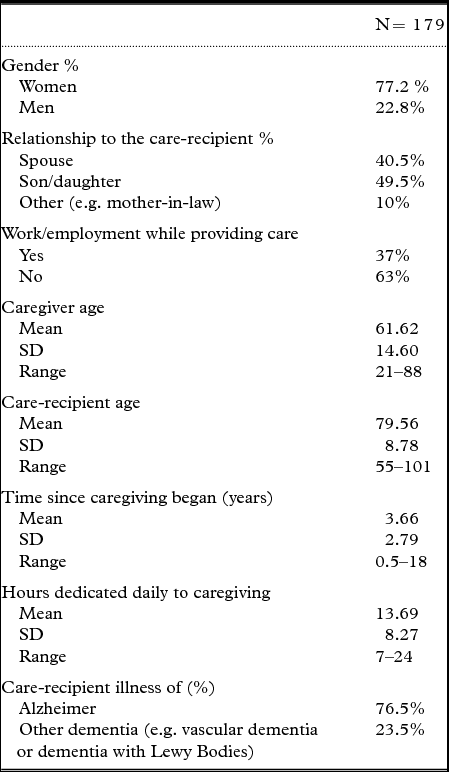
Face-to-face interviews were conducted with 179 dementia family caregivers from Madrid. The inclusion criteria for the study were: self-identification as the main source of help for their relatives with dementia, being 18 years or older, and caring for at least one hour per day during at least three consecutive months. As shown in Table 1, most of the sample was composed of women with a mean age of 60. The majority of caregivers were children (49.5%) or spouses (40.5%) of the person being cared for.
Socio-demographic characteristics of the sample

Procedure
Participants were recruited through different procedures. First, agreements for participation in the study were reached with social and health centres in the Community of Madrid (a) that were contacted by the researchers of the study or (b) that showed interest in collaborating with the researchers. In both cases, the centres identified potential participants for the study among their users and provided their contact data to the researchers. A second recruitment procedure took place through advertisements appearing in different media, including radio and Internet. In these cases, caregivers contacted the researchers directly. Initial contact was established by telephone to check whether participants met the inclusion criteria of the study. This was followed by face-to-face interviews in the participating centres. Before enrolling in the study, participants were invited to sign the informed consent form. The study was approved by the Spanish Ministry of Science and Innovation and the Ethics Committee at the Rey Juan Carlos University of Madrid.
Materials
Following the stress and coping model adapted to caregiving (Knight and Sayegh, Reference Knight and Sayegh2010), the following variables were assessed:
Socio-demographic variables
Gender and age of the participants, their relationship with the care recipient as well as the number of hours per day dedicated to caregiving and time since care began were assessed.
Care recipient functional status
The Barthel Index (Mahoney, Reference Mahoney1965) was used to assess the ability of the person with dementia in ten basic activities of daily living. In this study, the internal consistency (Cronbach's α) for the scale was 0.91.
Care recipient cognitive status
In order to assess the cognitive status of the care recipient, the Global Deterioration Scale (GDS; Reisberg et al., Reference Reisberg, Ferris, de Leon and Crook1982) was administered.
Frequency of behavioural problems
This variable was assessed through the Spanish version (Nogales-González et al., Reference Nogales-González, Losada and Romero-Moreno2015) of the Revised Memory and Behaviours Problems Checklist (RMBPC; Teri et al., Reference Teri, Truax, Logsdon, Uomoto, Zarit and Vitaliano1992). This scale is composed of 24 items that evaluate the frequency of observable disruptive behaviour during the previous week with a response format ranging from 0 = “not at all” to 4 = “extremely”. The internal consistency (Cronbach's α) obtained in this study was 0.73.
Personal values
Commitment to personal values was measured using the Valued Living Questionnaire Adapted to Caregiving (VLQAC) (Romero-Moreno et al., Reference Romero-Moreno, Gallego-Alberto, Márquez-González and Losada2016). The questionnaire consists of two factors. The first factor is labelled Family values and is composed of different aspects or family life domains (family relations; marriage/couples/intimate relationship; parenting; the role of the relative's caregiving), with an internal consistency of 0.60. The second factor is Own values, consisting of other different domains (friendships and social relations; education, training, personal development/growth; employment/professional life; recreation, leisure and free time/hobbies; religion, spirituality; citizenship/community life; health/physical well-being, and caring for oneself). The internal consistency for this factor was 0.75 (Cronbachs α).
Guilt
Guilt feelings were measured through the Caregiver Guilt Questionnaire (CGQ; Losada et al., Reference Losada, Márquez-González, Peñacoba and Romero-Moreno2010a). This instrument measures the frequency of guilt feelings in the caregivers during the previous week. It consists of 22 items (e.g. I have felt guilty about the way I've sometimes behaved with my relative) with Likert-type responses from 0 = “never” to 4 = “almost always”. The internal consistency found in this study (Cronbach's α) was 0.88.
Data analysis
First, assumptions for normality and outliers were analyzed. Descriptive analyses of the assessed variables were run (means, standard deviations and range). To analyse the effects of commitment to personal values on caregiver guilt, two hierarchical regression analyses were carried out, the first one analysing the effect on caregiver guilt of the two factors that compose the commitment to values questionnaire, and the second one analysing the effect of the 12 specific values that compose the scale. In order to ascertain whether commitment to values adds significant explained variance to guilt, this variable was included in a second step after controlling in a first step for variables usually considered in the stress and coping model (Knight and Sayegh, Reference Knight and Sayegh2010). Specifically, in the first step of the regression, the socio-demographic variables (gender and caregiver age) and the stressors (daily hours devoted to caregiving, time since caregiving begun, type of dementia, cognitive and functional status, and frequency of behavioural problems) were included. Commitment to values was included in the second step. Considering that the required sample size for obtaining a medium effect size (f2 ) with a statistical power higher than 0.80 and a probability level of 0.05 using 21 predictors is 160, the sample size of the present study is sufficiently large for the analyses that are included.
Results
Normality and outliers
The results suggest that the assessed variables follow a normal distribution (skewness and kurtosis were within expected values). Neither univariate (z scores greater than 3.29, p < 0.001) nor multivariate outliers (Mahalanobis distance = p < 0.001) were found.
Contribution of commitment to personal values to the explanation of guilt feelings
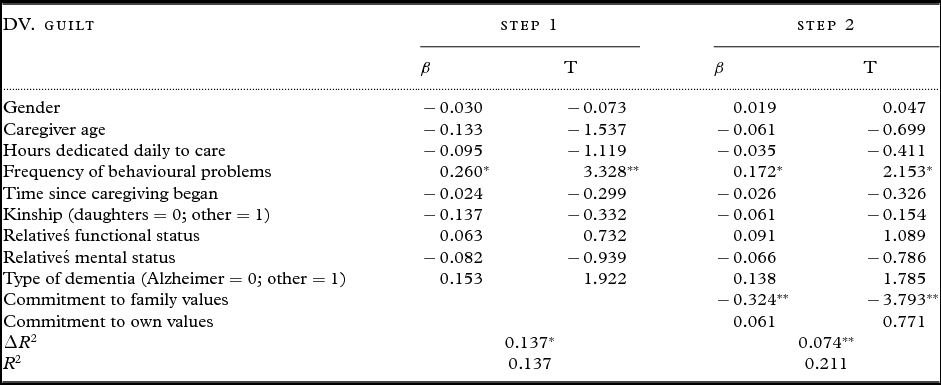
First, the effect of the factors commitment to own values and commitment to family values on caregiver guilt was assessed. As shown in Table 2, in the first step 14% of the variance in guilt was explained through the frequency of behavioral problems. In the second step, commitment to the two factors (own values and family values) were included. The results showed that the second step contributes significantly to the explanation of the variance in guilt feelings (7%), and the variables that contributed significantly to the explanation of guilt feelings were the commitment to family values and the frequency of behavioral problems. A higher commitment to the family values factor predicts lower guilt levels. In addition, a higher frequency of behavioral problems predicts more feelings of guilt. The full model explains 21% of the guilt feelings variance (F = 3.773; p < 0.0001).
Hierarchical regression with VLQAC factors

Note: *p ≤ 0.05; **p ≤ 0.01.
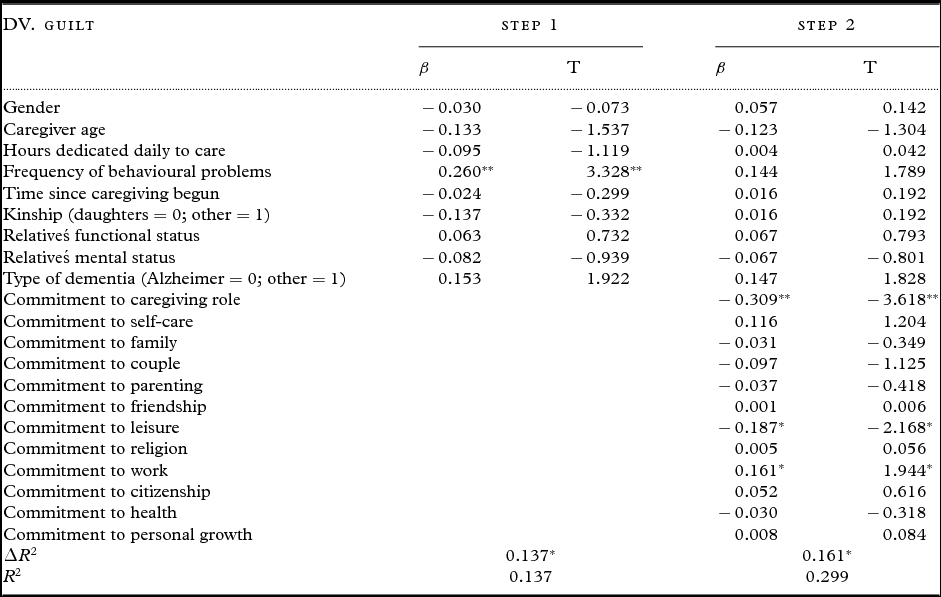
In a second regression analysis, the 12 specific values assessed by the VLQAC were included. The results (see Table 3) show that the variables that contribute significantly to the explanation of guilt were commitment to the caregiving role, leisure, and work. A higher commitment to the caregiving role and to leisure is associated with less guilt, whereas a major commitment to work predicts higher levels of guilt. Through this second step, an increase of 16% of variance was obtained. The full model explains 30% of the variance in guilt feelings (F = 2.939; p < 0.0001).
Hierarchical regression with individual values assessed in the VLQAC

Note: *p ≤ 0.05; **p ≤ 0.01.
Discussion
The present study aimed to analyze the influence of the commitment to personal values on the guilt feelings experienced by dementia caregivers. The results confirm our hypothesis that commitment to personal values is an important variable for the explanation of the caregivers’ guilt feelings. Even though to our knowledge the effects of commitment to personal values on caregivers´ well-being have not been previously studied, except for the VLQAC development study (Romero-Moreno et al., Reference Romero-Moreno, Gallego-Alberto, Márquez-González and Losada2016), the findings of this study are consistent with the previous literature in non-caregiving samples (McCracken and Yang, Reference McCracken and Yang2006; Wetterneck et al., Reference Wetterneck, Lee, Smith and Hart2013; Smout et al., Reference Smout, Davies, Burns and Christie2014; Trindade et al., Reference Trindade, Ferreira, Pinto-Gouveia and Nooren2015). Our results confirm the association between commitment to personal values and psychological well-being, in this case guilt feelings. However, our results suggest that when commitment to values is assessed through the VLQAC factors, only commitment to family values was negatively associated with guilt. No significant association was found for commitment to own values. These results are consistent with interpersonal theories of guilt, such as that developed by Baumeister et al. (Reference Baumeister, Stillwell and Heatherton1994), who argued that guilt occurs more frequently in close relationships, whose function is to reduce violations of social and other norms. The factor of commitment to family values is composed of vital areas related to relations with other relevant people for caregivers, and it is expected that commitment to this factor is associated with less distress.
When commitment to values is assessed through specific values, again not all the values contributed significantly to the explanation of caregiver's guilt feelings. The results suggest that the commitment to the caregiving role, leisure, and work contributed significantly to the explanation of guilt feelings. Higher scores in commitment to the caregiving role value are associated with lower levels of guilt. This result is consistent with previous research in the area of care. Spillers et al. (Reference Spillers, Wellisch, Kim, Matthews and Baker2008) analyzed the feelings of guilt on a sample of 635 cancer caregivers and found that caregivers experience guilt and sense of incompetence when their care does not contribute to the improvement of the relative. These results can be transferred to the area of dementia caregiving because this population is also exposed to uncontrollable situations such as the cognitive decline of the family, and other highly stressful situations, for example, the presence of a relative's disruptive behavior, which can lead to feelings of incompetence in their role as a caregiver.
A higher commitment to the value of care may indicate that the caregiver grants high importance to and is consistent with his/her actions as a caregiver. With regard to the definition of commitment to values, it can be expected that for caregivers with high commitment to caregiving, the performance of many actions committed to the care of the person with dementia provides an area of particular relevance in their lives. These data can be related to other studies showing that greater satisfaction with care is linked to positive outcomes on caregivers (Lai, Reference Lai2010). That is, those caregivers who live with greater commitment to their role as caregivers are likely to be more satisfied with their actions and therefore experience less distress and, as a result, less guilt.
On the other hand, our findings also suggest that commitment to leisure protects caregivers from suffering guilt. This result is consistent with the findings of Romero-Moreno et al. (Reference Romero-Moreno2014), which showed that guilt plays a moderator role in the relation between leisure activities and depressive symptomatology, particularly in daughters. Those daughters with more guilt and with lower leisure activity frequency were more vulnerable to suffering depression. In this sense, it is possible that caregivers with greater commitment to leisure carry out more and more coherent actions in this area, which may protect them from guilt feelings and ultimately from depressive symptoms. The findings obtained are also consistent with research showing the positive effects of engaging in leisure activities (Thompson et al., Reference Thompson, Solano, Kinoshita, Coon, Mausbach and Gallagher-Thompson2002; Losada et al., Reference Losada2010b), suggesting the important of measuring, in addition to important values (e.g. leisure), the degree to which they act consistently with their values. Helping caregivers to engage in actions coherent with their values may contribute to increase the effects of valuable interventions such as respite services on caregivers’ distress. As suggested by Lund et al. (Reference Lund2014), interventions may be helpful for helping caregivers to make more beneficial use of respite time, targeting the intervention to their specific needs and desires (values). However, not all the values seem to be associated with lower levels of guilt. Commitment to work appears to show a profile of vulnerability to guilt. Our results show that a higher commitment to the value of work increases caregivers’ feelings of guilt. In line with the work of Spillers et al. (Reference Spillers, Wellisch, Kim, Matthews and Baker2008) and Bernard and Guarnaccia (Reference Bernard and Guarnaccia2003), those caregivers who work while caring for their families have higher levels of guilt. Similarly, Rosa et al. (Reference Rosa, Lussignoli, Sabbatini, Chiappa, Di Cesare, Lamanna and Zanetti2010) found that those dementia caregivers who experience a greater role conflict between work and family life have major difficulties in developing adaptive emotional reactions and new roles, which in turn can lead to guilt feelings. In other words, being exposed to incompatible demands in the context of work and family, in this case exacerbated by the needs of the relative with dementia, creates a situation in which caregivers may feel overloaded and experience guilt feelings.
Our findings also show that the frequency of behavioral problems predicts caregiver guilt. This result is coherent with the findings of Ankri et al. (Reference Ankri, Andrieu, Beaufils, Grand and Henrard2005), who also found that a higher score in guilt was associated with more behavioral problems in the care recipient. However, when commitment to specific values is included in the second step of the regression, this effect disappears. This finding may be suggesting a mediator effect of engagement with personal values in the relationship between behavioral problems in the care recipient and caregivers distress, specifically guilt feelings.
These data have important clinical implications. Our results suggest that commitment to personal values may contribute to putting caregivers in a position of vulnerability to develop guilt feelings. Specifically, low levels of commitment to the caregiving role and to leisure and high commitment to work are associated with guilt feelings. Detecting these profiles may be relevant for the development, implementation, and optimization of psychological interventions aimed at preventing or reducing levels of guilt in caregivers. The perspective of contextual therapies and, specifically, Acceptance and Commitment Therapy (ACT, Hayes et al., Reference Hayes, Strosahl and Wilson1999), offers an interesting frame for these interventions, as it states that the realization of committed actions increases psychological well-being. Along these lines, Losada et al. (Reference Losada2015) demonstrated the effectiveness of ACT in decreasing caregivers’ levels of depression and anxiety. Future studies could analyze the effects of this type of intervention for decreasing levels of caregiver guilt.
The present study has various limitations. First, the sample is composed of caregivers who volunteered to participate in the study, and the study has a cross-sectional design. These issues limit the generalizability of the results to the rest of the caregiver population. Another source of limitations that may impact the generalizability of the obtained results has to do with the cultural background of the participants in this study. The influence of cultural variables on the caregiving stress process has received strong empirical support (Knight and Sayegh, Reference Knight and Sayegh2010). For example, differences have been found between cultures associated with variables such as familism (Losada et al., Reference Losada2006), and cultural issues may have a significant impact on commitment to personal values. Future studies should confirm if the findings obtained here are generalizable to samples with different cultural backgrounds.
Furthermore, the correlational nature of the study does not permit us to make any causal inferences. The present results should be interpreted with caution, given the existence of alternative hypotheses and explanations for relationships between variables found in this work. For example, an alternative explanation of the obtained results can be formulated, if we consider guilt feelings as an independent variable, rather than a dependent one as is the case in the present study. Hence, it is possible that the relationship between guilt and commitment to values takes an alternative direction, with guilt functioning as a predictor of commitment to values. That is, those caregivers who experience higher levels of guilt might find more difficulties in being consistent and engaged with their values so that levels of guilt influence the degree to which the caregivers are engaged with their values. Longitudinal and experimental research is needed to confirm the interpretation of these results.
The assessment measures that have been used capture caregivers’ subjective feelings associated with their role. For example, some caregivers reported to be caring for 24 hours per day, and the maximum number of years caring was 18. Even though it is frequent to find caregivers who believe that they take care for their relative for 24 hours per day (up to 59% of the caregivers consider this in the last year of care and some Alzheimer's patients live 20 years after diagnosis (Alzheimer's Association, 2013)), most of the caregiving literature is based on subjective reports made by the caregivers (even cognitive and functional status; Pearlin et al., Reference Pearlin, Mullan, Semple and Skaff1990). Although these reports have been considered as indicators of the demands and hardships that caregivers encounter in their daily lives, the use of objective indicators of the assessed variables may show a different pattern of results to the one reported in this study.
Finally, considering that feelings of guilt may have different consequences on caregivers’ distress depending on their kinship (Gonyea et al., Reference Gonyea, Paris and Saxe Zerden2008; Roach et al., Reference Roach, Laidlaw, Gillanders and Quinn2013; Romero-Moreno et al., Reference Romero-Moreno2014), future studies should analyze the effects of personal values on caregivers’ guilt considering kinship differences.
In spite of the limitations mentioned, our results show an association between psychological health and commitment to values. These findings suggest that commitment to values seems to be clinically relevant in explaining the dementia caregivers’ levels of guilt.
Conflict of interest declaration
None.
Description of authors’ roles
L. Gallego-Alberto formulated the research questions, carried out the statistical analyses and wrote the paper. A. Losada, R. Romero-Moreno and M. Márquez-González designed the study, carried it out, supervised the data collection and assisted with writing the paper. C. Vara assisted with writing the paper.
Acknowledgments
The study was supported by the Spanish Ministry of Economy and Competiveness (PSI2012-31239 and PSI2015-65152-C2-1-R). The authors would like to all the caregivers for their participation in the project.