

The largest gold mining project in Chile, Pascua-Lama (valued at US$8.5bn), owned by the world’s largest gold mining company Barrick Gold, was given the go-ahead in 2000, yet was ordered by domestic environmental authorities to shut down in 2018—a decision that was reexamined by Chile’s Supreme Court in 2019. For almost two decades, this mine, which has strategic importance for Chile as it is economically dependent on its mining industry (Moran, Reference Moran2014), has been disputed between communities, environmental activists, state authorities and the company. For at least six years of this dispute, Barrick has been employing UN guided human rights principles to deal with the rights claims by the community, making Pascua-Lama an important test case for the business and human rights (BHR) approach.
Barrick Gold is one of the strongest supporters of the BHR approach (Dashwood, Reference Dashwood2012). Since 2012, Barrick Gold has employed John Ruggie the then UN Special Representative on Business and Human Rights and architect of the UN Guiding Principles (UNGPs), as a special advisor. On their website, the company claims:
To help meet our commitment, human rights considerations have been embedded into Barrick’s values, governance frameworks and corporate management systems. From supply chain and human resources to security and community relations, Barrick considers it our responsibility to respect human rights throughout the business. We have developed a human rights program that is robust and comprehensive, strives to be consistent with the UN Guiding Principles (UNGPs), and is tailored to the issues and circumstances in every location we operate (Barrick Gold, Reference Gold2017).
Many authors claim that there is great promise in the UNGP, as human rights are “changing the logic of doing business in a fundamental way” (Wettstein, Reference Wettstein2015: 275). However, BHR scholars and activists are increasingly divided over the approach taken by the UNGPs (Deva & Bilchitz, Reference Deva and Bilchitz2013; Mares, Reference Melish, Meidinger and Mares2012; Rodríguez-Garavito, Reference Rodriguez-Garavito2017). Some advocate for the adoption of a legally binding UN–BHR treaty (Bilchitz, Reference Bilchitz2016; de Schutter, Reference De Schutter2016; Deva & Bilchitz, Reference Deva and Bilchitz2017), frustrated by the UNGPs’ voluntary approach. Others take a more pragmatic view, focusing on improving the practical implementation of the UNGPs (Baumann-Pauly & Nolan, Reference Baumann-Pauly and Nolan2016; Rodríguez-Garavito, Reference Rodriguez-Garavito2017).
In this article, we identify two key problems with this polarized debate on BHR regulation. First, we detect a certain “de-territorialization” of the regulatory response to human rights violations (Bartley, Reference Bartley2018; Cutler, Reference Cutler2005). As argued by Rodríguez-Garavito, there is a disconnect between “top-down, norm-making, and norm-implementation processes” and bottom-up initiatives made by “myriad communities along with local and national organizations around the world [that] engage in campaigns, litigation, negotiations, and information politics” (Reference Rodriguez-Garavito2017: 9). We argue that there is a need for studies that interrogate the linkages between transnational regulation and the domestic context, characterized by differing political, economic, and juridical circumstances (Bartley, Reference Bartley2018; Reinecke & Donaghey, Reference Reinecke and Donaghey2015). Second, legal and business scholars in the BHR field tend to take the law for granted, treating it as an exogenous force. In this article, we argue for a more sociological understanding of law as legality (Edelman, Reference Edelman2016; Edelman & Stryker, Reference Edelman, Stryker, Smelser and Swedberg2005; Selznick, Reference Selznick1969), including a processual understanding of how rights are actually mobilized by people and communities, particularly those affected by large-scale developments.
Borrowing the concepts of “rights mobilization” and “legal consciousness” from socio-legal literatures, this article sets out to address these shortcomings by using a combination of field and secondary data, analyzing the complexities and impacts of implementing the UNGPs from the perspective of rightsholders—a local, indigenous community—affected by the Pascua-Lama mine. Focusing our analysis on how the community has mobilized its human rights over a period of almost twenty years, this article shows how community activists have engaged with the mining company, local and national governments, as well as with the legal system in different ways over time. Specifically, we employ Edelman’s theoretical framework (Edelman, Reference Edelman2016; Edelman & Stryker, Reference Edelman, Stryker, Smelser and Swedberg2005), which helps us examine the dynamics of rights mobilization within the context of two main fields: the legal field (in our case, the Chilean domestic legal system) and the business organization field (in our case, Barrick). Our research question is hence: How has the affected local community mobilized its human rights in relation to the transnational business organization and the domestic legal field?
This article makes three distinct contributions. First, we maintain that effective human rights protection and redress depends, to a large extent, on how and why the affected community groups mobilize their rights (McCann, Reference McCann, Whittington, Kelemen and Caldeira2010). Second, our analysis stresses the major role of domestic governance and the constitutive power of the legal field in shaping rights mobilization and business counter-mobilization strategies. Third, our study reveals how the adoption of the UNGPs has enabled the company to privatize the dispute, paradoxically resulting in weaker rights mobilization and a more divided local community.
The article is structured as follows. We first review the relevant literatures on BHR, showing why a focus on rights mobilization is needed. We then introduce the Chilean case before discussing the research methods used. The case’s empirical findings are then presented in detail and subsequently discussed and theorized in light of the existing literatures. Finally, we will conclude the article by outlining our contributions and the wider implications of our study.
BUSINESS AND HUMAN RIGHTS: BRIDGING TRANSNATIONAL AND DOMESTIC GOVERNANCE
Since its emergence in the 1990s, the field of BHR has turned into a “microcosm” (Ruggie, Reference Ruggie2014: 6) of the broader debate on the extent to which public authorities can regulate the behavior of multinational corporations (MNCs) (Bartley, Reference Bartley2018; Braithwaite & Drahos, Reference Braithwaite and Drahos2000; McBarnet et al., Reference McBarnet, Voiculescu and Campbell2007; Strange, Reference Strange1996;). Until recently, it was conventional wisdom that the responsibility for enhancing business’ respect for human rights lay with governments. However, an initial attempt to elaborate international, legally binding norms failed in 2003 (Kinley et al., Reference Kinley, Nolan and Zerial2007). This led to the appointment of Professor John Ruggie as UN Special Representative and the endorsement by the UN Human Rights Council in June 2011, of the UNGPs on BHR he had elaborated and negotiated (United Nations, 2011). The UNGPs provide an internationally accepted BHR framework for states and corporations, and it is considered as the “most comprehensive discussion to date of the relationship between corporations and human rights” (Muchlinski, Reference Muchlinski2012: 145). Also known as the “Protect, Respect and Remedy” framework, the UNGP features three pillars: a state duty to protect human rights; a corporate responsibility to respect human rights; and access to effective remedies for human rights abuses through judicial and nonjudicial means.
At the heart of the UNGPs is the view that globalization is diminishing the capacity of nation states and the international order to regulate MNCs as they expand their operations beyond the jurisdiction of their home countries. This is creating widening gaps in business governance that require a new decentralized and polycentric approach (Ruggie, Reference Ruggie2014, Reference Ruggie2017). In line with growing attention to the emergence of transnational business governance initiatives (Bartley, Reference Bartley2007; Büthe & Mattli, Reference Büthe and Mattli2011; Sahlin-Andersson & Djelic, Reference Sahlin-Andersson and Djelic2006), the pragmatic solution proposed by Ruggie entails that MNCs play a stronger regulatory role in filling these gaps, especially when they operate in states that lack the willingness, capacity, or resources to address human rights violations. In practice, corporations are required to adopt corporate human rights due diligence policies to see whether and how they are involved, or risk becoming involved, in human rights violations (Lambooy, Reference Lambooy2010; Mares & Bird, Reference Mares, Bird, Cahoy and Prenkert2014; Ruggie & Sherman, Reference Ruggie and Sherman2017). Also, where violations emerge, business responsibility to respect human rights requires active engagement in providing remedy to victims, by itself or in cooperation with other actors (Lukas et al., Reference Lukas, Linder, Kutrzeba and Sprenger2016; Newton, Reference Newton2019). As Ruggie clearly explained, this business responsibility is not based on legal obligations:
This responsibility . . . is rooted in a transnational social norm, not an international legal norm. It serves to meet a company’s social license to operate, not its legal license; it exists ‘over and above’ all applicable legal requirements; and it applies irrespective of what states do or do not do (Ruggie & Sherman, Reference Ruggie and Sherman2017: 924).
The adoption and implementation of the UNGPs has been widely debated, attracting a large and varied academic literature (Deva & Bilchitz, Reference Deva and Bilchitz2013; Mares, Reference Mares2011; Rodríguez-Garavito, Reference Rodriguez-Garavito2017). However, the BHR community is divided over the UNGPs’ effectiveness. Some express frustration over the voluntary nature of the UNGPs (Albin-Lackey, Reference Albin-Lackey2013; Bard & Vo, Reference Bard and Vo2016; Deva & Bilchitz, Reference Deva and Bilchitz2013), advocating for the development of a legally binding UN treaty on BHR (de Schutter, Reference De Schutter2016; Bilchitz, Reference Bilchitz2016; Deva & Bilchitz, Reference Deva and Bilchitz2017). Others focus on the practical implementation of the UNGPs (Fasterling, Reference Fasterling2017; Rodríguez-Garavito, Reference Rodriguez-Garavito2017; Santoro, Reference Santoro2017;). This debate concerns particularly Pillar III and the question of how to ensure access to remedy when human rights violations occur abroad. Some argue that the UNGPs encourage states and firms to fill the remedy gap (Olsen, 2017). Suggestions have been made to strengthen its application through the development of more effective operational grievance mechanisms (see Lukas et al., Reference Lukas, Linder, Kutrzeba and Sprenger2016; Thomson, Reference Thompson2017). Others maintain that the UNGPs approach is fundamentally flawed because it puts access to remedy into the hands of states and businesses that are often the liability-holders, creating a patent conflict of interest or at least weak incentives to redress abuses (Melish & Meidinger, Reference Melish, Meidinger and Mares2012). In practice, the majority of operational grievance mechanisms have been designed and implemented by target companies, neglecting the perspective of the victims (Coumans, Reference Coumans2017; Kaufman & McDonnell, Reference Kaufman and McDonnell2016). Thus, some NGOs are calling for extraterritoriality norms to enhance corporate accountability for human rights violations committed overseas (Bernaz, Reference Bernaz2013; Skinner et al., Reference Skinner, McCorquodale and De Schutter2013).
Against this polarized debate, we identify two major areas that should receive greater attention. First, there is a lack of studies that interrogate, in a specific context, the linkages between transnational business initiatives inspired by the UNGPs and domestic legal structures and governance. Because of its emergence in relation to the phenomenon of globalization, there is a tendency to “de-territorialize” both human rights violations by MNCs and the regulatory response to them. De-territorialization broadly entails “detachment of regulatory authority from a specific territory” (Brölmann, Reference Brölmann, Nijman and Nollkaemper2007: 86). De-territorialization processes are increasing the importance of a primarily networked organization of spatial power by replacing, in particular, the traditional role of the nation-state (Kobrin, Reference Kobrin, Scherer and Palazzo2008; Ó Tuathail & Luke, Reference Tuathail and Luke1994; Strange, Reference Strange1996). On the contrary, re-territorialization processes can be defined as the restructuring of local forms of organization of spatial power, such as the nation-state (Popescu, Reference Popescu and Warf2010). As argued by Cutler (Reference Cutler2005: 199), “critical globalization studies in law means the development of a critical understanding of the dialectical relationship between the deterritorialization and reterritorialization of law.” Drawing on Bartley (Reference Bartley2018), we argue that low- and middle-income countries are too often treated as “empty spaces” that need to be rescued by the international community in the form of corporate due diligence mechanisms, binding international treaties, and extraterritorial regulation. However, what is often forgotten is that, beyond this empty-spaces imagery, domestic governance is filled not only by the activism of local communities but primarily by governmental agencies, domestic laws, and tribunals, as well as local authorities (Banerjee, Reference Banerjee2018; Bartley, Reference Bartley2018). This underscores the need for understanding the unique role of the state in pluralist fields of governance, such as the UNGPs regime. In particular, it suggests a closer and more substantive enquiry of how the implementation of the UNGPs into corporate policies and practices interplays with domestic legal, political, and socio-economic contexts.
Secondly, we argue that part of the problem is that scholars in the BHR field tend to treat law as an exogenous force imposed from above on business and other actors (Bernaz, Reference Bernaz2013; Deva & Bilchitz, Reference Deva and Bilchitz2017; Melish & Meidinger, Reference Melish, Meidinger and Mares2012). As such, law is often taken for granted as an independent variable: either invoked as a coercive and determinative force or dismissed as mere business compliance. A substantive and contextual understanding of BHR regulation could be enhanced by adopting a more sociological consideration of law as “legality” and a renewed focus on rightsholders, their legal consciousness, and their capacity to mobilize their rights (Selznick, Reference Selznick1969; Edelman & Stryker, Reference Edelman, Stryker, Smelser and Swedberg2005; Santos & Rodriguez-Garavito, Reference Santos and Rodríguez-Garavito2005).
RIGHTS MOBILIZATION: STUDYING DISPUTE PROCESSES FROM THE PERSPECTIVE OF RIGHTSHOLDERS
To develop a more critical, substantive, and contextual approach to BHR regulation, we suggest it is productive to borrow insights from the socio-legal research. In particular, we draw on research that has studied the problematic enforcement of US antidiscrimination laws following landmark social reforms promoted, since the 1960s, by the civil rights movement (Brigham, Reference Brigham1996; Edelman, Reference Edelman2016; McCann, Reference McCann, Whittington, Kelemen and Caldeira2010). Our analytical framework, illustrated by Figure 1, is based on three intertwined elements: rights mobilization, legal consciousness, and legality.
Theoretical Framework (adapted from Edelman, Reference Edelman2016)

The phenomenon of rights mobilization was first explored in a host of empirical studies that emerged in the United States beginning in the 1960s and 1970s (McCann, Reference McCann, Whittington, Kelemen and Caldeira2010). For the scope of this study, we prefer this term to the popular, yet narrower, concept of legal mobilization. According to Zemans’s (Reference Zemans1982: 700) definition, “The law is … mobilized when a desire or a want is translated into a demand as an assertion of rights.” Rights mobilization provides an important “bottom-up” contribution to the BHR debate by emphasizing that laws, norms, or even corporate policies are of very limited use if rights are not mobilized by the affected communities or individuals. Thus, it responds to frequent calls for rights-based and bottom-up approaches to BHR regulation (Coumans, Reference Coumans2017; Kaufman & McDonnell, Reference Kaufman and McDonnell2016; Melish & Meidinger, Reference Melish, Meidinger and Mares2012). Its main focus is on ordinary people’s response to (un)perceived injurious experiences.
Rights mobilization has been theorized as a longitudinal, dynamic, multistage process of disputing among various parties. To mobilize rights, individuals or communities must first recognize a rights violation (naming), then attribute the violation to a legally responsible party (blaming), and lastly take action to seek redress for the violation (claiming). This widely adopted three-step process, known as “naming, blaming, and claiming” (Felstiner et al., Reference Felstiner, Abel and Sarat1980), is often perceived by the rightsholders as complex and daunting. There is extensive evidence that the vast majority of individuals whose rights are violated take no formal action to redress those violations, particularly if they have limited social power or economic resources (Galanter, Reference Galanter1974; Miller & Sarat, Reference Miller and Sarat1980; Nielsen et al., Reference Nielsen, Nelson and Lancaster2010). In fact, many individuals do not even recognize when a violation of their rights has occurred, or they may believe that recurring to legal redress could lead to retaliation or is simply futile. In other words, rights mobilization depends at least in part on a second key element: legal consciousness.
Legal consciousness can be defined as the understanding of the meaning of law and rights by individuals or groups as they engage, avoid, resist, or just assume the law and legal meanings (Brigham, Reference Brigham1996; Ewick & Silbey, Reference Ewick and Silbey1991). In particular, Brigham (Reference Brigham1996) identifies “rights, rage, and remedy” as three significant forms of how legal conventions prefigure, frame, and express the aspirations and world-views of social movements. Subaltern groups and relatively powerless citizens often have limited capacity to engage with legal discourses, knowledge, and language against more powerful groups and organizations. Thus, they are less likely to successfully mobilize their rights or even perceive injurious experiences.
Most of the literature on dispute processes has gradually shifted towards alternative dispute resolution (ADR), dialogue, and conflict resolution (cf. Menkel-Meadow, Reference Menkel-Meadow2000, Reference Menkel-Meadow2004). Following this trajectory, the UNGPs present human rights due diligence and non-judicial grievance mechanisms as tools to identify and address “any legitimate concerns” before they “may over time escalate into more major disputes and human rights abuses” (UNGPs: 32). Thus, the current debate on the operationalization of the UNGPs emphasizes firm-community dialogue and participatory processes as means to prevent and resolve BHR disputes (Gathii & Odumosu-Ayanu, Reference Gathii and T Odumosu-Ayanu2016; Kaufman & McDonnell, Reference Kaufman and McDonnell2016; Tamir & Zoen, Reference Tamir and Zoen2017; Thompson, Reference Thompson2017).
Lastly and relatedly, understanding law as legality helps explain the social structures within which rights mobilization and legal consciousness evolve over time. In particular, our analytical framework (Figure 1) draws on Edelman’s approach to legality (Edelman & Stryker, Reference Edelman, Stryker, Smelser and Swedberg2005), which offers two relevant insights to our study. First, she has developed a comprehensive theory of the interplay between law and business organizations, based on her research on courts, corporations, and civil rights (Edelman, Reference Edelman2016). Building on the bottom-up approach taken by rights mobilization and legal consciousness researches, the author stresses the “endogeneity of law.” That is, “the meaning of law is shaped by widely accepted ideas within the social arena that law seeks to regulate” (Edelman, Reference Edelman2016: 12). Thus, deploying a sociological theory of fields, she conceptualizes law and organizations as overlapping social fields (Bourdieu, Reference Bourdieu1987; Di Maggio & Powell, Reference DiMaggio and Powell1983; Fligstein & McAdam, Reference Fligstein and McAdam2012), which she calls the “legal field” and the “business organizational field” (see Figure 1). This approach differs from the focus on actors—NGOs, corporations, public authorities, etc.—taken by most of the BHR literature. By stressing that there are fundamental tensions between the different core logics of legality and business fields, this approach contributes to our understanding of the interplaying rationalities, languages, and social structures deployed by business organizations and legal institutions to frame BHR matters (Branco, Reference Branco2008; Wettstein, Reference Wettstein2012).
Furthermore, Edelman (Reference Edelman2016) contributes to the emerging literature on counter rights mobilization, corporate backlash, and group-based resistance (cf. Boutcher & Chua, Reference Boutcher and Chua2018) by finding that one important reason for continuing racial and gender discrimination in the workplace is a process that she calls “managerialization of law.” This is often spurred by some combination of social movement activity and perceived legal threats, which Edelman calls “legalization of organizations” (Figure 1). She shows that—as a response to the legalization process—business organizations typically create law-like “symbolic” structures that “demonstrate attention to law and, therefore, lend legitimacy to organizations in the eye of the law” while “maintaining sufficient flexibility to preserve managerial prerogatives and practices that are seen as advancing business goals” (Reference Edelman2016: 31–32).
This is relevant for the scope of our enquiry because these corporate law-like structures include the typical “new governance” mechanisms supported by the UNGPs, such as corporate human rights policies, that look like legal norms, as well as grievances mechanisms and corporate appeal procedures that are similar to judicial and law enforcement systems. We argue that Edelman’s explanatory framework offers valuable insights to explain how the interplay between UNGPs-inspired transnational business structures and domestic governance shapes rights mobilization. We will now explore these dynamics in the Pascua-Lama case in Chile.
METHODS AND DATA
Case Selection and Research Context
Since the question of rights mobilization and the UNGPs has not been greatly examined in the literature so far, we find the use of a qualitative contextualized case study most appropriate (Edmondson & McManus, 2007; Pettigrew, Reference Pettigrew2013). In particular, it enables us to “observe everyday life through interpretative frameworks, to get close to the context of the study, and to reveal unfolding social processes” (Pettigrew, Reference Pettigrew2013: 124). The case selection was based on the anticipation of the opportunity of developing a theory by learning about various hypotheses and their observable implications in a specific context (Eisenhardt & Graebner, Reference Eisenhardt and Graebner2007; Stake, Reference Stake1995). The Pascua-Lama dispute represents an unusually revelatory case (Yin, Reference Yin2017), able to offer theoretical insights to explore the transformations of human rights mobilization and the interplay between domestic and transnational business governance. In many ways, this lengthy dispute—starting in 2000 and still ongoing at the moment of writing—represents a familiar case of rights mobilization by an indigenous community against a mega-mining project that menaces its very existence (Bebbington et al., Reference Bebbington, Bebbington, Bury, Lingan, Muñoz and Scurrah2008; Bruijn & Whiteman, Reference Bruijn and Whiteman2010; Maher, Reference Maher2019; Misoczky & Böhm, Reference Misoczky, Böhm, Pullen and Rhodes2015; Misoczky, Camara, & Böhm, Reference Misoczky, Camara and Böhm2017). The local mobilization appears even more significant because of the extreme environmental conditions in which it is taking place and the unlikely capacity of the residents to stop the largest gold mining company in the world (Li, Reference Li2017). The paradigmatic nature of this dispute has attracted, from the very beginning, a vast echo, including some academic interest (Arboleda, Reference Arboleda2015; Cavallo; 2013, Li, Reference Li2017; Maher, Valenzuela, & Böhm, Reference Maher, Valenzuela and Böhm2019; Smith & McCormick, Reference Smith and McCormick2019; Urkidi & Walter, Reference Urkidi and Walter2011). While our study builds on previous analyses, it aims to deploy a more comprehensive socio-legal explanatory framework of material and symbolic struggles, focusing on the community’s rights mobilization.
The fragile Huasco Valley can be described as a fertile oasis snaking its way down from the Andes in the middle of one of the driest deserts on Earth. The valley is famous for its plump olives, pisco, and a celebrated wine, known as pajarete, and it is the home of a rural community (4,840 people) of which about half belongs to the Diaguita indigenous group. Almost seven in ten houses are adobe buildings, and three-quarters of the working population has not completed standard schooling (Urkidi, Reference Urkidi2010). Notably, the initial phase of the Pascua-Lama dispute coincided with the struggles of the Diaguita people to be legally recognized by the Chilean government. At an altitude of between 3,800 and 5,200 meters, the mine is believed to contain 18 million ounces of gold and 600 million ounces of silver with a planned investment of US$8.5bn. During droughts, the locals struggle to get access to the limited available water, and thus water and fertile land are sacred and invaluable to them. By seriously threatening the existence of three glaciers (known as Toro 1, Toro 2, and Esperanza), on which depends their access to freshwater, the local communities perceive the Pascua-Lama mining project as a direct threat to their existence. As noted by Li (Reference Li2017:15), “Pascua-Lama’s contested glaciers can help to elucidate the dynamics of recent mining conflicts and unsettle theoretical assumptions about resources.”
The significance of the case is also enhanced by the profile of Barrick Gold, the largest gold miner in the world and owner of the Pascua-Lama mine. This Canadian company holds a special place in the BHR debate, having been implicated in a variety of other conflicts with communities worldwide. For example, analysts have reported on rapes of female community members by Barrick’s security forces at its Porgera mine, in Papua New Guinea. The corporation has been praised by some for the way it has implemented a grievance mechanism in Porgera, where it was advised by John Ruggie (Human Rights Clinics, 2015). However, most of the literature takes a critical lens toward Barrick’s legacy at Porgera (Coumans, Reference Coumans2017; Kaufman & McDonnell, Reference Kaufman and McDonnell2016) as well as in other countries, such as Tanzania (Mining Watch Canada, 2017).
There is a key difference between Pascua-Lama and other human rights disputes in which Barrick has been involved. Significant barriers to remedy and justice exist both in Tanzania and Papua New Guinea due to limited domestic governance and weak judicial systems. These cases fit the conventional imagery of human rights violations perpetrated by MNEs in so-called “areas of limited statehood” (Borzel & Risse, Reference Börzel and Risse2010). Thus, it has been acknowledged that Barrick’s remedy mechanism provided victims with a remedy that many otherwise would have been unlikely to receive (Human Rights Clinics, 2015). In contrast, the Chilean state has a more developed governmental and judicial system, although it is considered to have insufficient environmental and human rights legislation (Cavallo, 2013). In this sense, Pascua-Lama provides a more significant research context to study how the interplay between private transnational governance and domestic circumstances shape human rights mobilization.
Data Collection
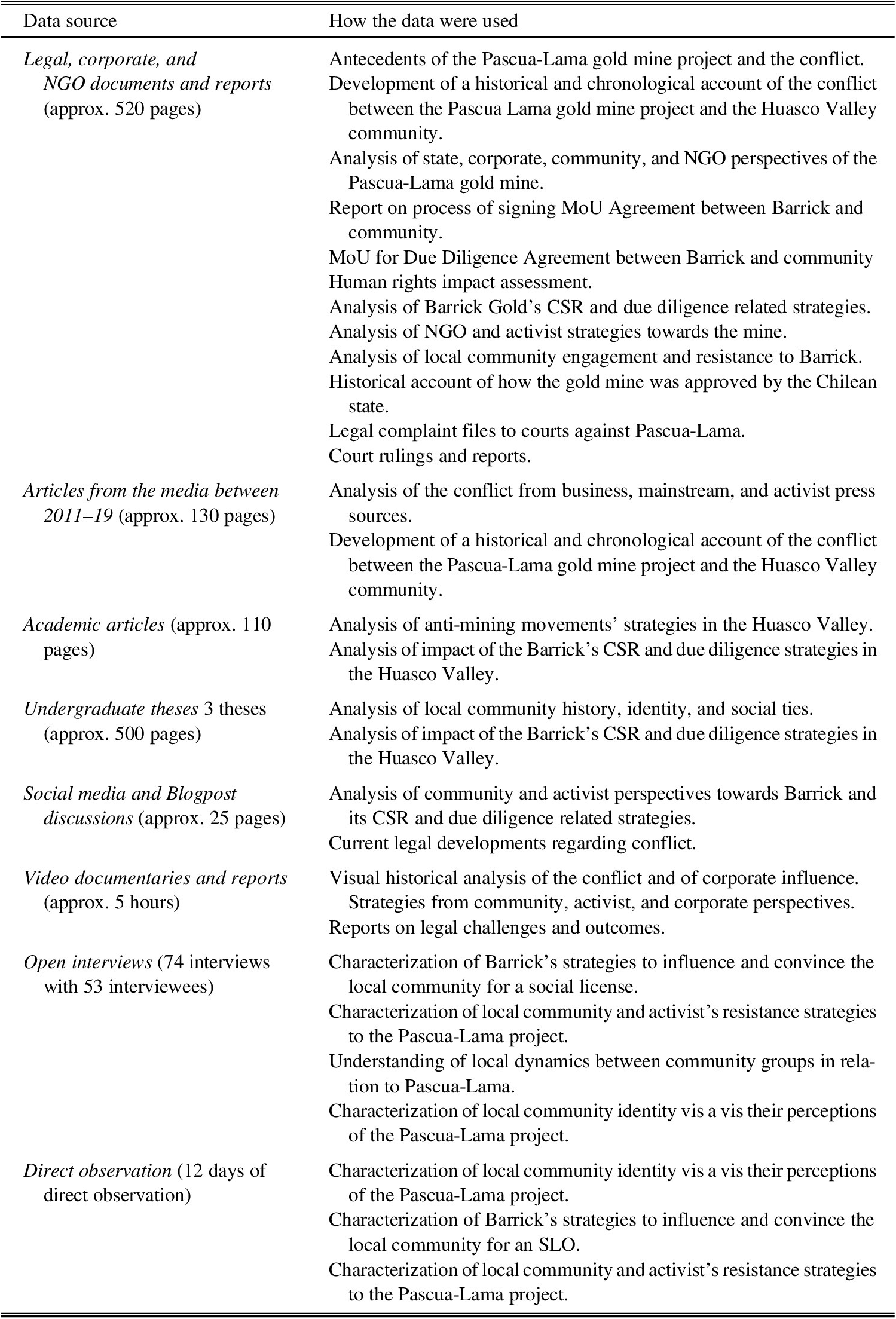
Our research covers a period from 2000 to May 2019, from the beginning of the dispute to the current situation, where a judicial decision to permanently close the mine is being challenged in the courts. Actual data gathering started in 2012, and during this long period, we adopted an iterated, inductive approach (Glaser & Strauss, Reference Glaser and Strauss1967), strategically looking for information sources that could fill our information gaps. Overall, our dataset combines multiple sources: seventy-four interviews (fifty-eight with local residents, four with local politicians, three with national NGO activists, and two with BG representatives); participant observation; and archival data. Table 1 summarizes all our data sources. Most of the interviews were recorded, transcribed, and translated (the authors are fluent in Spanish).
The international prominence of the case helped our analysis of the dispute because of the availability of a vast amount of archival information. The data collection comprises various phases. We began in 2012 by analyzing publicly available data. Initially, this case study formed part of a larger project that sought to understand the influences and explanatory factors for community positions towards eight nearby mining projects in Brazil and Chile. Then, in 2012, the lead author completed a first participatory observation—living with the local community, participating in meetings, and conducting a series of interviews through snowballing sampling. Initial access to this close-knit community was through OLCA, an environmentalist NGO, but soon a relation of trust was established with key members of the community, facilitating meetings with different groups (e.g., indigenous people, small farmers, activist, politicians, and the local clergy). Interviews were focusing on an overview of the dispute process, the valley, the impact of the project, and possible grievances. In total, twenty people were interviewed, and this material was invaluable to identify the position of the main community groups. Since 2013, we have been reviewing newsletters and had consistent electronic communication via various platforms (WhatsApp, Skype, and emails) with three community leaders/residents on the dispute, and completed two interviews in 2015 at international events with a community leader. A second participant observation and series of field interviews took place in September 2017. Despite the suspension of the mine, this time the community was deeply divided and mobilization was depressed. Thus, the interviews with twenty-two residents and two politicians focused on the community fractions, mapping the position of the groups, and rights mobilization transformations. A third research visit to the Huasco Valley was undertaken in February 2019 where the field researcher interviewed fifteen residents and two politicians. This third trip was valuable since it allowed us to gauge perceptions after Pascua-Lama had been legally ordered to close by Chilean courts in January 2018.
As the Pascua-Lama dispute has attracted substantial public attention and there is a wealth of secondary data, particularly that produced by various civil society groups opposing the mine, our understanding of this case has also been greatly aided by an analysis of a substantial amount of archival documents. They include technical and media reports, video documentaries and interviews, and legal documents dating from 2000 to 2019. We consulted a total of sixty-one such archival sources (including videos). In particular, various legal documents and records were collected and analyzed in 2018 and 2019, as the legal domain became increasingly central to our research (see also Table 1).
Sources of Information and Type and Amount of Data Obtained in Each Category
Data Analysis
Data analysis started in May 2017, following an inductive approach. Internal discussions and interdisciplinary synergies helped us to make sense of the data and identify major themes pertaining to rights mobilization and business logics whilst often going back to the raw data, pedaling back and forth between the raw data, themes, processual dynamics, and our research question (Denzin & Lincoln, Reference Denzin and Lincoln2005). Raw data were separately analyzed and then discussed together by the authors against the literature and our emerging analytical framework. As the complex narrative started to become clear, we used an iterative method of aggregating findings and analytical tools provided by the rights mobilization literature to construct our emerging theorization.
We realized during our first data analysis that a major shift occurred in the community between 2012 and 2017, which we analyzed as a shift from resistance to acquiescence; that is, from a community broadly united in fighting against the corporation to one deeply divided and increasingly resigned. Thus, we asked ourselves what could explain this change. We used open, first order coding to identify chronological changes in the mobilization of the affected community against the project, focusing on the interplay between the community and the other two actors—the corporation and the state. However, we realized that by focusing only on the actors, some key elements that shaped the transformation of the dispute risked being missed. In particular, we considered that symbolic struggles needed greater attention. Thus, we deployed rights mobilization (naming, blaming, and claiming) and legal consciousness of the various local groups (e.g., mistrust of the legal system and the state, awareness of rights violations, uncertainty about legal outcomes) as central analytical tools in explaining the shift from resistance to acquiescence. This led us to identify second-order themes (naming, blaming, claiming, law response to community, and changing corporate social responsibility [CSR] strategies), which better captured the interplay between the community’s rights mobilization, legality, and business, understood as social fields. Once we agreed that rights mobilization was central in explaining the transformation of the dispute, we studied the dynamics of rights mobilization by the community over time. First, we considered the transformations in rights mobilization in relation to the legal and business social fields. Second, following Langley (1999), we organized the rights mobilization process into cumulative and partially overlapping phases in which the meaning and practices of rights mobilization changed, yet various elements of the previous phase remained the same. Consequently, we present our findings “within a chronological timeline to evidence how specific dynamics take place within a given moment and how they evolve across time” (Reay et al., Reference Reay, Zafar, Monteiro, Glaser, Zilber, Amis and Mair2019: 10).
EMPIRICAL ANALYSIS AND FINDINGS
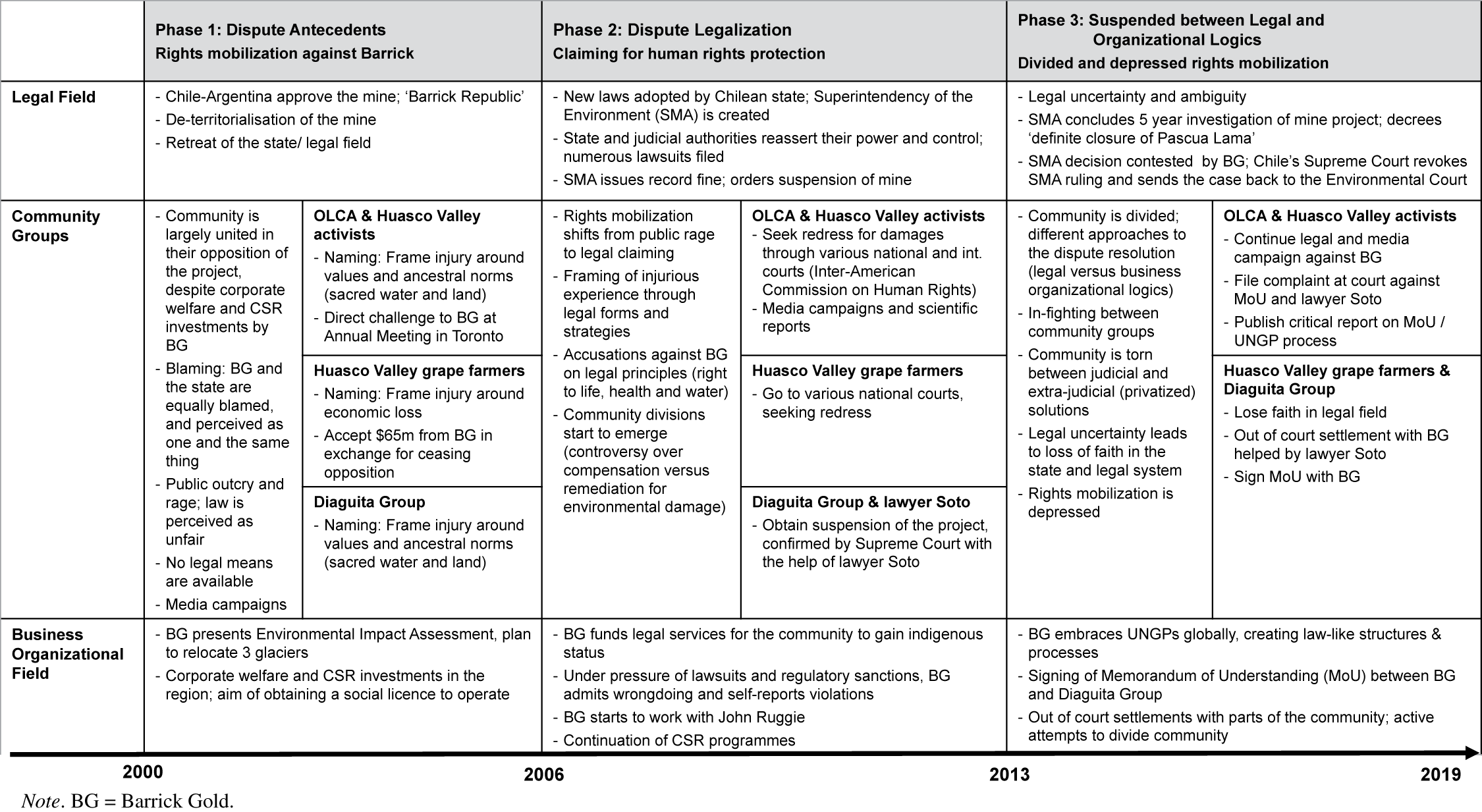
In this section, we discuss how rights mobilization has changed over a period of almost two decades in the context of a significant and complex human rights dispute between Barrick Gold and the Huasco Valley community in Chile. The affected community accused Barrick’s Pascua-Lama mining project of having a severe negative impact on freshwater resources as well as land and indigenous rights. In our longitudinal study, we focus on the perspective of the affected local community. In accordance with our theoretical framework (see Figure 1), we aim to investigate how the community’s rights mobilization has been affected by the interplay between the domestic governance (the legal field/legality) and transnational private regulation (the organizational field/Barrick Gold). As summarized in Figure 2, we identify three distinct phases in the dispute. Each phase differs in terms of the relationship between legal and organizational fields and the response of the affected community to perceived violations of their fundamental rights.
Three Phases of Rights Mobilization at Pascua-Lama (2000-2019)
Phase I: Dispute Antecedents (2000–2006)
Following the ratification in 2000, of a bilateral mining treaty between the states of Chile and Argentina, Barrick Gold was able to create a so-called “third state” in the Andes, between the two borders, exclusively managed by the mining company. This extraterritorial status allowed Barrick to mine gold and silver without facing legal obstacles in either country (Quevedo et al., Reference Quevedo, Padilla and Olivares2004). This unusual power can be illustrated by the fact that public officials, or civil society, had to give a fifteen-day formal notice to Barrick before being allowed to enter what was internally known as the “Barrick Republic” (Globe and Mail, 2014). Soon after, Barrick submitted its initial environmental impact assessment (EIA) in order to start mining. In the EIA, Barrick planned to move three glaciers in order to gain access to the deposits beneath them. They would be moved to another glacier with which they were to bond (Li, Reference Li2017).
Rights Mobilization against the Barrick “Third State”
Rights mobilization in the Huasco Valley began around 2000 as the community became, quite accidentally, aware of the project. Quickly, the community decided to “fight off these big mining companies invading our land!” because “those who are not from the valley do not understand the sacred value of the water and the land, the Mammu Ashpa, as we say in our language” (interview, community leader C, 2012). In this initial phase, the community was very united against the mega-project. By 2005, according to a poll by the main newspaper in the region, 97 percent of the Huasco Valley community was against the Pascua-Lama mine (Diario Chañaricillo, Reference Chañarcillo2005).
As noted by Felstiner et al., the earlier stages of naming, blaming, and claiming are crucial to determine the following transformations of rights mobilization, “not only because of the high attrition they reflect, but also because the range of behaviour they encompass is greater than that involved in the later stages of disputes, where institutional patterns restrict the options open to disputants” (Reference Felstiner, Abel and Sarat1980: 636). These early stages reflect social stratifications as well as personality traits and individual characteristics that explain why “people do or do not perceive an experience as an injury, blame someone else, claim redress, or get their claims accepted” (Reference Felstiner, Abel and Sarat1980: 636). Notably, the community’s initial perception that their fundamental rights had been violated (naming) was framed around two nonlegal rationales.
First, most of the local community perceived the project as a violation of the sacred value of water in this arid region. This popular feeling was supported by both Christian and more ancestral norms and beliefs. Second, some groups, particularly landowners, stressed the potential ruinous economic impact of the mega-mining project, with the glaciers helping to sustain agricultural production in the valley downstream (Li, Reference Li2017). Both clearly emerge from our interviews: “Water is life and the mine represents destruction to the valley” (interview, community leader C, 2012); “The most sacred for the Diaguitas are the mountains … where you can find the spirits of our tatai (ancestors). From these mountains life comes: la co, ko, which means water” (email correspondence with community leader C, 2013); “Without water we cannot continue to grow the sweetest grapes for export, or avocados, watermelons and other crops” (interview, community resident C, 2012).
Crucially, the local clergymen legitimized this process of collective awakening after having obtained the support of national environmental NGOs such as OLCA: “the priest gave mass on the riverbed to show the importance of the water and OLCA with other locals painted the church, walls and organized lots of marches against Barrick” (Interview, community leader, C, 2012). Rapidly, the community became very assertive in attributing to the company a responsibility for a long list of violations and abuses (blaming). The community was particularly offended by the fact that Barrick had omitted the existence of glaciers in its initial EIA: “We, the Diaguitas, never forgave them for that” (email correspondence with community leader C, 2013).
Starting in 2001, multiple smallholder farmers consistently blamed Barrick for negatively affecting the quality of the water and creating water scarcity. However, despite all the accusations mentioned above, the affected community did not seek legal redress (claiming) from Chilean courts until 2012. Their accusations were translated into public rage, marches, and community meetings where abuses were discussed and denounced. This situation has a twofold explanation. The community mistrusted the state, blaming it for being “in bed with” Barrick. Indeed, they deemed the bilateral mining treaty to be unconstitutional, feeling abandoned by the state (Quevedo et al., Reference Quevedo, Padilla and Olivares2004). In the words of our interviewee Sergio Campusano, President of the Huascoaltinos cooperative farmers, “the State of Chile has not respected our basic right to decide what we want for our development.… Our community was intentionally ignored by the State of Chile … because we oppose mega-mining development within our land” (Protestbarrick.net, 2010). Furthermore, the Pascua-Lama project brought to light the difficulties in accessing redress and protecting indigenous access to water when domestic human rights and environmental laws are not in place and fully harmonized with international standards (Cavallo, 2013).
Translocal Business and Human Rights
The absence of state and legal actors is striking in the initial phase of the dispute. Pascua-Lama’s extraterritoriality perfectly illustrates what scholars call transnational private regulation, defined as “a de-territorialized form of authority where governments offload regulation to the private sector, partly reflecting neoliberal ideas about the power of markets to solve social problems” (Bartley, Reference Bartley2018: 12). As part of Pascua-Lama de-territorialization, it is significant that Barrick initially disregarded the glaciers’ existence. The glaciers were only later included in the EIA. As Li (Reference Li2017) notes, from Barrick’s organizational perspective, glaciers, mountains, and rivers tend to be seen as resources to be managed, while for the locals they make up people’s sense of place, their identities, and ways of life.
The cession of sovereignty by the Chilean and Argentine governments to a transnational business organization is an extreme example of the declining authority of the state that characterizes neoliberal globalization (Strange, Reference Strange1996). Firm-community relations are not embedded in the more vertical nation state modes of governance. Drawing on Banerjee’s concept of translocal governance, “communities make alliances with other communities and local actors and firm-community interactions tend to be direct and not mediated by participation in larger forums” (Reference Banerjee2018: 811). In our case, the firm-community conflict rapidly escalated from the Huasco Valley to a transnational scale via innovative forms of “networked activism” (Land, Reference Land2009). The OLCA NGO helped local activists to communicate their concerns to international activist networks, such as Canadian NGOs Protest Barrick and Mining Watch, which had begun covering the dispute. Between 2004 and 2006, major street protests against Pascua-Lama were organized not only in Chile but also in Barcelona, London, Cambridge, and Toronto (Urkidi & Walter, Reference Urkidi and Walter2011). From 2004 onward, in an attempt to attack Barrick at home, these accusations were publicly directed against the company by Campusano during the Annual Shareholder Meetings in Toronto. They were also repeated in many street rallies, town meetings, and university or public lectures about the violation of Huascoaltinos’ rights across the globe (Protestbarrick.net, 2010).
As the opposition to the project mounted, Barrick’s response was equally direct, trying to bargain local support for the project by launching massive welfare investments and CSR projects. Between 2003 and 2005, Barrick spent US$16m to co-fund—with the local and regional government—housing and education projects in the region (Barrick Gold, Reference Gold2018). In 2006, the company signed a contract with large wealthy farmers, worth US$65m over twenty years, for monitoring and improving the water supply (Barrick Gold, Reference Gold2018). The indigenous community accused the company of having paid the sum to obtain the farmers’ powerful support as pointed out in numerous interviews during our fieldwork. Arguably, this strategy was effective with public authorities. In 2006, the environmental regulator approved an amended version of the mining project with four hundred conditions (Barrick Gold, Reference Gold2018). The company could finally start its Pascua-Lama operations. The decision only increased the community’s rage and perception of distress and injustice (OLCA, Reference OLCA2006). It also fueled mistrust toward the Chilean state and judicial system. Significantly, in November 2006, the community staged a “citizens’ tribunal,” with testimonies and judges that would determine abuses and responsibilities that the state was averse to sanction, and emit a verdict on Barrick’s activities (Miningwatch Canada, 2006).
Phase II: Dispute Legalization (2006–13)
Once the project officially started in 2006, rights mobilization also began to be transformed. The mounting public rage was gradually transferred into more formal legal actions against Barrick. The community took the dispute to various international and eventually national courts, seeking redress for the alleged violations. Meanwhile, the Chilean state strengthened its human rights and environmental legislation, also in response to the growing public concern created by mega-mining projects such as Pascua-Lama. As a result, Barrick was forced to become more responsive to public authorities and the affected population, reframing its actions through legal tools and according to the domestic legal order.
Re-centering the State
In contrast to Phase I, during Phase II the state and judicial system became much more assertive in protecting human rights and the environment. In particular, the situation changed after the election of the socialist President Bachelet (2006–10). The Chilean state started strengthening its human rights and environmental legislation. In September 2008, Chile ratified ILO 169 on indigenous peoples’ rights. Two years later, in Bachelet’s penultimate month in office, the government also introduced important environmental reforms that came into effect in 2012. Law 20600 entailed the creation of new environmental courts, specialized and independent jurisdictional entities that are under the supervision of the Supreme Court (Biblioteca del Congreso Nacional de Chile, 2012). The law also established the Superintendency of the Environment (SMA), a decentralized public service with legal authority, subject to the supervision of the Ministry of the Environment. The SMA was granted the power to prosecute environmental violations (SMA, 2018), something which had the potential to appease the growing number of environmental conflicts in the country.
At the same time, the limitations of Pascua-Lama’s transnational private governance soon became evident. Multiple complaints kept emerging from community residents about the impact of the mine operations to the local watershed, accompanied by hundreds of publicly available videos evidencing contamination (e.g., Pascua-Lama, El llanto de la Montaña, video, 2015). “Pollution will be and is high. The river turned red in January and February due to mine testing by Barrick, we depend on this river!” (Interview, local leader C and later B, 2012). This regulatory failure triggered a major shift in the relationship between the organizational and legal fields, re-centering the authority away from the company toward the state. The company was forced to focus more on compliance with domestic law, engaging in costly lawsuits. Immediately after its creation in 2012, the SMA began conducting inspections at Pascua-Lama. Between 2012 and 2013, the residents filed various lawsuits against Barrick. In January 2013, part of the canal system at Pascua-Lama collapsed. Barrick, coming increasingly under pressure, self-denounced to authorities for severe infractions of their environmental permit (SMA, 2013). Various local community groups also filed complaints against Barrick to the newly established SMA for faulty construction of the perimeter channels and failure to fulfil the mine’s glacier monitoring plan. In April, the residents obtained the suspension of Pascua-Lama via the Court of Appeals in the city of Copiapó. In May 2013, after conducting onsite investigations, the SMA ordered Barrick to suspend all operations and charged the company with a record fine of around US$16m (SMA, 2013).
During this phase, Barrick did not fundamentally change its counter-mobilization tactics, based on privatized welfare and CSR investments, in exchange for a social license to operate (e.g., the Atacama Commitment). It was forced to become more responsive to legal discourses about the constitutional and indigenous rights of the affected community. For instance, in 2008–9, Barrick offered to pay for legal services necessary for local communities to gain indigenous status from Chilean authorities, affording them access to certain social, economic, and state benefits. However, rights were still framed through business logics, seen as a form of “bargaining” dispute resolution (Menkel-Meadow, Reference Menkel-Meadow2014). Barrick also demonstrated greater attention to the affected community, beyond wealthy landowners. Between 2008 and 2009, the company completed over a thousand local community consultations. As a result, in 2009, Barrick announced a community monitoring program through which local residents could independently test water quality (Barrick Beyond Borders, 2017). Despite its efforts, according to our data, traditional CSR investments and community dialogue were ultimately ineffective in shifting the community opposition to the mining project. The following quote from the Director of OLCA suggests the company’s strategy remained de-territorialized, responding to transnational organizational logics external to the Valley:
Those initiatives, finally of course, have a communicational impact externally but internally it is not so clear whether they achieve the impact that they [Barrick] want, because they do not manage to completely dissolve the opposition to the project (interview with Director of OLCA, 2017).
Claiming for Human Rights Protection
The legalization of the dispute and the decision by the SMA to suspend the project and fine Barrick US$16m can be largely attributed to a significant change in the affected community’s mode of rights mobilization, from public rage to legal claiming. This corresponds to a transformation in their legal consciousness (Ewick & Silbey, Reference Ewick and Silbey1991). Rage, as an ideological discourse, often identifies government and judicial instruments “with oppression rather than protection” (Brigham, Reference Brigham1996: 310). Thus, the Huasco Valley community found it hard to move away from mobilization by rage to reliance on judicial and governmentally produced rules. This shift also depended on the adoption of human rights and environmental law reforms by the Chilean government, which created “legal opportunity structures” for the affected community (Anderson, Reference Anderson2008).
In this phase, legal forms came to infuse the language, strategies and ideals of the Huasco Valley community. Given their mistrust of the Chilean state, it is not surprising that the Huascoaltinos went first to the Inter-American Commission for Human Rights (IACHR) rather than the Chilean courts, filing a case against the Chilean state for failing to protect their rights (IACHR, 2009). In 2009, the Commission declared the admissibility of their petition, submitted in June 2007, accusing the Chilean state of violations of the rights to property, to access to justice, and to participation (IACHR, 2009). Even though the Commission did not reach a final decision on the case, this episode strengthened and legitimized the community’s legal consciousness, their shared beliefs, and ideas related to the acceptance of legal concepts and compliance. According to Campusano, this opened “a window” and gave “new hope for the defence of the Huasco Valley” (Protestbarrick.net, 2009). The process of legalization of the dispute reached its peak in 2011–13 when all three groups of community rightsholders from the Huasco Valley filed various legal claims against the company. However, some differences started to emerge. While activists and NGOs saw the legal battle as a new means to continue the protests and campaigns, others from the valley decided to sue Barrick, looking for compensation. As explained by one grape farmer, “We need to get compensation from them if they dry our water supplies” (interview, community leader A, 2012). A local community leader commented: “the mine won’t ever leave the valley and the government will always back them so they need to pay us compensation for the damage they’ve already done and comply with the environmental permit they received” (interview, community leader A, 2012).
Consistent with the rights mobilization literature, this transformation in the legal consciousness of the affected community was facilitated by the role of “cause lawyers” (Sarat & Scheingold, Reference Sarat and Scheingold1998). Cause lawyering consists of using legal skills to bring about social change, and it tends to have an ambivalent relationship with social movements, swinging between serving them and seeking control (see Sarat & Scheingold, Reference Sarat and Scheingold2006). In particular, much of the legalization of the dispute was driven by the work of a lawyer named Lorenzo Soto, who first met a group of Diaguita in 2012. In terms of legal consciousness, it is significant that they told Soto that they did not believe they could derail the project through a legal challenge, because it already had a license and had been under way for years (Globe and Mail, 2014). In October 2012, the Copiapó Court of Appeals accepted the constitutional complaint (writ of amparo) submitted by Soto and signed by five hundred Diaguita residents against Pascua-Lama (El Mostrador, Reference Mostrador2012). Then in April 2013, following the collapse of part of the canal system at Pascua-Lama, Soto obtained a first suspension of Pascua-Lama via the Copiapó Court.
Phase III: Suspended Between Legal and Organizational Logics (2013–19)
This latest phase is dominated by legal ambiguity and uncertainty following the suspension of mining by the SMA. Despite a lengthy investigation and judicial process, as of May 2019, there has not been a resolute judicial outcome, and it is unclear whether Barrick will have to permanently close the mining project. As a consequence, the future of Pascua-Lama and the Huasco Valley remains uncertain. This stalemate profoundly affected the community’s legal consciousness and rights mobilization. The community is increasingly divided between two alternative logics to solve the Pascua-Lama dispute. A fraction keeps following the logic of “rights,” relying on judicial claims and governmental protection. Another follows the business organizational logic of “bargaining” through forms of “privatized remedy.”
Divided and Depressed Rights Mobilization
Until 2013, the community was largely united against the Pascua-Lama project and rights mobilization remained strong. During the following phase, rights mobilization weakened and the community became deeply divided. There are two main causes of this shift. First, the mining suspension created a situation of ambiguity and legal uncertainty that negatively affected the community’s legal consciousness. It revived mistrust of the state and cynicism about the real possibility of stopping the mining. Second, the uncertainty exacerbated preexisting differences within an exhausted community between those motivated by strong social norms about the (sacred) value of water and others acting mainly out of economic concerns for this essential natural resource.
Barrick now became more effective in exploiting this fault line. In fact, following a failed attempt to obtain the permanent closure of the project in court, lawyer Soto convinced part of the Diaguita community to come to an out-of-court settlement with Barrick. That was concluded in January 2014, whereby the plaintiffs agreed to drop all accusations against Barrick. Four months later, Barrick managed to sign a UNGPs-inspired Memorandum of Understanding (MoU) with these and other community groups (fifteen out of twenty-two Diaguita neighborhoods). In a logic of “bargaining” their rights, immediately after the ratification of the MoU, lawyer Soto suggested that the Diaguita people could be paid an “indigenous royalty” to resolve the conflict (Reuters, 2014).
The arbitrations and MoU marked a cleavage in the mode of rights mobilization. Having lost faith in judicial and governmental redress mechanisms, part of the community opted for what we call here “privatized remediation.” As Brigham (Reference Brigham1996: 313) notes, “The remedial form of law in society puts forth the settlement of conflict as an overriding concern.… It follows and is an extension of the progressive revolt against formal processes in the courts.” On the other hand, OLCA and the Huasco Valley activists formally and informally contested the MoU process, arguing that it lacked open participation and transparency and involved manipulation, bribes, intimidation, and coercion (Wiebe, Reference Wiebe2015). Our interviews confirm that those taking part in the MoU process received a monthly payment “for our time and participation in the process” (interview, community leader C, 2019). According to a local leader, “they were also discussing compensation for future impacts, that is like mortgaging our conscience … meaning if Barrick destroyed a glacier in the future and we complained they would reply ‘but we’ve paid you for that!’” (interview, community leader B, 2019).
Crucially, privatized remediation is an agreement between private parties, beyond state jurisdiction. This is problematic because the Chilean government “takes no responsibility for compliance or the legality of the agreement” and “does not support or monitor the negotiation or the execution,” thus the balance of power “is asymmetrical and communities are without legal recourse” (activist Lucio Cuenca, cited by Wiebe, Reference Wiebe2015: 13). This was confirmed as in June 2014, a formal claim against the MoU filed to the Indigenous Affairs Department (CONADI) was rejected because the state could not intervene in a private agreement between Barrick and the Diaguita. One claimant later commented that CONADI “turned its back on us” (El Ciudadano, 2018). Divisions within the community escalated as the community leaders that signed the MoU were publicly called “vendidos” (sellouts) by the activists, while those who signed the MoU accused the activists and OLCA of making a living out of this dispute, being funded by foreign governments who want permanent conflict in the Valley.
Only a fraction of the indigenous community—led by OLCA and the Huasco Valley activists—kept fighting Barrick through judicial mechanisms, asking for the permanent closure of the mine. Between 2016 and 2017, the SMA completed a new investigation on the environmental impact of the mine, decreeing in January 2018, the “total and definitive closure” of Barrick’s Pascua-Lama mine in addition to the imposition of a fee of $11.5m, citing serious environmental infractions (SMA, 2018). In a series of press releases, OLCA celebrated this remarkable success by recalling a seventeen-year conflict during which they witnessed “all the strategies of division, co-optation, interventions, harassments, discredit … that produced exhaustion and insecurity that deeply impacted the territory” (OCMAL, 2018). However, according to our sources, most of the locals remained hesitant about the outcome. As one of the residents told us, “I’ll believe it when I see it” (interview, community leader C, 2019). Sergio Campusano cautiously noted after the January 2018 ruling: “One could say that we won a battle, but not the war to mining contamination in our territory.” In March 2019, Chile’s Supreme Court revoked the SMA’s decision and sent the case back to the Environmental Court for review by a different panel of judges. The new judicial process could last for months, further extending the community’s perception of legal ambiguity and uncertainty.
Legal Ambiguity and the Managerialization of Human Rights
The prolonged condition of legal ambiguity and uncertainty is hardly surprising as judicial processes are notoriously lengthy, contingent, and indeterminate (McCann, Reference McCann, Whittington, Kelemen and Caldeira2010). However, it is interesting to note that Barrick exploited this situation by changing its counter-mobilization strategy. While in the previous two phases it relied on privatized welfare to obtain a social license to operate, during this period it adopts law-like corporate structures and mechanisms inspired by the UNGPs. They demonstrate formal attention to human rights discourses, community dialogue, and transparency, lending much-needed legitimacy to the business organization. Drawing on Edelman (Reference Edelman2016), we call this process the “managerialization of human rights.” In essence, this consists of adopting business organization structures that mimic the public legal order in form; for example, by internalizing dispute resolution procedures and mechanisms (see Monciardini, Bernaz, & Andhov, Reference Monciardini, Bernaz and Andhov2019). They demonstrate attention to law and, therefore, lend legitimacy to organizations. At the same time, they allow to maintain “sufficient flexibility to preserve managerial prerogatives and practices that are seen as advancing business goals” (Edelman, Reference Edelman2016: 30).
Our data show that Barrick decided to launch its Human Rights Compliance Programme in 2011, inspired by the UNGPs. Consistent with Barrick’s de-territorialized form of private authority, this had nothing to do with the Pascua-Lama case. In fact, it was a global response to the vast echo provoked by an investigation revealing human rights violations in its Porgera mine, in Papua New Guinea. Essentially, the Programme entailed the adoption of corporate policies and processes, such as human rights due diligence processes, company-based grievance mechanisms to report violations, and corporate structures to investigate them (Barrick Gold, 2017). Jonathan Drimmer, former Deputy Director of the US Justice Department, was hired to oversee its implementation, and John Ruggie, the architect of the UNGPs, was appointed as Special Advisor. In 2013, the new Programme spread to Barrick’s Pascua-Lama’s operations. Its application included the creation of a network of “offices located in the communities to directly engage with local stakeholders” and the adoption of a variety of tools “including a grievance mechanism, public meetings, door to door visits …. On average in 2014, [their] team engaged with over 650 stakeholders each month” (BHR Resource Centre, 2015) While OLCA and the Huascoaltinos activists constantly denounced Barrick’s human rights strategy as a subtle attempt to divide and co-opt a “fragile” and “disoriented” community (Asamblea por el Agua del Guasco Alto, 2015), according to Barrick, the launch of its internal grievance mechanism in the Huasco Valley was finally “giving the communities a voice” (Barrick Beyond Borders, 2013). We found that these new practices allowed Barrick to exert greater control over the territory and the resolution of the Pascua-Lama dispute.
Ultimately, OLCA and the Huascoaltinos activists’ judicial engagement was instrumental in the SMA decision to order the definitive and total closure of the mine in January 2018. This decision halted the process of disintegration of the community and finally granted legal certainty. However, the SMA did not revoke Barrick’s environmental permit. Thus, the company could interpret the sentence as a “re-evaluation process,” ordering only “the closure of existing facilities on the Chilean side of the project” (Barrick Gold, Reference Gold2018). Finally, in March 2018, a pro-market liberalization president, Sebastián Piñera, took office, replacing the socialist President Bachelet. One year later, Chile’s Supreme Court decided to reexamine the permanent closure. Barrick commented that “last month [Barrick CEO] met with Chile’s Minister of Mining Baldo Prokurica,” and “Chile is an investor-friendly country, with a significant mineral endowment, and which encourages the development of mining projects” (Barrick Gold, Reference Gold2019).
DISCUSSION
Our study has analyzed how a community, affected by a large-scale mining project, has mobilized its rights in relation to both the transnational business organization (Barrick Gold) and the domestic legal field (in Chile). We were motivated by two shortcomings in the existing BHR literature. First, there is a lack of studies that interrogate, in a specific context, the linkages between transnational voluntary initiatives—such as the UNGPs—and domestic governance structures and dynamics. Second, the BHR literature tends to adopt a formalistic and exogenous approach to law. By deploying a set of socio-legal concepts—rights mobilization, legal consciousness, and legality—we have provided a more critical and contextual analysis of the dynamics of firm-community BHR disputes (Bartley, Reference Bartley2018; Banerjee, Reference Banerjee2018; Levy et al. Reference Levy, Reinecke and Manning2016). Taking the perspective of the affected local community, we have been particularly focused on how rightsholders mobilize their rights in the interplay between the differing logics of the business and legal fields. In this section, we further discuss our findings, offering theoretical reflections about the dynamics of rights mobilization in BHR disputes, particularly identifying two key dynamics: de- and re-territorialization on the one hand, and legalization and privatization of the dispute on the other.
Figure 3 provides a visual overview of our theoretical analysis of how rights mobilization evolved in our case over time, identifying key processual dynamics of rights mobilization in the interplay between the domestic legal field and the transnational organizational field. With Edelman (Reference Edelman2016), we can theorize the different core logics of the two overlapping fields, generating tensions that became explicit in Phase II, then exploding in Phase III. In particular, the legal field tends to frame rights mobilization in terms of “entitlement,” meaning the normative criteria according to which an individual or a group should be qualified to enjoy rights. On the other hand, as Branco (Reference Branco2008: 18) noted, the business organization “feels more comfortable when dealing with wants than with rights; … satisfying wants implies the use of concepts like cost, benefit and price,” framing the world in terms of resources management and efficiency. This business logic repeatedly emerges in our case. For example, Barrick focuses on water and the glaciers as resources to be managed efficiently (Li, Reference Li2017), responding to rights mobilization by offering forms of “privatized welfare” to satisfy the material needs and wants of the community. Barrick consistently tries to bargain human rights, offering benefits to the community. In the logic of the legal field, these issues are framed very differently: the (un)lawful conduct by Barrick, irregularities, lack of compliance with the company’s environmental permit, and failure of protecting the environment and the affected community (Phase II).
The Community’s Changing Rights Mobilization Over Time

Drawing on Brigham’s (Reference Brigham1996) work on “rage, rights, and remedy,” our study has revealed that rights mobilization in the Valley was initially expressed by a united community through public “rage,” against both the Chilean state and Barrick, fueled by a mix of religious values and economic motives (Phase I). This rage was an expression against the de-territorial and translocal nature of the dispute. The community was then gaining trust in the legal field, partly because of political changes in Chile, increasingly framing the situation through a “rights” lens: legal claims, relying on governmental rules, and legal opportunity structures (Phase II). Yet, then, the community became deeply divided (Phase III), torn apart between a fraction that continuously relied on judicial mechanisms and another that opted for out-of-court arbitration and UNGPs-inspired “privatized remedy.” Each of these processual dynamics was facilitated by different intermediaries: the clergy and NGOs; cause lawyers; negotiators and arbiters.
While most of the BHR literature appears polarized along the divide between voluntary UNGPs and the adoption of a binding UN treaty (Baumann-Pauly & Nolan, Reference Baumann-Pauly and Nolan2016; Deva & Bilchitz, Reference Deva and Bilchitz2017), we argue that both perspectives are based on the assumption of the decreased importance of nation-states and the need to fill “governance gaps” (Kobrin, Reference Kobrin2009; Ruggie, Reference Ruggie2014, Reference Ruggie2017). During the last two decades, the conventional wisdom has been that the problems arising from the globalization process are rooted in the asymmetry between increasingly interconnected economic activities and the territory-bound validity of state regulation and bureaucracy (Habermas Reference Habermas2001; Scherer et al., 2016). Poor and middle-income governments have been often described as too submissive to powerful corporations (Banerjee, 2008, Reference Banerjee2010) and Western governments as privileging sovereignty and non-intervention over the protection of human rights (Kobrin, Reference Kobrin2009). Thus, extraterritorial, international, and voluntary multistakeholder “fast-track” solutions have been invoked to strengthen human rights protection, bypassing the state (Bernaz, Reference Bernaz2013; Rodríguez-Garavito, Reference Rodriguez-Garavito2017; Skinner et al., Reference Skinner, McCorquodale and De Schutter2013). Our study maintains that this view should be reversed. Inspired by Bartley’s (Reference Bartley2018: 45), we found it more fruitful to start from the premise that “sites of implementation are crowded with actors, agendas and rules,” rather than treating them as empty spaces waiting to be filled by transnational standards. Hence, we have analyzed in detail the processes of rights mobilization from below (Misoczky & Böhm, Reference Misoczky, Böhm, Pullen and Rhodes2015; Misoczky et al., Reference Misoczky, Camara and Böhm2017) and the linkages between private transnational rules and domestic judicial and governmental enforcement mechanisms. Theorizing the changing nature of rights mobilization in the Pascua-Lama case (Figure 3), our study highlights a more dynamic and dialectical relationship between processes of de-territorialization and re-territorialization of BHR governance and legalization and privatization of human rights disputes.
Dynamics of De- and Re-territorialization
Here we introduce a dialectic perspective in the analysis of BHR governance that conceives of de- and re-territorialization dynamics as entangled. As already noted by Rodríguez-Garavito (Reference Rodriguez-Garavito2017), much of the current debate about BHR governance appears to take a “top-down” approach disconnected from the struggles of local and national communities and organizations engaged in campaigns, litigations, and negotiations on the ground.
Our study revealed a tension between two models of governing BHR conflicts. On the one hand, transnational business organizations like Barrick try to impose a new form of de-localized transnational private authority, bypassing and replacing the traditional role of the nation-state (Ó Tuathail & Luke, Reference Tuathail and Luke1994). As illustrated by other BHR analyses (see Coumans, Reference Coumans2017; Human Rights Clinics, 2015; Kaufman & McDonnell, Reference Kaufman and McDonnell2016), corporate decisions are taken independently from local identities and ways of life, based purely on organizational logics of resource efficiency and good managerial practices. In the absence of the state, firm-community interactions become inevitably more direct and are reorganized through the reality of transnational corporations increasingly engaged “in authoritative decision making that was previously the prerogative of sovereign states” (Cutler et al. 1999: 16; Scherer et al., 2016). This is evident in Phase I, characterized by Barrick’s de-territorialized private authority, fully supported by the Chilean state. Drawing on Banerjee (Reference Banerjee2018), we call this governance framework “translocal business and human rights” because the national dimension is bypassed in favor of either transnational or local dynamics. Firm-community interaction is conflictual (“rage”), without being mediated by public fora. We found that rights mobilization in Phase I mirrors corporate transnational dynamics, operating through networked advocacy groups (Land, Reference Land2009). This “deterritorialization” of the dispute reemerged in Phase III, as Barrick’s new form of corporate BHR governance, which we call “privatized remediation,” inspired by the UNGPs, is being implemented “top down” in the Huasco Valley, based on changes in its global corporate human rights policy.
However, on the other hand, our case has shown that there are also less explored re-territorialization dynamics, suggesting the emergence of a “place-conscious” model of BHR governance (Bartley, Reference Bartley2018: 258). They are partly based on restoring the authority away from the company towards more traditional state-centric governance due to the perceived failure of business organization in performing a regulatory role. The capacity of Chile’s state and legal system allowed for an increased trust of the community in the legal field, leading to a re-territorialization of the dispute (from Phase I to II), meaning that firm-community interaction became indirect, mediated by the logic of legality and public fora, “re-centering the state” (Bartley, Reference Bartley2014; Reference Bartley2018). From 2006, hence, rights mobilization became reconfigured from translocal actions to domestic dynamics: all community groups were increasingly attracted into strategic legal actions, reflecting and deepening reliance on domestic legal frames and judicial redress mechanisms. Barrick, in this phase, had no choice but to comply with domestic rules (e.g., self-denounce to authorities) and suspend the mine.
Dynamics of Legalization and Privatization of the Dispute
Another dialectic relationship that emerges from the study concerns legalization and privatization dynamics. The legalization of the dispute consists of transferring blame into more formal legal claims. Our study has shown the importance of rights mobilization and legal consciousness and the unique perception of injurious experience suffered by the affected community (Felstiner et al., Reference Felstiner, Abel and Sarat1980; McCann, Reference McCann, Whittington, Kelemen and Caldeira2010), particularly in the early stages of rights mobilization (naming and blaming), to explain the evolution of the dispute and the possible involvement of state authorities and formal legal institutions (claiming). Against the idea of law as an exogenous force, whereby access to justice should be granted to the affected community by either the international community or by privatized transnational governance (Kobrin, Reference Kobrin2009; Ruggie, & Sherman, Reference Ruggie and Sherman2017; Scherer et al. 2016), our study stressed the “constitutive power” of law (Brigham, Reference Brigham1996). This means to recognize that individuals and groups think as well as act on the basis of legal values and understandings that shape their perceptions, aspirations, and calculations (Ewick & Silbey, Reference Ewick and Silbey1998; McCann, Reference McCann, Whittington, Kelemen and Caldeira2010). This can be seen most clearly in Phase II as all the community’s groups are increasingly attracted into strategic legal actions. Thus, we agree with Bartley that treating the state “as just one of many relevant actors and institutional structures in fields of transnational governance would be a mistake, as states are unique in their capacity to shape market access on a large scale and institutionalize the rights of citizens and firms within their borders” (Reference Bartley2014: 95). It is important to realize that in times of, what we called, de-territorialization of human rights governance, the state and the legal field are still present, providing access to legal remedy to rightsholders. BHR analysts should therefore not forget the possibilities offered by the legal and regulatory systems in specific national circumstances. The legalization of the Pascua-Lama dispute constitutes a “paradigm change,” as the founder of Barrick, Peter Munk, said at Barrick’s 2013 AGM, due to “new governments, punitive governments, more aggressive regulatory systems, driven by a whole cadre of trained and highly competent lawyers” (CHRE, 2015).
Our case shows that Barrick continuously strives to privatize the dispute, avoiding the intermediation of legal logics and public fora, using a range of counter-mobilization strategies, from private welfare programs (Phase I and II) to forms of privatized remedy (Phase III). Both corporate strategies mimic the public order in form to gain legitimacy, concealing the prevalence of business logics and private authority. “Privatized welfare” is very common in the extractive industry and well-documented (Banerjee, Reference Banerjee2018). It entails a vast investment by the business organization in the provision of public goods—e.g., housing, education, and services for disabled children (Barrick Beyond Borders, Reference Barrick2009)—that are usually state prerogatives. In our case, privatized welfare was rejected by the community (Phases I and II) as economic benefits were widely perceived as incommensurable to the value of water.
“Privatized remedy” consists in devising law-like corporate policies and structures (e.g., grievances mechanisms and due diligence processes) for dispute management and resolution similar but alternative to the legal system. This can be theorized as a form of “managerialization of law” (Edelman, Reference Edelman2016), or, more precisely, managerialization of rights (Monciardini, Bernaz & Andhov, Reference Monciardini, Bernaz and Andhov2019). This was achieved through the creation of corporate structures and processes in the form of an UNGPs-inspired MoU, which was designed to lend legitimacy to Barrick in the eye of the legal field, while maintaining managerial flexibility, keeping a firm eye on the main goal of gaining a social license to operate for the Pascua-Lama mine. It appears as a form of “bargaining in law’s shadows” (Mnookin & Kornhauser, Reference Mnookin and Kornhauser1978), enabled by mistrust toward judicial solutions in a context of legal ambiguity (Edelman, Reference Edelman2016). Analytically, this is an important point: corporate BHR programs are not only implemented in the face of an absent state, or within ”governance gaps,” as many authors argue (Ruggie, Reference Ruggie2014, Reference Ruggie2017). Instead, in our case, the corporation’s UNGPs-inspired program actively counter-acted the legal field. Privatized remediation appealed to part of the community because it offered a legitimate settlement, through a predictable and formally independent remedy process, to the victims of human rights abuses, allowing them to move forward. However, privatized remedy mechanisms devised by Barrick weakened rights mobilization, and, during Phase III, we found the affected community increasingly divided, pulled in opposite directions by the quasi-magnetic force (Martin, Reference Martin2003) of the organizational and legal fields.
CONTRIBUTIONS AND POLICY IMPLICATIONS
Analyzing the dynamics of rights mobilization by the community and the transformations of the Pascua-Lama dispute, our study has provided three relevant contributions to the debate on BHR regulation. First, going beyond the current BHR policy debate, polarized between transnational “new governance” and international legally binding solutions, we argue that both approaches overlook rights mobilization from below as they tend “to move in one primary direction: from ‘higher’ international frameworks to ‘lower’ individual actors” (Melish & Meidinger, Reference Melish, Meidinger and Mares2012: 313). Drawing particularly on Bartley (Reference Bartley2018) and mobilizing a body of socio-legal research and conceptual tools (Edelman, Reference Edelman2016; Ewick & Silbey, Reference Ewick and Silbey1998; McCann, Reference McCann, Whittington, Kelemen and Caldeira2010), we have advanced a broader analytical model of studying BHR disputes, centered around three intertwined elements: rights mobilization, legal consciousness, and legality.
In particular, we have found that effective human rights protection and redress depends, to a large extent, on how and why the affected community groups mobilize their rights. The UNGPs and a large part of the BHR community tend to underline the role of exogenous factors—e.g., state-based or corporate-led mechanisms—in providing effective redress to victims of human rights violations. However, our analysis shows that endogenous factors, such as “legal consciousness” and “rights mobilization,” are equally, if not more, relevant to explain access to effective redress. Arguably, judicial or non-judicial mechanisms would have been of very limited value if the Huasco Valley residents did not mobilize their rights against the Pascua-Lama project. As Melish and Meidinger (Reference Melish, Meidinger and Mares2012: 313) note, there is a tendency to “undervalue the critical role of local actors in both creating relevant human rights meaning in accordance to local values, mores and conditions and, equally important, in holding actors accountable to such meanings in locally effective and meaningful ways.” We argue that it is through strengthening its legal consciousness that the community achieved a legalization and hence, what we call, a re-territorialization of the dispute. In other words, the rights mobilization from below led to a significant shift in the dynamics between the business and legal fields.
Second, our analysis stresses the major role of domestic governance and the constitutive power of legality. This is in line with Bartley’s (Reference Bartley2018) call for going beyond the imaginary of “empty spaces” toward “place-conscious transnational governance” by rethinking much of the conventional discourse of “bypassing the state” that informs the BHR debate. In fact, both the advocates of the UNGPs (Ruggie, Reference Ruggie2014) and those supporting a legally binding UN Treaty (Deva & Bilchitz, Reference Deva and Bilchitz2017) tend to start from the same premises of “governance gaps” and the inadequacy of domestic laws in a context of economic globalization (Habermas Reference Habermas2001; Kobrin, Reference Kobrin2009; Scherer et al., 2016). Instead, we have found that this centrality of law persists even when the state is absent (Phase I). For example, the Huasco Valley community felt strongly that “the State of Chile [that] has not respected our basic rights” (Protestbarrick.net, 2010). This is because, “the law is real, but it also is a figment of our imagination,” as Scheingold puts it (Reference Scheingold1974: 3). We suggest that this paradox can be explained by going beyond the current emphasis on instrumental dimensions of law to appreciate the “constitutive power” of law as “legality.” “Constitutive” means that “legal conventions routinely prefigure, delimit, and express the expectations, aspirations, and practical world-views of subjects” (McCann, Reference McCann, Whittington, Kelemen and Caldeira2010: 527). Accordingly, as Brigham (Reference Brigham1996: 313) notes, despite being “ostensibly … opposed to the legal process,” even the provision of a “privatized remedy” by Barrick (Phase III) “in practice depends on the form epitomized by courts and lawyers as a foil.”
Third, our study has revealed that, by adopting the UNGPs framework, Barrick has developed a new form of privatization of the dispute, which amounts to a corporate counter-mobilization strategy that we call “privatized remedy.” This strategy consists in devising law-like corporate policies and structures (e.g., grievances mechanisms and due diligence processes) for dispute management and resolution formally similar but alternative to the legal system. The findings are consistent with other studies in which company-led grievance mechanisms inspired by the UNGPs were described as inappropriate and ineffective (Kaufman & McDonnell, Reference Kaufman and McDonnell2016; SOMO, 2014)—some also involving Barrick (Coumans, Reference Coumans2017; Human Rights Clinics, 2015; Mining Watch Canada, 2017). However, these other cases were taking place in so-called areas of limited statehood (Borzel & Risse, Reference Börzel and Risse2010). In this sense, operational grievance mechanisms offered the victims some form of remedy that they would have otherwise unlikely received.
Our data has revealed that the adoption of this dispute privatization strategy followed a period in which the Chilean state and legal system were very active (Phase II—legalization of the dispute); the community had filed legal claims against Barrick and the SMA investigation was still ongoing. As already mentioned, this form of “privatized remediation” appears as a form of “bargaining in law’s shadows” (Mnookin & Kornhauser, Reference Mnookin and Kornhauser1978). Drawing on Edelman (Reference Edelman2016), we found that this form of “managerialization” of human rights was enabled by a context of legal ambiguity and uncertainty (the suspension of the Pascua-Lama project). Effectively, the implementation of the UNGPs in the Pascua-Lama case weakened rights mobilization and divided the affected community, giving Barrick greater control over the dispute as compared to complaints handled through the formal legal system.
Although the UNGPs explicitly state that operational-level grievance mechanisms should not be used “to preclude access to judicial or other non-judicial grievance mechanisms” (Principle 29), this statement is ambiguous. Barrick could claim that the company is not precluding access to justice. On the contrary, it is implementing due diligence and operational grievances mechanisms in accordance to the UNGPs. In effect, as Edelman (Reference Edelman2016: 39) noted, the major risk with this process of managerialization of law is that ineffective or indeed counterproductive human rights corporate strategies come to be widely accepted and promoted by policy makers, legal institutions, and administrative agencies “indicia of compliance” with human rights laws without evaluating their effectiveness (Monciardini, Bernaz & Andhov, Reference Monciardini, Bernaz and Andhov2019).
Based on our analysis of the Pascua-Lama case, we suggest that policy makers be dubious of the “new governance” turn in BHR policies embodied by the UNGPs, which is advocating a stronger regulatory role of business organizations. While there is an argument for operational grievances mechanisms to be implemented in areas of limited statehood, ideally engaging the victims or their representative in a truly participatory process (Kaufman & McDonnell, Reference Kaufman and McDonnell2016), we suggest that in most other cases this process risks to follow a business “compensatory logic” (Thompson, Reference Thompson2017: 60), rather than promoting effective remediation. Thus, our recommendation to policy makers is to strengthen domestic governance by enhancing rigid and prescriptive legislative rules for business organizations to avoid legal ambiguity, strengthen specialized tribunals, and administrative agencies. They could also demand multinational business organizations that are serious about human rights to lobby for legislative changes in all the countries in which they operate, rather than focusing mainly on voluntary transnational standards and principles, bypassing the state.
SUPPLEMENTARY MATERIALS
To view supplementary material for this article, please visit https://doi.org/10.1017/beq.2019.49.
ACKNOWLEDGEMENTS
We are grateful to the comments received at a presentation of an earlier version of this article at the second Business and Human Rights Young Researchers Summit at the University of St. Gallen, Switzerland, in April 2017. We would also like to thank Juliane Reinecke, as BEQ’s handling associate editor, as well as the three reviewers for their insightful comments on earlier versions of this article. We gratefully acknowledge the contribution by PhD researcher Chia-Hao Ho who helped with some aspects of the data handling and presentation. Some of the data for this research was made possible in part thanks to funding from European Union Horizon 2020 Marie Curie Individual Fellowship, project number 707485.
Rajiv Maher is postdoctoral research fellow at the Department of Geography, Trinity College Dublin. He was previously an assistant professor at Université Paris-Dauphine. He has a PhD in management from Cranfield University. His research interests lie at the intersection of indigenous and rural community organizing and human rights, territorial governance and dynamics, ecological conflicts over extractives projects, and corporate social responsibility.
David Monciardini is senior lecturer at the University of Exeter Business School, UK. He has an interdisciplinary background that spreads across sociology, management, and law. His research focuses on the relationship between business organizations and society and its regulation. This includes research on business and human rights, social and environmental business accountability, and the governance of circular economy. Monciardini has published in international journals such as Business & Society and Regulation & Governance.
Steffen Böhm is professor in organization and sustainability at the University of Exeter Business School, UK. His research focuses on political economy, political ecology, and governance relations. He has published five books: Repositioning Organization Theory (Palgrave), Against Automobility (Blackwell), Upsetting the Offset: The Political Economy of Carbon Markets (Mayfly), The Atmosphere Business (Mayfly) and Ecocultures: Blueprints for Sustainable Communities (Routledge). A new book, Climate Activism, is forthcoming with Cambridge University Press.



