Introduction
Despite the fact that depression and anxiety often co-exist (Kessler et al. Reference Kessler, Berglund, Demler, Jin, Merikangas and Walters2005), rarely occur in pure form (Brown et al. Reference Brown, Campbell, Lehman, Grisham and Mancill2001) and are known to load on a common internalizing dimension (e.g. Krueger, Reference Krueger1999; Krueger & Bezdijan, Reference Krueger and Bezdjian2009; Eaton et al. Reference Eaton, Krueger, Markon, Keyes, Skodol, Wall, Hasin and Grant2013; Kushner et al. Reference Kushner, Krueger, Wall, Maurer, Menk and Menary2013; Wright et al. Reference Wright, Krueger, Hobbs, Markon, Eaton and Slade2013), the vast majority of subtyping studies have so far strictly focused on either depression (e.g. Sullivan et al. Reference Sullivan, Kessler and Kendler1998; Van Loo et al. 2012) or anxiety (e.g. Kessler et al. Reference Kessler, Stein and Berglund1998; Olino et al. Reference Olino, Klein, Lewinsohn, Rohde and Seeley2010). Previous data-driven subtyping studies have furthermore focused solely on symptoms without taking disability into account, while disability is strongly interrelated with depression and anxiety. People with a mood or anxiety disorder experience impaired functioning on social, occupational, and physical domains (Bijl & Ravelli, Reference Bijl and Ravelli2000; Kessler et al. Reference Kessler, Berglund, Demler, Jin, Merikangas and Walters2005; Patten et al. Reference Patten, Wang, Williams, Lavorato, Bulloch and Eliasziw2009; Wittchen et al. Reference Wittchen, Jacobi, Rehm, Gustavsson, Svensson, Jönsson, Allgulander, Alonso, Faravelli, Fratiglioni, Jennum, Lieb, Maercker, van Os, Preisig, Salvador-Carulla, Simon and Steinhausen2011). The importance of disability is reflected in formal diagnostics (e.g. DSM-5) and clinical guidelines (e.g. Kramer et al. Reference Kramer, Smith and Maruish2004), whereas the presence of disability is a defining criterion that also signals need for care. Although increased symptom severity is reflective of the level of general functioning (Wakefield et al. Reference Wakefield, Schmitz and Baer2010), the correlation with disability is only modest (McKnight & Kashdan, Reference McKnight and Kashdan2009) and symptoms provide little domain-specific information about functional impairment (e.g. physical, social, or occupational). This is unfortunate because disability occurring in specific functional domains is known to be predictive of important clinical outcomes such as treatment response (Hirschfeld et al. Reference Hirschfeld, Dunner, Keitner, Klein, Koran, Kornstein, Markowitz, Miller, Nemeroff, Ninan, Rush, Schatzberg, Thase, Trivedi, Borian, Crits-Christoph and Keller2002), remission (Von Korff et al. Reference Von Korff, Katon, Rutter, Ludman, Simon, Lin and Bush2003; Zimmerman et al. Reference Zimmerman, McGlinchey, Posternak, Friedman, Boerescu and Attiullah2008), and recurrence (Scholten et al. Reference Scholten, Batelaan, van Balkom, Penninx, Smit and van Oppen2013). This additional information conveyed in disability measures may therefore serve as a source of relevant inter-personal variation on top of the variation that is captured by symptom scores alone, and may thus have an important role in identifying subtypes.
The simultaneous consideration of a broad set of symptoms and disability within a data-driven subtyping approach could yield subtypes which better describe individual, symptom, and severity differences inherent to depression and anxiety (Lux & Kendler, Reference Lux and Kendler2010; Goldberg, Reference Goldberg2011; Wardenaar & de Jonge, Reference Wardenaar and de Jonge2013). Importantly, the obtained empirical classification may guide research by providing targets for biological, neurological, and genetic research (Kapur et al. Reference Kapur, Phillips and Insel2012; Cuthbert & Insel, Reference Cuthbert and Insel2013), and may provide guidance as to which treatment strategy may benefit patients most (Andrews et al. Reference Andrews, Anderson, Slade and Sunderland2008; Baumeister & Parker, Reference Baumeister and Parker2012).
The aim of the present study was to identify and validate data-driven cross-diagnostic subtypes to capture the heterogeneity of depressive and anxiety symptomatology in a large population sample (n = 73 403), incorporating both symptoms and disability measures as sources of clinically relevant inter-personal variation. All subjects had a full assessment of their current depression and anxiety symptoms.
Method
Participants and procedures
Data came from Lifelines (Scholtens et al. Reference Scholtens, Smidt, Swertz, Bakker, Dotinga, Vonk, van Zon, Wijmenga, Wolffenbuttel and Stolk2014), a large prospective population-based cohort study of 1 67 729 persons in the Northern Netherlands. In the study, information on a broad range of biomedical, sociodemographic, behavioural, physical and psychological factors that contribute to the health and disease of the general population are assessed, with a special focus on multi-morbidity and complex genetics. Study participants were recruited via general practitioners and self-registration, following family referral to include family members. Participants visited a Lifelines research site for biomedical assessments, standardized interviews, and completed extensive questionnaires. The Lifelines cohort is broadly representative for the adult population of the north of The Netherlands, with a low risk of selection bias and good generalizability to the general population (Klijs et al. Reference Klijs, Scholtens, Mandemakers, Snieder, Stolk and Smidt2015). All participants signed informed consent and the Medical Ethical Committee of the University Medical Center Groningen approved the study.
For the current study, participants were included if they had complete data on an adapted version of the standardized Mini International Neuropsychiatric Interview (MINI). To facilitate quick assessments, the original MINI interview allows interviewers to skip questions about symptoms of major depressive disorder (MDD) and generalized anxiety disorder (GAD) if core DSM-criteria are not met. However, between February 2012 and December 2013, Lifelines used an adapted version of the MINI in which all internalizing symptoms were assessed without symptom-skips in order to enable present analyses. This dataset consisted of 73 403 participants and was split into a training set (75%, n = 55 054) for model fitting and a validation set (25%, n = 18 349) for model selection and validation.
Measures
Internalizing symptoms
The MINI was administered by trained medical professionals and used to assess MDD, GAD, panic disorder, agoraphobia and social phobia (Sheehan et al. Reference Sheehan, Lecrubier, Sheehan, Amorim, Janavs, Weiller, Hergueta, Baker and Dunbar1998). The nine criterion symptoms of MDD were considered present if participants experienced them almost daily during the past 2 weeks. The seven criterion symptoms of GAD were considered present if experienced on most days during the past 6 months. Lifetime presence was assessed for agoraphobia, panic attacks and social fear. For three symptoms that overlapped between MDD and GAD (‘sleep disturbance’, ‘fatigue’ and ‘concentration problems’), the GAD symptoms were excluded. The MDD symptoms were favoured because of their more restrictive time-frame of 2 weeks, which increases the likelihood that someone who endorses one of the symptoms also currently experiences disability as a result from that symptom. This resulted in a dataset containing 16 internalizing symptoms that were assessed for all subjects.
Disability covariates
Four subscales of the RAND-36 (Hays & Morales, Reference Hays and Morales2001) were included in the analyses: physical functioning, social functioning, role limitations due to emotional problems and role limitations due to physical health problems. The role limitations scales assess problems with work or other regular daily activities as a result of physical health or emotional problems. The RAND-36 is a widely used questionnaire to assess health-related quality of life with sound psychometric properties. Sum scores for the four scales were linearly transformed to a 0–100 scale and standardized.
External variables
A wide range of external variables was assessed, including sociodemographics, lifestyle factors, psychological factors, and health status. Participants’ age, gender, marital status (partner or no partner), education level (low, middle, high), income (above or below modal), and work status (currently employed, work absence, afraid to lose job; all dichotomized) were assessed using self-report questionnaires. Body mass index (BMI) was assessed during the research visit. Current smoking and current alcohol consumption (dichotomized as more than once a week) were assessed using self-report questionnaires. Medication use, the presence of a major medical condition (cancer, diabetes, arteriosclerosis, asthma, chronic obstructive pulmonary disease), a cardiovascular disease (hypertension, stroke, heart failure, myocardial infarction), and cardiovascular symptoms (arrhythmia, swollen ankles, chest pain, heart function loss) were assessed using questionnaires. Somatization was assessed using a subscale of the Symptom Checklist (SCL-90; Derogatis et al. Reference Derogatis, Lipman and Covi1973). Social support was measured using the subscales affection (i.e. feeling loved), behavioural confirmation (i.e. belonging and doing things right), and status (i.e. distinction in valued aspects) of the Social Production Form (SPF-IL; Nieboer et al. Reference Nieboer, Lindenberg, Boomsma and Van Bruggen2005). The lifetime and past-year occurrence of stress were measured using the Long-term Difficulties Inventory (LDI) for chronic stress and the List of Threatening Events (LTE) for recent stress (Rosmalen et al. Reference Rosmalen, Bos and de Jonge2012). Positive and negative affect was assessed using the Positive and Negative Affect Schedule (PANAS; Watson et al. Reference Watson, Clark and Tellegen1988). In line with work of Broadhead et al. (Reference Broadhead, Blazer, George and Tse1999), participants were asked to indicate in a disability days questionnaire how many days in the preceding month they were (i) unable to perform daily activities, (ii) remained in bed, (iii) had to take a step back, or (iv) were less able to focus.
Statistical analyses
Missing data
Participants with more than 10 missing values on the RAND-36 (n = 541) were excluded. For the remaining participants (n = 73 403), missing values on RAND-36 (0.9%) and external variables (1.7%) were imputed using the R package ‘mice’ (Buuren & Groothuis-Oudshoorn, Reference Buuren and Groothuis-Oudshoorn2011) with logistic regression for binary variables, proportional odds models for ordered categorical variables, and predictive mean matching for continuous variables (default settings).
Models
The latent structure of the included symptoms was first explored using latent class analyses (LCA) and explorative factor analyses (EFA). In LCA, a categorical latent variable representing a number of latent classes is assumed to explain all population heterogeneity in symptom-reporting without assuming severity variations within classes. In contrast to LCA, EFA is a dimensional approach which can be used to gain insight into the latent structure of the (co)variances of the assessed symptoms using continuous latent factors.
The hybrid mixture models consisted of Mixed Measurement Item Response Theory (MM-IRT) models and were fitted without disability covariates first. These models add a continuous latent factor to the LCA model accounting for quantitative differences within each class, and circumvent the problem of LCA finding parallel classes reflective of severity differences and that are not qualitatively different (van Loo et al. Reference Van Loo, De Jonge, Romeijn, Kessler and Schoevers2012). As such, MM-IRT provides a hybrid approach: variations in the observed data are assumed to reflect the existence of latent groups with qualitatively different symptom patterns, but within each subgroup, quantitative differences on a severity continuum are allowed. Conceptually, this means that subgroups with distinct symptom patterns exist, but that each pattern may occur at different severity levels. For example, one might find a latent class consisting of subjects who report a pattern consisting mainly out of GAD symptoms and no other symptoms. Within this group quantitative differences can then exist, with severe cases reporting all GAD symptoms and mild cases reporting only a few (e.g. only tensed but not anxious or nervous).
To incorporate information about inter-individual differences in experienced disability, both symptoms and disability were considered simultaneously in the models. For this aim, MM-IRT mixture models were run with RAND-36 measures of disability (physical functioning, social functioning, role limitations due to emotional problems, and role limitations due to physical health problems) added as covariates predicting latent class membership (MM-IRT with covariates; MM-IRT-C). The disability covariates were modelled in conjunction with the latent classes, and did not serve as direct indicators of the classes, but influenced model solutions through prediction of class membership. The estimated classes still reflect different latent subgroups with distinct symptom patterns as in the MM-IRT models, but measures of disability now form an additional source of information to optimize the distinction between classes (Tay et al. Reference Tay, Newman and Vermunt2011). To evaluate the relative value of each disability covariate, a likelihood ratio test was used to compare the fit of the MM-IRT-C model with all disability measures to the fit of four MM-IRT-C models, each omitting one disability covariate. Next, the covariates were added in a stepwise fashion to evaluate which disability measure added most information to the model. The characteristics of the optimal model were further investigated by analysing the associations with external variables in the full dataset.
Estimation procedure
EFA was performed using the R package ‘psych’ (Revelle, Reference Revelle2014) and results were used to fit confirmatory factor analysis (CFA) models. LCA, CFA, MM-IRT and MM-IRT-C models were fitted in LatentGold 5.0 (Vermunt & Magidson, Reference Vermunt and Magidson2013). First, models were fitted in the training set. The obtained models were then applied and compared using information criteria in the validation set, a part of the data that was not included in the training set. The use of an independent validation set for model selection prevented the selection of models that overfitted the data. All models used 500 start sets, 25 000 estimation maximization iterations and 1000 Newton Raphson iterations until convergence in the training set. Models were run multiple times to explore likelihood values and avoid solutions at local maxima. All latent class models were nested in a single general latent variable model, allowing for direct comparisons across models. To find the optimal number of classes and select the best-fitting model, the Bayesian Information Criterion (BIC) and the consistent Akaike's Information Criterion (CAIC) were compared across models in the validation set. The best LCA and EFA models served as baseline references for the hybrid mixture models. As traditional regression methods underestimate the relationship between class membership and external variables and lead to biased estimates due to classification error, a corrected approach was used (Vermunt, Reference Vermunt2010).
Results
Sample characteristics
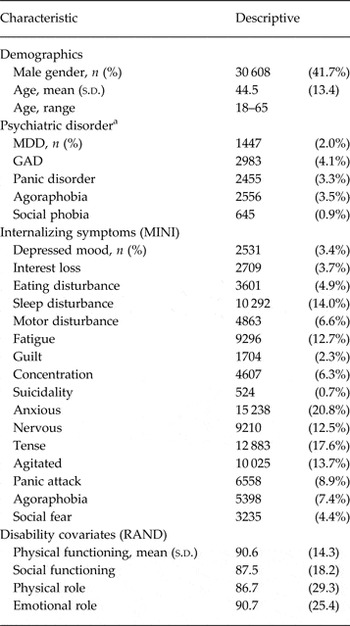
The 73 403 participants had a mean age of 44.5 (range 18–93) years, 58.3% were female, and 55.1% reported at least one of the assessed symptoms (Table 1). According to the MINI, 1447 (2.0%) participants met DSM criteria of MDD, 2983 (4.1%) met DSM criteria of GAD, and 824 (1.1%) met DSM criteria for both MDD and GAD. Most participants had some level of disability on at least one RAND-36 subscale (score <100), with 36.9% reporting disability in physical functioning below the mean (12.5% below mean minus 1 s.d.), and 26.9% experiencing social functioning below the mean (15.9% below mean minus 1 s.d.).
Descriptives of baseline Lifelines sample (n = 73 403)

s.d., Standard deviation; MDD, major depressive disorder; GAD, generalized anxiety disorder; MINI, Mini International Neuropsychiatric Interview.
a Participants meeting criteria for current psychiatric disorder as assessed by the MINI interview.
LCA and EFA
Comparison of LCA models with increasing numbers of classes did not point towards one definite best-fitting model: information criteria kept decreasing with each class addition (online Supplement 3). Inspection of the solutions with different numbers of classes showed an interesting hierarchical pattern, pointing towards the existence of subgroups with clearly different symptom prevalence rates and symptom patterns (online Supplement 1). In the models with few classes, most classes were qualitatively distinct. However, with the addition of more classes, the classes that emerged showed mostly quantitative severity differences. This suggested that in these models, the latent class solutions increasingly approximated a granular representation of an underlying, continuous severity spectrum.
The EFA (online Supplement 2) showed a strong first factor – a general internalizing severity factor – with a ratio between the first factor eigenvalue (8.81) and the second factor eigenvalue (0.82) of 10.7.
Together, the results of these explorative analyses suggested that there were qualitative as well as quantitative differences across participants in internalizing symptom reporting, indicating that the use of a hybrid MM-IRT approach could be of substantial added value.
MM-IRT models
BIC and CAIC statistics indicated that MM-IRT models were superior to LCA models: the data were better described by a mixture model that allows for quantitative severity differences within classes (online Supplement 3). The incorporation of disability scales as covariates further improved the model, implying that the additional information allowed the model to better distinguish between classes. Likelihood ratio tests showed that each disability covariate separately contributed significantly (p < 0.001) to the prediction of class membership. Stepwise addition of each covariate showed that the addition of social functioning improved the model most, followed by role limitations due to emotional problems, physical functioning and role limitations due to physical health problems (see online Supplement 4). Based on its lowest BIC and CAIC values in the validation set, the five-class MM-IRT-C model was selected for further investigation. Separation between the classes in this model was strong (online Supplement 5).
Variations of the final model were fitted to find out if differences in the intervals of the assessment of symptoms (last 2 weeks for MDD symptoms and last 6 months for GAD symptoms) had any influence on the model. Separate factors for symptoms assessed for the past 2 weeks and for past 6 months were included. Comparable results were found for these models and they were not preferable in terms of CAIC or BIC. Moreover, analyses performed using the GAD versions of the overlapping symptoms ‘sleep disturbance’, ‘fatigue’, and ‘concentration problems’, resulted in comparable findings. In addition, analyses with the overlapping symptoms removed, retrieved the same classes except for the ‘Somatic’ class that was primarily based on these overlapping symptoms. Overall, this suggests that the choice of time-frame played a limited role, and that overlapping symptoms were relevant to accurate class distinction.
Class characteristics: symptom profiles and external correlates
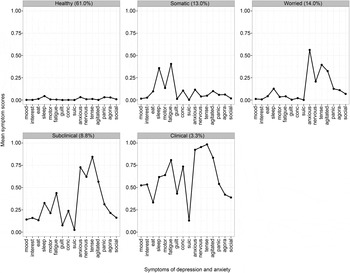
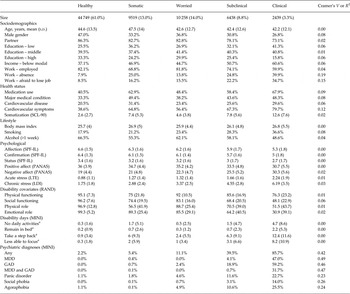
Of the five-class MM-IRT-C model, the largest class was a ‘Healthy’ class of 61.0%, with a minimal amount of depression and anxiety symptoms, high physical and social functioning, scoring highest on positive psychological factors, with highest education, income and employment rate, and lowest absence from work (Fig. 1, Table 2).
Symptom profiles of disability-driven classes of depression and anxiety symptoms of the final five-class Mixed Measurement Item Response Theory with covariates model.

External correlates of latent classes

s.d., Standard deviation; SCL-90, Symptom Checklist; SPF-IL, Social Production Form; PANAS, Positive and Negative Affect Schedule; LTE, List of Threatening Events; LDI, Long-term Difficulties Inventory; MINI, Mini International Neuropsychiatric Interview; MDD, major depressive disorder; GAD, generalized anxiety disorder.
All F and χ2 tests significant at p < 0.001, only effect sizes are reported.
a Number of days in the past 30 days.
The model included two classes that reported mild levels of symptomatology and decreased levels of physical and social disability. The first class (‘Somatic’, 13.0%) reported mainly ‘fatigue’, and ‘sleep disturbances’ combined with low physical functioning. People in this class were comparatively older, had a higher BMI, poorer health status with more major medical conditions, and had few psychiatric diagnoses. The second class (‘Worried’, 14.0%) often reported anxiety symptoms like ‘feeling anxious’, and ‘feeling tense’ but few depression or panic symptoms. Functioning in this class was lower compared to the Healthy class but considerably higher compared to the other classes and the prevalence of psychiatric disorders was low (11.1%). The Worried class had increased levels of chronic and recent stress, more days with disability, more absence from work and worries about losing their job.
The two remaining classes (‘Subclinical’ and ‘Clinical’) reported higher amounts of symptomatology and higher levels of disability. The Subclinical class (8.8%) frequently reported anxiety symptoms and elevated depressive symptoms. Despite the fact that this class had poor functioning, high levels of internalizing symptoms, and low scores on positive psychological factors, only 39.5% satisfied DSM criteria for a diagnostic classification. The Clinical class (3.3%) showed high frequencies of both depression and anxiety symptoms, low levels of social functioning, and increased role limitations due to emotional problems and physical health problems. A high percentage (85.7%) of this class met criteria for a DSM classification and almost all co-morbid cases of MDD and GAD were found in this class (93.9% of the 824 co-morbid cases). Interestingly, the Clinical class did not capture a single disorder, but included both MDD (47.0%) and GAD (59.2%). In addition, the Clinical class had poor health status compared to all but the Somatic class, scored lowest on positive psychological factors, highest on chronic and recent stress, and highest on negative affect. Further, the Clinical class reported most disability days, had the lowest mean education level, income, and employment rate.
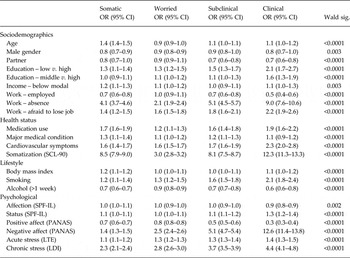
Multivariate regression (Table 3) showed that psychological factors best predicted class membership (R 2 = 21.7%), followed by health status (R 2 = 21.3%), demographics (R 2 = 9.4%), and lifestyle factors (R 2 = 2.3%). Overall, strong predictors of Subclinical and Clinical class membership, respectively, were work absence [Subclinical: odds ratio (OR) 5.1; Clinical: OR 9.0], somatization (OR 8.1 and 12.3), low positive affect (OR 0.3 and 0.5), high negative affect (OR 5.1 and 12.6) and chronic stress (OR 3.7 and 4.4).
External variables predicting class membership (odds ratios of standardized variables with 95% confidence intervals are reported)

OR, Odds ratio; CI, confidence interval; SCL-90, Symptom Checklist; SPF-IL, Social Production Form; PANAS, Positive and Negative Affect Schedule; LTE, List of Threatening Events; LDI, Long-term Difficulties Inventory.
Multivariate logistic regression model with Healthy class as reference estimated using a proportional maximum likelihood approach with robust standard errors. Backward selection using CAIC as criteria eliminated SPF-IL behavioural confirmation scale, and cardiovascular disease from the model (coefficient estimates were also non-significant at p > 0.41).
Discussion
Exploring symptom data from a large population sample, the current study identified five cross-diagnostic subtypes of depression and anxiety (Healthy, Somatic, Worried, Subclinical, Clinical), using a statistical method that accounted for severity differences within each class and incorporated disability as an additional source of inter-personal variation. These results provided important new insights into the different phenotypical presentations of depressive and anxiety symptomatology in the population, summarized by three key observations: (i) disability is an important source of information to identify clinically relevant subtypes in psychiatry, (ii) data-driven classes did not differentiate between pure depression v. anxiety disorders, and (iii) there was a large class with clinically relevant depressive and anxiety symptomatology at subthreshold levels. Each of these is discussed below in more detail.
First, many symptoms of depression and anxiety (e.g. fatigue) are non-specific: they frequently occur in other instances than depressive or anxiety disorders (e.g. fatigue in Somatic class), which is a known source of heterogeneity in anxiety and depression (Wanders et al. Reference Wanders, Wardenaar, Kessler, Penninx, Meijer and de Jonge2015; Wardenaar et al. Reference Wardenaar, Wanders, Roest, Meijer and De Jonge2015). In the current study, the inclusion of domain-specific disability measures of physical and social functioning improved the differentiation between subjects reporting isolated non-specific symptoms from those with more severe psychopathological symptoms. This finding is in line with previous studies showing the predictive value of disability measures (e.g. McKnight & Kashdan, Reference McKnight and Kashdan2009), and recent ideas as stated in the Research Domain Criteria framework (Cuthbert & Insel, Reference Cuthbert and Insel2013) that advocate a focus broader than symptom scores alone for better distinction between normal and abnormal behaviorur (Insel, Reference Insel2014).
Second, no classes describing pure depression or anxiety were observed; only mixed presentations (Subclinical and Clinical), consistent with growing evidence for strong aetiological and phenomenological overlap between depression and anxiety. Besides strongly correlated and highly co-morbid (Kessler et al. Reference Kessler, Berglund, Demler, Jin, Merikangas and Walters2005), both disorders share genetic risk (Kendler et al. Reference Kendler, Neale, Kessler, Heath and Eaves1992), and load on a single internalizing dimension (Krueger & Bezdjian, Reference Krueger and Bezdjian2009; Wright & Simms, Reference Wright and Simms2015). Moreover, depression and anxiety often have comparable treatment indications and respond similarly to antidepressants (Turner et al. Reference Turner, Matthews, Linardatos, Tell and Rosenthal2008; Roest et al. Reference Roest, de Jonge, Williams, de Vries, Schoevers and Turner2015), psychosocial treatments (Haby et al. Reference Haby, Donnelly, Corry and Vos2006) and self-guided help (Cuijpers et al. Reference Cuijpers, Donker, van Straten, Li and Andersson2010a ). In contrast to previous subtyping efforts within anxiety, and within depression, the current findings suggest high convergence with etiological and treatment literatures.
Third, the finding that a large part of the sample (8.8%, Subclinical) experienced clinically relevant symptomatology on subthreshold levels, without meeting diagnostic criteria, is in line with studies on anxious forms of depression (Goldberg, Reference Goldberg2014) and latent class analyses investigating mixed anxiety depression disorder (Das-Munshi et al. Reference Das-Munshi, Goldberg, Bebbington, Bhugra, Brugha, Dewey, Jenkins, Stewart and Prince2008; Hettema et al. Reference Hettema, Aggen, Kubarych, Neale and Kendler2015). Although labelled as subclinical in our study in line with that the majority do not meet DSM criteria of a full diagnosis, we show that participants in this class suffer from serious disability resulting in negative impact on public health (Das-Munshi et al. Reference Das-Munshi, Goldberg, Bebbington, Bhugra, Brugha, Dewey, Jenkins, Stewart and Prince2008) and high economic costs (Cuijpers et al. Reference Cuijpers, Smit, Penninx, de Graaf, ten Have and Beekman2010b ; Ormel et al. Reference Ormel, Jeronimus, Kotov, Riese, Bos, Hankin, Rosmalen and Oldehinkel2013). Subthreshold anxiety and depression with functional impairment are moreover strong predictors of subsequent full syndrome onset (Karsten et al. Reference Karsten, Hartman, Smit, Zitman, Beekman, Cuijpers, van der Does, Ormel, Nolen and Penninx2011), again emphasizing this subtype's pertinence.
The Subclinical and Clinical classes showed strong associations with somatization and somatic symptoms (including cardiovascular) and these associations were even stronger than in the Somatic class, suggesting these somatic complaints have to some extent non-physical aetiologies and are part of the mental disorder (Simms et al. Reference Simms, Prisciandaro, Krueger and Goldberg2012; Bekhuis et al. Reference Bekhuis, Boschloo, Rosmalen and Schoevers2015). The Subclinical and Clinical classes were also characterized by markedly decreased positive affect and increased negative affect. This is in line with research showing that low positive affect and high negative affect can reflect a general vulnerability to psychopathology (Ormel et al. Reference Ormel, Jeronimus, Kotov, Riese, Bos, Hankin, Rosmalen and Oldehinkel2013). In the current results, this vulnerability was further emphasized by high scores on experienced chronic stress and occupational problems in these classes.
Strengths of this study include the large sample size, use of a full interview-based assessment of depression and anxiety symptoms without skips, use of advanced latent variable models, the incorporation of disability as additional source of inter-personal variation, and use of independent subsamples for model fitting (training set), and model selection and validation (validation set). However, there were also limitations. First, the use of a cross-sectional population sample without clinical information about psychiatric disorders (e.g. history, duration, treatment) limits generalizability of the results. It is likely that within the Clinical class, clinically relevant subclasses also exist, but that these remained undetected because of the relatively limited number of participants with severe depression and anxiety. Second, different time intervals for current depression (last 2 weeks) and anxiety (last 6 months) were used, which might have resulted in classes which were separated based on symptom duration instead of symptom quality. However, analyses that modeled the assessment interval of each symptom found no effect on obtained results. The strength of this design is that the currently used time intervals correspond to diagnostic criteria (e.g. DSM-5) and reflect a consensus about the duration a symptom should be experienced to be considered part of a disorder.
The strong separation observed between the Clinical and Subclinical classes suggests qualitatively distinct structures of depression and anxiety symptomatology in each class. Detailed investigation of their differences on the symptom level in future work may (i) yield insights into the specific symptoms that play a key role in the transition to a full clinical disorder with high disability (Fried & Nesse, Reference Fried and Nesse2015), (ii) explain why individuals experience subthreshold symptomatology yet with associated disability, and (iii) could increase our understanding of the relationship between symptoms and the underlying internalizing spectrum (Wright et al. Reference Wright, Krueger, Hobbs, Markon, Eaton and Slade2013). An interesting starting point could be symptoms of ‘guilt feelings’ and ‘concentration problems’ that showed the strongest differences between the Subclinical and Clinical classes. Interestingly, previous studies have found an important role for ‘concentration problems’ with a large unique impact across different disability domains (Tweed, Reference Tweed1993; Fried & Nesse, Reference Fried and Nesse2014).
The longitudinal design of Lifelines allows for future studies to test the predictive value of the identified classes in prospective data. Eventually, if these data-driven classes prove to be robust and have sufficient predictive power over time, they could serve as starting-points for new classification models and be evaluated for their potential added value for treatment. Such an alternative empirical classification scheme could serve as an early stage stratification tool, recognizing that a sizable proportion of individuals in need of care suffer from a mixed presentation of depression and anxiety at a subclinical level. Ultimately, the efficiency and effectiveness of mental healthcare could be improved if these Subclinical individuals could be identified and treated with low-cost, effective primary-care treatment programmes (Patel et al. Reference Patel, Weiss, Chowdhary, Naik, Pednekar, Chatterjee, De Silva, Bhat, Araya, King, Simon, Verdeli and Kirkwood2010) or guided self-help (Cuijpers et al. Reference Cuijpers, Donker, van Straten, Li and Andersson2010a ) and referring only Clinical individuals to high intensity specialized care.
Conclusions
The present study described the structure of current depression and anxiety symptoms in the population with several subgroups showing mild isolated symptomatology and two cross-diagnostic subtypes with serious disability on either a clinical and subclinical level. The results suggest that diagnostic nets should be cast wider than the current phenomenology-based categorical systems to allow for a clearer focus of efforts to decrease the burden and costs of depression and anxiety in the population.
Supplementary material
The supplementary material for this article can be found at http://dx.doi.org/10.1017/S0033291716002221.
Acknowledgements
The current study was supported by a VICI grant (no.: 91812607) received by Peter de Jonge from The Netherlands organization for Scientific research (NWO-ZonMW). The Lifelines Biobank initiative has been made possible by funds from FES (Fonds Economische Structuurversterking), SNN (Samenwerkingsverband Noord Nederland) and REP (Ruimtelijk Economisch Programma). Lifelines is a facility that is open for all researchers. Information on application and data access procedure is summarized on http://www.lifelines.net.
Declaration of Interest
None.