After the gang rape of twenty-three-year-old Jyoti Singh Pandey in the suburbs of Delhi in December 2012, images of protests across India triggered by the incident looped and relooped in Indian national and international media. Along with many thousands of others across the world, watching my television and computer screen at home in London, I was shocked by the brutality of the attack on the young woman and saddened to learn that she later died of her injuries. The following summer, at the Edinburgh Festival, I heard of Nirbhaya, directed by South African theatre-maker Yaël Farber, which dealt with the Delhi gang rape. The play used as its title and publicity image the Hindi word meaning ‘the fearless one’ tattooed across an Indian woman's back. Witnessing the play's re-enactment of the incident, and hearing the catalogue of its female performers’ testimonies of their own experiences of violent and sexual abuse, I found Nirbhaya profoundly difficult to watch and to listen to. Like other audience members, I joined the standing ovation of the cast, but left the auditorium in tears.
Afterwards, I considered a comment posted on Facebook by an acquaintance who had also seen the play. Nirbhaya, he commented, had left him ‘battered’. Thinking about this, I could not deny that the play was hard-hitting, transferring to its audience members a sense of the trauma that its performers had suffered. But then, I reasoned, have not such incidents and women's accounts of them regularly been silenced or brushed aside? As a feminist, how should I respond to the aggrieved and solicitous voice of women's testimony? Such questions and others incited me to follow the play's progress. I saw Nirbhaya at the London South Bank, where it was invited to be part of the Women of the World Festival in March 2014, and in India, where it was first performed at the Ficci Auditorium in Delhi. Following its Facebook page, I learnt that the play also toured to Mumbai, Bangalore and the Pavilion Theatre in Dublin. By the time it was performed in London, the play had been seen by thousands of people, and won a Herald Angel Award, a Scotsman Fringe First Award and an Amnesty International Freedom of Speech Award. When I saw it in India, the paraphernalia of sponsorship, logos and marketing that it had attracted seemed to be symptomatic of broader cultural, political and ideological allegiances. Strips of stars awarded by critics now joined the tattooed scar across the poster woman's back, as if to adorn her with the stamp of critical acclaim. Witnessing these developments, and participating in them as an audience member, seemed to complicate the issue of responding to the play's female testimonies further. A ticket to the play seemed to have become ‘hot’, its potential audiences competing for a chance to experience a ‘hit’ show, as much as to express support for the issues it raised and to break the silence around the abuse of women. The success of Nirbhaya had created a platform for interested parties to broadcast not only concern regarding violence against women, but the interests of their own organizations.
I wish to explore these and further ethical issues of using and responding to female testimony. In her work on violence against women in early modern performance, Kim Solga cautions ‘feminist spectators’ against shutting down and branding a disturbing or violent performance inadequate. An ‘ethical response’, she counsels, is needed, which goes beyond preferred ways of seeing and knowing.Footnote 1 Even beginning to point to such a response is a challenge, given the complexities of hearing and responding to traumatic and traumatizing testimony.Footnote 2 As part of my efforts I choose to attend closely to female voices that carry personal and experiential testimony, exploring their disruption of traditional configurations of private and public space. I also want to hear these voices in a global context in which activist and advocacy movements are using accounts of violence against women across physical contexts and virtual spaces and sites. While the potential of these tactics is powerful, they can raise well-rehearsed ethical objections by presenting the issue of violence against women as universal, grouping its witnesses within a totalizing ‘we’, and skating over the local and specific contexts in which incidents take place.Footnote 3 When such a ‘foreclosure of alterity’ occurs in the name of feminism, as theorist Judith Butler argues, it can become ‘unequivocally identified with the imposition of values on cultural contexts willfully unknown’.Footnote 4 By attending closely to the voices of Nirbhaya, and to the use of female testimony as a tactic of local and global movements, I argue that female voices risk displacement, mediatization and co-option through their role as advocates and agents of cultural change. In doing this, I try to use my practice as a scholar of theatre as a form of ‘ethical response’ that not only attends to the solicitous female voice in embodied contexts, spaces and networks, but also is alert to the economies of audibility which reveal evolving globalized geopolitical motivations and structures.
Nirbhaya
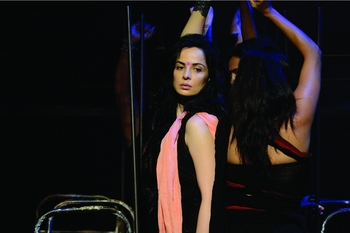
My response to Nirbhaya at Edinburgh in August 2013 developed as I entered the rather grand Assembly Auditorium, took in the atmospherically lit staging and became aware of an ominous soundscape. As the play progressed, I watched its enactment of events of the evening of the gang rape of Singh Pandey, played by Japjit Kaur, in a series of broken interludes. Between these sequences I heard a string of accounts given by female actors, Sapna Bhavani, Priyanka Bose, Poorna Jagannathan, Sneha Jawale and Rukhsar Kabir (Fig. 1), all testifying to the bodily violation that they had themselves suffered previously.
Rukhsar Kabir in Nirbhaya, Edinburgh, 2013. Photographer: William Burdett Coutts.

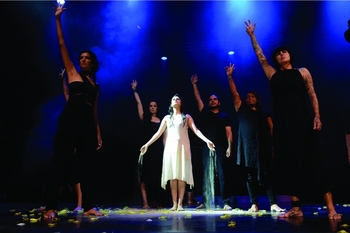
Their accounts formed a dreadful litany of abuse, including being raped as a child, suffering extreme domestic violence, and falling victim to violent gang rape in the United States. One male actor, Ankur Vikal, took on various roles – authoritarian husband, witnessing brother, gentle boyfriend, abusive ‘uncle’ – that served the women's stories. I noted that he played a key role in the translation into English of the testimony of Sneha Jawale, hideously scarred by acid after her family failed to make dowry payments to her husband's family. As the events of the gang rape unfolded, at key moments the action of the physically enacted narrative was frozen, most notably when a member of the cast was poised with a metal bar to penetrate the body of Singh Pandey. In these pauses Kaur stepped out into a psychic, timeless space from which her sad and lovely Hindi singing gently but fearlessly laced through the violent accounts and enactments, calling to the other women's testimonies from the ‘darkness’. Inhabiting a space that was not tied to a specific time, these women's testimonies recalled experiences that seemed to bleed out into the symbolic, present not only to me and their other witnesses in the auditorium, but in the universal space in which individual violations become violence against women in general. In a sequence that recalled to me the ‘coming out’ of previously closeted gay performers, each of the cast members identified herself as a victim of abuse.Footnote 5 ‘Poorna Jagannathan’, the actor–producer of the show, was the first to name herself, her parents, and the crime against her: ‘sexual abuse’.Footnote 6 In the final image of the play the actors’ arms were raised, a gesture of solidarity, of survival and of ongoing struggle, recalling an iconic image from the protests at Indiagate of a young woman with an arm held aloft in protest. It was a gesture that faced the audience, and seemed to me, whether intended or not, to include, incite and enlist its members. At this moment, I felt the play had performed a shift from the testimonial to the persuasive, not only positioning me as witness of these women's abuse and survival, but also aligning me as a fellow campaigner and potential activist.
There could be many grounds on which I or any other scholar could object to Nirbhaya. Speaking at the International Federation of Theatre Research conference in 2014, Professor Bishnupriya Dutt argued, for example, that the play perpetuated a cycle of female victimhood that places pain and penetration at the centre of a woman's experience, and reduces her to a sexual organ.Footnote 7 It would not be difficult to see in the beautiful actress–singer Kaur's playing of Singh Pandey, with her virginally pure, white salwar kameez and her modest demeanour, a seductive portrayal that could be linked to philosopher Theodor Adorno's critique of the aestheticization of suffering, and was recently described by theatre scholar Lucy Nevitt in Theatre & Violence.Footnote 8 Neither would it be difficult to point to how the play's mythologizing structures seemed at odds with the production's testimonial form and range of other authenticating documentary techniques. Often these seemed to me to be manipulatively deployed, designed to make Singh Pandey appear noble and self-sacrificing in her aspirations. Through the other actors, I was told that Singh Pandey asked her father to give her only the money he would have spent on her wedding to pay for her studies. Her last words, ventriloquized by Vikal – ‘I’m sorry, mama. I can't fight any more’ – were intensely affective, played to emphasize Singh Pandey's humility and filial dutifulness in death, as well as the actor's own empathetic concern. Of the young woman's statements on her deathbed to the police about the identity of her killers, about which I later discovered, nothing was said. Further, the choric dialogue, a strategy chosen to represent major parts of Singh Pandey's story, came close to giving a dominant narrative voice based on a distinctly Western point of view. She was called, quite deliberately near the beginning of the production, ‘an emerging new India’, a young woman both ‘devoted to her family’ and longing to leave ‘restrictions’ behind her. Indeed, the play seemed to confirm the media's repeated references to Singh Pandey as ‘India's daughter’, a description that fits only ‘if by India one means the nation that belongs to the aspiring, English-speaking middle-class’.Footnote 9
While the play gave an opportunity to its female performers to articulate the specific nature and context of their experiences, it seemed to me that the play's greater commitment was to the universal principle of female bodily integrity. During a sequence when the action left India for Chicago, Sapna Bhavnani described her refusal as a young girl to conform to norms of modesty enforced by Indian women. She got drunk, lost her virginity and dressed in ‘high heels’ and ‘fuck-me lipstick’. She and the cast enacted her being callously gang-raped by a group of students in the US, lit by the same moonlight as in India, and accompanied by Singh Pandey's singing of a Christmas carol. This was for me an intensely problematic point in the play, which in its dissolution of the parameters of representational space dissipated a sense of specific physical and material contexts. Colourful plastic bowls, one of which Bhavnani used to bathe her defiled body, were soon after carried on the other cast members’ heads, a practice which I presumed was intended to recall a common image of women in developing countries. Surely the play enters here the notoriously contested territory that has beleaguered the feminist agenda, which appears to put the universal rights of women above a consideration for local context, and aligns the play more than ever with a spurious universalism that ultimately obscures and elides rather than respects the complex vocal geographies that underlie individual testimony.Footnote 10 But here my own interpretation slips into the present tense, perhaps a symptom of a totalizing and objectifying reaction that helps me to dispose of the psychic and physical responses that it incited within me and which still affect me as I write this now.
It seems possible to declaim the play's power to move its witnesses given the aforementioned reasons, as well as others. Yet I find that I cannot now unsee its representation of events, nor unhear what it told me. Its accounts of violent abuse have profoundly affected me; as literary scholar Shoshana Felman argues of testimonies of trauma, these dreadful stories seem to ‘beget’ themselves upon me and ‘pursue me’.Footnote 11 I am particularly drawn to return to the testimony of Jawale, the performer whose face was permanently scarred by acid after an attack by her husband's family. On each of the three occasions I saw her perform, Jawale's account was deeply emotional, tears streaming down her scarred face, testifying to the still open psychic wound caused by her treatment and by the separation from her son who was taken from her. Here, it seems to me, Jawale's story teeters at the brink of the known and the unknown: that ambiguous but fertile terrain whose ethical implications have been explored by theorists such as Cathy Caruth and Sara Ahmed. Telling the ‘story of a wound that cries out’, Jawale's physical scars, her streaming tears, her presence onstage and her ‘own’ ‘original’ words, all seemed to me to promise to deliver access to ‘a reality or truth that is not otherwise available’.Footnote 12 Yet the apparent ‘truth’ of her testimony also triggers an awareness of the impossibility of feeling another's pain and an ethical responsibility to the other that speaks. Further, in the case of my response to Jawale, as a non-Hindi speaker and a British woman with little knowledge of the diurnal conditions of women's lives in India, I am conscious that the impossibility of feeling any other person's pain is compounded by the limits of my cultural knowledge and understanding. Here, where a woman's voice seems to call most loudly for an answer, I feel most acutely the limits of my abilities to empathize, and least certain of my right to respond.
The sense in which a cry of pain demands to be heard while also revealing the limitations of empathy has been present in philosophy and in critical discourse. Here, the language of crying out recurs around moments of crisis and violence in human relations. Caruth, in discussing Freud's use of the story of Tasso to illustrate the psychic revisiting of catastrophic events upon their victims, notes the power of ‘the moving and sorrowful voice that cries out, a voice that is paradoxically released through the wound’.Footnote 13 This power, following the thinking of philosopher Emmanuel Levinas on the voice as a metonym of human vulnerability, incites its hearer to consider the relations of him- or herself to the other. Some discourse on oral performance goes further, insisting that the acts of giving testimony and bearing witness make possible a sense of social change, a radicalism produced as a result of the imaginative, sensuous and collective response of audiences.Footnote 14 Certainly, the incitement of response through the sensuous and emotional cry of the human voice raises further questions around affect and emotion. The voice of testimony, proceeding from a damaged individual, creates a sense of moral onus, and a power to a greater or lesser extent benign, whose influence on others is hard to resist. Notwithstanding the constrictions that I have signalled with regard to responding to Jawale's heartbreaking testimony, it seems not only inhumane but also morally remiss to fail to attend to it. To hear and respond to another's pain is to recognize the validity of that individual's experience within the public sphere, and the speaker's right to have it legally and culturally acknowledged.
Hearing female testimony
At this point I want to give further reasons why I felt compelled to listen to the gruesome accounts of Nirbhaya, hung as they were around its enactment of the Delhi gang rape. My feeling of obligation is compounded by the discourses in feminism which lead me to understand rape as a practice that quite literally controls and regulates the behaviour, bodies, voices and movements of women. According to US feminist Susan Brownmiller, rape is a ‘sexual invasion of the body by force, an incursion into the private, personal inner space without consent – in short, an internal assault . . . and a hostile, degrading act of violence’.Footnote 15 Of all crimes, rape surely reminds me of the vulnerability of the borders between my body and others, and the necessary observation of consensual practices in social conduct. It is an act that, because of tendencies in some cultures to assume it is natural and therefore futile to complain of, has tended to render the female voice powerless.Footnote 16 Worse, as Jasminka Kalajdzic's 1996 article ‘Rape, Representation, and Rights’ argues, the widespread acceptance that it is a natural occurrence means that states have had a vested interest in using it as a military tactic, with apparently little to gain by involving women in developing legal measures to prevent it. The law, as it now stands, Kalajdzic says, ‘lacks women's voices’.Footnote 17 In more diurnal legal cases of sexual abuse and rape, the pitting of different and differently weighted accounts of the same event against each other has often undermined female testimony – by no means only in India, but in many Western nations, including my own, the United Kingdom. This leads to the notoriously vicious circle that lack of legal conviction leads to underreporting. In India, The Hindu newspaper has claimed that the National Crime Records Bureau (NCRB) occludes this obscure area even further, grossly undercounting rape by recording only the ‘principal offence’ of ‘murder’. Gang rape is not categorized as a crime at all.Footnote 18 It is hard to accept that such culturally and legally enforced negation and erasure of female experience and agency is not a form of deprivation that can contribute to a damaging sense of abjection. Frequently dependent as a ‘truth’ on women's voice to testify to it, rape is a crime that demonstrates the fragility and contingency of the wounded voice, and the difficulty of convincing its hearers that the person who has been violated should be attended to and believed – let alone be deserving of redress.
It can be argued that attending to testimonies such as Nirbhaya's is to combat stigma, endorse women's voices and experiences in the public realm and encourage alternative non-violent structures of social conduct. Farber aims to use theatre to challenge cultural attitudes around rape, and to ‘break the silence’ that is complicit in its perpetration. Indeed, she describes the sense of conviction behind the making of an earlier play, A Woman in Waiting (1999), based on the memories of South African actress Thembi Mtshali-Jones, as emerging from a sense of the ‘haunting silent presence’ of the women on the ‘periphery’ of the Truth and Reconciliation hearings.Footnote 19 In Nirbhaya the testimonies seemed not only to proceed from the physical injuries of their complainants, but also to emerge as a response to the sense that the women's individual identities had been hidden or silenced in a void of darkness. A recurring trope was the obliteration of self. Jagannathan testified to disappearing down a ‘rabbit hole’ when abused as a child, and Priyanka Bose, who was abused by a series of individuals known to her family, felt one day that she had been ‘swallowed’ by a man in a park. In focusing on making women's voices audible, and on bringing the private and stigmatized into the open, Nirbhaya seeks to redress a balance, and to reverse the powerful cultural dynamics that shame women's voices into silence. For Farber, the horrific rape of Singh Pandey was both a ‘wound’ and a ‘window’ through which the ‘light’ of truth can enter.Footnote 20 This recalls Felman, who in Testimony claims that ‘the wound gives access to the darkness’ that language must traverse in its attempt to access reality.Footnote 21 Farber's use of ‘window’ again suggests the imbrications of personal pain and public perception – that a wound is both a frame and a portal, conducting and facilitating both expression and understanding. Arguably, her use of ‘light’, with its Christian connotations, suggests a missionary purpose to her efforts.
Nirbhaya does not stop at its attempts to bring to the surface the truth of female experience. In some respects the play's strategies are risky and its demands radical. Its final image (Fig. 2), of Kaur's outstretched arms and backlit form, may suggest Christian martyrdom, but it is the coming of the powerful and destructive Indian Goddess Kali that also drives the ending of the play. ‘Bring it the fuck on’, cast members intone, as they voice their awareness that their demands will elicit hostility. This ‘truth-telling’ play seeks not only to counter the physical violation of the female body with a space of voice and of listening, but to be a catalyst of moral and cultural change whatever the consequences. Speaking for myself, its call to arms both stirs and fires me, but also returns me to some of my major sticking points. If I am to join the struggle, I not only accept a role as a witness to violence and the responsibilities that this entails, but also align myself with modes of activism that contribute to a global coalition whose interests may sometimes exceed or complicate the desire to recognize the validity of female experience. I need to remember that ‘stories of pain involve complex relations of power’, that testimonies are often displaced into spaces and contexts far from the sites and circumstances which provoked them, and that neither testifier nor witness can wholly dissociate themselves from the factors which confer cultural audibility.Footnote 22 Since witnessing it in three different auditoria I have continued to wonder if Jawale's testimony in Nirbhaya – so far displaced from the original context in which the events it referred to occurred – was made audible by the same forces of global power and market economics that might exploit and exacerbate the suffering of women whose voices remain unheard.
Closing image, Nirbhaya, Edinburgh, 2013. Photographer: William Burdett Coutts.

The female voice and transnational advocacy
Nirbhaya can be seen as part of a global wave of feminist advocacy that seeks to address violence against women (VAW) within the framework and discourse of human rights. Over recent decades, since its introduction as an object of UN activity in 1985, the issue has been pushed up the agenda by feminist and human rights campaigners, charities, advocacy groups and other non-governmental organizations (NGOs), supplanting historically divisive concerns such as discrimination and development as a focus for the international feminist movement. A shift has occurred, following activist Charlotte Bunch's 1990 article, towards ‘women's rights as human rights’, and away from the discrimination framework which was behind the UN Convention of 1979 that enjoined states to ‘modify the social and cultural patterns of conduct of men and women’.Footnote 23 Diverse issues such as female genital mutilation (FGM), rape, sex trafficking and domestic violence have been appearing in public discourse with frequency. Further, it seems that everywhere in the Western media, women of status, reputation and power have been making their voices heard. Human rights advocate and former actress Bianca Jagger, in her Longford Lecture in 2013, called for the elimination of VAW to be included in the UN Development Agenda in advance of its 2015 agreement.Footnote 24 Other women, such as actress Angelina Jolie, who has promoted and advocated for humanitarian causes for over a decade, is ‘fighting’ for female rights by campaigning against rape as a political tactic in war zones.Footnote 25 Perhaps most potently of all, Pakistani schoolgirl Malala Yousafzai, shot in the head by a Taliban gunman in 2012 in the Swat Valley in Pakistan, seems to have become a one-woman ‘condensation symbol’, rallying support and, in her own words, ‘raising women's voices’ for female education and empowerment.Footnote 26 A relative newcomer in the campaigning game (unlike her co-winner of the Nobel Peace Prize Indian activist Kailash Satyarthi), much of the power of her ‘voice’ comes from what is perceived as a true display of courage to speak out in the face of the most fearful personal danger. Eliciting the kind of extreme emotional response upon which advocacy movements rely (described in 1998 in Activists beyond Borders by Margaret Keck and Kathryn Sikkink long before Manuel Castell's 2012 discussion of the use of emotion in activist networks in Networks of Outrage and Hope), her ‘wound’ appears to have legitimized and universalized her voice in terms of its right to cry out for other women, and to help them raise their own voices.
Female testimony has historically been an important tactic in campaigns to bring attention to the abuse or exploitation of women. In 1993 in Vienna, a Global Tribunal on Violations of Women's Rights used personal testimonies to support the case for women's rights as human rights. A film framed women's stories, using dozens of testimonies, in which women spoke of violence perpetrated upon them.Footnote 27 In very recent times, a plethora of NGOs have mounted campaigns, using the voices of ‘ordinary’ women who have suffered and survived violence. Often these campaigns employ the shift from the testimonial to the persuasive that I hear in Nirbhaya. In 2014, in UNiTE's film Survivor Stories (2014), first a young German testifies to the domestic abuse she has suffered, and then she is followed by women from different countries, races, ethnicities and cultural backgrounds: Sosan, Noor, Katrianna, Maria Amalia all speak in their native languages, their voices audible under the English voice-over that translates their experiences.Footnote 28 Here, the women's male aggressors remain unseen, the women filmed alone or with children, sometimes on journeys, sometimes – like the English-speaking Oyama – symbolically placed on the restorative shores of an unknown sea. Such women populate not only the UNiTE campaign, but also a vast ocean of websites, congregating globally in ‘psychic space’ that hosts a morally driven narrative structure of risk, rescue and survival. Here, Ratna Kapur's very powerful point is pertinent: that while the establishment of a ‘shared location’ has brought the issues of violence against women out of the private or domestic ‘female’ realm, it tends to underline women's status as victims.Footnote 29 Further, whether safe in cyberspace, represented in a film for distribution on the Internet, or insulated like the actresses in Nirbhaya by a theatre auditorium, the women have become not only deracinated from the polyphonous sites in which they suffered violence, but also potentially attached to new violence-producing contexts (a point to which I will return).
Another major tactic of the feminist movement has been the creation of networks that support and enhance female audibility. A series of international UN conferences in Mexico, Copenhagen, Nairobi, Vienna, Cairo and Beijing have helped to bring women together and led, Keck and Sikkink argue, to the ‘interactive’ exchange of ‘beliefs, information, testimony, strategy, and sometimes services’. This has been a process, they report, that may have led women to change ‘each other’.Footnote 30 Of course it is also important to recognize the way that networks that appear to work horizontally may disguise vertical structures of privilege and power. In the End Sexual Violence in Conflict conference in London in 2014, attended by Jolie and British foreign secretary William Hague, state and celebrity voices joined forces around the issue of stopping rape as a tactic of war. After the conference, pictures of Jolie hugging a Congolese campaigner were widely published, as were reports of Jolie's ‘welling up’ as she heard victims talk of their experiences.Footnote 31 Such reporting serves to emphasize as important the practice of Western empathy, reinforcing rather than disrupting, through the globalized media, structures that determine, as Butler puts it, what ‘can appear’ and who ‘can be heard’.Footnote 32 Further, the staging of these events may point to the uncomfortable discrepancy between the state's display of empathy for women's voices and its highly selective willingness to act. After all, it has often been the role of NGOs to call the state to account, rather than to construct a united front. The UN refugee agency the United Nations High Commission for Refugees (which made Jolie an ambassador in 2001), for example, has been concerned about the failings of UK Visas and Immigration to deal with women who have been victims of sexual violence. One woman, reported the Observer, claimed that Home Office officials ‘screamed’ at her, that they thought she was a ‘liar and that they can come for me in the night’.Footnote 33 These officially unsanctioned testimonies seem to illustrate the limits to the extent to which the state will respond to the cry of an abused and vulnerable female, especially if her presence seems to conflict with its more pressing electoral and ideological priorities.
It seems fair to suggest that in the case of Nirbhaya the conditions that made the performance of its testimonies possible were created through the support and investment of a transnational network of individuals, businesses and communities willing to share or be seen to be sharing the play's humanitarian messages. Its original production benefited from the support of Assembly, where in the previous year Farber had a huge success with her ‘South African’ Mies Julie; from private investment by ‘theatre angels’, such as US philanthropist Marshall Cordell and the actress and producer Trudi Styler; from the multinational courier company DHL; and from a grant from the Indo-American Arts Council. In addition, many investments, large and small, were made by hundreds of donors to the Nirbhaya Kickstarter funding campaign that raised over fifty thousand pounds. On its subsequent international tour it has been supported by organizations as diverse as the British Council, South African Airlines, the Ford Foundation and UN Women. Its progress has raised paradoxes and contradictions. Jagannathan has elsewhere gained celebrity in Delhi Belly, a film that makes light of, amongst many things, the issue of rape. The cast's appearance in Indian Vogue, posing stylishly amongst the fashion models in pure white Western garments, as well as the corporate branding it has attracted, suggests the problematic imbrication of marketing and advocacy.Footnote 34
Most apparent when I saw Nirbhaya in Delhi at the Ficci Auditorium was the way that the production was gathering a coalition of players.Footnote 35 Before the play, representatives of several parties took the stage, framing its voices according to various agendas, including the British Council's support for ‘high-quality’ work originating in Britain, and the collective moral outrage of the UN's staff at the Delhi gang rape. It was left to the chief executive of Oxfam India, Nisha Agrawal, to refer to the grave difficulties faced by organizations attempting to change cultural practices. In spite of the 2005 law passed by the Indian parliament to protect women against violence, 70 per cent of men and women, she told the audience, thought that wife-beating was acceptable, especially if dinner was not ready on time. Asking the audience to be ‘change-makers’, Agrawal argued that more important than law were the attempts to change attitudes made by Oxfam and other NGOs in Africa and South Asia. Indeed, the Ugandan Raising Voices campaign (1999–), and the We Can initiative in South Asia (2004–) to which she referred, had been using both physical and virtual networks. A ritualistic pledge, in the shape of a promise by abused women to reflect, and to talk to ten others, has aimed to create an embodied and supportive network that begins with female solidarity and sharing experience. This is a version of the ‘power-within’ tactic long used by organizations aiming to build women's confidence in finding their own solutions to male violence.Footnote 36 A report on the project admits the difficulties in assessing the success of such initiatives, particularly in the long term; that violence against women, particularly in the shape of female infanticide in South Asia, has worsened; and that the rise of religious fundamentalism is a severe impediment to progress.Footnote 37
Asking for it?
Across the world it seems women are asking for an end to the violence against them, but in ways that sometimes elide the issue of VAW with agendas that push economic and cultural opportunity. At times, this potentially places women not in a place of safety but in the dangerous front line of the literal and symbolic struggles for cultural and territorial dominance. The cast of Nirbhaya was indeed ‘fearless’, its actresses courageous in their willingness to risk the pain of reopening their wounds, and ‘shaming’ themselves in public. At both the South Bank and Ficci the women's bravery was acknowledged in the post-show discussion. Many audience members expressed gratitude to the actresses for bringing the private into the public, and relieving the burden of their own stigmatized experience. Many felt compelled to speak to the performers afterwards, or share their own stories of abuse. Many spoke of their new resolution as mothers to begin to educate their sons.
Yet in spite of these many performances of fearlessness, in London when they were about to embark on their tour of India, I also noted the cast's fears. After the show, its members confessed they had not told their mothers about abuse they had suffered while still living with their families, and yet were performing their testimonies to hundreds of strangers every night. At the South Bank they admitted that the idea of breaking the silence became much harder to put into action the nearer to home they got. Further, in spite of their desire to reclaim the night, the mothers in the cast confessed their impulses to protect their own daughters, and keep them indoors. Jagannathan told me herself, when I met her at the event, that she was very anxious indeed regarding security issues and the response they would face in India, somewhat qualifying the play's repeated exhortation to ‘bring it the fuck on’. As feminists have known for many decades, the progress made by acting upon anger may be undermined or undone because of the violent reaction or backlash it can provoke.Footnote 38 Disturbing norms of private and public space not only is traumatic for both the instigator and the witness, but also potentially increases the physical vulnerability of both.
When I have seen and heard Yousafzai, I have been impressed by her ‘dreams’ of ‘equality’ and of ‘justice’. Yet her calls for women to use their voices as ‘weapons’, such as that she made during her 2014 visit to Nigeria to meet the families of the girls kidnapped by Boko Haram, raises some awful questions.Footnote 39 To be clear, I wish neither to question the good intentions of Yousafzai, nor to disparage the work of her fund with local partners in Jordan, Pakistan, Nigeria and Kenya.Footnote 40 I do, however, want to hear her voice, which cries out quite consciously on behalf of women, as part of a wider geopolitical context in which the role of women has become an intensely politicized issue. I also want also to recall philosophers Michael Hardt and Antonio Negri's claim that the ‘moral intervention’ made by NGOs is not disconnected from the type of ‘imperial intervention’ made in geopolitical contexts.Footnote 41 In July 2013, Yousafzai addressed the UN, telling the highly sympathetic audience that ‘weakness, fear and hopelessness’ had died, and that ‘strength, power and courage’ were born. The extremists, she said, were afraid not only of pens and books, but of women.Footnote 42 Not surprisingly, US first lady Michelle Obama invoked Yousafzai when she took her husband's weekly television broadcast to address the nation regarding the abduction of the Nigerian girls. Malala's ‘courage and hope’, Obama told the nation, served as a ‘call to action’. Watching the broadcast, I found it difficult to ignore the way Obama's sincere and passionate address seemed to converge with the American foreign-policy agenda. Girls’ attendance at secondary school, she argued, ‘boosts their country's entire economy’ and is the ‘best chance’ for the girls ‘themselves, the family and the nation’.Footnote 43 Her version of an ideal female subject in developing countries is a girl who conforms to and indeed labours to fulfil economic goals.Footnote 44 As the news of the ‘marrying off’ of the kidnapped Nigerian girls reminds me that the cries and outcries of women continue to be ignored or deemed not important enough to ‘act’ upon, it seems hard to deny that they are also used to serve the interests of diplomatic and political persuasion, of economic and imperialistic territorialism, of terrorism, of international crime and of military interest.Footnote 45
As I approach the end of this article, which has tried to mobilize caveats and provisions in the service of critical activism, I want to stand up for the potential of female voices to imagine and create a safer and more equal world. In India, where there is a long and varied history of female protest against patriarchal behaviours, the pink-sari-clad Gulabi Gang led by Sampat Pal Devi in the poor rural Uttar Pradesh area have used both dialogue and direct confrontation to challenge domestic abuse.Footnote 46 Many Indian groups are using performance as a means to educate and empower both women and men. Internationally, NGOs continue to promote cultural change, not only with regard to raising female voices, but also by encouraging men to change.Footnote 47 At Nirbhaya, there were standing ovations, the audience making their own symbolic gesture of solidarity by standing up for the de-silencing of the female voice. In both India and London I heard men and women asking what they could do, one young woman at the South Bank offering her service to the production as a volunteer, others lingering to speak to the staff of the NGOs. Such impact suggests that testimony has the power to pursue its witnesses and elicit a sense of responsibility in others, and can incite and provoke both action and reaction. Yet given this power it is necessary to be aware of how it appoints and aligns both testifiers and witnesses, and the cultural audibility it provides is partly the outcome of complex and powerful vectors of geopolitical, ideological and economic influence. Though overtly feminist, Nirbhaya's testimonies are framed by traditional Christian and Hindu religious tropes that have not historically wholly suggested the liberation and equality of women in public spaces and spheres. As I have discussed, the play's funding suggests the support of neo-liberal alliances which do not necessarily free women from sexual objectification or eliminate economic and cultural violence against them. Rather, they support minimal and tactical investments in doing so. In attempting to make an ethical response to testimonies of violence against women I feel obliged to attend to female voices, but I am also challenged to acknowledge the local and global contexts from which they emerge and the ways their cries are displaced, mediated and co-opted by forces whose invisible powers swirl under and around the apparent spaces of safety that confer their audibility.
As of April 2015, Nirbhaya continues its global itinerary. The play is running for a month at New York's Culture Project, ‘New York's Premier Home for Socially Conscious People’.Footnote 48 The project's name, along with that of ShivHans Pictures, a self-financing film production company, is now prominent in the play's publicity, tattooed across the poster woman's back along with SOLD OUT! signs across four of the play's previous international venues. In March, Leslee Udwin's BBC documentary on the Delhi gang rape, due to be shown on International Women's Day, was banned from broadcast in India after a court order gained by the Indian police prohibited broadcast. The film includes an interview with one of the four men convicted of Singh Pandey's rape and murder, in which he expressed the view that women are more responsible for rape than men. A defence lawyer in the case says he would set fire to a female member of his family who ‘disgraced’ herself. Uploaded multiple times on YouTube, clips from the film have received hundreds of thousands of hits, in spite of the channel's compliance with the Indian government's order to block them.Footnote 49 While testimonies of trauma ‘beget’ themselves upon and ‘pursue’ their hearer, the relationship is reciprocal, and the space they breach from known to unknown experience may also breed and beget diverse responses and interpretations which may gain cultural traction louder and more powerful than the voices of those who cry out. What was ‘opened’ by the wounds and death of Jyoti Singh Pandey was a conduit for competing discourses and potentially explosive tensions between forces of cultural change, reaction and control. As a part of this, Farber's Nirbhaya may not be the truth, but it is a way in which some women are making use of their economic, cultural and creative resources to gain cultural audibility. Safety, equal treatment, and freedom from violence for many women in diverse countries and contexts remain privileged commodities.