Introduction
Variationists have begun with increasing frequency to investigate the social meaning of variation, as opposed to correlations between linguistic patterns and speaker identities (Campbell-Kibler Reference Campbell-Kibler2007; Eckert Reference Eckert2000; Johnstone & Kiesling Reference Johnstone and Kiesling2008; Llamas Reference Llamas2007; Mendoza-Denton Reference Mendoza-Denton2008; Moore Reference Moore2004; Podesva Reference Podesva2007; Schilling-Estes Reference Schilling-Estes2004; Wagner Reference Wagner2007; Zhang Reference Zhang2005, Reference Zhang2008). For scholars concerned with social meaning, the analytical focus has shifted to what the use of a particular linguistic form means when it is uttered or heard. With an emphasis on the interactional significance of sociolinguistic variation, we are left wondering what the connection is between interactional meaning and larger, more enduring units like identity categories. Recent work on style and identity by Bucholtz & Hall Reference Bucholtz and Hall2005 and Coupland Reference Coupland2007 underscores the idea that both fleeting and persistent levels of identity are articulated through language use, but what is the nature of the relationship between these levels? This article aims to shed light on the relationship between interactionally grounded social meanings and ideologically governed identity categories by investigating the social meaning of tag questions.
Before motivating our decision to examine tag questions, we must briefly elaborate on what we mean by the term “social meaning.” In its narrowest sense, social meaning can be defined as “the stances and personal characteristics indexed through the deployment of linguistic forms in interaction” (Podesva under review). As this definition suggests, an approach privileging this level of social meaning, while it does not deem identity categories unimportant, treats the choice between linguistic variants as being motivated primarily by the stances taken by virtue of using a particular variant (e.g. Kiesling Reference Kiesling2002; Ochs Reference Ochs, Duranti and Goodwin1992). Although the term “stance” has been construed in a number of different, if related, ways in sociolinguistics (Du Bois Reference Du Bois and Englebretson2007, Goodwin Reference Goodwin2007, Jaffe Reference Jaffe2009, Kärkkäinen Reference Kärkkäinen2006, Kockelman Reference Kockelman2004, Schiffrin Reference Schiffrin2006), most approaches involve the act of evaluation. As Du Bois (Reference Du Bois and Englebretson2007:163) notes, “In taking a stance, the stancetaker (1) evaluates an object, (2) positions a subject (usually the self), and (3) aligns with other subjects.” While most work on stance concentrates on its discursive construction, stances can also be taken by virtue of using a linguistic variant. For example, Eckert Reference Eckert2000 has shown that a group of “burnouts” (stancetaking subjects) in a high school in suburban Detroit more frequently employ negative concord than do their “jock” counterparts. Negative concord indexes a rebellious stance built in opposition to the school (the evaluated object), a stance that burnouts take more than their jock peers (with whom the burnouts disalign). That burnouts use more of this feature has less to do with their identification as burnouts per se than it has to do with the rebellious stances burnouts habitually recruit.Footnote 2
What enables us to interpret negative concord as “burnout” is this feature’s occurrence in a way-of-being that is recognizably burnout. For the burnouts at Belten High, negative concord is neither socially nor linguistically isolated; this feature is but one element in the constitution of a style. As this term has come to denote myriad distinct concepts in variationist research – most notably attention paid to speech (Labov Reference Labov1972), audience design (Bell Reference Bell1984), and speaker design (as in Schilling-Estes Reference Schilling-Estes, Chambers, Trudgill and Schilling-Estes2002) – it would be useful to specify how we employ the term here. Adopting the definition proposed by the Half Moon Bay Style Collective, we treat style as “a socially meaningful clustering of features within and across linguistic levels and modalities” (Campbell-Kibler, Eckert, Mendoza-Denton & Moore Reference Campbell-Kibler, Eckert, Mendoza-Denton and Moore2006). Crucially, as this definition states, styles are clusters of features rather than singular and isolated forms divorced from other language. They are embedded in social practice and occur across linguistic levels, such that syntax, phonology, and discourse work synergistically rather than independently of one another. We also note that style is not simply an array of meaningful signs, because such arrays do not take on meaning unless they contrast against another array of signs. Consequently, we follow Irvine Reference Irvine, Eckert and Rickford2001 in treating style as distinctiveness.
Styles can be reified when speakers are actively categorized in relation to them. For instance, in Eckert’s study, the act of labeling someone “burnout” makes burnout style visible in ways that other styles may not be. The reification of a style generates a social category, which may be salient as a local level persona (“burnout”) and/or as a structural demographic social type (“working class”). It is important to note that, while all styles are socially meaningful, not all styles achieve categorical status. That is, as analysts, we can identify the style of a group, but the group itself may not be ideologized relative to the style we observe. What is more, when styles are reified as categories, the process may operate differently depending upon who is doing the ideologizing (Wenger Reference Wenger1998:61). Consequently, it is important that we make a distinction between styles, which refer to the analyst’s observation of a group’s social and linguistic practice, and categories, which are ideological instantiations or interpretations of stylistic practice.
In our discussion of social meaning, we have been careful thus far to avoid using the term “identity.” Identity has become something of a loaded term in sociolinguistics, as one of us discusses elsewhere (Moore forthcoming). Cameron & Kulick Reference Cameron and Kulick2003, Reference Cameron and Kulick2005 have been critical of the hegemonic presence of identity in sociolinguistic research, claiming that such a focus obscures the wide variety of social purposes fulfilled by language. It is important to note, however, that Cameron & Kulick (Reference Cameron and Kulick2003:104; Reference Cameron and Kulick2005:123) define identity in relatively narrow terms: as the habitual embodiment or “claiming” of a social position. By this definition, identity is something that is allocated to an individual voluntarily or by someone else as a “social address.”
Elsewhere in sociolinguistics, scholars use “identity” in a broader sense, defining it not just in terms of social position, but as a process that spans different social levels. Coupland (Reference Coupland2007:113–14) refers to macro-, meso- and micro-social identity frames – corroborating Bucholtz & Hall’s (Reference Bucholtz and Hall2005:592) argument that “identities encompass (a) macro-level demographic categories; (b) local, ethnographically specific cultural positions; and (c) temporary and interactionally specific stances and participant roles.” By this definition, all speakers are constantly engaged in identity work; whether or not speakers are actively constituting a demographic identity type, they will be appropriating and constructing social meanings in ways that identify them relative to micro-, meso-, and macro- identity frames.
In line with Bucholtz & Hall Reference Bucholtz and Hall2005 and Coupland Reference Coupland2007, we embrace the idea that demographic categories reflect a distinct level of social meaning (and one that has provided much important context for sociolinguistic inquiry). However, we also acknowledge the difficulties of the terms “identity” and “category,” which can span different social levels. Consequently, in this article, we use the terms “stance,” “persona,” and “social type” to refer to the different types of social meaning potentially articulated by the use of a linguistic feature. To return to the “burnout” example above, it is possible to observe the following social meanings associated with negative concord in Eckert’s study: a rebellious stance, a burnout persona, and a working-class social type (the last referring to the demographic category predominantly associated with the burnouts in Eckert’s study). Stances reflect micro-social identity processes, personae (or local social categories) reflect meso-social identity processes, and social types (or demographic social categories) reflect macro-social identity processes. To understand what a linguistic feature means requires us to understand how it is embedded in the styles that generate recognizable meaning at one or more of these social levels.
A theoretical concept crucial to our understanding of the connections among linguistic features, style, and social meaning is indexicality, and more specifically, Silverstein’s (Reference Silverstein, Basso and Selby1976, Reference Silverstein, Mertz and Palmentiers1985, Reference Silverstein, Schieffelin, Woolard and Kroskrity1998, Reference Silverstein2003) notion of indexical orders. Silverstein (Reference Silverstein, Basso and Selby1976:15; Reference Silverstein, Mertz and Palmentiers1985) observes that linguists tend to study meaning in terms of its referential properties (its “semanticity”) and its pragmatic properties (its “pure indexicality”) and argues that the social meaning of any utterance (or its “total linguistic fact”) is a consequence not only of its referential properties, but also of the ways in which it is ideologically construed in the context of its use. Thus scholars interested in the interface between linguistic form and meaning must be able to account for the co-presence of multiple social meanings – meanings that are constructed as speakers rationalize correlations between linguistic features and social information. Silverstein (Reference Silverstein2003:194) argues that the interpretive process begins with a correlation of some sort (the n-th order index), which semiotically competes with further indexical orders (which may have been formed through a repackaging/reinterpretation of the n-th order association): “N + 1st order indexicality is thus always already immanent as a competing structure of values potentially indexed in-and-by a communicative form of the n-th order, depending on the degree of intensity of ideologization.” Thus, Silverstein (Reference Silverstein2003:216–20) is able to explain Labov’s Reference Labov1972 social class and (attention-to-speech) contextual style findings in New York City in terms of an ideological schematization. He characterizes the correlation between high social class and standard variants as a 1st-order indexical (the n-th order), which is assigned the 2nd-order indexical (n + 1st order) meaning of “prestige” via the ideological interpretation of the speech behavior of the upper social classes. The latter indexical order is hypothesized in Labov’s contextual style findings.
Silverstein’s model provides a framework through which it is possible to explain the relationship between different levels of social meaning. It should be noted, however, that Silverstein himself does not prioritize any “level” of meaning in his framework. Although he describes n-th order indexicality as “preideological” and n + 1st order indexicality as “postideological,” he clearly states that this is something of a conceit, given that “there is no possible absolutely preideological – that is, zero-order, social semiotic” (1998:128–29). In this sense, an analyst may observe any n-th order correlation (be it at the level of stance, persona, or social type) and consider its relationship with a different level of social meaning in terms of an n + 1st order indexical ideologization.
Nonetheless, Ochs’s (Reference Ochs, Duranti and Goodwin1992) treatment of indexicality clearly suggests that some types of social meaning are more direct than others. For Ochs, few features of language directly index demographic categories like gender (and by extension, social class). Rather, these indexical levels are mediated by stances, acts, and activities that are considered to be typical or unmarked behaviors for a given category of speakers (Ochs Reference Ochs, Duranti and Goodwin1992:343). In this sense, we might suppose that ideology more strongly governs the connection between linguistic practice and macro-social categories (like social class and gender) than it does that between linguistic practices and micro-social stances. Of course, the more ideologically laden a level of meaning is, the more potential there is for the co-presence of multiple and competing social meanings, as Johnstone, Andrus & Danielson Reference Johnstone, Andrus and Danielson2006 have shown.
It is important to note that the ability to make indexical connections between linguistic features and social meanings is nothing new to sociolinguistics. Labov’s (Reference Labov1963) discovery that the use of centralized diphthongs correlated with a positive orientation toward the island of Martha’s Vineyard effectively highlighted the indexical link between this feature and the “Vineyarder” style of fishermen, up-islanders, and island-loyal youngsters. Nevertheless, the Vineyarder style constitutes only one of the levels of social meaning outlined above. A full account of the social meaning of centralized diphthongs would, for example, additionally consider the stance(s) they articulate and the ideological association between such stances and Vineyarder style.
In this article, we attempt to offer an analysis that captures the levels of social meaning that can be attributed to a single linguistic feature: tag questions. Following Eckert Reference Eckert2008, we will place the myriad social meanings that could be attributed to tag questions in a single ideological plane, an indexical field, which captures the interrelationships among different levels of social meaning. We aim first to show how stylistic context enables linguistic features to articulate stances, personae, and social types, and second to reflect upon the ideological space these levels of meaning occupy.
Tag Questions and Indexicality
Tag questions are well suited for exploring the connection between micro-, meso- and macro-social meanings, since the relationship between their functional properties (their ability to mark stance) and their propensity for indexing styles and social categories has long been recognized. Lakoff (Reference Lakoff1975:15), for example, argues that tags – “midway between an outright statement and a yes-no question” – suggest a lack of confidence on the speaker’s part. She points out that this perceived lack of confidence at the micro-social level could come to index a social type at the macro-social level, arguing that women are expected to use tentative forms, which simultaneously subordinates them and marks them as feminine. However, the categorical labeling of questions as less assertive than statements is, of course, problematic when one takes the context of an utterance into account. Compare, for instance, a statement like I’m not much of a dancer uttered by an especially shy adolescent with the question Do you want to take this outside? uttered by a burly nightclub bouncer.
Many sociolinguists have drawn attention to the multiple pragmatic functions tag questions can serve, faulting Lakoff for focusing on just one.Footnote 3 Holmes Reference Holmes1982, Reference Holmes1984, Reference Holmes1995 was the first to seriously draw attention to the manifold purposes that tags can serve. She distinguishes between epistemic modal tags (those that request information about which the speaker is genuinely unsure, e.g. Nobody’s using this chair, are they?), and affective tags (those that indicate concern for the addressee either by being facilitative, e.g. It’s a lovely day, isn’t it?, or softening, e.g. That was a bit silly, wasn’t it?). Based on a quantitative analysis of her corpus, Holmes reports that epistemic modal tags and softening affective tags are used more by men, and that facilitative affective tags are used more by women. Crucially, she illustrates that tags may not only express a lack of confidence, but can be used to facilitate discourse or interpersonal relationships.
Others have gone on to propose a wider range of stances potentially articulated by tag questions. Drawing on Holmes’s work, Cameron, McAlinden & O’Leary Reference Cameron, McAlinden, O’Leary, Coates and Cameron1989 point out that tag questions can be used to request information, increase an utterance’s politeness, or facilitate talk. Importantly, and in contrast to Lakoff Reference Lakoff1975, not all of these functions work to subordinate women. Algeo Reference Algeo1988 makes a similar argument, asserting that in British English tags can sometimes be used in a peremptory or aggressive manner. He suggests that tags are employed for such purposes by women and men alike, and further notes that neither type of tag is likely to be interpreted as sounding tentative. Finally, Winefield, Chandler & Bassett Reference Winefield, Chandler and Bassett1989 also argue against the deferential interpretation of tag questions. Although their quantitative analysis reveals that a female patient’s use of tag questions increases over the course of psychotherapy, qualitative analysis reveals that her specific use of tags represents increased levels of independence.
While taking stock of the pluralistic pragmatic functionality of tags, it is important to acknowledge that determining such functions is by no means a straightforward endeavor. Holmes (Reference Holmes1995:113) admits that “interpreting the function of tags is a subjective business”; the need to add a third category of affective tag, “challenging,” to her 1995 analysis alludes to the difficulty in assigning affective meanings to the tag questions in her analysis. Furthermore, it is not necessarily the case that using tags to articulate one stance precludes the simultaneous conveyance of another. As Coates (Reference Coates1987:130) observes, speakers regularly “exploit the polypragmatic nature of [linguistic items] to say many things at once.” Accessing speakers’ motivations in particular moments of interaction, to the extent that it can be done, presents the sociolinguist with a difficult challenge. Consequently, we argue that we also stand to benefit from attending to what the structure of the tag enables a speaker to communicate.
Cheshire Reference Cheshire1981 attends to precisely this issue in her examination of the interplay between the grammatical composition of a tag and its function in the discourse. Examining tags relative to the wider linguistic practice of the speakers who used them, she distinguishes between tags whose content could be confirmed/disputed (because the interlocutor knew the information) and those whose content could not (because the interlocutor did not have the required knowledge). The former, which she calls “conventional tags,” occurred with a wide range of verb forms, from nonstandard ain’t and int to standard negated forms (e.g., ‘isn’t’). In contrast, nonconventional tags occurred only with int. Cheshire further observes that these int tags achieved an aggressive meaning and were used predominantly by adolescents engaged in the vernacular culture. Here then, the meaning of the tag question as aggressive and/or challenging is determined not only by Cheshire’s “sense” of the stance articulated by the tag, but also by virtue of its grammatical design. This particular tag was composed using a marked nonstandard form associated with the aggressive vernacular style in which it predominantly occurs. Cheshire’s (Reference Cheshire1981) work highlights our earlier point that single linguistic features like tag questions are stylistically embedded and may indeed express meaning through other linguistic features, such as the morphosyntactic forms they contain. For Cheshire, the structure of the tag (which was indexically linked to a social style) disambiguated its social meaning.
In our analysis of tag questions, we aim to present a stylistic analysis of the trajectory of social meaning that connects micro-social stances to macro-social social types, via meso-social personae. We accomplish this task first by utilizing quantitative methods to identify the basic and generalizable function of tag questions, which we discern via an analysis of the discourse contexts in which the variable occurs. We then trace how this feature is used to articulate a range of stances that are distinctly styled in the interactions of different communities of practice. In adhering to style, our analysis does not just assess grammatical structure, but also considers the phonological shape of tag questions, their turn context and design (where a tag occurs in a speaker’s turn and the response it achieves), and the nature of the talk in which they occur. The study differs from previous quantitative work on tag questions in that it locates statistical trends in the social practices and identities of its speakers. Other quantitative approaches (Andersen Reference Andersen1998, Reference Andersen2001; Nordenstam Reference Nordenstam1992; Tottie & Hoffman Reference Tottie and Hoffmann2006), though very robust for the purposes of identifying statistical trends, draw on corpora that lack ethnographic detail. We conclude by exploring how meaning is constructed recursively across linguistic and social contexts, endeavoring to illustrate the multimodal (i.e., constructed in social and linguistic practice) and indexically layered (i.e., adapted and redesigned across ideological space) nature of social meaning.
The Study
The data for this study are drawn from Moore’s (Reference Moore2003, Reference Moore2004) ethnography of female students at Midlan High, a school in northwest England. Between June 2000 and February 2002, Moore engaged in participant observation with a group of 40 girls in Year 8 (aged 12 to 13) when the research began and in Year 10 (aged 14 to 15) on completion of the fieldwork. Throughout this period, Moore went into the school to spend the lunch hour with the girls and engaged in whatever activity was occurring (this could range from simply eating lunch in the canteen, to attending a dance practice, to hanging out with the smokers behind the sports hall). The fieldwork was documented in field notes amounting to 196,400 words. Interactions between the girls were recorded from Year 9 onward. Recordings never took place as a formal interview and served as an extension of Moore’s regular interaction with the girls. The girls would discuss recent events and used the sessions as a way to record their activities. In addition to these recordings, questionnaires were also circulated to the study’s participants. These questionnaires provided an informant view on social practices, and were used to corroborate Moore’s ethnographic observations.
The recordings comprise approximately 50 hours of data and a 262,000-word corpus. In all, the corpus includes 778 tag questions. In this number, we count only those tags that follow a declarative. While McGregor Reference McGregor, Hasan and Fries1995, Reference McGregor1997 offers a typology of tag questions including those that can be preceded by interrogatives, imperatives, and exclamatives, forms other than declaratives were either exceptionally rare or nonexistent in the corpus. With respect to the form of the tag itself, we examined only those tag questions consisting minimally of both a verb and a subject. Lexical tags (e.g., huh, right) were thus excluded. We also excluded invariant verbal tags (e.g., innit). Although this grammaticalized feature predominates in London youth culture (Andersen Reference Andersen2001), our recordings from northwest England contained a single token of invariant innit (Cos it depends what mood she’s in, innit?). It appears that although the feature is widespread in the boroughs of London, it has not taken hold as strongly in the North, at least not among the adolescent girls studied here.Footnote 4
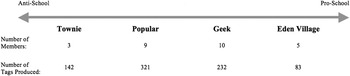
Given that linguistic features are used with reference to an overall linguistic and social style, the girls in this study were categorized according to community of practice (CofP) membership (Eckert & McConnell-Ginet Reference Eckert and McConnell-Ginet1992). Each girl’s CofP membership was determined on the basis of whom she spent time with, what activities she engaged in, her orientation to peers and her surroundings, personal style and appearance, and her own and others’ assessments of her group memberships. The four CofPs identified over the course of fieldwork can be superficially positioned on an anti-school to pro-school continuum. This continuum, though something of a generalization, is typical of school ethnographies that categorize students on the basis of their levels of engagement in activities deemed illegitimate by the school, such as smoking, truancy, and unauthorized occupation of space (cf. Willis Reference Willis1977). Figure 1 depicts this orientation and summarizes the number of speakers in and tags produced by each group. The Populars exhibit an anti-school attitude, display a sporty and feminine style of dress, and engage in moderately rebellious activities like drinking and smoking. They often associate with boys of the same age, frequently as their “girlfriends.” Midway during the fieldwork, the TowniesFootnote 5 emerged and broke off from the group of Populars, when the former started to engage in risky behavior such as drug-taking and sexual activity. Their friendship network includes older boys, with whom they spend time in the local area. Townies have a more streetwise dress style, which includes wearing gold jewelry and heavy makeup. The Geeks, by contrast, maintain most of their relationships through the school in activities like orchestra and sport. They wear little makeup and jewelry and take a more practical approach to their appearance. Although the Geeks, like the Populars, associate with male peers, Geeks form exclusively platonic relationships with boys. Finally, the Eden Village girls adopt a trendy “teen” style, wearing pastels and glittery accessories, preferring to spend free time dancing, shopping, and at sleepovers. Their friendship network is rather close-knit and excludes boys.Footnote 6
Communities of practice at Midlan High

Each of the 778 tag questions was coded for the tagger’s CofP, as well as a number of discursive, grammatical, and phonological factors. At the level of discourse, we carefully examined the discourse in determining (i) whether interlocutors expressed agreement with the tag; (ii) whether interlocutors overlapped with the tagger’s turn, and if so where; and (iii) whether tags occurred at the end of a turn or turn-medially. We examined agreement (i) primarily because much has been made of the solidarity function of tags (Coates Reference Coates1987; Holmes Reference Holmes1984, Reference Holmes1995). We were particularly interested in quantitatively examining whether the use of tags does in fact result in explicit expressions of accord. Each tag was categorized as being met with assent (i.e., the interlocutor explicitly agrees with the proposition expressed by the tagger), dissent (i.e., interlocutor explicitly disagrees), no response (i.e., interlocutor makes no reference to proposition expressed by tagger), and other (i.e., idiosyncratic responses, such as a request for clarification or an ambiguous response). We coded for overlap (ii) in order to investigate the potential role of tag questions in organizing discourse, marking whether interlocutors overlapped with the tagger before, during, or after the tag, if at all. We also examined the turn context (iii), coding each tag as either turn-final or turn-medial.Footnote 7 If tags encourage interlocutors to verbally engage in the interaction at hand, then we would expect tags to be placed at the ends of turns, where they facilitate turn transition.
Given Cheshire’s (Reference Cheshire1981) discovery that the internal composition of tags influenced their ability to communicate social meaning, we additionally coded for a number of grammatical and phonological factors. At the grammatical level, we examined the grammatical subject of the tag, as previous research has noted the high frequency of tags with it (Tagliamonte Reference Tagliamonte1998, Tottie & Hoffmann Reference Tottie and Hoffmann2006). The great majority of subjects in this study were pronouns; we distinguished between each, including the distinction between generic and specific you. Studying grammatical subject also enabled us to consider the type of talk in which tag questions occur, as we discuss later. Also at the grammatical level, we considered whether tags included nonstandard morphosyntax, enabling us to identify any correspondences between tag design and the use of nonstandard forms. By “nonstandard forms,” we refer to fully lexical forms, namely nonstandard were (the most common nonstandard form of agreement in the corpus) and ain’t. Here we made a three-way distinction between tags with nonstandard morphosyntax (e.g. His mum were downstairs, weren’t she?), those with standard morphosyntax (where nonstandard forms would have been possible; e.g. They’re happy, aren’t they?), and those in which there was no environment for nonstandard forms (e.g. She can be alright, can’t she?). The latter were excluded from this part of the analysis.
At the phonological level, we examined the realization of word-final /t/ within tag questions. We included this variable both because of the feature’s social salience (informants remarked on their parents’ “corrections” of intervocalic [ʔ] in the discussions of language use convened by Moore post-data collection) and because of the great deal of attention the glottalized and released variants of the region have received in the sociophonetics literature, particularly with respect to “youth norms” (Docherty, Foulkes, Milroy, Milroy & Walshaw Reference Docherty, Foulkes, Milroy, Milroy and Walshaw1997; Foulkes, Docherty & Watt Reference Foulkes, Docherty and Watt1999, Reference Foulkes, Docherty and Watt2005; Llamas Reference Llamas2007; Milroy, Milroy, Hartley & Walshaw Reference Milroy, Milroy, Hartley and Walshaw1995; and various articles in Foulkes & Docherty Reference Foulkes and Docherty1999). We were able to consider this feature because the overwhelming majority of the tags in our corpus exhibited negative polarity, the most common tag form in English (Kimps Reference Kimps2007), and hence carried a contracted form of not. Each word-final /t/ appearing in a tag question was coded as released, glottal(ized), deleted, or palatalized,Footnote 8 and the effect of linguistic factors (preceding and following phonological context) was also considered.
In addition to the aforementioned features, we investigated the verb used in the tag, syllable deletion, and the dropping of word-initial /h/. As none of these analyses revealed strong patterns according to CofP membership, we do not discuss them further here. One potentially salient phonological feature of tag questions not considered here is intonational shape. Although many scholars have taken note of the pragmatic importance of intonation to the interpretation of tag questions (Ladd Reference Ladd1981, Millar & Brown Reference Millar and Brown1979, Ramirez Verdugo & Romero Trillo Reference Ramirez Verdugo and Romero Trillo2005), examining the intonation of tag questions can be accomplished only once the meaningful tunes – for this particular variety from northwest England – are catalogued. Cruttenden Reference Cruttenden2001 contends that the intonational system of a very closely related variety, the Mancunian dialect, presents a particular problem for standard systems of intonational representation. Nonetheless, we recognize the value of an intonational analysis and plan to pursue this line of research in future work.
Similarities Across Groups
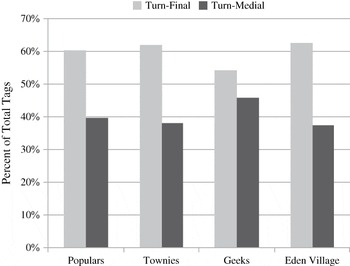
We begin discussing our results by identifying properties of tag questions that are similar or identical across the four communities of practice, and we conclude the section by discussing the social significance of such similarities. In spite of their widely divergent social styles, the four groups use tag questions in some discursively similar ways. Perhaps unsurprisingly, all four groups use tags at the ends of their turns the majority of the time. As indicated in Figure 2, a greater percentage of tag questions appear turn-finally than turn-medially (χ2 = 25.918, df = 1, p ≤ 0.001), with no significant difference between social groups.
Location of tag relative to speaker turn

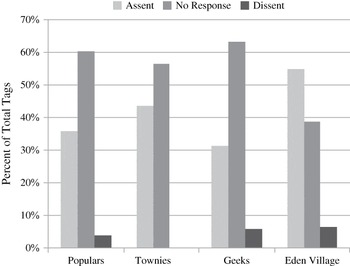
In addition to this pattern of tag production, we find cross-group similarity in how interlocutors respond to turn-final tags. As shown in Figure 3, for all four groups, interlocutors most often express explicit agreement with turn-final tags (χ2 = 222.583, df = 2, p ≤ 0.001), as opposed to expressing dissent or offering no response, with no statistically significant differences between the four groups.
Agreement with turn-final tags

Having established that tag questions most commonly occur at the ends of turns and that interlocutors most commonly agree with their propositional content, regardless of social group, we now turn to consider the meaning of these patterns. First, the fact that most tags are turn-final suggests that they are frequently used by speakers prior to conceding the conversational floor. That is, they are used to encourage orderly and shared turn-taking. This is consistent with Sacks, Schegloff & Jefferson’s (Reference Sacks, Schegloff and Jefferson1974:719) characterization of tag questions as exit devices. Furthermore, the fact that they most frequently receive agreement – and rarely dissent – suggests that they encourage recipients to take a stance in response, specifically one of alignment (Du Bois Reference Du Bois and Englebretson2007). This interpretation concurs with Hudson’s (Reference Hudson1975) analysis of the syntax and semantics of tag questions. He observes that tag questions carry the sincerity conditions of both a declarative and a question: much as with a declarative, “the speaker believes the proposition to be true,” and as with an interrogative, the speaker of a tag “believes that the hearer knows at least as well as he does whether or not the proposition is true” (Hudson Reference Hudson1975:24). Kimps (Reference Kimps2007:272) similarly notes that “tag questions convey the speaker’s orientation to the proposition by signaling a specific attitude and the expected response.” Tags are conducive, then, because they encourage the hearer to agree with a proposition – in the sense that it is easier to agree with an established proposition than to construct dissent against it – particularly when an interlocutor is responding to the first part of an adjacency pair. This is borne out in the quantitative results for the discourse shape of tags. These observations suggest that tag questions may have a basic function that is universal across social groups: being conducive. We use the term “conducive” in contrast to “facilitative.” The term “facilitative,” as it is commonly employed in the language and gender literature, implies altruism and positive politeness on the part of the speaker. In contrast, a speaker can be conducive for a number of different reasons – including being manipulative or enlisting support for a contentious claim. Only qualitative analysis could expose the nature of the conducing in the case of each individual tag question; we return to this issue below, in discussing the ways in which members of each CofP distinctively style tags.
The conducive nature of tag questions provides us with a starting point to begin elaborating on their social meaning. Recall that earlier we noted how Eckert Reference Eckert2008 places the myriad social meanings that could be attributed to a linguistic feature in an indexical field. If a variable has an underlying function that goes across its use, we may consider this core association, or “kernel of similarity” (Podesva Reference Podesva2008), to lie at the center of the indexical field as an n-th order indexical. In the case of tag questions, this n-th order indexical is “conducive.” Of course, the indexical field of tag questions extends well beyond the realm of the n-th order indexical value we have identified. We begin to move into the territory of higher-order indexical meanings in the following section, in which we examine differences in tag question usage between the four CofPs.
Distinctions Between Groups
In this section, we focus on stylistic practices at the discursive, grammatical, and phonological levels of tag question design. As discussed in the introductory section, we follow Irvine Reference Irvine, Eckert and Rickford2001 in treating style as distinctiveness and aim primarily to identify the differences between groups that emerge through quantitative analysis of the data. The social significance of these distinctions will be discussed in the next section. We begin by discussing intergroup differences in discourse properties of tag questions.
Recall from the previous section that speakers of all groups typically expressed agreement with turn-final tags. If we consider the rate of agreement with turn-medial tags, however, we find a different pattern. As is evident in Figure 4, most groups – the Populars, Townies, and Geeks – usually offer no response to turn-medial tags. Put another way, members of the Popular (χ2 = 13.562, df = 1, p ≤ 0.01), Townie (χ2 = 4.184, df = 1, p ≤ 0.06),Footnote 9 and Geek (χ2 = 18.157, df = 1, p ≤ 0.01) CofPs express agreement more often in response to turn-final tags than to turn-medial tags. We argue that this pattern obtains because the pragmatic pressure to concur with the proposition expressed in a tag question is reduced when the tagger does not concede the conversational floor.
Agreement with turn-medial tags

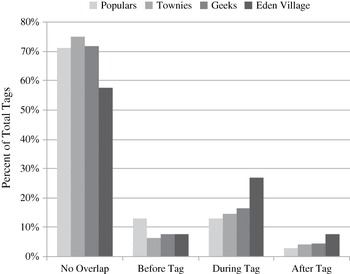
Shifting our attention to the Eden Village girls, the data reveal that they typically express agreement even with turn-medial tags. Though interactional norms do not necessitate the expression of agreement turn-medially, Eden Village girls provide it nonetheless. One can interpret this pattern to mean that Eden Village girls are particularly agreeable, or that they are reluctant not to respond to tags (Figures 3 and 4 both illustrate that of the four CofPs, Eden Village girls have the lowest percentage of “no response” responses). Either interpretation supports the claim that these girls exhibit a high-involvement style (Tannen Reference Tannen2005 [1984]). We find additional evidence for this claim if we examine the interaction between the expression of agreement and overlapping. Figure 5, which depicts the location of overlap relative to tags that were agreed with, shows that most tags are delivered turn-finally without overlap. More relevant to the point at hand, the figure indicates that Eden Village girls resist overlapping less and more frequently overlap with the tagger during the tag itself. Eden Village girls, then, exhibit a strong tendency for what Tannen Reference Tannen1990 terms “cooperative overlap,” which we operationalize as the co-occurrence of overlap and agreement.
Location of overlap relative to tag when expressing agreement

Shifting gears from variation above the level of the utterance to variation within the utterance, we focus our attention on the grammatical subject of the tag question. Unsurprisingly, we found that the grammatical subject used interacts with the content of the talk. For example, first person subjects are relatively common when groups are talking about their own CofP, but considerably less so when discussing other CofPs. Perhaps more interesting are the correlations between grammatical subject and CofP membership when individuals are not talking in the first person. When talking about their own group, Townies use relatively higher rates of he subjects in tags (14% compared to between 4–8% for the other CofPs). It is noteworthy that other groups generally did not talk about boys in contexts where they produced tags. All other groups, when talking about themselves, have high rates of she subjects in tags (Townies = 16%; other CofPs between 23–28%), indicating that they talked about friends in their own groups above anything else. The Populars and Eden Village girls also use high rates of we (c.25%, compared to c.13% for the Townies and the Geeks), suggesting that tags occur in collective and self-inclusive styles of talk. When talking about other groups, Townies’ tag questions have a relatively high number of they subjects (40%, compared to between 13–28% for other CofPs), while other groups tend to produce tags with more she subjects (7% for Townies, compared to between 28–63% for other CofPs). When talking about generic topics, all groups unsurprisingly prefer it subjects (and recall that invariant innit is not represented in the analysis). This finding is consistent with Tottie & Hoffmann’s (Reference Tottie and Hoffmann2006) observation that it is the most common pronoun in British English tag questions (they also exclude invariant innit from analysis), usually in the isn’t it? form. In analyzing the grammatical subject of the tag questions, we are given an indication of the wider discourse context of the tags’ occurrence. Given that tags are attributed social meaning on the basis of their contextual use, we discuss how the content of talk affects how a tag may be construed in the next section.
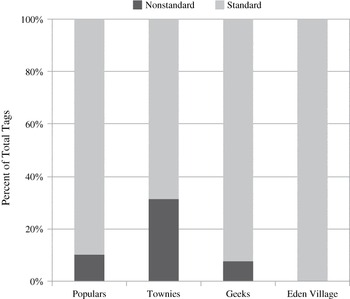
With regard to morphosyntax, we found that all groups predominantly produce standard morphosyntax, but the extent to which they do this correlates with their placement on a pro-/anti-school continuum (see above). As shown in Figure 6, the association between nonstandard grammar use and CofP is statistically significant (χ2 = 27.634, df = 3, p ≤ 0.01), with Townies producing far more fully lexical nonstandard forms than the other groups. In related work, Moore Reference Moore2003 investigated the effect of CofP as well as a number of internal constraints (verb function, subject type, and polarity) on the rate of nonstandard were, the most commonly used nonstandard morphosyntactic form. She reports that CofP strongly constrains its occurrence.
Nonstandard morphosyntax

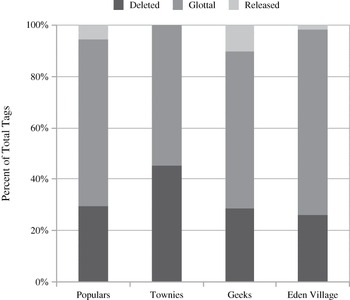
The last difference in tags between groups concerns a phonological feature, the realization of word-final /t/. Making a three-way distinction between deleted, glottalized, and released stops, we find that the distribution of variants varies significantly according to CofP membership (χ2 = 26.089, df = 6, p ≤ 0.01). As shown in Figure 7, all groups use the glottalized form most frequently and do so with the same frequency. While previous work observes extensive social differentiation in various degrees of glottalization (e.g., Docherty et al. Reference Docherty, Foulkes, Milroy, Milroy and Walshaw1997, Llamas Reference Llamas2007, Milroy et al. Reference Milroy, Milroy, Hartley and Walshaw1995), a multivariate analysis did not choose CofP as a factor influencing the use of this feature. We attribute this result to the fact that social class, gender, age, and geographical region – none of which varies significantly among speakers represented in the current study – are the most robust social dimensions of variation for this particular feature.Footnote 10 With regard to the other variants, Geeks release /t/ more than members of the other communities of practice, a finding which has also been reported by Bucholtz Reference Bucholtz and Ahlers1996, Reference Bucholtz2001 in her work on the linguistic practices of “nerds.” By contrast, Townies exhibit high rates of deletion when compared to the other three CofPs. Both of these differences obtain in VARBRUL analyses that factor in the effect of linguistic factors influencing the choice of one variant over another.
Realization of word-final /t/

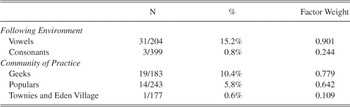
Table 1 summarizes the factors influencing the occurrence of released /t/. The following phonological environment is the strongest predictor of the released variant, with vowels strongly favoring it and consonants strongly disfavoring it. While previous work on linguistic factors affecting the rate of released /t/ (Benor Reference Benor2001, Podesva Reference Podesva2006) reports the significance of the preceding phonological environment and morphological affiliation, both of these factors are invariant in the data analyzed here, as all tokens are preceded by /n/, from the contracted form of not (e.g. isn’t). When taking the following environment into account, CofP still has a significant effect, with Geeks highly favoring the feature, Populars slightly favoring it, and Townies and Eden Village girls avoiding it nearly categorically.Footnote 11
VARBRUL summary of factors influencing occurrence of released (-t) in tag questions.

Input = 0.012, Log likelihood = -92.018, p ≤ 0.000
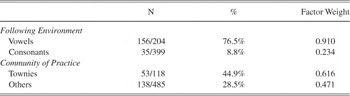
Table 2 encapsulates the results of a multivariate analysis used to determine factors influencing the occurrence of the deleted variant of word-final /t/. As was the case for the released variant, the following environment has the strongest effect on the occurrence of deletion, with vowels strongly encouraging deletion and consonants strongly discouraging it. This trend runs counter to every study on (-t/d) deletion, whether on White (Guy Reference Guy and Labov1980, Reference Guy1991), African American (Fasold Reference Fasold1972, Labov, Cohen, Robins & Lewis Reference Labov, Cohen, Robins and Lewis1968, Wolfram Reference Wolfram1969), or Chicano (Santa Ana Reference Santa Ana1996) varieties of U.S. English or (White varieties of) British English (Tagliamonte & Temple Reference Tagliamonte and Temple2005). We attribute this finding to the phonotactics of /t/ within tag questions. As mentioned previously, all of our (-t) tokens are preceded by /n/, whereas previous studies have examined the full range of preceding segments. In the environment n __ # C, /t/ is most commonly realized as a glottal stop or glottalized stop. On the other hand, in the environment n __ # V, /t/ is most frequently deleted, since the glottal variant is less permissible here. Regarding social constraints on the use of the deleted variant, Townies slightly favor the deleted form, while the other groups slightly disfavor it.
VARBRUL summary of factors influencing occurrence of deleted (-t) in tag questions.

Input = 0.239, Log likelihood = -227.903, p ≤ 0.047
To summarize the results of this section, we find a number of distinctive properties of each group’s tag questions. Compared to members of the other CofPs, Populars use relatively high rates of she and we as grammatical subjects when talking about themselves. In contrast, Townies are more likely to use he as a grammatical subject in the same context. They also use more vernacular grammatical and phonological forms, exhibiting higher rates of nonstandard verb morphosyntax and deleted /t/. Geeks use more conservative phonology in tag questions, using relatively high rates of released /t/. Finally, Eden Village girls, like the Populars, more frequently use she and we as grammatical subjects when discussing their own CofP. They differ from the Populars and the other CofPs, however, mostly with respect to the discourse design of tag questions, very often expressing agreement as interlocutors (even when speakers are in mid-turn) and often overlapping during the tag itself to express agreement. In the following section we look more closely into each CofP’s distinct practices of tag question usage, locating tag questions in their ethnographic and discourse contexts in order to tap into the range of social meanings they can index.
Tagging Styles
In this section, we focus on how members of the four communities of practice diverge in their use of tag questions and how divergences assist members in constructing distinct group styles. The girls whose stylistic practices are under analysis in this article combine features of discourse, grammar, and phonology in ways that contrast with those of their peers at Midlan High. This section is concerned with examining how constellations of each group’s distinct features of tag questions are employed in interaction and with situating these linguistic practices in relation to social practice. We show that even though all groups use tag questions, and that even though all of them use tags to conduce, what precisely is conduced varies greatly from one group of girls to the next.
For each of the four groups, we will discuss conversational extracts featuring the group’s prototypical tag design. That is, we examine excerpts featuring all or many of the tag components that make the group linguistically distinct from its peer groups, as identified in the quantitative analysis discussed in the previous section. It is important to note that we do not intend to suggest that every tag uttered by every CofP member is designed like the examples discussed. Rather, the examples are presented as illustrations of the group’s prototypical tag questions, which we take to represent iconic performances of group style. These constellations of features, or style clusters, “provide further insight into the social motivations for employing styles” (Podesva Reference Podesva2008:7).
The Popular tag
The extract in (1) features a clustering of eight prototypically Popular tag questions, each appearing in boldface. In this excerpt and all that follow, we use [ ] to indicate overlapping speech, < > for descriptions of nonlinguistic sounds or gestures, .. for pauses, and – for hesitations or disfluencies. The phonetic realization of /t/ in tag questions is represented in IPA, enclosed by square brackets; deleted variants are represented by [ø]. The girls in this interaction are talking about the substantial discord between Ellie, a Townie girl, and Annabel, another Popular girl.
(1) 1 Cindy: And I think.. at one point – at – near the end of Year 9, they changed for the
2 worse, some of them, din[ø] they? [They were really] awful. But..
3 Tina: [Yeah, cos like.. yeah]
4 Cindy: they’ve calmed down a bit now, [but..]
5 EM: [What,] like being bitchy about
6 [people and stuff?]
7 Tina: [Yeah, cos people –] some people like noticed more than others. D’you know
8 what I mean?
9 Cindy: Um.
10 Tina: Like.. especially like Annabel.
11 She – cos Ellie and Annabel don’t really get along, do they?
12 Cindy: No.
13 Tina: They’re only – they’re only really civil to each other. And they only get along if
14 like they’re in really good – if they’re in a really good mood. Say, if one of them’s
15 just in a bad mood – it’s s-, nothing to do with the other one – they’ll take it out
16 on that one.. on the other person.
17 Cindy: They don’t get on at all.
18 Tina: No.. They could be fine and then if someone brings summat up, one of them’ll
19 say something about her. D’ [you know what I mean?]
20 Cindy: [Yeah.]
21 Tina: D’you [know what I mean? So..]
22 EM: [I noticed when I came in like doing this – ] like yesterday, as soon as
23 Ellie came in the room, Annabel went out.
24 Tina: Yeah.
25 EM: They just won’t talk, will they?
26 Tina: No. They just – they’ve never got along really, have they? Cos when they were at
27 primary school, they – that’s what we’ve heard anyway.
28 Cindy: Yeah.
29 Tina: So..
30 EM: So are you still getting along with Annabel and stuff?
31 Tina: Well, yeah. We don’t despise her but she’s – she can be a bit annoying. She’s there
32 going, “<Sharp intake of breath>.” [Hyperactive,] in[ø] she?
33 Cindy: [Loud.] Well, cos me and Annabel were
34 quite close, but we’re not really as much any-, anymore, are we?
35 Tina: No.
36 Cindy: As much as we used to be. [Which] is quite good
37 EM: [Oh.]
38 Cindy: [<laughs>]. Cos I think it –
39 EM: [<laughs>]
40 Cindy: umm, we were too like together and it just..
41 Tina: Yeah, it kind of annoyed you a bit, [dint[th] it, when she was] babbling away?
42 Cindy: [Yeah, I dint like it.] Controlling and..
43 Tina: Yeah.
44 Cindy: And I just dint like it.
45 Tina: She’d be like really nasty to you [about stuff, weren’t[ʔ] she?]
46 Cindy: [Yeah. Being really awful.]
47 Tina: Like if she laughed or summat, she’d scream out,
48 “Cindy, shut the fuck up!”
49 Cindy: Yeah, if I laughed all the time.
50 Tina: Cos Cindy’s like really always laughing.
51 Cindy: <laughs>
52 Tina: Cos me and Cindy really get along. We just laugh about [anything.]
53 Cindy: [Cos we’re] the only
54 ones that get – get each other’s jokes, aren’t[ʔ] [we? Nobody gets our] jokes.
55 EM: [<laughs>]
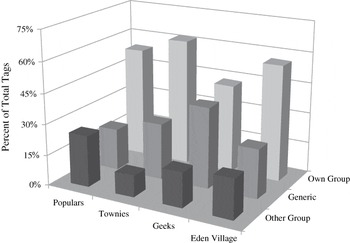
Recall that, in our analysis of grammatical subject, we noted that grammatical subject interacted with the content of the talk in expected ways (e.g., more first person subjects in talk about one’s own CofP). When exploring this interaction, we noted another stylistic peculiarity: Different CofPs tended to produce their tags in slightly different kinds of talk. As Figure 8 illustrates, most tags occur in talk about one’s own CofP, irrespective of the CofP membership of the tag producer. However, Populars produce proportionally more of their tags in talk about other groups than do other CofPs; whereas Townies produce proportionally fewer tags in this context. Note also that Geeks produce proportionally more of their tags when talking generically (i.e., in talk that does not relate to any of the speaker’s high school peers or extended social group) than do other CofPs. The association between CofP and the type of talk in which tags occur was found to be statistically significant (χ2 = 36.712, df = 6, p ≤ 0.01).
Type of talk in which tag questions occur

What distinguishes the tag questions in (1) as Popular tags, then, is their occurrence in talk about a girl belonging to another group (lines 1–2, 11, 26), and the tendency to use more she (lines 32, 45) and we (lines 33–34, 53–54) subjects in tags occurring in talk about their own group. An analysis of what Cindy and Tina accomplish in this extract provides us with a story about what this particular tag question design achieves. The extract shows that for Populars, tags occur in talk about people; more specifically, they are used to describe, evaluate, and position Populars individually and collectively relative to other people in their school. Tina contends in line 11 that Ellie and Annabel – one a Townie, the other a Popular – do not get along, attempting to enlist Cindy’s support in constructing opposition by asking a tag question. Cindy agrees with Tina’s assertion, explicitly assenting in line 12. Tag questions, as used by the Populars, seem to occur in talk that could be construed as gossip, which is often said to describe and evaluate (Coates Reference Coates and Coates1998, Gluckman Reference Gluckman1963, Jones Reference Jones and Cameron1990). For the Popular girls, tag questions – occurring as they do in talk that aims to conduce agreement around social engineering, identities, and self-presentation – may be an effective linguistic strategy in gossip contexts because of their ability to emphasize or intensify criticism. Later in the extract, after the opposition between Ellie and Annabel has been fully established, Tina and Cindy police norms within their own group. They claim Annabel as a member of their group (line 31), but not without a strong dose of criticism for hyperactivity (line 32), talking too much (line 41), and acting nasty (line 45). Tina and Cindy use tag questions in the context of criticism to jointly conduce a critical view of behaviors they deem unacceptable, which they contrast with more desirable behaviors, such as getting each others’ jokes (lines 53–54). In the latter case, a tag question is used to conduce agreement over what is acceptable.
The Populars themselves acknowledge the regulatory function that their tags serve. In post-fieldwork interviews, Moore asked a few Populars about their use of tag questions and whether they use particular variants. As Beverley observes in line 4 of the extract in (2), Populars utilize tag questions as a means of criticizing, with criticism generally falling on another girl, as suggested by the tag’s pronoun shift from line 1 to line 4.
(2) 1 EM: “In[ø] ‘e?”
2 Beverley: We do that.
3 Lindsey: Yeah.
4 Beverley: When you – when you’re slagging someone off. “Int[ʔ] she?” Yeah <laughs>.
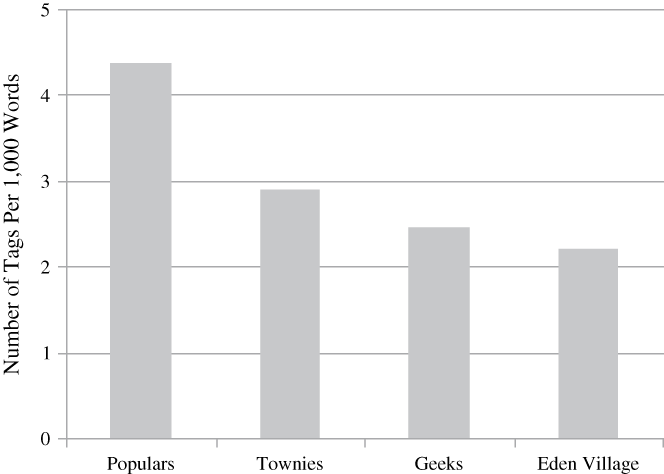
In addition to the distinct functions Popular tag questions serve, it is important to note that Populars differ from members of the other CofPs in the frequency with which they use tags. A frequency analysis for tag questions cannot follow Labov’s (Reference Labov1969) principle of accountability, as it is impossible to identify the number of potential environments in which tags could appear, a well-documented challenge of studying variation in discourse features (Lavandera Reference Lavandera1978, Romaine Reference Romaine1984). Accordingly, we did not incorporate the frequency dimension into the study detailed in the third section above, preferring to follow the more established tradition of reporting the number of tags occurring in a given number of words as employed, for example, in sociolinguistics (Macaulay Reference Macaulay, Chambers, Trudgill and Schilling-Estes2002) as well as corpus linguistics (Tottie & Hoffmann Reference Tottie and Hoffmann2006). As shown in Figure 9, Populars use considerably more tag questions than members of the other three groups. While a one-way between groups analysis of variance showed no statistically significant difference in tag frequencies for the four groups, a planned contrast test indicated a statistically significant difference between the scores of the Populars and those of the members of the other three CofPs (F(1, 23) = 5.09, p ≤ 0.034). The tagging rates for the Townies, Geeks, and Eden Village girls is comparable to the rate reported in Tottie & Hoffmann (2.38 tags per 1,000 words) for British English, based on the spoken component of the British National Corpus. The Popular rate, in contrast, stands considerably higher, at 4.37 tags per 1,000 words. Moreover, there is considerable intragroup homogeneity in tagging rate; when the 27 girls whose speech is represented in the corpus are ranked according to individual tagging frequency, the four highest – each with a tagging rate above 6 tags per 1,000 words – all belong to the Popular CofP.
Mean frequency of tag use
With the tagging rate for Populars so much higher than that of the other groups, it is possible that the act of tagging may be indexically linked to membership in the Popular group itself. Indeed, Populars are recognized and recognize themselves as active users of tag questions. In Moore’s post-fieldwork interviews, for example, the Popular girls consulted acknowledged that using tag questions was a behavior in which they habitually engaged, as exemplified above in extract (2).
We argue that the association between tag questions and Popular status began to surface in Year 9. As mentioned in the third section, it was at the end of this year that the issue of group identity took center stage, when the Populars and Townies split into two groups. This occurrence, which saw the Townies acknowledged as the most rebellious CofP, left the Populars’ identity in question, given that they had previously occupied this role. While the Townies’ nonstandard morphosyntax assisted in their maintenance of a “cool” identity, through the mediating stance of rebelliousness, Populars did not use nonstandard features to the same extent. As shown in the preceding section, Popular tag questions are only moderately vernacular in terms of morphosyntactic design. Instead, using tag questions – particularly in the way exemplified by the style cluster appearing in (1) – served as a resource for Populars to construct themselves as simultaneously cool (as a group whose membership was worth monitoring) and distinct. Moore Reference Moore2004 provides evidence for this assertion, reporting that the frequency with which Populars used tag questions increased from Year 9 to Year 10. This trend indicates that tags began occupying a more significant part of the group’s linguistic repertoire.
The Townie tag
Prototypical Townie tag questions are exemplified in the extract in (3). In this interaction, Ellie, Meg, and Amanda are discussing an evening spent online, chatting with an American boy whom they had never met. As revealed in the quantitative analysis in the previous section, Townie tags more typically occur in talk about members of their own group (lines 1–2, 5, 24), have higher rates of he as the grammatical subject (lines 32–33, 41–42), and contain more nonstandard grammar (lines 1–2, 32–33), and deletion of word-final /t/ (lines 32–33, 41–42) than other CofP tags.
(3) 1 Ellie: Right, I was proper fucked up for some strange reason at her house,
2 weren’t[ʔ] I? [When I sl-,]
3 Meg: [When? That] day?
4 Ellie: [Yeah.]
5 Amanda: [Oh] yeah, you went all weird, dint[ʔ] you?
6 Ellie: Yeah.
7 Amanda: Oh.
8 Ellie: So I went downstairs and I watched telly and then they were
9 [still upstairs on the in]ternet talking to Bobby.
10 Meg: [It’s cos Dr Dre were on.]
11 Ellie: And, er – no, but I [went out] [for a fag first.]
12 Amanda: [<US accent> Bobby.]
13 Meg: [<US accent> Bobby. <laughs>]
14 Ellie: And I came back up [stairs – it was so] sweet –
15 Meg: [No, but he had –]
16 Ellie: and he goes – Erm, cos I heard the microphone thing. And we could hear them
17 but not got one so we just had to type and he read it and he just give us the
18 answer with the microphone.
19 EM: Cool.
20 Ellie: And he goes – He came back up and he goes, <US accent> “Here’s a kiss for you,
21 Ellie,” and “<kissing noise>.”
22 Meg: And then he goes, “It’s a French one!” <laughs>.
23 Ellie: [“It’s a French one!”]
24 Amanda: [Oh yeah, cos you left me,] dint[ʔ] you? And I went, “They’ve left me on my
25 own.” And he went, “Oh, well, I’ll send you French kisses,” and all this.
26 <US accent> “D’you like Frenchkisses?” [<laugh>] <US accent> “Yeah.”
27 Meg: [<laugh>]
28 Ellie: [<laugh>]
29 Amanda: [[<laugh>]]
30 Meg: [[<laugh>]]
31 Ellie: [[<laugh>]] <US accent> “I [don’t mind.”]
32 Meg: [He was playing] all these songs over the thing,
33 weren[ø] [‘e? And] [then his] graduation song
34 Ellie: [Yeah.]
35 Amanda: [Bobby’s Girl.]
36 Meg: and all [this lot.
37 Ellie: [And there was this song and it goes, <singing> “I wanna be.. Bobby’s Girl!”
38 EM: [<laughs>]
39 Amanda: [And he played that.] It’s so sad.
40 Ellie: And he said – and, so, whenever [this song –]
41 Meg: [But he liked all the Beatles and Elton John
42 and everyone, [din[ø] ‘e?]
43 Ellie: [Yeah.]
44 Meg: He went, “He’s from –” No, he said the Beatles are from London. I went, “No, Liverpool.”
45 He went, <US accent> “Oh, sorry.” <laughs>
That Townie tags typically occur in talk that targets members of their own group (as opposed to occurring in talk which targets members of other groups) highlights an important point about Townie community engagement: Townies are primarily concerned with their own group’s dynamics, having already moved beyond the school as the focus for their social engagement. For them, tags are a resource for indexing their independence, a function of tag questions having been previously identified by Winefield et al. Reference Winefield, Chandler and Bassett1989. Although independent of the other CofPs in the school, Townies actively participate in communities outside of school. Sexual activity, engagement with older boys, and taking drugs all have high currency in these interactions, and accordingly, Townie tags occur predominantly in narratives about behavior and activities outside the confines of the school, as in (3). In stark contrast to the Popular tags, which were used to enlist support for evaluative comments, the Townie tags in this excerpt are not used to establish norms. With the exception of line 5 (you went all weird, dint you?), none of the tags in this extract is preceded by a proposition with a disputable truth value. Rather, tags are used to encourage involvement in the telling of the narrative.
It is important to note not only that the Townies are engaged in discussion of their own group dynamics, but also that they are engaged in relating a story about the heterosexual market. What is conduced by these tags may be a shared viewpoint of their engagement in this market, a viewpoint that valorizes rebelliousness. For Townies, rebelliousness can be signaled by participating in and, crucially, by talking about sexual activities believed to be inappropriate by their peers and/or adults, such as flirting with strangers and chatting with them about French kissing (lines 20–26). Alternatively, or in addition, a rebellious stance – constructed in opposition to the school and the linguistic norms it enforces – can be enacted by using vernacular features like nonstandard were and deleted word-final /t/, and by dropping word-initial /h/ (lines 32–33, 41–42). The activities themselves, talk about the activities, and how the talk is rendered all serve as resources for constructing the rebellious Townie style. Here, tags conduce a shared viewpoint about experience, authoritativeness, and active participation in the post-school world.
The Geek tag
The extract in (4) features three prototypical Geek tag questions. In this interaction, Caroline and Faye discuss how relationships with the opposite sex may change over time. These three particular tag questions are identifiably Geek because they occur in talk with a generic flavor (lines 2–4, 28) and contain more conservative phonology (isn’t it is not reduced to innit in line 28; /t/ is released and /h/ is retained in line 37).
(4) 1 Caroline: You like have a more.. not mature because <they’re boys>
2 [but like you have a – ]
3 EM: [<laughs>]
4 Caroline: a different type of conversation [with them, don’t[ʔ]] you, to what you do when you-?
5 Faye: [Yeah, you do.]
6 Faye: And you act differently.. Well, I do anyway. <laughs>
7 EM: Yeah.
8 Faye: In front of.. the lads. Do you not?
9 Caroline: Yeah. But – I’m kind of used to that now, be [cause I go –]
10 Faye: [Yeah.]
11 Caroline: They’re always at my house..
12 EM: Yeah.
13 Caroline: But Lara’s – d’you know Lara?
14 EM: Yeah.
15 Caroline: She – her mum doesn’t let her hang around with boys at all.
16 EM: Really?
17 Caroline: She – no. Not at all.
18 EM: God.
19 Caroline: If she knew that she hanged aroun-, if L-, L-, Lara’s mum knew that it was like this..
20 When we go riding, her friend, Jack.. and.. little Warren.. they come riding with
21 us. And they’re not even allowed to the stables, which is facing her nana and
22 granddad’s house, because her nana and grandad might tell her mum.
23 EM: God.
24 Caroline: So it’s – that’s how serious it is, so.. j-, we all hang around. We [all –]
25 EM: [That’s] weird, innit?
26 Faye: [Yeah.]
27 Caroline: [speak different] when boys are there. It’s not – it’s not like you fancy them, though.
28 Cos that’s totally different, isn[ø] it?
29 EM: [<laughs>]
30 Faye: [<laughs>]
31 EM: [You mean] you can’t speak to them at all.
32 Faye: [Yeah.]
33 EM: [<laughs>]
34 Caroline: [No.]
35 Faye: I try and talk to Eddie but he – he doesn’t talk to me, cos he knows I fancy him.
36 EM: <laughs>
37 Faye: But you know who Eddie fancies cos he’s always like – int[th] he?..
38 [He – he won’t talk] to anybody else,
39 Caroline: [He fancies Liz.]
40 Faye: unless he fancies them.
On the surface, the topic of this conversation is not dissimilar to that of the Townie example in (3), as both deal with boys as objects of affection (the Townie extract explicitly mentions physical affection, while the Geek extract at most alludes to potential physicality in lines 20–22). The primary difference between the two lies in who is implicated as a participant in relationships with boys. The Townies discuss their views about boys through the telling of narratives, narratives that place them as figures in the action (Goffman Reference Goffman1981). Geeks, on the other hand, do not generally talk about their own relationships with boys – as such relationships do not yet exist – but instead offer their opinions and views about hypothetical relationships, with generic you (lines 2–4). As Caroline suggests with her tag question in line 28, it is impossible even to talk with boys one fancies (let alone enter into relationships with them), a view Faye holds as well, as acknowledged shortly thereafter (line 32).
The Geeks’ tendency to talk about relationships in generic terms is indicative of a larger Geek pattern to produce proportionally more tag questions in the context of generic debate. This pattern may stem from their social network structure which, in contrast to the dense and multiplex networks of the Populars, tends toward less cohesion and weaker ties. Because Geek tags often lack personal content, they may not contribute to or reflect interpersonal relationships to the same extent as they do for the Populars or Townies.
As pointed out by Algeo Reference Algeo1988, however, tag questions may work to manage rights in interaction. For the Geeks, peremptory tags sometimes demonstrate knowledge or signal an ability to engage in a conversational debate in an authoritative way. Peremptory tags enable their users to make a point that cannot be disputed, using knowledge as a form of power (Kiesling Reference Kiesling, Johnson and Hanna Meinhof1997:68). One such example occurs in the extract in (5). Moore has asked Michelle and Caroline about transport to and from school, and Michelle answers that her mother drives her to school. Caroline then seizes the opportunity to demonstrate her familiarity with Michelle’s routine (line 5), pointing out that Michelle may not have been entirely forthcoming in answering the question. Caroline’s tag places some pressure on Michelle to agree with her addendum, and indeed, Michelle acquiesces in the following line.
(5) 1 EM: Where do you live?
2 Michelle: I live, erm, down the road. I live on Denton Place.
3 EM: Right
4 Michelle: And my mum takes me to school and stuff and er –
5 Caroline: You walk home, though, don’t [you?]
6 Michelle: [I walk] home sometimes, sometimes.
Although we have argued that Geek tags may assist those holding knowledge in establishing authority and power, we do not wish to claim that tag questions are defining components of Geek style. Among the four CofPs at the school, distinctive tag design appears to accomplish the least for the Geeks, and it may be that tags have only a limited role to play in constituting this group’s distinctiveness. In spite of being rich linguistic features that can vary considerably in both discourse organization and internal composition, like any linguistic feature, tag questions are but one of a host of variables that can contribute to a social style.
The Eden Village tag
Prototypical Eden Village tags appear in the extract in (6). The girls in this interaction – Ruth, Catherine, Helen, and Lucy – are talking about a school trip to France. Recall that the primary distinctive features of Eden Village tags are a somewhat weak tendency to have she and we (line 19) as grammatical subjects and a considerably stronger tendency to constitute highly cooperative discourse. More specifically, Eden Village tags are more commonly agreed with (lines 4, 17, 19, 42), even during the tagger’s turn (lines 17, 19, 42), in contrast to the tags of their Popular, Townie, and Geek counterparts.
(6) 1 EM: Did you go to the France – on the France..
2 Ruth: Yeah.
3 Catherine: [See, can all – you can all talk about Fran-]
4 Ruth: [I know you’ve spoken to Dan]ny, haven’t[ʔ] you, about the France trip?
5 EM: Yes.
6 Catherine: See you can all talk about [France now and I dint go, did I? So..?]
7 EM: [So go on, give me your version. <laughs>]
8 Helen: I thought it was [good.]
9 Ruth: [Did he say] that we were flashing him, by the way?
10 EM: He said.. [Natalie was.]
11 Helen: [I actually [didn’t flash.]]
12 Catherine: [He actually said on] [this that – on the tape]
13 Ruth: [Did he say I was?]
14 EM: <Shakes head>
15 Catherine: Natalie [was –]
16 Ruth: [Good.] Cos I -
17 Lucy: It was mainly Natalie, wasn[ø] [it?]
18 Ruth: [It] was Natalie [was fla[shing.]
19 Helen [You – [Me and] Lucy didn’t,] did we?
20 Catherine: [Natalie was flashing.]
21 Helen: [We] were the good [girls.]
22 Lucy: [No.]
23 Ruth: [She] kept lifting her top up in front of him.
24 [And then, we just did like] [once cos they]
25 Lucy: [I wasn’t wearing a bra though, so..]
26 Helen: [Were you not?]
27 Ruth: [came to the door] and they were like [obviously like <laugh>]
28 Lucy: [No.]
29 Helen: [<inaudible>]
30 Ruth: [so I just went, “Go away!” like that. Then they were like] <laugh>
31 Lucy: [I was wearing a bikini. I don’t know why.]
32 Helen: [<inaudible>]
33 Catherine: [But Natalie like,] she’s like..
34 Lucy: But, they put the bin up against our door so we couldn’t [get out <laughs>.]
35 Ruth: [Yeah.] And then..
36 Lucy: Then they [went into our room and took all] our clothes
37 Ruth: [Someone had been smoking..]
38 Lucy: and put [them in] the bin.
39 Ruth: [Yeah.] [And put all our clothes in the bin.]
40 Helen: [And at one point like]
41 Helen: the whole chateau was like..
42 Ruth: Yeah, cos someone’d been [smoking, ant[ʔ] they? So] we dint have this disco,
43 Helen: [Yeah. That was it.]
44 Ruth: and Miss Mansfield went into our room and she came down, she went, “The girls
45 in the big room, upstairs now!” cos every-, all the clothes were [everywhere.]
46 Helen: [<inhales> All]
47 our blooming room [was a tip. I’ve [never seen such a mess in my] whole life.]
48 Lucy: [They thought it [had been ransacked. <laughs>]
49 Ruth: [Yeah, it got invaded by all the boys.]
50 [Cos all the boys were raiding rooms and stuff.]
51 Catherine: [I – I wish I’d’ve gone but I couldn’t – I know.] I wish I’d’ve gone.
An analysis of the use of we in line 19 reveals that, like the Populars, Eden Villagers also employ tag questions to calibrate group norms. The girls are discussing an extended episode during their school trip to France in which their classmate, Natalie, exposes herself to some of the boys on the trip. It is important to note that Natalie and her speech style were not investigated in this study. Although she could have been considered an Eden Village girl at the beginning of fieldwork, primarily because she lived in Eden Village, she operated at the periphery of the group and grew apart from its core members by Year 10. Importantly, Helen distances both herself and Lucy from Natalie’s behavior in line 19 with the utterance Me and Lucy didn’t [flash the boys], did we? Her tag, with its inclusive we, asserts that she and Lucy are not the type of girl to engage in such activities, and Lucy agrees in line 22. They might wear bikinis, or even forgo a bra, but flashing oversteps the bounds of good taste. As Helen explicitly states on behalf of herself and Lucy in line 21, they are good girls. Interestingly, none of the Eden Villagers telling this story disparages Natalie. While they, like the Populars, use tags to articulate what constitutes appropriate behavior, they differ from the Populars in that they do not use tags to explicitly criticize others. Populars may take advantage of the critical functions of tag questions to construct their coolness, but Eden Villagers, as Helen herself affirms, are good girls.
Perhaps even more strikingly evident in (6) is the intense level of interaction among the girls. All five utterances containing a tag question overlap with a previous speaker, a following speaker, or both. Although overlap in and of itself does not constitute a collaborative interaction, we can see that the truth of the tag’s proposition is explicitly confirmed for three of the five tags. In one case (Lucy’s assertion It was mainly Natalie, wasn’t it? in line 17), the tag elicits agreement from not just one but two interlocutors (Ruth in line 18 and Catherine in line 20). Moreover, the thread of the narrative is sustained following all five tag questions, and each of the four girls takes responsibility to move the story along. Their level of agreement and overlap creates a highly engaged interactive style; and their reference to their own group and the individuals within it, as was seen for the Populars, suggests concern with collectivity and self-monitoring. These are the tag questions that seem most clearly to resemble the prototypical feminine tag discussed in the language and gender literature (e.g. Holmes Reference Holmes1995), given their standard grammatical and phonological design and the fact that many of them could be interpreted as positively polite using the schemas outlined in this literature.
In post-fieldwork interviews, Leah, Lucy, and Ruth provided their views on the phonological design of their own tags, a phonological design that positions them relative to the other CofPs at the school. As can be seen in (7), Eden Villagers claim that they are most likely to use the tags in’ he (as reported by Lucy in line 7) or int it (as Leah first reports in line 10 and confirms in line 15). Crucially, they avoid the nonstandard form – innit – which Leah explicitly associates with Townie identity in line 1. They also avoid the most conservative phonological form – isn’t he – which retains all its syllables and is perhaps associated with the more conservative linguistic style of the Geeks. This commentary evidences Eden Villagers’ belief that they exhibit distinctive linguistic patterns in their tag design, and more importantly, that their linguistic style allows them to build their identities in relation to other groups at Midlan High.
(7) 1 Leah: [No, we don’t say “innit.”] That’s Townies.
2 EM: [<inaudible>]
3 Lucy: Uh-uh.
4 EM: Is it?
5 Leah: Yeah.
6 Ruth: <laughs>
7 Lucy: Yeah, but we do say, “in[ø] he,” don’t we?
8 Ruth: Yeah.
9 Lucy: Not “isn’t he.”
10 Leah: You go, “int[th] it” or..
11 EM: Oh right, so you’d say something like, “in[ø] he” but you wouldn’t say, “innit?”
12 Leah: No.
13 Lucy: [Uh-uh.]
14 EM: [Or you’d say] – “int[th] – int[th] it” rather than “innit?”
15 Leah: Yeah.
The Indexical field for Tag Questions
Having examined intergroup distinctiveness in tag design in the previous section, we are now in a position to elaborate on the indexical relationships between tag questions and their many social meanings. Returning to the concept of the indexical field (Eckert Reference Eckert2008), as introduced in the first section, we note that the indexical field relates the direct index of a particular linguistic form to higher-order indexical values. Put in Silverstein’s (Reference Silverstein2003) terms, the indexical field represents the ideological associations among an n-th order indexical value and any additional (e.g. n + 1st order) indexical values. As Eckert (Reference Eckert2008:484) asserts, “The emergence of an n+1st indexical value is the result of an ideological move, a sidestepping within an ideological field.” In other words, creating an n + 1st order indexical value simultaneously reconstrues the n-th order indexical value and gives shape to the linguistic feature’s indexical field. Thus, at the heart of the indexical field for tag questions lies the n-th order indexical value we identified, and radiating out from it is a series of n + 1st order indexical values. This relationship is captured in Figure 10.
Indexical field for tag questions at Midlan High

Recall that the direct index for tag questions was “conducive,” depicted in the box at the center of the figure. Conduciveness is enlisted in constructing many other kinds of social meanings (n + 1st order indexical values), as was discussed in detail in the preceding section. These n + 1st order indexes appear in plain text in Figure 10. Populars use tag questions to conduce evaluative stances toward girls in the school, and to criticize and regulate behavior. Such uses of tag questions have enabled Popular girls to portray themselves as cool. In contrast to Populars, Townies use tag questions to conduce a shared viewpoint surrounding their independence, experience, and authoritativeness. But similar to the Populars, the Townie-specific use of tags can also index their own brand of coolness. Thus the “cool” second-order index is recruited by both Populars and Townies, illustrating that meanings in the indexical field can be repackaged and combined in unique ways to create quite distinct local identities. The Geeks also draw on the conducive functions of tags to construct authority and emphasize their knowledge. Here again we see overlap in the meanings exploited by two different groups, as both Geeks and Townies draw on the “authoritative” n+1st order indexical value. Finally, Eden Villagers are intensely collaborative in their use of tags, politely conducing their mutual involvement and friendships. Like the Populars, Eden Villagers utilize the regulatory functions tags cans serve.
We have until now focused mainly on social meaning at the interactional level (mostly stances and ephemeral characteristics of individuals at particular moments in time), but these meanings are, of course, not divorced from more enduring socially meaningful units like personae and social types. Johnstone and her colleagues have shown, for example, that the indexical values of a number of linguistic features can be harnessed for indexing identities tied to the local geographic area of Pittsburgh. Johnstone Reference Johnstone and Englebretson2009, for example, illustrates how the discursive construction of an expert stance, built through the demonstration of dialect awareness, enables an individual to construct a Pittsburgher identity. Phonological features can be used to similar effect, as monophthongal /aw/ has over time been linked to both working-class identity and Pittsburgh (geographical) identity (Johnstone et al. Reference Johnstone, Andrus and Danielson2006, Johnstone & Kiesling Reference Johnstone and Kiesling2008).
In the current study, the indexical values of tag questions can come to index a group persona through the process of stance accretion (Du Bois Reference Du Bois2002; Rauniomaa Reference Rauniomaa2003, both cited in Bucholtz & Hall Reference Bucholtz and Hall2005). For example, we have seen how Populars use tag questions in order to construct cool, critical, and evaluative stances. The frequency of the Populars’ repeated co-production of these stances – revealed in Figure 9 and acknowledged in (2) – hints at an ideological crystallization, to the point that the stances accrete into the Popular categorization itself as a higher-level indexical order (represented in small caps in Figure 10). A particular tag design, and its component indexical meanings, may thus become associated with a CofP identity. Apart from the Populars, it is unclear whether the entire set of stances associated with each group has accreted into a discrete social meaning emblematic of a group; accordingly, the CofP labels in Figure 10 lie outside the borders of the indexical field, and the boundaries between CofP styles are marked with dotted lines.
Finally, associations between linguistic features and identities do not end at the locally meaningful meso-social level. All the CofPs we have analyzed in this article are also constrained by and judged relative to macro-category classifications. For instance, the Townie girls’ rebellious lifestyle causes them to engage in areas of the wider community that are more readily associated with working-class culture; so despite the relatively high social status of these girls, their forms of practice and engagement regularly situate them (and their tag question use) relative to a working-class social type. Furthermore, while all of the girls analyzed in this study unambiguously classify themselves as female and are identified by others as such, the nature of some girls’ practices sit more comfortably alongside dominant discourses of femininity. Where this is the case, for instance, with the Eden Village girls (who by their own admission are “girly girls”), tag questions may be interpreted as part of this overall “feminine” style. Indexical values at the macro-social level are represented in capitalized italics in Figure 10.
Of course, the Eden Village girls and their practices can be interpreted as “feminine” and the Townies and theirs can be interpreted as “working-class” only if the interpreter engages with an ideology that facilitates such a link. The same can be said for all the indexical associations we have made in this section. Because we have deconstructed the trajectory of meaning in this community, we are able to trace social meanings from a core “conducive” meaning, via the micro-social indexical level of stance, through the stylistically embedded meso-social level of personae and macro-social level of demographic social type. In this way, we have “layered” meaning across the identity frames acknowledged by Bucholtz & Hall Reference Bucholtz and Hall2005 and Coupland Reference Coupland2007 and provided the analyst’s view of social meaning at Midlan High. However, it is important to note that, at any one time, for the Midlan High speaker these meanings may be discrete and in competition with one another; thus, the same tag question uttered by a Popular girl may be variably heard as “Popular” or “cool” or “evaluative” depending upon who at Midlan High hears it and the ideological lens through which it is filtered. One of the benefits of the indexical field we have presented is that it enables us to see meanings as distinct (albeit related) and, thus, discourages an analyst from privileging any one level of meaning without appropriate contextual accountability.
Conclusion
We have illustrated how an analysis of style and indexicality can contribute to our understanding of the social meaning of tag questions. Tag questions, though they all conduce organized talk, can vary dramatically above the level of the utterance in their discourse properties and below the level of the utterance in terms of grammatical and phonological content. Such variation contributes a great deal to the feature’s social meaning potential, widely expanding the indexical field of the feature. Significantly, the indexical field contains meanings at a number of levels of abstraction, from stances at the micro-social level, to locally meaningful personae at the meso-social level, to structural/demographic designations at the macro-social level. The use of a tag question can activate a social meaning at any or all of these levels.
We advocate taking an approach to social meaning that departs from traditional frameworks in two key respects. First, although we would not deny the importance of considering the frequency with which a linguistic feature occurs, frequency is just one dimension of relevance to the study of social meaning. Noting that frequency is perhaps best suited to studying a variant’s trajectory through a speech community or geographical area, Mendoza-Denton Reference Mendoza-Denton, Cole and Hualde2007 makes a similar point. In her FRESA model, she suggests that along with frequency, we must consider a variant’s recency (whether it clusters in particular types of discourse and how often it does so), its salience (what it is ideologically associated with), and the agency of the speakers involved (how actively speakers are designing their talk). As we have suggested here, it is also essential to examine the stylistic composition of linguistic features, situating them in their full linguistic and social contexts. Regarding the former, styles index social meanings that operate simultaneously across phonological, grammatical, and discourse categories. With respect to the latter, one must ground the use of a linguistic form, or a cluster of linguistic forms, in its ethnographic context. We have demonstrated here that foregrounding the ethnographic perspective sheds new light on the motivations behind particular community members’ choices in tag design. Taking the linguistic and social contexts together, we hope to have shown that ethnography, combined with the systematic deconstruction of the component parts of a linguistic feature, provides a way to access the processes involved in meaning making from the perspective of the speakers who are being analyzed.
A second way in which our approach departs from traditional treatments of social meaning lies in our decision to treat content as a component of style. As Eckert (Reference Eckert2008:456) remarks, even though within linguistics style is concerned with examining “ways of saying the same thing,” other disciplines concerned with style, such as art and music, consider content itself a dimension along which styles can vary. We have argued in this article that what – or rather whom – people talk about is just as important a locus of study. Expanding the stylistic enterprise to include examinations of content can provide us with additional insights into what underlies the decision to use a particular linguistic feature. Style is not only about how to render an utterance; it is about whether to utter it, and when. Taking this view enables us to think of social meaning as a process rather than a static, immutable object, and it requires us to think about the space – or to use Appadurai’s (Reference Appadurai1990) terminology, the “scapes” – that meaning inhabits.
As we have stressed above, the ideological spaces in which meanings are co-related – or indexical fields – bring together meanings at multiple social levels, from the micro to the macro. As sociolinguists continue to refine theoretical and methodological approaches to the study of social meaning, it is important that we be clear about the indexical levels at which we are investigating meaning. Each level will surely require different analytical techniques, and we face the challenge of determining the most successful strategies for learning more about the ideological lens through which indexical associations are viewed at each level. In addition to theorizing about the link between linguistic form and social meaning, we emphasize the need to devote attention to analyzing the connections between social meanings themselves. Campbell-Kibler Reference Campbell-Kibler2005, Reference Campbell-Kibler2007 has made this point from the perspective of cognition, using perceptual methods to show that the social meanings (at the micro-social level) attributed to variants of (ING) depend on the assumptions listeners make about the macro-social characteristics (geographic affiliation, perceived sexual orientation) of speakers. We have aimed in this article to illustrate how an approach focused on patterns of production, too, can clarify the micro-macro connection. Social meanings span levels of identity, and we hope that future work on the meaning of variation will further explicate the ways in which they do so.