Prosthetic valve thrombosis leading to valvular obstruction could potentially be a life-threatening complication whose treatment remains controversial. Reference Biteker, Altun, Basaran, Dogan, Yildirim and Ergun1 In adults, the incidence of prosthetic valve thrombosis has been quoted as 0.6–6% in left-sided valves. Reference Otto and Nishimura2 In contrast, its incidence in paediatrics is unknown.
Early diagnosis followed by treatment is of paramount importance as any delay can lead to significant morbidity and mortality. Reference Roudaut, Serri and Lafitte3 There is a lack of definite guidelines for the treatment of prosthetic valve thrombosis not only in the paediatric population but also in the adult population as well. Treatment options vary from anticoagulation, thrombolytic therapy, or in extreme cases might need urgent prosthetic valve replacement. Reference Huang, Lan, Cheng, Zhang and Ren4–Reference Vitale, Renzulli and Cerasuolo6 These options vary from patient to patient depending on the prosthetic valve position, size of the thrombus, and haemodynamic status of the patient, and hospital experience. Reference Gürsoy, Kalçık and Yesin7
Though thrombolysis has been used in the paediatric population for a long time for different indications, especially in patients with central venous catheter thrombosis, and after arterial access problems, there is still limited data on its risks and benefits in this population. Reference El-Segaier, Khan, Khan, Momenah and Galal8
Out of all the thrombolytic agents, alteplase has shown to have a high affinity for fibrin. Reference Dillon, Stevens, Dusenbury, Massaro, Toy and Purdon9 Given this fact, alteplase is the most recommended thrombolytic agent. One other potential advantage which alteplase has over other thrombolytics is its short half-life. Reference Bivard, Lin and Parsonsb10
There is growing literature of its efficacy and safety in prosthetic valve thrombosis in the adult population. Reference Dangas, Weitz, Giustino, Makkar and Mehran11 However, its role in paediatric prosthetic valve thrombosis is still not clearly established. Moreover, there is no clear dosing regimen as well. Reference Ootaki, Yamaguchi and Yoshimura12–Reference Ferrari, Vagnarelli and Gargano14
The aim of this study is to publish our experience regarding the effectiveness of alteplase for paediatric prosthetic mitral valve thrombosis. The primary outcome was successful thrombolysis without major bleeding complications. Moreover, we would like to suggest an algorithm for the management of prosthetic valve thrombosis in the paediatric population.
Methods
This retrospective chart review included patients who underwent thrombolysis (alteplase) for prosthetic mitral valve thrombosis from June, 2011 to June, 2021. We identified 10 patients with 20 attempts of alteplase infusion (three patients received alteplase infusion more than once).
Ethical approval was obtained from the hospital Institutional Review Board Committee (2021–08).
Included in our study were patients less than 14 years of age who underwent mechanical mitral valve replacement and had to receive alteplase infusion because of valve thrombosis. We excluded those patients who had mitral valve replacement beyond childhood period (after age of 14 years) and patients who did not receive alteplase infusion.
The demographic data and outcome were collected and entered in an Excel sheet. In addition, the alteplase regimen including the dose given, type of infusion (intermittent or continuous), duration, and frequency were also noted. We also included the outcome with the most recent follow-up.
The diagnosis of prosthetic mitral valve thrombosis was suspected clinically or found during routine follow-up by transthoracic echocardiography demonstrating “elevated velocity or gradient (mean transvalvular gradient increase > 50% across the prosthesis), with either limited leaflet motion or attached mobile densities consistent with thrombus, or both” Reference Otto and Nishimura2 (Fig 1a). In doubtful cases, definitive diagnosis was made by fluoroscopy (Fig 1b).
(a) Transthoracic echocardiography before alteplase infusion showing (i) closed prosthetic mitral valve in systole, (ii) stuck posterior mitral valve leaflet in diastole and (iii) increased mean gradient across the valve. Post-alteplase infusion echocardiography reveals (iv) closed prosthetic mitral valve in systole, (v) both leaflets opening normally in diastole, and (vi) return of mean gradient across prosthetic mitral valve back to baseline. Anterior leaflet is shown in bold arrow and posterior leaflet in dotted arrow. (b) Fluoroscopy of prosthetic mitral valve showing closed mechanical valve during systole (i), stuck mitral valve leaflet (ii), partial opening of mitral valve leaflets (iii), and normal opening of mitral valve leaflets (iv).

Thrombolysis was done using alteplase with a dose of 0.1 – 0.5 mg/kg/hour. Successful thrombolysis was defined as a drop of the mean gradient to baseline level and complete normalisation of valve function (normal leaflet motion either by echocardiography or fluoroscopy). Partial response was defined as > 50% reduction in gradients but with restricted leaflet motion. Failure of thrombolysis was declared if there was <50% reduction of gradient along with restricted leaflet motion.
Major bleeding was defined as gastrointestinal bleeding, intracranial bleeding, or any bleeding requiring blood transfusion.
Results
A total of 10 patients with 20 trials of alteplase infusion from June, 2011 to June, 2021 were included.
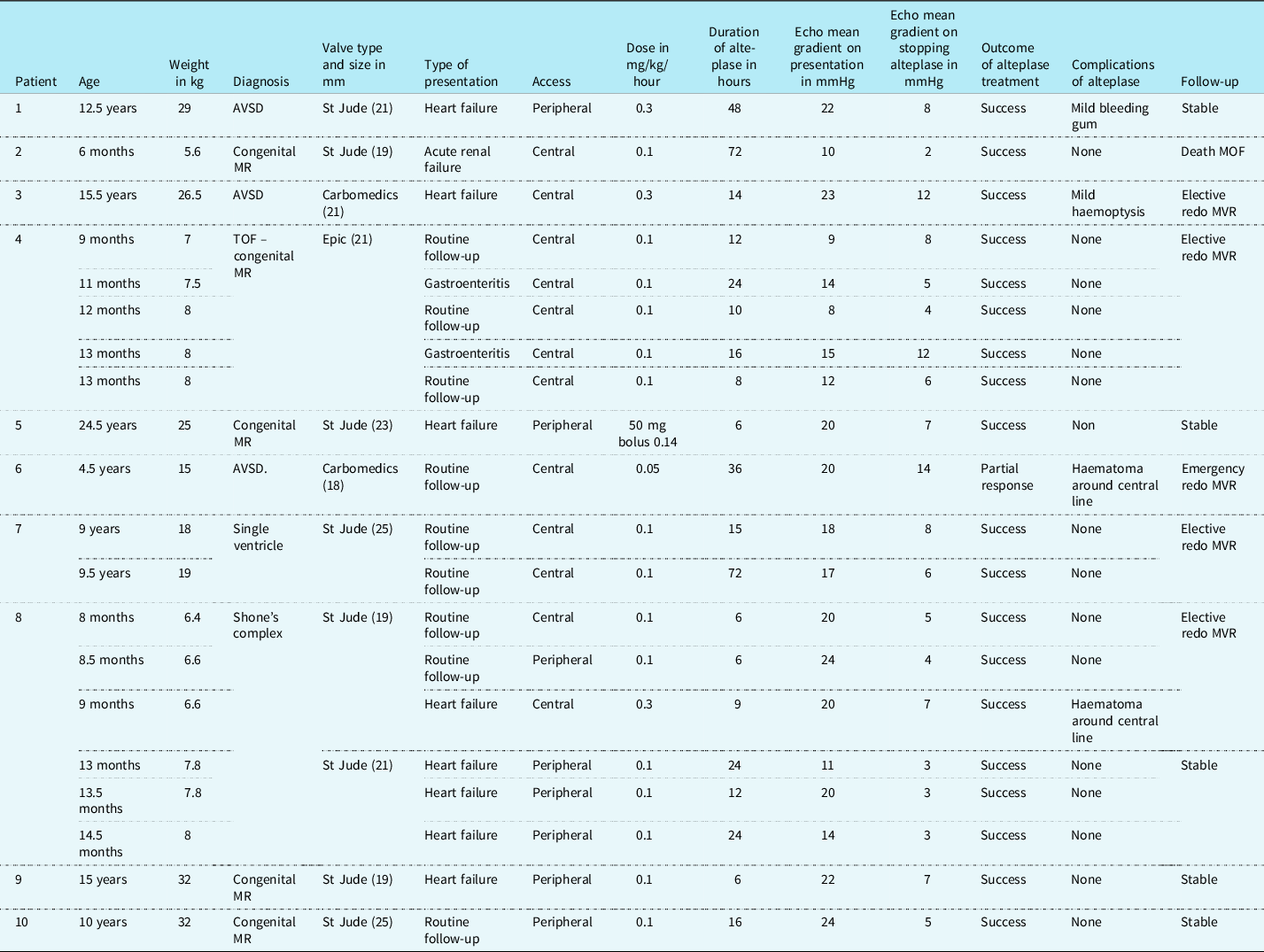
Demographic data and outcome of patients are shown in Table 1.
Demographic data and outcome of patients

Abbreviations: AVSD = atrioventricular septal defect; MOF = multiorgan system failure; MR = mitral regurgitation; MVR = mitral valve replacement; TOF = tetralogy of Fallot.
There was equal gender distribution with five male and five female patients. Age at presentation ranged from 6 months to 24.5 years with a median age of 13 months. Weight at presentation ranged from 5.6 to 32 kg with median weight of 8 kg. Original diagnosis was congenital mitral valve regurgitation in four patients, complete atrioventricular septal defect in three patients, one patient each with Shone’s complex, tetralogy of Fallot, and one with single-ventricle morphology. Three patients were syndromic, two with Down syndrome, and another with achondroplasia.
St. Jude Medical® Mechanical Heart Valve (SJM; St. Jude Medical Inc.; Minneapolis, Minn) was used in eight patients, and CarboMedics Standard Aortic Valve (CM; CarboMedics, Inc.; Austin, Tex) bileaflet valve prostheses was used in two patients. The valve size ranged from 19 to 25 mm with a median of 21 mm. Timing of thrombosis ranged from 5 days to 12 years post-mechanical valve replacement.
Anticoagulation was established using warfarin in nine patients and enoxaparin in one patient. INR (International normalized ratio) level was below target range (i.e., 2.5–3.5) in eight presentations, within desired range in four presentations, and above target range in two presentations. The only patient who had six attempts of alteplase infusion was on enoxaparin and monitored by heparin assay (anti-Xa assay) which was within target range.
Presentation was quite variable as out of these 20 events; thrombosis was discovered incidentally in nine presentations during routine checkup and patients were otherwise asymptomatic. Eight presentations presented with acute heart failure. Two events were related to gastroenteritis and dehydration and one with acute renal failure.
Diagnosis was confirmed by transthoracic echocardiography in 14 events, and fluoroscopy was needed for confirmation in six events. Mean gradient by echocardiography on presentation across the mitral valve ranged from 8 to 24 mmHg.
Dose of alteplase ranged from 0.1 to 0.5 mg/kg/min. One 24-year-old patient received alteplase bolus with a dose of 50 mg, while the others received maintenance infusion only. Duration of alteplase infusion ranged from 6 to 72 hours. They were monitored with prothrombin time, partial thromboplastin time, fibrinogen, and D-dimer performed initially and at 12, 24, and 72 hours post-alteplase infusion.
Seven patients needed alteplase infusion for relief of thrombosis only once. One patient had two episodes where obstruction was relieved successfully with alteplase in both episodes.
One patient had five attempts of alteplase. She was 6 months at time of mitral valve replacement and suffered from repeated valve thrombosis. Ultimately, she underwent redo valve replacement at the age of 14 months. Another patient had six attempts of alteplase infusion. Mitral valve replacement was at 6 months of age. She had three episodes of valve thrombosis and underwent redo mitral valve replacement at the age of 1 year. After redo, thrombosis recurred thrice, and finally the patient was managed with a combination of anticoagulant and antiplatelet therapy (aspirin, clopidogrel bisulfate, warfarin, and enoxaparin). She is currently asymptomatic and had no further recurrence of thrombotic events and is being closely monitored. Both patients were thoroughly investigated from haematological standpoint to exclude any prothrombotic states and were found to be normal.
Central line was used for infusion in 12 trials and the peripheral line in 8 trials. Initially, peripheral line insertion was used to avoid any delays until central line access was established. Later, we found it to be effective and safe. Subsequently, we used it as the primary and sole access in four trials. Alteplase was combined with heparin infusion in five trials; however, alteplase was used alone in 15 trials.
There were no major bleeding complications. Minor bleeding complications were seen in four patients. They included haematoma around the central line in two patients, mild haemoptysis in one patient, and minor bleeding from gums in another patient. Dose of alteplase was noticed to be on the higher side ranging from 0.3 to 0.5 mg/kg/hour in those with bleeding.
Alteplase was successful in 19 attempts to relieve valve thrombosis with gradient drop ranged from 4 to 20 mmHg. However, one patient developed haematoma around the central line, so a smaller dose of alteplase was used but it was not effective.
The follow-up post-alteplase infusion revealed no need for further interventions in four patients, and four patients went for redo mitral valve replacement as elective procedure later due to repeated valve obstruction (pannus underneath valve restricting its mobility in two patients and small size of the valve relative to age and weight in other two).
One patient had to go for redo mitral valve replacement in the same admission as a small dose of alteplase was not effective, and one patient died 10 days after relief of obstruction because of sepsis and multiorgan system failure not related to the alteplase.
Discussion
With better survival in children with CHD, there is increased incidence of prosthetic valve implantation. Rheumatic heart disease, especially in the developing world, is also a major contributor for prosthetic valve implantation. Reference Knirsch and Nadal15 Prosthetic valve thrombosis is although rare, it could be fatal especially if not recognised and treated in a timely fashion.
Treatment of prosthetic valve thrombosis consists of either anticoagulation or thrombolysis versus redo surgery. Multiple redo surgeries especially in complex CHD carries additional mortality and morbidity risk; hence, thrombolytic therapy is an effective way and can be considered as first-line management. There has been increasing use of thrombolytic therapy in the adult population, although there is paucity of literature in the paediatric age group. Reference Williams16
2020 American Heart Association/American College of Cardiology Guideline for the Management of Patients with Valvular Heart Disease recommendation states that “the two options of either low-dose, continuous-infusion thrombolytic therapy or emergency surgery are both effective, with the decision to proceed with either one based on multiple clinical factors and local experience and expertise.” Reference Otto and Nishimura2
In this study, we have shown that alteplase infusion is highly effective in the management of prosthetic valve thrombosis in the paediatric population. Moreover, the risk of fatal complications is negligible. The overall success rate was more than 95%. Low-dose regimen appears to be as effective as high dose. Additionally, we demonstrated that alteplase can be administered safely and effectively via peripheral line.
In adults, there are meta-analyses and systematic reviews with regard to the outcomes of each treatment strategy for prosthetic valve thrombosis. In an analysis by Karthikeyan et al which included seven studies of prosthetic valve thrombosis, there was no significant difference in main outcomes (mortality and improvement of valve function) between surgery and thrombolysis. Reference Karthikeyan, Senguttuvan, Joseph, Devasenapathy, Bahl and Airan17 However, they recommended urgent surgical intervention to be preferred to thrombolysis in experienced centres. In contrast, Castilho et al evaluated 27 studies with 1107 patients treated by thrombolysis and 26 studies with 1132 patients operated for prosthetic valve thrombosis. Reference Castilho, De Sousa, Mendonça, Ribeiro and Cáceres-Lóriga18 They found a higher mortality rate with surgery as compared to thrombolysis (18.1% versus 6.6%) and hence recommended thrombolytic therapy as first-line treatment.
The Ultra-slow PROMETEE trial which included 114 adults with 120 episodes showed an overall success rate of 90%, and it also concurs with our findings. The overall complication rate was 6.7% (3.3% non-fatal major, 2.5% minor, and 0.8% death). The predictors of complications were presence of atrial fibrillation, higher NYHA class, and thrombus area. Luckily in the paediatric population, we do not have risk factors like atrial fibrillation, and hence complication rate is low. Reference Baghai, Alphonso and Sundar19
The paediatric literature regarding thrombolytic therapy in mechanical valve thrombosis is very limited. There are few case reports. In 2004, Kogon et al published two case reports and included a review of the literature thus far. They described a total of 26 patients with 32 occurrences of prosthetic valve thrombosis, of which 31 were treated with various thrombolytics. Resolution of prosthetic valve occlusion was 87 % with 10 % mortality. The doses used for mechanical valve thrombolysis in the two cases were 0.5 and 0.4 mg/kg/hour which are higher than our recommended dose. Reference Kogon, Kirshbom, Forbess and Kanter20 In another study by Serpi et al 2001, they described the use of alteplase in infants aged 4, 10, and 18 months. The initial dose of alteplase was 0.4 mg/kg over 15 minutes followed by continuous daily infusion of 1.6 to 2 mg/kg in combination with heparin infusion (200 IU/kg/day). Reference Serpi, Schmidt, Kreuz, Bucsenez, Springer and Hagl21 Cheung et al reported successful treatment of severe mechanical mitral valve thrombosis with tissue plasminogen activator in a 7-month-old infant. Reference Cheung, Aponte-Patel and Bacha22 Yen et al also reported successful use of alteplase therapy in a 16-month-old female child with a late-presenting mitral valve thrombosis. Reference Yen, Chen, Chen, Wang, Chang and Wu23 Our case series is one of the largest experiences in the paediatric population with very promising results.
Based on our experience regarding alteplase infusion, in the majority of our patients, we used slow infusion of 0.1–0.3 mg/kg/hour rate with the aim of reducing embolic and bleeding complications while keeping the success rate as high as possible. We did not come across any major complications like gastrointestinal or neurological bleeding. We had one patient who developed intracranial haemorrhage 3 days after receiving alteplase infusion, and at that time it was thought to be related to high INR rather than alteplase as a complication. Apart from that, two children required redo surgery because they had recurrent thrombosis on the valve, and both of them did well after the replacement of their prosthetic valve. We also looked at the risk factors which could have precipitated prosthetic valve thrombosis, but all of the patients seem to be well anticoagulated at the time of presentation. Another possible explanation could be some sort of mechanical issue which renders the valve liable for thrombogenicity.
In terms of diagnostic modality, we have found that in the majority of cases, transthoracic echocardiography (Fig 1a) is sufficient to diagnose this complication. In contrast, transoesophageal echocardiography is usually required in adults to diagnose it which also carries its own risks. In doubtful cases, urgent fluoroscopy either in cath lab or radiology department can clarify the diagnosis by looking at the valve mobility (Fig 1b).
In the paediatric population, we do not have any standard guidelines to treat prosthetic valve thrombosis. Moreover, it is a rare occurrence, and hence in clinical practice, it could be a challenging situation. Although the safe dose range of alteplase has been described in the paediatrics, there are no set guidelines. The decision of starting thrombolysis needs to be made on a case-by-case basis comparing the risks and benefits. Reference Tarango and Manco-Johnson24 We suggest an algorithm for the management of this condition in the paediatric population.
The first step in the algorithm is the diagnosis of prosthetic mitral valve thrombosis by echocardiography and confirmation by fluoroscopy in doubtful cases. Alteplase is started if there is no contraindication for thrombolysis.
Contraindications for thrombolysis in paediatrics include active bleeding, concurrent bleeding diathesis, recent major surgery or trauma, intracranial haemorrhage, infarction or intracranial or spinal surgery within the last 2 months, known right-to-left intracardiac shunt in addition to cardiopulmonary resuscitation or asphyxia within 7 days of therapy. Reference Tarango and Manco-Johnson24
Based on the INR level, heparin is added (if INR less than 2.5) or alteplase is started alone. The patient needs to be reevaluated by echocardiography 2 hours after starting alteplase and accordingly to decide on the new dose of alteplase. Twelve hours after starting alteplase, the patient is evaluated again to decide the duration and dose of alteplase. In case there is no improvement after 72 hours, then alteplase infusion is stopped. The patient then will need to go for redo mitral valve replacement (Fig 2).
Algorithm for the management of prosthetic mitral valve thrombosis.

By following the algorithm, this complication can be diagnosed and managed in an effective manner as timely intervention is the key to success.
Limitations of the study
One of the main limitations of our study is the retrospective analysis and also the relatively small size of the sample. This is mainly due to the rare occurrence of this complication, but we think that this data adds substantial information with regard to management. Also, our study is not a head-to-head comparison of thrombolytic therapy to surgery or any other thrombolytic therapy regimen for the treatment of prosthetic valve thrombosis.
Conclusion
Alteplase infusion as preferred fibrinolytic therapy in the paediatric population appears to be a safe option in cases of acute prosthetic valve thrombosis. We recommend using it as a low-dose infusion through the peripheral line rather than a loading or high-dose regime. There should be a low threshold to start this to prevent long-term complications of prosthetic valve thrombosis.
Acknowledgements
None
Financial support
This research received no specific grant from any funding agency, commercial, or not-for-profit sectors
Conflicts of interest
None