

Introduction
Nowadays, issues of primary importance are: food security, due to an increasing in world population, soil degradation by its mismanagement and anthropogenic increases in atmospheric greenhouse gases emission. All of these issues are linked to the sustainability of soil quality especially in relation to soil organic carbon (SOC) pool and its dynamics (Lal, Reference Lal2001). Accordingly, the agricultural sector is asked to increase the use efficiency of arable land to meet the increase of world’s population. It also needs to maintain economic feasibility in order to guarantee an income for farmers who face an increasingly competitive and fluctuating market. Finally, environment and preservation of biodiversity should not be neglected. To achieve these requirements, the agricultural sector can adopt principles and strategies derived from conservation agriculture (CA) and precision farming (PF). Indeed, the continued use of tillage over the years with inversion of layers has led to a change in physical, chemical and biological features of the soil, including a degradation of soil structure, a deterioration of water retention and infiltration, phenomena of intense compaction and decrease in soil organic matter leading to strong depressions of biological and microbiological activity (Holland, Reference Holland2004).
CA, which does not include implementation of plow, maintains on the surface at least 30% of the crop residue allowing to preserve the physical, chemical and biological soil features (Derpsch et al., Reference Derpsch, Friedrich, Kassam and Hongwen2010). Furthermore, CA can reduce the energy needed to carry out soil tillage operations with a decrease in gases emission into the atmosphere. For this reason, CA plays an important role in terms of mitigation of climate change that represent one of the most serious problems to sustainable global development. With reference to past experiments carried out in Italy, the use of CA allows a reduction in CO2 emissions equal to 17–65% of the national rate reduction defined by the Kyoto Protocol. Besides, implementing CA with an appropriate crop rotation combined with the use of cover crops, allows to increase the content of organic carbon in the soil (Lal, Reference Lal2004). Then, soil is seen as a carbon sink (C-sink), as opposed to traditional processes, where soil represent a carbon source (C-source) due to organic carbon mineralization (Nelson et al., Reference Nelson, Hellwinckel, Brandt, West, Ugarte and Marland2009).
The growing interest in CA techniques has led to the definition of different kinds of soil managing systems, which are different in terms of working intensity. Strip-tillage is one of the last interesting introduced techniques, focusing its characteristics on crop suitability, soil features preservation and environmental sustainability. With this technique, less than 50% of total surface is tilled, producing the typical strips where seeds are deposed (Celik et al., Reference Celik, Altikat and Way2013). Its correct exploitation necessarily involves the use of satellite guidance systems in order to carry out the sowing on the strips of soil previously tilled. In general, the benefits of CA could be enhanced by the contribution derived from PF. PF can be seen as the application of technologies, principles and strategies for the management of space and time variability, in order to increase the response of the crop production and protection of environmental resources (Marinello et al., Reference Marinello, Pezzuolo, Cillis, Chiumenti and Sartori2017). Indeed, the possibility of modulating the inputs rates on the basis of stable homogeneous zones (Zhang et al., 2010) characterized by soil and crop features could lead to an increase of economic and environmental benefits (Basso et al., Reference Basso, Dumont, Cammarano, Pezzuolo, Marinello and Sartori2016). Additionally, it is possible to enhance inputs and soil use efficiency (Licht et al., Reference Licht, Lenssen and Elmore2016), and mitigate the yield gap characterizing CA related to conventional soil tillage technique. Finally, another tool belonging to precision agriculture strategies applicable to conservation tillage is the use of predictive models. A predictive model is capable to give a decisional support related to site-specific crop inputs management in order to increase their efficiency and to have an increase in economic, energetic and environmental sustainability (Pezzuolo et al., Reference Pezzuolo, Basso, Marinello and Sartori2014).
The aim of the present work is to investigate the synergy between CA and PF identifying, through experimental tests combined with simulation of different scenarios of medium and long-term, the best technical solutions allowing optimization in terms of energy efficiency and production.
Materials and methods
Study area and agronomic management
The experimentation was carried out in the pilot and demonstrative farm of Vallevecchia (45.63° N, 12.95° E) within the AGRICARE project (LIFE13 ENV IT AGRICARE 0583). The study specifically analyses data derived from the crop season 2014/2015.
The study area covers a surface of 23.4 hectares (500 m long and 470 m wide), divided into 16 plots with an area of about 1.5 hectares each, representing the experimental theses. The study considers three conservation soil tillage techniques characterized by a different working intensity of soil, in decreasing order: minimum tillage (MT), strip tillage with 55 cm spacing (ST) and no-tillage (NT), compared with the conventional tillage (CT) which is used as a reference.
The considered crop rotation included the most important crops present in the Po Valley: wheat, rapeseed, corn and soybean. Since conservation tillage techniques are characterized by a permanently covered soil surface, after the main crop, a cover crop was sown, which was eventually devitalized before starting a new crop cycle.
In addition, with the exception of the CT witness, all of the other soil tillage techniques were integrated with the most modern PF technologies. Therefore, agricultural machines were equipped with satellite, radio antennas and automatic guidance systems, while the experimental farm was implemented with satellite and radio antennas allowing Real Time Kinematic (RTK) correction characterized by an error of 2.5 cm and a repeatability of 5 cm. Finally, all of the machines used for the inputs application were implemented with technologies providing section control and variable rate application. However, in order to evaluate the contribution of PF within the different conservation tillage techniques investigated, a central test bands managed with fixed rate of inputs were identified.
From a climate perspective, the average annual rainfall in 20 years recorded by an agro-meteorological station located nearby was 935 mm year−1.
Study of the variability
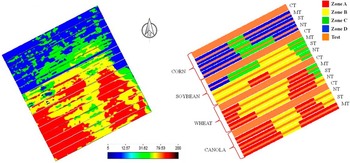
In order to get an objective characterization of variability, field data and information, regarding soil and crops features have to be accurately corrected. Data collection has to be performed through a non-random pattern: indeed, it has to be representative of the whole field. The definition of homogeneous zones is achieved in different ways using proximal or remote sensors providing information on soil, vegetation and yield. The experimentation started by studying soil variability using information derived from aerial images (giving basic information about the study area), Automatic Resistivity Profiling (ARP©, Geocarta) and soil samples analysis, and yield maps from previous years. Monitoring productions is effective information, useful to identify the field areas characterized by a more homogeneous trend. Indeed, the analysis of historical yield maps allows to identify the temporal stability of the spatial variability, thus helping characterization of repeatability in time domain of the zones having the same productive potential. Two years historical yield maps were used to define the homogeneous zones. Maps were derived from corn and soybean cultivation to obtain information about the suitability of different crops in the study area. Additionally, the ARP analysis allows to collect information on spatial variability of soil features. ARP is an on-the-go multi-depth resistivity device. It is a non-invasive soil sampling method allowing investigation of soil profile at three different depth levels (0–0.5, 0–1 and 0–2 m). In this study the resistivity measurement were carried out with a transect of 5 m apart, as shown in Figure 1.
Interpolated ARP map expressed in ohm-meters (left) and experimental homogeneous zones characterization (right).

In order to support and complete ARP data, additional physic-chemical soil parameters analyses at three depth level (0–10 cm, 10–30 cm, 30–60 cm) were carried out. 20 sampling position were defined taking advantage of ARP maps, thus allowing an optimization of samples localization.
The homogeneous zones characterization derived from the interpolation of all field collected data. Such operation was completed by means of dedicated statistical software, the MZA-Management Zone Analyst - University of Missouri-Columbia software (Fridgen et al., Reference Fridgen, Kitchen, Sudduth, Drummond, Wiebold and Fraisse2004). Finally, the productive potential characterizing the different homogeneous classes derived from the MZA analysis was assigned. As a result, the study area was divided into 4 homogeneous zones with an increasing productive potential, namely from A to D (Figure 1).
To assess the optimal rate of inputs to be applied to the different homogeneous zones, the predictive model SALUS (System Approach to Land Use Sustainability) was used. SALUS is a model designed to simulate the production response of herbaceous and woody crops under different agronomic management strategies (Dzotsi et al., Reference Dzotsi, Basso and Jones2013). It simulates the dynamics of nutrients, soil and atmospheric carbon and the directly or indirectly connected environmental impact (Basso et al., Reference Basso, Ritchie, Grace and Sartori2006).
Input data of the software tool are:
-
∙ soil characteristics (texture, depth, reaction, etc.);
-
∙ daily climate data (maximum and minimum temperature, rainfall, solar radiation);
-
∙ agronomic management (plan of crop rotation, type of tillage, sowing, seed rate, fertilization, irrigation management, etc.).
Depending on site-specific soil features, climatic characteristics and management strategies, SALUS simulates the growth of plants and the soil conditions for each day having available climate data.
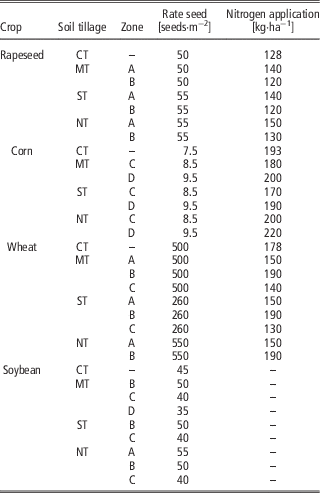
Taking advantage of SALUS simulations, the optimal seed and nitrogen rate for each homogeneous zone was defined considering their productive potential, the nitrogen curves efficiency, their expected leaching and economic sustainability in terms of marginal costs. This operation was performed for each crop and soil tillage technique; main results are reported in Table 1. The information about the inputs rates was transferred to the field by means of specific prescription maps. In order to achieve a technical and operating feasibility, prescription maps were built using a GIS software with a 3×5 m grid for MT and NT theses, and 2.2×5 m for ST.
Optimal seed and nitrogen rates applied for each homogeneous zone in different crops and soil tillage techniques.

Data collection
The harvesting operation was performed implementing a combine integrated with yield mapping system. The system allows to generate yield maps useful to monitor field distribution of crop production. Yield maps were utilized to assess the crop yield of each homogeneous zone, characterizing the different theses, and to compare areas managed with or without PF techniques.
Therefore, the energetic balance and energy efficiency assessment were performed for each soil tillage technique, crop and homogeneous zone. The energetic outputs were calculated considering the dry matter of the different crop yields and using energetic coefficients found in literature (Singh et al., Reference Singh, Prakash, Srinivas and Srivastva2008; Unakitan et al., Reference Unakitan, Hurma and Yilmaz2010). A similar procedure was performed for all used inputs, assigning their energetic value through conversion coefficients found in literature. On the other hand, the total input’s energetic values derived from the sum of different items represented by: direct and indirect mechanization energetic value (Sartori et al., Reference Sartori, Basso, Bertocco and Oliviero2005; Bertocco et al., Reference Bertocco, Basso, Sartori and Martin2008), man power energy consumption needed to carry out each operation (Canakci et al., Reference Canakci, Topakci, Akinci and Ozmerzi2005; Mandal et al., Reference Mandal, Roy, Das, Ramkrushna, Lal, Verma, Kumar, Singh and Layek2015) and all of the materials needed to produce those commodities (Barut et al., Reference Barut, Ertekin and Karaagac2011; Bilalis et al., Reference Bilalis, Kamariari, Karkanis, Efthimiadou, Zorpas and Kakabouki2013).
Results
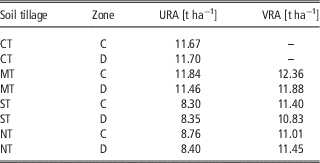
Yield data from the first experimentation year are here reported, processed in order to highlight crop productions from different homogeneous zones. The aim is to allow a comparison of crop-yield, inputs use efficiency end energy efficiency for each homogeneous zone belonging to different theses. Specifically, results from corn cultivation are reported in Table 2, showing the productive response of the soil managing methods supported by PF.
Corn yield response to different soil tillage techniques managed with uniform rate application (URA) and variable rate application of inputs (VRA).

Corn undergoing uniform seed and nitrogen rates, was greatly influenced by simplified soil tillage methods, which led to a reduction in yield higher than 25% in ST and NT compared to CT. Such gap is strongly mitigated in those theses where CA techniques are managed with variable rate application of inputs: indeed, in this case, ST and NT feature production levels close to those of CT, while PF contribution allows MT to obtain higher crop yields compared to the reference CT.
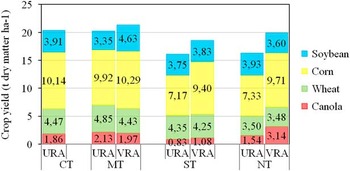
The same approach was applied to all the four crops studied in this work (Corn, Soybean, Wheat and Rapeseed), but with different observed trends, as shown in Figure 2. Indeed, soybean cultivation is characterized by an important gap in terms of crop yield only in specific homogeneous zones, and the implementation of PF practices allowed to get the highest production in MT.
Sum of crop yield characterizing the experimentation for different soil tillage techniques managed with inputs uniform rate application (URA) and variable rate application (VRA).

On the other hand, PF benefits did not lead to an increase in crop yield in the case of wheat. However, considering the nitrogen application rates defined before, an increase in nitrogen use efficiency can be observed passing from soil tillage techniques managed with a fixed rate of input and the same methods implemented with PF technologies. Finally, rapeseed cultivation had technical problems for some theses in the first year of experimentation. Specifically, the adoption of a new prototype machine designed to seed rapeseed in strips (in the case of ST) partially failed with negative effects in final yield.
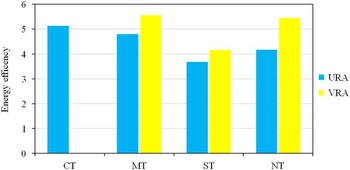
From the energetic point of view, theses that reached highest crop yields got greatest amount of gross energy, while energy consumption differences are less evident. Therefore, the energy efficiency was estimated as the ratio between the crops energetic content and the total input needed to their growth. Figure 3 shows the average energy efficiency gain achievable by each thesis considering the previously described crop rotation and spatial variability characterizing the study area.
Energy efficiency for different soil tillage techniques managed with inputs uniform rate application (URA) and variable rate application (VRA).

In particular, PF contributes to increase energy efficiency in MT and NT with an increase with respect to CT, of 8% and 6% respectively. Finally, ST supported by PF technologies shows an increase in energy efficiency of 13% compared to ST managed with a fixed rate of inputs.
Conclusions
This work is aimed to evaluate a technical feasibility and the energy efficiency derived from the synergy between conservation agriculture supported by precision farming principles, compared to conventional tillage technique and uniform inputs application. To this regard, it is important to consider the working width of the machines providing variable rate inputs application during the homogeneous zones characterization. Indeed, the homogeneous zones were shaped in order to allow an operating feasibility in terms of working width and change in inputs rate. In addition, the first year’s experimentation results show an increase in crops production due to PF contribution in term of total yield derived from the four crops considered in this study. Especially in the simplified soil tillage techniques, it allows to gain a higher total production, respectively by 15% and 22% in ST and NT compared to the same techniques managed with uniform rate inputs application. Besides, MT supported by PF got the highest total crop yield, with a 5% increase with respect to CT. A similar trend is observed from the energy assessment point of view, in which the energy efficiency is at the highest level in those techniques supported by precision agriculture. In particular, it contributes to gain better energy efficiency in minimum tillage and no-tillage, with an increase of 8% and 6% compared to conventional tillage. Similarly, ST reported a 13% increase in energy efficiency when PF practices are implemented.
Acknowledgements
This study has been performed under the framework of the AGRICARE project–Introducing innovative precision farming techniques in Agriculture to decrease Carbon Emissions, supported by the European Commission – DG Environment through the LIFE+ programme; under contract number LIFE13 ENV / IT / 000583.