Introduction
The dietary supplementation of boron (B) has become a concern for the poultry industry given its regulatory role in mineral metabolism. Vitamin D, Mg, Ca, P, Mo, F, Al, Se, protein and omega-3 fatty acids are among the nutrients that affect the response to dietary B (Hunt and Nielsen, Reference HUNT and NIELSEN1981; Hunt, Reference HUNT1989; Reference HUNT1998; Nielsen et al., Reference NIELSEN, HUNT, MULLEN and HUNT1987; Reference NIELSEN, SHULER, ZIMMERMAN and UTHUS1988a; Reference NIELSEN, SHULER, ZIMMERMAN and UTHUS1988b; Hegsted et al., Reference HEGSTED, KENAN and SIVER1989). In a given nutritional state, these minerals modify the type and degree of response to B (Hunt, Reference HUNT1994; Nielsen, Reference NIELSEN1998; Armstrong and Spears, Reference ARMSTRONG and SPEARS2001). These nutrients have clear roles in skeletal metabolism, and consequently affect bone growth and the compositional properties of soft tissues (Nielsen, Reference NIELSEN1990; Samman et al., Reference SAMMAN, NAGHII, LYONS WALL and VERUS1998). A review of experimental studies looking at the biological effects of B on the bone and serum mineral profiles of animal models suggest that numerous known and unknown influences affect the responsiveness of bone development to dietary B.
Most of the current interest in B in the nutrition of monogastric animals began in the early 1980s. The interest increased in the 1990s with evidence that either physiological amounts of B or using it to a concentration of 300 mg/kg, stimulated growth. Many studies had been conducted to reveal the nutritional role of B on growth and on the utilisation and tissue distribution of various minerals and blood constituents, including steroid hormones (Samman, et al., 1998; Naghii and Samman, Reference NAGHII and SAMMAN1997; McCoy et al., Reference McCOY, MONTGOMERY, KENNY, IRWIN, WILLIAMS and ORRELL1994).
The available literature indicates a marginal nutritional role of B in broiler chickens (Rossi et al., Reference ROSSI, BOOTWALLA and MILES1990; Reference ROSSI, MILES, DAMRON and FLUNKER1993; Kurtoğlu et al., Reference KURTOĞLU, KURTOĞLU and COŞKUN2001; Fassani et al., Reference FASSANI, BERTECHINI, BRITO, KATO, FIALHO and GERALDO2004; Bozkurt et al., Reference BOZKURT, KÜÇÜKYILMAZ, ÇATLI, ÇINAR, ÇABUK and BINTAŞ2012; Yıldız et al.,, 2013) and layer hens (Yeşilbağ and Eren, 2008; Mızrak et al., 2010; Olgun et al., Reference OLGUN, YAZGAN and ÇUFADAR2013; Bintaş, Reference BINTAŞ2013). The effect of B on mechanical and compositional properties of bone, however, is less clear and the relevant studies have yielded inconsistent results (Wilson and Ruszler, Reference WILSON and RUSZLER1998; Çınar et al., 2011; Küçükyılmaz et al., 2014). The discrepancies between these studies clearly indicate the need for more directed studies, particularly to assess the role of the dietary minerals assumed to interact with B. Such studies would clarify our understanding of the bird's performance and bone mineral density, relationship between bone quality and egg production and/or eggshell structure, which could all of it be affected by supplemental B.
Both qualitative and quantitative differences in the response to B in various experiments with broiler chickens and layer hens suggest that there are other factors not yet identified that may determine the effect of B. Although many research articles have been published on the effects of dietary supplements on broiler and layer hen performance, with reported changes in performance indices and the structure and composition of bone, to our knowledge, there is no review that evaluates the complete body of evidence from the last three decades. The current paper thus describes the role of B supplementation in poultry diets on the resulting productive performance. This paper also identifies characteristics that explain the observed variances in bioavailability.
Nutritional essentiality and the mechanism of action of boron
The study of B essentiality in animal nutrition was limited until a landmark study reported that supplemental B to cholecalciferol-deficient chicks tended to correct malformations in the marrow sprouts of bone and decreased the number of cases of rickets (Hunt and Nielsen, Reference HUNT and NIELSEN1981). In other early work (Rossi et al., Reference ROSSI, MILES, DAMRON and FLUNKER1993), B was shown to alleviate the symptoms of tibial dyschondroplasia. Extensive reviews on dietary B can be found in other papers (Nielsen et al., Reference NIELSEN, HUNT, MULLEN and HUNT1987; Nielsen, Reference NIELSEN1996; Naghii and Samman, Reference NAGHII and SAMMAN1993; Reference NAGHII and SAMMAN1997; Hunt, Reference HUNT1998; Samman et al., Reference SAMMAN, NAGHII, LYONS WALL and VERUS1998; Devirian and Volpe, Reference DEVIRIAN and VOLPE2003) and will therefore not be covered in detail here.
It has been hypothesised that B can enhance the function of other nutrients and hormones acting at the cell membrane level (Nielsen, Reference NIELSEN2002a). B supplementation has been shown to affect the concentration of steroid hormones in circulation. Nielsen et al. (Reference NIELSEN, HUNT, MULLEN and HUNT1987) first reported that B supplementation in post-menopausal women increased the serum concentrations of 17β-estradiol and testosterone. Naghii and Samman (Reference NAGHII and SAMMAN1997) found that B supplementation increased plasma estradiol concentrations and tended to increase plasma testosterone concentrations in men. Thus, changes in the status of some nutrients and hormones that act at the cell membrane level can apparently affect the response to various intake levels of B.
Nielsen et al. (Reference NIELSEN, SHULER, ZIMMERMAN and UTHUS1988a) suggested that the beneficial effects of B on bone mineralisation are related to its parathyroid hormone regulating action, and may have implications on bone growth and bone strength in broiler chickens (Kurtoğlu et al., Reference KURTOĞLU, KURTOĞLU, ÇELIK, KEÇECI and NIZAMLIOĞLU2005; Bozkurt et al., Reference BOZKURT, KÜÇÜKYILMAZ, ÇATLI, ÇINAR, ÇABUK and BINTAŞ2012) and layer hens (Wilson and Ruszler, Reference WILSON and RUSZLER1998; Küçükyılmaz et al., 2014). Other results have indicated that B may affect serum thyroid concentrations in chickens and pigs (Armstrong et al., Reference ARMSTRONG, SPEARS and LLOYD2001; Çınar et al., 2011).
B plays a role in regulating the enzymatic activity of pathways involved in energy substrate metabolism and insulin release, which it modifies by altering the metabolism of nicotinamide adenine dinucleotide (Hunt, Reference HUNT1998). Antioxidant activities of supplemental B have been noted. The activities of the enzymes superoxide dismutase and glutathione peroxidase destroy reactive oxygen species that cause tissue damage and can be increased by B supplementation (Nielsen, Reference NIELSEN1994; Reference NIELSEN1997). However, the mechanism by which B affects the activity of these enzymes is unknown.
Available findings indicate that B may interfere with lipid metabolism in humans and animals. Armstrong et al. (Reference ARMSTRONG, SPEARS, CRENSHAW and NIELSEN2000) reported that pigs supplemented with a 15 mg B/kg diet had increased plasma triglyceride concentrations. Administration of a diet with B caused an increase in the serum triglyceride concentrations of chickens (Hunt and Herbel, Reference HUNT and HERBEL1993) and rats (Hunt and Herbel, Reference HUNT and HERBEL1992) during vitamin D deficiency. In addition, fasting serum triglyceride concentrations were increased by B supplementation in postmenopausal women (Nielsen et al., Reference NIELSEN, GALLAGHER, JOHNSON and NIELSEN1992), which may indicate a shift in the distribution of endogenous fuels Hunt (Reference HUNT1996). In contrast, the dietary administration of B to rats significantly lowered the serum and plasma low-density lipoprotein, total cholesterol and triglyceride concentrations (Hall et al., Reference HALL, SPIELVOGAL and GRIFFIN1989; Naghii and Samman, Reference NAGHII and SAMMAN1997). The results from these studies indicate that boron-containing drugs may provide a therapeutic benefit in cases of coronary heart diseases.
B has been implicated in immune system function (Hunt and Idso, Reference HUNT and IDSO1999; Nielsen and Penland, Reference NIELSEN and PENLAND1999). It has been reported to affect the humoral immune response by increasing antibody production in response to an injected antigen in rats (Bai et al., Reference BAI, HUNT and NEWMAN1997). A decreased inflammatory response was reported when pigs (Armstrong et al., Reference ARMSTRONG, SPEARS, CRENSHAW and NIELSEN2000) and chicks were fed a diet with added B (Kurtoğlu et al., Reference KURTOĞLU, KURTOĞLU, ÇELIK, KEÇECI and NIZAMLIOĞLU2005).
Overall, B compounds have been shown to be potent anti-osteoporotic, anti-inflammatory, hypolipemic or hyperlipemic, anticoagulant, antioxidant, and anti-neoplastic agents, both in vitro and in vivo. In light of the above evidence, it seems likely that B could make positive contributions to the health and productive performance of animals.
The boron requirements of poultry and nutritional variables affecting efficacy
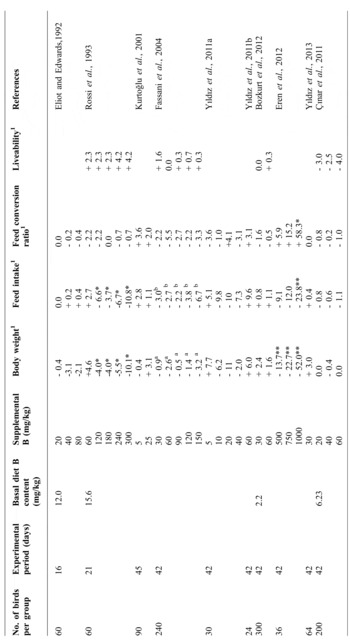
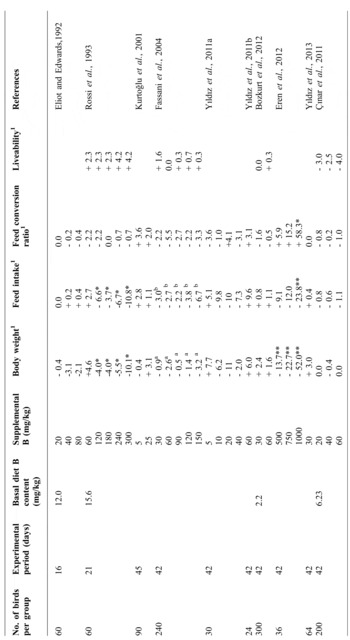
Until the late 1980s, B did not merit special attention in the field of poultry nutrition as a semi-essential micro-element. A series of studies have been conducted with broiler chickens and layer hens throughout the last three decades, although there has been decreasing interest in this topic after the early 2000s, and there is currently no definitive B requirement for any class of poultry (Table 1
Effects of dietary supplementation with B on the body weight, feed intake, feed conversion ratio and liveability of broiler chickens.

1Numbers in columns indicate percentage of change in comparison to control group; significant difference found *(P< 0.05); **(P<0.01); aQuadratic effect (P < 0.01; R2=0.85); bCubic effect (P < 0.01)
). Although B is not considered essential for poultry, the inclusion of 2 ppm in poultry feed has been recommended by the NRC (1984), regardless of the poultry category and production type, even though it is not listed as a requirement in the NRC (1994) and recommendations are from experimental and purified diets (Fassani et al., Reference FASSANI, BERTECHINI, BRITO, KATO, FIALHO and GERALDO2004). The current scientific literature reveals that inclusion levels are far from standardised and range between 5 to 400 mg/kg diet.
A substantial part of this inconsistency may be due to a lack of appreciation for the inherent B content of the basal diet and an incomplete understanding of the physiological factors determining B efficiency. It is interesting to note that although levels in feed is generally assumed to not meet the birds’ needs, the evidence from many studies suggesting the inefficiency of supplemental B support the necessity of supplementation in poultry diets. B supplementation to practical corn-soybean meal diets at levels of 5.6 (Çınar et al., 2011), 9.4 (Rossi et al., Reference ROSSI, MILES, DAMRON and FLUNKER1993), and 2.6 mg/kg (Bozkurt et al., Reference BOZKURT, KÜÇÜKYILMAZ, ÇATLI, ÇINAR, ÇABUK and BINTAŞ2012) had no significant effect on the body weight, feed intake, feed conversion ratio or mortality of broiler chickens. Supplemental B levels in the studies varied between 20 and 80 mg/kg diet. Of note, plant legumes such as soybeans and soybean protein by-products are known to be high in B content (Hunt, Reference HUNT1997). This might account for the lack of response to B supplementation in studies where the performance indices were not altered by its addition.
In contrast, a practical basal diet containing 9.5 mg/kg B with 5 and 40 mg/kg added as a supplement improved the growth of male broiler chicks in one experiment. The addition of 60 mg/kg B improved the growth of males and females in a second experiment. Feed efficiency was improved with a 120 mg/kg supplement of B in both experiments (Rossi et al., Reference ROSSI, MILES and DAMRON1989). Rossi et al. (Reference ROSSI, BOOTWALLA and MILES1990) reported that 320 mg/kg B retarded growth, decreased feed consumption and increased the mortality rate of broiler chicks at 21 days of age; however, B supplementation did improve the feed efficiency from 1 to 49 days old. Available data obtained from earlier recent studies showed that these results were not definitive or indicative of a B requirement in broilers fed diets based on maize and soybean meal.
This is similarly true in the case of layer hens (Table 2
Effects of dietary supplementation with B on the feed intake, egg production rate, egg weight, egg mass output, feed conversion ratio, body weight gain and liveability of laying hens.

1Numbers in columns indicate percentage of change in comparison to control group; significant difference found *(P< 0.05); **(P<0.01).
B at dietary supplemental levels (mg/kg diet) of 50a; 100 and 200b; 5, 10 and 50c; 25 and 75d; 25 and 100e did not differ from the no B added control treatment with regard to overall performance traits (P > 0.05) in the corresponding experiments.
). In this context, supplemental B test limits in layer hen nutrition differed between the 25 and 240 mg/kg diets. However, discrepancies among the current studies prevent us from postulating a clear suggestion about the definitive supplemental boron level for improved hen performance and egg quality.
The nutrients that affect the response to dietary B include Vitamin D3, Mg, Mo, Ca, Se, protein, and omega-3 fatty acids (Hoffman et al., Reference HOFFMAN, SANDERSON, LECAPTAIN, CROMARTIE and PENDLETON1991; Hunt, Reference HUNT1994; Nielsen, Reference NIELSEN2002b). Previous research in poultry has demonstrated improvements in performance variables, bone ash and bone mineral components in association with nutritional stressors including Ca, Mg, Vitamin D3, and P (Hunt and Nielsen, Reference HUNT and NIELSEN1986; Eliot and Edwards, Reference ELIOT and EDWARDS1992; Rossi et al., Reference ROSSI, MILES, DAMRON and FLUNKER1993; Kurtoğlu et al., Reference KURTOĞLU, KURTOĞLU and COŞKUN2001; Reference KURTOĞLU, KURTOĞLU, ÇELIK, KEÇECI and NIZAMLIOĞLU2005; Bozkurt et al., Reference BOZKURT, KÜÇÜKYILMAZ, ÇATLI, ÇINAR, ÇABUK and BINTAŞ2012; Küçükyılmaz et al., 2014). In a series of experiments with one day-old chicks fed for 30 days, Hunt et al. (Reference HUNT, SHULER and NİELSEN1983) demonstrated that signs of B deficiency may be related to the level of Vitamin D3, Mg and possibly other nutrients in the diet.
Indeed, a comparison of the findings from the aforementioned studies with the reported performance indices from the boron-calcium (B-Ca), boron-magnesium (B-Mg), and boron-vitamin D3 (B-Vit D3) studies suggests that the relationships between B-Mg and B-vitamin D3 are much stronger than those between B-Ca and B-P. An improved understanding in these areas should help identify interactions with other nutrients and the environment, which could modify the adverse and beneficial actions of B.
Experiments with broiler chickens
Most of the time, B does not appear to influence the growth, feed intake, feed conversion rate or mortality of broiler chicks, even when applied at a dosage of 360 mg/kg. Even though the purported mechanisms are supported by promising evidence in humans and laboratory animals, the use of B in poultry nutrition occasionally results in apparently inconsistent responses in terms of the growth rate and bone mineralisation. It is noteworthy that all human experimental subjects suffered from either deficiency of another nutrient or a metabolic disorder (i.e., osteoporosis, arthritis). However, in most of the conducted bird studies with B, the birds were within certain physiological limits and did not have any nutritional deficiencies. This might account for the lack of an observed beneficial response, considering that in most of the experiments, the growth performance was not enhanced by B.
In a few of the available experiments, broiler chickens fed adequate diets benefited from supplemental B, where better growth responses were noted in three (Rossi et al., Reference ROSSI, BOOTWALLA and MILES1990) and six week old broilers (Fassani et al., Reference FASSANI, BERTECHINI, BRITO, KATO, FIALHO and GERALDO2004). In contrast, fortification of the diet with B up to a level of 300 mg/kg was found to be ineffective for growth promotion in chicks grown for 16 to 21 days old (Eliot and Edwards, Reference ELIOT and EDWARDS1992; Rossi et al., Reference ROSSI, MILES, DAMRON and FLUNKER1993) and for 42 to 49 days old (Kurtoğlu et al., Reference KURTOĞLU, KURTOĞLU and COŞKUN2001; Çınar et al., 2011; Yıldız et al., 2011a; 2011b; Bozkurt et al., Reference BOZKURT, KÜÇÜKYILMAZ, ÇATLI, ÇINAR, ÇABUK and BINTAŞ2012; Yıldız et al., 2013). As depicted in Table 1, no changes in the mortality rate were observed after increasing B supplementation under normal physiological states or in the presence of nutritional stressors (i.e., Mg or vitamin D3).
The positive effects of feeding B are more marked when cholecalciferol and Mg are deficient. It was concluded that in condition of the dietary deficiency of Mg (Nielsen et al., Reference NIELSEN, SHULER, ZIMMERMAN and UTHUS1988a; Reference NIELSEN, SHULER, ZIMMERMAN and UTHUS1988b; Hunt, Reference HUNT1989) cholecalciferol (Hunt and Nielsen, Reference HUNT and NIELSEN1981; Kurtoğlu et al., Reference KURTOĞLU, KURTOĞLU and COŞKUN2001; Reference KURTOĞLU, KURTOĞLU, ÇELIK, KEÇECI and NIZAMLIOĞLU2005) or both cholecalciferol and Mg (Hunt and Nielsen, Reference HUNT and NIELSEN1986), B exerts its bioactivity while increasing bone mineralisation and promoting growth rates in broiler chickens. Therefore, as proposed by Nielsen (Reference NIELSEN1990), it may be possible that B has a pronounced influence on mineral metabolism only when animals are subjected to nutritional or other types of stressors. There can be many potential reasons for the inconstancy of B supplementation to elicit beneficial metabolic, biological and economic responses. One key reason, however, is the responsiveness of the diet to B supplementation, which can be elusive and difficult to accurately define.
Researchers have proposed several mechanisms concerning the regulatory role of B on tissue mineral deposition and hormonal activity, which both relate to its effectiveness in the nutrition of humans (Hunt, Reference HUNT1994; Nielsen et al., Reference NIELSEN, HUNT, MULLEN and HUNT1987). Nonetheless, few experiments with broiler chickens have indicated that dietary Ca and P levels influence the actions of dietary B. One of two recent studies on this topic (Çınar et al., 2011) reported that there was no indication that B supplementation to Ca- and P-deficient diets alleviated reduced growth, poor food utilisation and bone mineralisation, which are characteristic of Ca and P deficiency in broiler chickens. B supplementation had no clear effect in Ca-P adequate diets either. In a recent study, the positive effect of B was only pronounced in the feed conversion ratio and bone ash of chicks fed diets deficient in Ca and P (Bozkurt et al., Reference BOZKURT, KÜÇÜKYILMAZ, ÇATLI, ÇINAR, ÇABUK and BINTAŞ2012). The authors postulated that a reduction of approximately 20 to 27% in the dietary Ca and P levels relative to the current recommendations was not enough to induce severe Ca and P deficiency.
The use of B in the diets of broiler chickens was found to be detrimental to their performance in two of the 11 reviewed studies (Rossi et al., Reference ROSSI, MILES, DAMRON and FLUNKER1993; Eren et al., Reference EREN, UYANIK, KOCAOĞLU and ATASEVER2012) (Table 1). In these studies, the growth rate and feed consumption were actually reduced following B supplementation, and feed efficiency worsened in chicks provided with 60 to 1000 mg/kg inclusion levels. A significant reduction in the body weight gain of broiler chickens was recently reported by Jin et al. (Reference JIN, GU, WANG, JIN and LI2014) when B was administered to their drinking water for 42 days (i.e., 0, 100, 200 and 400 mg/L). Similarly, the survival and growth rates of mallard ducklings were reduced in response to 1000 mg/kg B (Hoffman et al., Reference HOFFMAN, SANDERSON, LECAPTAIN, CROMARTIE and PENDLETON1991).
It can be inferred from these results that, in addition to nutritional variables, the age of the bird is another important factor determining the effect of B. Several authors (Kurtoğlu et al., Reference KURTOĞLU, KURTOĞLU and COŞKUN2001; Çınar et al., 2011; Bozkurt et al., Reference BOZKURT, KÜÇÜKYILMAZ, ÇATLI, ÇINAR, ÇABUK and BINTAŞ2012) reported that broiler chicks grew faster and more efficiently on a diet with supplemental B than the control during the first 21 and 28 days of age, but that this positive effect disappeared as the birds aged (at 42 and 49 days of age). It appears that the purported beneficial effects of B are most relevant during the early life stages of chickens. A greater understanding of the responsiveness of a given diet to supplemental B would allow the maximisation of the benefits of B, giving it a potential role as a semi-essential mineral in poultry nutrition.
Experiments with layer hens
A direct comparison between the available layer studies is difficult as supplemental B substantially differed in terms of the dosage, and background raw material B concentrations were not taken into consideration uniformly. Moreover, experimental conditions, as well as genetics and the age of the birds, may have markedly affected the results observed in the various trials. For the layer hens, the data is insufficient to warrant the conclusion that B has a performance enhancer effect; however, preliminary evidence is suggestive of this. The evidence for the beneficial effects of B is not promising in the eggshell as decreased eggshell deformations (measured via the cracked-broken egg ratio and shell-less egg number) were observed following B supplementation (Eren et al., Reference EREN, UYANIK and KÜÇÜKERSAN2004; Olgun et al., Reference OLGUN, ÇUFADAR and YILDIZ2009; Reference OLGUN, YAZGAN and ÇUFADAR2012).
Fortification of the diet with B was found to be ineffective for promoting laying hen performance. In general, B supplementation in the range of 5 to 400 mg/kg diet did not positively affect the performance indices of laying hens in terms of their egg production rate, egg weight, egg mass output, feed intake, feed conversion ratio or mortality (Wilson and Ruzsler, 1996; 1998; Kurtoğlu et al., Reference KURTOĞLU, KURTOGLU, COSKUN, SEKER, BALEVI and CETINGUL2002; Eren et al., Reference EREN, UYANIK and KÜÇÜKERSAN2004; Köksal et al., 2009; Mızrak et al., 2010; Bintaş, Reference BINTAŞ2013). Similarly, Qin and Klandorf (Reference QIN and KLANDORF1991), and Mızrak (2008) produced inconclusive results regarding the beneficial effect of B on the feeding of broiler breeder and layer hens, respectively.
However, B did not have the some consistent effects across several experiments. The inclusion of B at concentrations of 25, 50 and 100 mg/kg in layer diets significantly increased the feed intake and egg weight of aged laying hens after a 75 day feeding period. Additionally, the number of cracked eggs was reduced in accordance with the increased eggshell thickness and strength, with the magnitude of the response depending on the B dosage (Yeşilbağ and Eren, 2008). As indicated by Küçükyılmaz et al. (2014), the inclusion of B might be useful for improving egg production rate and feed conversion ratio when provided as a dietary supplement at concentrations of 75 and 150 mg/kg. Another trial provided a positive indication that supplementation with 60 and 120 mg/kg B improved feed conversion ratio (Olgun et al., Reference OLGUN, YAZGAN and ÇUFADAR2013). It is noteworthy that the lower feed consumption was accompanied by a reduction in the feed conversion ratio, which was significant in only two of the nine layer hen studies completed to date (Table 2). However, it is not clear whether such an improvement in the feed conversion ratio regarding the B supplementation is managed by the increased nutrient use prompted by B or by a direct impact of the reduced feed intake.
In contrast, B has been suggested to have a number of adverse effects on the egg weight, feed consumption, egg production and body weight gain. Egg production and egg weight were reduced following a 400 mg/kg concentration of B (Wilson and Ruszler, Reference WILSON and RUSZLER1996). There were also significant negative effects of B on hens, in which the egg weight, egg mass, and body weight were adversely affected, mainly through reduced feed consumption (Olgun et al., Reference OLGUN, YAZGAN and ÇUFADAR2013; Küçükyılmaz et al., 2014). The latter work reported that B could not ameliorate the adverse effects of dietary Ca and P deficiency in terms of any hen performance criteria other than mortality. A detrimental effect of supplementation diet with 100 mg/kg boron on egg weight and egg mass and a diet of 400 mg/kg B on body weight was reported by Bintaş (Reference BINTAŞ2013) and Eren et al. (Reference EREN, UYANIK and KÜÇÜKERSAN2004), respectively.
Unchanged hen mortality was reported in four of the eleven studies available in the literature. Survival rates over 97% accompanied with excellent laying performance in these studies indicated that B has no adverse effect on the general health status of hens fed for a period of at least 20 weeks.
Data shows that B rarely produces better performance outcomes as birds for the most part did not show improvements in their laying rate, egg weight, egg mass or feed conversion efficiency. Hence, the use of B appears to have limited economic benefits for application in layer hens. Indeed, many of the claims that have been made about the dietary supplementation of B could not be fully substantiated by published research.
Conclusions
The current scientific knowledge therefore does not support the conclusion that B has consistent growth-promoting effects in broiler chickens. It is similarly not possible to conclude that B enhances laying performance and egg quality. Additional studies, preferably using identical experimental protocols, are warranted to justify the nascent state of knowledge that B has a regulatory role on metabolism of several macro and micro minerals, which in turn, may affect health and productive performance of chickens and layer hens. Other effects of B on hormonal and enzymatic activities, for which preliminary evidence varies, need to be studied carefully. It can be inferred from the available literature that there remain many questions to be answered and barriers to be overcome before B, as a semi-essential micro-element, can be successfully used in the poultry industry in the future.