Introduction
Compared to the general population, patients with schizophrenia have a reduced life span of 15–20 years.Reference Hjorthoj, Sturup, McGrath and Nordentoft 1 , Reference Lawrence, Hancock and Kisely 2 Somatic diseases, primarily cardiovascular disease (CVD), account for approximately 60% of the premature deaths.Reference Lawrence, Hancock and Kisely 2 – Reference Henderson, Vincenzi, Andrea, Ulloa and Copeland 4 Compared to the general population, patients with schizophrenia have a 2 to 3-fold increased prevalence of metabolic syndromeReference De Hert, Correll and Bobes 5 , Reference Vancampfort, Stubbs and Mitchell 6 and type 2 diabetes (T2D),Reference Ward and Druss 7 , Reference Vancampfort, Correll and Galling 8 as well as a 1.5-fold increased risk for coronary heart disease and cerebrovascular disease.Reference Correll, Solmi and Veronese 9 The high prevalence of somatic diseases in patients with schizophreniaReference Stubbs, Koyanagi and Veronese 10 is most likely driven by lifestyle factors, such as physical inactivity and unhealthy diet, and genetic factors, as well as antipsychotic treatment effects.Reference Henderson, Vincenzi, Andrea, Ulloa and Copeland 4 , Reference van Os and Kapur 11
Second-generation antipsychotics (SGAs) are effective for treating schizophrenia,Reference Leucht, Corves, Arbter, Engel, Li and Davis 12 , Reference Leucht, Cipriani and Spineli 13 and several SGAs (eg, clozapine and quetiapine) are less likely to cause extrapyramidal side effects compared to low-dose first-generation antipsychotics (eg, haloperidol).Reference Leucht, Corves, Arbter, Engel, Li and Davis 12 , Reference Leucht, Cipriani and Spineli 13 Unfortunately, most SGAs increase appetite and body weight, and cause metabolic disturbances.Reference Correll, Lencz and Malhotra 14 Clozapine and olanzapine are two of the most effective SGAs,Reference Leucht, Corves, Arbter, Engel, Li and Davis 12 , Reference Leucht, Cipriani and Spineli 13 and clozapine is used for treatment-resistant schizophrenia.Reference Leucht, Corves, Arbter, Engel, Li and Davis 12 , Reference Kane, Honigfeld, Singer and Meltzer 15 However, clozapine and olanzapine are also the two antipsychotics causing the most weight gainReference Allison, Mentore and Heo 16 , Reference De Hert, Detraux, van Winkel, Yu and Correll 17 and conferring the highest risk of obesity, metabolic disturbances, and T2D.Reference Correll, Lencz and Malhotra 14 , Reference De Hert, Detraux, van Winkel, Yu and Correll 17 , Reference Deng 18
T2D is a progressive disease, where glucose homeostasis gradually becomes more dysregulated.Reference Kahn, Cooper and Del19 In normal glucose tolerant (NGT) individuals, glucose homeostasis is tightly regulated by feedback mechanisms between the insulin-producing beta cells and glucagon-producing alpha cells of the pancreas and the insulin-sensitive tissues in the body (ie, the liver, muscles, and adipose tissues).Reference Kahn, Cooper and Del19 When obesity develops, the insulin-sensitive tissues become more resistant to insulin,Reference Kahn, Cooper and Del19 and the beta cells of the pancreas will initially increase insulin release in order to maintain the strict glucose control.Reference Kahn, Cooper and Del19–Reference Lebovitz21 When the beta cells of the pancreas are no longer capable of releasing enough insulin to maintain the strict glucose control, the plasma glucose (PG) levels start to rise.Reference Kahn, Cooper and Del19 Before the glucose levels surpass the threshold for T2D, patients will be in a prodromal state called prediabetes. Prediabetes is characterized by impaired fasting plasma glucose (IFG) and/or impaired glucose tolerance (IGT) and/or elevated glycated hemoglobin A1c (HbA1c).Reference Nathan20
Prediabetes and the cluster of metabolic abnormalities of metabolic syndrome are closely interlinked and well-established risk factors for later T2D development and CVD.Reference Long and Fox22 Metabolic syndrome is defined by the presence of ≥3 individual metabolic abnormalities: elevated waist circumference, dyslipidemia (elevated triglycerides or decreased high-density lipoprotein (HDL)), elevated blood pressure, and elevated fasting glucose.Reference Grundy, Brewer, Cleeman, Smith and Lenfant23 Despite prediabetes and metabolic syndrome being well-known risk factors for T2D and CVD, prediabetes in antipsychotic-treated individuals has received only scarce attention,Reference Reaven, Lieberman and Sethuraman24 and early identification of high-risk antipsychotic-treated patients has proven difficult.Reference De Hert, Correll and Bobes5, Reference Deng18, Reference Yamamoto, Yamanaka and Takasugi25 Moreover, the mechanism for development of T2D and metabolic abnormalities among patients treated with antipsychotics, especially clozapine or olanzapine, has not been fully elucidated.Reference De Hert, Correll and Bobes5, Reference De Hert, Detraux, van Winkel, Yu and Correll17, Reference Zhang, Deng and Huang26–Reference Galling, Roldan and Nielsen28
Obesogenic and diabetic effects of clozapine and olanzapine mediated through glucometabolic gut hormones have been suggested.Reference Mayfield, Siskind and Winckel29 In rodents, clozapine and olanzapine have been reported to reduce plasma levels of glucagon-like peptide-1 (GLP-1) and elevate plasma levels of glucagon,Reference Smith, Chaussade, Vickers, Jensen and Shepherd30–Reference Smith, Vickers and Shepherd32 which theoretically could account for some of the increased appetite and higher glucose levels seen in antipsychotic-treated patients.Reference Smith, Chaussade, Vickers, Jensen and Shepherd30–Reference Smith, Vickers and Shepherd32 The GLP-1 receptor agonist (GLP-1RA) liraglutide improves glycemic control, decreases appetite, and induces body weight reduction, and is therefore approved for T2D and obesity treatment.Reference Holst33 Recently, a 16-week randomized clinical trial (RCT), using liraglutide in overweight clozapine- or olanzapine-treated schizophrenia patients with prediabetes, reported improvement in several metabolic abnormalities and a body weight loss of 5.3 kg.Reference Larsen, Vedtofte and Jakobsen34 We used the screening assessments from that RCT to describe the prevalence of prediabetes and metabolic abnormalities among clozapine- or olanzapine-treated patients. We hypothesized that a significant number of overweight or obese schizophrenia patients treated with clozapine or olanzapine would fulfill criteria for prediabetes and that individuals with prediabetes would have significantly worse metabolic profiles than those without prediabetes.
Methods
Study population
Patients with a schizophrenia-spectrum disorder (schizoaffective excluded) but without T2D were examined from May 2013 to November 2015 as part of an investigator-initiated, randomized, placebo-controlled, double-blinded clinical trial, which was designed to investigate the effect of the GLP-1RA liraglutide on glucose tolerance in patients with prediabetes, who were treated with clozapine or olanzapine (NCT01845259).Reference Larsen, Vedtofte and Holst35 Three of the examined patients had another diagnosis than schizophrenia and were therefore not included in the current study to increase homogeneity. The study was conducted in accordance with the Helsinki Declaration and monitored by the Good Clinical Practice (GCP) unit of Copenhagen. Before the participants underwent any examinations, they had been provided with oral and written information and had given written informed consent.
Patients with schizophrenia
Patients with schizophrenia were recruited from several psychiatric centers across Denmark and examined at two clinical sites. Key inclusion criteria were as follows: (1) Diagnosis of schizophrenia according to the International Classification of Diseases, 10th edition (ICD-10) or the Diagnostic and Statistical Manual of Mental Disorders, Fourth Edition (DSM-IV),36, 37 (2) stable treatment with clozapine or olanzapine (at least 6 months of treatment without any change of dose 30 days prior to inclusion), (3) age between 18 and 65 years, and (4) body mass index (BMI) ≥27 kg/m.Reference Lawrence, Hancock and Kisely2, Reference Larsen, Vedtofte and Holst35 Patients with T2D (HbA1c ≥48 mmol/mol) or on antidiabetic medication were excluded (n = 6) (Figure S1, available online in the Supplementary Materials).
Healthy controls
For comparisons, a small group of healthy control individuals were included (n = 10). The healthy controls were matched to the patients with schizophrenia with respect to age, sex, and BMI and had no history of psychiatric illnesses, did not receive any psychotropics, and did not have a family history of T2D (2 generations back). Only normal glucose tolerant healthy controls were eligible for the study.
Prediabetes vs normal glucose tolerant (NGT) participants
Participants were categorized as having prediabetes if they met one of the following criteria: elevated fasting plasma glucose (FPG) (ie, FPG level between 6.1 and 6.9 mmol/l) and/or elevated HbA1c (ie, HbA1c between 43 and 47 mmol/mol) and/or impaired glucose tolerance (IGT), defined as a 2-hour PG level above 7.8 mmol/l following a 75-gram oral glucose tolerance test (OGTT). Participants with PG levels below these values were classified as NGT participants.
Procedures
To identify potentially eligible patients for the study, ethical approval was obtained to screen for schizophrenia diagnosis and treatment with olanzapine or clozapine. All patients with a relevant diagnosis and receiving treatment with olanzapine or clozapine could be referred to the study for screening. Potential participants were screened after 10 hours of fasting. At the screening visit, the medical history was obtained along with blood sampling and measurements of blood pressure, height, body weight, and waist circumference. For patients diagnosed with schizophrenia, the medical history was confirmed in hospital records. On a subsequent day, 10–14 days after screening, eligible participants met after 10 hours of fasting for a 75-g OGTT and assessment with different rating scales.
Laboratory tests
Blood was sampled for HbA1c, FPG, total cholesterol, low-density lipoprotein cholesterol (LDL), very low-density lipoprotein cholesterol (VLDL), high-density lipoprotein cholesterol (HDL), triglycerides, and liver enzymes [alanine transaminase (ALT), aspartate transaminase (AST), alkaline phosphatase, amylase].
75-g oral glucose tolerance test (OGTT)
During the first 5 minutes of the test, 75 g of water-free glucose dissolved in 300 ml water was ingested. Blood was sampled from a cannula inserted into an antecubital vein before oral intake of the glucose load and at specific time points hereafter: –15, –10, 0, 5, 10, 15, 20, 30, 40, 50, 60, 90, and 120 minutes. The hand on the cannula side was wrapped in a heating blanket (42 °C). Blood samples were collected for analyses of PG, C-peptide (a marker for insulin secretion), glucagon, and the incretin hormones GLP-1 and glucose-dependent insulinotropic polypeptide (GIP).
PG was analyzed immediately after blood sampling by use of a glucose analyzer (Yellow Springs Instrument, 2300 STAT plus analyzer, YSI Inc., Yellow Springs, OH). Whole blood samples were distributed between chilled tubes containing EDTA and serum tubes containing a clot activator. To prevent degradation of the incretin hormones, a dipeptidyl peptidase 4 (DPP-4) inhibitor (valine-pyrrolidide (Val-Pyr)) was added to the EDTA-tubes, with a final concentration of 0.01mmol/l. The serum samples were left to coagulate at room temperature. All tubes were centrifuged at 4 °C for 15 min. Plasma samples were stored at –20 °C for analyses of GLP-1, GIP, and glucagon, and serum samples were stored at –80 °C for analysis of C-peptide. PG, C-peptide, and glucagon were measured in all participants, and GLP-1 and GIP were analyzed in a randomly selected sample, consisting of 10 participants from each of the 3 groups [schizophrenia patients with prediabetes (Sz-prediabetes), schizophrenia patients with NGT (Sz-NGT), and healthy controls)], matched for age, sex, and BMI. Incretin hormones, glucagon, and C-peptide were analyzed as follows: (1) total GLP-1 was measured using an antibody (code no. 89390) specific for the amidated C-terminal of GLP-1Reference Orskov, Wettergren and Holst38; (2) total GIP was measured using the C-terminal directed antiserum (code no. 80867), which reacts fully with intact GIP and the N-terminally truncated metaboliteReference Lindgren, Carr and Deacon39; (3) glucagon was measured using a C-terminal glucagon-specific antibody (code no. 4305)Reference Wewer Albrechtsen, Hartmann and Veedfald40; and (4) C-peptide was measured using a 2-sided electrochemiluminescence immunoassay (ADIVA Centaur XP, Siemens, Ballerup, Denmark).
Rating scales
The utilized rating scales focused on (1) quality of life [the Schizophrenia Quality of Life Scale (SQLS)],Reference Wilkinson, Hesdon and Wild41 (2) severity of illness [Clinical Global Impressions, Severity Scale (CGI-S)],Reference Busner and Targum42 (3) daily functioning [Global Assessment of Functioning (GAF)],Reference Aas43 and (4) alcohol use [Alcohol Use Disorders Identification Test (AUDIT)].Reference Saunders, Aasland, Babor, de la Fuente and Grant44
Statistical analyses
Analyses were performed using SAS 9.4. Two-tailed P-values<0.05 were considered significant, without correction for multiple testing. Fasting values of PG, C-peptide, glucagon, and incretin hormones were calculated as means of concentrations of the samples drawn at the time points: –15, –10, and 0 min during the OGTT. The area under the curve (AUC) was calculated by the trapezoidal rule and expressed as total (tAUC) from –15 to 120 min or incremental AUC (iAUC) from 0 to 120 min. Differences between groups (Sz-prediabetes patients, Sz-NGT patients, and healthy controls) were analyzed using an unpaired T test for all continuous outcomes. For variables with skewed distribution, the comparisons were based on log-transformed data. Categorical outcomes were analyzed using χ2 analyses.
Results
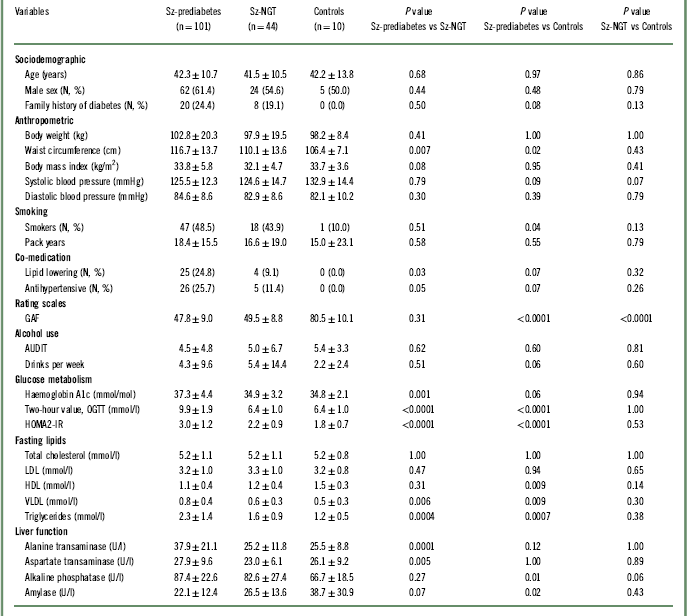
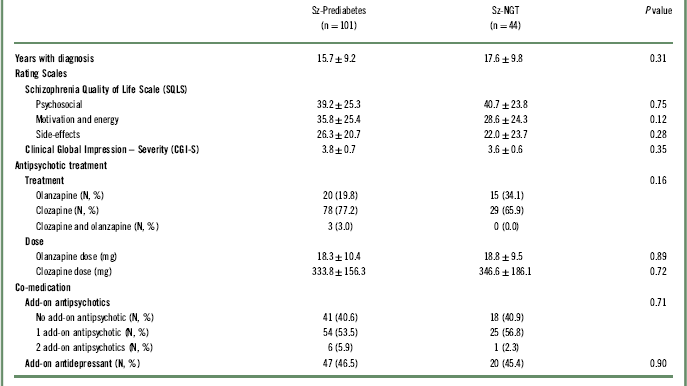
Altogether, 214 schizophrenia-spectrum disorder patients treated with clozapine or olanzapine, not diagnosed with T2D, were screened, and 69 (32.2%) patients were excluded following the initial screening due to not fulfilling inclusion criteria (n = 46) or declining study participation (n = 23) (Figure S1). The remaining 145 patients with schizophrenia underwent examinations for prediabetes, and 101 (69.7%) had prediabetes (Figure S1). For comparison, sex-, age-, and BMI-matched healthy controls were included (n = 10). There were no overall differences between the 3 groups (Sz-prediabetes, Sz-NGT, healthy controls) regarding age (P = 0.92), sex (P = 0.63), and BMI (P = 0.22) (Table 1). Sz-prediabetes and Sz-NGT patients did not differ regarding family history of T2D (first-degree relatives), disease duration of schizophrenia, or type of antipsychotic treatment. Clozapine was used more often than olanzapine in both groups without differences in doses across groups (Table 2).
Demographic, cardiometabolic, functional, and laboratory values

Plus-minus values are means±SD.
P values are difference between the groups. For continuous variables, the P values are estimated by unpaired T test and for categorical variables the P values are estimated by χ2. For the variables body weight, drinks per week, 2-hour value (OGTT), HOMA2-IR, HDL, triglycerides, alanine transaminase, aspartate transaminase, and amylase the comparisons are based on log-transformed data due to skewed distributions.
SD = standard deviation; Sz = patients with schizophrenia; NGT = normal glucose tolerant; Controls = healthy individuals; GAF = global assessment of functioning; AUDIT = Alcohol Use Disorders Identification Test; OGTT = oral glucose tolerance test; HOMA2-IR = homostatic model assessment – insulin resistance; LDL = low density lipoprotein; HDL = high density lipoprotein; VLDL = very low density lipoprotein.
Illness and treatment characteristic in the patients with schizophrenia

Plus-minus values are means±SD.
P values are difference between the 2 groups. For continuous variables, the P values are estimated by unpaired T test and for categorical variables the P values are estimated by χ2.
Sz denotes patients with schizophrenia and NGT normal glucose tolerant.
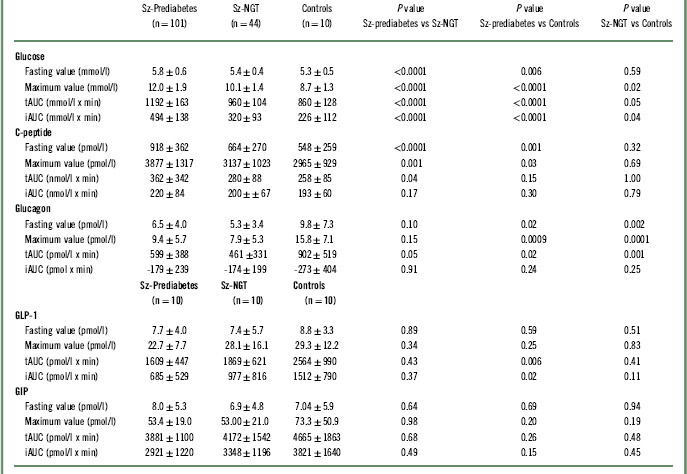
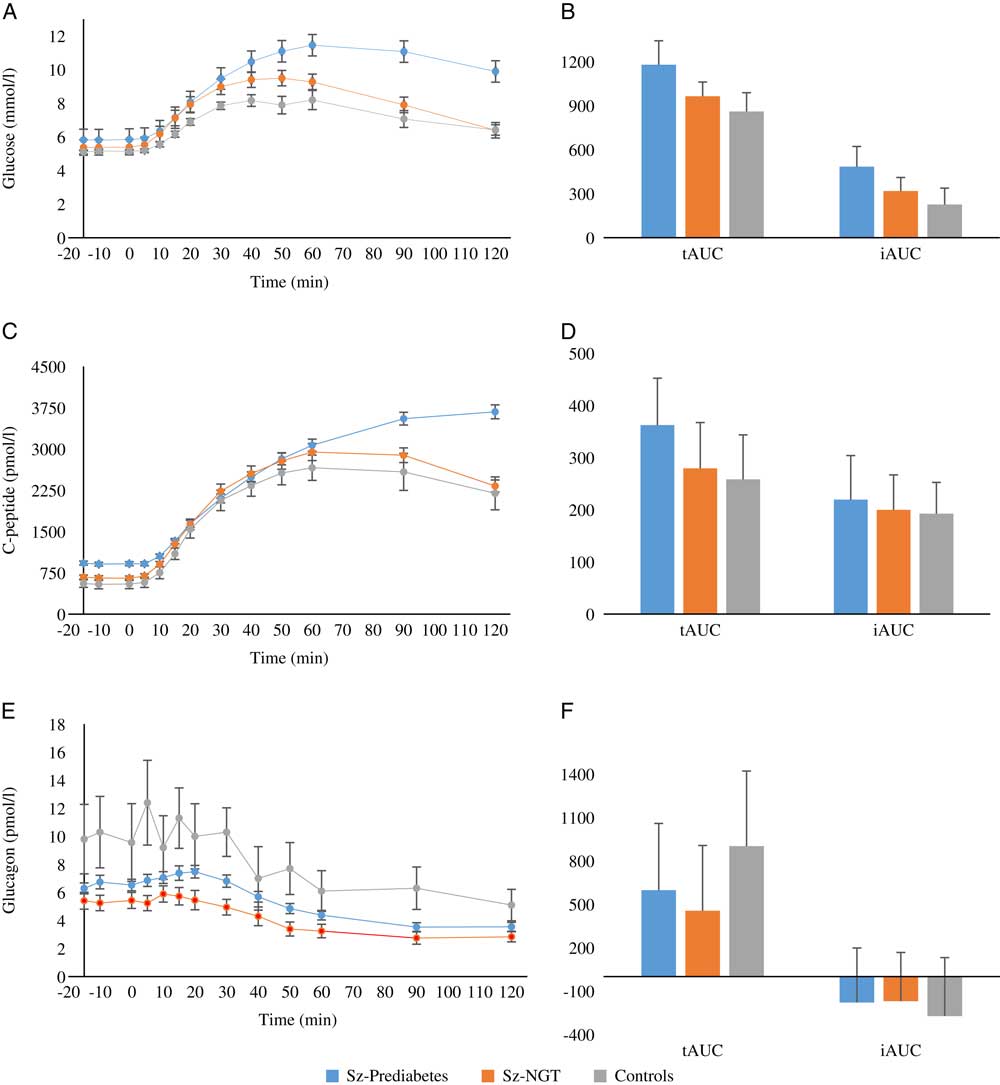
As expected, Sz-prediabetes patients were more insulin resistant (IR) compared to the Sz-NGT patients (IR: 3.0±1.2 vs 2.2±0.9, P<0.0001) and the healthy controls (IR: 3.0±1.2 vs 1.8±0.7, P<0.0001) and had poorer glycemic control (Table 1). The Sz-prediabetes patients had significantly higher levels of PG and C-peptide compared to the Sz-NGT patients and healthy controls during the OGTT (Table 3, Figure 1). Significant differences were found in glucose tolerance between all 3 groups evaluated by the tAUC and iAUC (Table 3, Figure 1). Evaluated by the tAUC, both schizophrenia groups had suppressed levels of GLP-1 and glucagon compared to healthy controls, and significantly higher glucagon secretion was found in the Sz-prediabetes patients compared to the Sz-NGT patients during the OGTT (Table 3, Figure 1). No differences in glucagon suppression or GIP secretion evaluated by iAUC were found between the 3 groups during the OGTT (Table 3, Figures 1 and S2).
Oral glucose tolerance test and glucose metabolism parameters

Plus-minus values are means±SD.
For continuous variables, the P values are estimated by unpaired T test. For the variable tAUC (C-peptide) the comparison is based on log-transformed data due to a skewed distribution.
Sz = patients with schizophrenia; NGT = normal glucose tolerant; Controls = healthy individuals; tAUC = total area under the curve; iAUC = incremental area under the curve; GLP-1 = glucagon-like peptide 1; GIP = glucose-dependent insulinotropic polypeptide.
75-g oral glucose tolerance test. A + B: Plasma glucose; C + D: C-peptide; E + F: glucagon. For the curves (A, C, E), values are means±SEM. For the diagrams (B, D, F), total area under the curve and incremental area under the curve are presented as means±SD. The participants were divided into 3 groups: Sz-prediabetes patients, Sz-NGT patients, and healthy controls. SEM denotes standard error of the mean, SD standard deviation, Sz patients with schizophrenia, and NGT normal glucose tolerant.

Sz-prediabetes patients were more centrally obese with higher waist circumference compared to both the Sz-NGT patients (116.7±13.7 vs 110.1±13.6 cm, P = 0.007) and healthy controls (116.7±13.7 vs 106.4±7.1, P = 0.02) (Table 1). Sz-prediabetes patients had higher triglycerides levels compared to both the Sz-NGT patients (2.3±1.4 vs 1.6±0.9 mmol/L, P = 0.0004) and the healthy controls (2.3±1.4 vs 1.2±0.5 mmol/L, P = 0.0007) (Table 1). Healthy controls had higher HDL levels compared to Sz-prediabetes patients (Table 1). No differences were found in total cholesterol, LDL, or blood pressure between the groups (Table 1). Compared to the Sz-NGT patients, more Sz-prediabetes patients received treatment with lipid lowering (24.8 vs 9.1%, P = 0.03) and antihypertensive (25.7 vs 11.4%, P = 0.05) medications (Table 2).
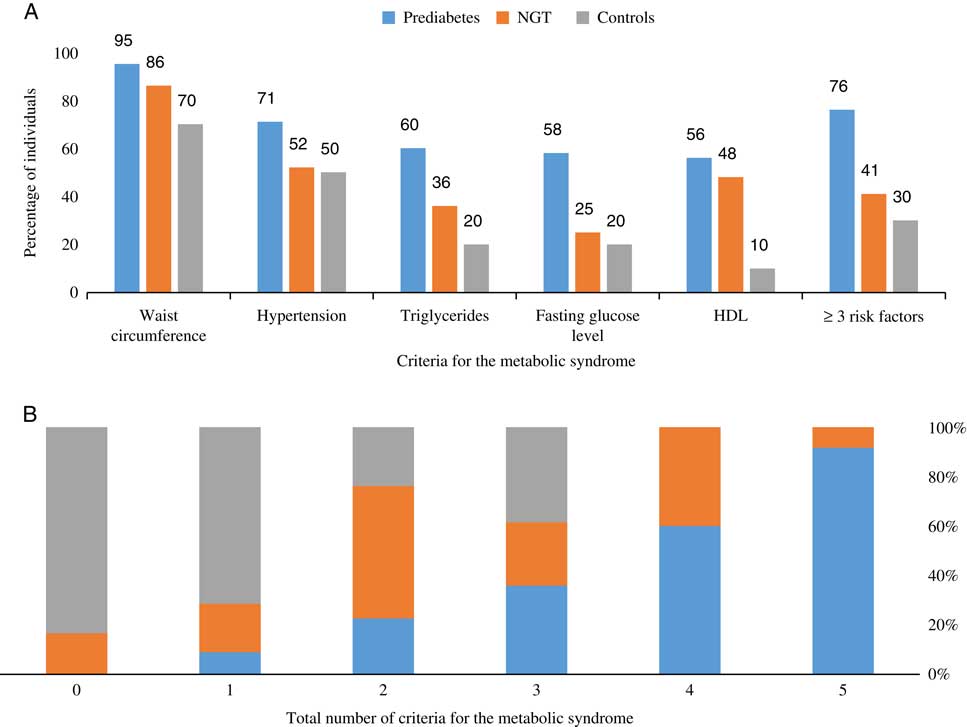
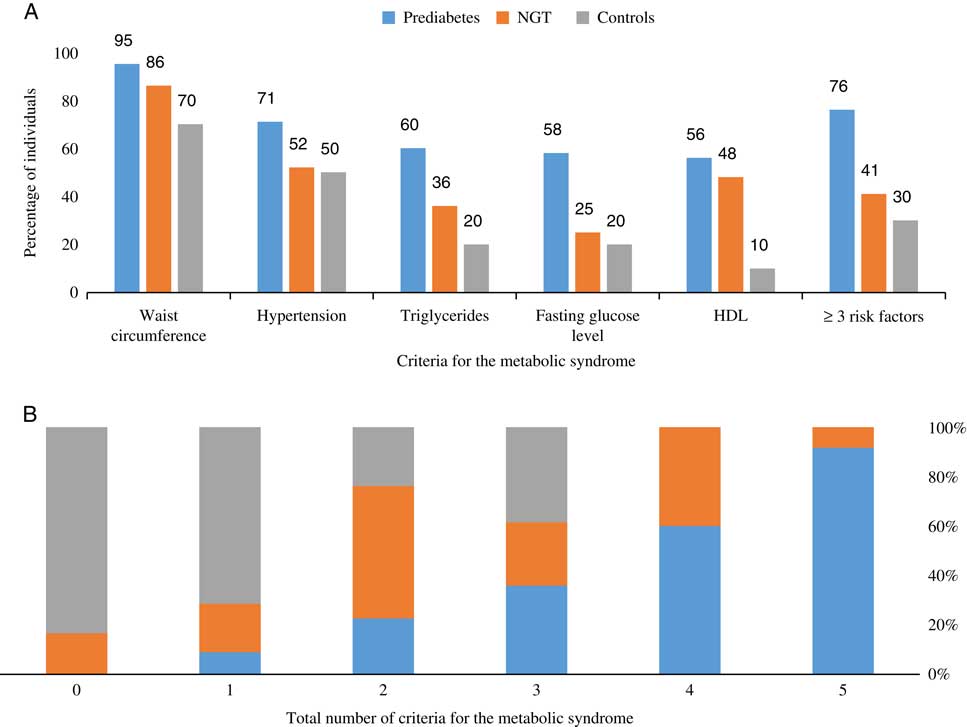
Altogether, 77 (76.2%) of the 101 Sz-prediabetes patients met metabolic syndrome criteria as defined by the American Heart Association.Reference Grundy, Brewer, Cleeman, Smith and Lenfant 23 In both NGT groups (Sz-NGT patients and healthy controls), the prevalence of metabolic syndrome was significantly lower (40.9% and 30.0%, respectively). Sz-prediabetes patients had the highest prevalence of each individual metabolic syndrome criterion (Figure 2A). Furthermore, only patients with schizophrenia fulfilled ≥4 criteria of metabolic syndrome, and the majority of patients meeting 4 or 5 criteria concurrently had prediabetes (Figure 2B).
Metabolic syndrome. A: Percentage of participants who met an individual criterion of metabolic syndrome, as defined by the American Heart Association in 2004: waist circumference (males>102 cm; females>88 cm); hypertension (≥130/85 mmHg or use of medication for hypertension); triglycerides (≥1.7 mmol/l); fasting glucose level (≥5.6 mmol/l); HDL (males<1.03 mmol/l, females<1.29 mmol/l). B: Distribution of participants who met a total number of criteria of metabolic syndrome. The participants were divided into 3 groups: Sz-prediabetes patients, Sz-NGT patients and healthy controls. HDL denotes high-density lipoprotein, Sz patients with schizophrenia, and NGT normal glucose tolerant.
Finally, the Sz-prediabetes patients had higher liver transaminase levels compared to Sz-NGT patients (ALT: 37.9±21.1 vs 25.2±11.8 U/L, P = 0.0001 and AST: 27.9±9.6 vs 23.0±6.1 U/L, P = 0.005). No differences were found in alcohol consumption as evaluated by AUDIT and drinks per week (Table 1). Slightly more patients with schizophrenia smoked compared to healthy controls, but no other differences were found in quality of life, daily function, or disease severity between the Sz-prediabetes patients and Sz-NGT patients (Tables 1 and 2).
Discussion
Compared to previous reports assessing either patients with mixed psychiatric diagnoses treated with any SGA (prediabetes prevalence = 38%),Reference Manu, Correll, van Winkel, Wampers and De Hert 45 schizophrenia patients treated for 6 months with either ziprasidone or olanzapine (prediabetes incidence = 18%),Reference Reaven, Lieberman and Sethuraman 24 or first episode schizophrenia patients with <6 months lifetime antipsychotic treatment (prediabetes prevalence: 15.4%),Reference Correll, Robinson and Schooler 46 the current study found a much higher prevalence of prediabetes among patients with schizophrenia. In this enriched group of schizophrenia patients (BMI≥27 kg/m2 and clozapine or olanzapine treatment for at least 6 months), almost 70% met the criteria of prediabetes.
Compared to both the Sz-NGT patients and the healthy controls, the Sz-prediabetes patients presented with a higher prevalence of all of the classic hallmarks of metabolic syndrome: (1) insulin resistance and impaired glycemic control, (2) larger waist circumference, (3) dyslipidemia, and (4) more frequent treatment with lipid lowering- and antihypertensive medications. Comparing Sz-prediabetes patients with Sz-NGT patients, no differences with respect to demographic, disease duration, illness severity, and treatment variables were identified, highlighting the difficulties in identifying patients with schizophrenia at high-risk for later development of overt T2D and CVD. Altogether, the Sz-NGT patients and the healthy controls did not differ regarding metabolic abnormalities, except for better glucose tolerance and higher GLP-1 and glucagon levels among healthy controls.
Only clozapine- or olanzapine-treated patients were included in this study, because compared to other antipsychotics they confer the greatest risk of body weight gain, metabolic abnormalities, and T2D development, and due to the efficacy of the compounds, especially clozapine, change to other SGAs is often not possible.Reference Henderson, Vincenzi, Andrea, Ulloa and Copeland 4 , Reference Correll, Lencz and Malhotra 14 No differences were found between Sz-prediabetes and Sz-NGT regarding the proportion of clozapine- and olanzapine-treated patients, as well as daily doses of either clozapine or olanzapine, or adjunctive antipsychotics or antidepressant. A previous study reported clozapine, but not olanzapine, to be associated with impaired glucose tolerance,Reference Manu, Correll and Wampers 27 while another study supported the finding of olanzapine and clozapine having a comparable high diabetogenic risk.Reference De Hert, Detraux, van Winkel, Yu and Correll 17 Of further note, the steady state serum concentration of SGAs was reported to correlate better with the frequency of metabolic disturbances than the daily doseReference Simon, van Winkel and De Hert 47 ; thus, using only the daily dose of the SGAs might not be sufficiently sensitive to identify any effects on metabolic abnormalities.
Prediabetes is a precursor for T2D and is considered a particularly strong risk factor for later T2D development.Reference Kahn, Cooper and Del 19 The Sz-prediabetes patients were further characterized by an increased prevalence of all the classic hallmarks of metabolic syndrome. Waist circumference was significantly larger in the Sz-prediabetes group, although all 3 groups had comparable BMIs. Central obesity is more important than BMI itself, as abdominal fat is closely linked to the initial development of prediabetes, metabolic syndrome, and CVD.Reference Eckel, Alberti, Grundy and Zimmet 48 Low HDL and high triglycerides levels were present even despite the fact that significantly more Sz-prediabetes patients were on lipid-lowering medications, indicating that Sz-prediabetes patients were metabolically more dysregulated. Of further note, studies have also shown that use of lipid-lowering medication is an independent risk factor for T2D development.Reference Cederberg, Stancakova, Yaluri, Modi, Kuusisto and Laakso 49 Interestingly, no differences were found between the Sz-prediabetes and Sz-NGT groups regarding blood pressure, but significantly more Sz-prediabetes patients received antihypertensive medication. The concurrent high prevalence of all individual components of metabolic syndrome in the Sz-prediabetes group highlights the close relationship between central obesity, insulin resistance, prediabetes, and the cluster of metabolic abnormalities of metabolic syndrome.Reference Eckel, Alberti, Grundy and Zimmet 48
As expected, the Sz-prediabetes patients showed signs of insulin resistance with higher levels of both FPG and C-peptide, a marker of insulin secretion, compared to both Sz-NGT patients and healthy controls. Due to prediabetes, the OGTT glucose excursion was significantly higher in the Sz-prediabetes group and an increased C-peptide secretion was observed. Furthermore, more Sz-prediabetes patients smoked compared to healthy controls, and smoking has been shown to be an independent risk factor for insulin resistance.Reference Ohkuma, Iwase and Fujii 50 , Reference Manu, Tsang, Napolitano, Lesser and Correll 51
In addition, both groups of patients with schizophrenia had decreased GLP-1 responses compared to the healthy individuals, and the decreased GLP-1 response was even more pronounced in the Sz-prediabetes patients. These findings are consistent with preclinical studies, where clozapine and olanzapine treatment were reported to decrease GLP-1 levels.Reference Smith, Chaussade, Vickers, Jensen and Shepherd 30 – Reference Smith, Vickers and Shepherd 32 Studies related to GLP-1 secretion are conflicting, but in nonschizophrenia, prediabetes individuals a decreased GLP-1-response to nutrients compared to NGT individuals has been reported.Reference Faerch, Torekov and Vistisen 52 , Reference Calanna, Christensen and Holst 53 Therefore, these findings suggest that a reduced GLP-1 secretion is present before overt T2D, and therefore may contribute not only to increased appetite but also to the development of T2D. Preclinical studies have also suggested an increase of glucagon with clozapine or olanzapine treatment.Reference Smith, Chaussade, Vickers, Jensen and Shepherd 30 – Reference Smith, Vickers and Shepherd 32 In the present study, the Sz-prediabetes patients presented with higher glucagon levels, compared to Sz-NGT patients, which is supportive of the idea of hyperglucagonemia and increased hepatic glucose production as an underlying contributor to the hyperglycemia seen in patients treated with clozapine or olanzapine.Reference Ward and Druss 7 , Reference Vancampfort, Correll and Galling 8 Notably, in nonschizophrenia individuals with IGT, elevated glucagon levels and a reduced suppression of glucagon secretion have previously been reported.Reference Ahren and Larsson 54 However, surprisingly, during the OGTT no significant difference in glucagon suppression was found between the 3 groups. Furthermore, the healthy individuals had higher fasting levels of glucagon compared to both groups of patients with schizophrenia. However, the healthy control group was small (n = 10), and therefore, these results should be interpreted with caution.
The Sz-prediabetes patients had higher plasma levels of liver enzymes, without differences in alcohol consumption or antipsychotic treatment regiments, including doses of the antipsychotic medication. Most antipsychotics can cause an increase of liver enzymes, but most of these increases are transient.Reference Rettenbacher, Baumgartner and Eder-Ischia 55 Importantly, all patients had been treated with clozapine or olanzapine for at least 6 months, and no change in dose of any medications 30 days prior to the examination was allowed. A plausible explanation for increase in liver enzymes could be the presence of non-alcoholic fatty liver disease (NAFLD).Reference Vernon, Baranova and Younossi 56 NAFLD is closely related to metabolic syndrome and T2D; it is the most common liver disease, and is characterized by steatosis and elevated liver enzymes.Reference Vernon, Baranova and Younossi 56 , Reference Anstee, Targher and Day 57 The findings of elevated liver enzymes suggestive of NAFLD in Sz-prediabetes patients are particularly concerning because NAFLD is associated with an increased risk of T2D development, and in patients with overt T2D, NAFLD is also associated with an increased risk of microvascular complications, CVD, and all-cause mortality.Reference Vernon, Baranova and Younossi 56 , Reference Anstee, Targher and Day 57
Results from this study should be interpreted in view of its strengths and limitations. Strengths include the relatively large number of participants who underwent substantial examinations for metabolic abnormalities. However, the study population was a highly selected group, which limits generalizability. All patients were diagnosed with schizophrenia and were overweight or obese, on stable treatment with clozapine or olanzapine for at least 6 months, and not diagnosed with T2D. Furthermore, there was an upper age limit of 65 years of age. As T2D prevalence increases with age,Reference Sinclair, Dunning and Rodriguez-Manas 58 the upper age limit may have led to an underestimation of the prediabetes prevalence. On the other hand, only patients with HbA1c ≥48 mmol/mol were characterized as having diabetes, allowing patients with a 2-hour value slightly above 11.0 mmol/l during the OGTTs to be characterized as prediabetes instead of T2D, potentially leading to an overestimation. Additionally, some selection bias may have occurred, leaving out the most severely ill schizophrenia patients. However, there were no restrictions regarding treatment facilities, ie, patients were allowed to be hospitalized, treated in outpatient psychiatric clinics, or by general practitioners as long as they did not receive compulsory treatment. Finally, the group of healthy controls was very small. However, despite the small sample, effect sizes were large enough to yield significant differences in several parameters, and the comparison between the Sz-prediabetes and Sz-NGT patients was the primary objective.
Conclusion
Despite the increased morbidity and mortality risk from CVD,Reference Correll, Solmi and Veronese 9 patients with schizophrenia and concurrent somatic diseasesReference Stubbs, Koyanagi and Veronese 10 are still often inadequately monitored and treated.Reference Cooper, Reynolds and Barnes 59 This study underscores the magnitude of the cardiometabolic risk in overweight or obese olanzapine- or clozapine-treated patients with schizophrenia, especially in those with prediabetes. Among the olanzapine- or clozapine-treated schizophrenia patients with prediabetes, 76.2% concurrently met the criteria of metabolic syndrome, highlighting an extremely high prevalence of many known CVD risk factors.Reference Long and Fox 22 Thus the current study emphasizes the importance of regular assessments for metabolic abnormalities and T2D in patients treated with clozapine or olanzapine.
Unfortunately, the pathophysiological mechanisms for the abundant cardiometabolic disturbances seen in these patients remain largely unknown and further research is needed. In addition, pharmacological and nonpharmacological interventions to mitigate antipsychotic-induced CVD risk factors have until now only shown limited effects.Reference Cooper, Reynolds and Barnes 59 Interestingly, results from a recent RCT with the longer-acting GLP-1RA agonist liraglutide demonstrated improvements in several metabolic risk factors together with a body weight loss of 5.3 kg in clozapine- or olanzapine-treated patients with prediabetes,Reference Larsen, Vedtofte and Jakobsen 34 thereby suggesting a possible novel treatment option for these high-risk patients with prediabetes.Reference Mayfield, Siskind and Winckel 29 , Reference Cooper, Reynolds and Barnes 59