Introduction
The exploration of the deep subsurface of other planetary bodies is motivated by potentially high scientific returns. Particularly on bodies such as the Moon or Mars, where impact gardening has disrupted and perturbed surface environments, the deep subsurface can provide access to relatively unaltered materials. On Mars, the deep subsurface is recognized to be a location that may have hosted habitable conditions in its past and has a high possibility of hosting such conditions today (Boston et al., Reference Boston, Ivanov and McKay1992; Hofmann, Reference Hofmann2008). For example, these locations have the potential to provide access to materials influenced by groundwater via upwelling events. As observed on Mars in regions such as the Burns Formation, groundwater had the ability to move through permeable sediment rock pathways to record ancient water–rock and water–mineral interactions (Clark et al., Reference Clark, Morris, McLennan, Gellert, Jolliff, Knoll, Squyres, Lowenstein, Ming, Tosca, Yen, Christensen, Gorevan, Bruckner, Calvin, Dreibus, Farrand, Klingelhoefer, Waenke, Zipfel, Bell III, Grotzinger, McSween and Rieder2005; McLennan et al., Reference McLennan, Bell, Calvin, Christensen, Clark, de Souza, Farmer, Farrand, Fike, Gellert, Ghosh, Glotch, Grotzinger, Hahn, Herkenhoff, Hurowitz, Johnson, Johnson, Jolliff, Klingelhöfer, Knoll, Learner, Malino, McSween, Pocock, Ruff, Soderblom, Squyres, Tosca, Watters, Wyatt and Yen2005; Andrews-Hanna et al., Reference Andrews-Hanna, Zuber, Arvidson and Wiseman2010). Should these features have been host to organics or biogenic features in early Martian history when the climate was more hospitable (Ehlmann et al., Reference Ehlmann, Mustard, Murchie, Bibring, Meunier, Fraeman and Langevin2011) and Earth-like, it would simultaneously provide protection and preservation of targets of astrobiological interest for future missions. Thus, the subsurface of Mars is a promising location to test the hypothesis of past life on Mars and the existence and persistence of habitable conditions on that planet.
In terms of human exploration, subsurface environments provide potential refugia from harsh surface conditions including Solar particle events and micrometeorite impacts. Although a permanent troglodyte existence may be unappealing to denizens of the Earth, in extraterrestrial environments such locations provide safe havens on the Moon, Mars and even asteroids, particularly if deep caverns are used that have already been formed by natural processes.
Access to the subsurface of other planetary bodies can be achieved by investigating naturally uplifted crater materials (Michalski and Niles, Reference Michalski and Nils2010), indirectly through radar sounding (Picardi et al., Reference Picardi, Plaut, Biccari, Bombaci, Calabrese, Cartacci, Cicchetti, Clifford, Edenhofer, Farrell, Federico, Frigeri, Gurnett, Hagfors, Heggy, Herique, Huff, Ivanov, Johnson, Jordan, Kirchner, Kofman, Leuschen, Nielsen, Orosei, Pettinelli, Phillips, Plettemeier, Safaeinili, Seu, Stofan, Vannaroni, Watters and Zampolini2005; Watters et al., Reference Watters, Leuschen, Plaut, Picardi, Safaeinili, Clifford, Farrell, Ivanov, Phillips and Stofan2006), or by drilling in robotic and human missions (Smith and McKay, Reference Smith and McKay2005). However, it is now understood that natural access to the subsurface is also provided by features such as volcanic and impact-produced caves and lava tubes (e.g. Cushing et al., Reference Cushing, Titus, Wynne and Christensen2007; Williams et al., Reference Williams, McKay, Toon and Head2010). These features provide compelling locations for robotic and human exploration and eventually for future human habitation.
Using deep subsurface environments on the Earth to carry out analogue research is rare primarily because access to subsurface environments is often logistically difficult. Existing examples are the European Space Agency's (ESA) CAVES and PANGAEA programmes. In this paper, we describe the use of a deep subsurface astrobiology facility (Cockell et al., Reference Cockell, Payler, Paling and McLuckie2013; Payler et al., Reference Payler, Biddle, Coates, Cousins, Cross, Cullen, Downs, Direito, Gray, Genis, Gunn, Hansford, Harkness, Holt, Josset, Li, Lees, Lim, McHugh, McLuckie, Meehan, Paling, Souchon, Yeoman and Cockell2016) and Mars Yard to test instruments, develop protocols and simulate deep subsurface exploration as part of a Mine Analog Research Program (MINAR). This programme takes advantage of a subsurface laboratory at the active Boulby Mine, UK and allows for technology transfer work between planetary sciences and mining (Bowler Reference Bowler2013). The geological and scientific context of the underground analogue activity is the presence of ~0.25 Ga-old deep subsurface evaporite deposits that contain within them chloride and sulphate salts that provide geological, geochemical and habitability analogues for the study of salt-rich environments on other planetary bodies.
Methods
General location of MINAR
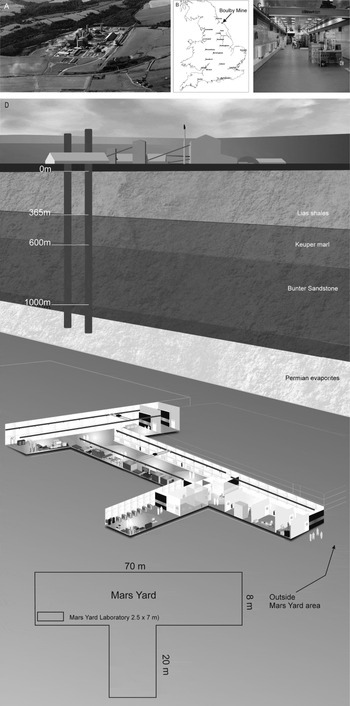
The Boulby Mine (run by Israel Chemicals Limited (ICL)) exploits the Zechstein evaporite deposits, the remnants of a ~250 million years old inland Permian sea that once stretched from the shoreline of the modern UK to Eastern Europe. The mine is situated in north Yorkshire, UK (Fig. 1) (Woods, Reference Woods1979).
(a) Surface image of Boulby Mine, (b) location of Boulby Mine, (c) the inside of the Boulby Underground Laboratory, (d) schematic of the Boulby Underground Science Laboratory and Mars Yard.

The Zechstein sequence contains a number of repeating evaporite mineral horizons, including chloride and sulphate salts such as halite (NaCl), sylvite (KCl), sylvinite (a mixture of NaCl and KCl) and polyhalite (K2Ca2Mg(SO4)4·2H2O) that often contain impurities of other minerals and clays.
Large-scale evaporite deposits, such as those found at Boulby, provide a terrestrial analogue for parts of the Martian surface and potentially deep subsurface. Chloride and sulphate minerals have been detected over much of Mars’ surface and in Martian meteorites (Bridges and Grady, Reference Bridges and Grady1999; Reference Bridges and Grady2000; Squyres et al., Reference Squyres, Grotzinger, Arvidson, Bell, Calvin, Christensen, Clark, Crisp, Farrand, Herkenhoff, Johnson, Klingelhöfer, Knoll, McLennan, McSween, Morris, Rice, Rieder and Soderblom2004; Langevin et al., Reference Langevin, Poulet, Bibring and Gondet2005; Osterloo et al., Reference Osterloo, Hamilton, Bandfield, Glotch, Baldridge, Christensen, Tornabene and Anderson2008; Reference Osterloo, Anderson, Hamilton and Hynek2010; Hynek et al., Reference Hynek, Osterloo and Kierein-Young2015). Brine fluids are hypothesized to exist in the shallow subsurface, and even surface regions, of present-day Mars (Zorzano et al., Reference Zorzano, Mateo-Martí, Prieto-Ballesteros, Osuna and Renno2009; Martínez and Renno, Reference Martínez and Renno2013; Martin-Torres et al., Reference Martin-Torres, Zorzano, Valentin-Serrano, Harri, Genzer, Kemppinen, Rivera-Valentin, Jun, Wray, Madsen, Goetz, McEwan, Hardgrove, Renno, Chevrier, Mischna, Navarro-Gonzalez, Martinez-Frias, Conrad, McConnochie, Cockell, Berger, Vasavada, Sumner and Vaniman2015; Ojha et al., Reference Ojha, Wilhelm, Murchie, McEwen, Wray, Hanley, Masse and Chojnacki2015). Such saline environments can record ancient fluvial activity as well as transitions between wet and dry environmental settings. Such transitions are observed for the late Noachian–early Hesperian on Mars.
Other planetary bodies, such as the asteroid Ceres, also host salt deposits (De Sanctis et al., Reference De Sanctis, Raponi, Ammannito, Ciarniello, Toplis, McSween, Castillo-Rogez, Ehlmann, Carrozzo, Marchi, Tosi, Zambon, Capaccioni, Capria, Fonte, Formisano, Frigeri, Giardino, Longobardo, Magni, Palomba, McFadden, Pieters, Jaumann, Schenk, Mugnuolo, Raymond and Russell2016; Stein et al., Reference Stein, Ehlmann, Palomba, De Sanctis, Nathues, Hiesinge, Ammannito, Raymond, Jaumann, Longobardo and Russell2018) and may be locations for future robotic and human exploration. Boulby is one potential analogue for the eventual robotic and human exploration of these environments.
The Boulby Mine hosts the Boulby Underground Science Laboratory, which since 2005 has led research into Dark Matter and other experiments requiring low background radiation (Bettini, Reference Bettini2011; Murphy and Paling, Reference Murphy and Paling2012; Smith, Reference Smith2012; De Angelis, Reference De Angelis2017). In 2011, we assembled an underground laboratory to carry out astrobiology and space exploration research (Cockell et al., Reference Cockell, Payler, Paling and McLuckie2013). Building on the potentially fruitful collaboration between planetary scientists and an active mine, we established the MINe Analog Research (MINAR) programme to enhance the testing and development of instruments and scientific studies related to the robotic and human exploration of the deep subsurface (Bowler Reference Bowler2013; Payler et al., Reference Payler, Biddle, Coates, Cousins, Cross, Cullen, Downs, Direito, Gray, Genis, Gunn, Hansford, Harkness, Holt, Josset, Li, Lees, Lim, McHugh, McLuckie, Meehan, Paling, Souchon, Yeoman and Cockell2016).
A question with any analogue site is what advantage is to be gained in using such a site. In the case of MINAR, there are three rationales for the use of the site: (1) the investigation of life in the deep subsurface. Evaporites of different kinds are thought to underlie a substantial fraction of the Earth's continental surface area, thus the study of these environments is of scientific interest for understanding the extent of the deep biosphere and its influence on global biogeochemical cycles. (2) Test technology relevant to the subsurface exploration of other planetary bodies such as the Moon and Mars in a controlled subsurface environment with access to power, Internet, wet laboratory facilities and other logistics facilities. (3) Carry out technology testing in a commercial setting (an active mine) thus enhancing technology transfer between the space and mining sectors and stimulating activity that links a planetary analogue campaign to Earth-based applications.
The first MINAR event, MINAR 1, was a workshop, ‘From Outer Space to Mining’ held 22–24 April 2013 to define analogue research in the deep subsurface and identify scientific and technical priorities for this type of research (the meeting was summarized by Bowler Reference Bowler2013). MINAR 2 (30 March–4 April 2014) and MINAR 3 (17–19 November 2014) were two events used to carry out analogue research using planetary instrumentation. The summary of the MINAR 1–3 events can be found in Payler et al. (Reference Payler, Biddle, Coates, Cousins, Cross, Cullen, Downs, Direito, Gray, Genis, Gunn, Hansford, Harkness, Holt, Josset, Li, Lees, Lim, McHugh, McLuckie, Meehan, Paling, Souchon, Yeoman and Cockell2016). MINAR 4 occurred from 18 to 20 July 2016 and was focused on the study of biosignatures in Permian evaporite polygonal formations. MINAR 5 (8–22 October 2017), the largest of the MINAR campaigns, was carried out as a collaboration with Spaceward Bound NASA and the Kalam Centre, India and is the subject of this paper.
Location of MINAR 5
During MINAR 5, several sites were used:
(a) The Mars Yard. This was used for instrument testing and deployment of environmental monitoring equipment. Eight defined samples of the three major evaporite types in Boulby: halite (NaCl), potash (KCl) and ‘polyhalite’ (K2Ca2Mg(SO4)4·2H2O) were procured of known geological provenance and deposited in the Mars Yard for instrument teams to use.
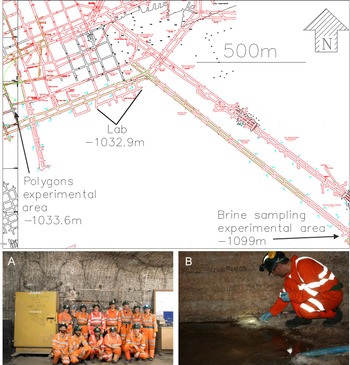
(b) Two excursions were implemented to well-defined polygonal features (Fig. 2). These are features in the halite formed in the original Zechstein deposit and today are found as dark black/brown lineations in the salt. The features are the location of enhanced mineral and carbon accumulations. They were used to test drilling and three-dimensional (3D) mapping technology and to collect samples for Close-Up Imager (CLUPI), UV fluorescence spectroscopy, Raman spectroscopy and adenosine triphosphate (ATP)/limulus amebocyte lysate (LAL) analysis.
Fig. 2.Sites where samples were acquired and studied during MINAR 5 in relation to the underground laboratory and mine roadways (top). The ‘Lab’ constitutes the underground laboratory and Mars Yard (see Fig. 1). Depths below sea level are shown. (a) Polygons experimental area. The dark lineations of the polygons can be seen in the wall behind the sampling team. (b) Brine sampling experimental area. ESA astronaut Matthias Maurer samples brine solutions at the edge of the pool.

(c) Two excursions were implemented to a large halite brine seep/pool caused by water infiltration into the mine and its ponding in a mine stub. This pond is characterized by both saturated salt solutions and secondary halite precipitation around its edges. This site was used to collect samples for CLUPI, UV fluorescence spectroscopy, Raman spectroscopy, and ATP/LAL analysis.

In addition, samples were collected around the mine in regions of high human activity by NASA JPL personnel to study microbial bioload as part of a study of microbial populations in cleanroom/spacecraft facilities and to test portable real-time DNA sequencing technology.
A deep subsurface Mars simulation facility
To achieve the objectives of MINAR 5, a ‘Mars Yard’ was constructed adjacent to the Boulby Underground Laboratory (Figs. 1 and 2). The Mars Yard is a 720 m2 space equipped with a small Internet-linked, air-conditioned laboratory (2.5 × 7 m (width) × 2.3 m (height)) at one end, which acts as an interface to the main laboratory and the surface as well as a location to test and ready instruments for deployment. The Mars Yard area is an open area of Permian halite with large lumps of different evaporite minerals collected from different areas of the mine and brought to the Mars Yard for instrument teams to study. This was the first purpose-built planetary simulation environment to be constructed in the deep subsurface.
MINAR analogue objectives
The MINAR 5 (8–22 October 2017) campaign had an overarching aim to test instruments and methods for the subsurface exploration of the Moon and Mars in an integrated campaign using the study of habitability and deep subsurface life as the motivator, and to use this work to develop new educational materials to advance planetary sciences in primary and secondary schools. Within this aim, the campaigns had four primary objectives:
(a) Testing of planetary exploration technology while studying deep subsurface life and biosignatures. Carry out testing of planetary instrumentation for deep subsurface exploration in an integrated way from sample collection through to analysis while studying Permian evaporite deposits and present-day habitats, in particular, study extant life and ancient biosignatures.
(b) Astronaut operations. During MINAR 5, the campaign was joined by ESA astronaut Matthias Maurer as part of his activities in the context of the ESA analogue training and testing programmes CAVES and PANGAEA. The purpose of attendance was to learn about planetary instrumentation proposed for Mars missions and to gain experience in a deep subsurface environment that complements lava tubes and natural fieldsite analogues used in ESA CAVES and PANGAEA, but also other artificial analogues like the future ESA LUNA facility.
(c) Education. MINAR 5 aimed to develop new curriculum materials. During the MINAR event, the education team (Audra Phelps (lead), Lilit Hakobyan, Libby Kuretn, Annalea Beattie, Anushree Shirvastava) joined expedition team members in the deployment and testing of the equipment described in this paper. Members of the education team joined the MINAR scientists in excursions to the polygon features, brine seeps and activities in the Mars Yard with the intention of learning about the different methods and how field work could be integrated into a classroom extra vehicular activity (EVA). At other times, the team met in the underground laboratory to discuss and put together lesson plans that incorporated the MINAR work.
(d) Outreach. MINAR 5 was used to reach a general audience to provide education in planetary science and astrobiology. During MINAR 5, three 1 h live links were conducted from the mine. These consisted of a format of ~5 min introduction, a ~20 min guided tour of the Mars Yard and some of the instruments being tested, a ~15 min guided tour of the main underground laboratory and a ~15 min session answering questions. These live links were carried out on October 16 (10:00 GMT) and October 18 (10:00 GMT and 15:00 GMT). They were conducted in collaboration with the Dr A. P. J. Abdul Kalam Centre, New Delhi, India with Srijan Singh and Shaily Shah from the Kalam Centre on site at Boulby. Over 500 schools and colleges associated with the Centre took part and the live feeds were available to the over 400 000 students of the Dr A. P. J. Abdul Kalam Technical University. The Kalam Centre aims to promote innovations, especially in governance and social enterprises, improve youth participation in national and international development and improve access to education and knowledge in all strata of Indian society. By coordinating the live links directly with the Kalam Centre, students from across India were able to learn about planetary exploration and take part in question and answer sessions about space exploration and specifically science being carried out in Boulby as part of MINAR 5. The second set of live links involved ESA astronaut Matthias Maurer who described his reasons for being at MINAR and some of his objectives there. Throughout MINAR 5, other short (~5–10 min) live interviews were carried out with scientists involved in MINAR to explain their science and technology activities to a wider audience.
Instruments tested during MINAR
During MINAR, a range of instruments was tested broadly split into sample acquisition, analysis and environmental monitoring. In the context of Boulby, the application of these instruments was particularly focused on testing their efficacy when applied to the study of ancient evaporite minerals.
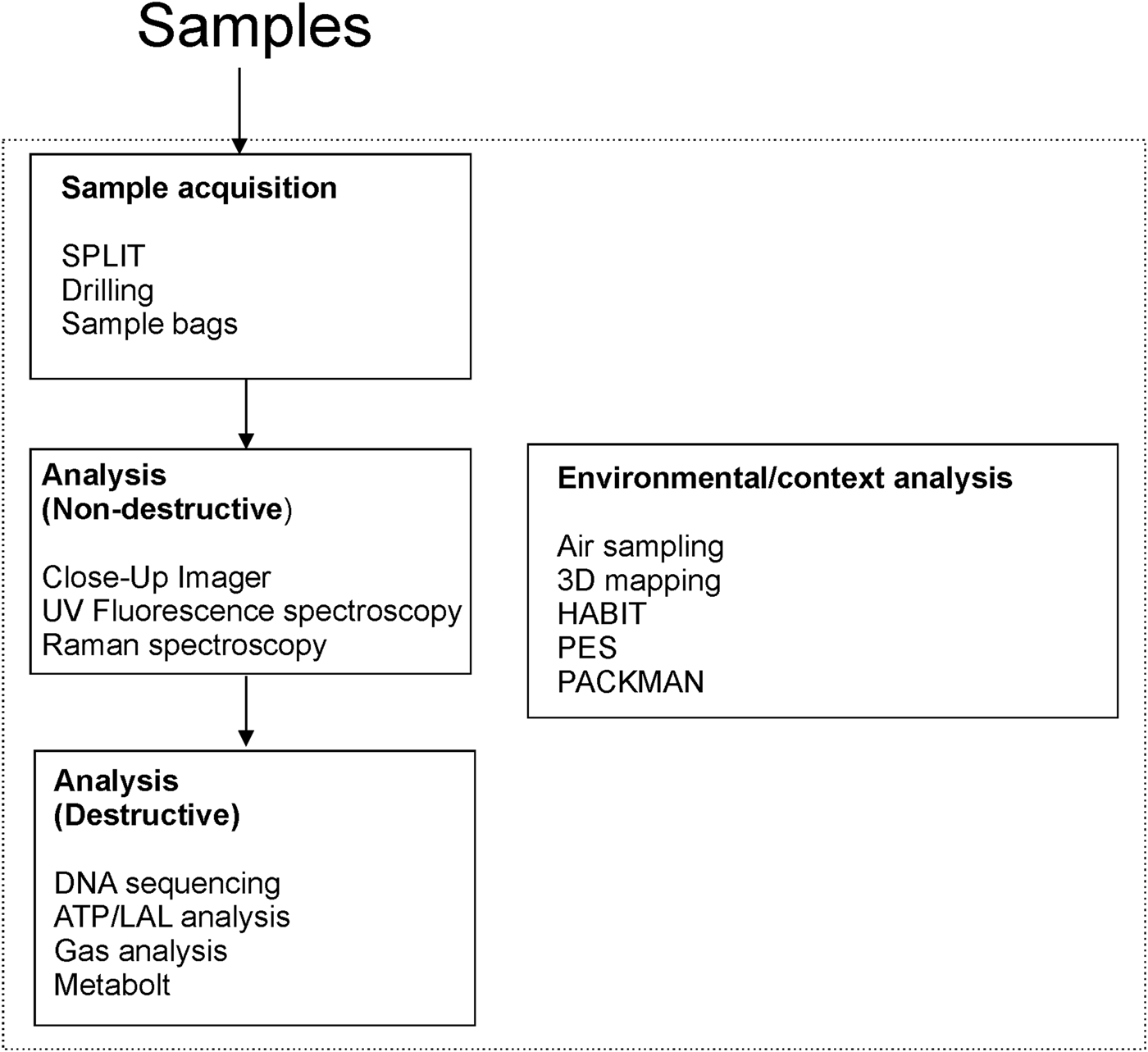
In order to emulate the type of study that might be undertaken by robotic or human explorers, samples were acquired using different methods (manual collection, Small Planetary Impulse Tool (SPLIT) and drilling) from the sites described in ‘Location of MINAR 5’ section, first analysed by non-destructive methods and they were then analysed by destructive methods (Fig. 3). Many of these samples were taken after MINAR to be analysed in more detail by respective science teams. Here we describe representative analyses carried out in situ using the scheme shown in Fig. 3.
A flow chart showing the sequence of sample analysis in MINAR 5 to emulate robotic or human exploration studies on other planetary surfaces.

Sample acquisition
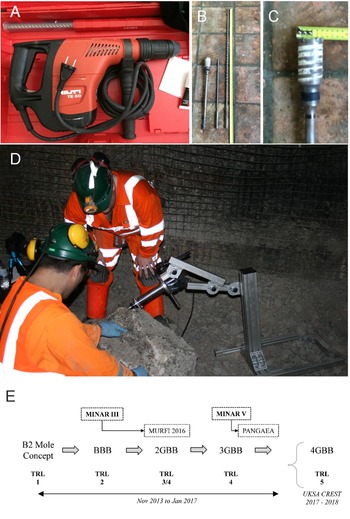
Sample acquisition instrumentation was a suite of instruments designed to acquire samples more effectively, with greater cleanliness or to improve the quality of samples that can be used for further analysis (Fig. 4).
Some of the sample acquisition instrumentation deployed in MINAR 5. (a)–(c) NASA drill. (a) The Hilti Drill TE 50, 1050 Watts; (b) 42 cm core string; 40.6 cm cutting string; 92.7 cm cuttings string; (c) core drill bit diameter 5 and 7 cm long, (d) The SPLIT instrument in operation on an artificial outcrop of halite in the Mars Yard; (e) the use of MINAR for the methodical development of the SPLIT technology (see ‘Results’ section for details).

NASA drill (NASA Ames Research Center)
MINAR 5 was used as an analogue field site validation test of drilling capabilities into ancient salt (halite) deposits and a test of contamination prevention protocols for planetary drilling.
A drill and three drill strings (Fig. 4) were used in Boulby Mine to get up to ~0.4 m deep samples within and along the boundaries of polygonal structures in halite at the polygons experimental area (Fig. 2).
Drilling took place with a hand-held Hilti TE 02 drill equipped with three drill strings: a 42 cm core sample string, a 40.6 cm cuttings string and a 92.7 cm cuttings string. The longest string was a prototype string for the proposed IceBreaker Mars life detection mission (McKay et al., Reference McKay, Stoker, Glass, Davé, Davila, Heldmann, Marinova, Fairen, Quinn, Zacny, Paulsen, Smith, Parro, Andersen, Hecht, Lacelle and Pollard2013). The cuttings strings produced 1–5 mm-sized cuttings, while the core string mostly recovered larger fragments (~0.5 cm diameter) and several 5 cm-diameter, 1–2 cm-thick pieces (cookies) sandwiched in a 7 cm core.
An essential part of the drilling process was to ensure sterility and cleanliness of the drill string in relation to the studies of biomarkers. The protocols for drill string cleaning included a combination of chemical disinfectants, flame sterilization followed by bio-burden monitoring (Hygiena UltraSnap surface swabs) using ATP luminometry to detect traces of ATP biomarker.
As flame sterilization was not possible in Boulby on account of safety procedures, previous protocols (i.e. Bonaccorsi and Stoker Reference Bonaccorsi and Stoker2008; Miller et al., Reference Miller, Bonaccorsi and Zacny2008) were modified to use only chemical disinfectants to sterilize the core string. To mitigate the lack of flame sterilization, implying the potential for high contamination, we used only the core drill bit to ensure the acquisition of a larger volume of polygon material. This way an uncontaminated sample suited for low levels of biomarkers could be obtained from the central part of the core, which is not in contact with potentially contaminated surfaces of the core string metal. Use of cuttings was avoided to minimize the use of contaminated drilled powder-sized cuttings in contact with the string thread's surface. Fine-grained cuttings have a large collective surface, enabling contamination when drilled with a potentially contaminated string thread. Furthermore, the heat generated during the drilling itself, which might influence biomarkers in the fine-grained cuttings, was mitigated by using the larger core string.
SPLIT (University of Leicester)
A major problem facing remote robotic in situ planetary missions is ambiguity caused by the nature and characteristics of a rock's measurement surface, which may mask an underlying, more representative mineralogy, petrology or hidden biosignatures. Based on the practice of field geology, it has been firmly established for planetary surface exploration, both manned and remote, that effective sampling of rocks is a key to maximizing scientific return and the delivery of mission objectives. SPLIT is a novel geotechnics approach to this problem, an instrument that breaks a rock target exactly as a field geologist would with a hammer to expose a deep internal pristine surface.
The SPLIT tip is pre-loaded by approximately 10N with the tip remaining in contact with the rock; some compliance in the system is provided by the forward bellows. The mechanism of SPLIT is actuated with a Maxon EC22 motor such that for each output rotation of the planetary gearbox, the hammer mechanism generates a single impulse. As the follower progresses the cam track, the cam body, with hammer, is displaced, thereby compressing the machined spring and storing potential energy. On completion of the cam track, the follower falls back to its original position; the compressed spring is released and thus, an impact is delivered by the hammer on the anvil, which couples the high-energy impulse to the tip. This repeated impact energy is used to induce brittle fracture at the interface. However, rock materials are generally discontinuous at microscopic scales, such that the crystal structure, grain boundaries, cleavage planes, as well as micro fractures and pores, all act as matrix defects exhibiting stress concentrations. SPLIT takes advantage of this feature in the various lithologies expected in planetary exploration where the cumulative effect of the technique is intended to induce low-cycle fatigue through the accumulation of plastic deformations in the rock matrix.
Complementary to other tools, SPLIT facilitates subsequent targeted sampling and extends sampling depth of current technologies. The technique can take advantage of an irregular surface, further extending the target range of other sampling tools. Furthermore, SPLIT is a controlled technique exposing a rock interior within a few minutes and may be used to manage wear of other tool tips and thus rover energy resources or deployed as a geological ‘triage’ tool to determine rock hardness with its sensor.
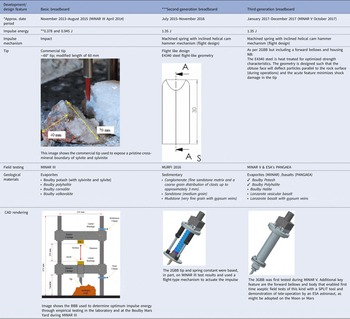
The space industry uses an agreed Technology Readiness Level (TRL) matrix to assess the maturity of new technologies prior to their incorporation in proposed spacecraft or instrument payloads. TRL's range from the lowest level, TRL 1 where the basic principle is observed and reported, to TRL 9 where the actual system is flight proven through a successful mission (ESA, 2008). This allows for realistic management of both science and engineering, providing a tool to help mitigate the risks imposed by performance, schedule and budget. The model philosophy adopted during the SPLIT research programme within MINAR is summarized in Fig. 4(e) and shows engineering evolution of the design to date. Early concept testing with the Beagle 2 Mole mechanism (Richter et al., Reference Richter, Coste, Gromov, Hochan, Pinna and Richter2001) enabled the development of the basic breadboard (BBB), which was then refined and tested through to the current third-generation breadboard (3GBB).
Planetary exploration sample bags (University of Edinburgh)
The collection of samples that are free of human contamination is essential in planetary exploration, particularly when the focus is on organics and life detection, but as a general matter, samples that have minimal contamination is beneficial since contaminant biota and organics can change the geochemistry of rocks. This project was an initiative to use prior experience with commercially available sampling bags to design and test prototypes of an optimal planetary sampling bag. Several prototype bags were tested in the Mars Yard and they were compared with the existing Whirl-Pak™ bags generally used in field biological sampling. MINAR 5 was used to test the prototype sample bags in a field setting.
Analytical instruments
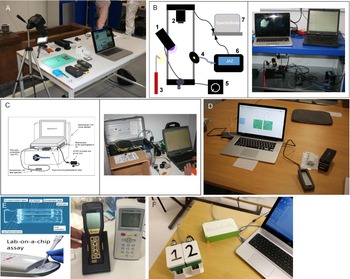
Analytical instrumentation was a suite of instruments designed to investigate samples after collection either for geological, geochemical or biological characteristics (Fig. 5).
Some of the analytical instrumentation deployed in MINAR 5. (a) Close-Up Imager (CLUPI) (seen as the camera on the tripod, top left), (b) UV fluorescence spectrometer (showing schematic of instrument set-up on left and image of instrument on right), (c) Raman spectrometer (showing schematic of instrument set-up on left and image of instrument on right), (d) Minion DNA sequencer, (e) ATP/LAL analysis (LAL lab-on-a-chip top left and bottom left, ATP luminometer on right), (f) Metabolt.

CLUP (Space-X Institute, Switzerland)
CLUPI is one of the instruments of the ExoMars 2020 rover, a joint mission of the ESA and the Russian Federal Space Agency (Roscosmos) (Vago et al., Reference Vago, Westall, Coates, Jaumann, Korablev, Ciarletti, Mitrofanov, Josset, De Sanctis, Bibring and Rull2017). CLUPI is a camera system designed to acquire high-resolution close-up images of geological samples, providing visual information similar to that a geologist would obtain using a hand lens (Josset et al., Reference Josset, Westall, Hofmann, Spray, Cockell, Kempe, Griffiths, Cristina de Sanctis, Colangeli, Koschny, Föllmi, Verrecchia, Diamond, Josset, Javaux, Esposito, Gunn, Souchon, Bontognali, Korablev, Erkman, Paar, Ulamec, Foucher, Martin, Verhaeghe, Tanevski and Vago2017). The images of sedimentary structures and rock textures produced with CLUPI will be crucial to select and contextualize the samples to be in turn analysed with other instruments located within the rover. It is also designed to be used to study drill holes, drilling fines and drilled core samples delivered in the Core Sample Transportation Mechanism (CSTM) prior to sending to the instruments within the rover.
CLUPI is a powerful, miniaturized, low-power, efficient and highly adaptive system composed of three main parts: an optics with focus mechanism that allows the acquisition of sharp images of any target from 10 cm to infinity, a colour (red–green–blue (RGB)) active pixel sensor with 2652 × 1768 × 3 pixels and a high-performance integrated electronics system. The functionality of z-stacking (i.e. combining of many images acquired at different focus positions to generate an image that is sharp in all areas) is also implemented in order to increase the scientific return. The CLUPI analogue instrument tested during the MINAR campaigns has the same image sensor as the instrument that will be on the ExoMars rover, although with different optics, which provide a slightly larger field of view (20° instead of 14°). The CLUPI Calibration Target (CCT, provided by Aberystwyth), 2.5 cm × 2.5 cm in size, was also used.
During MINAR 5, science validation activities (i.e. preparatory activities done on Earth to test and train using the instrument) were performed (Fig. 5(a)). A collection of samples comprising a variety of evaporitic minerals were imaged with a CLUPI prototype, allowing the CLUPI science team to test their instrument with samples that have a texture, luster, colour and general morphology analogous to materials that will be of prime interest during the ExoMars mission. As hydrated salt minerals that share compositional, crystallographic and textural similarities with the evaporitic mineral constituting the Permian Zechstein sequence of Boulby Mine (Woods, Reference Woods1979) have been identified on the surface of Mars (Barbieri and Stivaletta, Reference Barbieri and Stivaletta2011), the materials examined in MINAR 5 provide a way to test the imaging capabilities of the CLUPI instrument.
Ultraviolet fluorescence spectroscopy (University of St Andrews/University of Aberystwyth)
Ultraviolet (UV) fluorescence spectroscopy can be used to examine the samples for organics (which fluoresce in the UV radiation region) and minerals with fluorescence characteristics. Fluorescence excitation was carried out using a 280 and 365 nm LED, in complete darkness and at room temperature (Fig. 5(b)). An 0.22 NA optical fibre was positioned to collect light at approximately a 90° angle from the incident UV illumination. Emission spectra were measured using an Ocean Optics JAZ spectrometer and reflected UV light was rejected by a Schott 395 nm long pass filter (GG395). Data were recorded using SpectraSuite software, for wavelengths ranging from 350 to 750 nm. Imaging was obtained with a Thorslabs DCC1645C camera of 1.3 megapixels (1280 × 1024) and 25 mm f/1.4 lens mounted to view the sample surface at normal incidence from 200 mm. The lens was fitted with a Schott 410 nm long pass filter (GG410) to reject reflected UV illumination.
MINAR 5 was used as an analogue field site validation test of UV fluorescence spectroscopy with a specific focus on ancient salt samples with different geochemistries. The set-up prefigures the development of a dedicated and field-oriented UV camera, as a collaborative project between the University of St Andrews and the University of Aberystwyth.
Raman spectroscopy (NASA Ames Research Center)
Raman spectroscopy is planned on a number of missions including the ExoMars and the Mars2020 mission. This method is suited for the detection of organics and mineral determinations. An InPhotonics inPhotote Raman Spectrometer (model INP-3b-785ZZ) was used to characterize the mineral composition of various ancient evaporite minerals from different locations in Boulby Mine (Fig. 5(c)). This instrument was supplied with a 785 nm excitation 350 mW class IIIb monochromatic red laser and has a fibre optics sampling probe enabling the laser light to pass through the sample under investigation. The resulting Raman scattering radiation is transferred to the spectrograph with corrected background radiation for subsequent data analysis.
MINAR 5 was used as an analogue field site validation test of Raman spectroscopy with a specific focus on ancient salt samples with different geochemistries.
DNA sequencing (NASA Jet Propulsion Laboratory)
DNA sequencing is a powerful way to study life in the deep subsurface, but also to assay subsurface environments and other sites of astrobiological interest for human contaminants. For example, it has been shown by Saul et al. (Reference Saul, Aislabie, Brown, Harris and Foght2005) that human activity-induced hydrocarbon contamination significantly changed the in situ soil bacterial diversity near a field station in Antarctica. Understanding the contributions of human activities on microbial diversity of the pristine environments will help us understand planetary protection (PP) implications during human habitation on Mars.
DNA sequencing was performed in situ using a MinION sequencer (Oxford Nanopore Technologies, UK). The MinION from Oxford Nanopore Technologies is a compact, portable sequencer ideal for in-field nucleic acid sequencing during field expeditions (Fig. 5(d)). It sequences DNA and RNA strands by detecting changes in ionic currents caused by different nucleotide sequences as the strands pass through thousands of nanopores located on the flow cell of the MinION. Owing to its portability, it has been used in extreme, remote environments such as the International Space Station (Castro-Wallace et al., Reference Castro-Wallace, Chiu, John, Stahl, Rubins, McIntyre, Dworkin, Lupisella, Smith, Botkin, Stephenson, Juul, Turner, Izquierdo, Federman, Stryke, Somasekar, Alexander, Yu, Mason and Burton2017) and Antarctica (Johnson et al., Reference Johnson, Zaikova, Goerlitz, Bai and Tighe2017) and it has been used as a genomic surveillance tool in West Africa during the Ebola outbreak (Quick et al., Reference Quick, Loman, Duraffour, Simpson, Severi, Cowley, Bore, Koundouno, Dudas, Mikhail, Ouédraogo, Afrough, Bah, Baum, Becker-Ziaja, Boettcher, Cabeza-Cabrerizo, Camino-Sanchez, Carter, Doerrbecker, Enkirch, Dorival, Hetzelt, Hinzmann, Holm, Kafetzopoulou, Koropogui, Kosgey, Kuisma, Logue, Mazzarelli, Meisel, Mertens, Michel, Ngabo, Nitzsche, Pallash, Patrono, Portmann, Repits, Rickett, Sachse, Singethan, Vitoriano, Yemanaberhan, Zekeng, Trina, Bello, Sall, Faye, Faye, Magassouba, Williams, Amburgey, Winona, Davis, Gerlach, Washington, Monteil, Jourdain, Bererd, Camara, Somlare, Camara, Gerard, Bado, Baillet, Delaune, Nebie, Diarra, Savane, Pallawo, Gutierrez, Milhano, Roger, Williams, Yattara, Lewandowski, Taylor, Rachwal, Turner, Pollakis, Hiscox, Matthews, O'Shea, Johnston, Wilson, Hutley, Smit, Di Caro, Woelfel, Stoecker, Fleischmann, Gabriel, Weller, Koivogui, Diallo, Keita, Rambaut, Formenty, Gunther and Carroll2016). The low cost and simple library prep also make the MinION a good teaching tool for students (Jain et al., Reference Jain, Olsen, Paten and Akeson2016).
MINAR 5 was used as an analogue field site validation test of in situ DNA sequencing. At the time of MINAR 5, it was the deepest in situ DNA sequencing yet performed. MINAR 5 also provided the first opportunity to study microbial bioload in an underground laboratory compared with other existing surface cleanroom facilities such as spacecraft assembly rooms and laboratories.
Five samples were collected in duplicate from different locations based on varying degrees of human activity around the underground laboratory. Sites with a high degree of human activity were those near the laboratory entrance while samples collected far away from the laboratory had relatively low foot traffic. End-to-end sample collection, sample processing, DNA extraction, PCR, sequencing library preparation and DNA sequencing of microbial communities was performed in a cleanroom inside the laboratory.
Passive air sampler (NASA Jet Propulsion Laboratory)
The Rutgers Electrostatic Passive Sampler (REPS) passively captures biological airborne particles due to its permanently polarized ferroelectric films. The sampler is light, compact and can be deployed for long-term campaigns without supervision. It requires no electricity to operate. As power sources are limited in the mine, the REPS proved to be a convenient and non-intrusive method for monitoring airborne microbes.
REPS samplers were applied in the Boulby Potash Mine to demonstrate its efficiency in collecting airborne particles from an extreme, low biomass, environment. Samplers were deployed in duplicate in ISO6 and ISO7 cleanrooms inside the laboratory, six locations in the mine to compare between areas with little human presence and those frequented by humans. Data captured from the portable REPS sampler will help us understand airborne bacteria and fungi diversity present in the deep mine environment.
LAL/ATP analysis (NASA Ames Research Center)
Both LAL and the ATP assays are suitable for the detection of recent biological activity and were deployed in MINAR 5 to determine whether biosignatures of recent or older biological activity were present in the samples collected (Fig. 5(e)).
The LAL assay detects lipopolysaccharides (LPSs), which are primary components in the cell walls of all Gram-negative microbes including active, dormant or dead cells. The LAL chromogenic assay has been extensively used for quality control of pyrogens (lipid A) in drugs. More recent, the LAL assay has been applied to bioburden monitoring in spacecraft (NASA PP standard practices, NPR 5340, 2007), during field astrobiology trials (Maule et al., Reference Maule, Toporski and Steele2006a, Reference Maule, Steele, Burbank, Eppler, Kosmo, Ross, Wainwright, Child, Flores, Monaco, Graziosi and Splawn2006b; Eigenbrode et al., Reference Eigenbrode, Benning, Maule, Wainwright, Steele and Amundsen2009), and has been proposed for life detection for future planetary missions. The assay has been applied in biologically low biomass rocks and minerals (≤102 cell equivalent g−1), to biomass-rich sediments and soils, i.e. ~109 cell equivalent g−1 (Bonaccorsi et al., Reference Bonaccorsi, McKay and Chen2010).
LPSs were extracted from ~1 g of mineral, aseptically crushed and dissolved into ~3.5 mL of doubly distilled water. The solution was subsequently vortexed (2 min), sonicated (10 min at 40°C) and centrifuged at high speed (6400 g) for 15 min. At the end of each cycle, the LPS-enriched supernatant was transferred in a new 15 mL vial, while the LPS-leached solid residue (pellet) underwent further extraction. This procedure was repeated three times to ensure cell breakage, fragmentation of the LPS-bearing cell membranes, thus to increase LPS dislodgement, homogenization, as well as its concentration and detection. The final 11 mL solution was centrifuged one last time for 20 min to obtain a clear supernatant. Four 25 µL aliquots of this solution were pipetted into a laboratory-on-a chip cartridge (sensitivity range 0.5–0.005 EU mL−1 and 1.0–0.01 EU mL−1) and analysed with a Portable Test System (PTS) spectrophotometer (405–410 nm) (Fig. 5(e)). The chip has four ports receiving the liquid sample, two for spiked and two for non-spiked sub-aliquot samples. The resulting Endotoxin Unit (EU), 1EU = 1 × 10⁵ cell equivalent mL−1 of Escherichia coli, is translated into nanograms of LPS (ng mL−1) using calibration curves built into the PTS’ software. The current practical limit of detection for the LAL assay is 0.005 EU, equivalent to (5 × 10⁻¹³ g of LPS) per mL of water, or approximately 500 cells mL−1. When necessary, such as with reaction-inhibited or enhanced samples, the solution was diluted from ten to 1000 times with pyrogenic-free LAL water, or a different sensitivity range's cartridge was used. Samples were run in quadruplicate, two different cartridges with two ports, each (N = 4).
ATP assay
We estimated the living biomass in samples using the ATP assay in conjunction with a hand-held EnSURE Luminometer. The luminometer measures the light emitted by the luciferine–luciferase enzymatic reactions binding with the ATP released by living cells (e.g. Balkwill et al., Reference Balkwill, Leach, Wilson, McNabb and White1988). Lighting events are translated into Relative Luminosity Units (RLUs).
The RLU values are directly translated into ATP biomarker concentration by using known dilutions of ATP (ATP salts) within the dynamic range of two types of device.
The Hygiena system assay uses honey dipper test devices, one for total ATP (AquaSnap Total) and one for free ATP (AquaSnap Free) to quantify the labile ATP biomarker as a proxy for living cells. The total ATP device contains an extraction agent to break down cells, releasing their ATP content. The two test devices are used together to determine the microbial load in liquid samples. We estimated the microbial ATP by processing 100 µL aliquots of the same sample with the two sampling devices, i.e. cellular/microbial ATP = total ATP−free ATP. The larger the difference, the more microbial ATP a sample contains.
For the analysis, we used 1–10 g of rocks, or 1 mL of liquid brine sample. Ten grams of evaporites were dissolved in 30 mL of ddH2O in sterile 50 mL Falcon tubes. Liquid brines were diluted 100–1000 times in ddH2O. For each rock type and environment, the appropriate dilution protocol was determined (until the best signal/noise ratio was achieved). Each sample was analysed up to 3–4 times for free ATP and three times for free ATP.
MINAR 5 was used as an opportunity to test the LAL/ATP assay methods to investigate bioassay operation, procedures and results in ancient salt samples with different contamination conditions.
Methane gas analyses (Newcastle University/Durham University)
The concentration and stable isotopic values of methane can give valuable information as to its source (such as microbial, thermogenic, abiogenic; e.g. Whiticar Reference Whiticar1999). The concentration and carbon stable isotopic composition of methane at various points throughout the subsurface mine tunnels were analysed, and methane was extracted from representative evaporite minerals (halite, polyhalite, potash) from the mine to test for potential biosignatures.
Survey of methane (CH 4) concentrations and δ13C-CH 4 isotope values. Methane concentrations in the mine atmosphere were analysed at a total of 13 points in the mine tunnels. In situ concentrations were measured using an EcoTec TDL-500 portable tunable diode Laser Methane/Gas Analyser (Geotechnical Instruments Ltd, Leamington Spa, UK). At each sampling point, the instrument was left to equilibrate for 30 s or more prior to readings being taken. The detection range was 0–10 000 ppmv, and prior to analyses, the detector was calibrated to a 500 ppmv standard. At each analysis point, 5 L of the mine atmosphere was additionally sampled into a gastight aluminium-coated Tedlar bag (30274-U, Sigma) using a small battery powered air pump. The 5 L bags were then transported back to the Boulby Underground Laboratory, stored overnight and the 12CH4 concentrations (precision 5 ppb + 0.05% of reading 12C) and δ13C-CH4 values (precision <0.8‰) measured on a Picarro G2201-i cavity ring down spectrometer (Picarro Inc, Santa Clara, CA, USA). Samples with concentrations >100 ppm (over-range for high precision δ13C-CH4 measurements) were diluted prior to δ13C-CH4 analysis by injecting 200 mL of gas into a ~2 L sample of air within a gastight Tedlar bag.
Concentrations/δ13C-CH 4 values of methane extracted from representative Boulby Mine mineralogies. Eight representative evaporite minerals representing the dominant lithologies at Boulby Mine (halite, potash, polyhalite) were broken up to grain sizes of ~1 to <5 mm with a hammer, and 2.5 g of each weighed into 5 mL borosilicate serum vials (Wheaton). Each vial was sealed with a thick rubber stopper (Bellco) and crimp sealed with an aluminium top. The air within the vials was then connected via a needle and gastight tubing to a vacuum pump, and the air within the vials evacuated over a period of 2 min each. Once all the vials had been degassed, 40 mL of 5.0 grade helium (BOC) was added to each vial using a gastight syringe/needle. The helium was stored in a gastight 5 L Tedlar bag prior to use. Twenty millilitres of 18.2 MΩ.cm water, previously purged of air by gassing with 5.0 grade helium for 1 h, was then added to the vials, and the vials shaken for 20 s. They were then left for an hour for mineral dissolution to occur prior to gas headspace analysis of the samples. From each vial, 20 mL of gas was extracted and analysed on the Picarro Surveyor P0021-S cavity ring down spectrometer described above.
The objective of MINAR 5 was to demonstrate the application of portable methane concentration and isotopic determination technology in the deep subsurface while acquiring new primary data. The work also showed the potential use of portable gas detection technologies for geology and astrobiology investigations by future explorers on other planetary bodies.
Metabolt (Luleå University of Technology)
Metabolt is a lightweight, robust, low-power, ultra-portable instrument to investigate, if present, the signature of life and quantify the metabolic activity in soil or regolith (Fig. 5(f)). The instrument monitors the variability of the electrical conductivity, redox potential and gas concentrations of dominant metabolic by-products, oxygen and carbon dioxide. Simultaneously, environment parameters such as soil temperature, air temperature, air pressure and relative humidity (RH) are also recorded. The instrument monitors in parallel the electrical properties and gas concentrations for two samples of which one is doped with glucose.
MINAR 5 was used as an analogue field site validation test. The main objective of the campaign was to validate the Metabolt instrument in an uncontrolled environment analogous to Mars and to operate the instrument with the salt samples available in the mine. A halite salt mixture was used that was deliberately collected from a highly human-accessed area recording highest number of DNA fingerprints in the PCR studies carried out by NASA JPL's scientists (see ‘DNA sequencing’).
Environmental analysis
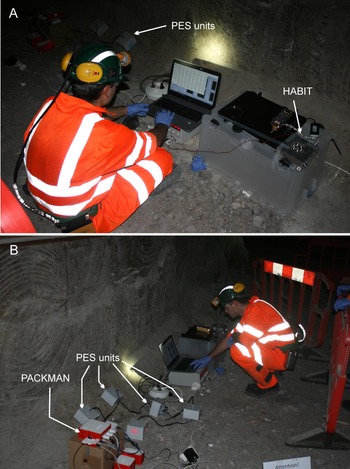
Environmental analysis instrumentation was a suite of instruments designed to monitor environmental conditions in sampling sites. These types of instruments can be deployed by explorers to assess the safety of sites, to map field sites or they can be left for the long term to monitor physical and chemical conditions in an extraterrestrial site of scientific interest (Fig. 6).
Some environmental analysis equipment deployed in MINAR 5. (a) HABIT and Perpetual Environmental Station (PES), (b) PACKMAN and PES.

In-Xpace 3D (Luleå University of Technology)
An essential instrument for future robotic and human exploration of the subsurface is 3D mapping. The Instrument for eXploration of space 3D (In-Xpace 3D) is a 3D mapping system developed using RGB and an infra-red (IR) depth camera and the dense simultaneous localization and mapping ElasticFusion algorithm to generate a point cloud image. The In-Xpace 3D system provides a real-time 3D imaging and post-sensing capability with an RGB-IR depth camera that can be used on astronaut helmets or mast of rovers for planetary exploration of geological features such as caves. The ability to operate in a low light environment and the absence of complex post-processing to produce point cloud images, makes InXSpace 3D competitive to current 3D mapping techniques.
MINAR 5 was used as a field site validation test of 3D mapping in an underground space analogous to underground caverns or caves on the Moon and Mars. The technology was deployed in the Mars Yard to map the cavern itself and target rocks. It was also deployed in the polygons experimental area to map polygonal structures in the area in 3D. It was used to test 3D mapping under low light/dark conditions in real-time exploration.
HabitAbility, Brine Irradiation and Temperature (Luleå University of Technology)
HABIT (HabitAbility, Brine Irradiation and Temperature) is a multipurpose instrument devoted to evaluating the habitability of Mars, but also an in situ resource utilization instrument for future Mars exploration. It is approved for flight on the ESA ExoMars landing element. The objectives of HABIT are: (a) to investigate (and quantify) the habitability of the landing site in terms of the three most critical environmental parameters for life as we know it: availability of liquid water, UV radiation biological dose and thermal ranges (on Earth, microbial metabolism has only been found above 240 K and reproduction above 255 K); (b) to provide environmental information (air and ground temperature, ground RH and UV irradiance), to investigate the atmosphere/regolith water interchange, the subsurface hydration, as well as the ozone, water and dust atmospheric cycle and the convective activity of the boundary layer; (c) to demonstrate an in-situ resource utilization technology for future Mars exploration.
During a mission, the instrument performs the following environmental and vessel measurements: (i) air temperature (×3); (ii) wind activity (forced convection regimes); (iii) ground temperature; (iv) brine conductivities (×6); (v) vessel temperatures (×6); (vi) filtered-UV irradiances (×6). The instrument operates autonomously measuring at 1 Hz, with regular acquisitions (about 5–10 min h−1 plus 1–4 h of extended continuous acquisitions as defined in the schedule table) during the day and in particular during the cold night hours, on a predefined schedule basis programmed by the SP Compute Element (SPCE). The instrument is able to autonomously heat each vessel to dehydrate the salt (regeneration) at night. By optimizing this, the amount of water captured at night is maximized to investigate future ISRU applications.
MINAR 5 was used as an analogue field site validation test of the HABIT instrument in a salt-rich environment. Tests conducted included the use of the following substrates in the HABIT cells: Test 1: cell (1) 40% potash in halite; (2) pure halite; (3) rehydrated halite; (4) potash; (5) polyhalite; (6) 60% potash in halite. Test 2: cell (1) 40% potash in halite; (2) stalactite sample (middle electrode); (3) rehydrated halite; (4) brine pool sample; (5) polyhalite; (6) 60% potash in halite.
PACKMAN (Luleå University of Technology)
PACKMAN is a small, robust, light and scalable instrument that monitors γ, β, α radiation and muons with two Geiger counters (Zorzano et al., Reference Zorzano, Martin-Torres, Mathanlal, Ramachandran and Soria-Salinas2017). This instrument includes environmental sensors to monitor pressure, temperature, RH and magnetic perturbations (with three fluxgate magnetometers in three perpendicular axes) and includes data archiving, GPS and communication capabilities. PACKMAN is an autonomous instrument that can be deployed at remote locations and send the data automatically through wireless communications. The PACKMAN-G (ground), installed at the Boulby Mine, is adapted for surface monitoring, including outdoors remote operation, to provide simultaneous records at multiple latitudes (and longitudes) with different geomagnetic fields and at different heights with different total air column (pressure) and weather phenomena. Three ground-based indoor versions of PACKMAN are installed in Kiruna (PACKMAN-K), Luleå (PACKMAN-L) and Edinburgh (PACKMAN-E).
MINAR 5 was used as a field site validation test of background particle monitoring in underground environments. The instrument was deployed long term in Boulby to test robustness and reliability as part of a global PACKMAN network and to use the permanence of the underground laboratory to allow for long-term monitoring studies.
Perpetual Environmental Station (Luleå University of Technology)
The Perpetual Environmental Station (PES) is a robust instrument, designed to last in harsh environmental conditions, with a suite of sensors for a long temporal study of the shallow region of the sub-surface environment and the surface parameters (temperature, pressure) over a wide spatial area. The PES has sensors oriented in a vertical fashion using a pole structure, installed at multiple depths for studying and characterizing the sub-surface environment. With a real-time data acquisition and communication, each station is self-sustaining.
MINAR 5 was used as a field site validation test of the PES in underground environments. The instrument was deployed long term in Boulby to test robustness and reliability and to use the permanence of the underground laboratory to allow for long-term monitoring studies.
Results
Testing of planetary exploration technology (objective a)
Sample acquisition
NASA drill
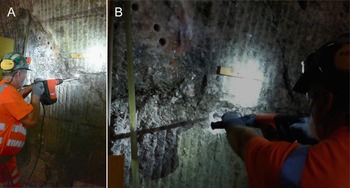
Drilling into a polygon boundary in the polygons experimental area (Fig. 2) is shown in Fig. 7. Four holes were drilled: the first a trial blank hole cored to mechanically cleanout the corer, the second into the polygon boundary junction and the remaining two near a polygon's centre. For each hole, up to four minicores were drilled. The core samples were obtained in 7 cm increments (the corer length), with the drill string re-entering the same hole. Core cuttings created during drilling were collected into sterile 50 mL Falcon tubes. The total hole depth was measured with a ruler at the end of drilling and ranged from 20 to 37 cm. The core samples were cooled down in the encasing core string and directly sampled into sterile bags (Whirl-Pak™). Representative samples were processed for extraction of the target biomarker. The exercise successfully demonstrated the ability to acquire drilled samples from ancient halite samples using the prototype Mars IceBreaker drill string (McKay et al., Reference McKay, Stoker, Glass, Davé, Davila, Heldmann, Marinova, Fairen, Quinn, Zacny, Paulsen, Smith, Parro, Andersen, Hecht, Lacelle and Pollard2013).
Drilling into Permian halite. (a) and (b) Drilling into salt polygon boundary junction (darker coloured strip) using the NASA Mars IceBreaker drill and core string.

SPLIT
As shown in Fig. 4, the MINAR field campaign has been crucial to developing and implementing key design features of the SPLIT device; this is summarized in Table 1 (impulse energy, impulse mechanism and tip geometry). By validation of the BBB, MINAR III directly informed the second-generation breadboard (2GBB) design, which was later verified during the UK Space Agency MURFI field trials in Utah (Balme et al., Reference Balme, Curtis-Rouse, Banham, Barnes, Barnes, Bauer, Bedford, Bridges, Butcher, Caballo, Caldwell, Coates, Cousins, Davis, Dequaire, Edwards, Fawdon, Furuya, Gadd, Get, Griffiths, Grindrod, Gunn, Gupta, Hansen, Harris, Holt, Huber, Huntly, Hutchinson, Jackson, Kay, Kybert, Lerman, McHugh, McMahon, Muller, Paar, Preston, Schwenzer, Stabbins, Tao, Traxler, Turner, Tyler, Venn, Walker, Wright and Yeomans2016). In 2017, MINAR V confirmed the results obtained during the earlier MINAR III programme, and allowed preparation for ESA's CAVES/PANGAEA testing of new Lunar/planetary sampling protocols by astronaut Matthias Maurer (using the flight-like 3GBB SPLIT). Field testing is fundamental to this type of instrument development with MINAR III and V being critical to both the development of SPLIT, in terms of engineering, and writing the scientific protocols that enable the instrument. MINAR III was the first time that SPLIT was used outside the laboratory environment and thus met a TRL assessment criteria of testing in a representative environment (thermal and vacuum environmental testing will be implemented at TRL 5 development). This was an important step for SPLIT because early field testing revealed nuances about SPLIT sampling, with analogue material, that had not been seen in specially prepared analogues for the laboratory. The Boulby analogues, used in situ during MINAR, provided a realistic and ‘natural’ presentation of rock that subsequently increased our confidence in the SPLIT technique and its efficacy for a given impulse energy.
The use of MINAR campaigns to advance SPLIT development

*Dates refer to STFC/UK Space Agency grant dates with specific field tests in parenthesis ().
**Early concept testing with the Beagle 2 Mole mechanism used a calculated impulse energy of 0.378 J that was used as an engineering baseline for SPLIT development.
***The 2GBB was not specifically used during MINAR.
Universal Planetary Sampling Bag
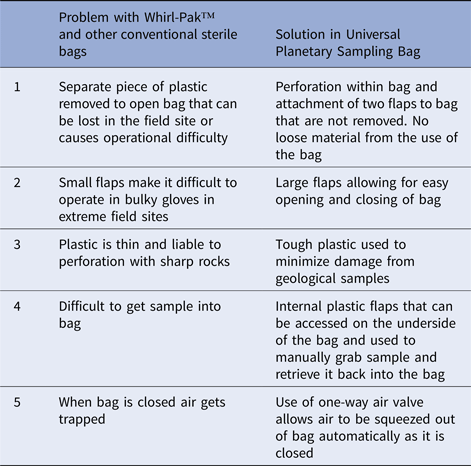
Many field expeditions, particularly those collecting samples aseptically for biological sampling, make use of the ‘Whirl-Pak™ bag’, a sterile sampling bag originally patented for the purpose of transporting milk. Although the bag has found very wide use in field expeditions because it is commercially available, it is apparent to anyone who uses it that it suffers from several flaws that reflect the lack of design for field sampling.
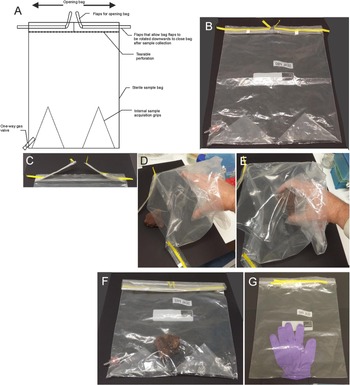
In view of these flaws, we set about to identify the major problems with existing bags and to identify solutions to them (Table 2). With these solutions in mind, we fabricated prototype Universal Planetary Sampling Bags and optimized them based on testing in the MINAR 5 campaign. The resulting prototype design is shown in Fig. 8(a) with photographs illustrating the steps in its use (Fig. 8(c)–(f)).
The Universal Planetary Sampling Bag. (a) Diagrammatic concept of bag. (b) A prototype bag. (c)—(f) Sequence of images showing use of bag prototype. (c) Bag is opened using perforated flanges that remain attached to bag. (d) Internal flaps allow for grabbing motion within the bag to obtain sample. (e) Sample is acquired and pulled into bag. (f) Sample inside bag with flanges wrapped down to seal bag. One-way air valve (bottom left) used to remove excess air. (g) An example prototype bag that uses a glove attachment inside for sample grabbing (see text for discussion).

Problems with conventional Whirl-Pak™ sampling bags for field exploration solved with the Universal Planetary Sampling Bag

There are variants of the bag that were tested, including replacing the internal sample acquisition flaps with a glove (Fig. 8(g)). However, given different hand and glove sizes, it was deemed that simple internal flaps were more effective and they provided sufficient purchase to obtain samples. Problems encountered attempting to fit a hand into a glove also had a tendency to rip the bag.
From these trials, we suggest the fabrication of a bag for human exploration missions with the characteristics described in Table 2 and illustrated in prototype form in Fig. 8(a) and (b).
Analytical instruments
CLUPI
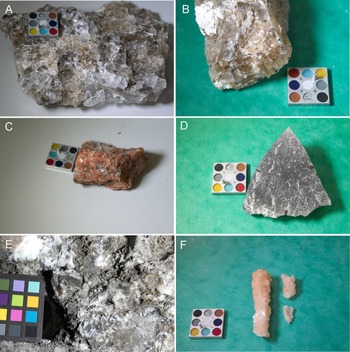
The CLUPI instrument was successfully used to image a range of evaporitic deposits that now form a library of such minerals acquired with calibration targets. Materials included the three primary evaporite types (halite, potash and polyhalite; Fig. 9(a)–(d)) as well as surfaces in the polygons experimental area (Fig. 9(e)), and secondary halite minerals from the brine sampling experimental area (Fig. 9(f)). Over 75 images of different materials were acquired. These analyses and image library provide information in addition to that already gathered in the MINAR 2–3 campaigns (Josset et al., Reference Josset, Souchon, Josset and Cockell2014; Reference Josset, Westall, Hofmann, Spray, Cockell, Kempe, Griffiths, Cristina de Sanctis, Colangeli, Koschny, Föllmi, Verrecchia, Diamond, Josset, Javaux, Esposito, Gunn, Souchon, Bontognali, Korablev, Erkman, Paar, Ulamec, Foucher, Martin, Verhaeghe, Tanevski and Vago2017; Payler et al., Reference Payler, Biddle, Coates, Cousins, Cross, Cullen, Downs, Direito, Gray, Genis, Gunn, Hansford, Harkness, Holt, Josset, Li, Lees, Lim, McHugh, McLuckie, Meehan, Paling, Souchon, Yeoman and Cockell2016) and other CLUPI field tests.
CLUPI images of key evaporite materials in Boulby. (a) and (b) halite, (c) potash, (d) polyhalite, (e) material at the edges of a NASA drill hole through polygon material, (f) secondary NaCl mineralization near the edges of a brine seep.

In addition, MINAR 5 was an occasion for members of the CLUPI science team to collaborate with other scientific teams that performed geochemical and spectral analyses on the same samples photographed with CLUPI. This situation provided ideal conditions to train and simulate activities analogous to those that take place during rover missions generally and specifically at the Rover Operating Center (ROC) during the ExoMars mission. The CLUPI images are intended to contextualize and interpret the results obtained with the bulk analysis that will be performed within the rover. It is therefore crucial to understand what morphological details are relevant for the other teams and learn to create the most profitable synergy.
UV fluorescence spectroscopy
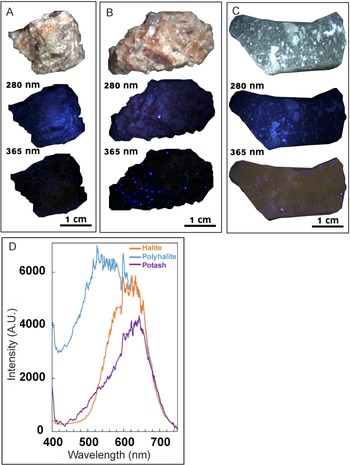
UV fluorescence is a phenomenon where UV photons/matter interactions cause electronic transitions to higher energy states, following a quick (<10−9 s) de-excitation and light emission in the visible range. Fluorescence can be produced by point defects, impurities, organic radicals and dislocations, all considered as emitters (or centres). The objective of MINAR 5 was to test UV fluorescence spectroscopy on ancient evaporitic materials and its potential for field use to identify evaporitic minerals. The materials studied with CLUPI were further investigated in the underground laboratory. Figure 10 shows representative images under different UV illumination and their spectra. Figure 10(a)–(c) shows some of the UV illuminations obtained for halite, potash and polyhalite. Overall, and especially at 365 nm, illumination is limited. Only polyhalite exhibits a bright signature in the orange at 365 nm (Fig. 10(c)). Figure 10(d) presents some of the results obtained for halite, polyhalite and potash, for a UV excitation at 365 nm. Overall, the three spectra are distinctive, and yet show a strong component between 600 and 650 nm. In alkali halides, the emitter in this region is generally Mn2+, present between 571 and 647 nm (Delumyea and Schenk, Reference Delumyea and Schenk1976; MacRae and Wilson, Reference MacRae and Wilson2008). Mn2+ could be present as impurity in interstitial position (Gorobets and Rogojine, Reference Gorobets and Rogojine2002). As Mn2+ is not a strong light absorber, only highly concentrated minerals exhibit a sharp colour (Platonov, Reference Platonov1979). As UV fluorescence is a sensitive spectroscopy, this may explain why polyhalite, despite being uncoloured in the visible, shows a strong Mn2+ component. Moreover, halite shows a broad emitter, previously observed in halite but still unspecified (CSIRO database, MacRae and Wilson Reference MacRae and Wilson2008). The shoulder observed in polyhalite at 580 nm could account for the presence of the same, but unidentified emitter. With such a shoulder, polyhalite appears more like a ‘mix’ of the halite and the potash signatures. Finally, the resemblance between potash and the halite observed here is predictable, considering the structural similarities of their primary components (KCl and NaCl, respectively). As well as having similar hardness (considered as soft – under 20 kg mm−2), they also exhibit the same crystal structure (CFC), the same slip system, and despite being non-identical, they share similar electronic properties (Poole et al., Reference Poole, Liesegang, Leckey and Jenkin1975).
UV fluorescence spectroscopy. (a)–(c) Images of halite, potash and polyhalite obtained under 280 and 365 nm illumination, at room temperature. (d) Spectra obtained of the three samples for a 365 illumination at room temperature.

These data demonstrate that the three primary evaporite minerals found at Boulby can be distinguished using UV fluorescence spectroscopy and that distinct peaks in fluorescence could be used in planetary environments to disentangle single or mixed deposits of evaporitic materials comprised of chloride or sulphate salts.
Raman spectroscopy
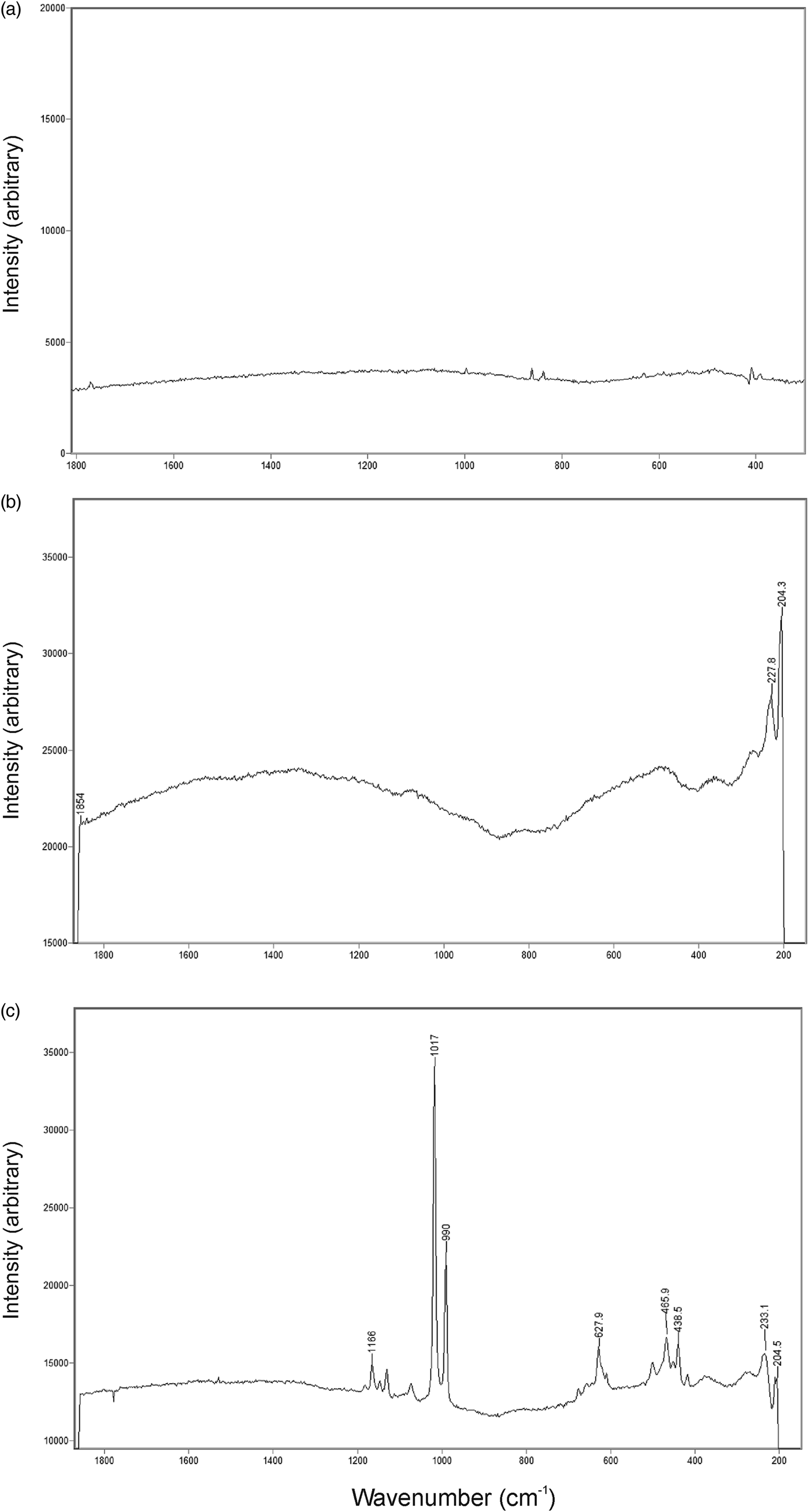
Raman analysis of evaporite samples showed the expected featurelessness of the halite (Fig. 11). No distinguishing peaks were observed. Broad peaks were observed in some samples, which may be caused by iron oxide or clay inclusions. However, polyhalite showed two characteristic peaks associated with sulphate. These peaks are consistent with similar peaks observed previously in this material (Payler et al., Reference Payler, Biddle, Coates, Cousins, Cross, Cullen, Downs, Direito, Gray, Genis, Gunn, Hansford, Harkness, Holt, Josset, Li, Lees, Lim, McHugh, McLuckie, Meehan, Paling, Souchon, Yeoman and Cockell2016). The Raman analysis shows the potential for effective analysis of evaporite minerals. However, the data also show that halite, because of its featureless spectrum, cannot be readily identified by the method. These results highlight the need to use multiple methods (such as UV fluorescence) to achieve identification of halite evaporites, particularly if they are mixed with evaporites such a sulphates that have distinguishing features and will swamp the presence of these other minerals.
Raman spectroscopy. Spectral plots of (a) halite, (b) iron oxide/clay inclusions in potash, (c) polyhalite.

DNA sequencing
DNA sequencing technology tests focused on samples that would yield insights into the bioload associated with an underground clean laboratory as a comparison to surface clean laboratory sites. Five samples were collected in duplicate from different locations based on varying degrees of human activity around the laboratory. Sites with a high degree of human activity were those near the laboratory entrance while samples collected far away from the laboratory had relatively low foot traffic. End-to-end sample collection, sample processing, DNA extraction, PCR, sequencing library preparation and DNA sequencing of microbial communities were successfully performed in a cleanroom inside the laboratory. In addition to in situ collection, the JPL team collected samples of evaporite minerals from the Boulby Mine for biosignature detection using metagenomics and planetary instruments. Microbial signatures in these samples will be detected at JPL using next-generation DNA sequencing and bioinformatics analysis. The mineral samples will be scanned by SHERLOC and PIXL instruments planned for the Mars2020 mission for biosignature detection at JPL. Post-SHERLOC and PIXL analysis, we will perform an in-depth metagenome analysis of these same samples to understand the extent of microbial and eukaryotic diversity and their functional capabilities. This comparative analysis is imperative for verifying biosignature detection capabilities of future life detection instruments.
LAL/ATP analysis
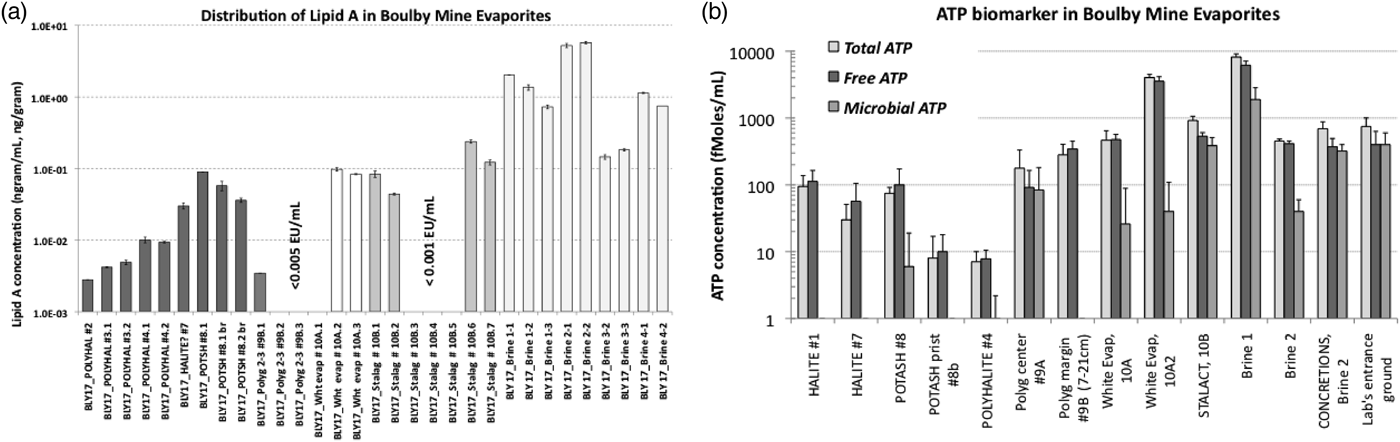
LAL and ATP assays were successfully used to examine the samples from the mine. Samples collected in a non-sterile way were found to contain markers. For example, polyhalite samples collected by mine personnel for the purposes of MINAR 5 (samples 2–4) yielded values between 0.0028 and 0.011 ng LPSs per gram (ng g−1) as well as ~10–113 fmoles of total/free ATP per gram of rock. High concentrations were observed in the brine pool area that has seen human activity. Specifically, the white evaporitic crust collected from the brine pool's shoreline yielded ~0.1 ng LPS per gram of sample. Four brines analysed showed values that ranged from a minimum concentration of LPS at 0.73–2.0 and 0.15–0.18 ng mL−1 to maximum concentrations of this biomarker at between 5.22 and 5.75 ng mL−1. Two of these brines yielded the highest amount of total ATP 453 ± 31 and 8200 ± 938 fmoles mL−1 including 9–23% of microbial ATP, respectively. The highest percentage proportion of microbial ATP was found in the contaminated ground of the laboratory entrance (53%) and in the secondary modern evaporites (stalactites and concretions) from the brine pool's wall with 42 and 46% microbial ATP, respectively.
The lowest concentration of measurable LPSs was found associated with the polygons where strict sterile drilling was observed. Only one out of three replicates of sample 9B, cored from the clay-rich polygon margin, yielded concentrations above the LPS detection limit, i.e. 0.055 ng g−1 of halite rock. Non-measurable lipid, below the limits of detection (<0.005 EU mL−1) were found in the clay-free samples drilled from the polygon's centre (sample 9A). However, these samples were positive for free ATP, which comprised 100% of the total ATP (Fig. 12(b)). The absence of microbial ATP rules out contamination during drilling and sample handling. Clay-barren and clay-rich halite from the polygon centre and clay-rich polygon margin yielded ~180–280 fmoles g−1 of total ATP, respectively, perhaps reflecting some preservation of relatively modern biomarker in the halite and clay-rich matrix.
(a) Concentration distribution of LPS. Error bars are the %CV for each duplicate assay. Samples are as follows: first nine samples are solid salt samples of polyhalite, halite and potash. Following three samples (‘polyg 2–3’) are samples from polygons in polygons experimental area. Following 19 samples are evaporite (‘wht evap’), salt stalagmite (‘stalag’) and brine samples (‘brine’) from brine sampling experimental area. (b) ATP in ancient and modern evaporite/brine system using selected samples in (a) including a sample from the ground at the laboratory entrance (far right).

MINAR 5 thus provided a demonstration that aseptic drilling can be accomplished in ancient evaporites using basic decontamination methods without contamination detectable by this assay. It also allowed us to optimize LAL/ATP assays for use by human explorers to monitor the movement of contamination in areas of human habitation on other planetary surfaces.
Metabolt
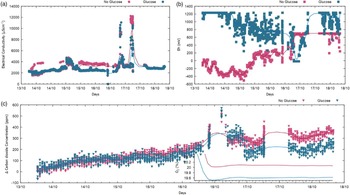
MINAR 5 was used to carry out analogue field tests of the Metabolt instrument demonstrating its operability in uncontrolled remote environment. Figure 13 shows an example of a MINAR 5 experiment where two samples of crushed halite from the mine were monitored over 5 days in the mine, after the addition of 40 mL of water. Each sample was incubated independently in one container. In one of them, glucose was added as an organic carbon source, diluted in 40 mL of water with a 0.5% concentration by volume. During the first 4 days of incubation, there was a smooth evolution of the electrical conductivity (Fig. 13(a)), redox (Fig. 13(b)), carbon dioxide gas (Fig. 13(c)). The redox value showed a significant transition on 16–17. During this time, both experiments showed an emission of carbon dioxide and a strong consumption of oxygen (Fig. 13(c) inset). This was coincident with sudden changes in the electrical conductivity, which may be attributed to release of products during metabolic activity.
Metabolt operation. (a) Comparison of electrical conductivity in samples with and without glucose. (b) Comparison of redox potential (Eh) in samples with and without glucose. (c) Comparison of change in carbon dioxide levels in samples with and without glucose; (inset) anti-correlation with oxygen levels.

The MINAR 5 analogue campaign allowed the in situ demonstration of Metabolt capabilities as an instrument to monitor metabolic activity of samples within their natural environment. Metabolt is a promising technology for life exploration on Mars or analogue environments on Earth, including simulation chambers.
Gas analysis
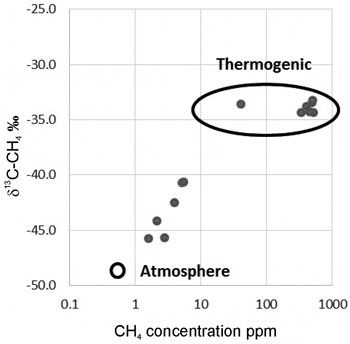
The MINAR 5 campaign allowed the in situ analysis of mine atmosphere CH4 and δ13C-CH4 at various points within the tunnels. A plot of CH4 versus their δ13C-CH4 values indicates that the methane within the mine tunnel atmosphere is most simply explained by a mixture of thermogenic CH4 (with a δ13C-CH4 between −33.6 and −34.3‰) and atmospheric surface derived air CH4 (~47‰; Whiticar Reference Whiticar1999) (Fig. 14). The thermogenic (i.e. thermally altered organic matter of previously biological origin) CH4 is most likely derived from underlying hydrocarbon source rocks, which form economic deposits within the North Sea (Hitchman et al., Reference Hitchman, Darling and Williams1989).
Methane concentrations, sampled in the atmosphere within 13 locations in the Boulby Mine tunnels, plotted against their respective δ13C-CH4 values. The simplest explanation for the range of values is mixing between a thermogenic source and an atmospheric (ambient surface derived air) source. The value for the atmosphere endmember is taken from Whiticar (Reference Whiticar1999).

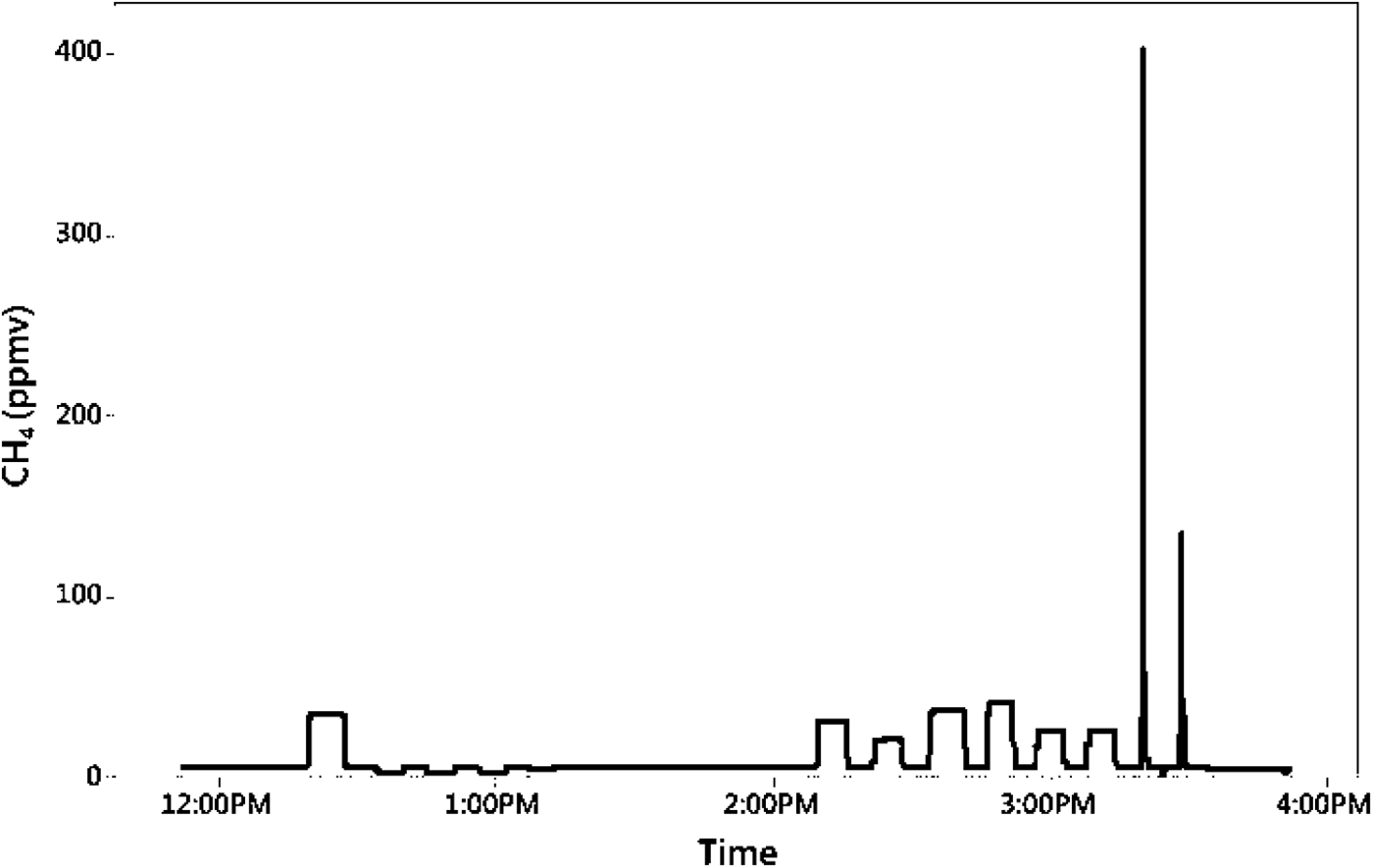
The pilot study to extract CH4 from representative evaporite minerals was successful, with above background concentrations of CH4 extracted from the two potash samples, but not from the halite or polyhalite minerals (Fig. 15). Unfortunately, the peak concentrations of CH4 from the potash (402 and 136 ppm) were too high to allow quantitative δ13C-CH4 analysis (samples with concentrations >100 ppm required dilution in the analytical set-up that we used). Nonetheless, these results suggest that CH4 is concentrated only within certain mineral layers (potash) within the mine, and not others. This CH4 may represent the partial trapping of upwelling thermogenic methane identified in the mine tunnel atmosphere, although further research is required to quantitatively test this hypothesis. Knowledge that methane gas is concentrated within certain mineral horizons could potentially aid future mineral exploration in the area (e.g. via the analysis of gases from boreholes).
Raw data of methane concentration (12C) within mine atmosphere samples (flat topped peaks) and gases extracted from the two potash samples (two highest peaks on right-hand side of plot), as measured by the Picarro G2201-i cavity ring down spectrometer. No methane was detected within the other suites of mineral samples tested (halite, polyhalite).

MINAR 5 also demonstrated the deployment of methane collection and analytical instrumentation and data acquisition and analysis in a simulated planetary exploration scenario. Similar spatial analysis of methane could be carried out by human explorers on the surface and in subsurface deployments on Mars.
Environmental monitoring
3D mapping
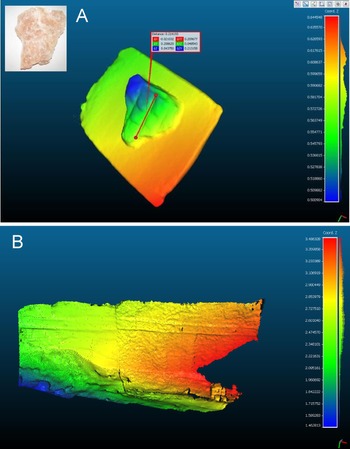
The MINAR 5 campaign provided an opportunity to test the InXSpace 3D instrument. Close-range mapping of salt rocks (Fig. 16(a)) and long-range mapping of the surface features of the mine shaft walls (Fig. 16(b)) was carried out in the Mars Yard. In Fig. 16(a), the inner square on top left shows the halite rock specimen that was taken for the close-range 3D mapping analysis. The camera was positioned about 0.5 m above the specimen in the Nadir view. The depth elevation model (DEM) analysis shows the capability of the system to resolve the surface features of the specimen to close tolerances. In the long-range mapping, the camera was moved in a rectilinear motion pointing towards the mine shaft walls. From Fig. 16(b), the DEM analysis reveals the features that could be observed from a distance of 1.2 m. The box structure observed in the lower right portion of Fig. 16(b) shows the PACKMAN module installed in the Boulby Mine during the MINAR 5 campaign. The testing of the low-cost, quick 3D mapping InXSpace 3D system in the MINAR 5 campaign validated the short-range and long-range capability of the system for deep subsurface exploration and mapping of terrestrial and extraterrestrial environments both in lit and dark conditions.
3D mapping. (a) Close range 3D mapping image done in the Boulby Mine with a rock sample. (b) Long range 3D mapping of the wall of the mine shaft. The small box on the bottom right of the image is the PACKMAN instrument.

HABIT
The HABIT instrument was operated during MINAR 5 using Permian halite to test the efficacy of the instrument using natural salts. After the several days, continuous operation of HABIT in the MINAR 5 campaign, corrosion was observed in some electrodes. This experience has led to the modifications of their material, as well as their electronic paths in order to remove capillarity effects, which were also observed during the campaign. Thus, the MINAR 5 campaign both provided additional testing of the HABIT instrument and specifically identified required improvements in design that are to be implemented prior to future spaceflight.
PACKMAN and PES
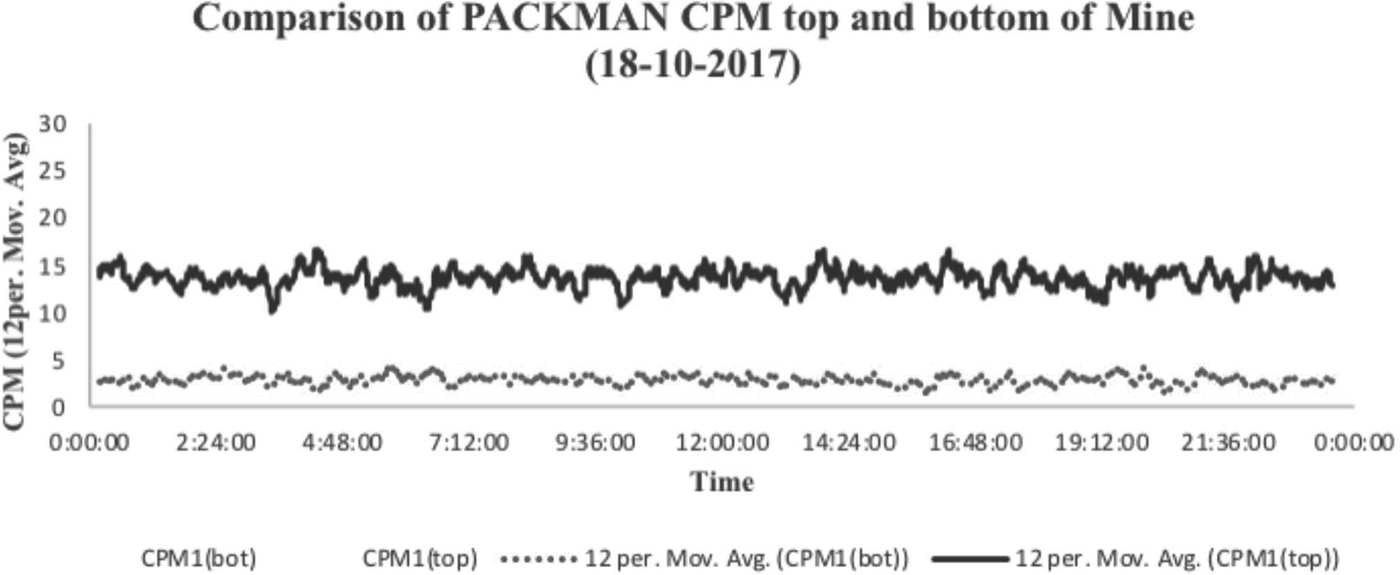
PACKMAN was installed in the Boulby Mine during the MINAR 5 campaign to study the low-radiation environment and make a comparative study with a similar instrument operating on the surface of the Boulby Mine. Figure 17 shows the average particle count recorded by Geiger 1 of the PACKMAN operating on the surface and the average counts recorded by the Geiger 1 of the PACKMAN in the mine. A 12 min moving average has been taken to smoothen the plot. The radiation ‘quietness’ of the mine owing to the kilometre of crust that shields the mine tunnels from the background radiation can be observed. These data and operations show the validity of deploying the PACKMAN as a radiation sensor in human habitats on and under other planetary surfaces. PACKMAN has been left within the mine to provide remotely accessible background particle data in the mine environment and to test remote access capabilities over a long time period.
PACKMAN operation. Figure showing the lower background radiation experienced in Boulby Mine (dots) compared with surface particle flux (solid line), validating the instrument in a ‘quiet’ radiation environment.

The PES was also deployed in the mine for long-term monitoring. The PES modules have been installed during the MINAR 5 campaign for a technological demonstration of operation of a wide range of sensors for studying sub-surface parameters. At present, the modules are not buried below the sub-surface and are just placed on the sub-surface to measure the long-term operability of the modules.
Astronaut operations
During MINAR 5, ESA astronaut Matthias Maurer took part in a week of activities. His work during this period included: taking part in field trips to brines and evaporite polygon structures to understand the motivations and work of the scientists involved in MINAR; working alongside different instrument teams to understand the use and rationale of instruments being tested for robotic and human missions and particularly those instruments approved for flight on robotic missions; and taking part in live outreach links from MINAR.
Education
Capitalizing on the unique environment of the mine, the teachers taking part in MINAR 5 focused on developing a classroom EVA. The EVA is a flexible classroom activity designed to teach sampling techniques used in obtaining biological and geological samples in planetary exploration. During the activity, students learn numeracy and literacy skills, group collaboration in carrying out scientific research, and critical thinking skills needed to explore our world and reach new levels of understanding of the Universe at large. To begin setting the parameters for the EVA, teachers accompanied MINAR researchers on sampling excursions into various mine environments, included brine pools and polygon formations. Teachers benefitted especially from observing real-time sampling procedures and they made evaluations for realistic classroom adaptations by collaborating with researchers in the field. Collaboration of teachers across disciplines broadened the scope of curriculum writing and added ways of making EVAs and sampling activities more interesting and understandable to various types of learners.
Beyond the more focused work of writing lesson plans, the teachers were exposed to the application, communication and reflection on the nature of science and the scientific method. Conversations with researchers on how projects were developed, tested and implemented highlighted how scientific reasoning is fundamental to their projects and how to incorporate this into the EVA.
The EVA involves breaking the class into groups, including a mission control and an EVA team. The mission control and EVA team communicate with one another as the EVA team go about collecting samples. These sampling protocols could be sampling biology, geology, taking environmental measurements or any activity consistent with the learning objectives for a given class or stage of learning. The class reconvene to discuss the results and conclusions. Thus, the EVA lesson plan consists of a core EVA plan for use in any classroom and ‘bolt-in’ EVAs that can be developed by teachers for any given science-learning objective. The material was written to be appropriate for primary or secondary schools.
Outreach
A total of 17 live interviews were undertaken during MINAR. The interviews included three 1 h overviews of the MINAR activities and 11 shorter interviews with members of MINAR 5 covering a variety of the instruments being tested (some of these videos are available on YouTube). The live links were streamed through Facebook. Fourteen days after MINAR, the mean number of views of these interviews was 8503 (standard deviation 12 441) with a maximum of 38 000 and a minimum of 240. Successful live links to schools, colleges and the Dr A. P. J. Abdul Kalam Technical University through the Kalam Centre in New Delhi, India were made, demonstrating the value of real-time education from a deep subsurface science laboratory. Accepting the time delay, these types of lecture and show-and-tell activities from an analogue environment demonstrate not only the ability to do effective remote educational outreach from analogue environments on Earth, but the potential for future outreach from subsurface laboratories and stations on the Moon and Mars and the enormous intrinsic interest they capture among science and engineering students and the general public.
In addition to MINAR-led activities, MINAR was also covered by the BBC News (Look North), Channel 4 national news, the BBC World Service and other Internet news outlets.
Discussion
Deep subsurface environments on other planetary bodies provide access to samples and measurements of interest for understanding the origin, history and potential habitability of those bodies (Boston et al., Reference Boston, Ivanov and McKay1992; Cushing et al., Reference Cushing, Titus, Wynne and Christensen2007; Hofmann, Reference Hofmann2008; Williams et al., Reference Williams, McKay, Toon and Head2010). Furthermore, large natural subsurface caverns provide potential locations to situate future human habitats. We have used the Boulby Mine in the UK, a 1 km deep active mine in Permian evaporite deposits, as a place to carry out science and test instruments and operational approaches for the robotic and human exploration of the deep subsurface (Bowler Reference Bowler2013; Cockell et al., Reference Cockell, Payler, Paling and McLuckie2013; Payler et al., Reference Payler, Biddle, Coates, Cousins, Cross, Cullen, Downs, Direito, Gray, Genis, Gunn, Hansford, Harkness, Holt, Josset, Li, Lees, Lim, McHugh, McLuckie, Meehan, Paling, Souchon, Yeoman and Cockell2016).
MINAR 5 successfully undertook a coordinated campaign involving 42 individuals. The scientific focus of the campaign was the study of evaporite minerals and life detection. The instruments tested during the campaign included sample acquisition methods, non-destructive and destructive sample analysis methods and environmental monitoring equipment. We found that the organisation of these methods and instruments into a sequence of steps allowed us to bring together diverse sample acquisition and analysis methods into a coordinated campaign of experimental testing.
As well as in situ investigations, the MINAR campaign created a diversity of sample analysis and instrument development objectives that will continue after the MINAR campaign. They include: study of biosignatures in ancient salt samples collected during MINAR (NASA JPL), study of microbial distribution and aerobiology using air sampling devices and samples obtained in MINAR (NASA JPL), optimization of the robotic hammer, SPLIT (University of Leicester), optimization of drills for future exploration based on experiences in MINAR (NASA Ames Research Center), optimization of robotic instrumentation including the ExoMars rover CLUPI, HABIT instruments based on experiences during MINAR (Space-X Institution and Luleå University of Technology), advancement of new instrument improvements such as UV fluorescence spectroscopy (St Andrews University/Aberystwyth University). These activities show that analogue campaigns are not an isolated activity, but rather they provide real testing that leads to further studies of acquired samples and optimization of instruments.
One advantage of running an analogue campaign in an active commercial setting is the possibility for exploring direct links with Earth-based challenges. Two concerns in active mining environments are the collapse of the roof and the build-up of gases. The collapse of the roof is a general ongoing safety concern, but it may also occur in places that a mine wishes to bring back to economic activity and thus requires exploration capability to investigate the state of an environment. The build-up of gases is a concern since in some mines gases are explosive or, in the specific case of mines like Boulby, they can cause the blow-out of material during the release of pressure. During MINAR, the use of 3D visible and IR mapping technologies and the study of gases, including methane, enclosed within salts will advance potential approaches to improving rapid structural studies in mines and in the specific case of Boulby, understanding the location and source of gases that are of safety concern. A spin-off from MINAR 5 was the acquisition of funding by the Luleå University of Technology to design and build a rover to be deployed in the mine with 3D mapping, gas detection sensors and other instrumentation based on work conducted during MINAR 5. The rover will be tested in the Mars Yard with the objective of further advancing the link between astrobiology instrumentation for the subsurface exploration of other worlds and the advancement of technology to improve the economic efficiency and safety of mining activity on Earth. In the future, these links may even come full circle with potential links to mining of asteroids and other extraterrestrial resources. This rover will be deployed in the context of future MINAR events.
MINAR also allowed for the deployment of permanent instrumentation within Boulby with subsurface mining and future subsurface astrobiology applications. The Perpetual Environmental Sensor instrument and the PACKMAN particle detector were deployed and linked into the Internet during MINAR and left for long-term monitoring of the mine environment and its geophysical conditions. In particular, the PACKMAN instrument in Boulby is part of a global network of these instruments being developed and deployed by the Luleå University of Technology showing how an analogue environment can be used as a site to deploy instruments that are part of global monitoring and planetary exploration studies.
In MINAR, we worked in collaboration with the ESA CAVES and PANGAEA programmes: geology and astrobiology training and testing programmes using analogue field sites such as caves and lava tubes in Lanzarote to train astronauts. During MINAR, ESA astronaut Matthias Maurer was able to work with different instrument and science teams on a daily basis to learn a variety of new methods and techniques for the human exploration of other planetary bodies. An advantage of the analogue environment and campaign are the opportunity for astronauts involved in planetary exploration to gain rapid insight in a large number of activities and instruments that are localized to the analogue site for the duration of the campaign.
MINAR demonstrates how an analogue field campaign can be used as a mechanism to develop new curriculum materials. In the case of MINAR 5, educators were able to follow instrument teams and carry out field investigations and they were able to use this information to develop a classroom EVA. The field excursions provided ideas and concepts for field excursion and sample analysis activities that could be carried out by students in a simulated EVA. In particular, much consideration was given by the educators to the scientific method and how a classroom EVA can be used to teach students concepts in carrying out good science such as appropriate controls, collecting multiple samples, problems with noise (contamination), sample analysis, etc. We conclude by noting the additional value for little extra effort that incorporating the development of curriculum materials into planetary field activities can achieve.
Acknowledgements
The authors thank the Science and Technology Facilities Council (STFC) for their support of the Boulby Underground Science Facility in which MINAR 5 was conducted. Knowledge gained in the execution of STFC grant, ST/M001261/1, was used to advance objectives in MINAR 5. The authors also thank Cleveland Potash and ICL for their generous in-kind and logistics support to MINAR and the underground science facility with which MINAR is made possible. Boris Laurent is funded by a Leverhulme Trust Research Project Grant, RPG-2016-071. SPLIT Research and Development has been funded by three research grants (UKSA CREST and STFC's Follow on Fund) between 2013 and 2017, with support in 2018 by CREST to realise a TRL 5 flight type prototype instrument. Jon Telling (gas analysis development) is funded in part by UK Space Agency grant ST/R001421/1.