Introduction
Kochia is a problematic summer annual broadleaf weed species that infests cropland and non-cropland areas across the U.S. Great Plains, including Kansas (Friesen et al. Reference Friesen, Beckie, Warwick and Van Acker2009). Early seedling emergence, low soil seed persistence (1 to 2 yr), aggressive growth (C4 plant), and tolerance to biotic (insects, animals) and abiotic stresses (heat, cold, salt, drought) make kochia a highly invasive and troublesome weed species in this region (Dille et al. Reference Dille, Stahlman, Du, Geier, Riffel, Currie, Wilson, Sbatella, Westra, Kniss, Moechnig and Cole2017; Friesen et al. Reference Friesen, Beckie, Warwick and Van Acker2009; Kumar et al. Reference Kumar, Jha, Dille and Stahlman2018; Schwinghamer and Van Acker Reference Schwinghamer and Van Acker2008). Season-long crop interference from kochia can potentially cause>90% yield loss in sugar beet (Beta vulgaris L.) (Weatherspoon and Schweizer Reference Weatherspoon and Schweizer1969). Kochia manifests a high degree of outcrossing and pollen-mediated gene flow attributed to its monoecious and protogynous nature of flowering (Beckie et al. Reference Beckie, Blackshaw, Hall and Johnson2016; Mengistu and Messersmith Reference Mengistu and Messersmith2002; Stallings et al. Reference Stallings, Thill, Mallory-Smith and Shafii1995). Kochia also possesses high genetic diversity and phenotypic plasticity within and among field populations (Kumar and Jha Reference Kumar and Jha2015b; Mengistu and Messersmith Reference Mengistu and Messersmith2002; Stallings et al. Reference Stallings, Thill, Mallory-Smith and Shafii1995). Kochia is a prolific seed producer (>100,000 seeds plant−1) and disperses its seed via wind-mediated tumbling of the matured plant (Baker et al. Reference Baker, Withrow, Brown and Beck2010; Christoffoleti et al. Reference Christoffoleti, Westra and Moore1997; Kumar and Jha Reference Kumar and Jha2015c), further contributing to rapid gene flow across landscapes.
Kochia populations resistant to at least four different herbicide sites of action, including photosystem II inhibitors (atrazine; Group 5), acetolactate synthase (ALS) inhibitors (sulfonylurea and imidazolinone herbicides; Group 2), synthetic auxins (dicamba and fluroxypyr; Group 4), and 5-enolpyruvyl-shikimate-3-phosphate synthase (EPSPS) inhibitor (glyphosate; Group 9) have been reported across the U. S. Great Plains (Heap Reference Heap2018). In addition, multiple resistance to all four of these herbicide sites of action has also been recently confirmed in a kochia population from Kansas (Varanasi et al. Reference Varanasi, Godar, Currie, Dille, Thompson, Stahlman and Jugulam2015).
Glyphosate was ranked one of the most effective POST herbicides for kochia control until the first discovery of glyphosate-resistant (GR) populations across western Kansas in 2007 (Godar et al. Reference Godar, Stahlman, Jugulam and Dille2015; Heap Reference Heap2018; Waite et al. Reference Waite, Thompson, Peterson, Currie, Olson, Stahlman and Khatib2013). Currently, GR kochia has been reported from 10 states in the United States and 3 Canadian provinces (Heap Reference Heap2018). The EPSPS gene amplification has been found to confer glyphosate resistance in almost all those confirmed GR populations (Gaines et al. Reference Gaines, Barker, Patterson, Westra, Westra, Wilson, Jha, Kumar and Kniss2016; Godar et al. Reference Godar, Stahlman, Jugulam and Dille2015; Kumar et al. Reference Kumar, Jha, Giacomini, Westra and Westra2015, Reference Kumar, Felix, Morishita and Jha2017; Wiersma et al. Reference Wiersma, Gaines, Preston, Hamilton, Giacomini, Buell, Leach and Westra2015). Recent studies have established that the EPSPS gene copy numbers can be reliably used as a molecular marker to identify and detect glyphosate-resistance levels in kochia (Gaines et al. Reference Gaines, Barker, Patterson, Westra, Westra, Wilson, Jha, Kumar and Kniss2016; Kumar et al. Reference Kumar, Felix, Morishita and Jha2017). For instance, Kumar et al. (Reference Kumar, Felix, Morishita and Jha2017) reported that 2.7- to 9.1-fold increases in the relative EPSPS gene copy number resulted in 2.0- to 9.6-fold levels of resistance (based on R:S ratios) to glyphosate in the GR kochia accessions collected from sugar beet (Beta vulgaris L.) fields in Idaho and Oregon.
The widespread occurrence of GR kochia populations in the U.S. Great Plains has escalated the use of auxinic herbicides (dicamba and fluroxypyr) for its control (Ou et al. Reference Ou, Thompson, Stahlman and Jugulam2018; Westra Reference Westra2016). In addition, a drastic decline in the cost of dicamba has increased its use for GR weed control. Kochia resistant to dicamba was first reported in 1994 from wheat (Triticum aestivum L.) fields near Fort Benton, MT (Cranston et al. Reference Cranston, Kern, Hackett, Miller, Maxwell and Dyer2001; Heap Reference Heap2018). Until now, it has been reported from corn (Zea mays L.) and/or wheat–fallow fields in six U.S. states and one Canadian province (Crespo et al. Reference Crespo, Bernards, Sbatella, Kruger, Lee and Wilson2014; Jha et al. Reference Jha, Kumar and Lim2015; Kumar and Jha Reference Kumar and Jha2016; Nandula and Manthey Reference Nandula and Manthey2002; Preston et al. Reference Preston, Belles, Westra, Nissen and Ward2009; Varanasi et al. Reference Varanasi, Godar, Currie, Dille, Thompson, Stahlman and Jugulam2015; Westra Reference Westra2016). However, kochia with resistance to fluroxypyr has only been reported from Montana, North Dakota, and Nebraska in the United States and Saskatchewan in Canada, and a majority of those fluroxypyr-resistant kochia populations were also cross-resistant to dicamba (Cranston et al. Reference Cranston, Kern, Hackett, Miller, Maxwell and Dyer2001; Heap Reference Heap2018; Howatt and Ciernia Reference Howatt and Ciernia2014; LeClere et al. Reference LeClere, Wu, Westra and Sammons2018).
In the summer of 2017, control failures of kochia with a PRE dicamba followed by two POST applications (PRE to crop) of a tank mixture containing fluroxypyr and glyphosate were observed in two different corn fields near Garden City, KS. These sampled fields also had a history of poor kochia control with glyphosate in previous years (RSC, personal observation). Therefore, the main objectives of this research were to (1) confirm and characterize the levels of cross-resistance to dicamba and fluroxypyr in the putative auxinic herbicide–resistant (Aux-HR) kochia accessions using whole-plant dose–response assays and (2) determine the EPSPS gene copy number in those putative kochia accessions to establish whether those accessions were also multiple resistant to glyphosate.
Materials and Methods
Plant Material
Fully matured seeds from individual kochia plants surviving PRE application of dicamba (Clarity® herbicide, BASF, Research Triangle Park, NC) at 560 g ae ha−1 followed by two POST applications of a tank mixture containing fluroxypyr (Starane® Ultra, Dow AgroSciences, Indianapolis, IN) at 157 g ae ha−1 and glyphosate 870 g ae ha−1 (Roundup PowerMax®, Monsanto, St Louis, MO) were collected in fall 2017 from two different corn fields (designated as KS-4 and KS-10) near Garden City, KS. The sampled fields were under wheat–fallow–wheat rotation for>6 yr followed by corn (KS-4; 38°00′10.00″N, 100°48′54.80″W) or a wheat–corn–fallow rotation (KS-10; 38°01′13.76″N, 100°49′51.40″W) with frequent use of dicamba and fluroxypyr. Seeds from eight individual plants collected from each field were maintained as separate accessions (denoted as KS-4A, KS-4B, KS-4C, KS-4D, KS-4E, KS-4F, KS-4G, KS-4H; and KS-10A, KS-10B, KS-10C, KS-10D, KS-10E, KS-10F, KS-10G, KS-10H). Seeds from each accession were hand threshed and cleaned with an air-propelled column and stored in paper bags at 4 C until used. Similarly, seeds of a herbicide-susceptible kochia accession (KS-SUS) were collected from a pasture field with no previous history of dicamba or fluroxypyr herbicide at the Kansas State University Agricultural Research Center (KSU-ARC) near Hays, KS. Seeds from another susceptible kochia accession (MT-SUS) from Huntley, MT, were also included for comparison.
Single-Dose Experiments
The putative Aux-HR (KS-4A through KS-4H and KS-10A through KS-10H) and susceptible (KS-SUS and MT-SUS) kochia accessions were tested with discriminating doses of dicamba (560 g ae ha−1) and fluroxypyr (235 g ae ha−1) in a greenhouse at the KSU-ARC. Seedlings from each Aux-HR and susceptible accession were grown in a Square Ultra Plug plastic flat (54 by 28 cm) containing 72 cells (each cell 8-cm deep) filled with commercial potting mixture (Miracle-Gro® Moisture Control® Potting Mix, Miracle-Gro Lawn Products, 14111 Scottslawn Road, Marysville, OH). Experiments were conducted during fall 2017 and repeated in spring 2018 in a randomized complete block design, with three replications (each replication comprised one flat containing 72 seedlings of one accession). Separate experiments were conducted for dicamba and fluroxypyr. Seedlings were treated when they were 7- to 9-cm tall. Greenhouse conditions were maintained at 25/23±3 C day/night temperatures and 16/8-h photoperiod supplemented with metal-halide lamps (560 µmol m−2 s−1). Herbicide applications were made using a stationary spray chamber (Research TrackSprayer, De Vries Manufacturing, Hollandale, MN), equipped with an even flat-fan nozzle tip (TeeJet® 8001EXR, Spraying Systems, Wheaton, IL) calibrated to deliver 112 L ha−1 of spray solution at 241 kPa. Visual assessment of percentage of survivors on a scale of 0 (no survivors/all dead) to 100 (all survived/alive) was made at 28 d after treatment (DAT). A treated plant was rated as “dead” if the plant showed epinasty, stem curling/swelling, chlorosis, and necrosis, and there was no new regrowth at 28 DAT.
Dose–Response Experiments
The levels of cross-resistance to dicamba and fluroxypyr for the selected Aux-HR (KS-4A, KS-4D, KS-4H and KS-10A, KS-10G, KS-10H) kochia accessions were characterized using whole-plant dose–response experiments at the KSU-ARC. The dose–response study only used kochia accessions that had high survival percentage in single-dose experiments. Seedlings from each selected accession (field-collected seeds) were grown in the greenhouse in plastic pots (10 by 10 cm) containing the same potting mixture as previously described. Separate dose–response experiments were conducted for dicamba and fluroxypyr herbicides and were repeated in time. Each experiment was conducted in a randomized complete block design with 12 replications (1 plant pot−1). Actively growing young kochia seedlings (8- to 10-cm tall) from each accession were treated with dicamba at different doses: 0, 140, 280, 560, 1,120, 1,680, and 2,240 g ae ha−1. The doses for fluroxypyr included: 0, 58.75, 117.5, 235, 470, 705, and 940 g ae ha−1. All herbicide treatments were applied to 8- to 10-cm-tall plants using a cabinet spray chamber, and plants were grown in the greenhouse under conditions similar to those described for the single-dose experiments. For each kochia accession and herbicide treatment, the percent visible injury of treated plants was visually rated on a scale of 0 (no injury) to 100 (complete plant death) at 14 and 28 DAT. At 28 DAT, the aboveground biomass of each treated plant was hand harvested to obtain shoot fresh and dry (oven-dried at 65 C for 96 h) weights.
Estimation of EPSPS Gene Copy Number
The relative EPSPS gene copy number in the Aux-HR kochia accessions from Kansas were determined using a qPCR assay at the Montana State University Southern Agricultural Research Center (MSU-SARC), Huntley, MT. Fresh leaf tissue samples (200 mg) from six untreated plants for each Aux-HR (KS-4A, KS-4D, KS-4H, KS-10A, KS-10G, and KS-10H) and susceptible (MT-SUS and KS-SUS) kochia accession were collected from the single-dose experiments and shipped (overnight) to the MSU-SARC. The genomic DNA extraction and quantification from each leaf tissue sample was performed following a previously established protocol (Kumar et al. Reference Kumar, Jha, Giacomini, Westra and Westra2015, Reference Kumar, Felix, Morishita and Jha2017). The ALS gene was chosen as a reference gene because of the stability of ALS gene expression across kochia populations (Wiersma et al. Reference Wiersma, Gaines, Preston, Hamilton, Giacomini, Buell, Leach and Westra2015). Previously reported primer sequences specific to kochia EPSPS and ALS genes were used (Wiersma et al. Reference Wiersma, Gaines, Preston, Hamilton, Giacomini, Buell, Leach and Westra2015). Briefly, the qPCR reaction had 2 μl of genomic (g) DNA (2 ng μl−1) template, 1× PerfectaSYBR Green Supermix, and 250 nM each of forward and reverse primer for the EPSPS and ALS genes (Kumar et al. Reference Kumar, Jha, Giacomini, Westra and Westra2015, Reference Kumar, Felix, Morishita and Jha2017). Each qPCR reaction had a final volume of 12.5 μl on a 96-well PCR plate. The thermal conditions for the qPCR were 95 C for 15 min, 40 cycles of 95 C for 30 s, and 60 C for 1 min, followed by a melt-curve analysis. The relative EPSPS gene copy number was calculated as 2−ΔCt (Ct refers to threshold cycle), as previously described in Kumar et al. (Reference Kumar, Jha, Giacomini, Westra and Westra2015). Each kochia sample was run in triplicate to calculate the mean and standard error of increase in relative EPSPS copy number.
Statistical Analyses
For single-dose and dose–response assays, the experimental run-by-treatment interaction was not significant; therefore, data were combined over runs for each herbicide (dicamba or fluroxypyr). Data on fresh or dry shoot weight of each kochia accession were subjected to ANOVA using PROC MIXED in SAS (SAS® 9.3, SAS Institute, Cary, NC) to test the significance of accession and herbicide dose (dicamba or fluroxypyr) and their interactions. The ANOVA assumptions were tested using PROC UNIVARIATE in SAS, and all data met both assumptions. Data on shoot fresh and dry weights (% of nontreated) of each accession were regressed against dicamba or fluroxypyr doses by using a three-parameter log-logistic model (Equation 1) (Ritz et al. Reference Ritz, Baty, Streibig and Gerhard2015; Ritz and Streibig Reference Ritz and Streibig2005):
 $$y{\equals}\left\{ {d/1{\plus}{\rm exp}\,\left[ {b\left( {{\rm log}\,{x}-{\rm log}\,{e}} \right)} \right]} \right\}$$
where y is the percent fresh or dry weight reduction (% of nontreated); d is the maximum shoot fresh or dry weight; e is the dicamba or fluroxypyr dose needed for 50% reduction in shoot fresh or dry weight (referred as I50 or GR50 values, respectively); x is the herbicide (dicamba or fluroxypyr) dose; and b represents the slope for each curve. The selected log-logistic model accurately described the data according to the lack-of-fit test (P>0.05). Nonlinear regression parameter estimates were calculated using the drc package in R software. The resistance index (R:S ratio) for each Aux-HR accession was estimated by dividing the I50 or GR50 value by the averaged I50 or GR50 values of both susceptible accessions.
Results and Discussion
Single-Dose Experiments
Results at 28 DAT indicated that KS-4 accessions (KS-4A to KS-4H) had 78% to 100% survivors when treated with dicamba and 85% to 100% survivors when treated with fluroxypyr (Table 1). Similarly, at 28 DAT, KS-10 accessions (KS-10A to KS-10H) had 87% to 100% survivors when treated with dicamba and 92% to 100% survivors when treated with fluroxypyr. In contrast, seedlings from MT-SUS and KS-SUS accessions did not survive the dicamba or fluroxypyr dose at 28 DAT (unpublished data). These results indicate the coevolution of dicamba and fluroxypyr resistance in the selected Aux-HR kochia accessions from Kansas.
Percent survivors of putative auxinic herbicide–resistant kochia accessions (KS-4 and KS-10) collected from Garden City, KS, following a discriminate dose of dicamba (560 g ae ha−1) or fluroxypyr (235 g ae ha−1) at 28 d after treatment at Kansas State University Agricultural Research Center near Hays, KS, in fall 2017.a

a Kochia seedlings were sprayed when they were 8- to 10-cm tall. For each herbicide and experimental run, about 216 seedlings from each accession were tested.
Dose–Response Experiments
Dicamba Dose Response
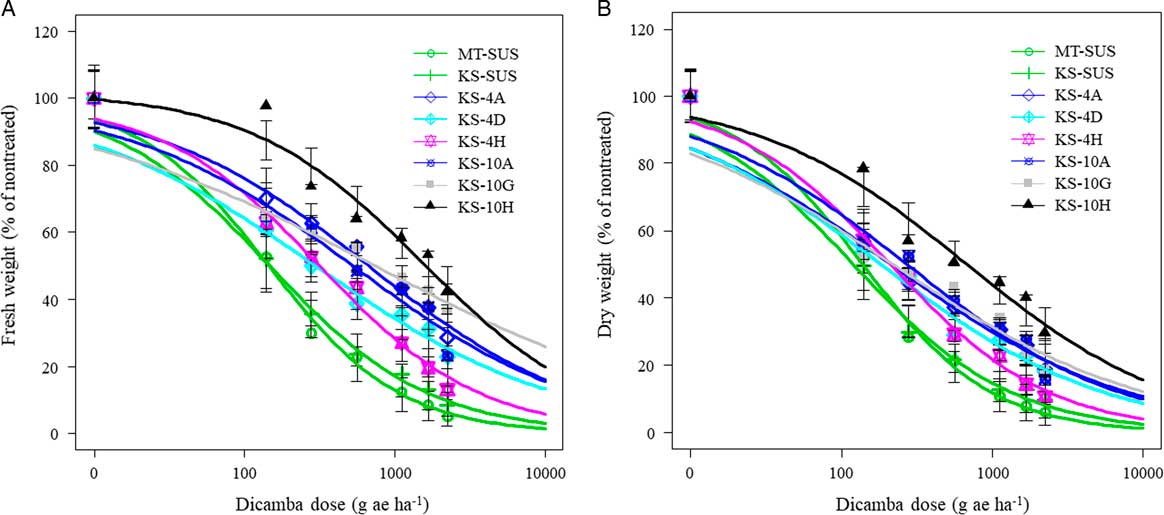
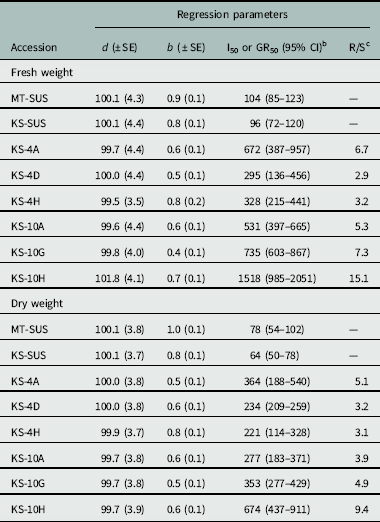
Based on shoot fresh weight response at 28 DAT, the estimated dicamba doses for 50% shoot fresh weight reduction (I50 values) of KS-4 (4A, 4D, 4H) and KS-10 (10A, 10G, 10H) subaccessions ranged from 295 to 1,518 g ae ha−1, which were higher than the 104 and 96 g ae ha−1 for MT-SUS and KS-SUS accessions (Table 2; Figure 1A). Based on shoot fresh weight reduction (I50 values), the selected KS-4 (4A, 4D, 4H) and KS-10 (10A, 10G, 10H) accessions exhibited 2.9- to 15.1-fold resistance to dicamba compared with the MT-SUS and KS-SUS accessions, with an average I50 value of 100 g ae ha−1 (Table 2; Figure 1A). Based on shoot dry weight reduction response (GR50 values), the selected KS-4 (4A, 4D, 4H) and KS-10 (10A, 10G, 10H) accessions had 3.1- to 9.4-fold resistance to dicamba relative to MT-SUS and KS-SUS accessions, with an average GR50 value of 71 g ae ha−1 (Table 2; Figure 1B). These results indicate the evolution of high levels of resistance (up to 15-fold) to dicamba in kochia accessions from Kansas. Cranston et al. (Reference Cranston, Kern, Hackett, Miller, Maxwell and Dyer2001) reported up to 4.5-fold resistance to dicamba in dicamba-resistant (DR) kochia inbreds obtained after two generations of recurrent selection from field populations collected in 1993/1994 from Montana. Jha et al. (Reference Jha, Kumar and Lim2015) also observed up to 6.8-fold resistance to dicamba among three kochia inbreds from Montana. Nandula and Manthey (Reference Nandula and Manthey2002) reported 5- to 10-fold resistance to dicamba in DR kochia accessions collected from North Dakota. In contrast, a less than 2.5-fold variation in susceptibility to dicamba was found in seven field-collected accessions from Nebraska (Crespo et al. Reference Crespo, Bernards, Sbatella, Kruger, Lee and Wilson2014). In a recent study, an up to 38-fold level of resistance to dicamba was reported in a DR kochia inbred line (obtained through recurrent selection over several generations) from western Nebraska (LeClere et al. Reference LeClere, Wu, Westra and Sammons2018).
Shoot fresh (A) and dry weight (B) response of six auxinic herbicide–resistant (Aux-HR) accessions and two susceptible kochia accessions in a whole-plant dose–response experiment with dicamba at 28 d after treatment at Kansas State University Agricultural Research Center near Hays, KS, in spring 2018. MT-SUS, susceptible kochia accession from Huntley, MT; KS-SUS, susceptible kochia accession from Hays, KS; KS-4A, 4D, 4H and KS-10A, 10G, 10H were Aux-HR kochia accessions from Garden City, KS.

Regression parameter (Equation 1:  $y{\equals}{\rm }\left\{ {d/1{\rm }{\plus}{\rm exp }\left[ {{b}\;\left( {{\rm log}\;{x}-{\rm log}\;{e}} \right)} \right]} \right\}$) estimates for growth reductions of auxinic herbicide–resistant (Aux-HR) and auxinic herbicide–susceptible kochia accessions treated with dicamba in whole-plant dose–response experiments conducted at Kansas State University Agricultural Research Center near Hays, KS, in spring 2018.a

a Abbreviations: MT-SUS, susceptible kochia accession from Huntley, MT; KS-SUS, susceptible kochia accession from Hays, KS; KS-4A, 4D, 4H and KS-10A, 10G, 10H were Aux-HR kochia accessions from Garden City, KS; CI, confidence interval.
b I50 or GR50 is effective dose (g ae ha−1) of dicamba for 50% reduction in shoot fresh or dry weight, respectively.
c R/S (resistance factor) is the ratio of I50 or GR50 of a resistant accession to averaged I50 or GR50 of the MT-SUS and KS-SUS kochia accessions.
Fluroxypyr Dose Response
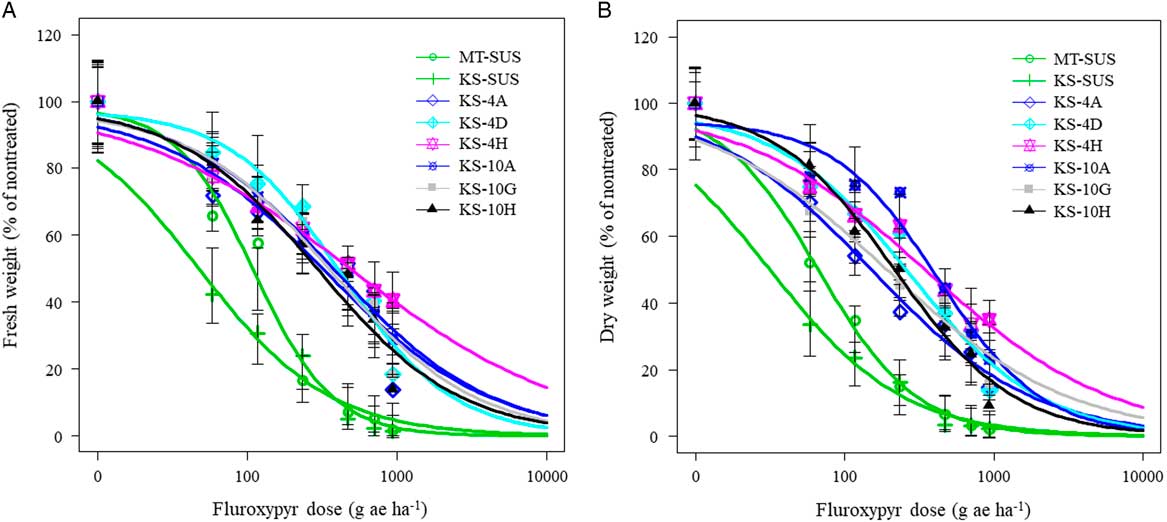
From the fitted log-logistic model, the estimated fluroxypyr doses to obtain 50% shoot dry weight reduction (I50 values) of KS-4 (4A, 4D, 4H) and KS-10 (10A, 10G, 10H) accessions ranged from 300 to 582 g ae ha−1, which were greater than the doses for the MT-SUS (111 g ha−1) and KS-SUS (48 g ae ha−1) accessions (Table 3). Based on the I50 values, the selected KS-4 and KS-10 kochia accessions exhibited 3.8- to 7.3-fold levels of resistance to fluroxypyr compared with averaged I50 values for the MT-SUS and KS-SUS accessions (Table 3; Figure 2A). The doses of fluroxypyr causing 50% shoot dry weight reduction (GR50 values) of selected KS-4 and KS-10 kochia accessions ranged from 151 to 423 g ae ha−1 compared with 66 and 32 g ae ha−1 for MT-SUS and KS-SUS accessions (Table 3). Based on the GR50 values, the selected KS-4 and KS-10 accessions had 3.0- to 8.6-fold level of resistance to fluroxypyr (Table 3; Figure 2B). The DR kochia populations from Montana had 1.4- to 5.7-fold resistance to fluroxypyr based on visible percent control and 1.6- to 4.0-fold resistance based on the shoot dry weight response (Jha et al. Reference Jha, Kumar and Lim2015). Similarly, up to 6-fold resistance to fluroxypyr was reported in kochia populations from North Dakota (Howatt and Ciernia Reference Howatt and Ciernia2014). The DR kochia inbred from the western Nebraska was also cross-resistant to fluroxypyr (13-fold resistance) (LeClere et al. Reference LeClere, Wu, Westra and Sammons2018).
Shoot fresh (A) and dry weight (B) response of six auxinic herbicide–resistant (Aux-HR) accessions and two susceptible kochia accessions in a whole-plant dose–response experiment with fluroxypyr at 28 d after treatment at Kansas State University Agricultural Research Center near Hays, KS, in spring 2018. MT-SUS, susceptible kochia accession from Huntley, MT; KS-SUS, susceptible kochia accession from Hays, KS; KS-4A, 4D, 4H and KS-10A, 10G, 10H were Aux-HR kochia accessions from Garden City, KS.

Regression parameter (Equation 1:  $y{\equals}\left\{ {d\,/\,1{\plus}{\rm exp}\left[ {b\left( {{\rm log}\,{\rm x}-{\rm log}\,{\rm e}} \right)} \right]} \right\}$) estimates for growth reductions of auxinic herbicide–resistant (Aux-HR) and auxinic herbicide–susceptible kochia accessions treated with fluroxypyr in whole-plant dose–response experiments conducted at Kansas State University Agricultural Research Center near Hays, KS, in spring 2018.a

a Abbreviations: MT-SUS, susceptible kochia accession from Huntley, MT; KS-SUS, susceptible kochia accession from Hays, KS; KS-4A, 4D, 4H and KS-10A, 10G, 10H were Aux-HR kochia accessions from Garden City, KS; CI, confidence interval.
b I50 or GR50 is effective dose (g ae ha−1) of fluroxypyr for 50% reduction in shoot fresh or dry shoot weight, respectively.
c R/S (resistance factor) is the ratio of I50 or GR50 of a resistant accession to averaged I50 or GR50 of the MT-SUS and KS-SUS kochia accessions.
EPSPS Gene Copy Number
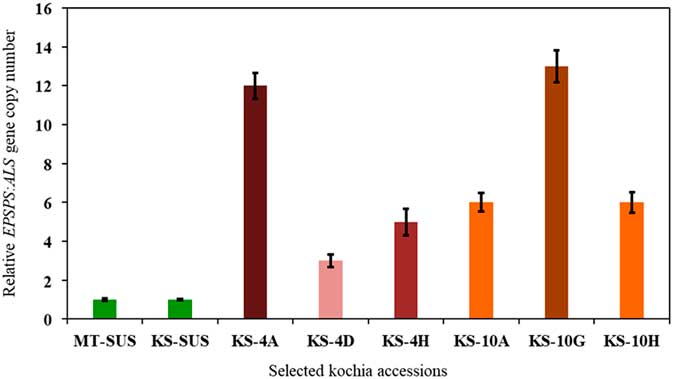
Selected Aux-HR kochia accessions from Kansas, viz. KS-4A, KS-4D, KS-4H, KS-10A, KS-10G, and KS-10H had 12, 3, 5, 6, 13, and 6 copies of the EPSPS gene, respectively, compared with a single copy of the EPSPS gene in MT-SUS and KS-SUS accessions (Figure 3). Previous studies have shown a linear relationship between EPSPS gene copy numbers and glyphosate resistance levels in GR kochia populations (Godar et al. Reference Godar, Stahlman, Jugulam and Dille2015; Kumar et al. Reference Kumar, Jha, Giacomini, Westra and Westra2015, Reference Kumar, Felix, Morishita and Jha2017). Therefore, low to moderate levels of glyphosate resistance can be expected in KS-4D, KS-4H, KS-10A, and KS-10H accessions and high levels of resistance can be expected in KS-4A and KS-10G accessions. This indicates that these Aux-HR accessions were multiple herbicide resistant and had low to high levels of resistance to glyphosate. Similarly, GR kochia populations reported from wheat–fallow fields in Colorado, Montana, and western Kansas had 2.5 to 13.0 EPSPS gene copies (Godar et al. Reference Godar, Stahlman, Jugulam and Dille2015; Kumar and Jha Reference Kumar and Jha2015b; Kumar et al. Reference Kumar, Jha, Giacomini, Westra and Westra2015; Wiersma et al. Reference Wiersma, Gaines, Preston, Hamilton, Giacomini, Buell, Leach and Westra2015). Kochia populations with resistance to glyphosate collected from sugar beet fields in Montana, Wyoming, Colorado, Nebraska, Idaho, and Oregon exhibited 2.5 to 10.2 EPSPS gene copies (Gaines et al. Reference Gaines, Barker, Patterson, Westra, Westra, Wilson, Jha, Kumar and Kniss2016; Kumar et al. Reference Kumar, Felix, Morishita and Jha2017).
Relative EPSPS:ALS gene copy number in six auxinic herbicide–resistant (Aux-HR) accessions and two susceptible kochia accessions in a qPCR assay at Montana State University Southern Agricultural Research Center, Huntley, MT, in spring 2018. MT-SUS, susceptible kochia accession from Huntley, MT; KS-SUS, susceptible kochia accession from Hays, KS; KS-4A, 4D, 4H and KS-10A, 10G, 10H were Aux-HR kochia accessions from Garden City, KS.

Practical Implications
Results from this research confirm the first report of kochia accessions from Kansas with moderate to high levels of cross-resistance to dicamba and fluroxypyr (auxinic herbicides) and low to high levels of resistance to glyphosate (via increased EPSPS gene copies). The underlying mechanism(s) conferring cross-resistance to auxinic herbicides is still unknown. In a DR kochia inbred from western Nebraska, Pettinga et al. (Reference Pettinga, Ou, Patterson, Jugulam, Westra and Gaines2017) reported a 2-fold higher transcription of the chalcone synthase (CHS) gene that regulates the synthesis of flavonols, quertecin, and kaemperfol. It was proposed that a greater synthesis of flavonols would compete with the intercellular transport of dicamba molecules, thus impairing the dicamba translocation in DR kochia plants (Pettinga et al. Reference Pettinga, Ou, Patterson, Jugulam, Westra and Gaines2017). This impaired dicamba translocation may potentially have a fitness penalty in kochia (Pettinga et al. Reference Pettinga, Ou, Patterson, Jugulam, Westra and Gaines2017). In another study using the same DR kochia inbred line, LeClere et al. (Reference LeClere, Wu, Westra and Sammons2018) observed a point mutation (glycine to asparagine amino acid change within a highly conserved region of an AUX/IAA protein) endowing cross-resistance to dicamba, 2,4-D, and fluroxypyr. In that study, a fitness cost due to a point mutation was observed (LeClere et al. Reference LeClere, Wu, Westra and Sammons2018). Similarly, Kumar and Jha (Reference Kumar and Jha2016) reported a fitness cost in a kochia line cross-resistant to dicamba and fluroxypyr in Montana. The fitness attributes of the newly evolved Aux-HR kochia accessions from Kansas are still unknown. Nevertheless, the fitness penalty associated with auxinic resistance observed in DR kochia from Nebraska and Montana suggests that multitactic weed control methods, such as tillage, cover crops, diversified crop rotations, herbicide rotations, and multiple herbicide sites of action will be effective in reducing Aux-HR kochia seedbanks (Kumar and Jha Reference Kumar and Jha2015a, Reference Kumar and Jha2015c). It is important to note that the recent commercialization of DR soybean [Glycine max (L.) Merr.] will increase the use of dicamba for in-crop broadleaf weed control (Vink et al. Reference Vink, Soltani, Robinson, Tardif, Lawton and Sikkema2012) and will most likely increase the selection pressure for further development and spread of DR kochia in this region. Therefore, growers should adopt proper stewardship programs to sustain the long-term utility of dicamba and other auxinic herbicides.
Future studies will investigate the underlying mechanism(s) of resistance in these newly evolved Aux-HR kochia accessions from Kansas. We plan to conduct long-term, multilocation studies to determine the effect of crop competition, cover crops, and strategic tillage on the life-history traits and seedbank dynamics of these Aux-HR kochia accessions, which should provide useful information for developing ecologically based weed management programs in the region.
Acknowledgments
The authors greatly appreciate the technical assistance of Pat Geier and Grant Boyer at Kansas State University and that of Anjani J. at Montana State University. This research received no specific grant from any funding agency or the commercial or not-for-profit sectors. No conflicts of interest have been declared. This publication is contribution no. 19-034-J from the Kansas Agricultural Experiment Station, Manhattan, KS.