Introduction
Strategic human capital theory highlights that the unique knowledge and skills of star employees and their utilization can enhance organizational performance (Call, Nyberg, & Thatcher, Reference Call, Nyberg and Thatcher2015; Kehoe, Lepak, & Bentley, Reference Kehoe, Lepak and Bentley2018; Wright, Coff, & Moliterno, Reference Wright, Coff and Moliterno2014). The significance of star employees on a firm's competitiveness has been gaining more attention recently, given that such employees can contribute disproportional value to organizational success and create new business opportunities (Aguinis & O'Boyle, Reference Aguinis and O'Boyle2014; Call et al., Reference Call, Nyberg and Thatcher2015; Eccles & Crane, Reference Eccles and Crane1988; Kehoe et al., Reference Kehoe, Lepak and Bentley2018). The contribution of star employees is particularly apparent in professional organizations, such as athletes on sports teams (Chen & Garg, Reference Chen and Garg2018; Swaab, Schaerer, Anicich, Ronay, & Galinsky, Reference Swaab, Schaerer, Anicich, Ronay and Galinsky2014), researchers in R&D sectors (Kehoe & Tzabbar, Reference Kehoe and Tzabbar2015; Li, Li, Li, & Li, Reference Li, Li, Li and Li2020; Zucker, Darby, & Brewer, Reference Zucker, Darby and Brewer1998), and security analysts in investment banks (Groysberg, Polzer, & Elfenbein, Reference Groysberg, Polzer and Elfenbein2011; Kang, Oldroyd, Morris, & Kim, Reference Kang, Oldroyd, Morris and Kim2018).
However, strategic human capital theory also suggests that the mere use of star employees may not automatically guarantee organizational performance (Barnes, Jiang, & Lepak, Reference Barnes, Jiang and Lepak2016; Ployhart & Moliterno, Reference Ployhart and Moliterno2011). For example, prior studies have shown that the too-much-talent could hurt organizational performance in professional industries (Groysberg et al., Reference Groysberg, Polzer and Elfenbein2011; Groysberg & Lee, Reference Groysberg and Lee2008; Kehoe & Tzabbar, Reference Kehoe and Tzabbar2015). Stars are often granted higher status and power by their organizations, which prompts feelings of injustice and deprivation in other employees. Such unequal treatment often demotivates colleagues and hinders collaboration on collective tasks (Groysberg et al., Reference Groysberg, Polzer and Elfenbein2011; Lockwood & Kunda, Reference Lockwood and Kunda1997).
When is the use of star employees more likely to produce higher organizational performance? To answer this question, extant strategic human capital scholars have suggested that future research efforts should be directed toward identifying contextual factors that stimulate the predicted behaviors of star performers (Ployhart & Moliterno, Reference Ployhart and Moliterno2011; Taylor & Bendickson, Reference Taylor and Bendickson2020). In particular, previous research has noted two categories of boundary conditions: task environment and interpersonal relations.
First, the task environment is defined as the extent to which a unit's tasks require interdependent and coordinated activities among members (Ployhart & Moliterno, Reference Ployhart and Moliterno2011). For example, highly interdependent tasks require strong behavioral integration and coordination between star and non-star employees. In such a task environment, the downside effects of star performers may outweigh the benefits of their talents (Groysberg et al., Reference Groysberg, Polzer and Elfenbein2011; Swaab et al., Reference Swaab, Schaerer, Anicich, Ronay and Galinsky2014). Despite the significance of task interdependence on the effect of stars, little attention has been given to examining the effects of star performers in organizational settings with low-task interdependence.
The current study examines the effects of star surgeons on department performance in the colorectal surgery departments of hospital organizations. Surgeons provide a unique research context that has not been considered in previous studies. Surgeons need to perform highly interdependent and collective tasks with their surgical team consisting of all healthcare service providers (e.g., nurses, technicians, and anesthesiologists), yet at the same time, the interdependence among surgeons in the surgery department is considerably low. Surgeons generally work in an autonomous and independent way, wherein they have the authority to make decisions on their patients' treatment plans, surgery, drug intake, and discharge. Under the low-task interdependence context of hospital organizations, we suggest that the upside effects of star surgeons may exceed the downside effects.
Second, strategic human capital theory also suggests that the positive effects of star surgeons play out in a more complex manner than previously considered because of the interpersonal relations between star and non-star surgeons (Groysberg & Lee, Reference Groysberg and Lee2008; Kehoe & Tzabbar, Reference Kehoe and Tzabbar2015; Taylor & Bendickson, Reference Taylor and Bendickson2020). In this study, we suggest that the relative status between stars and non-stars constitutes an important context that shapes interpersonal relations because status itself is an important motivator to maintain or increase status over others (Groysberg et al., Reference Groysberg, Polzer and Elfenbein2011; Loch, Huberman, & Stout, Reference Loch, Huberman and Stout2000). In hospital organizations, the status distinction of star and non-star surgeons is highly contingent on the level of expertise (Magee & Galinsky, Reference Magee and Galinsky2008); as a result, the expertise disparity between star and non-star surgeons is more likely to promote different levels of status competition. Therefore, we suggest the expertise disparity between star and non-star surgeons as a moderator that influences the relationship between star surgeons and department performance.
Furthermore, unlike prior studies that show the negative consequences of status competition between star and non-star employees, we add nuance to the star literature by focusing on two different types of surgery department performance. Hospital organizations are required to provide high-level treatments that are satisfactory to patients while maintaining financial stability to ensure their sustainable survival (Porter & Teisberg, Reference Porter and Teisberg2006; Weinberg, Reference Weinberg2003). A higher number of treatments of surgical patients requires more medical resources, such as surgeons, nurses, and technicians, which may hurt the level of patient treatment quality. That is, the healthcare outcomes suggest some degree of trade-off between the quality and quantity of patient treatments. Thus, the moderating role of expertise disparity on the two different types of healthcare outcomes is worth investigating.
Finally, another objective of our study is to extend the generalizability of the star literature to Eastern countries and South Korea, particularly respecting cultural orientations that value collective behaviors with high power distance (Hofstede, Reference Hofstede, Bleichrodt and Drenth1991; Hofstede & Bond, Reference Hofstede and Bond1984). We find that most prior studies on the topic of star employees have focused on Western countries except for a few studies (e.g., Kang et al., Reference Kang, Oldroyd, Morris and Kim2018; Li et al., Reference Li, Li, Li and Li2020); thus, research that replicates (or refutes) past findings in other cultural contexts is necessary.
Hypothesis development
Star employees and department performance
Previous studies of star performers have identified two characteristics that stars need to possess. One important trait is that they achieve exceptional performance compared to other employees (Aguinis & O'Boyle, Reference Aguinis and O'Boyle2014; Zucker & Darby, Reference Zucker and Darby1997). The other trait is their visibility to internal and external stakeholders (e.g., Oldroyd & Morris, Reference Oldroyd and Morris2012). As such, star employees are commonly defined as individuals who demonstrate exceptionally high productivity and enjoy broad external visibility (Kehoe et al., Reference Kehoe, Lepak and Bentley2018, p. 1849). Following Kehoe et al.'s (Reference Kehoe, Lepak and Bentley2018) definition of star employees, this study refers to star surgeons as individuals who exhibit high-quality medical performance and visibility to external customers (i.e., patients).
Strategic human capital theory in the star literature emphasizes the role of the task environment as a contextual contingency that could strengthen or weaken the star's effect on unit performance (Ployhart & Moliterno, Reference Ployhart and Moliterno2011). For example, Swaab et al. (Reference Swaab, Schaerer, Anicich, Ronay and Galinsky2014) showed that a high level of task interdependence between stars and non-stars is a key boundary condition when more talent is detrimental rather than beneficial (e.g., too-much-talent effect). However, little is known about whether the star effects are consistent with past findings under a low-task interdependence context.
In this section, we argue how star surgeons can improve surgery department performance by utilizing their high-quality medical expertise and visibility. Star surgeons' visibility represents their reputations within and outside hospitals (Call et al., Reference Call, Nyberg and Thatcher2015; Merton, Reference Merton1968). Research has shown that external visibility (i.e., visibility outside the organization) contributes to organizational success by inducing more customers (Lucifora & Simmons, Reference Lucifora and Simmons2003; Ravid, Reference Ravid1999) and investors (Higgins, Stephan, & Thursby, Reference Higgins, Stephan and Thursby2011). For example, in the motion picture industry, star actors can generate higher film revenues by attracting more audiences via their reputations (Ravid, Reference Ravid1999). Star athletes also play a critical role in commercials promoting customers' willingness to purchase sporting event tickets or sporting goods due to the high quality and reliability associated with their status (Lucifora & Simmons, Reference Lucifora and Simmons2003). Higgins et al. (Reference Higgins, Stephan and Thursby2011) also found that the likelihood of successful initial public offerings is greater for firms that hired Nobel laureate scientists in technology firms than those without such highly acclaimed employees. Thus, the reputational spillover from star employees tends to improve organizational values (i.e., products or services) by attracting external stakeholders (i.e., customers and investors).
In line with the above stream of research, we argue that star surgeons in hospital organizations can contribute to surgery department performance by attracting more patients via their visibility to potential patients. According to a previous study on 52 acute hospitals in the USA, the medical skills and reputation of doctors have a positive relationship with the number of patients, including those from outside the hospital's service area (Sosa et al., Reference Sosa, Bowman, Tielsch, Powe, Gordon and Udelsman1998). In addition, because of their external visibility, star surgeons have better and faster access to new technologies than their colleagues, and they can also facilitate the adoption of the newest surgical technology and information through their external networks (Burke, Fournier, & Prasad, Reference Burke, Fournier and Prasad2007). Considering the low level of task interdependence among surgeons regarding patient care, we expect the number of patients to increase proportionally as the number of star surgeons increase. That is, the visibility of star surgeons will have a positive effect on patient satisfaction, which in return improves the visitation of potential patients and increases the number of surgical patients. Based on the above arguments, we propose the following hypothesis:
Hypothesis 1. The number of star surgeons in a surgery department is positively related to the department's average number of surgical patients.
We also argue that star surgeons' medical expertise can improve the quality of patient treatments. Previous research has shown that star employees can add additional value to their organizational performance through the direct application of their exceptional knowledge and skills (Groysberg et al., Reference Groysberg, Polzer and Elfenbein2011; Kehoe et al., Reference Kehoe, Lepak and Bentley2018; Zucker & Darby, Reference Zucker and Darby1997). Accordingly, the more star surgeons the hospital has, the higher its human capital level is, which increases overall healthcare outcomes (Lockwood & Kunda, Reference Lockwood and Kunda1997; West, Reference West and West1996; Zucker et al., Reference Zucker, Darby and Brewer1998). A study in the healthcare industry showed that doctors with high levels of medical expertise play a critical role in improving performance in areas such as death rates (Vicente, Lomar, Mélot, & Vincent, Reference Vicente, Lomar, Mélot and Vincent2004). Similarly, patients' length of stay (LOS) after surgery, which is one key indicator we focus on in this paper with regard to quality patient treatment, will also be reduced with an increased level of expertise of surgeons in a surgery department.
Given that star surgeons are apt adopters of advanced medical technologies, stars' advanced medical procedures might be introduced and institutionalized by the surgery department. Surgeons are generally less likely to compete or conflict with other surgeons regarding patients' treatment because the surgeons have the authority to determine their own patients' treatment plan independently. Star surgeons are less reluctant to share their knowledge and skills. Furthermore, non-star surgeons may be able to learn medical methods utilized by star surgeons and apply those skills to their patients (Burke et al., Reference Burke, Fournier and Prasad2007). In that sense, we argue that star surgeons can contribute to the quality of patient treatments indirectly through spillover effects.
In general, organizational studies have suggested that employees can learn implicit knowledge and skills by interacting with stars (e.g., Groysberg & Lee, Reference Groysberg and Lee2010; Kehoe & Tzabbar, Reference Kehoe and Tzabbar2015; Oettl, Reference Oettl2012). Specifically, star performers can enhance their peers' human capital and task performance further through collaboration and knowledge sharing (Azoulay, Graff Zivin, & Wang, Reference Azoulay, Graff Zivin and Wang2010; Kehoe & Tzabbar, Reference Kehoe and Tzabbar2015), mentoring (Noe, Reference Noe1988), and helping behaviors (Furukawa & Goto, Reference Furukawa and Goto2006; Oettl, Reference Oettl2012). Research has also shown that such spillover effects of star performers are more prominent in knowledge-intensive industries (Kehoe & Tzabbar, Reference Kehoe and Tzabbar2015). For example, scientists working with stars contribute to team productivity by lowering the hindrance and uncertainty of innovative behaviors partly because other team members can learn behavioral characteristics that trigger the high productivity of star scientists (Wood & Bandura, Reference Wood and Bandura1989; Zucker et al., Reference Zucker, Darby and Brewer1998). On the basis of the above arguments, we hypothesize the following:
Hypothesis 2. The number of star surgeons in a surgery department is negatively related to patients' LOS after surgery.
Moderating effect of expertise disparity on the relationship between star surgeons and department performance
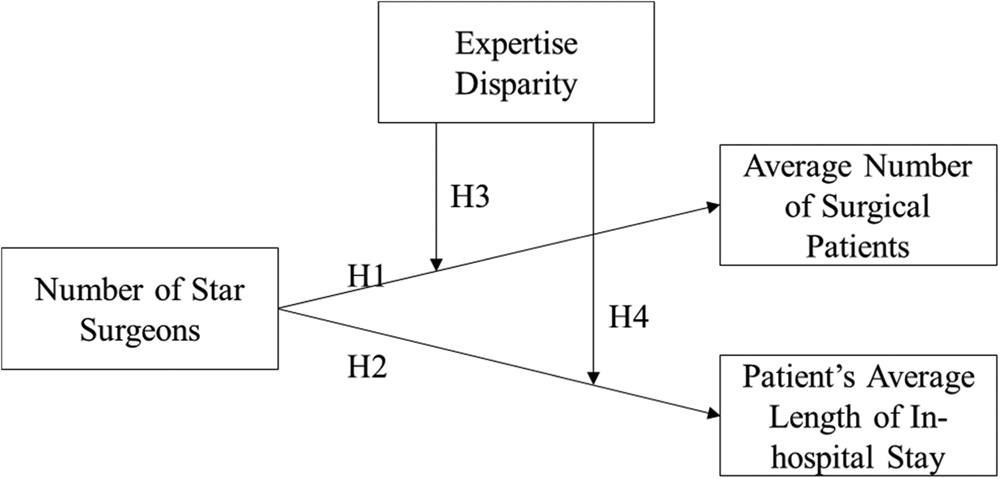
Based on the strategic human capital theory that examines the impact of star performers on unit performance, we argue that the number of star surgeons in a surgery department can increase the number of surgical patients (Hypothesis 1) and reduce the patients' LOS (Hypothesis 2). However, stars' performance is not always translated into unit-level performance; rather, their performance needs to be leveraged appropriately to do so (Delery & Roumpi, Reference Delery and Roumpi2017; Nyberg, Moliterno, Hale, & Lepak, Reference Nyberg, Moliterno, Hale and Lepak2014; Taylor & Bendickson, Reference Taylor and Bendickson2020). Ployhart and Moliterno (Reference Ployhart and Moliterno2011) proposed that interpersonal relations are one important condition that enables the human capital of stars to transform into unit performance under high-task interdependence. Previous studies have explored the interpersonal relations between stars and their colleagues, such as collaborative involvement, team coordination, and relational quality that moderate the effect of stars on organizational performance (Groysberg et al., Reference Groysberg, Polzer and Elfenbein2011; Kehoe & Tzabbar, Reference Kehoe and Tzabbar2015; Li et al., Reference Li, Li, Li and Li2020). We also follow this stream of research and suggest that surgeons' expertise disparity with star surgeons in the surgery department plays a moderating role in the relationship between the number of star surgeons and department performance (i.e., the number of surgical patients and patients' LOS).
Expertise disparity refers to the extent to which non-star surgeons differ from star surgeons in terms of their level of expertise (Harrison & Klein, Reference Harrison and Klein2007; Van der Vegt, Bunderson, & Oosterhof, Reference Van der Vegt, Bunderson and Oosterhof2006). A high level of expertise disparity is indicated when the majority of surgeons consists of rookies with only a few star surgeons in the department. In contrast, a low level of expertise disparity implies that non-star surgeons in the department are all experienced with medical skills comparable to those of star surgeons.
Because star employees possess higher performance and visibility, they are more likely to be higher-status individuals (Magee & Galinsky, Reference Magee and Galinsky2008). Status is defined as ‘one's standing in a social hierarchy as determined by respect, deference, and social influence’ (Ridgeway & Walker, Reference Ridgeway, Walker, Cook, Fine and House1995, p. 281). High status in organizations is not only a means to obtain future resources (e.g., Lin, Reference Lin and Breiger1990, Reference Lin, Markovsky, Lawler, O'Brien and Heimer1994) and powers (e.g., Thye, Reference Thye2000) but also a powerful motivator itself (Huberman, Loch, & Önçüler, Reference Huberman, Loch and Önçüler2004). Thus, highly regarded employees tend to strive to maintain or increase their status (Groysberg et al., Reference Groysberg, Polzer and Elfenbein2011; Hogan & Hogan, Reference Hogan, Hogan, Bleichrodt and Drenth1991; Loch et al., Reference Loch, Huberman and Stout2000). In particular, when high-status employees perceived the threat of losing their status to other similar status colleagues, they tend to compete with them.
Surgeons' expertise level has been considered an important factor of social status in the healthcare industry. That is, the publicly recognized expertise and competence of star surgeons may confer prestige, power, and key resources in hospital organizations (Bendersky & Hays, Reference Bendersky and Hays2012; Berger, Cohen, & Zelditch, Reference Berger, Cohen and Zelditch1972; Bunderson, Reference Bunderson2003; Kehoe & Tzabbar, Reference Kehoe and Tzabbar2015). However, when non-star surgeons' expertise is comparable to that of star surgeons (i.e., low-expertise disparity), the distinction between stars and non-stars may become unstable, and the ease of transition from non-star to star surgeons will be relatively high. In such a case, non-star surgeons are more likely to attempt to enhance their status by competing with star surgeons (Chattopadhyay, Tluchowska, & George, Reference Chattopadhyay, Tluchowska and George2004). Such a competitive nature between stars and non-star surgeons could foster goal commitment and the adoption of challenging goals and further strengthen quantitative performance, particularly under the low-task interdependence condition (Beersma et al., Reference Beersma, Hollenbeck, Humphrey, Moon, Conlon and Ilgen2003; Murayama & Elliot, Reference Murayama and Elliot2012).
In the surgery department, surgeons work in relatively independent ways wherein surgeons are fully responsible for the patients' treatment plans, such as surgery, drug intake, and dischargeFootnote 1. Consequently, non-star surgeons may take more surgical patients to compete with star surgeons to enhance their status. In the same vein, star surgeons may also recognize non-star surgeons as a threat to their status because the latter can also possess expertise comparable to that of the former (Chattopadhyay, Finn, & Ashkanasy, Reference Chattopadhyay, Finn and Ashkanasy2010). Thus, star surgeons may also tend to treat more surgical patients to maintain their status and reputation. Therefore, the effect of star surgeons on the number of surgical patients will be strengthened when the non-stars' expertise disparity with star surgeons is low. Thus, we hypothesize as follows:
Hypothesis 3. The positive effect of the number of star surgeons in a surgery department on the average number of surgical patients will be moderated by the level of expertise disparity. Specifically, the positive relationship will be stronger when expertise disparity is low than when expertise disparity is high.
We also argue that expertise disparity moderates the relationship between the number of star surgeons and patients' LOS. More specifically, we expect that high levels of expertise disparity between star and non-star surgeons would strengthen the negative relationship between the number of star surgeons and patients' LOS. First, learning from star surgeons is more likely to occur in high-expertise disparity situations. Under a high-expertise disparity condition, status differences between non-star and star surgeons will be relatively stable and legitimate. When status differences are salient and stable, low-status non-star surgeons are more receptive of help from high-status star surgeons (Nadler & Halabi, Reference Nadler and Halabi2006). Star surgeons are also unlikely to view low-status members as threatening, which can facilitate knowledge sharing, mentoring, and helping behaviors between stars and non-stars (Azoulay et al., Reference Azoulay, Graff Zivin and Wang2010; Furukawa & Goto, Reference Furukawa and Goto2006; Kehoe & Tzabbar, Reference Kehoe and Tzabbar2015; Noe, Reference Noe1988). Such knowledge sharing and help-giving behaviors will not undermine the status of star surgeons under high-expertise disparity conditions; rather, they can enhance star surgeons' reputation and power (Flynn, Reference Flynn2003; Van der Vegt et al., Reference Van der Vegt, Bunderson and Oosterhof2006). Thus, learning and receiving help from stars will be more likely under the high-expertise disparity condition, and the effects of star surgeons on quality patient treatments (i.e., patients' LOS) will be strengthened.
In contrast, knowledge sharing and learning are less likely to occur under low-expertise disparity situations. Learning and receiving help from others inherently involve status relations. For example, seeking help may reveal incompetence or lack of skills with a potential loss of face (Lee, Reference Lee2002). Previous research has found that high-status individuals are reluctant to adopt the perspectives or ideas of others, and low-status individuals are less willing to learn from high-status groups, particularly when the status differences are minimal (Bunderson & Reagans, Reference Bunderson and Reagans2011; Lammers, Galinsky, Gordijn, & Otten, Reference Lammers, Galinsky, Gordijn and Otten2008; Nadler & Halabi, Reference Nadler and Halabi2006) (Figure 1).
Research model.

Given that the expertise level between star and non-star surgeons is similar under low-expertise disparity conditions, non-star surgeons who possess expertise levels similar to those of star surgeons are unlikely to absorb knowledge and information provided by star surgeons. Stars also hesitate to share their knowledge and information when they perceive other members as threats to their status (Bendersky & Hays, Reference Bendersky and Hays2012; Groysberg et al., Reference Groysberg, Polzer and Elfenbein2011). Therefore, the positive effect of star surgeons on quality patient treatments (i.e., reduced patients' LOS) will be limited. Based on these arguments, we hypothesize the following:
Hypothesis 4. The negative relationship between the number of star employees and patients' LOS will be moderated by the level of expertise disparity. Specifically, the relationship will be stronger when expertise disparity is high compared to when expertise disparity is low.
Method
Sample and procedure
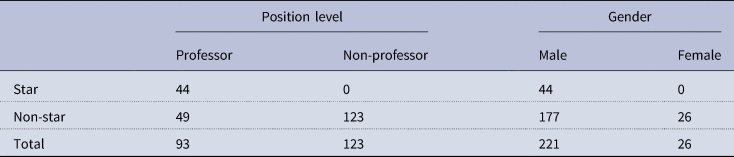
Samples of this study were obtained from colorectal cancer surgeons and their departments in a total of 80 South Korean hospitals. Given that each hospital operates one colorectal cancer department, the total number of colorectal cancer departments in this study was equivalent to the number of hospitals (i.e., 80 hospitals). Specifically, we collected our data from three sources. First, we gathered information regarding department performance (i.e., the number of surgical patients and patients' LOS) from the Health Insurance Review and Assessment Service (HIRA) of South Korea. The HIRA is a South Korean public agency that develops health and medical treatment policies, such as reviews of medical fees of medical care institutions, evaluations of the appropriateness of medical care benefits, and the development of medical insurance fees. Second, we retrieved information on surgeons in each department from the hospitals' website (i.e., the number of surgeons treating colorectal cancer and surgeons' position level). Finally, the star surgeons of each department were identified based on four media sources, resulting in 44 stars among the 247 surgeons. A total of 247 colorectal cancer surgeons in 80 departments were used as the final data set. The 44 star surgeons were all males and at the professor level, and 32 out of 80 departments had more than one star surgeon. Among 203 non-stars, 87.2% were males, and 28.5% were at the professor level that had comparable expertise to the star surgeons (see Table 1).
Characteristics of star/non-star surgeons by position level and gender

Note. N = 247 surgeons nested in 80 departments. For position level, 31 cases (12.6%) were missing because some hospitals did not provide their surgeons' professional levels.
Measures
Number of star surgeons in the colorectal cancer department
We followed the steps suggested by prior studies to collect the number of star surgeons (Groysberg & Lee, Reference Groysberg and Lee2009; Kang et al., Reference Kang, Oldroyd, Morris and Kim2018). For example, Groysberg and Lee (Reference Groysberg and Lee2009) identified star surgeons from the annual All-America Team issues of Institutional Investors, and Lu and Rui (Reference Lu and Rui2018) also used an online doctor evaluation system (e.g., http://www.RateMDs.com) to examine the effect of star employees.
In this study, star surgeons were identified from four media sources: the South Korean Educational Broadcasting System, the Chosun Ilbo Newspaper, the Dong-A Daily News, and www.kormedi.com. The four media sources announced the star surgeons based on the recommendations of peer specialists and patients. Specifically, the peer specialists evaluated the stars based on the trustworthiness of the surgeon regarding patient treatments, research, patient care performance, and sincerity. Patients were also asked to identify the star surgeons using the following questionnaires: ‘Please recommend a surgeon based on (1) the perceived competence among the surgeons you have met thus far, (2) the received patient care, and (3) the perceived excellence of received treatment.’ Star surgeons were selected and announced based on the evaluation of peer specialists and patients, which resulted in 44 star surgeons. The star surgeons identified in our sample represent two properties: outstanding medical performance and visibility.
Expertise disparity between the star and other surgeons in the colorectal cancer department
The moderating variable in this study was expertise disparity, which captures the differences in expertise between non-star and star surgeons. We measured expertise disparity as a ratio of non-professor level surgeons among all surgeons in the colorectal cancer department, excluding star surgeons. In the case of medical surgeons in South Korea, non-professor level surgeons are considered less experienced and are promoted to professor level surgeons after they accumulate experience and exhibit sufficient medical skills. Meanwhile, professor level surgeons are regarded to have relatively comparable expertise to star surgeons. Thus, expertise disparity scores could range from zero to one, wherein a high value indicates a large number of non-professor level surgeons, whereas a low value implies a large number of professor level surgeons. Specifically, we used the following formula:

where $non \hbox{-} professor{\rm \;}level{\rm \;}surgeons_i$ represents the number of non-professor level surgeons of department i. We divided this number by the number of all surgeons in the department excluding star surgeonsFootnote 2.
Number of surgical patients and patients' LOS
Our dependent variables (i.e., number of surgical patients and LOS after surgery in the hospital) are commonly used performance indicators of hospital organizations (Luciano, Bartels, D'Innocenzo, Maynard, & Mathieu, Reference Luciano, Bartels, D'Innocenzo, Maynard and Mathieu2018). We accessed the surgery department performance data from the HIRA. First, the department's average number of surgical patients was calculated by the average number of surgeries per surgeon in each department. Second, the HIRA released the LOS data of patients diagnosed with colorectal cancer who underwent surgery. Patients' LOS in the surgery departments was used to indicate a proxy for the quality of patient treatments in hospitals (Thomas, Guire, & Horvat, Reference Thomas, Guire and Horvat1997).
Control variables
We controlled the department-level characteristics that could affect the hypothesized relationships. The control variables in this study were the number of sickbeds, hospital type, and the total number of surgeons in the department. The number of sick beds and hospital type were obtained from the HIRA, while the number of surgeons in the department was obtained from the website of each hospital in our sample. Regarding the hospital types, the HIRA categorized hospitals into two types: advanced general hospitals (i.e., tertiary care general hospitals that perform highly difficult medical procedures for serious illnesses designated by the Ministry of Health and Welfare of South Korea) were coded as one, and other general hospitals were coded as zero. The number of surgeons was based on active-duty colorectal cancer surgeons listed on the website of the corresponding hospital. We also included the average number of surgical patients that could affect treatment performance (Choi et al., Reference Choi, Yang, Cho, Kim, Park and Han2017).
Analytical strategy
We tested our hypothesis using hierarchical regression analysis. To reduce non-essential multi-collinearity (Cohen, Cohen, West, & Aiken, Reference Cohen, Cohen, West and Aiken2013; Dalal & Zickar, Reference Dalal and Zickar2012), we used mean-centered independent and moderating variables. The results showed that the maximum estimated variance inflation factor was 2.5, which was well below the recommended ceiling of 10 (Cohen et al., Reference Cohen, Cohen, West and Aiken2013).
Results
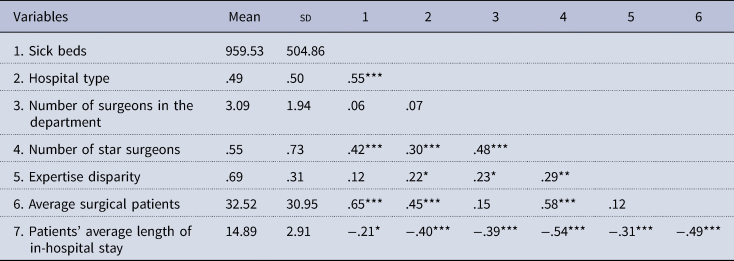
Pearson's correlation analysis was performed to determine the relationships among the variables (see Table 2). The results showed a positive correlation (r = .58, p < .01) between the number of star surgeons and the department's average number of surgical patients. In contrast, a negative correlation was observed between the number of star surgeons and patients' LOS in the department (r = − .54, p < .01). As expected, the correlational analysis results indicated that the number of star surgeons was significantly correlated with two dependent variables.
Means, standard deviations, and correlations

*p < .10, **p < .05, ***p < .01.
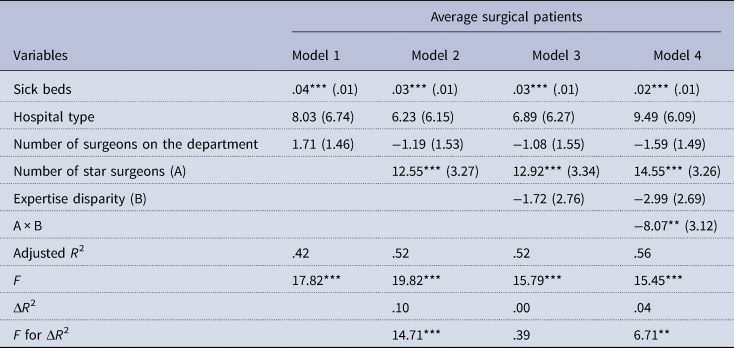
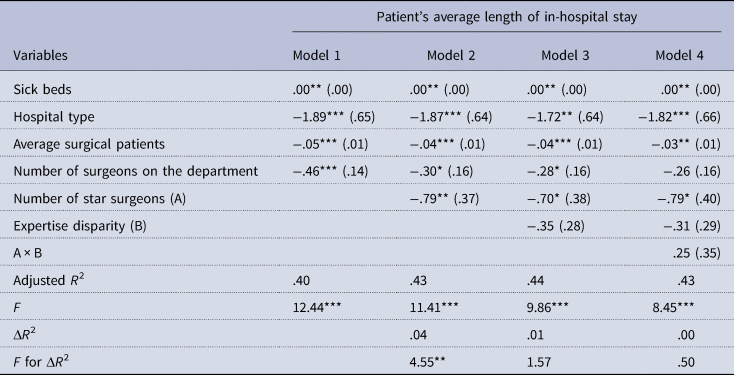
We conducted a hierarchical regression analysis to test our hypotheses. The results of the regression analysis are presented in Tables 3 and 4. Hypothesis 1 posited a positive relationship between the number of star surgeons and the department's average number of surgical patients. The results showed that the number of star surgeons was positively related to the average number of surgical patients (b = 12.55, p < .01; model 2 in Table 3), which supports Hypothesis 1. In Hypothesis 2, we argued that a negative relationship between the number of star surgeons in the department and patients' LOS can be observed. As shown in model 2 in Table 4, the number of star surgeons had a significant negative effect on patients' LOS (b = − .79, p < .05). Therefore, Hypothesis 2 is supported.
Results of regression analysis of Hypotheses 1 and 3

*p < .10, **p < .05, ***p < .01.
Unstandardized coefficients are reported; the figures in parentheses are standard errors.
Results of regression analysis of Hypotheses 2 and 4

*p < .10, **p < .05, ***p < .01.
Unstandardized coefficients are reported; the figures in parentheses are standard errors.
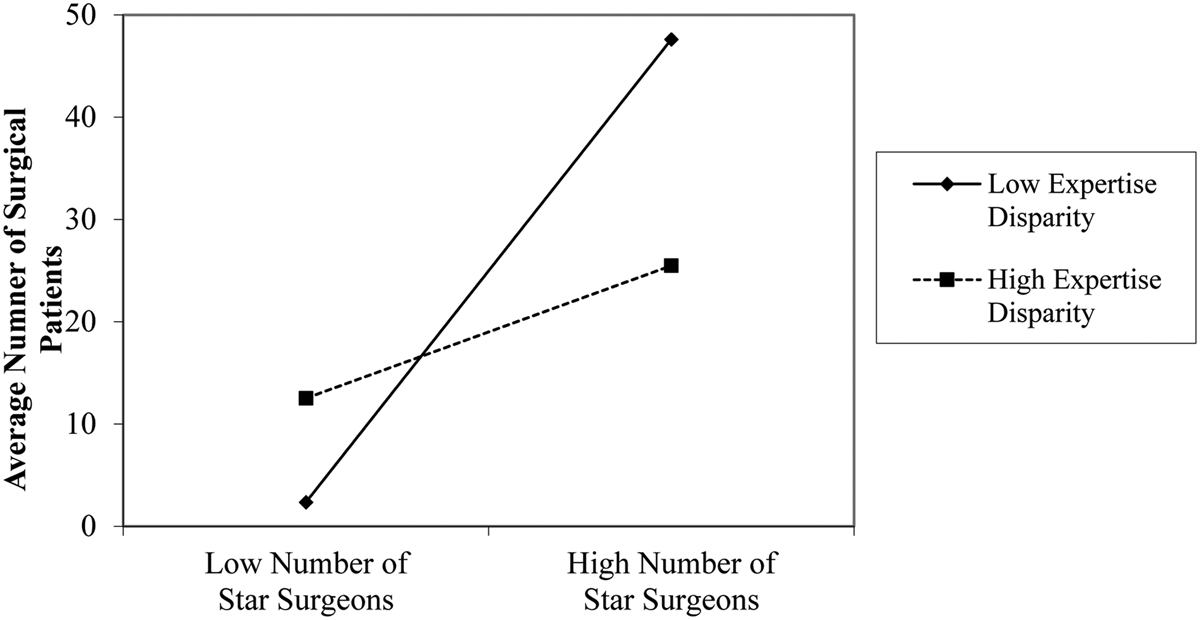
Hypothesis 3 posited that expertise disparity moderates the relationship between the number of star surgeons and the department's average number of surgical patients. Model 4 in Table 3 shows that the coefficient of the interaction term had a significant negative relationship with the department's average number of surgical patients (b = − 8.07, p < .05), thus lending support to Hypothesis 3. The results of a simple slope test showed that the relationship between the number of star surgeons and the department's average number of surgical patients was significant when expertise disparity was low (b = 22.62, p < .01) but insignificant when expertise disparity was high (b = 6.48, ns). Figure 2 graphically presents the interaction effect between expertise disparity and the number of star surgeons at high and low levels (1 sd above and below the sample mean). As predicted, the slope between the star surgeons and the average number of surgical patients was steeper when expertise disparity was low.
Interaction of the number of star surgeons and expertise disparity for average number of surgical patients.

In Hypothesis 4, we proposed that expertise disparity moderates the relationship between the number of star surgeons and patients' LOS in the surgery department. As shown in model 4 in Table 4, the interaction coefficient between the number of star surgeons and the expertise disparity was insignificant (b = .25, ns).
Discussion
A key reason for organizations to use star employees is their disproportionate value for organizational success. We found support for most of the hypotheses (i.e., Hypotheses 1, 2, and 3) in the context of hospital organizations. As predicted, a positive relationship was found between the number of star surgeons and the average number of surgical patients in the department. Our results also showed that the number of star surgeons reduced patients' LOS. More importantly, our findings revealed that the positive effects of star surgeons on department performance were contingent on the level of expertise disparity. In particular, a low level of expertise disparity strengthened the positive relationship between star surgeons and the number of surgical patients.
Theoretical contribution
The mere use of star performers may not guarantee better unit-level performance. However, we know little about which particular conditions organizations can cultivate to acquire the benefits of star performers. In this inquiry, we theoretically embed strategic human capital theory to understand the link between the use of stars and unit-level performance in healthcare organizations. In particular, we highlight the moderating role of expertise disparity between stars and non-star surgeons in surgery department outcomes. The findings of this study offer several important contributions to expand the current understanding of strategic human capital and star literature.
First, the task environment matters in the utilization of star performers for organizational performance. Past studies have emphasized that star performers can have a positive impact on organizational value creation, yet they have also pointed out that star effects can be negative under high-task interdependent conditions (e.g., too-much-talent-effect, Groysberg et al., Reference Groysberg, Polzer and Elfenbein2011; Groysberg & Lee, Reference Groysberg and Lee2009; Kehoe & Tzabbar, Reference Kehoe and Tzabbar2015). However, there appears to be a lack of studies that examine the effect of star employees when less coordination is required (e.g., low-task interdependence context). Different from previous studies showing the negative effects of too many star performers in highly interdependent tasks (e.g., sports teams, Swaab et al., Reference Swaab, Schaerer, Anicich, Ronay and Galinsky2014; security analyst group, Groysberg et al., Reference Groysberg, Polzer and Elfenbein2011), our empirical results reveal that the positive effects of star surgeons overwhelm the negative ones in low-task interdependent settings, such as hospital organizationsFootnote 3.
Furthermore, our findings on the moderating role of expertise disparity between surgeons also advance the strategic human capital and star literature. The existing research suggests that the expertise of stars can have a positive impact on unit-level performance when stars share cohesive interpersonal relationships with one another (Kehoe & Tzabbar, Reference Kehoe and Tzabbar2015; Taylor & Bendickson, Reference Taylor and Bendickson2020). However, expertise itself can represent social status, which has important implications for relational dynamics in professions (Magee & Galinsky, Reference Magee and Galinsky2008). For example, in healthcare settings in our research context, surgeons' status tends to be determined by their expertise and skills, and status distinction tends to create social hierarchies (Tzabbar, Reference Tzabbar2009; Zucker et al., Reference Zucker, Darby and Brewer1998). Thus, non-star surgeons' comparable expertise to star surgeons in the department might be a threat to the star surgeons' status, and star and non-star surgeons may compete with each other to enhance their own status. Few empirical studies have explored this direction. Our findings address this limitation by examining expertise disparity as a moderator in the relationship between the use of star surgeons and healthcare outcomes.
The findings of our study indicate that the low level of expertise disparity strengthens the positive relationship between the number of star surgeons and the number of surgical patients. This finding is important because previous studies in the star literature have mostly considered the negative effects of relational dynamics between stars and non-stars on organizational performance (Call, Campbell, Dunford, Boswell, & Boss, Reference Call, Campbell, Dunford, Boswell and Boss2020; Li et al., Reference Li, Li, Li and Li2020). The findings from our study complement the previous studies by attending to the moderating effects of expertise disparity. In the relatively low-task interdependent work context, our findings suggest that the effects of star surgeons would result in a higher number of patients' treatments when the expertise levels of non-star surgeons are not far below those of stars.
However, we did not find the moderating role of expertise disparity in predicting patients' LOS. We speculate that the insignificant results may be due in part to the power distance culture of South Korea. Power distance culture represents a high degree of hierarchy and a clearly defined social order. Under the power distance culture, the most important resources and information are likely to be controlled by high-status individuals (Daniels & Greguras, Reference Daniels and Greguras2014; Javidan, Dorfman, De Luque, & House, Reference Javidan, Dorfman, De Luque and House2006). Consequently, high-status star surgeons may have more influence on non-star surgeons, and non-star surgeons, regardless of their expertise level, will be compelled to adopt the medical skills provided by star surgeons.
Another possible explanation might be the characteristics of hospital organizations. The main tasks of hospital organizations are the diagnosis of disease and patient treatment. Therefore, large uncertainty, time constraints, and even more costly failures are inevitable (Gittell et al., Reference Gittell, Fairfield, Bierbaum, Head, Jackson, Kelly and Zuckerman2000; Richman, Flaherty, & Rospenda, Reference Richman, Flaherty and Rospenda1996). Thus, treating patients' illnesses and saving their lives might be more important for surgeons than maintaining their status. Star surgeons, regardless of expertise disparity, may actively share medical skills not only with low-expertise (i.e., high-expertise disparity condition) but also with similar expertise surgeons (i.e., low-expertise disparity condition). For these reasons, the effect of star surgeons on patients' LOS via stars' knowledge sharing and collaboration with non-star surgeons may not depend on the levels of expertise disparity. We acknowledge that we are offering a speculative explanation, and thus, further research is needed.
Practical implications and limitations
The results of this study provide several important lessons for managers in hospital organizations. One significant finding of this study is that the strategic utilization of star surgeons plays a pivotal role in increasing patients' treatment and reducing patients' LOS. Hospital organizations should focus more attention on attracting and retaining star surgeons. One strategy for hospital organizations in recruiting and retaining star surgeons is enhancing employer branding activities (Banerjee, Saini, & Kalyanaram, Reference Banerjee, Saini and Kalyanaram2020; Hieronimus, Schaefer, & Schroder, Reference Hieronimus, Schaefer and Schroder2005). Employer branding is defined as ‘the package of functional, economic, and psychological benefits provided by employment, and identified with the employing company’ (Ambler & Barrow, Reference Ambler and Barrow1996, p. 187). Organizations with employer branding could attract more and better applicants (e.g., Collins & Han, Reference Collins and Han2004; Lievens & Slaughter, Reference Lievens and Slaughter2016; Turban & Cable, Reference Turban and Cable2003). Hospital organizations should also consider whether they need to acquire star surgeons from inside the hospitals (i.e., make strategy) or hire them from the external labor market (i.e., buy strategy) depending on the context of healthcare industries (Boudreau & Ramstad, Reference Boudreau and Ramstad2005).
Second, expertise disparity is critical to the synergistic effect of star surgeons on the number of surgery patients. Specifically, hospitals can fully leverage the benefits of star surgeons when the medical skills of surgeons become comparable to star surgeons. Moreover, although our results did not support the moderating effect of expertise disparity in the relationship between star surgeons and patients' LOS, we suggest that hospitals may need to take additional efforts on creating a more positive synergy of star surgeons with non-star surgeons regarding patients' LOS. Facilitating collaboration or collective reward structures can be used as alternative solutions that help non-star surgeons accumulate further experiences and skills from star surgeons (Kehoe & Tzabbar, Reference Kehoe and Tzabbar2015; Reagans & McEvily, Reference Reagans and McEvily2003).
Despite the theoretical and practical contributions to the current literature on star performers, several limitations must be considered. First, this study examined the contextual effects of star surgeons as a department-level factor (i.e., expertise disparity). However, these moderating effects can also vary depending on the characteristics of the human resource management (HRM) practices of hospitals. For example, the relational qualities between non-star and star surgeons may depend on the appraisal and reward system (i.e., individual- or collective-oriented). We were unable to collect relevant data on the appraisal and reward system of each hospital. Thus, future research can utilize and explore HRM practices as a contextual factor to extend the understanding of star performers' effects. Additionally, the effects of star surgeons on healthcare outcomes may differ because hospitals use different acquisition strategies for star surgeons (i.e., making stars inside the organization vs. hiring stars from the external labor market). This study did not specifically investigate the different types of stars (i.e., star surgeons from inside or outside the organization). Hence, further research may explore the effects of star employees based on different acquisition strategies (i.e., make vs. buy strategy). Finally, although this study focused on the positive aspects of using star surgeons, the disadvantages of utilizing star surgeons in hospital organizations need to be identified and empirically analyzed in future research. For example, Tzabbar and Kehoe (Reference Tzabbar and Kehoe2014) found that strong dependence on star employees may make organizations vulnerable when such employees move to other organizations. Thus, in-depth discussion and empirical analyses on the downside effects of star surgeons in hospital organizations are needed.
Conclusion
Applying strategic human capital theory to the hospital context, we set out to understand how star surgeons influence surgery department performance. In particular, we extended the existing research about star effects by connecting expertise disparity as a boundary condition in the relationship between the number of star surgeons and the two types of healthcare outcomes (i.e., number of surgical patients and length of patients' in-hospital stay after surgery) in surgery departments. Contrary to the previous research that showed the detrimental effect of too-much-talents, we demonstrated that more talent improves organizational performance in the low-task interdependent context in surgery departments. Furthermore, we offered the expertise disparity between star and non-star surgeons as a boundary condition for the star effects in the healthcare setting. Taken together, we have extended knowledge of when and how star surgeons improve unit-level performance and thus highlighted the strategic value of stars.
Sangsuk Oh works at National Cancer Center in South Korea as a performance manager. His research interests include turnover, star employees, and strategic HRM.
Owwon Park is a Professor of Business Administration at the Catholic University of Korea. His research interests include talent management, strategic HRM, voluntary turnover, and compensation.
Woonki Hong is an Associate Professor at the Ulsan National Institute of Science and Technology in South Korea. His research focuses on expertise utilization in teams, interpersonal helping behavior, and team conflicts.