1. Introduction
The diffeomorphism group of a smooth manifold and its classifying space are fundamental objects in topology. For a smooth manifold W, the classifying space
 $B\mathrm{Diff}(W)$
encodes both the topology and group structure of
 $\mathrm{Diff}(W)$
. Even more, it plays an essential role on constructing smooth fibre bundles with fibre W and topologically enriched cobordism categories. There is a lot of ongoing work on understanding the classifying space of diffeomorphism groups. For higher genus surfaces, we know their homotopy type is a K(G,1) for G a mapping class group, but the other invariants as the cohomology ring are still unknown. For manifolds in higher dimensions we know even less about the homotopy type of these spaces. One key strategy when studying
 $B\mathrm{Diff}(W)$
is to understand how its homology behaves when changing the manifold W by operations such as connected sum or gluing of cobordisms. This approach has detected stability phenomena on homology after such operations and has lead to the study of such stable homology groups. In this paper, we study the stable homology of decorated diffeomorphism groups, which includes for instance the study of manifolds with punctures.
Let W denote a smooth compact manifold of dimension
 $d\geq 2$
and
 $\mathrm{Diff}(W)$
its diffeomorphism group with Whitney
 $C^\infty$
topology. When W has a non-empty boundary, we further require that the elements of
 $\mathrm{Diff}(W)$
restrict to the identity on a collar of
 $\partial W$
(note that this is usually denoted
 $\mathrm{Diff}_\partial(W)$
). If moreover W is an orientable manifold, we denote by
 $\mathrm{Diff}^+(W)$
the subgroup of orientation preserving diffeomorphisms. The manifold W is said to be decorated if it is equipped with disjoint embeddings of k points and m discs
 $D^d$
. The decorated diffeomorphism group of W, denoted
 $\mathrm{Diff}^k_m(W)$
, consists of those diffeomorphisms which preserve the marked points and parametrised discs up to permutations. The classifying space
 $B\mathrm{Diff}^k_m(W)$
has been studied from many different perspectives, for instance, considering the behaviour after increasing the number of marked points or discs (see [
Reference Bödigheimer and Tillmann2, Reference Tillmann32
]).
The first decoupling result for decorated diffeomorphism groups was developed in the context of orientable surfaces by Bödigheimer and Tillmann [
Reference Bödigheimer and Tillmann2
]. Let
 $S_{g,b}$
denote an orientable surface of genus g and
 $b\geq 1$
boundary components, and assume it to be decorated by k points and m discs. The strategy in [
Reference Bödigheimer and Tillmann2
] for what was called the splitting result, was to look at an element in
 $B\mathrm{Diff}^k_m(S_{g,b})$
and separate the information it carries about the surface, and the decorations. Namely, we can look at three maps
 \begin{align} f\;:\;B\mathrm{Diff}^k_m(S_{g,b}) \longrightarrow B\mathrm{Diff}(S_{g,b}),\qquad & e_m\;:\;B\mathrm{Diff}^k_m(S_{g,b}) \longrightarrow B\Sigma_m \\[5pt] & e^{k}\;:\;B\mathrm{Diff}^k_m(S_{g,b}) \longrightarrow B(\Sigma_k\wr \mathrm{SO}(2)), \nonumber \end{align}
where f is induced by the inclusion of groups,
 $e_m$
is induced by recording the permutation of the parametrised discs, and
 $e^k$
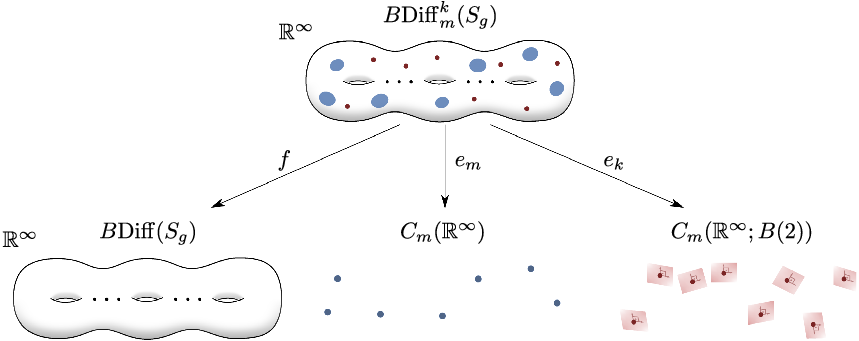
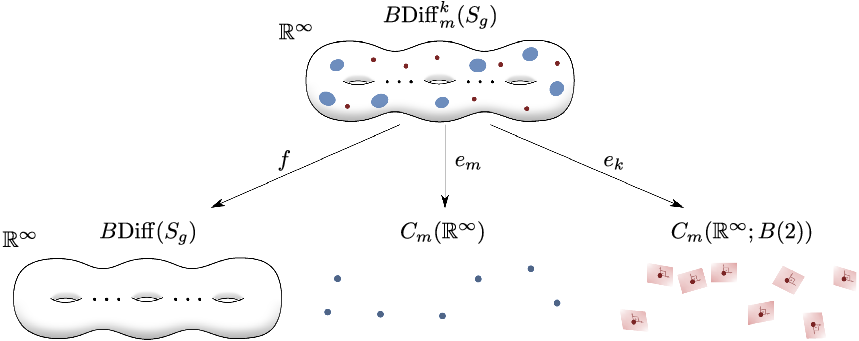
is induced by recording the permutation of the marked points together with the induced map on their tangent space. The decoupling map is defined as the product

(see Figure 1 for a geometric representation of the decoupling map). The decoupling result in [
Reference Bödigheimer and Tillmann2
] shows that D induces a homology isomorphism in degrees
 $\leq {g}/{3}$
. Hence, in this range, we say that the decorations, which were bound to the manifold, get decoupled. This result was generalised to non-orientable surfaces in [
Reference Hanbury10
]. In this paper, we further generalise this result to moduli spaces of manifolds in higher dimensions with more types of tangential structures.
Geometric representation of the decoupling map for the oriented moduli space of a surface
 $S_g$
as the product of three maps: forget the decorations, record the centre of the m marked discs, and record the k marked points and their oriented tangent spaces. For more details on the geometric interpretation see Section 1·1.
In the case described above we looked specifically at surfaces admitting an orientation. Just like framings, spin structures and maps to a background space, orientation is an example of a what is called a tangential structure. These are precisely the ones which can be described just from data on the tangent bundle of a manifold. Precisely, a tangential structure is a topological space
 $\Theta$
equipped with a continuous
 $\mathrm{GL}_d$
action. And a
 $\Theta$
-structure on a d-dimensional manifold W is a
 $\mathrm{GL}_d$
-equivariant map
 $\rho_W\;:\;{\mathrm{Fr}}(TW)\to \Theta$
, from the space of framings of W to
 $\Theta$
. A canonical example is
 $\Theta^{or}\,{:}\,{\raise-1.5pt{=}}\,\{\pm1\}$
with action of
 $\mathrm{GL}_d$
given by multiplication with the sign of the determinant. It is simple to check that a
 $\Theta^{or}$
-structure on a manifold is equivalent to a choice of orientation.
Just like the space
 $B\mathrm{Diff}^+(W)$
captures the diffeomorphisms of W respecting orientations, the moduli space of W with
 $\Theta$
-structure is the analogue of this for a general
 $\Theta$
. The space of all
 $\Theta$
-structures on W has an action of
 $\mathrm{Diff}(W)$
given by precomposition with the differential. Then for a closed manifolds with a
 $\Theta$
-structure
 $\rho_W$
, the moduli space
 $\mathcal{M}^\Theta(W,\rho_W)$
is defined as the path component of
 $\rho_W$
in the Borel construction (i.e. homotopy quotient)
 \begin{equation*}\{\mbox{$\mathrm{GL}_d$-equivariant maps }\rho\;:\;{\mathrm{Fr}}(TW)\longrightarrow \Theta\}\mathbin{\!/\mkern-5mu/\!} \mathrm{Diff}(W).\end{equation*}
This definition generalises the classifying spaces
 $B\mathrm{Diff}(W)$
and
 $B\mathrm{Diff}^+(W)$
, as can be seen by using the tangential structures
 $\Theta^*\,{:}\,{\raise-1.5pt{=}}\,\{*\}$
and
 $\Theta^{or}$
, respectively.
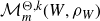
Analogously, when W is a closed manifold equipped with k marked points and m parametrised discs, the decorated moduli space of
 $(W,\rho_W)$
, denoted
 $\mathcal{M}^{\Theta,k}_m(W,\rho_W)$
, is defined as the path component of
 $\rho_W$
in the Borel construction
 \begin{equation*}\{\mbox{$\mathrm{GL}_d$-equivariant maps }\rho\;:\;{\mathrm{Fr}}(TW)\longrightarrow \Theta\}\mathbin{\!/\mkern-5mu/\!} \mathrm{Diff}^k_m(W).\end{equation*}
If W is a manifold with non-empty boundary, the moduli space and its decorated version are defined analogously but only considering the
 $\mathrm{GL}_d$
-equivariant maps
 $\rho\;:\;{\mathrm{Fr}}(TW)\to \Theta$
which agree with
 $\rho_W$
on
 ${\mathrm{Fr}}(TW_{|\partial W})$
.
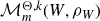
The decoupling result we prove in this paper, takes an element of
 $\mathcal{M}^{\Theta,k}_m(W,\rho_W)$
and, as in the surface case, separates the information it carries about the manifold, and the decorations. Analogous to (1·1), we look at three maps, which for an orientable manifold are given by
 \begin{eqnarray} F\;:\;\mathcal{M}^{\Theta,k}_m(W,\rho_W) \longrightarrow \mathcal{M}^\Theta(W,\rho_W),\qquad & E_m\;:\; \mathcal{M}^{\Theta,k}_m(W,\rho_W) & \longrightarrow \Theta^m\mathbin{\!/\mkern-5mu/\!}\Sigma_m, \\ & E^k\;:\;\mathcal{M}^{\Theta,k}_m(W,\rho_W) & \longrightarrow (\Theta\mathbin{\!/\mkern-5mu/\!}\mathrm{GL}_d^+)^k\mathbin{\!/\mkern-5mu/\!}\Sigma_{k},\nonumber \end{eqnarray}
constructed using the same maps as in the surface case. The product of these is what we call the decoupling map

In particular, taking W to be a surface and
 $\Theta$
the orientation structure, D is precisely the map of equation (1·2). The image of D is a path-component of the codomain, which we denote
 \begin{equation*}\mathcal{M}^\Theta(W,\rho_W)\times \Theta^m_0\mathbin{\!/\mkern-5mu/\!}\Sigma_m\times (\Theta\mathbin{\!/\mkern-5mu/\!}\mathrm{GL}_d^+)^k_0\mathbin{\!/\mkern-5mu/\!}\Sigma_k.\end{equation*}
The Decoupling Theorem (Theorem 3·10) states that, for a vast amount of cases, the map D induces a homology isomorphism onto its image, in a range depending on W and
 $\Theta$
. In particular, this generalises the splitting results in [
Reference Bödigheimer and Tillmann2, Reference Hanbury10
] and when applied to important tangential structures, gives new decoupling results for surfaces (Corollary 3·11). The main result of this paper is the corollary of Theorem 3·10 for manifolds of high even dimension, where no such splitting result had been proved. In this case, the stable range is determined by the stable genus of the manifold with a given tangential structure, as defined in [
Reference Galatius and Williams7
, section 1·3] (see Section 2·3).
Theorem A. Let W be a simply-connected manifold of dimension
 $d=2n\geq 6$
with non-empty boundary, and
 $\rho_W$
an n-connected
 $\Theta$
-structure on W. Let g be the stable genus of
 $(W,\rho_W)$
. Then the decoupling map
 \begin{equation*}D\;:\;\mathcal{M}^{\Theta,k}_{m}(W,\rho_W)\longrightarrow\mathcal{M}^\Theta(W,\rho_W)\times \Theta^m_0\mathbin{\!/\mkern-5mu/\!}\Sigma_m \times (\Theta\mathbin{\!/\mkern-5mu/\!} \mathrm{GL}_{2n}^+)_0^k\mathbin{\!/\mkern-5mu/\!}{\Sigma_k}\end{equation*}
induces homology isomorphisms in degrees
 $\leq ({g-4})/{3}$
.
A stronger version of this result is stated in Corollary 3·12 including manifolds W that have empty boundary.
The Decoupling Theorem (Theorem 3·10) is stated in terms of a homology stability hypothesis. For odd dimensional manifolds, it is still unknown if this hypothesis is satisfied under any conditions. For details about such homology stability condition and a recollection of the cases in which it was proven to hold, see Section 2·3.
The connectivity assumption in Theorem A is essential, which we show by exhibiting in Example 5·1 a case where the decoupling does not hold in its absence. Although this condition is quite restrictive, we show that it is still possible to obtain further results for more general tangential structures using the techniques of [Reference Galatius and Williams7, section 9]. As an example, we use these tools to analyse the case below, in which Theorem A does not directly apply.
Theorem B. The stable cohomology of
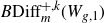 $B\mathrm{Diff}^{+,k}_m(W_{g,1})$
with rational coefficients is isomorphic to
 \begin{align*} \mathbb{Q}[\kappa_c|c\in\mathcal{B},|c|>2n] \otimes\left(\bigotimes\limits_m\bigwedge [y_1,\dots, y_{\lfloor\frac{n-1}{4} \rfloor}]\right)^{\Sigma_m} \otimes \left(\bigotimes\limits_k\mathbb{Q}[ p_{\lceil\frac{n+1}{4}\rceil},\dots,p_{n-1},e]\right)^{\Sigma_k}, \end{align*}
where
 $p_i$
and e are, respectively, the Pontryagin and Euler classes in
 $H^*(B\mathrm{SO}(2n),\mathbb{Q})$
,
 $\mathcal{B}$
denotes the set of monomials in the classes
 $p_{\lceil\frac{n+1}{4} \rceil},\dots,p_{n-1}$
, e, with
 $|\kappa_c|=|c|-2n$
, and
 $y_i$
is the ith generator of
 $H^*(\mathrm{SO}(2n),\mathbb{Q})$
, which has degree
 $4i-1$
. The fixed points are taken with respect to the action of the symmetric group that permutes the generators in the tensor product.
When studying surfaces, it is natural to look at decorations by marked points and discs, however for a high dimensional manifold W, one is allowed to explore more general types of decorations. This has been studied for instance in the recent work [
Reference Kupers20, Reference Palmer24–Reference Palmer26
]. As a final contribution, we generalise the definition of the decorated moduli space of a manifold allowing a general submanifold
 $L\subset W$
as decoration, and prove an analogous decoupling theorem. This result depends on the group of automorphisms of the normal bundle of L that can be induced by diffeomorphisms of W. In general this group is hard to describe so we look more closely at the example of decorations being embedded circles. This is an important example because of its relation to the literature and also its relevance to string theory. In this case, we completely describe this group of automorphisms and show it depends only on whether or not W admits a spin structure (Lemma 4·15).
We denote the moduli space of a manifold W with k embedded circles and
 $\Theta$
-structure by
 $\mathcal{M}^{\Theta}_{kS^1}(W,\rho_W)$
and, as in Theorem A, it also admits a splitting result. In this case, the term that appears related to the decorations is the space of configurations of circles in
 $\mathbb{R}^\infty$
with labels in a space
 $\mathcal{L}$
(see Definition 4·17), which we denote
 ${{C}_{kS^1}}(\mathbb{R}^\infty,\mathcal{L})$
.
Theorem C. Let W be a simply-connected manifold of dimension
 $2n\geq 6$
with non-empty boundary, equipped with k marked circles and with a
 $\Theta$
-structure
 $\rho_W\;:\;{\mathrm{Fr}}(TW)\to \Theta$
which is n-connected. Let g be the stable genus of
 $(W,\rho_W)$
. Then the decoupling map
 \begin{equation*}D_{kS^1}\;:\;\mathcal{M}^{\Theta}_{kS^1}(W,\rho_W) \longrightarrow \mathcal{M}^{\Theta}(W,\rho_W)\times {{C}_{kS^1}}(\mathbb{R^\infty};\;\mathcal{L})\end{equation*}
induces homology isomorphisms in degrees
 $\leq ({g-4})/{3}$
. Here
 $\mathcal{L}$
is a space depending on the spinnability of W (made explicit in the proof), and is related to the free loop spaces of
 $\Theta$
and
 $\mathrm{GL}_d$
.
1·1. Geometric interpretation
The spaces and maps used in the decoupling result all have concrete geometric models, which we briefly introduce.
We discussed before that moduli spaces with tangential structures are generalisations of the classifying space
 $B\mathrm{Diff}(W)$
, as can be verified by considering the tangential structure
 $\Theta^*=\{*\}$
. In particular, this means that the geometric model of
 $B\mathrm{Diff}(W)$
given by the quotient
 $\mathrm{Emb}(W,\mathbb{R}^\infty)/\mathrm{Diff}(W)$
is also a model for
 $\mathcal{M}^{\Theta^*}(W,\rho_W)$
. With this construction, this moduli space is the subspace of all submanifolds of
 $\mathbb{R}^\infty$
that are abstractly diffeomorphic to W. Analogously, fixing an arbitrary
 $\Theta$
-structure
 $\rho_W$
on the manifold W (for instance a choice of orientation), the moduli space
 $\mathcal{M}^\Theta(W,\rho_W)$
has a model given by the space of all submanifolds of
 $\mathbb{R}^\infty$
that are abstractly diffeomorphic to W together with a choice of
 $\Theta$
-structure concordant to
 $\rho_W$
. A detailed description of this model can be found in [
Reference Galatius and Williams8
, sections 6 and 7]. Using the same ideas, the decorated moduli space
 $\mathcal{M}^{\Theta,k}_m(W,\rho_W)$
can be modelled by the space of all submanifolds of
 $\mathbb{R}^\infty$
that are diffeomorphic to W together with k marked points, m marked parametrised discs, and a choice of
 $\Theta$
-structure concordant to
 $\rho_W$
.
We also have geometric models for the spaces
 $\Theta^m_0\mathbin{\!/\mkern-5mu/\!}\Sigma_m$
and
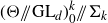 $(\Theta\mathbin{\!/\mkern-5mu/\!}\mathrm{GL}_d)_0^k\mathbin{\!/\mkern-5mu/\!}\Sigma_k$
appearing in the decoupling theorem. Namely, they can be described via unordered configuration spaces with labels. Recall that given a space X, the configuration space of s points in M with labels in X is defined as
 \begin{equation*}{C}_s(M;X)\;:\!=\;(\mathrm{Emb}(\{1,\dots,s\},M)\times X^s)/\Sigma_{s},\end{equation*}
where
 $\Sigma_s$
acts by permutataion of the points in
 $\{1,\dots,s\}$
and the factors of
 $X^s$
. In other words,
 ${C}_s(M)$
is the space of unordered collections of s distinct points in M, where each point is labelled by a point in X. Since the space
 $\mathrm{Emb}(\{1,\dots,m\},\mathbb{R^\infty})$
is weakly contractible it is simple to verify that a model for
 ${\Theta^{m}_0}\mathbin{\!/\mkern-5mu/\!} \Sigma_m$
is precisely the space of
 $C_m(\mathbb{R}^\infty,\Theta_0)$
. Analogously, a model for the
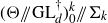 ${(\Theta\mathbin{\!/\mkern-5mu/\!} \mathrm{GL}_d^\dagger)^{k}_0}\mathbin{\!/\mkern-5mu/\!} \Sigma_k$
is given by the space
 $C_k(\mathbb{R}^\infty,(\Theta\mathbin{\!/\mkern-5mu/\!}\mathrm{GL}_d)_0)$
.
With these models, the three maps in (1·3) can be described as: F is the map that forgets the marked points and discs and only remembers the abstract manifold with the tangential structure;
 $E_m$
records the points in the centre of the m marked discs in the abstract manifold together with local tangential structure information; and finally
 $E^k$
records the positions of the marked points in
 $\mathbb{R}^\infty$
together with their tangent spaces and tangential structure information. See Figure 1 for an illustration of these maps.
With this geometric interpretation, the decoupling result tells us that the stable homology of the space of submanifolds of
 $\mathbb{R}^\infty$
diffeomorphic to W equipped with marked points and discs, can be understood in terms of the homology of a space where these points and discs are not constrained to the manifold anymore, i.e. they are decoupled.
1·2. Outline of the paper
Section 2 recalls the basic concepts and results needed throughout the paper. We start by defining and giving examples of tangential structures and moduli space of manifolds. We discuss the homological stability condition that is a central hypothesis of the decoupling theorem, recalling the many contexts in which it was proved to hold. Finally, we prove auxiliary results on fibre sequences of Borel constructions and the splitting argument (Proposition 2·15) which will be central throughout the paper.
In Section 3 we define the decorated moduli space of manifolds and the decoupling map, and we prove the Decoupling Theorem 3·10. The key ingredient for the proof and main technical result of the section is the construction of the homotopy fibre sequence in Proposition 3·7. As a consequence of Theorem 3·10, we deduce new decoupling results for surfaces (Corollary 3·11) and Theorem A.
In Section 4 we define the generalisation of the decorated moduli space for more general types of submanifold decorations, define the decoupling map and prove the decoupling theorem in this case (Theorem 4·8). The key technical result of this part is Proposition 4·6. We specialise further in the case of decorations being embedded unlinked circles and prove Theorem C, using as a main input the result of Lemma 4·15.
Finally, in Section 5 we look at high dimensional manifolds with tangential structures that fail the hypothesis of Theorem A and provide a generalisation of the result for these cases. In particular, by applying this result to the manifolds
 $W_{g,1}$
, we show Theorem B, which is the key technical result of this section.
2. Preliminaries
In this section we recall the main concepts and results that will be used throughout the paper. We start by discussing tangential structures and moduli spaces of manifolds. We give examples of these concepts that will be used in Section 3 to look at specific corollaries of the Decoupling Theorem, such as Corollary 3·11 about surfaces. The next subsection discusses the homological stability condition which is the central hypothesis in the Decoupling Theorem A and presents a concise survey of the cases in which this condition is known to hold. We end the section by recalling fundamental results about descending fibre sequences to homotopy quotients as well as the splitting argument (Proposition 2·15) that will be used throughout the paper.
2·1. Tangential structures
Let W be a smooth compact connected d-dimensional manifold, possibly with non-empty boundary. We denote by
 $\mathrm{Diff}(W)$
the group of diffeomorphisms of W with Whitney
 $C^\infty$
topology, and if
 $\partial W\neq \emptyset$
we assume all diffeomorphisms fix a collar of the boundary (this is often denoted
 $\mathrm{Diff}_\partial(W)$
). If moreover W is an orientable manifold, we denote by
 $\mathrm{Diff}^+(W)$
the subgroup of orientation preserving diffeomorphisms.
Given a vector bundle
 $p\;:\;E\to B$
, the frame bundle of E over B will be denoted by
 ${\mathrm{Fr}}(E)$
. Recall that the fiber of
 ${\mathrm{Fr}}(E)\to B$
over a fixed b is the space of ordered bases of
 $p^{-1}(b)$
, and this forms a
 $\mathrm{GL}_d$
-principal bundle. Throughout, we denote by TW the tangent bundle of the manifold W, and by
 $\varepsilon^n\to B$
the trivial n-dimensional vector bundle over some base space B. In this paper, we will consider only real vector bundles.
We now define tangential structures following the terminology established by Galatius and Randal–Williams in [ Reference Galatius and Williams9 ].
Definition 2·1. A tangential structure for d-dimensional manifolds is a space
 $\Theta$
with a continuous action of
 $\mathrm{GL}_d\,{:}\,{\raise-1.5pt{=}}\,\mathrm{GL}_d(\mathbb{R})$
. A
 $\Theta$
-structure on a d-manifold W is a
 $\mathrm{GL}_d$
-equivariant map
 $\rho\;:\;{\mathrm{Fr}}(TW)\to \Theta$
.
Many of usual structures we consider on manifolds can be described using tangential structures:
Example 2·2. Let W be a connected manifold.
-
(a) An orientation on W is equivalent to a
 $\mathrm{GL}_d$
-equivariant map
${\mathrm{Fr}}(TW)\to \{\pm1\}$
, where the action on
$\Theta^{or}\;:\!=\;\{\pm1\}$
is given by multiplication by the sign of the determinant.
-
(b) A framing on a manifold is a
$\Theta^{\mathrm{fr}}$
-structure for
$\Theta^{\mathrm{fr}}\,{:}\,{\raise-1.5pt{=}}\,\mathrm{GL}_d$
, with action by multiplication. -
(c) A manifold together with a continuous map to a space X, can be described as a
$\Theta_X$
-structure where
$\Theta_X\,{:}\,{\raise-1.5pt{=}}\, X$
with the trivial action. This tangential structure is usually referred to as maps to a background space X. -
(d) A manifold with no extra structure can be seen as one equipped with a
$\Theta^*$
-structure, where
$\Theta^*\,{:}\,{\raise-1.5pt{=}}\,\{*\}$
.




Remark 2·3. Many authors approach tangential structures in a different way, namely by defining it as a fibration
 $\theta\;:\;B\to B\mathrm{O}(d)$
, and by setting a
 $\theta$
-structure on a manifold W to be a map
 $W\to B$
lifting the map
 $W\to B\mathrm{O}(d)$
classifying TW. The two definitions are equivalent, as can be shown using the correspondence between spaces with a
 $\mathrm{GL}_d$
action and spaces over
 $B\mathrm{GL}_d\simeq B\mathrm{O}(d)$
, made through the principal
 $\mathrm{GL}_d$
-bundle
 $E\mathrm{GL}_d\to B\mathrm{GL}_d$
. Both the spaces
 $\Theta$
and B associated to a given tangential structure will come into the decoupling result, so it is worth making precise the relation between them: given a fibration
 $\theta$
, the pullback space
 $$\Theta \,{:}\,{\raise-1.5pt{=}}\, E{\rm{G}}{{\rm{L}}_d}\mathop \times \limits_{B{\rm{G}}{{\rm{L}}_d}} B$$
is naturally equipped with a
 $\mathrm{GL}_d$
action. On the other hand, given a
 $\mathrm{GL}_d$
-space
 $\Theta$
, we can define B as the Borel construction
 $\Theta\mathbin{\!/\mkern-5mu/\!} \mathrm{GL}_d$
(ie. the quotient of
 $E\mathrm{GL}_d\times \Theta$
by the diagonal action of
 $\mathrm{GL}_d$
). Then
 $E\mathrm{GL}_d\times \Theta\to B$
is a principal
 $\mathrm{GL}_d$
-bundle, which means B comes equipped with a map
 $\theta\;:\;B\to B\mathrm{GL}_d$
. Since
 $E\mathrm{GL}_d$
is contractible, these processes are inverse up to equivariant fibre-wise weak equivalence.
Example 2·4. Spin structures on an n-dimensional manifold are known to be classified by lifts along the fibration
 $\theta_{\mathrm{Spin}}\;:\;B\mathrm{Spin}\to B\mathrm{O}(d)\simeq B\mathrm{GL}_d$
. So the corresponding
 $\Theta^\mathrm{Spin}$
fits into the following diagram of fibre sequences

Hence the space
 $\Theta^\mathrm{Spin}$
is homotopy equivalent to
 $\{\pm 1\}\times B\mathbb{Z}/2$
.
Definition 2·5. Let W be a closed manifold and
 $\Theta$
a fixed tangential structure. We define the space of
 $\Theta$
-structures on W, denoted
 $\mathrm{Bun}^\Theta(W)$
, to be the space of all
 $\mathrm{GL}_d$
-equivariant maps
 ${\mathrm{Fr}}(TW)\to \Theta$
equipped with the compact-open topology.
Let W be a manifold with non-empty boundary and a collar together with a
 $\mathrm{GL}_d$
-equivariant map
 $\rho_{\partial}\;:\;{\mathrm{Fr}}(T\partial W\oplus \varepsilon)\to \Theta$
. We define the space of
 $\Theta$
-structures on W restricting to
 $\rho_\partial$
, denoted
 $\mathrm{Bun}^\Theta_{\rho_\partial}(W)$
, to be the space of all
 $\mathrm{GL}_d$
-equivariant maps
 ${\mathrm{Fr}}(TW)\to \Theta$
that restrict to
 $\rho_\partial$
on
 $\partial W$
.
Example 2·6. Let W be a connected manifold.
-
(a) Let
$\Theta^{or}$
be as described in Example 2·2(a). If W is a closed orientable manifold, it admits two
$\Theta^{or}$
-structures so
$\mathrm{Bun}^{\Theta^{or}}(W)$
consists of two points. If W has a non-empty boundary, then
$\mathrm{Bun}^{\Theta^{or}}_{\rho_\partial}(W)$
consists only of those
$\mathrm{GL}_d$
-equivariant maps which restrict to
$\rho_\partial$
, and therefore it is a single point. -
(b) A
$\Theta_X$
structure on a manifold W (Example 2·2(c)) is a continuous map
$W\to X$
, hence for W closed,
$\mathrm{Bun}^{\Theta_X}(W)$
is the space of continuous maps from W to X. -
(c) For
$\Theta^*$
the trivial tangential structure of Example 2·2(d),
$\mathrm{Bun}^{\Theta^*}(W)$
is a single point.


2·2. Moduli spaces of manifolds
The action of the diffeomorphism group of W on the tangent bundle TW induces an action on the space
 $\mathrm{Bun}^\Theta(W)$
for any tangential structure
 $\Theta$
. Explicitly, given
 $\phi\in\mathrm{Diff}(W)$
and
 $\rho\in\mathrm{Bun}^\Theta(W)$
,
 \begin{equation*}\phi\cdot \rho=\rho\circ D\phi^{-1}\end{equation*}
where
 $D\phi\;:\;{\mathrm{Fr}}(TW)\to{\mathrm{Fr}}(TW)$
is the map induced by the differential of
 $\phi$
.
Definition 2·7. Let W be a closed manifold and fix
 $\rho_W$
a
 $\Theta$
-structure on W, we define
 $\mathrm{Bun}^\Theta(W,\rho_W)$
to be the orbit of the path-component of
 $\rho_W$
in
 $\mathrm{Bun}^\Theta(W)$
under the action of the diffeomorphism group
 $\mathrm{Diff}(W)$
. If W has non-empty boundary
 $\mathrm{Bun}^\Theta(W,\rho_W)$
is defined to be the orbit of the path-component of
 $\rho_W$
in
 $\mathrm{Bun}^\Theta_{\rho_\partial}(W)$
, where
 $\rho_\partial$
is the restriction of
 $\rho_W$
to the boundary.
We define the moduli space of W with
 $\Theta$
-structures concordant to
 $\rho_W$
to be the Borel construction (ie. homotopy orbit space)
 \begin{equation*}\mathcal{M}^\Theta(W,\rho_W)\;:\!=\; \mathrm{Bun}^\Theta(W,\rho_W)\mathbin{\!/\mkern-5mu/\!} \mathrm{Diff}(W).\end{equation*}
Remark 2·8 In the above definition, when W is a manifold with boundary and
 $\rho_W$
a fixed
 $\Theta$
-structure, we have omitted the symbol
 $\rho_\partial$
from the notation for the space
 $\mathrm{Bun}^{\Theta}(W,\rho_W)$
. However, it should always be understood that there is a fixed boundary condition which is determined by the restriction of the fixed
 $\rho_W$
to the boundary.
The most important examples of these moduli spaces come from the simplest tangential structures: for the trivial tangential structure
 $\Theta^*$
, the space
 $\mathrm{Bun}^{\Theta^*}(W)$
consists of a single point for any W and therefore
 $\mathcal{M}^{\Theta^*}(W,\rho_W)$
is the classifying space
 $B\mathrm{Diff}(W)$
. If W is an orientable manifold
 $\mathrm{Bun}^{\Theta^{or}}(W,\rho_W)$
consists of either one or two points depending on whether
 $\mathrm{Diff}(W)$
has an element that reverses the orientation of W. In either case, the moduli space
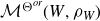 $\mathcal{M}^{\Theta^{or}}(W,\rho_W)$
is homotopy equivalent to
 $B\mathrm{Diff}^+(W)$
.
2·3. Homological stability
In the centre of the decoupling result is a condition on homological stability of moduli spaces of manifolds when gluing highly connected cobordisms along the boundary. In this section we give a concise survey of results on homological stability of moduli spaces of manifolds, focusing on the cases relevant to the decoupling theorem.
Homological stability results for classifying spaces of manifolds go back to the work of Harer [
Reference Harer11
] on the mapping class group of oriented surfaces. Among other results, he proved there is homological stability when gluing a disc
 $D^2$
along a boundary component of an oriented surface
 $S_{g,b+1}$
of genus g and
 $b+1$
boundary components. Namely, extending a diffeomorphism by the identity induces a map
 \begin{equation} B\mathrm{Diff}^+(S_{g,b+1})\longrightarrow B\mathrm{Diff}^+(S_{g,b}). \end{equation}
Harer showed that this map induces an isomorphism in homology in a range increasing with the genus g. This range was improved several times throughout the years [
Reference Boldsen3, Reference Harer11, Reference Ivanov16–Reference Ivanov18, Reference Williams29
]. The most recent bound, by Randal–Williams in [
Reference Williams29
], gives isomorphisms of homology groups in degrees
 $\leq 2g/3$
.
This result was generalised for surfaces with framings [
Reference Williams28
], spin structures [
Reference Bauer1, Reference Harer12, Reference Williams28
], maps to a simply-connected background space X [
Reference Ralph and Madsen4, Reference Ralph and Madsen5, Reference Williams29
], and
 $\mathrm{Spin}^r$
-structures [
Reference Williams28
]. As before, it was shown that the map induced by (2·1) on the moduli spaces of surfaces with these tangential structures gives isomorphisms in homology in ranges increasing with the genus.
Such a homological stability result was also proven to hold for non-orientable surfaces. Namely, let
 $\mathcal{N}_{g,b}$
be the non-orientable surface
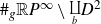 $\#_g\mathbb{R}P^\infty\setminus{{\scriptstyle \coprod\limits_{{b}}}}D^2$
, then the map
 \begin{equation*}H_i(B\mathrm{Diff}(\mathcal{N}_{g,b+1}))\longrightarrow H_i(B\mathrm{Diff}(\mathcal{N}_{g,b}))\end{equation*}
was shown in [
Reference Wahl33
] to be an isomorphism for all
 $4i\leq g-3$
. This was generalised in [
Reference Williams28
, section 4] to an analogous result on the homological stability of moduli spaces of non-orientable surfaces with tangential structures
 ${\mathrm{Pin}}^{+}$
and
 ${\mathrm{Pin}}^-$
.
These homological stability results were recently generalised in [
Reference Galatius and Williams7
] to the case of higher dimensional manifolds with respect to gluing highly-connected cobordisms (not necessarily discs). Let W be a manifold with non-empty boundary P, and
 $\rho_W$
a
 $\Theta$
-structure on W. Given a cobordism M from P to Q together with a
 $\Theta$
-structure
 $\rho_M$
on M which restricts to
 $\rho_W$
over P, there is an induced map between the moduli spaces

induced by extending a
 $\Theta$
-structures on W by
 $\rho_M$
, and the diffeomorphisms on W by the identity. In [
Reference Galatius and Williams7
], Galatius and Randal–Williams showed that, for many W of even dimension
 $d=2n\geq 6$
, cobordism M and structure
 $\Theta$
, this map induces a homology isomorphism in a range depending on the stable genus of
 $(W,\rho_W)$
, a concept we recall briefly, following the notation of [
Reference Galatius and Williams9
].
Analogously to the surface case, the genus of a manifold of dimension
 $d=2n$
is measured by disjoint embeddings of the space
 $(S^n\times S^n)\setminus\{*\}$
, but also taking into account the tangential structure. Namely, Galatius and Randal–Williams define what it means for a
 $\Theta$
-structure on
 $(S^n\times S^n)\setminus \{*\}$
to be admissible (for details see [
Reference Galatius and Williams9
]) and define the genus of a manifold W with
 $\Theta$
-structure
 $\rho_W$
to be
 \begin{equation*}g(W,\rho_W)=\max\left\{g\in\mathbb{N}\left| \begin{array}{c} \text{ there are} \, {g} \, \text{disjoint embeddings} \, j\;:\;(S^n\times S^n)\setminus \{*\}\hookrightarrow W\\ \text{ such that} \, j^*\rho_W \, \text{is admissible} \end{array}\right.\right\}.\end{equation*}
The stable genus of
 $(W,\rho_W)$
is defined to be
 \begin{equation*}\overline{g}(W,\rho_W)=\max\left\{g\left(W\# W_{k,1},\rho^{(k)}_W\right)-k|k\in \mathbb{N}\right\},\end{equation*}
where
 $W\# W_{k,1}$
is obtained from W by removing k discs and attaching k copies of
 $(S^n\times S^n)\setminus{\mathrm{int}}(D^{2n})$
along the new boundary. The
 $\Theta$
-structure
 $\rho^{(k)}_W$
is obtained by extending the restriction of
 $\rho_W$
by any admissible structure on
 $(S^n\times S^n)\setminus{\mathrm{int}}(D^{2n})$
.
Lemma 2·9. Let W be a smooth compact manifold of dimension
 $2n\geq 2$
,
 $L\subset {\mathrm{int}}(W)$
a closed submanifold of dimension
 $\leq n-1$
, and N a tubular neighbourhood of L. Then the genus of
 $W\setminus N$
is equal to the genus of W.
Proof. Sard’s theorem implies that for any submanifold
 $L' \subset (S^n\times S^n)\setminus \{*\}$
with
 $dim(L') \leq n-1$
there is an embedding
 $(S^n\times S^n)\setminus \{*\} \hookrightarrow (S^n\times S^n)\setminus \{*\}$
that avoids L
′ and is isotopic to the identity. In particular, this implies that for any
 $\phi\;:\;{{\scriptstyle \coprod\limits_{{g}}}}(S^n\times S^n)\setminus \{*\}\hookrightarrow W$
, there is an embedding
 $\phi'\;:\;{{\scriptstyle \coprod\limits_{{g}}}}(S^n\times S^n)\setminus \{*\}\hookrightarrow W$
that avoids L and is isotopic to
 $\phi$
. Since
 $W\setminus L$
is diffeomorphic to
 ${\mathrm{int}}(W\setminus N)$
via a diffeomorphism fixing everything but a collar of L, the result follows.
Theorem 2·10 ([
Reference Galatius and Williams7
], corollary 1·7). Assume
 $d=2n\geq 6$
, and
 $\Theta$
is such that
 $\Theta\mathbin{\!/\mkern-5mu/\!}\mathrm{GL}_d$
is simply-connected. Let W be a d-manifold,
 $\rho_W$
be an n-connected
 $\Theta$
-structure on W and let
 $g=\overline{g}(W,\rho_W)$
. Given a cobordism
 $(M,\rho_M)$
as above such that (M,P) is
 $(n-1)$
-connected, the map

is an isomorphism for all
 $3i\leq g-4$
.
We recall that a map is called n-connected if the map induced on homotopy groups
 $\pi_i$
is an isomorphism for
 $i<n$
and a surjection for
 $i=n$
.
Remark 2·11. In [ Reference Galatius and Williams7 , corollary 1·7], the result above is given in much more generality allowing arbitrary coefficient systems and providing a better stability range depending on the coefficient system and the tangential structure. We restrict ourselves to the case above, for simplicity, but remark that such generalisations for more general coefficient systems can also be immediately carried out in the decoupling theorem.
We end this section by remarking that there are many other types of homological stability results for moduli spaces of manifolds. Perhaps the most famous results show stabilising when increasing the genus of a manifold. This was carried out by Harer for oriented surfaces [
Reference Harer11
], and later extended to surfaces with structures such as framings [
Reference Williams28
], spin structures [
Reference Bauer1, Reference Harer12, Reference Williams28
], and maps to a simply-connected background space X [
Reference Ralph and Madsen4, Reference Ralph and Madsen5, Reference Williams29
],
 $\mathrm{Spin}^r$
-structures [
Reference Williams28
]. Homological stability when increasing the genus was also observed for non-oriented surfaces [
Reference Wahl33
], and surfaces with
 ${\mathrm{Pin}}^\pm$
-structures [
Reference Williams28
]. In dimension 3, this was carried out in [
Reference Hatcher and Wahl14
] where it was shown that the connected sum with
 $S^1\times S^2$
induces a homology isomorphism in a range. For higher dimensions, this was not only carried out for even dimensional surfaces [
Reference Galatius and Williams7, Reference Galatius and Williams8
], but also in odd dimensions by Perlmutter [
Reference Perlmutter27
], expanding on the idea of what it means to increase the genus of an odd-dimensional manifold.
Note that for odd dimensional manifolds we still do not know if gluing of cobordisms induces homology isomorphisms in a range, which is the relevant stability condition needed in the hypothesis of the Decoupling Theorem.
2·4. A lemma on fibre sequences and homotopy quotients
In this section we prove a lemma that will be used throughout the paper to construct fibre sequences of moduli spaces from equivariant fibre sequences of diffeomorphism groups and spaces of
 $\Theta$
-structures.
Lemma 2·12. Given a commutative diagram of topological spaces and continuous maps

such that f and h are Serre fibrations and h is surjective, then g is also a Serre fibration.
Proof. Since h is surjective, any map
 $D^i\times\{0\}\to Y$
admits a lift to X, as can be seen by induction on i: for
 $i=0$
, this follows from h being surjective, for
 $i>0$
, this lift follows from the identification
 $D^i\simeq D^{i-1}\times I$
and h being a Serre fibration. Then any lifting problem for g with respect to
 $D^i\times\{0\}\hookrightarrow D^{i}\times I$
gives a lifting problem for f, which admits a lift
 $\ell$
since f is a Serre fibration. Then
 $h\circ \ell$
is a lift with respect to g, as required.
Lemma 2·13. Let
 $G_i$
be a topological group and
 $p_i\;:\;M_i \to M_i/G_i$
be a
 $G_i$
-principal bundle, for
 $i=1,2,3$
.
-
(a) If
$\phi\;:\;G_2\to G_3$
is a continuous homomorphism and
$f\;:\;M_2\to M_3$
is a
$\phi$
-equivariant fibration, then the induced map is a fibration.
\begin{equation*}\psi\;:\;M_2/G_2 \longrightarrow M_3/G_3\end{equation*}
-
(b) Given a short exact sequence of groups
and a fibre sequence of equivariant maps
\begin{equation*}0\longrightarrow G_1 \to G_2 \longrightarrow G_3 \longrightarrow 0\end{equation*}
$M_1 \to M_2 \to M_3$
, the induced maps on quotients form a fibre sequence
\begin{equation*}M_1/G_1 \longrightarrow M_2/G_2 \longrightarrow M_3/G_3\end{equation*}




Proof.
-
(a) By assumption, the map
$p_2$
is a surjective fibration and the composition
$\psi\circ p_2$
is equals the composition of fibrations
$p_3\circ f$
. Therefore, by Lemma 2·12,
$\psi$
is a fibration. -
(b) Diagrammatically, we want to show that given the diagram of fibre sequences below, there exists a fibre sequence fitting into the bottom row:
By item (a), the map
$\psi$
is a fibration, so all that remains is to identify its fibres. The composition
$p_3\circ f$
is a fibration with fibre
$G_2\cdot i(M_1)\subset M_2$
. Then the fibre of
$\psi$
is
$p_2(G_2\cdot i(M_1))=p_2(i(M_1))$
. Since the action of
$G_3$
on
$M_3$
is free, we know that for any
$g\in G_2$
which is not in the kernel of
$\phi$
, the intersection
$(g\cdot i(M_1))\cap i(M_1)$
is empty. So
$p_2(i(M_1))$
is simply the quotient of
$i(M_1)$
by the action of
$\ker \phi=\iota(G_1)$
. Then the map
$M_1/G_1\to M_2/G_2$
is precisely the inclusion of the fibre of
$\psi$
.












Corollary 2·14. Let
 $G_i$
be a topological group and
 $S_i$
be a
 $G_i$
-space, for
 $i=1,2,3$
.
-
(a) If
$\phi\;:\;G_2\to G_3$
is a continuous homomorphism and
$f\;:\;S_2\to S_3$
is a
$\phi$
-equivariant fibration, then we can choose a model for the Borel constructions such that the induced map is a fibration.
\begin{equation*}\psi\;:\;S_2\mathbin{\!/\mkern-5mu/\!} G_2 \longrightarrow S_3 \mathbin{\!/\mkern-5mu/\!} G_3\end{equation*}
-
(b) Given a short exact sequence of groups
such that
\begin{equation*}0\longrightarrow G_1 \longrightarrow G_2 \xrightarrow{\;\;\;\;\phi\;\;\;\;} G_3 \longrightarrow 0\end{equation*}
$\phi$
is a principal bundle, and a fibre sequence of equivariant maps
$S_1 \to S_2 \to S_3$
, the induced maps on quotients form a homotopy fibre sequence
\begin{equation*}S_1\mathbin{\!/\mkern-5mu/\!} G_1 \longrightarrow S_2\mathbin{\!/\mkern-5mu/\!} G_2 \longrightarrow S_3\mathbin{\!/\mkern-5mu/\!} G_{3}.\end{equation*}




Proof. Both statements follow from applying Lemma 2·13 to the diagram

where the action of the groups is the diagonal action induced by the maps
 $\iota$
and
 $\phi$
. The commutativity of the diagram follows from the fact that the action of
 $G_1$
on
 $EG_3$
induced by
 $\phi\circ\iota$
is trivial.
In particular, applying the above corollary to the trivial fibration
 $*\to *$
, gives us the well-known result that a short exact sequence of groups
 $G_1\to G_2\to G_3$
induces a fibre sequence on classifying spaces
 $ BG_1 \to BG_2 \to BG_3$
.
2·5. The splitting argument
The proof of the decoupling results crucially uses a technique for comparing the homology of the total space of a fibre sequence to the one of a product. More specifically, we will compare the associated spectral sequences and look at the consequences when they are isomorphic in a range. This technique can be seen for instance in [ Reference Bödigheimer and Tillmann2, Reference Tillmann32 ], and can be stated as follows:
Proposition 2·15. Given a homotopy fibre sequence
 $F\xrightarrow{i} E\xrightarrow{p} B$
and a map
 $f\;:\;E\to M$
such that a the composite
 $f\circ i\;:\;F\to M$
induces an isomorphism on homology in degrees
 $\leq \alpha$
. Then the map
 $f\times p\;:\;E\to M\times B$
induces an isomorphism on homology in degrees
 $i\leq \alpha$
.
Proof. The following map of fibre sequences

induces a map of the respective Serre spectral sequences
 $E^\bullet_{p,q}\to \tilde{E}^\bullet_{p,q}$
. Since
 $f\circ i$
is a homology isomorphism in degrees
 $\leq \alpha$
, the map between the
 $E^2$
pages

is an isomorphism for all
 $q\leq \alpha$
. This also implies that all higher differentials involving a term in total degree
 $\leq \alpha$
are controlled: since a differential
 $d_r$
has bidegree
 $(\!-r,r-1)$
, if
 $d_r$
has a target in bidegree (p, q) with
 $p+q\leq \alpha$
, it comes from a term with bidegree (p
′,q
′) with
 $q'\leq \alpha$
. On the other hand, a differential
 $d_r$
coming from a term in bidegree (p, q) with
 $p+q\leq \alpha$
will have its target in total degree no greater than
 $\alpha$
. This implies that all the terms in total degree
 $\leq \alpha$
and their differentials are in the range of isomorphism of the spectral sequences and therefore
 $f\times p$
induces an isomorphism
 ${H_k(E)} \xrightarrow{\cong} {H_k(M\times B)}$
for all
 $k\leq \alpha$
. We leave the details to the reader.
3. The Decoupling Theorem
In this section we introduce decorated manifolds, the decorated moduli space, and the maps that are in the centre of the decoupling theorem: the forgetful map and evaluation map. We end by defining the decoupling map and proving the decoupling theorem.
For now, we focus on decorations being points and discs. These are the extreme cases: the simplest embedded manifolds of lowest and highest possible dimension. In Section 4 we show how this can be extended to more general submanifold decorations.
3·1. The decorated moduli space and the forgetful map
Throughout this section, let W be a compact connected smooth manifold. We will study manifolds equipped with decorations:
Definition 3·1. A d-dimensional manifold with decorations consists of a manifold W together with a set of distinct marked points in its interior
 $p_1, \dots, p_k\in W\setminus\partial W$
and disjoint embeddings
 $\phi_1,\dots,\phi_m\;:\;D^{d}\hookrightarrow W\setminus(\partial W\cup\{p_1,\dots,p_k\})$
, with
 $k,m\in\mathbb{N}$
. If W is orientable, we require all embeddings to be oriented in the same way. We refer to these choices as decorations on our manifold.
Given a manifold W with decorations, we define the decorated diffeomorphism group
 $\mathrm{Diff}^k_m(W)$
to be the subgroup of
 $\mathrm{Diff}(W)$
of the diffeomorphisms
 $\psi$
such that
 \begin{align*} \psi\circ \phi_j = \phi_{\alpha(j)} \qquad\qquad\qquad\qquad\qquad\qquad \psi(p_i) = p_{\beta(i)} \end{align*}
for some
 $\alpha\in \Sigma_m$
and
 $\beta\in\Sigma_k$
.
In other words, we are looking at the diffeomorphisms that preserve the marked points and parametrised discs up to permutations. Note that the notation
 $\mathrm{Diff}^k_m(W)$
does not record which points and embedded discs comprise the decorations. The following lemma justifies this notation.
Lemma 3·2. If
 $d\geq 2$
, the isomorphism type of
 $\mathrm{Diff}^k_m(W)$
does not depend on the choice of the k points and m embedded discs that comprise the decorations.
Proof. For any two collections of decorations in W denoted
 $\{p_i\}_{i=1}^k$
,
 $\{\phi_j\}_{j=1}^m$
and
 $\{p'_i\}_{i=1}^k$
,
 $\{\phi'_j\}_{j=1}^m$
there exists a diffeomorphism
 $\psi$
of W such that
 $\psi(p_i)=p_i' $
and
 $ \psi\circ\phi_i=\phi_i'$
. This can be constructed recursively by extending isotopies of the points and discs to diffeotopies of W as described in [
Reference Palais22
, theorem B] and [
Reference Debray, Galatius and Palmer6
, proposition 6·2·4]. Then conjugation with
 $\psi$
defines an isomorphism between the group of diffeomorphisms preserving
 $\{p_i\}_{i=1}^k$
,
 $\{\phi_j\}_{j=1}^m$
and the one preserving
 $\{p'_i\}_{i=1}^k$
,
 $\{\phi'_j\}_{j=1}^m$
.
We are now ready to define the analogue of the moduli space, including the decorations:
Definition 3·3. Given a manifold W with a
 $\Theta$
-structure
 $\rho_W$
, we define the decorated moduli space of W with k points and m discs to be
 \begin{align*} \mathcal{M}^{\Theta,k}_m(W,\rho_W)\;:\!=\;\mathrm{Bun}^{\Theta}(W,\rho_W)\mathbin{\!/\mkern-5mu/\!} \mathrm{Diff}^k_m(W). \end{align*}
Recall that, if W has non-empty boundary, then
 $\mathrm{Diff}(W)$
consists only of those diffeomorphisms fixing a collar of the boundary and the elements of
 $\mathrm{Bun}^\Theta(W,\rho_W)$
agree with
 $\rho_W$
on
 $\partial W$
.
We define the forgetful map
 \begin{equation} F\;:\;\mathcal{M}^{\Theta,k}_m(W,\rho_W)\longrightarrow \mathcal{M}^\Theta(W,\rho_W) \end{equation}
to be the one induced by the identity map on
 $\mathrm{Bun}^\Theta(W)$
and the subgroup inclusion
 $\mathrm{Diff}^k_m(W)\to \mathrm{Diff}(W)$
.
3·2. The evaluation map
In this section we define the evaluation map which will be used in the construction of the decoupling map in Definition 3·9. We also prove Proposition 3·7, which is the key ingredient for the proof of the Decoupling Theorem A and is the main technical result of the section.
Let W be a decorated manifold with k marked points and m marked discs. Fix throughout this section
 $N\subset W$
which is the union of a tubular neighbourhood of the marked points and the interiors of the parametrised discs. This choice of tubular neighbourhood gives, for each marked point
 $p_i$
, we a preferred frame of
 $T_{p_i}W$
, and if W is oriented, we ask that these frames have the same orientation. The decoupling result follows from understanding the difference between the decorated moduli space of W and the moduli space of
 ${W\setminus N}$
.
For instance, assume
 $k=0$
and
 $m=1$
, then there is a group isomorphism
 \begin{equation*}\mathrm{Diff}({W_1})\longrightarrow \mathrm{Diff}_1(W)\end{equation*}
given by extending a diffeomorphism on
 ${W_1}$
by the identity on the marked disc. More generally, if W is a manifold with m embedded discs, the map
 \begin{equation*}e_m\;:\;\mathrm{Diff}_m(W)\longrightarrow \Sigma_m \end{equation*}
taking a diffeomorphism
 $\phi$
to the
 $\alpha\in \Sigma_m$
recording the permutation induced on the discs by
 $\phi$
, is a surjective homomorphism with kernel
 $\mathrm{Diff}({W_m})$
, where, as above,
 ${W_m}$
is the manifold obtained from W by removing the interior of the m embedded discs.
Assume now W has k marked points
 $\{p_1,\dots,p_k\}$
and no marked discs. We still get a homomorphism
 \begin{equation*}\mathrm{Diff}({W_k})\longrightarrow \mathrm{Diff}^k(W)\end{equation*}
by extending a diffeomorphism on
 ${W_k}$
by the identity on the removed neighbourhood of the points, but this is not an isomorphism, since the elements of
 $\mathrm{Diff}^k(W)$
are not required to fix the entire neighbourhood of the marked points. A way to understand the diffeomorphisms around these is by looking at the differential map on the chosen frames at the marked points. So we define a map to the wreath product
 \begin{align*} e^k\;:\;\mathrm{Diff}^k(W)&\longrightarrow \Sigma_k\wr \mathrm{GL}_d\\ \phi &\longmapsto (D_{p_1}\phi,\dots,D_{p_k}\phi,\beta), \end{align*}
where
 $\beta\in \Sigma_k$
is the permutation induced on the marked points by
 $\phi$
. The image of
 $e^k$
depends on the manifold W.
Definition 3·4. An orientable decorated manifold W with k marked points and m marked discs is called decorated-chiral if every
 $\phi \in \mathrm{Diff}_m^k(W)$
preserves the orientation.
Remark 3·5. If the manifold W is either decorated by
 $m>0$
discs or
 $\partial W\neq \emptyset$
then it is immediately decorated-chiral. On the other hand, if
 $m=0$
, a closed manifold is decorated-chiral if and only if it is already chiral, independently of the number k of marked points.
It follows from [ Reference Tillmann32 , lemmas 2·3 and 2·4] that:
Lemma 3·6 ([ Reference Tillmann32 ]). Let W be a compact connected decorated manifold, then:
-
(a) the map
is a surjective principal bundle, where the group
$\mathrm{GL}_d^\dagger$
is
$\mathrm{GL}_d^+$
if W is decorated-chiral, and
$\mathrm{GL}_d$
otherwise;
-
(b)
$\mathrm{Diff}({W\setminus N})$
is the homotopy fibre of e.


The rest of this section consists of proving a generalisation of the above lemma, constructing a fibre sequence of moduli spaces with tangential structures which is the key to the proof of the decoupling.
Proposition 3·7. Let W be a compact connected decorated manifold and
 $\rho_W$
a fixed
 $\Theta$
-structure on W, then:
-
(a) the homomorphism e induces an evaluation map
which is a Serre fibration onto the path component which it hits, where the group
$\mathrm{GL}_d^\dagger$
is
$\mathrm{GL}_d^+$
if W is decorated-chiral, and
$\mathrm{GL}_d$
otherwise;
-
(b) let
${W\setminus N}$
be equipped with the
$\Theta$
-structure
$\rho_{{W\setminus N}}$
given by the restriction of
$\rho_W$
. Then is the homotopy fibre of E over its image.
\begin{equation*}\mathcal{M}^\Theta({W\setminus N},\rho_{{W\setminus N}})\end{equation*}


To prove the Proposition, we will need the following lemma:
Lemma 3·8. Let W be a connected manifold and S a smooth submanifold, then the restriction map
 \begin{equation*}r_{s}\;:\;\textrm{Bun}^{\Theta}(W)\longrightarrow\textrm{Map}_{\textrm{GL}_d}(Fr(TW|s),\Theta)\end{equation*}
is a Serre fibration.
Proof. For any
 $i\geq 0$
, a lift for the diagram

is equivalent to a
 $\mathrm{GL}_d$
-equivariant extension of the following
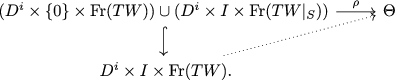
Since the inclusion
 $S\hookrightarrow W$
is an embedding, there exists a strong deformation retract
 \begin{equation*} r\;:\; D^i\times I\times W \longrightarrow (D^i\times \{0\}\times W)\cup (D^i\times I\times S).\end{equation*}
If i denotes the inclusion of
 $(D^i\times \{0\}\times W)\cup (D^i\times I\times S)$
into
 $D^i\times I\times W$
, we have an isomorphism
 \begin{equation*}f\;:\;D^i\times I\times {\mathrm{Fr}}(TW)\xrightarrow{\cong} r^*i^*(D^i\times I\times {\mathrm{Fr}}(TW))\end{equation*}
which is the identity on
 $(D^i\times \{0\}\times {\mathrm{Fr}}(TW))\cup (D^i\times I\times {\mathrm{Fr}}(TW|_S))$
.
Therefore the composite

gives a lift to diagram (3·2). This implies that the map
 $\mathrm{Bun}^\Theta(W)\to {\mathrm{Map}}_{\mathrm{GL}_d}({\mathrm{Fr}}(TW|_S),\Theta)$
is a Serre fibration.
Proof of Proposition 3·7.
-
(a) Let
$P\subset W$
be the union of the k marked points and the centres of the m marked discs. By Lemma 3·8, the restriction map is a Serre fibration. For each marked point, we chose a frame of its tangent space. Each point in the centre of a marked disc, comes with a preferred frame induced by the parametrisation of the disc. So every point in P is equipped with a frame of its tangent space, and this gives us a diffeomorphism
\begin{equation*}r_P\;:\;\mathrm{Bun}^\Theta(W,\rho_W)\longrightarrow {\mathrm{Map}}_{\mathrm{GL}_d}({\mathrm{Fr}}(TW|_P),\Theta)\end{equation*}
${\mathrm{Fr}}(TW|_P)\cong \mathrm{GL}_d\times P$
. Therefore the space of
$\mathrm{GL}_d$
-equivariant maps
${\mathrm{Fr}}(TW|_P)\to \Theta$
can be identified with the space of continuous maps
$P\to \Theta$
, which is just
$\Theta^{m}\times \Theta^{k}$
. The result then follows by applying Corollary 2·14 to combine the fibration
$r_P$
with the homomorphism of Lemma 3·6 (3·3)We apply Corollary 2·14(a) by taking
\begin{equation} \mathrm{Diff}^k_m(W)\xrightarrow{\;\;\;\;e\;\;\;\;} \Sigma_m\times(\Sigma_k\wr \mathrm{GL}_d^\dagger). \end{equation}
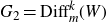
$G_2=\mathrm{Diff}^k_m(W)$
and
$S_2=\mathrm{Bun}^\Theta(W,\rho_W)$
, with the usual action by precomposition with the differential. On the other hand, we take
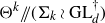
$G_3=\Sigma_m\times(\Sigma_k\wr \mathrm{GL}_d^\dagger)$
, and
$S_3=\Theta^{m}\times \Theta^{k}$
with the following action: the space
$\Theta^{m}\times \Theta^{k}$
can be spit into the m factors corresponding to the marked discs and k factors corresponding to the marked points. Then we have an action of
$\Sigma_m\times(\Sigma_k\wr \mathrm{GL}_d^\dagger)$
on
$\Theta^{m}\times \Theta^{k}$
induced by the actions Then the fibration
$\mathrm{Bun}^\Theta(W,\rho_W)\to \Theta^{m}\times \Theta^{k}$
is e-equivariant and therefore, by Corollary 2·14(a), we have a fibration Since
$E\Sigma_k\times(E\mathrm{GL}_d)^k$
is a model for
$E(\Sigma_k\wr \mathrm{GL}_d^\dagger)$
, then is a model for
\begin{equation*}(\Theta\mathbin{\!/\mkern-5mu/\!} \mathrm{GL}_d^\dagger)^k\mathbin{\!/\mkern-5mu/\!} \Sigma_k\end{equation*}
$\Theta^k\mathbin{\!/\mkern-5mu/\!}(\Sigma_k\wr \mathrm{GL}_d^\dagger)$
, and the result follows.
-
(b) A description of the fibre of E can be obtained using Corollary 2·14(b) with the short exact sequence of groups being
(3·4)and the fibre sequence
\begin{equation} \ker e \longrightarrow \mathrm{Diff}^k_m(W)\xrightarrow{e} \Sigma_m\times(\Sigma_k\wr \mathrm{GL}_d^\dagger) \end{equation}
$S_1\to S_2\to S_3$
being the one associated to the fibration
$r_P$
of item (a). The fibre of
$r_P$
over
$r_P(\rho_W)$
is the subspace of all elements of
$\mathrm{Bun}^\Theta(W,\rho_W)$
which restrict to
$r_P(\rho_W)$
over P, which we here denote
$\mathrm{Bun}^\Theta_P(W,\rho_W)$
. This space carries an action of
$\ker e$
by precomposition with the differential, and it is simple to check that this fibre sequence is equivariant with respect to (3·4). Then by Corollary 2·14(b), the fibre of the evaluation map E is given by
\begin{equation*}\mathrm{Bun}^\Theta_P(W,\rho_W)\mathbin{\!/\mkern-5mu/\!}\ker e.\end{equation*}
























Recall
 $N\subset W$
is the union of a tubular neighbourhood of the marked points and the interiors of the parametrised discs, and P is the space defined in item (a). Applying Lemma 3·8 to both submanifolds P and N, we obtain two fibrations fitting into the following commutative diagram

where the right-hand vertical map is induced by the inclusion
 $i\;:\;P\hookrightarrow N$
. Since
 ${\mathrm{Fr}}(TD^d)$
is isomorphic to
 $\mathrm{GL}_d\times D^d$
as
 $\mathrm{GL}_d$
-bundles, and the spaces
 $\mathrm{GL}_d\times D^d$
and
 $\mathrm{GL}_d\times \{*\}$
are homotopy equivalent as
 $\mathrm{GL}_d$
-spaces, the map
 $i^*$
is a homotopy equivalence. In particular, this implies that the map from the fibre of
 $r_N$
to
 $\mathrm{Bun}^\Theta_P(W,\rho_W)$
is a homotopy equivalence.
The fibre of
 $r_{_N}$
over
 $r_{_N}(\rho_W)$
is by definition the space of all
 $\Theta$
structures on W which agree with
 $\rho_W$
on N. We claim that this space is homeomorphic to
 $\mathrm{Bun}^\Theta({W\setminus N},\rho_{{W\setminus N}})$
, since the restriction map
 $r_{_{{W\setminus N}}}$
takes the fibre of
 $r_{_N}$
bijectively to
 $\mathrm{Bun}^\Theta({W\setminus N},\rho_{{W\setminus N}})$
and it has an inverse given by extending an element by
 $r_{_N}(\rho_W)$
.
So we have a commutative diagram of principal fibre bundles

where the top horizontal map is a homotopy equivalence by Lemma 3·6 and the middle map is a homotopy equivalence by the discussion above. Therefore the map
 \begin{equation*}\mathcal{M}^\Theta({W\setminus N},\rho_{{W\setminus N}}) \longrightarrow \mathrm{Bun}^\Theta_P(W,\rho_W)\mathbin{\!/\mkern-5mu/\!} \ker e\end{equation*}
is also a homotopy equivalence, as required.
3·3. Proof of the decoupling
In this section we prove the Decoupling Theorem. The key inputs are the homotopy fibre sequence constructed in Proposition 3·7 and the splitting argument of Proposition 2·15. We end this section by showing how this implies new decoupling results for surfaces (Corollary 3·11) and Theorem A (Theorem 3·10), and give examples of applications.
Definition 3·9. The decoupling map

is the product of the forgetful map (3·1) and the evaluation map E defined in Proposition 3·7.
We now restate the decoupling theorem:
Theorem 3·10. Let W be a smooth connected compact manifold equipped with a
 $\Theta$
-structure
 $\rho_W$
. If the map
 \begin{equation*}\tau\;:\;H_i(\mathcal{M}^\Theta({W\setminus \big({{\scriptstyle \coprod\limits_{{m+k}}}}D^d}\big),\rho_{{W\setminus \big({{\scriptstyle \coprod\limits_{{m+k}}}}D^d}\big)}))\longrightarrow H_i(\mathcal{M}^\Theta(W,\rho_W))\end{equation*}
induces a homology isomorphism in degrees
 $i\leq \alpha$
, then for all such i the decoupling map D induces an isomorphism
 \begin{equation*}H_i(\mathcal{M}^{\Theta,k}_m(W,\rho_W))\cong H_i(\mathcal{M}^\Theta(W,\rho_W)\times \Theta^m_0\mathbin{\!/\mkern-5mu/\!}\Sigma_m\times (\Theta\mathbin{\!/\mkern-5mu/\!} \mathrm{GL}_d^\dagger)_0^k\mathbin{\!/\mkern-5mu/\!}\Sigma_k),\end{equation*}
where
 $(\!-\!)_0$
denotes a path component of the image of
 $\rho_W$
, and the group
 $\mathrm{GL}_d^\dagger$
is
 $\mathrm{GL}_d^+$
if W is orientable and decorated-chiral, and
 $\mathrm{GL}_d$
otherwise.
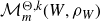
Proof. By Proposition 3·7, E is a fibration. Since
 $\mathcal{M}^{\Theta,k}_m(W,\rho_W)$
is connected by definition, we know that the image of E is precisely the path component
 \begin{equation*}\Theta^m_0\mathbin{\!/\mkern-5mu/\!}\Sigma_m\times (\Theta\mathbin{\!/\mkern-5mu/\!} \mathrm{GL}_d^\dagger)_0^k\mathbin{\!/\mkern-5mu/\!}\Sigma_k.\end{equation*}
Proposition 3·7 implies we have a homotopy fibre sequence

where
 $N\subset W$
is the union of a tubular neighbourhood of the marked points and the interiors of the parametrized discs. Then
 $N\cong {{\scriptstyle \coprod\limits_{{m_k}}}}D^d$
and, by assumption, the composition
 \begin{equation*}\mathcal{M}^\Theta({W\setminus N},\rho_{{W\setminus N}}) \longrightarrow\mathcal{M}^{\Theta,k}_{m}(W,\rho_W) \xrightarrow{\;\;\;\;F\;\;\;\;} \mathcal{M}^\Theta(W,\rho_W)\end{equation*}
induces a homology isomorphism in degrees
 $i\leq \alpha$
. Therefore, by Proposition 2·15, the decoupling map D induces a homology isomorphism in the same range of degrees.
Using Theorem 3·10 and the homology stability results for surfaces recalled in Section 2·3, we obtain the following new decoupling results for surfaces.
Corollary 3·11. Let
 $S_{g,b}$
be an orientable surface of genus g and b boundary components, and let
 $\mathcal{N}_{g,b}$
be the non-orientable surface
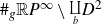 $\#_g\mathbb{R}P^\infty\setminus{{\scriptstyle \coprod\limits_{{b}}}}D^2$
. Then for the following tangential structures, we have the decoupling results:
-
(i) framings: for all
$6i\leq 2g-8$
\begin{equation*}H_i(\mathcal{M}^{\mathrm{fr},k}_m(S_{g,b},\rho))\cong H_i\Big(\mathcal{M}^{\mathrm{fr}}(S_{g,b},\rho)\times \mathrm{SO}(2)^m\mathbin{\!/\mkern-5mu/\!}\Sigma_m \times B\Sigma_k\Big);\end{equation*}
-
(ii) spin-structures: for all
$4i\leq g-2$
\begin{equation*}H_i(\mathcal{M}^{\mathrm{Spin},k}_m(S_{g,b},\rho))\cong H_i\Big(\mathcal{M}^{\mathrm{Spin}}(S_{g,b},\rho)\times B(\Sigma_m\wr \mathbb{Z}/2)\times B(\Sigma_k\wr \mathrm{Spin}(2))\Big);\end{equation*}
-
(iii) maps to a simply-connected background space X: for all
$3i\leq 2g$
\begin{equation*}H_i(\mathcal{M}^{\mathrm{X},k}_{m}(S_{g,b},\rho))\cong H_i\Big(\mathcal{M}^{\mathrm{X}}(S_{g,b},\rho)\times X^m\mathbin{\!/\mkern-5mu/\!}\Sigma_m \times X^k\mathbin{\!/\mkern-5mu/\!}(\Sigma_k\wr \mathrm{SO}(2))\Big);\end{equation*}
-
(iv) Spinr-structures: for all
$6i\leq 2g-8$
\begin{equation*}H_i(\mathcal{M}^{\mathrm{Spin^r},k}_{m}(S_{g,b},\rho))\cong H_i\Big(\mathcal{M}^{\mathrm{Spin^r}}(S_{g,b},\rho)\times B(\Sigma_m\wr\mathbb{Z}/r)\times B(\Sigma_k\wr\mathrm{Spin}^r(2))\Big);\end{equation*}
-
(v)
$\mathrm{Pin}^+$
-structures: for all
$4i\leq g-6$
\begin{equation*}H_i(\mathcal{M}^{\mathrm{Pin}^+,k}_m(\mathcal{N}_{g,b},\rho))\cong H_i\Big(\mathcal{M}^{\mathrm{Pin}^+}(\mathcal{N}_{g,b},\rho)\times B(\Sigma_m\wr \mathbb{Z}/2)\times B(\Sigma_k\wr{\mathrm{Pin}}^+(2))\Big);\end{equation*}
-
(vi)
$\mathrm{Pin}^-$
-structures: for all
$5i\leq g-8$
\begin{equation*}H_i(\mathcal{M}^{\mathrm{Pin}^-,k}_m(\mathcal{N}_{g,b},\rho))\cong H_i\Big(\mathcal{M}^{\mathrm{Pin}^-}(\mathcal{N}_{g,b},\rho)\times B(\Sigma_m\wr \mathbb{Z}/2)\times B(\Sigma_k\wr{\mathrm{Pin}}^-(2))\Big).\end{equation*}


Proof. The proof of all the results follows from applying Theorem 3·10 and identifying the spaces
 $\Theta_0$
and
 $(\Theta\mathbin{\!/\mkern-5mu/\!} \mathrm{GL}_d^\dagger)_0$
for each tangential structure considered. We show this for item (ii) about surfaces with spin structures and leave the proof of the other items, which can be obtain by the same approach, to the reader.
Recall from Section 2·3 that the moduli space of surfaces with spin structures satisfies the necessary homology stability condition as shown in [
Reference Bauer1, Reference Harer12, Reference Williams28
]. With the most recent stability range, we know we have homology isomorphisms in degrees
 $\leq (g-2)/4$
. Therefore Theorem 3·10 applies. We end by identifying the terms
 $\Theta_0$
and
 $(\Theta\mathbin{\!/\mkern-5mu/\!} \mathrm{GL}_d^\dagger)_0$
. From Example 2·4, we know that
 $\Theta^\mathrm{Spin}$
is weakly equivalent to
 $\{\pm 1\}\times B\mathbb{Z}/2$
, and therefore
 $(\Theta^\mathrm{Spin})_0$
is weakly equivalent to
 $B\mathbb{Z}/2$
. On the other hand,
 $\Theta^\mathrm{Spin}\mathbin{\!/\mkern-5mu/\!} \mathrm{GL}_2^+$
is the disjoint union of two copies of
 $B\mathrm{Spin}(2)$
and therefore
 \begin{equation*}(\Theta^\mathrm{Spin}\mathbin{\!/\mkern-5mu/\!} \mathrm{GL}_2^+)_0^k\mathbin{\!/\mkern-5mu/\!}\Sigma_k\simeq B\mathrm{Spin}(2)^k\mathbin{\!/\mkern-5mu/\!} \Sigma_k\simeq B(\Sigma_k\wr \mathrm{Spin}(2)).\end{equation*}
We can also apply Theorem 3·10 in higher even dimensions, where the homological stability condition was shown to hold in many cases, as recalled in Theorem 2·10. Combining these results, we obtain the following corollary, a more general version of Theorem A:
Corollary 3·12. Assume
 $d=2n\geq 6$
, and
 $\Theta$
is such that
 $\Theta\mathbin{\!/\mkern-5mu/\!}\mathrm{GL}_d$
is simply-connected. Let
 $\rho_W$
be an n-connected
 $\Theta$
-structure on W and let
 $g=\overline{g}(W,\rho_W)$
. Then for all
 $i\leq ({g-4})/{3}$
we have an isomorphism
 \begin{equation*}H_i(\mathcal{M}^{\Theta,k}_{m}(W,\rho_W))\cong H_i(\mathcal{M}^\Theta(W,\rho_W)\times \Theta^m_0\mathbin{\!/\mkern-5mu/\!}\Sigma_m \times (\Theta\mathbin{\!/\mkern-5mu/\!} \mathrm{GL}_{2n}^\dagger)_0^k\mathbin{\!/\mkern-5mu/\!}{\Sigma_k}),\end{equation*}
where
 $\mathrm{GL}_{2n}^\dagger$
equals to
 $\mathrm{GL}_{2n}^+$
if W is decorated-chiral, and is
 $\mathrm{GL}_{2n}$
otherwise.
Proof. Since the map
 $\rho_W$
is n-connected and the pair
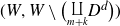 $(W,{W\setminus \big({{\scriptstyle \coprod\limits_{{m+k}}}}D^d}\big))$
is
 $(2n-1)$
-connected, then the restriction
 $\rho_{{W\setminus \big({{\scriptstyle \coprod\limits_{{m+k}}}}D^d}\big)}$
is still an n-connected
 $\Theta$
-structure.
The map
 $\tau\;:\;H_i(\mathcal{M}^\Theta({W\setminus \big({{\scriptstyle \coprod\limits_{{m+k}}}}D^d}\big),\rho_{{W\setminus \big({{\scriptstyle \coprod\limits_{{m+k}}}}D^d}\big)}))\to H_i(\mathcal{M}^\Theta(W,\rho_W))$
in the hypothesis of the decoupling theorem, is induced by attaching
 ${{\scriptstyle \coprod\limits_{{m+k}}}}D^{2n}$
along the
 $m+k$
boundary sphere components of
 ${W\setminus \big({{\scriptstyle \coprod\limits_{{m+k}}}}D^d}\big)$
. Since
 \begin{equation*}(M,P)=({{\scriptstyle \coprod\limits_{{m+k}}}}D^{2n},\partial {{\scriptstyle \coprod\limits_{{m+k}}}}D^{2n})\end{equation*}
is
 $(n-1)$
-connected, the hypotheses of Theorem 2·10 are satisfied, which implies that
 $\tau$
induces a homology isomorphism in degrees
 $3i\leq g-4$
. Applying Theorem 3·10, the result follows.
Example 3·13. Let
 $W_{g,1}=(S^n\times S^n)\# D^{2n}$
. Since
 $TW_{g,1}$
is trivialisable, we know
 $W_{g,1}$
admits a framing
 $\rho_{W_{g,1}}\;:\;{\mathrm{Fr}}(TW_{g,1})\to \mathrm{GL}_{2n}$
. Since
 $W_{g,1}$
is
 $(n-1)$
-connected,
 $\rho_{W_{g,1}}$
is n-connected. Denoting by
 $\overline{g}$
the stable genus
 $\overline{g}(W_{g,1},\rho_{W_{g,1}})$
, then by Corollary 3·12, for all
 $i\leq {\overline{g}-4}/{3}$
, the group
 $H_i(\mathcal{M}^{\mathrm{fr},k}_m(W_{g,1},\rho_{W_{g,1}}))$
is isomorphic to
 \begin{equation*}H_i\left(\mathcal{M}^\mathrm{fr}(W_{g,1},\rho_{W_{g,1}})\times \mathrm{SO}(2n)^m\mathbin{\!/\mkern-5mu/\!}\Sigma_m\times B\Sigma_k\right).\end{equation*}
Example 3·14. Let
 $V_d\subset \mathbb{C}P^{4}$
be a smooth hypersurface determined by a homogeneous complex polynomial of degree d. This is an orientable chiral 6-dimensional manifold whose diffeomorphism type depends only on the degree d. In [
Reference Galatius and Williams9
, section 5·3] it is shown that, if d is even, there exists a 3-connected
 $\mathrm{Spin}^c$
-structure
 $\rho_{V_d}$
on
 $V_d$
. They also compute an expression for the stable genus
 $\overline{g}(V_d,\rho_{V_d})$
in terms of d.
Applying the procedure of Example 2·4 to the fibre sequence

we get that
 $\Theta^{\mathrm{Spin}^c}\simeq\{\pm1\}\times B\mathrm{U}(1)$
, and
 $\Theta^{\mathrm{Spin}^c}\mathbin{\!/\mkern-5mu/\!} \mathrm{GL}_6^{+}\simeq\{\pm1\}\times B\mathrm{Spin}^c(6)$
. Therefore, by Corollary 3·12, for all
 $i\leq ({d^4-5d^3+10d^2-10d+4})/{4}$
, the group
 $H_i(\mathcal{M}^{\mathrm{Spin^c},k}_m(V_d,\rho_{V_d}))$
is isomorphic to
 \begin{equation*}H_i\left(\mathcal{M}^\mathrm{Spin^c}(V_d,\rho_{V_d})\times B(\Sigma_m\wr\mathrm{U}(1))\times B(\Sigma_k\wr\mathrm{Spin}^c(6))\right).\end{equation*}
The conditions on the tangential structure in Theorem 2·10 are quite restrictive, for instance the trivial tangential structure
 $\Theta^*$
does not satisfy the hypothesis because
 $B\mathrm{GL}_d$
is not simply connected for any d. Moreover, the condition that we start with an n-connected
 $\Theta$
-structure
 $\rho_W$
excludes many of the cases we are interested in. For instance, it implies that the manifold
 $W_{g,1}$
with an orientation does not satisfy the hypothesis of Theorem 2·10. In Section 5, we prove a generalisation of Theorem A for high dimensional manifolds with any tangential structure.
4. Decoupling submanifolds
In Section 3, we proved a decoupling result for the decorated moduli space of a manifold with marked points and discs, following the works of [ Reference Bödigheimer and Tillmann2, Reference Ralph and Madsen5, Reference Hanbury10 ]. Recently, in [ Reference Palmer24–Reference Palmer26 ] Palmer has studied manifolds equipped with more general decorations, allowed to be any embedded closed manifold. In this section, we show that there is a decoupling result for these generalised decorations. As a specific example, we focus on the case where the decorations are unlinked circles, which have also been closely studied in dimension 3 by Kupers in [ Reference Kupers20 ].
4·1. The L-decorated moduli space
In this section, we generalise the definition of a decorated manifold to allow more general submanifolds as decorations. We also define the forgetful map which will be used in the definition of the decoupling map (Definition 4·7). Throughout, let W be a smooth connected compact d-dimensional manifold.
Definition 4·1. A L-decorated manifold is a pair (W, L) of a manifold W together with a closed embedded submanifold
 $L\subset W$
.
Given a L-decorated manifold (W, L), we define the decorated diffeomorphism group
 $\mathrm{Diff}_L(W)$
to be the subgroup of
 $\mathrm{Diff}(W)$
of the diffeomorphisms
 $\psi$
such that
 \begin{align*} \psi(L)=L. \end{align*}
In other words, we are looking at the diffeomorphisms preserving the marked submanifold, but not necessarily pointwise.
Definition 4·2. Given a closed manifold W and a
 $\Theta$
-structure
 $\rho_W$
on W, we define the L-decorated moduli space of W to be
 \begin{align*} \mathcal{M}^{\Theta}_L(W,\rho_W)\;:\!=\;\mathrm{Bun}^{\Theta}(W,\rho_W)\mathbin{\!/\mkern-5mu/\!} \mathrm{Diff}_L(W). \end{align*}
The inclusion of groups
 $\mathrm{Diff}_L(W)\to \mathrm{Diff}(W)$
induces a map
 \begin{equation} F_L\;:\;\mathcal{M}^{\Theta}_L(W,\rho_W)\longrightarrow \mathcal{M}^\Theta(W\rho_W) \end{equation}
which we call the forgetful map.
4·2. The evaluation map
$E_L$

In this section we define the evaluation map which will be used in the construction of the decoupling map in Definition 4·7. We also prove Proposition 4·6, which is the key ingredient for the proof of the Decoupling Theorem for submanifolds (Theorem 4·8), and Lemma 4·3, which is the main technical result of the section.
Let (W, L) be an L-decorated manifold and let
 $\nu_{L}\,{:}\,{\raise-1.5pt{=}}\,(TW_{|L})/TL$
be the normal bundle of L in W. Fix N a tubular neighbourhood of the decoration identified as the image of an embedding
 $\Phi\;:\;\nu_{L}\to W$
. The theorem for decoupling submanifolds relies on understanding the difference between the L-decorated moduli space of W and the moduli space of
 ${W\setminus N}$
.
We start by constructing an equivariant fibre sequence relating the decorated diffeomorphism groups
 $\mathrm{Diff}_L(W)$
and
 $\mathrm{Diff}({W\setminus N})$
. Recall that
 $\mathrm{Diff}({W\setminus N})$
consists only of those diffeomorphisms fixing a collar neighbourhood of the boundary of
 ${W\setminus N}$
, including the newly formed boundary obtained by removing N. Extending a diffeomorphism by the identity on N, gives us a homomorphism
 \begin{align} \mathrm{Diff}({W\setminus N}) \longrightarrow \mathrm{Diff}_L(W). \end{align}
Since any diffeomorphism
 $\phi\in \mathrm{Diff}_L(W)$
fixes L, the differential of
 $\phi$
induces an isomorphism of the tangent bundle
 $TW_{|L}$
fixing TL (not necessarily pointwise). This gives a map:
 \begin{align} e_L\;:\;\mathrm{Diff}_L(W) & \longrightarrow \mathrm{Iso}(TW_{|L},TL) \\ \phi & \longmapsto D\phi|_{L},\nonumber \end{align}
where
 $D\phi|_{L}$
denotes the isomorphism of
 $TW_{|L}$
induced by the differential of
 $\phi$
, and
 $\mathrm{Iso}(TW_{|L},TL)$
denotes the group of bundle isomorphisms of
 $TW_{|L}$
fitting into the following diagram:

Lemma 4·3. Let (W, L) be a compact connected L-decorated manifold, then


Proof. Throughout this proof, we will use a generalisation of Palais’ theorem in [ Reference Palais23 ] proved by Lima in [ Reference Lima21 ], which gives us a principal bundle

Let
 $\mathrm{Emb}_L(N,W)$
be the subspace of embeddings
 $f\;:\;N\hookrightarrow W$
such that the core of N is taken to our marked submanifold L in W. Then taking the pullback along the inclusion
 $\mathrm{Emb}_L(N,W)\hookrightarrow \mathrm{Emb}(N,W)$
gives as the principal bundle:

Write N as the image of an embedding
 $\exp\circ\Phi\;:\;\nu_L\hookrightarrow W$
, where
 $\Phi\;:\;\nu_L\to TW_{|L}$
. Consider the forgetful map
 \begin{equation*}d\;:\;\mathrm{Emb}_{L}(N,W)\rightarrow \mathrm{Iso}(TW_{|L},TL)\end{equation*}
taking an embedding to the map induced on the normal bundle of the zero section
 $L\subset N$
. Then
 $e_L=d\circ r$
. We will show d is a fibre bundle, which implies
 $e_L$
is a principal bundle. It is enough to exhibit a local section of d at a neighbourhood of the identity (for details see [
Reference Steenrod30
, part I, section 7·4]).
Given
 $\overline{f}\;:\;TW_{|L}\to TW_{|L}$
in
 $\mathrm{Iso}(TW_{|L},TL)$
we can define

Since the assignment
 $f\mapsto s_f$
is continuous and
 $\mathrm{Emb}(\nu_L,W)$
is an open subset of
 $\mathcal{C}^\infty(\nu_L,W)$
, then the space of maps
 $\overline{f}\in \mathrm{Iso}(TW_L,TL)$
such that
 $s_f$
is an embedding, is an open neighbourhood U of the identity. Therefore, the map
 \begin{align*} U &\longrightarrow \mathrm{Emb}(\nu_L,W)\\ \overline{f} &\longmapsto s_f \end{align*}
is a local section for d at the identity.
Part (b): The map i fits into the following commutative diagram of fibre sequences:

The fiber of the forgetful map d over the identity is simply the space of tubular neighbourhoods of L in W, which is contractible. This implies d is a homotopy equivalence and therefore so is i.
The image of the homomorphism
 $e_L$
of Lemma 4·3 is by definition the collection of isomorphisms of tangent bundle of L in W, which can be achieved by a diffeomorphism of the whole manifold W fixing L. In the next section we will look closely at the case where L is a collection of unlinked circles and determine
 $\mathrm{ Im }\, e_L$
. In the general case, this image is very much dependent of L, W and the chosen embedding.
Definition 4·4. For any subgroup
 $G\subset \mathrm{ Im }\, e_L$
, we define
 $\mathrm{Diff}_G(W)$
to be the subgroup
 $e_L^{-1}(G)$
. Given a closed manifold W and a
 $\Theta$
-structure
 $\rho_W$
on W, we define
 \begin{align*} \mathcal{M}^{\Theta}_G(W,\rho_W)\;:\!=\;\mathrm{Bun}^{\Theta}(W,\rho_W)\mathbin{\!/\mkern-5mu/\!} \mathrm{Diff}_G(W). \end{align*}
Note that taking
 $G=\mathrm{ Im }\, e_L$
, one recovers precisely the definition of
 $\mathcal{M}^\Theta_L(W,\rho_W)$
.
Notation 4.5. We denote the kernel of
 $e_L$
by
 $\mathrm{Diff}(W,TW|_L)$
. Note that these are precisely the elements of
 $\mathrm{Diff}_L(W)$
which fix the submanifold L pointwise and whose differential
 $D_p\phi$
is the identity on every point of the submanifold L.
We now use the map
 $e_L$
and Lemma 4·3 to construct the evaluation map:
Proposition 4·6. Let W be a compact connected manifold and
 $\rho_W$
a fixed
 $\Theta$
-structure on W, then:
-
(a) the homomorphism
$e_L$
, induces the evaluation map which is a Serre fibration onto the path component which it hits; -
(b) let
${W\setminus N}$
be equipped with the
$\Theta$
-structure
$\rho_{{W\setminus N}}$
given by the restriction of
$\rho_W$
. Then is the homotopy fibre of
\begin{equation*}\mathcal{M}^\Theta({W\setminus N},\rho_{{W\setminus N}})\end{equation*}
$E_L$
over its image.


Proof. The proof follows the same strategy as the one for the proof of Proposition 3·7. For simplicity, we only indicate the places where the two arguments differ and leave the details for the reader.
-
(a) By Lemma 3·8, the restriction map
(4·5)is a Serre fibration. Then the result follows by applying Corollary 2·14 to combine the fibration
\begin{align} r_L\;:\;\mathrm{Bun}^\Theta(W,\rho_W)\longrightarrow {\mathrm{Map}}_{\mathrm{GL}_d}({\mathrm{Fr}}(TW|_L),\Theta) \end{align}
$r_L$
with the homomorphism of
$e_L\;:\;\mathrm{Diff}_G(W)\rightarrow G$
of Lemma 4·3. We apply Corollary 2·14(a) by taking
$G_2=\mathrm{Diff}_G(W)$
and
$S_2=\mathrm{Bun}^\Theta(W,\rho_W)$
, with the usual action by precomposition with the differential. On the other hand, we take
$G_3=G$
, and
$S_3= {\mathrm{Map}}_{\mathrm{GL}_d}({\mathrm{Fr}}(TW|_L),\Theta)$
with the action induced by Then the fibration
$\mathrm{Bun}^\Theta(W,\rho_W)\to {\mathrm{Map}}_{\mathrm{GL}_d}({\mathrm{Fr}}(TW|_L),\Theta)$
is
$e_L$
-equivariant and therefore, by Corollary 2·14(a), we have a fibration onto the path components which it hits. -
(b) A description of the fibre of
$E_L$
can be obtained using Corollary 2·14(a) with the short exact sequence of groups being and the fibre sequence
\begin{equation*} \ker e_L \longrightarrow \mathrm{Diff}_G(W)\xrightarrow{e_L} G \end{equation*}
$S_1\to S_2\to S_3$
being the one associated to the fibration
$r_L$
in (4·5). Using the same arguments of the proof of Proposition 3·7(b) replacing P by L and e by
$e_L$
, we get a map from
$\mathcal{M}^\Theta({W\setminus N},\rho_{{W\setminus N}})$
to the fibre of
$E_L$
and show this is a homotopy equivalence.
















Proposition 3·7 can be recovered as a special case of Proposition 4·6: take L to be
 $m+k$
points, which are the k marked points and the centres of the m marked discs. Then TL is a zero-dimensional bundle and
 $TW_{|L}$
is a trivial bundle of dimension d. Taking
 $G\subset \mathrm{Iso}(TW_{|L},TL)\cong \mathrm{Iso}({{\scriptstyle \coprod\limits_{{m+k}}}}\mathbb{R}^d)$
to be the subgroup
 $(\Sigma_k\wr\mathrm{GL}_d)\times \Sigma_m$
, we recover Proposition 3·7. Note that an element of
 $\mathrm{Diff}_G(W)$
can permute the k marked points with no restrictions on their tangent bundle, while the m points are allowed to be permuted, but the map induced on their tangent spaces has to be the identity.
4·3. Decoupling L-decorations
In this section we prove the decoupling result for submanifold decorations. The key inputs are the homotopy fibre sequence constructed in Proposition 4·6 and the splitting argument of Proposition 2·15.
Definition 4·7. The decoupling map

is the product of the forgetful map (4·1) and the evaluation map
 $E_L$
defined in Proposition 4·6.
We now state the decoupling theorem:
Theorem 4·8. Let (W, L) be an L-decorated manifold, with W a connected compact manifold equipped with a
 $\Theta$
-structure
 $\rho_W$
, and
 $G\subset \mathrm{ Im }\, e_{L}$
. If
 $\tau\;:\;H_i(\mathcal{M}^\Theta({W\setminus N},\rho_{{W\setminus N}}))\to H_i(\mathcal{M}^\Theta(W,\rho_W))$
is an isomorphism in degrees
 $i\leq \alpha$
, then for all such i the decoupling map
 $D_L$
induces an isomorphism
 \begin{equation*}H_i(\mathcal{M}^{\Theta}_G(W,\rho_W))\cong H_i(\mathcal{M}^\Theta(W,\rho_W)\times ({\mathrm{Map}}_{\mathrm{GL}_d}({\mathrm{Fr}}(TW|_L),\Theta)\mathbin{\!/\mkern-5mu/\!} G)_0),\end{equation*}
where
 $(\!-\!)_0$
denotes a path component of
 $E_L(\rho_W)$
.
Proof. By Proposition 3·7,
 $E_L$
is a fibration onto the path-components which it hits, therefore the restriction of
 $E_L$
to the subspace
 $\mathcal{M}^{\Theta}_G(W,\rho_W)$
is a fibration onto the path-component of
 ${\mathrm{Map}}_{\mathrm{GL}_d}({\mathrm{Fr}}(TW|_L),\Theta)\mathbin{\!/\mkern-5mu/\!} G$
which it hits. We denote it
 \begin{equation*}({\mathrm{Map}}_{\mathrm{GL}_d}({\mathrm{Fr}}(TW|_L),\Theta)\mathbin{\!/\mkern-5mu/\!} G)_0.\end{equation*}
Therefore, we have a homotopy fibre sequence

By assumption, the composition
 \begin{equation*}\mathcal{M}^\Theta({W\setminus N},\rho_{{W\setminus N}}) \to \mathcal{M}^{\Theta}_G(W,\rho_W) \xrightarrow{F_L} \mathcal{M}^\Theta(W,\rho_W)\end{equation*}
induces a homology isomorphism in degrees
 $i\leq \alpha$
. Therefore, by Proposition 2·15, the decoupling map
 $D_L$
induces a homology isomorphism in the same range of degrees.
We give an application of this theorem for high even-dimensional manifolds using [ Reference Galatius and Williams7 , corollary 1·7], which we recalled in Theorem 2·10.
Corollary 4·9. Let (W, L) be an L-decorated manifold, with W a compact simply-connected manifold of dimension
 $2n\geq6$
, and L of dimension less than n. Let
 $\rho_W$
be an n-connected
 $\Theta$
-structure on W, and denote by g the stable genus of W. Then for all
 $i\leq({g-4})/{3}$
and
 $G\subset \mathrm{ Im }\, e_{L}$
, the decoupling map
 $D_L$
induces an isomorphism
 \begin{equation*}H_i(\mathcal{M}^\Theta_G(W,\rho_W))\cong H_i\left(\mathcal{M}^\Theta(W,\rho_W)\times ({\mathrm{Map}}_{\mathrm{GL}_d}({\mathrm{Fr}}(TW|_L),\Theta)\mathbin{\!/\mkern-5mu/\!} G)_0\right),\end{equation*}
where
 $(\!-\!)_0$
is the path component of the image of
 $\rho_W$
.
Proof. We know that N is homotopy equivalent to L, and that the boundary of N is a sphere bundle over L with fibre
 $S^{c-1}$
, where c is the codimension of L and W. The dimension assumption on L implies that
 $c\leq n+1$
, and therefore the pair
 $(N,\partial N)$
is
 $(n-1)$
-connected. Moreover, by Lemma 2·9, the stable genus of
 ${W\setminus N}$
is equal to g. Hence we are under the hypothesis of Theorem 2·10 and
 \begin{equation*}\tau\;:\;H_i(\mathcal{M}^\Theta({W\setminus N},\rho_{{W\setminus N}}))\longrightarrow H_i(\mathcal{M}^\Theta(W,\rho_W))\end{equation*}
is an isomorphism for all
 $i\leq({g-4})/{3}$
. By Theorem 4·8, the result follows.
4·4. Decoupling unlinked circles
In this section, we apply Theorem 4·8 to the specific case where L is a collection of k unlinked circles. The main result of this part is Corollary 4·20 and it is obtain from Lemma 4·15, which is the key technical result of this section. Throughout this section, we assume W to be a compact simply-connected manifold of dimension
 $2n\geq6$
, to satisfy the hypothesis of Corollary 4·9.
Definition 4·10. An embedding
 $f\;:\;{{\scriptstyle \coprod\limits_{{k}}}}S^1\to W\setminus\partial W$
is said to be unlinked if it extends to an embedding
 $\overline{f}\;:\;{{\scriptstyle \coprod\limits_{{k}}}}D^2\to W\setminus\partial W$
. If W is oriented and 2-dimensional we also assume that the embedding
 $\overline{f}$
is orientation preserving.
Notation 4.11. Throughout this section, we let
 $kS^1$
denote the space
 ${{\scriptstyle \coprod\limits_{{k}}}}S^1$
, and
 $kD^2$
denote the space
 ${{\scriptstyle \coprod\limits_{{k}}}}D^2$
.
In this section, we will repeatedly use the following result, which follows from [ Reference Hirsch15 , chapter 8, theorems 3·1, 3·2] and [ Reference Debray, Galatius and Palmer6 , proposition 6·2·4].
Lemma 4·12. Let W be a connected d-manifold and and
 $f,g\;:\;kD^2\hookrightarrow W$
embeddings of k disjoint discs into W. If
 $d=2$
and W is oriented, assume also that f and g both preserve, or both reverse, orientation. Then there is a diffeomorphism
 $\phi$
of W which is diffeotopic to the identity, such that
 $\phi\circ f=g$
.
An immediate consequence of the result above is the following
Corollary 4·13. The isomorphism type of
 $\mathrm{Diff}_{f(kS^1)}(W)$
does not depend on the choice of the unlinked embedding
 $f\;:\;kS^1\hookrightarrow W$
.
From here on, we denote by
 $\mathrm{Diff}_{kS^1}(W)$
the isomorphism type of
 $\mathrm{Diff}_{f(kS^1)}(W)$
for any embedding
 $f\;:\;kS^1\hookrightarrow W$
, which is well-defined by Corollary 4·13.
In the case W is a surface decorated by k unlinked circles, then
 $\mathrm{Diff}_{kS^1}(W)$
is homotopy equivalent to
 $\mathrm{Diff}^k(W)$
the decorated diffeomorphism of W with k embedded discs (see Definition 3·1). This follows directly from Smale’s theorem on the contractibility of
 $\mathrm{Diff}(D^2)$
, the diffeomorphisms of the disc fixing the boundary. Since we already proved a decoupling result for surfaces decorated by points (see Theorem 3·10 and Corollary 3·11) we will restrict our attention to higher dimensional surfaces.
We want to use Theorem 4·8 for the case where the submanifold L is an collection of unlinked circles, but instead of choosing a subgroup of G, we will take
 $G=\mathrm{ Im }\, e_{kS^1}$
, the image of the evaluation map defined in Section 4·2. We start by analysing what this image is. Fix an unlinked embedding of
 $kS^1$
in W (we will refer to it as
 $kS^1\subset W$
). Since W is orientable, fixing a Riemmannian metric we get an explicit isomorphism
 \begin{equation*}TW_{|kS^1}\cong TkS^1\oplus \nu_{kS^1}.\end{equation*}
Lemma 4·14. There is a quotient map
 $q\;:\;\mathrm{Iso}(TW_{|kS^1},TkS^1)\to \mathrm{Iso}(\nu_{kS^1})$
which is a homomorphism, a Serre fibration and a homotopy equivalence.
Proof. Any isomorphism
 $\overline{f}\in\mathrm{Iso}(TW_{|kS^1},T{kS^1})$
satisfies
 $\overline{f}(TkS^1)=TkS^1$
. Therefore, it induces a map on the quotient bundle
 $[\overline{f}]:TW_{|kS^1}/TkS^1=\nu_{kS^1}\to \nu_{kS^1}$
. Using the inclusion
 $\nu_{kS^1}\to TW_{|kS^1}$
induced by the choice of a Riemannian metric, it is simple to check that this map satisfies the homotopy lifting property of Serre fibrations. Moreover, using the identification
 $TW_{|kS^1}\cong TkS^1\oplus \nu_{kS^1}$
, we can verify easily that the fibre of q over the identity is the space of sections of the vector bundle
 $\mathrm{Hom}(\nu_{kS^1}, T{kS^1})\to {kS^1}$
which is contractible.
Since the normal bundle of the marked circles is also orientable and any orientable vector bundle over a circle is trivial, we know there is a bundle isomorphism
 $\nu_{kS^1}\cong kS^1\times \mathbb{R}^{d-1}$
giving a short exact sequence

where f takes an isomorphism of
 $\nu_{kS^1}$
to the underlying diffeomorphism of the base
 $kS^1$
. The map
 $\mathrm{Diff}(kS^1)\to \mathrm{Iso}(\nu{kS^1})$
defined by taking
 $\phi$
to the isomorphism
 $\phi\times {\mathrm{Id}}$
is a section for f, and therefore
 \begin{equation} \mathrm{Iso}(\nu_{kS^1})\cong C^\infty(S^1,\mathrm{GL}_{d-1})^k\rtimes\mathrm{Diff}(kS^1). \end{equation}
Fixing such isomorphism, the evaluation map (4·3) together with the quotient map of Lemma 4·14 induce a homomorphism

We want to determine the image of the map
 $\overline{e_{kS^1}}$
, which is equivalent to identifying the isomorphisms of the normal bundle of the circles that can actually be realised by a diffeomorphism of W.
The key aspect we need to understand is when there exists a diffeomorphism of W that induces a loop with non-trivial homotopy class in
 $\pi_1(\mathrm{GL}_{d-1})$
as depicted in Figure 2. It is clear that determining this image does not only depend on the orientability of W, as it was for the case of points and discs, but it will also depend on the spinnability of W.
A non trivial isomorphism of the normal bundle of
 $S^1$
in a 3-dimensional manifold.

Lemma 4·15. Let W be a simply-connected manifold of dimension
 $d\geq 5$
. Then the image of
 $\overline{e_{kS^1}}$
is
 \begin{equation*}C^\infty_\diamond(S^1,\mathrm{GL}_{d-1})^k\rtimes \mathrm{Diff}(kS^1),\end{equation*}
where
 $C^\infty_\diamond(S^1,-)$
is equal to the subspace
 $C^\infty_{null}(S^1,-)$
of nullhomotopic loops if W is spinnable, and is equal to
 $C^\infty(S^1,-)$
otherwise.
Here we are not thinking of the spaces as pointed, so we consider a nullhomotopic loop to be one that is homotopic to a constant loop, not necessarily at a base point.
Proof. Fix once and for all an embedding
 $f\;:\;kD^2\hookrightarrow W$
, and consider
 $f(\partial kD^2)$
to be the
 $kS^1$
decoration in W. Any diffeomorphism
 $\phi\in\mathrm{Diff}^+(kS^1)$
can be extended to
 $\overline{\phi}\in\mathrm{Diff}^+(kD^2)$
[
Reference Hirsch15
, chapter 8, theorem 3·3], so it is sufficient to find a diffeomorphism
 $\psi$
of W such that
 $\psi\circ f=f\circ \overline{\phi}$
. But this can always be done, by Lemma 4·12. Hence any diffeomorphism of
 $\mathrm{Diff}(kS^1)$
can be realised by an element in
 $\mathrm{Diff}_{kS^1}(W)$
. Without loss of generality, we assume from now on that
 $k=1$
.
Since
 $\overline{e_{S^1}}$
is surjective on path components, we know that
 $C^\infty_{null}(S^1,GL_{d-1}^+)\rtimes \mathrm{Diff}(S^1)$
is contained in the image of
 $\overline{e_{S^1}}$
because it is the path component of
 $\overline{e_{S^1}}(Id)$
.
By Lemma 4·12 there exists an orientation preserving diffeomorphism
 $\phi_c\in \mathrm{Diff}_{S^1}(W)$
that restricts to complex conjugation along the marked circles. This implies that
 $\phi_c$
induces an orientation reversing diffeomorphism on the normal bundle of
 $S^1$
. Since the marked circle bounds an embedded 2-disc, we can define such a
 $\phi_c$
by taking an embedded disc
 $D^d$
in W containing the marked circle in its equator, and applying a rotation that flips the circle. By the Isotopy Extension Theorem, such a rotation can be extended to an isotopy in W. Then
 $\overline{e_{S^1}}(\phi_c)$
is contained in
 $C^\infty_{null}(S^1,GL_{d-1})\rtimes \mathrm{Diff}(S^1)$
. Since
 $\overline{e_{S^1}}$
is surjective on path-components, we conclude that
 \begin{equation*}C^\infty_{null}(S^1,GL_{d-1})\rtimes \mathrm{Diff}(S^1)\subset \mathrm{ Im }\, \overline{e_{S^1}}.\end{equation*}
We now show that a smooth curve
 $\gamma \notin C^\infty_{null}(S^1,\mathrm{GL}_{d-1})$
is in the image of
 $\overline{e_{S^1}}$
if, and only if, W is not spin.
First, assume W is spin, and choose
 $\phi\in\mathrm{Diff}_{S^1}(W)$
. We know that any diffeomorphism of the circle is isotopic either to the identity or to complex conjugation, so without loss of generality, we can assume that
 $\phi$
restricts to one of these two maps on the marked circle. Start by assuming that
 $\phi$
restricts to the identity on the marked circle. Then using the embedding
 $f\;:\;D^2\hookrightarrow W$
bounding the marked circle, we can define a continuous function
 $g\;:\;S^2\to W$
by sending the bottom hemisphere
 $D^2_-$
to
 $f(D^2)$
, and the top hemisphere
 $D^2_+$
to
 $\phi\circ f(D^2)$
. Since we assume W to be spin, we know that
 $w_2(g^*(TW))=g^*(w_2(TW))=0$
. Since
 $d\geq 5$
, the class
 $w_2$
detects the only obstruction to lifting to
 $E\mathrm{SO}(d)$
the map
 $S^2\to B\mathrm{SO}(d)$
classifying the bundle
 $g^*(TW)$
. Since
 $w_2(g^*(TW))=0$
, this implies that
 $g^*(TW)$
is a trivial bundle, and in particular, its clutching function
 $S^1\to \mathrm{GL}_d^+$
is nullhomotopic. But note that
 $D\phi$
along the marked circle is a clutching function of
 $g^*(TW)$
, and therefore
 $\overline{e_{S^1}}(\phi)$
is contained in
 $C^\infty_{null}(S^1,\mathrm{GL}_{d-1}^+)\rtimes \mathrm{Diff}(S^1)$
.
On the other hand, if
 $\phi$
restricts to complex conjugation on the marked circle, then composing with the map
 $\phi_c$
constructed above, we get a map restricting to the identity. By the same arguments as above, we can conclude that
 $\overline{e_{S^1}}(\phi)\in C^\infty_{null}(S^1,\mathrm{GL}_{d-1})\rtimes \mathrm{Diff}(S^1)$
.
Now assume W is not spin. Since W is simply-connected, by Hurewicz theorem, all its second homology classes are represented by maps
 $S^2\to W$
and by [
Reference Thom31
, theorem II.27] we can always pick a representative given by an embedding. Since W is not spin, there exists an embedding
 $h\;:\;S^2\to W$
such that
 $w_2(h^*(TW))\neq0$
, and since
 $d\geq 5$
, we can pick one such h not intersecting
 $f(D^2)$
by the Transversality Theorem (see [
Reference Kupers19
, corollary 12·2.7]). By Lemma 4·12, we know there exists a diffeomorphism
 $\phi_h$
of W taking
 $\phi_h\circ h|_{D^2_-}$
to
 $h|_{D^2_+}$
, and which restricts to the identity on the image of
 $f(D^2)$
. By definition,
 $D\phi_h|_{h(S^1)}$
is a clutching function for
 $h^*(TW)$
and therefore is not nullhomotopic as
 $h^*(TW)$
is non-trivial.
Let
 $\psi$
be a diffeomorphism taking
 $f(D^2)$
to
 $h|_{D^2_-}$
. Then
 $\psi^{-1}\circ \phi_h\circ \psi$
is a diffeomorphism of W whose image through
 $\overline{e_{S^1}}$
is not in
 $C^\infty_{null}(S^1,\mathrm{GL}_{d-1}^+)\rtimes\mathrm{Diff}(S^1)$
. Since
 $\overline{e_{S^1}}$
is surjective on path components, we conclude that the image of
 $\overline{e_{S^1}}$
contains
 $C^\infty(S^1,\mathrm{GL}_{d-1}^+)\rtimes \mathrm{Diff}(S^1)$
. Analogously, looking at the composition
 $\psi^{-1}\circ \phi_f\circ \psi\circ \phi_c$
, we conclude that the image of
 $\overline{e_{S^1}}$
is
 $C^\infty(S^1,\mathrm{GL}_{d-1})\rtimes \mathrm{Diff}(S^1)$
.
Remark 4·16. Lemma 4·15 can be generalised for dimension 4 assuming the manifold is spin, using exactly the same argument as above.
Now that we have analysed the image of
 $\overline{e_{kS^1}}$
we will apply Theorem 4·8. It will be convenient to have a specific geometric model for the image of the evaluation map
 $E_{kS^1}$
defined in Proposition 4·6, which appears in Theorem 4·8. As discussed in Section 1·1, the space
 $\mathrm{Emb}(S_{g,b},\mathbb{R}^\infty)$
is a model for
 $E\mathrm{Diff}(S_{g,b})$
, and therefore it is also a model for
 $E\mathrm{Diff}_{kS^1}(S_{g,b})$
. With this model, the elements of
 $B\mathrm{Diff}_{kS^1}(S_{g,b})$
are oriented submanifolds of
 $\mathbb{R}^\infty$
diffeomorphic to
 $S_{g,b}$
with k marked unlinked circles. With this model, the forgetful map
 \begin{equation} F_{kS^1}\;:\;B\mathrm{Diff}_{kS^1}(S_{g,b})\longrightarrow B\mathrm{Diff}(S_{g,b}) \end{equation}
simply forgets the marked circles.
To interpret the evaluation map
 $E_{kS^1}$
in this model, we recall a definition that will also be useful for the interpretation of the evaluation map for the moduli space in higher dimensions with general tangential structures.
Definition 4·17. Let W be a manifold and X be a space with an action of
 $\mathrm{Diff}(S^1)$
, the space of k-unlinked circles in W with labels in X is defined to be
 \begin{equation*}{{C}_{kS^1}}(W;X)\;:\!=\;\mathrm{Emb}^{\mathrm{unl}}(kS^1,W)\times X^k/\mathrm{Diff}(kS^1),\end{equation*}
where
 $\mathrm{Emb}^{\mathrm{unl}}$
denotes the space of unlinked embeddings.
Note that if W is a simply connected manifold of dimension
 $d\geq 5$
, all embeddings of
 $kS^1$
into W are unlinked.
A model for
 $B\mathrm{Diff}^+(kS^1)\simeq B\mathrm{SO}(2)^k$
is the configuration space
 ${{C}_{kS^1}}(\mathbb{R}^\infty;\{\pm 1\})$
of k circles in
 $\mathbb{R}^\infty$
with labels in
 $\{\pm 1\}$
, and the evaluation map
 $E_{kS^1}$
simply takes an oriented decorated submanifold S in
 $\mathbb{R}^\infty$
, to the configurations given by the marked k oriented circles. Hence, using the homotopy equivalence
 $B\mathrm{Diff}_{kS^1}(S_{g,b})\simeq B\mathrm{Diff}^k(S_{g,b})$
, we get the following:
Corollary 4·18. Let
 $S_{g,b}$
be the oriented surface of genus g and
 $b\geq 1$
boundary components. Then for all
 $3i\leq 2g$
 \begin{equation*}H_i(B\mathrm{Diff}_{kS^1}(S_{g,b}))\cong H_i(B\mathrm{Diff}(S_{g,b})\times {{C}_{kS^1}}(\mathbb{R}^\infty;\{\pm 1\})).\end{equation*}
Analogous results for other tangential structures can be obtained by the same arguments. We now look at how the result above generalises for higher dimensions.
Notation 4.19. We let
 $L(-)\,{:}\,{\raise-1.5pt{=}}\, {\mathrm{Map}}(S^1,-)$
denote the free loop space.
Corollary 4·20. Let W be a compact simply-connected manifold of dimension
 $2n\geq6$
,
 $\rho_W$
an n-connected
 $\Theta$
-structure on W, and denote by g the stable genus of W. Then for all
 $i\leq\frac{g-4}{3}$
, the decoupling map
 $D_{kS^1}$
induces an isomorphism
 \begin{equation*}H_i(\mathcal{M}^\Theta_{kS^1}(W,\rho_W))\cong H_i\left(\mathcal{M}^\Theta(W,\rho_W)\times {{C}_{kS^1}}(\mathbb{R}^\infty;(L(\Theta)\mathbin{\!/\mkern-5mu/\!} L_\diamond(\mathrm{GL}_{d-1}))_0)\right),\end{equation*}
where
 $(-)_0$
is the path component of the image of
 $\rho_W$
,
 $L_\diamond(-)$
is equal to the subspace
 $L_{null}(-)$
of nullhomotopic loops if W is spinnable, and is equal to
 $L(-)$
otherwise.
Proof. The result follows from applying Corollary 4·9, taking
 $G=\mathrm{ Im }\, e_{kS^1}\simeq \mathrm{ Im }\, \overline{e_{kS^1}}$
, which was identified in Lemma 4·15. Moreover, since
 $TkS^1$
is orientable, it is a trivial bundle and therefore the space
 ${\mathrm{Map}}_{\mathrm{GL}_d}({\mathrm{Fr}}(TkS^1),\Theta)$
is equivalent to the space of continuous maps
 $kS^1\to \Theta$
, which is precisely
 $L(\Theta)^k$
.
Then, by Corollary 4·9, for all
 $i\leq({g-4})/{3}$
, the decoupling map
 $D_{kS^1}$
induces an isomorphism
 \begin{equation*}H_i(\mathcal{M}^\Theta_{kS^1}(W,\rho_W))\cong H_i\left(\mathcal{M}^\Theta(W,\rho_W)\times (L(\Theta)^k\mathbin{\!/\mkern-5mu/\!} C^\infty_\diamond(S^1,\mathrm{GL}_{d-1})^k\rtimes \mathrm{Diff}(kS^1))_0\right).\end{equation*}
Moreover, the space
 $(L(\Theta)^k\mathbin{\!/\mkern-5mu/\!} C^\infty_\diamond(S^1,\mathrm{GL}_{d-1})^k\rtimes \mathrm{Diff}(kS^1))_0$
is homotopy equivalent to
 \begin{equation} (L(\Theta)\mathbin{\!/\mkern-5mu/\!} C^\infty_\diamond(S^1,\mathrm{GL}_{d-1}))^k\mathbin{\!/\mkern-5mu/\!} \mathrm{Diff}(kS^1))_0. \end{equation}
Taking
 $\mathrm{Emb}(kS^1,\mathbb{R}^\infty)$
as the model for
 $E\mathrm{Diff}(kS^1)$
, we get a model for the space in 4.8, which is precisely the configuration space of k circles in
 $\mathbb{R}^\infty$
with labels in
 $(L(\Theta)\mathbin{\!/\mkern-5mu/\!} C^\infty_\diamond(S^1,\mathrm{GL}_{d-1}))_0$
, as required. Since the space of smooth loops is homotopy equivalent to the free loop space, the result follows.
5. Decoupling for general tangential structures in higher dimensions
In this section we show how the decoupling results for higher dimensional manifolds (Corollaries 3·12 and 4·9) can be generalised for all tangential structures, based on the techniques used by Galatius and Randal–Williams in [
Reference Galatius and Williams7
, section 9]. We start by showing in Example 5·1 that the connectivity hypothesis for the decoupling result as stated in Corollary 3·12 is essential, by showing a case where the result does not hold in its absence. We then recall the tools developed in [
Reference Galatius and Williams7
] and use them to prove Proposition 5·3, a generalisation of Corollary 3·12. We use this result to conclude Theorem 2 (Theorem 5·8) explicitly computing the stable cohomology of
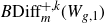 $B\mathrm{Diff}^{+,k}_m(W_{g,1})$
with rational coefficients, which is the main technical result of this section.
Recall that the decoupling theorems (3·10 and 4·8) relied on the hypothesis that the map
 \begin{equation*}\mathcal{M}^\Theta({W\setminus N},\rho_{{W\setminus N}}) \longrightarrow \mathcal{M}^\Theta(W,\rho_{W}) \end{equation*}
induces a homology isomorphism in a range. In even dimensions at least 6, this assumption was shown to hold in several cases in [
Reference Galatius and Williams8
, corollary 1·7] as recalled in Theorem 2·10, but only when the
 $\Theta$
-structure
 $\rho_W\;:\;{\mathrm{Fr}}(TW)\rightarrow \Theta$
is n-connected. One could hope that for any manifold W and any
 $\Theta$
-structure
 $\rho_W$
, the decoupling map would still induce a homology isomorphism, but this is not the case, as it is shown by the following example.
Example 5·1. Consider the manifold
 $W_g=\#_gS^n\times S^n$
with one embedded disc as a decoration. Let
 $W_{g,1}=\#_g(S^n\times S^n)\setminus {\mathrm{int}}(D^{2n})$
and recall there is an isomorphism
 \begin{equation*}\mathrm{Diff}^+(W_{g,1})\xrightarrow{\cong}\mathrm{Diff}^+_1(W_g)\end{equation*}
given by extending the diffeomorphism of
 $W_{g,1}$
by the identity on the marked disc (see Lemma 3·6). Therefore, the decorated moduli space
 $\mathcal{M}^{or}_1(W_g,\rho_W)\simeq B\mathrm{Diff}^+_1(W_g)$
is weakly equivalent to
 $\mathcal{M}^{or}(W_{g,1},\rho_W)\simeq B\mathrm{Diff}^+(W_{g,1})$
. In this case, the decoupling map

does not induce a homology isomorphism on integral coefficients in a stable range as was shown in [ Reference Galatius and Williams9 , sections 5·1 and 5·2]. This implies that the decoupling as stated in Corollary 3·12 is not true for general tangential structures.
To generalise the decoupling for all tangential structures we use the techniques and results developed in [
Reference Galatius and Williams8
, section 9], which we briefly recall. Let W be a 2n-dimensional manifold,
 $2n\geq 6$
, with possibly non-empty boundary, and
 $\lambda_W$
a
 $\Lambda$
-structure on W. If the map
 $\lambda_W\;:\;{\mathrm{Fr}}(TW)\to \Lambda$
is not n-connected we will use an “intermediate” tangential structure
 $\Theta$
which is better behaved. Precisely, let the following be the Moore–Postnikov n-stage of
 $\lambda_W$
,
 \begin{equation} \lambda_W\colon{\mathrm{Fr}}(TW) \xrightarrow{\;\;\rho_W\;\;} \Theta \xrightarrow{\;\;\; u\;\;\;} \Lambda. \end{equation}
That is:
 $\Theta$
is a
 $\mathrm{GL}_d$
-space, u is an n-co-connected (ie. the induced map on the ith homotopy groups is an isomorphism for
 $i>n$
and a monomorphism for
 $i=n$
) equivariant fibration and
 $\rho_W$
an n-connected equivariant cofibration. Such a factorisation always exists and it is unique up to homotopy equivalence.
Denote by
 $\rho_\partial$
and
 $\lambda_\partial$
the restriction of
 $\rho_W$
and
 $\lambda_W$
respectively to
 ${\mathrm{Fr}}(TW)|_{\partial W}$
. Any
 $\Theta$
-structure on W induces a
 $\Lambda$
-structure by postcomposition with u, giving us a map
 \begin{equation*} \mathrm{Bun}^\Theta(W,\rho_W)\longrightarrow \mathrm{Bun}^{\Lambda}(W,\lambda_W). \end{equation*}
We now define a topological monoid that is crucial to the comparison between the moduli spaces
 $\mathcal{M}^\Lambda(W,\lambda_W)$
and
 $\mathcal{M}^\Theta(W,\rho_W)$
.
Definition 5·2. If W is a closed manifold, denote by
 $\mathrm{hAut}(u)$
the group-like topological monoid consisting of
 $\mathrm{GL}_d$
-equivariant weak equivalences
 $h\;:\;\Theta\to \Theta$
over u, ie. such that
 $u\circ h=u$
.
If W has non-empty boundary, let
 $\rho_\partial$
be the restriction of
 $\rho_W$
to
 $\partial W$
. Denote by
 $\mathrm{hAut}(u,\rho_\partial)$
the group-like topological monoid consisting of equivariant weak equivalences
 $h\;:\;\Theta\to \Theta$
over u and under
 $\rho_\partial$
, ie. such that
 $u\circ h=u$
and
 $\rho_\partial=h\circ \rho_\partial$
.
The monoid
 $\mathrm{hAut}(u,\rho_\partial)$
acts on the space of
 $\Theta$
-structures on W by post-composition. The crucial result we will use [
Reference Galatius and Williams7
, lemma 9·2] states that the map induced by postcomposition with u
 \begin{equation} \mathrm{Bun}^\Theta_{\rho_\partial}(W)\mathbin{\!/\mkern-5mu/\!} \mathrm{hAut}(u,\rho_\partial)\xrightarrow{\;\;\simeq\;\;} \mathrm{Bun}^{\Lambda}_{\lambda_\partial}(W) \end{equation}
is a homotopy equivalence onto the path components which it hits. In particular, this implies analogous homotopy equivalences between the moduli spaces with
 $\Theta$
and
 $\Lambda$
structures. We denote by
 $\mathrm{hAut}(u,\rho_\partial)_{[W,\rho_W]}$
the components of
 $\mathrm{hAut}(u,\rho_\partial)$
that map
 $\mathrm{Bun}^\Theta(W,\rho_W)$
to itself.
With these tools we can prove the following result, which should be interpreted as a generalisation of Corollary 3·12 for an arbitrary tangential structure
 $\Lambda$
.
Proposition 5·3. Let W be a manifold of dimension
 $d=2n\geq6$
,
 $\lambda_W$
a
 $\Lambda$
-structure on W and
 $g=\overline{g}(W,\lambda_W)$
. Let
 $\Theta$
,
 $\rho_W$
, u, and
 $\mathrm{hAut}(u,\rho_\partial)_{[W,\rho_W]}$
be as above. Then for all
 $i\leq ({g-4})/{3}$
, the group
 $H_i(\mathcal{M}^{\Lambda,k}_{m}(W,\rho_W))$
is isomorphic to the ith homology group of
 \begin{equation} \Big(\mathcal{M}^\Theta(W,\rho_W)\times \Theta^m_0\mathbin{\!/\mkern-5mu/\!}\Sigma_m \times (\Theta\mathbin{\!/\mkern-5mu/\!} \mathrm{GL}_{2n}^\dagger)_0^k\mathbin{\!/\mkern-5mu/\!}{\Sigma_k}\Big)\;\mathbin{\!/\mkern-5mu/\!} \mathrm{hAut}(u,\rho_\partial)_{[W,\rho_W]}, \end{equation}
where
 $\mathrm{GL}_{2n}^\dagger$
equals to
 $\mathrm{GL}_{2n}^+$
if W is decorated-chiral, and is
 $\mathrm{GL}_{2n}$
otherwise. The Borel construction is taken with respect to the diagonal action of
 $\mathrm{hAut}(u,\rho_\partial)_{[W,\rho_W]}$
on the product.
Proof. Since the map (5·2) is a homotopy equivalence on path components, the map induced on the Borel constructions with the group
 $\mathrm{Diff}^k_m(W)$
is also a homotopy equivalence. This gives that
 \begin{equation*}\mathcal{M}^{\Lambda,k}_{m}(W,\rho_W)\simeq \mathcal{M}^{\Theta,k}_{m}(W,\rho_W)\mathbin{\!/\mkern-5mu/\!} \mathrm{hAut}(u,\rho_\partial).\end{equation*}
Since
 $\rho_W$
is by assumption a n-connected
 $\Theta$
-structure, we can apply Corollary 3·12. We finish the proof with the fact that the stable genus
 $\overline{g}(W,\rho_W)$
is equal to
 $\overline{g}(W,\lambda_W)$
as shown in [
Reference Galatius and Williams7
, lemma 9·4].
Remark 5·4. The proof above can be easily adapted to provide a generalisation for the result of decoupling submanifolds (Corollary 4·9). We omit this for simplicity.
We can specialise this result to the manifolds of the type
 $W_{g,1}=\#_g S^n\times S^n\setminus D^{2n}$
. Besides being crucial examples in higher dimensions, these manifolds are particularly amenable to the decoupling result because of the following:
Lemma 5·5 ([
Reference Galatius and Williams9
], lemma 4·15). If
 $(W,\partial W)$
is c-connected for some
 $c\leq n-1$
, then the monoid
 $\mathrm{hAut}(u,\rho_\partial)$
is a non-empty
 $(n-c-2)$
-type. In particular, it is contractible if
 $(W,\partial W)$
is
 $(n-1)$
-connected.
The above lemma, together with (5·2) and Proposition 5·3 gives the following:
Corollary 5·6. Consider
 $W_{g,1}=\#_g S^n\times S^n\setminus D^{2n}$
, for
 $n\geq 3$
, equipped with a
 $\Lambda$
-structure
 $\lambda_{W}$
. Let g denote the stable genus
 $\overline{g}(W,\lambda_W)$
. For all
 $i\leq ({g-4})/{3}$
, the group
 $H_i(\mathcal{M}^{\Lambda,k}_m(W_{g,1},\lambda_{W_{g,1}}))$
is isomorphic to
 \begin{equation*} H_i(\mathcal{M}^{\Lambda}(W_{g,1}, \lambda_{W})\times \Theta^m_0\mathbin{\!/\mkern-5mu/\!}\Sigma_m\times (\Theta\mathbin{\!/\mkern-5mu/\!} \mathrm{GL}_{2n}^+)^k_0\mathbin{\!/\mkern-5mu/\!}\Sigma_k),\end{equation*}
where
 $(\!-\!)_0$
denotes the path-component of
 $E(\rho_W)$
, for
 $\rho_W$
as in (5·1).
Note that in the above corollary, the decorations on
 $\mathcal{M}^{\Lambda,k}_m(W)$
get decoupled into components depending on
 $\Theta$
, the tangential structure that appeared in the Moore–Postnikov n-stage factorisation of
 $\lambda_W$
. This is quite different than what was obtained in Corollary 3·12 where the decoupled components corresponding to the marked points and discs depended on the original chosen tangential structure
 $\Lambda$
.
We finish this section by using the above results to get explicit computations on the stable cohomology of
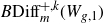 $B\mathrm{Diff}^{+,k}_m(W_{g,1})$
with rational coefficients, for
 $n\geq 3$
. In this case, a
 $\mathrm{GL}_d$
-equivariant map
 $\lambda_W\;:\;{\mathrm{Fr}}(TW_{g,1})\to \{\pm 1\}$
determines, up to a contractible choice, a map
 $\ell'_W\;:\;W_{g,1}\to B\mathrm{SO}(2n)$
fitting into the following homotopy pullback square

Then an equivariant Moore–Postnikov factorisation of
 $\lambda_W$
can be obtained from a Moore–Postnikov factorisation of
 $\ell'_W$
. Since
 $W_{g,1}$
is
 $(n-1)$
-connected and parallelisable, we know that the n-stage of this factorisation is given by maps

where
 $B\mathrm{O}(2n)\langle n\rangle$
is the n-connected cover of
 $B\mathrm{O}(2n)$
. Taking the pullback of
 $\{\pm 1\}\to B\mathrm{SO}(2n)$
along these maps, we get

where
 $\mathrm{O}[0,n-1]$
is the
 $(n-1)$
-truncation of O. Note that a path-component of
 $\mathrm{O}[0,n-1]$
is homotopy equivalent to
 $\mathrm{SO}[0,n-1]$
, the
 $(n-1)$
-truncation of SO.
Corollary 5·7. Let
 $W_{g,1}=\#_g S^n\times S^n\setminus D^{2n}$
, for
 $n\geq 3$
. Then for all
 $i\leq ({g-4})/{3}$
, the group
 $H_i(B\mathrm{Diff}^{+,k}_m(W_{g,1}))$
is isomorphic to
 \begin{equation*} H_i(B\mathrm{Diff}^+(W_{g,1})\times \mathrm{SO}[0,n-1]^m\mathbin{\!/\mkern-5mu/\!}\Sigma_m\times B\mathrm{O}(2n)\langle n\rangle^k\mathbin{\!/\mkern-5mu/\!}\Sigma_k).\end{equation*}
The proof is a direct application of Proposition 5·6 using the factorisation described above, and the fact that for an orientation
 $\rho_{W_{g,1}}\;:\;{\mathrm{Fr}}(TW_{g,1})\to\{\pm1\}$
, the stable genus
 $\overline{g}(W_{g,1},\rho_{W_{g,1}})$
is equal to g (see [
Reference Galatius and Williams9
, section 3·2]).
We now use the result above to explicitly compute the cohomology of
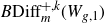 $B\mathrm{Diff}^{+,k}_m(W_{g,1})$
with rational coefficients, in the stable range.
Theorem 5·8. The stable cohomology of
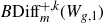 $B\mathrm{Diff}^{+,k}_m(W_{g,1})$
with rational coefficients is isomorphic to
 \begin{align*} \mathbb{Q}[\kappa_c|c\in\mathcal{B},|c|>2n] \otimes\left(\bigotimes\limits_m\bigwedge [y_1,\dots, y_{\lfloor\frac{n-1}{4} \rfloor}]\right)^{\Sigma_m} \otimes \left(\bigotimes\limits_k\mathbb{Q}[ p_{\lceil\frac{n+1}{4}\rceil},\dots,p_{n-1},e]\right)^{\Sigma_k}, \end{align*}
where
 $p_i$
and e are, respectively, the Pontryagin and Euler classes in
 $H^*(B\mathrm{SO}(2n),\mathbb{Q})$
,
 $\mathcal{B}$
denotes the set of monomials in the classes
 $p_{\lceil\frac{n+1}{4} \rceil},\dots,p_{n-1}$
, e, with
 $|\kappa_c|=|c|-2n$
, and
 $y_i$
is the ith generator of
 $H^*(\mathrm{SO}(2n),\mathbb{Q})$
, which has degree
 $4i-1$
. The fixed points are taken with respect to the action of the symmetric group that permutes the generators in the tensor product.
Proof. By Corollary 5·7 and Kunneth Theorem, the elements of
 $H^*(B\mathrm{Diff}^{+,k}_m(W_{g,1});\mathbb{Q})$
of degree
 $i\leq ({g-4})/{3}$
, are given by the elements of such degrees in the tensor product of the cohomology rings of
 $B\mathrm{Diff}^+(W_{g,1})$
,
 $\mathrm{SO}[0,n-1]^m\mathbin{\!/\mkern-5mu/\!}\Sigma_m$
and
 $B\mathrm{O}(2n)\langle n\rangle^k\mathbin{\!/\mkern-5mu/\!}\Sigma_k$
.
The first term in the tensor product of Theorem 5·8, is simply the stable cohomology of
 $B\mathrm{Diff}^{+}(W_{g,1})$
with rational coefficients (see [
Reference Galatius and Williams8
, corollary 1·8]).
Since we are taking coefficients in
 $\mathbb{Q}$
, the cohomology of a Borel construction with the symmetric group is given by
 \begin{equation*}H^*(X^k\mathbin{\!/\mkern-5mu/\!}\Sigma_k)\cong H^*(X^k)^{\Sigma_k}\end{equation*}
the fixed points by the action of
 $\Sigma_k$
which permutes the factors of
 $X^k$
. This follows directly from
 $E\Sigma_k\times X^k\to X^k\mathbin{\!/\mkern-5mu/\!}\Sigma_k$
being a finite cover (for details see [
Reference Hatcher13
, proposition 3G·1]).
Now we simply analyse the Borel constructions in Corollary 5·7. Since
 $H^*(B\mathrm{O}(2n);\mathbb{Q})$
is a polynomial algebra, taking the n cover simply eliminates generators of degree less or equal to n in cohomology. Hence
 $H^*(B\mathrm{O}(2n)\langle n\rangle^k;\mathbb{Q})^{\Sigma_k}$
is isomorphic to
 \begin{equation*}\left(\bigotimes\limits_k\mathbb{Q}[ p_{\lceil\frac{n+1}{4}\rceil},\dots,p_{n-1},e]\right)^{\Sigma_k}\end{equation*}
the fixed points by the action of
 $\Sigma_k$
which permutes the respective generators in the k-fold tensor product.
Finally, we discuss the cohomology of the group-like topological monoid
 $\mathrm{SO}[0,n-1]$
. The map
 $B\mathrm{SO}(2n)\langle n\rangle\to B\mathrm{SO}(2n)$
is a principal fibration for the group like topological monoid
 $\mathrm{SO}[0,n-1]$
. This is enough to show that
 \begin{equation*}H*(B\mathrm{SO}[0,n-1],\mathbb{Q})=\mathbb{Q}[p_1,p_2,\dots,p_{\lfloor\frac{n}{4}\rfloor}]\end{equation*}
(see [
Reference Galatius and Williams9
, section 5·2·1] for details). Then the Serre spectral sequence for the universal bundle of
 $\mathrm{SO}[0,n-1]$
gives that
 \begin{equation*}H^*(\mathrm{SO}[0,n-1];\mathbb{Q})\cong \bigwedge [y_1,\dots, y_{\lfloor\frac{n-1}{4} \rfloor}]\end{equation*}
with
 $|y_i|=4i-1$
. As required
Acknowledgements
I would like to thank my supervisor Ulrike Tillmann for her support and for the many useful conversations. In addition, I would like to thank Jan Steinebrunner and Tomáš Zeman for all the helpful discussions and comments. This work was carried out with the support of CNPq (201780/2017-8) and produced while the author was in residence at the Mathematical Sciences Research Institute in Berkeley, California, during the Spring semester of 2020.