Introduction
Non-governmental organisations (NGOs)Footnote 1 have become an integral part of the global governance architecture, closely interacting with state governments, businesses, and intergovernmental organisations (IGOs).Footnote 2 In particular the collaboration between IGOs and NGOs at the boundary between the governmental and the societal sphere is often regarded as exemplary for the emergence of ‘global governance’, understood as an inclusive and cooperative way of steering political affairs and the global economy.Footnote 3 Some authors have also explored the normative significance of enhanced NGO participation in IGOs, speculating that it might become a remedy to the ‘democratic deficit’ in world politics. The existing literature on NGOs and world politics is rich and provides a very detailed account of NGOs' strategies, their resources, and their power. However, the cooperation between NGOs and IGOs is not very well explained. Despite some recent advances in theory-building we do not have a general theoretical model for explaining the emergence and transformation of IGO-NGO relations.Footnote 4 Why and under what conditions do IGOs and NGOs actually cooperate?
The purpose of this article is to develop a more systematic approach to the analysis of IGO-NGO relations. I suggest a theoretical framework that takes motivations on both sides into account and that lends itself to the study of both success and failure cases. Drawing on the existing literature and its insights, I present a comprehensive framework for studying IGO-NGO relations that identifies and aligns factors that may be causally significant. The idea is to structure these factors in such a way that casual hypotheses on IGO-NGO relations may be derived from it and comparative research designs facilitated. It is, in other words, an exercise in explication, clarification, and systematisation. My ultimate aim here is to promote systematic theory-building in this subfield of IR and to give some more theoretical rigour to the empirical study of NGO-IGO relations.
The theoretical framework suggested here is grounded in the assumption that NGOs and IGOs are complex organisational actors with internal struggles over political priorities and strategies, but nevertheless able to act purposefully and coherently towards the outside. They have clearly defined goals and try to achieve them. In many instances this requires them to engage in inter-organisational cooperation. By inter-organisational cooperation I mean a reciprocal interaction in which organisations exchange resources of the material or immaterial kind for mutual benefit. This cooperation may take place in formal or informal ways. Formalised interaction may be regulated by contracts, for instance, when an IGO pays an NGO for a clearly specified service. It may also be formalised when rules of procedure allow NGOs to attend official meetings of an IGO body, in which participants share pieces of information and political points of view. Cooperation may also take place informally. This would be the case, for instance, when IGO officials or state representatives meet with members of an NGO off the record to share information or discuss a political project that they deem important. In this article, however, the emphasis is on the emergence of institutionalised and regulated forms of inter-organisational cooperation, most notably the official participation of NGOs in IGO meetings. I will mention informal contacts between individuals belonging to the two types of organisations on several occasions but it is not the phenomenon that I seek to explain here.
I argue in this article that, in principle, cooperation between the two types of actors may be the result of two different dynamics: NGOs may push into intergovernmental institutions of global governance; or IGOs may pull them in. Hence, the first analytical distinction introduced here is one between ‘push factors’ and ‘pull factors’ that determine patterns of collaboration between two types of actors. The second element of the proposed theoretical framework are distinct phases of the policy process. As I will show in some more detail below, analysts have described a number of functions that IGOs and NGOs perform. These may be usefully aligned along different phases in the process of international policymaking. As a heuristic tool I adopt the concept of the policy cycle from comparative politics that so far has been rarely used in the study of International Relations. The version of the international policy cycle that I propose here is divided into six phases: agenda-setting, research and analysis, policy formulation, policy decision, implementation, and evaluation. The analytical advantage of this model is that it can account for the fact that incentives for cooperation (and hence the power of push and pull factors) may change over time, and on both sides. The salience of incentives crucially depends upon the specific tasks that an IGO or an NGO are pursuing with regard to the different phases of the international policy cycle. Some IGOs are implementing concrete projects while others are predominantly rule-making. In a similar vein, service NGOs are predominantly implementation-oriented while advocacy NGOs mainly seek to influence the formulation of international norms and rules. Thus, the policy cycle can help us identify cooperation dynamics within and across international policy fields.
The proposed theoretical framework, like any other, has its limits, posed both by the underlying assumptions about the actors involved and by the selection of empirical factors that it takes into account. In order to identify the limits of its explanatory power I highlight two factors that cannot be fully integrated into a framework based on the idea of inter-organisational resource exchange as they eschew the logic of specific incentives. These are: (a) general legitimacy concerns of IGOs, understood as a response to normative expectations of ‘good governance’; and (b) path dependent developments and the effects of a specific organisational culture in IGOs that may be more or less conducive to collaboration with NGOs.
The article is structured as follows. In the second section I take issue with the existing literature and outline different theoretical perspectives on the role of NGOs in world politics. Building on this brief discussion I then more specifically focus on existing explanations of inter-organisational cooperation. In the third section, the model of an international policy cycle is developed and tailored to the question at stake here. Section four explores the limits of the proposed theoretical framework, as well as alternative explanations, and section five briefly concludes.
Towards a comprehensive framework for analysis
The literature discussing the role of NGOs in international relations is huge, and it comes under several headings. From the perspective of theory-building this is a mixed blessing. Although we have a tremendous amount of empirical knowledge it is scattered over various academic disciplines, informed by very different research interests. This is also reflected in the theoretical apparatus applied to the empirical material, ranging from anthropology to classic International Relations theory. Most authors interested in the political role of NGOs have focused their analysis on strategies and tactics, with the aim of discovering the determinants of NGO success in influencing world politics.Footnote 5 The title of an early work of this genre captures the approach well: International Non-Governmental Organisations: their Purposes, Methods and Accomplishments.Footnote 6 This very perspective was also adopted by the mainstream IR literature, once NGOs were widely discovered as an ‘actor’ in international relations,Footnote 7 forming part of a wider class of transnationally operating non-state actors that can be distinguished from state actors whose behaviour IR scholars had traditionally studied.Footnote 8 Authors working in this tradition have primarily sought to show that non-state actors (and NGOs prominently among them) are influential in world politics. Thus, this strand of literature had a clear tendency to focus on NGOs themselves, their power, their resources, their strategies, and the conditions under which they succeed. As NGOs usually do not command sufficient resources to threaten states, or to set incentives for them, their influence on international relations is supposed to be of the ‘soft’ sort. They raise awareness,Footnote 9 they (re)frame issues,Footnote 10 they act as norm-entrepreneurs,Footnote 11 and they engage in public shaming campaigns to persuade states to change their policies.Footnote 12 Much of this literature is closely tied to a social-constructivist research interest in norms and values in IR. Accordingly, it conceptualises NGOs, individual activists, and transnational social movements as important agents of ideational change in international relations.Footnote 13 A good deal of the literature thus frames the question of NGO-influence in the context of IR theory debates, and some IR scholars have explicitly called for such a framing.Footnote 14 While it gave NGO scholars some standing in the IR community it also came at a price. One of the artefacts of this framing is that NGOs and states are often depicted as rivals, implying that a rise in NGO power would necessarily mean a loss in state power.Footnote 15 As we will see below, such notions of a zero-sum game are questionable. Another unintended consequence of the IR theory framing was a somewhat single-eyed focus on NGOs, their aims, strategies, and resources.
Parallel to the unfolding of the mainstream IR debate on non-state actors, an alternative reading of NGOs emerged in the 1990s, viewing them as part of an emerging global civil society.Footnote 16 Global civil society is a somewhat fuzzy concept.Footnote 17 It is usually understood as being a large and dispersed social structure, rather than a distinct and purposeful actor; a ‘sphere of ideas, values, institutions, organisations, networks, and individuals located between the family, the state, and the market and operating beyond the confines of national societies, polities, and economies’.Footnote 18 It is commonly assumed, however, that social movements and NGOs are the politically most relevant agents within global civil society.Footnote 19 What differs from the ‘NGO as actors’ perspective here is the wider conception of politics. NGOs are not conceptualised as pressure groups that lobby governments and IGOs, but as attempting ‘to shape public affairs by working within and across societies themselves’.Footnote 20 More radically than the ‘NGO as actors’ approach, the civil society literature adopted a bottom-up perspective on international relations.Footnote 21 Much of the resistance against established forms of global politics and international organisations emerged from the substate level.Footnote 22 As exponents of an emerging global civil society, NGOs became viewed as agents of political resistance,Footnote 23 contestation,Footnote 24 and systemic transformation.Footnote 25 Non-state actors are ‘overcoming’ the dominance of states and intergovernmental bodies in world politics. Thus, the civil society view came to focus much less on causal pathways of influence, or scope conditions of political success, but on the emancipatory role of NGOs and social movements as an expression of direct citizen action.Footnote 26 This emancipatory aspect clearly distinguishes the global civil society perspective from the ‘NGOs as actors’-framing outlined above, although the enthusiasm about the emancipatory potential of transnational civil society has been curbed in recent years.Footnote 27 To summarise, the pioneer generation of NGO studies in IR took a view on NGOs themselves, on their aims, their means, and their repertoire of action. Much of this literature also clung to the idea of NGOs being a ‘third force’, rivalling states and other actors in IR. In the next section I turn to a perspective on NGOs not as rivals of governments and IGOs, but as their partners.
NGOs as ‘partners in global governance’
In the literature discussed so far NGOs figured as a counterweight to other actors in IR, mostly governments. While this perspective implied studying political alliances among NGOs and others, including ‘progressive’ governments and IGOs, it did not take issue with the emergence of a relatively stable ‘global governance complex’ that included public and private actors in continuous cooperation. Global governance is an ill-defined term that refers to some form of cooperative multilateral steering of global politics and the global economy in the post-Cold War era.Footnote 28 Global governance is not just a description of what is, but also, and for some authors in the first place, a blueprint for what should be.Footnote 29 The governance approach emanates from the assumption that in the age of globalisation and global interdependence, governmental action is insufficient to resolve pressing political problems. As a consequence, global public policy to tackle such problems must by necessity include businesses and NGOs.Footnote 30 The concomitant view on international relations is much less centred on states than traditional IR theories but suggests that ‘governance is embedded in and interwoven with state-civil society interactions’.Footnote 31 New types of public-private partnerships are therefore crossing the traditional boundaries between the sphere of the state and the private sector.Footnote 32 In summary, the global governance perspective is remarkably optimistic about the capacities of NGOs to make up for the deficits of intergovernmental politics. An interesting feature of this literature is that it highlights the demand for NGO involvement in the governmental arena, which classic NGO studies have often sidelined. States and international organisations are depicted as deeply deficient and unable to guarantee effective problem-solving.
While the literature on global governance can give us an indication as to why NGOs and IGOs might cooperate in principle it does not say much about the emergence of such cooperative ventures. A first cut at the question can be found in the literature on NGO strategies, in particular where the political motivations and strategies of NGOs are concerned. NGO involvement in IGOs is often explained by the opportunity structures that are provided for NGOs.Footnote 33 As decisions are taken in settings beyond the state in the age of internationalised policymaking, NGOs as well have gone international. In addition, NGOs at times engage with the international forum in order to bypass a nation state that might be repressive, or unresponsive to their demands.Footnote 34 NGO activists then may find new allies beyond the target state in advancing their goals and mobilise coalitions in order to put pressure on resistant national governments – a dynamic exemplified by the ‘spiral model’ developed in the field of human rights.Footnote 35
These approaches tend to focus on one side of the relationship, the NGO side or activist side, in bringing about issue-specific change. However, IGO-NGO cooperation is the result of a more complex dynamic. After all, many IGOs actively provide opportunity structures to NGOs and we can assume that they do this for some reason.Footnote 36 Where do opportunity structures come from? They do not just emerge – they are consciously opened up. But not all international organisations accommodate NGOs in their policymaking process, only some of them do. There is some literature which tackles the question of why IGOs even in the face of external pressure are reluctant to collaborate with civil society;Footnote 37 why certain IGOs are more or less susceptible to pressure by NGOs;Footnote 38 or why interaction is particularly dense in some policy fields such as development.Footnote 39 Unfortunately, this insight has not resulted in the formulation of a more general theoretical model of IGO-NGO cooperation.
Explaining NGO-IGO cooperation
Theoretical approaches to explaining the interaction between IGOs and NGOs are short in supply. Mapping the field, Jonas Tallberg recently identified three ways of theorising access of non-state actors to IGOs.Footnote 40 The first approach he puts in the tradition of rational choice institutionalism and its application in studying international cooperation. This approach follows, according to Tallberg, a functionalist logic, in that international institutions are designed to help their creators (states) to overcome collective action problems. By analogy, NGOs should gain access to IGOs if they can help the respective IGO reach its goals in an efficient manner. Second, and as sketched above, there is a broad literature that calls for NGO involvement in IGOs as an advantage in terms of democratic legitimacy. These authors contend that NGO participation is an appropriate remedy to the democratic deficit of global governance. Tallberg associates this largely normative reasoning with social constructivism as an empirical-analytical approach to IR. He argues that a growing expectation that IGOs should democratise puts these organisations under pressure to open their doors to NGOs. The third approach outlined by Tallberg is power-based and derived from realist IR theories that explain the foundation of IGOs as a hegemonic project. By analogy, also the access of NGOs to IGOs should follow the wishes of influential state parties. The causal logic implied here is that access is granted to NGOs when powerful states or groups of states hope to reap particular benefits from the presence of NGOs as allies, and therefore promote their inclusion.
In this article I take the first of the three distinct approaches that Tallberg identifies as a starting point for formulating a theoretical model. I contend that this ‘rationalist first cut’Footnote 41 at the question of why NGO-access is granted enjoys the greatest prima facie plausibility. The major problem with the good governance approach is that cooperation among IGOs and NGOs is historically much older than any ‘governance norm’ suggesting that IGOs should consult with non-state actors. It should suffice to recall that the International Labour Organisation includes non-state actors since 1919, and that the consultative status of NGOs with ECOSOC as liaison body of the UN dates back to 1946.Footnote 42 While emergent norms of good governance may well play a role in the rapid advance of participatory practices in recent years it is unlikely that they can sufficiently explain the phenomenon. The power-based approach, on the other hand, enjoys little explicit support in the specialised NGO literature. Tallberg refers to cases in which powerful actors such as the US and the EU promoted NGO access to certain IGOs or regimes. However, the installation of new consultative regimes normally requires ample majorities or unanimity among the member states of an IGO. The willingness of single states to invest political capital into NGO-access against resistance from other member states is certainly limited. After all, a hegemon or other powerful states are unlikely to need NGO allies for wielding influence in an IGO. Again, this does not exclude that NGO access may be crucially affected in some cases by constellations of member state preferences, but conceptualising NGO access as a function of state power seems to be a questionable starting point for theorising inter-organisational cooperation.
What Tallberg does not discuss systematically in his essay on explaining private actor access to IGOs is the supply side. It might sound trivial but the presence of an NGO-population interested in an IGO and its policies is a precondition for any cooperation to emerge. I therefore suggest taking a more integrated perspective on IGO-NGO cooperation even if I agree that IGOs have disproportionately more leverage in setting the terms and conditions of the collaboration. Such an integrated framing of cooperation is provided by exchange theories to which I will turn in the next section.
Push factors, pull factors, and the policy cycle
In this section I develop a theoretical framework that approaches the issue of cooperation between IGOs and NGOs by linking the resource exchange perspective to the concept of an international policy-cycle. Before turning to the theoretical building blocks that I seek to combine in the proposed framework some clarifications on the nature of the actors under scrutiny are in order. Both NGOs and IGOs are quite complex social organisations. We can distinguish between the members that constitute the organisation and a bureaucratic structure that works on behalf of these members. Organisational sociology and in particular principal-agent theory point out that there is potential conflict between the constituent members of an organisation (the ‘principal’) and the hired professionals performing the delegated tasks (the ‘agents’).Footnote 43 Especially in the case of IGOs, the Secretariat as agent may be more eager on cooperating with NGOs than the state members of the organisation. However, the Secretariat normally is not in the position to determine the formal rules governing NGO access to an IGO. These rules need to be adopted by representatives of the state parties. In some IGOs a majority decision is sufficient, in others such decisions need to be taken unanimously. The IGO bureaucracy may therefore try and broker coalitions of states in favour of such proposals or persuade reluctant state members to agree to cooperative ventures. If this fails and formal access is not granted the Secretariat may still stage informal consultations.
This shows that it is also an advantage to disaggregate the notion of inter-organisational cooperation and distinguish informal and formal types of interaction. As far as informal practices are concerned we will need to take the role of the Secretariat into account. Regarding formal regulations that confer privileges such as speaking and submission rights to NGOs, it seems warranted to assume that an IGO is a collective actor controlled by member governments. Informal consultations can take many forms and happen at any point along the policy cycle, on the initiative of either NGOs, IGO staff, or governments. As it is unlikely to come up with a model that captures all possible instances of informal cooperation I limit my theoretical model to the explanation of formalised and institutionalised forms.
Exchange theories of cooperation have their theoretical foundation in organisational sociology, in particular in research on inter-organisational relations. ‘Organizational exchange is any voluntary activity between two organizations which has consequences, actual or anticipated, for the realization of their respective goals or objective.’Footnote 44 The idea is that organisations trade some resources to mutual benefit. The resources exchanged may be of the material kind, such as money and staff, or of the immaterial kind, most notably information. The dynamics of exchange are captured by the resource dependence model. ‘The resource dependence model proceeds from the indisputable proposition that organizations are not able to internally generate either all the resources or functions required to maintain themselves, and therefore organizations must enter into transactions and relations with elements in the environment that can supply the required resources and services.’Footnote 45 This view of organisations as generally deficient and far from autonomous can be applied to NGOs, IGOs, and even to the state. As we have seen above, the global governance literature has highlighted the limits of public actors and the need for inter-organisational cooperation. An exchange perspective hence seems to be the most useful starting point for studying interaction among NGOs and IGOs.
A seminal study that adopts such an exchange perspective on IGO-NGO relations is Raustiala's on international environmental governance.Footnote 46 Raustiala argues that the increasing collaboration of NGO and IGOs in the sphere of environmental politics can only be explained with a focus on the mutual benefits resulting from cooperation. Similar exchange models have been used by others to study the conditions under which private actors are admitted to public political settings.Footnote 47 According to Bouwen's model, non-state actors seek for access to the IGO in order to influence political choices. The IGO, in turn, obtains from them different kinds of information and trades access for it. Another lesson to be learned especially from Bouwen's work on the EU is that, even within one single IGO, access is provided selectively. An NGO usually does not have access to every body, working group or negotiation process within an IGO but only to some. Therefore, a theory that proposes to explain the current patterns of participation should be sensitive to different settings to which NGOs get access. While it is possible that access granted in one area may subsequently creep into others, this is not necessarily the case. A comprehensive model therefore should also take into account that motivations might change as tasks of organisations evolve. The challenge, in other words, is to provide a theoretical framework for studying NGO-IGO relations that
(a) takes motivations on both sides into account;
(b) is sensitive to exchange relationships;
(c) is fine-grained enough to capture policy phase-dependent interests.
If we add a temporal dimension to the exchange model outlined in the preceding paragraphs, cooperation between the two types of actors may be the result of two different dynamics: NGOs might have pushed into institutions of global governance; or IGOs might have pulled NGOs in. Hence, it should be useful to analytically distinguish between the ‘push’ factors and the ‘pull’ factors that may determine patterns of cooperation emerging between the two types of actors. Synergies (in the sense of mutual interest in cooperation) may be found empirically, but not necessarily so. In order to attain an even more fine-grained empirical picture, a second distinction should be made between different phases in the process of international policymaking. A useful heuristic framework that allows for such a distinction of phases is the policy-cycle.Footnote 48
The policy cycle
The policy cycle is a concept developed in the field of policy research and over time has become one of the standard tools of public policy analysis.Footnote 49 The basic idea is to analytically distinguish certain phases in an idealised standard procedure of policymaking.Footnote 50 A model of the policy cycle involves a certain degree of abstraction from the empirically much more complex and non-linear nature of the policy process. Although the overall structure of the various ‘policy cycles’ in use is always similar, models vary with regard to the number and description of the discrete phases. For the purpose of this article I adopt a model of the international policy-cycle with six phases:
(1) agenda-setting;
(2) research and analysis;
(3) policy formulation;
(4) policy decision;
(5) policy implementation;
(6) policy evaluation.
The policy-cycle, it should be stressed, is not a causal model but a heuristic tool that can help us distinguish several types of activities that typically occur in policymaking. Applied to the context of international politics this differentiation of phases can account for the fact that the patterns of IGO-NGO cooperation might change over time, depending on the tasks that actors are pursuing and the problems they are trying to resolve. This allows us to identify push and pull factors that might be salient only in certain phases of policymaking or only be relevant for IGOs or NGOs that put heavy emphasis on one phase or another. Motivations for cooperation might change on both sides and over time, and the policy cycle is a model that allows for such a detailed account. The following subsections will illustrate the allocation of pull factors and push factors to phases of the policy cycle.
Pull factors
Pull factors are defined here as motivations of IGOs for cooperation with NGOs. With a view to the empirical literature we can identify four possible situations in which an IGO might be interested, for functional reasons, in cooperation with non-state actors. First, IGOs might seek NGO assistance in order to pinpoint new or upcoming issues which should be dealt with. This is, presumably, often the case in ‘forum organisations’, whose task it is to identify and discuss emerging problems in the international system. Globalisation and the corresponding increase in the scope and complexity of international negotiations have set the conditions in which outside assistance for agenda-setting is useful.Footnote 51
A prominent real-world example for cooperation in agenda-setting is the consultative relationship between NGOs and the Economic and Social Council of the United Nations (ECOSOC). Once accredited in one of three categories, NGOs can participate as observers at public meetings of the Council, its committees and sessional bodies, or at least be present at the meetings which are concerned with matters within their field of competence. In addition, they have large speaking and submission rights. The number of NGOs in consultative status at ECOSOC has grown significantly over the years. Whereas in 1948, there was a total of 40 accredited NGOs, this number had grown to 744 in 1992, and to 2719 in 2005.Footnote 52 NGOs that have general consultative status (the most important category) in the ECOSOC have the right to suggest topics for the agenda. In the UN there have been conflicts among member states over consultative status of some types of NGOs (mainly human rights NGOs).Footnote 53 However, it seems warranted to assume that there is no principal conflict of interest between the Secretariat and member states in this phase of the policy cycle.
Second, an IGO might seek NGO cooperation to acquire additional expertise for the formulation of its policies.Footnote 54 This seems particularly useful when there is uncertainty about the problem that international governance is designed to resolve. The expert function of non-state actors in international environmental governance has been highlighted, inter alia, in the literature on epistemic communities of concerned scientists.Footnote 55 The UN conferences organised since the early 1970s are an example of the incentives to solicit the advice of NGO experts.Footnote 56 Environmental politics is a case in which the expert advice by specialist NGOs was much needed in order to understand the issues at stake and to formulate political responses to them.Footnote 57 At the 1992 UN Conference on Environment and Development (UNCED), five NGOs were even allowed to sit among the working parties of the PrepCom sessions.Footnote 58 The practice of bringing non-governmental expertise in is not confined to the UN. The IMF, for example, also keeps ties with non-governmental research institutions and think tanks in order to tap into their macroeconomic expertise.Footnote 59 Again, with regard to consultations designed at gathering policy-relevant knowledge there does not seem to be a general conflict over NGO access between Secretariats and member states, even if we need to take the possibility into account that activist IGO Secretariats may have an extra incentive to liaise with like-minded NGOs.
Third, and most importantly, an IGO might seek NGO cooperation in the implementation phase of the policy-cycle. Many IGOs do not have sufficient staff to implement directly all the projects they are funding. In particular since the 1990s, the UN has intensified the transfer of funds and services through NGOs.Footnote 60 An area where this is of particular importance is the field of development.Footnote 61 In the case of the World Bank, around 70 per cent of all its development projects are implemented in cooperation with non-governmental organisations.Footnote 62 This has led, inter alia, to remarkable processes of concentration among NGOs, if not oligopoly of Northern NGOs active in the field of development.Footnote 63 If implementation by non-state actors is functionally necessary due to limited capacities there should be no fundamental conflict between state parties and the IGO Secretariat so that one may treat an IGO in this context as a unitary actor.
Fourth, an IGO might seek NGO cooperation to monitor compliance with international norms or agreements. Again, some IGOs do not have enough personnel and resources to monitor compliance with their own policies effectively. They hence make use of information provided by non-state actors about the situation ‘on the ground’. Human rights protection in the UN is an excellent example of such cooperation: the system of surveillance would simply not work without NGO input.Footnote 64 Since the 1990s, we have seen evidence of an increasing need for NGO involvement at the operational level in policy fields other than classic human rights protection, that is, in peacekeeping. Since human rights are nowadays not only seen as a distinct subject, but also as an integral part of many other policies, this new incentive to work with NGOs increasingly concerns more and more UN operational agencies.Footnote 65 Even organisations active in the field of international security, such as OSCE, have opened up to NGOs as a response to the need for implementing their missions on the ground.Footnote 66
The pull-factors outlined so far and allocated to policy phases were derived from the functional needs of IGOs, which were treated as objectively given. The implication is that an organisation as a whole, that is, staff as well as member governments, can agree on such functional needs. This does not preclude that individuals from IGO and NGO side may have an additional interest in cooperation. For instance, in the policy formulation phase informal contacts may flourish between ‘like-minded’ NGOs, IGO officials, and representatives of interested states. Cooperation is hence not completely absent from this phase. However, it is likely to remain informal and inter-personal, rather than formal and (officially) inter-organisational. In a similar vein, even if there is a clear-cut functional need for cooperation contrasting interests of individuals may lead to conflicts over NGO access. If some member states of an IGO face compliance problems they may object to formal cooperation with NGOs in the monitoring dimension while the IGO Secretariat and many other governments may be strongly in favour of it. Such conflicts may lead to a stalemate and prevent NGO access in the end. However, what I develop here is a model that abstracts from a much more complex (and messy) reality and that is probabilistic in nature. I hence identify phases in the policy cycle in which it is more likely, ceteris paribus, that cooperative arrangements between IGOs and NGOs emerge. Empirically, we may still find examples to the contrary.
Push factors
By investigating push factors we reverse the perspective and adopt the viewpoint of an NGO. What reasons might they have to seek cooperation with an IGO? In much of the literature it is usually taken for granted that NGOs have an interest in IGOs and their policies. Yet, a distinction is useful as the answer to the question crucially depends on the type of NGO under scrutiny. NGOs, as is well described in the literature, may perform two fundamentally different functions when engaging with world politics.Footnote 67 They either function as service providers, or they engage in advocacy. In their first, ‘operational’ role, they deliver specified services to IGOs, very often on a contractual basis and with financial remuneration.Footnote 68 This is the counterpart of the IGO-rationale outlined above for the field of development assistance. Many international NGOs are in fact in continual search for funding, and IGOs, in particular those active in the field of development and humanitarian aid, can be considerable sources of financing.Footnote 69 This rationale for seeking cooperation is fundamentally different from advocacy and has prompted scholars to adopt perspectives from political economy to the study of NGOs as self-interested actors fighting for their economic survival.Footnote 70 Therefore, one important explanation of why NGOs push towards collaboration with IGOs is organisational self-interest: the non-state actor needs funding to survive. Along the phases of the policy cycle, there are two situations in which financial self-interest may be paramount: first, as just outlined, when NGOs are paid for implementing the projects financed by an IGO; second, when NGOs are remunerated for providing studies or data to IGOs, that is, commissioned expertise.
With regard to advocacy, NGOs might seek to bring a new issue on the international political agenda as this can generate more publicity for it and elicit a political response. The campaign against landmines, for instance, was initiated by NGOs pushing for international recognition of these weapons as a problematical category in need of multilateral regulation.Footnote 71 Second, NGOs might also seek to influence the research process that informs the definition of problems and political options. Much of NGO activity in the field of climate change, for example, falls into this category: environmental NGOs as well as business NGOs try to feed their assessment of the imminence and risks of anthropogenic climate change into the fact-finding process of the international regime.Footnote 72
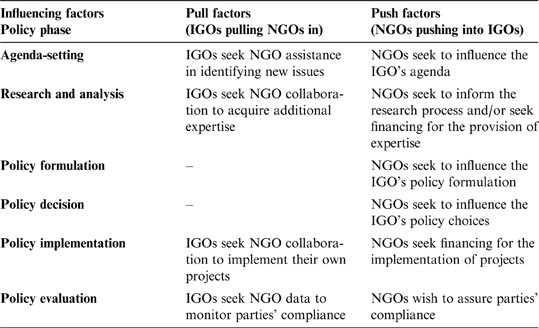
Third, NGOs seek to influence an IGO's policy formulation and decision in an issue area. Thus, beyond informing research or discussion in an IGO, they try to achieve their goals and promote their values by exerting political influence at intergovernmental level. The means employed by NGOs to reach this goal are manifold. There is, first of all, the lobbying of national delegations.Footnote 73 NGOs also seek to set up informal coalitions with states, a strategy that has been successful in the case of the International Criminal Court.Footnote 74 Generally speaking, however, NGOs face an uphill struggle during the formulation and decision phases as they do not have voting rights but need to rely on state delegations to take their interests on board. Fourth, NGOs might also seek to monitor the compliance of parties with the rules or decisions of the IGO that they support. The following table now summarises all the explanatory factors examined so far:
Table 1 displays the model of the policy-cycle suggested here as a framework for analysis. It suggests that there is potential for IGO-NGO cooperation in almost all phases of policymaking, in particular, in the agenda-setting and research phase, and during the implementation of projects. The factors that are identified in the framework can help us to understand why this potential is realised in some cases and not in others. Some well-staffed and sufficiently funded IGOs, for example, do not need any data or information from NGOs because they can rely on their own personell or national experts, or a combination of both. Likewise, many rule-making IGOs quite simply do not have any projects to implement and hence no funding to give to non-state actors. Conversely, NGOs might not be interested in the policies of some international organisations because they do not perceive these policies as affecting the values and interests of their constituencies. The amount of de facto cooperation between IGOs and civil society in the different phases of policymaking will hence depend on the specific circumstances of the case.
A theoretical framework for analysing IGO-NGO relations

It is striking, however, that pull factors are absent in the central stage of the policymaking process: the formulation of decisions. Many NGOs, quite clearly, would like to influence these policy decisions. Yet, the IGO or the state representatives negotiating in it are not likely to reap any benefits from NGO presence at this stage.Footnote 75 On the contrary, public exposure threatens to obstruct package deals being made among diplomats and politicians.Footnote 76 Even in the UN attempts at a further institutionalisation of the existing procedures of NGO-IGO relations or an extension of participation procedures to other main UN bodies have never succeeded. This is particularly obvious in the case of the UN Security Council. With the emergence of the notion of ‘human security’, which embraces humanitarian and social issues, governmental actors seemed to have become more inclined to allow NGOs in ‘through the cracks in the floor’. Two procedures have developed for informal contacts with NGOs. The first, baptised the ‘Arria Formula’, gives NGOs the opportunity to brief the Council on international peace and security issues.Footnote 77 The second, the so-called ‘NGO Working Group on the Security Council’, allows NGOs to consult with Council members and to be briefed.Footnote 78 However, these meetings remain informal, off-the-record and are held outside the official Council meeting rooms.
A tendency to exclude NGOs from formalised participation in the central stages of policymaking is even more obvious in international organisations that are active in the field of economic governance. The World Trade Organization (WTO), for example, has opened only at the margins to the scrutiny of NGOs.Footnote 79 Demands for intensified cooperation have been accommodated by organising annual public symposia, briefings, seminars, etc. However, the trade policy process itself remains closed to NGO scrutiny even at the committee level. In a similar vein, the International Monetary Fund (IMF) has come to consult with NGOs through occasional seminars, rather than formal accreditation and access to political meetings so that ‘IMF engagement of civil society continues to unfold in a largely improvised fashion’.Footnote 80 It is here that a potential conflict between the Secretariat and member states appears most probable. If we assume that Secretariats, generally speaking, favour an extension of the mission and competencies of an IGO they may have an interest in incorporating NGOs who support their case.
The evidence suggests that IGOs are eager to protect an intergovernmental core of decision-making against NGO influence, even if they have a long track record of cooperation with civil society (like the UN). By the metaphor intergovernmental core, I mean all those processes of negotiation in which a political decision is imminent and state representatives (and not bureaucrats or experts) are the driving force. As was argued above, incentives for liaising with non-governmental actors are presumably low at this stage. If non-state actors are present in this phase of the policy-cycle in an IGO, this can only be due to a massive push on the part of civil society. The idea of an intergovernmental core can thus illustrate by way of example how one might derive quite general hypotheses for future research from the theoretical framework suggested in this article. More concrete working hypotheses may be derived from each phase of the policy cycle and put to the test in comparative research. For example, we should expect that all IGOs which have a need for monitoring capacities will offer access to NGOs that promise to deliver the respective data. This motivation should be discernible in IGO documents and interviews with IGO officers. It should also be reflected in the specific form of NGO access granted, that is, access to an IGO body that collects and evaluates data.
Limits of the theoretical framework and alternative explanations
The purpose of the theoretical framework developed in this article is to introduce and define key concepts and the assumed causal relations among them. I have also suggested above how one might generate more concrete hypotheses from this framework. No reasonably parsimonious theoretical framework can claim to cover all factors that are potentially relevant for the explanation of an empirical phenomenon. In order to be explicit about the limitations of a proposed framework one ought to discuss variables which cannot be covered by the suggested explanatory strategy. Two empirical phenomena described in the literature exemplify the possible blind spots of a theoretical framework that stresses functional necessities and claims that these can be allocated to distinct phases of a policy process. First, there may be factors at work that are more general in their effect on the IGO-NGO-relation than the specific resource needs outlined in this model. This is the case for the issue of organisational legitimacy and an organisation's need to respond to external expectations regarding appropriate behaviour. Second, there are organisation-specific factors to be taken into account, such as path dependence created by existing participatory arrangements, or the specific organisational culture of an IGO. I will address these two factors in turn.
Governance norms and legitimacy
International organisations, as every social actor that enjoys decision-making competence, seek to generate the perception that their claim to authority is legitimate.Footnote 81 If an IGO does not manage to achieve perceptions of legitimacy, the efficacy, and stability of the organisation may erode.Footnote 82 Yet, standards of legitimacy are fluid. With regard to international organisations they have been changing rapidly over the last 20 years or so. The traditional doctrine of agreement among states as main source of IGO legitimacy has come under strain and citizens are increasingly conceived of as addressees of international rules and obligations – either directly or ultimately.Footnote 83 ‘Demands for multilateral organizations to become more accountable to “civil society” rather than simply to states have proliferated.’Footnote 84 Thus, there is some evidence of a mounting external pressure on international organisations to consult with civil society or ‘stakeholders’ as a matter of ‘good governance’. According to Reimann, such a ‘pro-NGO norm’ emerged from development discourses of the 1980s and, ‘[o]n a separate but overlapping track’,Footnote 85 from UN visions of participatory global governance of the 1990s. Civil society actors have referred to this new norm quite consciously when invoking standards of ‘good governance’ in their struggle for access to international organisations.Footnote 86 Thus, it might seem that the general expectation of good participatory governance has made it more difficult for IGOs to keep their doors closed to non-state actors.
Such a general shift in normative expectations towards ideas of ‘good governance’ cannot be accommodated easily by an explanatory framework based on resource exchange. Organisational legitimacy is a quality of a social actor that is ascribed to it by an audience. It exists only in the eye of the beholder. As such it is not a resource that an individual or organisation could own, let alone transfer to others (this is what a resource exchange model of inter-organisational cooperation requires). What an explanation based on ideas of ‘good governance’ implies is that IGOs are liaising with NGOs because their elite believe that this is what the relevant audience expects from them. I set aside the question if this is due to the elite being convinced that liaising is appropriate or if it strategically adapts to external expectations, trying to elicit positive evaluations by their audience.Footnote 87 However, I conclude that we should conceptualise the effect of good governance norms as leading towards a general propensity of IGOs to opening up, ceteris paribus. If other incentives to liaise with NGOs are present in an IGO, the presence of good governance expectations in the environment of the organisation should reinforce the trend to cooperation. In the absence of concrete IGO incentives specified above it should not be a sufficiently strong motivation. Thus, I suggest that legitimacy concerns can be an intervening variable, but not a necessary condition for cooperation to emerge.
Path dependence and organisational culture
A second critical issue in investigating IGO-NGO relations is institutional culture within organisations and path-dependence. Empirically, it is in fact undeniable that some organisations, such as the UN, have quite consistently included NGOs whenever their activities spread in new issue areas and new organisational bodies have been founded. There seems to be a form of path-dependence at work here that makes it difficult for the IGO to relapse. Path-dependence is caused, first of all, by important legal provisions, such as Article 71 of the UN-ChartaFootnote 88 that establishes NGO consultation by ECOSOC; or public pledges to regularly consult NGOs, as in the European Commission's ‘White Paper on Governance’.Footnote 89 Such provisions can be strategically invoked by NGOs that seek access to IGOs but they can also shape the identity of civil servants that work in the respective IGO.
Moreover, prolonged interaction of human beings may trigger the emergence of a team spirit, and instances of learning and socialisation, as described by negotiation analysisFootnote 90 and the study of international bureaucracies.Footnote 91 These tendencies have been explored especially in the EU but also in other international organisations. Socialisation seems to hit both individuals active in an IGO (as governmental delegates or civil servants) and on the NGO side. NGOs also adapt to their international working environment by professionalisation and bureaucratisation.Footnote 92 It is thus reasonable to assume that prolonged interaction may lead to the emergence of a ‘culture of consultation’ between NGOs and IGOs. Therefore, in traditionally inclusive organisations it may be harder to exclude NGOs from newly established bodies or committees because this would contradict the long-standing ‘culture of consultation’ in the organisation.
To what extent can the theoretical framework presented here accommodate path dependence and the effects of organisational culture? First, instances of path dependence may well constitute a limiting case, in which the model presented here is not applicable any more. If legal entitlements to NGO participation attain ‘constitutional’ status within an organisation, an IGO may not have any practicable option left to refuse access to NGOs. In this case, a theoretical model of collaboration that assumes freedom of choice on both sides becomes obsolete. Second, path dependence or organisational culture may, as considerations of legitimacy, create a general predisposition of an IGO to cooperate with NGOs. However, path dependent developments and organisational culture are more ambivalent with regard to the causal direction of their influence, leading either towards more or towards less inclusion.Footnote 93 Some organisations, such as the Bank for International Settlements, have a secretive organisational culture that is not amenable to NGO participation and would presumably act as a deterrent even if incentives for inclusion were to emerge. In summary, I suggest that empirical research on IGO-NGO relations should control for path dependence and organisational culture. In cases were legal precedent compels IGOs to liaise with NGOs, path dependence limits the applicability of the resource exchange model. In many other cases we are unable to predict its influence before an in depth analysis of cases.
Conclusion
The main motivation for writing this article was a certain dissatisfaction with the NGO literature and the lack of a comprehensive theoretical account of why and under what conditions NGOs and IGOs cooperate. In order to fill this gap I outlined a general framework for analysing the (non-)emergence of cooperation between IGOs and NGOs. It consists of three elements: two classes of actor interests, named pull factors and push factors, and the process dimension of the policy-cycle. The aim of proposing this analytical framework was to facilitate the formulation of specific research hypotheses and comparative research programmes. The analysis of the policy cycle highlights the absence of pull factors on the governmental side in the central phases of policy formulation and decision, that I called the intergovernmental core. One might use this to formulate hypotheses on the specific phases of policymaking in which NGOs are primarily consulted. Is it true, beyond anecdotic evidence, that IGOs seek to protect the ultimate phases of intergovernmental bargaining against NGO insight? Or can we identify circumstances under which IGOs open up these settings? Can we generalise from this and conclude that the higher an issue on the member states' agenda, the less access to NGOs is provided? Hence, one would predict little access in security, finance, and trade, but much more in fields such as development, environment, and human rights.
The theoretical framework suggested here in fact may be useful to guide comparative studies on the relative importance of push and pull factors across policy fields. Are there policy fields, such as environmental protection, in which pull-factors are decisive for explaining patterns of cooperation? Some authors have claimed this,Footnote 94 pointing to the exceptionally high need for research and expertise in the field. Are there other fields, such as trade and finance, in which there is generally very little NGO access because there is very little pull? Researchers might also be tempted to test the limits of the policy cycle model and systematically compare the relative strength of material incentives for cooperation with the effects as ‘pro-NGO norms’ and effects of organisational culture. Is organisational culture, for instance, able to explain those cases of collaboration in which explanations based on the constellation of push and pull factors fail? In summary, the proposed framework for analysing interactions between IGOs and NGOs should enable us to formulate a broad range of competing hypotheses and thus help us study this important phenomenon in a more systematic fashion.