1. Introduction
The wave of umbrellas and colorful tents pitched in the middle of the main roads in the financial center, the hazy but pungent fog of teargas, and police clashing with unarmed protesters are among the most memorable scenes from the Umbrella Movement in Hong Kong in 2014. Yet, another scene not widely captured was the heated debates between pan-democracy (pan-dem)Footnote 1 legislators and student activists at the occupy sites over the usefulness of the occupying tactics. This rift between movement activists and opposition politicians further manifested in the subsequent District Council and Legislative Council (LegCo) elections, in which a number of ‘umbrella soldiers’ (those who participated in the movement) entered the electoral races not only to extend the momentum of the Umbrella Movement, but also to challenge the established political elites from the pro-Beijing and pan-dem camp. In June 2019, Hong Kong entered another protest cycle in opposing the government's Extradition Law Amendment Bill (ELAB) and the indiscriminate police violence on protesters.Footnote 2 District Council election in November of the same year served as another arena for movement mobilization. Unlike the post-Umbrella Movement elections, activists and pan-dem candidates gave way to strategic collaboration, devising strategies and coordinating the fielding of candidates, mobilizing not only activists but also third parties (citizens) to turnout to vote in support of the movement. The landslide victory of the pro-dem side legitimized the movement as it refuted the official narrative that a silent majority sided with the government and the police on their handle of the protests.
What shapes movements' strategies in the electoral arena? Why the Anti-ELAB electoral intervention was more effective than the post-Umbrella Movement? Although in both protest cycles activists turned to elections to expand their influence, I argue that their strategies involving the electoral arena were quite different. The post-Umbrella Movement engagement with elections was marked by normal politics, in which activists' strategies were shaped and constrained by institutional structure: they formed new parties, fielded candidates, competed and some won seats in the elections. Rather than playing by the rule, the Anti-ELAB Movement transformed the electoral arena into a ground for protest, turning the act of voting into a contentious repertoire.
This paper follows the footsteps of McAdam et al. (Reference McAdam, Tarrow and Tilly2001) in bringing the literature of contentious collective action and voting in dialog by highlighting the common threads between the two sets of actions. Movement scholars have noted the fluid and permeable boundaries between transgressive and contained forms of popular mobilization (Kriesi, Reference Kriesi, Snow, Soule, Kriesi and McCammon2004), and that social movements can unleash and harness massive raw energy and redirect it into other avenues to transform the crucible of popular power (McAdam and Tarrow, Reference McAdam and Tarrow2010). I provide a framework in understanding a movement's electoral strategic by highlighting the relationships between social movement actors and political elites in conjunction with regime type. Theories of regimes' effect on social movement assume public claim-making repertoires are foreclosed on dissenters in authoritarian regimes, whereas theories of contentious politics are largely built with cases with relatively democratic social movement politics (McAdam et al., Reference McAdam, Tarrow and Tilly2001: 18). Following Robertson's (Reference Robertson2011) intuition of ‘hybrid regimes tend to feature hybrid protest’ and Chen and Moss's (Reference Chen, Moss, Snow, Soule, Kriesi and McCammon2019) call for a more nuanced conceptualization of movements under authoritarian system, I explore the thin line that movements and opposition elites tread on in authoritarian elections.
I posit three necessary scope conditions needed to be met for movements to perceive electoral strategy as viable: (1) the protest cycle precedes and/or overlaps with the electoral period, (2) election perceived to be largely competitive and produce legitimate and binding results, and (3) political opportunity for street protest becomes more restrictive. I further argue that the tactics movements pursue in the electoral arena is conditional on the relationships between movement actors and political elites. When movement actors have negative perceptions of existing parties, they are more likely to form their own party.Footnote 3 When trust and solidarity are established between the activists and political elites, they are more likely to join force. Moreover, the time horizon for their collaboration is contingent on the regime type. In democratic regimes where parties and elections are institutionalized and less volatile, movements are on a more solid ground to invest in a long-term electoral strategy with existing parties. Contrarily, electoral competition in authoritarian regimes tends to skew toward incumbent's advantage and ruling elites enjoy more discretions in controlling and repressing oppositions. Movement activists and political elites may seek short-term strategic mobilizations focusing on leveraging the election at hand rather than a long-term plan. I test my theory using a within case study of Hong Kong's mass movements – the Umbrella Movement in 2014 and the Anti-ELAB Movement in 2019 – leveraging the most similar strategy.
In the following section, I first discuss the initial separated treatment of social movement and election in the literature, and the recognition and convergence of the two in recent years to understand political process such as regime change and democratization. Next, I present my theory of a short-term strategic mobilization around the electoral arena. I consider three necessary scope conditions for movements to perceive the electoral arena as a viable ground to extend their mobilization into, followed by a dynamic approach which involves the interaction between movement–party relationship and electoral regime types. I then offer a granular account of two cases: Umbrella Movement in 2014 and Anti-ELAB movement in 2019 in Hong Kong. The last section concludes by summarizing the thrust of the argument and pointing to further research avenues. This paper does not examine whether movement's electoral strategies succeeded in bringing regime change, but the decision of movements to exploit the electoral arena to further their cause.
2. Conventional divide between voting and contentious tactics
Contentious repertoires and voting have been studied under two different umbrellas. The former are collective-based actions that aim to disrupt the status quo and make claims, while the latter is seen as an individual act that in aggregation and repetition serves to cement a certain institutional arrangement and power dynamic, although a good number of regime change is achieved by the ballots. Moreover, actors in the institutional and non-institutional arena operate under different logics. Movement leaders and activists have to abide by rules and procedures governing the electoral process if they enter the electoral game. Vice versa, politicians without ‘street cred’ or experiences working with activists at the grassroot level would unlikely be supported and embraced by members from the civil society.
2.1 Collective actions vs individual routes of contention
One notion that undergirds the distinction between collective actions and voting is that the former is placed outside of the power structure maintained by institutions. ‘Collective action becomes contentious when it is used by people who lack regular access to representative institutions, who act in the name of new or unaccepted claims, and who behave in ways that fundamentally challenge others or authorities’ (Tarrow, Reference Tarrow2011: 7). It is through the collective coordination and mobilization that sustain claim making campaigns can outsiders mount concerted pressure on governments to heed to their grievances. On the contrary, voting, as inscribed in institutional design, is traditionally viewed as an individual act – the ‘one person one vote’, alone in the confined space of a voting booth. Many prominent theories and perspectives on voting rest upon an individualistic political engagement that is largely determined by individual attributes instead of emphasizing on collective and network-based influence processes (Wolfinger and Rosenstone, Reference Wolfinger and Rosenstone1980; Blais, Reference Blais2000).
2.2 Disruption vs reproduction of status quo
Another main divide between contentious repertoires and voting is the logic of their operation. Contentious collective actions most often are marked by interrupting, obstructing, or rendering uncertain the activities of others (Tarrow, Reference Tarrow2011). Activists engaging in contentious collective actions, both non-violent and radical direct actions, are less endowed with stable resources such as money, organization, access to state, which are controlled by interest groups and political parties. Disruptive actions break with routine, startle bystanders, and leave elite disoriented for some time, forcing them to attend to the protesters' demands and gaining support from the third parties (Piven and Cloward, Reference Piven and Cloward1978).
Election, in terms of a political process, exists within the institutional structure; and voting is a device designed to reproduce the existing institutional status quo. Elections can be found in both democracy and non-democracy regimes, albeit the differences in the integrity and quality of the electoral outcomes between the two types of regimes are another matter. Even though elections in authoritarian regimes can produce power turnover in which voters vote to throw the rascal out and initiate a regime change as in the color revolutions, it is important to acknowledge that sometimes election is weaponized by ruling regimes to buttress their hold on power. Leaders in competitive authoritarian regimes reap benefits from competitive elections such as legitimation, coalition building, and international recognition, while diminishing their prospect of losing power (Schedler, Reference Schedler2002; Lindberg, Reference Lindberg2006; Levitsky and Way, Reference Levitsky and Way2010).
3. Common ground between movement, parties, and elections
The relationship between movement, parties, and elections has become the object with an extensive literature, nuancing the classical separation between institutionalized politics and non-institutionalized contentious action (Goldstone, Reference Goldstone2004; McAdam and Tarrow, Reference McAdam and Tarrow2013; Kriesi, Reference Kriesi, Della Porta and Diani2015). Recent studies have begun to highlight different aspects of movement–election dynamics (Almeida, Reference Almeida, Van Dyck and McCammon2010; Bunce and Wolchik, Reference Bunce and Wolchik2010). Movements can condition electoral results, alter the structures, practices, and agendas of parties, and facilitate/disrupt the goals of influential state actors, while elections can be the object for mobilization, providing movements and parties with publicity and recruitment opportunities, and associational and collaborative incentives (McAdam and Tarrow, Reference McAdam and Tarrow2013; Trejo, Reference Trejo2014; Kriesi, Reference Kriesi, Della Porta and Diani2015; Van Antwerp and Brown, Reference Van Antwerp and Brown2018).
3.1 When parties and movements work together
Movements and parties often play complementary and pivotal roles in political and social change (Bermeo and Yashar, Reference Bermeo, Yashar, Bermeo and Yashar2016; Hutter et al., Reference Hutter, Kriesi, Lorenzini, Snow, Soule, Kriesi and McCammon2018). From a resource mobilization perspective, social movement benefits from allies such as political parties endowed with organizational resources across a wide-geographical space. Besides calling on their supporters in multiple locales to participate in collective action campaigns, parties can also work within the institutional channel of participation (Klandermans, Reference Klandermans1997). Vice versa, social movements can raise awareness of social and political issues, pressuring political elites to incorporate them into their agenda (Kitschelt, Reference Kitschelt1988). Some political parties actively seek civil society's collaboration to promote certain agenda. Almeida (Reference Almeida, Van Dyck and McCammon2010) documents the coalition between the oppositional parties and the social movement campaign in opposing neoliberal policies in Latin America, highlighting a mutually beneficial condition that bring movement and opposition parties together. Similarly, Bunce and Wolchik's (Reference Bunce and Wolchik2010) ‘electoral model’ documents how activists and political opposition pooled resources and coordinated strategies to challenge autocratic incumbents within the existing system in color revolutions.
3.2 When parties and movements fail to collaborate
The relationship between movement and party is not always a comfortable one and should not be taken for granted. Some parties may be recognized as part of a movement both by large: the Green parties in Germany (Kitschelt, Reference Kitschelt1988; Poguntke, Reference Poguntke2002) and labor movement in Brazil (Keck, Reference Keck1992; Hunter, Reference Hunter2010) are some of the exceptions as their origins lie in social movements. Some mainstream parties have found it difficult to integrate policy dimensions such as environmental and post-materialist ones into their programs that underpin the left-right partisan divide (Carter, Reference Carter2013). Moreover, due to extreme fragmentation of political opposition under authoritarian regimes, opposition movement and electoral political parties are likely to divorce from each other, in which opposition leaders seek to effect change via civil society organizations rather than through political parties (Langohr, Reference Langohr2004).
Another key factor that can sour party–movement relationship is co-optation. Social movement and political party operate on two different sets of logic and carry distinctive power structures. The risk of co-optation is a frequent topic among activists, who fear that working with political elites would diminish their position and agency in pushing for change (Gamson, Reference Gamson1975; Piven and Cloward, Reference Piven and Cloward1978). This is particularly vital in countries where trust in institutions is weak.
In a more recent trend, some social movements gain recognition in a series of mass protests and transfer the momentum into forming a political party for contestation, formally challenging the political elites. The indigenous movement and anti-neo-liberalist movement in Bolivia that brought its leader Evo Morales and his party MAS (Movimiento al Socialismo) to the presidential stage, and the anti-austerity movement in Spain, Italy, and Greece that eventually opened door for movement parties such as Podemos, the Five Star Movement, and Syriza to challenge the traditional parties, are cases in which movements occupy a niche in the political spectrum that has not been represented by mainstream parties.Footnote 4
Most of aforementioned theories delineate a more stable and long-term strategy for movements to anchor in the institutionalized arena via strategic partnership with political parties or transforming the movement into an organizational structure for political contestation. Nonetheless, movements that want to enter electoral contestation under hybrid regimes may find this long-term strategy less plausible and appealing. Even though elections officially take place in some authoritarian regimes, political competition is heavily skewed by the strength of authoritarian institutions and the weakness of independent organizations. Moreover, ruling elites command overwhelming resources to insure victory in elections – not only for buying votes and paying for repression, but also for coopting the opposition. Such adverse circumstances further cut short movement actors' time horizon to invest in building a new party to challenge the regime.
Notwithstanding, electoral arena should not be ruled out as a tool for movements to pressure the governing elites in hybrid regimes. I propose a new relationship between street and electoral politics that takes into account the short time horizon, in which movement actors and opposition elites join forces in turning the electoral arena into a ground for mobilization. This transforms voting into a contentious tactics by mobilizing massive turnout to overtake an election, for instance, turning it into a pseudo-referendum that allows the maximum number of claimants to make collective claims against the government. In this sense, the act of voting becomes a repertoire of contention, instead of just an individual act of civil engagement. The next section will lay out the necessary conditions that make the electoral strategy viable for movements, and examine how the strategic decisions are contingent upon relationships between movement actors and opposition elites, and regime type.
4. When voting becomes a contentious repertoire: a theory
Pursuing an electoral tactics is not always viable for movements: some movements see election as a threat rather than an opportunity, or largely irrelevant to their identity and goal. I first underscore three scope conditions that create more favorable conditions for movement activists to consider expanding their contention into an institutionalized arena. After narrowing down movement's electoral viability, I propose two dimensions – the relationships between movement actors and political elites, and electoral regime type – that condition the tactics movements pursue in the electoral arena. The phenomenon of interest here is not electoral victory or regime transition, rather it focuses on how movements leverage the electoral arena into a tool to shore up their momentum and recognition.
4.1 Protest–election sequence
The sequence in which elections are situated in the protest cycle is critical: for voting to be adopted as a contentious repertoire, the cycle of contention has to precede and/or overlap with an election. This condition rules out the reactive electoral mobilizations incited by disputed elections (Bunce and Wolchik, Reference Bunce and Wolchik2010). Evidently, election can be a catalyst for protest movement especially in authoritarian states, in that the election itself becomes a critical juncture spurring off mobilization against the regime and/or intensifying regime repression. This paper is mostly interested in movement's strategy in the prequel of elections, and thus imposes a restrictive scope condition for the sequence of protest cycle preceding elections.
Although timing for elections is to a large extent fixed or predicable, protest cycles do not necessarily follow election cycles as exogenous shock and critical junctures can hit and nudge it off its path. Thus, for a protest movement to consider the option of expanding its repertoire to the electoral arena, the protest–election sequence is a must, and the further the time gap between the movement and the election, the harder it is for activists to transfer the movement momentum into political capital for elections.
4.2 Elections perceived to be credible and contestable
One key challenge movement leaders face is to gain public legitimacy and sustain support for their protest. When an election is competitive to a large extent, and free from political externalities such as fraud, vote buying and corruption that diminish its integrity, the power of aggregating vote and large turnout (compared to protest events) would amount pressure on the government. When protesters overtake the electoral arena, they inherently transform it into a referendum on the issues central to their movement.
For democracy, these qualities of election are mostly guaranteed. Yet, this condition is more salient for protests in hybrid regimes where free and fair elections are not a given. Long history of fraudulent election in post-communist countries and limited electoral participation in Egypt and Tunisia have demobilization effect on citizens' perception of political efficacy. Voting from their perspective is a futile exercise as regime can and will manipulate the result in its favor, and the opposition is constantly in a disadvantage, standing little chance to make a dent in the authoritarian machine. Consequently, the public participates less and less over time in the electoral process (Bunce and Wolchik, Reference Bunce and Wolchik2010). Moreover, if the election is likely to be rigged, even if the results support the movement's cause, the weak legitimacy may backfire. Or worse, protesters may be seen as playing into the government's hand.
4.3 Closing of political opportunity window for street mobilization
The closing of political opportunity window signals an increasing threat of engaging in disruptive collective actions. Even though state repression via violent policing, mass arrest, and trump up charges can contribute to escalating collective action, especially when they are perceived as unjust and non-discriminatory (Alimi, Reference Alimi, Della Porta and Diani2015; Almeida, Reference Almeida, Snow, Soule, Kriesi and McCammon2019), not all protesters are willing to bear the cost. Zealots who believe the chances of success are high may decide to shoulder the high costs (jail time, exile, or even death), while others may avoid them. Those threats not only aim to repress active protests, but also deter and suppress third parties who may wish to participate.
If the threats do not transpose to the electoral arena, in other words, exercising the right to vote is still protected under the law, protesters may exploit the electoral area, turning it into a ground for collective action. In some case, electoral arena may be a last resort for protesters as they exhausted their repertoires of contention. As Gandhi and Lust-Okar (Reference Gandhi and Lust-Okar2009) summarize, where social movements are unable to challenge the incumbents through other means, even rigged elections and ineffectual parliaments become attractive avenues of political participation.
4.4 Movement–party, election, and regime type
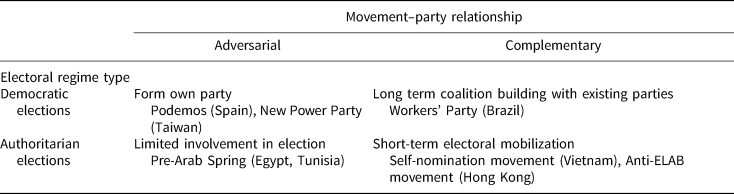
I argue that the two dimensions – movement–party relationship and electoral regime type – are at play to determine whether a movement will move the mobilization in the electoral arena, and the tactics that it would employ. It is worth noting that the theory is presented as an archetype. The operation of these mechanisms is contextual, conditioned by a range of political opportunity structures, and their interrelations and path-dependency are causally complex. Regime trajectory can diverge after electoral confrontations, such as becoming more democratic or intensify authoritarian crackdown. Nonetheless, the theory aims to serve as a framework nuancing the role of regime type plays in determining movement's electoral strategies. As synthesized in Table 1, this distinguishes four possibilities a movement can pursue in the electoral arena.
Electoral regime and movement–party relationship

4.5 Movement–party relationship
Almost in all movements do we see clashes of narratives, values, and tactics to achieve its goals at play. Movement participants contemplating running in an election could be seen as betraying the movement. The possibility of cooptation by political insiders is deeply felt by movement activists, and working proximately with institutions may lead movements to become too ‘imbues with their logic and values’ that can weaken their claims and mobilization (Tarrow, Reference Tarrow2011). This lack of trust between movement actors and political elite is more pronounced in movement with decentralized organizational structure as spontaneous mobilization via social media network draw new and usually younger protesters who do not necessarily possess trust and loyalty toward established movement and political organizations (Cheng, Reference Cheng, Gold and Veg2020a). Thus, when social movement actors have negative perceptions of existing parties and in the absence of trust, they are more likely to form their own party such as Podemos from the anti-austerity movement in Spain and New Power Party from the Sunflower movement in Taiwan (upper left quadrant).
Contrarily, when movements and parties do find common ground and form complementary relationships, movements may mobilize to help parties achieve their electoral goals, and opposition elites can become major sponsor of their cause and supply them with political and logistical resources. As Trejo (Reference Trejo2014) underscores, this quid pro quo between social movements and opposition parties give rise to coalition formation between the two main actors (upper right quadrant).
4.6 Electoral regimes
Elections do take place in authoritarian regimes and are enormously varied. In particular, I zoom in on the dynamics of authoritarian elections which, unlike democratic elections that are repeated games under a preset democratic rule of game, is characterized by an uneven playing field and a shorter time horizon. Existing scholarship points to factors such as asymmetrical resource endowments (Magaloni, Reference Magaloni2006; Brownlee, Reference Brownlee2007; Greene, Reference Greene2007; Levitsky and Way, Reference Levitsky and Way2010), electoral manipulation (Myagkov, Ordeshook, and Shakin, Reference Myagkov, Ordeshook and Shakin2009), and the abuse of electoral rules (Magaloni, Reference Magaloni2006; Brownlee, Reference Brownlee2007; Blaydes, Reference Blaydes2010; Levitsky and Way, Reference Levitsky and Way2010; Schedler, Reference Schedler2013), that introduce high level of uncertainty in the electoral arena for the opposition elites and movement leaders. Gandhi and Lust-Okar (Reference Gandhi and Lust-Okar2009) note that authoritarian elections tend to have high turnover, leading to weak parties and little party discipline. In other words, authoritarian elections in some cases are one-shot game. Even if the opposition manages to form political parties, many of them do not enjoy longevity. These obstacles leave them with difficult and inherently divisive strategic choices, compounding the difficulties in forging a complementary relationship between movements and existing opposition parties, and further discounting the long-term investment in building a party organization and coalition.
Even with their hands tied, movement and party may still find wiggle room for collaboration in the electoral arena. Movement actors and opposition elites join force to turn the electoral arena into contentious ground by mobilizing massive turnout to overtake an election, transforming it into a pseudo-referendum that allows the maximum number of claimants to make collective claims on the government, or as a display of the calibrated limitations of the electoral system (Truong, Reference Truong2021). With a substantial turnout in support of the movement, this strategy adds to the legitimacy of the movement on a whole, which is crucial for the survival of a movement, and the effective coordination of collective action as it requires support and cooperation of participants. Powell and DiMaggio (Reference Powell and DiMaggio1991) point out that collective actors who most closely mimic institutionally legitimated features gain an advantage relative to groups that do not reflect that template as well.
5. Method and cases
My argument will be tested in a within-country comparison with the most similar case approach. The two cycles of protest in Hong Kong – the Umbrella Movement in 2014 and Anti-Extradition Bill Movement in 2019 – will form the basis of the case study.
Hong Kong shares many commonalities with competitive authoritarian regimes (Wong, Reference Wong2014), yet possesses idiosyncratic electoral design. Despite the limited scope in which political competition is permitted (only in the District Council and the geographical constituencies in the LegCo),Footnote 5 those elections were largely competitive, fraud-free, and producing legitimate and binding outcomes. Another unique element is the ‘executive-dominance style’ of governance, with power concentrated in the hands of the non-partisan Chief Executive vis-à-vis the legislature (Fong, Reference Fong2014). Nearly all legislation and budgetary proposals were under the control of the executive authorities, and the role of the LegCo was largely confined to rubber-stamping the government's policy, even when a party or a coalition obtains a majority in the LegCo. This political configuration sets Hong Kong apart from other hybrid regimes where movement activists and opposition elite seek the electoral route to induce regime change. Hong Kong's protests are less about toppling the hybrid regime but demanding a pathway toward democratization as promised in the 1984 Sino–British Joint Declaration.
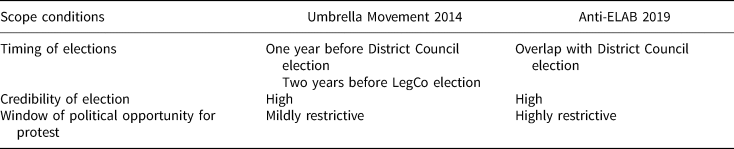
In terms of the sequencing, both movements took place before the local elections. However, the temporal proximity between the movement and the elections differs. The District Council and the LegCo election took place 1 and 2 years, respectively, after the conclusion of the occupying movement in 2014; and the District Council election in 2019 took place at the height of the Anti-ELAB movement. The mobilization to take over the electoral arena in 2019 benefited from the consistent momentum-driven events for the past 6 months. A poll by Public Opinion Research Institute (PORI) in December 2019 revealed that 59.2% respondents were still in support of the Anti-ELAB movement.Footnote 6 On the contrary, the momentum from the Umbrella Movement was dissipating even before the end of the movement with half of the respondents opposing the occupying tactic; 83% wanted the occupation to be over; and 68% supported the government to clear the sites according to the Hong Kong University Public Opinion Program (HKU POP).Footnote 7 Admittedly, localism became the third contender in political landscape after Umbrella Movement, yet the magnitude of mobilization in the two subsequent elections was limited. In both cases, disruptive collective actions carried heavier penalties such as being arrested, beating up by the police, and facing prosecution, and yet the crackdown by the police on collective actions was more severe in 2019 than that in 2014. Table 2 summarizes the three scope conditions for the two cases.
Scope conditions for Umbrella Movement and Anti-ELAB movement

One major different between the two cases was the movement–party dynamic. The Umbrella Movement was plagued with conflicts between activists and opposition politicians, and between radicals and moderates over the decision-making process within the movement. In contrast, the Anti-ELAB movement activists and participants enjoyed a decentralized and horizontal movement structure where various repertoires were accepted. Under this pluralist atmosphere where old and new repertoires blossomed, a complementary relationship between movement and parties grew.
6. Case I: Umbrella Movement 2014 and the subsequent elections
6.1 Background
Umbrella Movement is an occupying movement in 2014 that lasted for 79 days and extended to three different sites (Admiralty, Causeway Bay, and Mongkok). It was prompted as an anticipation of the political reform which would push Hong Kong forward in the democratization process: granting universal suffrage for electing the Chief Executive and abolishing the Functional Constituency structure in the LegCo. The occupy plan was first envisioned by professor Benny Tai Yiu-ting, along with his colleague professor Chan Kin-man and Reverend Chu Yiu-ming (dubbed by the media the ‘Occupy Trio’). As early as in 2013, the Trio had publicized their game plans, in which the Occupy Central with Love and Peace (OCLP) was the last resort in pressuring the government should the negotiation with Beijing fall apart.
In working along with student associations (Scholarism and the Hong Kong Federation of Students, HKFS), the OCLP got some buy-in from political parties such as the Civic Party and the Labour Party at the plenary stage.Footnote 8 The Democratic Party was under heavy pressure to join the OCLP to demonstrate their support for the movement to mend their tainted reputation in entering the back-door deal with Beijing that bore no fruit in 2010. On the whole, mainstream parties only played a supporting rather than a leading role, and took moderate measures to reinforce the movement.
The occupy movement was spearheaded by a small group of students who stormed and occupied the Civic Square, an act that caught many by surprise. The rough treatment of the unarmed students by the police galvanized the Hong Kong public to pour into the streets, not necessarily in support of the OCLP but the arrested students. The police's effort to disperse the unsuspected crowd with tear gas and rubber bullets backfired, driving even more sympathizers out on the streets which eventually became the basis for the Umbrella Movement.
6.2 Closing of opportunity for disruptive actions
The regime's response to the protest was short of a full-on repression but along the line of what Yuen called ‘attrition’. The concept refers to ‘a mode of regime response that ostensibly tolerate protest, but also uses a proactive tactical repertoire to discredit, wear out, and increase the cost of the protests’ (Yuen, Reference Yuen, Ma and Cheng2019). After the tactical error by the police to pursue a heavy-handed approach by firing tear gas on an unarmed and peaceful crowd, rumors and threats of further state repression spread like wildfire, with former Chief Executive C.Y. Leung warned that the government and police were obligated and determined ‘to take all necessary actions’ to restore public order. Instead of a major crackdown, counter-movement groups with links to state authorities and pro-Beijing political factions were mobilized to threaten and harass protesters with violence. The most severe case was at the Mongkok occupy site. Groups with triad background launched regular small-scale protests at the site, often igniting tensions with the Occupy protesters (Ong, Reference Ong2018). The most intense clash happened on 3 October when men wearing facemasks with possible ties to the triads started to remove barricades, dismantle encampments, and violently attack protesters.Footnote 9 Amid the assault by thugs, the police were mostly inactive and slow to respond. Finally, governments and private bodies leveraged court injunctions in many jurisdictions to ban or expel protesters. Protesters who disobeyed the court orders were physically removed by the police and faced charges such as contempt of court.
6.3 Failure to generate common ground between actors
The storming of the Civic Square and the subsequent decision by the police to disperse protesters with excessive tear gas brought together an unusual diversity of actors in unexpected quantities – parties, CSOs, students but also unaffiliated citizens of various motivational backgrounds – that jointly constituted and shaped ‘structurally underdetermined [events] characterized by high levels of uncertainty’ (Della Porta, Reference Della Porta2020). These transformative events, as McAdam and Sewell (Reference McAdam, Sewell, Aminzade, Goldstone, McAdam, Perry, Sewell, Tarrow and Tilly2001) wrote, ‘become turning points in structural change, concentrated moments of political and cultural creativity when the logic of historical development is reconfigured by human action but by no means abolished’ (p. 102). Yet, the new relational pattern among different actors emerged from this critical juncture was one characterized with intense conflict and distrust.
This new relational pattern was visible when those who were in solidarity with the arrested students left en masse as the Occupy trio hastily announced the beginning of OCLP campaign. Veteran in the movement realm and legislator Leung Kwok-hung (also known as Long Hair) had to dramatically kneel and beg the students to stay. After the police escalated their response by firing a large amount of teargas to the crowd, the Occupy trio, student leaders, and opposition politicians attempted to call off the occupation concerning the safety of all protesters under the slogan ‘Preserve our energy, Fight another day’. However, instead of heeding the advice of protest leaders, thousands of citizens became occupiers. Many of them were in their youth, school uniform-wearing late-teens who experienced emotional intensity and cognitive opening (McAdam, Reference McAdam1988). For many who decided to remain in solidarity, the opposition elite's effort to deescalate the movement was perceived in a hostile manner.
The conflictive relationship was in fact compounded by the cumulating tension between activists and opposition parties. Grassroots activists and especially young generations are disappointed with the pan-dem parties for making compromises to secure weak concessions, and resent the quality of electoral politics (Ma, Reference Ma2011; Tang and Cheng, Reference Tang and Cheng2021). Many grow impatient with the constraints pan-dem parties face in the legislative arena, and with peaceful protests which have become a modular performance and lost their disruptive power (Ku, Reference Ku2007). As Ma (Reference Ma, Kuah-Pearce and Guiheux2009) observed, movements seek to avoid the contamination of partisan politics in order to maintain the purity of their causes. The Umbrella Movement brought new tactics and repertoires to the streets, yet its scope remained quite limited as Hong Kong public in general and pan-dem elites did not have the appetite for the radical flavor in contentious politics. The attempt by activists to occupy the central business district in July 2014 was met with condemnation by the pan-dem parties, criticizing them for ‘hijacking’ the annual 1 July protest (Cheng, Reference Cheng2016).
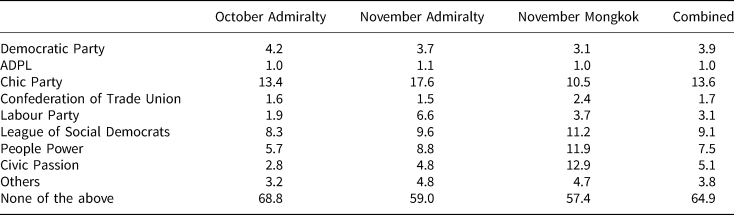
A handful of moderate pan-dem legislators joined some of their counterpart in the pro-Beijing camp to call for a ‘cease-fire’ between the two camps, believing the National People's Congress Standing Committee (NPSCS) would reflect the Hong Kong people's view.Footnote 10 Their actions were seen by the protesters as ineffective, and the feeling of being betrayed by career politicians was echoed among the activists. Lee and Chan (Reference Lee and Chan2018) surveyed the occupy sites and found that many activists largely discredited the effectiveness and efficiency of pan-dem parties, and harbored cynical views that politicians only serve their own interest in remaining in power. Table 3 captures the level of support for major pan-dem parties at various occupy sites. Some of the most established parties such as the Democratic Party, Association for Democracy and People's Livelihood (ADPL), and Confederation of Trade Union (CTU) received the lowest rating. Even parties with a more confrontational style such as League of Social Democrats, People Power and Civic Passion received below 10% support. In total, 64.9% of respondents from the sites reported not supporting any political parties. This negative feeling stemmed from the perception that many moderate pan-dem legislators were seen by protesters as sell-outs and too eager to compromise to Beijing's pressure.
Support for political parties at different occupy sites (in percentage)

Source: Lee and Chan (Reference Lee and Chan2018).
The schism between different groups over tactics and leadership were also found in the deliberation process within the movement. The Five-Party Platform, the coordinating group of the Umbrella Movement comprised of five collectives – Occupy trio, representatives from the pan-dem parties, HKFS, Scholarism, and approximately 18 CSOs – was set out to facilitate dialog and decision-making process (Cai, Reference Cai, Ma and Cheng2019; Ho, Reference Ho2019). However, it became the source of conflict as different collectives envisioned the movement differently and failed to reach consensus. As Kwok and Chan (Reference Kwok and Chan2017) note, the trio advocated for an inclusive approach taking into account both the protesters and the public, and insisted on a strict non-violence principle to avoid public antipathy for the movement; pan-dem parties shared the same principle as the trio but were less supportive for a long-term occupation; HKFS and Scholarism's vision was more participant-centric, in which they aimed to create mechanisms to sustain the momentum of the occupy sites. The solidarity forged at the beginning of the occupying movement among different actors faded in the blink of an eye.
6.4 Post-Umbrella Movement elections
Although the occupy movement ended, the impetus stayed. In documenting the biographical consequences of the Umbrella Movement, Mok (Reference Mok2020) noted that the disappointment and politicization prompted movement actors to continue their activism after the occupation. New groups with movement connections were formed to enter the electoral races. Many wanted to use the elections as platforms to retrospectively prove that, although the occupation had failed to secure concrete gains, it did have a popular mandate. Others tried to present themselves as alternatives to break the dichotomy of Hong Kong's pro-Beijing vs pro-democracy political landscape. Arguably, many of the post-Umbrella Movement groups followed the movement party path similar to Podemos in Spain, and Taiwan after the Sunflower movement (Della Porta et al., Reference Della Porta, Fernandez, Kouki and Mosca2017; Ho, Reference Ho2019).
The first post-umbrella movement election was the District Council election in 2015.Footnote 11 Around 50 novice candidates who took part in the Umbrella Movement, loosely dubbed by the Hong Kong media as ‘umbrella soldiers’, entered the race in all 18 district councils.Footnote 12 Similarly, in the LegCo election in 2016, newly formed parties and groups such as Demosistō, Youngspiration, other localist candidates Eddie Chu Hoi-ding and Lau Siu-lai who gained popularity and recognition in the Umbrella Movement, also joined the contestation.
Both elections drew record turnout in their times: 47% of the registered voters in the 2015 District Council election and 58% in the LegCo election cast their votes. The pro-Beijing camp won the majority on the District Council with 298 seats, the pan-dem camp took 105, and the localist and independent gained 17 seats. Of the 35 seats in the Geographic Constituency in the LegCo that were up for election, pro-Beijing camp won 16, pan-dem 13, and localist 6. The election outcome was unprecedented with localist candidates succeeded in breaking the dichotomous division between pro-Beijing and pan-democracy in the LegCo. This signaled a changing of the guard, as a number of pan-dem political veterans such as Alberto Ho Chun-yan from the Democratic Party, Lee Cheuk-yan from the Labour Party, and Raymond Wong Yuk-man from Proletariat Political Institute were voted out.
The electoral arena was utilized by movement leaders as how it is intended to: political contestation and a passage leading to institutionalized politics. The conflict risen from the Umbrella Movement among those with different values and priorities spilled over to the electoral arena. Moreover, many activists came across high barriers and were forced to compromise their ideological stance in order to enter the race. That included rewording and recanting their support for radical direct action, Hong Kong independence, and self-determination. Demosistō faced obstacles in registering the party because of their mission statement regarding self-determination. This caused them financial difficulties and could only effort to field one candidate for the race. To put it differently, as movement leaders entered the electoral arena to play by the rule, they lost the reflexibility and fluidity they enjoyed in the protest. More so, Beijing and Hong Kong authorities further tilted the playing field by selectively disqualifying localist legislators in the oath-taking controversy,Footnote 13 and banning the pro-independence National Party. Election and formal politics become a rope that binds the hands of the movement.
7. Case II: Anti-Extradition Bill Movement 2019
7.1 Background
On 12 February 2019, the Hong Kong government revealed its plan to amend the extradition bill (ELAB). Prompted by a murder case committed by a Hong Kong citizen in Taiwan in 2018, the amended bill would allow Hong Kong to surrender fugitives to jurisdictions with which the city does not have existing bilateral extradition agreement, including mainland China, Taiwan, and Macau.
Although the Hong Kong government highlighted the motivation of the extradition bill was to allow the rendition of criminals in Hong Kong to mainland China, the bill was widely feared because it removed the ‘one country, two systems’ buffer that has protected Hong Kong residents from the judicial system in China. Many worried that the bill would suppress the protection of human rights and the rule of law in the city. Even though the 37 crimes listed in the bill exclude political ones, many feared the legislation would essentially legalize the sort of abductions to the mainland that have taken place in Hong Kong in recent years, such as the prominent case of Hong Kong bookseller Lee Bo who was taken across the Hong Kong–China border and put into Chinese custody for selling books and magazines purporting to reveal secrets and scandals about the inside lives of Chinese leaders. In addition, losing the buffer also translates into threats to the Hong Kong identity and cultural heritage (Cantonese language, unique history, and lifestyle), and the city's economic and political interests (Kaeding, Reference Kaeding2017).
7.2 Scaling up the cost for civil disobedience
The Anti-ELAB protest hedged on what Almeida calls the ‘bad news environment’ in which negative conditions encourage collective actions (Almeida, Reference Almeida, Snow, Soule, Kriesi and McCammon2019); people senses the threat that if mobilization is not undertaken, conditions will deteriorate for them (Tilly, Reference Tilly1978; Goldstone and Tilly, Reference Goldstone, Tilly, Aminzade, Goldstone, McAdam, Perry, Sewell, Tarrow and Tilly2001). Threats such as erosion of rights and state repression not only ushered third party and public opinion to side with the protesters, but also escalated confrontation and radicalized some protesters to resort to more radical repertoires.
Two incidents strengthened the police brutality threat: the 21 July mob attack at Yuen Long and the 31 August confrontation at Prince Edward MTR station. Thugs in white shirts launched an indiscriminate attack on citizens in the Yuen Long train station, some of whom were returning from protesting in other parts of the city. Many, including returning protesters, passengers, and reporters were injured in the assault. This attack was one of the key critical junctures that buttressed the movement as it evoked a widespread uproar not only against the thugs but also the police, which were seen by many as intentionally letting the thugs instill fear in the public, a tactics commonly used by the CCP in suppressing dissents. The attack led by the riot police at the Prince Edward station on 31 August served as another critical moment in the movement. Riot police were filmed by journalists storming into the station and the metro carriages, indiscriminately assaulting passengers with batons and pepper spray. The mishandling of the incident by the police further eroded the little confidence the public had in the police force.
Meanwhile, protesters were having their hands tied as the Hong Kong government issued and reinforced laws aiming to increase the cost of protesting. Under the Public Order Ordinance, any public march exceeding 30 people must obtain the ‘Letter of no Objection’ from the Police Commissioner. Yet starting in July, the Police Commissioner denied most public demonstration proposals citing safety concerns. This move rendered rejected protests unauthorized and illegal, meaning that people attending those protests could face prosecution and 5 years in jail were the police to enforce the rule strictly. Similarly, the anti-mask law under the colonial-era Emergency Regulations Ordinance was enacted to ban protesters from covering their faces during protests, allowing easier identification of protesters by the authorities. By arming the laws with teeth, the government effectively placed a heavy price on those who wished to join the movement.
Arbitrary arrest and beating of subdue protesters instilled fear to many protest sympathizers as well as medical volunteers and journalists, further deterring them from even being in areas close to protest sites. By October 2019, 2,379 protesters were arrested of which 750 were under 18 years old.Footnote 14 Those arrested could face charge of unlawful assembly and even rioting, which is punishable by 10 years' imprisonment. Stories recounted by victims of arbitrary arrest and torture under the police ricocheted in the public sphere, the unsympathetic notion of ‘this is what you should expect if you join the protest’ cemented the increasing risk of protesting.
The show of force of the police reached its apex during the weeklong siege at the Hong Kong Polytechnic University in November. This was the most violent display of the clashes between protesters and the police. Most protesters were students who were hurling bricks, Molotov cocktails and even arrows at the police to break the siege. The police tried to drive an armored vehicle into campus, blanketed the campus with excessive amount of tear gas, rubber bullets, bean bag rounds, and sponge grenades. The siege ended with more than a thousand people arrested as the police cleared the campus.
By the time of the university siege, protesters had tried a wide range of old and new contentious repertoires to pressure the governments to heed the five demands laid out by the movement.Footnote 15 Both radical and non-violence collective actions were under scrutiny as the government and the police exploited the legal system to exert high cost and risk on any protest activities (Hui, Reference Hui2020). Comparing to the Umbrella Movement, the scope of suppressing any Anti-ELAB protests was more encompassing and severe. What remained relatively undisturbed was the right to vote and the district council election on 24 November.
7.3 Be water: complementary relationship between movement and opposition elite
The Anti-ELAB movement drew tactical lessons from the Umbrella Movement, and benefited from the participants' ‘rude awaking’ as they became political attentive through involvement in the occupy movement. Those micro-cohort of participants eventually became a core part of the Anti-ELAB Movement (Ma, Reference Ma, Ma and Cheng2019). Moreover, participation in the Anti-ELAB movement was diverse and pluralistic, in which people contributed to the movement in various ways. Moyer (Reference Moyer2001) categorizes the four roles – citizen, change agents, reformist, and rebelFootnote 16 – people can play in a movement. The Anti-ELAB movement has successfully included the general public and third party to join their cause by expanding their repertoires. This is a stark contrast to the Umbrella Movement which focused heavily on the role of rebels while downplaying the other roles, leading to detrimental in-fightings.
The mottos ‘brothers climbing mountains, each offering one's efforts’ (兄弟爬山, 各自努力), and ‘going up and down together’ (齊上齊落) freed up the protest arena for both non-violence resistance and radical actions. The decentralized and fluid structure of the movement allowed groups to act independently and creatively while cementing the solidarity. New repertoires reflected citizens' proactiveness in initiating different campaigns: online crowdfunding to purchase newspaper front pages to explain the protest in Hong Kong to an international audience; creating and maintaining Lennon walls; designing and distributing promotional materials and infographic to shape the narrative of the movement; medical and legal volunteers; and groups that stayed at the frontline to dose teargas canisters.
Departing from a more critical stance toward protesters and direct actions in the Umbrella Movement, pan-dem political elites took a supportive yet active role, serving as mediators and overseers of the clashes between police and civilians. Some legislators not only fought the Anti-ELAB battle inside the LegCo chamber, but joined the protesters on the street. In particular, legislators from the Democratic Party such as Kwong Chun-yu, Teddy Hui Chi-fung, and Lam Cheuk-ting were at the frontline negotiating and mediating, and were assaulted, pepper sprayed, tear gassed, and arrested many times like some protesters. Their participation in the protests shifted the public perception and many protesters acknowledged their effort.
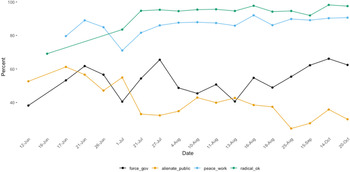
Despite occasional heated debate over whether certain radical tactics were justified, many moderates took an introspective lens: even though they might disagree with the tactics and would not participate, they refrained from condemning the radicals. At the same time, radicals toned down their view on the uselessness of non-violent repertoires. Figure 1 presents a more nuanced view on radical and non-violent tactics by protesters. The Anti-ELAB survey (Lee et al., Reference Lee, Yuen, Tang and Cheng2019) indicates a drastic change in attitude toward protest from the Umbrella Movement. Respondents in general do not see peaceful and radical tactics as mutually exclusive. Moreover, a decreasing number of respondents perceived radical tactics would alienate the general public, signaling a broader acceptance of radicalization in the protest repertoire. Nonetheless, many have reservation in the effectiveness of radical tactics alone in pressuring the government to heed the public grievance. On average, around 90% believed the most impactful protest repertoire is the combination of peaceful assembly and confrontational actions.
Hong Kong protesters' acceptance of radical and non-violent tactics. Source: Anti-ELAB Survey (Lee et al., Reference Lee, Yuen, Tang and Cheng2019). force_gov: ‘Radical protests can force the government to listen to the people’; alienate_public: ‘Radical protests will alienate the general public’; peace_work: ‘Only when peaceful assembly and confrontational actions are used together can the impact of protest be maximized’; radical_ok: ‘When the government fails to listen, the use of radical tactics by protesters is understandable’.

7.4 Extending collective action into District Council election
An extra element of claim making on authority was added to the election in 2019. Voters cast their vote not only to reject the pro-Beijing parties' long held influence in local politics; but more importantly to refute the narrative from the government that protesters were just a minority, and a silent majority was on the side of the law and order. This behavior falls in line with protest voting, which is an expression of dissatisfaction with established/mainstream politicians (Bowler and Lanoue, Reference Bowler and Lanoue1992; Pop-Eleches, Reference Pop-Eleches2010).Footnote 17
Movement activists and opposition politicians turned the election on its head by exploiting the polarization between protest supporters/sympathizers and regime supporters with a moral frame. Instead of having the election fragmenting the movement by engaging in intra-camp competition, such as the split between pan-democracy parties and localist groups in the post-Umbrella Movement elections, the movement–party coalition maintained a pragmatical level of solidarity. The popular slogan ‘you can be on different political camps, but moral conscience is absolute’ (黃藍是政見, 黑白是良知) urged people to transcend their political differences and instead vote out those who endorse and tolerate police brutality. People perceived this election to be tantamount in affirming all previous months of protests, radical and non-violent alike.
There was also a consensus among protesters, especially the radical ones, that disruptive protests would be halted on election day so not to draw attention away from the election. Many remained skeptical about electoral politics but casted their vote as an expression to support the movement and protesters. A sentiment echoed by many on various social media platforms posited that their votes were not an endorsement of party politics, and the pan-dem parties still had a long way to win their hearts and minds.
The galvanizing movement drove many to vote in the 2019 District Council election, resulting in a record-breaking turnout in which 71% of the registered voters participated. The opposition (pan-dem and independent candidate) achieved its biggest victory, gaining 388 out of 425 seats and controlling 17 of the 18 District Councils. All pro-Beijing parties suffered major setbacks and losses. The largest pro-Beijing party Democratic Alliance for the Betterment and Progress of Hong Kong (DAB) lost 96 seats. A number of pro-Beijing heavyweights failed to secure their seats for re-election, and in contrast, many pro-democracy activists who actively participated in the protests were elected. This unprecedented outcome was largely owing to the mobilization effort that not only solidified the participation of those who self-identified into political camps (pro-democracy, pro-Beijing, and localist), but also those who had weak to no political affiliation and not politically engaged.
Survey data from the Hong Kong Electoral Studies showed that on average 93% of the 835 respondents who self-identified with a political camp reported their participation in the District Council election. Although the linkage between those who have an ideological affinity and political participation is within expectation, the mobilization of the third party – those with weak affinity with any political camps and low level in protest participation – standing in long line to vote was remarkable. Non-partisans in general were less sanguine toward political efficacy via voting and civic engagement. They were less likely to see voting as civic engagement, as well as participate in Anti-ELAB protest activities such attending protest, signing petition, engaging in online commentary, and joining the yellow economic circle. Despite the lack of partisan affinity, 331 (70% of non-partisan respondents) reported voting in the District Council election, and 214 of them cast their vote for candidates belonging to the opposition. The electoral engagement from the non-partisan segment of the population signals the far-reaching scope of the protest and how the movement drew even the voting skeptics to the ballot box.
Besides mobilizing protest supporters to turnout on election day, the movement–party coalition with the aid of Power for Democracy, a civil society organization, collaborated in placing opposition candidates in all possible races to maximize the potential reach,Footnote 18 and avoiding scenarios where opposition politicians and independent candidates would face off in the same district and split the pro-democracy vote. The coordination effort for the 2019 election was joined by 397 members from pro-democracy parties and independent candidates. All 452 seats at the District Council were contested, and all but 40 races were successfully coordinated to avoid split voting.
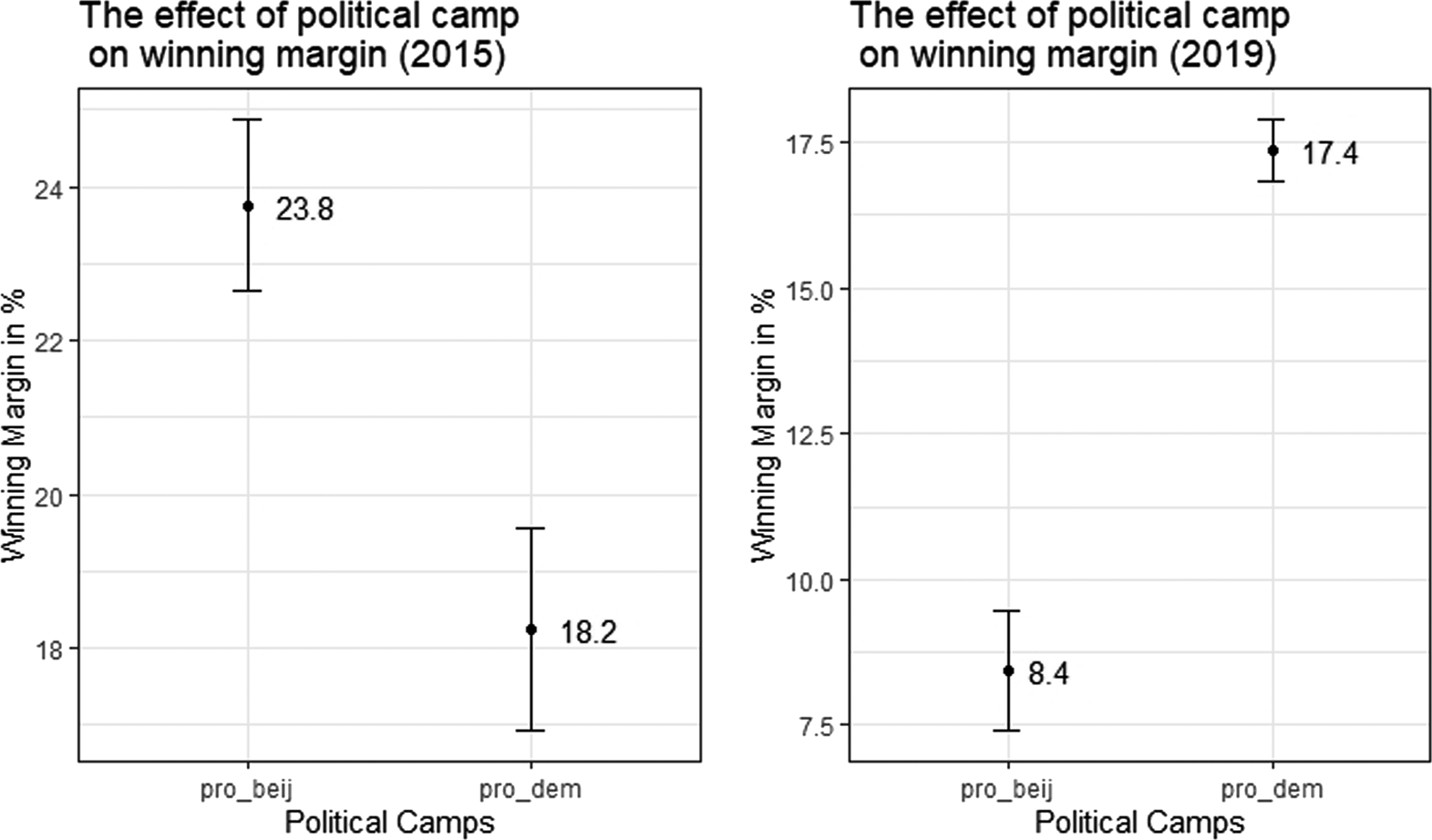
Looking beyond the landslide victory for pro-democracy politicians and activists, the winning margins between pro-Beijing and pro-democracy candidates further illuminate how the juxtaposition of the movement frame onto the election was successful. Based on the dataset compiled by the author with data from Hong Kong Electoral Affairs Commission (HKEAC), I compare the standard error of the average winning margin by political camp in the district council election in 2015 and 2019 (see Fig. 2). Interestingly, the pro-democracy camp flipped a significant number of seats, while maintaining their winning margin on average around 18% in the two elections. The pro-Beijing parties that acted as a proxy of the Hong Kong government saw their comfortable margin of 23.8% in 2015 plummet to 8.4% in 2019. They not only lost their hold on local politics, but also faced a stern rejection by a majority of Hong Kong voters who strongly casted them out.
Winning margin by political camp in District Council election (2015 and 2019). Source: Hong Kong Electoral Affairs Commission.

The 2019 election was not a typical District Council election. Voters were mobilized by threats, solidarity and frustration and turned the electoral arena into a protest ground for the movement. For the opposition and movement activists the election result reaffirmed the raging momentum even though the police had been cracking down severely on protesters and sympathizers for almost half of a year. Voting, as a peaceful, inclusive, and legitimate repertoire sent a strong rejection of Beijing's encroachment and demanded a clear mandate for democracy. This also gave the much-needed confidence for transnational activists to advocate for Hong Kong's pro-democracy cause.
8. Discussion and conclusion
This paper sets out to explore the intersection between street politics and electoral politics, in particular, when voting becomes a contentious repertoire, based on the two protest cycles in Hong Kong: the Umbrella Movement and the Anti-ELAB Movement. I have laid out three scope conditions: (1) protest–election sequence, (2) election perceived to be competitive and binding, and (3) closing of political opportunity window for street mobilization, that create a favorable environment for movement to seek electoral strategies. I further argue that movement's choices in pursuing the electoral arena are shaped by the relationship movement and opposition elites have, and the type of electoral regimes. More specifically, my case design has demonstrated that when the three scope conditions are fulfilled, movements that form complementary relationship with the opposition and establish solidarity can turn the electoral arena into a protest ground by juxtaposing the movement frame onto turnout mobilization effort.
The Umbrella Movement unleashed a strong youthful momentum that changed the political landscape. However, the distrust between movement and institutional actors, and the narrow scope in their protest repertoires did not open doors for any cooperation. Instead, subsequent elections served its intended purpose as selection of political representatives. On the contrary, the Anti-ELAB movement adopted a momentum-driven approach in sustaining the movement. Its decentralized structure was guided by a set of broad principles, which opened up different channels of participation both on the non-violent and radical fronts. Under this framework, opposition elites were absorbed by the movement. Legislators not only partook the struggle inside the LegCo, but also on the streets to protect the protesters and deescalate heated situations. The concerted mobilization effort for the District Council election on 24 November produced not only a new cohort of district councilors, but most importantly a strong claim by 1.6 millions of voters-protest supporters who urged the government to heed to the movement demands.
In sum, this study makes theoretical contributions in two ways. First, scholars have been making headway in synergizing the study of social movements and elections, yet the act of voting is at most considered a complementary product for the movement. I propose a framework that takes into account both the movement–party relationship and regime type in explaining the different tactics a movement can generate in pursuing the electoral arena. This is especially salient for hybrid regimes where elections are volatile and heavily influenced by the ruling authorities. Using the case of Hong Kong, I add a caveat of the short-term mobilization at the electoral sphere, a contentious repertoire found in hybrid regimes that is yet to be recognized and incorporated into the boarder discussion in the literature, such as the self-nomination movement in Vietnam in 2016 (Truong, Reference Truong2021).
Second, this study complements the rich set of in-depth analysis of the protest cycles in Hong Kong at the micro-level (Lee and Chan, Reference Lee and Chan2018; Ma and Cheng, Reference Ma and Cheng2019; Lee, Reference Lee2020; Cheng, Reference Cheng2020b) by applying Della Porta's (Reference Della Porta2020) proposal of understanding protest cycles at the meso-level. Instead of taking the movement–party solidarity for granted, I show that relationship between movement and opposition elite matters when interacting with macro factors such as regime type, and can produce new repertoires.
This paper only scratches the surface of the meso-level analysis, and potential research avenue should investigate how decentralized movement structure impacts the movement–party relationship. Movements in the Arab Spring and recent protests in Latin America and Southeast Asia have embraced a more fluid organizational form, adding another complex and unpredictable layer of the movement–party relationship. Although this paper does not venture into the discussion of the outcomes of the electoral model, future research should explore post-mobilization politics: whether the short-term mobilization in the electoral arena can generate enough momentum to produce what Della Porta (Reference Della Porta2020) calls a protest ‘crack’ that fundamentally shape people's collective loyalties and actions, and in turn leads to the sequence of vibrating and sedimenting that stabilizes the legacy of the initial critical juncture.
Acknowledgements
Preliminary versions of this paper were presented at V-dem East Asia's workshop on Contentious Politics in Asia, APSA Asia Program's Contentious politics and its Repercussions in Asia workshop, the Social Protest and Movement (SPAM) workshop at the University of Notre Dame, and the 2021 Midwestern Political Science Association. The author is indebted to Edmund Cheng, Teri Caraway, Dana Moss, Ho Ming-sho, Tomás Gold, and the anonymous reviewers for their thoughtful comments. All errors and omissions are my own.
Conflict of interest
The author declare no competing interest.