INTRODUCTION
Gender inequality among Muslims is one of the most urgent and widely debated problems in the contemporary world.Footnote 1 A quick glance at the headlines of any major news source reveals extensive public concern with the treatment of Muslim women and girls. Some analysts regard inequality between the sexes as a salient characteristic of Muslim societies (Abou El Fadl Reference Abou El Fadl2008; Afkhami Reference Afkhami1995; Ahmed Reference Ahmed1993; Ganji Reference Ganji2008; Mernissi Reference Mernissi1992; Charrad Reference Charrad2001; Mir-Hosseini Reference Mir-Hosseini1999; Moghadam Reference Moghadam2007; Sharabi Reference Sharabi1988). According to a rival position, the notion that women have it worse under Islam is based on cultural misunderstanding and superficial evidence (Abu-Lughod Reference Abu-Lughod2000; El Guindi Reference El Guindi2003; Gole Reference Gole1997; Shiva and Gocek Reference Shiva and Fatma Muge1995). A third perspective contends that other factors prevalent in some territories with large Muslim populations, such as lower levels of development and dependence on natural resources, rather than beliefs or practices connected to religious tradition, are responsible for higher levels of gender inequality (Offenhauer Reference Offenhauer2005; Ross Reference Ross2012).
Despite enormous interest in the possible relationship between religion and gender inequality, few works have systematically compared Muslims and non-Muslims. While the literature on Islam and gender offers a mountain of ideas, insights, and arguments, few studies pose the big questions as hypotheses and subject them to rigorous empirical testing. Although several large-N statistical analyses have identified a correlation between Islam and gender inequality (Fish Reference Fish2002; Alexander and Welzel Reference Alexander and Welzel2011), moreover, there is no scholarly consensus about the causal mechanisms that link these two variables. In this article, we explore one possible factor that might contribute to the endurance of structural inequalities between men and women in the Muslim world: attitudes toward gender inequality. Building on work that provides some preliminary insights (Inglehart and Norris Reference Inglehart and Norris2003a; Norris and Inglehart Reference Norris and Inglehart2004), this article examines whether Muslims are more (or less) inclined than non-Muslims to hold traditional (that is, male-dominant) beliefs.
THE LINK BETWEEN RELIGION AND GENDER INEQUALITY: THEORY AND HYPOTHESES
Why might Muslims be less likely to resist gender inequality? The theoretical literatures from a variety of social scientific disciplines can offer hypotheses for a correlation between certain religious beliefs and support for traditional sex roles (Ferguson Reference Ferguson1994; Peach Reference Peach2001; Sharma Reference Sharma1987), and among the major world religions, Islam is often seen as particularly prone to generating male-dominant beliefs. According to John Esposito (Reference Esposito, Yvonne Yazbeck and Esposito1998, xi), “Few issues in Islam and Muslim culture have attracted more interest — and yet proven so susceptible to stereotyping — as issues involving women…Subjugation and second-class citizenship probably best describes the perception of Muslim women in the West.” Many non-Muslims regard the wearing of the hijab as an act of enforced modesty and note the absence of an equivalent prescription for Muslim men. Practices such as the segregation of the sexes in many areas of public life, which many Muslims regard as religiously prescribed and are undoubtedly more common in Muslim lands than elsewhere, add to the perception of female subordination. Unquestionably unjust practices such as banning girls’ access to education may be rare, but where they are found, they are usually carried out in the name of Islam, as in Taliban-era Afghanistan. There would appear to be ample evidence that, among the adherents of the major world religions, Muslims are particularly prone to attitudes that support gender inequality (Callaway and Creevey Reference Callaway and Creevey1993; Inglehart and Norris Reference Inglehart and Norris2003b; Bouachrine Reference Bouachrine2014).
Some recent, theoretically informed case studies enhance understanding. They suggest that the lives of women in Muslim societies may indeed differ from the lives of women elsewhere, and that Muslims may hold distinctive views on matters of gender. At the same time, these case studies add nuance and in some instances challenge outsiders’ perceptions of gross inequality (Ghodsee Reference Ghodsee2010; Nageeb Reference Nageeb2004; Peshkova Reference Peshkova2014).
Still, while public discourse and the scholarly literature teem with generalizations about Islam and women, and while recent case studies have furnished valuable bases for re-examining prevailing views, we lack a solid empirical basis for the widespread perception that gender inequality is particularly pervasive among Muslims. A handful of studies provide some empirical basis for making global generalizations. Fish (Reference Fish2011) finds a gender gap in structural indicators of inequality in countries with a predominantly Muslim population. This gap cannot be explained away by variation in levels of socio-economic development alone, raising questions about whether attitudes may be to blame, and whether attitudes favoring gender inequality are more prominent among Muslims than non-Muslims. In earlier works, Inglehart and Norris (Reference Inglehart and Norris2003a; also Norris and Inglehart Reference Norris and Inglehart2004) found that traditional attitudes toward gender equality are more common in countries in which Islam is the dominant faith tradition. A more recent analysis by Alexander and Welzel (Reference Alexander and Welzel2011) finds that Muslim self-identification and Muslim social context are strong predictors of patriarchal values.
While much of the scholarship on the possible relationship between religion and attitudes toward gender inequality is vague about causal connections, most hypotheses can be divided into two general camps: those that emphasize the effect of individually held religious beliefs and those that focus on the effects of a society's dominant religion. In the realm of individual-level effects, one argument is that being Muslim may incline an individual toward traditionalism in attitudes toward gender inequality. To a greater extent than adherents of other faiths, Muslims may embrace specific family functions for women to the exclusion of other roles (Ali Reference Ali2006; Mir-Hosseini, Al-Sharmani, and Rummigner, Reference Mir-Hosseini, Al-Sharmani and Rumminger2015). Individuals’ attitudes may spring from the interpretation of foundational religious texts that originated in historical periods in which unequal treatment of men and women was taken for granted. All scholars who study the matter acknowledge that some passages in the Qur'an, Islam's fundamental text, and the Hadith, the reports on the life and sayings of the Prophet Muhammad, do endorse inequality. Yet some contemporary authors have reconsidered the sacred texts and found them to be more sexually egalitarian than they have often appeared to be (Brooks Reference Brooks1995; Cooke Reference Cooke2001; Hidayatullah Reference Hidayatullah2014; Souaiaia Reference Souaiaia2008; Wadud Reference Wadud1999).
Nevertheless, patriarchal interpretation of sacred texts dominates. According to Asma Barlas (Reference Barlas2002), the main problem has been that the classical exegeses (tafsir in Arabic) of the Qur'an as well as the Hadith were written and compiled in Islam's early centuries. Since male domination characterized life in those times, exegesis was naturally infused with a patriarchal understanding. That exegesis became the basis of fiqh, or Islamic jurisprudence. The classic fiqh texts of the early centuries enjoy a prestige that derives from the proximity of their authors to the time of the Prophet, and they have remained the touchstones of Islamic jurisprudential thinking down to the present day. Even if one can readily argue that Islam's sacred texts, like those of other major world religions, can be used as readily to require full equality between the sexes as to authorize inequality, the presence within Islam of a strong, enduring jurisprudential tradition based on thinking that prevailed a millennium ago may affect contemporary thinking.
Thus, even if Islam's foundational texts (meaning the Qur'an and the Hadith) alone probably cannot explain patriarchal attitudes among contemporary Muslims, interpretation of the texts, and the tradition of privileging the earliest exegeses and fiqh texts, may strongly influence attitudes as well as social practice. Moataz Fattah's study of public opinion among literate Muslims found that many ordinary Muslims rely on ulama and opinion leaders “to make sense of the world they live in” (Reference Fattah2006, 4) and that the positions adopted by ordinary Muslims are largely consistent with the discourses of such leaders (Reference Fattah2006, 8). Scholars such as Barlas and Amina Wadud argue that Muslims have long accepted patriarchal interpretations of the sacred texts that were formulated in the earliest centuries of Islam. They point to the importance of fiqh for the endurance of patriarchal interpretations. The women in Fattah's study also link fiqh to gender inequality, noting that male-centered schools of fiqh are what degrade women (Reference Fattah2006, 45).
If we find that self-identification as a Muslim predicts traditional attitudes toward gender inequality, and that this correlation is robust to the inclusion of confounding variables, we have good reason to suspect that some aspect of Muslims’ lived experience plays a causal role. When we start to consider lived experience, however, the unit of analysis for a possible connection between Islam and attitudes supportive of gender inequality may expand beyond individually-held beliefs to the role played by a person's social unit.
As Emile Durkheim (Reference Durkheim1951; Reference Durkheim1995; Reference Durkheim1997) theorized so effectively, the societal whole may be greater than — or different from — the sum of its individual parts. Individuals’ orientations may be shaped by the societal milieu within which the individual is embedded, which includes the predominant religion and the norms and practices it encourages. Thus, a full picture of the determinants of individuals’ attitudes requires considering beliefs in the aggregate. Following Durkheim, contemporary social scientists have hypothesized that dominant patterns of societal interaction may affect individuals’ beliefs and habits, including the way that individuals perceive appropriate sex-role values and behaviors (Inglehart and Norris Reference Inglehart and Norris2003a; Sapiro Reference Sapiro, Sears, Huddy and Jervis2003). For this reason, we need to examine not only self-identification as a Muslim, but also the size of the surrounding Muslim population. In other words, it may not be only the individual beliefs of Muslims that incline them to hold more traditional attitudes, but also whether individuals are embedded in a society in which patriarchal patterns of behavior find their origins in religious practice.
One aspect of patriarchy with origins in Islamic practice is jurisprudential thinking based on classic fiqh texts, mentioned above. In some societies, such as post-1979 Iran, fiqh is the basis of the entire legal structure. In many other Muslim-majority countries, it influences the law and may shape social thought and practice, even if it is not formally the basis for all legal code. It is, in any event, legally or socially influential; and it is based largely on decisions made a millennium ago. Elites may magnify the effects of traditional norms in efforts to build their own authority. Cherif (Reference Cherif2010) finds that post-colonial leaders in Muslim-majority states, in their quest to cultivate existing sources of legitimacy for political power, regularly incorporated patriarchal institutions that are perceived as being part of Islamic law to determine women's status within a polity. The belief that such law is divinely inspired made it more impervious to change over time. Cherif finds that this dynamic is less likely to obtain in more heterogeneous populations, thereby suggesting that the larger the Muslim population in a given society, the greater the likelihood that patriarchal institutions with origins in Islamic practice continue to dominate. One might then hypothesize that a Muslim who lives in a society with a proportionally smaller Muslim population will be less likely to hold to patriarchal beliefs that have their roots in Islam than will a Muslim who lives in a society with a proportionally larger Muslim population. Drawing on Durkheim's logic, one who lives as a member of a small Muslim minority in an overwhelmingly non-Muslim country may be particularly disinclined to hold such patriarchal beliefs.
Discussion to this point has focused on self-identification as a Muslim and ways that the interpretation and practice of religion may incline an individual toward patriarchal attitudes. But self-identification as a Muslim or living in a predominantly Muslim country might not be the sole determinant for a possible correlation between Islam and attitudes on gender inequality. Members of the same confession vary in their level of religiosity. Research on the relationship between religiosity and attitudes toward gender inequality has generally found that higher religiosity correlates with holding more traditional attitudes about gender roles among both Christians and Muslims (Diehl, Koenig, and Ruckdeschel Reference Diehl, Koenig and Ruckdeschel2009; Vanfossen Reference Vanfossen1977). Therefore, it is possible that the perceived relationship between Islam and patriarchal attitudes is based less in the specific content of Muslim beliefs and practices, and rather springs from the strength of these beliefs. If there is a link between being Muslim and holding more traditional attitudes on gender, it is possible that the link is present because Muslims are, on average, more religious than non-Muslims. In this event, religiosity, rather than specifically Islamic beliefs, could account for the tie between confessing Islam and holding particular attitudes.
What is more, it is possible that societal-level religiosity could serve as a macro-level characteristic that shapes attitudes toward gender inequality, even among the nonreligious. This hypothesis has not been explored extensively in the scholarship that looks at Islam and gender inequality.
As Bolzendahl and Myers (Reference Bolzendahl and Myers2004, 716) explain, most theoretical explanations about attitudes toward gender inequality are rooted in either interest-based or exposure-based approaches. Interest-based explanations argue that individuals will support practices that promote equal treatment of women when their defined interests benefit from such elevation, while exposure-based approaches emphasize the fluidity of attitude formation and suggest that ideas about women's place in society develop as individuals encounter situations in which women's status in the public sphere is elevated. Bolzehdahl and Myers (Reference Bolzendahl and Myers2004, 783) find evidence of both approaches in explaining feminist attitudes, suggesting that the two processes likely interact so that exposure prompts a redefinition of interest structures that could lead to further exposure.
According to this hypothesis, attitudes toward gender inequality reflect societal-level structural inequalities in social milieux in which individuals are embedded. Here we would anticipate that living in a society with higher levels of actual inequality between the sexes could produce more traditional attitudes about the relative value of male vs. female contributions to social and political life. In fact, countries with larger Muslim populations do tend to exhibit greater inequality between the sexes on measures such as literacy rate, earned income ratio, and participation in public life. These correlations generally do not disappear when level of socio-economic development is taken into consideration (Fish Reference Fish2011). While it is impossible to determine the causal arrow of the relationship between attitudes and structural inequalities with available data, we hypothesize that structural inequalities are at least partially responsible for a correlation between Islam and attitudes toward gender inequality.
In further contemplating interest-based vs. exposure-based explanations for attitudes toward gender inequality, it is worth considering whether sex and religious identification can intersect in a way that amplifies male-favoring attitudes. Surprisingly little has been written about the interaction between sex and religious identification with regard to attitudes about gender inequality. Yet, since speculation about a potential causal relationship between Islam and gender inequality posits a more traditional role for women than for men, it is reasonable to ask whether being a Muslim and a man strengthens one's preference for unequal relations between sexes, particularly if men's own interests are perceived as suffering should women's status be elevated.
While scholarship on Islam and gender provides compelling arguments that might link specific aspects of religious tradition and practice to gender inequality, other work argues that the role of Islam in explaining gender inequality is over-stated. One such argument is that gender inequality among Muslims is actually more accurately rendered as gender inequality among Muslims in the Middle East or Arabic-speaking lands (United Nations Development Programme 2002; Donno and Russett Reference Donno and Russett2004; Rizzo, Abdel-Latif, and Meyer Reference Rizzo, Abdel-Latif and Meyer2007). In some instances, this view is expressed in regional terms, with “Middle East” serving as shorthand for the predominantly Muslim countries that emerged following the collapse of the Ottoman Empire. A variation on this hypothesis suggests that gender inequality among Muslims originates from historical practices common in areas in which tribalism is strong, including and especially the Arab world. The logic of these arguments would suggest that patriarchal attitudes are a product of Arab or Middle Eastern culture rather than Muslim identification (Mernissi Reference Mernissi1987; Ahmed Reference Ahmed1993).
Another argument has been developed by Michael Ross (Reference Ross2012), who contends that economic reliance on oil explains the low status of females in Muslim societies. There is indeed a correlation between Islam and oil; nearly two-thirds of the world's oil exports originate from the roughly one-quarter of countries that are predominantly Muslim. Taking female participation in parliament and in ministerial positions as his dependent variable, Ross finds that including oil rents as an independent variable renders the variable for Islam statistically insignificant. Ross spells out a theory of modernization and workforce participation that explicates the causal link. While Ross does not investigate popular attitudes, for the purposes of our investigation, we may consider that the same dynamic that depresses female workforce participation in oil-rich countries could also contribute to patriarchal attitudes.
In a separate line of research, Chaturvedi and Montoya (Reference Chaturvedi and Montoya2013) find that Muslim countries that restrict the influence of fundamentalist religion improve women's economic and social rights. We might similarly anticipate that when fundamentalist groups have a stronger societal presence, patriarchal attitudes may also be more widespread.
DATA AND APPROACH
Our dependent variable is attitudes toward gender inequality. Our primary independent variable is self-identification as a Muslim. Here we offer a series of hypothesis tests using hierarchical models that allow us to examine both individual-level and country-level sources of variation in popular attitudes toward inequality. We aim to assess several possible ways that religion might affect attitudes toward gender inequality. We seek in particular to assess whether identifying as a Muslim, and/or living in a society with a higher percentage of Muslims in the population, is correlated with proneness to accept gender inequality. We examine several hypotheses about the interaction of religious identification and sex. We also test hypotheses about the force of religious identification while controlling for country-level contextual factors that are often considered root causes for a correlation between Islam and gender inequality: region, oil-dependence, and structural inequalities.
The World Values Survey (WVS) furnishes a valuable source for examining attitudes toward gender inequality cross-nationally. We use data from the 1999–2004 (fourth wave) and 2005–2008 (fifth wave) surveys.Footnote 2 In order to test the hypotheses on the largest possible sample, cases from these two waves were combined. They include 50 countries that were surveyed as part of the fifth wave and 33 cases from the fourth wave, for a sample of 114,440 individuals (see Appendix for list of countries). Respondents in the WVS are asked if they belong to a religious denomination, and if so, which one. The response options for this question were country specific, necessitating a series of recodes in order to make comparisons across cases. We found that 50.6% of respondents (N = 57,870) selected a religious denomination that could be categorized as Christian, 23.6% (N = 26,971) identified as Muslim, 8.8% (N = 10,029) selected another religious tradition (Hindu, Jewish, etc.), and 17.1% (N = 19,570) did not identify with a religion.
The WVS contains three items that address different aspects of attitudes toward gender inequality. The first asks respondents whether “a university education is more important for a boy than for a girl.” The question taps into attitudes about whether male and female children are valued equally in the distribution of privileged (and sometimes limited) resources. The second asks whether “when jobs are scarce, men should have more right to a job than women.” This item addresses the acceptability of gender discrimination in the labor market. The third item queries respondents on whether “men make better political leaders than women do” (WVS Integrated Questionnaire, numbers D060, C001, and D059, respectively). It measures perspectives about female competence in a sphere traditionally dominated by men. While some scholars (such as Alexander and Welzel Reference Alexander and Welzel2011) create an index of these three questions to gauge attitudes toward gender inequality, there is an advantage to looking at each item individually since they capture different aspects of inequality. It is possible for an individual to hold a more traditional position on women as political leaders, for example, while supporting equal employment rights. By examining each question separately, we can analyze whether attitudes about some domains of activity are more progressive or traditional than others, though we do not begin with strong priors about whether Muslim identity will play a stronger role in shaping attitudes in one domain than another.
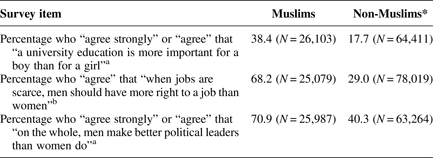
As Table 1 shows, Muslims express markedly more traditional views toward gender inequality than non-Muslims do across all three questions.Footnote 3 No countries or specific religious denominations skew the data distribution in such a way that should make us suspicious of outlier effects. Yet, while Muslims demonstrate more traditional views than non-Muslims do, we do see some meaningful differences in level of agreement with the survey questions, from a low of 38.4% of Muslims agreeing that university education is more important for a boy to 70.9% of Muslims agreeing that men make better political leaders.
Mean scores on indicators of attitudes toward gender inequality for Muslims and non-Muslims

* Includes all individuals who adhere to a religious denomination other than Islam as well as individuals who did not state adherence to a religious tradition.
a This question was not asked in Austria, Belgium, Belarus, Croatia, Czech Republic, Denmark, Estonia, Greece, Hungary, Iceland, Ireland, Israel, Latvia, Lithuania, Luxembourg, Malta, Portugal, and Slovakia.
b This question was not asked in Colombia and Israel.
Our statistical analysis is based on hierarchical level modeling, which allows us to examine the levels of analysis upon which our hypotheses operate and to consider individual- and country-level sources of variation in an individual's attitudes. In order to test the hypothesis that self-identification as a Muslim leads to attitudes more supportive of gender inequality, we include a variable “Muslim” that is coded “1” if the individual self-identified as a Muslim and “0” if he or she identified with any other religion or no religion. To test the hypothesis that there is a societal-level influence in which living in a country with more Muslims generates more favorable attitudes toward gender inequality, we include a variable on the percentage of the population that identifies as Muslim (Association of Religious Data Archives 2010).
Finding an appropriate indicator to test our hypotheses about religiosity is challenging. The WVS includes a question about attendance at religious services. The item suffers from two notable short-comings. First, the question was not translated uniformly across countries. In some Muslim-majority countries, such as Malaysia, respondents were asked how often they prayed, while in others, such as Indonesia, they were asked specifically about religious service attendance.Footnote 4 Consequently, it is impossible to gain an accurate comparative measure of behavior cross-nationally. Alexander and Welzel (Reference Alexander and Welzel2011) use this WVS question to measure religious attendance, raising questions about their findings of more frequent attendance among Muslims than non-Muslims. While non-Muslims likely gave information about religious attendance, some Muslims reported rates of attendance while others reported frequency of prayer. Because both types of Muslim responses are conflated within the same survey measure, it is impossible to know if the effect detected by Alexander and Welzel reflects greater levels of attendance among Muslims. Second, while it is tempting to view Muslim attendance at mosque services for Friday prayer as equivalent to Christian attendance at Sunday services, this comparison embeds a structure that risks under-estimating the religiosity of Muslim women. The problem is not simply that women are not obliged to attend Friday prayer, but that in many Muslim communities their attendance is discouraged. In some societies it is even not permitted and all mosque worship space is reserved for men. It is therefore advisable to rely on an attitudinal measure, rather than self-reporting on frequency of prayer or attendance at services, to measure religiosity and test hypotheses about its effects.Footnote 5 We include individuals’ scores on the question, “How important is God in your life?,” to which respondents give a number on a scale ranging from 1–10, with 10 indicating greatest importance.Footnote 6 We also created an aggregate religiosity score for each country by determining the mean results to this question for all survey respondents in the country. These two separate measures, one for individuals and one for the societies in which they live, allow us to test for individual-level religiosity as well as the effect of living in a society with higher (or lower) average levels of religiosity.
We test hypotheses about region with two variables: a dummy variable coded “1” if a country is in the Middle East or North Africa (MENA) and “0” if it is not, and a second dummy variable coded “1” if a country is an Arab League member and “0” if it is not. In order to test the fuels hypothesis, we include a variable for fuels as a percentage of merchandise exports in the year 2000. We test this variable as a predictor of a country's mean outcome on attitudes toward gender inequality.
To test the hypotheses about structural inequality, we use two indicators that best reflect the nature of the inequality examined in the question. For the survey questions on university education and preferential treatment in jobs, we test the possibly confounding effect of the female-to-male earned income ratio, which is taken from the United Nations Development Programme's Human Development Report from the earliest year available that is closest to the years of the WVS. Most data were taken from the 2001 report, which provides figures from 1999, but additional figures were filled in from later years as necessary. Our selection of this measure of structural inequality is based on the following logic: If male labor is valued to a greater extent than female labor, as evidenced by a low earned income ratio, this situational factor may help explain attitudes that favor preferential male access to education and jobs. Respondents in the survey who live in societies with a low earned income ratio may or may not believe that women are by nature less valuable employees, but they may perceive that female labor in practice is less well remunerated. Thus, regardless of their normative inclinations (that is, their view of that way they believe things should be), respondents may, based on their positive assessments (that is, their evaluation of the way things are), express inegalitarian opinions on gender.
For the survey question on political leaders, we examined the percent of seats in the parliament held by women as an indicator of female inclusion in political leadership. This measure of structural-situational inequality was selected based on the notion that an attitudinal bias against women in politics may be a product of circumstances in which individuals have had fewer opportunities to observe women in positions of political leadership. Since the mechanism we are testing is women's visibility in political roles, it is unimportant whether or not women's seats in parliament are ensured via quotas. Data for this measure were also taken from the Human Development Report from the earliest year available that is closest to the years in the WVS.
We test for an interaction between sex and religious identification using two different approaches. First, we test a simple multiplicative interaction between the variables “Muslim” and “Male,” which, if statistically significant and positive, would tell us that this intersection of sex and creed is particularly problematic for generating attitudes favoring gender equality. Second, we estimate a cross-level interaction term, the percentage of a population that is Muslim, to test whether countries with a higher percentage of Muslims differ from countries with a lower proportion of Muslims in terms of the strength of association between being a man and attitudes toward gender inequality. If this variable is found to be statistically significant, then we have evidence that the size of the Muslim population enhances the strength of sex as a predictor of attitudes. Additionally, we test a similar cross-level interaction term with the Arab League variable to determine whether Arab countries differ from non-Arab countries regarding the strength of association between being a man and traditional attitudes. A statistically significant coefficient on this variable tells us that sex is a stronger predictor of attitudes toward gender inequality in Arab countries.
In order to account for other factors that may correlate with the size of a country's Muslim population, level of religiosity, or attitudes toward gender inequality, we control for several potential confounding variables. At the individual level, we examine sex, age, and educational attainment. Similarly, we anticipate that several country-level factors, namely level of economic development and political openness, may shape attitudes toward gender inequality. Lower levels of economic development and political openness have generally correlated with greater tolerance toward gender inequality. In order to measure level of economic development at the country level, we include a control for the log of gross domestic product (GDP) per capita in U.S. dollars in 1998. Average Freedom House (2011) scores on political rights and civil liberties from the years 1994 through 1998 are included as a measure of political openness, with the scores reversed so that higher numbers represent greater political openness.
In the interest of space, the tables below include the 10 primary specifications for two of the survey questions. We do not provide analysis and discussion on the first question listed in Table 1 regarding access to university education because the trends revealed in statistical models of that question closely parallel the results for the question on job scarcity. In the following tables, the first model examines only individual-level predictors of attitudes toward gender inequality. The second then adds the country-level variables for GDP per capita and percent Muslim. The remaining models test the other hypotheses. The limited number of countries in the sample constrains the number of independent variables we can test in a single model, necessitating that we examine country-level variables one at a time.
STATISTICAL ANALYSIS
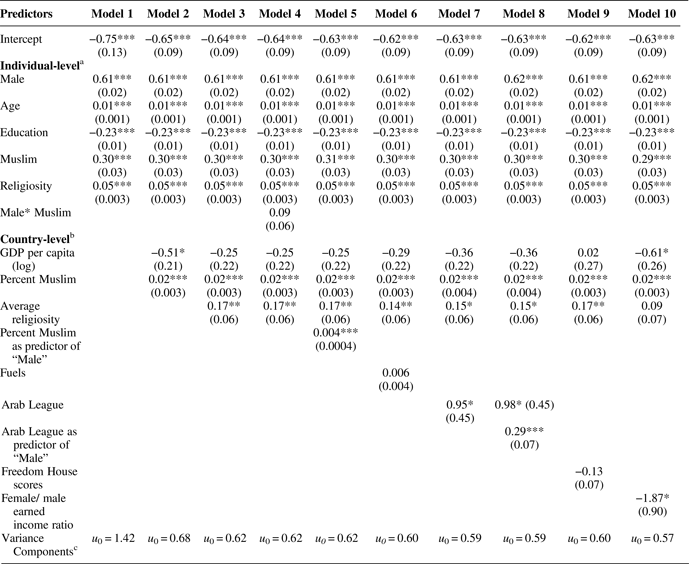
We begin, therefore, with examination of the question on employment opportunity. The models in Table 2 analyze agreement with the statement “When jobs are scarce, men should have more right to a job than women” using hierarchical generalized linear models (HGLM). HGLM is the appropriate technique for this question, in which observations are nested within countries, yielding two potential sources of variation: differences between individuals and differences between countries. Because our dependent variables are binary, we use a logistic link function. The variance partition coefficient for this question is 0.28, so 28% of the variance in attitudes toward preferential job access for men is due to differences between countries, while 72% is due to differences between individual-level characteristics.
HGLM analysis of statement: “when jobs are scarce, men should have more right to a job than women” (1 = agree, 0 = neither agree or disagree/disagree)

Entries are restricted maximum likelihood coefficients calculated using the Stata 11 “xtmelogit” command.
N = 100,428 in 81 countries except Model 10 which has 95,549 observations in 78 countries. Lack of data on earned income ratios in Iraq, Serbia, and Taiwan necessitated dropping these cases.
a All individual-level variables are centered at the group mean.
b All country-level variables are centered at the grand mean.
c The variance component for a null model including only the random Level-2 intercept is u 0 = 1.29.
*p < 0.05; **p < 0.01; ***p < 0.001.
The models in Table 2 show that self-identification as a Muslim has a statistically significant and positive effect on the likelihood of endorsing unequal access to employment. The percentage of a country's population that is Muslim also has a statistically significant and positive effect. Individuals who live in a country with a higher percentage of Muslims have a greater likelihood of endorsing unequal access to employment than those living in a country that has a lower percentage. Personal religiosity at the individual level, measured by a respondent's score on the importance-of-God scale, is a statistically significant and positive predictor of attitudes toward employment rights as well. A country's level of religiosity, measured by its average score on the importance-of-God scale, is also statistically significant and positive. Living in a more religious country increases the likelihood that one will agree that men should enjoy privileged access to jobs.
Regarding other individual-level variables, being a male has a positive effect on the likelihood of agreeing that when jobs are scarce, men should have more right to a job than women. Likewise, age is statistically significant and positive; as age increases, the likelihood of agreement becomes higher. The relationship between education and agreement is negative; the greater one's education level, the lower the likelihood of agreeing that unequal access to employment is justifiable. With the exception of Model 10 (discussed below), GDP per capita is not statistically significant.
What about our other hypotheses? The interaction term between male and Muslim is not statistically significant (Model 4), while living in a country with a greater percentage of Muslims enhances the effect of sex as a predictor of attitudes favoring gender inequality (Model 5). In other words, as the size of a country's Muslim population increases, the effect of being a man on approving of unequal access to employment becomes stronger. Men in countries with large Muslim populations are much more likely to hold traditional attitudes than women in those same societies. Similarly, the Arab League dummy variable (Model 7) and the interaction term between sex and Arab League membership (Model 8) are both statistically significant and positive. Living in an Arab country increases the likelihood of supporting inequality in job opportunity and also strengthens the effect of sex as a predictor. The inclusion of Arab League, however, does not diminish the size of the coefficient for the percentage of the population that is Muslim. The MENA dummy (not shown), Freedom House scores (Model 9), and fuels dependence (Model 6) are not statistically significant. On the whole, the findings from these models suggest that the size of the Muslim population in a country has an adverse effect on attitudes toward gender inequality, and that this effect is independent of a similarly negative effect derived from living in an Arab country.
How does structural inequality shape attitudes? As Model 10 shows, the female-to-male earned income ratio is a statistically significant and negative predictor: The higher the ratio, the less likely individuals are to agree that men have more of a right to a job than women. Thus, in countries where women's earnings are closer to men's, individuals are more likely to valorize employment access for women. Once earned income ratio is taken into consideration, moreover, GDP per capita also becomes statistically significant. Yet the variable for percent Muslim is virtually unchanged by the introduction of this structural inequality measure, and the proportion of the population that is Muslim continues to exert an independent effect on attitudes. From these data alone, it is impossible to establish causal direction. Perhaps earned income ratios are higher in some countries because greater value is placed on female workforce participation. In any event, the correlation between attitudes and this measure of structural inequality is apparent. Still, the relationship does not reduce the effect of the variable for percentage Muslim, suggesting that religious self-identification influences attitudes even when structural inequality is taken into consideration.
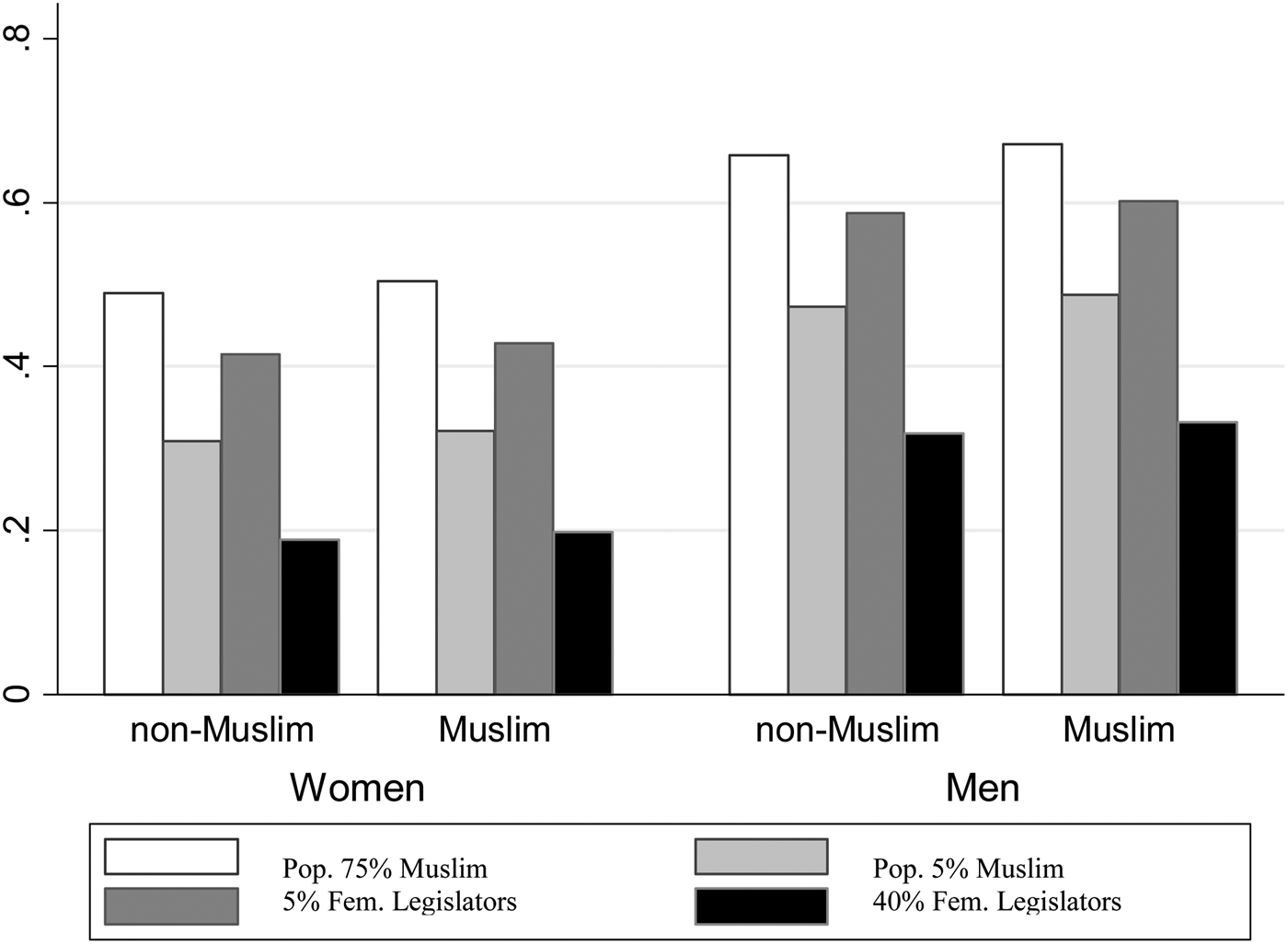
In order to better understand the magnitude of differences between Muslims and non-Muslims according to the models estimated in Table 2, we graph predicted probabilities of supporting unequal access to employment based on Model 10. Figure 1 includes predicted probabilities for Muslim and non-Muslim men and women with education, age, and religiosity equivalent to their countries’ averages and GDP per capita and aggregate religiosity held to the global average. We vary the size of the Muslim population and the earned income ratio to better understand the effect of these variables on the predicted probability of agreeing that men should have greater access to employment than women. The first two bars in each set of Figure 1 display predicted probabilities varying the size of the Muslim population from 75% to 5% while holding the earned income ratio at the global mean of 0.51. The final two bars vary the size of the earned income ratio from 0.25 to 0.75 while holding the Muslim population constant at the global mean of 24.14%. We see that, generally speaking, the differences in predicted probabilities between sexes are greater than the differences between Muslims and non-Muslims. Under all conditions graphed here, Muslim men have the greatest predicted probability of endorsing inequality in job opportunity, followed by non-Muslim men, Muslim women, and non-Muslim women. In other words, being a Muslim per se has an effect on the probability of adopting a traditionalist attitude about gender inequality, but that effect is modest, and being a man corresponds to a considerably stronger probability of traditional attitudes. Both the religious identification and the sex of the respondent matter, but sex matters more.
Predicted probabilities of “agreeing” that, “When jobs are scarce, men should have more right to a job than women” (Model 10 from Table 2).

Living in a country with a larger Muslim population greatly boosts this effect. We see that altering the size of the Muslim population from 75% to 5% reduces the predicted probability of agreement by almost half for women and almost a third for men. Figure 1 also shows that variation in the earned income ratio has a sizeable effect on predicted attitudes across all individuals: In a society in which the earned income ratio is 0.25, a Muslim man has a predicted probability of about 0.56 of endorsing inequality in job opportunity; in a society in which the earned income ratio is 0.75, that probability drops to 0.33. This range roughly mirrors the actual empirical range of the cases in our data, from a low earned income ratio of 0.21 in Saudi Arabia to a high of 0.75 in Ghana. Contextual factors — here, the confessional composition of society and the earned income ratio — appear to shape attitudes about employment access. Nevertheless, regardless of the size of the Muslim population or the earned income ratio, we observe the same patterns of agreement, in which Muslim men display traditional attitudes most frequently, followed by non-Muslim men, Muslim women, and non-Muslim women. That said, however, as the figure shows, the contextual factors and the sex of the respondent appear to influence responses much more strongly than does whether the respondent is a Muslim or a non-Muslim.
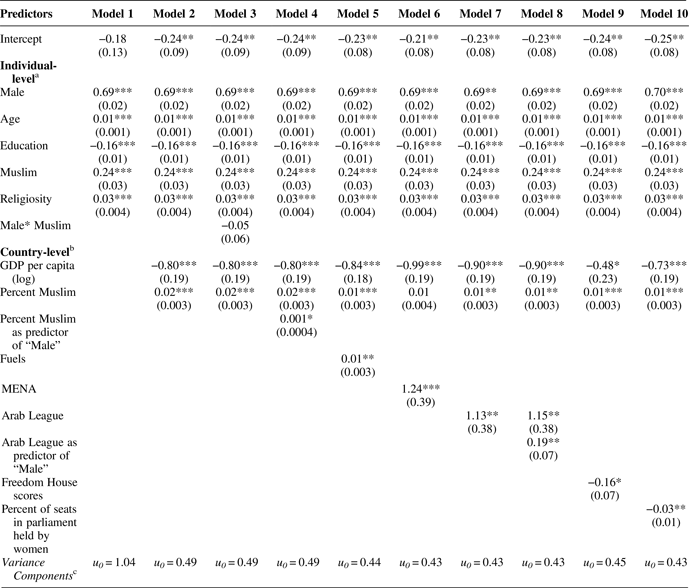
Let us turn to the question on political leadership. Table 3 presents HGLM analyses of agreement with the statement, “On the whole, men make better political leaders than women do.” The variance partition coefficient for this model is 0.23, indicating that 23% of the variance in the dependent variable is due to differences between countries, while 77% is due to differences between individuals. Table 3 shows broad similarities with the previous indicator. Identification as a Muslim has a statistically significant and positive effect on the likelihood of agreeing that men make better political leaders. Having a higher level of education has a negative effect on favoring male political leaders, while older age, being a male, and being more religious boost the chance of agreement. GDP per capita is statistically significant and negative; people living in wealthier countries, on average, are less likely to agree that men make better political leaders. In contrast to the previous model, average-level religiosity (not shown) is not statistically significant.
HGLM analysis of the statement: “on the whole, men make better political leaders than women do” (1 = “agree” or “strongly agree,” 0 = “disagree” or “strongly disagree”)

Entries are restricted maximum likelihood coefficients calculated using the Stata 11 “xtmelogit” command.
N = 87,346 in 65 countries except Model 9, which has 86,126 observations in 64 countries. Lack of data on the percentage of seats held in parliament by women in Serbia necessitated dropping this case.
a All individual-level variables are centered at the group mean.
b All country-level variables are centered at the grand mean.
c The variance component for a null model including only the random Level-2 intercept is u 0 = 0.97.
*p < 0.05; **p < 0.01; ***p < 0.001.
The percentage of the country's population that is Muslim is generally positively correlated with agreement with the notion that men make superior political leaders. Only when we include the MENA dummy (Model 6) does the percent Muslim variable cease to be statistically significant. The Arab League variable is also statistically significant and positive. As we would expect, the variables for percent Muslim, MENA, Arab League, and fuels are all strongly and positively correlated, ranging from a low of 0.42 between fuels and percent Muslim and fuels and Arab League membership, to a high of 0.79 between MENA and Arab League membership. These variables are also highly, though negatively, correlated with Freedom House scores, ranging from a low correlation of -0.43 between Arab League membership and Freedom House scores to a high of -0.61 between percent Muslim and Freedom House scores. Consequently, because of multi-collinearity, when all variables are included in a model, none are statistically significant. For this reason it is impossible to determine which of these variables most accurately reflects the underlying, robust correlation between each of the individual variables and attitudes toward gender inequality.
As with the previous questions, we find mixed support for the hypotheses on the interaction of sex and creed. The interaction between being a Muslim and being a man (Model 3) is not statistically significant, yet the cross-level interaction between the percent of inhabitants who are Muslims and being a man is (Model 6). Higher concentrations of Muslims in a country magnify the differences in how the sexes view political leadership. Additionally, the interaction term between Arab League membership and sex is also statistically significant and positive (Model 8), showing men living in Arab countries have an even stronger preference for male political leadership than do men living outside the Arab world.
With regard to structural inequality, we find that the percent of seats in parliament held by women is statistically significant and negative; the greater the presence of women in a country's legislature, the less likely individuals are to regard men as better political leaders. As with the question on job access, the percent Muslim variable remains unchanged when we include the measure of structural inequality. Both the size of the Muslim population and the presence of women in positions of political power exert independent effects on attitudes towards female political leaders.
In order to make better sense of these potential effects, we again calculate several predicted probabilities. Figure 2 graphs predicted probabilities for Model 10 of Table 3 for Muslim and non-Muslim men and women while holding age, education, and religiosity at respondents’ country means and while holding GDP per capita at the global average. The percentage of the population that is Muslim and the percentage of female parliamentarians are varied to help untangle the strength of effects. The first two bars for each subgroup in Figure 2 vary the size of the Muslim population while holding the percentage of female parliamentarians at the global mean of 12.91. The last two bars hold the Muslim population at the global mean of 24.14% while varying parliamentary seats held by women. The empirical range for female representation in parliament in our data extends from a low of zero in Saudi Arabia to a high of 42.7% in Sweden.
Predicted probabilities of “agreeing” or “strongly agreeing” that, “On the whole, men make better political leaders than women do” (Model 10 from Table 3).

Again there is a greater difference in the predicted probabilities between men and women than between Muslims and non-Muslims. According to Figure 2, the highest predicted probability is for a Muslim man living in a country that is 75% Muslim with an average level of female representation in parliament. By shifting the size of the Muslim population from 75% to 5%, we see that the predicted probability of agreement drops about one-quarter for men and one-third for women. In other words, regardless of the size of female representation in parliament or one's own religious self-identification, the size of the Muslim population has a substantial effect on attitudes toward the suitability of women compared to men for public office. The differences in predicted probabilities vary even more substantially when we hold the size of the Muslim population constant while varying the percentage of women in parliament. When shifting from 5% to 40% female representation while holding the Muslim population at the global mean, the predicted probability of agreeing that men make better political leaders drops by almost half for men and by more than half for women. While both the size of the Muslim population and the extent of female representation in parliament influence attitudes, the presence (or absence) of women in positions of political power appears to have a greater effect on attitudes about female political access than does the size of the Muslim population. Moreover, it bears to note that the contextual factors and respondent's sex appear to shape responses much more strongly than does whether the respondent is a Muslim or a non-Muslim.
While the models elaborated for the two survey questions above show several similarities, there are also some meaningful differences. Of greatest importance is the relative strength of the measures of structural inequality as predictors. From the predicted probabilities graphed in Figure 1, we see that varying the size of the Muslim population or the size of the female-to-male earned income ratio has a similar effect on the predicted outcome. Both matter, and neither religious composition (measured as the proportion of the population that is Muslim) nor structural inequality (measured as earned income ratio) can be said to be a stronger predictor.Footnote 7 Yet, for the question on political leadership, it is clear from Figure 2 that varying the size of female representation in parliament has a more dramatic impact on attitudes than does varying the size of the Muslim population. Seeing women in positions of political power appears to substantially loosen traditional attitudes and to have a stronger effect than does having a proportionally smaller Muslim population.
Another comparison of the dependent variables that merits discussion is the differences in overall predicted probabilities across indicators. When we calculate predicted probabilities of agreement with the three survey questions under investigation, we find that the overall likelihood of agreement varies considerably from question to question, suggesting that individuals are more tolerant and accepting of inequality in some domains than others. For illustrative purposes, we calculated predicted probabilities that varied individual-level characteristics while holding all country-level parameters at the global means. In particular, we looked at predicted probabilities of agreement for a 30-year-old individual with a high school education, varying the religious identification and sex of the respondent. Our hypothetical 30-year-old Muslim man has a predicted probability of only 0.21 of agreeing that men should have preferential access to university education. In other words, he only has a one-in-five chance of supporting inequality. In contrast, at 0.42, the predicted probability of agreement that men should have preferential job access is considerably higher for the same hypothetical 30-year old Muslim man, suggesting that his tolerance for inequality rises under the threat of economic scarcity. The predicted probability of supporting inequality increases again when asked about political leaders. The same 30-year old hypothetical Muslim man demonstrates a predicted probability of 0.52 of agreeing that men make better leaders. In other words, he is more likely to agree than disagree that men are superior politicians. In contrast, the predicted probabilities for the hypothetical 30-year old non-Muslim man, Muslim woman, and non-Muslim woman are below 0.50 for all three questions. These predicted probabilities suggest that while adherence to Islam may incline one to more traditional attitudes in general, the strength of support across different domains of activity varies. Moreover, with the exception of the hypothetical 30-year old Muslim male's predicted response to the question on political leaders, ceteris paribus, young, high-school educated individuals are more likely to disagree with gender inequality than support it.
SUMMARY OF RESULTS
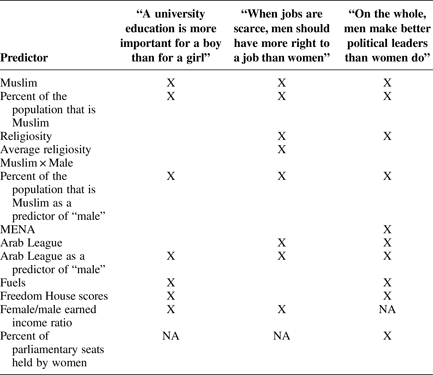
We tested multiple hypotheses regarding the possible effects of being Muslim, living in a predominantly Muslim society, individual- and societal-level religiosity, sex, location in the MENA and Arab League, fuels dependence, and structural indicators of gender inequality on attitudes toward gender inequality. Table 4 summarizes the findings. An “X” appears where we find statistically significant evidence of a relationship between the variable and agreement with the survey question that favors gender inequality. Being a Muslim and living in a society with proportionately more Muslims are consistent predictors of higher rates of endorsement of gender inequality. The proportion of the population that is Muslim predicts the strength of the effect of one's sex on attitudes toward gender inequality in all three questions. Similarly, living in a country that is in the Arab League also predicts the strength of the effect of one's sex on attitudes toward gender inequality. Additionally, our measures of structural gender inequality — the earned income ratio and the percentage of women in parliament — were statistically significant predictors of attitudes.
Summary of variables that predict agreement with statements supporting gender inequality

The findings for the rest of the hypotheses are mixed, suggesting that while Muslim self-identification and Muslim community dynamics shape attitudes toward inequality across different domains of activity, they do not tell the full story. Some of the variables that we included as controls are statistically significant for some of the survey questions. Our findings suggest that attitudes toward women as political leaders are particularly traditional in the Middle East and Arab lands, yet we do not see evidence supporting a regional explanation for traditional attitudes toward education and employment access. Additionally, while there appears to be some evidence that higher religiosity increases acceptance of gender inequality in the spheres of employment and politics, it does not play a role in shaping attitudes about education. Moreover, in only one instance did the inclusion of a control variable render one of our main variables of interest out of statistical significance. In Table 3, Model 6, we see that the MENA variable was a statistically significant predictor of agreement that men make better political leaders, but the percent Muslim variable is not statistically significant. What is more, while religiosity, location in the Middle East or an Arab country, and fuel exports do correlate with the size of the Muslim population, they are less consistent predictors of gender inequality than is religious identification. While these variables may play a contributing role to attitude formation, we have scant evidence that a correlation between Muslim self-identification and more traditional attitudes toward gender inequality is the sole product of the contextual factors we include as controls in our models.
These results provide clear evidence for three conclusions: First, self-identification as a Muslim and the proportion of the country made up of Muslims are good predictors of attitudes supportive of gender inequality, even while other factors exhibit their own independent effects. While Muslim religious identification may overlap with other variables that correlate with attitudes toward gender inequality, the inclusion of these confounders does not render religion meaningless. Second, an individual's sex has an even stronger effect on attitudes than does religious identification. Non-Muslim men have a greater likelihood of favoring gender inequality than do Muslim women, and the strength of sex as an independent predictor of attitudes is robust even when controlling for religion. A similar dynamic is also present among men in Arab countries, but the phenomenon is not exclusive to Arab Muslims. Third, structural inequalities appear to affect attitudes. As female-to-male earned income ratio increases, support for preferential male access to education and employment decreases; and as the percentage of women holding legislative seats increases, attitudes about women's capability as political leaders become more favorable. The effects of these variables do not disappear when we consider other contextual elements, such as GDP per capita, education, age, location in the MENA or Arab world, fuels dependence, and political openness. Structural inequalities therefore reinforce conservative attitudes on gender inequality.
CONCLUDING THOUGHTS ON METHOD AND FINDINGS
Our investigation demonstrates the advantages of a multi-level approach. Guided by a desire to work across the micro-macro divide and by the Durkheimian notion that the whole might influence the parts in meaningful ways, our theoretical hypotheses allowed for the possibility that societal-level factors might affect individual attitudes, and we saw merit in accounting for interactions between societal- and individual-level variables. Testing our hypotheses and grappling with possible interactions across the micro-macro divide required multi-level modeling — an invaluable tool for assessing the relationship between attitudes and broader structures.
The empirical analysis presented here shows that even when structural factors are taken into consideration, self-identification as Muslim and living in a society with a largely Muslim population inclines one to hold more traditional attitudes. We also find that one's own sex is of no small consequence in predicting attitudes toward gender inequality, and that the attitudinal differences between the sexes sharpen as the size of a country's Muslim population increases. These findings suggest that the correlation between Islam and more traditionalist attitudes on gender inequalities is not necessarily spurious, leading us to ask if there is something about Islam itself that is conducive to greater acceptance of gender inequality.
While we lack a full explanation for the link between Islam and attitudes toward gender inequality, we may note that a substantial and growing body of literature points to the prominence of fiqh on legal orders and popular thinking in Muslim societies (Barlas Reference Barlas2002; Fattah Reference Fattah2006; Wadud Reference Wadud1999). As discussed above, the tradition of privileging the earliest fiqh texts may be of particular importance. Regardless of how potent the early jurists’ intellects may have been, their reasoning and writings were naturally products of their times. And since most problems of jurisprudence are not settled in the Qur'an itself, the scholars who established the classics of fiqh naturally relied upon their own powers of reasoning. What emerges as a possible religious basis for gender inequality is the existence of a legal tradition rooted in religion itself, combined with the matchless prestige of the early, classical writings within that tradition.
Another possible explanation that is beyond our ability to explore with available data is that religious praxis reinforces traditional attitudes about gender inequality, whether or not the praxis is rooted in a particular tenet of sacred scripture. Is there something about praying five times a day in sex-segregated quarters that contributes to a sense of inequality between the sexes that is qualitatively different from the Christian religious practice of attending integrated services once per week? Is the absence of female religious leaders (which is also true of Catholic and Orthodox Christianity) a practice that subtly (if unintentionally) communicates a sense that women are less capable of leadership? When religious praxis is intimately intertwined with local customs and other daily-life rituals, views that may not be ascribed to sacred texts can be believed to enjoy religious legitimation. Given Muslims’ belief that the Qur'an can be fully grasped only in its original Classical Arabic, one can imagine that the words and behaviors of religious leaders — and hence their interpretations — hold great sway among many ordinary Muslims, including the 80% of the world's Muslims who are not Arabs.
The ruminations provided here are speculative. They are based on counterfactual reasoning and cannot readily be tested with available data. They merit mention, however, and deserve the attention of scholars who seek to grasp — and loosen — the link between a religious tradition and gender inequality.
APPENDIX: SURVEY INFORMATION
World Values Survey List of Countries (survey year)
Albania (2002); Argentina (2006); Australia (2005); Austria (1999); Bangladesh (2002); Belarus (2000); Belgium (1999); Bosnia and Herzegovina (2001); Brazil (2006); Bulgaria (2006); Burkina Faso (2007); Canada (2000); Chile (2006); China (2007); Colombia (2005); Croatia (1999); Cyprus (2006); Czech Republic (1999); Denmark (1999); Egypt (2008); Estonia (1999); Ethiopia (2007); Finland (2005); France (2006); Germany (2006); Ghana (2007); Great Britain (2006); Greece (1999); Hungary (1999); Iceland (1999); India (2006); Indonesia (2006); Iran (2005); Iraq (2006); Ireland (1999); Israel (2001); Italy (2005); Japan (2005); Jordan (2007); Kyrgyzstan (2003); Latvia (1999); Lithuania (1999); Luxembourg (1999); Macedonia (2001); Malaysia (2006); Mali (2007); Malta (1999); Mexico (2005); Moldova (2006); Morocco (2007); Netherlands (2006); New Zealand (2004); Nigeria (2000); Pakistan (2001); Peru (2006); Philippines (2001); Poland (2005); Portugal (1999); Romania (2005); Russia (2006); Rwanda (2007); Saudi Arabia (2003); Serbia (2006); Singapore (2002); Slovakia (1999); Slovenia (2005); South Africa (2007); South Korea (2005); Spain (2007); Sweden (2006); Switzerland (2007); Taiwan (2006); Tanzania (2001); Thailand (2007); Trinidad and Tobago (2006); Turkey (2007); Uganda (2001); Ukraine (2006); United States (2006); Venezuela (2000); Vietnam (2006); Zambia (2007); Zimbabwe (2001).
Note: Although Algeria was included in the fourth wave of the WVS, because the question about religious denomination was not asked we did not include it in the analysis.