COGNITIVE IMPAIRMENT AND FUNCTIONING IN PTSD
Posttraumatic Stress Disorder (PTSD) was included in the third edition of the Diagnostic and Statistical Manual (DSM-III) in 1980 (American Psychiatric Association, 1980) and began to be studied from a neuropsychological perspective soon afterward (e.g., Everly & Horton, Reference Everly and Horton1989). Interest in the neuropsychological effects of stress and trauma has risen during the past decade, particularly in light of the current conflicts in Iraq and Afghanistan, along with research showing that deployment alone is a risk factor for neurocognitive dysfunction (Vasterling et al., Reference Vasterling, Proctor, Amoroso, Kane, Heeren and White2006). Research on the cognitive impairments of trauma and PTSD over the past three decades has yet to yield a consensus regarding which cognitive domains are most affected, however. Impairments have been identified in almost every cognitive domain, including premorbid intellectual functioning (Vasterling et al., Reference Vasterling, Duke, Brailey, Constans, Allain and Sutker2002), attention/working memory (Horner & Hamner, Reference Horner and Hamner2002; Samuelson et al., Reference Samuelson, Neylan, Metzler, Lenoci, Rothlind and Henn-Haase2006; Stein, Kennedy, & Twamley, Reference Stein, Kennedy and Twamley2002; Vasterling, Brailey, Constans, & Sutker, Reference Vasterling, Brailey, Constans and Sutker1998; Vasterling et al., Reference Vasterling, Duke, Brailey, Constans, Allain and Sutker2002), processing speed (Samuelson et al., Reference Samuelson, Neylan, Metzler, Lenoci, Rothlind and Henn-Haase2006; Stein et al., Reference Stein, Kennedy and Twamley2002), learning (Horner & Hamner, Reference Horner and Hamner2002; Samuelson et al., Reference Samuelson, Neylan, Metzler, Lenoci, Rothlind and Henn-Haase2006; Vasterling et al., Reference Vasterling, Brailey, Constans and Sutker1998, Reference Vasterling, Duke, Brailey, Constans, Allain and Sutker2002), and executive functioning (Bremner et al., Reference Bremner, Vermetten, Vythilingam, Afzal, Schmahl and Elzinga2004; Leskin & White, Reference Leskin and White2007). Most studies have found no association between PTSD and impairment in memory retention or recognition (see Golier & Yehuda, Reference Golier and Yehuda2002, for review). The pattern of neuropsychological impairments found across studies suggests disruption in frontal-subcortical circuits (Stein et al., Reference Stein, Kennedy and Twamley2002; Vasterling et al., Reference Vasterling, Brailey, Constans and Sutker1998, Reference Vasterling, Duke, Brailey, Constans, Allain and Sutker2002), although decreased hippocampal size and functioning have also been associated with PTSD (see Bremner, Reference Bremner2006, for review). Importantly, not all studies have found differences in cognitive functioning between PTSD and non-PTSD samples (Gurvits et al., Reference Gurvits, Lasko, Schachter, Kuhne, Orr and Pitman1993; Stein, Hanna, Vaerum, & Koverola, Reference Stein, Hanna, Vaerum and Koverola1999; Twamley, Hami, & Stein, Reference Twamley, Hami and Stein2004).
Certain aspects of trauma exposure and PTSD have been associated with high likelihood of neurocognitive dysfunction and real-world functional impairments. For example, exposure to childhood trauma is associated with worse academic performance and numerous areas of cognitive deficits (Carrey, Butter, Persinger, & Bialik, Reference Carrey, Butter, Persinger and Bialik1995; Perez & Widom, Reference Perez and Widom1994; Saigh, Mroueh, & Bremner, Reference Saigh, Mroueh and Bremner1997). Among Axis I psychiatric disorders including PTSD, greater cognitive deficits are associated with greater psychiatric symptoms and functional impairment (Geuze, Vermetten, de Kloet, Hijman, & Westenberg, Reference Geuze, Vermetten, de Kloet, Hijman and Westenberg2009; Green, Kern, Braff, & Mintz, Reference Green, Kern, Braff and Mintz2000; Kalechstein, Newton, & van Gorp, Reference Kalechstein, Newton and van Gorp2003; Marvel & Paradiso, Reference Marvel and Paradiso2004; Twamley et al., Reference Twamley, Doshi, Nayak, Palmer, Golshan and Heaton2002). Therefore, cognitive impairments are an important area of focus in PTSD research. However, a consistent picture of the neuropsychological sequelae of PTSD has been elusive, partly due to the numerous confounds associated with trauma exposure. Potential factors that result in inconsistencies across samples include: variation in the history of PTSD (e.g., number, timing, spacing, and severity of traumatic events; age of onset, severity, and chronicity of PTSD symptoms); variation in types of traumatic events (e.g., betrayal-related trauma such as rape or incest, nonbetrayal events such as accidents or acts of nature, and other events such as killing or being injured in combat or terrorist attacks); and variation in comorbid conditions (e.g., current or historical depression, substance use disorders, dissociation, brain injury, or other medical illnesses known to affect cognition).
Our program of research on PTSD-associated neuropsychological impairment has attempted to reduce the influence of some of these factors by focusing on one type of trauma—domestic or intimate partner violence (IPV). We have limited our trauma sample to women survivors of IPV. Thus, each of the women experienced betrayal trauma, which has been shown to result in a greater likelihood and severity of posttraumatic symptoms (Freyd, Reference Freyd1996; Freyd, Klest, & Allard, Reference Freyd, Klest and Allard2005). All of the women in our sample experienced trauma during adulthood (although some also experienced childhood trauma), and none had comorbid alcohol or substance use disorders when they participated in our research. Furthermore, we do not include women with comorbid medical conditions or medications that could affect brain functioning. In previous studies of women who meet these criteria, we have found impairments primarily on timed tasks of attention/working memory, inhibition, and switching (Stein et al., Reference Stein, Kennedy and Twamley2002). To further examine these executive functioning domains, the current study included an expanded neuropsychological battery with finer-grained assessments of executive functions in a new sample of women survivors of IPV.
We hypothesized that compared with non-traumatized comparison participants (NCs), PTSD participants would perform worse on neuropsychological tests of executive functions, particularly timed tasks. Furthermore, we expected that within the PTSD group, worse neuropsychological performance would be associated with greater childhood history of trauma, more severe current psychiatric symptoms, and greater levels of functional disability.
METHOD
Participants
From a larger initial sample, 3 PTSD participants with low levels of education (≤10 years) and 11 NC participants with high levels of education (≥21 years) were excluded from the current study to create groups that did not differ statistically on education. The final sample of participants included 55 women with full or partial PTSD related to IPV experienced within the past 5 years and 20 women who never experienced IPV and never met full or partial criteria for PTSD (current or lifetime) related to any trauma (NCs). Participants were recruited through ads in a local events and entertainment magazine, on a community volunteer Web site, and flyers distributed to community agencies (including agencies that provide IPV-related services). Of the 55 subjects with IPV exposure, 48 met full DSM-IV criteria for PTSD, while seven partially met criteria for PTSD (i.e., fulfilled Criterion A and the impairment/distress criterion, and had one less symptom than necessary to fulfill C or D criteria). Excluding the seven subjects with partial PTSD did not change the results in any meaningful way. Therefore, they were included in the PTSD group. Partial PTSD has been associated with the same level of distress and impairment as full PTSD (Stein, Walker, Hazen, & Forde, Reference Stein, Walker, Hazen and Forde1997), although this has not been observed uniformly across studies (Breslau, Lucia, & Davis, Reference Breslau, Lucia and Davis2004).
Participants were excluded for factors known to affect neurocognitive functioning because these would interfere with understanding the relationship between cognitive functioning and PTSD. These exclusion criteria were: (1) current abuse of alcohol or other substances; (2) abuse of alcohol or other substances for a period of 5 years or more; (3) use of psychotropic medication within the last 4 weeks (fluoxetine within the last 6 weeks) or steroids in the past 4 months; (4) history of bipolar disorder, schizophrenia, attention deficit disorder, learning disability, loss of consciousness greater than 10 min or requiring hospitalization for 24 hr or more, or any neurological illness; and (5) English reading ability below the 8th grade level.
PTSD participants were not excluded if they had other mood disorders, such as major depressive disorder, because comorbid mood disorders are common among patients with PTSD and excluding them would have yielded a non-representative sample. NCs were excluded if they had any DSM-IV Axis I disorder. All participants gave informed written consent to participate in this study, which was approved by the University of California San Diego Human Research Protection Program and the VA San Diego Healthcare System Research and Development Review Committee.
Procedure
After obtaining verbal informed consent, a telephone interview was used to screen potential participants for the inclusion and exclusion criteria above and to gather demographic data. Callers were asked first about IPV history. If present, the Posttraumatic Stress Disorder Checklist - Civilian (PCL-C; Weathers, Litz, Herman, Huska, & Keane, Reference Weathers, Litz, Herman, Huska and Keane1993) was administered with regard to the IPV history. This brief, widely used self-report instrument was used to quantify PTSD symptoms and assess the likelihood of PTSD. If the caller met all criteria, she was invited for an in-person interview (see measures below). If the caller denied IPV history, she was asked about other trauma history and screened for PTSD using stem questions from the PTSD section of the Structured Clinical Interview for DSM-IV Axis I Disorders (SCID-I; First, Spitzer, Gibbon, & Williams, Reference First, Spitzer, Gibbon and Williams2002).
To screen for other disorders, the telephone interview included stem questions from other diagnostic categories in the SCID-I. Screeners administered stem questions from the psychotic and bipolar disorder sections to all callers and additionally the major depression, panic, generalized anxiety, and PTSD stem questions to potential NCs. When a caller answered any of the stem questions in the positive, the screener administered the full section of the SCID for that disorder. Screeners were doctoral level clinicians.
All participants gave written informed consent at their initial in-person visit. IPV participants completed a set of diagnostic interviews in person, took home a set of questionnaires to complete, and were administered a neuropsychological assessment battery at a subsequent visit within 6 weeks. NCs underwent neuropsychological testing and completed the take-home questionnaires, but were not administered further diagnostic interviews.
Measures
IPV participants were administered the Clinician-Administered PTSD Scale (CAPS; Blake et al., Reference Blake, Weathers, Nagy, Kaloupek, Gusman and Charney1995), a standard semi-structured interview to assess PTSD status and severity. Respondents were asked to describe the most traumatic IPV event(s) they experienced in their most recent abusive relationship, to be used as the basis of assessing PTSD. The CAPS assesses the frequency and intensity of each of the 17 items from the DSM-IV criteria B, C, and D during the past month. The F1/I2 method of scoring was used in the current study to determine diagnostic status (Weathers, Keane, & Davidson, Reference Weathers, Keane and Davidson2001), and a severity score was computed by summing the frequency and intensity scores over all 17 items. Ten percent of the CAPS outcome assessments were randomly selected throughout the study for audiotape review to establish inter-rater reliability. The intraclass correlation coefficient obtained on seven CAPS independently rated by two raters was .99 for the total score.
A take-home battery of self-report questionnaires was completed by all participants, including the following measures of child abuse history, current psychiatric symptom severity, and level of functioning. The Childhood Trauma Questionnaire (CTQ; Bernstein, Fink, Handelsman, & Foote, Reference Bernstein, Fink, Handelsman and Foote1994) measures childhood maltreatment across five domains: emotional abuse, physical abuse, sexual abuse, emotional neglect, and physical neglect. The total score, ranging from 5 to 125, was used in the current study, with higher scores reflecting higher levels of childhood trauma. The Beck Depression Inventory (BDI-II; Beck, Steer, & Brown, Reference Beck, Steer and Brown1996) was used to determine the presence and severity of symptoms of depression during the past week. Higher scores indicate greater severity of depressive symptoms. The Dissociative Experiences Scale Taxon (DES-T; Waller, Putnam, & Carlson, Reference Waller, Putnam and Carlson1996) is a modified version of the Dissociative Experiences Scale that relies on a subset of eight categorical items that reflect abnormal or severe dissociative experiences. Scores on the DES-T range from 0 to 100, with higher scores reflecting higher levels of dissociative experiences. The Sheehan Disability Scale (SDS; Sheehan, Reference Sheehan1983) assessed level of disablement using visual 0 to 10 rating scales and verbal descriptive anchors in three domains: work, social life, and family/home life. Higher scores on these three subscales reflect greater levels of impairment.
All participants underwent neuropsychological testing. Premorbid intellectual functioning was measured with the American National Adult Reading Test (ANART; Grober & Sliwinski, Reference Grober and Sliwinski1991). The neuropsychological battery emphasized executive functioning, using multiple subtests of the Delis-Kaplan Executive Function System (D-KEFS; Delis, Kaplan, & Kramer, Reference Delis, Kaplan and Kramer2001). The Wisconsin Card Sorting Test (Kongs, Thompson, Iverson, & Heaton, Reference Kongs, Thompson, Iverson and Heaton2000) was used as a general measure of reasoning. Verbal learning and memory tests were not included because in our previous work, we found no difference between women with PTSD due to IPV and healthy comparison subjects on verbal learning and memory tests using story, list, or paired associate stimuli. The battery included assessments of multiple domains, including the following: (1) Processing Speed (scaled scores from the D-KEFS Trail Making Test Visual Scanning, Number Sequencing, Letter Sequencing, and Motor Speed conditions); (2) Visuoconstruction (Rey-Osterrieth Complex Figure Test copy t score; Rey, Reference Rey1941; norms from Spreen & Strauss, Reference Spreen and Strauss1998); (3) Visual Memory (Rey-Osterrieth Complex Figure Test 30-min delayed recall t score; Rey, Reference Rey1941; norms from Spreen & Strauss, Reference Spreen and Strauss1998); (4) Speeded Fluency (scaled scores from the D-KEFS Design Fluency Test [Combined Filled Dots and Empty Dots], Letter Fluency, and Category Fluency); (5) Inhibition (D-KEFS Color-Word Interference Test Inhibition vs. Color Naming scaled score); (6) Switching (scaled scores from the D-KEFS Trail Making Test Number-Letter Switching vs. Combined Number Sequencing and Letter Sequencing Contrast Score; D-KEFS Design Fluency Test Switching vs. Combined Filled Dots and Empty Dots Contrast Score; D-KEFS Category Fluency Switching vs. Category Fluency Contrast Score; D-KEFS Color-Word Interference Test Inhibition/Switching vs. Inhibition Contrast Score); (7) Reasoning (Wisconsin Card Sorting Test-64 total errors t score [WCST]; Kongs et al., Reference Kongs, Thompson, Iverson and Heaton2000).
The t scores (characterized in a normal population by a mean of 50 and standard deviation of 10) were used for the Rey-Osterrieth Complex Figure Test and for the WCST; scaled scores (characterized in a normal population by a mean of 10 and standard deviation of 3) were used for all other tests.
Analyses
All variables were normally distributed. To assess the extent to which our groups were demographically matched, we conducted t tests to compare groups on age and education, and χ2 analyses to measure distribution differences in minority status. To reduce the possibility of Type I error, hypothesized differences between the two groups were tested with MANOVA (multivariate analysis of variance; when there was more than one test per neuropsychological domain) and t tests (when there was only one test per neuropsychological domain or when the MANOVA was significant). Associations between neuropsychological performance and symptom and disability severity were tested with Pearson correlations. Alpha for significance was set at .05 for the MANOVAs and .01 for all other tests, to reduce the chance of Type I error due to multiple comparisons.
RESULTS
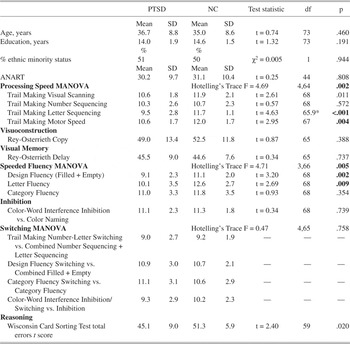
The groups did not differ statistically on age, education, ethnic minority status, or premorbid intellectual functioning as measured by the ANART (see Table 1). Within the PTSD group, the mean CAPS score was 73.3 (SD = 21.9); the mean PCL-C score was 62.3 [SD = 11.7; CAPS scores above 60 and PCL-C scores above 50 are each suggestive of PTSD (Weathers et al., Reference Weathers, Litz, Herman, Huska and Keane1993, Reference Weathers, Keane and Davidson2001)]; the mean BDI-II score was 17.9 (SD = 8.9), in the range of moderate depressive symptoms (Beck et al., Reference Beck, Steer and Brown1996); the mean score on the DES-T was 11.0 (SD = 14.3), indicative of high average levels of dissociation (Seedat, Stein, & Forde, Reference Seedat, Stein and Forde2003). PTSD participants’ mean CTQ score was 52.4 (SD = 20.4), suggesting that many participants had experienced childhood abuse. On the SDS, PTSD participants reported moderate levels of disablement in work, social, and home/family domains [means (SDs) were 5.7 (2.8), 6.7 (2.7), and 5.4 (2.9), respectively].
Comparison of demographic characteristics and cognitive function in the PTSD and NC groups (p values <.05 for MANOVAs and <.01 for other comparisons are highlighted in bold)

Note
ANART = American National Adult Reading Test; MANOVA = multivariate analysis of variance; PTSD = posttraumatic stress disorder group; NC = normal comparison group; SD = standard deviation.
* degrees of freedom adjusted for unequal variances
On the neuropsychological measures, within the PTSD group, the percentage of the sample that scored within the impaired range (<1.5 SD below the mean) was 13% on the Rey-Osterrieth copy, 17% on the Rey-Osterrieth delay, 17% on the WCST, and less than 10% on all other tests. By comparison, rates of impairment among the NC group were 14% on Rey-Osterrieth delay and less than 10% on all other tests.
In partial support of our first hypothesis, NCs outperformed participants in the PTSD group on most neuropsychological measures. However, these differences were only significant in the domains of processing speed and speeded fluency, with a trend toward significance in reasoning (see Table 1). Within the processing speed domain, the PTSD group performed worse than did the NC group on D-KEFS Trail Making Letter Sequencing and Motor Speed. Within the speeded fluency domain, the PTSD group performed worse than did NCs on D-KEFS Design Fluency and Letter Fluency. It is important to note that on all tests, the PTSD group’s mean performance was within the average range.
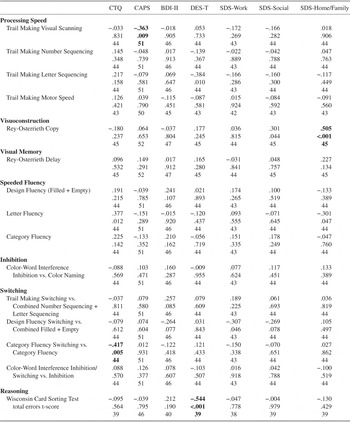
Supporting our second hypothesis (see Table 2), we found that, within the PTSD group, more severe current PTSD symptoms (measured with the CAPS interview) were associated with lower processing speed (Trail Making Visual Scan; r = −.36; p = .009). More severe dissociative symptoms (DES-T) were associated with worse reasoning (WCST; r = −.54; p < .001). More severe childhood maltreatment (CTQ) was associated with worse performance on D-KEFS Category Fluency Switching vs. Category Fluency (r = −.42; p = .005). On the SDS, unexpectedly, self-reported family/home impairment was associated with better visuoconstruction performance (Rey-Osterrieth copy; r = .51; p < .001). Current level of depressive symptomatology (BDI-II) was not associated with performance on any neuropsychological measure.
Correlations between cognitive performance and clinical variables within the PTSD group (correlation, p value, n; p-values <.01 are highlighted in bold)

Note
BDI-II = Beck Depression Inventory-II; CAPS = Clinician-Administered PTSD Scale; CTQ = Childhood Trauma Questionnaire; DES-T = Dissociative Experiences Scale-Taxon; SDS = Sheehan Disability Scale.
DISCUSSION
Although we expected PTSD participants to perform significantly worse than would NCs on tasks of executive functioning, the pattern of results showed that they differed primarily on speeded tasks (some of which involved the executive functioning domain of fluency). Thus, our results are similar to those finding PTSD-associated deficits in processing speed and executive functioning in recent U.S. veterans of the Iraq and Afghanistan conflicts (Nelson, Yoash-Gantz, Pickett, & Campbell, Reference Nelson, Yoash-Gantz, Pickett and Campbell2009). Notably, the differences we found between groups do not appear to be attributable to depressive symptom severity, as BDI-II scores were not associated with any performance on neuropsychological measure. Our PTSD sample did not differ significantly from the NC sample on any of the switching tests in the D-KEFS. It is important to note that most group differences were in the direction of NCs outperforming PTSD participants; larger sample sizes may have resulted in more statistically significant differences. However, such differences between groups may have little clinical significance, considering that the mean performance of the PTSD group on all tests was in the average range. Importantly, as a group, they were not impaired on any test. Although individuals with PTSD frequently present with subjective cognitive difficulty, previous research has found that cognitive complaints tend to be related more to psychiatric symptom severity than to actual cognitive performance (Binder, Storzbach, Anger, Campbell, & Rohlman, Reference Binder, Storzbach, Anger, Campbell and Rohlman1999; Garcia et al., Reference Garcia, Norman, Lang, Laffaye, Kennedy and Stein2004). Indeed, some well-controlled research on combat veterans with PTSD found no neuropsychological differences between patients with current PTSD, past PTSD, psychiatric comparison subjects, and healthy comparison subjects, despite large sample sizes (80 per group; Crowell et al., Reference Crowell, Kieffer, Siders and Vanderploeg2002). We found that higher levels of PTSD symptoms were associated with worse speeded attention, and higher levels of dissociation were associated with poorer reasoning performance. These results are similar to previous work finding associations between dissociation severity and greater Stroop interference (Freyd, Martorello, Alvarado, Hayes, & Christman, Reference Freyd, Martorello, Alvarado, Hayes and Christman1998).
Why would PTSD adversely affect processing speed? Cognitive slowing may be attributable to reduced attentional resources, which could be a consequence of brain resources being directed toward coping with psychological distress, unpleasant internal experiences (see DePrince & Freyd, Reference DePrince and Freyd1999, Reference DePrince and Freyd2004), or potential threats in the environment (i.e., hypervigilance) rather than the task at hand. In effect, even simple tasks could become exercises in multitasking. If people with PTSD experience micro-dissociations when confronted with intrusive memories, for example, reduced attentional resources could yield slower performance on processing speed measures. Other factors that could influence speeded tasks include sleep deficits, heightened anxiety or arousal due to the timed nature of the task, or exposure to recent PTSD-related triggers. Indeed, a recent event-related potential study linked heightened arousal to slowed central processing and attention problems in PTSD (Shucard, McCabe, & Szymanski, Reference Shucard, McCabe and Szymanski2008). Importantly, we did not find that poor performance on any test was correlated with increased level of self-reported disability (on the Sheehan Disability Scale). While this finding did not support our prediction, it is in keeping with our inference that the cognitive dysfunction seen in our PTSD sample is, at most, subtle, and unlikely to be clinically meaningful at a group level. At minimum, our failure to find a relationship between cognitive test performance and functional disability raises questions about the clinical relevance of neuropsychological dysfunction in PTSD.
Our study has several limitations. Although we restricted our sample to female victims of IPV to better understand the nature of neuropsychological dysfunction from this type of trauma, narrowing our sample also limits the generalizability of our results. However, our sample also allowed us to control for some of the common confounds (e.g., substance abuse, multiple trauma types within the same sample) in PTSD research. Although all of the women in this study met PTSD criteria based on exposure to IPV, some women had also experienced additional traumatic events. Future studies should include resilient groups of individuals with trauma exposure but without PTSD to clarify whether neuropsychological differences are associated with trauma exposure, PTSD, or both. Although we excluded participants with probable learning disability and those with moderate to severe head injury, individuals with mild traumatic brain injury from repeated, brief losses of consciousness of <10 min may have been included. Given data from the recent U.S. Iraq and Afghanistan military conflicts suggesting that mild traumatic brain injury may be associated with mental disorders such as PTSD (Hoge et al., Reference Hoge, McGurk, Thomas, Cox, Engel and Castro2008; Schneiderman, Braver, & Kang, Reference Schneiderman, Braver and Kang2008), and given the rates of mild TBI in survivors of IPV (Jackson, Philip, Nuttall, & Diller, Reference Jackson, Philip, Nuttall, Diller and Kendall-Tackett2004), it will be especially important to account for such potential associations in future research. Smoking status was not measured in our study, but given the links between acute smoking and cognitive performance (Evans & Drobes, Reference Evans and Drobes2009), smoking status should be measured in future studies. We included multiple measures of cognitive function across several domains. We attempted to mitigate the likelihood of false-positive results by limiting our initial between-groups comparisons to the functional domains, and then constraining attribution of statistical significance to post hoc and correlational analyses with p values < .01. Nonetheless, it is possible that some of our findings represent Type I errors. By the same token, it is also possible that, given our modest sample sizes, that some negative findings represent Type II errors. Larger studies, focused on the domains of cognitive function most consistently found to be abnormal in PTSD, will be needed. Finally, with our cross-sectional sample, we cannot make any inferences regarding the temporal precedence of our results. It is possible that the poorer neuropsychological performance of the PTSD group is a consequence of PTSD or trauma exposure, but it is also possible that it reflects pre-existing differences in cognitive reserve that might increase risk for PTSD (Koenen et al., Reference Koenen, Moffitt, Roberts, Martin, Kubzansky and Harrington2009).
In summary, our results suggest that women with PTSD due to IPV perform slower than do healthy women on speeded graphomotor tasks and speeded fluency tasks. Although the mean performance of the PTSD group was solidly within the normal range, rates of impairment on various tests were higher in the PTSD group. Thus, a subset of women in the PTSD group may experience cognitive impairment, which can have implications for real-world functioning situations that require speeded processing (e.g., responding quickly when driving, solving problems quickly at work, or working quickly with one’s hands). Because most measures of symptoms and functioning were not associated with neuropsychological performance, more detailed modeling will be needed to identify risk factors for cognitive impairment in these women. It will also be important to assess whether appropriate treatment of PTSD symptoms results in cognitive improvement. Future research will examine the trajectory of neuropsychological performance and subjective cognitive difficulty over the treatment course of PTSD.
ACKNOWLEDGMENT
This research was supported by a grant from the Veterans Affairs (VA) Merit Review Program to Murray B. Stein. The authors have no conflicts of interest.