Introduction
Upon its independence in 1957, the population of the Federation of Malaya (in the Malay Peninsula) of 6.3 million was approximately evenly divided between Bumiputera Footnote 1 (including Malays and other indigenous Malaysians) and non-Bumiputeras. By 2013, Malaysia's total population had increased to more than 29.7 million (Economic Planning Unit, 2013). In 2013, 62.4% of the population was classified as Bumiputeras, Chinese constituted 22.1%; Indians, 6.7%; and other Malaysians, 0.9% (Economic Planning Unit, 2013). Non-Malaysian citizens account for 2.38 million persons, or 8.0% of the country's population (Economic Planning Unit, 2013). Thus, Malaysia is a multi-ethnic country with a relatively high percentage of minorities.
The Malaysian government has formed a coalition, the Alliance (1955–74) and the Barisan Nasional (BN) (1974–present), consisting of several ethnic-based parties, including the United Malays National Organization (UMNO, Malay party), the Malaysian Chinese Association (MCA, Chinese party), and the Malaysian Indian Congress (MIC, Indian party). Each party ostensibly represents its own ethnic interests and identities. Similar to the BN, opposition political parties have been largely ethnic based and have tended to focus on communal-related issues, although their communal character appears to have been moderated after the formation of the opposition coalition, the Pakatan Rakyat (PR), which consists of the Parti Keadilan Rakyat (PKR, multi-ethnic partyFootnote 2), the Parti Islam Se-Malaysia (PAS, Malay partyFootnote 3), and the Democratic Action Party (DAP, Chinese partyFootnote 4). In this respect, nearly all political parties in Malaysia have been ethnic based, and ethnicity has been the most important factor in driving Malaysian politics. This ethnic-based political paradigm has been described as ethnic politics. Both the BN and the PR have adopted a consociational political system (consociationalism) based on the idea of power-sharing, in which ethnic parties and communities cooperate in a coalition for the purpose of conflict management and nation building (Lijiphart, Reference Lijiphart1977).
For Malaysia, which is a multi-ethnic country, the achievement of a cohesive national identity has been a core goal, and the development of national integration has been facilitated in various ways. The difficulty of developing national integration can be partly attributed to Malaysian ethnic politics and consociationalism. As Tan Chee Beng (1988: 155) argued, ethnic politics has tended to widen the communal gap rather than to promote national integration. Ethnic politics and consociationalism have made it difficult for the government to develop a clear and consistent policy framework for national integration (Segawa, Reference Segawa2013: 211). Therefore, the government has had to promote nation building while managing discordance between national integration and ethnic politics.
Some political observers argued that the BN's failure to attain a two-thirds majority in parliament following the 2008 election signalled a shift away from ethnic politics (Toh, Reference Toh2008: 14; Thomas, Reference Thomas2008: 40). After the 2013 election, some analysts suggested that ethnic politics had lost its political clout (Soon, Reference Soon2013: 23). These studies also imply the demise of BN's consociationalism. Whilst some scholars (Mohamad, Reference Mohamad2008; Pepinsky, Reference Pepinsky2009; Segawa, Reference Segawa2013) analysed the relationship between the 2008 election and ethnic politics, there is as yet no research on the relationship between the 2013 election and ethnic politics. Have the 2013 election results signalled a shift away from ethnic politics and consociationalism? This paper will examine the prospects of ethnic politics and consociationalism in Malaysia with respect to their structures and capabilities by considering the BN's policies from 2008 to 2013, the BN's and the PR's electoral strategies in the 2013 election, and the results of the 2013 election, particularly in peninsular Malaysia. These considerations will highlight differences between the ethnic politics and consociationalism of the BN and those of the PR. As ethnic politics and consociationalism have impeded the development of national integration, this examination is also expected to outline the possibilities for national integration in Malaysia.
The following section will examine the prospects of ethnic politics and consociationalism in terms of their structures by considering whether parties within the BN and the PR represent ethnic interests and identities. The third section of the paper will explain the role/capability of ethnic politics by examining the BN's and the PR's electoral strategies for obtaining votes. This explanation will also differentiate between the ethnic politics and consociationalism of the BN and those of the PR. The fourth section will analyse the prospects of ethnic politics and consociationalism in terms of their capabilities by examining whether ethnic politics effectively secured votes in the 2013 election. This section will focus on the impact of BN's strategies to utilize ethnic politics as a vote-gathering device on the trends of Chinese voters in the 2013 election. The fifth section will examine the future direction of ethnic politics and consociationalism mainly by considering the PR's strategies and performance in the 2013 election and the PR's inherent weaknesses. The sixth section will conclude the paper.
Maintenance of an ethnic-based political structure
The Malaysian government is made up of a coalition consisting of several ethnic-based parties,Footnote 5 including the UMNO, the MCA, and the MIC, each of which ostensibly represents its own ethnic interests and identities. The UMNO was founded to protect Malay interests and to resist the 1946 British proposal establishing the Malayan Union, which would no longer recognize Malay special rights. In 1949, the MCA was formed to protect Chinese interests and to dispel the suspicion that most Chinese people sympathized with the Malayan Communist Party (MCP) and its armed insurrection against colonial rule. The MIC was established in 1946 to represent the Indian community. The UMNO continues to promote itself as the guardian of Malay interests and identity and champions Malay supremacy in an effort to rebuild its solid Malay support base. MCA leadership has argued that the party has been traditionally committed to the protection of Chinese interests (Chua, Reference Chua2010) and the MIC has emphasized its status as the representative of the Indian community and its commitment to provide a better standard of living for the community (New Sunday Times, 2008).
Similar to the BN, opposition political parties have been largely based on ethnicity, and have tended to focus on communal-related issues. The PAS was founded in 1955 with the aim of establishing an Islamic state based on Shari’a law (penal code). This party campaigned on Malay communal issues before the 1980s and has consistently emphasized Islamic issues, particularly the establishment of an Islamic state. The DAP was formed in 1965 as a successor to the People's Action Party (PAP) and has emphasized a non-communal national vision referred to as ‘Malaysian Malaysia’ but also promoted Chinese social and cultural rights which are central to the Chinese identity.
During the 2008 election, three parties, the PKR,Footnote 6 the PAS, and the DAP, worked together under the Barisan Rakyat coalition. After the election, they founded the opposition coalition, the PR, under the banner of a multi-ethnic agenda, pledging to guarantee the rights and privileges of all Malaysians irrespective of ethnicities and religions. Under the PR opposition coalition, the communal character of the PAS and the DAP appears to have been moderated.
However, it has been difficult for the PR component parties to completely agree on several issuesFootnote 7 because each party pursues its own agenda. The ideological differences between the PAS and the DAP have complicated the PR framework. The PAS and the DAP must overcome their differences regarding the Islamic state and ‘Malaysian Malaysia’. The PAS has not abandoned its Islamic principles, and its leadership has advocated the implementation of Hudud (Islamic laws).Footnote 8 Understandably, the DAP leadership has not moderated its opposition to the PAS's Islamic ideology (Lee and Looi, Reference Lee and Looi2011). Although in the run-up to the 2013 election, the PAS did not emphasize the establishment of an Islamic state, problems with the PAS's Islamic agenda have not been resolved in the PR. Hudud and the Islamic state issues remain controversial within the PR and have the potential to deepen the division between the PAS and the DAP. They continue to represent ethnic interests and identities, even though the PR's multi-ethnic agenda cuts across ethnic divides.
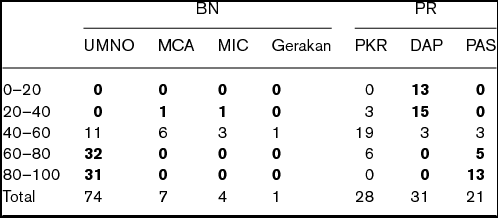
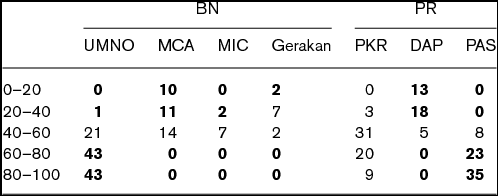
In the 2013 election, both the BN and the PR employed ethnic-based electoral strategies. Parliamentary seats in Malay-majority constituencies, where the Malay population represents more than 60% of the total electorate, in peninsular Malaysia were won mainly by Malay parties such as the UMNO and the PAS (see Table 1). Parliamentary seats in non-Malay-majority constituencies, where non-Malays accounted for more than 60% of the voters, in peninsular Malaysia were won mainly by Chinese parties such as the DAP (see Table 1). These results can be attributed to the fact that the BN and the PR nominated mainly UMNO and PAS candidates, respectively, in Malay majority constituencies and mainly MCA and DAP candidates, respectively, in non-Malay majority constituencies (see Table 2).
Percentage of Malay voters and parliamentary seats in peninsular Malaysia in the 2013 election

Source: Based on data from Utusan Online.
Percentage of Malay voters and parliamentary candidates in peninsular Malaysia in the 2013 election
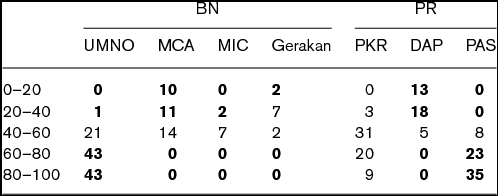
Source: Based on data from Utusan Online.
Ethnic-based political orientations could also be observed in the ceramah (political gathering) during the 2013 election. In the BN, ceramahs had been mainly organized by each component party, whereas the PR's ceramahs had been mainly organized jointly by its three component parties. On the surface, the BN is ethnic based, whereas the PR is supposedly multi-ethnic. However, in the PAS and the PKR ceramahs, most participants are Malays and the Malay language is used. Similarly, in the DAP ceramahs, most participants are Chinese and the Chinese language is commonly used. Additionally, although in the PR joint ceramah involving three parties, participants did not speak negatively of other ethnic communities, in the ceramah organized by the PKR, the PAS, or the DAP, each party discussed the protection and development of ethnic interests and participants expressed their resentment towards other ethnic communities.Footnote 9 Political parties in both the BN and the PR thus continue to represent ethnic interests and identities. The ethnic-based political structure and consociational political system, which is based on ethnic-based political considerations, has been retained by both coalitions.Footnote 10
Ethnic politics and electoral strategies
An ethnic-based political structure and consociational system have been maintained in both the BN and the PR. However, the structure and system in the BN differ from those in the PR in power balance terms. The BN coalition has been dominated by the UMNO with policy decisions determined by the UMNO leadershipFootnote 11 (Loh Francis, Reference Loh2013: 4). Additionally, the 2013 election results, in which the UMNO won two-thirds of the BN's total parliamentary seats, have reinforced its dominance in the BN.Footnote 12 The PR is based on the premise that all three parties are equal. As the 2013 election results demonstrate, the distribution of the PR's parliamentary seats is relatively balanced: the DAP holds 38 seats, the PKR holds 30, and the PAS holds 21. Hence, the PR coalition is not dominated by a single party.
More importantly, the BN's ethnic politics is distinct from the PR's ethnic politics in electoral role. In the BN, ethnic politics has been employed to obtain votes. The BN has managed ethnic politics by balancing and controlling the interests and grievances of ethnic communities and manipulating ethnic and religious sentiments to win votes. The BN has traditionally competed against the PAS for Malay votes and the DAP for Chinese votes. Therefore, the BN has had to be responsive to the communal demands of various communities to prevent Malay and Chinese votes from being strongly channelled towards the PAS or the DAP. The PAS has consistently emphasized Islamic issues, particularly the establishment of an Islamic state based on Shari’a law. The DAP has emphasized the protection and promotion of Chinese social and cultural rights consistent with the idea of ‘Malaysian Malaysia’. The BN has attempted to balance the interests and grievances of the various ethnic communities by incorporating the idea of Malay (Islam) dominance yet also recognizing non-Malay social and cultural rights.
Moreover, the BN's policies have flexibly modulated and responded to changes in the political climate in each election. The BN's policy direction depends on the extent to which the BN requires Malay or non-Malay electoral support. For example, when Chinese votes are crucial to the BN's electoral victory, the BN government is more inclined to compromise on Chinese demands to regain Chinese support. In the 1995 election, the BN needed to regain Chinese support and was willing to concede to Chinese demands.Footnote 13 The Chinese attached importance not only to sustained economic growth and their economic rights but also to their cultural rights (Gomez, Reference Gomez1996: 37). Therefore, in the spirit of compromise, in the early 1990s, the BN implemented several policies to protect and to develop Chinese social and cultural rights.Footnote 14 The BN's 1995 election manifesto emphasized the liberalization of language, education, and cultural policies as well as economic growth (Gomez, Reference Gomez1996: 21). Additionally, Vision 2020, presented in 1991, confirmed that ‘Malaysians of all colours and creeds are free to practise and profess their customs, cultures and religious beliefs and yet feeling that they belong to one nation’ (Mahathir, Reference Mahathir1991).
The BN has also manipulated non-Malay fears of an Islamic state and Malay fears of expanding Chinese economic and political dominance. The Chinese have been warned that a vote for the DAP means a vote for the PAS and the establishment of an Islamic state whilst the Malays cautioned that a vote for the PAS means a vote for the DAP – and with this, the development of Chinese social and cultural rights and the elimination of Malay preferential policies.
By contrast, the PR's electoral strategies have not been focused on ethnic interests and identities. In the 2008 and 2013 elections, the PR emphasized common interests that cut across ethnic divides, such as the elimination of corruption, cronyism, and nepotism; the promotion of democratic governance, accountability, and transparency; the enhancement of public safety; and the alleviation of living costs.Footnote 15 In the 2013 election, the PR campaigned under the slogan of ‘change’: ‘Ini Kalikah, Ubah (This is the time, change)’ and ‘Wu Yue Wu, Huan Zheng Fu (Fifth of May, change the government)’.
In addition to differences in the power balance structure amongst political parties within a coalition, differences in electoral strategies between the BN and the PR indicate that the nature of the BN's ethnic politics and consociationalism differs qualitatively from the PR's consociationalism. The BN's ethnic politics has played a role as a vote-gathering device, whilst for the PR, ethnic politics seems to be just a structure. The consociational political system can work effectively if a coalition party receives strong electoral support from all ethnic communities. The BN has tried to maintain its legitimacy by managing ethnic politics, whilst the PR has downplayed ethnicity and emphasized good governance.
Efficacy of the BN's ethnic politics and consociationalism
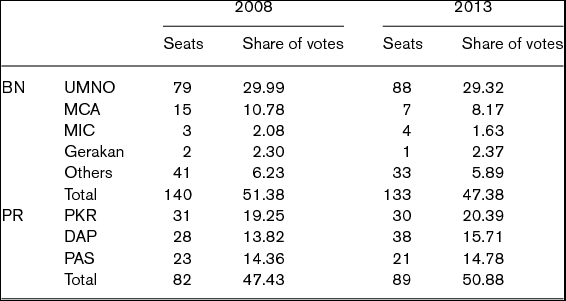
In the 2013 election, the BN won only 133 of the 222 seats in parliament and 47.38% of the total voteFootnote 16 (see Table 3). This result is worse than the 2008 election, which has been referred to as a major ‘political tsunami’ (Toh, Reference Toh2008: 13). In the 2008 election, the BN won 140 of the 222 seats and 51.38% of the total vote (see Table 3). It has been said that the BN's ethnic politicking led to a reduced number of seats, whereas the PR approach of emphasizing common national interests across ethnic lines garnered more seats (Soon, Reference Soon2013: 23; Boo, Reference Boo2013). This then begs the question: Did the BN's ethnic politics contribute to its electoral decline and weaken its legitimacy as a multi-ethnic coalition?
Number of parliamentary seats and share of votes by parties

Source: Based on data from Malaysia Suruhanjaya Pilihanraya (2009) and Malaysia Suruhanjaya Pilihanraya Website.
The BN has historically balanced and manipulated ethnic interests. Malay dominance has been balanced with the recognition of non-Malay social and cultural rights – flexibly altering the balance to respond to changes in the political climate in each election. For example, in the 1995 election, the BN made concessions in the area of Chinese social and cultural rights because it needed to regain Chinese support (Gomez, Reference Gomez1996). Rewarded for its cultural liberalization policies, the BN enjoyed an overwhelming victory in the 1995 election that can be attributed to the Chinese community's solid support. It seems that this BN's electoral strategies were effective in garnering enough votes to retain government.Footnote 17
In the 2008 election, the BN's share of seats and votes decreased sharply, partly due to its failure to obtain non-Malay support. The percentage of Chinese support that swung to the opposition was 30%, whereas the Indian vote swing accounted for 35% (Mohamad, Reference Mohamad2008: 447). Following the 2008 election, the BN extended non-Malay social and cultural rightsFootnote 18 in an attempt to regain non-Malay support. Having moved towards a multicultural stance, the BN downplayed its Malay dominance rhetoric.
In an act of compromise, Najib promised to champion the rights of both Malays and non-Malays (Malaysiakini, 2008) and in 2009 introduced the ‘1Malaysia’ concept, which promised each ethnic community fair and equitable welfare and social services, economic development, and protection from the government (Ministry of Information, Communications and Culture, 2009). The ‘1Malaysia’ concept represents a shift towards multiculturalism.
In April 2009, the liberalization of 27 service sub-sectors was announced (Najib, Reference Najib2009a). The government removed regulations which mandate 30% of equity to MalaysFootnote 19 in these sectors. In June 2009, the government stated that the 30% Malay equity condition would be abolished (Najib, Reference Najib2009b). With the unveiling of the New Economic Model (NEM) in March 2010, Najib posited that the government would replace ethnic-based affirmative action with needs-based affirmative action (Najib, Reference Najib2010). He indicated that this policy shift would favour the bottom 40% of Malaysia's income strata. In other words, preferential treatment should be given irrespective of ethnicity (National Economy Advisory Council, 2009: 136; Najib, Reference Najib2010). This proposed policy shift implied that the ethnic quota system, which benefitted only the Malays, in terms of the acquisition of licenses, contracts, and scholarships, as well as for entrance to public universities, would be eliminated.
Moreover, the BN made several policy concessions to the Chinese community after the 2008 election. For example, the government built non-Malay primary schools,Footnote 20 increased financial aid to non-Malay schools,Footnote 21 and recruited teachers for these schoolsFootnote 22 (New Straits Times, 2008a, 2008b; Vasudevan et al., Reference Vasudevan2008). The government promised that utility bills in all public Chinese primary schools would be paid by the Education Ministry (Chua, Reference Chua2010), and the Prime Minister's Department announced that the share of the Public Service Department scholarships allocated to non-Malays would increase from 10% to 45% (Azman et al., Reference Azman2008). Additionally, the BN's 2013 election manifesto promised the implementation of policies that were fair to all ethnic communities and offered non-Malay communities greater educational and recruitment opportunities in civil service.
During the 2013 election campaign, the BN also utilized ethnic and religious sentiments to regain non-Malay support. The MCA argued that a vote for the DAP was a vote for the PAS in an attempt to instill the Chinese fear of PAS's Islamic state agenda (Mustafa, Reference Mustafa2013: 13; Lopez, Reference Lopez2013: 23).
The BN controlled the interests and grievances of ethnic communities and manipulated ethnic sentiments in an attempt to obtain votes, particularly non-Malay votes, in the 2013 election.Footnote 23 However, the BN's electoral performance was worse than in the 2008 election – notable for ethnic minority desertion of the BN. Most Chinese apparently supported the PR in the 2013 election.
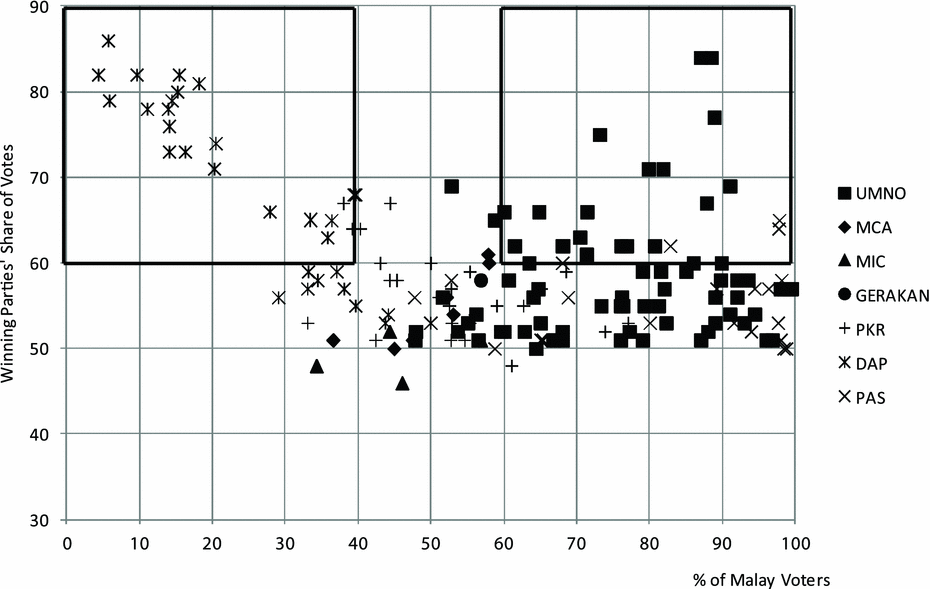
In the 2013 election, the BN lost in most non-Malay majority constituencies, in which more than 60% of voters were non-Malays (see Table 1). Yeoh (Reference Yeoh2013) said that the BN lost 96% of seats in constituencies in which the Chinese constituted more than 40% of voters. Figure 1 shows that PR parties’ share of votes was significantly higher in most non-Malay majority constituencies in peninsular Malaysia. By contrast, BN parties won many seats in Malay majority constituencies. Thus, in the 2013 election, the PR succeeded in obtaining strong support from non-Malay communities, whereas the BN maintained Malay support – particularly in rural areas. Approximately 90% of Chinese voters are thought to have supported the DAP in the election (Yeoh, Reference Yeoh2013; Looi et al., Reference Looi2013).
Percentage of Malay voters and winning parties’ share of votes in peninsular Malaysia in the 2013 election
Source: Based on data from Utusan Online.

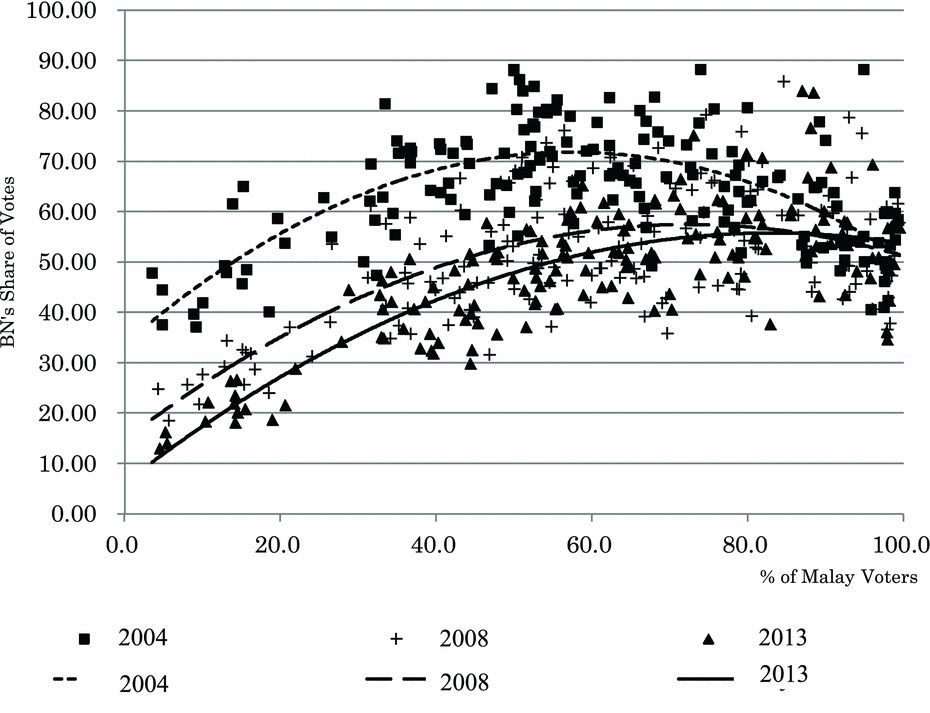
Compared to the 2008 election, the BN's reduced support in non-Malay majority constituencies was higher than in Malay majority constituencies in peninsular Malaysia (see Figure 2). According to a polynomial approximation (see Figure 2), in constituencies where 20% of voters were Malay, BN's share of votes decreased by approximately 7.9%. In constituencies where 40% of voters were Malays, BN's share decreased by approximately 6.7%. In constituencies where 60% of voters were Malays, the BN's share decreased by approximately 4.3%. In constituencies where 80% of voters were Malays, the BN's share decreased by approximately 1.2%. The data suggests that the BN lost mainly non-Malay support in the 2013 election.
Percentage of Malay voters and BN's share of votes in peninsular Malaysia in the 2004, 2008 and 2013 elections
Source: Nakamura (Reference Nakamura and Yamamoto2013).
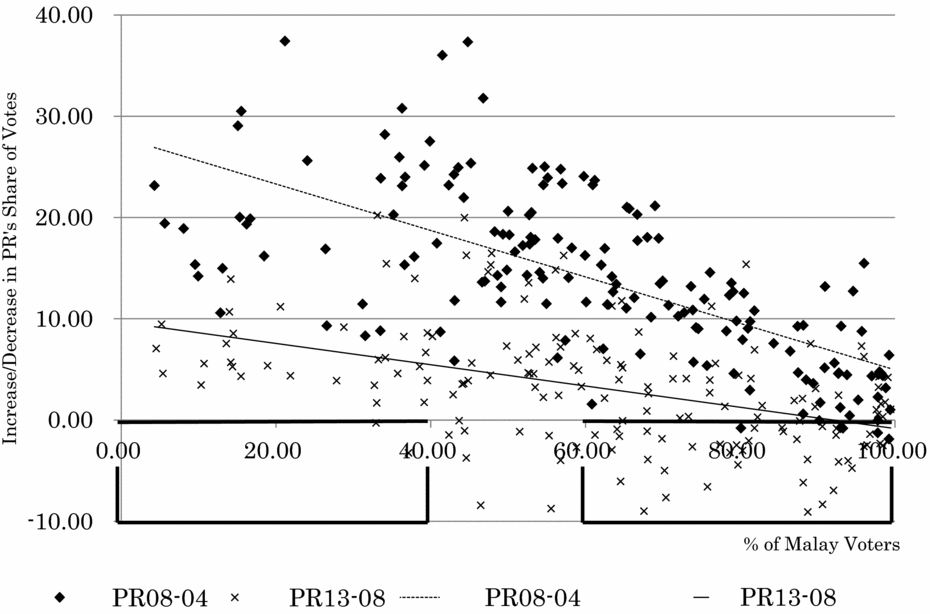
Figure 3 indicates that in nearly all constituencies where the percentage of non-Malay voters exceeded 60% in peninsular Malaysia, PR's share of votes in the 2013 election was higher than in the 2008 election, whereas in approximately half of the constituencies where the percentage of Malay voters exceeded 60%, PR's share of votes in the 2013 election was lower than in the 2008 election. It seems that the percentage of non-Malays swinging to the PR was higher than the percentage of Malays swinging to the PR. It can be inferred that the PR obtained more support mainly from non-Malay communities in the 2013 election.
Percentage of Malay voters and the increase/decrease in the PR's share of votes in peninsular Malaysia in the 2008 and 2013 elections
Note: This figure indicates the increasing or decreasing rate of PR's share of votes in the 2008 and the 2013 elections.
Source: Based on data from Nakamura (Reference Nakamura and Yamamoto2013).
The above tables and figures show that the BN failed not only to regain non-Malay votes, particularly Chinese votes, but lost additional non-Malay support in the 2013 election. It seems that the BN's weak performance can be mainly attributed to the Chinese electoral rebuffFootnote 24 (that is, the Chinese swing to the PR), whilst it has been observed that the PR received support from all MalaysiansFootnote 25 (Zahiid, Reference Zahiid2013; Boo, Reference Boo2013). The 2013 election results suggest that the BN's electoral strategies to manage ethnic politics did not work effectively.Footnote 26
The BN's multi-ethnic coalition had in the past received strong electoral support from all ethnic communities by managing ethnic politics. The BN's consociationalism had maintained a measure of social stability and its legitimacy. However, because the BN failed to obtain strong Chinese support in the 2008 and 2013 elections, the BN's consociationalism appears to have incurred diminishing returns.
In the 2013 election, the BN lost in most non-Malay majority constituencies while winning in many Malay majority constituencies. Did the BN succeed in retaining seats in multi-ethnic constituencies where 40% to 60% of the total electorate were Malays? In the 2004 election, the BN won in all multi-ethnic constituencies, whereas the DAP and the PAS lost in these seats. This phenomenon suggests that support from all ethnic communities is necessary to win in multi-ethnic constituencies. Therefore, success in parliamentary seats in multi-ethnic constituencies is required in a stable consociational political system that can effectively facilitate long-term social and political stability.
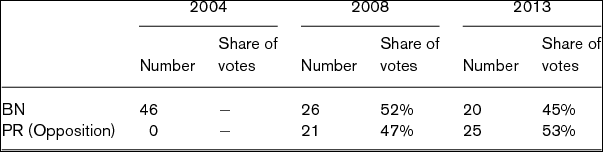
Table 4 indicates that in the 2008 election, the BN lost approximately half of the parliamentary seats in multi-ethnic constituencies in peninsular Malaysia, although it received strong electoral support and won in all multi-ethnic constituencies in the 2004 election. In the 2013 election, the BN lost additional seats in these crucial constituencies.
BN's and PR's seats and share of votes in multi-ethnic constituencies in peninsular Malaysia

Source: Based on data from Utusan Online.
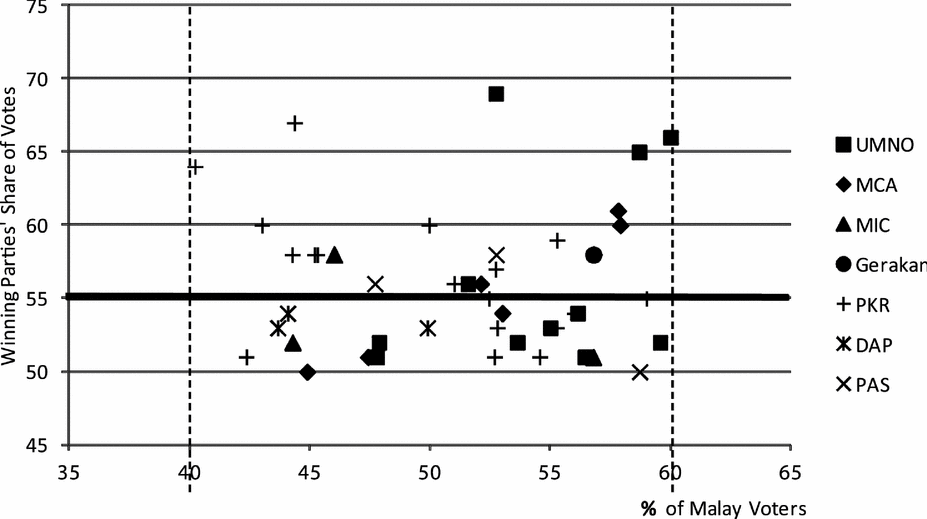
Figure 4 highlights that the BN's electoral performance in multi-ethnic constituencies in peninsular Malaysia was weaker than the reduced number of BN seats would suggest. In the 2013 election, the BN gained more than 55% of the total vote in nine of 21 BN-winning seats in multi-ethnic constituencies, whereas the PR gained more than 55% of the votes in 13 of 25 PR-winning seats in multi-ethnic constituencies (see Figure 4). However, in the 2008 election, the BN normally won seats with more than 55% of the total vote in multi-ethnic constituencies, whereas the PR largely won seats by gaining only 50–55% of the votes (Segawa, Reference Segawa2013: 216).
The winning parties’ share of votes in multi-ethnic constituencies in peninsular Malaysia in the 2013 election
Source: Based on data from Utusan Online.
In addition to its failure to attract non-Malay electoral support, the BN, as Table 4 and Figure 4 indicate, has been losing electoral support from all ethnic communities. This loss of support means that the BN's consociationalism is less able to maintain social stability and its legitimacy and promote nation building, and it is becoming dysfunctional.
Eclipse of the BN's ethnic politics and consociationalism?
The 2013 election indicates that the BN's ethnic politics and consociational politics have become less attractive to Malaysians.Footnote 27 However, this does not represent the demise of BN's ethnic politics and consociationalism. Having increased the number of parliamentary seats from 82 in the 2008 election to 89 in the 2013 election, the PR has focused on an agenda which is based on the elimination of corruption, cronyism, and nepotism; the promotion of democratic governance, accountability, and transparency; the enhancement of public safety; and the alleviation of living costs. A major campaign issue in the 2013 election was the choice between the BN's ‘track record’ and the PR's slogan of ‘change’. The BN's weak performance can be attributed to dissatisfaction with its governance record causing corruption, the absence of the rule of law, a high crime rate, and the rising cost of living and support for the PR's governance agenda (Soon, Reference Soon2013: 25; Lopez, Reference Lopez2013: 23). It is worth noting that in the 2013 election, the PR did not advocate a multi-ethnic agenda as strongly as it had in the 2008 election. The reason of the BN's failure to secure majority support in the 2013 election was not simply a rejection of the BN's ethnic politics but rather a combination of several negative factors.Footnote 28
In the 2013 election, the PR received support from all ethnic communities under the slogan of ‘change’ and good governance such as anti-corruption and the promotion of democratic governance and transparency. However, the PR coalition may remain rooted in ethnic politics in terms of structures as well as capabilities. For example, the DAP and the PAS have yet to overcome their ideological differences. It appears that the PR has merely shelved politically sensitive issues related to Islam and coalition unity remains largely superficial. Therefore, it is not certain that the PR will be able to continue to shelve its ideological differences and transcend ethnic differences. Is the PAS likely to contain its conservative religious orientation interests in the event of a future PR electoral victory? It is questionable whether the PR's electoral gains will result in a qualitative shift from ethnic politics. Moreover, the PR coalition is tenuous, particularly as PAS remains deeply divided between the moderates and conservative Islamists who would prefer to engage in a Malay unity alliance with the UMNO.Footnote 29
It cannot be completely denied a possibility that a political situation in which BN's ethnic politics work effectively in elections and the BN's consociationalism regains strong electoral support from all ethnic communities will re-emerge. Time will determine whether a shift away from BN's ethnic politics and consociationalism will consolidate. As long as the PR remains a coalition of ethnic-based parties, concerns over ideological differences between the DAP and the PAS will persist. However, the shift from the ethnic politics and consociationalism can be more firmly consolidated if the PR parties are incorporated into one political party.
Conclusion
Have the 2013 election results signalled a shift away from ethnic politics and consociationalism?
Although the BN and the PR coalitions have maintained an ethnic-based political and consociational framework, the BN differs from the PR in terms of the power balance and cooperative structures amongst parties within the coalition and, more importantly, in terms of the role of ethnic politics in elections. The BN has utilized ethnic politics as a vote-gathering strategy by balancing, controlling, and manipulating ethnic grievances. By contrast, the PR's electoral strategies are not based strongly on ethnic interests and identities. This difference suggests the dynamics of the BN's consociationalism differs from the PR's consociationalism.
The results of the 2013 elections indicate that the BN's electoral strategies based on ethnic politics have failed to attract large segments within Malaysian society. However, this electoral decline does not necessarily signal the demise of BN's ethnic politics and consociationalism. The PR parties, particularly the PAS and the DAP, have failed to qualitatively shift their sectarian orientation. As such, the PR could well fragment if the tensions between the DAP and PAS and within the PAS remain unresolved. The shift from ethnic politics and consociationalism may deepen when the PR parties are reconstituted into one political party. Visionary leadership will determine whether a qualitative shift away from ethnic politics and consociationalism is likely to emerge in the near future.
About the author
Noriyuki Segawa is an Associate Professor in the Faculty of International Studies at Osaka Gakuin University, Japan. He obtained his Ph.D. in Political Science from the University of Sydney, Australia, in 2009. His current research interests are ethnicity, nationalism, multiculturalism, democratization, and nation building in Southeast Asia and Pacific Islands, with a special focus on Malaysia and Fiji. His major publications include papers in Sojourn, Nationalism and Ethnic Politics, African and Asian Studies, and Asian Studies Review and in Japanese journals.