Historical Background
During the 1954 Geneva Conference,Footnote 1 Zhou Enlai (1898–1976), the Premier and Foreign Minister of the People’s Republic of China (PRC), presented a 1953 film version of the popular story of Liang Shanbo and Zhu Yingtai—the protagonists of the popular Butterfly Lovers story — to Western diplomats and journalists as the Chinese counterpart of Romeo and Juliet (Qian Reference Jiang2005:135). He chose this film to highlight the cultural and historical commonalities between the Chinese and Western worlds and thus establish a palpable connection between their citizens.
In the story of The Butterfly Lovers, Zhu Yingtai, a young woman, disguised herself as a male student in order to leave home and pursue further study. Zhu first convinced her parents how, despite living in a society where women were confined to the domestic sphere, she could achieve her personal goals without sacrificing traditional womanhood. She then traveled to a school in Hangzhou and studied there for three years. In the meantime, she got to know Liang Shanbo, a fellow student with whom she soon fell in love. Before she returned home for family reasons, she earnestly asked Liang to visit her home and seek her “younger sister” (Zhu undisguised) as his wife. When Liang finally came, Zhu was already promised to marry a wealthy local playboy. Her parents refused to break the engagement and she had to follow their will. Liang soon died of rejection and longing. Later, when Zhu was on the way to her marital home, she passed by Liang’s grave; there was a sudden weather change and the grave split asunder before Zhu jumped into it to join her beloved.
For more than a thousand years, The Butterfly Lovers has appeared in many versions on paper, onstage, and on-screen. As Wilt Idema (Reference Idema2010:xi–xii) and Yu Siu Wa (Reference Wah, Pen-yeh, Jianzhong and Jingfang2001:1056) posit, this story has been exemplary and constitutive of not only Chinese folk and popular cultural output but also Chinese social and political discourse. Its importance in Chinese history justifies Zhou Enlai’s praise for The Butterfly Lovers; he referred to the version he brought to the conference as a new “film of stage art” (wutai yishu pian).Footnote 2 With this first color film of the PRC, he proudly showed Westerners how the “New China” (xin Zhongguo) had succeeded in blending Chinese traditional arts with modern media technologies. He strategically glossed over the fact that the film translated a stage production of Shaoxing opera (aka Yue opera)—a young Chinese regional opera genre in contrast to the classical kunqu opera and jingju, the national Peking opera—whose development during the 1940s was pertinent to a politically charged reform led by Yuan Xuefen (1922–2011), the principal actor-singer (performing as Zhu) and chief artistic advisor of the film. Zhou was also reticent about the film’s response to the struggle between romance and filial piety in modern China by promoting gender equality and the freedom to love (ziyou lian’ai) while removing feudal ( fengjian) and superstitious (mixin) elements from both earlier versions of The Butterfly Lovers and performance conventions of Shaoxing opera (Bai Reference Hua1948:14; Yuan Reference Xuefen2002:7, 26–29, 137; Jiang Reference Jiang2009:188). Nonetheless, the film served its purpose at the conference to ultimately convey a message to the people of China.
Following Zhou’s ambassadorial mission in Geneva, the film entered the international festival circuit. It received critical recognition in Karlovy Vary in the Czech Republic, Edinburgh in the United Kingdom, and Locarno in Switzerland. It reached Chinese audiences as Liang Shanbo yu Zhu Yingtai (Liang Shanbo and Zhu Yingtai), creating a lasting cultural phenomenon in mainland China, Hong Kong, and Southeast Asia. It inspired Chen Gang (1935– ) and He Zhanhao (1933– ) to compose Butterfly Lovers Violin Concerto (1958) while they were students at the Shanghai Conservatory of Music. It also prompted Li Han-hsiang (1926–1996) to make The Love Eterne (1963), a Mandarin “yellow plum”Footnote 3 musical film (guoyu Huangmeidiao dianying) version of The Butterfly Lovers, produced by Shaw Brothers Studio in Hong Kong (see Chen Reference Chen and Ain-ling2003:51–74).
The Shaoxing opera film version of The Butterfly Lovers was rooted in nationalism, feminism, and a mode of cultural acquisition that substantiated what Pierre Bourdieu might regard as “the whole relationship of the petite bourgeoisies to culture” (Reference Bourdieu1984:319). Together with The Love Eterne as well as the Cantonese (1958), Taiwanese (1963), and Teochew opera (1963) film versions of the story, the 1953 film featuring Yuan shows how mid-20th-century Chinese audiences from different localities and communities perceived specific cultural meanings based on knowledges and systems of interpretation that were socially differentiated. It exemplifies various modes of production, distribution, and consumption in the multifaceted Chinese film culture. It also demonstrates the potency of Chinese opera in nationalizing Chinese cinema, offering local or regional values as cultural ideals that lend support to the national agenda through mass media and commoditization.
From Allegorizing Women’s Liberation to Hegemonizing Chineseness
In her autobiography published around a decade before her death in 2011, Yuan Xuefen rued the days she was exploited as a young Shaoxing opera actor-singer. She told of how her early career led to her decade-long project of transforming The Butterfly Lovers into a Shaoxing opera on film. She showed not only her sensitivity to illiteracy as a traditional stigma associated with the majority of women and Chinese opera actor-singers, but also her strong belief in the notion of qingbai Footnote 4 (pure body and conduct). She lamented the performance conventions of traditional opera troupes being socially backward, proclaiming that a thorough reform of Shaoxing opera was necessary:
Shaoxing opera must and has the potential to bring about a thorough reform. There is no script, so we should choose meaningful content for writing a script; there is no director, so we should have a director; rehearsals should involve choreographers and artistic advisors for handling makeup, costumes design, mise-en-scène, and stage lighting; vocal tunes should include preexisting stock tunes such as siping diao but require further creation and enrichment; from modification of the backstage environment to rehearsals and performances, there must be a system of regulation [guifan de zhidu] that sustains this thorough reform and modernized artistic creativity. We have to let those performers and specialists notice the relationship between the rise and decline of Shaoxing opera and their own destinies [geren mingyun]. (Yuan Reference Xuefen2002:10)
The Metamorphosis in Shanghai
Hoping to ideologically transform so-called illiterate housewives (wu wenhua de jiating funü) into modern women, Yuan embarked on a reform of Shaoxing opera in 1942 when she was 20 years old. Inspired by huaju, modern spoken dramas, which evolved from early-20th-century didactic wenming xi Footnote 5 plays, she was determined to replace Shaoxing opera performance conventions with newly established principles of theatrical performance. She taught herself script-writing techniques, collaborated with amateur playwrights, and staged new productions with contemporary social themes. Notwithstanding, she could not ignore the lasting popularity of The Butterfly Lovers. She knew the audience had certain expectations for her performance, so she held to her progressive ideals and interpreted The Butterfly Lovers to highlight what Haiyan Lee may perceive as “the enlightenment structure of feeling,” in which the romantic and psychoanalytic definitions of love became the basis of literary and theatrical productions (Reference Lee2007:221).
Yuan’s revisionist approach to The Butterfly Lovers involved five notable changes. First, she wanted only to preserve and emphasize what she deemed the pure love between Liang Shaobo and Zhu Yingtai. Echoing the notion of qingbai, she valued their loyalty and fidelity (zhongzhen) for promoting modern moral and matrimonial values. She found many of the existing Shaoxing opera musical-theatrical narratives to be regressive, vulgar, and filled with superstition. Particularly, she despised the grotesque and salacious sexual innuendos in the vocal delivery. Second, she considered the music of Shaoxing opera inadequate. She wanted to improve the quality of the music and therefore began her collaboration with Zhou Baocai (1912–2002), a huqin (Chinese two-string bowed lute) player, and Liu Ruzeng (1918–1999), a conservatory-trained composer. Third, she dismissed the use of lutou Footnote 6 (synoptic outline, also known as tigang) as a theatrical nonsense that deceived the audience. She preferred the use of a script over learning by mimicry, as she felt the script could help deliver sophisticated ideas. Fourth, she abandoned the long-established role-type system (hangdang) and adopted an acting method that focused on internalizing the psychological states of a story character. Fifth, she replaced conventional operatic costumes with costumes that appeared more historically accurate (Lu and Gao Reference Shijun and Yilong1997:297).
Yuan revered the stage and believed the audience should “contribute to the artistic atmosphere by being polite and refraining from casual applause throughout” (Reference Xuefen2002:42). She attempted to transform a performance space of multiple social and artistic functions into “a monument of holy spirits” and “a mirror of the society” that enhanced the social and artistic status of Shaoxing opera (9, 42). Echoing pioneering figures such as the Xia Brothers who built Xin wutai (The New Stage) for Peking opera performances, Yuan stressed the difference between social and representational spaces and that between real and performed identities. But still, as an actor-singer, she paid little attention to the convergence of mechanical and architectural technologies that had been integral to the socio-spatial reconfiguration of Chinese opera performance venues since the late 19th century (see also Goldstein Reference Goldstein2007:55–117; Pang Reference Pang2007:133–63). She also appeared to be unaware of the interplay between cinema (Chinese as well as Hollywood) and theatre (spoken dramas as well as folk dramas):
Aside from its self-serving attitude, the report [from an American government trade official] does confirm in a rather rudimentary fashion certain affinities between the Hollywood narrative tradition and some prevalent formulaic devices in traditional Chinese popular fiction, for example, the da tuanyuan (great reunion) ending and the melodramatic necessity of the “triumph” of right over wrong. […] The popularity of so-called historical pictures is easily explainable, as it can be related to the Chinese audience’s interest in traditional folktales and historical romances. […] It must also be noted […] that for all the brilliance of their cinematic technique, Chinese films of the 1930s—leftist or not—continued to emphasize the development of plot. […The] elements of folk singing and the like further reinforce the impression that certain scenes are “staged”—hence the foregrounding of acting. […T]he Chinese film does not strictly follow the established conventions of the Hollywood genre film (e.g., the musical, the slapstick comedy, the western, film noir, and so on) but rather uses some of its generic devices for its own purposes. […] The narrative tempo fluctuates precisely because the Chinese film is made to contain diverse elements from different film and cultural genres. (Lee Reference Lee1999 :97, 106, 108)
Surrounded by film adaptations of successful plays as well as theatre adaptations of popular movies, Yuan was keen to integrate into Shaoxing opera what she referred to as top-tier performance elements. She admired not only the choreographed steps and water-sleeves from kunqu opera, but also the “interiorized psychological activities” (neizai de xinli huodong) and “perform-ing bodies” (xingti biaoyan) of female Hollywood film stars (Reference Xuefen2002:13). She formed a troupe that shared props, costumes, and sets with film studios specializing in folk drama films, while her reform of Shaoxing opera was inspired by the modern urban life as portrayed in Hollywood films (Fu Reference Fu2003:31, 34). She adapted familiar cultural forms and conventions in such a way that her performance pleased lower-class people and women who did not work outside the home. Only after winning their attention did Yuan engage them in issues about class, gender, and social justice.
Yuan was passionate about pojiu lixin—breaking with the old and establishing the new. She was adamant that Shaoxing opera and its practitioners must become modern and respectable. She took as her role models patriotic figures such as the late–Song dynasty scholar-bureaucrat Wen Tianxiang (1236–1283) and the late–Qing dynasty feminist revolutionary Qiu Jin (1875– 1907). Her artistic endeavor, in conjunction with her views on marriage, morality, and patriotism, followed a dialectic based on dichotomies between the civilized and the uncivilized, between the vulgar and the tasteful, and between the feudal and the progressive. She likely read and agreed with what Xia Yan (1900–1995) wrote in the preface to his Qiu Jin script:
When feminism and sexual equality are used by a few as stepping-stones, “the women’s movement” is suffocated. But the real women’s movement and the real new women have emerged among the people who do not debate terminology such as equality. Here there is no hero, and there are no glorious speeches and theories. They just want and they just do. They treat themselves as human beings […] member[s] of the new China, human being[s] of indomitable spirit. (in Wang Reference Zheng2016:176)
For Yuan, opera troupes were once “a miniature of the old society, where actor-singers lived at the lowest level, and one could witness exploitation all over the place” (2002:2). It was where she experienced class struggle in the form of sexual and economic exploitation, and why she was dismissive of the conventional practices of Shaoxing opera. She was determined to reform the genre despite her acknowledged lack of artistic insight and cultural knowledge (9). With an undifferentiated reverence for cultural forms such as kunqu opera and Hollywood cinema, she committed herself and her reform of Shaoxing opera to modernization, nation-building, and women’s liberation—to enhancing Shaoxing opera without sacrificing its accessibility.
The dichotomy between the feudalistic and the progressive was a common thread running through literature, theatre, cinema, and other Chinese cultural forms since the beginning of the New Culture Movement in the late 1910s. Nevertheless, while modern Chinese literature, spoken drama, and left-wing cinema were treated seriously by Chinese intellectuals who chiefly reestablished elite culture, Shaoxing opera reform began with Yuan, herself a popular actor-singer of rural upbringing and moderate literacy, who actively recruited amateurs and professionals of marginal status for inspiration. Yuan’s vision of a more sophisticated Shaoxing opera perhaps originated in a survival instinct grounded in cultural consumption, a practice “predis-posed, consciously and deliberately or not, to fulfill a social function of legitimating social dif-ference” (Bourdieu Reference Bourdieu1984:7):
They were poor children who had no way to make a living other than to learn traditional theatrical singing [chang xi]. When they became popular in Shanghai, their adoptive mothers and fathers exploited them, while evil forces in the society surrounded and corrupted them. A few of them soon recognized they were being abused and approached progressive spoken drama workers [ jinbu huaju gongzuozhe] led by the Chinese Communist Party’s underground forces. (Lu and Gao Reference Shijun and Yilong1997:313)
Yearning for opportunities and recognition in addition to better living standards, Yuan and her recruits participated either wholeheartedly or opportunistically in canonizing an as-yet-unrecognized performing art form. Zhou Baocai, Zheng Chuanjian (1910–1966), and Liu Ruzeng were among Yuan’s earliest recruits; they successfully altered their own career paths to become prominent figures in the history of Shaoxing opera. They contributed their respective expertise in Peking opera, kunqu opera, and Western classical music to Yuan’s reform of Shaoxing opera. Their artistic footprints meant to guarantee Shaoxing opera a higher artistic standard, but they distanced themselves from comparison to their past work.
Zhou Baocai was primarily a Peking opera accompanist before Yuan hired him as her principal accompanist in 1943 (Lu and Gao 1997:363). He introduced numerous Peking opera instrumental tunes and techniques to Shaoxing opera, and was key to creating two “aria types”Footnote 7 (banqiang): che diao and xianxia diao. Most of the vocal tunes in Liang Shanbo yu Zhu Yingtai were one of these two types (363).
Zheng Chuanjian was a graduate of the distinguished Kunju chuanxisuo (Institute for the Preservation and Transmission of Kunqu Opera). He started working for Yuan in 1944 as an instructor specializing in kunqu opera’s choreographed steps and water-sleeves (338). He shared with Yuan an emphasis on character portrayal, and was the first to adapt kunqu opera performance techniques for Shaoxing opera’s “modern naturalistic expression of love and desire” ( Jiang Reference Jiang2009:92). In 1947, he became the first technical director ( ji dao) in the history of Chinese opera, and his cross-genre adaptations—best exemplified in the opening and final episodes of Liang Shanbo yu Zhu Yingtai—set an illustrious example for Chinese opera’s later development.
Liu Ruzeng was acclaimed as the first conservatory-trained composer specializing in the music of Chinese opera. He began his collaboration with Yuan in 1945 by composing a theme song (zhuti qu) for the Shaoxing opera production Yueguang qu (Song of Moonlight). He was known for pioneering the use of thematic interludes as well as adopting Western symphonic and modern Chinese orchestral sounds for Chinese opera (Lu and Gao Reference Shijun and Yilong1997:366; Cheng Reference Gongliang and Xiaoxing2015:183–85).Footnote 8
Yuan asserted that Shaoxing opera was “restricted by its own melodic diversity” (2002:10) and “not expressive enough in accompaniment” (37). She capitalized on her leadership to justify changes to Shaoxing opera that would rectify these inadequacies, appropriating musical elements from both Peking opera, an iconic Chinese performance genre since the mid–Qing dynasty, and Western classical music, an emblem of Chinese musical modernity since the early 20th century. She fully respected her music collaborators, seldom questioning why or how the appropriated musical elements would be compatible with and advantageous to Shaoxing opera. She held the same attitude toward the borrowing of choreographed steps and water-sleeves from kunqu opera. Her vocal style was influenced only minimally by the aesthetics of kunqu singing, but she recognized the “classical and cultured but esoteric and waning” status of kunqu opera (7). In general, the music and choreography in Liang Shanbo yu Zhu Yingtai gave the audience an impression of resplendence, even if the grandeur concealed cultural appropriation marked by “a choice of sure and certified products” (Bourdieu Reference Bourdieu1984:331).
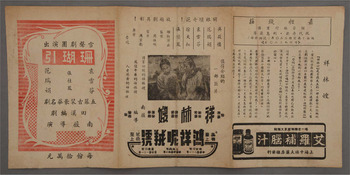
Yuan’s stylistic borrowing from spoken drama could also be an artistic and cultural expression of “asceticism, rigor, legalism, the propensity to accumulation in all its forms,” something Bourdieu regards as “the necessity underlying the characteristic dispositions of the petit-bourgeois habits” (331). Praising spoken drama in overtly moralistic and nationalistic terms, Yuan viewed Shaoxing opera as ready to follow the lead of spoken drama in (re)presenting modern social and individual selves. On the one hand, Yuan’s strong belief in the notion of qingbai—manifested onstage in her performance as Zhu Yingtai and offstage in her refusal to perform at a private party (tanghui) for Madame Chiang Kai-shek—speaks of what Yuan herself regarded as “the interrelationship between the rise and decline of Shaoxing opera and the destiny of the individual” (Reference Xuefen2002:9).Footnote 9 On the other hand, during the second half of 1946, she proved herself “correct” and “corrected” by insisting on a Shaoxing opera adaptation of a novella by Lu Xun (1881–1936), one of the most prominent Chinese literary figures of the time (fig. 1; see Lee Reference Lee and Lee1985:ix–xix). Her adaptation was recognized by literary and political luminaries; it later became what Wang Zheng describes as “a rallying point of left-wing artists in Shanghai when they were facing intense persecution from the ruling Nationalist Party” (Reference Zheng2016:188). Yuan’s noted sensitivity to public opinion about her social and artistic activities even induced her quest for approbation from left-wing cultural producers ( Jiang Reference Jiang2009:154).
The Shaoxing opera film version of Xianglin sao (Xianglin the Sister-in-Law; 1948), synopsis (right) and advertisement (middle). (Photo courtesy of Shaoxing Archives)

Another significant impact on Yuan’s reform of Shaoxing opera was the emergence of “mod-ern woman” images and lifestyles in Shanghai’s foreign concessions (zujie).Footnote 10 At the very least, it engendered the social aspirations of both Shaoxing opera actor-singers and the female audience of factory workers and middle-class housewives as well as businesswomen and university students. Prior to Yuan’s endeavor, Yao Shuijuan (1923–1968) and Xiao Dangui (1920–1947) had already experimented with a theatrical mise-en-scène that was inspired by Mandarin films and spoken dramas. Yuan was more ambitious. She not only treated Mandarin films and spoken dramas as important sources of well-developed stories and advanced acting and scriptwrit-ing skills, but also studied Hollywood films whose plots, acting styles, and lighting designs, among many elements, were extensively borrowed or adapted by Chinese filmmakers and playwrights. She advocated for performing with true emotions and concrete feelings (zhenqing shi-gan de biaoyan), favoring the modern (modeng) acting style of Ingrid Bergman (1915–1982),Footnote 11 Bette Davis (1908–1989), Greta Garbo (1905–1990), and Greer Garson (1904 –1996) exemplified in their Hollywood wenyi Footnote 12 films.
Yuan justified her appropriation of Hollywood cinema as a tool to improve upon the artistic inferiority and shallowness of Shaoxing opera (Reference Xuefen2002:13–14). The film culture in Shanghai during the 1930s and 1940s was undoubtedly part and parcel of the modern Chinese self, and yet the vision of modernity projected in this culture was to a great extent prescribed by the social, cultural, and artistic hierarchies that were associated with production costs, exhibition practices, advertising strategies, and mainstream journalism. Through film criticism, Chinese intellectuals (especially the leftists) translated foreign and modern appeals of cinema into certain artistic and educational values that reflected the social reality. The movie approval ratings published in mainstream newspapers and magazines were often dominated by Hollywood blockbusters; they listed Mandarin films much less frequently and mostly with low or even no scores. Movie theatres themselves were ranked according to location, ticket prices, screening options, and architectural design. First-run Hollywood films were screened only in lavish “movie palaces” with comfortable seats located in Western concessions, where a moviegoer had to pay a prohibitive ticket price and adhere to “a new code of behavior shaped by bourgeois values of self-restraint, orderliness, privacy, and respectability that befitted the urban modernity their sleek surroundings embodied” (Fu Reference Fu2003:34). Mandarin films were exhibited in older and less-equipped second-run theatres in the city’s northern part, where “a noisy, rowdy clientele […] enjoyed little privacy or orderliness” (35). The burgeoning Chinese tabloids, film journals, and women’s magazines were flooded with news and photos of Hollywood (and later Chinese) female film stars. They promoted moviegoing as a pilgrimage to a fantasized new, liberal, and fashionable world.
Zhu Yingtai Joining the Party in Beijing
Following the establishment of the PRC and the institutionalization of the entire field of cultural production by the Chinese Communist Party (CCP), the cultural legitimacy of Shaoxing opera was, like other Chinese opera genres, subject to neither class distinction nor aesthetic scrutiny but to the principles set by Mao Zedong in his Zai Yan’an wenyi zuotanhui shang de jian-ghua (Talks at the Yan’an Conference on Literature and Art; 1942). Zhou Enlai declared Chinese opera “an important weapon that educates the people through the spirits of democracy and patriotism” (Zhou Reference Enlai1951). His colleague Tian Han (1898–1968) lauded Chinese opera as “an educational and recreational cultural enterprise that connects hundreds of thousands of artists to tens of millions of audience members” (Tian Reference Han1951).
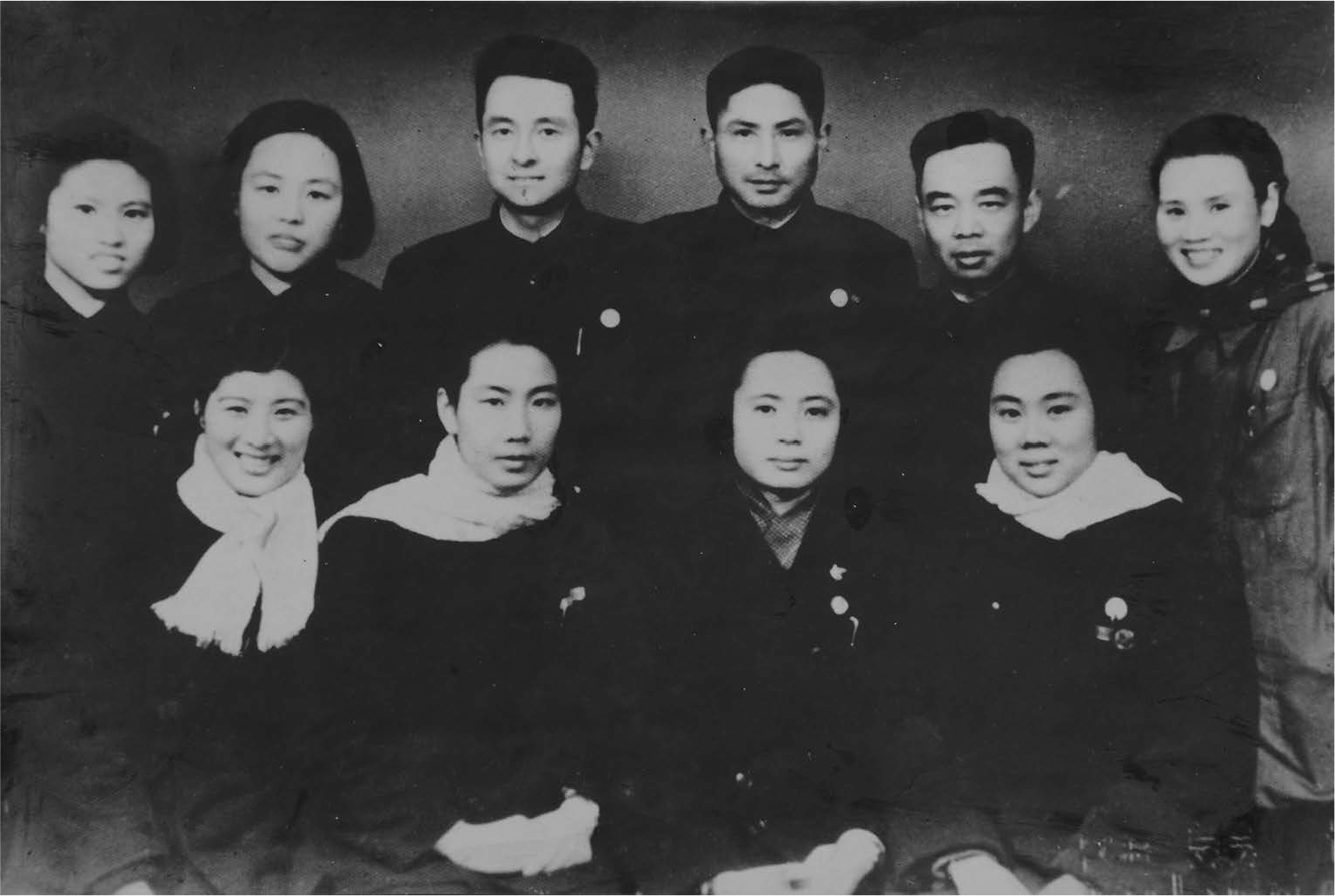
Shaoxing opera was among the best candidates to actualize and promote the new nationwide cultural policies due to its popularity, its left-leaning content, and its incorporation of both ancient Chinese and modern Western elements ( yang wei zhong yong, gu wei jin yong). The CCP instantly affiliated itself with Shaoxing opera, taking advantage of its popularity and political propriety. The Party referred to both Yuan Xuefen and her reform of Shaoxing opera as benchmarks for the large-scale Chinese Opera Reform (Xiqu gaige). Yuan was invited to the first Chinese People’s Political Consultative Conference in 1949 as one of the four Chinese opera actor-singers as well as the only female and non–Peking opera performer. The Party appointed her as the president of the newly nationalized East China Experimental Shaoxing Opera Troupe (ECESOT) in April 1950 (fig. 2); it sent her to the Second World Peace Council Congress in Warsaw and the Sixth Council of the World Federation of Democratic Youth in Vienna half a year later. ECESOT staged The Butterfly Lovers in Beijing for the 1951 National Day official program, which prompted the Ministry of Culture to request an encore for the first National Convention of Chinese Opera Performance (NCCOP) the next year. ECESOT garnered top prizes in all categories during the convention, while Yuan received highest honors “for her past struggles against the reactionaries and her contribution to the reform of Shaoxing opera” (Yuan 2002:134).
Yuan Xuefen (front row, second from left) and her ECESOT peers in 1950. (Photo courtesy of Shaoxing Archives)

With her “proper treatment of Chinese opera as a national heritage” (Renmin ribao 1952), both Yuan and ECESOT were deemed artistically prestigious and politically correct. This recognition led to various calls for The Butterfly Lovers to become a Shaoxing opera film promoting artistic reform and mass education (Sun and Li Reference Jianhua and Dade1955:32; Jiang Reference Yi1954:30; Ding Reference Zu1955:62–63). Yuan Xuefen, screenwriter Sang Hu (1916–2004), and film producer Xu Sangchu (1916–2011) stated in different contexts that Zhou Enlai and Xia Yan—the chief of the Shanghai Municipal Cultural Bureau—initiated their plan to make the film before the first NCCOP commenced. According to Yuan, the East China Ministry of Culture approved her retirement as an actor-singer during the first NCCOP, but insisted on her performance as Zhu Yingtai (with Fan Ruijuan as Liang Shanbo) for the film to be made after the Convention (Reference Xuefen2002:133). Xu noted that Zhou advised the nationalized Shanghai Film Studio to use its expired color film stock to film the updated Shaoxing opera version of The Butterfly Lovers (Reference Sangchu1995:163), while Sang Hu attended the first NCCOP because Xia recommended him as the film’s director (Reference Ling1995:353). The goal pursued by Zhou and Xia was unclear, but Madame Zhou (1904 –1992) seemed to have suggested a political consideration in a letter written to Yuan in April 1950:
Recently, the Central People’s Government has announced the Marriage Law, a great means to liberate every man and woman from the feudalistic marriage system. In order to implement this Law thoroughly, the Government needs to conduct promotional work for educating the masses, and we are working on that. Such a long-term task requires coordination with various sectors for the best social effect. There could be more extensive involvement in that from the field of [traditional and modern] theatre, and I think you [and your fellows] must have already noticed and taken action on that. (in Yuan Reference Xuefen2002:126–27)
The Marriage Law was part of the PRC’s first legislation on “private matters” (Zhongguo renda wang 1950; Chen Reference Chen2016:532). The second highest Government Administration Council (Zhengwuyuan) passed it on 3 March 1950, before the highest Council of the Central People’s Government (Zhongyang renmin zhengfu weiyuanhui) gave it the final approval on 13 April 1950. It fulfilled virtually all of Yuan’s feminist agenda as projected in her reform of Shaoxing opera and her revisions of The Butterfly Lovers, which “identified free love, as opposed to traditional arranged marriage, and women’s liberation in general, as fundamental components of China’s socialist culture and the basis for forging a new socialist citizenry” ( Jiang Reference Jiang2009:185). The Butterfly Lovers was thus an effective means for the masses to understand women’s struggle for gender equality:
The pure love relationship between Liang Shanbo and Zhu Yingtai, as well as their suicidal resistance to a feudalistic arranged marriage, loudly proclaim the longstanding desperation, grief, and anger of those men and women who strive for blissful marriage in our country, which is why they love the story on the one hand and use their wisdom and creativity to update this story on the other hand. (Sang Reference Hu1954)
As such, the Shaoxing opera film version may have been important to the 1953 nationwide mass movement to implement the Marriage Law:
All levels of leading Party and government bureaus should extensively mobilize their members of each’s departmental system with close cooperation in order to thoroughly implement the Marriage Law, participating in this large-scale social reform movement. We demand that the leading officials and general members of the Party section, the political and military sections, the citizenry section, the workers section, the peasants section, the youth section, the women section, [and] the culture and education sections, be models of the Law, supporting this movement in public opinion and coordinating their actual work with this movement under the unified leadership of local Party and governmental bureaus. (Renmin ribao 1953)
Mao Zedong repeatedly asserted that the CCP had to satisfy the cultural needs of the masses despite the scarcity of professional skills and technological resources. He definitely recognized the potential of Shaoxing opera and The Butterfly Lovers story for promoting the Marriage Law.
In the summer of 1950, Mao was accompanied by Zhou Enlai and several other high-ranking PRC officials while attending a performance by the Dongshan Shaoxing Opera Society in the Hall of Embracing Compassion at Zhongnanhai (Meyer-Clement Reference Meyer-Clement2016:49). Zhou probably told Mao about the cultural significance and political potential of Shaoxing opera, and Mao seemed to have learned from Beijing-based print media about the popularity of Shaoxing opera afterward (Xu Reference Lanjun2010:55–56).
In 1952, the Shanghai Film Studio released an “evaluative conclusion report” (zhengfeng xuexi zongjie baogao), which identified ECESOT as a target for collaboration in order to attract factory workers and the rural populace (in Wu Reference Di2006:325). This proposition ultimately led to the decision to appoint Yuan Xuefen as the principal actor-singer and chief artistic advisor of Liang Shanbo yu Zhu Yingtai. She and the film crew spent the first half of 1953 rehearsing, recording the soundtrack, planning the shots, experimenting with color film, and designing sets and costumes, but the film took at least six more months to complete (Yuan Reference Xuefen1954; Jiang Reference Yi1954:30; Sun and Li Reference Jianhua and Dade1955:32; Sang Reference Hu1995:354). This painstaking effort to make the first color film of the PRC was marked by technical challenges and resource scarcity, both of which nearly brought the production to a halt (Yuan Reference Xuefen1954; Yuan Reference Xuefen2002:135–37). The severe difficulties caused by the stu-dio’s unfamiliarity with both the Sovcolor process and the use of carbon arc lamps, in addition to the unfamiliarity with lip-synching and camera movements among actor-singers, resulted in an exhausting number of retakes (Yuan Reference Xuefen1954; Fan Reference Ruijuan1954; Leyda Reference Leyda1972:209). The morale of the film crew was very low when Chen Yi (1916–2011), the mayor of Shanghai, admonished them before urging them to view those technical challenges as a test of artistic collectivism that could prove they were underestimated by Soviet experts (Ding Reference Zu1955:63; Yu Reference Ling1995:68).Footnote 13 By evoking what Tina Mai Chen calls “a moment of equalization [when] China asserted itself at the center of socialist film exchanges” (2009:78) during the First Five-Year Plan (Diyige wunian jihua), Chen Yi set the triumphant tone for the film’s addition of an eye-catching final episode, wherein those choreographed steps and water-sleeves originated in kunqu opera were captured in a way that, according to film director Zhang Junxiang (1910–1996), “transcended stage configurations and followed cinematic conventions” (Reference Junxiang, Junxiang and Hu1958:13–14).
The Butterfly Lovers in Disguise in Geneva
The making of Liang Shanbo yu Zhu Yingtai was strongly associated with the CCP’s promotion of both the Marriage Law and the Chinese Opera Reform. Nevertheless, as Zhou Enlai revealed during the postproduction process, the film was also intended to be the Chinese counterpart of Romeo and Juliet, so as to promote Chinese art in front of foreign—especially European—diplomats:
After the filming was over, the Premier couple Zhou Enlai and Madame Zhou insisted on visiting the Shanghai Film Studio to attend a test screening and show their support to the crew. […] After the screening, the Premier appeared very pleased… He cheered up the crew: “Thanks to your effort, you all helped me to gain more admiration. For the first time, I can use the color film of our own country to welcome those diplomats from other countries and send this film to each of our embassies for promoting our own art. Who said only the United Kingdom and Shakespeare have Romeo and Juliet? We have it as well; our Romeo and Juliet is The Butterfly Lovers. I am going to bring this first color film of New China overseas for an upcoming Conference.” (Yu Reference Ling1995:68–69)
Xiong Xianghui (1919–2005), a Chinese Communist spy and then high-ranking PRC official, wrote about his impression of the screening in Geneva:
[For the debut screening, the Premier] advised me to write the following line in those invitation letters: “I would like to invite you to watch a color opera film (caise geju dianying)—the Chinese Romeo and Juliet.” He proposed a three-minute plot introduction in English right before the screening, using words that would provoke a poetic feeling and a tragic atmosphere, to help the audience appreciate the film without further elaborations […] We followed what the Premier told us […] We rented a grand restaurant, and the 250 seats were filled with people 10 minutes before the screening began […] [T]he whole venue was silent once the film began. I looked around and saw everyone focusing on the film. While the film showed the episodes “Crying with the Grave” (Ku fen) and “Metamorphosis to Butterflies” (Hua die), I overheard some people crying. After the screening was over, […] the audience remained seated and were still fantasizing; the restaurant maintained its silence for around a minute before there was a sudden burst of applause. For a long while, those people were not willing to leave; they enthusiastically expressed their opinions. Generally speaking, they thought the film was so beautiful and even more touching than Shakespeare’s Romeo and Juliet. (Xiong Reference Xianghui1995:131–32)
For Zhou and his fellows, the film was highly successful in Geneva because it brought the PRC notable international recognition, which Xiong took note of:
Many of the social elite in Geneva praised the beauty of the film’s colorfulness and music, acclaiming it as a “subtle Eastern-style performance.” An American professor attended without advance notice, and he asked if he could buy a copy of the film. He said he should bring the film to the US and show it to those Hollywood filmmakers who could only make movies that showed [female] thighs. (132)
Somewhat ironically, the decision to screen the film in Geneva came about because of some negative responses to an earlier event:
The Premier asked, “Is there any criticism of the documentary film?” I said I overheard an American reporter saying that the film illustrated China promoting militarism. The Premier replied, “This allegation deserves our attention even if no others say so. Let us show those people one more film: Liangzhu aishi ([pre-release title for] Liang Shanbo yu Zhu Yingtai).” (130–31)
Arguably the best spy in the CCP’s history (see also Guo Reference Guo2012:324 –25; Bieler [2004] Reference Bieler2015:348), Xiong’s observation was more than mere suspicion. According to the New York Times:
The Chinese Communist propaganda effort at Geneva entered the movie field tonight. On invitation from the press officer of the Chinese delegation to the Geneva [C]onfer-ence, a large international audience witnessed a film showing the 1952 National Day celebrations in Peiping [Beijing], together with views of Communist construction and productive activities. (New York Times 1954)
Until the PRC reestablished “normal diplomatic relations” (zhengchang waijiao guanxi) with foreign countries in the early 1970s, Chinese artists from the mainland could only travel to so-called neutral countries such as Switzerland and Sweden, or those countries in the Eastern Bloc, in most parts of Southeast Asia, and in some parts of Africa and Latin America. PRC artists had even more restrictions than their Soviet comrades, as they could only perform for the purpose of diplomatic cultural exchange whenever they left their home country. Under the Bamboo Curtain and following the Korean War (1950–1953), the PRC created a national image that was somewhat mysterious to foreigners, whereas the Republic of China (ROC) had been taking diplomatic advantage to claim national legitimacy through “orthodox” (zhengtong) cultural means. The 1954 Geneva Conference was thus more than an opportunity for the PRC to demonstrate its influence on international politics; the PRC also hoped to display to the West its cultural assets. Liang Shanbo yu Zhu Yingtai served this purpose, as it showcased various artistic, dramatic, and technical elements by using the most advanced cinematic technology available.
Despite the initial poor reception of a test screening in Geneva (Xiong Reference Xianghui1995:131), the film created a positive impression of classical China as soon as Zhou Enlai insisted on promoting it as the Chinese counterpart of Romeo and Juliet (131–32). Zhou was attuned to Westerners’ unfamiliarity with the plot of The Butterfly Lovers and the musical and visual tropes of Chinese opera used in the film. He was also sensitive to how the Shaoxing opera film could be compared to a Western musical, theatrical, or cinematic version of Romeo and Juliet, offering Westerners a perceptual and conceptual framework that effectively translated the film into a symbol of the PRC’s national pride. First, although coincidental, the film’s elimination of “regressive content ”— such as superstitious rituals and reincarnation—made the overall narrative less culturally specific and hence more accessible to Westerners. Second, by emphasizing the struggle of Liang Shanbo and Zhu Yingtai as tragic, the film rendered the couple as comparable to Romeo and Juliet. Third, the film’s vocal setting and instrumental accompaniment offered some melodic expressions and sonic qualities that were not too distant from the music of The Tales of Hoffmann (1951), a highly acclaimed (European) opera film (see Citron Reference Citron and Neumeyer2014:51–53).Footnote 14 And finally, the film’s lack of English subtitles assisted Zhou in exoticizing it as a transcultural audiovisual allusion to Romeo and Juliet: one could leave the plot aside and take pleasure in the music, the spectacle, and the performing bodies (Guardian 1955). Zhou veiled the film’s political initiatives and connotations by recontextualizing or even decontextualizing its content. He maneuvered, appropriated, and reinvented certain symbolic meanings for performing the Chinese self for the Western other.
Emancipating the Butterfly Lovers in Hong Kong and Southeast Asia
Following a diplomatic triumph in Europe, Liang Shanbo yu Zhu Yingtai was released in Shanghai and other major PRC cities. It was later available to Chinese audiences in Hong Kong and Southeast Asia through the Southern Film Corporation, a CCP-affiliated film distributor based in Hong Kong. It became the most-watched Chinese film of the 1950s.
The film’s domestic success was predictable in a country where state policies and institutions were well integrated into different levels of cultural practice. Its immense popularity outside the PRC, however, was associated with external factors beyond the CCP’s control, albeit involving implementation of an official strategy, according to the ROC government in Taiwan:
[T]he overseas united front promotion work [haiwai zhi tongzhan xuanchuan] of those communist bandits [gongfei] could often be done with a concentration of effort as well as cohesive coordination. In the case of the Hong Kong release of Liang Shanbo yu Zhu Yingtai, there were: first, a concerted effort by all communist[-affiliated] newspapers on publicizing the film; second, a collective ticket-booking initiated by some people from left-wing labor unions and pro-communist schools; third, the deliberate setup of a promotion showcase [xuanchuan chuchuang] in pro-communist bookstores. Apparently, this film is apolitical, which therefore has the effects of: first, implying the communist bandits have not entirely overthrown old stuff [ jiu dongxi]; second, easily arousing the nostalgic sentiments of Shanghainese migrants through Shaoxing opera; third, proclaiming the CCP’s advance in cinematic technology and techniques [dianying jishu]; fourth, paving the way for the overseas distribution of other CCP political propaganda films. (Lianhe bao 1956)
People in Hong Kong and other Chinese localities outside the mainland were subject to social, political, and economic structures different from their PRC counterparts. They did not live with or under the CCP’s ideology of mass culture and class struggle; they had a more open access to cultural forms and knowledge. In Hong Kong, Chinese natives (i.e., Hakka, Tanka, Hoklo, and Punti) and migrants (from Guangdong, Fujian, Shanghai, etc.) were quite different from each other in terms of both cultural practice and language use. While they followed the lunar calendar and celebrated traditional festivals such as the New Year, the Dragon Boat Festival, and the Mid-Autumn Festival, their affinity with customary rituals, cuisines, and entertainment forms varied. One notable example of this would be the ritual opera (shengong xi) for “purificatory sacrifice” (qing jiao) and the Hungry Ghost Festival ( yulan jie) (see Benedict Reference Benedict1996:115–19; Jones [2010] Reference Jones2016:102–05, 110–13). During a performance, actor-singers and musicians would perform stock folktales—such as “celebration of longevity” (heshou) and “gift-ing of a son” (songzi)—but with different plot emphases, spoken languages, and musical styles. Ethnic pride was intensified within this population not only due to the presence of many migrants from different parts of mainland China, but also the opposite, namely the exposure to similar practices due to the rapid production and circulation of comparable cultural representations. These factors were made more perceptible by what Prasenjit Duara describes as “a polyphony of voices, contradictory and ambiguous, opposing, affirming, and negotiating their views of the nation” (Reference Duara1995:10).
For those Chinese natives and migrants, the association between Liang Shanbo yu Zhu Yingtai and the Marriage Law and the first Five-Year Plan was irrelevant. They could however use the film as an agency for maintaining their contact with the homeland (Appadurai [1996] Reference Appadurai2008:53–55). As a 1954 Hong Kong article from an elite newspaper succinctly summarizes, film was one of the most powerful weapons when the “liberal world” and its communist (or social-ist) counterpart changed their strategies, forms, and methods of ideological propagation (Xu Reference Dunle2005:44). Such a power made the British colonial governments (in Hong Kong and the Malay peninsula) and many Southeast Asian governments very cautious about their film censorship.Footnote 15 Consequently, the CCP played the “apolitical” and “cultural tradition” cards of Chinese opera film so as to promote the PRC as a modern nation-state with impressive cultural wealth (Lo Reference Wai-luk2005:200). There is evidence that some underground CCP members in Hong Kong attempted to mobilize film stars, the cultural elite, and Cantonese opera “divas” to generate praise and attention for the Shaoxing opera film (Xu Reference Dunle2005:35–36).
Liang Shanbo yu Zhu Yingtai expressively depicted the suffering of an archetypal couple; it romanticized the couple’s endurance until a sentimental chorus concluded the story with the couple’s fulfillment in love and moral triumph in death. It also projected a glamorous vision of Chinese modernity by establishing Chinese opera film as a film style characterized by both traditional content and innovative expression. It transcended the regional boundaries affixed to linguistic preference and musical inheritance; it pleased not only the elite but also many commoners who used to enjoy folk drama films with a conservative bent. It coordinated with the CCP’s united front strategies (tongyi zhanxian gongzuo) in the most economical manner, engrossing nearly a million (or more) overseas Chinese viewers originally from Guangdong, Fujian, Shanghai, and other regions along the southern coast of mainland China (Xu Reference Dunle2005:37). It was in such high demand that it was even screened in movie theatres that mostly scheduled Hollywood blockbusters and mainstream Japanese movies. The two Chinese “liberal” film distribution and exhibition powerhouses (the Cathay Organization and the Shaw Organization) purchased its distribution rights in Southeast Asia. It firmly established the benchmark for the transregional distribution of Chinese films during the mid-20th century, empowering the CCP to mobilize soft power beyond the mainland by showing how, in contrast to the previous regime, the “motherland” was developing with “new citizens, new affairs, and new trends” (xin renshi, xin zuofeng).
Reconsidering Shaoxing Opera through the Lens of the First Color Film of the People’s Republic of China
Shaoxing opera first emerged in Shanghai during the 1930s as an urbanizing regional opera that combined Jiangnan folk and traditional music, narratives, and performing bodies with Western dramaturgy, Romantic aesthetics, and liberal values. It was then institutionalized by the CCP for various purposes at local (within Shanghai), regional (within the Jiangnan area), national (within mainland China), transregional (among Chinese communities beyond the mainland, except Taiwan), and international levels. These processes of urbanization and institutionalization involved different participants who engaged in staging, reforming, filming, and promoting Shaoxing opera by particular means, to varying degrees of commitment, and with specific agendas in mind. Shaoxing opera also absorbed Chinese audiences from localities with distinct social structures and cultural practices. All these particularities and differences were nevertheless transcended by a desire for a modern Chinese characterized by nationalistic sentiments or ambitions. This phenomenon reveals how, regarding the (re)construction and maintenance of Chineseness, the openness of the deterritorialized Chinese communities during the mid-20th century assured the persistence of various articulations of the Chinese self; a total consistency of cultural expressions was impossible despite the necessity for some common modes of cultural communication.
The Butterfly Lovers played a vital role in the development of Shaoxing opera not only because it exemplified the social and artistic aspirations of both the Shaoxing opera reform led by Yuan Xuefen and the Chinese Opera Reform overseen by the CCP, but also due to its malleability and its ability to satisfy populist demands for political appropriation. The transformation of The Butterfly Lovers into Liang Shanbo yu Zhu Yingtai is thus reflective of a history of cultural production that, to quote Arjun Appadurai, ties Shaoxing opera “with images, ideas, and opportunities that come from elsewhere, often moved around by the vehicles of mass media” ([1996] 2008:54). The film maintained enough of the appearance of the stage version so that it remained in the imagination, instead of as a composite of “residual practices” (53).
Arguably, by means of specialization, professionalization, and artistic appropriation, the film’s realization of a “conscious design and political will” was more important than its offering of “antidotes” to social restraints, for establishing itself as the Chinese opera film par excellence during the 1950s (53, 54). When Zhou Enlai brought the film to Geneva along with the deluxe maotai liquor and a handful of rare antiques from the Palace Museum in Beijing, the film was instantly canonized and historicized despite the relatively brief history of Shaoxing opera (see Wo Reference Xiao1935). Zhou’s strategy of presenting The Butterfly Lovers as the Chinese counterpart to Romeo and Juliet conjured up a discursive richness for the film while seeking cultural legitimacy for the PRC. Purposely or not, Zhou established the film as a hegemonic articulation of Chineseness while exposing the ambiguous lacuna between the strained Chinese reality and the idealistic Chinese imaginary to Chinese and non-Chinese people, within and beyond the mainland.