Introduction
Recent research has highlighted the phenomenological similarities between the symptoms of post-traumatic stress disorder (PTSD) and schizophrenia. The ‘hallmark’ symptom of PTSD is involuntary trauma-related memories, or ‘flashbacks’. Intrusive phenomena have also been associated with psychotic symptoms, in the form of auditory hallucinations (Nayani & David, Reference Nayani and David1996) and repetitive visual images (Morrison, Reference Morrison2001). Such phenomena are experienced as uncontrollable and spontaneous, and are associated with distressing emotions and a sense of real and current threat.
A cognitive account of the development of the intrusive phenomena associated with these two disorders has been put forward (Steel et al. Reference Steel, Fowler and Holmes2005). This account draws on previous cognitive models of PTSD (Ehlers & Clark, Reference Ehlers and Clark2000) and psychosis (Hemsley, Reference Hemsley1993), and highlights the potential common underlying mechanism as one of weakened ‘contextual integration’. Ehlers & Clark's (Reference Ehlers and Clark2000) model of PTSD refers to a dimension of information processing characterized by conceptual processing (CP) at one end of the dimension, and data-driven processing (DDP) at the other. CP refers to the organized processing of the meaning and context of incoming stimuli, and is essential for contextual integration to occur. CP leads to certain aspects of information (e.g. meeting a person) being integrated into the wider context (e.g. where and when we met, what we did, who else was there). This organized processing facilitates subsequent voluntary access to this information, in the form of a memory. By contrast, DDP is associated with moments of intense emotion, such as a traumatic event, and is characterized by a relative failure to process incoming stimuli into a meaningful context. DDP is also associated with strong perceptual priming, resulting in memories of traumatic events being triggered by encountering stimuli present during the original trauma. Such a memory is experienced as an involuntary intrusive memory. Once triggered, the lack of contextual integration of the memory results in the intrusion being experienced as fragmented, disorganized and lacking in temporal context.
Various studies have highlighted the relationship between increased levels of DDP (and therefore an associated low level of contextual integration) and subsequent intrusive experiences of traumatic events (Murray et al. Reference Murray, Ehlers and Mayou2002; Halligan et al. Reference Halligan, Michael, Clark and Ehlers2003; Hellawell & Brewin, Reference Hellawell and Brewin2004). Halligan et al. (Reference Halligan, Clark and Ehlers2002) developed a ‘state’ and ‘trait’ measure of DDP, and found that a high level of state DDP during exposure to a stressful film was associated with poor subsequent intentional recall. Furthermore, a high level of ‘trait’ DDP was associated with higher levels of PTSD-like symptoms following the film.
A disruption in contextual integration has also been proposed as central to a cognitive model of the positive symptoms of psychosis (Hemsley, Reference Hemsley1993). Hemsley (Reference Hemsley1993) suggested that positive symptoms (i.e. hallucinations and delusions) are the product of intrusions from long-term memory into conscious awareness, a relative inability to make use of past informational regularities within current perception giving rise to unstructured sensory input and mental representations that lack contextual information. This account of positive psychotic phenomena is consistent with reports of perceptual disorganization (Silverstein et al. Reference Silverstein, Kovacs, Correy and Valone2000; Peters et al. Reference Peters, Nunn, Pickering and Hemsley2002), weakened associative learning (Jones et al. Reference Jones, Gray and Hemsley1992) and reduced cognitive (Peters et al. Reference Peters, Pickering, Kent, Glasper, Irani, Day, David and Hemsley2000) and latent (Gray et al. Reference Gray, Feldon, Rawlins, Hemsley and Smith1991) inhibition in individuals diagnosed with schizophrenia.
A trait information processing style characterized by poor contextual integration has also been found in ‘high schizotypes’, that is individuals scoring highly on questionnaires measuring attenuated psychotic symptomatology (Gray et al. Reference Gray, Fernandez, Williams, Ruddle and Snowden2002; Steel et al. Reference Steel, Hemsley and Pickering2002; Laroi et al. Reference Laroi, Collignon and Van der Linden2005; Peters et al. Reference Peters, Smeets, Giesbrecht, Jelicic and Merckelbach2007). These studies demonstrate that previous findings of poor trait contextual processing in patients with psychosis are not merely an artefact of a generalized performance deficit. They also suggest that the continuous distribution of positive psychotic traits (van Os et al. Reference van Os, Linscott, Myin-Germeys, Delespaul and Krabbendam2009) may be associated with a continuous distribution in the ability to integrate information contextually. Steel et al. (Reference Steel, Fowler and Holmes2005) argue that a low level of schizotypy is associated with strong, and a high level of schizotypy with weak, trait contextual integration. A weak contextual integration information processing style renders ‘high schizotypes’ vulnerable to intrusive experiences, even following mild traumas. For an individual diagnosed with a psychotic disorder, a relatively minor daily stressor (such as a family argument) may be all that is required to impact on an already weak level of trait contextual integration, to the extent that frequent intrusive memories occur. Studies demonstrating high sensitivity to stress in individuals with psychosis (Myin-Germeys & van Os, Reference Myin-Germeys and van Os2007) and high schizotypal traits (Lataster et al. Reference Lataster, Wichers, Jacobs, Mengelers, Derom, Thiery, van Os and Myin-Germeys2009) concur with such an account. Thus, individual differences in schizotypy and the associated trait information processing style may be important variables in determining both the frequency and the phenomenology of PTSD symptoms.
Evidence for this hypothesis comes from the finding that positive schizotypy is associated with intrusion proneness. Holmes & Steel (Reference Holmes and Steel2004) used the trauma film paradigm (see Holmes & Bourne, Reference Holmes and Bourne2008 for a review) and showed that individuals scoring high in positive schizotypy, assessed using the Oxford–Liverpool Inventory of Feelings and Experiences (O-LIFE; Mason et al. Reference Mason, Claridge and Jackson1995), reported more frequent intrusions within the week following exposure to the trauma film. This vulnerability to frequent intrusions has also been reported in high schizotypes following a recent road traffic accident (Steel et al. Reference Steel, Mahmood and Holmes2008) and in those on the waiting list for psychological treatment at a specialist PTSD clinic (Marzillier & Steel, Reference Marzillier and Steel2007).
The current study sought to replicate and extend previous findings. Steel et al.'s (Reference Steel, Fowler and Holmes2005) ‘contextual integration hypothesis’ was tested in individuals who display psychotic-like experiences in the absence of a need for care, rather than individuals who merely score highly on schizotypy questionnaires. Using a sampling strategy adopted in previous research (Peters et al. Reference Peters, Day, McKenna and Orbach1999; Brett et al. Reference Brett, Peters, Johns, Tabraham, Valmaggia and McGuire2007; Lovatt et al. Reference Lovatt, Mason, Brett and Peters2010), individuals reporting anomalous experiences akin to florid psychotic states (but with no clinical history or need) were compared to a control group of low-scoring schizotypes on their response to a trauma analogue (i.e. the trauma film paradigm). It was predicted that the anomalous experiences (AE) group would exhibit a lower level of trait DDP, and that this would be associated with more intrusions (both immediate and delayed) following exposure to the trauma film, than the low schizotypy group.
The current study also sought to replicate previous findings that individuals who are engaged in a concurrent visuospatial task (VST), such as finger tapping, while being exposed to a stressful, or traumatic, event exhibit less subsequent intrusive memories (Brewin & Saunders, Reference Brewin and Saunders2001; Holmes et al. Reference Holmes, Brewin and Hennessy2004). It was predicted that conducting a concurrent VST would reduce the number of intrusions reported for both groups, but that the reduction of intrusions would be more pronounced in the AE group because of their weaker baseline contextual integration. Thus, we predicted an interaction between group and presence/absence of a concurrent VST. Based on the hypotheses put forward by Steel et al. (Reference Steel, Fowler and Holmes2005), we also predicted that the AE group would report more phenomenological characteristics of intrusive memories consistent with weakened contextual integration, that is rate them as more intrusive (more easily triggered, associated with a wider range of cues, more vivid, and increased levels of emotion) and more disorganized.
Method
Design
A mixed design was used with two groups (low schizotypy versus AE) watching a trauma film under two conditions [concurrent VST versus no task (NT)]. Each participant completed both conditions, with a different trauma film shown in each condition. The order of these conditions and the order of presentation of the trauma films were counterbalanced. Dependent variables were: (1) number of intrusions recorded within a 4-min task immediately after the exposure to the trauma film; (2) number of intrusions recorded in a diary within 1 week after the trauma film; (3) ratings of the phenomenological qualities of the intrusions recorded in the Trauma Memory Questionnaire (TMQ; Halligan et al. Reference Halligan, Michael, Clark and Ehlers2003); and (4) scores on the DDP and CP scales of the Trait–Cognitive Processing Questionnaire (T-CPQ; Halligan et al. Reference Halligan, Clark and Ehlers2002).
Participants
The low schizotypy control (C) group (n=26; 13 males and 13 females; mean age 31.6 years, range 22–60) was self-selecting and recruited by advertisement from a community research register, a job centre, and staff and students at King's College London. Their low schizotypy status was ensured by selecting individuals who scored in the lowest 25th percentile on the Unusual Experiences (UnEx) subscale of the O-LIFE (i.e. ⩽4 for participants aged 22–50 years and ⩽3 for those aged ⩾51 years, as reported in Mason & Claridge, Reference Mason and Claridge2006).
The AE group (n=23; seven males and 16 females; mean age 40 years, range 24–62) was also self-selecting, recruited using strategies previously applied to this population (Brett et al. Reference Brett, Peters, Johns, Tabraham, Valmaggia and McGuire2007; Lovatt et al. Reference Lovatt, Mason, Brett and Peters2010). Participants were recruited from a specialist college (College of Psychic Studies), spiritualist associations (Spiritualist Association of Great Britain; Spiritualists National Union), a psychic fair, and King's College London. A snowballing method was used, encouraging participants to pass on information about the study to appropriate contacts. All potential participants were screened using the Appraisals of Anomalous Experiences (AANEX; Brett et al. Reference Brett, Peters, Johns, Tabraham, Valmaggia and McGuire2007) Screening Tool. Only individuals who reported having at least one anomalous experience of a psychotic nature in the past month, and at least occasionally over their lifetime, in the absence of any drug use and in clear consciousness, were included. Only those reporting having such experiences for more than 2 years were selected, to avoid possibly prodromal individuals (based on findings that most of those ‘at risk’ of developing psychosis do so within the first 24 months; Yung & McGorry, 1998). None had had any contact with services in relation to their anomalous experiences, and none were taking psychotropic medications.
Both groups were screened for having suffered the specific traumas present in the video clips, and for current PTSD symptoms using the Impact of Event Scale – Revised (IES-R; Weiss & Marmar, Reference Weiss, Marmar, Wilson and Keane1997). None of the participants in this study were above the recommended clinical cut-off (Creamer et al. Reference Creamer, Bell and Failla2003).
As expected, the AE group scored significantly higher than the C group on the UnEx subscale of the O-LIFE (F 4,44=56.3, p<0.001). They were significantly older than the C group (t 48=2.90, p<0.01), but there were no significant differences in gender [χ2(df=1)=1.93, p(n.s.)], marital status [χ2(df=1)=2.35, p(n.s.)] or educational background [χ2(df=2)=0.09, p(n.s.)].
Materials
Trauma films
The materials used by Holmes et al. (Reference Holmes, Brewin and Hennessy2004) were divided into two trauma films of 5½ min each. Footage was from widely available media sources and included road traffic accidents, surgery, drowning and war trauma. Pilot data from the authors on the number of intrusions evoked by each video clip were used to divide the clips into two separate videos, balancing them in terms of the types of trauma involved and the number of intrusions associated with each. One film contained five separate clips, the other contained six.
VST
The VST was similar to that reported by Holmes et al. (Reference Holmes, Brewin and Hennessy2004), modified to suit different hardware. Participants were shown a box with a 4×5 buttons matrix, each labelled with a single letter (A–T) running alphabetically in rows from left to right. Participants were instructed to tap a set sequence of five buttons (HTMRA) continuously and repeatedly, while watching a trauma film, without looking at the buttons. They were informed that the number of correct sequences, errors and speed would be recorded. Participants had 1 min to practice tapping the sequence with their dominant hand while the buttons were visible and with feedback provided on a computer screen. After 1 min, the buttons were concealed from view. They were instructed to pay close attention to the film throughout, while tapping the sequence.
Measures
Mood, attention and distress relating to trauma film (from Holmes et al. Reference Holmes, Brewin and Hennessy2004)
Participants rated how happy, angry, sad and anxious they felt immediately before and after the film, and also the level of attention to, and distress resulting from, the film, using 11-point scales with anchors of 0 (not at all) and 10 (extremely).
Intrusions training
Participants were informed that intrusions consisted of involuntary, spontaneously occurring and non-deliberate memories (which may be thoughts or images), which they believed related to the trauma film viewed during the study.
Four-minute intrusion task (Davies & Clark, Reference Davies and Clark1998)
Once trained to recognize intrusions, participants used a hand-held clicker counter to record each intrusion of the film experienced during a 4-min period, starting 30 min after the film had ended. To prevent deliberate recall or suppression, participants engaged in a low-effort cognitive task involving reading out a random series of two-digit numbers appearing on a computer screen.
Seven-day intrusion diary (Holmes et al. Reference Holmes, Brewin and Hennessy2004)
Participants were trained to use a diary to record all intrusions of the trauma film in the 7 days after the viewing. It was reiterated that intrusions must be spontaneous and involuntary memories, that they could be thoughts or images, and that they were only of the film seen in this session. Participants were asked to give a brief description of each intrusion's content. Understanding was checked and written instructions were provided in the diary. Participants were asked to keep the diary with them at all times to ensure accurate recording.
Diary compliance (from Davies & Clark, Reference Davies and Clark1998)
Seven days after viewing the film, diary compliance was assessed by asking participants to rate the statement ‘I have often been unable, or forgot, to record my intrusive images in the tick diary’ from 0 (not at all true) to 10 (completely true).
Recognition memory test (Holmes et al. Reference Holmes, Brewin and Hennessy2004)
The recognition memory test consists of forced-choice responses to a series of statements. There was one question relating to each of the scenes within the trauma film, with correct responses scoring 1 and incorrect responses scoring 0. Scores were converted to percentage accuracy.
TMQ (Halligan et al. Reference Halligan, Michael, Clark and Ehlers2003)
This questionnaire was used to assess the phenomenology of the trauma film memories. Thirteen statements describing memories of the film were rated on a five-point scale, anchored at 0 (not at all) to 4 (very strongly). The five-item Disorganization subscale assesses deficits in intentional recall (e.g. ‘I cannot get what happened during the video clips straight in my mind’), and participants were to rate the items in relation to the trauma film as a whole. The eight-item Intrusiveness subscale assesses a wider range of phenomenological characteristics such as the associated emotion and reliving (e.g. ‘the feelings I had during the video clips keep coming back to me’). In this study, the wording was changed to assess memories of the traumatic film rather than a traumatic event.
T-CPQ (Halligan et al. Reference Halligan, Clark and Ehlers2002)
The T-CPQ measures the type of processing individuals engaged in during past traumatic events. Participants are asked to think of past stressful events and rate on a five-point scale, with anchors of 1 (not at all) to 5 (very), how much each statement applies to them. The 11-item DDP scale describes processing the surface aspects of an event (e.g. ‘there are so many sensations I cannot put everything together’) and the six-item CP scale describes the processing of the meaning of an event (e.g. ‘I have a clear impression of how one thing follows from another’).
O-LIFE (Mason & Claridge, Reference Mason and Claridge2006)
The O-LIFE is a schizotypy questionnaire containing four subscales that is widely used with well-established validity and reliability (Mason & Claridge, Reference Mason and Claridge2006). Participants respond yes or no to 104Footnote 1 Footnote † questions about themselves on four scales: Unusual Experiences (UnEx), Cognitive Disorganization (CogDis), Introvertive Anhedonia (IntAn) and Impulsive Nonconformity (ImpNon).
AANEX (Brett et al. Reference Brett, Peters, Johns, Tabraham, Valmaggia and McGuire2007) Screening Tool
This screening tool (a shortened version of the AANEX-Inventory) assesses anomalous experiences, including experiences of thought transmission or withdrawal, receptivity, passivity, reference, activity, loud thoughts, and hearing voices.
Depression, Anxiety and Stress Scale-21 (DASS-21; Lovibond & Lovibond, Reference Lovibond and Lovibond1995; Anthony et al. Reference Antony, Beieling, Cox, Enns and Swinson1998)
This scale contains three subscales of depression, anxiety and stress. There are 21 statements (seven for each scale) describing symptoms rated for their presence over the past week on a four-point scale, ranging from 0 (not at all) to 3 (most of the time). For scoring, each scale is multiplied by 2 and scores can range from 0 to 42 for each: the healthy range for Depression is 0–9; for Anxiety 0–7; and for Stress 0–15.
Trauma History Questionnaire (THQ; Green, 1996)
Participants indicated if, when and how many times they had experienced each of 24 traumatic events. Items are grouped into three categories: crime-related, general disaster/trauma and unwanted physical/sexual experiences, and the total number of traumas within each category are calculated.
Procedures
Following suitability screening with the IES-R and O-LIFE UnEx scale or AANEX screening tool, participants completed both conditions, with a different trauma film being presented in each condition. Films and conditions (NT or VST) were counterbalanced across participants. Sessions 1 and 2 followed the same format. Participants watched one film under one condition (either NT or VST) and completed pre- and post-film measures. Viewing instructions were given immediately before the film. Participants were instructed to watch the film as if a bystander at the scene of the incident, to pay close attention throughout, and not look away, as they would later be asked questions about it. After viewing the film, participants had a break of 30 min. In session 1 this time was used to complete the DASS and the T-CPQ, and in session 2 they completed the O-LIFE. For any remaining time, they were provided with neutral reading material. Thirty minutes after the end of the trauma film, participants were taught the definition of an ‘intrusion’ and completed the 4-min intrusion task. They were instructed on how to use the 7-day diary. Seven days after session 1 (i.e. the start of session 2), the diary was checked and diary compliance, the recognition memory test and the TMQ were completed. Following session 2, participants were given a sealed envelope containing these measures and the THQ, which they completed during the follow-up telephone call 7 days later.
Results
Statistical analyses
Outliers lying more than 3 standard deviations (s.d.) from the mean were excluded from all measures where parametric tests were used: two from the recognition memory data (one from each group) and one AE group participant from the diary compliance data.
Skewed data from the 4-min and diary tasks, and the total IES-R scores, were successfully transformed using a logarithmic transformation. The intrusion measures and validity checks were analysed using a mixed-model analysis of variance (ANOVA) or covariance (ANCOVA), with a between-participant factor of group (C v. AE) and a within-participants factor of condition (VST v. NT). MANOVAs were used to compare scores on the THQ, DASS and O-LIFE, and t tests were used for scores on the transformed total IES-R scores and the two T-CPQ scores.
We intentionally did not include covariates (apart from age) in our analyses. The aim of the current study was to explore the vulnerability to, and phenomenological experience of, intrusions within the AE group. It is likely that this group will have suffered higher levels of traumatic events (Lovatt et al. Reference Lovatt, Mason, Brett and Peters2010) than a low-schizotypy group. The relationship between previous trauma and schizotypal personality remains to be understood. Statistically controlling for the shared variance between these items is likely to remove meaningful variance within schizotypal personality. The aim of the study was centred on the relationship between personality type and reaction to stressful events, not on the development of the personality type. Furthermore, the AE group is likely to report higher levels of anxiety and depression than the C group. However, to control for the variance of anxiety and depression within analyses relating to this group would also be likely to remove meaningful variance (see Miller & Chapman, Reference Miller and Chapman2001 for a discussion of how covariate analyses are used inappropriately).
Demographics
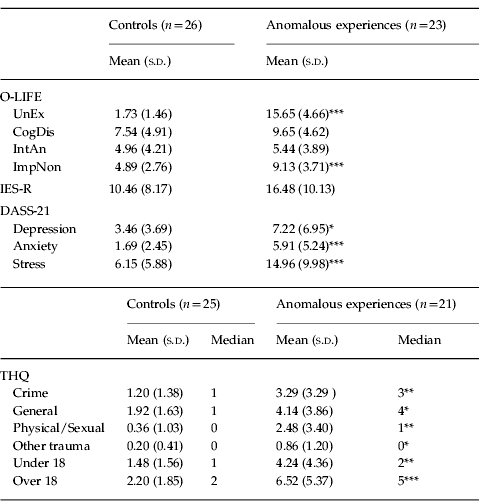
As shown in Table 1, the AE group scored higher than the C group on the DASS-21 (F 3,45=6.7, p=0.001), with significant individual effects on all subscales (depression, anxiety and stress). However, both groups scored within normal limits. The AE group reported significantly higher levels of trauma than the controls on the THQ (F 5,40=3.4, p=0.011), with significant individual effects on all subsections, and on both childhood and adult trauma. Ninety percent of the AE group reported at least one traumatic experience over the age of 18, and 81% at least one trauma under 18 years, compared to 80% and 72% respectively for the C group. No significant differences were found on the transformed IES-R scores [t 47=–1.6, p(n.s.)].
Means, standard deviations (s.d.) and medians for participant characteristics

O-LIFE, Oxford–Liverpool Inventory of Feelings and Experiences; UnEx, Unusual Experiences; CogDis, Cognitive Disorganization; IntAn, Introvertive Anhedonia; ImpNon, Impulsive Nonconformity; IES-R, Impact of Event Scale – Revised; DASS-21, Depression, Anxiety and Stress Scale-21; THQ, Trauma History Questionnaire.
* p<0.05, ** p<0.01, *** p<0.001.
Trait information processing style
Differences in trait DDP and trait CP for past trauma using the T-CPQ were analysed separately. The AE group reported significantly higher levels of trait DDP than the C group (AE: mean=33.9, s.d.=7.7; C: mean=28.7, s.d.=8.5; ANCOVAFootnote 2 : F=9.5, df=1,46, p<0.01) but no differences in trait CP [AE: mean=19.3, s.d.=4.5; C: mean=16.5, s.d.=4.6; ANCOVA: F=0.75, df=1,46, p(n.s.)].
Validity checks for experimental task
Effects of video on mood, attention and recognition memory
Both groups under both conditions had a similar response to the trauma film. A series of 2 (group)×2 (condition)×2 (pre-/post-video) ANOVAs showed that viewing the video resulted in a deterioration of mood ratings in both groups for depression (F 1,47=24.7, p<0.001), anxiety (F 1,47=27.0, p<0.001), anger (F 1,47=11.1, p<0.01) and happiness (F 1,47=68, p<0.001). Participants reported reduced attention to the video in the VST condition in both groups (F 1,47=37.0, p<0.001). There were no significant effects on recognition memory for condition [F 1,45=0.94, p(n.s.)] or group [F 1,45=0.00, p(n.s.)]. The mean recognition memory across groups and conditions was fairly low, lying just above the chance level, with accuracy ranging from 54% to 58%.
VST compliance
There was a mean of 55.3 key presses and 5.2 correct sequences per minute. An accurate five-key sequence order was tapped on 47.4% of occasions, with no significant differences between groups [t 47=0.57, p(n.s.)].
Diary compliance
The diary compliance rating was averaged across conditions. There were no significant group differences in diary compliance [U=255.5, p(n.s.)]. An overall mean diary compliance rating of 1.95 (s.d.=1.15) indicates that participants believed they recorded most of their intrusions.
Post-traumatic intrusions
Four-minute intrusion task
The AE group recorded significantly more intrusions in the 4-min task than the controls (ANCOVA: F 1,46=15.97, p<0.001). The effect of the visuospatial condition did not reach significance (F 1,46=3.2, p=0.08) and no significant interaction between group and condition was found [F 1,46=1.9, p(n.s.)].
Seven-day diary intrusion task
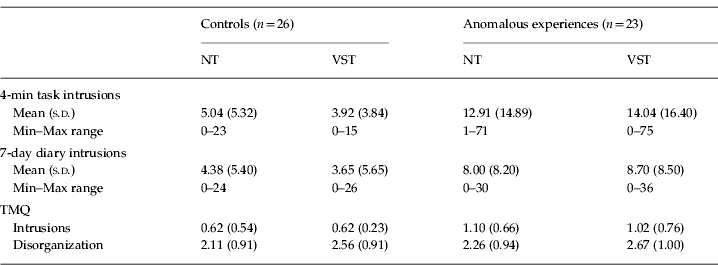
The AE group reported significantly more intrusions in the diary than the controls (ANCOVA: F 1,46=8.37, p<0.01). There was no significant effect of visuospatial condition [F 1,46=0.11, p(n.s.)] and no significant interaction between group and condition [F 1,46=2.15, p(n.s.)]. The means and standard deviations are reported in Table 2.
Means and standard deviations (s.d.) for intrusions and Trauma (film) Memory Questionnaire (TMQ)

NT, No task; VST, visuospatial task.
Trait information processing style and intrusions
Reported intrusions on the VST and NT conditions were collapsed, as no significant differences were found between conditions. There were significant associations between trait levels of DDP and the number of intrusions experienced in both the 4-min task (Spearman's ρ=0.39, p<0.01) and the 7-day diary task (Spearman's ρ=0.38, p<0.01), and a near-significant positive association with self-reported intrusiveness on the TMQ (Spearman's ρ=0.28, p=0.056). There were no significant associations between trait CP and any of the intrusion measures, or between either of the T-CPQ scales and memory organization.
TMQ
The Intrusiveness and Disorganization subscales were analysed separately. The AE group reported higher levels of intrusiveness than the controls (ANCOVA: F 1,46=7.06, p=0.011). There was no significant effect of condition [F 1,46=0.20, p(n.s.)] and no significant interaction between group and condition [F 1,46=0.36, p(n.s.)]. A MANCOVA showed that the AE group scored significantly higher than the C group on the vividness items [‘My memories of the video consist of vivid images’ (AE: mean=2.07, s.d.=0.87; C: mean=1.27, s.d.=1.01; p<0.01); ‘When I remember the video it is like I am watching it again, here and now’ (AE: mean=1.04, s.d.=0.93; C: mean=0.40, s.d.=0.57; p<0.01)], on the emotions items [‘I experience feelings similar to those I had during the video even when I am not thinking of it’ (AE: mean=0.63, s.d.=0.69; C: mean=0.23, s.d.=0.38; p<0.05); ‘I experience strong emotions when remembering the video clips’ (AE: mean=0.96, s.d.=0.89; C: mean=0.48, s.d.=0.59; p<0.05)], and at trend level on the re-experiencing item [‘The feelings I had during the video clips keep coming back to me’ (AE: mean=0.78, s.d.=0.93; C: mean=0.35, s.d.=0.56; p=0.053)]. There were no differences on the trigger items [‘Many different things trigger memories of the video’; ‘I find myself unexpectedly remembering the video clips’ (AE: mean=0.75, s.d.=0.72; C: mean=0.97, s.d.=0.99; p(n.s.)].
There was no significant main effect of group on the Disorganization subscale [ANCOVA: F 1,46=0.05, p(n.s.)] or of condition (F 1,46=2.97, p=0.09). There was no significant interaction between group and condition [F 1,46=1.59, p(n.s.)].
Post-hoc analysis
Because participants from both groups reported less attention being paid to the trauma film during the VST condition, analyses were repeated while controlling for the effects of this variable. The same findings were obtained. Post-hoc independent t tests were also used to assess for a potential ordering effect of the two conditions on intrusions, and none was found.
Discussion
The main prediction of the study was that healthy individuals reporting anomalous experiences would experience more frequent intrusions of a stressful event than low-scoring schizotypes. This prediction was supported, with the AE group exhibiting more frequent intrusions both immediately after watching a trauma film and within the following 7 days. The finding of increased intrusions immediately after the trauma film is an addition to the literature, whereas the results obtained over the 7-day period support previous reports in a psychometrically identified schizotypy group (Holmes & Steel, Reference Holmes and Steel2004). This is the first study reporting increased intrusions for this group in both an immediate and a delayed time frame. There is a clear theoretical account that may explain this group's vulnerability to the development of intrusions. However, a psychiatric diagnosis may then be obtained if such intrusions are maintained. The reasons for a vulnerability to the maintenance of intrusions in this group are less clear, and require further research within the context of existing cognitive models of schizophrenia.
In addition to reporting more frequent intrusions, the AE group rated their intrusions more highly on the Intrusiveness subscale of the TMQ than low schizotypes. Specifically, they reported higher levels of emotion and vividness; characteristics in line with the weak level of contextual integration hypothesized to underlie their development. Surprisingly, the intrusions in the two groups did not differ in terms of the ease with which they were triggered. However, this may be the product of the forced recording of intrusions within an experimental situation. The two groups also did not differ on the Disorganization subscale of the TMQ, as had been predicted. One potential explanation may be that the Disorganization subscale lacks validity for use with non-autobiographical memories produced from an analogue trauma (Jelink et al. Reference Jelink, Randjbar, Seifert, Kellner and Moritz2009). Individuals may have poorer confidence in non-autobiographical, unrelated memories, and the memory Disorganization subscale may have captured forgetting rather than fragmentation, as had been intended.
In line with predictions and previous research, the AE group displayed higher levels of trait DDP than the low-schizotypy group (Steel et al. Reference Steel, Mahmood and Holmes2008), with no group differences in CP. Furthermore, trait DDP (but not CP), was significantly associated with increased intrusions in both the 4-min task and the 7-day diary. These results replicate previous findings of trait DDP being associated with analogue PTSD symptoms (Halligan et al. Reference Halligan, Clark and Ehlers2002).
The other main prediction of the study was that conducting a concurrent VST while watching a trauma film would protect against the development of intrusions (Brewin & Saunders, Reference Brewin and Saunders2001; Holmes et al. Reference Holmes, Brewin and Hennessy2004; Stuart et al. Reference Stuart, Holmes and Brewin2006), especially for the AE group. Our results did not support this hypothesis. One possibility is that the subtle differences between the design of our VST and those used in previous studies may have proved crucial. For instance, the hardware used in the current study made the VST more difficult than those adopted in previous studies: Holmes et al. (Reference Holmes, Brewin and Hennessy2004) reported a speed of 70 taps/min and an accuracy rate of 82.3% on their five-key sequence, which is far higher than that found in the current study (55 taps/min with a 47.4% accuracy rate). It may be that the potential increased difficulty of our task paradoxically resulted in less resources being directed towards it.
The recruitment of healthy individuals reporting anomalous experiences of a psychotic nature is an advantage of this study. Such individuals display greater similarity to patients with psychosis than high-scoring schizotypes because they report experiences that are indistinguishable from their clinical counterparts. They also offer the possibility of investigating the processes underlying positive psychotic symptoms and their relationship to traumatic intrusions, in the absence of confounding variables such as general cognitive deficits, medication, and non-specific illness-related factors. The use of such a group also allows for the modelling of analogue trauma, which, for ethical reasons, could not be conducted with a clinical sample.
There were, however, limitations to the current study. As described earlier, the use of a slightly different type of VST may have prevented the replication of previous reports in which intrusions are reduced. In addition, as most measures were completed retrospectively, it is not possible to rule out the potential effects of memory bias. However, the recording of intrusive experiences was not retrospective, which is a strength of the current design.
The main findings of the current study have important implications for our understanding of a possible relationship between traumatic symptoms and psychosis. The presence of intrusive memories after a trauma film can be understood with reference to high levels of trait DDP and associated low levels of contextual integration. Of particular interest is how those individuals reporting anomalous experiences also reported more frequent, emotive and vivid intrusive memories. This result can be understood in the context of such individuals being particularly vulnerable to weaker contextual integration. If individuals who have psychotic experiences are vulnerable to more frequent and intense intrusions, there is a potential route from traumatic experiences to psychosis. Although psychiatric outcome is likely to be determined by the appraisal of such experiences, the presence of frequent, vivid intrusive memories could form the basis of distressing appraisals. The relationship between idiosyncratic beliefs and the appraisal of intrusions is clearly an important area for future research. The current sample of individuals reporting anomalous experiences is also likely to exhibit source-monitoring problems (Laroi et al. Reference Laroi, Collignon and Van der Linden2005). If a vulnerability to frequent intrusions is combined with a weakened ability to identify the origin of intrusions as being internal (i.e. a memory), it may lead to appraisals of external threat that are characteristic of psychotic presentations (e.g. ‘someone is putting this in my head’ or ‘this is a premonition of the future’). This process fits with the personal account of one participant describing an intrusion of the trauma film as a ‘psychic attack’.
There are clear clinical implications based on such a relationship between intrusions and psychosis. The gentle assessment of traumatic history and any intrusive experiences during therapy sessions may facilitate a connection between intrusions and past events that is less threatening than the current psychotic explanation. Helping patients to formulate their current symptoms in terms of past and/or current traumas and stressors, linked to an understanding of triggers, may enable them to detach intrusive experiences from a sense of current threat. This would help to change their appraisals of the dangerousness, controllability and source of intrusive experiences and could provide an intervention to reduce the distress and clinical need associated with other, maladaptive appraisals (Garety et al. Reference Garety, Kuipers, Fowler, Freeman and Bebbington2001; Morrison, Reference Morrison2001).
In summary, the current study found that individuals with psychotic experiences were vulnerable to frequent and intrusive post-traumatic memories that were related to trait DDP. This lends support to one aspect of Steel et al.'s (Reference Steel, Fowler and Holmes2005) theoretical account, which argues that weak trait contextual integration underlies the development of intrusions in psychosis in vulnerable individuals. The proposed relationship between changes in state DDP and traumatic intrusions in schizotypal individuals remains to be explored. This area is likely to benefit from improved methodologies that are able to assess real-time changes in information processing style, such as neuroimaging.
Acknowledgements
We are grateful to the participants who took part in this study, and to Dr E. Holmes, University of Oxford for providing the material used within the trauma film.
Declaration of Interest
None.