INTRODUCTION
Mangroves are highly productive ecosystems which can be potential sources of organic matter and nutrients, mainly through detritus, as particulate organic matter (POM) and dissolved organic matter (DOM) exported to estuarine and adjacent coastal areas, especially in the more oligotrophic regions (Robertson et al., Reference Robertson, Alongi, Boto, Robertson and Alongi1992; Jennerjahn & Ittekkot, Reference Jennerjahn and Ittekkot2002; Dittmar et al., Reference Dittmar, Hertkorn, Kattner and Lara2006). Litterfall, which is composed primarily of leaves (Robertson et al., Reference Robertson, Alongi, Boto, Robertson and Alongi1992; Aké-Castillo et al., Reference Aké-Castillo, Vázquez and López-Portillo2006), provides a large input of organic material (Jennerjahn & Ittekkot, Reference Jennerjahn and Ittekkot2002; Mfilinge et al., Reference Mfilinge, Meziane, Bachok and Tsuchiya2005), and leaf detritus is an important food source for decomposer food webs, which can be recycled within the mangrove forest or exported (Jennerjahn & Ittekkot, Reference Jennerjahn and Ittekkot2002; Kristensen et al., Reference Kristensen, Bouillon, Dittmar and Marchand2008).
The process of leaf-litter decomposition on the sediment has an important role in the availability of organic matter and nutrient cycling in mangroves and adjacent areas (Kathiresan & Bingham, Reference Kathiresan and Bingham2001; Barroso-Matos et al., Reference Barroso-Matos, Bernini and Rezende2012). This process can be divided into two stages: (1) a rapid weight loss, mainly due to leaching and degradation of soluble compounds such as certain sugars and tannins (Davis et al., Reference Davis, Coronado-Molina, Childers and Day2003; Kristensen et al., Reference Kristensen, Bouillon, Dittmar and Marchand2008); (2) slower decomposition resulting from the deterioration of structural and refractory materials such as lignin (Melillo et al., Reference Melillo, Aber and Muratore1982; Ananda et al., Reference Ananda, Sridhar, Raviraja and Ba'rlocher2008).
Decomposition depends on the degree and frequency of tidal inundation, climatic factors such as temperature, humidity and rainfall, substrate conditions and the presence of leaf detritus-consuming fauna (Twilley et al., Reference Twilley, Lugo and Patterson-Zucca1986; Tam et al., Reference Tam, Vrijmoed and Wong1990; Mackey & Smail, Reference Mackey and Smail1996; Alongi, Reference Alongi2009; Galeano et al., Reference Galeano, Pineda and Calderón2010). The detritivores affect decomposition by shredding, ingesting and assimilating litter, which facilitates leaf decomposition and can increase microbial colonization (Imgraben & Dittmann, Reference Imgraben and Dittmann2008; Alongi, Reference Alongi2009). Crustaceans, molluscs and annelids are the main macrofauna groups that process leaf litter into smaller particles (Alongi, Reference Alongi1998; Oliveira et al., Reference Oliveira, Rizzo and Couto2012).
Bacteria and fungi participate significantly in decomposition, especially in its early stage (Cundell et al., Reference Cundell, Brown, Stanford and Mitchell1979; Kathiresan & Bingham, Reference Kathiresan and Bingham2001), through the enrichment of leaves by mineralization or immobilization of some nutrients, making the leaves more attractive for detritivores. Alongi et al. (Reference Alongi, Boto, Robertson, Robertson and Alongi1992) noted that organic materials that are rich in nitrogen (low C:N ratio) favour mineralization, whereas nitrogen-poor material (high C:N ratio) favours the immobilization of this nutrient. The dynamics of nitrogen are important because the litter quality of the leaf is given by the C:N ratio, in which low values of the ratio indicate high concentrations of nitrogen and higher litter quality (Wafar et al., Reference Wafar, Untawale and Wafar1997; Ashton et al., Reference Ashton, Hogarth and Ormond1999).
The leaf decomposition rate varies among plant species and depends mainly on the structure and chemical composition of the leaf, especially the lignin and nutrient concentrations (Tam et al., Reference Tam, Wong, Lan and Wang1998). Decomposition is also influenced by the amount of polyphenols, usually in the form of tannins, which are astringent secondary metabolites and act as a defence mechanism against herbivores (Kandil et al., Reference Kandil, Grace, Seigler and Cheeseman2004).
Mangroves occur along 92% of the Brazilian coastline (6786 km), and show wide variability in their structural and spatial attributes, related to their geographical distribution (Schaeffer-Novelli et al., Reference Schaeffer-Novelli, Cintrón-Molero, Adaime and Camargo1990, Reference Schaeffer-Novelli, Cintrón-Molero, Soares and De Rosa2000). Avicennia schaueriana Stapf & Leechman, Laguncularia racemosa C.F. Gaertn and Rhizophora mangle L. are the three main species found in Brazilian subtropical mangrove forests (Schaeffer-Novelli et al., Reference Schaeffer-Novelli, Cintrón-Molero, Adaime and Camargo1990; Colpo et al., Reference Colpo, Chacur, Guimarães and Negreiros-Fransozo2011). They have different chemical constituents, especially the concentrations of nutrients and secondary metabolites (Godoy et al., Reference Godoy, Mayworm, Lo, Salatino and Schaeffer-Novelli1997; Bernini et al., Reference Bernini, Silva, Carmo and Cuzzuol2006). These differences in chemical composition may affect the degradation and subsequent decomposition of their leaves.
The nylon-mesh bag technique is most frequently used to study leaf litter decomposition. Despite its limitations, the litterbag technique is useful because it does reflect trends and can provide comparisons between treatments (Tam et al., Reference Tam, Vrijmoed and Wong1990; Bosire et al., Reference Bosire, Dahdouh-Guebas, Kario, Kazungu, Dehairs and Koedam2005). Studies commonly test the effect of the exclusion of specific faunal groups through the deployment of bags with different mesh sizes, in order to determine the effects of these animals on the decomposition process (Bradford et al., Reference Bradford, Tordoff, Eggers, Jones and Newington2002). A fine mesh allows small invertebrate consumers to enter, in conjunction with the microbial decomposition activity, but excludes large invertebrate consumers (i.e. large Decapoda and Gastropoda) and prevents much of the particulate organic matter from being flushed from the bag (Robertson, Reference Robertson1988; Silva et al., Reference Silva, Oliveira, Rego and Mozeto2007; Imgraben & Dittmann, Reference Imgraben and Dittmann2008). A coarse mesh enables observation of a nearly natural decomposition process, by allowing entry of macroinvertebrates and facilitating physical fragmentation (Nanda et al., Reference Nanda, Asaeda, Fujino, Siong and Nakajima2009).
As noted by Kristensen et al. (Reference Kristensen, Bouillon, Dittmar and Marchand2008), understanding nutrient cycling and the factors controlling nutrient pathways is essential to reveal ecosystem capacity; and decomposition, as one of its factors, can have important trophic implications (Alongi, Reference Alongi2009). The few investigations of leaf-litter decomposition dynamics in Brazilian mangrove forests include those of Sessegolo & Lana (Reference Sessegolo and Lana1991), Moura (Reference Moura1997) and Barroso-Matos et al. (Reference Barroso-Matos, Bernini and Rezende2012). In order to better understand the leaf-litter decomposition process and its potential implications in biogeochemical cycling and trophic webs in subtropical mangroves, this study analysed and compared the rates of leaf decomposition of Brazilian mangrove species (A. schaueriana, L. racemosa and R. mangle) in nylon-mesh bags (fine: 2 × 2 mm and coarse: 8 × 8 mm) over time.
MATERIALS AND METHODS
The study was conducted in a subtropical mangrove located along the banks of the Itapanhaú River in the municipality of Bertioga (23°50′11″S 46°09′10″W) on the southern coast of São Paulo, Brazil. The mangrove sediments are fine (Queiróz-Neto & Küpper, Reference Queiróz-Neto, Küpper and Azevedo1965), and tides are semidiurnal and range around 1.5 m. The annual rainfall ranges from 1500 to 4000 mm; the mean annual temperature is 22°C, with a minimum of 10°C and a maximum of 35°C; and the relative humidity oscillates around 80% (Afonso, Reference Afonso2006).
The experiment was conducted over four months during autumn and early winter (March–July 2011). Senescent leaves of each species (Avicennia schaueriana, Laguncularia racemosa and Rhizophora mangle), which were yellow and close to abscission, easily detached from the twigs (Ashton et al., Reference Ashton, Hogarth and Ormond1999), were collected in the mangrove. In the laboratory, the leaves were air-dried at room temperature for 48 h to remove part of the moisture (Imgraben & Dittmann, Reference Imgraben and Dittmann2008). Dried leaves (5 g) of each species were placed in nylon litter bags of two kinds, fine mesh (2 × 2 mm) and coarse mesh (8 × 8 mm), measuring 18 × 13.5 cm. The litter bags with fine and coarse mesh were randomly arranged on the sediment inside the mangrove forest. The bags were tied to tree trunks or roots at 15 m from the river bank, to ensure the same tidal conditions. Also, three extra bags containing 5 g of air-dried but undecomposed leaves of each species were dried at 60°C for 96 h to determine the initial dry weight (DW 0) (Aké-Castillo et al., Reference Aké-Castillo, Vázquez and López-Portillo2006).
Three litter bags of each species and type of mesh were collected randomly from the study site 7, 12, 19, 27, 41, 57, 70, 84, 97 and 112 d after the beginning of the experiment and taken to the laboratory. Initially the bags were collected weekly, since changes occur more rapidly in the early stages of decomposition (Moura, Reference Moura1997). In the laboratory, the leaves from the collected bags were gently rubbed and washed under tap water on a sieve with mesh size of 0.25 mm, to remove the sediment and retain the leaf debris. Then, each sample was dried at 60°C for 96 h to obtain the dry weight (Silva et al., Reference Silva, Oliveira, Rego and Mozeto2007). In order to determine the decomposition rate we used a mathematical model described by Olson (Reference Olson1963), by adjusting the curves for dry-weight loss to the exponential model:
 $$DW/DW_0 = e^{ - kt}$$
in which DW 0 is the initial dry weight, DW is the final dry weight, k is the coefficient of decomposition and t is the time elapsed. The decomposition coefficient (k) of each sample indicates its decomposition rate.
To compare the decomposition rates of the three mangrove species, as influenced by the different meshes, over time, the data were subjected to a repeated measures ANOVA (between-subjects factors: species (three levels: A. schaueriana, L. racemosa and R. mangle), mesh (two levels: fine and coarse) and within-subjects factor: time (10 levels: 7, 12, 19, 27, 41, 57, 70, 84, 97 and 112 d)) (Zar, Reference Zar1999). The homogeneity of variances was determined through the Cochran test, and when necessary the data were transformed using Ln(x). The Student–Newman–Keuls (SNK) test was used a posteriori to detect significant differences (Underwood, Reference Underwood1997).
The invertebrates associated with the leaves and found during washing were separated and preserved in 70% ethanol. Later, the specimens were identified and counted under a stereomicroscope.
RESULTS
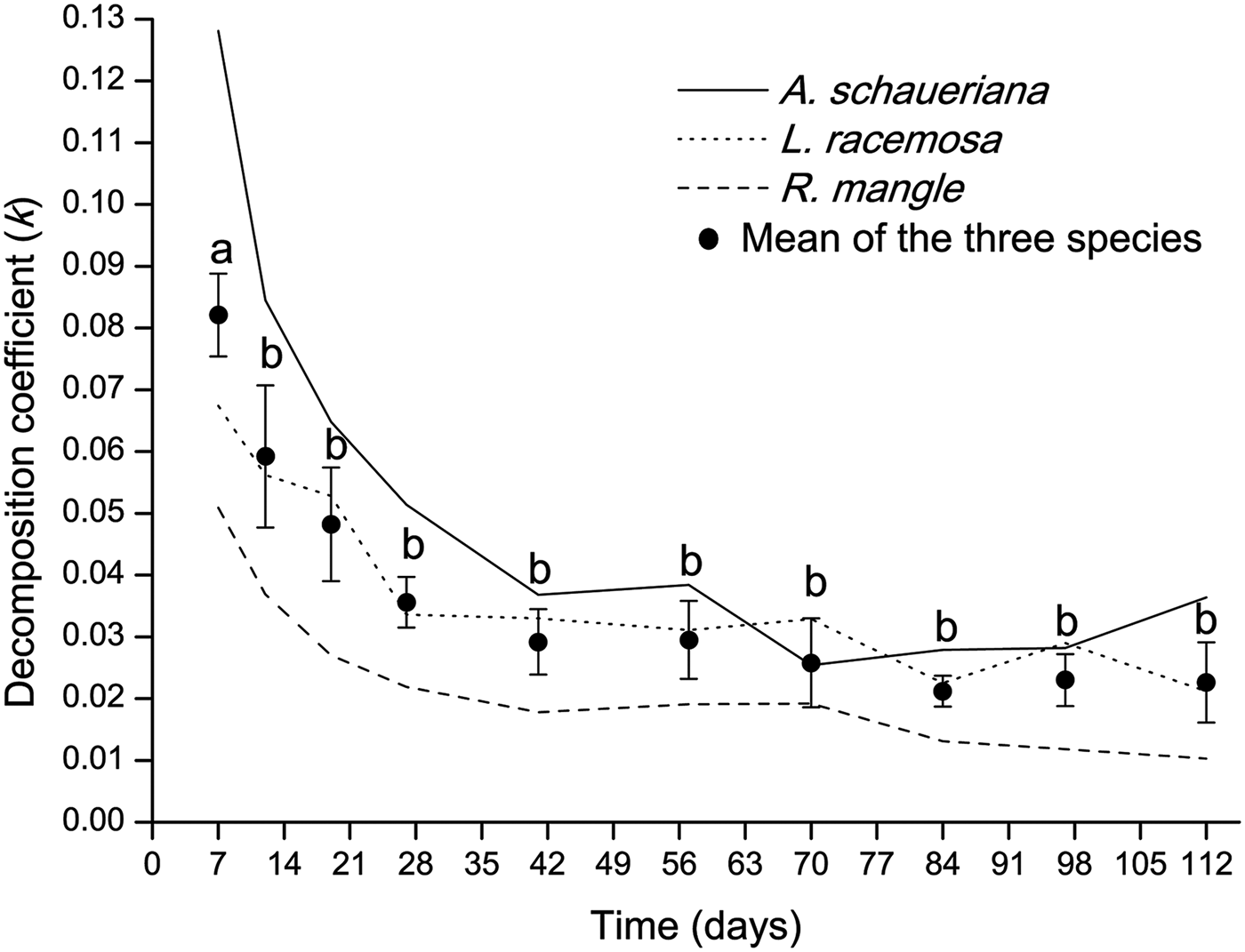
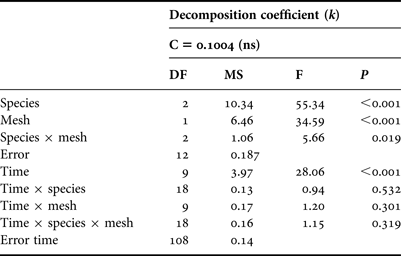
The repeated-measures ANOVA showed that the decomposition coefficient of all species was highest on the first sampling day (day 7), and decreased significantly by the second sampling day (day 12). Subsequently the coefficient gradually decreased until the 112th day (Table 1; Figure 1). After the 12th day the decomposition entered a slower phase.
Decomposition coefficient (k) of leaves from each mangrove species over time. Dots indicate the overall mean and SE of k for the three species. Different letters indicate a statistical difference (P < 0.01).

Summary of repeated measures ANOVA, showing the effects of species, mesh and time on the decomposition process, for the decomposition coefficient (k).
C, Cochran's C-test; ns, not significant.
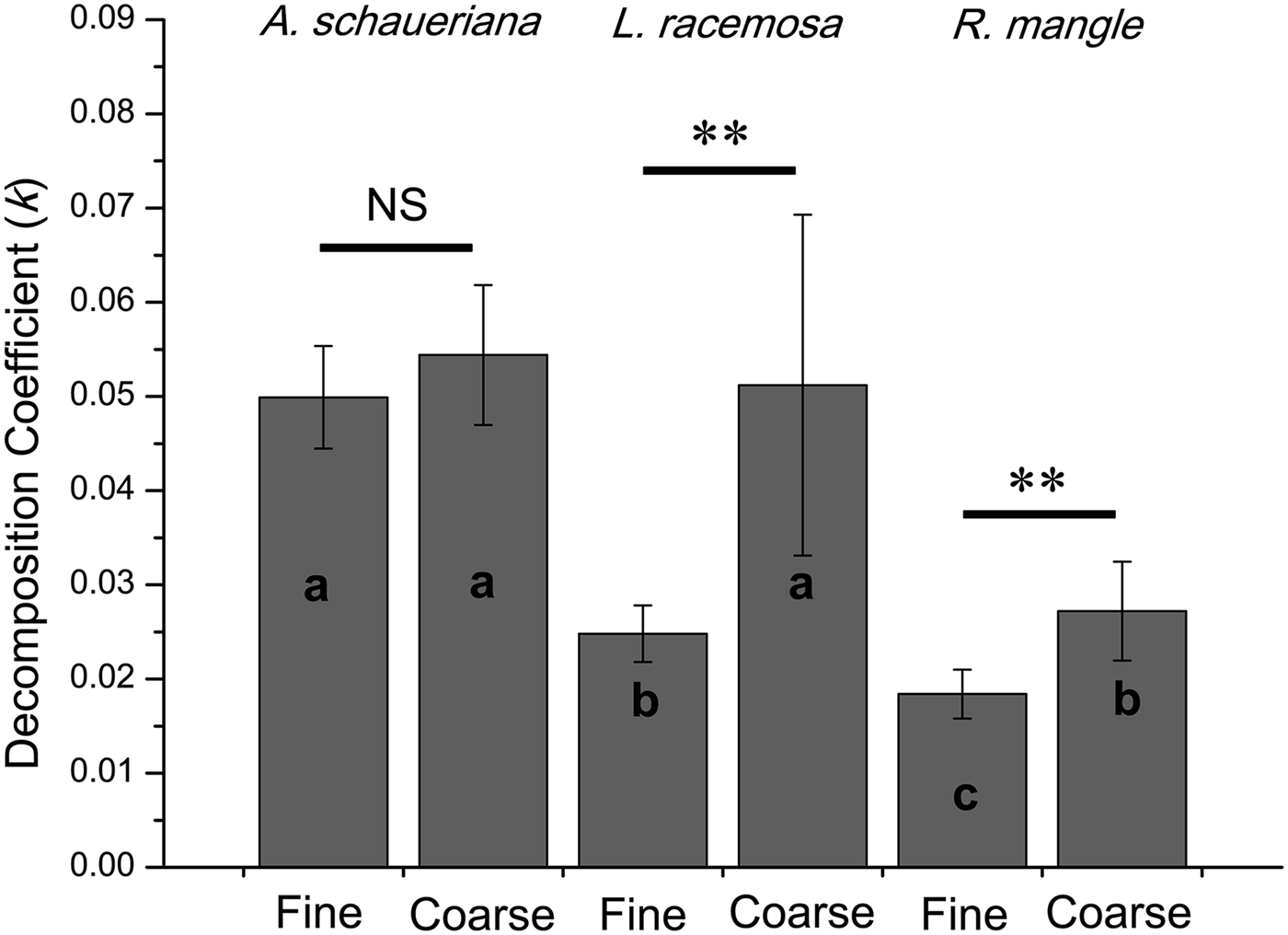
The decomposition coefficient of Avicennia schaueriana leaves was similar in the bags of different meshes, while for Laguncularia racemosa and Rhizophora mangle the decomposition coefficients were higher in the coarse mesh than the fine mesh (Table 1; Figure 2). Leaves of L. racemosa in coarse-mesh bags decomposed 100% faster than in fine-mesh bags, and in R. mangle this difference was 47% faster. Comparison of coefficients between each species and mesh indicated that A. schaueriana in both meshes (fine mesh = 0.049 ±0.006, mean ±SE; coarse mesh = 0.054 ±0.006) and L. racemosa in coarse mesh (0.051 ±0.007) decomposed at a similarly rapid rate. Similar intermediate coefficients were recorded for the fine mesh of L. racemosa (0.025 ±0.002) and coarse mesh of R. mangle (0.027 ±0.003). The fine mesh of R. mangle showed the slowest decomposition rate recorded (0.018 ±0.002) (Figure 2).
Mean decomposition coefficient (k) of Avicennia schaueriana, Laguncularia racemosa and Rhizophora mangle in fine- and coarse-mesh bags (mean and SE). Different letters indicate a statistical difference (P < 0.05). **, P < 0.01; NS, P > 0.05.
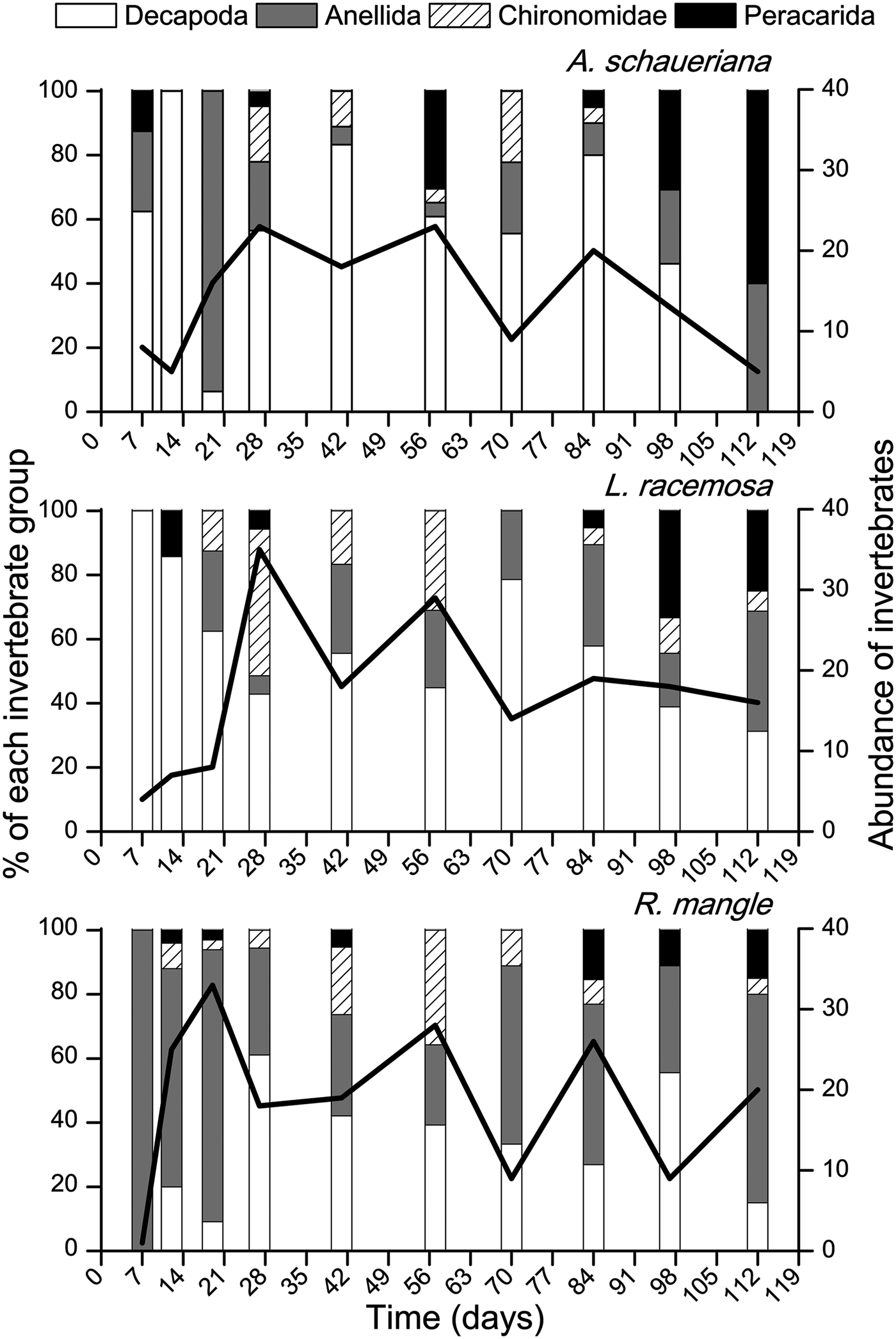
Arthropods and annelids were found in the decomposition bags (coarse and fine mesh). Crustaceans were the most diverse group, with representatives from Peracarida (orders Isopoda, Tanaidacea and Amphipoda) and Decapoda (juveniles of the families Sesarmidae, Ocypodidae and Xanthidae). Chironomid larvae (Diptera) were also recorded. Among Annelida, polychaetes of the order Phyllodocida (families Nereididae, Nephtyidae and Goniadidae) and subclass Oligochaeta were found. Invertebrate abundance in the decomposition bags reached its maximum on the 19th day for R. mangle and on the 27th day for A. schaueriana and L. racemosa (Figure 3). Juveniles of Decapoda predominated throughout the survey in A. schaueriana and L. racemosa, and comprised 54.1% and 54.6%, respectively, of the total of invertebrates in the bags. However, in R. mangle, annelids predominated on six of the ten sampling days and comprised 55.9% of the invertebrate abundance in the bags of leaves of this species (Figure 3).
Relative and total abundance of main macrofauna groups on mangrove leaves in mesh bags during the decomposition process.
DISCUSSION
All species showed a high decomposition rate in the first week of the decomposition process, with a pronounced decrease of the coefficient in the following weeks, as reported in several other litter-decomposition studies; the period of decrease can vary from days to weeks (Robertson et al., Reference Robertson1988; Dick & Osunkoya, Reference Dick and Osunkoya2000; Davis et al., Reference Davis, Coronado-Molina, Childers and Day2003; Aké-Castillo et al., Reference Aké-Castillo, Vázquez and López-Portillo2006; Barroso-Matos et al., Reference Barroso-Matos, Bernini and Rezende2012). This rapid weight loss, which results from the high decomposition rate in the beginning of the experiment, is usually attributed to leaching of soluble compounds such as sugars, organic acids, proteins and phenols (Mfilinge et al., Reference Mfilinge, Atta and Tsuchiya2002; Davis et al., Reference Davis, Coronado-Molina, Childers and Day2003, Reference Davis and Childers2007; Kristensen et al., Reference Kristensen, Bouillon, Dittmar and Marchand2008). After the first week a slower phase began, with a constant and decreasing decomposition rate. This phase is normally marked by a more gradual decomposition (Ananda et al., Reference Ananda, Sridhar, Raviraja and Ba'rlocher2008; Galeano et al., Reference Galeano, Pineda and Calderón2010) and is well recognized in the literature as a period of intense microbial action, when the N content increases (Robertson et al., Reference Robertson1988, Reference Robertson, Alongi, Boto, Robertson and Alongi1992; Wafar et al., Reference Wafar, Untawale and Wafar1997; Davis et al., Reference Davis and Childers2007).
Leaves placed in coarse-mesh bags usually have higher decomposition rates than leaves in fine-mesh bags, since they are more exposed to leaching, physical abrasion and loss of particles (Bradford et al., Reference Bradford, Tordoff, Eggers, Jones and Newington2002; Aké-Castillo et al., Reference Aké-Castillo, Vázquez and López-Portillo2006). In the present study, leaves of Laguncularia racemosa in coarse-mesh bags decomposed 100% faster than in fine-mesh bags, while in Rhizophora mangle this difference was 47% faster. Meyer et al. (Reference Meyer, Ostertag and Cowie2011), in a study in a Hawaiian rain forest, observed 17% faster decomposition in treatments that did not exclude large invertebrates (larger than 2 mm). Middleton & McKee (Reference Middleton and McKee2001) found that the participation of these invertebrates is indispensable, and with macroinvertebrates present the decomposition rate was three times faster than with microorganisms alone. However, in this study, Avicennia schaueriana showed a similar decomposition rate in bags of both mesh sizes. This similarity could have resulted from the high litter quality of its leaves, as represented by the low C:N ratio previously reported for this genus (Wafar et al., Reference Wafar, Untawale and Wafar1997; Bernini et al., Reference Bernini, Silva, Carmo and Cuzzuol2006; Sánchez-Andrés et al., Reference Sánchez-Andrés, Sánchez-Carillo, Alatorre, Cirujano and Álvarez-Cobelas2010). Leaves with a low C:N ratio are normally preferred by detritivores (Poovachiranon et al., Reference Poovachiranon, Boto and Duke1986; Nordhaus et al., Reference Nordhaus, Salewski and Jennerjahn2011), which in turn might have led to the high weight loss and decomposition rates in both meshes observed here.
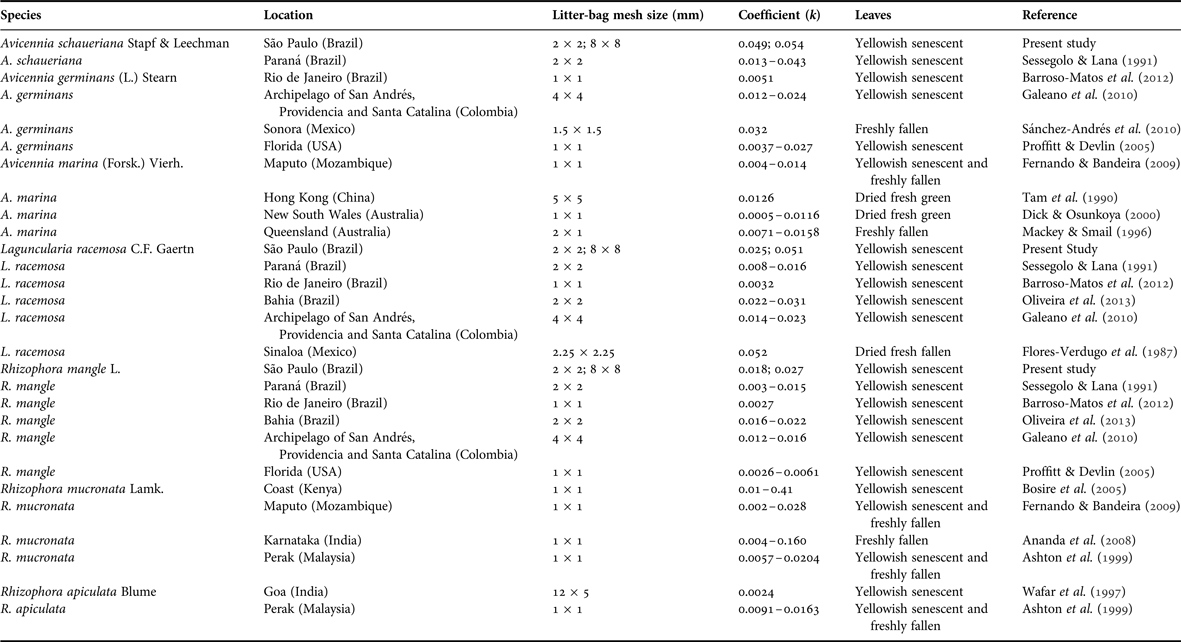
According to the classification of Ananda et al. (Reference Ananda, Sridhar, Raviraja and Ba'rlocher2008), all three species had rapid decomposition rates (k > 0.01). In general, setting aside the effect of mesh size, the decomposition rate for A. schaueriana was higher during most of the decomposition process, followed closely by L. racemosa with intermediate coefficients, and last by R. mangle. Similar differences between members of these genera have been found previously in other studies worldwide, as shown by an overview of the k range in Table 2; and usually follow the same pattern, in which k of Avicennia > k of Laguncularia > k of Rhizophora. However, comparisons among studies scattered around the world have their limitations, mainly because of the lack of methodological standardization.
Overview of decomposition rates, represented by the worldwide range of the coefficient (k).
The initial chemical composition of the leaves, especially the concentrations of N, tannins and lignin, which determine litter quality, is regarded as a regulator of the decomposition rate (Melillo et al., Reference Melillo, Aber and Muratore1982; Wafar et al., Reference Wafar, Untawale and Wafar1997; Mfilinge et al., Reference Mfilinge, Atta and Tsuchiya2002), in addition to leaf morphology (Steinke et al., Reference Steinke, Barnabas and Somaru1990; Ashton et al., Reference Ashton, Hogarth and Ormond1999), and has been invoked as the main explanation for the differences in decomposition rate among these genera (Fernando & Bandeira, Reference Fernando and Bandeira2009; Galeano et al., Reference Galeano, Pineda and Calderón2010; Sánchez-Andrés et al., Reference Sánchez-Andrés, Sánchez-Carillo, Alatorre, Cirujano and Álvarez-Cobelas2010; Barroso-Matos et al., Reference Barroso-Matos, Bernini and Rezende2012). Twilley et al. (Reference Twilley, Lugo and Patterson-Zucca1986) suggested that a higher concentration of N in Avicennia germinans L. induced degradation at twice the rate observed for R. mangle. According to Middleton & McKee (Reference Middleton and McKee2001), in addition to the high concentration of N, low tannin amounts contributed to the faster weight loss of leaves of A. germinans compared to R. mangle and L. racemosa. Also for the same genus, Avicennia officinalis L. showed a decomposition coefficient four to five times higher than those of Rhizophora apiculata Blume, Rhizophora mucronata Lam. and Sonneratia alba J. Smith, probably as a consequence of its thinner leaves, which fragment easily and accelerate decomposition (Wafar et al., Reference Wafar, Untawale and Wafar1997). Avicennia leaves tend to decompose faster than other species because they are thinner and have a high N content and low concentrations of lignin and tannin (Godoy et al., Reference Godoy, Mayworm, Lo, Salatino and Schaeffer-Novelli1997; Wafar et al., Reference Wafar, Untawale and Wafar1997; Kathiresan & Bingham, Reference Kathiresan and Bingham2001; Bernini et al., Reference Bernini, Silva, Carmo and Cuzzuol2006). Comparing the two remaining species, Moura (Reference Moura1997) found that the lower decomposition rate of R. mangle compared with L. racemosa is probably because of the thick waxy cuticle and epidermis, which impede shredders (Cundell et al., Reference Cundell, Brown, Stanford and Mitchell1979), besides the higher lignin content (Godoy et al., Reference Godoy, Mayworm, Lo, Salatino and Schaeffer-Novelli1997). Since the leaves in this experiment were under the same environmental conditions, it is likely that the observed differences among species were influenced mainly by the litter quality.
The predominance of crabs in bags with A. schaueriana and L. racemosa leaves may be a consequence of their food preferences, and of the litter quality of these plant species. Nordhaus et al. (Reference Nordhaus, Salewski and Jennerjahn2011) suggested that plants with larger amounts of nitrogenous compounds were the preferred food for mangrove crabs. The low N content and the thick cuticle of R. mangle may repel the crabs, but also these features may attract the annelids that were the predominant invertebrate group in this mangrove species. Most annelid species in estuarine areas are surface deposit-feeders, with discrete motility and opportunistic behaviours (Magalhães & Barros, Reference Magalhães and Barros2011; Oliveira et al., Reference Oliveira, Rizzo and Couto2012). They feed on microorganisms, sediments and organic matter that settle on the leaf surface (Oliveira et al., Reference Oliveira, Rizzo and Couto2012). The leaves of R. mangle, which showed the lowest decomposition rate, may be a more stable substrate than A. schaueriana and L. racemosa for the establishment of annelids and their food source. The different abundances of decapods and annelids on the three mangrove species and their respective decomposition rates may also suggest that annelids are less efficient shredders than decapods, although Camilleri (Reference Camilleri1992) and Oliveira et al. (Reference Oliveira, Rizzo and Couto2012) noted the important role of polychaetes in processing leaves in tropical mangroves.
The different meshes of litter bags used in this study did not prove significant for mediating macrofauna access when the litter quality was taken into account, as in the case of A. schaueriana, but may have had some influence on leaching and fragmentation, leading to the differences found for L. racemosa and R. mangle. Therefore, we conclude that the differences in litter quality among the species, which determine their palatability, together with the abundance and activity of the detritivorous fauna (mediated in this study by the mesh sizes) were the main factors that regulated the decomposition rate of leaf litter, and may control the decomposition dynamics as estimated in this Brazilian subtropical mangrove forest.
ACKNOWLEDGEMENTS
We deeply appreciate the collaboration of Isabella Romitelli and Bruna Otaguiri, who helped with field and laboratory work. We are also grateful to Dr Ronaldo Christofoletti for his valuable suggestions in the statistical analyses. Finally we thank Dr Janet W. Reid for improving the English text.