The whole thing illustrates how foolish our representatives can be when dealing with something that does not affect their chances of reelection and concerning which they have no knowledge, nor the ambition to acquire it.
—Daniel Williams, Secretary to the Philippine CommissionFootnote 1Our San Domingo solution has worked so well that the public is now paying no heed to the matter whatever.
—Theodore Roosevelt to Henry Cabot Lodge, 1905Footnote 2[M]any American editors and other Americans … refused to distinguish between old-fashioned selfish exploitation and the new and sincere and practical effort to help. They refused to accept the plain fact that our Government was using Wall Street to serve our national interest and to benefit other countries.
—F. M. Huntington Wilson, Assistant Secretary of State (1909–1913)Footnote 3On October 12, 1898, William McKinley arrived at the Trans-Mississippi Exposition in Omaha. Just months before, the United States had emerged victorious from the Spanish-American War, and the president was on a ten-day tour to judge the public's reaction to America's new global role. “Shall we,” McKinley rhetorically asked the assembled crowd, “deny to ourselves what the rest of the world so freely and so justly accords to us?” “No!” came the answer. “The war was no more invited by us than were the questions which are laid at our door by its results,” the president continued to great applause. “Now as then we will do our duty.”Footnote 4 Convinced that the public was now firmly behind him, McKinley demanded from Spain not only the small island territories of Guam and Puerto Rico, but also the entire Philippine archipelago. In return for a nominal payment of $20 million, the United States acquired its first overseas colonies and laid the legal and bureaucratic foundations for a formal overseas empire.
Only seven years after McKinley's decision to retain the islands, Theodore Roosevelt faced another foreign policy dilemma that would have equally far-reaching consequences. The Dominican Republic, deeply in debt to European creditors, was preparing to default on its loans, and Roosevelt, fearing that German, British, or even Italian interests might intervene to force Santo Domingo to maintain payments, offered to take responsibility for the debt. Unlike McKinley, however, Roosevelt (in his inimitable style) famously conceded that he had “about the same desire to annex it as a gorged boa constrictor might have to swallow a porcupine wrong-end-to.”Footnote 5 That the U.S. Congress would never support such an action was, of course, the unspoken subtext. Instead of outright annexation, Roosevelt brought the Dominican Republic under American control through a unique partnership between American bureaucrats and Wall Street bankers whereby the United States arranged for a private loan to refund Dominican debt in exchange for the effective transfer of Dominican sovereignty to a U.S.-controlled protectorate. Although the policy faced fierce opposition in Congress, where Roosevelt was accused of usurping the Senate's treaty-making rights and engaging in illegal negotiations with foreign powers, this controversial neocolonial solution, later dubbed “Dollar Diplomacy” by the press, would serve as the model for subsequent colonial regimes in Haiti, Nicaragua, and Liberia. Yet these institutions of empire would change again a few years later—this time under the Democratic administration of Woodrow Wilson. His arguments for national self-determination in other parts of the world notwithstanding, Wilson ordered the invasion of Haiti and the Dominican Republic in 1915 and 1916 respectively, expanding on Roosevelt's receivership system and bringing the entire island of Hispaniola under direct American administration.Footnote 6
What explains this variation in U.S. colonial control across time and across territories? Why, after the United States established the institutions for formal colonial control in the Philippines and Puerto Rico, were lighter institutional forms established in some Caribbean dependencies, only to be replaced again by a military occupation? How did parts of the American empire come to be dominated by a partnership between American executive officials and the newly emergent New York investment banking industry that Congress would never fully support? The answers, I argue, lie in understanding some systems of American imperial rule and expansion not as evidence of state capture by American finance capital, but rather as innovative and adaptive responses to a discrete series of political-administrative problems—in short, as a form of endogenous institutional change.Footnote 7 In their quest to transform the United States from a prosperous industrial republic into a world power, American empire builders confronted the same obstacles—conditions of mass democracy, a weak central state, and the complex constraints of the U.S. Constitution—that earlier reformers had run up against in their efforts to rationalize the administration of the domestic American state.Footnote 8 Yet despite its famously weak administrative state, the United States conquered and ruled an island empire that stretched halfway around the globe, and the institutional developments and variation that underlay this seemingly effortless, but often unstable, expansion of American power offer important lessons about how the liberal American state navigated the world of international relations.
In this article, I argue that elements of American imperial policy after the Spanish-American War were decisively shaped by the efforts of colonial state officials to expand American hegemony in the face of institutional roadblocks, political veto points, and limitations on administrative capacity. When the time came to design the structures for colonial administration, Congress chose to delegate nearly all responsibility for overseas colonial administration to the president and the nascent colonial state, but it provided few resources to develop the colonies. Most members of Congress saw little advantage in devoting time or treasure to imperial projects that promised few district-specific benefits or spoils. At the same time, the enacting coalition that hammered out the legislative guidelines for the formal colonies reflected the deep divide in Congress between those who championed American imperial expansion and those who objected to the acquisition of American colonies on philosophical grounds, or, more commonly, because of fears that domestic markets would be flooded with raw materials from the islands. The result was legislation that restricted land sales within colonies and maintained tariff barriers for goods entering the United States, while at the same time granting broad powers to colonial bureaucrats to manage internal finances. Confronted with this tepid support (both legal and financial) from Congress for further imperial expansion and development, colonial bureaucrats began to look to private actors to fund their ambitious plans for the American empire, a process I term “state-building through partnership.”
The crux of their strategy lay in the cultivation of public-private partnerships with investment bankers. These partnerships were developed and supported though a variety of cross-cutting professional networks in American banking, economics, and colonial administration. Beginning, in part, with their efforts to develop the Philippines, colonial bureaucrats slowly began to form relationships with bankers who, in turn, floated colonial bonds on Wall Street to fuel the railroad and infrastructure development projects in the islands. By leveraging colonial gold reserves and other resources, they offered these often-reluctant bankers financial incentives to invest in American empire and to increase the capital available for development. These partnerships later spread to the Caribbean, where American colonial officials used them to bring new states under American control without congressional sanction. For their part, bankers initially were provided with small financial inducements and investment guarantees, but as the American empire grew, they began to benefit from the stabilization of Latin American economies, which provided a dramatically safer investment market. Although the bankers did not initiate this form of imperialism, they came to benefit from it. Despite their ideological objections to imperialism, even officials in the Wilson administration, including William Jennings Bryan, found such arrangements to be convenient solutions to foreign policy problems. Yet these loans, and the partnerships more generally, rested on the implicit (but not legal) guarantee from colonial state officials that the bankers' investments would remain safe. The end result would be a perverse and unexpected outcome. As the supervisory regimes began to fail in spectacular fashion by World War I, the Wilson administration was forced to shore up the receiverships by extending formal imperial control. Thus, a policy that had developed to achieve relative autonomy from Congress led to the creation of a new embedded form of imperialism that was partially captured by American finance.
I first briefly outline past economic theories of American imperial expansion and suggest reasons for focusing on the American state's independent interests in imperialism. Second, I present the theoretical components of my argument in more detail. Specifically, I highlight the importance of examining the downstream consequences of a congressional delegation decision and discuss public-private partnerships as an important alternative to traditional theories of state building. Third, I present historical narratives, based largely on archival research, on the emergence of the Dollar Diplomacy partnership in the Philippine colonial state, the spread of this system of imperialism to the Caribbean, and its collapse in the early Wilson administration. I conclude with a discussion of how these formative moments in American state development affected the subsequent expansions of American empire.Footnote 9
1. AMERICAN ECONOMIC EXPANSION, THE AUTONOMOUS STATE, AND “GENTLEMANLY CAPITALISM”
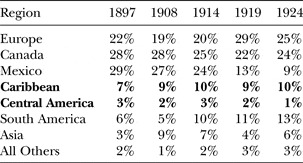
Economic explanations have long been central to studies of American imperialism.Footnote 10 In the 1920s, American scholars built on earlier work by the English political economist John Hobson to criticize U.S. interference with Caribbean nations, arguing by implication that the interests of American business were dictating American foreign policy.Footnote 11 William Appleman Williams and his students at the University of Wisconsin later expanded on these earlier themes to conclude that much of American foreign policy could be explained by a relentless quest for overseas markets.Footnote 12 Despite the theoretical dominance and intuitive appeal of the “Wisconsin School” theories of American diplomatic history, the exact connection between private economic actors and American imperialism remains unclear.Footnote 13 Although American foreign direct investments did increase significantly in this period, relatively little of that money was sent to areas under direct American control. As Table 1 demonstrates, investment in the Caribbean and Latin America represented but a fraction of total American foreign investments both before and after the Spanish-American War, increasing by only three percentage points between 1897 and 1914. Even by 1911, most American investment in the Caribbean region was concentrated in the lucrative Cuban sugar industry, a business in which American investors had long played a central role. By contrast, American direct investment in the Dominican Republic, Haiti, and Nicaragua—all three of which saw Dollar Diplomacy interventions—was extremely modest, accounting for half of the investment in Guatemala alone, a nation that never came under direct American administration.Footnote 14 As economic historians Lance Davis and Robert Cull argue, “[I]t is difficult to rationalize the level of intervention with the size of the American's investment stakes in those countries.”Footnote 15
Direct and Portfolio American Foreign Investments by Region

Source: Calculated from Celona Lewis, America's Stake in International Investments (Washington, DC: Brookings Institution, 1938), 606; Lance E. Davis and Robert J. Cull, International Capital Markets and American Economic Growth, 1820–1914 (New York: Cambridge University Press, 1994), 81.
To be sure, this could be due to the fact that those areas under formal American control were, first and foremost, meant to secure a global trading network—particularly to gain access to the fabled China market—and were not necessarily seen as areas of investment themselves. Yet American investment in Asia was also quite modest. Even by 1900, trade with China and Japan amounted to less than 4 percent of total foreign trade.Footnote 16 American capitalists, it seems, simply saw no reason to enter fragile developing markets when there was easier money to be made in the rapidly expanding economies of Western Europe, Canada, and Mexico. Nor did they necessarily need the state's assistance to expand their markets. As one detailed study of American industrial exports in this period holds, “[f]or the most part, the larger producers had their own sources of market information and their own business employees to represent them abroad … Big business did not rely on the American government to further its interests in foreign markets.”Footnote 17
Nevertheless, the value of considering economic motivations cannot be dismissed. American portfolio investments in the sovereign debt of Central American and Caribbean nations did increase significantly during this period, growing from essentially nothing in 1897 to about $58.6 million by 1914, and this suggests the value of considering the role of financiers and the nascent American investment banking industry apart from American manufacturers.Footnote 18 During this period, American bankers were becoming increasingly interested in the sovereign debt market of Latin America, but this market presented unique challenges that did not confront manufacturers, particularly the need to be backed by a state that would provide a vigorous defense in the case of default.Footnote 19 To be sure, the role of financiers is central to older theories of imperialism. Both Bukharin and Lenin distinguished the export of capital from the export of commodities, and both emphasized that imperialism emerged from the necessity of finding profitable investment opportunities for so-called “surplus capital.”Footnote 20 Yet the search for new markets, even markets for investment capital, leaves much unexplained, including the role of the state. As a rule, classical Marxist theories of imperialism treat the state as the agent of financiers, an assumption that does not allow for the possibility that state actors may have their own set of interests—a proposition that would be much more difficult to defend today.Footnote 21
Indeed, a generation of scholars has held that, under certain conditions, states may pursue interests that are independent of dominant social or economic forces.Footnote 22 As Stephen Krasner argues in a well-known work, partial autonomy has even been achieved by the weak American state in the unlikely area of raw materials policy.Footnote 23 In a related thesis, Fareed Zakaria focuses on relative state power or capacity, as opposed to national or economic power, to develop his concept of “state-centered realism.”Footnote 24 According to Zakaria, it was the increased ability of the American state to act independently of social forces—achieved through the centralization of authority in central state bureaucracies—that explains when the United States increased its influence abroad. Yet a pure state autonomy or capacity theory is too quick to dismiss the essential role played by economic actors in the expansion of American power. As I argue in this account, economic actors played a crucial role in enhancing the state's capacity and its autonomy vis-à-vis Congress.
What is needed, then, is a more nuanced interpretation that allows for the possibility that the interests of American finance capital and state actors became aligned; one that acknowledges these activities as a partnership, rather than a relationship of capture or coercion. Indeed, recent work by historians has posited just such a connection. For example, in their well-known “gentlemanly capitalism” theory of British overseas empire, Cain and Hopkins emphasize the close bond and shared worldview of British financiers and high-level state actors in shaping British imperial policy.Footnote 25 American historians have made broadly similar arguments about the United States, most notably Emily Rosenberg in her landmark analysis, Financial Missionaries to the World. Yet the specific causal mechanisms that lead to this shared project, as well as the generalizable lessons for state development that such partnerships imply, are not always made as clear as they might be in these more descriptive works.
Over the past three decades, scholars studying domestic state institutions have come to a clear consensus that state structure and development have important effects on state action. Yet by focusing on the domestic state to develop these theories, scholars have missed an opportunity to apply these valuable insights to explain state action in an international context.Footnote 26 This is especially curious, since scholars in all three empirical subfields of political science have hinted that there may be important policy effects that result from a state's unique external face. Indeed, in a seminal volume on the state written over two decades ago, Skocpol and her coauthors hint at this possibility: “For both older and newer national states,” they write, “there may also be systematic differences between parts of states oriented to transnational environments and those specializing in purely domestic problems.”Footnote 27 In part, then, this article is an attempt to improve our understanding of imperialism by applying the theoretical tools developed in political science and sociology to better understand the causal mechanisms of American empire and to test how well such theories explain state action and development abroad.
2. THE ARGUMENT: THE UNINTENDED CONSEQUENCES OF DELEGATION AND STATE BUILDING THROUGH PARTNERSHIP
At its core, this study highlights two kinds of processes: (1) the downstream effects of congressional delegation decisions and their role in motivating institutional adaptations, and (2) the formation of public-private partnerships as an alternative means of state development, as well as the unique pitfalls of this approach. Taking each point in turn, let me first explain the theoretical motivation for understanding the process in question and then illustrate how each process helps us to understand the development of American imperialism.
The Unintended Consequences of Delegation
The story of American foreign relations as it is traditionally told is the story of presidential dominance. From Aaron Wildavsky's “two-presidencies” thesis to Arthur Schlesinger's notion of the “imperial presidency,” the consensus is that the president and the attendant foreign policy state have increased their dominance of American foreign affairs throughout the twentieth century.Footnote 28 Generally, this development has been understood as a matter of divergent incentives. Given that members of Congress represent single geographic districts, they are unlikely to get much of the credit (or the blame) for decisions made in the conduct of American foreign relations.Footnote 29 In a more recent look at the relative powers of Congress and the president, Canes-Wrone, et al. find support for the notion that the president is, indeed, more influential in foreign than in domestic affairs, and that such incentives “encourage members of Congress to delegate more policymaking authority to the president in foreign than domestic affairs.”Footnote 30
Delegation, then, is likely to be more common and delegated authority is likely to be broader in foreign affairs. Imperialism is no exception to this rule. After all, spending state resources on people outside the boundaries of the nation—indeed, on people constitutionally barred from voting—provides no electoral benefits to members of Congress. Hence, it makes little sense, at least in the short term, for members of Congress to invest time or expertise in directly managing American empire. Furthermore, as McCubbins and Page argue in their classic article on delegation, Congress is more likely to delegate under conditions of uncertainty and when there is significant conflict among members—two conditions that certainly held when the institutions for colonial governance were designed.Footnote 31 According to this literature, however, when Congress delegates responsibilities to its agents, it can build in oversight requirements to prevent shirking or bureaucratic drift.Footnote 32 Thus, for scholars working in this tradition, the politics of structural choice—the working out of the initial powers and constraints of an institution—are crucial. Yet as a result of its focus on the decision to delegate (as opposed to the results of that delegation), the delegation literature makes some important, yet possibly problematic, assumptions.
First, the bureaucrats in such models, although always assumed to have their own divergent set of interests, are rarely accorded much agency of their own. Such models primarily focus on the ways in which bureaucrats react to a particular system or set of incentives designed to solve the problems of congressional oversight. Even scholars such as Terry Moe, who have criticized aspects of this approach, accept that an organization's development and behavior are largely a function of its institutional design—even if, in Moe's well-known argument, that design dooms an agency to failure.Footnote 33 The second assumption is that members of Congress will always know how to design a reasonably effective set of incentives and reporting requirements to maintain effective oversight and keep bureaucratic drift within acceptable limits. The third, and perhaps most important, assumption is that these institutions, once created, remain self-reinforcing—change is expected only when some exogenous process upsets the equilibrium. As reasonable as these assumptions may appear, they preclude the possibility of endogenous institutional adaptations driven by the “agents” to change the rules from within.Footnote 34 Under certain conditions, however, I argue that congressional delegation may motivate an entirely unintended set of institutional adaptations.
It is important to be clear about when and under what conditions this process of institutional adaptation may unfold. This claim assumes that members of Congress would be unable to anticipate these actions, an unreasonable assumption for routine matters of governance, but one more likely when experience is limited. When Congress confronts a genuinely new governing responsibility, such as the management of overseas territories, members may simply lack the knowledge to design effective arrangements for oversight, leaving openings for bureaucratic agents to pursue their own agendas through unanticipated actions. This is not to suggest that Congress did not try to protect its interests in designing the institutions of imperial governance; indeed, as I show, it saddled the imperial bureaucrats with significant restrictions on their authority and power. It is merely to suggest that members of Congress are “boundedly rational satisficing” actors who operate according to Herbert Simon's axiom that human decision making is usually “concerned with the discovery and selection of satisfactory alternatives; only in exceptional cases is it concerned with the discovery and selection of optimal alternatives.”Footnote 35 Thus, confronted with an “ill-structured problem,” or a problem with unclear goals, as American imperial governance most certainly was, Congress may simply design institutions to protect its known interests even though, in retrospect, these may not effectively constrain the activities of its bureaucratic agents.Footnote 36 In the context of American empire, as I will show, the downstream consequences of Congress's institutional design of the Philippine colonial state put into motion a process of institutional adaptation that would make the subsequent development of American imperialism more difficult to control. Understanding this process requires careful attention to institutional adaptation and the strategic responses of institutionally situated actors to the political contexts of their environments.Footnote 37
State-Building Through Partnership
How might bureaucrats make policy with low administrative capacity and weak public support? One option I suggest in this article is the formation of collaborative relationships with actors outside formal state institutions. Liberal states—the United States in particular—are likely to have rich civil societies that contain a number of strong and influential nonstate actors and organizations, offering opportunities for bureaucrats to harness this already-existing capacity for their own ends by collaborating with powerful private interests. Such public-private collaborations have occurred with surprising frequency throughout American history and in a wide variety of policy environments, from the anti-vice crusade of Anthony Comstock to the enforcement of prohibition and equal opportunity employment laws.Footnote 38 American imperialism, I argue, constitutes yet another case of borrowing capacity from private actors, and an especially clear case at that. The inability to secure significant funding from Congress to pursue an imperial foreign policy was not a detrimental obstacle, because money—the most clearly observable and measurable form of capacity—was borrowed from Wall Street banks.Footnote 39
Despite its relatively common appearance in American state development, this pattern of state building is somewhat alien to our theories, which still assume that state building means the creation of formal bureaucracies along traditional Weberian lines. After all, borrowing capacity and mobilizing outside support is not the same thing, and recognizing this requires us to complicate our understanding of liberal state development. As Elisabeth Clemens argues, these efforts to “borrow” rather than directly build state capacity must be recognized as “expressions of power, but in the form of the exercise of government within particular institutional arrangements, rather than the cooptation of supporters or strategic pursuit of some electoral logic.”Footnote 40 In other words, state building through partnership implies that private actors are central players in the administration of policies and not merely supportive constituencies used to build support for public programs.Footnote 41 At the same time, state building through partnership requires that bureaucrats remain independent from private interests and retain their own unique preferences, which they then pursue through these partnerships. The partnerships, in other words, are dependent on both sides realizing demonstrable gains from cooperation. In this way, state building through partnership represents something quite distinct from older theories of bureaucratic “capture.”Footnote 42 Furthermore, the shift away from the hierarchical organization of traditional state agencies to the contractual model of private agreements makes political oversight significantly more difficult as the line between public and private authority becomes blurred, which may provide important political gains to state actors.Footnote 43
But how were these partnerships formed? Why would powerful private interests lend state actors access to their own capacity or resources? A number of recent and well-received studies of institutional development and adaptation argue that the answer to these questions can be found in the entrepreneurial behavior of state actors who facilitate partnerships among groups both within the state and between the state and society.Footnote 44 The political entrepreneur, defined variously as “strategic, self-activated innovators who recast political institutions” or “someone who sees a prospective cooperation dividend that is currently not being enjoyed,” stitches together various interests by crafting policies or institutions that meet a variety of goals.Footnote 45 Furthermore, these entrepreneurs are likely to sit at the center of multiple cross-cutting networks, giving them access and influence with other groups.Footnote 46 Although the frequent rotation in and out of office by members of the American state has often been seen as a signal weakness, such limited tenures mean that state actors—especially high-level officials—are likely to have strong and enduring relationships with major societal interests.
Yet a strategy of state building through partnership also has a number of unique pitfalls. For one, the ability of state actors to “borrow” private capacity is dependent on the maintenance of the partnership. Should either state or private actors renege on their commitments, or should external factors dramatically alter the costs to either party, the partnership could very quickly crumble. Furthermore, the costs to exiting the partnership may increase over time. As these organizational commitments and mutually beneficial compromises lead to further interlinkages among less foundational institutional arrangements, the costs to change or to abandon the partnership rise precipitously. Such a situation may lead to suboptimal outcomes as state actors are forced to act in ways that are politically controversial, or at least highly visible, to meet commitments made earlier to their private partners.Footnote 47 This suggests that while state building through partnership may offer state actors powerful short-term increases in capacity and a way around restrictions on their power, it may also prove to be less stable than traditional state-building strategies.
Observable Implications, Evidence, and Case Selection
The theories outlined above, if correct, contain a number of observable implications. First, if state building through partnership is dependent on entrepreneurial behavior, then the actors responsible for the initial arrangements ought to sit at the center of cross-cutting networks that span the public-private divide. Second, if the arrangements are genuine partnerships and not examples of coercion by public authorities or capture by private actors, then we should observe gains to both parties. Third, if it is true that these partnerships are difficult to control, then we ought to see some measure of congressional “regret.”Footnote 48 That is, if Congress has not granted implicit approval to pursue these actions, then we ought to observe Congress try and fail to limit the authority being exercised by the partnership.
Through a method of process tracing, the historical narratives to follow examine the creation and spread of the Dollar Diplomacy partnership—principally, its roots in the Philippines, its spread to the Dominican Republic and Nicaragua, and its collapse in the early Wilson administration. I chose these cases because each illustrates important developments in this public-private relationship. The case of the Philippines was the most ambitious example of American formal empire, and this was the formal colony where private bond sales were used earliest and most extensively. The Dominican Republic was the first case where the public-private receivership system of colonial control was applied, as well as the first to collapse, and Nicaragua was the first partnership formed with no congressional approval. Honduras is included as negative case: it was an attempted Dollar Diplomacy partnership that failed to be established. The blurring of public and private authority in the governance and expansion of American empire also necessitated that the data provided range far wider than government reports, thus the historical evidence (see the Appendix) comes from a wide variety of internal memoranda and personal papers.
It should not be supposed that these were the only significant cases of American imperial development. Colonial officials in Puerto Rico and Cuba also used private bonds to finance development, although, as will be explained, this strategy was adopted in these territories several years later than in the Philippines. Furthermore, in reaching out to private partners to achieve the ends of American imperial expansion, American colonial state officials drew on a tradition that had been used in American overland expansion throughout the nineteenth century.Footnote 49 Yet the political logic of settler expansion differed considerably from the later overseas empire. As all members of Congress and the executive were keenly aware, today's settlers were destined to be become tomorrow's voters. Consequently, the federal government provided generous subsidies to support settlements, including the maintenance of postal routes, the construction of public buildings, and payment of official salaries, but it left these responsibilities to the relevant executive agencies like the post office and treasury.Footnote 50 Unlike the American West, however, Congress put up legal impediments to private direct investment—the investment that fueled expansion in the West—in America's overseas colonies, and these very restrictions motivated colonial officials to reach out to private partners.
Finally, the reliance on public-private partnerships did not apply to all areas of American empire; Guam, American Samoa, the Virgin Islands, and the Panama Canal Zone were ruled directly by American military governors during this period. It would be far too ambitious to account for all of these forms of imperial rule in one essay. The goal of this article, then, is merely to illustrate one mechanism, albeit a central one, that structured American imperial expansion and colonial rule, and to illustrate how public-private partnerships, even in the unlikely arena of American foreign affairs, have been used to dramatically increase the capacity of state actors when they are blocked by congressional restrictions.
3. INSTITUTIONAL DESIGN AND THE PHILIPPINE COLONIAL STATE, 1898–1902
When the Treaty of Paris was signed on December 10, 1898, American elites remained deeply divided over the decision to acquire colonies. Many Progressives, anxious to see their nation take its place among the Great Powers, were ardent supporters of American imperialism, yet a significant faction who had supported the war now reacted with shock and disgust that the American republic was poised to become an imperial power.Footnote 51 The question was especially vexing because it defied normal partisan categories and deeply divided the Progressive wing of the Republican Party, as well-known Republicans such as Carl Schurz and Senator George Frisbee Hoar entered a tense alliance with Democrats against the rank-and-file of the party and President McKinley.Footnote 52 The adoption of the Treaty of Paris in February of 1899, however, did not end the debate over American imperialism. How would the United States govern these new colonies? As Frank Vanderlip, assistant secretary of the Treasury, frankly assessed the situation in the August 1898 edition of The Century, “It is a problem for the solution of which we have surprisingly little data. Neither precedent nor experience can be satisfactorily drawn on, and we see with sudden clearness that some of the most revered of our political maxims have outlived their force.”Footnote 53
The Philippine Organic Act
As the first governor of the Philippines and secretary of war, respectively, William Howard Taft and Elihu Root laid the early foundations of American colonial policy. For the most part, they drew their inspiration from Progressive policies that were already at work at home. Education, improved infrastructure, and sound money, they thought, would stimulate trade with the United States and transform the islands from a backwater in Spain's quickly crumbling empire into a showcase of American progress. “Nothing will civilize them so much as the introduction of American enterprise and capital here,” the future governor had written to Henry Cabot Lodge the year before.Footnote 54 Consequently, the Organic Act, as drafted by the War Department over the summer of 1901 and introduced to both houses on January 7, 1902, devoted large sections to mining and forestry laws, and to the creation of a new currency and banking system.Footnote 55 The Commission further recommended that Congress reduce “by at least 50 per cent the United States duty on tobacco, hemp, and other merchandise coming from the Philippine Islands into the United States” and grant the Commission broad powers to distribute public lands up to 5,000 acres.Footnote 56
Despite the many entreaties from the Commission, the bill reflected the preferences of an unusual alliance, but one that would plague insular authorities for decades. Representatives from states with significant tobacco and sugar-beet interests were concerned about possible competition from the Philippines while anti-imperialist Republicans and Democrats, led by George F. Hoar (R-MA), objected to the sale of public lands or the granting of mining or timber franchises. The final Organic Act permitted the Commission to sell or lease not more than 40 acres of land to individuals or 2,500 acres for corporations. The most significant defeat, however, was over tariff legislation. The Philippine Tariff Act of 1902 adopted on March 8 only allowed for a 25 percentage point reduction in Dingley tariff rates. As one colonial official cabled Taft in Washington on hearing the news, “This is prohibitive and if expressive of ultimate policy most unfortunate.”Footnote 57
The Commission's disappointment was understandable. Consider just how restrictive these limitations were. Congress had, for all practical purposes, prohibited direct American investment in its own colony by restricting land ownership and, through its refusal to significantly lower the Dingley tariffs, had made the export of raw materials from the Philippines to the United States largely unprofitable. By granting it no appropriations, by restricting its ability to attract investments, and by refusing to lower American tariff rates in any significant way, Congress had seemingly undermined the imperial policy of colonial bureaucrats.
Taft had earlier warned Root that it would be “like running on one wheel to develop this country without power to offer investments to capital.”Footnote 58 Now, it seemed, the Commission would be forced to do exactly that. Congress had delegated complete administrative control over the Philippines to the Department of War, acting through the Commission, but it had limited its ability to attract capital through high tariff laws and public lands restrictions. The difficulties were mounting—American public opinion had grown increasingly tepid toward America's imperial experiment in Asia, American capital showed little interest in sinking its money into an undeveloped market, and Congress had proven decidedly hostile to many of the colonial officials' plans for the islands. Although the Organic Act had granted the Commission unprecedented powers to govern the islands, it had effectively denied the colony access to the domestic American market and made the attraction of American industry significantly more difficult. “The truth is,” Taft later acknowledged, “that capital finds itself so profitable employed in [the United States] that it is only after the greatest effort that it can be induced to go as far as the Philippine Islands.”Footnote 59
To make a success of the imperial experiment, it was becoming abundantly clear that the colonial state would have to play a much more active role in economic development than anyone had expected. In a lesson that would have profound effects on the development of American imperialism, insular authorities would learn to take advantage of Congress's radical delegation of authority to make up for its lack of resources.Footnote 60 Rather than simply offering lands for sale or favorable terms for infrastructure development, as had been done in the American West, the Commission would need to borrow money for development, and to do that the colonial state would look to New York.
4. THE COLONIAL STATE ON WALL STREET
Among the many dramatic changes to occur in the American system of capitalism following the Civil War was the remarkable rise in the power and international stature of American investment banks.Footnote 61 To raise the vast amounts of new capital to finance railroad construction during the Gilded Age, banks began to develop the infrastructure necessary to market securities directly to the public. As the American railroads grew in power and importance, so did the banks that provided their financing.Footnote 62 In the words of one financial historian, by 1900 “the passive, relatively detached merchandiser of securities typical of the pre-railroad era had been replaced by the active investment banker, the central figure in a more integrated stage of capitalist development.”Footnote 63 Between 1900 and 1913, for example, 250 separate loans with a value of nearly $1.1 billion were placed with American banks; in 1905 alone a total of $175 million bond issues were floated.Footnote 64
The massive growth of American investment banks and the domestic market for securities also put New York City on the map as a major center of international finance. Although American banks still dealt primarily with domestic securities, by the end of the nineteenth century the strongest banking houses of J. P. Morgan, Speyer & Company, J. & W. Seligman, Kidder Peabody, and Kuhn, Loeb, as well as large commercial banks like the National City Bank, began to look for international investment opportunities. In 1899, as part of a consortium of British and German banks that were arranging a £22.7 million loan to Mexico, J. P. Morgan became the first American firm to co-manage a large international loan. That an American firm was involved in international lending for the first time did not escape the notice of the English press. “The strangest fact of all,” noted London's Daily Mail, “is the appearance for the first time of an American banking house on a foreign loan prospect.”Footnote 65 For American empire builders the timing could not have been more fortuitous. Just as they began looking for money to finance their imperial policies, New York was beginning to look for more international investment opportunities.
Bonds for Imperial Development
The relationship between the colonial state and Wall Street began with an attempt to establish a new currency for the Philippines. Congress had left internal finances largely in the hands of colonial officials, which gave them access to a steady stream of customs income that was not dependent on congressional appropriations. Furthermore, unlike Puerto Rico, which used U.S. dollars, Congress allowed the Philippines to retain its own currency. Although these must have seemed like minor concessions to members of Congress, they would prove to be of crucial importance in forming relationships with private capital.
Shortly after taking control of the islands, Root and Taft recognized the need to put the Philippines on a solid financial footing, preferably a gold standard, which could easily be exchanged for dollars. On the recommendation of Secretary of the Treasury Lyman Gage, Root had retained Charles A. Conant, a well-known business journalist and vocal proponent of imperialism, whose book, The United States and the Orient, had established him as an authority on monetary issues.Footnote 66 As a former reporter and analyst for the Journal of Commerce, Conant also had influence and contacts in the New York financial community. Conant, who would later become known for his currency reforms in Puerto Rico, Cuba, and the Dominican Republic, recommended that the Philippines have a silver peso pegged to the dollar, thus easing trade between the Untied States and the Islands, but also avoiding any shock that might accompany the introduction of a foreign currency.Footnote 67 Such a dual currency, it was also thought, had the added advantage of minimizing opposition from silver-state representatives whose constituents stood to profit from the coinage.
During the debate over the Organic Act, Conant mobilized support from the financial press and wrote several articles himself for such Wall Street publications as Bankers' Magazine, as well as more mainstream outlets like the Atlantic Monthly. Footnote 68 Although the currency provisions of the Organic Act were jettisoned during congressional debate, when the currency measures were reintroduced a year later, Conant, now employed by the Morton Trust Company of New York, sent word to silver interests in financial circles that, with the value of silver bullion in decline, their interests would be hurt by delaying the passage of the bill.Footnote 69 It is not known how much influence Conant's lobbying had on the effort to pass the bill through the Senate, although the deadlock seems to have been cleared up fairly quickly, and the final measure authorizing the dual currency was adopted in March of 1903. Congress had given an executive agency permission to coin its own money and to develop its own monetary system, a power expressly forbidden to any state in the Union. It is important to be clear on this point: The Philippine currency was not U.S. currency with slightly different markings—it was a separate currency backed by its own gold reserve fund.Footnote 70 To provide the gold reserves for this new currency, the act authorized the Commission to issue and sell $10 million in bonds on Wall Street, and this task was given to Col. Clarence Edwards at the War Department's colonial office—the Bureau of Insular Affairs (BIA).Footnote 71 Insular authorities, however, were not entirely sure how Wall Street would react to these new Philippine bonds. The colonial government, after all, had no credit history, and failure to make a full bond sale would contribute to the already tenuous financial position of the colonial state.
Fortunately, the sale was a success. Working through the Guaranty Trust Company, Edwards managed to easily offer the $6 million worth of bonds at a favorable rate.Footnote 72 The importance of Edwards's ability to negotiate Wall Street bond markets was not lost on his superiors. “I think Edwards has done very good work in getting 31/2 per cent interest on balances with the Guarantee [sic] Trust Company,” Root wrote to Taft, “and if, as I hope, we can sell the certificates of indebtedness at a little premium, we will be borrowing the money to carry the operation through without its costing anything at all.”Footnote 73 In all, three million silver certificates were successfully floated, giving the colonial state sufficient funds to carry out its currency operations. Following the success of their first bond offering, BIA and Commission officials again returned to Wall Street to float $7 million worth of bonds for the purchase of a Catholic monastic orders' extensive land holdings in the islands.Footnote 74
For cash-strapped insular officials, the successful sale of bonds on Wall Street indicated that development funds could be successfully raised from private sources. It was clear by this point that, without substantial adjustments to the tariff, American capitalists would not rush to invest in the islands. But if the colonial state could finance significant infrastructure improvements, it might be able to make the islands more attractive to Americans. “It seems to me,” Taft wrote to Edwards following the currency bond sale, “that the premium which you obtained is marvelous and indicates that the credit of the Philippine Government is such that we shall not have much difficulty in floating the bonds in more important matters.” And this, Taft concluded, meant that “the idea that we are to remain in the islands for an indefinite time in the future is deeply fixed,” a perception that would be sure to improve the colonial state's credit among the bankers.Footnote 75
The insular government's success on Wall Street was remarkable—at the time, the prevailing interest rate in the islands on the best commercial security was many times higher—and it requires some explanation.Footnote 76 While Edwards's careful planning and Conant's many connections on Wall Street likely contributed to the successful offering, these personal factors alone surely do not explain why some three million certificates could be sold at a good rate by an entity with no previously established credit. A further answer lies in an ambiguity easily exploited by Edwards; namely, the official status of Philippine government bonds. Few investors would normally purchase bonds from a fragile Asian government, but they would be willing to buy them if they thought the U.S. Treasury backed them, an impression that colonial officials were anxious to encourage. Indeed, as a result of BIA pressure, both the Secretary of Treasury and the Postmaster General had ruled that Philippine government bonds were acceptable as security for deposits of public money.Footnote 77 As a matter of law, however, the U.S. government did not guarantee these bonds, but the savvy investor could reasonably assume that the U.S. Treasury would bail out the colonial government if it ever reached the point of default. Governor Taft, testifying before the House Committee on Insular Affairs in 1903 on the friar land bonds offering, admitted as much:
I suppose that investors have assumed that that fact would lead Congress to assume the obligation of them if the government ever became bankrupt. I only know that banking houses are entirely willing to take the bonds without a guaranty by the Government, and the rate at which the bonds sold is an indication that the shadow of the United States in the background is very valuable.Footnote 78
Later that year, Attorney General Philander Knox attempted to add a penumbra of legal authority to the issue. “Although the loan is not legally guaranteed by the United States,” he held, “the issue is obviously made over its faith and credit and by its aid and recognition.” At the most basic level, he concluded, “The interest and credit of the United States are deeply and essentially concerned in these matters.”Footnote 79 Opinions like these could only improve the insular government's credit on Wall Street—and infuriate the opposition in Congress, who charged them with orchestrating the profits of bankers on the backs of Filipino taxpayers.Footnote 80
Nevertheless, colonial bureaucrats were supremely confident in their ability to exploit Wall Street's investment capital to develop the islands—especially Edwards, who boasted that he was “on intimate terms now with all the hydra-headed capitalists in New York.”Footnote 81 By 1904, after the initial bond sales had been concluded, colonial bureaucrats decided to cement their relationship with the Wall Street banks by employing one of their own. This, it seems clear, was a primary consideration for encouraging W. Cameron Forbes, a scion of the legendary Forbes banking family, to join the Commission. Forbes was not being considered because of his political connections, but because of his experience in finance and, perhaps even more importantly, his social connections on Wall Street. As one colonial state official wrote to Taft, “He is evidently a man of affairs and will be most valuable as a member of the Commission at a point where it is weakest, because of his practical knowledge of corporate affairs and American capitalists. I am inclined to think he is just the man to ‘hustle the East’, if anybody can?”Footnote 82
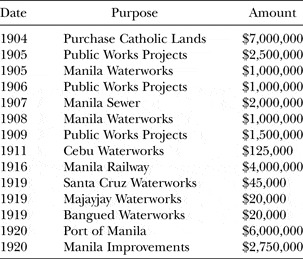
As it became clear that insular bond sales could be used to leverage more capital for development projects, colonial officials returned to Congress to gain broad authority to take out even more development bonds—a task that proved surprisingly easy. Members of Congress were not unaware that these bonds might have the implied, if not legal, guarantee of the U.S. Treasury. As one Democrat pointed out, “it is undeniable that the purchasers … regard the United States as ultimately responsible for their payment.”Footnote 83 But Republicans dismissed this as an unwarranted conclusion. Although there was a “kind of moral support,” Edgar Crumpacker (R-IN) acknowledged, there was “no liability upon the part of the Government for their payment.”Footnote 84 On February 6, 1905, Congress passed the Cooper Law, which provided a 4 percent guarantee on railway investments and allowed the insular government, with the president's approval, to fund the further construction of roads, bridges, and various municipal buildings through future bond offerings.Footnote 85Table 2 lists these bond issues in the Philippines from 1904 to 1920.
Philippine Bond Issues, 1904–1920

Source: Forbes, Philippine Islands, v. 1, 269.
After conducting their first two successful bond sales and being given congressional permission for more, insular officials began to use bond sales to fund ambitious public works projects, including railroad development, in the islands. For Americans who had come of age during the great railway boom in the United States, this faith in the ability of the railroad to spur economic development is unsurprising. “If we can possibly get a crowd of strong Americans to build a comprehensive railroad system for Luzon,” one official wrote to Taft in 1904, “it would be of more benefit for this people than anything we could possibly do.”Footnote 86 Under the advice of Sir William Van Horne, the builder of the Canadian Pacific, the Commission had earlier commissioned a survey of new railway lines, and this report was now privately sent to a number of top Wall Street firms. Initially, J. P. Morgan & Co., James J. Hill, the Guaranty Trust, and Lee, Higginson & Company had all expressed some interest, but Speyer & Co. eventually emerged as the most likely partner.Footnote 87 This was fine with Edwards, who thought Speyer's interest would signal to the rest of Wall Street that the Philippines was a sound investment. As he reported back to another official, “Speyer, as Commissioner Forbes will tell you, is about as clever a chap as they have on Wall Street. He don't [sic] miss any opportunities, and his relation with London capital allows him to command financial situations.”Footnote 88 Speyer, at the BIA's suggestion, had placed himself in an excellent position to win the concession by gaining control of the Manila Railway Company in 1904—the Philippines' only existing railroad.Footnote 89 By this point, the relationship between the colonial state and Wall Street had become decidedly cozy.Footnote 90 After the large bond sales and early negotiations for railway investment, Edwards could brag in a letter back to Manila, “One or two of the ambitious financial concerns who think they are going to get the franchises for the trunk line railroads are flattering me by asking me if I won't resign, and at a big salary and manage the proposition in the Philippines. I wonder if I could get along with the Commission if I should take them up?”Footnote 91
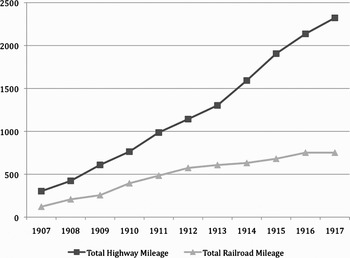
After all this—the extensive lobbying and bond trading on Wall Street—it is worth asking if anything was actually accomplished. The record of the colonial state here is impressive, especially because the American insular state managed these improvements with almost no direct financial support from Congress. Given conditions such as these, it would not have been surprising if nothing were done. Yet, through their partnership with American banks, colonial state officials were able to fund, albeit in less lavish fashion, their ambitious public works projects. As Figure 1 shows, for example, the mileage of all improved roads and rails grew dramatically during the colonial period, and this success was followed by harbor and waterworks developments. By 1905, then, after just five years of civil government, the American insular state had developed a remarkable collection of resources to run the Philippines with significant independence from Congress and with little assistance from the domestic American state.
Highways and Railrods in the Philippines, 1907–1917 Source: Railroad miles are the combined total of the Manila Railroad Company and the Philippine Railway Company. Highways are first-class roads. Figure for 1907 is an estimate. Data adapted from Forbes, Philippine Islands, v.1, 1907.

The Spread of Private Financing to Puerto Rico and Cuba
This public-private strategy for raising funds would be replicated in other parts of America's formal empire, too. Although Puerto Rico adopted this strategy more slowly than the Philippines, issuing its first bond sale in 1907 for $1 million to finance road construction, colonial officials in San Juan eventually embraced it with a fervor equal to their counterparts in Manila.Footnote 92 In part, the fact that Congress granted Puerto Rico eventual free trade made it easier to attract direct investment from the United States, which made the need for capital less immediate than in the Philippines. Yet when control over Puerto Rico was transferred to the BIA in 1909, colonial officials dramatically increased the use of private bonds to finance development. Indeed, by 1913 Puerto Rico's bond debt stood at $5.8 million and would nearly double by 1918 to $10.8 million.Footnote 93 As in the Philippines, much of Puerto Rico's bonded indebtedness went to finance infrastructure improvements. In Cuba, too, the use of private bonds to finance development occurred later than in the Philippines. When Charles Magoon, formerly General Counsel of the BIA, became the provisional governor during the second American occupation in 1909, he worked with Speyer & Co. to offer a $16.5 million loan to finance sewer improvements.Footnote 94
In the context of these formal colonies and occupations, then, the public-private partnership provided colonial officials with increased capacity to pursue their development goals, and it allowed Congress to avoid politically divisive questions about the tariff or having to justify more direct state support for the controversial colonies. Yet the confidence colonial officials had in this strategy would soon lead them to apply it in more unstable contexts and over the outright opposition of Congress.
5. CREATING THE DOMINICAN MODEL
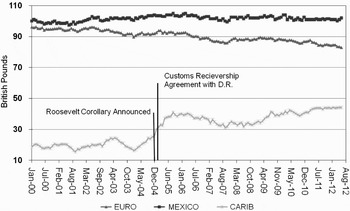
In his annual message to Congress in December 1904, President Theodore Roosevelt laid out an aggressive new principle to govern U.S. foreign relations. Later dubbed the Roosevelt Corollary to the Monroe Doctrine, the president announced that in “flagrant” cases of “wrongdoing or impotence” the United States may be forced “to the exercise of an international police power.”Footnote 95 In effect, Roosevelt had declared to European powers that the United States would now take responsibility for stability in the Western Hemisphere. Roosevelt, Taft, and Root, who had made it their quest to see the United States achieve a level of international influence and prestige commensurate with its economic power, were not about to give up on American power.Footnote 96 Their goals remained the same, but they had begun to conclude that formal imperialism might not be the best way to achieve them. How could the United States continue to expand its global reach in the face of congressional obstruction and public indifference? The small Caribbean nation of the Dominican Republic would serve as the testing ground for their new answer to that question and would, in Roosevelt's later evaluation, “serve as a precedent for American action in all similar cases.”Footnote 97 What later became known as the “Santo Domingo solution,” was the first application of a more robust form of the public-private partnership that was already in place in the Philippines and soon to be adopted in Puerto Rico.
The Dominican Crisis
The Dominican Republic was in a state of near-constant turmoil for the entirety of the nineteenth century. Ruled at various points by France and Spain, and suffering from repeated invasions by Haiti, its more populous neighbor to the west, it finally achieved a measure of stability under the dictatorial rule of Ulises Heureaux between 1882 and 1899.Footnote 98 But Heureaux's rule came at a heavy price—crushing loads of debt. To buy off opposition leaders and provide some minimal level of public services to the population, the Dominican Republic became trapped in vicious cycle of debt and default that soon reached catastrophic proportions, while revolutionary outbreaks crippled the government's ability to collect revenues. By 1903 the debt totaled $33 million and the duties on various export commodities had already been promised to other creditors, leaving the government completely broke and with no prospects for future income. After the Dominican Republic defaulted on its massive debt, an arbitral commission made up of European and American creditors ordered it to pay $450,000 a year to its creditors, an obligation that the government was entirely unable to meet.Footnote 99
Roosevelt administration officials began to fear that European powers would intervene to force payment to their creditors, which, according to contemporary international law, they were well within their rights to do. The Dominican default now presented itself as the first test of Roosevelt's recently articulated Corollary. Giving European powers a foothold in the Western Hemisphere so near the Panama Canal was anathema to Washington, but to prevent this, the administration needed to devise a solution that satisfied European creditors and also avoided domestic opposition to the acquisition of further American colonies. At the very least, Washington would need to take emergency control of Dominican finances to buy some time.
Secretary of State John Hay instructed U.S. minister Thomas Dawson to “ascertain whether the Government of Santo Domingo would be disposed to request the United States to take charge of the collection of duties,” an arrangement that Dominican President Carlos Morales readily agreed to, telling Dawson that “he had long been of the opinion that the best solution was for the United States to take charge of the collection of the revenues, guaranteeing to the Dominican Government enough to live on and arranging with the creditors.”Footnote 100 A formal agreement was quickly reached on January 20, 1905, and a treaty signed on February 7, giving the United States full authority to collect the customs revenues of the Dominican Republic, to appoint the collection personnel, and to pay any surplus funds beyond that needed to pay the national debt to the Dominican government at the end of the year. Furthermore, no changes in the tariff or port duties were to be made without the consent of the United States. For its part, the United States would take responsibility for the debt and negotiate terms with European creditors. To further allay Dominican fears that the United States might be trying to add Santo Domingo to its collection of colonies, Hay instructed Dawson to add the words “agreeing to respect the complete territorial integrity of the Dominican Republic” to the treaty's preamble.Footnote 101
Yet the president was under no illusions that the treaty would find a warm reception in the Senate. It didn't help matters that word of the January agreement reached the United States before Roosevelt had announced his intention to submit the agreement as a treaty. In an aptly titled editorial, “President vs. Senate,” the New York Times reported that “the Secretary of State is running around the Senatorial end with the Santo Domingo ball, and depositing it, as a ‘fait accompli,’ behind the Senatorial goal. It is a beautiful quarrel as it stands.”Footnote 102 Predictably, Senate charges of executive usurpation of senatorial powers were raised. “I deny,” Senator Henry Teller (D-CO) exclaimed, “the right of the executive department of the Government to make any contract, any treaty, any protocol, or anything of that character which will bind the United States … .”Footnote 103 Although the treaty was successfully reported out of the Foreign Affairs Committee on March 10, Republicans leaders informed Roosevelt that the treaty would fail, and no vote was taken. Roosevelt was furious, but not surprised. For him, as for Root and Taft, the Senate's attempts to shore up its institutional prestige were preventing the United States from taking its rightful place among world powers. “Apparently the Senators in question felt that in some way they had upheld their dignity,” he later wrote in his Autobiography. “All that they had really done was to shirk their duty.”Footnote 104
With the treaty's failure, the Dominican Republic would have no access to funds and would be unable to settle with its creditors, a situation that would almost certainly end with the intervention of European powers in America's backyard. Refusing to back down, Roosevelt declared a modus vivendi, dispatched several experienced colonial hands from the Philippines to take charge of Dominican customs, and continued with his plans to bring the Dominican Republic under the aegis of the American empire.Footnote 105 Until the situation could be stabilized, Roosevelt ordered that revenue collected in Dominican customs ports was to be deposited in the United States at the National City Bank of New York, the same bank that held most of the Philippine Commission's gold reserve fund. As he informed Secretary of the Navy Charles Bonaparte, “I intend to keep the island in status quo until the Senate has had time to act on the treaty, and I shall treat any revolutionary movement as an effort to upset the modus vivendi. That this is ethically right I am dead sure, even though there may be some technical or red tape difficulty.”Footnote 106
Bureaucrats and Banks: Securing the Dominican Loan
Among the Senate's central objections to the treaty was a provision that put the United States in charge of refunding the Dominican loan. What was needed was a way to confine American responsibility only to debt collection, not the payment of creditors. Root, returning to Washington as secretary of state in 1905, proposed a third private party to take on this responsibility:
The question has arisen in my mind whether the two questions could not be separated, the debt being adjusted on a fair and reasonable basis by someone acting under the authority of Santo Domingo, and making the adjustment conditional upon the United States ensuring the service of the debt substantially as provided by the pending treaty. We would then have a different proposition to present to the Senate; that is, the single proposition of ensuring the service of a debt already adjusted.Footnote 107
For Root, a man widely regarded as one of the top corporate lawyers in New York, there wasn't anything especially novel about this solution. The Dominican Republic would be treated as a bankrupt corporation, and a third party—in this case the U.S. government—would arrange for the restructuring of its debt. A private investment bank would then refinance the Dominican debt and settle with its creditors, while a U.S. customs receiver appointed by the American president would supervise debt collection. The United States would get out of the business of debt settlement, thus pleasing the Senate opposition, but its presence on the island would reassure a private bank that such an investment was sound. Root, who was on far better terms with the Republican leadership in the Senate than was Roosevelt, now had to assure the senators that they were not doing precisely what they feared they were doing; that is, providing an effective guarantee to private investors. He reassured Senator Shelby Cullom (R-IL), chairman of the Foreign Relations Committee, that the “so-called modus vivendi … consists merely in a plan or way of getting along, pursued by the Government of San Domingo on its own responsibility, but with the acquiescence and unofficial good offices of the President.”Footnote 108 Yet this arrangement, while similar to the private financing of infrastructure improvements in the Philippines, was, of course, far less secure, because the Dominican Republic was not to become an official possession of the United States.
Naturally, before any loan could be made with private funds, someone would first need to sort through the web of Dominican creditors and ascertain who owed what to whom, much like what would have to be done with any bankrupt corporation. In 1905, while the treaty was still being debated in the Senate, Jacob Hollander, a Johns Hopkins economist who had organized the conversion of Puerto Rico's currency to U.S. dollars, was appointed as the president's confidential agent to study the debts and to examine “the amount actually received by Santo Domingo, the amount of indebtedness nominally incurred, the circumstances so far as they are known under which the various debts were incurred, and so forth.”Footnote 109 As he began to dig into the records, however, Hollander became convinced that a great deal of the debt was fraudulent or the result of terrible financial decisions made by past corrupt regimes. Even the American-owned Santo Domingo Improvement Company (SDIC), the republic's largest creditor, was not immune from Hollander's audit. In his final report of October 1905 he concluded that the SDIC's “presence and activity in Santo Domingo have been a continuous embarrassment and impediment to the course of orderly and economical government,” and later referred to the SDIC-owned Santo Domingo Railway as “40 miles of old junk.”Footnote 110 Other members of the Roosevelt administration shared Hollander's negative reaction to the SDIC's claims. Indeed, Roosevelt himself had written to Hollander that if negative reports on SDIC practices proved to be true, “we must take sharp measures to disassociate the Government from all responsibility for the debt.”Footnote 111 The administration's hostility to the SDIC belies the notion that the receivership was merely a scheme to defend America business. In fact, it seems, administration officials were worried that the very appearance of impropriety would draw the attention of muckraking journalists or Congress. To further combat such charges during the final loan agreements, Root insisted that the white shoe law firm of Stetson, Jennings & Russell—the same firm used by J. P. Morgan and other major Wall Street financiers—represent Dominican interests.Footnote 112
As Hollander began to lay the groundwork for a private loan to refinance Dominican debt, Root also had to confront the very real possibility that the Senate would never pass the treaty. What then? The evidence here is conflicting. Root initially appears to have resisted any such scheme for continuing to operate the receivership in the event of outright Senate rejection of the treaty. “I strongly disapprove of the proposition,” he wrote to Taft. “If the Senate refuses to give the President the legal right to act officially in regard to Dominican finances, I do not think that we should go on as we are now.”Footnote 113 Months later, however, Drew Carrel, the private secretary for Dominican General Receiver George Colton, reported that “[Root], like everyone else in authority here who are tying to keep in touch with matters in Santo Domingo, cannot say what will happen to the Treaty … Mr. Root told me that I would be perfectly justified in saying to you, unofficially, that the original policy of the United States toward Dominican affairs is unchanged and as strong as ever.”Footnote 114 Whether or not the modus vivendi would have continued indefinitely, however, became more of a technical question, as it quickly became clear that bankers would be unwilling to extend credit without a formal treaty. In the Philippines, after all, the colonial state had managed to maintain a certain ambiguity about this issue, but bankers were taking a much more significant risk in floating bonds for the Dominican Republic, which still retained its official sovereignty.
Hollander's familiarity with the Dominican situation led Roosevelt to ask him to work out the refunding negotiations with private bankers. The problem he confronted, however, was convincing banks to lend to the Dominican Republic. Reacting to what he considered the dishonorable conduct of the SDIC, Hollander reached out to prominent and well-established American banks, some of which had also been involved in financing operations in the Philippines. In June of 1906, he wrote to Charles Allen, head of the prominent Morton Trust and former governor of Puerto Rico, to encourage him to make the loan:
I think the opportunity is here presented for some high class financial institution to render a great public good, at a fair compensation for the immediate services and with ultimate advantages of some magnitude. Why should not the Morton Trust Company, under your guidance become the instrument for the fiscal reorganization first of San Domingo [sic], and thereafter for other Latin-American governments that—if we should only turn the trick well—will surely have recourse to the United States to have done for them what we have already done for Cuba and are now asked to do for San Domingo.Footnote 115
While the proposition was “worth while of anybody's attention,” Allen responded, he could not commit to anything in specific.Footnote 116 Allen's reaction was typical of many bankers who were reluctant to sink their money into this new venture without proper guarantees that their investments would remain safe. Days later Hollander received J. P. Morgan's response, which exposed yet another wrinkle in the scheme. “[T]he whole value of the bonds,” Morgan wrote, “would depend entirely upon the form of interference contemplated by the United States Government in case of repudiation by the San Domingo Government … [U]nless the public are quite convinced that the American control will in future be absolute and in proper form so that no change of administration will affect the policy, the price is very high for the bonds.”Footnote 117 Morgan's concern that a change in policy might come from a change in administration exposed a central problem with the entire plan. Although his fears would later be proven unwarranted, Morgan had every reason to believe that a Democratic administration might not look so kindly on the arrangement, and with no formal relationship between Washington and Santo Domingo, the bank would have no recourse. At the very least, the bankers needed a credible commitment that they would not be abandoned in the case of Dominican default or Democratic control of the White House, and this was why the Senate's adoption of the treaty became crucial. Yet even with the condition that any new private loan would only be extended with a formal customs treaty in place, it was difficult to attract the cautious bankers.
Hollander must have been relieved, then, when Jacob Schiff, the legendary financier and senior partner of Kuhn, Loeb, agreed to entertain a Dominican offer. Hollander later claimed that he had agreed in part as an idealistic proposition, because, as he noted, “it was such a picayune profit that it would not interest them as a business proposition.”Footnote 118 Even Schiff, however, had his initial doubts. When he wrote to Assistant Secretary of State Robert Bacon a few days after acknowledging his interest, he confessed that “[N]o one, I believe, will touch the proposed new Bonds unless the United States will undertake to look to the sufficiency of the customs tariff, to its proper collection and application to the service of the debt, and unless the Bondholders can look to the United States for this, no bankers, who value their reputation should undertake to sell the Proposed bonds to the public.”Footnote 119 In other words, if the government could not formally guarantee the loan, then it must administer the receivership itself. Naturally, Schiff's offer was contingent on the Senate's approval of the treaty, which would allow American control of Dominican customs houses and supervision of its finances. Yet this was an easier challenge to surmount, particularly because American officials were already running Dominican finances under the modus vivendi.
As Root predicted, the arrangement proved far less objectionable to the Senate. On July 20, 1906, the Dominican representative signed an agreement with Kuhn, Loeb for the sale of $20 million in gold bonds at a rate of 5 percent for fifty years and with the Morton Trust Company, where Root had previously been general counsel and Conant was treasurer, to serve as the depository for payments.Footnote 120 Furthermore, as a result of Hollander's efforts with the Dominican creditors, the debt was cut in half, leaving $5 million of the expected bond sale for the use of public works.Footnote 121 The new agreement met with the approval of the Senate, and a new convention was signed with Dominican officials and sent to the Senate on February 8, 1907. The clause that obligated the United States to guarantee the integrity of the Dominican Republic was eliminated, as was the original proposal that the United States would take over its debt. Now the only U.S. obligation was to collect the customs revenues. Further stipulations prevented the Dominicans from taking on more debt or changing their duties without American consent. These amendments were enough to secure the support of two-thirds of the Senate, and the treaty was adopted on February 25, on a 43 to 19 vote, and subsequently signed by Roosevelt on June 22.
American goals in operating the Dominican receivership, of course, were far more modest than those in the Philippines, but the American customs officials did manage to settle the Dominican debt situation and to provide the Dominican government with a stable supply of revenue for the first ten years of its operation. Under American administration, trade increased dramatically with exports nearly doubling in five years.Footnote 122 The lessons American executive officials drew from these results were simple: their solution worked, or at least that was how it seemed at the time. Through Dominican-style arrangements they could project power into Latin America and keep the Europeans out, while also avoiding the ire of the Senate. Yet the expansion of the partnership also came at a cost, although one that must have seemed quite remote to these men who so firmly believed in the stability of their experiment. After all, the success of the Dominican receivership required an implicit commitment to American bankers that their investments would be safe. Should the receivership prove inadequate—as indeed it very soon would—it would undermine the entire strategy and dramatically increase the political costs of the arrangement.
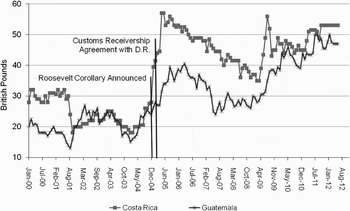
6. WHAT DID BANKERS WANT? EVIDENCE FROM SOVEREIGN BOND PRICES
Although Hollander attributed Jacob Schiff's interest in refunding the Dominican debt to be based partly on idealism, no investor as talented as Schiff would have pledged his bank to an unprofitable proposition. Indeed, Schiff agreed to invest only when state actors had made their promises to defend the bank's investment in the case of default more credible with the adoption of a formal treaty between Washington and Santo Domingo. Furthermore, the bond sale itself, while significant, was hardly a massive prize, given that Kuhn, Loeb had sold $75 million worth of Japanese bonds the year before. What, then, was in it for the bankers? In part, the bankers' enthusiasm stemmed from the fact that these foreign loans commanded a higher interest rate and were becoming increasingly attractive as the market for domestic securities began to decline in the latter half of the decade.Footnote 123 A more significant gain, however, may have come from the financial stability American intervention provided to the region. By signaling that American bonds were now backed by a robust American foreign policy, American bankers stood to gain in the lucrative sovereign debt market of Latin America.
For years, the Caribbean market for sovereign debt had suffered as state after state defaulted on massive obligations. According to a 1901 edition of The Investors Monthly Manual, a major London securities publication, “The Guatemalan Government continues to trample upon every obligation undertaken by them towards their external creditors, while finding £110,000 for the payment of a junior and more favoured creditor. Honduras has, in its 28 years' default, piled up its arrears until, with the principal, they amount to nearly £19,000,000 … .”Footnote 124 Along with Guatemala and Honduras, by 1904 Colombia, Costa Rica, and Venezuela had all defaulted on their debt obligations, leaving creditors to trade these so-called “rubbish stocks” on speculation that they might begin to service their debt again some day. If, then, American bankers assumed, as default or revolution among Caribbean nations increased, that the entire Caribbean region would become a substantially better place to invest after an American intervention, their stake and interests in the partnership become more understandable. If this was the case, we should be able to find a response in prices paid for Latin American debt following the announcement of the Corollary, and especially after it was made credible with the establishment of the Dominican receivership. Bankers, naturally, would be willing to pay far more for debt—even in default—if they thought it stood a reasonable chance of being collected.
The proposition that empire provides a “public good” through stability is well established in the economics literature.Footnote 125 Following these suggestive results, in particular work by Mitchener and Weidenmier, I developed a dataset of monthly bond prices on the London Stock Exchange from 1900 to 1912 gathered from The Investors Monthly Manual.Footnote 126 The results are striking. As Figure 2 shows, bond prices for Costa Rica and Guatemala (both in default at the time) rose dramatically following the announcement of Roosevelt's Corollary and continued to rise after the formation of the Dominican receivership in 1905.Footnote 127 After trading for merely £18 in February of 1904, the price of Costa Rican debt had rocketed to £57 by May of 1905, an increase of 217 percent. The significance of this was not lost on the financial community. As Investors Monthly noted in January of 1905, “a feature of the month's business has been the speculation in ‘rubbish’ South American stocks.”Footnote 128 Although the bonds decreased somewhat after the initial speculative fever wore off, in all four cases their value remained significantly higher in the years following the establishment of the receivership than before.
Sovereign Bond Prices for Costa Rica and Guatemala, 1900–1912 Source: The Investors Monthly Manual (1900–1912)

Although these results seem to support the notion that bankers were responding to the Dominican intervention, perhaps they merely reflect a worldwide rally on the bond markets. To test for this, I created an index of Caribbean bonds by averaging the monthly bond prices from five Caribbean nations: Colombia, Costa Rica, Guatemala, Honduras, and Venezuela. At the time, all five nations had defaulted on their debt. I compared these results to a European sovereign bond index, which was constructed by calculating the average monthly sovereign bond price for Britain, Germany, and France. In Figure 3, I also include Mexican sovereign bond prices to measure the effect of this announcement on a relatively wealthy, and, at this point in history, very stable nation in Latin America.Footnote 129 As Figure 3 shows, the Caribbean rally was not repeated in Europe or Mexico. While the Caribbean index increased by over 160 percent between May 1904 and January 1906, Mexican bond prices increased by a mere 1 percent, and European bonds showed almost no movement at all. Furthermore, the Caribbean index remained relatively stable after this period; indeed, after having never traded above £30 before 1905, it never dropped below £30 after 1905. It is important to emphasize, too, that the nations in this sample were not under the control of American officials – investors were simply reacting to America's new commitment to stability in the Caribbean. American intervention in the Dominican Republic improved the market for all Caribbean securities.
Sovereign Bond Prices on London Exchange, (1900–1912) Source: Calculated from data in The Investors Monthly Manual (1900–1912).

Although the data reported here are from London, the news would have hardly been lost on American bankers. By risking a small amount of money to assure that the United States would be able to adhere to Roosevelt's new policy, these bankers dramatically improved the stability of the Latin American bond market. Yet this stability, like the partnership itself, was based upon the market's understanding that the American state had signaled that it would now enforce sovereign debt obligations.
7. THE SPREAD OF DOLLAR DIPLOMACY
When William Howard Taft was sworn in as president in 1909, he entered office with nearly a decade of experience in colonial administration, first as governor of the Philippines and later as secretary of war. Other officials who had experience in insular affairs joined him, including his new secretary of state, Philander Knox, who had served as attorney general under McKinley and Roosevelt, when he had endorsed the use of private bond sales to develop the Philippines.Footnote 130 The incoming administration arrived convinced of the virtues of “Dollar Diplomacy,” and began to view the Dominican experiment as a panacea for political instability in Latin America and as a symbol of American honor and good intentions.Footnote 131 It was, according to Knox, “a signal success” and “a bright example to all the Americas and to the world.”Footnote 132 By 1909, after all, Dominican finances had improved significantly, loan payments were made on time, and the republic appeared to be politically stable. In a commencement speech at the University of Pennsylvania entitled “The Spirit and Purpose of American Diplomacy,” Knox described the brilliant success of the Dominican solution to the graduating class of 1910:
[T]he assistance of the United States has enabled the Republic of Santo Domingo to reduce by half the face value of its debt, to furnish unquestioned security, and to have a customs administration so efficient that, after caring for the liquidation of a relatively enormous debt, it has supplied ample funds for all governmental purposes, the surplus for such purposes being actually greater in amount than the total revenues which entered the Dominican treasury prior to the present customs administration. On its political side it has freed Santo Domingo from apprehension of intervention on the part of creditor nations, and has contributed immensely to domestic tranquility and prosperity, unaccompanied by violent repression, to a degree never before known in the Republic.Footnote 133
As Knox continued to extol the virtues of the Dominican receivership, the phrase “Dollar Diplomacy” itself began to take on a new meaning. Originally a pejorative term employed by anti-imperialists, Knox and Taft embraced it as a broad description of their benevolent foreign policy.Footnote 134 Dollar Diplomacy, which began as an adaptive response to Congress's refusal to grant generous funding to America's formal colonies or to take responsibility for Dominican debt, now became a central tool of American foreign policy. Taft administration officials even began to think about it in this way. In one revealing interview, for example, Knox referred to the United States as “armed with Dollar Diplomacy,” and noted how “‘Dollar Diplomacy’ has substituted peace and prosperity for bloodshed in Santo Domingo … .”Footnote 135
It also had the signal advantage of attracting little notice from Congress. Taft, for example, emphasized the private aspects of the policy in his 1912 message to Congress, where he lauded the American bankers “who were willing to lend a helping hand” to troubled countries “because this financial rehabilitation and the protection of their customhouses from being the prey of would-be dictators would remove at one stoke the menace of foreign creditors and the menace of revolutionary disorder.”Footnote 136 American investment bankers became more willing partners as well. In July of 1909, J. P. Morgan, Kuhn, Loeb, National City, and other banks wrote to the secretary to tell him that they had joined to form a North American Group “for the purpose of obtaining information and considering South American financial propositions.” Knox wrote them back to commend their “laudable” enterprise and promised them the administration's help “in every proper way.”Footnote 137 Now with Dollar Diplomacy recognized as a successful tool of American foreign policy and a low-cost way to bring stability and American hegemony to the Caribbean, Taft and Knox looked to apply it elsewhere, and Honduras emerged as a likely candidate.
Honduras and Dollar Diplomacy's Failure
Not every proposed extension of Dollar Diplomacy was successful. American bankers were not fools. Despite the profits that stood to be made in the sovereign bond market, there were limits to the amount of risk bankers considered acceptable, and mere assurances from bureaucrats were not enough to force an investment. In the Philippines and Puerto Rico, the formal colonial status of those nations was enough to convince them to extend credit even if the Treasury did not technically guarantee the bonds. In the Dominican Republic, having an American-run customs receiver backed by a treaty, while admittedly less solid, provided enough security for Jacob Schiff to proceed with a loan. The problem, of course, was that a formal treaty—the most credible commitment the U.S. government could make—required congressional approval. Naturally, this requirement dramatically increased the political costs of Dollar Diplomacy, because Congress objected to precisely what the bankers demanded—a guarantee that the U.S. government would defend their investments in the case of default. As Taft administration officials looked to expand Dollar Diplomacy partnerships into even more unstable nations, they were caught between the Senate's hostility to providing formal guarantees of bankers’ debt and the bankers' desire for some credible signal that the U.S. government would do precisely that. In Honduras, these obstacles would prove insurmountable, but they would also pave the way for more creative arrangements that pushed the partnership even further from congressional sanction.
Honduras, much like the Dominican Republic, entered the twentieth century in desperate financial straits. After defaulting on a British loan in 1873, its debt, in arrears for nearly forty years, amounted to $120 million by 1909, an especially regrettable situation given the fact that, as one diplomatic memo noted, the nation had “little to show in return but a very few miles of railway.”Footnote 138 For officials in the State Department, this seemed to offer a clear opportunity for another Dollar Diplomacy intervention, which, it was confidently predicted, would stabilize Honduras and increase American influence in the Caribbean by replacing British with American banks. In London, the Council of Foreign Bondholders had made an attempt to settle the debt, but an internal State Department memo dismissed their proposal as an irresponsible “scheme” and observed with studied contempt that it involved “the raising of the customs duties and the mortgaging of nearly everything in sight to the detriment of commerce and future enterprise.”Footnote 139
To provide an alternative American option for refunding the debt, Assistant Secretary of State Francis Huntington Wilson set to work trying to attract J. P. Morgan, who was sought out specifically because of his good relationships with the British Council of Foreign Bondholders.Footnote 140 As in the negotiations for the resettlement of the Dominican debt, however, Morgan proved more cautious than the Taft administration would have liked. At the very least, Morgan wrote to Huntington Wilson, his bank would not extend credit in the absence of a formal treaty.Footnote 141 Although Morgan himself thought the administration was unlikely to deliver on this requirement, he agreed to proceed because the project was so strongly endorsed by both Taft and Knox.Footnote 142 The bankers were not the only ones who greeted this further extension of Dollar Diplomacy with skepticism. In Honduras, President Dávila was understandably reluctant to sign over management of his country's finances to the Americans. But after a great deal of arm-twisting by Huntington Wilson, and faced with few other options, he agreed to send representatives to New York for discussions. After two years of negotiations, a loan convention was signed in January 1911, which provided Honduras with a $10 million loan of which $7.5 million would be immediately issued. Nearly all of this money, however, would go to settling the republic's old British debt, making the arrangement an especially bitter pill for the Honduran government to swallow. Furthermore, the bankers would only take the bonds at a price of 88 percent of par, a rather generous 12-point profit spread, which would net them $529,900.Footnote 143 Nevertheless, Charles Conant, who had been so instrumental in establishing the credit of the Philippines and Puerto Rico and who was hired to review the contract, concluded that terms were as good as could be expected given the Honduran history of default.Footnote 144
Taft dispatched the convention to the Senate with a note assuring the senators that the arrangement's success was “a self-evident proposition.”Footnote 145 Yet what concerned the Senate Foreign Relations Committee more than its probable success in stabilizing Honduras was the American state's implied responsibility for collecting the debt. In an attempt to defend the convention from its critics on the committee, Knox provided a clear articulation of the convoluted logic that underlay the entire Dollar Diplomacy partnership:
[T]he more this plan of assistance to some of the more backward republics is extended, the less becomes the degree of intimacy established between the Government of the United States and that of the country to which the aid is given. I refer in particular to the fact that the provision in the Dominican convention made the general receiver of customs an appointee of the President of the United States, whereas the Honduras convention makes the collector of customs an appointee of the Government of the Republic of Honduras, the degree of intimacy in connection therefore being to that extent lessened…. In other words, the intimacy decreases in proportion as the ability and readiness of the country to meet its obligations increases. This, therefore, is not a policy of which the end can not be seen. The adoption of this convention is not setting such a precedent as might be desired to apply subsequently to all of the Caribbean Republics.Footnote 146
In short, Knox's point was that the borrowed money would increase stability, thereby decreasing the likelihood of an American intervention. “Prior to the Dominican convention this Government was constantly having to interpose between clamorous foreign claimants and the Dominican Government and to use its naval forces for the protection of United States property,” Knox explained to the Committee. “Since the Dominican convention no such necessity has arisen.”Footnote 147 Senators who were concerned about the U.S. government responsibility for the debt, then, were missing the entire point of the receivership—its “self-evident” success led to more stability, not less. The system's success, as Knox saw it, was the debt's real guarantee, and nobody in the Taft administration seriously entertained the idea that these arrangements would fail. Yet whether the customs receiver was appointed directly by the president, as was the case in the Dominican Republic, or from a list submitted to the government, as was proposed for Honduras, did not change the fact that the American state remained responsible for the debt's ultimate collection. This distinction was nothing more than a legal technicality, although one designed to disguise just how involved the American state was in these arrangements. Furthermore, Knox's claim that the treaty's adoption did not set a precedent for the entire Caribbean was, at best, a creative manipulation of the truth; at worst, it was a clear deception. Earlier that year Huntington Wilson had described the Honduran case to a State Department colleague “as a test case of utmost importance because … the principle we seek to act upon in Honduras is one we are bound to have to resort to in still other cases,” and Knox himself had proposed similar arrangements for Liberia, Guatemala, and Costa Rica.Footnote 148
In the meantime, however, a revolution had broken out in Honduras, which eventually doomed the Honduran receivership proposal. In February 1912, with little possibility that the treaty would be approved, J. P. Morgan withdrew from the convention, leaving Knox with no private bankers who were willing to refinance Honduras's debt.Footnote 149 Not that this failure led the Taft administration to abandon Dollar Diplomacy. What was needed was a way to remove the Senate from the picture altogether, yet still signal to the bankers that their investments would remain safe.
Nicaragua, Dollar Diplomacy, and the Private Contract
American-Nicaraguan relations had declined precipitously after the United States shifted the transoceanic canal route to Panama in 1903. Nicaraguan president José Santos Zelaya made no secret of his dim view of this bit of Yankee treachery, and by 1909 the Diario de Nicaragua, Zelaya's official mouthpiece, was calling for a Nicaraguan-Japanese alliance to keep the United States in check. In Washington, Zelaya was widely blamed for fomenting instability in neighboring Central American nations.Footnote 150 In particular, Taft administration officials feared that he might attempt to sell Nicaragua's canal rights to a foreign power. In 1909 a revolution broke out in Bluefields, the American-dominated commercial center on Nicaragua's Mosquito Coast, and Zelaya was forced to flee the country after Knox ordered American marines to the region on the pretext of protecting American lives and property.Footnote 151
To fill the power vacuum created in the wake of Zelaya's departure, Knox ordered Thomas Dawson, who had earlier negotiated the Dominican customs agreement, to Managua to work out a similar arrangement for Nicaragua. Knox also arranged for the investment houses of Brown Brothers and J. & W. Seligman and Company to send representatives for loan negotiations. Brown Brothers had earlier indicated their interest in providing such a loan, writing to Knox several months earlier to inquire if the “Government of Nicaragua is desirous of enlisting the good offices of our own Government and of entering into engagements with it which shall furnish a satisfactory basis for such security as may be required.”Footnote 152 Unlike the Dominican Republic, however, Nicaragua had never defaulted on its debt, and could possibly have obtained a loan without the receivership. Earlier in 1911, Speyer & Co. (the same firm that had funded the railways in the Philippines) had offered to make a $15 million loan on less favorable terms and Brown Brothers and Seligman had signaled that they would also consider making an offer before a receivership was in place. Officials in the State Department, however, had no interest in such arrangements; after all, the creation of a receivership, which they believed would have a stabilizing effect on the country, was the purpose behind all the negotiations.Footnote 153
On June 6, 1911, the Knox-Castrillo Convention was signed, providing for a $15 million loan in exchange for control of customs receipts and the appointment of an American general receiver.Footnote 154 The contract, however, was contingent on the U.S. Senate's approval of a Dominican-style convention, and this proved impossible to get when the Senate adjourned before considering the treaty. When the Senate again took up the Nicaraguan treaty in early 1912, Knox worked tirelessly to have the Committee on Foreign Relations consider it. Among other things, he sent to the members a copy of a speech he had made earlier in the year in which he explained in glowing terms the success of the Dominican receivership. In the speech, given before the New York Bar Association, he described the success of the Dominican receivership as “brilliant” and noted that it was “the best possible guaranty of the good effects to be expected from the Nicaragua” convention. More importantly, “[i]nstead of producing foreign entanglements,” he argued, “they have precisely the opposite effect because they do away with the present discontent and clamor of foreign creditors, because they insure prosperity, and because they make for peace.”Footnote 155 Knox's arguments, however, did little to sway the Senate, and the treaty never made it out of the Foreign Relations Committee.Footnote 156
With the lack of Senate approval for a treaty with Nicaragua and the collapse of Honduran loan negotiations, Taft and Knox now had a serious problem on their hands, one that placed the entire institution of Dollar Diplomacy in jeopardy. Their solution was not to abandon what had become a cornerstone of American foreign policy, but rather to move even further in the direction of market-based contractual relationships.Footnote 157 While waiting for Senate approval, they had negotiated with Brown Brothers and Seligman a smaller loan of $1.5 million, and though this arrangement was originally intended to provide Nicaragua with some much-needed short-term cash, they now moved to make it permanent. A receivership along the lines of the original Dominican modus vivendi was thus arranged using an entirely private contract between the Nicaraguan government and Brown Brothers, with a customs collector to be appointed by the State Department.Footnote 158
Why were bankers willing to take on this risk with no formal treaty? To some extent, of course, they weren't. The $1.5 million loan was far smaller than loans to the Dominican Republic. But State Department officials moved to construct a contract that placed control of Nicaragua's assets in the hands of bankers who were given control of Nicaragua's national bank. To secure an additional $750,000 loan, the State Department next pressured the Nicaraguans to give Brown Brothers a 51 percent stake in the national railroad. For most practical purposes, then, the Nicaraguan receivership operated exactly as the Dominican receivership had earlier, yet this newer arrangement had the virtue of cutting Congress out of the picture altogether, and as a technically private contract between the Nicaraguan government and the investment bank, it aroused little attention from the Senate.Footnote 159 Yet, in point of fact, the agreement rested on the same implied guarantees that had supported the use of private capital in the Dominican Republic and even the Philippines. In each case, whether it was the formal colonial status of the Philippines, the employment of American officials in the Dominican customs houses, or the use of Nicaragua's national bank as collateral, the bankers were left with little doubt that they could call upon the American state to defend their investments. The increasingly private appearance of these contracts was necessary only to avoid the ire of the Senate. For their part, colonial officials had supreme faith that sound American leadership under these agreements would lead to increased stability, and nobody in the Taft administration seems to have considered that this assumption might prove incorrect.
8. INSTABILITY IN THE DOMINICAN REPUBLIC: THREATS TO DOLLAR DIPLOMACY
As the details of the Nicaraguan receivership were being finalized in 1912, the peace and political stability achieved in the Dominican Republic began to collapse. The long-serving president, Ramón Cáceres, was fatally shot in November of 1911, leading to the rise of feuding leaders throughout the island and putting the much-heralded Dominican receivership in jeopardy.Footnote 160 Yet evidence of the increasingly unstable political situation in the Dominican Republic did little to stop Knox's public celebrations of the receivership system's successes. On a 1911 tour of the Caribbean, the secretary addressed the Dominican Congress to express his pleasure that the “dark cloud” surrounding Cáceres's assassination had not interrupted “the normal march of your people in the orderly path of self control.” He continued to lecture in this vein in Nicaragua, where he noted that the receivership had “cured almost century-old evils” in Santo Domingo.Footnote 161 The frantic dispatches from the State Department, however, painted a very different picture. In one of the first acknowledgments of the fragility of the entire receivership system, Assistant Secretary of State Huntington Wilson warned Taft of the dire consequences should they allow Santo Domingo to collapse:
I am sure that you feel, as Mr. Knox does, and as I do most strongly, that if the situation in the Dominican Republic should go from bad to worse … the whole policy concerned would be seriously discredited. I am sure that you will agree that such an eventuality, involving also a disastrous setback to the somewhat similar policy the administration has pursued in Nicaragua … would, indeed, be a very severe blow to American diplomacy.Footnote 162
Taft and Knox hardly needed to be reminded of this fact. If the receivership system could not be made to work, the American state would be responsible for the implicit promises to guarantee the bankers' investments they had made for years; the promises on which the entire partnership was founded. To shore up the Dominican receivership, at least in the short term, Huntington Wilson recommended that the president adopt “such measures as the breaking of diplomatic relations, the forcible protection of the customhouses, and perhaps the withholding of the customs revenues.”Footnote 163 Taft dispatched a special commission headed by the new BIA chief Frank McIntyre and a detachment of 750 marines to Santo Domingo. The commission's report was brutally frank. They found “a very hard situation.” The only permanent remedy, McIntyre wrote, “would require prolonged intervention and controls,” but such an action, he wisely concluded, was “practically impossible.”Footnote 164 By this, of course, McIntyre meant that it was politically impossible, or at least highly undesirable. Direct intervention, after all, undermined the entire point of Dollar Diplomacy. Not only would it demonstrate the inherent instability of this system, it would also confirm the Senate's original fears that the United States was ultimately responsible for the bankers' investments. As a stopgap measure, the commission forced the ouster of the newly elected president and replaced him with the archbishop of Santo Domingo, but nobody at the State Department fooled himself into thinking that this was a permanent solution to the problem. Indeed, the beleaguered clergyman would threaten to resign merely two weeks after assuming office, and he would agree to remain only after the personal appeal of Secretary Knox.Footnote 165
Months later, Taft was out of office, and the festering problems in the Dominican receivership were now left for the Wilson administration to solve. Dollar Diplomacy, built on years of partnership between the American foreign policy state and Wall Street and billed as a peaceful solution to Caribbean instability and a way to achieve hegemony without congressional sanction, was failing in a spectacular fashion.
The Wilsonian Interventions
Soon after taking office, Woodrow Wilson made his objections to the Taft administration's Dollar Diplomacy arrangements perfectly clear. In a 1913 address at the Southern Commercial Congress in Mobile, he noted that Latin American nations “have had harder bargains driven with them in the manner of loans than any other peoples in the world. Interest had been exacted of them, that was not exacted of anybody else, because the risk was said to be greater; and then securities were taken that destroyed that risk—an admirable arrangement for those who were forcing the terms!”Footnote 166 If this did not suggest the new direction Wilson planned to take, the appointment of William Jennings Bryan as his secretary of state certainly did. Dollar Diplomacy, according to Bryan, was nothing more than “a repudiation of the fundamental principles of morality.”Footnote 167 The threat that the Great Commoner posed to the receivership system was hardly lost on American bankers. Brown Brothers and J. & W. Seligman, which had so recently been persuaded by Knox to extend a loan to Nicaragua, threatened to pull out. At the very least, as one State Department official wrote to Huntington Wilson, they would extend no more credit “in the absence of any knowledge of what the attitude of the incoming administration might be.”Footnote 168 These, of course, were the exact fears that J.P. Morgan had expressed in 1905. Without a formal contract, how could bankers have any guarantee that their investments would be safe in a new administration? For his part, Huntington Wilson tried to smooth the transition and helpfully summarized the policy for the new secretary as “intelligent team work.”Footnote 169
Yet, as the bankers would soon discover, they had little reason to worry. Both Wilson and Bryan embraced Dollar Diplomacy as a central tool in their own Caribbean policy, especially after the outbreak of the war in Europe seemed to make American dominance of the Caribbean all the more important. Bryan himself, it seems, did not have any serious objections to the idea of using loans to stabilize countries in Latin America and the Caribbean. Rather, he objected to the appearance that the state was doing the work of bankers. Soon after assuming office, he had proposed to Wilson that the United States should directly lend money to the Caribbean nations. “If, for instance, in the stating of your policy, you propose, with the approval of Congress, that the Government lend its credit … we will offer what no one else is in a position to offer, and show that our friendship is practical and sufficient, as well as disinterested.”Footnote 170 Wilson, however, quickly rejected this idea “as a novel and radical proposal.”Footnote 171 Rather than repudiate the partnership with the bankers or question the wisdom of the receiverships, the Wilson administration recommended yet more loans and increased American control in the Caribbean. Indeed, even as evidence of the policy's spectacular failure presented itself in the Dominican Republic, the secretary would recommend that Haiti, too, should be controlled through a receivership. “The success of this Government's efforts in Santo Domingo,” he wrote to Wilson, “would it seems to me, suggest the application of the same methods to Hayti [sic] whenever the time is ripe.”Footnote 172 His fellow Democrats met Bryan's curious support for Dollar Diplomacy with surprise and indignation. Despite a personal appeal from the Great Commoner himself, the Senate refused to support a more comprehensive receivership agreement with Nicaragua, according to the New York Times, “on the ground that it is a return to the imperialism against which Secretary Bryan declaimed so vigorously in 1900.”Footnote 173
Undeterred, Bryan pressed on, eventually arranging a tighter receivership agreement with Nicaragua and extending American control to Haiti. Even these modified arrangements, however, soon proved too unstable to be sustained. In 1915, Wilson ordered the marines to occupy Haiti, and, a year later, military control was extended to the Dominican Republic and Nicaragua. In an ironic development, the Dollar Diplomacy partnerships, which had originally served to provide some measure of executive autonomy in foreign affairs, now left the Wilson administration defending the very banking interests they had denounced prior to taking office.
9. CONCLUSION
As the narratives offered here demonstrate, public-private partnerships were central to the management and expansion of the American imperial state. Yet, unlike some past theories of American imperialism, I argue here that the relationship between American colonial state officials and American bankers should be seen as a partnership, rather than an instance of state capture. By delegating most responsibility for overseas colonial administration, but restricting access to domestic state resources, Congress motivated colonial state officials to collaborate with American investment bankers to expand their capacity. Most members of Congress had little direct interest in America's overseas empire and were concerned, first and foremost, with protecting domestic constituencies.. Faced with such limited domestic support, colonial bureaucrats formed partnerships with bankers that were based on an implied, if not legal, guarantee of the bankers' investments. In the Philippines and, later, in Puerto Rico, colonial state officials gained access to private American capital through bond sales to finance infrastructure improvements. In the Dominican Republic and Nicaragua, private money was used to refinance sovereign debt and to bring these nations under informal American control. Yet the order that the receivership system promised proved illusory. Stability would come not from attentive financial management by colonial state bureaucrats, but from the marines ordered in by Woodrow Wilson.
In 1921, the Senate launched an investigation into the occupations of Haiti and the Dominican Republic, as well as the role of bankers and foreign policy bureaucrats in developing the policies that led to the invasions.Footnote 174 Ironically, a policy designed to extend American hegemony “on the cheap” and to avoid congressional scrutiny would become both expensive and highly politically visible. Yet Congress's actions came well after the damage had been done. Although both Republican and Democratic Congresses had opposed any suggestion that bankers' bonds were guaranteed by the state (even in the Philippines and Puerto Rico), colonial bureaucrats were able to develop creative institutional arrangements that effectively provided the same assurances. Congress's attempts to limit further extensions of the American empire by refusing to approve even moderate treaties, however, only motivated colonial bureaucrats to rely on their private partners all the more. Congress's oversight failures in these cases were due, in part, to its general indifference toward America's overseas empire, but also from its lack of independent information. What little information members did receive about the receiverships came almost entirely from the very bankers and bureaucrats who had every interest in their establishment. For bankers, however, the collapse of the receivership system did little to temper their enthusiasm for securities in Latin America. In the 1920s, as the speculative fever in financial circles spread, they sold hundreds of millions of dollars of sovereign bonds to American investors.Footnote 175 The increased stability of the Latin American bond market that was due, in part, to Dollar Diplomacy, contributed to this speculation, which itself would contribute to the onset of the Great Depression, as the investor confidence in sovereign bond offerings began to evaporate at the close of the decade.
For scholars of state development, the evidence presented here demonstrates how public-private partnerships offer an alternative way for actors to build capacity that differs sharply from traditional Weberian understanding of the state. When bureaucratic actors are blocked by legislatively imposed rules or regulations, the cultivation of private partnerships may allow them to pursue agendas for which they have neither the authority nor the capacity to achieve independently. Yet such strategies are built on gains from cooperation, and they may lead to perverse outcomes as state actors are forced to meet commitments made earlier to their private partners. In sum, this suggests that while state building through partnership may offer state actors powerful short-term increases in capacity and a way around restrictions on their power, it may also prove to be less stable than traditional state-building strategies. This work further suggests that scholars ought to be more attentive to the downstream consequences of a delegation decision. Although the politics of structural choice are undoubtedly important, attention should also be paid to the myriad ways that state actors can accomplish their goals outside the traditional confines of formal state institutions, and the ways in which such innovations may make the principal-agent model of traditional delegation difficult to sustain over time.
Appendix: Archives Consulted
Bentley Historical Library, University of Michigan. Ann Arbor, MI.
James A. LeRoy Papers
Houghton Library, Harvard University. Cambridge, MA.
W. Cameron Forbes Papers
Library of Congress (LOC), Manuscript Division. Washington, DC.
William Jennings Bryan Papers
John Hay Papers
Philip Jessup Papers
Philander Knox Papers
William McKinley Papers
Theodore Roosevelt Papers
Elihu Root Papers
William Howard Taft Papers
Massachusetts Historical Society. Boston, MA.
Clarence Edwards Papers
Henry Cabot Lodge Papers
National Archives and Records Administration (NARA) I. Washington, DC.
Records of the Committee on Insular Affairs, House Records, RG 233
Records of the Committee on the Philippines, Senate Records, RG 46
National Archives and Records Administration (NARA) II. College Park, MD.
Records of the Bureau of Insular Affairs, RG 350
Records of the Dominican Customs Receivership, RG 139
Records of the Department of State, RG 59
Jacob Hollander Papers
Rizal Library, Ateneo de Manila University. Quezon City, The Philippines.
American Historical Collection
Wisconsin Historical Society. Madison, WI.
Henry A. Cooper Papers