Introduction
Research has considerably enhanced our understanding of Alzheimer's disease and other disorders that impair decision-making capacity. Further knowledge is still needed, however, on effectively preventing, managing, or curing these diseases. Generating that knowledge will depend in part on clinical research involving affected individuals, including those who might lack the capacity to grant informed consent (Silverman et al., Reference Silverman, Luce and Schwartz2004; Katona et al., Reference Katona2009). The participation of these vulnerable individuals requires special care in study design and actual conduct (Alzheimer's Association, 2004).
The Canadian Tri-Council Policy Statement (TCPS) is an important source of research governance in Canada (Canadian Institutes of Health Research et al., 2010). Like other regulations (European Parliament, 2001; Saks et al., Reference Saks, Dunn, Wimer, Gonzales and Kim2008; Department of Health and Human Services, 2009), the TCPS requires researchers to secure consent from a legally authorized representative (LAR) for prospective participants unable to provide their own consent. LAR identification is deferred to local jurisdictions but few Canadian provinces offer a clear legislative basis for determining who, if anyone, is legally empowered to give third-party authorization for enrolling an incapacitated individual in research (Wildeman et al., Reference Wildeman2012). Whether family members are authorized to make such decisions is uncertain in most provinces, even more so if they have not been formally designated to act as substitute decision-makers.
The uncertain legal foundation for proxy consent, coupled with the lack of guidance provided by regulatory documents, has brought prominent scholars in research ethics and authoritative bodies to recommend safeguards aimed at protecting adults with conditions that may impair their ability to give valid consent while allowing promising research to go forward (Wendler and Prasad, Reference Wendler and Prasad2001; Karlawish, Reference Karlawish2003; Alzheimer's Association, 2004; Silverman et al., Reference Silverman, Luce and Schwartz2004; Katona et al., Reference Katona2009). These recommendations limit the kinds of risks that a proxy can accept on behalf of an incapacitated adult. They also emphasize the importance of assessing the individual's decisional capacity and, if deemed incompetent, of seeking his or her assent to participate where possible.
While some of these recommendations are reflected in the latest version of the TCPS, the problem of identifying the LAR persists, in Canada and elsewhere. Uncovering the procedures by which incapacitated adults are involved in research under existing conditions of legal uncertainty is necessary in order to identify opportunities for improving practices. To our knowledge, only four studies have aimed specifically at documenting researchers’ actual practices regarding the involvement of decisionally impaired participants. Two were conducted by the authors (Bravo et al., Reference Bravo, Dubois and Pâquet2004; Reference Bravo, Duguet, Dubois, Delpierre and Vellas2008), one in the predominantly French-speaking province of Quebec, Canada, and the other in France. The two other studies surveyed American investigators affiliated with Alzheimer's disease research centers (High, Reference High1993; Karlawish et al., Reference Karlawish2002). Although informative, the study by High was conducted 20 years ago and that by Karlawish and collaborators involved a relatively small sample of 30 respondents.
This paper uses data from the Substitute Consent for Research in Elderly Subjects (SCORES) study that extended the Quebec and France surveys to researchers from four primarily Anglophone Canadian provinces. In addition to describing researchers’ practices regarding the enrollment of decisionally incapacitated adults, the survey aimed at testing whether reported practices were associated with (1) whom researchers thought was authorized in their jurisdiction to make decisions for an incapacitated prospective participant and (2) their comfort with allowing a non-appointed family member to make such decisions.
Methods
Study design and population
The SCORES study, described in detail elsewhere (Bravo et al., Reference Bravo2011), comprised an anonymous postal survey designed for researchers in aging. These were identified by searching relevant websites, including that of the Canadian Institutes of Health Research, Canada's main funding body of health research. The survey was conducted in four Canadian provinces (Nova Scotia, Ontario, Alberta, and British Columbia) chosen to capture the diversity in laws governing substitute decision-making for research with decisionally incapacitated participants. The laws of the selected provinces were broadly representative of approaches taken to this issue in Canada (Wildeman et al., Reference Wildeman2012).
At the time of our study, Nova Scotia had no legislation explicitly addressing substitute decisions about research. In Ontario, substitute decision-making about research was addressed only in its express exclusion from the scope of that province's healthcare consent, guardianship, and advance directive legislation. The advance directive laws in Alberta prohibited a proxy designated in a personal directive from giving substitute consent to “research or experimental activities” without prior authorization, if the proposed research or experiment offered “little or no potential benefit” to the subject. At the time of our study, Alberta's laws did not otherwise explicitly address substitute decision-making about research. Of the four provinces we surveyed, British Columbia alone expressly authorized substitute decision-making about research, either by a court-appointed guardian, a proxy designated in an advance directive, or a family member not otherwise appointed but recognized under the province's healthcare consent legislation, so long as the research was approved by a Research Ethics Board (REB; Wildeman et al., Reference Wildeman2012).
The postal survey and questionnaire
To maximize the response rate, we followed the recommendations of Dillman Reference Dillman(2000) on questionnaire design, content, and number of repeated mailings. All survey materials were approved by the authors’ REBs. Potential participants received the questionnaire with a personal cover letter and a self-addressed stamped return envelope. We sent a thank you/reminder postcard two weeks after the first mailing, and a second survey package two months later.
The questionnaire had four main sections composed of forced-choice questions. The first section assessed the respondents’ knowledge of the state of the law regarding substitute consent for research purposes in their jurisdiction (Wildeman et al., Reference Wildeman2012). They were presented with scenarios that briefly described hypothetical studies in which an adult who lacks the capacity to consent was invited to participate. Each scenario concluded by asking who, if anyone, had legal authority to decide about the individual's participation. This paper focuses on the scenario (see Appendix S1, available as supplementary material attached to the electronic version of this paper at www.journals.cambridge.org/jid_IPG) in which the prospective participant had not selected a substitute decision-maker while competent had not been assigned a guardian by a court, and was solicited for a low-risk study that offered the prospect of direct benefit. Respondents’ answers were marked as correct or incorrect taking into account relevant provincial laws in force at the time of the survey.
The second section of the questionnaire elicited respondents’ comfort with a family member providing substitute consent for research purposes (Dubois et al., Reference Dubois2011). Like the knowledge section, it contained hypothetical scenarios featuring a close family member of a decisionally incapacitated adult being solicited for research. Each scenario concluded by asking the respondents in which situations they would feel comfortable with the family member deciding about the person's participation. Two scenarios are used in this paper (see Appendix S2, available as supplementary material attached to the electronic version of this paper at www.journals.cambridge.org/jid_IPG). In the first scenario, the family member was neither court-appointed nor designated in an advance directive to make decisions for the incapable prospective participant. The second scenario asked the respondents to imagine themselves unable to make decisions and to assume that no one was designated to make decisions for them. They were then asked in which situations they would feel comfortable with a close relative deciding on their behalf whether they would participate in the study. For analysis purposes, we created two binary variables for each of these two scenarios. The first captured whether the respondent had selected studies involving little or no risk to the participant, irrespective of who might benefit; the second, whether he or she chose studies involving serious risks potentially outweighed by personal benefits.
Section 3 of the questionnaire included questions regarding how researchers, in fact, secure consent for decisionally incapable older adults, and from whom. Some of those questions, as shown in Appendix S3 (available as supplementary material attached to the electronic version of this paper at www.journals.cambridge.org/jid_IPG), were asked in duplicate, first for studies involving little or no risk to participants, and second for studies involving serious risks potentially outweighed by personal benefits. In both cases, we focused on whether researchers turn to family for consent or exclude prospective participants deemed incapable of consent. The fourth and last section of the questionnaire collected demographic data about the respondents.
Statistical analyses
We first tabulated researchers’ responses to selected items of the questionnaire and drew a flow chart summarizing their practices with decisionally incapacitated prospective participants. We then used Fisher's exact test to study the associations between respondents’ practices, knowledge, and opinions regarding substitute decision-making for research purposes. Analyses were performed with SPSS version 18.0 (SPSS Inc., Chicago, IL, USA).
Results
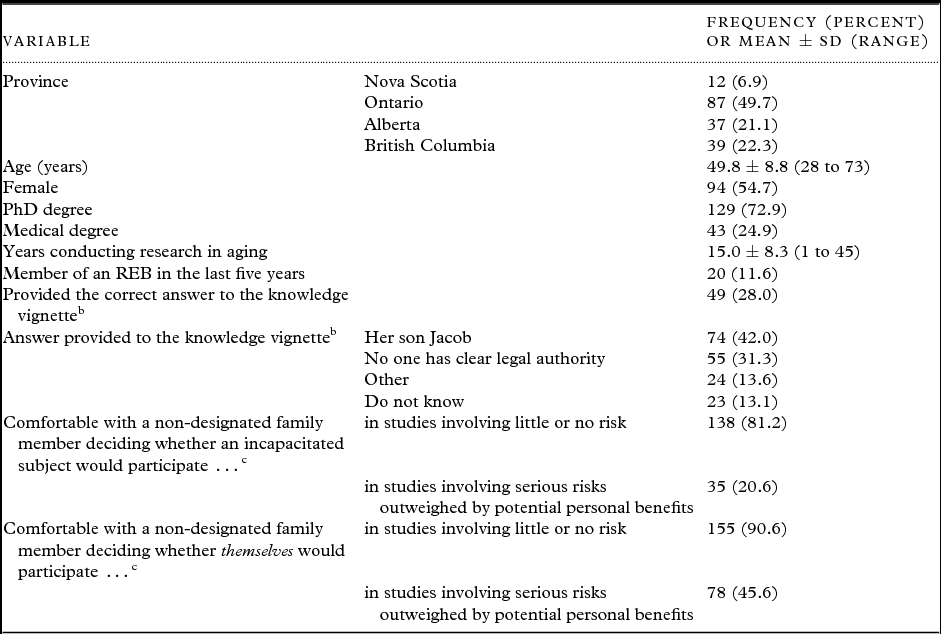
We identified 516 eligible researchers, of which 177 returned the questionnaire. Response rates vary from 30.0% in Nova Scotia to 37.4% in Alberta. Respondents are described in Table 1. Nearly half were from Ontario, the largest of the four selected provinces. A slight majority were women, most had a PhD and one in four was a physician. Few respondents (28.0%) provided the correct answer (including that “no one has clear legal authority”) to our knowledge vignette. Forty-two percent believed that the close relative was legally empowered to give third-party authorization for the adult's participation in the study, while one-third believed that no one had that authority in their province. Of the 74 respondents who attributed decision-making authority to the family member, 15 (20.3%) were from British Columbia, the only province among the four we surveyed that clearly authorizes the family member to provide consent in our scenario. Lastly, most respondents felt comfortable with a non-designated family member deciding whether an incapacitated relative would participate in low-risk studies, even more so if the decision involved them personally. Comfort decreased considerably where studies entailed serious risks, despite being potentially outweighed by personal benefits.
Respondents’ characteristics and answers to the knowledge and comfort vignettes (n = 177)a

aRespondents’ characteristics were first reported in Bravo et al. (Reference Bravo2011). Rates of missing data range from 1.1% for province to 6.8% for age.
bThe knowledge vignette is presented in Appendix S1.
cThe comfort vignette is presented in Appendix S2.
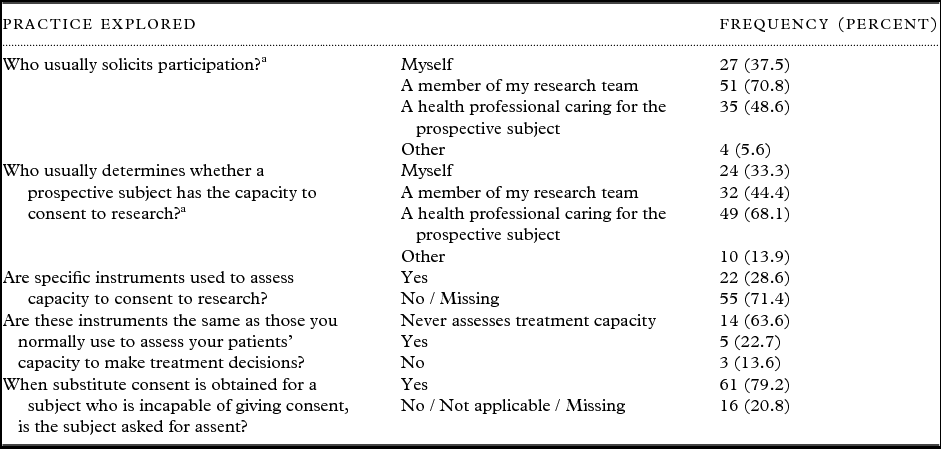
Seventy-seven respondents (43.5%) indicated that some of their research projects of the past five years involved decisionally incapable older adults. Subsequent questions aimed at exploring the processes by which they enroll such subjects were restricted to this sub-sample of respondents. As shown in Table 2, a member of the research team or a health professional providing care to the prospective participant was those most often involved in soliciting participation and in determining whether the prospective participant has the capacity to consent. Twenty-two researchers (28.6%) indicated using specific instruments to assess their participants’ capacity to consent. Sixteen of these 22 researchers reported using the Mini-Mental State Examination (MMSE), either alone or as part of a battery of tests. Of the 22 researchers who use specific instruments to assess capacity for research consent, 14 were non-clinicians who indicated never assessing the capacity of patients to make treatment decisions. Of the others, five use the same instrument, namely, the MMSE, to assess capacity in the research and treatment contexts. When enrolling a decisionally incapable participant in a research project with the consent of a third party, most researchers (79.2%) also seek the subject's assent.
Recruitment practices of researchers whose research projects in the last five years had involved decisionally incapable older adults (n = 77)
aMore than one answer could be given.
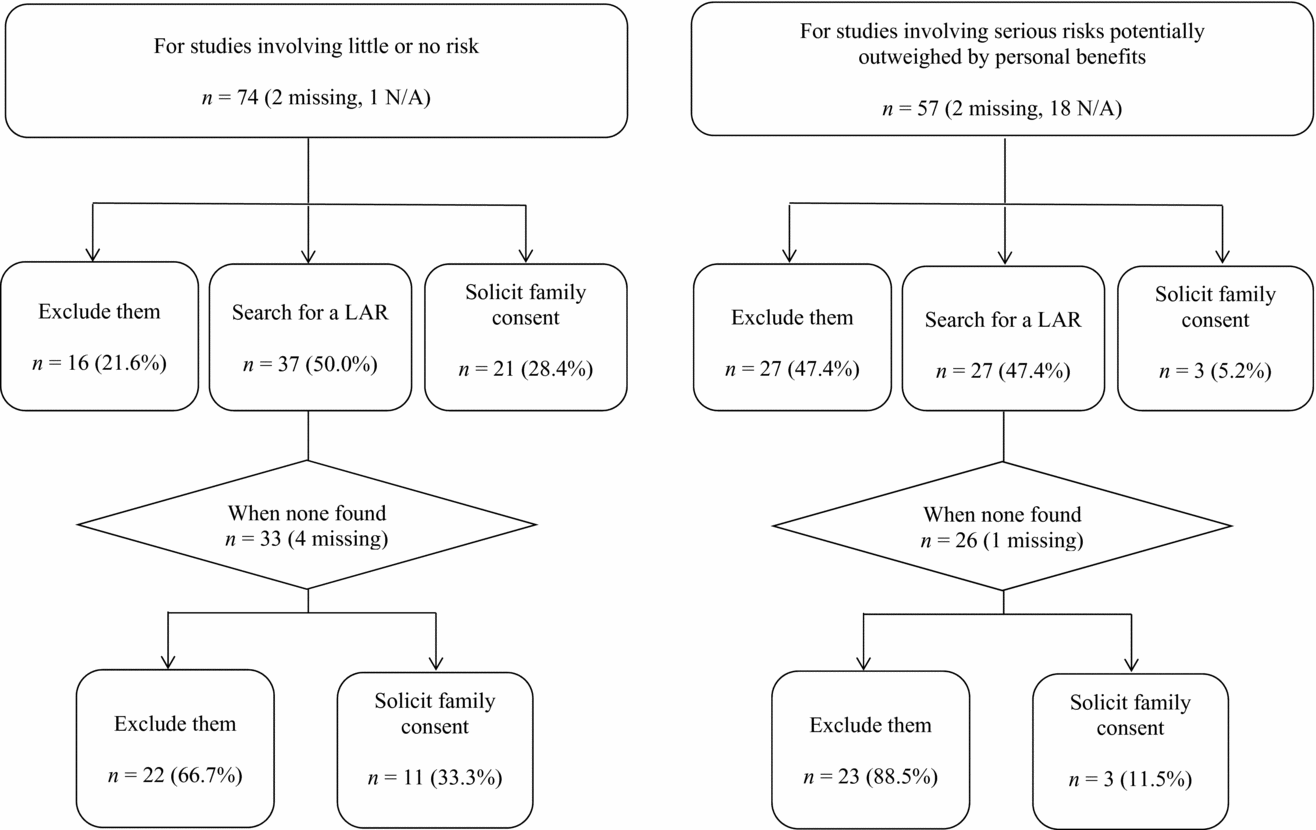
Figure 1 shows the respondents’ answers when asked what they actually do when a prospective research participant is deemed incapable of consent (see Appendix S3). For studies involving little or no risk to participants, half of the researchers check whether someone has the legal authority to give substitute consent by asking a health professional providing care to the prospective participant and/or a family member. When the researcher is unable to identify anyone who is legally authorized to make the decision, one out of three proceeds with the consent of a family member whose legal authority has not been established, while the others do not enroll the decisionally incapable person. Overall, 45.7% of researchers (32 out of 70 with complete data) turn to family for substitute consent, either without first searching for someone legally authorized to consent or after having determined that no such person exists.
Flow chart summarizing researchers’ practices with prospective participants who are unable to consent to two types of studies. LAR = Legally authorized representative, N/A = Not applicable according to the respondent.
In cases of studies presenting serious risks, fewer researchers turn directly to family members for consent (3 out of 57). Rather, they either exclude the incapable person at the onset or search for someone empowered to make a decision on his/her behalf. When no such person can be found, the vast majority of researchers exclude the incapable person. For studies presenting serious risks, 10.7% of researchers (6 out of 56 with complete data) solicit consent from a family member, again either without first searching for someone legally authorized to consent or after having determined that no such person exists. Researchers’ tendencies to solicit family consent were not related to whether provincial laws authorize family to provide consent for research purposes (p > 0.20 for both low-risk and serious risks studies).
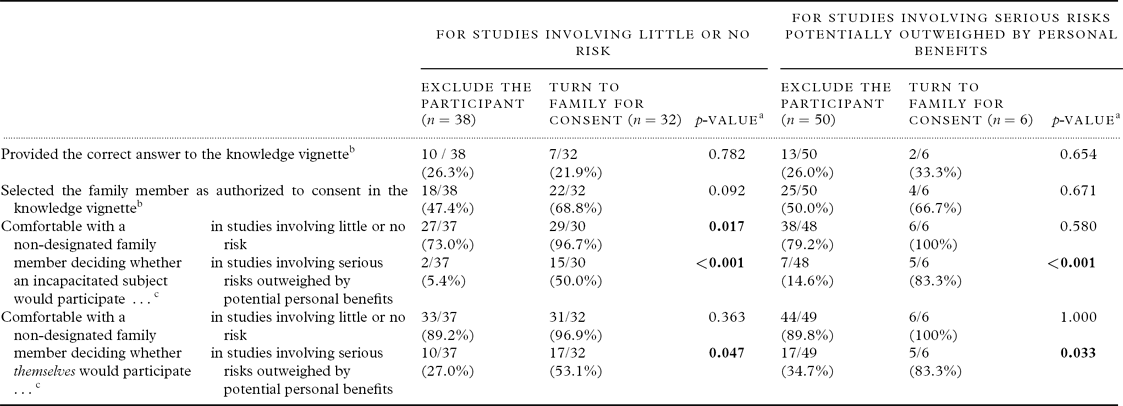
Final analyses involved testing whether researchers’ practices were linked to their understanding of the state of the law on substitute consent for research and comfort with turning to family for consent. Results are presented in Table 3. Respondents’ knowledge of who, if anyone, had legal authority to make a substitute decision in our knowledge vignette was not related to whether they actually exclude decisionally incapacitated prospective participants or seek consent from families. Among researchers who identified the family member as the person legally authorized to consent – whether or not this answer had clear support in law – a higher proportion reported that they turn to family for consent rather than exclude the prospective participant. Differences in proportions, however, were not statistically significant (p = 0.092 and 0.671 for little/no risk studies and serious risks studies, respectively). Comfort with proxy consent from a non-designated family member was, however, strongly linked to researchers’ behavior with incapacitated prospective participants. Researchers were more likely to turn to family for consent if they were comfortable allowing a non-designated family member to decide whether their incapacitated relative would participate in a study. This observation holds for both categories of studies and across the four comfort sub-questions, although some differences in proportions were not statistically significant due in part to the lack of variability in responses.
Associations between researchers’ actual practices, knowledge of who may consent for an incapacitated prospective participant, and comfort with family consent, by category of studies
aFisher's exact test. p-values in bold are statistically significant at the 0.05 level. bThe knowledge vignette is presented in Appendix S1. cThe comfort vignette is presented in Appendix S2.
Discussion
Alzheimer's disease and related disorders affect millions of people worldwide and engender tremendous human and financial costs. Further progress in understanding these disorders depends in part on enrolling affected individuals in clinical research. Yet, such research poses unique challenges that result from the incapacity of prospective participants to provide valid consent and the absence, in many jurisdictions, of clear legislation for identifying who may authorize their participation in a research study, under what circumstances, and with what additional safeguards. Little is known about researchers’ actual practices in the face of this uncertainty.
It is against this background that we conducted a descriptive study of Canadian researchers’ substitute consent practices with decisionally incapacitated prospective participants. We opted for a postal survey which, although not without limitations, allowed us to reach a geographically dispersed population from all across Canada. Our sample comprises researchers who work in different legal jurisdictions and range in regard to socio-demographic characteristics, professional background, and research experience. Limitations of our survey include the impossibility of determining whether respondents differ in any significant way from non-respondents and the sample size which, although larger than that of others, nonetheless limits the statistical power of some analyses.
With these caveats in mind, several findings are worth emphasizing. The first concerns most respondents’ lack of awareness of the state of the law in their jurisdiction concerning who, if anyone, can serve as a substitute decision-maker for a prospective research participant in the absence of a court-appointed guardian or advance directive. Discussed at greater length elsewhere (Wildeman et al., Reference Wildeman2012), the frequent failure of respondents to recognize that substitute decision-making authority may be uncertain or in some cases clearly lacking calls for enhanced clarity of laws enabling identification of LARs for research purposes. It also underlines a need to educate researchers about the state of the law on this matter in their jurisdictions (Karlawish et al., Reference Karlawish2002; Bravo et al., Reference Bravo, Pâquet and Dubois2003a; Stocking et al., Reference Stocking, Hougham, Baron and Sachs2003). According to our results, however, increased awareness about provincial laws may not change substitute consent practices given that knowledge, as measured by our vignette, was not associated with reported practices.
Also noteworthy is the significant proportion of respondents who identified the close relative as authorized to decide about an adult's research participation, even where such authorization is either uncertain or clearly lacking at law. Given the ubiquity of family authorization in the clinical realm, respondents may have reasoned that families must also be authorized to make decisions about research participation on behalf of an incapacitated relative. We and others have argued for legally empowering family members to provide research consent on behalf of an incapacitated relative without the impediments of a formalized process – provided additional safeguards are in place – as is currently the case in British Columbia (High, Reference High1993; Bravo et al., Reference Bravo, Pâquet and Dubois2003b; Wildeman et al., Reference Wildeman2012). Arguments include the lack of evidence that non-appointed family members afford lesser protection to research participants and the repeated observation that most people would trust their family to make research-related decisions on their behalf (Wendler et al., Reference Wendler, Martinez, Fairclough, Sunderland and Emanuel2002; Dubois et al., Reference Dubois2011; Kim, Reference Kim2011).
A third finding, discussed in more detail elsewhere (Dubois et al., Reference Dubois2011), is respondents’ generalized comfort with obtaining consent from non-assigned family members on behalf of an incapacitated relative, especially for studies presenting little or no risk to participants. Support for family consent has been observed repeatedly, among researchers from other jurisdictions as well as in other populations (Wendler et al., Reference Wendler, Martinez, Fairclough, Sunderland and Emanuel2002; Bravo et al., Reference Bravo, Pâquet and Dubois2003b; Reference Bravo, Duguet, Dubois, Delpierre and Vellas2008; Karlawish et al., Reference Karlawish, Kim, Knopman, van Dyck, James and Marson2008; Kim, Reference Kim2011). This support rests on the presumption that next of kin are typically concerned for their relatives’ welfare. Perhaps, as a result of this presumption, turning to non-assigned family for consent to low-risk studies was found to be a relatively common practice in our sample. “Double consent,” by which a researcher obtains consent from a family member along with the subject's assent, also appears widespread. These findings concur with those of High Reference High(1993).
But most notable is the relatively strong and systematic association that we found between comfort with turning to families for proxy consent, on the one hand, and behavior, on the other. Observed links between the knowledge, comfort and behavior variables can be summarized briefly as follows: researchers typically do not know who can serve as a research proxy in the absence of a court-appointed guardian or advance directive, many think (often erroneously) that a family member has the legal authority to provide consent in this circumstance, most feel comfortable seeking consent from a family member, and this is what several researchers reported doing in practice, unless serious risks are involved. In studies involving serious risks, far fewer researchers reported turning to family for consent, but the vast majority of those who did felt comfortable doing so.
A fifth finding worth discussing is the substantial proportion of respondents (one-third) who reported using specific instruments to assess their participants’ capacity to consent to research, most often the MMSE. A participant's decisional capacity is a legally and ethically required component of informed consent (Kim, Reference Kim2010). Cognitive impairment that sufficiently diminishes understanding, appreciation, reasoning, or expression of a choice – the four abilities relevant to consent capacity according to the widely cited Appelbaum–Grisso model of decision-making capacity (Grisso and Appelbaum, Reference Grisso and Appelbaum1998) – may render a person incompetent. However, poor performance on brief cognitive screens such as the MMSE does not justify by itself the judgment of incapacity (Bassett, Reference Bassett1999). Such tools can be useful as a first step, to characterize the nature and degree of impairment, before conducting a more focused and context-specific capacity interview (Palmer et al., Reference Palmer2005). The MacArthur competence assessment tool for clinical research (MacCAT-CR) was developed for that purpose and has been validated in several populations (Appelbaum and Grisso, Reference Appelbaum and Grisso2001). None of our respondents reported using the MacCAT-CR to assess capacity to consent to research.
Lastly, a unique finding of this study is the significant number of researchers who solicit family consent without first checking whether the decisionally impaired prospective participant has a LAR or after concluding that he or she does not. This observation uncovers a gap in research regulation. In theory, health research conducted without valid authorization may attract various forms of liability on the part of the researcher, ethics committee that approved the study, and research institution (Wildeman et al., Reference Wildeman2012). To our knowledge, no such case has ever been brought to court. Of note, we studied researchers’ behaviors in the context of studies that entail either low risks or serious risks potentially outweighed by personal benefits. A favorable risk-benefit ratio arguably decreases the likelihood of a case ever being brought before a court because of invalid consent.
Given researchers’ tendencies to turn to family for consent irrespective of the family member's legal status, people at risk of losing decisional capacity, such as those in the early stages of Alzheimer's disease, could benefit from communicating their desire to participate in research or not should they become incapacitated (Katona et al., Reference Katona2009). Like advance directives for healthcare, research directives are not without limitations. Nonetheless, they may assist families in making research participation decisions that respect their incapacitated relative's preferences.
In conclusion, this study has drawn a first portrait of how, and from whom, Canadian researchers in aging seek authorization when determining whether to involve a decisionally incapacitated adult in research. It shows the central place that families occupy in that process, even in provinces that do not – or do not clearly – recognize them as legitimate substitute decision-makers for research purposes. We reiterate the need for lawmakers to supply legal clarity where the law is unclear, and subsequently, ensure that researchers are aware of the applicable laws and of the importance of respecting them. Meanwhile, taking a pragmatic stance, we encourage people at risk of decisional incapacity to inform their families of their preferences regarding research involvement, given that researchers typically turn to family for consent whether or not there is a clear basis in law for doing so.
Conflict of interest
None.
Description of authors’ roles
Gina Bravo designed the study, performed statistical analyses, and wrote the paper. Sheila Wildeman, Marie-France Dubois, Carole Cohen, and Janice Graham designed the study and revised the paper. Scott Kim helped formulate the research questions, assisted with statistical analyses, and revised the paper. Karen Painter supervised the data collection and revised the paper.
Acknowledgments
The study was funded by the Canadian Institutes of Health Research (grant 200409MOP). Janice Graham held a Canada Research Chair in Bioethics.