Implications
Heat stress is a problem for the poultry industry because it reduces growth, increasing the number of days required to slaughter, and causing undesirable effects on carcass quality, reducing the proportion of breast meat and increasing the proportion of fat. It is becoming more evident that broilers exposed to high ambient temperature during the final phase of growth produce meat with lower quality, involving aspects closely related to consumer preferences such as shelf life, color and tenderness. Diet supplementation with vitamins C and E was not able to alleviate any of these negative effects and affected growth performance adversely.
Introduction
Maintaining comfortable conditions in chicken houses is one of the main problems facing chicken producers in tropical regions or during the summer in subtropical and temperate regions, given that the microenvironment is not always compatible with the chickens’ physiological needs for optimal performance.
Ambient temperatures above the thermoneutral zone may affect maintenance of homeothermy, inducing physiological adjustments that depress performance, alter slaughter yields, and impair meat quality traits (Renaudeau et al., Reference Renaudeau, Collin, Yahav, De Basilio, Gourdine and Collier2012; Lara and Rostagno, Reference Lara and Rostagno2013). Heat stress alters the structure and function of the cellular membrane and influences the animals’ oxidative metabolism (Mager and De Kruijff, Reference Mager and De Kruijff1995). The elevation of tissue lipid peroxidation leads to free radical buildup and, when the anti-oxidative capacity of the organism is overcome, there is a decrease in growth performance, and carcass quality traits may be affected. The high content of polyunsaturated fatty acids in chicken meat contributes to this quality decline (Lanari et al., Reference Lanari, Hewavitharana, Becu and De Jong2004; Maini et al., Reference Maini, Rastogi, Korde, Madan and Shukla2007).
Ascorbic acid, also known as vitamin C, is not essential in chicken diets, because there is enough synthesis in the liver for maintenance of growth and metabolism. However, heat stress drastically reduces the amount synthesized and may lead to the exhaustion of supplies (Macari et al., Reference Macari, Furlan and Gonzales2002). Therefore, supplementation of this vitamin to diets of chickens exposed to heat stress has been proposed, in an attempt to reduce the negative effects of heat stress on the birds (Macari et al., Reference Macari, Furlan and Gonzales2002; Rutz, Reference Rutz2002). Beneficial effects of diet supplementation with moderate levels (200 to 250 mg/kg of diet) of vitamin C on growth performance of chickens under heat stress have been reported (Kutlu and Forbes, Reference Kutlu and Forbes1993; Attia et al., Reference Attia, Hassan, Tag El-Din and Abou-Shehema2011; Imik et al., Reference Imik, Ozlu, Gumus, Aydemir-Ataserver, Urcar and Atasever2012). However, the supplementation of chicken diets with high levels of vitamin C is still controversial (Grau et al., Reference Grau, Codony, Grimpa, Baucells and Guardiola2001).
Vitamin E (tocopherol), on the other hand, is not synthesized by the chickens that are, therefore, dependent on dietary sources to meet their requirements (Tamehiro et al., Reference Tamehiro, Murakami, Brito, Tagliari, Sakamoto and Souza2005). Vitamin E requirements depend on the level of other nutrients in the diet such as sulfur amino acids, polyunsaturated fatty acids, and selenium (Rutz, Reference Rutz2002). The use of vitamin E supplementation is currently a subject of debate, especially with respect to help in mitigating losses caused by heat stress. Vitamin E has a potent antioxidant function by neutralizing free radicals (Lauridsen et al., Reference Lauridsen, Buckey and Morrisey1997). The National Research Council (1994) recommends that 10 mg of vitamin E/kg of diet be supplemented in basal diets of broiler chickens; however, levels 20 to 25 times higher have been used in the finisher phase (Barreto et al., Reference Barreto, Ferreira and Moraes1999). Positive effects of diet supplementation with high levels of vitamin E (100 to 200 mg/kg) have been described on meat quality of chickens exposed to oxidative stress (Sahin et al., Reference Sahin, Sahin, Onderci, Yaralioglu and Kucuk2001; Gao et al., Reference Gao, Lin, Wang, Song and Jiao2010), but growth performance was not always improved (Niu et al., Reference Niu, Liu, Yan and Li2009; Hazigawa et al., Reference Hazigawa, Kubota, Kadowaki and Fujimura2013).
Concurrent supplementation of diet with vitamin C and E was employed to help alleviate oxidative stress in chickens under cold conditions (Ruiz-Feria, Reference Ruiz-Feria2009), but not in chickens exposed to heat stress. Therefore, this study was conducted to investigate if concurrent diet supplementation with vitamins C and E above the recommended levels could reduce, or neutralize, the negative effects of heat stress, applied between 28 and 42 days of age, on carcass and meat quality traits of chickens. In addition to a control group at thermoneutral temperature, a group of chickens was pair-fed to heat stressed chickens to allow distinguishing between the effects of heat stress per se from those of depressed feed intake.
Material and methods
Animals and experimental design
The procedures involving animals were approved by the Institutional Animal Care and Use Committee of the College of Veterinary Medicine and Animal Sciences, UNESP, Botucatu (CEUA/FMVZ), under protocol number 142/2009.
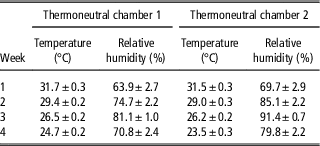
A total of 384 one-day-old male broiler chicks of the Cobb strain were used. During the pre-experimental period, the chicks were allocated eight per cage (0.60×0.50×0.45 m), in two environmental chambers kept at 31°C in the 1st week and at 29°C in the 2nd week (Table 1). From the beginning of the 3rd week and on, stocking density was reduced to six chickens per cage and the temperature was reduced at a rate of 3°C per week, reaching 24°C at the end of the 4th week of age. No resources to control relative humidity were available in the chambers. The experimental period began on day 28 when the chickens were reallocated four per cage in three environmental chambers (5.00×3.00×2.65 m): two chambers were thermoneutral (maintained at 24°C) and one of heat stress (maintained at 32°C). These temperatures were selected based on Belay and Teeter (Reference Belay and Teeter1993) and Teeter et al. (Reference Teeter, Beker, Brown, Broussard, Newman and Ward2009). Each chamber housed 32 wire cages. The experiment followed a completely randomized design with a 2×3 factorial arrangement (diet supplementation or not with vitamin C and E and two ambient temperatures plus a pair feeding group) and 16 replicates.
Ambient temperatures and relative humidity in the two chambers during the pre-experimental period

Corn and soybean meal based diets were formulated according to the recommendations of Rostagno et al. (Reference Rostagno, Albino, Donzele, Gomes, De Oliveira, Lopes, Ferreira and Barreto2005) for average performance of male broilers. The chicks were phase-fed a 22.0% CP and 12.35 MJ ME/kg pre-starter diet (from 1 to 7 days), a 20.8% CP and 12.56 MJ ME/kg starter diet (from 8 to 21 days), a 19.4% CP and 12.98 MJ ME/kg grower diet (from 22 to 35 days) and a 18.0% CP and 13.19 MJ ME/kg finisher diet (from 36 to 42 days). From 28 to 42 days of age, half the chickens received supplementation with vitamin C in the form of l-ascorbic acid 97.5% (Rovimix® C-EC, DSM Nutritional Products Inc., Parsippany, USA) and with vitamin E in the form of dl-α-tocopherol acetate 50% (Rovimix® E-50 Adsorbate; DSM Nutritional Products Inc.) simultaneously in the grower and finisher diets. Diet samples were assayed (Labtec Chemical Analysis Laboratory, Hortolândia, São Paulo, Brazil) for vitamins C and E levels using HPLC methods. In the grower diets, vitamin C levels were 46 and 257 mg/kg in the basal and supplemented diets, respectively, and vitamin E levels were 42 and 109 mg/kg in the basal and supplemented diets, respectively. In the finisher diets, vitamin C levels were 21 and 288 mg/kg in the basal and supplemented diets, respectively, and vitamin E levels were 18 and 93 mg/kg in the basal and supplemented diets, respectively. The levels of supplementation for vitamins C (Njoku, Reference Njoku1986; Kutlu and Forbes, Reference Kutlu and Forbes1993) and E (Sahin et al., Reference Sahin, Sahin, Onderci, Yaralioglu and Kucuk2001; Niu et al., Reference Niu, Liu, Yan and Li2009) were selected based on previous studies.
All the chickens had free access to drinking water through nipple drinkers. In the heat stress chamber, feed was offered ad libitum. In the two thermoneutral chambers, half of the birds were offered ad libitum feed and the other half was pair-fed to heat stressed chickens. This pair-fed control group allowed understanding of the effects of heat stress on performance, carcass and meat traits independent of the reduction in feed intake. Each day, the average feed intake per chicken was measured in the heat stress chamber. This exact amount was offered to the chickens in the pair-fed cages the next day. The cages with ad libitum feeding and pair-feeding were randomly distributed in the two thermoneutral chambers. Therefore, our interpretation of the results was as follows: if for a given trait, the heat stressed group differed from the thermoneutal control, but was similar to the pair-fed thermoneutral, the effect of heat stress was attributed to reduced feed intake. If, on the other hand, the heat stressed group differed from both thermoneutral control and pair-fed control for a given trait, and these latter two were similar to each other, the effect of heat stress was credited to the heat per se.
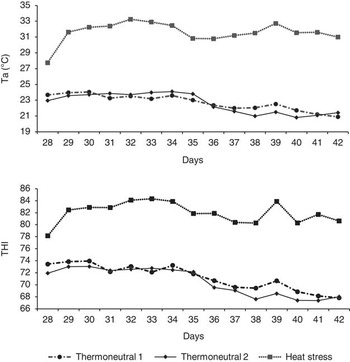
The lighting program was continuous. Average air temperature and relative humidity were determined according to Müller (Reference Müller1989), based on the values recorded daily at 0900 h, 1400 h and 2100 h. The temperature and humidity index (THI) was computed according to Kelly and Bond (Reference Kelly and Bond1971). Average daily ambient temperatures and air relative humidity during the entire experimental period were 22.6±0.3°C and 78.5±1.7% in thermoneutral chamber 1, 22.5±0.3°C and 71.3±2.0% in thermoneutral chamber 2, and 31.7±0.3°C and 59.1±1.5% in the heat stress chamber (Figure 1). The THI was considered normal in the thermoneutral chambers 1 (71±0.6 on average) and 2 (70.3±0.6 on average), but elevated (82±0.4 on average), as expected, in the heat stress chamber.
Average daily ambient temperature (Ta) and temperature humidity index (THI) in the thermoneutral and heat stress chambers from 28 to 42 days.

Cloacal and skin temperatures were recorded in one chicken per cage selected at random. The data were collected between 1400 h and 1600 h on 2 consecutive days a week, between days 28 and 42. Cloacal temperature was assessed using a rectal probe attached to a three-channel thermometer (TH-8 Thermalert Monitoring Thermometer, Physitemp Instruments Inc., Clifton, USA). The probes were inserted ~50 mm beyond the cloacal sphincter and allowed to equilibrate for a minute. Skin surface temperature was taken with a pistol type laser sighting infrared thermometer (Instrutherm® model TI-870, São Paulo, Brazil) positioned at ~25 cm from the target spots (comb, breast and leg). The average of two weekly measurements of each physiological indicator (cloacal temperatures and skin surface temperatures) was used as the weekly value for each individual chicken.
Evaluation of performance and of carcass and organs traits
Initial (day 28) and final (day 42) BWs and weekly feed consumption were recorded on a cage basis. Viability (100% mortality rate), average daily gain and feed conversion were estimated from 28 to 42 days of age.
On day 42, 144 chickens were randomly chosen (24 from each treatment) fasted for 8 h, weighed and euthanized. Chicks were stunned with an electrical 55 V device for 10 s and bled from the unilateral section of the jugular vein and carotid artery. Carcasses were scalded at 57°C for 3 min, mechanically defeathered and manually eviscerated. Pre-chilling was carried out in an ice water holding at 16°C, and chilling at 0 to 2°C, for 30 min (or until the internal carcass temperature reached 3°C). The carcasses (no blood, feathers and organs), abdominal fat depots, and organs (liver, gizzard, proventriculus and heart) were weighed and their yields (in %) were determined relative to slaughter weight. Similarly, the commercial cuts (wings, breast, drums and thighs and back) were weighed and their yields (in %) were calculated relative to the eviscerated carcass weight.
Meat physical quality evaluation
The right and left portions of the pectoralis major muscle were dissected, packed in plastic bags, and stored at 4°C for 24 h. A peagameter (Hommis® model 238, São Paulo, Brazil) with an attached glass probe (Digimed® model CF1, São Paulo, Brazil) was used to determine muscle pH. The glass probe was inserted ~3 mm into the sample. The objective color was determined at three sections of each muscle sample with a colorimeter (Minolta Konica, model CR-400, Toquio, Japan). The CIELAB system (Van Laack et al., Reference Van Laack, Liu, Smith and Loveday2000) was applied: lightness (L*), varying from black (0) to white (100), redness (a*), varying from green (−60) to red (+60) and yellowness (b*), varying from blue (−60) to yellow (+60) were evaluated. For these measurements, samples were previously exposed to air for 30 min at 15°C (Van Laack et al., Reference Van Laack, Liu, Smith and Loveday2000).
Water holding capacity (WHC) was evaluated according to the procedures described by Hamm (Reference Hamm1960), based on the water released when a 10 kg force was applied for 5 min on a 0.50 g pectoralis major sample. The percentage of water lost was calculated from the sample weight difference before and after the application of force. The equation [WHC=100 – % water loss] was then employed to estimate WHC of the sample.
For cooking loss, both the right and left portions of the pectoralis major muscle were weighed, vacuum packed in plastic bags and cooked in a water bath at 85°C, for 45 min, until they reached an internal temperature of 75°C to 80°C. Next, they were cooled to ambient temperature, dried with paper towels and weighed again. The weight difference between the in natura and the cooked sample was employed to estimate the percentage of cooking loss (Honikel, Reference Honikel1987).
Cooked samples previously used for cooking loss determination were subsequently employed for shear force measurement. For this, they were cut into at least five pieces measuring 1×1×2 cm (rectangular section 1×1 and 2 cm along the fiber axis), and positioned with their muscle fibers perpendicular to the blades of a Warner-Bratzler® TA.XT plus – Texture Analyser (Stable Micro Systems®, Haslemere, UK) (American Meat Science Association, 1995) for shredding. The device descent speed was set to 10 mm/s.
Statistical analyses
Physiological, performance, carcass and meat quality traits were analyzed as a 2×3 factorial by two-way ANOVA using the GLM procedure of SAS (2003). The models included the main effects of ambient temperature plus pair-feeding, and diet supplementation with vitamins, and the interaction between these two factors, in addition to the random error effect. Mean comparisons were conducted using Tukey’s test when necessary. The experimental unit for performance traits was the cage and for the other traits the experimental unit was the individual chicken.
Results
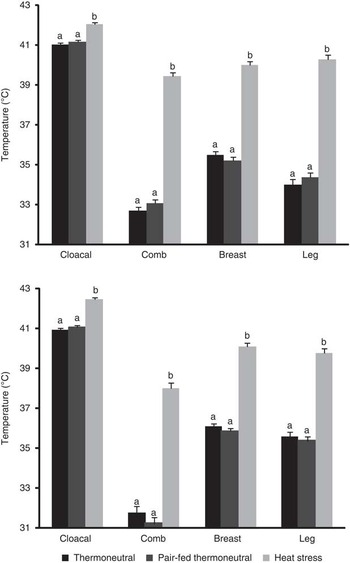
No ambient temperature×diet supplementation interactions (P>0.05) were detected for physiological, performance, carcass yield or meat quality traits, therefore the effects of each one of these factors were considered separately. Cloacal and skin surface (comb, breast and leg) temperatures were elevated at higher ambient temperature, both from 28 to 35 days and from 36 to 42 days (Figure 2). In pair-fed chickens, cloacal and skin surface temperatures were similar to controls in thermoneutral environment.
Average cloacal and skin surface temperatures in broiler chickens according to diet supplementation and ambient temperature from 28 to 35 days (upper panel) and from 36 to 42 days (lower panel).

Performance, carcass and organs yield
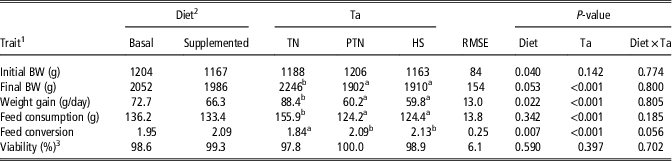
The chickens from the basal diet group had higher initial BW than those from the supplemented diet group (Table 2). This difference was unexpected, considering that the individuals were randomly assigned to treatments at 28 days of age. In order to eliminate this effect, initial BW was included as a covariate in the model for analysis of performance traits. In fact, covariate effects were detected in final BW (P<0.001), average feed consumption (P<0.001), and feed conversion (P=0.044).
Effect of diet supplementation with vitamins C and E and ambient temperature on the performance of broiler chickens from 28 to 42 days

Ta=ambient temperature; TN=thermoneutral; PTN=pair-fed thermoneutral; HS=heat stress.
1 Initial BW was included as covariate in the models of analyses for final BW, weight gain, feed consumption and feed conversion.
2 Basal=basal diet; Supplemented=diet supplemented with vitamin C (257 mg/kg in the grower phase and 288 mg/kg in the finishing phase) and E (93 mg/kg in the grower phase and 109 mg/kg in the finishing phase).
3 Viability=100 – % mortality recorded on a cage basis.
a,bDiffer according to Tukey’s test at P<0.05.
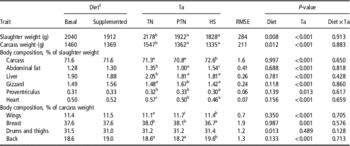
The chickens that received the diet concurrently supplemented with vitamins C and E above the recommended levels presented lower average daily gain, slaughter and carcass weights and increased feed conversion, with no change in daily feed consumption (Table 2). In addition, the P-value for final weight was very close to significance. Consequently, slaughter and carcass weights and the percentage of drums and thighs were also reduced (Table 3). Percentage of carcass, abdominal fat, breast, other carcass cuts and organs were unaffected by vitamin supplementation.
Effect of diet supplementation with vitamins C and E and ambient temperature on carcass traits of broiler chickens

Ta=ambient temperature; TN=thermoneutral; PTN=pair-fed thermoneutral; HS=heat stress.
1 Basal=basal diet; Supplemented=diet supplemented with vitamin C (257 mg/kg in the grower phase and 288 mg/kg in the finishing phase) and E (93 mg/kg in the grower phase and 109 mg/kg in the finishing phase).
a,bDiffer according to Tukey’s test at P<0.05.
Heat stress reduced final BW (−15%), average daily gain (−32%) and feed consumption (−20%), and increased feed conversion (+16%), but viability was unaffected (Table 2). The performance of pair-fed chickens (Table 2) was very similar to that of heat stressed chickens.
Exposure to heat stress from day 28 to 42 reduced slaughter and carcass weights, as expected, but increased carcass, abdominal fat, wings and back yields, in relation to controls maintained in thermoneutral conditions (Table 3). It reduced the percentages of breast and of internal organs such as liver, heart and proventriculus, did not affect drums and thighs percentage, but increased abdominal fat percentage. Pair-fed chickens showed the lowest fat percentage, but breast percentage was not affected. Liver percentage of pair-fed chickens was similar to that of heat stressed chickens, whereas heart and gizzard percentages were higher.
Physical meat quality
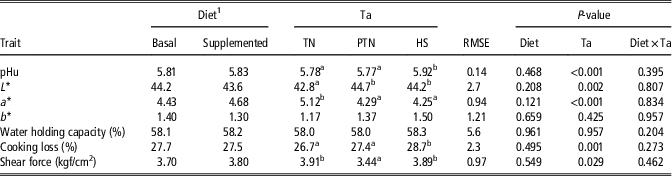
No effects of concurrent diet supplementation with vitamins C and E were detected for meat physical traits (Table 4). Heat stress increased pectoralis major pH 24 h after slaughter (Table 4). Effects of heat stress were also detected on meat color traits. Brightness was increased and redness was decreased compared to chickens in the thermoneutral condition. Yellowness was unaffected by heat stress. In pair-fed chickens, meat color was similar to the heat stressed group.
Effect of diet supplementation with vitamins C and E and ambient temperature on breast meat quality traits of broiler chickens

Ta=ambient temperature; TN=thermoneutral; PTN=pair-fed thermoneutral; HS=heat stress; pHu=pectoralis major muscle pH 24 h after slaughter; L*=lightness; a*=redness; b*=yellowness.
1 Basal=basal diet; Supplemented=diet supplemented with vitamin C (257 mg/kg in the grower phase and 288 mg/kg in the finishing phase) and E (93 mg/kg in the grower phase and 109 mg/kg in the finishing phase).
a,bDiffer according to Tukey’s test at P<0.05.
No effect of heat stress (or of pair-feeding) was detected on pectoralis major water holding capacity (Table 4). Cooking loss, on the other hand, increased in the meat of heat stressed chickens (Table 4), whereas pair-fed chickens performed similarly to controls. Interestingly, shear force was not affected by heat stress (Table 4), but the feed restriction imposed on pair-fed chickens resulted in more tender meat.
Discussion
This study aimed to investigate if concurrent diet supplementation with vitamins C and E, above the recommended levels, could reduce or neutralize the negative effects of heat stress, applied between 28 and 42 days of age, on carcass and meat quality traits of chickens. A group of chickens was pair-fed to heat stressed chickens to allow for distinguishing between the effects of heat stress per se from those caused by depressed feed intake.
Exposure to heat stress caused elevation of cloacal (+1 to 1.5°C) and skin surface temperatures (+4 to 6°C) of chickens from 28 to 35 days and from 36 to 42 days, proving that heat stress was established, but its intensity was not enough to impair viability. The elevation in skin temperature allows heat loss through sensible mechanisms, but the elevation in core temperature reflects the chickens’ inability to dissipate enough heat. It is likely that cardiovascular adjustments related to acclimatization, such as the vasomotor response, adaptations in the circulatory system, as well as reduction in heat production were taking place during this 2-week heat stress period (Yahav, Reference Yahav2009). These results are in agreement with previous studies in which increased core body and skin surface temperatures in broilers resulted from elevated ambient temperature over a period of 3 to 4 weeks (Cooper and Washburn Reference Cooper and Washburn1998; Giloh et al., Reference Giloh, Shinder and Yahav2012).
The chickens that received the diet concurrently supplementated with vitamins C and E above the recommended levels (Rostagno et al., Reference Rostagno, Albino, Donzele, Gomes, De Oliveira, Lopes, Ferreira and Barreto2005) presented lower average daily gain, slaughter and carcass weights and increased feed conversion, with no change in daily feed consumption, independently of ambient temperature. A possible carry-over effect of the lower initial weight of chickens in the supplemented group should be considered, despite the fact that we used the initial BW as a covariate in the analysis of performance traits. Alternatively, these differences suggest a catabolic effect of these two vitamins when supplemented simultaneously at high levels that could not be confirmed.
The physiological effects of constant heat stress and its consequences on growth performance and body composition of broiler chickens are well documented (Géraert et al., Reference Géraert, Padilha and Guillaumin1996; Renaudeau et al., Reference Renaudeau, Collin, Yahav, De Basilio, Gourdine and Collier2012). At high ambient temperature, feed intake is diminished in an attempt to reduce metabolic heat production. In the present study, the reduction in growth rate (32%) was higher than the reduction in feed intake (20%), resulting in poorer feed conversion (16%). Pair-fed chickens performed very similarly to heat stressed chickens, attesting that the reduction in growth under heat stress was entirely due to the reduction in feed intake.
Exposure to heat stress worsened carcass composition by altering the proportion of carcass parts. This effect was, at least partially, due to depressed growth performance. The most important changes were decreased breast percentage and increasing abdominal fat percentage, but the percentage of drums and thighs was not affected. Similar results were reported by Zhang et al. (Reference Zhang, Jia, Zuo, Zhang, Lei, Ren and Feng2012) working with Arbor Acres males. In the present study, carcass yield increased, but this was at least partially due to a relative reduction in organs weight. A possible explanation for why the percentage of drums and thighs was not influenced by heat stress in the present study, whereas breast percentage was reduced, may reside in differences in the metabolism of muscle fibers between breast and leg muscles. In the leg, red slow-contracting oxidative fibers predominate, whereas in breast, white fast-contracting glycolytic fibers are the most abundant (McKee, Reference McKee2003). The latter are richer in ATP and rely on glycogen supply for its metabolism and hypertrophy, therefore as feed intake was limited under heat stress, glycogen supply decreased leading to decreased protein synthesis in the breast muscle (Temim et al., Reference Temim, Chagneau, Peresson and Tesseraud2000).
Similar to what is reported here, it has been shown that chickens exposed to heat stress retained more fat (Ain-Baziz et al., Reference Ain-Baziz, Géraert, Padilha and Guillaumin1996; Zhang et al., Reference Zhang, Jia, Zuo, Zhang, Lei, Ren and Feng2012) and had less muscle protein deposition (Temim et al., Reference Temim, Chagneau, Peresson and Tesseraud2000; Zhang et al., Reference Zhang, Jia, Zuo, Zhang, Lei, Ren and Feng2012) credited to decreased capacity of protein synthesis and of peripheral lipolysis, respectively. Pair-fed chickens, in the present study, showed the lowest abdominal fat percentage; possibly due to the 20% feed restriction that was imposed on them, but their breast percentage was similar to thermoneutral controls. Therefore, we can conclude that the changes in metabolism and body composition of heat stressed chickens were caused by the high ambient temperature per se, and not by the reduction in feed intake.
The lower percentage of metabolically active organs such as the liver and heart in chickens kept under heat stress compared to thermoneutrality occurred due to the physiological adjustment derived from depressed feed intake. Similar results were described by De Oliveira et al. (Reference De Oliveira, De Oliveira, Donzele, Cecon, Vaz and Orlando2006) and Zhang et al. (Reference Zhang, Jia, Zuo, Zhang, Lei, Ren and Feng2012).
Breast meat physical traits were negatively affected by exposure to chronic heat stress. Final pH, cooking loss and lightness were increased, whereas redness was decreased. No differences in yellowness and shear force were detected between heat stressed and control chickens, but the meat of pair-fed chickens was tenderer, indicating that feed restriction was responsible for this positive effect. Diet supplementation with vitamins C and E simultaneously did not compensate for the negative effects of heat stress on meat quality traits. In contrast to these results, diet supplementation with 200 mg/kg of vitamin E was reported to improve chicken breast meat quality by reducing cooking loss and shear force, and improving meat color (Zhang et al., Reference Zhang, Shan, Jiang, Bi and Li2013). In addition, diet supplementation with vitamin C was efficient in lowering breast meat pH increased due to heat stress (Imik et al., Reference Imik, Ozlu, Gumus, Aydemir-Ataserver, Urcar and Atasever2012). However, no previous studies on the effects of concurrent diet supplementation with vitamins C and E to alleviate the negative impact of heat stress on meat quality traits of broilers were found.
Under anaerobic conditions, such as during the postmortem period, muscle glycogen degradation takes place via glycolysis leading to the synthesis of lactic acid from pyruvate, reducing muscle pH. This reduction is necessary for the conversion of muscle into meat (Dransfield and Sosnicki, Reference Dransfield and Sosnicki1999; Lehninger et al., Reference Lehninger, Nelson and Cox2008). Chronic exposure to high ambient temperatures, as occurred in the present study, may have lead to an exhaustion of muscle glycogen reserves in vivo, resulting in meat with higher pH (Mckee and Sams, Reference Mckee and Sams1997; Dai et al., Reference Dai, Gao, Xu, Zhang, Song and Zhou2012). Acute heat stress, in contrast, has been associated with faster postmortem pH decline and lower pH (Debut et al., Reference Debut, Berri, Baéza, Sellier, Arnould, Guémené, Jehl, Boutten, Jego, Beaumont and Le Bihan-Duval2003).
In pair-fed chickens, meat color was similar to that of the heat stressed group, indicating that increased lightness and decreased redness in heat stressed chickens were due to the depression in feed intake. Myoglobin is the main protein responsible for meat color, along with hemoglobin and cytochrome C (Mancini and Hunt, Reference Mancini and Hunt2005). Meat discoloration originates from the oxidation of ferrous myoglobin derivatives to metmyoglobin. Several studies have associated chronic heat stress with increased breast meat lightness (Aksit et al., Reference Aksit, Yalcın, Ozkan, Metin and Ozdemir2006; Lu et al., Reference Lu, Wen and Zhang2007; Dai et al., Reference Dai, Gao, Xu, Zhang, Song and Zhou2012), but the effects on redness and yellowness were variable. Similar to the present study, Zhang et al. (Reference Zhang, Jia, Zuo, Zhang, Lei, Ren and Feng2012) reported decreased redness and unchanged yellowness under chronic heat stress, but Aksit et al. (Reference Aksit, Yalcın, Ozkan, Metin and Ozdemir2006) found increased redness and Lu et al. (Reference Lu, Wen and Zhang2007) did not detect any changes in these two color measurements in the breast meat of Arbor Acres chickens under constant heat stress.
We expected that breast meat water holding capacity and shear force would be increased under heat stress, but our data did not confirm this. The elevation of meat pH caused by heat stress should increase meat protein capacity for water retention preventing water extravasation (Dransfield and Sosnicki, Reference Dransfield and Sosnicki1999) and resulting in less tender meat. Cooking loss, on the other hand, paralleled pH, being higher in heat stressed compared to control and pair-fed chickens. These were effects of the high temperature per se, and not of depressed feed intake. Zhang et al. (Reference Zhang, Jia, Zuo, Zhang, Lei, Ren and Feng2012) attributed increased cooking loss in the breast muscle of chickens exposed to chronic heat stress to a more pronounced protein denaturation that would reduce its ability to bind water. Interestingly, shear force was not affected by heat stress, but the feed restriction imposed to pair-fed chickens reduced shear force, probably due to an increased postmortem proteolytic potential.
Conclusion
Exposing chickens to heat stress in the grower finishing phases had a negative impact on performance, carcass composition, and meat physical quality traits, but not all these effects were due to the high ambient temperature per se. Important changes in carcass composition and in meat physical quality traits resulted from alterations in metabolism induced by high ambient temperature. These included decreased breast proportion, increased abdominal fat proportion, and increased meat pH and cooking loss. The pair-feeding system allowed for the determination that the depression in growth performance and liver proportion, and the alterations in meat color were actually attributed to the reduction in feed intake induced by the exposure to heat stress. Diet supplementation with vitamins C and E simultaneously was not able to neutralize or reduce any of the negative effects of the exposure of chickens to heat stress, in the grower finishing phases, on performance, carcass and meat physical quality traits. Future research is needed to investigate if other combinations of different levels of these two vitamins would be effective. Insights into the molecular mechanisms involved with heat stress in chickens may also reveal new approaches to mitigate these effects.
Acknowledgments
The authors thank DSM Nutritional Products Inc., Parsippany, USA for the donation of vitamins and Dr David R. Ledoux from Animal Sciences Division, University of Missouri, Columbia, USA for English language checking and editing. This project received financial support from FAPESP, Brazil (grant number 2009/15624-4). Cynthia P. Zeferino and Claudia M. Komiyama received research assistantships from CAPES and FAPESP, Brazil, respectively. Ana Silvia A.M.T. Moura and José R. Sartori are recipients of productivity scholarships from CNPq, Brazil.