

Why do governments establish institutional commitments that lock in policies, and when do they refrain from such reforms? Existing explanations posit that parties currently in government use domestic and international institutions to lock in their own policy preferences by tying the hands of successors (see, e.g., Keohane Reference Keohane1984; Moravcsik Reference Moravcsik2000; Boylan Reference Boylan2001; Figueiredo Reference de Figueiredo2002; Ginsburg Reference Ginsburg2005). Emphasizing the trade-off between implementing policy preferences, on the one hand, and exploiting partisan differences for electoral success, on the other hand, I argue that these explanations portray an incomplete picture of the incentives of governments: Locking in a policy takes an issue off the table, but it also undermines a party’s ability to leverage differences to the opposition in subsequent elections. The argument explains why governments refrain from reforms, even if they are in their perceived partisan interest: parties need to take into account the electoral cost of giving up an issue. Electoral incentives—keeping salient those issues on which parties compete successfully—can work against other motives for locking in policies.
I advance this argument in the context of the establishment of independent central banks. A right-wing government perceived as delivering low inflation rates may gain and hold office based on its anti-inflationary reputation. Once it takes inflation off the table, it loses this advantage. Voters that previously supported the party for its anti-inflationary stance may switch their vote, now that inflation is less influenced by the party in office. A low-inflation party would lock in its policy preferences, but, by losing voters, also reduces its prospects for re-election. Contrary to a view based on policy preferences, the larger are the differences between parties and the more important inflation is to voters, the less attractive is a commitment to a right-wing government.
This argument adds to a literature that has identified several partisan motivations for locking in monetary policy-making through central banks. Right-wing parties that prefer low inflation can use central banks to tie the hands of inflation-prone, left-wing successors (see, e.g., Goodman Reference Goodman1991; Boylan Reference Boylan2001; Oatley Reference Oatley2010). At the same time, faced with more severe time-inconsistency problems, left-wing parties may be more prone than right-wing parties to rely on commitment devices that tie their own hands (Barro and Gordon Reference Barro and Gordon1983; Giavazzi and Pagano Reference Giavazzi and Pagano1988; Milesi-Ferretti Reference Milesi-Ferretti1995; Bodea Reference Bodea2010b). Bodea (Reference Bodea2010a), offering a more nuanced view, shows that the relative propensity of left- and right-wing governments to establish independent central banks depends on the availability of alternative commitment devices and the macroeconomic environment. While this literature identifies the relative benefits of locking in policies to different parties, this paper emphasizes the electoral cost of doing so, and how this cost is shaped by the political environment—the salience of a policy and differences between parties. To right-wing governments, solving time-inconsistency problems not only may be less important than to left-wing governments, but detrimental to their electoral success. Electoral competition creates a disincentive for right-wing governments to lock in monetary policy-making, and therefore an incentive to delay reforms that increase central bank independence.
These electoral implications help explain why governments abstain from reforms, even when these reforms are perceived to be consistent with a party’s preferences. For instance, the central bank of the United Kingdom, the Bank of England, was for a long time among the most dependent central banks among developed countries. Ben Bernanke labeled it “essentially an agent of the British Treasury” (Reference Bernanke2010). During its 11 years in office, the conservative government of Margaret Thatcher, which stressed minimal government interference in the economy and implemented numerous other reforms, refused to grant the central bank more independence, despite repeated demands from Members of Parliament. It was a left-wing Labour government that increased the Bank of England’s independence in 1997, immediately after the conservative government lost office. While existing arguments account for the decision by the Labour government to reform the central bank—it allowed the left-wing government to gain credibility with markets—they do not explain why conservative governments deliberately refused to grant the Bank of England more independence.
Evidence from central bank reforms in preparation for joining the European Monetary Union provides tentative support for the argument: right-wing governments were reluctant to implement the required central bank reforms and often delayed them until they lost office. These reforms offer a unique opportunity to evaluate the argument. While member states had to implement them, the timing was left to national governments, providing an exogenous reform impetus. And because the reforms were mandatory, it is unlikely that other considerations, such as attempts to use these reforms as signals, were driving them. Additional evidence, drawing on central bank reforms in up to 45 countries, shows that the disincentive of right-wing parties to increase central bank independence is largest where inflation aversion is high and where differences in the economic policy stances of parties are most pronounced.
The argument is closely related to Milesi-Ferretti (Reference Milesi-Ferretti1995), who shows that right-wing parties prefer the absence of fixed exchange rates as commitment devices, but, if elections are uncertain, right-wing parties prefer to tie the hands of their successors. This paper shares the premise that parties can use the absence of institutions that lock in policies to their political advantage. It differs in several aspects. Modeling the decision of voters explicitly introduces uncertainty about the election result as a function of locking in the policy and as a function of the political environment. The model thus emphasizes how locking in the policy drives voters who would have voted for the right-wing party based on its anti-inflationary stance to switch to another party based on other policy considerations. This effect underscores the role of electoral competition. If voters are loyal to their parties and not able—or willing—to switch votes, the electoral incentives identified in this paper vanish. Conversely, the more voters change their vote choice after locking in the policy, the more pronounced is the effect.
Beyond the political economy of central banks, these results reinforce the importance of commitment problems in explaining policy inertia and the reliance on inefficient policy instruments (Robinson and Torvik Reference Robinson and Torvik2005). At the core of the theory in this paper is a commitment problem. Some parties have incentives to maintain discretion over policy, because voters are unable to commit to supporting them after policies are locked in. Moreover, some parties can maintain an electoral advantage in the absence of a commitment because they are the only party which can credibly deliver specific policies. This dynamic creates inefficient policy discretion. A similar argument may explain the creation of international institutions with weak enforcement mechanisms. These can be politically expedient to governments from a domestic politics perspective: maintaining a high probability of policy changes under future governments can help parties retain voters who are currently supporting them, but who might switch to a different party once the policy cedes to be driven by the party in power.
Finally, the paper points to an irony of competitive political systems with weak political allegiances. Electoral competition and the ability to switch between parties are supposed to benefit voters. Yet, electoral competition can undermine the incentives for parties to lock in policies, even if a commitment would be optimal from the perspective of voters. The result arises not because of special interest groups or curtailed political competition. It arises because the fear of losing votes by insulating an issue creates incentives to withhold reforms. Because voters are responsive to policy promises, and because parties are responsive to electoral concerns, voters are denied reforms that would improve their welfare. Electoral competition can be a culprit, not a remedy, for ensuring that voter interests are represented.
Elections and policy commitments
The following discussion builds on a probabilistic voting model. Two parties, p∈{g, o} for government and opposition, compete for office. The sequence of moves is as follows. First, the government decides whether to establish a commitment or to retain discretion. Then, both parties simultaneously propose policy platforms in order to maximize their probability of winning. Finally, an election is held, where voters vote for the party that yields the highest utility for them. The Online Appendix offers several extensions and variations, for instance, a model where parties compete by emphasizing the salience of different issues.
The parties compete on two dimensions, π p and q p . On the first dimension, they are characterized by an exogenously given parameter, π p ≥0. To focus on monetary policy-making, suppose π p reflects voters’ inflation expectations under party p, or the party’s inflation reputation. I refer to a government with π g <π o as a low-inflation government and a government with π g >π o as an inflation-prone government.
Following the literature, I equate inflation-prone governments with left-wing governments and low-inflation governments with right-wing governments (e.g., Hibbs Reference Hibbs1977; Alesina Reference Alesina1987; Franzese Reference Franzese1999; Clark and Hallerberg Reference Clark and Hallerberg2000; Leblang Reference Leblang2002; Bodea Reference Bodea2010a; Clark and Arel-Bundock Reference Clark and Arel-Bundock2013). Whether left-wing parties, in fact, produce higher inflation rates is less important for the following than what voters believe to be the case when casting their vote. Left parties may not be any more inflationary, but markets and voters certainly appear to have that belief. Even central banks consistently expect higher inflation under left-wing governments, and in particular appear to overestimate inflation rates (Gandrud and Grafstrom Reference Gandrud and Grafstrom2015). Differences in inflation expectations across parties might arise for a number of reasons.Footnote 1 Models that derive different expectations endogenously are relegated to the Online Appendix.
On the second dimension, both parties simultaneously propose policy platforms, q g and q o , which they implement after being elected. Introducing this second dimension allows discussing the role of the relative salience of inflation to the electorate (below) and trade-offs between conflicting policy goals (in the Online Appendix). It also serves to identify the contrast to the first dimension: where voters perceive no differences between parties a priori, policy convergence results, and parties would (weakly) prefer to lock in those policies. Policy proposals on this second dimension are independent of the party characteristics that determine π g and π o . This implies that the policy dimension is either unrelated to expected inflation rates under each party, or that voters do not recognize any links between the two dimensions. For instance, notwithstanding the trade-offs inherent to the Phillips curve, voters may simultaneously prefer low inflation rates and high growth.
With respect to π p , the government can rely on an international institution or a bureaucratic agency to fix policy and insulate it from the political process, locking it in permanently—in the present context, through delegating monetary policy-making to an independent central bank. Once the commitment is in place, the ruling party no longer influences the policy outcome on this dimension. Thus, the government chooses
 $$\omega {\equals}\left\{ {\matrix{ 1 \hfill & {{\rm }if\,discretion,{\rm }} \hfill \cr 0 \hfill & { if\,commit,{\rm }} \hfill \cr } } \right.$$
such that from the perspective of voters, the inflation rate under party p is ωπ p . The assumption entails that a commitment arbitrarily fixes the policy at 0.Footnote 2 This is not essential in the following; key is that the commitment fixes policy at a given level.
If the government establishes a commitment, I assume it is credible. The credibility of the commitment does not depend on the partisanship of the government, and it cannot be revoked. The literature identifies a number of factors that make commitments credible, such as reputational costs for backtracking on actions and public statements, the creation of vested interests that make it difficult to reverse legislation, and the presence of veto players (Broz Reference Broz2002; Tsebelis Reference Tsebelis2002; Keefer and Stasavage Reference Keefer and Stasavage2003; Bodea and Hicks Reference Bodea and Hicks2015b). The following results also obtain when inflation is a weighted average of the government’s characteristic and the policy under a commitment (see, e.g., Franzese Reference Franzese1999; Clark and Arel-Bundock Reference Clark and Arel-Bundock2013).
The electorate is composed of J groups, indexed by j=1,2, …, J, which each constitute a share λ j of the electorate; the groups may represent different socio-economic groups. Voter i in group j obtains utility from voting for party p of
 $$u_{{ij,p}} (q_{p} ,\pi _{p} ,\omega ){\equals}\alpha _{j} v_{j} (\omega ,\pi _{p} ){\plus}(1{\minus}\alpha _{j} )w_{j} (q_{p} ){\plus}\nu _{{ij,p}} .$$
Voter i in group j votes for the current government if u ij,g >u ij,o , and votes for the opposition otherwise. Voters evaluate parties’ electoral platforms on the basis of π p and q p , and weigh these in their utility with α j and (1−α j ), respectively, where α j ∈[0,1]. Thus, as in standard models of voter evaluations of the economy (Clark and Hallerberg Reference Clark and Hallerberg2000; Scheve Reference Scheve2004), α j represents the public’s inflation-aversion.
Within each group, all voters share the same ideal points q j and π j . Because q j and π j are the ideal points, I assume that v j (ω, π p )=−(ωπ p −π j )2 and w j (q p )=−(q p −q j )2. All J groups prefer the lowest possible value on the first dimension, such that π j =0 for all j. This assumption implies that all voters, provided they are concerned with inflation in the first place (such that α j >0), prefer the lowest possible inflation rate.Footnote 3 Easterly and Fischer (Reference Easterly and Fischer2001) provide empirical evidence that voters of all income strata prefer lower inflation rates. Studies of economic voting, similarly, find that voters reward governments when inflation is low (Tufte Reference Tufte1978; Franzese Reference Franzese2002). The assumption does not imply that voters do not also prefer other policies or economic outcomes—in particular, high employment or economic growth—that would have inflationary effects. The assumption only stipulates that, everything else equal, voters prefer lower inflation rates to higher inflation rates.
Voters may perceive other differences among parties that are independent of the proposed policies. As a consequence, parties are uncertain about each voter’s decision. For instance, voters might be ideologically biased toward one of the parties. Voters may also have a preference for or against the current government due its past record. These differences between parties are reflected by ν ij,p . Let ν ij =ν ij,g −ν ij,o be the disposition of voter i toward the government. If ν ij is positive, the voter is biased toward the current government. Following probabilistic voting models (e.g., Persson and Tabellini Reference Persson and Tabellini2002), I assume two types of uncertainty. From the perspective of the parties, voter i in group j receives a random shock from voting for party P, ν ij,p , which is decomposed as δ with cumulative density function F and as σ ij with cumulative density function G j , such that
 $$\nu _{{ij,g}} {\minus}\nu _{{ij,o}} {\equals}\delta {\plus}\sigma _{{ij}} ,$$
 $${\rm where}\,{\rm }\delta \,\sim\,{\cal U}\left[ {{\minus}{1 \over {2\psi }},\,{1 \over {2\psi }}} \right]\,{\rm and}\,\sigma _{{ij}} \,\sim\,{\cal U}\left[ {{\minus}{1 \over {2\phi _{j} }},\,{1 \over {2\phi _{j} }}} \right],$$
where δ affects aggregate preferences and σ ij affects preferences at an individual level.
Voter i in group j votes for the current government if and only if u ij,g >u ij,o , or
 $$\sigma _{{ij}} \,\gt\,\sigma _{j} \left( \omega \right){\equals}\alpha _{j} \left[ {v_{j} \left( {\omega ,\pi _{o} } \right){\minus}v_{j} \left( {\omega ,\pi _{g} } \right)} \right]{\plus}\left( {1{\minus}\alpha _{j} } \right)\left[ {w_{j} \left( {q_{o} } \right){\minus}w_{j} \left( {q_{g} } \right)} \right]{\minus}\delta ,$$
where σ
j
(ω) is the swing voter in group j. Defining  $\hat{\delta }_{\omega } $ such that for
 $\delta \,\gt\,\hat{\delta }_{\omega } $ the government wins the election, whereas for
 $\delta \leq \hat{\delta }_{\omega } $, the opposition wins the election, the probability that the government wins the election, p g, is given by
 $p_{g} \left( \omega \right){\equals}{\rm Pr}\left( {\delta \,\gt\,\hat{\delta }_{\omega } } \right)$.
The government maximizes its probability of winning by deciding whether to retain discretion and then by choosing its policy platform simultaneously with the opposition party. Define
 $$\kappa \,\equiv\,F\left( {\hat{\delta }_{{\omega {\equals}1}} } \right){\minus}F\left( {\hat{\delta }_{{\omega {\equals}0}} } \right),$$
as the government’s electoral incentive to commit. For κ>0, the government benefits from a commitment, because its probability of winning increases. As κ increases, the electoral incentive to commit increases, and the probability that the government implements a commitment and locks in the policy increases; as κ decreases, the electoral incentive to commit decreases and the probability that the government retains discretion increases.
Proposition 1: If π g <π o , the government loses votes when locking in the policy. Thus, the government has an electoral disincentive to commit (κ<0).
Proposition 1 implies that right-wing governments are better off retaining discretion than locking in the policy. This result provides a contrast to arguments that right-wing governments benefit from locking in their preferred policy preferences: electorally, they lose. The proposition is not new: it shares similarities with those parts of the literature that emphasize time-inconsistency problems as drivers of central bank independence (Barro and Gordon Reference Barro and Gordon1983). This literature recognizes that both left- and right-wing parties have incentives to lock in monetary policy-making to avoid time-inconsistency problems; however, because these are usually more pressing for left-wing parties, right-wing parties are less likely to delegate monetary policy-making and have less of an incentive to maintain existing commitments than left-wing parties (see, e.g., Leblang Reference Leblang2003; Bodea Reference Bodea2010b). At the same time, the mechanism giving rise to such a pattern is different here: instead of the relative benefits of hands-tying institutions in terms of reducing inflation, the model emphasizes the electoral cost of giving up an issue for the right-wing party, which creates a disincentive to increase central bank independence and an incentive to delay such reforms.
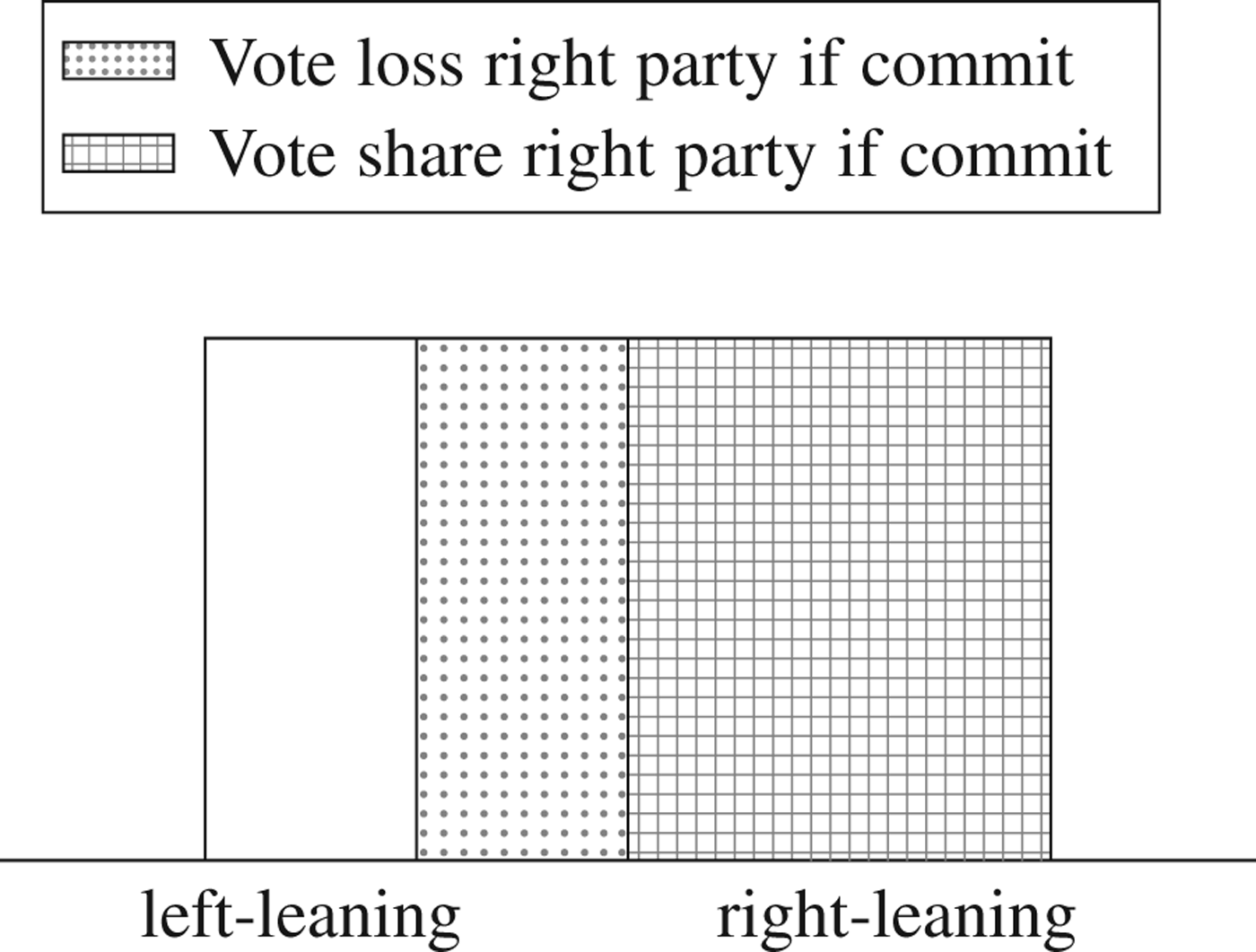
This mechanism is illustrated in Figure 1. Under discretion, the right-wing party attracts a set of voters—identified by the dotted area—who are pre-disposed toward the left-wing party, but who are compelled to vote for the right-wing party because of its low-inflation stance. For these voters, the right-wing party’s inflation reputation is sufficient to offset other considerations in favor of the left-wing party (caused by ν ij ). Once inflation is locked in and the identity of the party in government no longer determines the inflation rate, these voters switch to the left-wing party, and the right-wing party only captures the votes in the area shaded with the grid pattern. Moreover, the right-wing party cannot distinguish itself on the second policy dimension to compensate for those lost votes. The two parties propose the same policy platforms q p in equilibrium, such that q g =q o . Thus, under a commitment, the right-wing party loses voters, which reduces its probability of winning the election. Anticipating this loss, right-wing parties have an incentive to retain discretion and to keep inflation salient in elections.
Vote share for right-wing party under discretion and commitment Note: If locking in the policy, the right-wing party loses its most left-leaning voters, indicated by the dotted area. These voters have an inclination to vote for the left-wing party, but under discretion vote for the right-wing party because it delivers lower inflation rates.

The result is contingent on the assumptions that voters prefer lower inflation rates and that right-wing parties are better able to deliver those. However, it is not necessary that all voters prefer a zero inflation rate. It is sufficient if one of the groups of voters is concerned about inflation rates, with the majority of voters not affected by inflation rates. Similarly, while right-wing parties are assumed to be better able to deliver low inflation, it is not necessary for the result in Proposition 1 that right-wing parties, overall, are advantaged in the election. For instance, while right-wing parties might be perceived as being better able to deliver low inflation rates, they might be perceived as being less competent in designing and implementing welfare policies. Even if the electorate is biased toward one of the parties, a commitment implies a vote loss for right-wing parties and a vote gain for left-wing parties.
Writing the electoral incentive to commit, κ, as
 $$\kappa {\equals}{\psi \over {\sum_j {\rm \ztbnd }\lambda _{j} \phi _{j} }}\left\{ {\mathop{\sum}\limits_j {\lambda _{j} \phi _{j} \alpha _{j} } \left[ {v_{j} \left( {\omega {\equals}1,\pi _{o} } \right){\minus}v_{j} \left( {\omega {\equals}1,\pi _{g} } \right)} \right]} \right\}$$
yields two additional results, summarized in Proposition 2, that further emphasize the mechanism behind the right-wing party’s disincentive to commit: the more voters switch parties after locking in the policy, the larger is the disincentive to commit.
Proposition 2: If π
g
<π
o
, the government’s electoral incentive to commit decreases in the inflation-aversion of the electorate  $\left( {{{\partial \kappa } \over {\partial \alpha _{j} }}\,\lt\,0} \right)$ and in the differences with the opposition
 $\left( {{{\partial \kappa } \over {\partial \pi _{o} }}\,\lt\,0} \right)$.
The first part of Proposition 2 highlights that right-wing governments are less likely to lock in the policy when the electorate is more concerned with inflation. If the electorate’s emphasis on inflation increases, the right-wing party’s advantage increases: inflation is a more salient issue, and maintaining its advantage on this dimension becomes more valuable in terms of votes—the dotted area in Figure 1 expands in size. Hence, removing this advantage by locking in becomes more costly. This result can arise through two distinct channels: if more groups become concerned with inflation—such that α j >0 for a larger number of groups—the right-wing party’s electoral disincentive to commit increases; and if groups become more concerned with inflation—α j increases in size—the right-wing party’s electoral disincentive to commit also increases, as can be seen from Equation 6. This effect comes at the expense, in particular, of voters. The more voters are concerned about inflation, the less likely are right-wing governments to lock in low inflation rates. As in Scheve (Reference Scheve2004), high inflation-aversion can deter central bank reforms. Electoral competition has additional effects that lead to divergence across parties: higher inflation-aversion raises the value of a commitment to left-wing governments but raises the value of discretion to right-wing governments.
Second, the same logic holds as the differences with the opposition increase. As the inflation reputation of the opposition party becomes more dissimilar from the government’s inflation reputation, the right-wing party’s electoral advantage increases. Discretion becomes more valuable, which reduces the incentive to lock in the policy and increases the dotted area in Figure 1. By contrast, as the two parties become more similar, the dotted area shrinks and eventually disappears. In the case where π g =π o , both parties weakly prefer to commit: the two parties are no longer differentiated, and the term in square brackets in Equation 6 drops out. This effect contrasts with a theory of commitments based on policy preferences. Based on policy preferences, the incentive to lock in the policy and tie down inflation should be strongest when the differences to the opposition party are large.
That the disincentive of right-wing governments to commit is driven by political competition and the characteristics of voters and opposition parties distinguishes the theory from other political economy theories of hands-tying and partisanship. For instance, Bodea (Reference Bodea2010a) considers central banks and exchange rate pegs as alternative commitment devices and emphasizes how differences in the propensity of right- and left-wing parties to rely on central banks are shaped by the institutional and macroeconomic environment. By contrast, the incentives and disincentives to commit here are based on the political environment in which parties compete for votes—specifically, the inflation aversion of the electorate and the characteristics of opposition parties.
The focus on the political environment and the decisions of voters also distinguishes the theory from Milesi-Ferretti (Reference Milesi-Ferretti1995), who, similarly to the argument here, shows that right-wing parties may have a disincentive to commit; yet, in the model of Milesi-Ferretti (Reference Milesi-Ferretti1995), once elections are uncertain, right-wing parties tie the hands of successors. This differs from the present model: electoral competition, and the uncertainty over election outcomes it creates, drives the right-wing party’s disincentive to commit. By introducing voter decisions explicitly, the model emphasizes that election outcomes are endogenous to the government’s decision of whether to commit and that the extent of this effect is shaped by the political environment. The more inflation matters for the election outcome, and the larger are the differences between parties, the larger is the disincentive of right-wing parties to commit: a larger set of voters—who were compelled to support the right-wing party because of its low-inflation stance—is switching their vote choice to the left-wing party.
Notably, the argument relies on swing voters who are willing to switch their vote choice once a policy is locked in. As vote choices become less sensitive to party characteristics, and elections are less competitive, locking in the policy becomes less costly for the right-wing party. The most partisan voters—those with large biases in favor of either party—are not swayed by the decision to lock in the policy. Only those voters sensitive to party platforms, and with small biases toward one of the parties, switch their vote. If voters were sufficiently partisan, the disincentive for right-wing governments to commit would be reduced. Put differently, because voters lack the ability to commit to future vote choices, governments have incentives to withhold reforms that lock in policies on which parties are distinct. This contrast can also be seen by comparing the two policy dimensions. On the second policy dimension, q p , voters in group j obtain a policy closer to their preferred policy under either party when their group’s sensitivity to the policy platform increases. The opposite holds for the first policy dimension. Right-wing parties are less likely to lock in the low-inflation policies desired by voters the more sensitive voters are to inflation, because leveraging differences to the opposition becomes more valuable.
Hence, competitive elections create a distortion. Because parties maximize vote shares, rather than voter utility, parties that currently hold an electoral advantage try to maintain it. What matters to parties is not whether voters obtain the best possible outcome, but whether voters obtain a better outcome than what a competitor could deliver. In contrast to other explanations for why governments fail to pursue beneficial policies, this distortion is not caused by interest group influence or by limitations on electoral competition. The distortion exists because of electoral competition.
Beyond the literature on central banks, the argument that governments have incentives to lock in policies to tie the hands of their successors is also prominent in the literature on international institutions. Legalized institutions with strong obligations on governments may compel successor governments to maintain current policy choices into the future. As Goldstein et al. put it, governments may “deliberately employ international legalization as a means to bind themselves or their successors in the future” (Reference Goldstein, Kahler, Keohane and Slaughter2000, 393). The model emphasizes the contrast between the two motives of tying oneself and tying a successor, and identifies a political cost to the latter strategy: while governments can constrain future successors by relying on strong international institutions, governments also forgo the ability to leverage differences to the opposition for political gain.
This effect has implications for institutional design: for some governments, it increases the attractiveness of weak international agreements that rely on domestic mechanisms for compliance, as opposed to external enforcement (e.g., Dai Reference Dai2007). By providing a new policy to potential supporters and increasing its salience, but making the reversal of that policy relatively easy under a different government, the current government can maintain the political support of those interest groups and voters—switching their vote would imply losing the policy. If, by contrast, the policy is enforced through external means, such as the reputational costs to the government or inter-state reciprocity, the policy becomes locked in, and voters can switch to a different party without the risk of losing the policy as a consequence.
Thus, the argument provides a domestic political rationale for weakly legalized international institutions. Providing a policy that satisfies voters can be attractive to governments. Yet, locking in such policies through strong international agreements can be detrimental to a government’s electoral fortunes—not because the government values the opportunity to defect from the agreement, but because it benefits from maintaining concerns that a successor government might defect from the agreement in the future.
Evidence from central bank reforms
The previous section derived two key predictions. First, right-wing governments should have a disincentive to lock in monetary policy-making, and therefore should delay reforms to increase the central bank’s independence. Second, differences in the propensity of left-wing and right-wing governments to implement central bank reforms should be most pronounced where capitalizing on their anti-inflationary stance is most attractive to right-wing governments: where the inflation aversion of voters is high and where the economic policy stances of left-wing and right-wing parties differ. This section provides tentative evidence consistent with these propositions.
Delaying reform: central bank independence in the European Monetary Union
If right-wing parties in government have a disincentive to reform central banks, they should delay increasing the degree of central bank independence. The introduction of a common European currency, the Euro, provides an exogenous reform impetus to evaluate this argument systematically. The central banks of the Euro member states are joined together in the Eurosystem. To accede to the Eurosystem, the prospective members had to bring their central bank legislation in line with what would become the European Central Bank in 1998. For all but two members (Portugal and Germany), this required legal increases in Central Bank Independence (CBI). The changes to the central bank laws were mandatory. Each government had little discretion in whether to implement these reforms. However, governments had substantial discretion in the timing of the reforms. Some passed reforms as early as 1993, others waited until 1998. Moreover, in every country, at least one election occurred between 1992 and 1998. Presented with an exogenous impetus to reform the central bank, right-wing governments should have been reluctant to implement these reforms and delay them as long as possible.
That these reforms happened in the context of the creation of the European Monetary Union helps address several concerns. First, because the reforms were mandatory, governments had to implement them, inducing an exogenous pressure to implement reforms. Yet, the timing was left to the governments’ discretion. Second, the data display wide variation in the timing of these reforms, with several reforms occurring within the first few years and several reforms occurring only in 1998. The governments that implemented the reforms in several cases differed from those that agreed to them in the first place, alleviating concerns that the timing of reforms was driven by the party in power at the time: some governments delayed reforms, others were eager to implement them. Third, because the reforms had to be implemented, it is unlikely that governments used them for signaling purposes. If that was the case, governments should have implemented these reforms voluntarily. Fourth, while an alternative monetary anchor, in the form of the European Exchange Rate Mechanism, existed, it also lacked credibility, as the speculative attacks on the British pound demonstrated; hence, the central bank reforms could still matter for inflation expectations, given the imperfect nature of the existing exchange rate commitment (Bodea Reference Bodea2010a).
To assess whether right-wing governments were reluctant to reform their central bank laws, I combine data on the timing of central bank reforms for the initial Euro members (except for Portugal and Germany) and Greece (which joined only in 2000) from Acemoglu et al. (Reference Acemoglu, Johnson, Querubin and Robinson2008) with data on the partisanship of the central government from Cruz, Keefer and Scartascini (Reference Cruz, Keefer and Scartascini2015) for 1992 through 1998. I consider both centrist and right governments as governments that are perceived to deliver low inflation rates. This yields a total of 47 observations (23 observations drop out of the sample after a reform passed).Footnote 4
Descriptive statistics support the argument: left-wing governments passed more than twice as many of the reforms (7 as opposed to 3), even though they were in place just about half of the time (48.9 per cent) —right-wing governments appear to be reluctant to pass these reforms. For instance, in the Netherlands, a right-wing government delayed reforms during its entire term, even though it was the same government that negotiated entry into the Eurosystem. Among the governments that waited until the last year to implement the reforms, 40 percent were right-wing. By contrast, four of the five reforms that occurred within two years after they were agreed to were implemented by left-wing governments. Thus, the data provide some support for the argument that right-wing governments delayed reforms intentionally. Some governments left office without implementing the reforms at all. This provides evidence that there was at least some calculation on behalf of the government as to (i) whether to implement these reforms and (ii) when to implement these reforms.
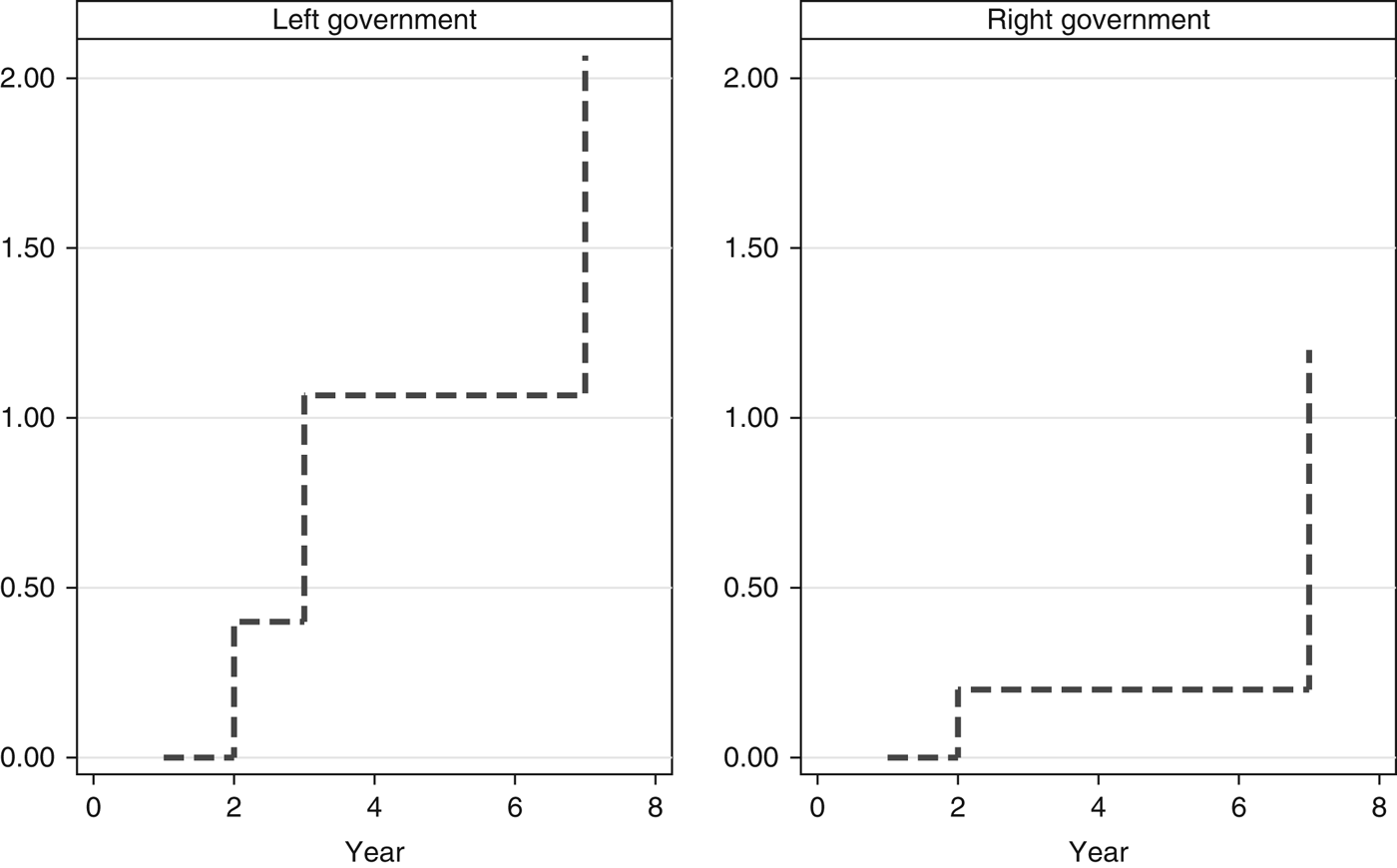
Figure 2 plots the cumulative hazard rates for left and right governments. These show the cumulative hazard that, at any point in time, a left (left panel) or right (right panel) government will have implemented the required central bank reform. As the graph indicates, left governments implement reforms earlier. The small sample size notwithstanding, a non-parametric log-rank test suggests that the difference between left-wing and right-wing governments is significant at the 10 percent level. The results from a semi-parametric Cox proportional hazards model provide further support: left governments are about two times more likely to enact central bank reforms than right governments. The estimated hazard ratio for the variable for left governments is 2.05, with a p-value of 0.067. A test based on Schoenfeld residuals does not reject the assumption of proportional hazard rates (p-value of 0.605). The results from a parametric, exponential regression provide even stronger support: left parties are about 2.4 times more likely to pass central bank reforms than conservative governments; the coefficient estimate has a p-value of 0.033.
Cumulative hazard rate for left and right governments, reforms to strengthen legal central bank independence, 1992–1998. Euro member countries, except Portugal and Germany.

Central bank reforms, inflation aversion, and partisan differences
While the data on central bank reforms in the European Union have a number of unique advantages—in particular, they allow to focus on whether right-wing governments delayed reforms—they also limit the generalizability of the results. To evaluate Proposition 2, I rely on a larger cross-section of countries, using data on central bank reforms from Garriga (Reference Garriga2016). The dependent variable is a binary variable coded one in the year in which a reform to increase central bank independence occurred. As before, I obtain a variable on the partisanship of the largest party in government from the Database of Political Institutions (Cruz, Keefer and Scartascini Reference Cruz, Keefer and Scartascini2015). The variable is coded 1 when a right-wing party is the largest government party, and 0 when a left-wing party is the largest government party.
To arrive at a measure of the inflation aversion of the electorate, I draw on the 2006 wave of the International Social Survey Programme on the Role of Government, which is the latest version of the survey and covers the largest cross-section of countries (ISSP Research Group 2008). From the survey responses, I calculate the share of respondents who identify rising prices as a larger concern than unemployment, and use the resulting variable as a measure of a country’s inflation aversion. To obtain a measure of economic policy differences between left-wing and right-wing parties, I use the Comparative Manifesto Project, which codes the share of sentences in a party’s electoral platform devoted to specific topics (Volkens et al. Reference Volkens, Lacewell, Lehmann, Regel, Schultze and Werner2011). For each election, I calculate the logged standard deviation in statements on demand-oriented economic policies across left- and right-wing parties, which as inflationary policies should relate to the perceived inflation rate under a party.Footnote 5
I interact these variables with government partisanship. I include a number of control variables to account for alternative explanation: the size of the economy, measured as log gross domestic product (GDP) and GDP per capita, obtained from the World Bank; the number of veto players (which increase the credibility of central bank independence but also impede reform) from Cruz, Keefer, and Scartascini (Reference Cruz, Keefer and Scartascini2015); capital account openness (Karcher and Steinberg Reference Karcher and Steinberg2013), which may reflect the dependence on foreign capital and therefore the pressure to reform central banks; current inflation rates and the three-year average inflation rate (from the World Bank); a variable for membership in the European Union; the lagged level of central bank independence to account for a ceiling effect in possible reforms (Garriga Reference Garriga2016); and a linear year trend.Footnote 6
The sample comprises 29 countries and 681 observations when interacting government partisanship with inflation aversion, and 45 countries and 813 observations when interacting government partisanship with differences across parties. Because the dependent variable is binary, I estimate logit models. Standard errors are clustered by country to account for the non-independence of observations from the same country.
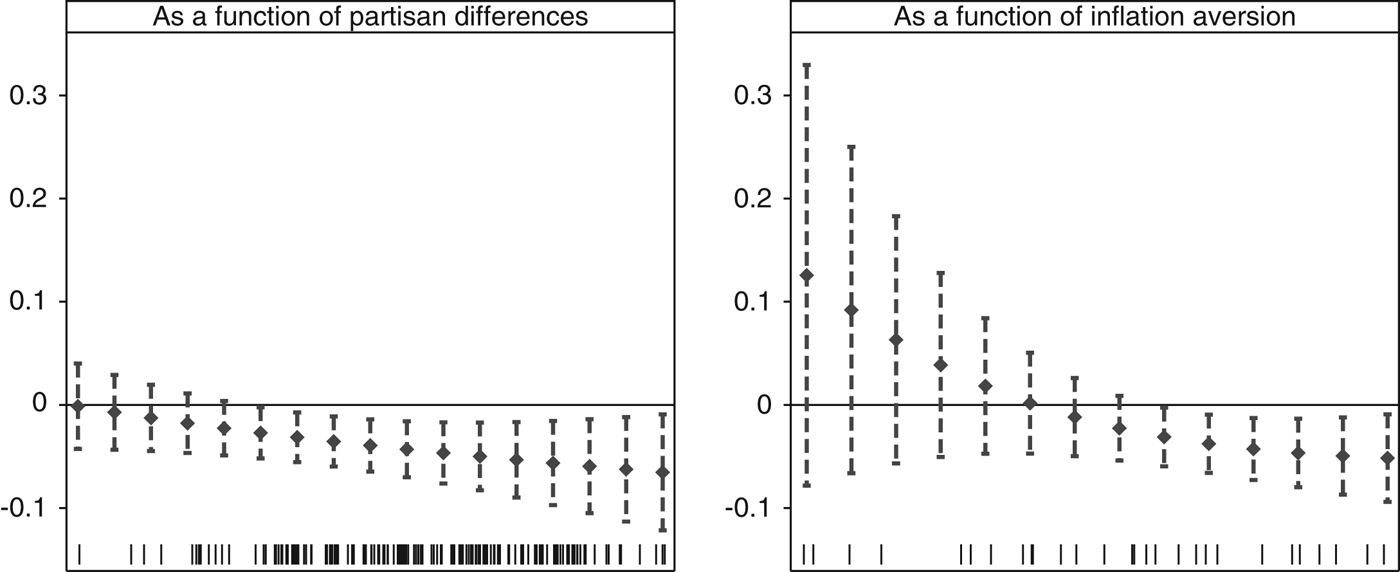
Figure 3 reports the results relevant for evaluating Proposition 2 (full results are reported in the Online Appendix). The left panel displays the marginal effect and 95 percent confidence interval of a right-wing government as a function of partisan differences; the right panel reports the marginal effect and 95 percent confidence interval of a right-wing government as a function of inflation aversion. The ticks along the horizontal axis indicate the distribution of the data on partisan differences and inflation aversion, respectively, in the estimation samples. Consistent with Proposition 2, Figure 3 shows that right-wing governments are less likely to increase central bank independence as differences between parties increase and as the inflation aversion of the electorate increases; the coefficients on the interaction terms are significant at the 5 percent level, implying that the differences in the marginal effects are statistically significant as well. Hence, the disincentive of right-wing governments to lock in monetary policies is most pronounced when parties differ in their economic policy stances and when inflation is a salient issue to voters. The Online Appendix shows that these results are also robust to including control variables for the electoral rule (which may affect the frequency of left-wing governments), the exchange rate regime (as an alternative commitment device), and country fixed effects.
Marginal effect of right-wing government on reforms that increase central bank independence as a function of partisan differences (left panel) and inflation aversion (right panel) Note: Each panel reports the marginal effect and the 95% confidence interval, and, in the bottom of the graph, the distribution of the data on partisan differences and inflation aversion, respectively, along the horizontal axis. Results are reported in the Online Appendix.

The history of central bank reforms in Italy further illustrates the argument. Between 1946 and 1990, Italian governments suffered from large credibility problems in monetary policy-making. Inflation rates were as high as 24.5 percent in 1974, and never fell below 10 percent between 1973 and 1983. From an economic perspective, the Italian government would have had much to gain from establishing an independent central bank. A monetary commitment even may have helped in the negotiation and maintenance of coalition governments (Bernhard and Leblang Reference Bernhard and Leblang2002). This was a particularly pressing factor in Italy, where governments were inherently unstable and often formed among very diverse coalition partners: on average, Italy had more than one government change per year. A party with a relatively free-market oriented stance, the Christian-Democratic Party (Democrazia Christiana, DC), headed all but three governments between 1946 and 1990.Footnote 7 Based on the extant literature, one would expect an independent central bank under these circumstances—the economic conditions called for it, and the governing party had more than enough time to implement reforms. Nevertheless, the Italian central bank, the Banca d’Italia, remained under tight government control.
This pattern is consistent with the theoretical propositions. The Communist Party (Partito Comunista Italiano, PCI) constituted the other major party in the political system. The governing coalitions under the DC were often held together primarily by an attempt to preclude the PCI from taking power. While the PCI won consistently high vote shares and entered administrations on the local and regional level, it never participated directly in a government coalition on the national level. The PCI was backed by the working class, and made this clear during electoral campaigns. Since inflation was in large part due to indexed wage increases, the PCI suffered a credibility problem—it had even less inflation-fighting credibility than the governing coalitions under the DC. It was good politics from the perspective of the DC to not establish an independent central bank: it rendered coalitions among the PCI and the DC’s coalition partners unlikely, and voters concerned about inflation were reluctant to vote for the PCI. The DC moved toward supporting greater CBI only when it started to suffer from credibility problems as a consequence of consistently high inflation rates (Bernhard Reference Bernhard1998).
The situation in the late 1970s therefore mirrored the scenario where the two parties’ inflation reputations are almost identical, with both the PCI and the DC being perceived as unable to deliver low inflation rates. Then, the electoral incentive to retain discretion declines for right-wing parties. The first central bank reform was enacted in 1981, when the “divorce” freed the Banca d’Italia from the obligation to purchase otherwise unsold government debt. The reform was, notably, undertaken under the first government in the postwar period headed by a left-wing prime minister. The reforms to the central bank were supported by the PCI (Bernhard Reference Bernhard2002, 134), which otherwise advocated expansionary monetary and fiscal policies.
The timing of these reforms, and that they were backed by the PCI, is surprising from the perspective of theories of hands-tying that point to monetary commitments as focal points in otherwise unstable coalitions (Bernhard Reference Bernhard1998; Bernhard and Leblang Reference Bernhard and Leblang2002). During the 1960s and 1970s, and in contrast to much of the 1950s, most Italian governments were composed of large coalitions of several governing parties; an independent central bank could have provided an anchor for coalition negotiations, yet reforms were not implemented until the early 1980s. Another way to view this pattern is that an independent central bank as an anchor for a large coalition would have been attractive to the government, but that the electoral effects made reforms unattractive to the DC as long as it could keep the left-wing PCI out of government by maintaining inflation as a salient issue. The coalition argument became more salient and decisive in pushing the government toward a reform only once the DC could no longer capitalize on its anti-inflationary stance. Thus, these explanations complement each other: The fear of enabling electoral victory for an inflation-prone opposition party plausibly prevented the governments under the DC from establishing an independent central bank. Reforms came only once the PCI was perceived as barely more inflation-prone than the DC.
Conclusions
Electoral effects can offset other incentives for governments to lock in policies. Office-seeking governments have disincentives to lock in their own policy preferences if these align with the preferences of the electorate. In the context of the literature on central bank independence, the theory dovetails with the observation that “it may be the case that the time-inconsistency framework does not capture how political actors evaluate the benefits and costs of different monetary arrangements” (Bernhard, Broz and Clark Reference Bernhard, Broz and Clark2002, 694). By providing a political theory of policy commitments, this paper suggests just that: For electorally motivated actors, the costs of tying their hands can undermine incentives to solve the time-inconsistency problem, and similarly can undermine incentives to use central banks as institutions for solving bargaining problems in large government coalitions (Bernhard Reference Bernhard1998) or for raising financing from foreign investors (Bodea and Hicks Reference Bodea and Hicks2015a). The paper highlights the contrast between theories of office-seeking parties and theories of policy-motivated parties—both of which feature prominently in studies of central bank independence (Gilardi Reference Gilardi2007). The two categories of explanations not only provide competing accounts, but are in tension with each other.
The theory in this paper has similar implications for other forms of policy commitments, and the model transfers to those contexts. An example are Bismarck’s social security programs in 19th century Germany. Faced with pressures from the working class, Bismarck took the issue of social security off the table by creating an institutionalized welfare state, much to the frustration of the Social Democratic Party. Following a similar logic, office-seeking Green parties should be hesitant to push for independent environmental protection agencies. Indeed, in the run-up to the 2013 federal election, the German Green party suggested the creation not of a politically independent bureaucracy to oversee the transition to renewable energies, but a government department headed by a cabinet member. The proposal increases political discretion, and by politicizing environmental policies would improve the electoral prospects of the Green party.Footnote 8 Similar arguments explain why conservative parties prefer courts to rule on social issues or immigration reform, thereby taking issues off the table on which, due to core voters, conservative parties find it difficult to compete with liberal parties. In 2013, parts of the Republican Party in the United States changed their stance on immigration reform, with some law-makers noting that taking the immigration debate out of the political debate would help their party’s electoral chances, in particular with Latino voters.Footnote 9
Instead of locking in policies through domestic institutions, governments may also turn to international institutions. That office-seeking and policy motives work in opposite directions creates a domestically driven cooperation problem in international relations. Some governments might refuse to join international agreements not because these are too distant from their own preferences, but because they are too similar. This point provides a domestic electoral rationale for a result familiar from the literature on policy misfit and European integration (Boerzel and Risse Reference Boerzel and Risse2003). Office-seeking governments may want to negotiate agreements that require few changes to the behavior of their successors and that are easily honored by themselves—or what would be considered shallow agreements with weak monitoring and enforcement mechanisms. They do so not because they fear being held accountable to an overly onerous agreement, but because they fear losing their electoral advantage if their successors are held accountable to it. This incentive to negotiate agreements with weak enforcement mechanisms is reinforced if international negotiations raise the salience of an issue domestically. Further exploring such links between domestic electoral considerations and international cooperation, and between partisan politics and institutional design, remains a promising area for future research.
Supplementary Material
To view supplementary material for this article, please visit https://doi.org/10.1017/psrm.2018.27
Acknowledgments
For comments and suggestions, the author thank Nicole Rae Baerg, Bill Clark, Andrew Kerner, Trevor Johnston, Isabel Perera, Pablo Pinto, Amy Pond, Dennis Quinn, Alton Worthington, participants at the Texas A&M University Political Economy and Political Violence workshop, and participants at the annual conferences of the Midwest Political Science Association and the European Political Science Association.
Replication data are available via https://dataverse.harvard.edu/dataverse/PSRM.