
Our understanding of the pre-colonial history of the Caribbean coast of Nicaragua is limited by the paucity of regional archaeological research and radiometric dates. The lack of systematic survey and excavation has resulted in a perception that the region was always sparsely populated and characterised by a ‘technological delay’ in comparison with the rest of the country, particularly those societies in the Pacific area of Nicaragua (Balladares & Lechado Reference Balladares, Lechado and Roksandic2016). Currently known as the Isthmo-Colombian region (Fonseca Reference Fonseca1992), the modern countries of El Salvador, Honduras, Nicaragua, Costa Rica, Panama and Colombia form the ‘Intermediate Area’ between the Mesoamerican cultural sphere in the North and the Andean (and Amazonian) cultural spheres in the South (Peregrine Reference Peregrine, Peregrine and Ember2001: xx). Although the Ulua River in Honduras is generally considered to represent the border between Mesoamerican cultures and the Isthmo-Colombian region (Healy Reference Healy1974), the cultures of the Pacific coast of Nicaragua—particularly the Nicoya group that characterises the entire Pacific coastline from 1600 BC–AD 1500 (Lange Reference Lange, Peregrine and Ember2001: 328)—represent local traditions with strong connections to Mesoamerica. Conversely, the traditions that characterise the Caribbean coast of Nicaragua belong firmly to the Isthmo-Colombian area and are usually considered to be part of the Early (1500 BC–AD 700) and Late (AD 700–1500) Chibcha traditions (Hoopes Reference Hoopes, Peregrine and Ember2001a: 100, Reference Hoopes, Peregrine and Ember2001b: 239).
There is no extant archaeological evidence pre-dating the Nicoya and Early Chibcha traditions, either in Nicaragua or on the Caribbean coast of Costa Rica (McCafferty et al. Reference McCafferty, Amador, Salgado Gonzáles, Dennet, Nichols and Pool2012). The oldest coastal evidence in the Isthmo-Colombian region is seen in the shell midden sites at Cerro Mangote in Panama, which date to 5000 BC, and with the Puerto Hormiga on the Caribbean coast of Colombia, dating to 3100 BC (Raymond Reference Raymond, Silverman and Isbel2008). In that context, the recently discovered burial at the Angi shell-matrix site on the Caribbean coast of Nicaragua—which dates to the early fourth millennium BC—represents an important contribution to our understanding of the early peopling of the region.
The Caribbean region of Nicaragua comprises two administrative units: the Autonomous Region of the North Caribbean Coast (Región Autónoma de la Costa Caribe Norte) and the Autonomous Region of the South Caribbean Coast (Región Autónoma de la Costa Caribe Sur). It is a low-lying area, interspersed by large rivers flowing west–east. Lush vegetation cover and wet conditions make overland communication difficult, even during the drier months of the year, and next to impossible during the rainy season. Thus, these large rivers and their tributaries, together with lagoons and coastal shelves, represent major communication routes for both modern and past inhabitants (Figure 1). Thick mangrove forests on the river banks and dense vegetation that spreads all the way to the sandy coastal beaches often inhibit the identification of archaeological structures. This is further exacerbated by the lack of easily discernible monumental structures and the ephemeral nature of the archaeological remains (Balladares & Lechado Reference Balladares, Lechado and Roksandic2016).
Left) maps of Nicaragua with the Región Autónoma de la Costa Caribe Sur and the location of the village of Monkey Point; right) location of the Angi shell-matrix site (figure by L.M. Viera Sanfiel from Imagery @2018 Data SIO, NOAA, U.S. Navy, NGA, GEBCO, Landsat/Copernicus, Data LDEO-Columbia, NSF, NOAA).

Indigenous traditions recognise numerous (sacred) sites through petroforms (rock formations arranged or altered by humans) and petroglyphs detailed in recent inventories available through the Bluefields Indian Caribbean University (BICU-CIDCA) (Byers Reference Byers2013; Serrano Reference Serrano2013; Balladares & Lechado Reference Balladares, Lechado and Roksandic2016). Some of the petroforms are natural formations that still serve today as important landscape markers and focal points for local practices. As the sites in the region are under threat from illegal logging and tourism, a concerted effort by local communities and the BICU-CIDCA has established a sustainable tourism protocol aimed at the long-term preservation and safeguarding of indigenous sacred sites. Development of the coastal zone by the central government, the influx of non-local residents into the region and the looming threat of the Interoceanic Canal (Roksandic Reference Roksandic2016a), however, require a much greater effort to enforce existing laws that safeguard indigenous territorial and cultural property rights.
The first systematic archaeological surveys of the region were conducted by Richard Magnus in the area of the Bluefields Lagoon and the Pearl Lagoon. These recorded different types of evidence for pre-Columbian human settlement, including shell middens, petroglyphs, ceramics and lithic material (Magnus Reference Magnus1974a, Reference Magnus1974b, Reference Magnus1975, Reference Magnus1976, Reference Magnus1977). Magnus established chronological and cultural sequences that are still used as the basis for the culture-history of the region (Balladares & Lechado Reference Balladares, Lechado and Roksandic2016). The most distinguishable human-built structures recorded by Magnus and later researchers are the shell-matrix sites—accumulations of shells resulting from human activities, such as the deposition of refuse (i.e. middens), or as planned structures (mounds) (Roksandic et al. Reference Roksandic, Mendonca de Souza, Eggers, Burchell and Klokler2014).
A research programme carried out between 1998 and 2008 by the Universidad Nacional Autónoma de Nicaragua (UNAN) Managua, in collaboration with the University of Barcelona, identified over 80 shell-matrix sites of different sizes around Pearl Lagoon, Bluefields Lagoon and the Kukra River. These represent 20 independent archaeological entities (Gassiot Reference Gassiot and Mayer2005; Clemente et al. Reference Clemente, Gassiot, Garcia, Bailey, Hardy and Camara2013). All of the sites were located around these two lagoons and on the banks of the Kukra River; radiocarbon dates obtained for 13 of the sites range from 1070 BC–AD 1500. Coastal sites south of the two major lagoons were investigated in 1972 by Jorge Espinoza, but only the Angi shell-matrix site close to the modern village of Monkey Point was excavated on a large scale (Espinoza Reference Espinoza1972). As Espinoza never published his findings systematically, it is impossible to discuss with any precision the typochronological attribution of the lithic industry, the significance of the radiocarbon dates obtained or the sporadic appearance of ceramics in the upper stratigraphic levels. Consequently, in 2013, one of Espinoza's stratigraphic profiles was cleaned to provide new insight into the site's chronology and to inform preservation of the site.
The Angi site
The Angi shell-matrix site (N-CS-Mp-001 in the National Registry of Archaeological monuments; 11°36′0″ north and 83°40′0″west) is located in the Afro-descendant community of Monkey Point (or Bleera Kaanu in the Rama language). Based on a large series of unpublished radiocarbon dates on charcoal, Espinoza (pers. comm.) determined that the Angi shell-midden was established c. 5560 BC. Magnus (Reference Magnus1976) reports the date as 7600 BC without giving any further information on the material dated. The site was revisited in 2013 by BICU-CIDCA, UNAN-Managua and the Communal Kriol Government of Monkey Point as part of a project to survey archaeological sites across the RACCS (Gaitán et al. Reference Gaitán, Serrano, Byers, Balladares and Lechado2014). In addition to Angi, three more shell-matrix sites were identified around Monkey Point (Figure 1). The Angi site is situated at the bottom of a hill, approximately 30m from the coast. The mound covers an area of 287m2, extending 25m north–south × 23m east–west. Espinoza excavated two north to south trenches measuring 12.4 × 5.5m and 5 × 2.6m to depths of 5 and 1.5m, respectively (Byers et al. Reference Byers, Serrano, Gaitán, Balladares and Lechado2014).
The stratigraphic profile
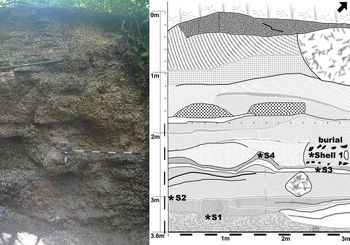
To record the current condition of the Angi shell-matrix site and to plan site conservation, a 3m-wide portion of Espinoza's western profile was cleaned to a depth of 3.5m (Figure 2). This allowed for the documentation, drawing and photographing of the stratigraphic sequence, and the collection of samples of deposits, including six shell and charcoal samples that were taken for radiocarbon dating (Figure 2). The visible portion of the profile was divided into 34 distinct units, consisting mostly of agglomerations of the bivalve Polymesoda solida, differentiated by levels of compactness, crushing, burning, the presence of other shells (mostly different snails), or admixture with sediment. These layers were interspersed with thin lenses of sediment containing charcoal, or mixed charcoal and burnt shell (Byers et al. Reference Byers, Serrano, Gaitán, Balladares and Lechado2014). Units were numbered as they became apparent during profile cleaning and therefore do not follow a typical top-to-bottom sequence.
Profile of the Angi shell-matrix site (courtesy of BICU-CIDCA). Left) photograph taken during profile cleaning and excavation of the burial; right) drawing of the profile with indicated locations from which the samples were taken: S1–4) ‘strats 1-4’; shell 1) location of the sample of shell from within the burial.

In addition to shell, snails and charcoal, fragments of monochrome ceramics and one incised pottery sherd were recorded in the upper sequence (up to 0.64m below surface). The incised fragment is a Lower Lagoon Fine Lined Incised Body sherd, identified by Magnus (Reference Magnus1974b) as belonging to the ‘Jarkin’ Complex and dated to AD 800–1200 (Martínez Cervantes Reference Martínez Cervantes2004; Byers et al. Reference Byers, Serrano, Gaitán, Balladares and Lechado2014: 67). This pottery type has also been found at other Monkey Point shell-matrix sites. Profile cleaning also exposed a human skeleton approximately 2.3m below the surface. With the permission of the local Rama and Kriol communities, the burial was excavated and the human remains taken to BICU-CIDCA for analysis. The remains are currently housed in the museum pending further decisions by the local communities.
The burial
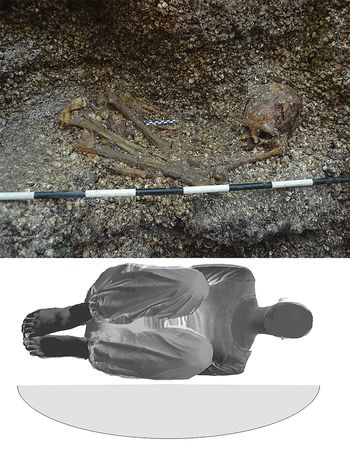
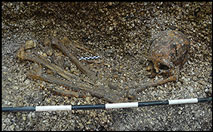
A single individual was buried in a shallow oval pit in a dorsal decubitus (i.e. lying on its back) position, with legs flexed over the torso and arms extended at the sides of the body (Figure 3). The base of the pit was lined with small basalt clasts of less than 100mm, deposited over a 100mm-thick layer of charcoal-rich sediment (Byers et al. Reference Byers, Serrano, Gaitán, Balladares and Lechado2014). The individual was found undisturbed in the original burial position, as demonstrated by the correct anatomical positioning of the hyoid bone (beneath the mandible). The position of the feet very close to the pelvis, the near-vertical positioning of the head and alignment of the clavicles, and the constriction around the shoulders indicate a cranio-caudally constrained burial space. A certain amount of lateral constriction is evidenced by the effect of the wall aligning the bones of the left arm (Roksandic Reference Roksandic, Haglund and Sorg2002; Duday Reference Duday2009). The arms were extended next to the body, and the hands were positioned close to the feet and the pelvis. The burial ritual most probably involved depositing the body into a prepared shallow pit, with legs flexed on top of the body, as reconstructed in Figure 3. The subsequent collapse of the legs outside of the shallow pit might indicate some form of covering of the body, or possible desiccation prior to decomposition (Mickleburgh & Hoogland Reference Mickleburgh and Hoogland2015). While the skeleton is relatively complete, the bones are heavily fragmented, mostly due to generally poor preservation conditions in the Caribbean.
Top) burial during excavation (courtesy of BICU-CIDCA); bottom) reconstructed position of the buried individual and schematic representation of the shallow burial pit.

The individual
Based on the shape of the greater sciatic notch, the presence of a preauricular sulcus conforming to the pattern observed only in women, the morphology of the pubic bone and the subpubic angle, the individual is a female (Bruzek Reference Bruzek2002). Skull morphology also exhibits characteristics more often observed in females, including faint nuchal relief, no occipital protuberance and sharp supercilliary arches. The mastoid process is slightly larger than is commonly observed in women, although there is considerable variation in the expression of this trait within and between populations. The mandible, with its gracile features, lack of gonion aversion and a small triangular mental protuberance fully conforms to the female pattern (Ferembach et al. Reference Ferembach, Schwindezky and Stoukal1980).
Estimation of the age at death of an adult individual is a more complex issue, as skeletal senescence can be greatly influenced by lifestyle (Roksandic & Armstrong Reference Roksandic and Armstrong2011). The individual from Angi is certainly an adult: all epiphyses are fused, as are the secondary centres of ossification on the pelvis. Damage to the pubic symphyseal surface precludes age assessment using this age indicator; there is no evidence of advanced synostosis of the skull sutures; the auricular surfaces on the pelvis show evidence of billowing; vertebral bodies show a very faint but persistent line between vertebral marginal border and the body. There are no degenerative changes on the lumbar vertebrae, which are commonly associated with later middle age and normal senescence (Roksandic & Armstrong Reference Roksandic and Armstrong2011). Although the cervical vertebrae are damaged, osteophyte formation (bony outgrowths indicative of inter-vertebral disc degeneration) (stage 2 of Steckel et al. Reference Steckel, Larsen, Sciulli and Walker2006) can be observed on at least one body. The individual is determined to be fully adult in terms of proposed life-history stages (Roksandic & Armstrong Reference Roksandic and Armstrong2011), but not mature or senile. In terms of the modern-day ageing process, this would suggest an age at death anywhere between 25 and 40 years of age, but closer to the younger age limit. Although the individual's dentition exhibits more wear than would be expected for that life stage, this is common in shell-matrix site populations examined by the first author.
A regression formula for estimating stature from long bones (Byers Reference Byers2015) provides a height estimate of between 1.49 and 1.62m, based on humeral length. Using the table provided for Mesoamerican indigenous populations (Del Angel & Cisneros Reference Del Angel and Cisneros2004), the height is estimated at 1.48m; thus, the individual was of short stature.
No pathological changes can be associated with a cause of death, as there is no evidence for either chronic conditions or ante- or peri-mortem trauma, although there are any number of acute (infectious) diseases that would leave no markers on the skeleton (Wood et al. Reference Wood, Milner, Harpending and Weiss1992). With the exception of moderate osteophytes on the cervical vertebrae, pathology was only observed to affect the dentition. While there is no evidence for ante-mortem tooth loss, periodontal disease is present on both the maxilla and mandible; almost a third of the root was exposed in all post-canine dentition. The resorption of the preserved alveolar bone corresponds to stages 4 and 5 (Kerr Reference Kerr1988), indicating acute or aggressive periodontitis (Wasterlain et al. Reference Wasterlain, Cunha and Hillson2011). The teeth are heavily worn—particularly the anterior dentition—and all molars show some degree of chipping. Hypercementosis (excessive accumulation of cementum in the lower third of dental roots) is visible in the teeth that have fallen out of their sockets (post-mortem), but it is not extreme. Of particular interest is the type of wear that could be associated with use of the dentition for processing fibrous tissues, which includes heavy wear, specific wear patterns, hypercementosis, plaque formation and root exposure. All of these characteristics are quite common in populations buried in shell-matrix sites and are, in the experience of the first author, known to occur at a relatively young adult age, especially among women.
The right mandibular condyle appears medio-laterially compressed and expanded in an antero-posterior direction. The mandibular fossa (forming part of the temporomandibular joint) is large and shows some degenerative changes (bony spicules), which could be associated with heavy tooth wear or, alternatively, with the medio-laterally constricted condyle—although the mechanism is unclear. The distal ends of both radii show torsion and deep grooves running from the posteromedial to posterolateral aspect of the bone (Figure 4). An X-ray of the radius in Figure 4 suggests no evidence of healed, acute or micro trauma, and the bone exhibits no reactive osseous tissue suggestive of infection. Of the muscles associated with the radius, the pronator teres (antero-laterally at the midshaft) and pronator quadratus (on the distal third) have their distal attachments on the anterior aspect of the radius. The flexor policis longus originates on the anterior lower half of the midshaft, while the abductor policis longus and extensor policis brevis originate in this area on the posterior side of the bone. These muscles are involved in pronation and supination of the forearm and flexion at the elbow, as well as abduction and flexion of the hand. While it is possible to associate the observed radial morphological changes with rowing or related activities, more research is needed to confirm this. No corresponding changes were observed on the associated ulnae.
Posterior view of the left radius with pronounced markings on the bone.

While not sufficiently preserved to allow measurement, the skull is relatively short, wide and very gracile. Only two non-metric traits could be observed on the skull: a notch on the left superciliary arch, a notch and a foramen on the right superciliary arch; and a large tympanic dehiscence on both temporal bones (Hauser & De Stefano Reference Hauser and De Stefano1989).
Dating
Nine samples were submitted to BETA Analytic for radiocarbon dating (Table 1). These include two samples (one tooth and one bone fragment) from the buried individual; one shell directly associated with the burial (‘shell 1’); and six samples of shell and charcoal from stratigraphic levels below the burial (‘strat’). The samples were selected to examine the time-depth and speed of deposition of the exposed shell-matrix stratigraphic sequence below the burial, and to establish the site-specific ΔR (a correction factor for local variance in the marine reservoir correction; see Roksandic et al. Reference Roksandic, Buhay, Chinique de Armas, Rodríguez Suárez, Peros, Roksandic, Mowat, Viera, Arredondo, Martínez Fuentes and Smith2015). The sampling strategy was intended specifically to address questions around the burial, and therefore does not provide a complete chronological sequence for the shell-matrix site.
Radiocarbon dates for the Angi shell-matrix site. Details of the stratigraphic position of samples is presented in Figure 2.

Of the samples submitted, the human bone and tooth did not yield results due to the typically poor preservation of collagen in the tropics (Pestle & Colvard Reference Pestle and Colvard2012). Seven successful AMS dates were obtained on the shell and charcoal samples and calibrated to calendar years BC (cal yrs BC) using the Calib 7.0.2 (MARINE13) and OxCal 4.3.2 (IntCal13) age calibration datasets for the charcoal and shell samples, respectively (Reimer et al. Reference Reimer2013; Bronk Ramsey Reference Bronk Ramsey2017). There is a 240- and 230-year difference between the ‘strat 1’ and ‘strat 3’ charcoal and shell conventional radiocarbon ages, respectively (Table 1). The global marine reservoir correction used in Calib 7.0.2 is 400 years (Stuiver & Reimer Reference Stuiver and Reimer1993), and therefore ∆R of −165±5 years was used for calibration of the ‘strat 1’, ‘strat 2’, ‘strat 3’, ‘strat 4’ and ‘shell 1’ dates. The age-depth model was constructed using Bchron in R (Haslett & Parnell Reference Haslett and Parnell2008). The dates are reproduced in Figure 5.
Graphic representation of the calibrated radiocarbon dates; black) charcoal; white) shell. Note the consistent difference between charcoal and shell from the same sample, as well as substantial overlap between ‘strat 1’, ‘strat 2’, ‘strat 3’ and ‘strat 4’.

Calibrated dates indicate a very fast deposition for the bottom 1m of the exposed stratigraphic sequence, which is represented by six distinct archaeological layers. In particular, there is an overlap in dates between the ‘strat 1’ and ‘strat 2’, and the ‘strat 3’ and ‘strat 4’ samples. The deposition of these samples occurred over 200 years of site use. The burial was dug into layer 10, which cut through an additional two layers deposited over the 500 years of site occupation.
Relevance
The seven dates obtained from the Angi shell-matrix site are the oldest dates so far published for occupation of the Caribbean coast of Nicaragua. Coming from the middle part of the stratigraphic sequence, they represent the terminus ante quem for the formation of the site. Given the reported 3m thickness of deposits below the dates currently obtained, Espinoza's proposed date of 5650 BC (pers. comm) for establishment of the shell mound is quite possible. Until the archaeological contexts for Espinoza's samples and the method used for obtaining the radiocarbon dates are published, however, this cannot be supported. Furthermore, detailed information concerning archaeological materials from this site that could be fitted into the regional culture-history is lacking. Material gathered during Espinoza's excavations in the 1970s has not been published. Apart from some sporadic incised pottery from the top layers of the Angi shell-matrix, no other material was recovered during the cleaning of the profile (Balladares & Lechado Reference Balladares, Lechado and Roksandic2016).
While it was not possible to obtain a direct date from the skeletal remains, sample ‘shell 1’ (Beta-375581) was collected from within the burial pit. The ‘strat 4’ shell (Beta-375585) came from the layer below the one into which the burial was dug; and the ‘strat 3’ samples (shell: Beta-375584; charcoal: Beta-379159) from a very thin layer below the ‘strat 4’ (Figure 2). Although the ‘strat 1’ (shell: Beta-375582; charcoal: Beta-379158) and ‘strat 2’ (shell: Beta-375583) samples are a further 0.5m below the ‘strat 3’ and the ‘strat 4’ samples, all four layers have dates averaging between 4680 and 4490 BC. These indicate a very fast deposition of the shell-matrix that contradicts the slow rate of deposition observed between ‘strat 3’, ‘strat 4’ and the burial. Given that the burial was cut from layer 10 through two additional stratigraphic units—which could have been deposited over a substantial period of time—the date is not implausible. Further detailed excavations are needed to understand the site-formation process. Given the overlapping features observable in the profile, it is possible that different areas of the shell-matrix accumulated at different times, and not in sequential layers (Jorge Espinoza pers. comm). Additionally, radiocarbon age differences of 240 and 230 years between the ‘strats 1 and 3’ shell and charcoal samples, respectively (Table 1 & Figure 5), suggest a localised marine reservoir age offset (∆R) of −165±5 years. This is significantly less than the standard 400 years (Stuiver & Reimer Reference Stuiver and Reimer1993) and entirely in keeping with other sites within the circum-Caribbean (Roksandic et al. Reference Roksandic, Buhay, Chinique de Armas, Rodríguez Suárez, Peros, Roksandic, Mowat, Viera, Arredondo, Martínez Fuentes and Smith2015). This probably results from temporal and regional changes in 14C reservoir exchanges between the Caribbean mixed and deep ocean layers.
Despite the uncertainties that require further investigation, a date of approximately 3900 BC for the burial does not directly contradict other dates in the sequence, and therefore should be considered valid. Thus, the burial from the Angi shell-matrix site represents the oldest-dated human remains from Nicaragua and the oldest burial currently known from the Caribbean coast of lowland Central America. Furthermore, the time period to which the burial is dated is significant: glotochronological calculations based on the statistical analyses of word changes within a language group suggest a date of 4680 BC for the Proto-Chibchan split, which happened supposedly during the early development of agriculture and prior to the c. post-3000 BC appearance of chiefdoms in the region (Fonseca Reference Fonseca1992; Drennan Reference Drennan1995; Constenla Umaña Reference Constenla Umaña, Campbell and Grondona2012). The generally accepted view is that Chibchan speakers were continuously present in the region for at least several millennia, and that early Isthmo-Antillean interactions occurred in the period between 4000–500 BC (Hoopes & Fonseca Reference Hoopes, Fonseca, Quilter and Hoopes2003; Rodríguez Ramos Reference Rodríguez Ramos, Keegan, Hofman and Ramos2013). Early interactions between the Isthmus—lowland Central America and Mesoamerica—and the Greater Antilles have been proposed on the bases of material culture, domesticates and the toponyms in the Greater Antilles (Veloz Maggiolo Reference Veloz Magiollo1993; Pagan Jiménez et al. Reference Pagan Jiménez, Rodríguez, Chanlatte Baik and Narganes Storde2005; Rodríguez Ramos Reference Rodríguez Ramos, Keegan, Hofman and Ramos2013; Roksandic Reference Roksandic and Roksandic2016b). The dating of this individual from Angi to c. 3900 BC therefore indicates the importance of further investigation of this shell-matrix site for our understanding of the peopling of the Caribbean coast of Nicaragua, and potentially for the peopling of the entire Caribbean (Roksandic Reference Roksandic and Roksandic2016b).
Conclusion
Cleaning of a 1970s stratigraphic profile at the Angi shell-matrix site close to the village of Monkey Point revealed the skeletal remains of a fully adult woman buried in a constricted pit. Radiocarbon dating of shell from within the burial pit dates the individual to 3900±95 BC. This individual represents the earliest-known burial from the Caribbean coast of Nicaragua, demonstrating the importance of the site for understanding the early history of lowland Central America and, potentially, the peopling of the Caribbean, and the urgent need for its protection and further evaluation.
Acknowledgements
We are grateful to the communities of Monkey Point and Bankukuk Taik for their hospitality during our research visit, and to the personnel of the BICU-CIDCA and CIDA-UNAN. Funding for the project was provided by the BICU-CIDCA, University of Winnipeg Research Office and the Social Sciences and Humanities Research Council of Canada grants 410-2011-1179 and 435-2016-0529.