Introduction
Prematurity and critical illness predispose children to multi-factorial disruption of early brain development. Aetiologies include exposure to abnormal environmental stimuli while hospitalised, disruption to parental bonding and to physiological and neurological co-regulation, and extended mechanical circulatory support and resuscitation. Reference Sood, Newburger and Anixt1,Reference VandenBerg2 Such disruptions predispose critically ill children with increased risk for long-term neurodevelopmental complications: notably, language delays and learning disorders. Reference VandenBerg2–Reference McCormick, Workman-Daniels and Brooks-Gunn5
Language acquisition begins at birth and is facilitated by environment and exposure. Importantly, language exchange between parent and child is associated with a variety of favourable short-and long-term developmental outcomes beyond language. 6 These associations can be disrupted or degraded by aspects of the intensive care environment such as parental stress and inhibitions to parent-led care and engagement, chaotic and unstructured sensory stimuli, and ongoing medical, surgical, and pharmacological procedures. Reference Boissel, Guilé and Viaux-Savelon7–Reference Lisanti, Demianczyk and Vaughan9
Many ICUs have implemented targeted developmental and neuroprotective care programmes to address issues associated with hospital-based factors that increase neurodevelopmental risk. Reference Jones, Caprarola and Schlatterer10–Reference Ortinau, Smyser and Arthur13 Studies have demonstrated that within well-child populations, parent–infant shared reading is effective in facilitating positive neurodevelopmental outcomes as it promotes bonding and ensures children receive appropriate neurodevelopmental stimuli. Reference Klug, Hall and Delaplane14–Reference Torowicz, Lisanti, Rim and Medoff-Cooper16 The positive outcomes of reading interventions in well children suggest that similar programmes may hold promise in the critical care setting where parental stress, abnormal stimuli, and iatrogenic disruptions threaten typical developmental processes. Reference Boissel, Guilé and Viaux-Savelon7,Reference Gramszlo, Karpyn and Christofferson8
Although the benefits of such programmes are well established in the outpatient setting, Reference Weitzman, Roy, Walls and Tomlin17,Reference Zuckerman18 there remains no consensus on their clinical impact on the outcomes of hospitalised critically ill children. Thus, this review centres upon observational and experimental studies examining interventions promoting adult-driven shared reading on the psychological, behavioural, and physiological outcomes of neonatal and paediatric patients with critical illness.
Review question
In hospitalised, critically ill infants and young children (age birth to five years), what are the effects of reading interventions performed by adults, including parents, volunteers, or clinicians, on physiological, psychosocial, or developmental status during or after the period of hospitalisation? Do these interventions have any psychological or behavioral impact on the parent or caregiver performing the intervention?
Methods
A preliminary search of MEDLINE, the Cochrane Database of Systematic Reviews, and Joanne Briggs Institute Evidence Synthesis was conducted, and no current or underway systematic reviews or scoping reviews with this topic and population of interest were identified. Additionally, this search demonstrated that a variety of reading interventions have been performed in neonatal and paediatric critical care settings, yielding a variety of outcomes at different points in time. Because of the high likelihood for heterogeneity in populations, interventions, and outcomes, a scoping review methodology conducted using the Arksey and O’Malley framework Reference Arksey and O’Malley19 and in accordance with the Joanne Briggs Institute methodology for scoping reviews Reference Peters, Godfrey and McInerney20 was used to chart and describe current knowledge about the role and effect of reading-based interventions in critical care environments and potentially guide further research, implementation, and intervention. A scoping review research protocol was written using JBI guidelines to document the review objectives and approach to evidence acquisition, selection, and extraction, but was not registered.
Eligibility criteria
Inclusion criteria included studies that reported quantitative or qualitative outcomes relating to a reading activity or intervention conducted in a neonatal or paediatric critical care environment with children from birth to age five years. Only articles published since 2000 were eligible, as paediatric intensive care environments prior to 2000 were more restrictive regarding parental engagement in care and implementation of non-medical interventions. Reference Dragoi, Munshi and Herridge21 This review included any study that generated empirical data, including randomised controlled trials, non-randomised controlled trials, before-and-after studies, and interrupted time-series studies. Qualitative studies were also eligible, including but not limited to designs such as phenomenology, grounded theory, ethnography, qualitative description, action research, and feminist research. As the review team is proficient only in English, only studies published in English were included.
Search strategy
Searches for eligible articles were performed in PubMed, CINAHL (EBSCO), Scopus, and PsycINFO (Ovid) (see Figures S1 and S2). In addition, the Cochrane CENTRAL registry was searched for relevant studies. A total of 1273 studies were imported for screening; of these 1214 were removed in two rounds of screening due to duplication or ineligibility. Ultimately, 59 studies were assessed in full text, and 20 of these were included in the final scoping review. See supplemental figure 1 for detailed search strategy.
Study selection
At completion of the search, citations were uploaded into Covidence, and duplicates were removed. An initial exclusion phase performed by one reviewer (RJ) aimed to remove citations clearly out of the scope of the review due to the ambiguity of the term “reading” in clinical literature. A total of 722 titles and abstracts were then individually screened by two independent reviewers chosen from the author group (KP, RJ, ES, AY, LG, CP, and KN). Studies were included in the review if they reported results from the design and implementation of an intervention using textual reading or recitation from an adult caregiver or care provider directed at a hospitalised child receiving critical care. After this selection stage, citations were retrieved in full text and assessed in detail against the inclusion criteria by two independent reviewers. Any disagreements between the reviewers at each stage of the selection process were resolved by an additional reviewer (RJ).
Data extraction
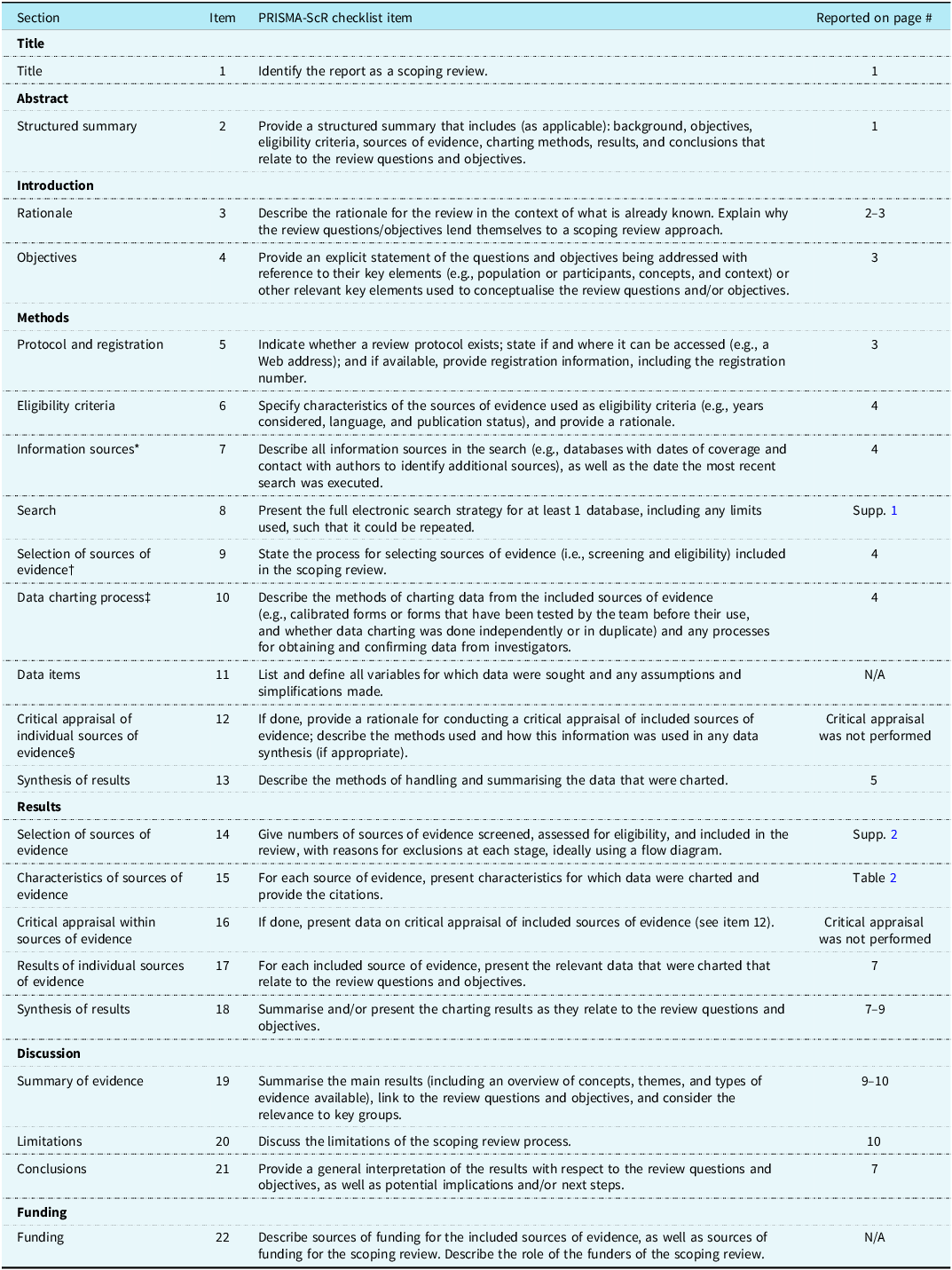
Data were extracted from articles using a Covidence (Melbourne, Australia) template adapted for the purposes of this review by members of the review team. Data were first collected from each article by one reviewer (LG or AY) and then validated by another (RJ) for accuracy and consistency. The extracted data included specific clinical and demographic details about the participants, clinical environment, implemented programme, study methods, and key findings relevant to the review. See Supplemental Figure 2 for PRISMA flow diagram and Table 1 for PRISMA checklist.
Preferred reporting items for systematic reviews and meta-analyses extension for scoping reviews (PRISMA-ScR) checklist

Table 1. Long description
The table presents the PRISMA-ScR checklist, which is a structured guide for conducting and reporting systematic reviews and meta-analyses extension for scoping reviews. It includes sections such as Title, Abstract, Introduction, Methods, Results, and Discussion, each with specific items to be reported. The table has multiple rows and columns, detailing the items to be included in each section, the description of each item, and the page numbers where these items are reported. For example, the Title section includes items like the identifier and the scoping review, while the Abstract section includes items like the rationale and objectives. The table aims to ensure comprehensive and transparent reporting in scoping reviews.
Results
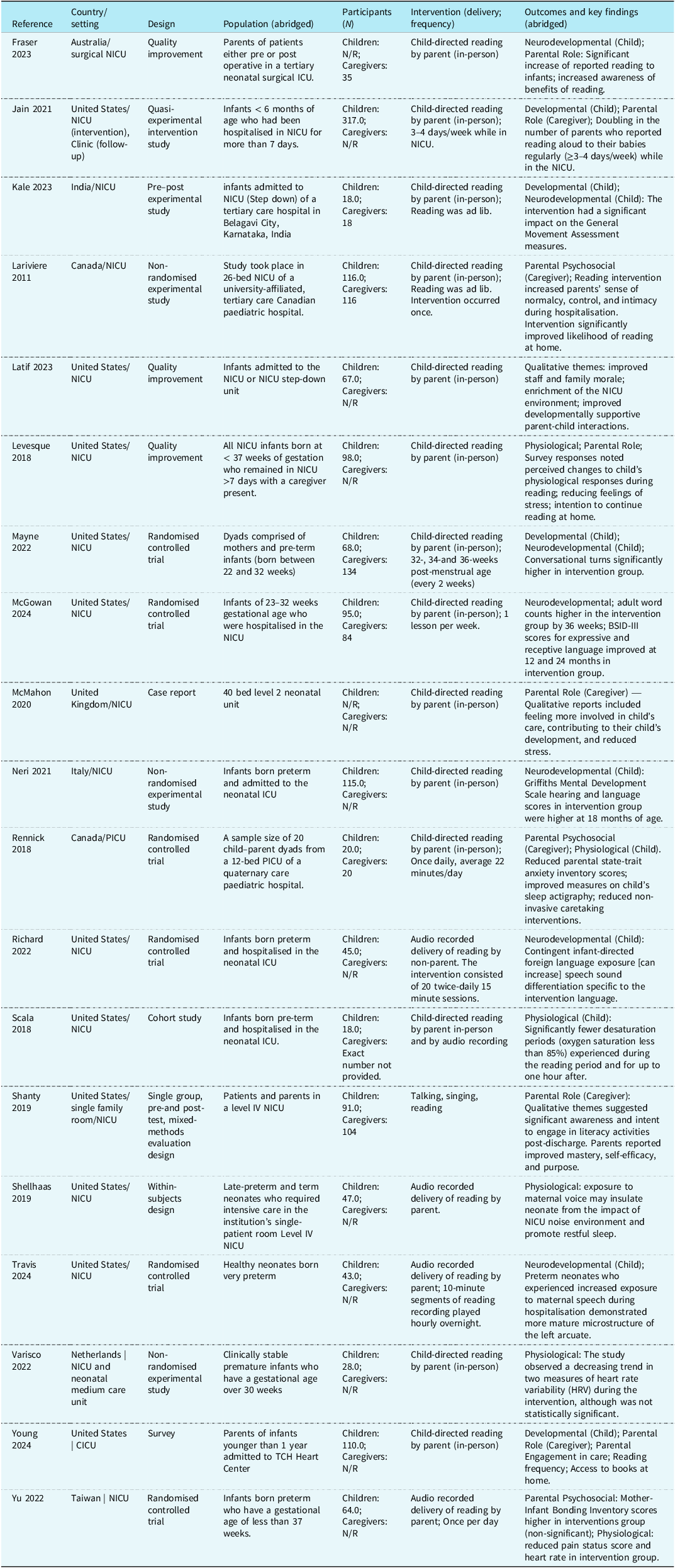
Twenty articles were analysed in the scoping review, including 19 studies from 16 journals and one preprint (see Table 2). Sixty percent (n = 12) of the studies were performed in the U.S.
Included studies

Table 2. Long description
The table presents the Preferred Reporting Items for Systematic Reviews and Meta-Analyses Extension for Scoping Reviews (PRISMA-ScR) checklist. It includes sections such as Title, Abstract, Introduction, Methods, Results, and Discussion, each with specific items to be reported. The table specifies whether each item is reported and on which page it can be found. For example, the rationale for the review is described on page 2, the objectives on page 3, and the methods of charting data on page 4. The table also indicates that critical appraisal was not performed and provides details on the synthesis of results and the summary of evidence.
NICU = neonatal ICU, CICU = cardiac ICU.
Only two of the 20 studies were completed in non-neonatal ICU settings: one occurred in a cardiac unit Reference Young, Ruth and Ginn22 and the other in a paediatric ICU. Reference Rennick, Stremler and Horwood23 Of the remaining studies, six were completed in single-room ICUs. Reference McGowan, Caskey, Tucker and Vohr24–Reference Fraser, Griffiths and Webb29 The rest were performed in traditional open units or in unspecified clinical environments.
With regards to study type, six of the included studies were randomised controlled trials, Reference Rennick, Stremler and Horwood23–Reference Mayne, McGowan, Chiem, Nwanne, Tucker and Vohr25,Reference Richard, Jeanvoine, Stark, Hague, Kjeldsen and Maitre30–Reference Yu, Chiang, Lin, Chang, Lin and Chen32 while five were non-randomised. The remaining six studies implemented a variety of other designs, including a cohort study Reference Scala, Seo and Lee-Park39 a survey-based study, Reference Young, Ruth and Ginn22 a within-subjects study, Reference Shellhaas, Burns, Barks, Hassan and Chervin26 a case report, Reference McMahon, Tebbs, Shanmugalingam and Harding40 and a mixed-methods evaluation study. Reference Shanty, Dowling, Sonnenschein and Hussey-Gardner28
At least 1360 infants (birth to 12 months) were included across all 20 studies, with 25% in randomised trials (n = 335). Of the paediatric subjects, 98% (n = 1332) were younger than 12 months at the time of intervention. About half of the infant participants (n = 627) were born preterm or very preterm.
Of 15 studies that reported demographic data for participants, the percentage of male and female infants was roughly equal (male 53%, female 47%). However, data for race and ethnicity were reported in only a few studies and, in some cases, were inferred from parental demographics. White, non-Hispanic subjects comprised 58–75% of these samples.
Five of the 12 U.S.-based studies, 17.75% (n = 243) of infants included in the review, used reading interventions directly based upon or adapted to the Reach Out and Read framework. Reference Young, Ruth and Ginn22,Reference Kale and Deshpande35,Reference Latif, Duarte Ribeiro and Blatz37–Reference Scala, Seo and Lee-Park39 Study designs used in Reach Out and Read-based studies were heterogenous, with three evaluating programme implementation, Reference Young, Ruth and Ginn22,Reference Latif, Duarte Ribeiro and Blatz37,Reference Levesque, Tran and Levesque38 one assessing pre-and post-implementation language development using the Bayleys Scale for Infant and Toddler Development (BSID-III), Reference Kale and Deshpande35 and one investigating the effect of recorded reading on cardiorespiratory stability. Reference Scala, Seo and Lee-Park39
The Language Environment Analysis System (Louisville, Colorado) was used in three studies to analyse and quantify language input from caregiver to infant. Reference McGowan, Caskey, Tucker and Vohr24–Reference Shellhaas, Burns, Barks, Hassan and Chervin26 Vital signs were recorded at time points before, during, and after the reading intervention in one study. Reference Scala, Seo and Lee-Park39 Magnetic resonance imaging (MRI) scans to measure cerebral areas implicated in language processing were done in one study. Reference Travis, Scala and Marchman31 Language development over time was measured in one study using the Griffith Mental Development Scale, Reference Neri, De Pascalis and Agostini34 in one study using the BSID-III, Reference Kale and Deshpande35 and in one study using the STIM!-I_READ subscale. Reference Jain, Kessler and Lacina27
Although the objectives of the included studies varied widely, they could be synthesised and evaluated via the following themes: enhancing the neonatal ICU language environment and language exposure, Reference McGowan, Caskey, Tucker and Vohr24,Reference Mayne, McGowan, Chiem, Nwanne, Tucker and Vohr25,Reference Fraser, Griffiths and Webb29,Reference Levesque, Tran and Levesque38 improving physiological outcomes, Reference Shellhaas, Burns, Barks, Hassan and Chervin26,Reference Yu, Chiang, Lin, Chang, Lin and Chen32,Reference Varisco, Van Der Wal, Bakker-Bos, Kommers, Andriessen and Van Pul36,Reference Scala, Seo and Lee-Park39 facilitating bonding, Reference Shanty, Dowling, Sonnenschein and Hussey-Gardner28,Reference Yu, Chiang, Lin, Chang, Lin and Chen32,Reference Lariviere and Rennick33 enhancing neurodevelopment and language development, Reference Richard, Jeanvoine, Stark, Hague, Kjeldsen and Maitre30,Reference Travis, Scala and Marchman31,Reference Neri, De Pascalis and Agostini34,Reference Kale and Deshpande35 establishing parent–infant reading routines, Reference Jain, Kessler and Lacina27,Reference Shanty, Dowling, Sonnenschein and Hussey-Gardner28,Reference Lariviere and Rennick33 and describing or evaluating a programme. Reference Young, Ruth and Ginn22,Reference Rennick, Stremler and Horwood23,Reference Latif, Duarte Ribeiro and Blatz37,Reference McMahon, Tebbs, Shanmugalingam and Harding40
Enhancing the neonatal ICU language environment and language exposure
Four studies Reference McGowan, Caskey, Tucker and Vohr24,Reference Mayne, McGowan, Chiem, Nwanne, Tucker and Vohr25,Reference Fraser, Griffiths and Webb29,Reference Levesque, Tran and Levesque38 described programmes centred upon improving the language environment or increasing language exposure for infants receiving care in the neonatal ICU. Two studies used a QI framework Reference Fraser, Griffiths and Webb29,Reference Levesque, Tran and Levesque38 the other two were randomised controlled trials. Reference McGowan, Caskey, Tucker and Vohr24,Reference Mayne, McGowan, Chiem, Nwanne, Tucker and Vohr25 Fraser et al. Reference Fraser, Griffiths and Webb29 and Levesque et al. Reference Levesque, Tran and Levesque38 reported that key aspects of their programmes—including provision of literacy resources, staff education on the importance of language exposure, and communication with families emphasising the parental role—contributed to statistically significant pre–post survey improvements in the frequency of parent-led reading to infants and parental awareness of the benefits of language exposure. In fact, Levesque et al. Reference Levesque, Tran and Levesque38 highlighted a 50% increase in reading post-intervention, while Fraser et al. Reference Fraser, Griffiths and Webb29 observed a 47% increase. Meanwhile, the two randomised trials assessed the effect of a language-enrichment curriculum, including parent–child reading, on language exposure and early language in the neonatal ICU. The curriculum included adult word counts, conversational turns, and child vocalisations. In both studies, conversational turns were observed to be higher in groups that had received the reading intervention. Further, McGowan et al. Reference McGowan, Caskey, Tucker and Vohr24 reported that adult word counts were 52% higher in the intervention group, and infants who received the intervention scored higher in BSID-III measures for receptive and expressive language than subjects in the control group.
Improving physiological outcomes
Five studies measured the effect of a reading intervention on physiological measures, including heart rate variability, desaturation, respiratory rates, and sleep–wake patterns, for infants in the neonatal ICU. Reference Scala, Seo and Lee-Park39,Reference Shellhaas, Burns, Barks, Hassan and Chervin26,Reference Varisco, Van Der Wal, Bakker-Bos, Kommers, Andriessen and Van Pul36,Reference Yu, Chiang, Lin, Chang, Lin and Chen32,Reference Young, Ruth and Ginn22 Scala et al. Reference Scala, Seo and Lee-Park39 reported fewer desaturation events during parental reading exposures, with a sustained effect for as much as an hour after the reading exposure. This physiological impact was amplified with live parental reading rather than recorded reading sessions. Additionally, Varisco et al. Reference Varisco, Van Der Wal, Bakker-Bos, Kommers, Andriessen and Van Pul36 and Yu et al. Reference Yu, Chiang, Lin, Chang, Lin and Chen32 noted small decreases in heart rate during reading exposure. Yu et al., Reference Yu, Chiang, Lin, Chang, Lin and Chen32 however, reported no differences in respiratory rate and oxygen saturation. Young et al. Reference Young, Ruth and Ginn22 described self-reported physiological responses that parents noted in their child after reading: more than half reported that their child became more alert and interactive, while about one-third reported that their child had calmer breathing.
Facilitating bonding
Two studies examined the capacity of reading-based interventions to facilitate parent–child bonding. Reference Shanty, Dowling, Sonnenschein and Hussey-Gardner28,Reference Lariviere and Rennick33 In the study by Lariviere et al., Reference Lariviere and Rennick33 parents received books, information about the benefits of reading, and support from nursing staff in reading to their child. Three months after discharge, parents who had received the intervention were significantly more likely to read to their child three or more times a week at home. Additionally, parents enrolled in the study identified that reading provided a sense of normalcy, control, and connection during hospitalisation. Similarly, parents who received the reading intervention by Shanty et al. Reference Shanty, Dowling, Sonnenschein and Hussey-Gardner28 reported increased feelings of mastery, self-efficacy, and caring competence as well as increased intention to engage in reading and early literacy activities.
Enhancing neurodevelopment and language development
Three neonatal ICU studies investigated the impact of reading interventions on language development. Reference Travis, Scala and Marchman31,Reference Neri, De Pascalis and Agostini34,Reference Kale and Deshpande35 . One Reference Neri, De Pascalis and Agostini34 assessed infants enrolled in a neurodevelopmental programme at six timepoints up to age 24 months using the Griffiths Mental Development Scale. Infants who had received the programme’s reading intervention while in the neonatal ICU showed higher hearing and language scores at 18 months corrected age when compared with infants in the control group. Meanwhile, Kale et al. Reference Kale and Deshpande35 administered an Reach Out and Read intervention to hospitalised infants and evaluated them using the General Movement Assessment and the BSID-III six months post discharge. While there was no significant difference between the BSID-III scores of intervention and control groups, infants who had received the intervention showed statistically significant improvements on their General Movement Assessment scores. Lastly, the randomised study performed by Travis et al. Reference Travis, Scala and Marchman31 administered an audio recording of their mother reading a children’s story several times a day to study group of very preterm infants hospitalised in a neonatal ICU to increase the infants’ total speech exposure. Subsequently, MRI scans were used to measure changes in infants’ left and right arcuate fasciculi—areas of the brain implicated in language processing. Infants who were randomised to the intervention demonstrated more mature microstructure of the left arcuate, suggesting a causal link between increased language exposure and enhanced brain development in very preterm children.
Establishing parent–infant reading routines
Three studies examined the impact of reading interventions on sustained reading routines post hospital discharge. Reference Jain, Kessler and Lacina27,Reference Shanty, Dowling, Sonnenschein and Hussey-Gardner28,Reference Lariviere and Rennick33 These studies followed children up to two years after neonatal ICU discharge, and all showed improvements in sustained reading routines at home following receipt of a reading intervention during neonatal ICU hospitalisation.
Describing or evaluating a programme
Four studies Reference Young, Ruth and Ginn22,Reference Rennick, Stremler and Horwood23,Reference McMahon, Tebbs, Shanmugalingam and Harding40,Reference Latif, Duarte Ribeiro and Blatz37 documented how the programmes were developed. Nurses noted that the intervention facilitated clustering of nursing care, reduced non-intensive caretaking by nursing staff, integrated smoothly into regular care, and improved parents’ sense of engagement in their infant’s care.
Discussion
The image of a parent reading to their child has become a common representation of loving parental engagement since Victorian times. Shared book reading with children is well established as an essential facilitator for language development and reading ability in infants and preschool children. The American Academy of Pediatrics issued guidance in 2014 emphasising the significance of reading to children as early as infancy, 6 and initiatives promoting early literacy are widespread and widely supported. For example, Reach Out and Read, which provides books and literacy guidance in general paediatrics, is practiced by thousands of clinicians nationwide. Reference Weitzman, Roy, Walls and Tomlin17,Reference Zuckerman18 A 2018 meta-analysis by Xie et al. Reference Xie, Chan, Ji and Chan41 demonstrated significant psychosocial benefits to both parents and children from shared book reading.
The results of this scoping review suggest that the implementation of reading interventions in critical care hospital settings may hold promise as a strategy for protecting and improving neurodevelopment in hospitalised infants and children. Specifically, the studies analysed here demonstrate that these interventions may improve outcomes for preterm infants’ language acquisition and neurodevelopment, improve their physiological stability, and facilitate infant-caregiver bonding, although authoritatively establishing long-term effects and outcomes of these programmes is not possible without longer-term follow-up and additional longitudinal studies, especially given the unique health concerns of critically ill infants and the impact on various outcomes of critical care interventions and acute and chronic health conditions. However, these interventions may be particularly desirable in critical care settings as they are scalable and can be provided at bedside by caregivers with little diversion of time or resources for unit staff. In particular, interventions performed in single-room settings may be particularly effective, given their tendency to be more language-impoverished than traditional critical care settings. Reference Rand and Lahav44,Reference Heo and Kim45
Notably, while the majority of studies discussed in this review were performed with preterm infants, there is convincing evidence that the brains of infants born at full term with CHDs share similarities with those of preterm infants. Reference Easson, Khairy and Rohlicek42,Reference Palmis, Easson and Devenyi43 Therefore, interventions showing effectiveness in preterm infants may exhibit similar benefits in other critical care contexts, although the well-documented impact of cardiopulmonary bypass and mechanical circulatory support on neurodevelopment strongly suggests that dedicated studies of reading interventions in this population would be welcome.
The title of this article is deliberately chosen from one study’s instructions to parents: “You can read something that is delightful to you” [authors’ emphasis]. Reference Kale and Deshpande35 Along with the positive developmental impact suggested by the studies reviewed here, several studies also suggest a benefit to the person delivering the intervention, reporting that reading interventions helped address parental isolation and alterations to the parental role during hospitalisation. Reference Young, Ruth and Ginn22,Reference Shanty, Dowling, Sonnenschein and Hussey-Gardner28,Reference Fraser, Griffiths and Webb29,Reference Lariviere and Rennick33 Parental stress, anxiety, and depression are independently associated with adverse behavioral and developmental outcomes in children and are potentially modifiable. Reference Bernardo, Rent, Arias-Shah, Hoge, Richard and Shaw46 In addition, these interventions may assist parents with social or economic obstacles that limit the amount of time they can spend visiting with their hospitalised child, since it increases their opportunities to be independently and asynchronously contributing to their child’s recovery and treatment if they are less able to participate in more typical nurse-mediated therapies such as kangaroo care. Notably, one study discussed a specific intention of improving outcomes for lower socio-economic status families. Reference Levesque, Tran and Levesque38 and reported an experimental sample largely composed of minority groups (32% African American and 38% Latinx/Hispanic).
There are some limitations in the interpretation of our results. First, studies analysed within this review were largely performed within the neonatal intensive care setting. Therefore, further research is needed to explore benefits and risks of reading interventions in specialised clinical environments—such as cardiac critical care—as well as with specific patient populations. In addition, the studies represented here do not account for the possible differential effects of reading interventions in children with intellectual and developmental disabilities (IDD), which may be diagnosed as they grow older or in those with neurological injury. Given the prevalence of IDD and developmental delay within the CHD population, Reference Ortinau, Smyser and Arthur13,Reference Latal47 the impact of reading for these individuals may be beneficial focused interventions with this population. Thus, additional larger and multicenter studies with well-defined goals in other paediatric critical care settings could strengthen the data related to reading in the clinical environment and, thus, encourage providers to develop and implement reading programmes for critically ill paediatric patients that may be scalable, pragmatic, and not resource-intensive.
The therapeutic benefits of the reading interventions evaluated in this review demonstrate the value of incorporating reading at the bedside for critically ill children. The wide-ranging nature of potential benefits—including immediate physiological support, reductions in parental stress and isolation, and long-term literacy and educational milestones—reported here can be used to incentivise development of comprehensive guidelines for integrating reading into clinical practice. Care centres should consider working to support early literacy in critical care settings through providing resources that emphasise the potential active therapeutic role that bedside reading can play. Since reading as an opportunity to developmentally enrich parent–child interactions may integrate smoothly into existing neurodevelopment-oriented therapeutic approaches, centres that already actively support neurodevelopmental care may want to consider integrating reading time and language exposure into existing activities.
Supplementary material
The supplementary material for this article can be found at https://doi.org/10.1017/S1047951126113638.
Acknowledgements
The authors acknowledge the assistance of the Division of Editorial Services at Nemours Children Health,
Richard James would like to thank the Congenital Neurodevelopmental Outcome Collaborative (CNOC) for giving him the opportunity to collaborate over the years with such a dedicated group of pre-eminent and passionate clinicians and researchers.
Financial support
None to declare.
Competing interests
None to declare.
Ethical standard
Not applicable.