



1. Introduction
Massive stars leave behind stellar-mass black holes (BHs) after they burn off their nuclear fuel. Such BHs frequently accompany visible companions, which is called BH binaries. Recently, BH binaries without mass transfer have been discovered owing to the Gaia mission (Gaia Collaboration 2023; Chakrabarti et al. Reference Chakrabarti, Simon, Craig, Reggiani, Brandt, Guhathakurta, Dalba, Kirby, Chang, Hey, Savino, Geha and Thompson2023): Gaia BH1 (Tanikawa et al. Reference Tanikawa, Hattori, Kawanaka, Kinugawa, Shikauchi and Tsuna2023; El-Badry et al. Reference El-Badry, Rix, Quataert, Howard, Isaacson, Fuller, Hawkins, Breivik, Wong, Rodriguez, Conroy, Shahaf, Mazeh, Arenou, Burdge, Bashi, Faigler, Weisz, Seeburger, Almada Monter and Wojno2023b), Gaia BH2 (El-Badry et al. Reference El-Badry, Rix, Cendes, Rodriguez, Conroy, Quataert, Hawkins, Zari, Hobson, Breivik, Rau, Berger, Shahaf, Seeburger, Burdge, Latham, Buchhave, Bieryla, Bashi, Mazeh and Faigler2023a), and Gaia BH3 (Gaia Collaboration 2024). We call these Gaia BHs “astrometric BH binaries” collectively. Astrometric BH binaries are hard to form in the conventional binary evolution model (El-Badry et al. Reference El-Badry, Rix, Cendes, Rodriguez, Conroy, Quataert, Hawkins, Zari, Hobson, Breivik, Rau, Berger, Shahaf, Seeburger, Burdge, Latham, Buchhave, Bieryla, Bashi, Mazeh and Faigler2023a; El-Badry et al. Reference El-Badry, Rix, Quataert, Howard, Isaacson, Fuller, Hawkins, Breivik, Wong, Rodriguez, Conroy, Shahaf, Mazeh, Arenou, Burdge, Bashi, Faigler, Weisz, Seeburger, Almada Monter and Wojno2023b). Thus, several studies have claimed that astrometric BH binaries may be created in dense star clusters (Rastello et al. Reference Rastello, Iorio, Mapelli, Arca-Sedda, Di Carlo, Escobar, Shenar and Torniamenti2023; Tanikawa et al. Reference Tanikawa, Cary, Shikauchi, Wang and Fujii2024; Di Carlo et al. Reference Di Carlo, Agrawal, Rodriguez and Breivik2024; 2024A A…688L…2M; Fantoccoli et al. Reference Fantoccoli, Barber, Dosopoulou, Chattopadhyay and Antonini2025).
Each astrometric BH binary is supposed to consist of one BH and one visible star, however the BH is actually two BHs. In other words, an astrometric BH binary may be a triple system containing binary BH (BBH) and visible star (Hayashi et al. Reference Hayashi, Trani and Suto2022; 2023ApJ…958…26H). We call it “astrometric BBH triple”. Hayashi et al. (Reference Hayashi, Wang and Suto2020) and Hayashi and Suto (Reference Hayashi and Suto2020) have proposed that high-precision radial-velocity (RV) observations can identify an astrometric BBH triple from an astrometric BH binary (see also Liu et al. Reference Liu, D’Orazio, Vigna-Gómez and Samsing2022). In fact, Nagarajan et al. (Reference Nagarajan, El-Badry, Triaud, Baycroft, Latham, Bieryla, Buchhave, Rix, Quataert, Howard, Isaacson and Hobson2024) have performed high-precision RV observations, and have put strong constraints on the binarity of the dark object in Gaia BH1. On the other hand, there are no constraints on the binarities of the dark objects in Gaia BH2 and BH3.
In this article, we examine the number fraction of astrometric BBH triples to astrometric BH binaries, supposing that all astrometric BH binaries are formed in open clusters. Our results will be a guideline to search for astrometric BBH triples among a large number of Gaia BHs discovered in upcoming Gaia Data Release (DR) 4 era, when several 10 astrometric BH binaries will be detected (Nagarajan et al. Reference Nagarajan, El-Badry, Chawla, Di Carlo, Breivik, Rodriguez, Agrawal, Delfavero and Chatterjee2025).
2. Method
We perform gravitational N-body simulations of open clusters to follow the dynamical formations of astrometric BH binaries and BBH triples in open clusters. Since the details are described in Tanikawa et al. (Reference Tanikawa, Wang, Fujii, Trani, Hayashi and Suto2025), we briefly introduce our numerical method. We use the N-body code PETAR (Wang et al. Reference Wang, Iwasawa, Nitadori and Makino2020). In the PETAR code, binary evolution is treated with the BSE code (Hurley et al. Reference Hurley, Tout and Pols2002; Banerjee et al. Reference Banerjee, Belczynski, Fryer, Berczik, Hurley, Spurzem and Wang2020). We consider metallicities of
 $Z=0.02, 0.01, 0.005, 0.002$
, and
 $0.0002$
for open clusters. Each open cluster has
 $10^3\;{{\rm M}_\odot}$
, and the number of open clusters is
 $10^4$
for each metallicity.
We assess the stability of astrometric BBH triples obtained in our N-body simulations by means of the OKINAMI code (Trani and Spera Reference Trani and Spera2023). The OKINAMI cod solves a table hierarchical triple system by integrating the equations of motion in Dlunay elements derived from a three-body Hamiltonian expanded at the octupole-level interaction and averaged over the mean anomalies of the inner and outer binaries. Additionally, we investigate the detectability of these astrometric BBH triples with high-precision RV observations. For this purpose, we use the TSUNAMI code (Trani and Spera Reference Trani and Spera2023) to dynamically follow the orbit of each star in a triple system.
3. Results
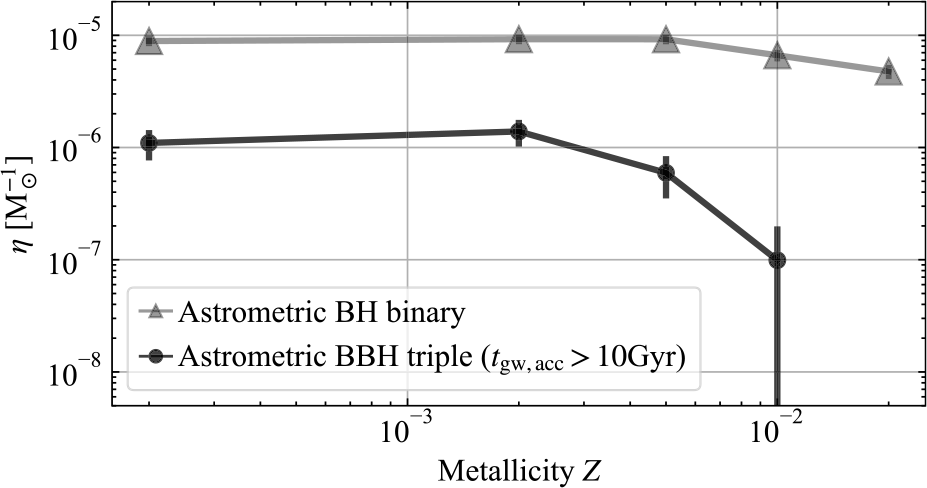
Figure 1 shows the formation efficiencies of astrometric BH binaries and BBH triples as a function of metallicity. These astrometric BBH triples are stable during the Hubble time. The inner binary BHs do not merge, and the configurations are not disintegrated due to 3-body effects, which are confirmed by the OKINAMI code. We can see that the number fractions of astrometric BBH triple are
 $\sim 10$
% in low metallicity environments (
 $Z \le0.005$
), while these fractions are
 $\lesssim 1$
% in high metallicity environments (
 $Z \ge 0.01$
).
Formation efficiencies of astrometric BH binaries and BBH triples as a function of metallicity. This figure is reproduction of figure 2 in Tanikawa et al. (Reference Tanikawa, Wang, Fujii, Trani, Hayashi and Suto2025).

We pick up all the astrometric BBH triples from our simulations, and assess their detectability by high-precision RV observations. We find that
 $\gtrsim 30$
% of them have large RV modulations of visible stars (
 $\gt 1$
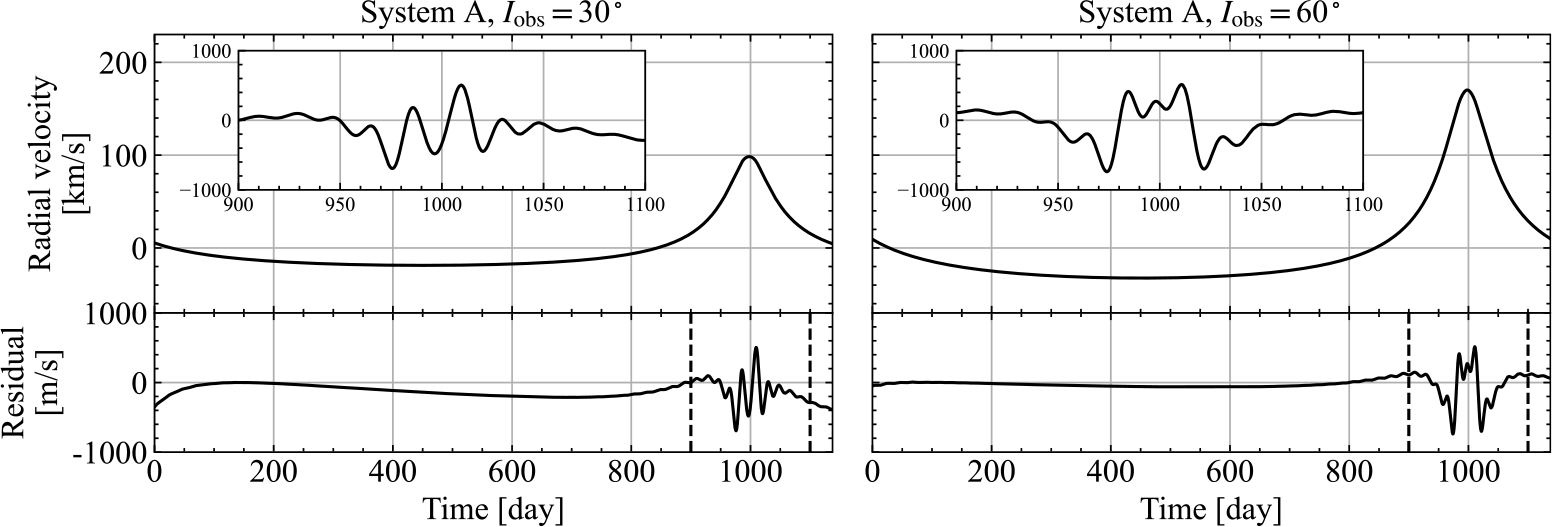
m/s) from the Keplarian solution because of the presence of inner BH binaries. Such large RV modulations can be detected by the current spectroscopic observations. Figure 2 demonstrates the temporal evolution of RVs and their residuals from the Keplarian motions for system A, which indicates the largest RV modulations among our astrometric BBH triples. We can find huge RV modulations (
 $\gtrsim 100$
m/s) at the pericenter passage of the visible star.
Temporal evolution of RVs and their residuals from the Keplarian motions for system A observed at inclination of
 $30^\circ$
(left) and
 $60^\circ$
(right) from the outer orbits. This figure is reproduction of figure 13 in Tanikawa et al. (Reference Tanikawa, Wang, Fujii, Trani, Hayashi and Suto2025).

In order to estimate the number fraction of detectable astrometric BBH triples to astrometric BH binaries, we combine our results with a Milky Way model constructed by Wagg et al. (Reference Wagg, Broekgaarden, de Mink, Frankel, van Son and Justham2022). We find that there is one detectable astrometric BBH triple in
 $\sim 40$
astrometric BH binaries.
4. Conclusion
We examine the number fraction of astrometric BBH triples to astrometric BH binaries formed in open clusters. We find one detectable astrometric BBH triple in
 $\sim 40$
astrometric BH binaries. Several 10 astrometric BH binaries would be discovered in Gaia DR4 era. Our results strongly motivate the survey for astrometric BBH triples in the upcoming Gaia DR4 era.
Acknowledgement
This research was partly supported by Grants-in-Aid for Scientific Research, 24K07040 (A.T.).
 30∘
 60∘


