Speech production entails three levels of processing (Levelt, Reference Levelt1989, Reference Levelt1999; Levelt, Roelofs & Meyer, Reference Levelt, Roelofs and Meyer1999). The semantic (conceptual) level involves the selection of the conceptual information that the speaker wants to communicate. At the lexical (lemma) level, the correct word along with its grammatical properties is retrieved. Finally, the phonological (word form) level involves the retrieval of specific phonological segments of the word to be produced. This simple cognitive architecture, composed of three levels of processing in monolingual individuals, has been also postulated to explain the way in which bilinguals speak (Costa, Miozzo & Caramazza, Reference Costa, Miozzo and Caramazza1999; Hermans, Reference Hermans2000; Poulisse & Bongaerts, Reference Poulisse and Bongaerts1994). However, language production in bilinguals is further complicated by the existence of lexical representations in two languages and phonological segments several of which are shared across languages. For instance, a Spanish–English bilingual would have two lexical representations for the same concept (i.e., the concept of a ship would be associate to the words ship and barco in English and Spanish, respectively) and at the phonological level, there would be phonological segments shared across the two languages (i.e., the phonemes /ɪ/ and /p/) and segment used in one language only (i.e., the phoneme /ʃ/ does not exist in Spanish). Hence, an important question is to specify how the flow of activation spreads through the lexical and phonological representations of the bilinguals’ two languages.
There is agreement that from the semantic level, lexical items receive activation in parallel when a bilingual intends to speak (Costa, Reference Costa, Kroll and De Groot2005, for a review). Hence, in several models of bilingual language production, it is assumed that an activated semantic representation spreads activation to lexical representations in the language the bilingual wants to communicate in and also in the unintended language (Costa et al., Reference Costa, Miozzo and Caramazza1999; de Bot, Reference de Bot1992; Green, Reference Green1998). Therefore, the bilingual lexical retrieval is language non-specific. However, there is no consensus concerning the activation of phonological forms in bilingual individuals and whether the possible coactivation of phonological segments across their two languages might impact the production of the speech when they communicate in one of them.
Perspectives on phonological encoding in bilingualism
There are two main theoretical views about the way bilinguals activate phonological information when they speak. From the language specific phonological activation perspective, the bilingual activates phonological forms in only one language. This view is closely related to discrete models of speech production in monolingual speakers in which, after retrieving the conceptual and lexical representations, only the phonology of the intended word becomes active at the phonological level (Levelt, Reference Levelt1999; Levelt et al., Reference Levelt1999; Schriefers, Meyer & Levelt, Reference Schriefers, Meyer and Levelt1990; see Goldrick, Reference Goldrick, Goldrick, Ferreira and Miozzo2014, for a recent review of phonological encoding in the speech production of monolingual speakers). Thus, in the case of bilingual speakers, only the phonology of the language in which they want to communicate is activated.
On the contrary, the language non-specific phonological activation perspective states that any activated lexical representation regardless of the language they belong to would spread activation to their corresponding phonological nodes. This perspective is associated to cascade models of language processing in monolingual speakers in which the phonology of the name that is intended to be produced is activated along with the phonological forms of concepts related to the target name (Dell, Schwartz, Martin, Saffran & Gagnon, Reference Dell, Schwartz, Martin, Saffran and Gagnon1997; Bloem & La Heij, Reference Bloem and La Heij2003; Bloem, van den Boogaard & La Heij, Reference Bloem, van den Boogaard and La Heij2004; Rapp & Goldrick, Reference Rapp and Goldrick2000). Thus, under this perspective it is reasonable to assume that bilingual speakers would activate phonological representations in their two languages.
There are not too many studies devoted to dissociation between the two proposals about the phonological encoding in bilinguals speakers. Moreover, as we will review later, the results obtained in these studies seem to support the non-specific phonological activation perspective but they have some methodological drawbacks. The question to be answered is whether bilinguals activate phonology in a non-specific manner across languages. In the next section we offer a critical review of the empirical evidence on these issues.
Evidence of phonological coactivation across the bilingual's languages
One of the first studies which demonstrated the activation of phonological forms in the bilinguals’ two languages was reported by Hermans, Bongaerts, de Bot and Schreuder (Reference Hermans, Bongaerts, de Bot and Schreuder1998). In their study, Dutch–English bilinguals were required to name pictures in their second language (L2, English). In the critical condition to demonstrate phonological coactivation of the unintended language (their first language, L1, Dutch), the authors presented spoken word distractors that were phonologically similar to the translation of the picture in Dutch. The participants were slower to name these pictures relative to a control condition in which distractors were phonologically unrelated. This result was interpreted as evidence that the distractor phonologically related to the translation promoted its activation, which produced lexical competition with the correct picture name in English.
However, this interference effect might be artificially generated by the presence of contextual information (the spoken word) that induced the activation of the unintended language due to the phonological relationship between the spoken word and the name of the picture in the unintended language. In short, although picture–word like paradigms are useful to study between-language phonological coactivation, they might foster an artificial activation of the non-used language.
Additional experiments have solved this drawback by using experimental paradigms in which the presence of contextual stimuli that might promote the activation of the irrelevant language has been eliminated. Costa, Caramazza, and Sebastián-Galles (Reference Costa, Caramazza and Sebastián-Gallés2000), asked Catalan–Spanish bilinguals to name pictures presented in isolation. Some of the picture names were cognates in the bilinguals’ two languages. The authors reported a cognate facilitation effect so participants were faster to name pictures with cognate names relative to pictures with non-cognate names. These results suggested that the phonology of the unintended language was activated and it facilitated the activation of the target phonology. However, the high proportion of cognates in Spanish and Catalan and the overall high phonological similarity between these two languages might be mediating the phonological effect reported by Costa et al. Therefore, a replication of this effect with other language combination was critical. Kroll, Dijkstra, Janssen and Schriefers (Reference Kroll, Dijkstra, Janssen and Schriefers2000) used a cued picture naming task in which Dutch–English bilinguals had to randomly name pictures depending on a cue (a high or low tone) in one of their languages (mixed condition) or they named the pictures in one language alone (blocked condition). The critical manipulation was again the presence of pictures with cognate names. The authors observed cognate facilitation in the mixed condition regardless of the language they were spoken, Dutch or English. Also, there was cognate facilitation in the blocked condition but it was restricted to the situation in which bilinguals named the pictures in L2, English. The overall pattern of results seems to indicate again that participants activated the phonology of items in the unintended language, which facilitated the activation of the target picture name when it was a cognate word with between-language phonological similarity. In addition, the different results obtained in the mixed condition and blocked condition suggested that participants were sensitive to the experimental task. When bilinguals were required to alternate between their two languages in the mixed condition, task requirement induced the activation of phonology regardless of the language, so cognate effects were observed in L1 and L2. In contrast, when only one language was needed to perform the picture naming in the blocked condition, the activation of the unintended phonology was only observed in L2, which corroborated the idea that L2 was more permeable to L1 influences than vice versa (Kroll, Bobb & Wodniecka, Reference Kroll, Bobb and Wodniecka2006, for a review).
The two studies reviewed above (Costa et al., Reference Costa, Caramazza and Sebastián-Gallés2000; Kroll et al., Reference Kroll, Dijkstra, Janssen and Schriefers2000), also present methodological drawbacks associated to the use of cognates as the critical manipulation to demonstrate phonological activation of the unintended language. There are several studies suggesting that, in addition to the lexico-phonological similarity across languages, cognates would also have more morphonological overlap (Sánchez-Casas & García-Albea, Reference Sánchez-Casas, García-Albea, Kroll and Groot2005) and they would share more semantic features than non-cognate items (de Groot & Nas, Reference de Groot and Nas1991). Thus, it would be difficult to conclude that the cognate effects in language production (Costa et al., Reference Costa, Caramazza and Sebastián-Gallés2000; Gollan & Acenas, Reference Gollan and Acenas2004; Kroll et al., Reference Kroll, Dijkstra, Janssen and Schriefers2000) are exclusively due to the activation of the non-target phonology.
A different set of studies have provided strong evidence of phonological coactivation in the bilinguals’ two languages by employing methodologies other than the cognate manipulation; specifically, the phoneme monitoring task (Colomé, Reference Colomé2001; Hermans, Ormel, van Besselaar & van Hell, Reference Hermans, Ormel, Van den Besselaar and van Hell2011). Colomé presented pictures to balanced Catalan–Spanish bilinguals and they had to decide whether a given phoneme was present in the name of the picture in Catalan. The phoneme could be part of the Catalan name, part of the Spanish translation or neither. For example, the phoneme /t/ was part of the Catalan name of the picture table (taula), /m/ was part of the Spanish name of table (mesa) and /p/ was not part of either the Catalan name or the Spanish name. The authors observed slower response time to decide that the phoneme /m/ was not part of the picture name in Catalan (taula) when it was part of its translation in Spanish (mesa) relative to the condition in which the phoneme (i.e., /p/) was not present in the Catalan or Spanish name (taula, mesa). The author concluded that the phonology of non-target Spanish names was activated even when the task was performed in Catalan only.
However, the phoneme monitoring tasks share some of the disadvantages previously discussed which might induce the phonological activation of the unintended language. First, the presence of phonemes which were part of the non-target phonology, in some occasions, might favor the activation of names in the non-used language that, in other circumstances would not be activated. Second, as discussed previously, the high phonological similarity of Catalan and Spanish languages might foster the activation of the non-intended language. Moreover, the study reported by Colomé (Reference Colomé2001) included a set of filler items which was a mixture of pictures with cognate and non-cognate names (cited in Hermans et al., Reference Hermans, Ormel, Van den Besselaar and van Hell2011, p. 1690). As we have commented previously, the presence of pictures with cognate names might be modulating the results obtained in the phoneme monitoring task. Hermans et al. directly addressed this point by conducting a study with the phoneme monitoring task in which Dutch–English bilinguals were required to decide whether or not a particular phoneme was part of the L2 English name of the picture. The critical manipulation was the percentage of filler pictures with cognate and non-cognate names. When the task included filler pictures with cognate names (25% or 100% of the filler items such as trein–train in Dutch–English), phonological coactivation across languages was observed. The participants took more time to decide that a phoneme (e.g., /k/) was not part of the English name of the picture (e.g., pillow) when it was part of its Dutch name (e.g., kussen) relative to phonemes that were phonologically unrelated to the Dutch or English picture name (/b/). Crucially, there were no differences between these two conditions when the set of fillers were all pictures with non-cognate names. This pattern of results seems to indicate that bilinguals do not have the phonology of their languages always active but that there are linguistic and contextual factors that might promote a non-genuine phonological coactivation of the bilinguals' two languages.
Aware of some of the factors that might restrict conclusions about the generality of phonological coactivation across the bilinguals' two languages, Colomé and Miozzo (Reference Colomé and Miozzo2010) embraced a new paradigm, the picture–picture task previously used in monolingual studies (Meyer & Damian, Reference Meyer and Damian2007; Morsella & Miozzo, Reference Morsella and Miozzo2002; Navarrete & Costa, Reference Navarrete and Costa2005), and they extended it to the case of bilingual language production. In this paradigm two colored pictures partially overlapped were presented and participants were required to name a target picture depicted in one color, while ignoring a distractor picture depicted in a different color. The main manipulation was the relationship between the target name and the distractor name when Spanish–Catalan bilinguals named the target picture. The critical result was the observation of a phonological effect from the non-target language when participants named pictures with non-cognate names. There was a facilitation effect when the names of the distractor pictures in the unintended language were phonologically related to the names of the target pictures. For example, relative to a control condition with phonologically unrelated distractors, participants were faster to name the target picture of a vest (armilla in Catalan), when it appeared with the distractor picture of a squirrel, whose name in Spanish (ardilla) was phonologically related to the target name. The authors interpreted this effect as due to the activation of the picture name in the non-target language which spread activation to the phonemes of the target names. It is important to note that the facilitation effect reported by Colomé and Miozzo with the picture–picture paradigm was observed with pairs of target and distractor pictures that were not related semantically. Hence, phonological coactivation was observed even when the influence of semantic information was prevented. The strong characteristic of the picture–picture paradigm used by Colomé and Miozzo is that it avoids different factors that might favor the non-genuine activation of the unintended language such as the explicit presence of words from the irrelevant language or the introduction of pictures with cognate names. However, there is a drawback from the picture–picture paradigm to the conclusion that by default, bilinguals always activate the phonology of their two languages: The phonological coactivation of distractor pictures might have been induced by the overlap between the target picture and the distractor picture. In the next paragraph we elaborate on this point.
In monolinguals, the picture–picture task has been used to explore within-language phonological coactivation in several studies (see Navarrete & Costa, Reference Navarrete and Costa2009; for a review). Morsella and Miozzo (Reference Morsella and Miozzo2002) showed that a superimposed distractor picture (i.e., bell) with a name phonologically related to a target picture (i.e., bed), facilitated the naming of the target picture. The finding supported models of cascade processing in which the phonology of different words could be coactivated during the production process. This observation was replicated in other picture naming studies (Meyer & Damian, Reference Meyer and Damian2007; Navarrete & Costa, Reference Navarrete and Costa2005; Roelofs, Reference Roelofs2008). However, Jescheniak, Oppermann, Hantsch, Wagner, Mädebach and Schriefers (Reference Jescheniak, Oppermann, Hantsch, Wagner, Mädebach and Schriefers2009) did not find phonological facilitation from distractor pictures in three experiments (for other failures to obtain phonological effects from distractor pictures, see Bloem & La Heij, Reference Bloem and La Heij2003; Bloem et al., Reference Bloem, van den Boogaard and La Heij2004). In addition to these opposing results, Oppermann, Jescheniak, Schriefers and Görges (Reference Oppermann, Jescheniak, Schriefers and Görges2010) further argued that phonological facilitation of distractor pictures might be induced by the experimental situation in which the target and distractor pictures are superimposed and, thus, both have to be processed necessarily in order to separate the target from the distractor (although see Navarrete & Costa, Reference Navarrete and Costa2009, p. 539–540, for a counter-argumentation). In our opinion, the picture–picture task with overlapped pictures might present some drawbacks to the study of phonological coactivation in both monolinguals and bilinguals. In particular, the presence of two pictures overlapping might cause confusion in the decision of which picture has to be lexicalized leading to the erroneous phonological processing of the distractor picture in some cases. In other words, the lexicalization of the distractor picture would be an exception caused by the pictures’ overlap and not the rule.
The studies reviewed so far seem to corroborate the language non-specific phonological activation perspective in bilingual speakers. These previous studies have used a variety of methodological approaches such as picture–word like paradigms (Hermans et al., Reference Hermans, Bongaerts, de Bot and Schreuder1998), cued picture naming tasks (Kroll et al., Reference Kroll, Dijkstra, Janssen and Schriefers2000), phoneme monitoring tasks (Colomé, Reference Colomé2001; Hermans et al., Reference Hermans, Ormel, Van den Besselaar and van Hell2011), and picture–picture tasks (Colomé & Miozzo, Reference Colomé and Miozzo2010) which have yielded extremely valuable results. These studies converge in the observation of between-language phonological effects, which seems to suggest that they are a reliable phenomenon, leading to the conclusion that the phonology of the bilinguals’ two languages might become activated even when they need to communicate in one language alone.
Overall, two effects have been reported in previous studies reviewed in this section with bilingual individuals, a phonological facilitation effect and a phonological interference effect. In our opinion, the locus of these two effects is placed at the same level of processing, the phonological encoding. When a phonological facilitation effect is reported (Colomé & Miozzo, Reference Colomé and Miozzo2010; Costa et al., Reference Costa, Caramazza and Sebastián-Gallés2000; Kroll et al., Reference Kroll, Dijkstra, Janssen and Schriefers2000), a non-target dimension of the stimulus (i.e., the name of a picture in a language not required to perform the task) promotes the activation of target phonemes needed to name the target stimulus and, thus, phonological encoding is facilitated. For instance, when Catalan–Spanish bilinguals have to name pictures with cognate names in one language (i.e., Catalan) phonological segments shared in the bilinguals’ languages would receive activation from two sources: the picture name in the target language (Catalan) and the picture name in the non-target language (Spanish). Therefore, this converging activation would facilitate the naming process. The same explanation would account for the phonological facilitation effect obtained with the picture–picture paradigm (Colomé & Miozzo, Reference Colomé and Miozzo2010). Bilinguals naming a picture in a target language (i.e., armilla, vest in Catalan) would activate the name of the overlapped non-target picture in the other language (i.e., ardilla, squirrel in Spanish). When the two names are phonologically related (armilla–ardilla), shared phonemes would receive converging activation from these names, facilitating the production process in the intended language.
On the other hand, when a phonological interference effect has been reported, the names of pictures in a non-target language promote the activation of phonemes which are not part of the target names. For example, in the phoneme monitoring task (Colomé, Reference Colomé2001; Hermans et al., Reference Hermans, Ormel, Van den Besselaar and van Hell2011), when participants have to indicate that phoneme /m/ is not part of the target picture name of a table in Catalan (taula), the activation of the non-target picture name in Spanish (mesa) adds activation to the phoneme /m/ which makes it difficult to reject it as part of the target name taula. Moreover, there is evidence from monolingual studies suggesting that phonological interference effects might be associated to the coding of phonological segments of words at sublexical levels of processing (Meyer, Reference Meyer1996). In short, the same mechanism would explain the facilitation effects and interference effects found in the literature on phonological encoding in bilinguals. When the retrieval of words in a non-target language adds converging activation to shared phonemes of target names, a facilitation effect might be observed. When non-target words activate phonemes which are not part of the target names, an interference effect might be found.
Without taking away the merit of previous work in the field, some experiments that support bilingual language coactivation at the phonological level might present some drawbacks since they might favor language non-selectivity. Therefore, a greater challenge for bilingual language production is to demonstrate that bilinguals activate phonological forms in their two languages by default even when the salience of the unintended language is minimized. In the current study we made use of the color naming task which has been used successfully to corroborate within-language phonological coactivation. In the next section we review studies that have considered this experimental task.
The color naming task. A tool to evaluate phonological coactivation in bilingual language production
To our knowledge, the color naming task has been used with monolingual participants only (Dumay & Damian, Reference Dumay and Damian2011; Janssen, Alario & Caramazza, Reference Janssen, Alario and Caramazza2008; Kuipers & La Heij, Reference Kuipers and La Heij2009; Navarrete & Costa, Reference Navarrete and Costa2005). In this task, individuals are presented with a single colored picture and they are required to produce the name of the color in which it is depicted. In this situation the participants do not need to retrieve conceptual, lexical or phonological information about the presented picture. The advantage of this task is that participants have to focus on one dimension of the stimulus (the color) that is quite different from the distractor dimension (the content depicted), hence avoiding the confusion between the two dimensions of the stimulus. The rationale behind the color naming task is that if the name of the picture is activated (the irrelevant dimension) when retrieving the color name (the relevant dimension), it should influence naming latencies.
The color naming task has been used to evaluate the possibility of within-language phonological coactivation in language production. Navarrete and Costa (Reference Navarrete and Costa2005) asked Spanish participants to name the color in which colored pictures were presented. In some cases, the name of the color shared the phonological beginning with the picture name: for example, the picture vela (candle) colored in verde (green). In other occasions, the name of the color and the picture name did not have phonological overlap; for example, the picture maleta (suitcase) colored in verde. The authors observed faster naming latencies in the phonologically related condition relative to the phonologically unrelated condition. This phonological facilitation effect with the color naming task was replicated with Dutch speakers (Kuipers & La Heij, Reference Kuipers and La Heij2009) and English speakers (Damian & Dumay, Reference Damian and Dumay2009).
The facilitation effect in the color naming task is at odd with the discrete view of speech production in monolingual individuals (Levelt et al., Reference Levelt1999) in which only the target lexical representation spreads activation to its phonological form (the color name). However, this effect is predicted by cascade models in which any perceived item automatically activates its phonology (Morsella & Miozzo, Reference Morsella and Miozzo2002). Hence, when participants are required to name the color of a picture whose name is phonologically related to the color name, phonological segments receives activation from two sources, the color name and the picture name and, thus, the processing is facilitated. However, it should be noticed that the speakers do not activate by default the color names in which pictures are depicted but only when the task requires the retrieval of these color names. In fact, when monolingual individuals perform a picture naming task with colored pictures, there is no influence of the phonological relationship between the color names and the picture names (e.g., Kuipers & La Heij, Reference Kuipers and La Heij2009). Overall, the properties of pictures such as their color, size, etc., are not lexicalized unless they are required by the task. For instance, Roux, Bonin and Kandel (Reference Roux, Bonin and Kandel2013) showed that the naming of the object size (i.e., grand; meaning big in French) was facilitated when the picture name was phonologically related (grange, meaning barn in French); however, this phonological effect was not found when participants produced the name of the objects.
The current study
When monolingual speakers perform the color naming task, a phonological facilitation effect is observed which suggests the existence of within-language phonological coactivation. This effect is a robust phenomenon that has been replicated in several studies (Dumay & Damian, Reference Dumay and Damian2011; Janssen, Alario & Caramazza, Reference Janssen, Alario and Caramazza2008; Kuipers & La Heij, Reference Kuipers and La Heij2009; Navarrete & Costa, Reference Navarrete and Costa2005). In the current study, the color naming task was used with bilingual individuals to evaluate whether phonological coactivation applies to the case of the bilinguals’ two languages. The interesting feature of this task is that it does not induce the activation of the irrelevant language because only a single stimulus is presented and participants are instructed to name it in one language alone without the inclusion of distracting words or phonemes belonging to the unintended language. In this study Spanish–English bilinguals (L1–L2 respectively) performed the color naming task in L2. The critical manipulation was the phonological relationship between the name of the picture and the color name in L1Footnote 1 . In the phonologically related condition, the picture name (e.g., maleta, suitcase in Spanish), shared its phonological beginning with the name of the color in which the picture was presented (e.g., marrón, brown in Spanish). In the phonologically unrelated condition, the picture name did not share phonological segments with the color in which it was depicted (e.g., rosa, pink in Spanish).
If language non-selective phonological activation occurs across the two languages of a bilingual speaker, a phonological interference effect would be observed in the current study. This effect would be explained as follows: If the picture name maleta (suitcase) is activated along with the color name marrón (brown) in the phonologically related condition, the shared phonemes of these two names ma- would be strongly activated relative to the phonologically unrelated condition in which the picture name maleta and the color name rosa (pink) do not share phonemes. The increased activation of phonological segments which are irrelevant to perform the color naming task in L2 would hinder the naming of the target color (brown).
Experiment 1
Method
Participants
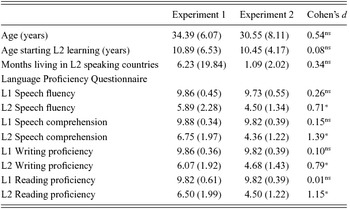
Twenty-eight Spanish–English bilinguals from the English department at the University of Granada served as volunteers. The participants' characteristics are reported in Table 1. The participants were asked to complete a language proficiency questionnaire on reading, writing, listening and speaking in Spanish (L1) and English (L2), previously used in our laboratory (Macizo, Bajo & Martín, Reference Macizo, Bajo and Martín2010; Macizo, Bajo & Paolieri, Reference Macizo, Bajo and Paolieri2012). The ratings ranged from 1 to 10 where 1 was not fluent and 10 was very fluent. The mean fluency in L1 was higher (9.86, SD = 0.31) than the mean fluency in L2 (6.30, SD = 1.86), t(27) = 9.88, p < .001. This difference suggests that participants were fluent in English but dominant in Spanish.
Characteristics of participants in the study

Note. The self-report ratings of speech fluency, speech comprehension, writing proficiency and reading proficiency in L1 (Spanish) and L2 (English) ranged from 1 to 10 where 1 was not fluent and 10 was very fluent. Standard deviations are given into brackets. Cohen's d = Effect sizes for t-test analyses comparing participants of Experiment 1 and Experiment 2, ns p > .05, *p < .05.
Design and materials
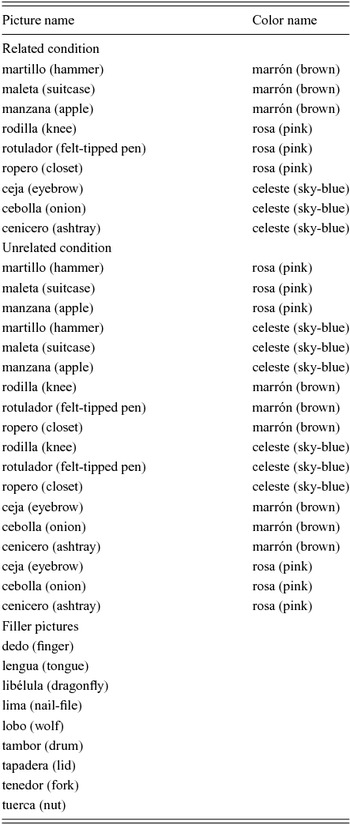
Two experimental conditions were implemented (phonologically related condition and phonologically unrelated condition). The phonologically related condition was composed of colored pictures whose Spanish name (e.g., maleta, suitcase) and the Spanish name of the color in which they were drawn shared the phonological beginning (e.g., marrón, brown). The phonologically unrelated condition was composed of colored pictures whose Spanish name never shared their phonological beginning with any of the color names used in the experiment.
Three colors were selected for the color naming task, brown (marrón; RGB values: 149, 74, 0), sky-blue (celeste; RGB values: 135, 205, 255), and pink (rosa; RGB values: 249, 202, 201)Footnote 2 . In the phonologically related condition, for each color, three pictures were taken from Snodgrass and Vanderwart (Reference Snodgrass and Vanderwart1980) and Pérez and Navalón (Reference Pérez and Navalón2003) whose Spanish name and the color names in Spanish shared an average of 2.11 segments, and at least their first two segments including the first vowel; for example, the picture of a suitcase ( ma leta) colored in brown ( ma rrón). The total number of pictures in the phonologically related condition was 9 (three different pictures for each of the three colors). The stimuli were carefully selected so that the English name of pictures (e.g., hammer) and colors (e.g., pink) did not share the first two phonemesFootnote 3 . The Spanish names of pictures and colors were also phonologically unrelated to their English translation. Moreover, pictures with cognate names in Spanish and English were avoided. We also controlled for the overall amount of phonological overlap between the color names and the picture names regardless of the position of shared phonemes (a phoneme was repeated if it was part of the picture name and the name of the color regardless of whether the position of the phoneme was the same in the two names). This was done since it has been demonstrated that phonological facilitation is possible across segmental positions (Damian & Dumay, Reference Damian and Dumay2009). Regarding the Spanish names, the phonologically related condition was the one with more shared segments (4.67, SD = 1.66) relative to the phonologically unrelated condition (2.00, SD = 1.50), t(25) = 4.22, p < .001. When the English names of colors and pictures were considered, there were no differences between the shared segments in the phonologically related condition (0.89, SD = 1.36) and the phonologically unrelated condition (1.36, SD = 0.94), t(25) = 0.13, p = .89. Finally, the mean number of shared segments between the color names in English and the Spanish names of the pictures was equated in the phonologically related condition (1.22, SD = 1.56) and the phonologically unrelated condition (1.67, SD = 1.03), t(25) = .89, p = .38.
The phonologically unrelated condition was composed of the same 9 pictures which were presented in two of the three colors so their Spanish names (e.g., maleta) and the Spanish name of the color in which they were drawn (e.g., rosa, pink), did not share the phonological beginning. The combination of each of the nine pictures with the two colors whose names were phonologically unrelated yielded a total of 18 stimuli in this condition.
In addition to the 9 pictures used in the phonologically related and unrelated condition, a set of 9 filler trials were included whose names were phonologically unrelated to any of the color names. These filler pictures were presented in all three colors, yielding a total of 27 filler trials which were not entered in the analyses reported below. Therefore, the total number of colored pictures used in the experiment was 54 (9 pictures in the phonologically related condition, 18 pictures in the phonologically unrelated condition and 27 filler pictures). The appendix shows the complete set of picture names and color names combinations used in the study.
Procedure
The experiment was controlled by a Genuine-Intel compatible PC 1.73 GHz, using E-prime experimental software, 1.1 version (Schneider, Eschman & Zuccolotto, Reference Schneider, Eschman and Zuccolotto2002). Instructions and stimuli were presented on a 17” screen located at approximately 60 cm in front of the participant. Response latencies were collected using a microphone ATR 20 with low impedance connected to a PST serial Response Box (Schneider, Reference Schneider1995) and tape-recorded to eliminate trials with errors in the latency analyses.
The Spanish–English bilinguals performed the color naming task in L2 (English). They were instructed to name the color in which the picture was depicted as soon as possible but trying not to make errors. To avoid language context effects, the instructions were given in the language in which the participants had to perform the task (English). The participants practiced with the color naming task before performing the experiment with a set of 6 trials in which a picture was randomly presented twice in each of the three colors. The picture name and its color name were phonologically unrelated and the picture was not presented in the experimental trials. Afterward, the experimental trials started. The color naming task consisted of two blocks of 54 trials and, thus, the participants were presented 108 experimental trials. A short break was introduced between blocks. In each block, the same pictures and colors combinations were randomly presented (9 pictures in the phonologically related condition, 18 pictures in the phonologically unrelated condition and 27 filler pictures). Although trials were randomly presented, each block started with two filler trials, pictures in two consecutive trials were colored in different colors and pictures in the phonologically related condition were separated by at least three trials.
In each trial a fixation point was presented for 500 ms. Next, after a blank period of 200 ms the picture was presented in the middle of the screen until the participant response or for 1500 ms. Afterward, the experiment continued with the next trial.
Results and discussion
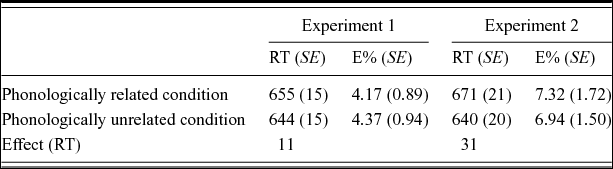
Only correct responses were included in the analyses of the reaction times (RTs). Data points were excluded from the RT analyses if: (a) the participants produced non-verbal sounds that triggered the voice key, (b) the participants stuttered or hesitated in naming the color, (b) the participants produced something different from the color requested. The percentage of errors was 4.27%. Response latencies were hand-checked and only correct naming latencies were introduced in the RT analyses. Also, correct RT data below 300 ms or above 3 SD for an individual participant's mean were excluded from the analyses (1.52%). The RT and error data were submitted to analyses of variance (ANOVA) with participants as random factor. Given the limited number of items (three color names) we did not perform item analysesFootnote 4 (Navarrete & Costa, Reference Navarrete and Costa2005). The Type of Stimulus (phonologically related condition and phonologically unrelated condition) was the within-participant variable. Table 2 shows RT means and error rates per condition. Concerning analyses performed on the error data, the effect of Type of Stimulus was not significant, F < 1.
Mean naming latencies (RT, in milliseconds), standard error (SE), error percentage (E%), and phonological effect (related condition minus unrelated condition) obtained in the study

In the analyses of RTs, the effect of Type of Stimulus was significant, F(1, 27) = 4.60, p = .04, η 2 = .15. The RTs were 11 ms slower in the phonologically related condition relative to the phonologically unrelated condition. Hence, an interference effect was observed.
Furthermore, we evaluated whether the interference found in the latency analysis was a cumulative effect that developed through the course of the experiment. To this end, an ANOVA was performed with Type of Stimulus (phonologically related vs. phonologically unrelated) and Block (first part vs. second part of the experiment). The Type of stimulus x Block interaction was not significant, F(1, 27) = 2.98, p = .10, η 2 = .09. Thus, the interference effect did not increase during the course of the experiment.
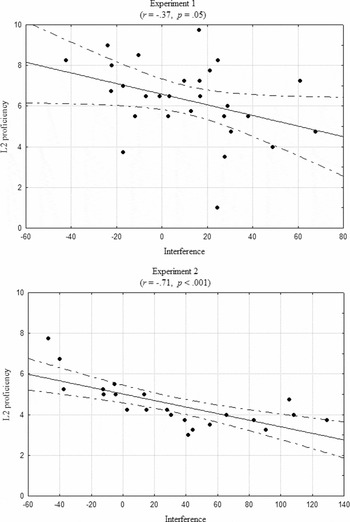
In addition, we performed additional analyses to evaluate whether the interference effect was modulated by the fluency of participants in L2. It might be argued that the activation of L2 phonology would be weaker in less fluent participants. Hence, the influence of L1 phonology would be more visible in these participants. Consequently, bilinguals with low fluency in L2 might show more interference than those with high L2 fluency. We computed firstly the interference effect (the mean RT in the related condition minus the mean RT in the unrelated condition) for each participant. Afterward, a correlation analysis showed that the interference effect was negatively correlated with the mean fluency of participants in L2, r = −.37, p = .05. Hence, participants with reduced proficiency in L2 presented more interference effect than those with high proficiency in L2 (see Figure 1).
Scatterplots depicting the relationship between the interference effects obtained in this study (mean RT in the related condition minus the mean RT in the unrelated condition) and the mean proficiency of bilinguals in L2 in a 10 point scale (0-not fluent, 10-very fluent) for bilinguals with more proficiency (Experiment 1, upper graph) and less L2 proficiency (Experiment 2, lower graph).

The results obtained in Experiment 1 seem to indicate that bilinguals activated phonological segments associated to words from their L1 (Spanish) even when they were irrelevant to perform the color naming task in L2 (English). Compared to a control condition with phonologically unrelated picture names and color names in L1, participants were slower to name the color of a picture in L2 when its L1 name was phonologically related to the name of the picture in L1. Hence, L1 phonology was activated during the production of the color name in L2 which produced the interference effect observed in the experiment. This pattern of results cannot be explained by discrete models of language production in which only the phonology of a target item is activated during the course of the lexicalization process (Levelt, Reference Levelt1999). However, the interference effect obtained in this experiment is in agreement with cascade models of speech production in which phonological coactivation is assumed by default (Caramazza, Reference Caramazza1997; Costa et al., Reference Costa, Caramazza and Sebastián-Gallés2000).
In addition, the results of Experiment 1 seem to suggest that the coactivation of L1 phonology was modulated by the fluency of participants in L2. In fact, the interference effect in the color naming task increased as the fluency of bilinguals in L2 decreased. This observation is in line with previous studies showing that between-language lexical activation is easier to observe with less L2 proficiency relative to more proficient bilinguals when they perform a task in L2 (Kroll, Michael, Tokowicz & Dufour, Reference Kroll, Michael, Tokowicz and Dufour2002; see van Hell & Tanner, Reference van Hell and Tanner2012, for a review). For instance, Kroll et al. observed a cognate facilitation effect when bilinguals named items in L2 which was larger for the less fluent group relative to the more fluent group. Similarly, Roselli, Ardila, Jurado and Salvatierra (Reference Roselli, Ardila, Jurado and Salvatierra2014) found a higher cognate effect in non-balanced bilinguals when they named pictures using the Boston Naming Test in the non-preferred language relative to balanced bilinguals with similar fluency in their two languages. Therefore, the degree of phonological coactivation in bilinguals seems to be modulated by the proficiency of participants in L2.
Experiment 2
The goal of Experiment 2 was twofold. Firstly, the phonological interference effect obtained in Experiment 1 with bilingual participants was innovative and it required replication. Secondly, in our first experiment the activation of L1 phonology seemed to be related to the L2 proficiency of participants. In Experiment 2 we selected bilinguals with less L2 proficiency than those who participated in our previous experiment. By comparing the magnitude of the interference effect in the color naming task between experiments, we had the opportunity of evaluating whether the degree of phonological coactivation across languages depended on the fluency of bilinguals in L2.
Method
Participants
A new set of twenty-two Spanish–English bilinguals from the same population as that used in Experiment 1 took part in the experiment. None of them participated in Experiment 1. The participants' characteristics are reported in Table 1. T-test comparisons showed that participants in this experiment did not differ from those of Experiment 1 in their mean age, age of L2 acquisition and months living in L2 speaking countries. The participants of Experiment 1 and Experiment 2 were also equated in their mean L1 fluency (M = 9.86, SD = 0.31 and M = 9.80, SD = 0.32, respectively), t(48) = 0.68, p = .50, d = 0.19. However, the bilinguals of Experiment 2 showed lower mean fluency in L2 (M = 4.51, SD = 1.15) than that of participants in Experiment 1 (M = 6.30, SD = 1.86), t(48) = 3.96, p < .001, d = 1.11. The complete comparison between the two groups of bilinguals is reported in Table 1.
Design and Materials
The same design used in Experiment 1 was employed here with the Type of Stimulus (phonologically related condition and phonologically unrelated condition) as a within-participants variable.
Procedure
The same procedure used in Experiment 1 was adopted in Experiment 2.
Results and Discussion
We followed the same procedure to exclude data points in the RT analyses as that described in Experiment 1. The percentage of errors was 7.13%. Similar to Experiment 1, correct RT data below 300 ms or above 3 SD for an individual participant's mean were excluded from the analyses (3.37%). The RT and error data were submitted to analyses of variance (ANOVA) with participants as random factor. Table 2 shows RT means and error rates per condition. The analyses performed on the error data did not show a significant effect of Type of Stimulus, F(1, 21) = 0.18, p = .67, η 2 = .008.
In the latency analyses, the effect of Type of Stimulus was significant, F(1, 21) = 8.55, p = .008, η 2 = .29. The RTs were 31 ms slower in the phonologically related condition relative to the phonologically unrelated condition. Thus, Experiment 2 replicated the interference effect observed in Experiment 1.
Similar to what was done in Experiment 1, we considered whether the interference effect varied through the course of the task. In the analyses performed with Type of Stimulus (phonologically related vs. phonologically unrelated) and Block (first part vs. second part of the experiment), the Type of Stimulus did not interact with Block, F < 1. Therefore, the interference effect found in Experiment 2 was not modulated by the course of the experiment.
As done in Experiment 1, we evaluated the possible relationship between the interference effect (the mean RT in the related condition minus the mean RT in the unrelated condition) and the mean fluency of bilinguals in L2. The negative correlation between these two factors was significant, r = −.71, p < .001. Moreover, overall correlation across Experiments 1 and 2 between the magnitude of the interference and the level of proficiency was significant, r = −.51, p < .001. Therefore, bilinguals with less proficiency in L2 showed more interference effect than those with more L2 proficiency (see Figure 1).
The results obtained in Experiment 2 replicated the interference effect observed in Experiment 1 when bilinguals named the color of pictures in L2 whose names and the color name in L1 were phonologically related. In addition, the magnitude of the interference effect in Experiment 2 seemed to be larger in bilinguals with less L2 proficiency relative to bilinguals with more L2 proficiency (Experiment 1).
The relationship found in this study between the interference effect and the fluency of bilinguals in L2 corroborates previous research showing that cross-language activation is higher in non-balanced bilinguals relative to balanced bilingual (Kroll et al., Reference Kroll, Michael, Tokowicz and Dufour2002; Roselli et al., Reference Roselli, Ardila, Jurado and Salvatierra2014). These differences might be due to the difficulty of activating L2 in bilinguals with less fluency which produced a strong influence of the non-target language. Moreover, it might be speculative but possible that the development of proficiency in L2 would be accompanied by an efficient use of cognitive control processes to avoid the activation of irrelevant information (i.e., the non-target language) which might interfere with the performance of a linguistic task in a target language (La Heij & Boelens, Reference La Heij and Boelens2011; La Heij, Boelens & Kuipers, Reference La Heij, Boelens and Kuipers2010, for a similar proposal to explain the developmental course of the color–object interference in children and young monolinguals).
General discussion
After retrieving semantic and lexical information, a bilingual speaker has to select the correct phonological form in the correct language to finally produce the intended message. There is agreement among theories of bilingual language processing that lexical access is language non-specific (Costa et al., Reference Costa, Miozzo and Caramazza1999; de Bot, Reference de Bot1992; Green, Reference Green1998). Thus, lexical units from the two languages of a bilingual individual become active during the speech planning. However, there is no theoretical agreement about the link between lexical and phonological information in the bilinguals’ two languages. It might be possible that bilinguals only activated the phonology of the language needed to communicate. On the contrary, bilinguals might activate phonological forms in their two languages.
The available empirical evidence on this issue is consistent, under some restrictions, with the idea that there is activation across the bilinguals’ two languages (Colomé, Reference Colomé2001; Colomé & Miozzo, Reference Colomé and Miozzo2010; Costa et al., Reference Costa, Caramazza and Sebastián-Gallés2000; Hermans et al., Reference Hermans, Bongaerts, de Bot and Schreuder1998; Kroll et al., Reference Kroll, Dijkstra, Janssen and Schriefers2000). However, studies that support phonological coactivation across languages use paradigms that might favor the activation of the unintended language. Thus, the question to pose is whether the phonological activation of the bilingual languages is a default condition (that occurs always) that individuals produce in one of their languages or, instead, the phonological activation of non-target items is limited to some circumstances.
In the current study we applied the color naming task (Navarrete & Costa, Reference Navarrete and Costa2005) to bilingual individuals in order to evaluate the possibility of phonological coactivation across their two languages. The main advantage of using the color naming task to evaluate phonological coactivation in bilinguals is that it does not favor the artificial activation of the unintended language. In fact, Spanish–English bilinguals were instructed in English to name the colors in English and there were no cues that promoted the activation or the use of Spanish. In addition, the languages spoken by the participants were not similar which also precluded the activation of non-target phonology. Moreover, each stimulus was presented in isolation eliminating the necessity of processing two stimuli at the time they performed the experimental task and, finally, the target stimulus dimension (the color name) was quite different from the non-target dimension precluding the erroneous lexicalization of the picture name.
Even when the color naming task required the activation of only one language, bilinguals seemed to activate their two phonological systems suggesting that phonological coactivation across the bilinguals’ two languages was a default condition when they proceeded with the production process. More specifically, relative to a phonologically unrelated condition, in the two experiments reported here, Spanish–English bilinguals were slower to name the color of a picture in English (i.e., brown), when the name of the picture in Spanish (maleta, suitcase in Spanish) was phonologically related to the Spanish name of the color (marrón). Hence, the interference effect obtained in this study with the color naming task suggests that even when the potential factors that might foster the salience of the unused language are minimized, participants activate phonological information of the language not needed to perform the task. Next, we discussed the relevance of this interference effect for models of language production in bilinguals.
Implications for bilingual language production models
In many studies a phonological facilitation effect is observed when monolingual speakers name the color of a picture whose name is phonologically related to the name of the color in which it is drawn (Dumay & Damian, Reference Dumay and Damian2011; Janssen et al., Reference Janssen, Alario and Caramazza2008; Kuipers & La Heij, Reference Kuipers and La Heij2009; Navarrete & Costa, Reference Navarrete and Costa2005). This effect suggests that unintended phonological representations (e.g., the picture names) become activated when monolingual speakers retrieve the target phonology (the color name). This within-language coactivation effect cannot be explained within a discrete view of language production in which only one name is activated at the phonological level (Levelt, Reference Levelt1999; Levelt et al., Reference Levelt1999). Instead, the phonological facilitation agrees with a cascade perspective by assuming that phonological coactivation takes place by default (Caramazza, Reference Caramazza1997; Costa et al., Reference Costa, Caramazza and Sebastián-Gallés2000; Dell, Reference Dell1986; Griffin & Bock, Reference Griffin and Bock1998; Harley, Reference Harley1993; Rapp & Goldrick, Reference Rapp and Goldrick2000). Similarly, the interference effect obtained in this study when bilingual speakers named the color of pictures in L2 is hard to reconcile with discrete views of bilingual language production but they can be accommodated within models that assume between-language phonological coactivation (Costa et al., Reference Costa, Miozzo and Caramazza1999; de Bot, Reference de Bot1992; Green, Reference Green1998). When bilinguals needed their L2 to communicate, they activated also their L1 and the activation of representations in the unintended language influenced the phonological encoding of names in the target language.
In addition, we observed that the degree of phonological coactivation across languages depended on the proficiency of bilinguals in L2. The magnitude of the interference effect was larger for bilinguals with reduced L2 fluency (Experiment 2) relative to those with more proficiency (Experiment 1). This last result suggests that the coactivation of phonological representations in the two languages of a bilingual is not fixed but that it is modulated by the learning experience of individuals in a second language. In fact, previous studies have shown that cross-language activation depends on several factors such as language proficiency and dominance (Basnight-Brown & Altarriba, Reference Basnight-Brown and Altarriba2007; Elston-Güttler, Gunter & Kotz, Reference Elston-Güttler, Gunter and Kotz2005), language immersion (Linck, Kroll & Sunderman, Reference Linck, Kroll and Sunderman2009), the professional expertise in managing several languages (i.e., translators and interpreters, Macizo & Bajo, Reference Macizo and Bajo2006), the type and order in which two languages are used to perform a linguistic task (Jared & Kroll, Reference Jared and Kroll2001), etc. (see Kroll, Bobb & Wodniecka, Reference Kroll, Bobb and Wodniecka2006; for a review).
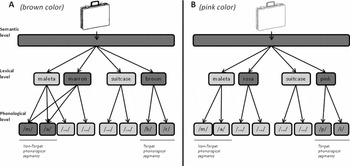
Figure 2 illustrates how the interference effect obtained in our study with bilingual speakers can be accommodated within a language production system of cascade processing. The system would involve the retrieval of semantic information as well as lexical and phonological representations in the two languages of the bilinguals (Spanish and English). When Spanish–English bilinguals named in English the color of a picture whose Spanish name and color name in Spanish were phonologically related (maleta marrón; brown suitcase in Spanish), the lexical representations in the non-target language (maleta, marrón) received activation from the semantic system. These representations sent activation to their phonological segments which are shared in the bilinguals’ two languages. In the phonologically related condition, the beginning of the color name in the non-target language (ma-), received additional activation from the non-target picture name maleta. This converging activation from the color marrón and the picture maleta, would produce the greater activation of the phonemes ma-. Since these phonemes were not needed to name the color in English, the strong activation of non-target phonological segments in the phonologically related condition hindered the color naming relative to the unrelated condition.
Schematic representation of the phonological activation in a cascade view of the bilinguals’ language production system during the color naming task. The architecture is composed of a semantic level, a lexical level and a phonological level. Panel A shows an example of the phonologically related condition in which the picture name (maleta, suitcase in Spanish) and the color name (marrón, brown in Spanish) share their phonological beginning. Panel B shows an example of the phonologically unrelated condition in which the color name (rosa, pink in Spanish) and the picture name (maleta) do not share their phonological beginning. Phonological segments are shared in the two languages. In Panel A the phonemes /m/ and /a/ are more activated in the phonologically related condition relative to the unrelated condition because they receive activation from two sources (marrón and maleta). These phonemes are activated from non-target names of pictures and colors in Spanish, when Spanish–English bilinguals name the color of the picture in English.

To sum up, we have used the color naming task as a tool to evaluate the possibility of phonological coactivation across the bilinguals’ languages. We acknowledge this task has some limitations because bilinguals do not name the color of objects in everyday situations. However, the color naming task possesses the advantage of avoiding potential factors that might induce the artificial activation of the unintended language experimentally. If we revisit the question stated in the introduction about whether bilinguals activate phonology of names in the non-target language, the answer appears to be affirmative.
Combination of picture names and color names used in the related and unrelated condition of the Study.