


1. Introduction
Let  $G$ be the identity component of the real points of a linear algebraic group
 $\boldsymbol {G}$, defined over
 $\mathbb {Q}$. Let
 $\Gamma$ be an arithmetic subgroup in
 $\boldsymbol {G}(\mathbb {Q})$, which does not have to be a lattice. Then
 $G$ naturally acts on the quotient space
 $G/\Gamma$ by homeomorphisms and it is natural to study the ergodic–theoretic aspects of this action.
In the present article, we focus on the following question. Let  $\boldsymbol {H}$ be a
 $\mathbb {Q}$-subgroup of
 $\boldsymbol {G}$ and write
 $H$ for
 $\boldsymbol {H}(\mathbb {R})^{\circ }$. We further assume that
 $H\Gamma /\Gamma$ is closed in
 $G/\Gamma$ and then it carries a unique
 $H$-invariant Haar measure
 $\mu _H$ (see [Reference RaghunathanRag72, Lemma 1.4]). On the other hand, let
 $(g_n)$ be a sequence in
 $G$. We are interested in the limiting behavior of
 $(g_n)_* \mu _H$ under the weak-
 $*$ topology where
 $(g_n)_* \mu _H(A)$ is defined to be
 $\mu _H(g_n^{-1}A)$.
The original interest in such a problem comes from the study of the asymptotics of integer points on an affine homogeneous variety. After the pioneering work of Duke, Rudnick and Sarnak [Reference Duke, Rudnick and SarnakDRS93] where a harmonic analysis method is used, Eskin and McMullen [Reference Eskin and McMullenEM93] (cf. [Reference Benoist and OhBO12]) gives a simpler proof using mixing. They assumed that  $\boldsymbol {H}$ is symmetric, that is, consisting of the fixed points of some involution, and has no non-trivial
 $\mathbb {Q}$-characters. The latter condition is equivalent to that
 $\Gamma _H:=\Gamma \cap H$ is of finite covolume in
 $H$. Based on the unipotent rigidity theorem of Ratner [Reference RatnerRa91] and linearization technique developed by Dani and Margulis [Reference Dani and MargulisDM93], Mozes and Shah [Reference Mozes and ShahMS95] and Eskin, Mozes and Shah [Reference Eskin, Mozes and ShahEMS96, Reference Eskin, Mozes and ShahEMS97] make a non-effective generalization assuming
 $\Gamma _H$ to be of finite covolume in
 $H$. On the one hand, they proved that, assuming the non-divergence of
 $(g_n)_*\mu _H$, any limit measure has to be a homogeneous measure. On the other hand, they complemented this by showing that when
 $\boldsymbol {G}$ and
 $\boldsymbol {H}$ are both reductive and
 $\boldsymbol {H}$ is not contained in any proper
 $\mathbb {Q}$-parabolic subgroup of
 $\boldsymbol {G}$, then non-divergence of
 $(g_n)_*\mu _H$ automatically holds for each sequence
 $(g_n)$ in
 $G$. In recent years, there is interest in removing the condition of
 $\Gamma _H$ being of finite covolume in
 $H$. In the work of Oh and Shah [Reference Oh and ShahOS14], such a generalization was obtained for
 $\boldsymbol {G}=\operatorname {SL}_2$ and
 $\boldsymbol {H}$ equal to the diagonal torus. A different proof is given later by Kelmer and Kontorovich [Reference Kelmer and KontorovichKK18] (cf. [Reference Kelmer and KontorovichKK18]) which yields stronger result. These two results are effective. Shapira and Zheng [Reference Shapira and ZhengSZ19] generalized the original approach of [Reference Eskin, Mozes and ShahEMS96] to treat the case when
 $\boldsymbol {G}=\operatorname {SL}_n$ and
 $\boldsymbol {H}$ is a maximal
 $\mathbb {Q}$-split torus. From their work, the key is to define certain family of polytopes and show that they grow in all directions. Zhang [Reference ZhangZha19] further generalized their work by allowing
 $\boldsymbol {H}$ to be an arbitrary maximal
 $\mathbb {Q}$-torus in
 $\operatorname {SL}_n$ (or after applying restriction of scalar to
 $\boldsymbol {H}$ and
 $\operatorname {SL}_n$). The main new difficulty there is to show that the polytopes defined indeed give non-divergence.
One should be careful when dropping the condition that  $\boldsymbol {H}$ has no non-trivial
 $\mathbb {Q}$-characters (or, equivalently, the condition that
 $\Gamma _H$ is of finite covolume in
 $H$). For instance, when
 $\boldsymbol {G}$ is
 $\operatorname {SL}_2$ with the standard
 $\mathbb {Q}$-structure and
 $\boldsymbol {H}$ is the subgroup of upper triangular matrices, by duality one sees that orbits of
 $H$ are all dense in
 $G/\Gamma$. Hence,
 $\mu _H$, even if defined, would not be a locally finite measure. Thus, it does not live inside the dual of compactly supported continuous functions. A sufficient group theoretical condition to guarantee the closedness of
 $H\Gamma /\Gamma$ is that
 $\boldsymbol {H}$ is an observable subgroup (to be defined later in this section) of
 $\boldsymbol {G}$. The converse is also true and is due to Weiss [Reference WeissWei98, Corollary 7]. It is healthy to keep this converse in mind, but we do not make use of this result and would actually deduce it from our analysis (see Corollary 4.16).
One may also decide not to consider the full orbit of  $H$, but rather a bounded piece. In addition, one does not have to require
 $\boldsymbol {H}$ to be defined over
 $\mathbb {Q}$. See the work of Richard and Zamojski [Reference Richard and ZamojskiRZ16] in the case when
 $\boldsymbol {H}$ is reductive.
One may also consider a similar question in the adelic setting. As we shall not touch upon this, the reader is referred to [Reference Gorodnik, Maucourant and OhGMO08, Reference Gorodnik and OhGO11, Reference ZamojskiZam10, Reference Einsiedler, Margulis, Mohammadi and VenkateshEMMV20, Reference David and ShapiraDS18, Reference David and ShapiraDS20] for more information.
Let us start with definitions of an observable subgroup. All representations are assumed to be finite-dimensional (algebraic) linear representations. It is helpful to keep in mind a theorem of Chevalley which asserts that one can always find a representation of  $\boldsymbol {G}$ and a line through the origin whose stabilizer is equal to
 $\boldsymbol {H}$.
Definition 1.1 Let  $\boldsymbol {G}$ be a linear algebraic group over
 $\mathbb {Q}$ and
 $\boldsymbol {H}$ be a
 $\mathbb {Q}$-subgroup. Then
 $\boldsymbol {H}$ is said to be an observable subgroup of
 $\boldsymbol {G}$ if and only if one of the following equivalent conditions is satisfied:
(i) there exists a
 $\mathbb {Q}$-representation $(\rho,\boldsymbol {V})$ of $\boldsymbol {G}$ and a non-zero vector $v\in \boldsymbol {V}(\mathbb {Q})$ such that $\boldsymbol {H}$ is the stabilizer of $v$ in $\boldsymbol {G}$;
(ii) same statement as in (i) replacing
$\mathbb {Q}$ by $\overline {\mathbb {Q}}$;(iii) each
$\mathbb {Q}$-representation $(\rho _0,\boldsymbol {V}_0)$ of $\boldsymbol {H}$ is contained in a $\mathbb {Q}$-representation of $\boldsymbol {G}$;(iv) same statement as in (iii) replacing
$\mathbb {Q}$ by $\overline {\mathbb {Q}}$;(v) for any one-dimensional
$\mathbb {Q}$-representation $(\rho _0,\boldsymbol {V}_0)$ of $\boldsymbol {H}$ that is contained in some $\mathbb {Q}$-representation of $\boldsymbol {G}$, the dual of $\rho _0$ is also contained in some representation of $\boldsymbol {G}$ over $\mathbb {Q}$;(vi) same statement as in (v) replacing
$\mathbb {Q}$ by $\overline {\mathbb {Q}}$.


We say that a  $\mathbb {Q}$-representation
 $\rho : \boldsymbol {G} \to \operatorname {SL}(\boldsymbol {V})$ is observable if and only if the image of
 $\boldsymbol {G}$ is an observable subgroup of
 $\operatorname {SL}(\boldsymbol {V})$.
The equivalences between conditions (iii) and (v) and between conditions (iv) and (vi) are proved in [Reference Bialynicki-Birula, Hochschild and MostowBHM63, Theorem 1]. The equivalence between conditions (iii) and (iv) is proved in [Reference Bialynicki-Birula, Hochschild and MostowBHM63, Theorem 5]. The equivalence between conditions (ii) and (iv) is proved in [Reference Bialynicki-Birula, Hochschild and MostowBHM63, Theorem 8] where it is also proved that condition (iii) implies condition (i). As condition (i) trivially implies condition (ii), we have all the equivalences above.
Further equivalent definitions can be found in [Reference GrosshansGro97] or [Reference Vinberg and PopovVP89, Section 4.7].
Examples of observable  $\mathbb {Q}$-subgroups include all reductive groups (see [Reference GrosshansGro97, Corollary 2.4]) and all groups with no non-trivial
 $\mathbb {Q}$-characters. Proper parabolic subgroups
 $\boldsymbol {H}$ are always examples of non-observable subgroups as otherwise there would be non-constant global (regular) functions on
 $\boldsymbol {G}/\boldsymbol {H}$. In addition, being observable is a relative notion. For instance, every group is an observable subgroup of itself. We also show that any
 $\mathbb {Q}$-linear group can be realized as an observable subgroup of some
 $\operatorname {SL}_n$ (see Lemma 2.9).
If  $(\boldsymbol {G},\boldsymbol {H}, v)$ is as in Definition 1.1 and
 $\Gamma$ is an arithmetic subgroup of
 $\boldsymbol {G}(\mathbb {Q})$, then
 $\Gamma \cdot v$ is discrete and, hence, closed in
 $G\cdot v$. As the map
 $g \mapsto g\cdot v$ induces a continuous map from
 $G/H$ to
 $G\cdot v$, by taking the preimage of
 $\Gamma \cdot v$ we see that
 $\Gamma H$ (actually the preimage of
 $\Gamma \cdot v$ is
 $\Gamma \cdot \boldsymbol {H}(\mathbb {R})$ rather than
 $\Gamma \cdot H$ but the argument still works) is closed in
 $G$, hence
 $H\Gamma /\Gamma$ is closed in
 $G/\Gamma$. Therefore, the natural map from
 $H/\Gamma _H$ to
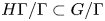 $H\Gamma /\Gamma \subset G/\Gamma$ is a homeomorphism and so the latter supports a unique up-to-a-scalar locally finite
 $H$-invariant measure which we also denote by
 $\mu _H$.
Now we take a sequence  $(g_n)$ in
 $G$ and ask what the possible limits of
 $(g_n)_*[\mu _H]:=[(g_n)_*\mu _H]$ are, where
 $[\mu ]$ denotes the equivalence class of a measure up to scaling (see the convention in§ 1.3). We assume that
 $\mu _H$ is infinite as otherwise it has been covered in the work of Eskin, Mozes and Shah [Reference Eskin, Mozes and ShahEMS97, Reference Eskin, Mozes and ShahEMS96].
1.1 Main theorem and its refinements
Theorem 1.2 Let  $(\boldsymbol {G},\boldsymbol {H})$ be as in Definition 1.1, let
 $\Gamma$ be an arithmetic subgroup of
 $\boldsymbol {G}(\mathbb {Q})$ and let
 $(g_n)$ be a sequence in
 $G$. Then either one of the following is true:
(1)
$(g_nH\Gamma /\Gamma )$ diverges topologically, that is, for any compact set $C\subset G/\Gamma$, there exists $n_C$ such that for all $n\geq n_C, g_nH\Gamma /\Gamma \cap C=\emptyset$;(2) there exists a subsequence
$(g_{n_k})_k$, an element $\delta \in G$ and an observable $\mathbb {Q}$-subgroup $\boldsymbol {L}$ of $\boldsymbol {G}$ such that $\lim _k (g_{n_k})_*[\mu _H]= \delta _*[\mu _{L}]$; in other words, there exists a sequence $(a_k)$ of positive real numbers such that $\lim _k ({1}/{a_k})(g_{n_k})_*\mu _H= \delta _*\mu _L$.








Suppose that we are in the second case and have already passed to the subsequence. Then we wish to know how to pin down what  $\boldsymbol {L}$ is. To see this, take a compact set
 $C$ that intersects non-trivially with
 $g_nH\Gamma /\Gamma$ for all
 $n$. It follows that one can write
 $g_n = \delta _n \gamma _n h_n$ for some sequence
 $(\delta _n)$ bounded in
 $G, (\gamma _n)$ in
 $\Gamma$ and
 $(h_n)$ from
 $H$. Then
 $(g_{n})_*\mu _H=(\delta _n\gamma _n)_*\mu _H$. By passing to a further subsequence, one may assume that
 $\lim \delta _n = \delta$ (this
 $\delta$ turns out to be the same
 $\delta$ as appeared in Theorem 1.2). Thus, it remains to understand the limit of
 $(\gamma _n)_*\mu _H$.
Theorem 1.3 Let  $(\boldsymbol {G},\boldsymbol {H})$ be as in Definition 1.1 and
 $\Gamma$ is an arithmetic subgroup of
 $\boldsymbol {G}(\mathbb {Q})$ and
 $(\gamma _n)$ be a sequence in
 $\Gamma$. Assume that
 $\boldsymbol {L}$ is an observable
 $\mathbb {Q}$-subgroup of
 $\boldsymbol {G}$ with
 $((\gamma _n),\boldsymbol {L})$ being potentially minimal for
 $\boldsymbol {H}$. Then
 $\lim _n (\gamma _{n})_*[\mu _H]=[\mu _{L}]$.
Potentially minimal means that  $\boldsymbol {L}$ contains conjugates of
 $\boldsymbol {H}$ by
 $\gamma _n$ for all
 $n$ and is minimal among observable subgroups that contains
 $\gamma _n \boldsymbol {H} \gamma _n^{-1}$ for infinitely many
 $n$ (see Definition 4.1). Such an
 $\boldsymbol {L}$ always exists after passing to a subsequence. Note that this theorem says that the convergence is essentially from ‘inside’ and this fact implies the following topological statement. The reader is referred to [Reference Benedetti and PetronioBP92, Chapter E.1], especially Proposition E.1.2, for the definition and basic properties of Chabauty topology.
Corollary 1.4 Use notation as in Theorem 1.2 and assume that case (1) does not happen. Then under the Chabauty topology  $g_{n_k}H\Gamma /\Gamma$ converges to
 $\delta L \Gamma /\Gamma$.
We also wish to know how to compute the asymptotic of  $(a_n)$ as this is uniquely determined once a normalization of
 $\mu _H$ and
 $\mu _L$ is fixed. When
 $\mu _H$ is finite,
 $(a_n)$ can be taken to be a constant sequence. In general, let
 $\boldsymbol {S}_{\boldsymbol {H}}$ be its maximal quotient
 $\mathbb {Q}$-split torus (e.g.,
 $\boldsymbol {S}_{\boldsymbol {H}}=\boldsymbol {H}$ if
 $\boldsymbol {H}$ itself is a
 $\mathbb {Q}$-split torus) of
 $\boldsymbol {H}$. Then the projection
 $H\to S_{\boldsymbol {H}}$ is a principal
 ${}^{\circ }\!H$-homogeneous (see § 2.1 for definitions) bundle over
 $S_{H}$ which factors through
 $\pi _{S_H}: H/H\cap \Gamma \to S_{\boldsymbol {H}}$ with fibers isomorphic to (translates of)
 ${}^{\circ }\!H/{}^{\circ }\!H\cap \Gamma$ which have finite volume. Note that for a bounded set
 $\mathcal {R}$ in
 $S_{H}$, its preimage
 $\mathcal {P}(\mathcal {R})$ in
 $H$ is right-invariant by
 $\Gamma _H$ and has finite measure in the quotient. In addition, if
 $\mathcal {R}$ is compact, then
 $\mathcal {P}(\mathcal {R})/\Gamma _H$ regarded as contained in
 $H\Gamma /\Gamma$ is closed in
 $G/\Gamma$ even when
 $\boldsymbol {H}$ is not observable. Then we hope to find a sequence of
 $\mathcal {R}_n$ such that the contribution of
 $(g_{n})_*\mu _H$ to the integration of a compactly supported function essentially comes from its restriction to
 $\mathcal {P}(\mathcal {R}_n)/\Gamma _H$. Then we wish to set
 $a_n$ to be the
 $\mu _H$-measure of
 $\mathcal {P}(\mathcal {R}_n)/\Gamma _H$.
A necessary condition for  $\mathcal {P}(\mathcal {R}_n)/\Gamma _H$ to contribute to the integral is that it comes back to a fixed compact set containing the support of the function after being pushed by
 $g_n$. To give a nice family of compact sets, we make use of Mahler's criterion. Thus, take a faithful observable
 $\mathbb {Q}$-representation
 $\rho$ of
 $\boldsymbol {G}$ into some
 $\operatorname {SL}_N$, whose existence will be guaranteed in § 2.1. We may and do assume that
 $\Gamma$ preserves the standard
 $\mathbb {Z}^N$ in the representation. Then we have a proper map
 $G/\Gamma \to \operatorname {SL}_N(\mathbb {R})/\operatorname {SL}_N(\mathbb {Z})$. According to Mahler's criterion, for
 $\eta >0$,
 \[ K_{\eta}(\rho):=\{[g]\in G/\Gamma, \|\rho(g)v\| \geq \eta , \forall v_{{\neq} 0} \in\mathbb{Z}^N\} \]
would be a family of compact sets. Thus, naively, one might define (for some  $\eta >0$) the region
 $\mathcal {P}_n$, which may not be of the form
 $\mathcal {P}(\mathcal {R}_n)$, to be those
 $h$ such that
 $\|g_nhv\|>\eta$ for all non-zero integral vectors
 $v$. This would be a good definition except that:
• to prove our main theorems, we need to go ‘deeper’ in this
$\mathcal {P}_n$, and to justify our arguments we need $\mathcal {P}_n$ to be of the form $\mathcal {P}(\mathcal {R}_n)$ with $\mathcal {R}_n$ being (the image under exponential map of) convex polytopes;• when applied to counting problems, we would like to explicitly compute the asymptotics of
$a_n$ for ‘generic’ $(g_n)$ and with this naive definition it is difficult.


To get such a region, we relax ourselves to demand  $\|g_nhv\|>\eta$ only for all integral weight vectors with respect to
 $\boldsymbol {H}$. Now
 $\mathcal {P}_n=\mathcal {P}(\mathcal {R}_n)$ are nice except that we may lose the non-divergence. We remedy this by:
• looking at more weight vectors from a bigger representation
$\rho ''$;• allowing perturbation by a fixed non-empty open bounded set
$\mathcal {O}$ in $H$.


Then we define  $\mathcal {P}_n=\mathcal {P}(g_n,\eta,\rho '',\Phi _{\rho ''})$ (see Definition 2.2 and (1) for the definition) and prove the following. The reader is referred to § 2.1 for precise definitions of undefined terms.
Theorem 1.5 Given a standard triple  $(\boldsymbol {G},\boldsymbol {H},\Gamma )$. Let
 $\rho ''$ be a superfaithful
 $\mathbb {Q}$-representation of
 $\boldsymbol {G}$. Take
 $\mathcal {O}$ to be a non-empty open bounded subset of
 $H$. For each sequence
 $(g_n)$ in
 $G, \eta >0$ and
 $h_n$ in
 $\mathcal {P}(g_n,\eta,\rho '',\Phi _{\rho ''})$, all weak-
 $*$ limits of
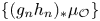 $\{(g_nh_n)_*\mu _{\mathcal {O}}\}$ in
 $G/\Gamma$ have the same total mass as
 $\mu _{\mathcal {O}}$.
There is a natural question about whether it is possible to reduce the amount of weight vectors that are needed. This will make the computation of  $a_n$ easier in practice. We state what we think is true and provide some evidence towards this in § 2.1.
Now we can state what  $a_n$ is in the special case when the limit measure is known to be finite. The reader is referred to § 4 for general cases.
Theorem 1.6 In the set-up of Theorem 1.3, assume also that  $\mu _L$ is finite and normalized to be a probability measure. Then we may take
 \[ a_n:= \mu_H(\mathcal{P}(\gamma_n,\eta,\rho'',\Phi_{\rho''})/\Gamma_H) \]
where  $\eta >0$ is any small enough positive number. That is,
 $\lim ({1}/{a_n})(\gamma _n)_*\mu _H = \mu _L$.
There is a similar statement in the set-up of Theorem 1.2.
In the set-up of Theorem 1.2, there are certain cases when non-divergence is automatically guaranteed for all possible sequences  $(g_n)$. Indeed, when
 $\boldsymbol {G}$ is reductive and
 $\boldsymbol {Z}_{\boldsymbol {G}}\boldsymbol {H}$ is assumed to be
 $\mathbb {Q}$-anisotropic, this has been achieved in [Reference Eskin, Mozes and ShahEMS96, Theorem 1.9]. Note that under these conditions,
 $\mu _H$ is implied to be finite. We prove a generalization when
 $\mu _H$ may not necessarily be finite. Maximal
 $\mathbb {Q}$-split tori in a reductive
 $\mathbb {Q}$-group
 $\boldsymbol {G}$ would be examples of such an
 $\boldsymbol {H}$ and there are also examples that do not contain a maximal
 $\mathbb {Q}$-split torus.
Theorem 1.7 Using the same notation as in Theorems 1.2 and 1.3, we assume in addition that  $\boldsymbol {G}$ and
 $\boldsymbol {H}$ are both reductive and
 $\boldsymbol {Z}_{\boldsymbol {G}}\boldsymbol {H}/\boldsymbol {Z}_{\boldsymbol {G}}\boldsymbol {H}\cap \boldsymbol {H}$ is
 $\mathbb {Q}$-anisotropic. Then:
• there exists a compact set
$C \subset G/\Gamma$ such that $g_nH\Gamma /\Gamma$ intersects $C$ non-trivially for all $n$. In other words, case (1) in Theorem 1.2 never happens;•
$\boldsymbol {L}$ is reductive.


Moreover, if  $(\gamma _n)$ (or, equivalently,
 $(g_n)$) diverges in
 $G/Z_{\boldsymbol {G}}\boldsymbol {S}$ for all non-trivial
 $\mathbb {Q}$-split tori
 $\boldsymbol {S}$ contained in the center of
 $\boldsymbol {H}$, then
 $\boldsymbol {L}$ is not contained in any proper
 $\mathbb {Q}$-parabolic subgroup of
 $\boldsymbol {G}$ and
 $\boldsymbol {G}$ has no non-trivial
 $\mathbb {Q}$-character. In particular,
 $\mu _L$ is finite.
Note that, conversely, if  $\boldsymbol {Z}_{\boldsymbol {G}}\boldsymbol {H}/\boldsymbol {Z}_{\boldsymbol {G}}\boldsymbol {H}\cap \boldsymbol {H}$ is not
 $\mathbb {Q}$-anisotropic, then case (1) in Theorem 1.2 does happen for certain
 $(g_n)$.
In the process of proving Theorem 1.7, we also obtain the following group-theoretical result (note that this is not a corollary of the unipotent rigidity theory).
Theorem 1.8 For two reductive  $\mathbb {Q}$-groups
 $\boldsymbol {H}\leq \boldsymbol {G}$. Assume the center of
 $\boldsymbol {G}$ is
 $\mathbb {Q}$-anisotropic. Then all observable
 $\mathbb {Q}$-subgroups of
 $\boldsymbol {G}$ containing
 $\boldsymbol {H}$ are reductive if and only if
 $\boldsymbol {Z}_{\boldsymbol {G}}\boldsymbol {H}/\boldsymbol {Z}_{\boldsymbol {G}}\boldsymbol {H}\cap \boldsymbol {H}$ is
 $\mathbb {Q}$-anisotropic.
Note that ‘if’ is the non-trivial direction. In the special case when  $\boldsymbol {G}$ is
 $\mathbb {Q}$-anisotropic, this is easy as there is no rational unipotent element. In the special case when
 $\boldsymbol {H}$ is a maximal torus, this is proved in [Reference GrosshansGro97, Lemma 3.10] where they also allow
 $\boldsymbol {G}$ to be non-reductive, which is not covered here.
1.2 Examples and applications
Now we turn to more explicit situations and some applications.
Proposition 1.9 Keep the notation as in Theorem 1.7. Suppose that  $\boldsymbol {H}$ is a maximal torus in
 $\boldsymbol {G}$ and for all diagonalizable
 $\mathbb {Q}$-subgroups
 $\boldsymbol {S}$ of
 $\boldsymbol {H}$ that properly contain
 $\boldsymbol {Z}(\boldsymbol {G})$, one has
 $(g_n)$ (or, equivalently,
 $(\gamma _n)$) diverges in
 $G/Z_{G}(S)$. Then
 $\boldsymbol {L}=\boldsymbol {G}$.
Note that, in general, it would be insufficient only to consider those subtori (namely, connected)  $\boldsymbol {S}$. A counterexample may be found in
 $\operatorname {SO}_{2N+1}$, where
 $\operatorname {SO}_{2N}$ is the centralizer of a disconnected diagonalizable subgroup. However, this is sufficient if
 $\boldsymbol {G}=\operatorname {SL}_N$ as was shown in [Reference Shapira and ZhengSZ19] and [Reference ZhangZha19]. We show that this also holds for the symplectic group
 $\operatorname {Sp}_{2N}$. Note that the centralizer of a torus is connected. For simplicity, we only treat the ‘generic’ case.
Proposition 1.10 Keep the notation as in Theorem 1.7. Suppose  $\boldsymbol {G}=\operatorname {Sp}_{2N}$ and
 $\boldsymbol {H}$ is a maximal
 $\mathbb {Q}$-torus. If
 $(g_n)$ diverges in
 $G/Z_{G}(S)$ for all non-trivial subtori
 $\boldsymbol {S}$ of
 $\boldsymbol {H}$, then
 $\boldsymbol {L}=\boldsymbol {G}$.
Using this we shall prove a counting result. Fix a polynomial  $p(t)$ of the form
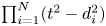 $\prod _{i=1}^N (t^2 -d_i^2)$ with
 $d_i\in \mathbb {Z}^+$ distinct. Consider
 $\boldsymbol {X}:= \{X\in \frak {sp}_{2N}, \det (tX-I_{2N})=p(t) \}$. Let
 $\|\cdot \|$ be the Euclidean norm on
 $2N \times 2N$ matrices.
Theorem 1.11 There exists a constant  $C>0$ such that
 \[ \lim_{R\to\infty} \frac{\#\{X\in \boldsymbol{X}(\mathbb{Z}), \|X\|\leq R \}}{CR^{N^2}(\ln{R})^{N}} =1. \]
A better, albeit not very explicit, description of  $C$ is given before Proposition 6.2.
Next we turn to a geometric application. Let  $\boldsymbol {H}^n\subset \mathbb {R}^n$ be the upper half space model of the
 $n$-dimensional hyperbolic space. Let
 $Q$ be the quadratic form
 $x_1^2+\cdots +x_n^2-y^2$ and
 $\boldsymbol {G}=\operatorname {SO}_{Q}$ be its symmetric group. We assume
 $\Gamma$, commensurable with
 $\boldsymbol {G}(\mathbb {Z})$, to be contained in
 $G$. Then
 $\Gamma$ naturally acts as isometries on
 $\boldsymbol {H}^n$, so we may form the quotient
 $\Gamma \backslash \boldsymbol {H}^n$ as a metric space. By abuse of notation, let
 $\pi _{\Gamma }$ denote the projection
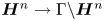 $\boldsymbol {H}^n\to \Gamma \backslash \boldsymbol {H}^n$. The set
 $\pi _{\Gamma }(\{(0,\ldots,0,t), t\in \mathbb {R}\})$ is (the base locus of) a divergent geodesic in the quotient
 $\Gamma \backslash \boldsymbol {H}^n$. Take a non-zero vector
 $\boldsymbol {v}=(v_1,\ldots,v_{n-1})\in \mathbb {R}^{n-1}$, which we identify with the boundary of
 $\boldsymbol {H}^n$ in
 $\mathbb {R}^n$. Now we start to ‘shear’ the geodesic by looking at the projection of
 $\mathcal {I}_{s\boldsymbol {v}}:=\{t(sv_1,\ldots,sv_{n-1},1), t\in \mathbb {R}\}$ as
 $s$ tends to
 $\infty$. For simplicity, we only discuss the generic case.
Theorem 1.12 Assume that  $\boldsymbol {v}$ is not contained in any proper
 $\mathbb {Q}$-linear subspace. Then under the Chabauty topology,
 $\pi _{\Gamma }(\mathcal {I}_{s\boldsymbol {v}})$ converges to
 $\Gamma \backslash \boldsymbol {H}^n$ as
 $s$ tends to
 $\infty$.
1.3 Summary of the paper
The main result of this paper is perhaps not surprising to the experts, but the technique of [Reference Eskin, Mozes and ShahEMS96] is not sufficient as in the current generality, it is not true that the limits of translate of a bounded piece of a homogeneous measure are again homogeneous. Hence, it is necessary to single out some ‘good pieces’ that do equidistribute to a homogeneous measure and prove that most pieces are either good or divergent.
In [Reference Shapira and ZhengSZ19], by exploring the properties of convex polytopes, they find that those problems reduce to showing that a certain family of polytopes contains balls of growing radius. This is also true for us. However, the method they employ to handle this does not seem to generalize. First, this is only true in the generic case, so they have to reduce to that case by doing induction. Luckily, due to the special property of  $\operatorname {SL}_n$, where the centralizer of a torus is a tori times products of
 $\operatorname {SL}_m$, hence the induction process does work. Second, in the generic case, by Iwasawa decomposition they assume that the sequence is all upper triangular matrices and they define a graph associated with this sequence and they argue with the graph, but, in general, we do not have a nice decomposition.
We resolve this by linking the properties of the polytopes to properties of being observable subgroups. In some sense, Lemma 4.10 is where our methods originate. The use of the language of linear algebraic groups makes our results achieve a quite general form. For instance, the ‘rigidity of torus’ is applied to handle the non-reductive case. In the reductive case (and assume the group  $\boldsymbol {H}$ is ‘large’), to make our conclusion even stronger, we use results from geometric invariant theory, which is also used, in a different way, to give a new proof of non-divergence.
In § 2.1, we define convex polytopes associated with the sequence and a representation and prove Theorem 1.5. This shows that most elements in those polytopes return to a compact set after translation. In § 2.2, we prove a finer result in the case of maximal split tori.
In § 4, we prove Theorems 1.2, 1.3, and 1.6. They are corollaries of Proposition 4.11. Some basic facts on polytopes and cones are collected in § 3. Then we recall [Reference Eskin, Mozes and ShahEMS96, Theorem 2.1] and enhance the statement in § 4.1. In § 4.2, we utilize the notion of observability to conclude the proof.
In § 5, we prove Theorems 1.7 and 1.8. In addition to Theorem 1.3, we also need the work of Kempf [Reference KempfKem78]. We also give an alternative short proof of non-divergence in this situation.
In the final section, § 6, we prove the examples and applications listed in the introduction. Even though we have a good understanding of limiting distribution of homogeneous measures, we still do not know how to find the asymptotic of integral points of bounded height on an affine homogeneous variety with respect to a general height. At the moment, it seems that each case requires a separate treatment.
Convention
We use the following notation throughout.
Definition 1.13 A standard triple  $(\boldsymbol {G},\boldsymbol {H},\Gamma )$ consists of the following data:
•
$\boldsymbol {G}$ is a connected linear algebraic group defined over $\mathbb {Q}$;•
$\boldsymbol {H}$ is a connected $\mathbb {Q}$-subgroup of $\boldsymbol {G}$;•
$\Gamma \leq \boldsymbol {G}(\mathbb {Q})$ is an arithmetic subgroup commensurable with $\boldsymbol {G}(\mathbb {Z})$.


If, furthermore,  $\boldsymbol {H}$ is an observable subgroup of
 $\boldsymbol {G}$, then we say that the standard triple is observable.
Let  $\iota$ be a
 $\mathbb {Q}$-embedding of
 $\boldsymbol {G}$ into
 $\operatorname {SL}_n$ for some
 $n$, then we say that
 $\Gamma$ is an arithmetic subgroup if
 $\Gamma$ is commensurable with
 $\iota ^{-1}(\operatorname {SL}_n(\mathbb {Z}))$. This notion is independent of the choice of
 $\iota$.
The definition of an observable subgroup has been given in Definition 1.1.
To simplify notation, we write  $\boldsymbol {G}$ also for
 $\boldsymbol {G}(\mathbb {C})$ for a linear algebraic group
 $\boldsymbol {G}$ over
 $\mathbb {C}$. If
 $\boldsymbol {G}$ is defined over
 $\mathbb {R}$, then the corresponding Roman letter
 $G$ denotes the analytic identity connected component of
 $\boldsymbol {G}(\mathbb {R})$. In addition,
 $\Gamma _H$ is defined to be
 $\Gamma \cap H$ for a
 $\mathbb {Q}$-subgroup
 $\boldsymbol {H}\leq \boldsymbol {G}$. We always assume
 $\Gamma$ to be contained in
 $G$ and write
 $\pi _{\Gamma }$ for the natural projection
 $G \to G/\Gamma$.
Given a standard triple  $(\boldsymbol {G},\boldsymbol {H},\Gamma )$, there exists a left
 $H$-invariant measure on
 $H/H\cap \Gamma$ (see [Reference RaghunathanRag72, Lemma 1.4]), which is denoted by
 $\mu _{H}$. This is only defined up to a positive scalar and we specify which one we pick whenever confusion might arise. If
 $\boldsymbol {H}$ is observable in
 $\boldsymbol {G}$, then the natural map from
 $H/H\cap \Gamma$ to
 $H\Gamma /\Gamma$ is a proper embedding into
 $G/\Gamma$ and we may push
 $\mu _H$ to a locally finite measure on
 $G/\Gamma$ supported on
 $H\Gamma /\Gamma$, which is still denoted by
 $\mu _H$. In this paper, we are mainly interested in the case when
 $\mu _H$ is infinite. For a non-empty open bounded subset
 $\mathcal {O}\subset H$, let
 $\mu _{\mathcal {O}}$ denote the restriction of
 $\mu _H$ to
 $\pi _{\Gamma _H}(\mathcal {O})$. One does not need
 $\boldsymbol {H}$ to be observable to push
 $\mu _{\mathcal {O}}$ to a locally finite measure on
 $G/\Gamma$.
Consider the collection of non-zero locally finite positive measures on a locally compact second countable space  $X$. Two such measures
 $\mu$ and
 $\nu$ are said to be equivalent iff there exists a positive real number
 $a>0$ such that
 $a\mu =\nu$. The equivalence class containing
 $\mu$ is denoted by
 $[\mu ]$. Whenever a measure
 $\mu$ is known to be finite we let
 $\hat {\mu }$ denote the unique probability measure in the equivalence class containing
 $\mu$. A sequence of classes
 $([\mu _n])_{n\in \mathbb {Z}^+}$ is said to converge to
 $[\nu ]$ if and only if one of the following equivalent conditions is satisfied (see [Reference Shapira and ZhengSZ19, Proposition 3.3]).
(1) For all
$f_1,f_2\in C_c(X)$, compactly supported continuous functions on $X$ such that $(f_2,\nu )\neq 0$ we have
\[ \lim_{n\to \infty} \frac{ \int f_1(x)\, d\mu_n(x) }{ \int f_2(x)\, d\mu_n(x)} =\frac{ \int f_1(x)\, d\nu(x)}{ \int f_2(x)\, d\nu(x)}. \](2) There exists a sequence of positive real numbers
$(a_n)$ such that for all $f\in C_c(X), ({1}/{a_n}) \langle f,\mu _n\rangle \to \langle f, \nu \rangle$.




The sequence  $(a_n)$ is also interesting so sometimes we keep track of this too. Note that by [Reference Shapira and ZhengSZ19, Proposition 3.3], the asymptotic of
 $(a_n)$ is uniquely determined once a set of representatives
 $\mu _n, \nu$ are fixed.
2. Representation and non-divergence
In this section, we discuss the problem of non-divergence mainly from the point view of representation theory. We also include a refined result in the case of maximal split tori of a semisimple group.
2.1 The general case
Let  $\boldsymbol {G}$ be a connected linear algebraic group and
 $\rho : \boldsymbol {G} \to \operatorname {GL}(\boldsymbol {V})$ be a representation over
 $\mathbb {Q}$. We let
 $X^*(\boldsymbol {G})$ (respectively,
 $X_*(\boldsymbol {G})$) be the
 $\mathbb {Z}$-module of
 $\mathbb {Q}$-characters (respectively,
 $\mathbb {Q}$-cocharacters) of
 $\boldsymbol {G}$. For each
 $\alpha \in X^*(\boldsymbol {G})$, let
 \[ \boldsymbol{V}_{\alpha}:=\{v\in \boldsymbol{V} \mid \rho(g) v=\alpha(g)v, \forall g\in \boldsymbol{G} \}, \quad \Phi_{\rho}:=\{\alpha\in X^{*}(\boldsymbol{G}) \mid \boldsymbol{V}_{\alpha}\neq \{0\} \}. \]
For  $\alpha \in X^*(\boldsymbol {G})$,
 $\boldsymbol {V}_{\alpha }$ is defined over
 $\mathbb {Q}$.
Let (see [Reference Borel and SerreBS73, Section 1.1])
 \[ {}^{{\circ}}\!\boldsymbol{G}:= \bigcap_{\alpha \in X^*(\boldsymbol{G})} \ker (\alpha^2), \quad \boldsymbol{S}_{\boldsymbol{G}}:= \boldsymbol{G} / {}^{{\circ}}\!\boldsymbol{G}, \]
then  $\boldsymbol {S}_{\boldsymbol {G}}$ is a
 $\mathbb {Q}$-split torus. Let
 $\pi _{S_G}:\boldsymbol {G} \to \boldsymbol {S}_{\boldsymbol {G}}$ be the natural projection. Note that for
 $s \in S_{\boldsymbol {G}}$ and
 $\alpha \in X^*(\boldsymbol {G})$,
 $\alpha (s)$ is well-defined. This is because
 $\alpha$ is trivial on
 ${}^{\circ }\!G$ (indeed,
 $\alpha (G)$ are positive numbers and so
 $\alpha (g)^2=1$ implies that
 $\alpha (g)=1$ for
 $g\in G$) and we also claim the following.
Lemma 2.1 We have  $S_{\boldsymbol {G}} = G/{}^{\circ }\!G$.
Proof. First, the natural map from  $G$ to
 $\boldsymbol {S}_{\boldsymbol {G}}(\mathbb {R})$ is surjective onto
 $S_{\boldsymbol {G}}$ as the image is connected. Hence,
 $S_{\boldsymbol {G}}=G/G\cap {}^{\circ }\!\boldsymbol {G} = G/G\cap {}^{\circ }\!\boldsymbol {G}(\mathbb {R})$. As
 ${}^{\circ }\!G$ is contained in both
 ${}^{\circ }\!\boldsymbol {G}(\mathbb {R})$ and
 $G$, it only remains to show the natural projection
 $\pi : G/{}^{\circ }\!G \to S_{\boldsymbol {G}}=G/G\cap {}^{\circ }\!\boldsymbol {G}(\mathbb {R})$ is injective. As
 $\boldsymbol {S}_{\boldsymbol {G}}$ is isomorphic to products of
 $\boldsymbol {G}_m$, the standard multiplicative group, we have that
 $S_{\boldsymbol {G}}$, as a Lie group, is isomorphic to products of
 $(\mathbb {R}_{>0},*)$. As
 $\pi$ is an isomorphism on Lie algebras and the kernel is finite, it is a covering map. However,
 $S_{\boldsymbol {G}}$ is simply connected, so it is a trivial covering map and we are done.
Therefore,  $d\alpha (t):=\ln \alpha (\exp {(t)})$ is also well-defined for
 $\alpha \in X^*(\boldsymbol {G})$ and
 $t \in \operatorname {Lie}(S_{\boldsymbol {G}})$.
Now take  $\boldsymbol {H}$ to be a
 $\mathbb {Q}$-subgroup of
 $\boldsymbol {G}$ and
 $\rho$ to be a
 $\mathbb {Q}$-representation of
 $\boldsymbol {H}$ that is obtained by restricting to
 $\boldsymbol {H}$ of some
 $\mathbb {Q}$-representation of
 $\boldsymbol {G}$. For a subset
 $\Phi \subset \Phi _{\rho }$, a
 $\mathbb {Z}$-structure on
 $\boldsymbol {V}_{\mathbb {Q}}$ (the dependence on which we often suppress), an element
 $g\in G$, and a positive real number
 $\varepsilon$ we define a polytope in the Lie algebra of
 $S_{\boldsymbol {H}}$ by
Definition 2.2
 \begin{align*} \Omega(g,\varepsilon,\rho,\Phi)&:= \Bigl \{ t\in \operatorname{Lie}(S_{\boldsymbol{H}}) \,\Big\vert\, \inf_{0\neq v \in \boldsymbol{V}_{\alpha}(\mathbb{Z})} \|g\exp{(t)}v\|\geq \varepsilon, \ \forall \,\alpha \in \Phi \Bigr \}\\ &= \Bigl \{ t \in \operatorname{Lie}(S_{\boldsymbol{H}}) \,\Big\vert\, d\alpha(t)\geq \ln\varepsilon -\ln \inf_{0\neq v \in \boldsymbol{V}_{\alpha}(\mathbb{Z})}\|gv\|,\ \forall \, \alpha\in \Phi \Big \}. \end{align*}
Note that  $\exp {(t)}v$ for
 $v$ in
 $\boldsymbol {V}_{\alpha }$ is well-defined up to
 $\pm$ sign. These definitions make sense even when
 $S_{\boldsymbol {H}}=\{e\}$ in which case
 $\Omega$ is either
 $\{0\}$ or empty.
There is a slightly different situation that we encounter later in § 4. Take  $(\boldsymbol {G},\boldsymbol {H},\Gamma )$ to be a standard triple. Let
 $\boldsymbol {L}$ be another connected
 $\mathbb {Q}$-subgroup of
 $\boldsymbol {G}$. Let
 $X(\boldsymbol {H},\boldsymbol {L})$ be the set of
 $g \in \boldsymbol {G}$ such that
 $g \boldsymbol {H} g^{-1}$ is contained in
 $\boldsymbol {L}$. For each
 $\gamma \in X(\boldsymbol {H},\boldsymbol {L})\cap \Gamma$, let
 $\boldsymbol {c}_{\gamma }$ be the morphism from
 $\boldsymbol {H}$ to
 $\boldsymbol {L}$ defined by
 $h\mapsto \gamma h \gamma ^{-1}$. Now take a
 $\mathbb {Q}$-representation
 $(\rho, \boldsymbol {V})$ of
 $\boldsymbol {L}$, which may not extend to a representation of
 $\boldsymbol {G}$. To define the analogous
 $\Phi _{\rho }$ in this case, we can certainly pull back
 $\Phi _{\rho \vert _{\boldsymbol {c}_{\gamma }\boldsymbol {H}}}$ to
 $X^*(\boldsymbol {H})$ but it depends on the choice of
 $\gamma$. Thus, we instead define in this case
 $\Phi _{\rho,\boldsymbol {L}}$ to be the set
 $\{\boldsymbol {c}_{\gamma }^* \Phi _{\rho \vert _{\boldsymbol {c}_{\gamma }\boldsymbol {H}}}\}$ as
 $\gamma$ ranges over
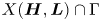 $X(\boldsymbol {H},\boldsymbol {L})\cap \Gamma$. We have the following result.
Lemma 2.3 The set  $\Phi _{\rho,\boldsymbol {L}}$ is a finite set.
Proof. First, we show that if  $(\beta _n)$ is an unbounded sequence in
 $X^*(\boldsymbol {H})$, then there exists an element
 $h$ in
 $\boldsymbol {H}(\mathbb {Q})$ such that
 $(\beta _n(h))_{n}$ has unbounded denominator. As
 $\boldsymbol {H}$ is connected,
 $X^*(\boldsymbol {H})$ is a free
 $\mathbb {Z}$-module. Fix a
 $\mathbb {Z}$-basis
 $\{\alpha _1,\ldots,\alpha _l\}$ of the free
 $\mathbb {Z}$-module
 $X^*(\boldsymbol {H})$. Write
 $\beta _n= \prod _i \alpha _i^{a_n^i}$. By passing to a subsequence, we may assume that
 $(a^{i_0}_n)$ diverges to
 $+\infty$ (the case of
 $-\infty$ is similar) for some fixed
 $i_0$. Now take
 \[ h \in \boldsymbol{H}(\mathbb{Q}) \cap ( \cap_{i\neq i_0} \ker \alpha_i) \]
such that  $\alpha _{i_0}(h)\notin \mathbb {Z}$. Then
 $\beta _n(h)= \alpha _{i_0}(h)^{a^{i_0}_n}$ has unbounded denominators.
Now if  $\Phi _{\rho,\boldsymbol {L}}$ were an infinite set, then there would exist
 $\gamma _n \in X(\boldsymbol {H},\boldsymbol {L})\cap \Gamma$ and
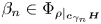 $\beta _n \in \Phi _{\rho \vert _{\boldsymbol {c}_{\gamma _n}\boldsymbol {H}}}$ such that
 $\boldsymbol {c}_{\gamma _n}^*(\beta _n)$ is unbounded in
 $X^*(\boldsymbol {H})$. Find an element
 $h\in \boldsymbol {H}$ as in the last paragraph.
Fix an integral structure on  $\boldsymbol {V}$. For each
 $n$, let
 $v_n$ be a primitive vector in
 $\boldsymbol {V}$ that is a non-zero weight vector with respect to
 $\rho (\boldsymbol {c}_{\gamma _n}(\boldsymbol {H}))$ with weight
 $\beta _n$. Then
 $\rho (\boldsymbol {c}_{\gamma _n}(h))v_n = \boldsymbol {c}_{\gamma _n}^*(\beta _n)(h)v_n$ is a rational vector with unbounded denominators.
On the other hand, as  $(\gamma _n)$ have bounded denominators,
 $(\boldsymbol {c}_{\gamma _n}(h))$ and, hence,
 $(\rho (\boldsymbol {c}_{\gamma _n}(h)))$ have bounded denominators. Having bounded denominators in
 $\boldsymbol {L}$ means that after identifying
 $\boldsymbol {L}$ as a
 $\mathbb {Q}$-subgroup of some
 $\operatorname {SL}_N$, all coefficients of
 $(\boldsymbol {c}_{\gamma _n}(h))$ have bounded denominators. This notion is independent of the identification. Therefore,
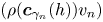 $(\rho (\boldsymbol {c}_{\gamma _n}(h))v_n)$ have bounded denominators. This is a contradiction.
Definition 2.4 For  $\gamma \in X(\boldsymbol {H},\boldsymbol {L})\cap \Gamma$ and a subset
 $\Phi$ of
 $\boldsymbol {c}_{\gamma }^* \Phi _{\rho \vert _{\boldsymbol {c}_{\gamma }\boldsymbol {H}}}$, we define
 \begin{align*} \Omega(\boldsymbol{c}_{\gamma},\varepsilon,\rho,\Phi)&:= \Big \{ t\in \operatorname{Lie}(S_{\boldsymbol{H}}) \,\Big\vert\, \inf_{0\neq v \in \boldsymbol{V}_{\alpha}(\mathbb{Z})} \|(\gamma\exp{(t)}{\gamma}^{{-}1})v\|\geq \varepsilon, \ \forall \, \alpha \in (\boldsymbol{c}_{\gamma})_*\Phi \Big \}\\ &= \Big \{ t \in \operatorname{Lie}(S_{\boldsymbol{H}}) \,\Big\vert\, d ({ \alpha\circ\boldsymbol{c}_{\gamma}})(t)\geq \ln\varepsilon -\ln \inf_{0\neq v \in \boldsymbol{V}_{\alpha}(\mathbb{Z})}\|v\|,\ \forall \, \alpha\in (\boldsymbol{c}_{\gamma})_*\Phi \Big \}. \end{align*}
If  $\gamma$ is assumed to preserve the integral structure on the representation and
 $\boldsymbol {L}=\boldsymbol {G}$, then
 $\Omega (\gamma,\varepsilon,\rho,\Phi )= \Omega (\boldsymbol {c}_{\gamma },\varepsilon,\rho,\Phi )$.
In both situations, we define
 \begin{equation} \begin{aligned} & \mathcal{P}(g,\varepsilon,\rho,\Phi):= \{h\in H \mid \pi_{S_H} (h) \in \exp(\Omega(g,\varepsilon,\rho,\Phi))\}, \\ & \mathcal{P}(\boldsymbol{c}_{\gamma},\varepsilon,\rho,\Phi):= \{h\in H \mid \pi_{S_H} (h) \in \exp(\Omega(\boldsymbol{c}_{\gamma},\varepsilon,\rho,\Phi))\}. \end{aligned} \end{equation}
Both are right invariant by  ${}^{\circ }\!\boldsymbol {H}(\mathbb {R})$ and, hence, by
 $\Gamma _{H}$ as
 $\Gamma _{H}$ is contained in
 ${}^{\circ }\!\boldsymbol {H}(\mathbb {R})$.
Proposition 2.5 Let  $(\boldsymbol {G},\boldsymbol {H},\Gamma )$ be a standard triple. Take a
 $\mathbb {Q}$-representation
 $(\rho,\boldsymbol {V})$ of
 $\boldsymbol {G}$. Define
 $\rho '$ to be
 $\bigoplus _{i}\bigwedge ^i\rho \big \vert _{\boldsymbol {H}}$. Take a non-empty open bounded subset
 $\mathcal {O}\subset H$ and a positive number
 $\eta >0$. Then there exists
 $\varepsilon >0$ such that for all
 $g\in G, h\in \mathcal {P}(g,\eta,\rho ',\Phi _{\rho '})$ and
 $v_{\neq 0}\in \boldsymbol {V}(\mathbb {Z})$, we have the inequality
 \[ \sup_{o\in \mathcal{O}} \| g ho\cdot v \|\geq \varepsilon. \]
Proof. Consider
 \[ \mathscr{F}:=\{ f : \boldsymbol{H} \to \mathbb{C} \mid f(h)=\langle hv,l\rangle, \exists v\in \boldsymbol{V} ,\ l\in \boldsymbol{V}^* \} \]
where the angled bracket denotes the natural pairing between  $\boldsymbol {V}$ and
 $\boldsymbol {V}^*$. Then
 $\mathscr {F}$ is a finite-dimensional vector space. Because
 $\mathcal {O}\cap \boldsymbol {H}(\mathbb {Q})$ is Zariski-dense in
 $\boldsymbol {H}$, the natural map
 $\mathscr {F} \to \mathscr {F}\vert _{\mathcal {O}\cap \boldsymbol {H}(\mathbb {Q})}$ is an isomorphism. As this is finite-dimensional, we may further find a finite subset
 $\Lambda \subset {\mathcal {O}\cap \boldsymbol {H}(\mathbb {Q})}$ such that
 $\mathscr {F} \to \mathscr {F}\vert _\Lambda$ is an isomorphism. This implies that
 $f\in \mathscr {F}$ vanishes on
 $\Lambda$ iff it vanishes on
 $\boldsymbol {H}$. We may find a positive integer
 $N$ such that
 $\Lambda \cdot \boldsymbol {V}(\mathbb {Z}) \subset ({1}/{N})\boldsymbol {V}(\mathbb {Z})$. Now we fix a non-zero
 $v\in \boldsymbol {V}(\mathbb {Z})$.
Let  $W$ be the
 $\mathbb {Q}$-linear subspace of
 $\boldsymbol {V}(\mathbb {Q})$ generated by
 $\boldsymbol {H}(\mathbb {Q})\cdot v$.
 $W_{\mathbb {C}}$ is
 $\boldsymbol {H}$-invariant. For
 $A\subset \boldsymbol {H}(\mathbb {Q}), A\cdot v$ spans
 $W$ iff all linear functionals
 $l$ that vanish on
 $A\cdot v$ also vanish on
 $W$. This is a condition on
 $\mathscr {F}$ and, hence,
 $\Lambda \cdot v$ spans
 $W$ and we may choose
 $\{\lambda _1,\ldots,\lambda _k\}\subset \Lambda$ such that
 $\{\lambda _i v\}_i$ forms a basis of
 $W$. Let
 $w:= \lambda _1 v \wedge \lambda _2 v\wedge \cdots \wedge \lambda _k v$, then
 $N^kw \in \bigwedge ^k\boldsymbol {V}(\mathbb {Z})$. In addition,
 $\boldsymbol {H}(\mathbb {Q})$ preserves the line spanned by
 $w$. Hence, by the definition of
 $\Omega (g,\eta,\rho ',\Phi _{\rho '})$, we have
 \[ N^k\|gh ({\wedge} \lambda_i v)\| = \|g\pi_{S_H}(h)(N^kw)\| \geq \eta. \]
On the other hand,
 \[ N^k\|gh ({\wedge} \lambda_i v)\| \leq N^k \prod_i \|gh\lambda_i v\| \leq N^k \sup_{o\in \mathcal{O}} \| gho\cdot v \|^k, \]
therefore,
 \[ \sup_{o\in \mathcal{O}} \| gho\cdot v \| \geq \eta^{1/k}N. \]
Taking  $\varepsilon :=\eta ^{1/k}N$ completes the proof.
Similarly, we have the following result.
Proposition 2.6 Let  $(\boldsymbol {G},\boldsymbol {H},\Gamma )$ be a standard triple and
 $\boldsymbol {L}$ be another
 $\mathbb {Q}$-subgroup of
 $\boldsymbol {G}$. Take a
 $\mathbb {Q}$-representation
 $(\rho,\boldsymbol {V})$ of
 $\boldsymbol {L}$. Define
 $\rho '$ to be
 $\bigoplus _{i}\bigwedge ^i\rho$. Take a non-empty open bounded subset
 $\mathcal {O}\subset H$ and a positive number
 $\eta >0$. Then there exists
 $\varepsilon >0$ such that for all
 $\gamma \in X(\boldsymbol {H},\boldsymbol {L})\cap \Gamma, h\in \mathcal {P}(\boldsymbol {c}_{\gamma },\eta,\rho ',\boldsymbol {c}_{\gamma }^*\Phi _{\rho '\vert _{\boldsymbol {c}_{\gamma }\boldsymbol {H}}})$ and
 $v_{\neq 0}\in \boldsymbol {V}(\mathbb {Z})$, we have the inequality
 \[ \sup_{o\in \mathcal{O}} \| \boldsymbol{c}_{\gamma}(ho)\cdot v \|\geq \varepsilon. \]
Proof. Indeed the set of functions
 \[ \mathscr{F}:=\{ f : \boldsymbol{H} \to \mathbb{C} \mid f(h)=\langle \boldsymbol{c}_{\gamma} (h) v,l\rangle, \exists v\in \boldsymbol{V} , l\in \boldsymbol{V}^*, \gamma \in X(\boldsymbol{H},\boldsymbol{L})\cap \Gamma \} \]
is also finite-dimensional. The rest of the proof is almost identical as in Proposition 2.5 which we omit.
To relate this proposition with non-divergence, we need the notion of  $(C,\alpha )$-good functions. Take a bounded open non-empty subset
 $\mathcal {D}$ in
 $\operatorname {Lie}(H)$. For a representation
 $(\rho,\boldsymbol {V})$ of
 $\boldsymbol {G}$ and a pair
 $(v,l)\in \boldsymbol {V} \times \boldsymbol {V}^*$ and
 $g\in G$, define
 $\phi _{g,v,l}: \mathcal {D}\to \mathbb {C}$ by
 \[ \phi_{g,v,l}(x):=\langle g\exp{(x)}v,l \rangle \]
where the angled bracket denotes the natural pairing between  $\boldsymbol {V}$ and
 $\boldsymbol {V}^*$. Similarly, if
 $\boldsymbol {L}$ is a connected
 $\mathbb {Q}$-subgroup of
 $\boldsymbol {G}$ and
 $(\rho,\boldsymbol {V})$ is a representation of
 $\boldsymbol {L}$, for
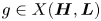 $g\in X(\boldsymbol {H},\boldsymbol {L})$ and a pair
 $(v,l)\in \boldsymbol {V}\times \boldsymbol {V}^*$ we define
 $\phi _{\boldsymbol {c}_{g},v,l}: \mathcal {D}\to \mathbb {C}$ by
 \[ \phi_{\boldsymbol{c}_{g},v,l}(x):=\langle \boldsymbol{c}_{g}(\exp{(x)}) v,l \rangle. \]
Then there exist two positive numbers  $C$ and
 $\alpha$ such that for all
 $(v,l)\in \boldsymbol {V} \times \boldsymbol {V}^*$ and
 $g\in G, \phi _{g,v,l}$ is
 $(C,\alpha )$-good which means that (see [Reference Kleinbock and MargulisKM98, Section 3])
 \[ \frac{1}{|B|} |\{ x \in B \mid |\phi_{g,v,l}(x)|\leq \varepsilon\} | \leq C \bigg(\frac{\varepsilon}{\sup_{x\in B}|\phi_{g,v,l}(x)|}\bigg)^{\alpha} \]
holds for all  $\varepsilon >0$ and open balls
 $B\subset \mathcal {D}$ where
 $|\cdot |$ denotes a standard Lebesgue measure on
 $\operatorname {Lie}(H)$. Therefore,
 $\phi _{g,v}(x):=\|g\exp (x)v\|$ is also
 $(C,\alpha )$-good on
 $\mathcal {D}$ where we take
 $\|\cdot \|$ to be a sup-norm with respect to some basis of
 $\boldsymbol {V}$ (see [Reference Kleinbock and MargulisKM98, Lemma 3.1]).
Similarly, if we fix  $\boldsymbol {L}$ and a representation
 $(\rho,\boldsymbol {V})$ of
 $\boldsymbol {L}$, there exist two positive numbers
 $C$ and
 $\alpha$ such that for all
 $(v,l)\in \boldsymbol {V} \times \boldsymbol {V}^*$ and
 $g \in X(\boldsymbol {H},\boldsymbol {L}), \phi _{\boldsymbol {c}_{g},v,l}$ is
 $(C,\alpha )$-good. In addition,
 $\phi _{\boldsymbol {c}_g,v}(x):=\|\boldsymbol {c}_g(\exp (x))v\|$ is
 $(C,\alpha )$-good.
In both cases, the set of functions  $\phi _{g,v,l}$ and
 $\phi _{\boldsymbol {c}_{g},v,l}$ as
 $g,v,l$ varies span a finite-dimensional space of analytic functions on
 $\mathcal {D}$. Hence, [Reference Kleinbock and MargulisKM98, Proposition 3.4] implies that there exist two positive constants
 $C, \alpha$ such that these two collections of functions in the vector spaces spanned are
 $(C,\alpha )$-good.
We also need a qualitative version of a theorem of Kleinbock and Margulis [Reference Kleinbock and MargulisKM98, Theorem 5.2]. We have implicitly chosen a sup-norm in the representation space.
Theorem 2.7 Given a  $\mathbb {Q}$-linear algebraic group
 $\boldsymbol {G}$ and connected
 $\mathbb {Q}$-subgroups
 $\boldsymbol {H}$ and
 $\boldsymbol {L}$. Let
 $\mathcal {D}$ be a non-empty open bounded subset in
 $\operatorname {Lie}(H)$. Take a representation
 $(\rho _1,\boldsymbol {V}_1)$ (respectively,
 $(\rho _2,\boldsymbol {V}_2)$) of
 $\boldsymbol {G}$ (respectively,
 $\boldsymbol {L}$). We fix an integral structure on
 $\boldsymbol {V}_1$ (respectively,
 $\boldsymbol {V}_2$). There exist constants
 $C'>0,\alpha >0$ and
 $0<\eta <({1}/{\dim \boldsymbol {V}_i})$ (
 $i=1$ or
 $2$) such that the following is true. For each ball
 $B=B(b,r)$ such that
 $B(b, 3^{\dim \boldsymbol {V}_1}r)\subset \mathcal {D}$ and
 $g\in G$ satisfying that
 \[ \sup_{x \in B}\|g\exp{(x)}v\| \geq \eta \quad \forall \, v_{{\neq} 0} \text{ pure wedge in } \bigwedge^{i}\boldsymbol{V}_1(\mathbb{Z}),\quad \forall \, i, \]
we have, for all  $\varepsilon \leq \eta$,
 \[ \frac{1}{|B|} \Big | \Big \{x \in B \,\Big\vert\, \inf_{0\neq v\in \boldsymbol{V}_1(\mathbb{Z})} \|g\exp{(x)}v\| \geq \varepsilon \Big \} \Big | \leq C'\bigg(\frac{\varepsilon}{\eta}\bigg)^{\alpha}. \]
Similarly, for all balls  $B=B(b,r)$ such that
 $B(b, 3^{\dim \boldsymbol {V}_2}r)\subset \mathcal {D}$ and
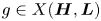 $g\in X(\boldsymbol {H},\boldsymbol {L})$ satisfying that
 \[ \sup_{x \in B}\|\boldsymbol{c}_{g}(\exp{(x)})v\| \geq \eta \quad \forall v_{{\neq} 0} \text{ pure wedge in } \bigwedge^{i}\boldsymbol{V}_2(\mathbb{Z}),\quad \forall \, i, \]
we have, for all  $\varepsilon \leq \eta$,
 \[ \frac{1}{|B|} \Big | \Big \{ x \in B \,\Big\vert\, \inf_{0\neq v\in \boldsymbol{V}_2(\mathbb{Z})} \|\boldsymbol{c}_{g}\exp{(x)}v\| \geq \varepsilon \Big \}\Big | \leq C' \bigg(\frac{\varepsilon}{\eta}\bigg)^{\alpha}. \]
For a  $\mathbb {Q}$-representation
 $(\rho,\boldsymbol {V})$ of
 $\boldsymbol {G}$ (respectively,
 $\boldsymbol {L}$) in
 $\operatorname {SL}(\boldsymbol {V})$, to transfer non-divergence on
 $\operatorname {SL}(V)/\operatorname {SL}(\boldsymbol {V}_\mathbb {Z})$ back to
 $G/\Gamma$ (respectively,
 $L/\Gamma _L$), we need
 $\rho (\boldsymbol {G})$ (respectively,
 $\rho (\boldsymbol {L})$) to be an observable subgroup of
 $\operatorname {SL}(\boldsymbol {V})$. Recall that a representation
 $\rho :\boldsymbol {G}\to \operatorname {SL}_N$ is said to be observable if its image is an observable subgroup of
 $\operatorname {SL}_N$. Let
 $\boldsymbol {G}_m$ be the linear algebraic group over
 $\mathbb {Q}$ whose
 $\mathbb {Q}$-points are
 $\mathbb {Q}^{\times }$. We record here a useful lemma.
Lemma 2.8 Let  $\{\boldsymbol {V}_i\}_{i=1,\ldots,l}$ be vector spaces. The group
 $(\boldsymbol {G}_m)^l$ naturally acts on
 $\prod _i (\boldsymbol {V}_i \backslash \{0\})$ and
 $\bigotimes \boldsymbol {V}_i$. Then the natural map
 $(\prod _i (\boldsymbol {V}_i \backslash \{0\})) /\boldsymbol {G}^l_m \to (\bigotimes \boldsymbol {V}_i)/\boldsymbol {G}^l_m$ is injective.
Proof. Indeed if  $\prod v_i$ and
 $\prod w_i$ coincide in
 $(\bigotimes \boldsymbol {V}_i)/\boldsymbol {G}^l_m$, then there exists
 $\{a_i\} \subset \mathbb {C}^{\times }$ such that
 $\otimes v_i = \otimes a_i \cdot w_i$. This implies that for each
 $i=1,\ldots,l$, the line represented by
 $v_i$ is the same as those represented by
 $w_i$. Therefore, there exists
 $\{b_i\}\subset \mathbb {C}^{\times }$ such that
 $v_i = b_i \cdot w_i$ for each
 $i$. This shows that
 $\prod v_i$ and
 $\prod w_i$ coincide in
 $(\prod _i (\boldsymbol {V}_i \backslash \{0\})) /\boldsymbol {G}^l_m$.
Lemma 2.9 For each  $\mathbb {Q}$-representation
 $\rho :\boldsymbol {G}\to \operatorname {GL}_n$ there exists an observable
 $\mathbb {Q}$-representation
 $\rho ':\boldsymbol {G}\to \operatorname {SL}_N$ containing
 $\rho$ as a direct summand.
Proof. By taking the direct sum  $\rho \oplus \det ^{-1}\circ \rho$ we assume that
 $\rho$ actually lands in
 $\operatorname {SL}_n$.
By Chevalley's lemma (see [Reference SpringerSpr98, Lemma 5.5.1]), there is a representation  $\psi :\operatorname {SL}_n \to \operatorname {SL}(\boldsymbol {V})$ and a non-zero
 $\mathbb {Q}$-vector
 $v$ such that
 $g\in \operatorname {SL}_n$ stabilizes the line
 $[v]$ spanned by
 $v$ iff
 $g$ is contained in
 $\rho (\boldsymbol {G})$. Then there is a character
 $\alpha : \boldsymbol {G} \to \boldsymbol {G}_m$ such that
 $\psi \circ \rho (g)v=\alpha (g)v$. Take
 $N=n +2$ and let
 \[ \rho'(g):= \left[ \begin{array}{c|c} \rho(g) & \\ \hline & \begin{array}{cc} \alpha(g) & \\ & \alpha^{-1}(g) \end{array} \end{array} \right]. \]
It is clear that the image of  $\rho '$ lands in
 $\operatorname {SL}_{N}$ and
 $\rho$ is a direct summand of
 $\rho '$. We claim that
 $\rho '$ is observable.
Embed  $\operatorname {SL}_n$ into
 $\operatorname {SL}_N$ in the upper-left corner and define
 \[ \boldsymbol{F}=\left[ \begin{array}{c|c} \operatorname{SL}_n & \\ \hline & \begin{array}{cc} t & \\ & t^{-1} \end{array} \end{array} \right]. \]
First, we extend  $\psi$ to a
 $\boldsymbol {F}\to \operatorname {SL}(\boldsymbol {V})$ such that
 \[ \left[ \begin{array}{c|c} I_n & \\ \hline & \begin{array}{cc} t & \\ & t^{-1} \end{array} \end{array} \right]\]
acts as identity.
As  $\boldsymbol {F}$ is observable in
 $\operatorname {SL}_N$, we may take a representation
 $(\tilde {\psi }_1, \widetilde {\boldsymbol {V}}_1)$ of
 $\operatorname {SL}_N$ whose restriction to
 $\boldsymbol {F}$ contains
 $\psi$ as a direct summand by condition (iii) in Definition 1.1 and by the fact that
 $\boldsymbol {F}$ is semisimple. In particular, there exists a non-zero
 $\mathbb {Q}$-vector
 $\tilde {v}_1$ such that
 $g\in \operatorname {SL}_n$ stabilize
 $[\tilde {v}_1]$ iff
 $g$ is contained in
 $\rho (\boldsymbol {G})$ and
 $\rho (g)$ acts by
 $\alpha (g)$. Let
 $(\tilde {\psi }_2, \widetilde {\boldsymbol {V}}_2)$ be the standard representation of
 $\operatorname {SL}_N$ and
 $\tilde {v}_2$ to be
 $e_{N}=e_{n+2}$. Then
 $\rho '(\boldsymbol {G})$ fixes the vector
 $\tilde {v}_1\otimes \tilde {v}_2$. Moreover, by Lemma 2.8,
 $g\in \boldsymbol {F}$ fixes
 $\tilde {v}_1\otimes \tilde {v}_2$ iff
 $g$ is contained in
 $\rho '(\boldsymbol {G})$.
Now take  $\widetilde {v}_3:=e_{1}\wedge \cdots \wedge e_n$ and
 $\widetilde {v}_4:=e_{n+1}\otimes e_{n+2}$. Then
 $g\in \operatorname {SL}_N$ fixes
 $\widetilde {v}_3\oplus \widetilde {v}_4$ iff
 $g$ is contained in
 $\boldsymbol {F}$. Hence,
 $\rho '(\boldsymbol {G})$ is exactly the stabilizer of
 $\widetilde {v}_1 \otimes \widetilde {v}_2 \oplus \widetilde {v}_3 \oplus \widetilde {v}_4$. Thus, it follows that
 $\rho '(\boldsymbol {G})$ and
 $\rho '$ are observable.
Given a faithful observable  $\mathbb {Q}$-representation, assuming
 $\rho (\boldsymbol {G}(\mathbb {Z}))\subset \operatorname {SL}_N(\mathbb {Z})$, the induced map
 $G / \boldsymbol {G}(\mathbb {Z}) \to \operatorname {SL}_N(\mathbb {R})/\operatorname {SL}_N(\mathbb {Z})$ is well-defined and is a proper map. Combined with Mahler's criterion, we have the following lemma.
Lemma 2.10 Let  $\boldsymbol {G}$ be a linear algebraic group over
 $\mathbb {Q}$ and
 $\Gamma \leq \boldsymbol {G}(\mathbb {Q})$ be commensurable with
 $\boldsymbol {G}(\mathbb {Z})$. Take a faithful observable
 $\mathbb {Q}$-representation
 $\rho : \boldsymbol {G}\to \operatorname {SL}(\boldsymbol {V})$ and a lattice
 $\boldsymbol {V}(\mathbb {Z})\subset \boldsymbol {V}(\mathbb {Q})$ that is preserved by
 $\Gamma$. Define for each
 $\varepsilon >0$,
 \[ K_{\varepsilon}(\rho):= \Big \{ \pi(g)\in G/\Gamma \, \Big\vert\, \inf_{0\neq v \in \boldsymbol{V}(\mathbb{Z})}\|gv\| \geq \varepsilon \Big \}. \]
Then as  $\varepsilon >0$ varies,
 $\{K_{\varepsilon }(\rho )\}$ is a family of compact sets and the union of their interior covers
 $G/\Gamma$.
Proposition 2.5, Theorem 2.7, and Lemma 2.10 together imply the following result.
Proposition 2.11 Use the same notation as in Proposition 2.5, and we further assume that the  $\mathbb {Q}$-representation
 $(\rho,\boldsymbol {V})$ is faithful into
 $\operatorname {SL}(\boldsymbol {V})$ and observable. Let
 $\rho ''$ be a further exterior product
 $\bigoplus _{i}\bigwedge ^i\rho '$. Then, for any
 $\delta >0$ and
 $\eta >0$, there exist
 $\varepsilon >0$ such that for all
 $g\in G, h\in \mathcal {P}(g,\eta,\rho '',\Phi _{\rho ''})$ we have
 \[ \hat{\mu}_{\mathcal{O}}\{\pi_{\Gamma}(o) \mid \pi_{\Gamma}(gho) \in K_{\varepsilon}(\rho) \} \geq 1-\delta. \]
In particular, for any  $\eta >0, \{g_n\}\subset G$ and
 $h_n\in \mathcal {P}(g_n,\eta,\rho '',\Phi _{\rho ''})$, all weak-
 $*$ limits of
 $(g_nh_n)_{*}\hat {\mu }_{\mathcal {O}}$ are probability measures.
Recall that  $\mu _{\mathcal {O}}$ is the restriction of the Haar measure on
 $H\Gamma /\Gamma$ to the image of
 $\mathcal {O}$ in
 $H\Gamma /\Gamma$ and it is normalized to a probability measure
 $\hat {\mu }_{\mathcal {O}}$. Similarly, we have the following result.
Proposition 2.12 Use the same notation as in Proposition 2.6, and we further assume that the  $\mathbb {Q}$-representation
 $(\rho,\boldsymbol {V})$ is faithful into
 $\operatorname {SL}(\boldsymbol {V})$ and observable. Let
 $\rho ''$ be a further exterior product
 $\bigoplus _{i}\bigwedge ^i\rho '$. Then for any
 $\delta >0$ and
 $\eta >0$, there exists
 $\varepsilon >0$ such that for all
 $\gamma \in X(\boldsymbol {H},\boldsymbol {L})\cap \Gamma, h\in \mathcal {P}(\boldsymbol {c}_{\gamma },\eta,\rho '',\boldsymbol {c}_{\gamma }^*\Phi _{\rho ''\vert _{\boldsymbol {c}_{\gamma }\boldsymbol {H}}})$ we have
 \[ \hat{\mu}_{\mathcal{O}}\{\pi_{\Gamma}(o) \mid \pi_{\Gamma}(\boldsymbol{c}_{\gamma}(ho)) \in K_{\varepsilon}(\rho) \} \geq 1-\delta. \]
In particular, for  $\eta >0$, a sequence
 $(\gamma _n)$ in
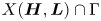 $X(\boldsymbol {H},\boldsymbol {L})\cap \Gamma$ such that all
 $\boldsymbol {c}_{\gamma _n}^*\Phi _{\rho ''\vert _{\boldsymbol {c}_{\gamma _n}\boldsymbol {H}}}$ are equal to the same
 $\Phi$ and a sequence
 $(h_n)$ with
 $h_n$ in
 $\mathcal {P}(\boldsymbol {c}_{\gamma _n},\eta,\rho '',\Phi )$ for each
 $n$, all weak-
 $*$ limits of
 $(\gamma _nh_n)_{*}\hat {\mu }_{\mathcal {O}}$ are probability measures.
Recall that by Lemma 2.3, as  $n$ varies, there are only finitely many different
 $\boldsymbol {c}_{\gamma _n}^*\Phi _{\rho ''\vert _{\boldsymbol {c}_{\gamma _n}\boldsymbol {H}}}$. Thus, we may always assume that all
 $\boldsymbol {c}_{\gamma _n}^*\Phi _{\rho ''\vert _{\boldsymbol {c}_{\gamma _n}\boldsymbol {H}}}$ are equal to the same
 $\Phi$ after passing to a subsequence.
The converse of Propositions 2.11 and 2.12 is also true.
Lemma 2.13 For  $\varepsilon >0$, a non-empty open bounded set
 $\mathcal {O}\subset H$, a representation
 $\rho _1:\boldsymbol {G}\to \operatorname {SL}(\boldsymbol {V})$ over
 $\mathbb {Q}$, and another faithful observable
 $\mathbb {Q}$-representation
 $\rho _2$ defining
 $K_{\varepsilon }(\rho _2)$, there exists
 $\eta >0$ such that for all
 $g\in G$ and
 $h\in H$ satisfying
 \[ \pi_{\Gamma}(gh\mathcal{O}) \cap K_{\varepsilon}(\rho_2) \neq \emptyset, \]
we have  $h\in \mathcal {P}(g,\eta,\rho _1,\Phi _{\rho _1})$. Similar statements hold in the other situation. Namely, take
 $\varepsilon >0$ and
 $\mathcal {O}$ as previously. Let
 $\rho _1'$ be a
 $\mathbb {Q}$-representation of
 $\boldsymbol {L}$ and
 $\rho _2'$ be another faithful observable
 $\mathbb {Q}$-representation of
 $\boldsymbol {L}$ defining
 $K_{\varepsilon }(\rho _2')$. Then there exists
 $\eta '>0$ such that for all
 $\gamma \in X(\boldsymbol {H},\boldsymbol {L})\cap \Gamma$ and
 $h \in H$ satisfying
 \[ \pi_{\Gamma}(\boldsymbol{c}_{\gamma}(h\mathcal{O}))\cap K_{\varepsilon}(\rho_2') \neq \emptyset, \]
we have that  $h\in \mathcal {P}(\boldsymbol {c}_{\gamma },\eta, \rho _1', \Phi )$ for
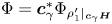 $\Phi =\boldsymbol {c}_{\gamma }^* \Phi _{\rho _1'\vert _{\boldsymbol {c}_{\gamma }\boldsymbol {H}}}$.
Note that the action of  $\mathcal {O}$ on a weight vector is just multiplying by a bounded (both away from zero and from above) constant. Hence, this lemma follows by definition and Lemma 2.3.
Definition 2.14 We say a  $\mathbb {Q}$-representation
 $\rho :\boldsymbol {G} \to \operatorname {SL}_N$ is superfaithful iff there exists a faithful observable
 $\mathbb {Q}$-representation
 $\iota : \boldsymbol {G} \to \operatorname {SL}_n$ such that
 $\rho$ contains
 \[ \bigoplus_{i, j\in\mathbb{Z}_{{\geq} 0}} \bigwedge^i\bigg(\bigwedge^j \iota\bigg) \]
as a direct summand.
Such a representation always exists thanks to Lemma 2.9, and Theorem 1.5 follows from Proposition 2.11. Note that a superfaithful representation is still faithful and observable.
2.2 Case of maximal split tori
Let  $\boldsymbol {G}$ be a semisimple group over
 $\mathbb {Q}$ and
 $\boldsymbol {H}$ be a maximal
 $\mathbb {Q}$-split torus in
 $\boldsymbol {G}$. Let
 $\mathcal {W}$ be the
 $\mathbb {Q}$-Weyl group associated with
 $\boldsymbol {H}$. Fix a set of representative
 $\dot {\mathcal {W}}$ of
 $\mathcal {W}$ in
 $\boldsymbol {G}(\mathbb {Q})$. In addition, fix a
 $\mathbb {Z}$-structure on
 $\frak {g}$ which is preserved by
 $\operatorname {Ad}(\Gamma )$. For each
 $\mathbb {Q}$-parabolic subgroup
 $\boldsymbol {P}$, let
 $v_{\boldsymbol {P}}$ be the unique up to sign primitive vector in
 $\wedge ^{\dim \boldsymbol {P}}\frak {g}_{\mathbb {Z}}$ that represents the Lie algebra of
 $\boldsymbol {P}$. That is,
 $v_{\boldsymbol {P}}=v_1\wedge \cdots \wedge v_{\dim \boldsymbol {P}}$ for a
 $\mathbb {Z}$-basis
 $\{v_1,\ldots,v_{\dim \boldsymbol {P}}\}$ of
 $\operatorname {Lie}(\boldsymbol {P})\cap \frak {g}_{\mathbb {Z}}$. Note that
 $\gamma \cdot v_{\boldsymbol {P}} = v_{\gamma \boldsymbol {P} \gamma ^{-1}}$. For
 $g\in G$, define
 $d_{\boldsymbol {P}}(g):=\|g\cdot v_{\boldsymbol {P}} \|$ where the
 $G$-action is induced from the adjoint action. Analogous to Mahler's criterion, by using reduction theory, the following can be shown to hold.
Proposition 2.15 Define for  $\eta >0$,
 \[ K_{\eta}:=\{[g]\in G/\Gamma \mid d_{\boldsymbol{P}}(g) \geq \eta , \text{ for all maximal proper }\mathbb{Q}\text{-parabolic subgroups } \boldsymbol{P} \}. \]
Then  $\{K_{\eta }\}_{\eta >0}$ forms a family of compact sets and the union of their interiors covers
 $G/\Gamma$.
Let  $\mathscr {P}$ denote the set of maximal proper
 $\mathbb {Q}$-parabolic subgroups of
 $\boldsymbol {G}$ and
 $\mathscr {P}_{\boldsymbol {H}}$ denote those containing
 $\boldsymbol {H}$. In the present case,
 $\mathscr {P}_{\boldsymbol {H}}$ is a finite set. For
 $g\in G, \varepsilon >0$, define
 \begin{equation} \Omega_{g,\varepsilon}:=\{ t\in \operatorname{Lie}(H) \mid d_{\boldsymbol{P}}(g\exp{(t)}) \geq \varepsilon,\ \forall \boldsymbol{P} \in \mathscr{P}_{\boldsymbol{H}} \} \end{equation}
which is a bounded convex polytope with finitely many sides. Note that  $d_{\boldsymbol {P}}(g\exp {(t)})$ is equal to
 $\exp (d\alpha _{\boldsymbol {P}}(t))d_{\boldsymbol {P}}(g)$ for some character
 $\alpha _{\boldsymbol {P}}$ depending on
 $\boldsymbol {P}$.
The following has been shown in [Reference Eskin, Mozes and ShahEMS97]. A different proof can be obtained by modifying the argument in [Reference Kleinbock and MargulisKM98].
Theorem 2.16 Fix a non-empty open bounded subset  $\mathcal {O}$ of
 $H$ and two positive numbers
 $\varepsilon$ and
 $\delta$. Then there exists another positive number
 $\eta$, depending on
 $\varepsilon$,
 $\delta$, and
 $\mathcal {O}$, such that for all
 $g\in G$ satisfying
 \[ \sup_{o\in\mathcal{O}}\|gov_{\boldsymbol{P}}\| > \varepsilon,\quad \forall \boldsymbol{P}\in\mathscr{P}, \]
we have
 \[ \widehat{\mu}_{\mathcal{O}} \{o \in \mathcal{O} \mid \pi_{\Gamma}(go) \notin K_{\eta} \} < \delta. \]
This is going to be applied in combination with the following.
Proposition 2.17 Fix a non-empty open bounded subset  $\mathcal {O}$ of
 $H$ and a positive number
 $\varepsilon$. Then there exists another
 $\varepsilon '>0$ such that for all
 $t \in \Omega _{g,\varepsilon }$,
 \[ \sup_{o\in\mathcal{O}}\|g\exp{(t)}ov_{\boldsymbol{P}}\| > \varepsilon',\quad \forall \, \boldsymbol{P}\in\mathscr{P}. \]
Hence, whenever  $\boldsymbol {H}$ is a maximal
 $\mathbb {Q}$-split torus in a semisimple group
 $\boldsymbol {G}$, one can use
 $\Omega _{g,\varepsilon }$ to compute the asymptotic of ‘
 $a_n$’. This will be needed for Theorem 1.11.
Before we start the proof of Proposition 2.17, we need [Reference Eskin, Mozes and ShahEMS97, Lemma 4.1] adapted to our situation.
Lemma 2.18 For a set of distinct characters  $\{\alpha _1,\ldots,\alpha _n\}$ on
 $\boldsymbol {H}$ and a non-empty open set
 $\mathcal {O}$ in
 $H$. Fix a vector space
 $V$ and a norm
 $\|\cdot \|$. Then there exists
 $\kappa >0$ such that for any
 $n$ vectors
 $v_1,\ldots,v_n$, one has
 \[ \sup_{o\in\mathcal{O}} \bigg\|\sum_i \alpha_i(o) v_i\bigg\| \geq \kappa \sup_i \|v_i\|. \]
Proof of Proposition 2.17 By reduction theory (see [Reference BorelBor19, Proposition 15.6]), there exists  $N_0 \in \mathbb {Z}^+$ such that for all
 $\boldsymbol {P} \in \mathscr {P}$, there exists
 $\gamma _{\boldsymbol {P}} \in \boldsymbol {G}(\mathbb {Q})$ and
 $\boldsymbol {P}' \in \mathscr {P}_{\boldsymbol {H}}$ such that
 \[ v_{\boldsymbol{P}} = {\lambda}\gamma_{\boldsymbol{P}}\cdot v_{\boldsymbol{P}'} \]
for some  ${1}/{N_0}\leq |\lambda | \leq N_0$. For each character
 $\alpha$ of
 $\boldsymbol {H}$ appearing in the adjoint representation and all its exterior powers, define
 $\pi _{\alpha }$ to be the projection to the corresponding weight space. After enlarging
 $N_0$, we may assume that
 $\pi _{\alpha }$ maps each integral vector to some vector that is either zero or has norm at least
 ${1}/{N_0}$. Let
 $\kappa >0$ be such that the conclusion of Lemma 2.18 holds with
 $V$ being equal to the Lie algebra of
 $\boldsymbol {G}$ and all its exterior powers and
 $\{\alpha _1,\ldots,\alpha _n\}$ being all weights of
 $\boldsymbol {H}$ that appear in the adjoint action and all its exterior powers.
Now fix a maximal proper  $\mathbb {Q}$-parabolic subgroup
 $\boldsymbol {P}_0$, choose
 $\gamma _0 \in \boldsymbol {G}(\mathbb {Q})$,
 $\boldsymbol {P}_0' \in \mathscr {P}_{\boldsymbol {H}}$, and
 ${1}/{N_0}\leq \lambda _0\leq N_0$ such that
 $v_{\boldsymbol {P}_0}=\lambda _0\gamma _0 \cdot v_{\boldsymbol {P}'_0}$. Take
 $\boldsymbol {P}_1'$ to be a minimal parabolic subgroup that is contained in
 $\boldsymbol {P}'_0$ and contains
 $\boldsymbol {H}$. Then
 $\boldsymbol {P}_1'=\boldsymbol {M}'_1\cdot \boldsymbol {H} \cdot \boldsymbol {U}_1'$ where
 $\boldsymbol {U}_1'$ is the unipotent radical of
 $\boldsymbol {P}_1'$ and
 $\boldsymbol {M}'_1\leq \boldsymbol {Z}_{\boldsymbol {H}}\boldsymbol {G}$ is
 $\mathbb {Q}$-anisotropic. Note that
 $\boldsymbol {M}'_1$ fixes
 $v_{\boldsymbol {P}}$ for all
 $\boldsymbol {P}$ containing
 $\boldsymbol {H}$ and preserves each weight space of
 $\boldsymbol {H}$.
By Bruhat decomposition, one can write  $\gamma _{0}= z_0 u_0 w_0 p_0$ for some
 $z_0 \in \boldsymbol {M}'_1(\mathbb {Q})$,
 $u_0 \in \boldsymbol {U}_1'(\mathbb {Q})$,
 $w_0 \in \dot {\mathcal {W}}$, and
 $p_0 \in \boldsymbol {P}_1'(\mathbb {Q})$. Hence,
 \[ \gamma_0 v_{\boldsymbol{P}_0'} = a_1 \cdot(z_0 u_0)\cdot v_{w_0\boldsymbol{P}_0'w_0^{{-}1}} = a_0 v_{w_0\boldsymbol{P}_0'w_0^{{-}1}} + \sum v_{\alpha} \]
for some  $a_0, a_1\neq 0$ and some weight vectors
 $v_{\alpha }$ with respect to certain characters
 $\alpha$ of
 $\boldsymbol {H}$ that are distinct from that corresponding to
 $w_0\boldsymbol {P}_0'w_0^{-1}$. To see why
 $v_{\alpha }$ have different weights, one may write
 $u_0$ as the exponential of some nilpotent element
 $n_0$ whose action always shifts the weight, that is, the
 $\alpha$-component of
 $n_0\cdot v_{\alpha }$ vanishes for all weights
 $\alpha$. In addition, remember that
 $z_0$ preserves each weight space. Thus, if
 $\alpha _0$ is the weight corresponding to
 $w_0\boldsymbol {P}_0'w_0^{-1}$, then
 \[ a_0 v_{w_0\boldsymbol{P}_0'w_0^{{-}1}}=\pi_{\alpha_0}(\gamma_0 v_{\boldsymbol{P}_0'} )= \pi_{\alpha_0}(\lambda_0^{{-}1} v_{\boldsymbol{P}_0}), \]
implying  $|a_0| \geq {1}/{N_0^2}$. Now take
 $t\in \Omega _{g,\varepsilon }$,
 \begin{align*} \sup_{o\in\mathcal{O}}\|g\exp{(t)}ov_{\boldsymbol{P}_0}\| &= \sup_{o\in\mathcal{O}}\|\lambda_0 g\exp{(t)} o \gamma_0v_{\boldsymbol{P}'_0}\| \\ &= \sup_{o\in\mathcal{O}}\bigg\|\lambda_0 g\exp{(t)} o \cdot \bigg(a_0 v_{w_0\boldsymbol{P}_0'w_0^{{-}1}} + \sum_{\alpha\neq \alpha_0} v_{\alpha}\bigg)\bigg\|\\ &= |\lambda_0| \sup_{o\in\mathcal{O}} \bigg\|g \exp{(t)} \bigg(\alpha_0 (o) a_0v_{w_0\boldsymbol{P}_0'w_0^{{-}1}}+ \sum_{\alpha\neq \alpha_0} \alpha (o) v_{\alpha}\bigg)\bigg\| \\ &= |\lambda_0|\sup_{o\in\mathcal{O}} \bigg\| \alpha_0 (o) g \exp{(t)} a_0 v_{w_0\boldsymbol{P}_0'w_0^{{-}1}} + \sum_{\alpha\neq \alpha_0} \alpha (o) g \exp{(t)} v_{\alpha}\bigg\|\\ &\geq\kappa|\lambda_0| \cdot \|g \exp{(t)} a_0 v_{w_0\boldsymbol{P}_0'w_0^{{-}1}}\|\\ &\geq \kappa |\lambda_0| \varepsilon |a_0| \geq \frac{1}{N_0^3}\kappa\varepsilon . \end{align*}
Setting  $\varepsilon ':=({1}/{N_0^3})\kappa \varepsilon$ then concludes the proof.
3. Polytopes and cones
In this section, we give some preliminaries on polytopes to be used in the next section.
For  $V$ a finite-dimensional
 $\mathbb {R}$-vector space and
 $\Phi \subset V^*$ a finite collection of linear functionals, we define the following.
Definition 3.1 We define
 \[ \operatorname{Cone}(\Phi):=\{v\in V \mid \alpha(v) \geq 0, \forall \alpha\in \Phi\}. \]
We also define
 \begin{align*} \Phi_{\operatorname{sing}}&:= \bigcup \bigg\{ I \subset \Phi\,\vert\, \exists \{a_{\beta}\}_{\beta \in I} \subset \mathbb{R}_{{>}0},\ \sum_{\beta\in I} a_{\beta}\beta=0 \bigg\}, \\ \Phi_{\operatorname{reg}}&:= \Phi \backslash \Phi_{\operatorname{sing}}, \end{align*}
where  $\Phi _{\operatorname {sing}}$ is to indicate that the cone defined by it degenerates.
Definition 3.2 Define  $W(\Phi )$ to be the
 $\mathbb {R}$-linear subspace spanned by
 $\operatorname {Cone}(\Phi )$ and
 $\pi _{W(\Phi )}:V\to V/W(\Phi )$ to be the natural projection. Moreover, if
 $V$ is equipped with a Euclidean metric, we identify
 $V/W(\Phi )$ as the orthogonal complement
 $U(\Phi )$ of
 $W(\Phi )$ in
 $V$.
Let  $\Phi '_{\operatorname {sing}}:=\{\alpha \in \Phi, \alpha \vert _{W(\Phi )} =0 \}$.
Lemma 3.3 We have  $\Phi _{\operatorname {sing}}=\Phi '_{\operatorname {sing}}$ and
 $W(\Phi ) =\ker \Phi _{\operatorname {sing}}$.
Proof. We write  $W=W(\Phi )$ in the proof. First, note that for each
 $\alpha \in \Phi \setminus \Phi '_{\operatorname {sing}}$ there exists
 $v_{\alpha } \in \operatorname {Cone}(\Phi )$ such that
 $\alpha (v_{\alpha })>0$ . Let
 $v_0:=\sum _{\alpha \in \Phi \setminus \Phi '_{\operatorname {sing}}} v_{\alpha }\in \operatorname {Cone}(\Phi )\subset W$. Then
 $\alpha (v_{\alpha })>0$ for all
 $\alpha \in \Phi \setminus \Phi '_{\operatorname {sing}}$. Thus, for
 $w \in \operatorname {Cone}(\Phi '_{\operatorname {sing}})$ small enough,
 $v_0+w$ is still contained in
 $\operatorname {Cone}(\Phi )\subset W$ and, hence,
 $w$ is in
 $W$. However, by definition, we have that
 $\ker \Phi '_{\operatorname {sing}}\subset \operatorname {Cone}(\Phi '_{\operatorname {sing}})$ and
 $W\subset \ker \Phi '_{\operatorname {sing}}$, so
 $\operatorname {Cone}(\Phi '_{\operatorname {sing}})=W=\ker (\Phi '_{\operatorname {sing}})$. It remains to show
 $\Phi _{\operatorname {sing}}=\Phi '_{\operatorname {sing}}$.
For  $\alpha _0 \in \Phi _{\operatorname {sing}}$, find
 $\alpha _1,\ldots,\alpha _k \in \Phi _{\operatorname {sing}}$ and
 $a_0,\ldots,a_k >0$ such that
 $\sum a_i \alpha _i=0$. For any
 $v\in \operatorname {Cone} (\Phi ), 0=\sum a_i\alpha _i(v)$ and each term is non-negative, so we have that
 $\alpha _i(v)=0$ for all
 $i$. In particular,
 $v\in \ker \alpha$ and
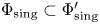 $\Phi _{\operatorname {sing}} \subset \Phi '_{\operatorname {sing}}$.
The harder direction is 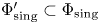 $\Phi '_{\operatorname {sing}} \subset \Phi _{\operatorname {sing}}$. Consider
 $\langle \Phi ' \rangle _{\mathbb {R}_{\geq 0}}$, the set of non-negative linear combination of elements from
 $\Phi '$. Similarly, define
 $\langle \Phi ' \rangle _{\mathbb {R}}$. We first show that
 $0\in V^*$ is contained in the relative interior of
 $\langle \Phi ' \rangle _{\mathbb {R}_{\geq 0}}$ viewed as a subspace of
 $\langle \Phi ' \rangle _{\mathbb {R}}$. Indeed, if not true, then
 $0$ is in the relative boundary of
 $\langle \Phi ' \rangle _{\mathbb {R}_{\geq 0}}$. By the Hahn–Banach theorem, there exists
 $v\in V$ such that
 $\alpha (v)\geq 0$ for all
 $\alpha \in \Phi '_{\operatorname {sing}}$ and there exists
 $l$ in
 $\langle \Phi ' \rangle _{\mathbb {R}_{\geq 0}}$ such that
 $l(v)>0$. Therefore,
 $\alpha (v)> 0$ for some
 $\alpha \in \Phi '_{\operatorname {sing}}$. This is a contradiction to
 $\operatorname {Cone}(\Phi '_{\operatorname {sing}})=\ker (\Phi '_{\operatorname {sing}})$. Once this is true, for any
 $\alpha \in \Phi '_{\operatorname {sing}}$ and
 $a>0$ small enough,
 $-a \alpha$ is still in the cone and can be written as non-negative linear combinations of elements from
 $\Phi '_{\operatorname {sing}}$. By the definition of
 $\Phi _{\operatorname {sing}}$, we have
 $\alpha \in \Phi _{\operatorname {sing}}$.
Built on this lemma, we can show the following (in the following,  $\operatorname {Map}(\Phi,\mathbb {R})$ denotes the set of set-theoretically maps from
 $\Phi$ to
 $\mathbb {R}$).
Lemma 3.4 Let  $V$ be a finite-dimensional
 $\mathbb {R}$-vector space equipped with a Euclidean metric and
 $\Phi \subset V^*$ be a finite collection of linear functionals on
 $V$. For each
 $\boldsymbol {a}\in \operatorname {Map}(\Phi,\mathbb {R})$, we define
 $\Omega (\Phi,\boldsymbol {a}):=\{ v\in V, \alpha (v)\geq \boldsymbol {a}(\alpha ) \ \forall \, \alpha \in \Phi \}$. Assume that we are given a decomposition
 $\Phi =\Phi _0\sqcup \Phi _1\sqcup \Phi _{\infty }$ and a sequence of
 $\{\boldsymbol {a}_n\} \subset \operatorname {Map}(\Phi,\mathbb {R}_{\geq 0})$ satisfying:
(1) there exists
$\boldsymbol {a}_0 \in \operatorname {Map}(\Phi _0\sqcup \Phi _1,\mathbb {R})$ such that $\boldsymbol {a}_n\vert _{\Phi _0\sqcup \Phi _1} = \boldsymbol {a}_0$ for all $n$;(2) for all
$\alpha \in \Phi _{\infty }, \boldsymbol {a}_n(\alpha )$ diverges to $+\infty$;(3) let
$\tilde {\Phi }:=\Phi _1\sqcup \Phi _0$, then $\Phi _1=\tilde {\Phi }_{\operatorname {reg}}$ and $\Phi _0=\tilde {\Phi }_{\operatorname {sing}}$.


Then we can find  $\{\omega _n\}$, a diverging sequence of positive numbers, such that
 \[ \lim_{n\to \infty} \frac{{\rm Vol}( \Omega(\Phi_{\infty}\sqcup \Phi_1, -\boldsymbol{a}_n+\omega_n) \cap \Omega(\Phi_{0}, -\boldsymbol{a}_n) )} {{\rm Vol}( \Omega(\Phi, -\boldsymbol{a}_n) )} =1. \]
In fact, let  $U$ be the orthogonal complement of
 $W=W(\Phi )$ in
 $V$ and denote by
 $\pi ^U_W$ the orthogonal projection onto
 $U$. Then there exists
 $\{\omega '_n\}$ and
 $\{\omega _n\}$ two diverging sequences of positive numbers, such that if we define
 \[ \Omega^{\rm spl}_n:=\pi^U_W \big(\Omega(\Phi_0,-\boldsymbol{a}_0) ) \oplus (W \cap \Omega(\Phi_{\infty}\sqcup \Phi_1,-\boldsymbol{a}_n+\omega'_n)), \]
then
 \[ \lim_{n\to \infty} \frac{{\rm Vol}( \Omega^{\rm spl}_n )} {{\rm Vol}( \Omega(\Phi, -\boldsymbol{a}_n) )} =1 \]
and  $\Omega ^{\rm spl}_n$ is contained in
 $\Omega (\Phi _{\infty }\sqcup \Phi _1, -\boldsymbol {a}_n+\omega _n) \cap \Omega (\Phi _{0}, -\boldsymbol {a}_n)$ for
 $n$ large enough.
The notation  $\Omega ^{\rm spl}_n$ is used to indicate that the polytope splits as a direct sum of two subspaces.
When  $\Phi _{0}=\emptyset$, this has been treated in [Reference Shapira and ZhengSZ19]. For simplicity write
 $\Omega _n(\omega _n)$ for
 $\Omega (\Phi _{\infty }\sqcup \Phi _1, -\boldsymbol {a}_n+\omega _n) \cap \Omega (\Phi _{0}, -\boldsymbol {a}_n)$ so
 $\Omega (\Phi, -\boldsymbol {a}_n)= \Omega _n(0)$. Note that
 $x\in W=\ker \Phi _0$ is contained in
 $\Omega (\Phi _0,-\boldsymbol {a}_0)$ if
 $\boldsymbol {a}_0\geq 0$. We also write
 $U_0$ for
 $\pi ^U_W(\Omega (\Phi _0,-\boldsymbol {a}_0))$, then with this notation
 $\Omega ^{\rm spl}_n= U_0 + (W\cap \Omega _n(\omega _n'))$.
The reader may find it helpful to keep the following example in mind. Take  $V=\mathbb {R}^3$ with standard basis
 $\{\boldsymbol {e}_1,\boldsymbol {e}_2,\boldsymbol {e}_3\}$ and write its dual basis as
 $\{\boldsymbol {f}_1,\boldsymbol {f}_2,\boldsymbol {f}_3\}$. Let
 $\Phi :=\{\boldsymbol {f}_3, -\boldsymbol {f}_3, -\boldsymbol {f}_1-\boldsymbol {f}_2, \boldsymbol {f}_1-\boldsymbol {f}_2, \boldsymbol {f}_2\}$,
 $\boldsymbol {a}_{n}(\boldsymbol {f}_3)=0$,
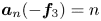 $\boldsymbol {a}_{n}(-\boldsymbol {f}_3)=n$, and
 $\boldsymbol {a}_{n}(-\boldsymbol {f}_1-\boldsymbol {f}_2)=\boldsymbol {a}_{n}(\boldsymbol {f}_1-\boldsymbol {f}_2)=\boldsymbol {a}_{n}(\boldsymbol {f}_2)=-1$. Then one can check that
 $\Phi _{\infty }=\{-\boldsymbol {f}_3\}, \Phi _1=\{\boldsymbol {f}_3\}$ and
 $\Phi _0=\{ -\boldsymbol {f}_1-\boldsymbol {f}_2, \boldsymbol {f}_1-\boldsymbol {f}_2, \boldsymbol {f}_2\}$. In addition,
 $W=\mathbb {R}\boldsymbol {e}_3$ and
 $\Omega (\Phi, -\boldsymbol {a}_n)$ is a cylinder based on a fixed triangle with the ceiling keeping growing and the floor remaining fixed. The projection
 $\pi _W$ in this case can be regarded as crushing the cylinder into its base triangle.
Proof. It suffices to prove the second asymptotic and the claim on the last line. First, we note the following.
Claim 3.0.1
For every sequence  $(\omega _n)$ of real numbers such that for all
 $\alpha \in \Phi _{\infty }, \boldsymbol {a}_n(\alpha )-\omega _n$ diverges to
 $+\infty$ we have that
 $\pi _W(\Omega _n(\omega _n))= \pi _W(\Omega (\Phi _0,-\boldsymbol {a}_0))$ for
 $n$ large enough, and both are bounded. Consequently, the same thing is true replacing
 $\pi _W$ by
 $\pi ^U_W$.
Proof of Claim 3.0.1 The non-trivial direction is to show that  $\pi _W(\Omega _n(\omega _n))$ contains
 $\pi _W(\Omega (\Phi _0,-\boldsymbol {a}_0))$.
First we claim that  $\pi _W(\Omega (\Phi _0,-\boldsymbol {a}_0))$ is bounded. Indeed
 $\Phi _0$ descends to a set of functionals
 $\overline {\Phi _0}$ on
 $V/W$. If not bounded then we can find a ray
 $\mathbb {R}_{\geq 0}\cdot x$ in
 $\pi _W(\Omega (\Phi _0,-\boldsymbol {a}_0))$, that is,
 $\bar {\alpha }(rx)\geq -\boldsymbol {a}_0$ for all
 $r \geq 0$ and
 $\alpha \in \overline {\Phi _0}$. Hence
 $\bar {\alpha }(x)\geq 0$ for all
 $\bar {\alpha } \in \overline {\Phi _0}$. As there are strictly positive numbers
 $a_{\alpha }$ such that
 $\sum a_{\alpha }\alpha =0$. We conclude that
 $\bar {\alpha }(x) = 0$, hence
 $x=0$ by the definition of
 $W$.
Now we take a compact set  $B \subset \Omega (\Phi _0,-\boldsymbol {a}_0)$ such that
 $\pi _W(B)=\pi _W(\Omega (\Phi _0,-\boldsymbol {a}_0))$. It suffices to show that for
 $v\in B$,
 $\pi _W(v)$ is contained in
 $\pi _W(\Omega _n(\omega _n))$, or in other words,
 $v+W \cap \Omega _n(\omega _n)\neq \emptyset$. As
 $\Phi$ is a finite set, we can find
 $b>0$ such that
 $\alpha \vert _{B}>-b$ for all
 $\alpha \in \Phi$. We also take
 $v_0\in W$ as in the proof of Lemma 3.3 such that
 $\alpha (v_0)>0$ for all
 $\alpha \in \Phi _1$. Then we can find
 $r_0>0$ such that
 $\alpha (v+r_0v_0)> -\boldsymbol {a}_0$ for all
 $\alpha \in \Phi _1$ and
 $v\in B$. Now there exists a possibly different
 $b'>0$ such that
 $\alpha \vert _{B+r_0v_0}>-b'$ for all
 $\alpha \in \Phi _{\infty }$. Take
 $n$ such that
 $\boldsymbol {a}_n(\alpha )-\omega _n> b'$ and
 $v \in B$, we show that
 $v+W\cap \Omega _n(\omega _n)$ is non-empty, which is sufficient to conclude the proof. Indeed, for
 $\alpha \in \Phi _{\infty }$,
 $\alpha (v+r_0v_0)>-b'>-\boldsymbol {a}_n(\alpha )+\omega _n$. In addition, inequalities for
 $\Phi _1$ and
 $\Phi _0$ have already been verified. Thus, we are done.
Hence, for any choice of  $\omega _n$ with
 $\boldsymbol {a}_n(\alpha )-\omega _n$ diverging to
 $+\infty$ and for
 $n$ large enough,
 \[ \Omega_n(\omega_n) = \bigcup_{u\in U_0} (u+W) \cap \Omega_n(\omega_n). \]
As  $U_0$ is bounded we can find a number
 $\omega _0>0$ such that for every choice of
 $\{\omega _n\}$ and each
 $u\in U_0$,
 \begin{gather*} (u+W) \cap \Omega_n(\omega_n) \supset u+ (W\cap \Omega_n(\omega_n+\omega_0)),\\ (u+W) \cap \Omega_n(0) \subset u+ (W\cap \Omega_n(-\omega_0) ). \end{gather*}
In particular, the first containment says that  $\Omega ^{\rm spl}_n= U_0+(W\cap \Omega _n(\omega _n'))$ is contained in
 $\Omega _n(\omega _n)$.
In addition, the second containment implies that
 \[ \frac{{\rm Vol} (U_0+(W\cap \Omega_n(\omega_n'))) } { {\rm Vol} (\Omega_n(0)) } \geq \frac{{\rm Vol} (U_0+(W\cap \Omega_n(\omega_n'))) } { {\rm Vol}\big(U_0+(W\cap \Omega_n(-\omega_0))\big) }. \]
As  $\operatorname {Cone}(\Phi _{bdd})$ restricted to
 $W$ is non-empty and open, arguing as in [Reference Shapira and ZhengSZ19, Lemma 6.2, 9.4], we know that there exists a divergent sequence of positive numbers
 $\{\omega '_n\}$ such that
 \[ \lim_{n\to \infty} \frac{{\rm Vol} (u_0+(W\cap \Omega_n(\omega_n'))) } { {\rm Vol}(u_0+(W\cap \Omega_n(-\omega_0))) } =\lim_{n\to \infty} \frac{{\rm Vol} (W\cap \Omega_n(\omega_n')) } { {\rm Vol}(W\cap \Omega_n(-\omega_0)) }=1 \]
for all  $u_0\in U_0$. Integrating over
 $u_0$ yields that
 \[ \lim_{n\to \infty} \frac{{\rm Vol} (U_0+(W\cap \Omega_n(\omega_n'))) } { {\rm Vol}(U_0+(W\cap \Omega_n(-\omega_0))) }= 1. \]
Thus, we are done.
4. Translates by $\Gamma$ and equidistribution

In this section, we are given an observable standard triple  $(\boldsymbol {G},\boldsymbol {H},\Gamma )$ and a sequence
 $(\gamma _n)\subset \Gamma$ and we wish to study the possible limits of
 $(\gamma _n)_*\mu _{H}$.
Definition 4.1 Given a standard triple  $(\boldsymbol {G},\boldsymbol {H},\Gamma )$, a connected
 $\mathbb {Q}$-subgroup
 $\boldsymbol {L}\leq \boldsymbol {G}$ and a sequence
 $(\gamma _n)\subset \Gamma$. We say that
 $((\gamma _n),\boldsymbol {L})$ is minimal for
 $\boldsymbol {H}$ if and only if for all infinite subsequences
 $\{n_k\}$, the closed subgroup generated by
 $\bigcup \gamma _{n_k}\boldsymbol {H}\gamma _{n_k}^{-1}$ is equal to
 $\boldsymbol {L}$ and potentially minimal for
 $\boldsymbol {H}$ if and only if for all infinite subsequences
 $\{n_k\}$, the closed subgroup generated by
 $\bigcup \gamma _{n_k}\boldsymbol {H}\gamma _{n_k}^{-1}$ is epimorphic in
 $\boldsymbol {L}$.
Recall that a subgroup  $\boldsymbol {H}$ of
 $\boldsymbol {G}$ is said to be epimorphic iff for every representation
 $(\rho,\boldsymbol {V})$ of
 $\boldsymbol {G}$ and every
 $v\in \boldsymbol {V}$ that is fixed by
 $\boldsymbol {H}, v$ is also fixed by
 $\boldsymbol {G}$. The notion of being epimorphic is closely related to being observable. Take
 $\boldsymbol {H}$ to be a subgroup of
 $\boldsymbol {G}$ and
 $\boldsymbol {L}$ to be the smallest observable subgroup of
 $\boldsymbol {G}$ containing
 $\boldsymbol {H}$. Then
 $\boldsymbol {H}$ is epimorphic in
 $\boldsymbol {L}$. In addition, if
 $\boldsymbol {H}$ is epimorphic in another subgroup
 $\boldsymbol {F}$ of
 $\boldsymbol {G}$, then
 $\boldsymbol {F}$ is contained in
 $\boldsymbol {L}$. This
 $\boldsymbol {L}$ is called the observable hull of
 $\boldsymbol {H}$ in
 $\boldsymbol {G}$.
We need the following important input from the work of Eskin–Mozes–Shah (see [Reference Eskin, Mozes and ShahEMS96, Theorem 2.1] and [Reference Eskin, Mozes and ShahEMS98]). Note that a connected real algebraic group in [Reference Eskin, Mozes and ShahEMS96] is  $G$ here for some linear algebraic group
 $\boldsymbol {G}$ defined over
 $\mathbb {R}$.
Theorem 4.2 Let  $(\boldsymbol {G},\boldsymbol {H},\Gamma )$ be a standard triple, let
 $\boldsymbol {L}$ be a connected
 $\mathbb {Q}$-subgroup, and let
 $\mathcal {O}\subset H$ be a non-empty open bounded subset. Assume that we are given a sequence of morphisms
 $\{\boldsymbol {c}_i:\boldsymbol {H}\to \boldsymbol {L} \}_{i\in \mathbb {Z}^+}$ of algebraic groups over
 $\mathbb {Q}$ such that:
(1) no proper
$\mathbb {Q}$-subgroup of $\boldsymbol {L}$ contains $\boldsymbol {c}_i(\boldsymbol {H})$ for infinitely many $i$;(2) for every
$h\in \boldsymbol {H}(\mathbb {Q})$, there exists $k\in \mathbb {Z}^+$ such that $\{\boldsymbol {c}_i(h)\}\subset \boldsymbol {L}(({1}/{k})\mathbb {Z})$;(3) for each sequence
$(h_i)$ in $H$ that converges to $e_{\boldsymbol {H}}$, all the eigenvalues for the action of $\operatorname {Ad}(\boldsymbol {c}_i(h_i))$ on $\operatorname {Lie}(\boldsymbol {L})$ tend to $1$ as $i\to \infty$;(4) for each regular algebraic function
$f$ on $\boldsymbol {L}, \{ \boldsymbol {c}_i^*(f)\}$ spans a finite-dimensional space of functions on $\boldsymbol {H}$;(5) for all
$i, \boldsymbol {c}_i(\Gamma _H) \subset \Gamma _L$.



By the last assumption,  $\boldsymbol {c}_i$ induces a map
 $H/\Gamma _H \to L/\Gamma _L$. Take
 $\nu$ to be any limit point of
 $(\boldsymbol {c}_i)_*\hat {\mu }_{\mathcal {O}}$, then
 $\nu$ is an
 ${}^{\circ }\!L$-invariant probability measure.
The only difference from the original statement is that neither  $\boldsymbol {H}$ nor
 $\boldsymbol {L}$ is assumed to have no non-trivial
 $\mathbb {Q}$-characters and a full homogeneous measure is replaced by
 $\mu _\mathcal {O}$. Let me briefly recall the proof to assure the reader that almost the same proof still works. Undefined terms can be found in [Reference Eskin, Mozes and ShahEMS96].
(1) One may assume that  $\mathcal {O}=h_0\exp (B)$ for some
 $h_0\in \boldsymbol {H}(\mathbb {Q})\cap H$ and
 $B \subset \operatorname {Lie}(H)$ open bounded and that by
 $(C,\alpha )$-goodness
 $\nu$ is a probability measure. In the original exposition of [Reference Eskin, Mozes and ShahEMS96] another class of functions
 $E_G(m,n,\Lambda )$ is used. Let us briefly explain that we indeed have the
 $(C,\alpha )$-goodness. Fix a finite-dimensional
 $\mathbb {R}$-representation
 $V$ of
 $\boldsymbol {G}$, let
 \[ \mathscr{F}:=\{f:B\to \mathbb{C} \mid f(x)=\langle g\boldsymbol{c}_i(h'\exp(x))v,l \rangle, v\in V, l\in V^*, h'\in H, i\in\mathbb{Z}^+ \} \]
Then  $\mathscr {F}$ spans a finite-dimensional vector space
 $\mathcal {F}$. This is because the matrix coefficients are finite-dimensional, the fourth property from Theorem 4.2 holds, and for any finite-dimensional subspace of regular functions on
 $\boldsymbol {H}$ there exists a bigger one that is still of finite dimension and left
 $\boldsymbol {H}$-invariant (see [Reference SpringerSpr98, Proposition 2.3.6]). Moreover, each function in
 $\mathcal {F}$ is analytic and, hence, one may conclude with [Reference Kleinbock and MargulisKM98, Proposition 3.4].
(2) Next one shows that  $v$ is invariant under a non-trivial one-parameter unipotent subgroup
 $U$. Indeed having no non-trivial
 $\mathbb {Q}$-characters plays no role in the proof of [Reference Eskin, Mozes and ShahEMS96, Proposition 2.2]. Invoking the rigidity theorem, one obtains a
 $\mathbb {Q}$-subgroup
 $\boldsymbol {F}$ with
 $\nu (\pi _{\Gamma }S(\boldsymbol {F},U))=0$ and
 $\nu (\pi _{\Gamma }N(\boldsymbol {F},U))\neq 0$.
(3) Then one applies [Reference Eskin, Mozes and ShahEMS96, Proposition 3.13]. Though stated for  $E_G(m,n,\Lambda )$ it holds also for
 $(C,\alpha )$-good functions. Then one may continue with the argument on the last four paragraphs of [Reference Eskin, Mozes and ShahEMS96, p. 273] and note that the argument on [Reference Eskin, Mozes and ShahEMS96, p. 274] has been replaced by [Reference Eskin, Mozes and ShahEMS98]. This part of the argument also makes no use of having no non-trivial
 $\mathbb {Q}$-characters so it carries through.
(4) Now we obtain a normal  $\mathbb {Q}$-subgroup
 $\boldsymbol {F}$, possibly different from the
 $\boldsymbol {F}$ above, that is of Ratner class and contains
 $U$ above such that
 $\nu$ is
 $F$-invariant. Look at the fiber bundle:

One may decompose the measure
 \[ \nu=\int_{x\in {\big({G}/{F}\big) }\big/ {\pi_F(\Gamma)} } \hat{\mu}_{Fx\Gamma} {(\pi_F)}_*\nu(x), \]
where  $\hat {\mu }_{Fx\Gamma }$ is the unique
 $F$-invariant probability measure supported on
 $Fx\Gamma /\Gamma$. By induction (one can verify the natural induction hypothesis is satisfied), we see that
 ${(\pi _F)}_*\nu$ is invariant by
 ${}^{\circ }\!\big ( G/F \big ) = {}^{\circ }\!G/F$. Then one can check by the integral expression above that
 $\nu$ is
 ${}^{\circ }\!G$-invariant.
Corollary 4.3 Suppose that we are given a standard triple  $(\boldsymbol {G},\boldsymbol {H},\Gamma )$, a sequence
 $(\gamma _n)$ from
 $\Gamma$, and a connected
 $\mathbb {Q}$-subgroup
 $\boldsymbol {L} \leq \boldsymbol {G}$. Assume that
 $((\gamma _n),\boldsymbol {L})$ is minimal for
 $\boldsymbol {H}$. Consider the map
 $\boldsymbol {c}_n: H/\Gamma _H \to L/\Gamma _L$ induced from
 $\boldsymbol {c}_{\gamma _n}$ defined by
 $\boldsymbol {c}_{\gamma _n}(h)=\gamma _nh\gamma _n^{-1}$. Then for all non-empty open bounded subsets
 $\mathcal {O}$ of
 $H$, all weak-
 $*$ limits of
 $\{(\boldsymbol {c}_n)_*\hat {\mu }_{\mathcal {O}}\}$ in
 $L/\Gamma _L$ are
 ${}^{\circ }\!L$-invariant probability measures.
Note that for  $N\subset M$ a closed embedded submanifold, a sequence of probability measures
 $(\mu _n)$ that converges to
 $\mu$ on
 $N$ also converges to
 $\mu$ on
 $M$. Hence, in order for us to understand the limit of
 $((\boldsymbol {c}_n)_*{\mu }_{H})$, in light of the above corollary, two things remain to be done:
• merely being
${}^{\circ }\!L$-invariant is not satisfactory; we want $((\boldsymbol {c}_n)_*{\mu }_{H})$ to converge to $\mu _L$ on $L/\Gamma _L$;• find such a
$\boldsymbol {L}$ that is observable in $\boldsymbol {G}$.


We take care of the first point in § 4.1 and the second point in § 4.2. In addition, we use the following definitions.
Definition 4.4 Let  $(\boldsymbol {G},\boldsymbol {H},\Gamma )$ be a standard triple and let
 $\boldsymbol {L}$ be a connected
 $\mathbb {Q}$-subgroup of
 $\boldsymbol {G}$. Given a
 $\mathbb {Q}$-representation
 $\rho :\boldsymbol {L} \to \operatorname {SL}_N(\boldsymbol {V})$ and a sequence
 $(\gamma _n)$ such that
 $\boldsymbol {c}_{\gamma _n} (\boldsymbol {H})$ is contained in
 $\boldsymbol {L}$ for all
 $n$. For an element
 $\Phi _{\rho }$ in
 $\Phi _{\rho,\boldsymbol {L}}$ and a subset
 $\Phi$ of
 $\Phi _{\rho }$, we say that
 $(\gamma _n)$ is
 $\Phi$-clean iff
 $\boldsymbol {c}_{\gamma _n}^* \Phi _{\rho \vert _{\boldsymbol {c}_{\gamma _n}\boldsymbol {H}}}$ is equal to
 $\Phi _{\rho }$ for all
 $n$ and for each
 $\alpha \in \Phi$, denoting
 $\alpha _n := (\boldsymbol {c}_{\gamma _n})_* \alpha \in X^*(\boldsymbol {c}_{\gamma _n}(\boldsymbol {H}))$, either:
(1)
$\inf _{0\neq v\in \boldsymbol {V}_{\alpha _n}(\mathbb {Z})} \| v\| \to +\infty$; or(2)
$\inf _{0\neq v\in \boldsymbol {V}_{\alpha _n}(\mathbb {Z})} \|v\|$ remains bounded.


Recall that by Lemma 2.3,  $\Phi _{\rho,\boldsymbol {L}}$ is a finite set. Hence, for an arbitrary sequence
 $(\gamma _n)\subset X(\boldsymbol {H},\boldsymbol {L})\cap \Gamma$, by passing to a subsequence, we may always assume that
 $(\gamma _n)$ is
 $\Phi _{\rho }$-clean for some
 $\Phi _{\rho }\in \Phi _{\rho,\boldsymbol {L}}$.
Definition 4.5 For a  $\Phi$-clean sequence
 $(\gamma _n)$, let
 $\Phi _{\infty }((\gamma _n)) \subset \Phi$ consist of those
 $\alpha$'s that fall in case
 $(1)$ and
 $\Phi _{bdd}((\gamma _n))$ be its complement. We also write
 \[ \Phi_0((\gamma_n)):= \Phi_{bdd}((\gamma_n))_{\operatorname{sing}},\quad \Phi_1((\gamma_n)):= \Phi_{bdd}((\gamma_n))_{\operatorname{reg}} \]
Note that, by definition,  $\Phi =\Phi _{\infty }((\gamma _n))\sqcup \Phi _1((\gamma _n))\sqcup \Phi _0((\gamma _n))$.
Though in the definition of  $\Phi _0$,
 $a_{\beta }$ are just positive real numbers, but as characters form a
 $\mathbb {Z}$-lattice in its
 $\mathbb {R}$-linear span, we may and do choose
 $\{a_{\beta }\}$ to be positive integers.
4.1 Convergence inside $L$

We fix a superfaithful  $\mathbb {Q}$-representation
 $\rho$ of
 $\boldsymbol {L}$. We assume that the sequence
 $(\gamma _n)$ is
 $\Phi$-clean for some
 $\Phi \in \Phi _{\rho,\boldsymbol {L}}$. Define
 $\Phi _{*}=\Phi _{*}((\gamma _n))$ for
 $*=0,1,\infty$ as in § 3. Take
 $W=W(\Phi _{bdd})$ defined to be
 $\ker \Phi _0$ and
 $U$ to be the orthogonal complement of
 $W$. Moreover, we require
 $\rho$ to contain a direct summand of the form
 \[ \boldsymbol{L} \to \boldsymbol{S}_{\boldsymbol{L}} \to \operatorname{SL}_N \]
with the second arrow being faithful. In particular:
• there exists
$\{\tilde {\alpha }_1,\ldots,\tilde {\alpha }_n\} \subset X^*(\boldsymbol {S}_{\boldsymbol {L}})$ containing a basis of $X^*(\boldsymbol {S}_{\boldsymbol {L}})\otimes \mathbb {Q}$ consisting of $\mathbb {Q}$-characters appearing in $\Phi _{\rho }$ and positive numbers $m_1,\ldots,m_n>0$ such that $\sum m_i \tilde {\alpha }_i =0$.




Without loss of generality we assume that  $m_i$ are actually positive integers. The dependence on
 $\rho$ will often be dropped as it will be fixed throughout this subsection.
Apply Lemma 3.4 to  $\Phi, V=\operatorname {Lie}(S_{\boldsymbol {H}})$ and
 $\boldsymbol {a}_n(d\alpha )= -\ln \varepsilon +\ln \inf _{0\neq v\in \boldsymbol {V}_{\alpha _n}(\mathbb {Z})} \|v\|$ with
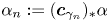 $\alpha _n:=(\boldsymbol {c}_{\gamma _n})_{*}\alpha$. For
 $\varepsilon$ small enough, these
 $\boldsymbol {a}_n$'s are all non-negative. By passing to a subsequence we assume that
 $\boldsymbol {a}_n(d\alpha )$ either diverges to
 $+\infty$ or remains constantly equal to some
 $\boldsymbol {a}_0(d\alpha )$ (not just bounded).
Keep  $U_0$ as in Lemma 3.4. As
 $U_0$ depends on
 $\varepsilon$, we shall write it as
 $U_0(\varepsilon )$. Note that as
 $\varepsilon$ decreases to zero,
 $U_0(\varepsilon )$ forms an increasing family of polytopes whose union covers
 $U$. Similarly, we have
 $\Omega ^{\rm spl}_{n,\varepsilon }$ and
 $\Omega _{\varepsilon }(\Phi,\boldsymbol {a}_n)$.
Lemma 4.6 There exists a sequence of real numbers  $\omega _n \to +\infty$ such that if we define
 \[ \Omega^{\rm spl}_{n,\varepsilon}:= U_0(\varepsilon) \oplus (W\cap \Omega(\boldsymbol{c}_{\gamma_n},\varepsilon+\omega_n,\Phi_1\sqcup\Phi_{\infty})), \]
then  $\Omega ^{\rm spl}_{n,\varepsilon }$ is contained in
 $\Omega _{\varepsilon }(\Phi,\boldsymbol {a}_n)=\Omega (\boldsymbol {c}_{\gamma _n},\varepsilon,\Phi )$ for
 $n$ large enough and
 \[ \lim_{n\to \infty} \frac{{\rm Vol}(\Omega^{\rm spl}_{n,\varepsilon})} {{\rm Vol}( \Omega(\boldsymbol{c}_{\gamma_n},\varepsilon,\Phi) ) } =1. \]
We also define
 \[ \Omega^{\rm vert}_{n,\varepsilon} := W\cap \Omega(\boldsymbol{c}_{\gamma_n},\varepsilon+\omega_n,\Phi_1\sqcup\Phi_{\infty}) \]
and
 \[ \mathcal{P}^{\rm spl}_{n,\varepsilon}:= \{h\in H \mid \pi_{S_H}(h) \in \exp(\Omega^{\rm spl}_{n,\varepsilon}) \}. \]
The notation  $\Omega ^{\rm vert}_{n,\varepsilon }$ is to indicate that it lies in
 $W$, being essentially the fiber of the identity of the morphism
 $\pi _W$ as in the diagram 3. One might imagine (not completely true, though) the full
 $\Omega (\boldsymbol {c}_{\gamma _n},\varepsilon +\omega _n,\Phi _1\sqcup \Phi _{\infty })$ is obtained by moving
 $\Omega ^{\rm vert}_{n,\varepsilon }$ ‘horizontally’ on the base.
The homomorphism  $\boldsymbol {c}_{\gamma _n}$ induces
 $\boldsymbol {p}_n : \boldsymbol {S}_{\boldsymbol {H}}\to \boldsymbol {S}_{\boldsymbol {L}}$, which, thanks to the following lemma, does not depend on
 $n$ after passing to a subsequence. We call this map
 $\boldsymbol {p} :=\boldsymbol {p}_n$.
Lemma 4.7 We have  $\boldsymbol {p}_n=\boldsymbol {p}_m$ if
 $\gamma _n$ and
 $\gamma _m$ are in the same Zariski connected component of
 $X(\boldsymbol {H},\boldsymbol {L})$.
Proof. Note that  $X(\boldsymbol {H},\boldsymbol {L})$ is an affine variety. Hence,
 $\{\boldsymbol {p}_n\}$ belongs to a family of morphism between tori parametrized by an affine variety. Now apply [Reference SpringerSpr98, Proposition 3.2.8].
Lemma 4.8 By abuse of notation we also write  $\boldsymbol {p} : S_{\boldsymbol {H}}\to S_{\boldsymbol {L}}$ as a morphism of Lie groups. Then
 ${\boldsymbol {p}}$ factors through
 $\overline {\boldsymbol {p}}: S_{\boldsymbol {H}}/\exp (W) \to S_{\boldsymbol {L}}$. Here
 $\overline {\boldsymbol {p}}$ is an isomorphism if
 $((\gamma _n),\boldsymbol {L})$ is minimal for
 $\boldsymbol {H}$.
Proof. Recall that we have fixed  $\{\tilde {\alpha }_1,\ldots,\tilde {\alpha }_n\}$ characters of
 $\boldsymbol {S}_{\boldsymbol {L}}$ containing a
 $\mathbb {Q}$-basis appearing in
 $\Phi _{\rho }$ and positive numbers
 $m_1,\ldots,m_n>0$ such that
 $\sum m_i \tilde {\alpha }_i =0$. It suffices to show that
 $\tilde {\alpha }_i (\boldsymbol {p}(\exp {w}))=1$ for all
 $w\in W$ and for all
 $i$. For this it suffices to show that
 $\alpha _i:= \pi _{S_H}^*\circ \boldsymbol {p}^* (\tilde {\alpha }_i)$ lies in
 $\Phi _0((\gamma _n))$. By the very definition of
 $\Phi _0$, we only need to prove that they are in
 $\Phi _{bdd}((\gamma _n))$ which also follows from the definition as
 $(\boldsymbol {c}_{\gamma _n})_{*}\alpha _i=\pi _{S_L}^* \tilde {\alpha }_i$ is independent of
 $n$.
Now we assume that  $((\gamma _n),\boldsymbol {L})$ is minimal for
 $\boldsymbol {H}$. The surjectivity of
 $\boldsymbol {p}$ follows by assumption and we now show that
 $\overline {\boldsymbol {p}}$ is injective. Thus, take
 $s_0\in \ker \boldsymbol {p}$ and a lift
 $h_0$ of
 $s_0$ in
 $H$. Then
 $\boldsymbol {c}_{\gamma _n}(h_0)$ is contained in
 $^{\circ }\!\boldsymbol {L}$ for all
 $n$ and we want to show that
 $s_0$ is contained in
 $\exp (W)$. Thus, take
 $a$ in
 $\Phi _0$ (actually
 $\Phi _{bdd}$ suffices). Passing to a subsequence we assume that there exists non-zero
 $v_a\in \boldsymbol {V}(\mathbb {Z})$ such that
 $\boldsymbol {c}_{\gamma _n}(h)v_a=a(h)v_a$ for all
 $n$ and
 $h\in \boldsymbol {H}$. By assumption, the line spanned by
 $v_a$ is also preserved by
 $\boldsymbol {L}$, so
 $lv_{a}=b(l)v_a$ for all
 $l\in \boldsymbol {L}$ and for some character
 $b$ of
 $\boldsymbol {L}$. That
 $b(\boldsymbol {c}_{\gamma _n}h_0)= \pm 1$ and
 $b(L)$ is contained in
 $\mathbb {R}^+$ imply that
 $b(\boldsymbol {c}_{\gamma _n}h_0)=1$. So
 $a(h_0)=1$ and
 $\text {da}(\log (s_0)) =0$, and we are done.
In summary we now have the following commutative diagram:

and the most important point here is that the bottom row does not depend on  $n$.
4.1 Normalization of Haar measures
We normalize the Haar measure  $\mu _H$ on
 $H/\Gamma _H$ and
 $\mu _L$ on
 $L/\Gamma _L$ such that
 $\mu _H$ (respectively,
 $\mu _L$) can be written as the fiber integration of probability homogeneous measures of
 ${}^{\circ }\!H$ (respectively,
 ${}^{\circ }\!L$) over the base
 $(S_{\boldsymbol {H}},\mu _{S_{\boldsymbol {H}}})$ (respectively,
 $(S_{\boldsymbol {L}},\mu _{S_{\boldsymbol {L}}})$) such that
 $\overline {\boldsymbol {p}}_*\mu _{S_{\boldsymbol {H}}/\exp {W}}= \mu _{S_{\boldsymbol {L}}}$ where
 $\mu _{S_{\boldsymbol {H}}/\exp {W}}$ is induced from the quotient metric in the Lie algebra. In addition, we assume that the
 ${\rm Vol}$ on the Lie algebra of
 $S_{\boldsymbol {H}}$ is identified with
 $\mu _{S_{\boldsymbol {H}}}$ under the exponential map.
Now we come to the main proposition of this subsection. For each  $\delta >0$, let
 $\mathcal {O}_{\delta }=\{h\in H \mid d(h,e)\leq \delta \}$.
Proposition 4.9 Given a standard triple  $(\boldsymbol {G},\boldsymbol {H},\Gamma )$, a sequence
 $(\gamma _n)\subset \Gamma$, and a connected
 $\mathbb {Q}$-subgroup
 $\boldsymbol {L} \leq \boldsymbol {G}$. Assume that
 $((\gamma _n),\boldsymbol {L})$ is minimal for
 $\boldsymbol {H}$. Consider the map
 $\boldsymbol {c}_n: H/\Gamma _H \to L/\Gamma _L$ induced from
 $\boldsymbol {c}_{\gamma _n}$. Then
 $\lim _n a_n(\gamma _n)_*\mu _H = \mu _L$ in
 $L/\Gamma _L$ with
 $a_n= 1/{\rm Vol}(\Omega ^{\rm vert}_{n,\varepsilon })$ for all
 $\varepsilon >0$ small enough.
Proof. Let  $\eta >0$ be an arbitrary small number. We can find
 $W_0 \subset W$ depending on
 $\eta$ and
 $\varepsilon >0$ such that for each
 $n$ there exists
 $I_N =\{t^N_i\}_{i=1,\ldots,l_n}\subset W$ such that
 \[ \Omega^{\rm spl}_{n,\varepsilon} \approx_{\eta{\rm Vol}(\Omega)} \bigsqcup_{t \in I_n} U_0(\varepsilon)\oplus (t+W_0) \]
where ‘ $\approx _{\eta {\rm Vol}(\Omega )}$’ means that the measure of the symmetric difference between both sides are smaller than
 $\kappa _{\eta }{\rm Vol}(\Omega ^{\rm spl}_{n,\varepsilon })$ for some constant
 $\kappa _{\eta }$ decreasing to zero as
 $\eta$ does. Hence,we can also find
 $\mathcal {O}\subset \mathcal {P}^{\rm spl}_{n,\varepsilon }$ (
 $\mathcal {O}$ is independent of
 $n$, it depends on
 $\eta$ and
 $\varepsilon$) such that
 $\mathcal {O}$ maps onto
 $U_0(\varepsilon )$ under the natural projection and there exists
 $J_n=\{h^n_{j}\}_{j=1,\ldots,l'_n} \subset H$ contained in the preimage of
 $\exp {W}$ such that
 \[ \mathcal{P}^{\rm spl}_{n,\varepsilon}/\Gamma_H \approx_{\eta{\rm Vol}(\mathcal{P})} \bigsqcup_{h \in J_n} h\mathcal{O}\Gamma_H/\Gamma_H. \]
Let us take arbitrary  $k_n\in \{1,\ldots,l'_n\}$ for each
 $n$ and let
 $h_n:=h^n_{k_n}$. Let
 $\nu$ be a limit of
 $\{(\boldsymbol {c}_n h_n )_{*}\hat {\mu }_{\mathcal {O}}\}$. Thus, we can find an infinite subsequence
 $(n_k)$ such that
 \[ \nu= \lim_{k \to \infty} (\boldsymbol{c}_{n_k} h_{n_k} )_{*}\hat{\mu}_{\mathcal{O}}. \]
Then, by Proposition 2.11,  $\nu$ is a probability measure on
 $L/\Gamma _L$ and
 $\boldsymbol {c}_{\gamma _{n_k}}( h_{n_k} \mathcal {O}_{\delta })$ is non-divergent in
 $L/\Gamma _L$ once we fix a
 $\delta >0$, that is, intersects a compact set in
 $L/\Gamma _L$ non-trivially for all
 $k$. Hence, there exist:
•
$\{\gamma _k'\} \subset \Gamma _L$, bounded $\{\delta _k\}\subset L$ and $\{o_k\}\subset \mathcal {O}_{\delta }$; such that•
$\gamma _{n_k} h_{n_k} o_k \gamma _{n_k}^{-1} = \delta _k \gamma _k'$.


Let  $\lambda _k:= \gamma _k' \gamma _{n_k}$ and
 $\boldsymbol {c}_k'$ be the map from
 $H/\Gamma _H \to L/\Gamma _L$ induced from
 $\boldsymbol {c}_{\lambda _k}$. Then
 \[ \gamma_{n_k} h_{n_k} o \gamma_{n_k}^{{-}1} = \delta_k \lambda_k o_k^{{-}1}o \lambda_k^{{-}1} \gamma_k', \quad \forall \, o\in \mathcal{O} \]
Thus, we have
 \[ (\boldsymbol{c}_{n_k}\circ h_{n_k})_* \hat{\mu}_{\mathcal{O}} \approx_{\delta} (\delta_{k}\circ \boldsymbol{c}'_{k})_* \hat{\mu}_{\mathcal{O}} \]
where  $\approx _{\delta }$ means the total mass of the symmetric difference of both sides is smaller than
 $\kappa _\delta$ for some
 $\kappa _{\delta }$ converging to zero as
 $\delta$ does. For simplicity, write
 $\pi$ for the natural projection from
 $L/\Gamma _L$ to
 $S_{\boldsymbol {L}}$. By Corollary 4.3 we assume that by passing to a subsequence
 $k_i$,
 \[ \lim_{i\to \infty} (\boldsymbol{c}'_{k_i})_* \hat{\mu}_{\mathcal{O}} =: \nu' = \int_{S_{\boldsymbol{L}}} \mu_{\pi^{{-}1}(s)} {\pi}_*\nu'(s), \]
where each  $\mu _{\pi ^{-1}(s)}$ is the unique probability
 ${}^{\circ }\!L$-invariant measure supported on
 $\pi ^{-1}(s)$ and
 $\nu '$ is a probability measure. We may also assume that
 $\delta _{k_i}$ converges to some
 $\delta _{\infty }$ and so
 \[ \lim_{i\to \infty} (\delta_{k_i}\boldsymbol{c}'_{k_i})_* \hat{\mu}_{\mathcal{O}} =: \nu'' = \int_{S_{\boldsymbol{L}}} \mu_{\pi^{{-}1}(s)} \pi_*\nu''(s). \]
Now
 \begin{align*} \pi_* \nu'' &= \lim_{i\to \infty} (\pi\circ \delta_{k_i} \circ \boldsymbol{c}_{k_i}')_* \hat{\mu}_{\mathcal{O}} \approx_{\delta} \lim_{i\to \infty} (\pi\circ \boldsymbol{c}_{n_{k_i}} \circ h_{n_{k_i}})_{*} \hat{\mu}_{\mathcal{O}}\\ &= \lim_{i\to \infty} (\boldsymbol{p} \circ \pi \circ h_{n_{k_i}})_{*} \hat{\mu}_{\mathcal{O}} = \lim_{i\to \infty} (\overline{\boldsymbol{p}}\circ \pi_W \circ \pi \circ h_{n_{k_i}})_{*} \hat{\mu}_{\mathcal{O}}\\ &= \overline{\boldsymbol{p}}_* \hat{\mu}_{U_0(\varepsilon)} = \hat{\mu}_{S_{\boldsymbol{L}}}\vert_{\overline{\boldsymbol{p}}(U_0(\varepsilon))}, \end{align*}
where we have employed the commutative diagram given previously. As the output is independent of the subsequence chosen and the constant  $\delta >0$, by letting
 $\delta$ converge to zero, we actually have
 \[ \lim_{n \to \infty} (\boldsymbol{c}_{n} h_{n} )_{*}\hat{\mu}_{\mathcal{O}} = \int_{S_{\boldsymbol{L}}} \mu_{\pi^{{-}1}(s)} \hat{\mu}_{S_{\boldsymbol{L}}}\vert_{\bar{p}(U_0(\varepsilon))}. \]
By taking the average,
 \[ \lim_{n\to \infty} \frac{(\boldsymbol{c}_n)_* \mu_{H}\vert_{\mathcal{P}^{\rm spl}_{n,\varepsilon}} } {\mu_H ({\mathcal{P}^{\rm spl}_{n,\varepsilon}}/\Gamma_H ) } \approx_{\eta} \int_{S_{\boldsymbol{L}}} \mu_{\pi^{{-}1}(s)} \hat{\mu}_{S_{\boldsymbol{L}}}\vert_{\bar{p}(U_0(\varepsilon))}. \]
In addition, by our normalization of Haar measures,
 \[ \mu_{H}({\mathcal{P}^{\rm spl}_{n,\varepsilon}}/\Gamma_H)= {\rm Vol}(\Omega^{\rm spl}_{n,\varepsilon}) ={\rm Vol}(U_0(\varepsilon)) \cdot {\rm Vol}(\Omega^{\rm vert}_{n,\varepsilon}). \]
Hence, by letting  $\eta \to 0$, we have
 \[ \lim_{n\to \infty} \frac{(\boldsymbol{c}_n)_* \mu_{H}\vert_{\mathcal{P}^{\rm spl}_{n,\varepsilon}} } {{\rm Vol}(\Omega^{\rm vert}_{n,\varepsilon} ) } = \int_{S_{\boldsymbol{L}}} \mu_{\pi^{{-}1}(s)} {\mu}_{S_{\boldsymbol{L}}}\vert_{\bar{p}(U_0(\varepsilon))}. \]
Note that for any two different  $\varepsilon,\varepsilon '>0$, the asymptotic of
 ${\rm Vol}(\Omega ^{\rm vert}_{n,\varepsilon } )$ remains the same. Thus, by fixing such an
 $\varepsilon _0>0$ and letting
 $\varepsilon$ go to zero, we obtain
 \[ \lim_{n\to \infty} \frac{1}{{\rm Vol}(\Omega^{\rm vert}_{n,\varepsilon_0})}(\boldsymbol{c}_n)_* \mu_{H}= \mu_{L}. \]
4.1 Example
The perhaps most basic example is to take  $\boldsymbol {G}=[ \begin {smallmatrix} a & * \\ 0 & 1/a \end {smallmatrix} ]$,
 $\boldsymbol {H}=[ \begin {smallmatrix} a & 0 \\ 0 & 1/a \end {smallmatrix} ]$,
 $\Gamma = [ \begin {smallmatrix} 1 & \mathbb {Z} \\ 0 & 1 \end {smallmatrix} ]$, and
 $\gamma _n= [ \begin {smallmatrix} 1 & n \\ 0 & 1 \end {smallmatrix} ]$. It is not hard to check that
 $((\gamma _n),\boldsymbol {G})$ is indeed minimal for
 $\boldsymbol {H}$. Thus, our theorem asserts that
 $(\gamma _n)_*[\mu _H]\to [\mu _G]$. Let us see why this is true intuitively. We first take a model of
 $G \to G/\Gamma$:

where  $\pi$ is the natural quotient map and
 $\Phi (x,y):= [ \begin {smallmatrix} e^x & 0 \\ 0 & e^{-x} \end {smallmatrix} ][ \begin {smallmatrix} 1 & y \\ 0 & 1 \end {smallmatrix} ]$. The little
 $\phi$ is then induced from
 $\Phi$. Under this isomorphism, the set
 $\gamma _n H$ becomes
 $\{(x,y)\mid y=e^{-2x}n\}$ carried with the measure
 $dx$. We may view
 $\pi _{\Gamma }(\gamma _n H)$ as a cord wrapping about an infinite cylinder. The larger
 $n$ is, the denser the wrapping becomes. Measure-theoretically, our theorem in this case is equivalent to the following elementary statement: for each compactly supported function
 $f:\mathbb {R} \to \mathbb {C}$ and each non-zero integer
 $m$,
 \[ \int f(x)\exp(2\pi i m n e^{{-}2x})\, dx \to 0 \quad \text{as } n \to \infty. \]
4.2 Find an observable $L$

A drawback of Proposition 4.9 is that the convergence happens inside  $L/\Gamma _L$. In order for the convergence to happen on
 $G/\Gamma$, it is sufficient that
 $L\Gamma /\Gamma$ is closed in
 $G/\Gamma$. This is true if
 $\boldsymbol {L}$ is observable in
 $\boldsymbol {G}$. The converse is also true, as is proved in [Reference WeissWei98]. We do not make use of the latter fact but rather derive it as a corollary.
In this section, we fix a superfaithful  $\mathbb {Q}$-representation
 $\rho : \boldsymbol {G} \to \operatorname {SL}(\boldsymbol {V})$ which contains all exterior products of the adjoint representation of
 $\boldsymbol {G}$. We write
 $\Phi$ for
 $\Phi _{\rho }$. In the notation of Definition 4.4, we are taking
 $\boldsymbol {L}$ to be
 $\boldsymbol {G}$ in which case
 $\Phi _{\rho,\boldsymbol {L}}$ is just a singleton
 $\{\Phi _{\rho }\}$.
Lemma 4.10 Suppose we are given a standard triple  $(\boldsymbol {G},\boldsymbol {H},\Gamma )$ and
 $\rho$ as above. Let
 $\{\lambda _n\}\subset \Gamma$ be a sequence that is
 $\Phi$-clean. Let
 $\boldsymbol {L} \leq \boldsymbol {G}$ be a connected
 $\mathbb {Q}$-subgroup. Assume that
 $((\lambda _{n_k}),\boldsymbol {L})$ is minimal for
 $\boldsymbol {H}$ for some infinite subsequence
 $n_k$. Let
 $\boldsymbol {L}'$ be the observable hull of
 $\boldsymbol {L}$ in
 $\boldsymbol {G}$. If
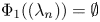 $\Phi _1((\lambda _n)) = \emptyset$, then:
(1) a normal
$\mathbb {Q}$-subgroup of $\boldsymbol {L}$ is also normal in $\boldsymbol {L}'$;(2)
$\boldsymbol {L}=\boldsymbol {L}'$, that is, $\boldsymbol {L}$ is observable.


Proof. Take  $\boldsymbol {N}$ to be a normal
 $\mathbb {Q}$-subgroup of
 $\boldsymbol {L}$. Let
 $v_{\boldsymbol {N}}$ be a non-zero vector in
 $\boldsymbol {V}(\mathbb {Z})$ that represents
 $\operatorname {Lie}(\boldsymbol {N})$. Then
 $g\in \boldsymbol {G}$ normalize
 $\boldsymbol {N}$ iff
 $g[v_{\boldsymbol {N}}]=[v_{\boldsymbol {N}}]$ where
 $[v_{\boldsymbol {N}}]$ denotes the line spanned by
 $v_{\boldsymbol {N}}$. We know by assumption that
 $\lambda _{n_k}\boldsymbol {H} \lambda _{n_k}^{-1}[v_{\boldsymbol {N}}]=[v_{\boldsymbol {N}}]$. By passing to an infinite subsequence we may assume that for some
 $\alpha \in \Phi$,
 \[ \lambda_{n_k} h \lambda_{n_k}^{{-}1} v_{\boldsymbol{N}} =\alpha(h) v_{\boldsymbol{N}}, \quad \forall \, k,\ \forall \,h\in\boldsymbol{H}, \]
which implies that  $\alpha$ is contained in
 $\Phi _{bdd}((\lambda _n)) = \Phi _{0}((\lambda _n))$.
Thus, there exist  $I=\{\alpha _0=\alpha,\alpha _1,\ldots,\alpha _n\}\subset \Phi _0((\lambda _n))$ and
 $\{a_0,\ldots,a_n\}\subset \mathbb {Z}_{>0}$ such that
 $\sum a_i \alpha _i =0$. Passing to a further subsequence we may assume that for each
 $i$, there exists a non-zero
 $v_i$ that is simultaneously an
 $\alpha _i$-weight vector of
 $\lambda _{n_k}\boldsymbol {H} \lambda _{n_k}^{-1}$ for all
 $k$. Let
 $w:= v_{\boldsymbol {N}}^{\otimes a_0} \bigotimes \otimes _{i=1}^N v_i^{\otimes a_i}$, then
 \[ \lambda_{n_k} h \lambda_{n_k}^{{-}1} w = \prod_{i=0}^N \alpha_i(h)^{a_i} w =w, \quad \forall \, k \implies \boldsymbol{L} w = w \implies \boldsymbol{L}' w= w. \]
By Lemma 2.8,  $\boldsymbol {L}'[v_{\boldsymbol {N}}]=[v_{\boldsymbol {N}}]$ so we have proved the first claim.
Now apply this to  $\boldsymbol {R}_{\boldsymbol {L}}$, the radical of
 $\boldsymbol {L}$. Thus,
 $\boldsymbol {R}_{\boldsymbol {L}}$ is normal in
 $\boldsymbol {L}'$. Note that
 $\boldsymbol {L}/\boldsymbol {R}_{\boldsymbol {L}} \leq \boldsymbol {L}'/\boldsymbol {R}_{\boldsymbol {L}}$ is observable as
 $\boldsymbol {L}/\boldsymbol {R}_{\boldsymbol {L}}$ is semisimple. This implies that
 $\boldsymbol {L}\leq \boldsymbol {L}'$ is also observable so we are done.
Now we can state and prove the main proposition of this subsection.
Proposition 4.11 Suppose we are given an observable standard triple  $(\boldsymbol {G},\boldsymbol {H},\Gamma )$ and
 $\rho$ as above. Let
 $\{\lambda _n\}\subset \Gamma$ be a sequence that is
 $\Phi$-clean. Let
 $\boldsymbol {L}$ be a connected
 $\mathbb {Q}$-subgroup of
 $\boldsymbol {G}$. Assume that
 $((\gamma _{n}),\boldsymbol {L})$ is minimal for
 $\boldsymbol {H}$ and let
 $\boldsymbol {F}$ be the observable hull of
 $\boldsymbol {L}$ in
 $\boldsymbol {G}$. Then
 $\lim _{n\to \infty } a_n(\gamma _n)_* \mu _H = \mu _{F}$ for some positive sequence
 $(a_n)$.
Proof. Take  $\varepsilon >0$ small enough and
 $\{h_n\}\subset \mathcal {P}^{\rm spl}_{n,\varepsilon }$ as in Lemma 4.6, then by Proposition 2.11, there exists a bounded sequence
 $\{o_n\}\subset H$, a bounded sequence
 $\{\delta _n\}\subset F$ and
 $\{\gamma '_n \} \subset \Gamma _F$ such that
 \[ \gamma_n h_n o_n \gamma_n^{{-}1} = \delta_n \gamma'_n. \]
Define  $\lambda _n=\gamma '_n\gamma _n$. One defines
 $\Phi _*((\lambda _n))$ in the same way as before even though we do not know yet whether it is clean. Thus, we only have that
 $\Phi \supset \Phi _{\infty }((\lambda _n))\sqcup \Phi _{1}((\lambda _n))\sqcup \Phi _{0}((\lambda _n))$. This will be clarified in the following claims.
Claim 4.2.1
We claim that  $\Phi _{\infty }((\lambda _n)) \supset \Phi _{\infty }((\gamma _n))\sqcup \Phi _{1}((\gamma _n))$.
Proof. Take  $\alpha \in \Phi _{\infty }((\gamma _n))\sqcup \Phi _{1}((\gamma _n))$. By definition,
 \[ \inf_{0\neq v \in \boldsymbol{V}_{\alpha}(\mathbb{Z})} \|\gamma_n h_n v\| \to +\infty. \]
So
 \[ \inf_{0\neq v \in \boldsymbol{V}_{\alpha}(\mathbb{Z})} \|\lambda_n v\| = \inf_{0\neq v \in \boldsymbol{V}_{\alpha}(\mathbb{Z})} \|\delta_n^{{-}1}\gamma_n h_n o_n v\| \approx \inf_{0\neq v \in \boldsymbol{V}_{\alpha}(\mathbb{Z})} \|\gamma_n h_n v\| \to +\infty \]
where  $\approx$ means ‘multiplicatively differed by a bounded error as
 $n$ varies’ and we are done.
Claim 4.2.2
We claim that 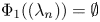 $\Phi _{1}((\lambda _n))=\emptyset$ and
 $\Phi _{0}((\lambda _n))=\Phi _{0}((\gamma _n))$.
Proof. Take  $\alpha \in \Phi _{0}((\gamma _n))$, then there exists
 $\{\alpha _0=\alpha,\alpha _1,\ldots,\alpha _n\}\subset \Phi _{0}((\gamma _n))$ and
 $\{a_0,\ldots,a_n\}\subset \mathbb {R}_{>0}$ such that
 $\sum a_i \alpha _i=0$. On the other hand, there exists
 $M>0$ such that
 $\inf _{0\neq v \in \boldsymbol {V}_{\alpha _i}(\mathbb {Z})} \|\gamma _n v\| \leq M$ for all
 $i$. Therefore,
 \begin{align*} &\inf_{0\neq v \in \boldsymbol{V}_{\alpha_i}(\mathbb{Z})} \|\gamma_n h_n v\| \geq \varepsilon, \quad \forall \, i,n \implies \alpha_i(h_n) \geq \frac{\varepsilon}{M}, \quad \forall \, i,n\\ &\quad \implies \alpha^{a_0}(h_n) = \frac{1}{\prod_{i\neq 0} \alpha_i^{a_i}(h_n)} \leq \bigg(\frac{M}{\varepsilon}\bigg)^{\sum_{i\neq 0} a_i}, \quad \forall \, n\\ &\quad \implies \alpha(h_n)\leq \bigg(\frac{M}{\varepsilon}\bigg)^{\sum_{i\neq 0} a_i/a_0}, \quad\forall \, n. \end{align*}
Thus, we have
 \[ \inf_{0\neq v \in \boldsymbol{V}_{\alpha}(\mathbb{Z})} \|\lambda_n v\| \approx \inf_{0\neq v \in \boldsymbol{V}_{\alpha}(\mathbb{Z})} \|\gamma_n v\| \alpha(h_n) \]
is bounded from above, implying that  $\Phi _{0}((\gamma _n))$ is contained in
 $\Phi _{bdd}((\lambda _n))$. By definition of
 $\Phi _0$, this actually implies that
 $\Phi _{0}((\gamma _n)) \subset \Phi _{0}((\lambda _n))$. The asserted equalities then come from the fact that
 \[ \Phi = \Phi_{\infty}((\gamma_n))\sqcup\Phi_{1}((\gamma_n))\sqcup\Phi_{0}((\gamma_n)) \subset \Phi_{\infty}((\lambda_n))\sqcup\Phi_{1}((\lambda_n))\sqcup\Phi_{0}((\lambda_n)) \subset \Phi. \]
Take an arbitrary infinite subsequence  $(n_k)$ and a
 $\mathbb {Q}$-subgroup
 $\boldsymbol {L}' \leq \boldsymbol {G}$ such that
 $((\lambda _{n_k}),\boldsymbol {L}')$ is
 $\boldsymbol {H}$-minimal. We may assume
 $\delta _{n_k}$ converges to some
 $\delta _{\infty }$ in
 $F$. Then
 $\boldsymbol {L}'$ is observable by Lemma 4.10 and
 \[ \lim_{k\to \infty} [(\lambda_{n_k})_* \mu_H] =[\mu_{L'}] \implies \lim_{k\to \infty} [(\gamma_{n_k})_* \mu_H] =(\delta_{\infty})_*[\mu_{L'}] \]
in  $G/\Gamma$. Now we claim that
 $\boldsymbol {L}'=\boldsymbol {F}$, which would conclude the proof. It is clear that
 $\boldsymbol {L}'$ is contained in
 $\boldsymbol {F}$. It is sufficient to show that it is also epimorphic. Indeed,take a
 $\mathbb {Q}$-representation of
 $\boldsymbol {F}$ and a non-zero
 $\mathbb {Q}$-vector
 $v$ fixed by
 $\boldsymbol {L}'$, that is,
 $\lambda _n \boldsymbol {H} \lambda _n^{-1}v=v$ for all
 $n$. Note
 $\lambda _n=\delta _n^{-1}\gamma _nh_no_n$, so
 $\lambda _n \boldsymbol {H} \lambda _n^{-1}= \delta _n^{-1}\gamma _n \boldsymbol {H} \gamma _n^{-1}\delta _n$. Hence,
 $\delta _n v$ is fixed by
 $\gamma _n \boldsymbol {H} \gamma _n^{-1}$. On the other hand,
 \[ \delta_n v = \gamma_n h_no_n \gamma_n^{{-}1} \gamma_n'^{{-}1} v = \gamma_n'^{{-}1} \lambda_n h_no_n \lambda_n^{{-}1} v = \gamma_n'^{{-}1} v \]
is both discrete and bounded. Hence, by passing to a subsequence we may assume that there exists  $w$, another
 $\mathbb {Q}$-vector, such that
 $w=\delta _nv=\gamma _n'^{-1} v$.
Now  $w$ is fixed by
 $\gamma _n \boldsymbol {H} \gamma _n^{-1}$ for all
 $n$ and so it is fixed by
 $\boldsymbol {F}$. Therefore,
 $v$ is also fixed by
 $\boldsymbol {F}$. Thus, we are done.
4.3 Complements
Definition 4.12 Given an observable standard triple  $(\boldsymbol {G},\boldsymbol {H},\Gamma )$ and a connected observable
 $\mathbb {Q}$-subgroup
 $\boldsymbol {L}$. Let
 $\Lambda$ be a subgroup of
 $\Gamma$.
 $\boldsymbol {H}$ is said to
 $\Lambda$-converge to
 $\boldsymbol {L}$ iff there exists a sequence
 $(\lambda _n)$ in
 $\Lambda$ such that
 $((\lambda _n),\boldsymbol {L})$ is potentially minimal for
 $\boldsymbol {H}$.
By Proposition 4.11, if  $\boldsymbol {H}$
 $\Lambda$-converges to
 $\boldsymbol {L}$, then
 $(\lambda _n)_*[\mu _H]$ converges to
 $[\mu _L]$ for some sequence
 $(\lambda _n)$ of
 $\Lambda$. The converse is also true by ignoring finitely many
 $n$. One may ask when
 $\boldsymbol {H}$ could
 $\Lambda$-converge to
 $\boldsymbol {L}$. We make some observations here but are unable to answer the general question even when
 $\Lambda =\Gamma$.
Lemma 4.13 Keep the notation as in the above definition. Given three connected observable  $\mathbb {Q}$-subgroups
 $\boldsymbol {A}, \boldsymbol {B}$ and
 $\boldsymbol {C}$ of
 $\boldsymbol {G}$. Then
 $\boldsymbol {A}$
 $\Lambda$-converges to
 $\boldsymbol {B}$ and
 $\boldsymbol {B}$
 $\Lambda$-converges to
 $\boldsymbol {C}$ implies that
 $\boldsymbol {A}$
 $\Lambda$-converges to
 $\boldsymbol {C}$. As a consequence,
 $\boldsymbol {A}\leq _{\Lambda } \boldsymbol {B}$ iff
 $\boldsymbol {A}$
 $\Lambda$-converges to
 $\boldsymbol {B}$ defines a partial order on the set of all connected observable
 $\mathbb {Q}$-subgroups of
 $\boldsymbol {G}$.
Proof. By assumption we can find a sequence  $(a_n)$ (respectively,
 $(b_n)$) in
 $\Lambda$ such that
 $((a_n),\boldsymbol {B})$ (respectively,
 $((b_n),\boldsymbol {C})$) is potentially minimal for
 $\boldsymbol {A}$ (respectively,
 $\boldsymbol {B}$). Let
 $\mathscr {D}$ be the collection of connected observable
 $\mathbb {Q}$-subgroups of
 $\boldsymbol {C}$. It is a countable set and we fix a enumeration
 $\mathscr {D}=\{\boldsymbol {D}_1,\boldsymbol {D}_2,\ldots \}$.
Then for each positive integer  $i$ there exists
 $N_i\in \mathbb {Z}^+$ such that for all
 $n\geq N_i$,
 $b_n\boldsymbol {B} b_n^{-1}$ is not contained in
 $\boldsymbol {D}_j$ for all
 $j\leq i$. For each fixed
 $n$,
 $((b_na_m)_m, b_n\boldsymbol {B} b_n^{-1})$ is minimal for
 $\boldsymbol {A}$. Thus, we can find
 $M_{n,i}\in \mathbb {Z}^+$ such that for all
 $n\geq N_i$ and
 $m\geq M_{n,i}$,
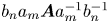 $b_na_m \boldsymbol {A} a_m^{-1}b_n^{-1}$ is not contained in
 $\boldsymbol {D}_j$ for all
 $j\leq i$ (here we use the fact that
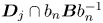 $\boldsymbol {D}_j \cap b_n\boldsymbol {B} b_n^{-1}$ is an observable subgroup of strictly smaller dimension than
 $b_n\boldsymbol {B} b_n^{-1}$). Hence, if we define
 $c_i = b_{n_i}a_{m_i}$ in
 $\Lambda$ for some
 $n_i\geq N_i$ and
 $m_i\geq M_{n,i}$, then
 $((c_n),\boldsymbol {C})$ is potentially minimal for
 $\boldsymbol {A}$.
Lemma 4.14 Use the same notation as previously. Assume that  $\boldsymbol {H}$ is an observable subgroup of
 $\boldsymbol {G}$ and is maximal (among proper subgroups) with respect to
 $\leq _{\Lambda }$. Then
 $\boldsymbol {H}$ is virtually normalized by
 $\Lambda$ in the sense that there is a finite-index subgroup
 $\Lambda _0$ of
 $\Lambda$ that normalizes
 $\boldsymbol {H}$.
Proof. If the conclusion were false, then we could find a sequence  $(\lambda _n)$ in
 $\Lambda$ such that
 $\lambda _n\boldsymbol {H} \lambda _n^{-1}\neq \lambda _m\boldsymbol {H} \lambda _m^{-1}$ for any
 $n \neq m$. Passing to an infinite subsequence we may assume that there exists a connected
 $\mathbb {Q}$-subgroup
 $\boldsymbol {L}$ of
 $\boldsymbol {G}$ such that
 $((\lambda _n),\boldsymbol {L})$ is minimal for
 $\boldsymbol {H}$. However, by assumption,
 $\dim \boldsymbol {L} = \dim \boldsymbol {H}$, so for all
 $n, \boldsymbol {L}=\lambda _n\boldsymbol {H} \lambda _n^{-1}$ and this is a contradiction.
Corollary 4.15 Use the same notation as previously. Assume that  $\boldsymbol {G}$ is
 $\mathbb {Q}$-simple and
 $\mathbb {Q}$-isotropic. Then the only maximal elements with respect to
 $\leq _{\Gamma }$ are the trivial group and
 $\boldsymbol {G}$. Consequently, for each non-trivial connected observable
 $\mathbb {Q}$-subgroup
 $\boldsymbol {L}$ of
 $\boldsymbol {G}$, there exists a sequence
 $(\gamma _n)$ in
 $\Gamma$ such that
 $\lim _n (\gamma _n)_* [\mu _L] = [\mu _G]$.
Proof. Take such a maximal element  $\boldsymbol {L}$. Then
 $\boldsymbol {L}$ is normalized by some finite-index subgroup
 $\Gamma _0$ of
 $\Gamma$. However, Borel's density theorem implies that
 $\Gamma _0$ is Zariski-dense in
 $\boldsymbol {G}$. Hence,
 $\boldsymbol {L}$ is normalized by
 $\boldsymbol {G}$, which must be either the trivial group or
 $\boldsymbol {G}$.
We also deduce a result of Weiss [Reference WeissWei98, Corollary 5].
Corollary 4.16 Given a standard triple  $(\boldsymbol {G},\boldsymbol {H},\Gamma )$ and assuming
 $\boldsymbol {H}$ to be epimorphic in
 $\boldsymbol {G}$, then
 $\pi _{\Gamma }(H)$ is dense in
 $G/\Gamma$. Therefore,
 $\pi _{\Gamma }(H)$ is closed iff
 $\boldsymbol {H}$ is observable.
Proof. Take a Levi decomposition of  $\boldsymbol {H}= \boldsymbol {L} \cdot \boldsymbol {U}$ where
 $\boldsymbol {L}$ is reductive and, hence, observable in
 $\boldsymbol {G}$. Let
 $\Lambda = U_{\Gamma }$ and take
 $\boldsymbol {F}$ to be a connected observable
 $\mathbb {Q}$-subgroup such that
 $\boldsymbol {L}$
 $\Lambda$-converges to
 $\boldsymbol {F}$ and
 $\boldsymbol {F}$ is maximal with respect to this property. By Lemma 4.14 and that any finite-index subgroup of
 $\Lambda$ is Zariski-dense in
 $\boldsymbol {U}$ (see [Reference RaghunathanRag72, Theorem 2.1]), we see that
 $\boldsymbol {F}$ is normalized by
 $\boldsymbol {U}$.
Now we use condition (vi) in Definition 1.1 to check that  $\boldsymbol {F}\cdot \boldsymbol {U}$ is observable in
 $\boldsymbol {G}$. Only here we use
 $\boldsymbol {V}$ to stand for
 $\boldsymbol {V}(\overline {\mathbb {Q}})$ instead of
 $\boldsymbol {V}(\mathbb {C})$. Take a character
 $\alpha$ of
 $\boldsymbol {F}\cdot \boldsymbol {U}$ that extends to a representation of
 $\boldsymbol {G}$. In other words, there is a representation
 $(\rho _1,\boldsymbol {V}_1)$ of
 $\boldsymbol {G}$ and non-zero
 $v\in \boldsymbol {V}$ such that
 $xv=\alpha (x)v$ for all
 $x\in \boldsymbol {F}\cdot \boldsymbol {U}$. As
 $\boldsymbol {F}$ is observable, by condition (vi) in Definition 1.1, there exists another representation
 $(\rho ',\boldsymbol {V}')$ such that the subspace
 $\boldsymbol {V}'_{-\alpha |_{\boldsymbol {F}}}$ is non-zero. As
 $\boldsymbol {U}$ normalize
 $\boldsymbol {F}$,
 $\boldsymbol {U}$ preserves the subspace
 $\boldsymbol {V}'_{-\alpha |_{\boldsymbol {F}}}$. However,
 $\boldsymbol {U}$ is a unipotent group so there exists a non-zero
 $v'\in \boldsymbol {V}'_{-\alpha |_{\boldsymbol {F}}}$ that is fixed by
 $\boldsymbol {U}$. Hence,
 $-\alpha$, which is just the dual of
 $\alpha$, is also contained in a representation of
 $\boldsymbol {G}$.
As  $\boldsymbol {F}\cdot \boldsymbol {U}$ contains
 $\boldsymbol {H}$ by definition,
 $\boldsymbol {F}\cdot \boldsymbol {U}$ is equal to
 $\boldsymbol {G}$ due to maximality. Hence, we also have
 $G=F\cdot U$.
Now we take  $X$ to be the closure of
 $\pi _{\Gamma }(H)$ in
 $G/\Gamma$. It is invariant by
 $U$. Hence, it contains translates of
 $L\Gamma /\Gamma$ by
 $\Lambda$ and by Proposition 4.11 also contains
 $F\Gamma /\Gamma$. Thus,
 $X\supset U F\Gamma /\Gamma =G/\Gamma$ and the proof is complete.
5. Translates of homogeneous measures associated with reductive subgroups
In this section we prove Theorem 1.7. Let  $(\boldsymbol {G},\boldsymbol {H},\Gamma )$ be a standard triple and assume that both
 $\boldsymbol {G}$ and
 $\boldsymbol {H}$ are reductive groups.
5.1 Non-divergence
We want to put an assumption on  $\boldsymbol {H}$ that would guarantee the non-divergence when translated by an arbitrary sequence in
 $G$. If
 $\boldsymbol {a}$ is a
 $\mathbb {Q}$-cocharacter in
 $\boldsymbol {G}$ that centralize
 $\boldsymbol {H}$ yet not contained in
 $\boldsymbol {H}$, then the full orbit
 $\pi _{\Gamma }(\boldsymbol {a}_t H)$ diverges to infinity set-theoretically, that is, for any compact subset
 $K$ of
 $G/\Gamma$ and for
 $t$ large enough,
 $\pi _{\Gamma }(\boldsymbol {a}_t H)\cap K=\emptyset$. If one wants to avoid this scenario, then it is necessary to use the following group-theoretical condition:
•
$\boldsymbol {Z}_{\boldsymbol {G}}\boldsymbol {H} / (\boldsymbol {Z}_{\boldsymbol {G}}\boldsymbol {H} \cap \boldsymbol {H})$ is $\mathbb {Q}$-anisotropic.


Proposition 5.1 Under this condition, there exists a compact set  $K\subset G/\Gamma$ such that
 $\pi _{\Gamma }(gH)\cap K \neq \emptyset$ for all
 $g\in G$.
In the case when  $\boldsymbol {Z}_{\boldsymbol {G}}\boldsymbol {H}$ is
 $\mathbb {Q}$-anisotropic, this is proved in [Reference Eskin, Mozes and ShahEMS97, Theorem 1.1]. In the present case, it can be deduced from [Reference Richard and ShahRS18] and [Reference Kleinbock and MargulisKM98]. We give an alternative short proof based on Proposition 2.11 (which also relies on [Reference Kleinbock and MargulisKM98]) and some input from geometric invariant theory. In view of Proposition 2.11 it suffices to prove Proposition 5.4.
First we record a result from [Reference KempfKem78, Corollary 4.5].
Lemma 5.2 Take a  $\mathbb {Q}$-representation
 $\rho : \boldsymbol {G} \to \operatorname {GL}(\boldsymbol {V})$ and a vector
 $v_0\neq 0$ in
 $\boldsymbol {V}(\mathbb {Q})$ fixed by
 $\boldsymbol {H}$. If
 $\boldsymbol {Z}_{\boldsymbol {G}}\boldsymbol {H} / (\boldsymbol {Z}_{\boldsymbol {G}}\boldsymbol {H} \cap \boldsymbol {H})$ is
 $\mathbb {Q}$-anisotropic, then
 $\boldsymbol {G}\cdot v_0$ is closed.
Combined with [Reference Benoist and QuintBQ12, Lemma 6.3], we have the following result.
Lemma 5.3 Assume that  $\boldsymbol {Z}_{\boldsymbol {G}}\boldsymbol {H} / (\boldsymbol {Z}_{\boldsymbol {G}}\boldsymbol {H} \cap \boldsymbol {H})$ is
 $\mathbb {Q}$-anisotropic. Take a representation
 $\boldsymbol {V}$ of
 $\boldsymbol {G}$ over
 $\mathbb {Q}$ and fix a
 $\mathbb {Z}$-structure of
 $\boldsymbol {V}_{\mathbb {Q}}$ and an Euclidean metric on
 $V$. Then there exists a constant
 $c>0$ such that for all
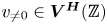 $v_{\neq 0}\in \boldsymbol {V}^{\boldsymbol {H}}(\mathbb {Z})$, we have
 $\|g\cdot v\| \geq c$ for all
 $g\in G$.
Proposition 5.4 Assume that  $\boldsymbol {Z}_{\boldsymbol {G}}\boldsymbol {H} / (\boldsymbol {Z}_{\boldsymbol {G}}\boldsymbol {H} \cap \boldsymbol {H})$ is
 $\mathbb {Q}$-anisotropic. Take a representation
 $(\rho,\boldsymbol {V})$ of
 $\boldsymbol {G}$ over
 $\mathbb {Q}$ and fix a
 $\mathbb {Z}$-structure of
 $\boldsymbol {V}_{\mathbb {Q}}$ and an Euclidean metric on
 $V$. Then there exists
 $\varepsilon >0$ such that
 $\Omega (g,\varepsilon,\rho,\Phi _{\rho })$ is non-empty for all
 $g\in G$.
Proof. Consider all possible subsets  $I=\{\alpha _1,\ldots,\alpha _k\}$ of
 $\Phi _{\rho }$ such that
 $\sum _i m_i\alpha _i=0$ has a solution
 $\{m_i\}$ in positive numbers. For each
 $I$ we fix a set of positive integers
 $\{m_i\}$ such that
 $\sum _i m_i\alpha _i=0$. As there are at most finitely many such
 $I$, the representation
 $\boldsymbol {W}:= \bigoplus _{I} \bigotimes \boldsymbol {V}^{\otimes m_i}$ is finite-dimensional. Applying Lemma 5.3 to
 $\boldsymbol {W}$, we have a constant
 $c>0$ which is a lower bound for
 $\|gw\|$ for all
 $g\in G$ and
 $w\in \boldsymbol {W}^{\boldsymbol {H}}(\mathbb {Z})$.
Note that for each  $t\in \operatorname {Lie}(S_{\boldsymbol {H}})$,
 $\Omega (g,\varepsilon,\rho,\Phi _{\rho })$ is non-empty iff
 $\Omega (g\exp {t},\varepsilon,\rho,\Phi _{\rho })$ is non-empty. We want to find a
 $t$ such that
 $\Omega (g\exp {t},\varepsilon,\rho,\Phi _{\rho })$ contains
 $0$. Consider the function
 \begin{align*} &\phi: \operatorname{Lie}(S_{\boldsymbol{H}}) \longrightarrow \mathbb{R} \\ &\quad t \mapsto\sup_{\alpha\in\Phi_{\rho}}\Big(\ln{\varepsilon}-\ln \inf_{0\neq v\in \boldsymbol{V}_{\alpha}(\mathbb{Z})}\|g\exp{(t)}v\|\Big)\\ &\qquad =\sup_{\alpha\in\Phi_{\rho}} \Big({-}d\alpha(t)-\ln\varepsilon-\ln \inf_{0\neq v\in \boldsymbol{V}_{\alpha}(\mathbb{Z})}\|gv\|\Big). \end{align*}
Thus,  $\Omega (g,\varepsilon,\rho,\Phi _{\rho })$ contains
 $0$ iff
 $\inf _{t\in \operatorname {Lie}(S_{\boldsymbol {H}})} \phi (t)$ is non-positive. If
 $\inf \phi (t)$ is equal to
 $-\infty$, then we are done. Otherwise,
 $\inf \phi$ can be achieved by some
 $t_0$. Consider the set
 $\Phi$ of
 $\alpha \in \Phi _{\rho }$ that achieves the supremum in the definition of
 $\phi (t_0)$. Define
 $\Phi _0$ and
 $\Phi _1$ as before. We claim that
 $\Phi _0$ is non-empty. Otherwise, there exists
 $t$ such that
 $d\alpha (t)>0$ for all
 $\alpha \in \Phi$ and perturbing by such an element would destroy the infimum. Hence, there are
 $\{\alpha _1,\ldots,\alpha _k\}$ in
 $\Phi$ and positive integers
 $\{m_1,\ldots,m_k\}$ such that
 $\sum m_i \alpha _i=0$. Moreover, we take the same
 $\{m_i\}$ as in the beginning of the proof. Thus,
 $\otimes _i v_{i}^{\otimes m_i}$ is contained in
 $\boldsymbol {W}^{\boldsymbol {H}}(\mathbb {Z})$ and
 \[ \prod_{i=1,\ldots,k}\|g\exp(t)v_i\|^{m_i}=\|g\otimes_{i=1,\ldots,k}v_{i}^{{\otimes} m_i}\|\geq c \]
for all  $0\neq v_i\in \boldsymbol {V}_{\alpha _i}(\mathbb {Z})$. This implies that there exists
 $i_0$ and
 $c'>0$ such that
 $\inf _{0\neq v\in \boldsymbol {V}_{\alpha }(\mathbb {Z})}\|g\exp (t)v\|\geq c'$. By taking
 $\varepsilon$ such that
 $\ln \varepsilon - \ln c' <0$, or equivalently
 $\varepsilon < c'$, then we are done.
5.2 Equidistribution
In this section we enhance Proposition 4.11 in the current case.
Proposition 5.5 Let  $(\boldsymbol {G},\boldsymbol {H},\Gamma )$ be a standard triple. We assume, in addition, that
 $\boldsymbol {G}, \boldsymbol {H}$ are both reductive and that
 $\boldsymbol {Z}_{\boldsymbol {G}}\boldsymbol {H} / (\boldsymbol {Z}_{\boldsymbol {G}}\boldsymbol {H} \cap \boldsymbol {H})$ is
 $\mathbb {Q}$-anisotropic. Given an arbitrary sequence
 $(g_n)$ in
 $G$, after passing to a subsequence, there exists a bounded sequence
 $(\delta _n)$ in
 $G$, a sequence
 $(\gamma _n)$ in
 $\Gamma$ and a reductive
 $\mathbb {Q}$-subgroup
 $\boldsymbol {L}$ of
 $\boldsymbol {G}$ such that
 $g_n \mu _H= \delta _n \gamma _n \mu _H, \gamma _n \boldsymbol {H} \gamma _n^{-1}\subset \boldsymbol {L}$ and
 $(\gamma _n)_*[ \mu _H] \to [\mu _L]$. Moreover,if
 $(g_n)$ is unbounded when projecting to
 $G/Z_{\boldsymbol {G}}\boldsymbol {S}$ for all non-trivial
 $\mathbb {Q}$-split subtori
 $\boldsymbol {S}$ in
 $\boldsymbol {Z}(H)$, then
 $\boldsymbol {L}$ is not contained in any proper
 $\mathbb {Q}$-parabolic subgroup and
 $\mu _L$ is finite.
In view of Propositions 4.11 and 5.1, we have such an observable subgroup  $\boldsymbol {L}$. It only remains to prove the other claims about
 $\boldsymbol {L}$. However, it is more convenient to establish the Theorem 1.8 after we prove the proposition above. There are special cases of Theorem 1.8 where one has a more direct proof, see [Reference GrosshansGro97, Lemma 3.10] when
 $\boldsymbol {H}$ is a maximal torus.
Definition 5.6 For a  $\mathbb {Q}$-cocharacter
 $\boldsymbol {a}:\boldsymbol {G}_m \to \boldsymbol {G}$ of a reductive
 $\mathbb {Q}$-group
 $\boldsymbol {G}$, we define
 $\boldsymbol {P}_{\boldsymbol {a}}$ to be the
 $\mathbb {Q}$-parabolic subgroup
 $\{ x \in \boldsymbol {G} \mid \lim _{t\to 0} \boldsymbol {a}_t x \boldsymbol {a}_t^{-1} \text {exists}\}$.
Then the unipotent radical of  $\boldsymbol {P}_{\boldsymbol {a}}$ is the subgroup
 $\{ x \in \boldsymbol {G}, \,\lim _{t\to 0} \boldsymbol {a}_t x \boldsymbol {a}_t^{-1}= \boldsymbol {e}\}$.
Proof of Theorem 1.8 Assume that the conclusion is false and take  $\boldsymbol {F}$ to be such a group, which we may assume to be connected. Write
 $\boldsymbol {U}$ to be the non-trivial unipotent radical of
 $\boldsymbol {F}$. By Proposition 5.5, if
 $\boldsymbol {H} \leq _{\Gamma } \boldsymbol {F}$, then we are done. Thus, assume that this is also false and without loss of generality we assume that
 $\boldsymbol {H}$ is a subgroup of
 $\boldsymbol {F}$ that is maximal with respect to
 $\leq _{\Gamma }$, then it is automatically maximal with respect to any subgroup of
 $\Gamma$. In particular, this is true for
 $\Lambda :=\Gamma \cap U$, a lattice in
 $U$. By Lemma 4.14,
 $\boldsymbol {H}$ is normalized by a finite-index subgroup
 $\Lambda _0$ of
 $\Lambda$, which is Zariski-dense in
 $\boldsymbol {U}$. Hence,
 $\boldsymbol {H}$ and, consequently, its center are normalized by
 $\boldsymbol {U}$. Let
 $\boldsymbol {S}$ be the maximal
 $\mathbb {Q}$-split torus in the center of
 $\boldsymbol {H}$. Then it follows that
 $\boldsymbol {S}$ is also normalized by
 $\boldsymbol {U}$. Hence,
 $\boldsymbol {S}$ is centralized by
 $\boldsymbol {U}$ as
 $\boldsymbol {U}$ is connected (see [Reference SpringerSpr98, Corollary 3.29]).
On the other hand, there exists a proper parabolic  $\mathbb {Q}$-subgroup
 $\boldsymbol {P}$ of
 $\boldsymbol {G}$ that contains
 $\boldsymbol {U}$ inside its unipotent radical and also contains
 $\boldsymbol {N}_{\boldsymbol {G}}\boldsymbol {U}$. As
 $\boldsymbol {H}$ is normalized
 $\boldsymbol {U}$,
 $\boldsymbol {P}$ contains
 $\boldsymbol {H}$. Thus, by Lemma 5.7,
 $\boldsymbol {P}$ is equal to
 $\boldsymbol {P}_{\boldsymbol {a}}$ for some cocharacter
 $\boldsymbol {a}$ of
 $\boldsymbol {S}$. However, this is a contradiction as
 $\boldsymbol {U}$ is contained in the unipotent radical of
 $\boldsymbol {P}$ so is impossible to centralize the image of
 $\boldsymbol {a}$.
Lemma 5.7 Let  $\boldsymbol {G}$ be a reductive
 $\mathbb {Q}$-group and
 $\boldsymbol {H}$ be a reductive
 $\mathbb {Q}$-subgroup of
 $\boldsymbol {G}$ such that
 $\boldsymbol {Z}_{\boldsymbol {G}}\boldsymbol {H} / (\boldsymbol {Z}_{\boldsymbol {G}}\boldsymbol {H} \cap \boldsymbol {H})$ is
 $\mathbb {Q}$-anisotropic. Then any
 $\mathbb {Q}$-parabolic subgroup
 $\boldsymbol {P}$ containing
 $\boldsymbol {H}$ is equal to
 $\boldsymbol {P}_{\boldsymbol {a}}$ for some
 $\mathbb {Q}$-cocharacter
 $\boldsymbol {a}$ of
 $\boldsymbol {S}$ where
 $\boldsymbol {S}$ is the maximal
 $\mathbb {Q}$-split torus in the center of
 $\boldsymbol {H}$.
Proof. Let  $\boldsymbol {L}$ be a Levi subgroup of
 $\boldsymbol {P}$ that contains
 $\boldsymbol {H}$ and let
 $\boldsymbol {S}'$ be the maximal
 $\mathbb {Q}$-split torus of the center of
 $\boldsymbol {L}$. Then
 $\boldsymbol {P}$ is equal to
 $\boldsymbol {P}_{\boldsymbol {a}}$ for some
 $\mathbb {Q}$-cocharacter
 $\boldsymbol {a}$ of
 $\boldsymbol {S}'$. However,
 $\boldsymbol {S}'$ centralize
 $\boldsymbol {H}$, therefore is contained in
 $\boldsymbol {S}$ by the assumption that
 $\boldsymbol {Z}_{\boldsymbol {G}}\boldsymbol {H} / (\boldsymbol {Z}_{\boldsymbol {G}}\boldsymbol {H} \cap \boldsymbol {H})$ is
 $\mathbb {Q}$-anisotropic.
Let us now turn to the proof of Proposition 5.5. We need [Reference KempfKem78, Theorem 4.2].
Theorem 5.8 Let  $\boldsymbol {G}$ be a reductive
 $\mathbb {Q}$-group and let
 $(\rho,\boldsymbol {V})$ be a
 $\mathbb {Q}$-representation of
 $\boldsymbol {G}$. For each
 $v_{\neq 0} \in \boldsymbol {V}(\mathbb {Q})$ such that
 $\overline {\boldsymbol {G} \cdot v} \ni \{0\}$, there is a unique
 $\mathbb {Q}$-parabolic subgroup
 $\boldsymbol {P}_v$ of
 $\boldsymbol {G}$ such that for each
 $\mathbb {Q}$-cocharacter
 $\boldsymbol {a}$ of
 $\boldsymbol {G}$ that is optimal for
 $v$ (see the next paragraph for an explanation), we have
 $\boldsymbol {P}_v= \boldsymbol {P}_{\boldsymbol {a}}$. Moreover, if
 $\boldsymbol {H}$ preserves the line spanned by
 $v$, then
 $\boldsymbol {H}$ is contained in
 $\boldsymbol {P}_v$.
The meaning of optimal is as follows. For each character  $\boldsymbol {a}: \boldsymbol {G}_m \to \boldsymbol {G}$, decompose
 $\boldsymbol {V}= \bigoplus \boldsymbol {V}_{\lambda \in X^*(\boldsymbol {a}(\boldsymbol {G}_m))}$ with respect to the
 $\boldsymbol {a}(\boldsymbol {G}_m)$-action. In addition, for
 $v\in \boldsymbol {V}$, write
 $v_{\lambda }$ for the
 $\boldsymbol {V}_{\lambda }$-component of
 $v$. Hence,
 $\boldsymbol {a}(t)\cdot v_{\lambda }= t^{\langle \boldsymbol {a}, \lambda \rangle }v_{\lambda }$. For
 $\boldsymbol {a}: \boldsymbol {G}_m \to \boldsymbol {G}$ and
 $v\in \boldsymbol {V}$, define
 \begin{align*} \|\boldsymbol{a}\|&:= \bigg( \operatorname{Tr}\bigg({\rm ad}\bigg(\boldsymbol{a}_*\bigg(\frac{d}{dt}\bigg)\bigg) \circ {\rm ad}\bigg(\boldsymbol{a}_*\bigg(\frac{d}{dt}\bigg)\bigg)\bigg)\bigg)^{1/2},\\ m(v,\boldsymbol{a})&:= \inf_{v_{\lambda}\neq 0} \langle \boldsymbol{a}, \lambda \rangle. \end{align*}
Fixing a vector  $v\in \boldsymbol {V}$, we say that
 $\boldsymbol {a}$ is optimal iff
 \[ \sup_{\boldsymbol{a}'\in X_*(\boldsymbol{G})} \frac{m(v,\boldsymbol{a}')}{\|\boldsymbol{a}\|} = \frac{m(v,\boldsymbol{a})}{\|\boldsymbol{a}\|}. \]
We refer the reader to [Reference KempfKem78] for further information. Here we only note that if  $v$ is a weight vector with respect to a
 $\mathbb {Q}$-split subtorus
 $\boldsymbol {S}$ with non-zero weight
 $\alpha$ and
 $\boldsymbol {G}$ is semisimple, then a
 $\mathbb {Q}$-cocharacter is optimal within the class of
 $\mathbb {Q}$-cocharacters of
 $\boldsymbol {S}$ if and only if it is contained in
 $\mathbb {Q}^+\alpha ^{\vee }$ where
 $\alpha \mapsto \alpha ^{\vee }$ denotes the identification of
 $X_*(\boldsymbol {S})\otimes \mathbb {Q}$ with
 $X^*(\boldsymbol {S})\otimes \mathbb {Q}$ provided by the restriction of Killing form. If
 $v$ is unstable and it happens that this cocharacter is also optimal in the class of
 $\mathbb {Q}$-cocharacters of
 $\boldsymbol {G}$, then
 $\boldsymbol {P}_{\alpha ^{\vee }}= \boldsymbol {P}_v$. In addition, if we decompose the Lie algebra
 $\frak {g}$ of
 $\boldsymbol {G}$ with respect to the adjoint action of
 $\boldsymbol {S}$ as
 $\bigoplus _{\beta \in X^*(\boldsymbol {S})} \frak {g}_{\beta }$, then the Lie algebra of
 $\boldsymbol {P}_{\alpha ^{\vee }}$ is
 $\bigoplus _{\beta \in X^*(\boldsymbol {S}), (\beta,\alpha )\geq 0} \frak {g}_{\beta }$ where the parentheses are nothing but the restriction of the Killing form.
Proof of Proposition 5.5 We let  $\tilde {\boldsymbol {S}}_{\boldsymbol {H}}$ be the unique lift of
 ${\boldsymbol {S}}_{\boldsymbol {H}}$ in
 $\boldsymbol {H}$. This is the maximal
 $\mathbb {Q}$-split torus in the center of
 $\boldsymbol {H}$. By passing to a subsequence, we assume that there is a subtorus
 $\boldsymbol {S}_0$ of
 $\tilde {\boldsymbol {S}}_{\boldsymbol {H}}$ such that:
• for all subtori
$\boldsymbol {S}$ of $\tilde {\boldsymbol {S}}_{\boldsymbol {H}}$ that properly contains $\boldsymbol {S}_0$, $(g_n)$ is unbounded when projecting to $G/Z_{\boldsymbol {G}}\boldsymbol {S}$; and• the sequence
$(g_n)$ is contained in $Z_{\boldsymbol {G}}\boldsymbol {S}_0$.


Hence, we may replace the ambient group  $\boldsymbol {G}$ by
 $Z_{\boldsymbol {G}}\boldsymbol {S}_0$. As the center plays no role in the dynamics, we may further replace it by its derived semisimple subgroup
 $[\boldsymbol {G},\boldsymbol {G}]$. Under these assumptions, one may check that the sequence
 $(g_n)$ is unbounded when projecting to
 $G/Z_{\boldsymbol {G}}\boldsymbol {S}$ for all non-trivial subtori
 $\boldsymbol {S}$ in
 $\tilde {\boldsymbol {S}}_{\boldsymbol {H}}$.
By non-divergence, there is a bounded sequence  $(\delta _n)$ in
 $G$, a bounded sequence
 $(h_n)$ in
 $H$ and a sequence
 $(\gamma _n)$ in
 $\Gamma$ such that
 $g_nh_n=\delta _n \gamma _n$. Then
 $(g_n)_*\mu _H= (\delta _n \gamma _n)_* \mu _H$ and
 $(\gamma _n)$ is unbounded when projecting to
 $G/Z_{\boldsymbol {G}}\boldsymbol {S}$ for all non-trivial subtori
 $\boldsymbol {S}$ in
 $\tilde {\boldsymbol {S}}_{\boldsymbol {H}}$. Passing to a subsequence we find a
 $\mathbb {Q}$-subgroup
 $\boldsymbol {F}$ such that
 $(\{\gamma _n\},\boldsymbol {F})$ is
 $\boldsymbol {H}$-minimal.
Recall the notation in previous sections. Take  $\rho : \boldsymbol {G} \to \operatorname {SL}(\boldsymbol {V})$ to be a superfaithful
 $\mathbb {Q}$-representation that contains all exterior powers of the adjoint representation of
 $\boldsymbol {G}$. Passing to a subsequence we assume that
 $(\gamma _n)$ is
 $\Phi _{\rho }$-clean. Hence,
 $\Phi _0$,
 $\Phi _1$, and
 $\Phi _{\infty }$ are defined. By the proof of Proposition 4.11 we may assume that
 $\Phi _1$ is empty and, by Lemma 4.10,
 $\boldsymbol {F}$ is observable. It suffices to show that
 $\boldsymbol {F}$ is not contained in any parabolic
 $\mathbb {Q}$-subgroup of
 $\boldsymbol {G}$. As this would first imply that
 $\boldsymbol {F}$ is reductive and [Reference Eskin, Mozes and ShahEMS97, Lemma 5.1] would further imply that
 $\boldsymbol {F}$ has no
 $\mathbb {Q}$-characters.
Let us first show that  $\Phi _0$, and hence
 $\Phi _{bdd}$, is contained in
 $\{0\}$. If not, then there are non-zero characters
 $\{\alpha _i\}_{i=1,\ldots,l}$ of
 ${\boldsymbol {H}}$, positive numbers
 $\{a_i\}_{i=1,\ldots,l}$ and non-zero vectors
 $v_n(\alpha _i)\in \boldsymbol {V}_{\alpha _i}(\mathbb {Z})$ such that
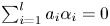 $\sum _{i=1}^{l} a_i \alpha _i =0$ and
 $\{\gamma _n v_n(\alpha _i)\}_n$ is bounded. As
 $\{\gamma _n v_n(\alpha _i)\}_n$ is discrete, we assume that
 $\gamma _n v_n(\alpha _i)$ is constantly equal to some non-zero vector
 $v_i\in \boldsymbol {V}(\mathbb {Z})$ by passing to a further subsequence. As
 $\alpha _i$ is non-zero, the
 $\boldsymbol {G}$-orbit through
 $v_i$ contains
 $\{0\}$ in its closure. According to Theorem 5.8, there exists a canonical
 $\mathbb {Q}$-parabolic subgroup
 $\boldsymbol {P}_i$ that contains the stabilizer of the line
 $\mathbb {Q} v_i$. In particular,
 $\boldsymbol {P}_i$ contains
 $\gamma _n \boldsymbol {H} \gamma _n^{-1}$ for all
 $n$.
By Lemma 5.7 and Theorem 5.8, there exists a cocharacter  $\boldsymbol {a}^I_n$ of
 $\tilde {\boldsymbol {S}}_{\boldsymbol {H}}$ such that
 $t \mapsto \gamma _n \boldsymbol {a}^I_n(t)\gamma _n^{-1}$ is optimal for
 $v_i$ and
 $\boldsymbol {P}_i= \gamma _n\boldsymbol {P}_{\boldsymbol {a}^I_n}\gamma _n^{-1}$. By the remarks made after Theorem 5.8, we have
 $\boldsymbol {P}_{\boldsymbol {a}^I_n}=\boldsymbol {P}_{\alpha _i^{\vee }}$, independent of
 $n$. Here we have abused notation to use
 $\alpha _i$ for its restriction to
 $\tilde {\boldsymbol {S}}_{\boldsymbol {H}}$ and
 $\alpha _i^{\vee }$ for its dual cocharacter of this torus. Hence,
 $\gamma _n\boldsymbol {P}_{\alpha _i^{\vee }}\gamma _n^{-1}=\gamma _1\boldsymbol {P}_{\alpha _i^{\vee }}\gamma _1^{-1}$ and so
 $\gamma _1^{-1}\gamma _n$ normalizes
 $\boldsymbol {P}_{\alpha _i^{\vee }}$. However, the normalizer of a parabolic subgroup is equal to itself (see [Reference SpringerSpr98, Corollary 6.4.10]), so
 $\gamma _1^{-1}\gamma _n$ is contained in
 $\boldsymbol {L}$, defined to be the intersection of
 $\boldsymbol {P}_{\alpha _i^{\vee }}$ as
 $i$ ranges from
 $1$ to
 $l$.
Referring to the remarks made after Theorem 5.8 again, the Lie algebra of  $\boldsymbol {L}$ consists of
 $\frak {g}_{\beta }$ with
 $(\beta,\alpha _i)\geq 0$ for all
 $i$. However,
 $\sum _{i=1}^{l} a_i \alpha _i =0$ for some positive numbers
 $\{a_i\}_{i=1,\ldots,l}$, we are forced to have
 $(\beta,\alpha _i) = 0$ for all
 $i$. Let
 $\boldsymbol {S}_{\beta }$ be any
 $\mathbb {Q}$-split subtorus of
 $\tilde {\boldsymbol {S}}_{\boldsymbol {H}}$ which is the image of some non-trivial cocharacter
 $\boldsymbol {a}$ that is in the
 $\mathbb {Q}$-span of
 $\beta ^{\vee }$. Then the adjoint action of
 $\boldsymbol {S}_{\beta }$ restricted to the Lie algebra of
 $\boldsymbol {L}$ is trivial. In other words,
 $\boldsymbol {L}^{\circ }$ is contained in the centralizer of
 $\boldsymbol {S}_{\beta }$. This is a contradiction as
 $\gamma _1^{-1}\gamma _n$ would then be bounded in
 $G/Z_{\boldsymbol {G}}\boldsymbol {S}_{\beta }$.
Thus, we have proved  $\Phi _{bdd}$ is at most
 $\{0\}$. Now suppose that
 $\boldsymbol {P}$ is a proper parabolic
 $\mathbb {Q}$-subgroup of
 $\boldsymbol {G}$, we want to show that
 $\boldsymbol {F}$ is not contained in
 $\boldsymbol {P}$. If this were not true, we have that
 $\gamma _n \boldsymbol {H} \gamma _n^{-1}$ normalizes the unipotent radical
 $\boldsymbol {U}$ of
 $\boldsymbol {P}$ for all
 $n$. Let
 $v_{\boldsymbol {U}}$ be an integral vector in
 $\wedge ^{\dim \boldsymbol {U}}\frak {g}$ that represents
 $\boldsymbol {U}$, then
 $\gamma _n \boldsymbol {H} \gamma _n^{-1}$ stabilize the line spanned by
 $v_{\boldsymbol {U}}$ for all
 $n$. Then we see that the character of
 $\boldsymbol {H}$ associated with
 $\gamma _n^{-1} v_{\boldsymbol {U}}$ is in
 $\Phi _{bdd}$, which has been shown to be contained in
 $\{0\}$. That is, the adjoint action of
 $\gamma _n \boldsymbol {H} \gamma _n^{-1}$ on
 $\operatorname {Lie}(\boldsymbol {U})$ has determinant
 $1$, which is a contradiction to Lemma 5.7.
6. Examples and applications
In this last section we discuss some examples and rather explicit applications.
6.1 Examples
In this subsection we prove Propositions 1.9 and 1.10.
Proof of Proposition 1.9 If the propositions were not true, by Theorem 1.7, we can find a sequence  $(\gamma _n)\subset {\Gamma }$ satisfying the property in the proposition, such that
 $\boldsymbol {L}$ contains
 $\gamma _n \boldsymbol {H} \gamma _n^{-1}$ for all
 $n$. By taking a conjugate, we may assume that
 $\boldsymbol {L}$ contains
 $\boldsymbol {H}$. By [Reference GilleGil10] (cf. [Reference Borel and De SiebenthalBD49]), there exists a diagonalizable subgroup
 $\boldsymbol {Z}$ of
 $\boldsymbol {H}$ that contains the center properly such that
 $\boldsymbol {L}$ is the connected component of
 $\boldsymbol {Z}_{\boldsymbol {G}}\boldsymbol {Z}$.
Therefore,  $\gamma _n\boldsymbol {H}\gamma _n^{-1}\subset \boldsymbol {Z}_{\boldsymbol {G}}(\boldsymbol {Z})$, or equivalently
 $\boldsymbol {H}\subset \boldsymbol {Z}_{\boldsymbol {G}}(\gamma _n^{-1}\boldsymbol {Z}\gamma _n)$ for all
 $n$. Hence,
 $\gamma _n^{-1}\boldsymbol {Z}\gamma _n$ centralize the maximal torus
 $\boldsymbol {H}$ and, hence, is contained in
 $\boldsymbol {H}$. Therefore
 $\gamma _n \in \boldsymbol {X}(\boldsymbol {Z},\boldsymbol {H})$ for all
 $n$. Apply [Reference SpringerSpr98, Proposition 3.2.8] and pass to a subsequence, we may assume that
 \[ \gamma_1 z \gamma_1^{{-}1}=\gamma_n z \gamma_n^{{-}1}, \quad \forall \, n, \ \forall \,z\in\boldsymbol{Z}. \]
Hence,  $\gamma _n \gamma _1^{-1} \in \boldsymbol {Z}_{\boldsymbol {G}}(\boldsymbol {Z})$, or equivalently
 $\gamma _n \in \boldsymbol {Z}_{\boldsymbol {G}}(\gamma _1^{-1}\boldsymbol {Z}\gamma _1)$ for all
 $n$. Note that
 $\gamma _1^{-1}\boldsymbol {Z}\gamma _1$ is also a subgroup of
 $\boldsymbol {H}$ properly containing the center. This is a contradiction.
Let  $J$ be the anti-symmetric matrix

Let  $\boldsymbol {G}=\operatorname {Sp}_{2N}$ be the subgroup of
 $\operatorname {SL}_{2N}$ which preserves the symplectic form represented by
 $J$.
Proof of Proposition 1.10 It suffices to show that for each diagonalizable subgroup  $\boldsymbol {Z}$ of
 $\boldsymbol {H}$ there exists
 $\boldsymbol {T}_{\boldsymbol {Z}} \leq \boldsymbol {H}$ a
 $\mathbb {Q}$-subtorus such that
 $\boldsymbol {Z}_{\boldsymbol {G}}(\boldsymbol {Z})=\boldsymbol {Z}_{\boldsymbol {G}}(\boldsymbol {T}_{\boldsymbol {Z}})$.
First, we assume that  $\boldsymbol {H}$ is the diagonal torus. Writing each element
 $z\in \boldsymbol {Z}$ as
 $\operatorname {diag}(z_1,\ldots,z_N,z_N^{-1},\ldots,z_1^{-1})$, we define an equivalence relation on
 $\{1,\ldots,N\}$ by
 \[ i \sim j \iff z_{i}=z_{j}, \quad \forall \, z\in \boldsymbol{Z}. \]
This relation defines a torus  $\boldsymbol {T}_{\boldsymbol {Z}}$ in
 $\boldsymbol {H}$ by
 \[ \operatorname{diag}(t_1,\ldots,t_N,t_N^{{-}1},\ldots,t_1^{{-}1}) \in \boldsymbol{T}_{\boldsymbol{Z}} \iff t_i = t_j,\quad \forall \, i\sim j. \]
By linear algebra, their centralizer in  $\operatorname {GL}_{2N}$ agrees and, hence, also agrees in
 $\boldsymbol {G}$. Thus, we are done in this case.
In general, we conjugate  $\boldsymbol {H}$ to the diagonal torus over
 $\overline {\mathbb {Q}}$ to obtains such a subtorus
 $\boldsymbol {T}_{\boldsymbol {Z}}$ with the desired property except that
 $\boldsymbol {T}_{\boldsymbol {Z}}$ may not be defined over
 $\mathbb {Q}$. However, this would imply that
 $\boldsymbol {Z}(\boldsymbol {Z}_{\boldsymbol {G}}(\boldsymbol {Z}))^{\circ }$ contains
 $\boldsymbol {T}_{\boldsymbol {Z}}$, which contains
 $\boldsymbol {Z}$. Thus, we may replace
 $\boldsymbol {T}_{\boldsymbol {Z}}$ by
 $\boldsymbol {Z}(\boldsymbol {Z}_{\boldsymbol {G}}(\boldsymbol {Z}))^{\circ }$.
6.2 Counting some conjugacy classes in $\operatorname {Sp}_{2N}$

In this subsection, for a group  $G$,
 $\mu _G$ will be a Haar measure on
 $G$ and we instead let
 $\mu _{G/\Gamma }$ be a Haar measure in the quotient. Let
 $\boldsymbol {G}$ be the same symplectic group as in last subsection.
Note that  $\boldsymbol {G}(\mathbb {R})$ is automatically connected, so
 $G=\boldsymbol {G}(\mathbb {R})$ contains
 $\boldsymbol {G}(\mathbb {Q})$. Let
 $\Gamma := \boldsymbol {G}(\mathbb {Z})$ and
 $\boldsymbol {G}':=\operatorname {SL}_{2N}$. Let
 $\boldsymbol {H}$ be the full diagonal torus given by
 \[ \left[ \begin{array}{c|c} \begin{array}{ccc} t_1 & &\\ & \ddots & \\ & & t_N \end{array} & 0 \\ \hline 0 & \begin{array}{ccc} t_N^{-1^{\vphantom{A}}} & &\\ & \ddots & \\ & & t_1^{-1} \end{array} \end{array} \right]. \]
This is a  $\mathbb {Q}$-split maximal torus of
 $\boldsymbol {G}$. Similarly, we let
 $\boldsymbol {H}'$ be the full diagonal torus in
 $\boldsymbol {G}'$. Let
 $\boldsymbol {U}$ be the
 $\mathbb {Q}$-subgroup of
 $\boldsymbol {G}$ consisting of elements of the form

Similarly, we let  $\boldsymbol {U}'$ be the group of upper triangular unipotent matrices in
 $\boldsymbol {G}'$. Let
 $K:= G\cap \operatorname {SO}_{2N}(\mathbb {R})$ be a maximal compact subgroup of
 $G$. Thus, we have
 $(K \times U \times H, \mu _K \otimes \mu _U \otimes \mu _H) \cong (G,\mu _G)$ via
 $(k,u,h)\mapsto kuh$.
6.2 Normalization of Haar measures
So far Haar measures are only up to a positive scalar. Now we want to specify this scalar.
First we choose  $\mu _K$ to be a probability measure. We take
 $\mu _H := ({2^{(N^2+N)/2-1}}/{\prod _{k=1}^N \xi (2k)})\cdot |\wedge _{i=1}^N ({dt_i}/{t_i})|$ where
 $\xi (z)=\pi ^{-{z}/{2}}\Gamma ({z}/{2})\zeta (z)$ is the completed Zeta function. The reason for this normalization will become clear in a moment. For the Haar measure on
 $\boldsymbol {U}$, let us first observe that
 $\boldsymbol {U}$ consists of
 \[ \Biggl[ \begin{array}{c|c} A & B \\ \hline\vphantom{\frac{1/2}{2/2}} 0 & J_N {}^tA^{-1} J_N \end{array} \Biggr] \]
with  $A$ being arbitrary upper triangular unipotents and
 $J_NA^{-1}B$ being symmetric. Let
 $A=(a_{ij})$ and
 $B=(b_{ij})$. Note that
 $U$ is in bijection with
 $\mathbb {R}^{{N(N-1)}/{2}+{N(N+1)}/{2}}=\mathbb {R}^{N^2}$ via
 $(a_{ij})_{i< j} \times (b_{ij})_{i+j\geq N+1}$. Then one can show that
 $|\wedge _{i< j}\,da_{ij}|\wedge |\wedge _{i+j\geq N+1}\,db_{ij}|$ is a Haar measure on
 $U$ and we take
 $\mu _U$ to be this one. Now we define
 $\mu _G$ via the Iwasawa decomposition above, and
 $\mu _{G/\Gamma }$ to be induced from
 $\mu _G$. We need a result of Siegel [Reference SiegelSie43, Theorem 11].
Theorem 6.1 Under this normalization,  $\mu _{G/\Gamma }$ is a probability measure.
Proof. This is not exactly how it is stated in [Reference SiegelSie43, Theorem 11] as different normalizations of volume forms are used. Let us recall the original statement. Let
 \[ \mathcal{H}^N:=\{Z=X+iY \mid {}^tX=X, {}^tY=Y, Y>0 \} \]
where  $X, Y$ are both real matrices and
 $Y>0$ means positive definite. Here
 $\mathcal {H}^N$ is equipped with a volume form
 $\omega$, whose absolute value at
 $i I_N$ is equal to
 \[ 2^{{N(N-1)}/{2}}|\wedge_{i\leq j}\,dy_{ij}|\wedge|\wedge_{i\geq j}\,dx_{ij}|. \]
In general, it is induced from the metric  $\operatorname {Tr}{(Y^{-1}\,dZ Y^{-1}\,dZ)}$. We are using a different symplectic group than the ‘homogeneous symplectic group
 $\Omega _0$’ used in [Reference SiegelSie43], which is defined to preserve the symplectic form
 \[ \Biggl[ \begin{array}{c|c} 0 & I_N \\ \hline\vphantom{\frac{1/2}{2/2}} -I_N & 0 \end{array} \Biggr]. \]
Note that
 \[ \Biggl[ \begin{array}{cc} I_N & 0 \\ 0 & J_N \end{array} \Biggr] \Biggl[ \begin{array}{cc} 0 & J_N \\ -J_N & 0 \end{array} \Biggr] \Biggl[ \begin{array}{cc} I_N & 0 \\ 0 & J_N \end{array} \Biggr] = \Biggl[ \begin{array}{cc} 0 & I_N \\ -I_N & 0 \end{array} \Biggr]. \]
Thus, if we take  $M_0$ to be
 $\operatorname {diag}(I_N,J_N)$, then
 $A \mapsto M_0^{-1}AM_0$ gives a bijection from
 $G$ to
 $\Omega _0$ and from
 $\Gamma$ to what is called the ‘modular group’ in [Reference SiegelSie43]. An element in
 $\Omega _0$ acts on
 $\mathcal {H}^N$ by
 \[ \Biggl[ \begin{array}{cc} A & B \\ C & D \end{array} \Biggr] \cdot Z:= (AZ+B)\cdot(CZ+D)^{{-}1}. \]
With this action and the volume form above, [Reference SiegelSie43, Theorem 11] states that
 \[ {\rm Vol}(\Gamma\backslash\mathcal{H}^N)=2\prod_{k=1}^N \xi(2k). \]
The inverse map  $(u,h)\mapsto (h^{-1},u^{-1})$ from
 $U\times H$ to
 $H\times U$ sends the measure
 $\mu _U\otimes \mu _H$ to
 $\mu _H \otimes \mu _U$. In addition, the map
 $\Phi : (h,u)\mapsto M_0huM_{0}^{-1}\cdot i I_N$, which identifies
 $H \times U$ with
 $\mathcal {H}^N$, pulls back
 $({1}/{2\prod _{k=1}^N \xi (2k)}) |\omega |$ to some multiple of
 $\mu _H\otimes \mu _U$ viewed as the absolute value of a volume form. It remains to show that these two (absolute value of) volume forms are the same at
 $(I_{2N},I_{2N})$.
As before write
 \[ u = \Biggl[ \begin{array}{cc} A & B \\ 0 & J_N{}^tA^{{-}1}J_N \end{array} \Biggr] \]
and  $h = \operatorname {diag}(t_1,\ldots,t_N,t_N^{-1},\ldots,t_1^{-1})$. Then
 $\Phi (h,u)$ is equal to
 \[ \left[ \begin{array}{ccc} t_1 & & \\ & \ddots & \\ 0 & & t_N \end{array} \right] B J_N {}^tA \left[ \begin{array}{ccc} t_1 & & \\ & \ddots & \\ 0 & & t_N \end{array} \right] + i \left[ \begin{array}{ccc} t_1 & & \\ & \ddots & \\ 0 & & t_N \end{array} \right] A{}^tA \left[\begin{array}{ccc} t_1 & & \\ & \ddots & \\ 0 & & t_N \end{array} \right]. \]
Taking its differential and evaluating at  $(I_{2N},I_{2N})$ we find
 \[ (dB) J_N + i (dA + d{}^tA) + 2\operatorname{diag}(dt_1,\ldots,dt_N). \]
This means that  $\Phi ^*_{I_{2N},I_{2N}}$ pulls back
 $dx_{ij}$ to
 $db_{i, N+1-j}, dy_{ij}$ with
 $i< j$ to
 $da_{ij}$ and
 $dy_{ii}$ to
 $2dt_i$. Hence
 $\Phi ^*_{I_{2N},I_{2N}}$ pulls back
 $|\omega |$ to
 \[ 2^{{N(N-1)}/{2}+N}|\wedge_{i+j\geq N+1}\,db_{ij}|\wedge|\wedge_{i< j}\,da_{ij}|\wedge|\wedge dt_i|, \]
and we are done.
We also identify  $(G/H,\mu _{G/H})$ with
 $(K \times U, \mu _K\otimes \mu _U)$.
6.2 Reduction of the counting problem
As in the introduction, fix a polynomial  $p(t)$ of the form
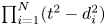 $\prod _{i=1}^N (t^2 -d_i^2)$ with
 $d_i\in \mathbb {Z}^+$ distinct. Consider
 $\boldsymbol {X}(\mathbb {R}):= \{X\in (\frak {sp}_{2N})_{\mathbb {R}}, \det (tI_{2N}-X)=p(t) \}$ and let
 $\boldsymbol {X}(\mathbb {Z})$ be its intersection with integral matrices. Similarly, we define
 $\boldsymbol {X}'(\mathbb {R})$ and
 $\boldsymbol {X}'(\mathbb {Z})$ to be those contained in
 $\frak {sl}_{2N}$. We fix a base point
 $x_0 \in \boldsymbol {X}(\mathbb {Z})$ equal to
 $\operatorname {diag}(d_1,\ldots,d_N,-d_N,\ldots,-d_1)$. Let
 $\|\cdot \|$ be the Euclidean norm on
 $2N \times 2N$ matrices and
 $B_R$ consist of elements in
 $\boldsymbol {X}(\mathbb {R})$ with norm less than or equal to
 $R$.
Note that  $g \mapsto g\cdot x_0$ gives an homeomorphism from
 $G/H$ to
 $\boldsymbol {X}(\mathbb {R})$. The non-trivial part is surjectivity. Every element
 $x\in \boldsymbol {X}(\mathbb {R})$ is semisimple with distinct eigenvalues in
 $\mathbb {Q}$, hence its centralizer
 $\boldsymbol {T}_{x}$ in
 $\boldsymbol {G}$ is actually a maximal
 $\mathbb {Q}$-split torus. Thus, there exists
 $\gamma \in \boldsymbol {G}(\mathbb {Q})\subset G$ such that
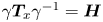 $\gamma \boldsymbol {T}_{x} \gamma ^{-1}=\boldsymbol {H}$ (see [Reference SpringerSpr98, Theorem 15.2.6]). At this point,
 $\gamma \cdot x$ is already diagonal. It remains to observe that there exists
 $w\in \boldsymbol {N}_{\boldsymbol {G}}\boldsymbol {H} (\mathbb {Q})\subset \boldsymbol {G}(\mathbb {Q})$ such that
 $w \gamma \cdot x=x_0$.
Thus, we may identify  $\boldsymbol {X}(\mathbb {R})$ with
 $G/H \cong K \times U$. As
 $K$ preserves
 $B_R$ and
 $\mu _K$ is a probability measure, we also think of
 $B_R$ as a subset of
 $U$ and
 $\mu _{G/H}(B_R)= \mu _U(B_R)$.
Note that  $\Gamma$ preserves
 $\boldsymbol {X}(\mathbb {Z})$ and decompose
 $\boldsymbol {X}(\mathbb {Z})$ into finitely many orbits by a theorem of Borel and Harish-Chandra [Reference BorelBor62, Theorem 6.9]. We let
 $C_0$ be this number
 $|\Gamma \backslash \boldsymbol {X}(\mathbb {Z})|$. Thus, to prove Theorem 1.11, it suffices to count each individual orbit separately. For simplicity, we assume that the orbit is
 $\Gamma \cdot x_0$. Other orbits can be treated similarly (see the last section of [Reference Shapira and ZhengSZ19] or [Reference ZhangZha19] for details).
For each  $I \subset \{1,\ldots,2N\}$, we say
 $I$ is isotropic if the subspace generated by
 $\{e_i\}_{i\in I}$ is. Let
 \[ \mathscr{A}:=\{I \subset \{1,\ldots,2N\} \mid I \text{ is isotropic} \}. \]
Here  $\mathscr {A}$ allows an explicit description: each
 $I\in \mathscr {A}$ is of the form
 $J\sqcup 2N+1-J'$ for some disjoint
 $J\sqcup J'\subset \{1,\ldots,N\}$. There is a bijective correspondence between
 $\mathscr {A}$ and
 $\mathscr {P}_{\boldsymbol {H}}$ given by taking the stabilizer of the line spanned by
 $e_{I}:=\wedge _{i\in I} e_i$ (again, defined up to sign). There also exists
 $C>0$ such that if
 $I$ corresponds to
 $\boldsymbol {P}$, then for all
 $g\in G, ({1}/{C})\|ge_I\|<\|d_{\boldsymbol {P}}(g)\|< C \|ge_I\|$. Hence, in the definition of
 $\Omega _{g,\eta }$ as in (2), we may replace
 $d_{\boldsymbol {P}}(g)$ by
 $\|ge_I\|$ as
 $I$ varies over
 $\mathscr {A}$.
Now we define two other constants relevant to the counting problem. The reason for this definition will be clear in the proof.
For  $I=\{i_1,\ldots,i_k\}$, define
 $c_I:= \sum _{\lambda =1}^k i_{\lambda }-\lambda$. Define
 $C_1>0$ by
 \[ {\rm Vol}(\{t\in \operatorname{Lie}(H), d\alpha_I(t) \geq{-}c_I,\ \forall \, I\in \mathscr{A}\}) \]
where  ${\rm Vol}$ is required to be compatible with
 $\mu _H$ under the exponential map. Define
 $C_2>0$ by
 \begin{align*} &C_2 \cdot \bigg|\prod_{1\leq i< j\leq N}(d_j-d_i)\prod_{1\leq i\leq j\leq N}(d_j+d_i) \bigg| \\ &\quad = {\rm Vol}\bigg(\bigg\{ (y_{ij},z_{ij}) \in \mathbb{R}^{N^2}\,\bigg\vert\, 2\sum_{i< j} |y_{ij}|^2 + 2\sum_{i+j> N+1} |z_{ij}|^2 + \sum_{i+j= N+1}|z_{ij}|^2 \leq 1 \bigg\}\bigg). \end{align*}
Let  $N_R:= C_1 C_2 R^{N^2} (\ln {R})^{N}$. Arguing as in [Reference Eskin and McMullenEM93], to prove Theorem 1.11 with the constant
 $C:=C_0 \cdot C_1\cdot C_2$, it suffices to show
 $\{B_R\}$ is well-rounded (see Lemma 6.4) and the following.
Proposition 6.2 For any  $f\in C_{c}(G/\Gamma )$ non-negative,
 \[ \lim_{R\to+\infty}\frac{1}{N_R} \int_{K \times B_R}\int_H f(kuh)\, dh \, du \, dk = \langle f, \mu_{G/\Gamma} \rangle \]
where, for simplicity, we have written  $dk$ for
 $\mu _K$,
 $du$ for
 $\mu _U$, and
 $dh$ for
 $\mu _H$.
6.2 Different coordinates for $U$ and $B_{R,\varepsilon }$


The coordinates  $a_{ij}$ and
 $b_{ij}$ are not easy to work with in terms of
 $B_R$. Thus, we move to a different set of coordinates and show how the Haar measure can be expressed in this new set of coordinates. Indeed,
 $g \mapsto g \cdot x_0$ gives a bijection from
 $U$ to
 \[ \biggl\{ X=\bigg[ \begin{array}{c|c} Y & Z \\ \hline\vphantom{\frac{1/2}{2/2}} 0 & -J_N {}^{t}YJ_N \end{array} \bigg] , y_{ii}=d_i, y_{ij}=0,\ \forall \, i>j, ZJ_N \text{ is symmetric} \biggr\}. \]
In terms of coordinates  $x_{ij}$, the coefficients of
 $X$, this says that
 $x_{ij}=0$ if
 $i>j$;
 $x_{ii}= d_i$ and
 $x_{N+i,N+i}=-d_{N+1-i}$ if
 $1\leq i\leq n$;
 $x_{i,N+j}=x_{N+1-i,N+(N+1-j)}$ for all
 $1\leq i,j\leq n$.
For instance, when  $n=3$, these are
 \[ \left[ \begin{array}{c|c} \begin{array}{ccc} d_1 & y_{12} & y_{13}\\ & d_2 & y_{23}\\ & & d_3 \end{array} & \begin{array}{ccc} z_{33} & z_{23} & z_{13}\\ z_{32 }& z_{22} & z_{23}\\ z_{31}& z_{32} & z_{33} \end{array} \\ \hline\vphantom{\frac{1/2}{2/2}} 0 & -\left(\begin{array}{ccc} d_3 & y_{23} & y_{13}\\ & d_2 & y_{12}\\ & & d_1 \end{array}\right) \end{array} \right]. \]
Using a computation made in [Reference Shapira and ZhengSZ19, Lemma 11.2], we have the following result.
Lemma 6.3 Under the bijection above,
 \[ |\wedge_{i< j}\,da_{ij}|\wedge|\wedge_{i+j\geq N+1}\,db_{ij}|= \frac{ |\wedge_{i< j}\,dx_{ij}|\wedge|\wedge_{i+j\geq N+1}\,dz_{ij}| }{ \big|\prod_{1\leq i< j\leq n}(d_j-d_i)\prod_{1\leq i\leq j\leq n}(d_j+d_i)\big| }. \]
Using the coordinates  $x_{ij}$ or
 $(y_{ij},z_{ij})$,
 $B'_R$ and
 $B_R$ are
 \begin{align*} B'_R&:= \biggl \{(x_{ij})_{i< j} \biggm | \sum_{i< j} |x_{ij}|^2 + 2\sum |d_i|^2 \leq R^2 \biggr\}, \\ B_R &= \;\bigg\{ (y_{ij})_{i< j},(z_{ij})_{i\geq j} \biggm | \\ & \qquad 2\sum_{i< j} |y_{ij}|^2 + 2\sum_{i+j> N+1} |z_{ij}|^2 + \sum_{i+j= N+1}|z_{ij}|^2+ 2\sum |d_i|^2 \leq R^2 \bigg\} \end{align*}
and for  $\varepsilon >0$ we define
 \begin{align*} B'_{R,\varepsilon}&:= \{ (x_{ij}) \in B'_R \mid |y_{i,i+1}|\geq \varepsilon R, \forall 1\leq i\leq 2N \}, \\ B_{R,\varepsilon}&:= \{ (y_{ij},z_{ij}) \in B_R \mid |y_{i,i+1}|\geq \varepsilon R, \forall 1\leq i\leq n, |z_{n,1}| \geq \varepsilon R\}. \end{align*}
Thus,  $B_R$ (respectively,
 $B_{R,\varepsilon }$) is just the intersection of
 $B'_R$ (respectively,
 $B'_{R,\varepsilon }$) with
 $\frak {sp}_{2N}(\mathbb {R})$.
Similar to [Reference Shapira and ZhengSZ19, Lemma 11.6] we have the following result.
Lemma 6.4 For any  $\varepsilon >0$, there exists
 $\varepsilon '>0$ such that
 \[ \frac{\mu_U(B_{R,\varepsilon'})}{\mu_U(B_{R})} \geq 1- \varepsilon \]
for all  $R>1$. In addition,
 \[ \lim_{R\to\infty} \frac{\mu_U(B_R)}{C_2R^{N^2}} =1. \]
In particular, the family  $\{B_R\}$ is well-rounded in the sense of [Reference Eskin and McMullenEM93].
6.2 Proof
Now we come back to the proof of the main proposition.
Lemma 6.5 For any  $\varepsilon '>0$,
 $\delta >0$, and
 $f\in C_c(G/\Gamma )$, there exists
 $R_0$ such that for all
 $R>R_0$ and for all
 $g\in B_{R,\varepsilon '}$,
 $k\in K$, we have
 \[ \bigg| \frac{1}{C_1(\ln{R})^N} \int f(kuh) \mu_H(h) - \langle f,\mu_{G/\Gamma} \rangle \bigg|<\delta. \]
Lemma 6.6 For all  $f\in C_c(G/\Gamma )$, there exists
 $C_f>0$ such that for all
 $R>1$ and all
 $u\in B_R, k\in K$, we have
 \[ \bigg| \frac{1}{C_1(\ln{R})^N} \int f(kuh) \mu_H(h) \bigg| \leq C_f. \]
Assuming these lemmas hold (to be proved later), let us prove the proposition.
Proof of Proposition 6.2 For any  $\varepsilon >0$ choose
 $\varepsilon '>0$ according to Lemma 6.4 above. In addition, fix an arbitrary
 $\delta >0$. Find
 $R_0$ by Lemma 6.5 and
 $C_f$ by Lemma 6.6. We decompose the original integral into two parts:
 \[ I_1 :=\frac{1}{N_R} \int_{K \times B_{R,\varepsilon}}\int_H f(kuh) \mu_H(h) \]
and
 \[ I_2 :=\frac{1}{N_R} \int_{K \times B_R-B_{R,\varepsilon}}\int_H f(kuh) \mu_H(h). \]
Take  $R>R_0$, then
 \begin{align*} I_1 &= \frac{1}{\mu_U(B_R)}\int \langle f,\mu_{G/\Gamma} \rangle + o(1) \\ &= \frac{\mu_U(B_{R,\varepsilon'})}{\mu_U(B_R)} (\langle f,\mu_{G/\Gamma} \rangle + o(1)) \\ &= (1+o'(1)) (\langle f,\mu_{G/\Gamma} \rangle + o(1)), \end{align*}
where  $o(1)$ is some number whose absolute value is less than
 $\delta$ and
 $o'(1)$ is some number whose absolute value is less than
 $\varepsilon$.
For the other part,
 \[ |I_2| \leq \frac{1}{\mu_U(B_R)}\int_{B_R-B_{R,\varepsilon'}} C_f \leq \varepsilon C_f. \]
Therefore, by taking the limit ( $\limsup$ and
 $\liminf$) of
 $I_1+I_2$ and then letting
 $\varepsilon,\delta$ go to zero we are done.
6.2 Proof of Lemmas
To prove Lemmas 6.5 and 6.6, let us recall the computation in [Reference Shapira and ZhengSZ19, Propositions 11.5 and 11.8].
Proposition 6.7
(1) There exists
$M>0$ such that for all $R>1$, for all $g\in B'_R$,
\[ \ln{\|ue_I\|} \leq M \ln{R},\quad \forall I\in\mathscr{A}; \](2) For all
$\varepsilon '>0$, there exists $M_{\varepsilon '}>0$, for all $R>1$ and $u\in B'_{R,\varepsilon '}$, one has
\[ |\ln{\|ue_I\|-c_I \ln{R}}| \leq M_{\varepsilon'},\quad \forall I\in\mathscr{A}. \]


Lemma 6.8 For any  $\varepsilon '>0$ and any sequence
 $(k_nu_n)$ with
 $k_n \in K, u_n \in B_{R_n,\varepsilon '}$ and
 $R_n \to + \infty$, we have
 $\lim _n (k_nu_n)_*[\mu _H]=[\mu _{G/\Gamma }]$.
Proof. If not true, by Proposition 1.10, there exists  $x_{\neq 0}$ in the Lie algebra of
 $H$ such that
 $\operatorname {Ad}(k_nu_n)\cdot x$ and, hence,
 $\operatorname {Ad}(u_n)\cdot x$ is bounded. Write
 \[ x=\operatorname{diag}(x_1,\ldots,x_N,x_{N+1},\ldots,x_{2N}) \]
with  $x_{N+i}=-x_{N+1-i}$. The absolute value of the
 $(i,i+1)$th entry of
 $\operatorname {Ad}(u_n)\cdot x$ is equal to
 $|x_{i+1}-x_i|\cdot |(u_n)_{i,i+1}| \geq |x_{i+1}-x_i|R\varepsilon '$, which diverges as
 $R \to \infty$. This is a contradiction.
Recall that  $\Omega _{g,\eta }$ (see § 2.2) is equal to
 \[ \{ t \in \operatorname{Lie}(H) \mid d\alpha_I(t) \geq \ln{\eta} - \ln{\|ge_I\|}, \ \forall \, I\in\mathscr{A} \}. \]
We take  $\eta >0$ small enough depending on
 $f$ such that
 \[ \int_H f(kuh) \mu_H(h) = \int_{\exp{(\Omega_{u,\eta})}} f(kuh) \mu_H(h) \]
for all  $u$ and
 $k$.
Proof of Lemma 6.5 In light of Lemma 6.8, it remains to show that for  $\eta >0$ sufficiently small and
 $u_R\in B_{R,\varepsilon '}$,
 \[ \lim_{R\to \infty} \frac{\mu_H(\Omega_{u_R,\eta})}{C_1\ln{R}^{N}} =1. \]
By Proposition 6.7,
 \[ \Omega_{u_R,\eta} \subset \{ t\in \operatorname{Lie}(H) \mid d\alpha_I(t) \geq \ln{\eta} - c_I \ln{R}- M_{\varepsilon'}, \forall I\in \mathscr{A} \} \]
and
 \[ \Omega_{u_R,\eta} \supset \{ t\in \operatorname{Lie}(H) \mid d\alpha_I(t) \geq \ln{\eta} - c_I \ln{R} + M_{\varepsilon'}, \forall I\in \mathscr{A}\}. \]
By dividing  $\ln R$, we obtain
 \begin{align*} &\bigg\{t\in \operatorname{Lie}(H), d\alpha_I(t) \geq{-}c_I + \frac{\ln{\eta}-M_{\varepsilon'}}{\ln R} , \forall I\in \mathscr{A}\bigg\} \\ &\quad \subset \frac{\Omega_{u_R,\eta}}{\ln{R}} \subset \bigg\{t\in \operatorname{Lie}(H), d\alpha_I(t) \geq{-}c_I + \frac{\ln{\eta}+M_{\varepsilon'}}{\ln R} , \ \forall \, I\in \mathscr{A} \bigg\}. \end{align*}
By the definition of  $C_1$, we are done.
Proof of Lemma 6.6 By Proposition 6.7, for  $u\in B_R$,
 \[ \frac{\Omega_{u,\eta}}{\ln{R}} \subset \bigg\{t\in \operatorname{Lie}(H), d\alpha_I(t) \geq \frac{\ln \eta }{\ln{R}} - M,\ \forall \, I\in \mathscr{A} \bigg\}. \]
Thus,  $\mu _H(\Omega _{u,\eta }) \leq M' \ln {R}^N$ for some constant
 $M'>0$. By taking
 $C'_f:=\sup |f|$, then
 \[ \bigg| \frac{1}{C_1(\ln{R})^N} \int f(kuh) \mu_H(h) \bigg| \leq \frac{C'_f\mu_H(\Omega_{u,\eta})}{C_1(\ln{R})^N} \leq C_f \]
for some constant  $C_f>0$.
6.3 Shearing a divergent geodesic
In this subsection, we prove Theorem 1.12. Let  $\boldsymbol {G}=\operatorname {SO}_{Q}$ with
 $Q(x_1,\ldots,x_n,y)=x_1^2+\cdots +x_n^2-y^2$. We start by reviewing some hyperbolic geometry for which the reader is referred to [Reference Benedetti and PetronioBP92, Chapter A] for details.
6.3 Lift from $\mathbb {H}^n$ to the group

The group  $G$ naturally acts transitively on
 $\mathbb {I}^n:=\{Q=-1\}$, a subset of
 $\mathbb {R}^{n+1}$. There is a bijection
 $\Phi$ from
 $\mathbb {I}^n$ to
 $\mathbb {H}^n$ given by the composition of
 \begin{align*} &(x_1,\ldots,x_n,y) \mapsto \frac{(x_1,\ldots,x_n)}{1+y} \\ &(x_1,\ldots,x_n) \mapsto \frac{2(x+\boldsymbol{e}_n)}{\|x+\boldsymbol{e}_n\|^2} -\boldsymbol{e}_n. \end{align*}
Therefore, the action of  $G$ on
 $\mathbb {I}^n$ can be transported to an action on
 $\mathbb {H}^n$, which turns out to be isometric. Let
 $\boldsymbol {o}:=\Phi ((0,\ldots,0,1))$ and the stabilizer of
 $\boldsymbol {o}$ in
 $G$ is a maximal compact subgroup
 $K$ in
 $G$. The map
 $g \mapsto g\cdot \boldsymbol {o}$ induces an isometry between
 $G/K$ and
 $\mathbb {H}^n$. Thus, it naturally descends to an isometry
 $\Psi$ between
 $\Gamma \backslash G/K$ and
 $\Gamma \backslash \mathbb {H}^n$.
For  $t\in \mathbb {R}$, let
 \[ a_t:= \left[ \begin{array}{c|c} I_{n-1} & 0 \\ \hline 0 & \begin{array}{ccc} \cosh{t} & \sinh{t}\\ \sinh{t} & \cosh{t} \end{array} \end{array} \right] \]
and for  $\boldsymbol {v}=(v_1,\ldots,v_{n-1})$,
 \[ u_{\boldsymbol{v}}=\left[ \begin{array}{c|c} I_{n-1} & \begin{array}{cc} -v_1 & v_1 \\ \vdots & \vdots\\ -v_{n-1} & v_{n-1} \end{array} \\ \hline \begin{array}{ccc} v_1 & \cdots & v_{n-1} \\ v_{1} & \cdots & v_{n-1} \end{array} & \begin{array}{ccc} 1- \dfrac{\|v\|^{2^{\vphantom{A}}} }{2}&\dfrac{\|v\|^2 }{2}\\ - \dfrac{\|v\|^2 }{2} & 1 +\dfrac{\|v\|^2 }{2} \end{array} \end{array}\right]. \]
Let  $\boldsymbol {U}$ be the
 $\mathbb {Q}$-subgroup generated by
 $u_{\boldsymbol {v}}$ as
 $\boldsymbol {v}$ varies in
 $\mathbb {Q}^{n-1}$. This is the commutative unipotent radical of a proper
 $\mathbb {Q}$-parabolic subgroup of
 $\boldsymbol {G}$ that is contracted by
 $\boldsymbol {c}_{a_t}(g):= a_t g a_t^{-1}$ as
 $t \to -\infty$. Note that
 $\boldsymbol {v} \mapsto u_{\boldsymbol {v}}$ gives an isomorphism between
 $(\mathbb {Q}^n,+)$ and
 $\boldsymbol {U}$ as
 $\mathbb {Q}$-algebraic groups.
Under  $\Psi$,
 $\Gamma a_t u_{\boldsymbol {v}} K$ is sent to the projection of
 $\Phi (a_tu_{\boldsymbol {v}}\cdot \boldsymbol {e}_{n+1})=a_tu_{\boldsymbol {v}}\cdot \boldsymbol {o}$, which is equal to
 \[ \frac{2+2\cosh{t}+\|\boldsymbol{v}\|^2e^t}{\|\boldsymbol{v}\|^2+(e^t+1 + \|\boldsymbol{v}\|^2e^t)^2} \cdot (v_1,\ldots,v_{n-1},1). \]
Now let  $t$ vary over
 $\mathbb {R}$, then we find that
 $\{\Psi [a_t u_{\boldsymbol {v}}], t\in \mathbb {R}\}=\pi _{\Gamma }(\mathcal {I}_{\boldsymbol {v}})$. In light of this calculation, it suffices to prove the following result.
Theorem 6.9 Assume that  $\boldsymbol {v}$ is not contained in any proper
 $\mathbb {Q}$-linear subspace. Then under the Chabauty topology,
 $\{\pi _{\Gamma }(a_t u_{s\boldsymbol {v}}), t\in \mathbb {R}\}$ converges to
 $\Gamma \backslash G$ as
 $s$ tends to infinity.
Proof. Without loss of generality assume that  $\|\boldsymbol {v}\|=1$. Recall Corollary 1.4 and use the terminology there. Take
 $g_k=u_{s_k\boldsymbol {v}}$ for arbitrary
 $s_k \to \infty$ and
 $\boldsymbol {H}$ to be the group generated by
 $a_t$, it suffices to show
 $\boldsymbol {L}=\boldsymbol {G}$ possibly after passing to a subsequence. To find
 $\boldsymbol {L}$, we modify
 $\{g_k\}$ from the left by a bounded sequence to some sequence contained in
 $\Gamma$. Use
 $\boldsymbol {v} \mapsto u_{\boldsymbol {v}}$ to identify
 $2\mathbb {Z}^{n-1}$ with a finite index subgroup of
 $\boldsymbol {U}(\mathbb {Z})$. As
 $\Gamma$ is commensurable with
 $\boldsymbol {G}(\mathbb {Z}), \Gamma \cap 2\mathbb {Z}^{n-1}$ is a finite index subgroup of
 $2\mathbb {Z}^{n-1}$. And therefore one can find a positive integer
 $N_0$ such that
 $\Gamma$ contains
 $2N_0\mathbb {Z}^{n-1}$.
Take a sequence  $(\boldsymbol {v}^k)$ in
 $2N_0\mathbb {Z}^{n-1}$ that is of bounded distance from
 $s_k\boldsymbol {v}$. Then
 $u_{s_k\boldsymbol {v}}$ is also of bounded distance (both from left and from right) from
 $u_{\boldsymbol {v}^k}$, which are contained in
 $\Gamma$. By our choice, we have that
 \[ \lim_k \frac{\boldsymbol{v}^k}{\|\boldsymbol{v}^k\|} = \boldsymbol{v}. \]
Passing to a subsequence we may assume that  $\boldsymbol {L}$ contains
 $u_{\boldsymbol {v}^k}^{-1}\boldsymbol {H} u_{\boldsymbol {v}^k}$ for all
 $k$. Let us compute
 $u_{\boldsymbol {v}^k}^{-1}a_t u_{\boldsymbol {v}^k}=u_{-\boldsymbol {v}^k}a_t u_{\boldsymbol {v}^k}$, which is equal to
 \[ \left[ \begin{array}{c|c} I_{n-1} & \begin{array}{cc} -(1-e^{-t})v^k_1 & (1-e^{-t})v^k_1 \\ \vdots & \vdots\\ -(1-e^{-t})v^k_{n-1} & (1-e^{-t})v^k_{n-1} \end{array} \\ \hline\vphantom{\frac{1/2\frac{1/2}{1/2}}{2/2}} \begin{array}{ccc} (e^t-1)v^k_1 & \cdots & (e^t-1)v^k_{n-1} \\ (e^t-1)v^k_{1} & \cdots & (e^t-1)v^k_{n-1} \end{array} & A_k \end{array}\right] \]
with
 \[ A_k = \left[ \begin{array}{ccc} \cosh{t}+(1-\cosh{t})\|\boldsymbol{v}^k\|^2 & \sinh{t}-(1-\cosh{t})\|\boldsymbol{v}^k\|^2\\ \sinh{t}+(1-\cosh{t})\|\boldsymbol{v}^k\|^2 & \cosh{t}-(1-\cosh{t})\|\boldsymbol{v}^k\|^2 \end{array}\right] . \]
As  $\|\boldsymbol {v}^k\| \to \infty$, for any
 $\lambda \in \mathbb {R}$ we can find
 $t_k\to 0$ such that
 \[ (e^{t_k}-1)\|\boldsymbol{v}^k\| = \lambda. \]
Then  $\lim _k u_{\boldsymbol {v}^k}^{-1}a_{t_k} u_{\boldsymbol {v}^k}$ is equal to
 \[ \left[ \begin{array}{c|c} I_{n-1} & \begin{array}{cc} -\lambda v_1 & \lambda v_1 \\ \vdots & \vdots\\ -\lambda v_{n-1} & \lambda v_{n-1} \end{array} \\ \hline \begin{array}{ccc} \lambda v_1 & \cdots & \lambda v_{n-1} \\ \lambda v_{1} & \cdots & \lambda v_{n-1} \end{array} & \begin{array}{ccc} 1- \dfrac{\lambda^{2^{\vphantom{A}}}}{2} & \dfrac{\lambda^2}{2} \\ -\dfrac{\lambda^2}{2} & 1 + \dfrac{\lambda^2}{2} \end{array} \end{array}\right] \]
which is exactly  $u_{\lambda \boldsymbol {v}}$. Thus,
 $\boldsymbol {L}$ contains
 $u_{\lambda \boldsymbol {v}}$ for all
 $\lambda \in \mathbb {R}$. As
 $\boldsymbol {L}$ is defined over
 $\mathbb {Q}$, it contains the smallest
 $\mathbb {Q}$-subgroup containing
 $u_{\lambda \boldsymbol {v}}$ which, by our assumption on
 $\boldsymbol {v}$, is equal to
 $\boldsymbol {U}$. As
 $\boldsymbol {L}$ is reductive, the adjoint action of
 $a_t$ on the Lie algebra of
 $\boldsymbol {L}$ is semisimple. As the contracting horospherical subgroup
 $\boldsymbol {U}$ (with respect to
 $\operatorname {Ad}(a_t)$ when
 $t\to -\infty$) is already contained in
 $\boldsymbol {L}$, the expanding horospherical subgroup should also be contained in
 $\boldsymbol {L}$, as otherwise the action would not be semisimple. However, these two together generate
 $\boldsymbol {G}$. Thus,
 $\boldsymbol {G}=\boldsymbol {L}$.
Acknowledgements
We are grateful for discussions with N. Shah, P. Yang, H. Zhang, and C. Zheng. We are also grateful to N. Shah and J. Cogdell for sending us various corrections, and for the comments made by the referee.





