Blatant prejudice and overt discrimination have declined across a broad range of societies internationally (European Commission, 2012; Pearson, Dovidio, & Gaertner, Reference Pearson, Dovidio and Gaertner2009). Nevertheless, subtle forms of bias, which maintain and reinforce the advantaged status of dominant groups over non-dominant groups, continue to shape intergroup relations in significant, systematic ways (Dovidio & Gaertner, Reference Dovidio and Gaertner2004; Saucier, Miller, & Doucet, Reference Saucier, Miller and Doucet2005). Moreover, subtle biases, for example in the form of hierarchy-justifying ideologies (e.g., meritocracy; Sidanius & Pratto, Reference Sidanius and Pratto1999) and system-justifying ideologies (e.g., perceiving the status quo as what should be; Kay et al., Reference Kay, Gaucher, Peach, Laurin, Friesen, Zanna and Spencer2009), engage members of both dominant and non-dominant groups in seemingly harmonious relations that promote and maintain the status quo (Scheepers, Spears, Doosje, & Manstead, Reference Scheepers, Spears, Doosje and Manstead2006). With respect to relations between men and women, examples of subtle forms of gender bias have been the focus of research on topics such as paternalism, in which the opportunities for a person or group are limited for the person’s or group’s “own good” (Jackman, Reference Jackman1994; Reference Jackman, Dovidio, Glick and Rudman2005), and benevolent sexism, in which women are viewed “stereotypically and in restricted roles … that are subjectively positive in feeling tone” (Glick & Fiske, Reference Glick and Fiske1996, p. 491). Integrating insights from prior work on subtle bias and maintenance of the status quo, the present research investigated the ways in which different forms of prosocial behavior can operate as social control mechanisms that can strategically affect responses to women and men who display socially valued or devalued characteristics.
In particular, we draw on the Intergroup Helping as Power Relations Model (Nadler, Reference Nadler2002), according to which the motivation to maintain or achieve status is a critical determinant of helping across group boundaries. This model identifies two functionally different forms of assistance: dependency-oriented and autonomy-oriented helping. Dependency-oriented helping represents seemingly positive action in that it offers immediate benefit to the recipient but makes the recipient reliant on others’ help in the future. For example, Halabi, Dovidio, and Nadler (Reference Halabi, Dovidio and Nadler2008; see also Nadler & Halabi, Reference Nadler and Halabi2006) operationalized dependency-oriented help as giving the person an answer to a problem but not explaining how to solve the problem. By contrast, autonomy-oriented help is instrumental for the recipient to improve his or her position and become independent (Nadler, Reference Nadler2002). For example, in Halabi et al. (Reference Halabi, Dovidio and Nadler2008), autonomy-oriented help was represented by assistance that included an explanation about how to solve a problem. These definitions of dependency- and autonomy-oriented helping parallel the distinction of Jackson and Esses (Reference Jackson and Esses2000) between direct assistance and empowerment helping. Dependency-oriented helping, similar to overhelping (Gilbert & Silvera, Reference Gilbert and Silvera1996) and assumptive helping (in which the need for help is presumed by the helper; Schneider, Major, Luhtanen, & Crocker, Reference Schneider, Major, Luhtanen and Crocker1996), is a subtle form of control that increases the extent to which recipients rely on assistance from a group or individual, reinforcing the superior position of the group or person providing the assistance. Thus, both forms of helping orientations – withholding autonomy-oriented help and giving dependency-oriented help – can operate as social control mechanisms.
Because dependency-oriented helping functions to create or reinforce the subordination of members of another group, it may be particularly likely to be exhibited when individuals are motivated to maintain their group’s advantaged status. For instance, people higher in prejudice (Abad-Merino, Newheiser, Dovidio, Tabernero, & Gonzalez, Reference Abad Merino, Newheiser, Dovidio, Tabernero and González2013) and higher in support for group-based hierarchy (Halabi et al., Reference Halabi, Dovidio and Nadler2008) are more likely to support helping policies that increase the dependency, relative to the autonomy, of ethnic minority groups. In addition, members of high-status groups are more likely to offer dependency-oriented relative to autonomy-oriented assistance when they perceive their advantaged position as less stable (Halabi, Dovidio, & Nadler, Reference Halabi, Dovidio and Nadler2012). By contrast, autonomy-oriented help, because it is empowering (Jackson & Esses, Reference Jackson and Esses2000), is reinforcing for recipients and thus may be strategically (albeit not necessarily consciously) provided when individuals or groups display behavior that is valued by the dominant group. For example, in the context of relations between Jews and Arabs, participants lower in social dominance orientation (SDO), who are generally more motivated to attenuate than enhance status differences between groups (Kteily, Ho, & Sidanius, Reference Kteily, Ho and Sidanius2012), were more willing to offer autonomy-oriented help to Arabs. In the present research, we extended research on intergroup helping as power relations to the domain of gender. Specifically, we investigated participants’ willingness to support social policies that would provide dependency-oriented or autonomy-oriented help to a male or female target as a function of whether the target exhibits prosocial or antisocial qualities.
In particular, the present experiment adapted the procedure of Abad-Merino et al. (Reference Abad Merino, Newheiser, Dovidio, Tabernero and González2013), in which participants read about a particular person in need, in the present case a White woman or man, who displayed positive (i.e., prosocial) or negative (i.e., antisocial) characteristics. That is, the person who demonstrated positive characteristics mentored at-risk youth in high school, tried hard in class, and was very motivated and achieved an outstanding academic record. However, despite of his/her effort, his/her family’s financial situation did not allow him/her go to college. By contrast, the person who demonstrated negative characteristics used drugs and engaged in criminal activity in high school, did not try hard academically, and his/her poor achievement did not allow him/her to go to college. Then, participants read scenarios that described concrete social problems faced by this particular male or female target. After reading each scenario, participants indicated the extent to which they would be willing to support small tax increases if that money were used to help the target cope with the difficulty she/he was facing. More specifically, modeled after the procedure of Abad-Merino et al. (Reference Abad Merino, Newheiser, Dovidio, Tabernero and González2013), participants indicated the extent to which they supported either dependency-oriented or autonomy-oriented assistance. Because people’s public policy preferences, especially in relation to providing assistance to individuals and groups in need, are strongly associated with political orientation (Sidanius, Levin, Federico, & Pratto, Reference Sidanius, Levin, Federico, Pratto, Jost and Major2001), we adjusted for political orientation in all analyses.
Given that dependency-oriented helping reflects motivations of social control (Nadler, Reference Nadler2002) and people are generally motivated to preserve the status quo (Jost et al., Reference Jost, Liviatan, van der Toorn, Ledgerwood, Mandisodza, Nosek, Kals and Maes2012), individuals may be more likely to offer more dependency- relative to autonomy-oriented helping to others who are perceived to pose a threat directly to the status quo (Halabi et el., Reference Halabi, Dovidio and Nadler2008) or who violate social norms that can undermine the stability of the status quo (Halabi et al., Reference Halabi, Dovidio and Nadler2012). Thus, we hypothesized that participants would endorse more dependency-oriented relative to autonomy-oriented helping for male targets displaying antisocial (vs. prosocial) qualities. Stated differently, because autonomy-oriented assistance is empowering and may thus be extended to recipients who display valued characteristics or behaviors, we anticipated that male targets displaying positive, prosocial characteristics would be rewarded with autonomy-oriented assistance.
When the target was a woman, we explored two possibilities. One potential result would be that, because anti-social qualities in a woman violate gender-stereotypic expectancies, even more so than a man with antisocial characteristics, a woman exhibiting antisocial qualities may receive even less autonomy- relative to dependency-oriented help than a man displaying these same characteristics. A different pattern, however, was also possible. Because the same antisocial characteristics likely pose a lesser threat when attributed to a female (vs. male) target (Biernat, Ma, & Nario-Redmond, Reference Biernat, Ma and Nario-Redmond2008), participants might endorse more dependency-oriented relative to autonomy-oriented helping for a woman who demonstrates prosocial qualities. Women who display prosocial characteristics uphold gender stereotypes (Eagly & Mladinic, Reference Eagly and Mladinic1989) and may thus elicit positive evaluations insofar as they help bolster the status quo (Glick & Fiske, Reference Glick and Fiske1996; Rudman & Fairchild, Reference Rudman and Fairchild2004). However, these positive evaluations likely come in the form of liking, but not respect (i.e., perceptions of high warmth but low competence), resulting in paternalistic responses (Fiske, Cuddy, Glick, & Xu, Reference Fiske, Cuddy, Glick and Xu2002; Kervyn, Bergsieker, & Fiske, Reference Kervyn, Bergsieker and Fiske2012). This perspective suggests that female targets displaying positive, prosocial characteristics would be “rewarded” with dependency-oriented assistance—representing a pattern of strategic prosocial behavior that serves to maintain the gender status quo. If this result is obtained, it may indicate that the meaning of dependency-oriented help differs based on the recipient’s gender: For male recipients, dependency-oriented help represents a form of punishment, whereas for female recipients, it represents a paternalistic “reward.”
Method
Participants
One hundred and eighty-one participants (58 men, 118 women; 5 participants did not report their gender; 66% White, 16% Asian, 6% African American or Black, 3% Hispanic or Latino/a, and 6% “other”; 6 participants did not report their race/ethnicity) were recruited via a research participation website hosted by a university in return for a chance to win a $20 gift certificate.
Procedure and measures
Participants were told that the goal of the study was to examine “people’s ideas about politics and how people assess different social policies” and were randomly assigned to conditions in a 2 (Target Gender) × 2 (Target History: Antisocial vs. Prosocial) × 2 (Type of Support: Autonomy-oriented vs. Dependency-oriented) between-subjects factorial design.
In the “Female Target, Antisocial History” condition, participants read: “Lauren Smith is a 38-year-old White American, originally from a disadvantaged urban neighborhood. When she was a teenager Lauren Smith experimented with various drugs and became addicted to some substances. Using drugs drove her to begin to engage in criminal acts in order to support her habit. She stole money from family members and products from stores that she could resell. She also became mixed up with gangs, which in turn lead her to other acts of crime. Along with this problem, her teachers routinely reported she wasn’t paying attention and not trying hard in class. Furthermore, her indifference and outside distractions created a downward spiral of low achievement that prevented her to go to college.”
In contrast, in the “Female Target, Prosocial History” condition participants read: “Lauren Smith is a 38-year-old White American, originally from a deprived urban neighborhood. When she was a teenager Lauren Smith helped in the community. Throughout high school she volunteered in a variety of social programs and activities devoted to mentoring at-risk youth. One of her most rewarding experiences was working as a mentor with teenagers that had substance abuse problems. Committing her time and effort to a cause that she felt strongly about usually brought her plenty of satisfaction from helping other people. In relation to her academic achievements, her teachers usually reported that Lauren Smith always tried hard in class, was very motivated and achieved an outstanding academic record. Despite of her effort, her family’s financial situation did not allow her go to college.” The male target conditions were identical with the sole exception that the target was named Peter Smith.
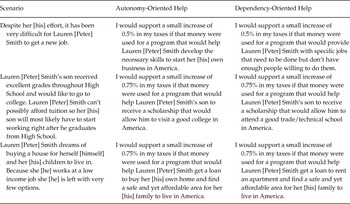
Next, participants read three scenarios describing a difficult situation in the life of the target person. After reading each scenario, participants indicated the extent to which they would be willing to support small tax increases if the surplus money were spent to help the target cope with the difficulty she/he was facing (1 = strongly disagree to 5 = strongly agree). Depending on condition, these items assessed participants’ support for either autonomy-oriented or dependency-oriented helping. The scenarios and items are presented in Table 1 (see Nadler & Halabi, Reference Nadler and Halabi2006, for a similar manipulation). We have employed similar scenarios in prior work (Abad-Merino et al., Reference Abad Merino, Newheiser, Dovidio, Tabernero and González2013); the scenarios used in this prior study were pretested in order to confirm that they were indeed differentially perceived as promoting autonomy-oriented and dependency-oriented help.
Scenarios and helping options presented to participants. Target gender and help type were manipulated between-subjects

Participants finally provided basic demographic information, including gender, race/ethnicity, and political affiliation (1 = extremely liberal to 4 = moderate, middle of the road to 7 = extremely conservative), and were debriefed and entered into a prize drawing for the gift certificates.
Results
Variations in degrees of freedom are due to missing data (e.g., not all participants reported their gender, as noted above). On the measure of political orientation, ten participants selected a response option specified as “Don’t know, haven’t thought.” Because we were specifically interested in adjusting for political orientation (and because political orientation was measured on a single, continuous item), we excluded data from these ten participants from all analyses. However, including these ten participants in the analyses yields the same general pattern of results as reported below (excluding results considering political orientation).
Across all conditions, support for policies to benefit the target person in the three scenarios were reliably associated, Cronbach’s Alpha = .78. Thus, responses to the three scenarios were averaged to form a policy support measure. Because our independent variables were categorical and we were interested in testing all of the potential interaction effects, we analyzed our results an ANOVA model, using political orientation as a covariate. This model is statistically equivalent to a least-square multiple regression including political orientation as a control variable, the direct effects of the independent variables, and all of the potential interactions (i.e., a saturated model).
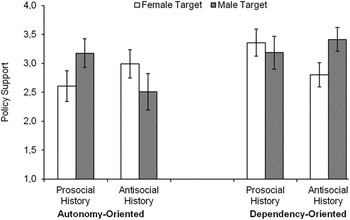
Specifically, we performed a 2 (Participant Gender) × 2 (Target Gender) × 2 (Target History: Antisocial vs. Prosocial) × 2 (Type of Support: Autonomy-oriented vs. Dependency-oriented) between-subjects ANCOVA, with political orientation as a covariate, on policy support. Political orientation was significantly associated with policy support, F(1, 149) = 12.87, p < .001, η p 2 = .08, with more conservative participants reporting less policy support overall, as anticipated. In addition, we observed main effects of Type of Support, F(1, 149) = 4.22, p = .042, η p 2 = .03, and Participant Gender, F(1, 149) = 3.53, p = .062, η p 2 = .02. Participants offered more dependency-oriented than autonomy-oriented support, Ms = 3.19 versus 2.82; and female participants demonstrated somewhat higher levels of policy support than male participants, Ms = 3.17 versus 2.84. The predicted Target Gender × Target History × Type of Support interaction was also obtained, F(1, 149) = 6.49, p = .012, η p 2 = .04 Footnote 1 (see Figure 1), and remained significant when political orientation was not adjusted, F(1, 150) = 4.41, p = .037, η p 2 = .03. This effect was not further moderated by Participant Gender: The four-way interaction was nonsignificant, F(1, 149) = .07, p = .787, η p 2 = .00.
Autonomy-oriented and dependency-oriented helping (i.e., policy support) as a function of target gender and prosocial or antisocial history. Error bars represent standard errors of the mean.

Because of their hypothesized distinctive dynamics, we examined the effects of Target Gender and Target History separately for autonomy-oriented and dependency-oriented policy support (adjusted means are presented in Figure 1). With respect to autonomy-oriented policy support, a marginally significant Target Gender × Target History interaction emerged, F(1, 71) = 3.25, p = .076, η p 2 = .04. For male targets, participants supported more autonomy-oriented help when his history was prosocial, M = 3.18, relative to antisocial, M = 2.51, F(1, 36) = 3.39, p = .074, η p 2 = .09. For female targets, there was no difference in autonomy-oriented help in terms of whether her history was prosocial, M = 2.61, or antisocial, M = 2.99, F(1, 34) = .66, p = .421, η p 2 = .02.
In terms of dependency-oriented policy support, a marginal Target Gender × Target History interaction also emerged, F(1, 77) = 3.09, p = .083, η p 2 = .04, but was of a different form: For male targets, there was no difference in dependency-oriented help in terms of whether his history was prosocial, M = 3.19, or antisocial, M = 3.41, F(1, 38) = .44, p = .510, η p 2 = .01. By contrast, for female targets, participants endorsed somewhat more dependency-oriented support when her history was prosocial, M = 3.36, than antisocial, M = 2.80, F(1, 38) = 3.42, p = .072, η p 2 = .08.
Discussion
Previous research on gender-related biases has focused largely on subtle biases embedded in sexism against women (e.g., Glick & Fiske, Reference Glick and Fiske1996). By contrast, the present research drew on work on intergroup relations generally to investigate systematic patterns of responses associated with the social control of the behavior of both women and men. In particular, we adopted Nadler’s (Reference Nadler2002) Intergroup Helping as Power Relations Model to examine how an apparently very positive form of behavior – helping – can be used to shape social relations for women and men. Whereas most of prior work on the Intergroup Helping as Power Relations Model has focused on groups other than men and women, and has typically examined groups in conflict or direct competition (e.g., Jews and Arabs in Israel), the present research investigated how both dependency-oriented and autonomy-oriented helping can operate as social control mechanisms when applied to the domain of gender. Helping in the present research was in the form of support for general policies that would aid the person in need to address his/her concrete problems. Thus, the current work further demonstrates how people’s social policy attitudes can be affected by making particular beneficiaries salient (Hurwitz & Peffley, Reference Hurwitz and Peffley2005).
As hypothesized, we found systematic differences in participants’ willingness to offer dependency- or autonomy-oriented support to targets showing prosocial or antisocial qualities. Moreover, participants’ responses were moderated by the target’s gender. In particular, when the target was a man, his antisocial versus prosocial characteristics primarily affected participants’ autonomy-oriented helping: Participants gave less autonomy-oriented help to a man displaying antisocial than prosocial characteristics; there was not a significant difference for a female target. By contrast, there was no difference as a function of a man’s antisocial or prosocial qualities for dependency-oriented helping, but there was for a female target. In this case, a woman with prosocial characteristics was given more dependency-oriented help than a woman with antisocial qualities.
Our finding that men with antisocial characteristics received less autonomy-oriented support than men who had prosocial qualities is consistent with Nadler’s (Reference Nadler2002) model, and with empirical findings related to social stability and threat by Halabi and colleagues (Reference Halabi, Dovidio and Nadler2008; Reference Halabi, Dovidio and Nadler2012). Autonomy-oriented help is empowering (Jackson & Esses, Reference Jackson and Esses2000), and it is thus more socially beneficial to empower men who possess prosocial (vs. antisocial) qualities.
Our finding that women who displayed prosocial characteristics received more dependency-oriented help than women who exhibited antisocial qualities seems less intuitive. As proposed by Glick and Fiske (Reference Glick and Fiske1996; see also Lee, Fiske, & Glick, Reference Lee, Fiske and Glick2010), benevolent sexism, which restricts the roles of women but cloaks this bias in positive expressions such as the importance of caring for and helping women and celebrating their “feminine” virtues, may shape this result. This perspective suggests that women who display prosocial characteristics would be responded to in a seemingly positive way, but not in a way that reflects true respect – in this case, by offering dependency-oriented helping. “Rewarding” women who exhibit prosocial characteristics with dependency-oriented helping represents a pattern of strategic prosocial behavior that serves to maintain the gender status quo.
We acknowledge that while our results reveal different patterns of dependency- relative to autonomy-oriented helping to men and women who exhibit anti-social or prosocial qualities, our data cannot definitively illuminate the underlying mechanism. For instance, an alternative, plausible interpretation for the results we observed for female targets is that because prosocial women are liked but not respected, they are perceived as child-like and need dependency-oriented help. This interpretation represents an alternative “matching” mechanism, whereby the type of help is matched to the need of the target (rather than a threat mechanism). Future research that investigates potential moderators relating to perceived threat (e.g., realistic or symbolic threat), to the desire to maintain the status quo, and to sexist attitudes (e.g., individual differences in endorsement of traditional gender roles or benevolent and hostile sexism; Glick & Fiske, Reference Glick and Fiske1996), as well as possible mediators (e.g., empathy and altruistic motivation), could help clarify the dynamics of these helping different responses for male and female targets. For instance, a finding that people higher in social dominance orientation (Sidanius & Pratto, Reference Sidanius and Pratto1999) or in system justification (Jost et al., Reference Jost, Liviatan, van der Toorn, Ledgerwood, Mandisodza, Nosek, Kals and Maes2012) show the pattern more strongly would implicate a threat explanation. Alternatively, a result demonstrating that people who more strongly endorse traditional gender roles display the different patterns of helping for men and women that we observed would be more consistent with the matching explanation.
These systematic differences in offering autonomy-oriented and dependency-oriented help occurred independently of political orientation. Consistent with previous work showing that liberals tend to be more willing than conservatives to support social programs providing social assistance (Skitka, Reference Skitka1999), we found that more politically conservative participants were generally less likely to endorse helping in the present study. The pattern of differences in autonomy-oriented and dependency-oriented helping that we found occurred over and above the effect of political orientation and was observed even when political orientation was not statistically controlled for in the analysis.
We note that the pattern of target gender differences we observed in the present study was similar for male and female participants; participant gender did not moderate any of the observed effects. Although men endorse benevolent sexism more than women do, there is still substantial support among women for statements reflecting benevolent sexism, as well as for women engaging in practices that support paternalistic biases in society against women (Jackman, Reference Jackman1994). In addition, Biernat and Vescio (Reference Biernat and Vescio2002) found that women, as much as men, engaged in patronizing forms of praise while still discriminating against competent women. Our finding of similar effects among male and female participants in the present research thus suggests that the processes outlined in the Intergroup Helping as Power Relations Model may operate without full conscious awareness. Thus, whereas the work of Nadler, Halabi, and colleagues on various forms of contentious intergroup relations (e.g., between Israeli Jews and Arabs) emphasizes the strategic ways that people engage in dependency-oriented and autonomy-oriented helping to maintain or enhance one’s group position, our findings suggest that these processes may (a) function similarly for groups in more positive, interdependent relations, and (b) operate perhaps unconsciously and in ways supported generally by members of the society regardless of status or group membership.
We also note some methodological limitations in the current work. First, although we pretested perceptions of the different options presented to participants in terms of the degree to which the represented dependency- or autonomy-oriented helping and described them as equivalently costly for participants (e.g., involving the same increase in taxes), perceptions of the magnitude of help may have differed between the autonomy-oriented versus dependency-oriented helping conditions. For example, while the cost to participants (a 0.75% increase in taxes) was the same in the two conditions, this type of help may have appeared less to participants when a house purchase (in the autonomy condition) or rental (in the dependency condition) was involved. Thus, future work would benefit from more comprehensive pretesting of the stimuli. Second, we note that the sample size per condition (slightly more than 20) restricted the statistical power for testing our higher-order interactions.
One potentially conceptually productive direction for future research would be to consider the role of target gender in responses in the context of intersecting social identities. For instance, prior work has revealed that people’s perceptions of and reactions to female and male targets diverge further based on the target’s race (Purdie-Vaughns & Eibach, Reference Purdie-Vaughns and Eibach2008). In particular, gender role violations lead to backlash against White female targets (Brescoll & Uhlmann, Reference Brescoll and Uhlmann2008) but not necessarily against Black female targets (Livingston, Rosette, & Washington, Reference Livingston, Rosette and Washington2012). Indeed, Black women at times appear to elicit responses that more closely resemble responses to male (rather than female) targets (Livingston et al., Reference Livingston, Rosette and Washington2012). Future research might thus productively examine, for example, whether Black female targets displaying prosocial characteristics would accrue dependency-oriented help, similar to White female targets in the present study, or whether Black female targets would instead elicit responses similar to those directed toward White male targets in the present study. Examining how gender, race, and other significant social identities (e.g., age, social class, and sexual orientation) combine to influence strategic helping behavior thus represents a particularly fruitful direction for future work on subtle group-based processes that function to bolster the status quo.
Future research might also further consider the complementary perspective of men and women who receive autonomy- or dependency-oriented help of the type described in our scenarios. The current research focused only on the responses of potential helpers. The work of Nadler, Halabi, and colleagues (Halabi et al., Reference Halabi, Dovidio and Nadler2008; Nadler, Reference Nadler2002; Nadler & Halabi, Reference Nadler and Halabi2006) reveals that when groups are in potential conflict (e.g., Arabs and Jews) members of the low status group are sensitive to the type of help available or offered to them, avoiding receiving dependency-oriented help particularly when group status relations are unstable – the circumstances under which the high status group is most likely to offer dependency oriented help. These dynamics can thus escalate intergroup conflict. By contrast, because of the interdependence of men and women, their frequent context, and their similar system-justifying motivations (Jost et al., Reference Jost, Liviatan, van der Toorn, Ledgerwood, Mandisodza, Nosek, Kals and Maes2012), it is possible that male and female recipients of help would display preferences for receiving different types of help that are similar to– and thus more compatible with – the help-giving preferences expressed by participants in the current study. Examining this line of research can thus illuminate potential similarities and differences between gender relations and other forms of intergroup relations that have been studied in the context of the Intergroup Helping as Power Relations Model.
Understanding the role that different forms of helping have in maintaining societal gender inequality can help bridge theories of power relations between groups (such as the Intergroup Helping as Power Relations Model and Social Dominance Theory), work on ideologies that justify and perpetuate the status quo (such as System Justification Theory; Jost et al., Reference Jost, Liviatan, van der Toorn, Ledgerwood, Mandisodza, Nosek, Kals and Maes2012), and research on sexism and gender relations more generally (such as Social Role Theory; Eagly, Wood, & Diekman, Reference Eagly, Wood, Diekman, Eckes and Trautner2000). Our results involving male targets, who received more dependency- than autonomy-oriented help when they displayed antisocial qualities, is consistent with the findings in research on the Intergroup Helping as Power Relations Model (Halabi et al., Reference Halabi, Dovidio and Nadler2008; Nadler, Reference Nadler2002) involving relations between groups in potential conflict (e.g., Israeli Arabs and Jews). In these cases, helping represents a fairly direct form of social control: Whereas autonomy-oriented help appears to reward and promote socially-valued behavior (e.g., prosocial orientations), dependency-oriented help can help constrain potentially threatening actions by groups or their individual members. As the current research reveals, practically, the helping orientations are reflected in the types of policies that people endorse, even at the cost of incurring some personal expense.
Our results for female targets, however, highlight the distinct and complex nature of prejudice against women. Previous research has revealed that with respect to social advancement women face unique barriers. In employment contexts, women in leadership positions who adopt strategies of self-promotion that are successful for men (e.g., frequently voicing their opinions, promoting their achievements) are perceived as less likeable and more demanding (Bowles & Babcock, Reference Bowles and Babcock2012) and experience backlash (Brescoll & Uhlmann, Reference Brescoll and Uhlmann2008), because these behaviors deviate from stereotypic expectations that threaten traditional values or the current structure of society (Becker, Glick, Ilic, & Bohner, Reference Becker, Glick, Ilic and Bohner2011; Eagly & Diekman, Reference Eagly, Diekman, Dovidio, Glick and Rudman2005). Alternatively, when they exhibit behaviors that reinforce their traditionally lower social status than men, women are treated in ostensibly positive and thus reinforcing ways (Glick & Fiske, Reference Glick and Fiske2011).
However, because social norms condemning sexism are becoming more prominent (Carter, Corra, & Carter, Reference Carter, Corra and Carter2009), people may more frequently inhibit overtly negative responses out of concerns about appearing or being sexist or incurring penalties for displaying bias. Practically, then, providing dependency-oriented help to women who conform to traditional gender roles may represent a socially acceptable form of influence to reinforce the status quo, particularly because women who endorse traditional gender roles more strongly respond more positively to such behavior (Moya, Glick, Expósito, de Lemus, & Hart, Reference Moya, Glick, Expósito, de Lemus and Hart2007). Thus, social norms, policies, and laws to combat discrimination in their overt and direct forms against a range of traditionally disadvantaged groups may be less effective for addressing subtle biases reflecting and reinforcing the social dependency of women to men and in society generally. To the extent that dependency-oriented helping can limit the advancement of women in society, increasing awareness of the potentially negative effects of such seemingly positive actions on women can alert both women and men to the immediate and long-term consequences of this behavior and promote more truly egalitarian treatment of women.
We gratefully acknowledge the contributions of Anna-Kaisa Newheiser whose role in the overall research process has made this study feasible.