INTRODUCTION
Corporate social responsibility (CSR) reporting, where companies voluntarily disclose details of their social and environmental performance, has recently emerged as a potential mechanism to encourage companies to be more socially responsible. In China, the first CSR report appeared in 1999; as of 2010, China's CSR reports had increased to only 1001 (CSRRC, 2011). Furthermore, more than 60% of these firms were publicly listed firms, some of whom were required to report by the Shanghai and Shenzhen Stock Exchanges (Marquis & Qian, Reference Marquis and Qian2013). Similarly, since 2003, the Carbon Disclosure Project (CDP) has been polling the 100 largest companies in China on their annual greenhouse gas emissions and other carbon-related information, yet as of 2010, the response rate was only 10% – the lowest among Asian countries and regions (CDP, 2011). Thus, it is clear that while these voluntary social responsibility practices have received some support, they have not yet gained traction and become popular in China. Such a situation raises questions about how to initially get a new management practice widely accepted, in particular, who are the first movers and what leads them to adopt?
While the adoption of new practices is a central topic in the management literature (Davis & Greve, Reference Davis and Greve1997; Kennedy & Fiss, Reference Kennedy and Fiss2009; Strang & Soule, Reference Strang and Soule1998), prior studies have almost exclusively focused on widely diffused and accepted practices (Aldrich & Ruef, Reference Aldrich and Ruef2006; Strang & Soule, Reference Strang and Soule1998). ‘There are few studies of the numerous practices that never diffused’ (Denrell & Kovacs, Reference Denrell and Kovacs2008: 110) or that are in early diffusion process stages. That bias immediately implies external invalidity: ‘What we do know about diffusion is unnecessarily limited’ (Rogers, Reference Rogers2010: 100). Thus, it would be beneficial to study less widely diffused practices to enrich our understanding of diffusion paths. We argue that the study is at least as important as studying widely diffused practices, because less-diffused practices are numerous and because better understanding may help promote better practices.
Institutional theory, a frequently used theoretical framework guiding diffusion studies, argues that organizations pursue management practices that appear socially legitimate to their industrial peers or stakeholders along the supply chain (Delmas & Toffel, Reference Delmas and Toffel2008; Liu & Anbumozhi, Reference Liu and Anbumozhi2009; Prakash & Potoski, Reference Prakash and Potoski2006; Zeng, Xu, Yin, & Tam, Reference Zeng, Xu, Yin and Tam2012). However, when considering new and not yet popular management practices, institutional theory has limited explanatory power, because it emphasizes mimetic and normative forces (Dimaggio & Powell, Reference Dimaggio and Powell1983) regarding accepted practices. Thus, when explaining early movers’ motivations in the diffusion process, scholars tend to emphasize economic considerations (Kennedy & Fiss, Reference Kennedy and Fiss2009; Tolbert & Zucker, Reference Tolbert and Zucker1983). That is, prior research on early diffusion stages has primarily focused on potential economic benefits associated with practices or innovations. This approach fails to explain, however, why some organizations may be first movers of new management practices that have no clear economic benefit.
To explain the initial diffusion of new management practices, and in response to the call for revitalized organizational research in the community context (Freeman & Audia, Reference Freeman and Audia2006; Marquis & Battilana, Reference Marquis and Battilana2009; Marquis, Glynn, & Davis, Reference Marquis, Glynn and Davis2007; O'Mahony & Lakhani, Reference O'Mahony and Lakhani2011; Thornton, Ocasio, & Lounsbury, Reference Thornton, Ocasio and Lounsbury2012), we turn to the neglected role of geographic community institutions. Local communities have diverse institutional settings and deal with various institutional logics and governmental regulations (Thornton et al., Reference Thornton, Ocasio and Lounsbury2012). When an industry or supply chain has not yet formed institutional legitimacy, new management practices may be spatially diffused as a result of frequent interactions among organizations because of location (Davis & Greve, Reference Davis and Greve1997), common background (Marquis & Battilana, Reference Marquis and Battilana2009), and traditions (Brint, Reference Brint2001). Those who share the community also trust one another (Adler & Heckscher, Reference Adler and Heckscher2006), have increased access to observing and learning processes (Crossan, Lane, & White, Reference Crossan, Lane and White1999), and share similar cultural orientations across geographic areas (Raynard, Lounsbury, & Greenwood, Reference Raynard, Lounsbury and Greenwood2013).
We define the organizational field as the geographical community where an organization's headquarters is located (Marquis, Davis, & Glynn, Reference Marquis, Davis and Glynn2013), and we propose two community-level factors: (1) institutional logics including normative and cognitive pressures; (2) regulatory pressures from local government or other regulatory agencies. We examine CSR reporting in China's banking industry using a sample from 142 banks across 128 prefectural cities in China from 2006 to 2011. We use survival analysis to test our arguments and find that local institutional forces, including social normative and regulatory processes, are significant factors driving CSR reporting among Chinese banks after controlling for organization-specific characteristics and globalization pressures. The impacts of the two institutional factors are further moderated by the length of time that banks have operated in communities. When banks are embedded in the community for a long time, they form deeper and more extensive connections with other organizations within the same community and thus encounter more institutional logic pressures. Older organizations, however, are less vulnerable to governmental pressures than are younger ones.
Our study complements and contributes to the literature on diffusion and institutional theory, and also promotes socially and environmentally responsible practices among Chinese organizations. First, by extending the organizational field to the geographic community where the headquarters are located, we argue that community-based construction is particularly useful for understanding why organizations would be motivated to be first movers of a new management practice. We hold that some communities may provide institutional conditions favoring the growth of certain management practices before the practices show economic benefits or gain legitimacy among industrial peers. Second, we theoretically differentiate duration of exposure to institutional pressures and contend that the organizational field is dynamic in that different organizational fields could have shifting relevance as time proceeds. Third, we provide empirical evidence that local factors are important for the initial diffusion of socially and environmentally responsible corporate practices in China.
THEORETICAL BACKGROUND AND HYPOTHESES
Community Institutions and the Adoption of Management Practices
The spread of new management practices – and more generally innovations – has been shown to form an S-curve. Rogers (Reference Rogers1962) described organizations along the diffusion curve as innovators, early adopters, early majority, later majority, and laggards. The diffusion process hastens when a new practice reaches critical mass. We are concerned with the stage before critical mass is achieved. In some cases, critical mass may never be reached. The time until successful practices are widely adopted varies (Davis & Greve, Reference Davis and Greve1997). Therefore, it is important to understand how to facilitate the growth of practices before they reach a critical mass, especially for practices that align poorly with short-term corporate economic benefits.
Institutional theory does not provide a strong explanation for firms’ motivations to be first movers in adopting management practices. Indeed, institutional theory often defines organizational fields and their supply chains as industrial sectors, because organizational systems are greatly interconnected (Scott & Meyer, Reference Scott, Meyer, Meyer and Scott1982), resources are increasingly centralized, and organizations must manage a great load of information (Aldrich & Fiol, Reference Aldrich and Fiol1994; DiMaggio, Reference Dimaggio1983). Thus, rather than study a focal organization and its environment, organizational scholars investigate interacting organizations that collectively form an institutionalized domain (DiMaggio, Reference Dimaggio1986).
However, emphasizing industries and their supply chains may lead to ignorance about important institutional elements that could shape organizational strategy and behavior. As DiMaggio (Reference Dimaggio1986: 365) has warned, it is dangerous to overemphasize organizational networks because ‘some phenomena are truly environmental and must, by their nature, be measured at the environmental level’. For example, Marquis and Battilana (Reference Marquis and Battilana2009) theoretically demonstrate that market and institutional mechanisms lead to enduring community influence and ‘place-bound features of local communities such as market structures, types of public policies, relational systems and networks, history, tradition, and physical geographic factors maintain a significant influence on organizations, […] create variation in organization behaviors across communities’ (Marquis & Battilana, Reference Marquis and Battilana2009: 284).
Realizing the danger, several recent studies call for revitalizing research on organizations in the community context (Freeman & Audia, Reference Freeman and Audia2006; Marquis & Battilana, Reference Marquis and Battilana2009; Marquis et al., Reference Marquis, Glynn and Davis2007; O'Mahony & Lakhani, Reference O'Mahony and Lakhani2011; Thornton et al., Reference Thornton, Ocasio and Lounsbury2012). ‘Contemporary work on organizational communities so defined tends to examine how relationally defined locations within organizational communities influence key organizational outcomes. Geographical space is all but ignored’ (Freeman & Audia, Reference Freeman and Audia2006: 149). Brint (Reference Brint2001) reconstructed the concept of community by developing a new typology that emphasizes community interactions. Marquis et al. (Reference Marquis, Glynn and Davis2007), more specifically, reviewed several studies and argued that appropriateness standards regarding corporate social action are embedded within local communities, and that organizational conformity to institutionalized practices yields systemic patterns that vary by community.
Actually, when Dimaggio & Powell (Reference Dimaggio and Powell1983) first formulated institutional theory, the organizational field referred to the society within which organizations function, of course including the local community where organizations operate. Thus, in this study, we define the organizational field as the geographical community housing an organization's headquarters, and propose two community-level factors:
-
1. institutional logics including normative and cognitive pressures in geographical communities;
-
2. regulatory pressures from local government or other regulatory agencies.
Community Institutional Logics
The institutional logics within communities could significantly impact organizations located there (Thornton et al., Reference Thornton, Ocasio and Lounsbury2012). Historical and collective processes often form local institutional logics regarding standards of ‘how things are done around here’ and ‘what is right around here’ (Marquis et al., Reference Marquis, Glynn and Davis2007: 934). The shared standards create reference templates for organizations to model in choosing their strategies or behaviors.
In the United States, institutional logics often vary across different geographical communities regarding corporate behavior such as organizational engagement in corporate social action (Marquis et al., Reference Marquis, Glynn and Davis2007), bank acquisitions (Marquis & Lounsbury, Reference Marquis and Lounsbury2007), and professionalization of mutual funds (Lounsbury, Reference Lounsbury2007). In China, however, the concept of geographical community as related to institutional logics is less widely addressed. Indeed, given China's scattered geographical distribution, historical complexity, and ethnic and cultural diversity, institutional logics vary widely (Raynard et al., Reference Raynard, Lounsbury and Greenwood2013; Yin & Zhang, Reference Yin and Zhang2012). Some local logics such as social normative and cognitive pressures are likely to be quite pronounced in China's CSR context.
Community social normative logics
Chinese culture highly values collectivism and conformity (Earley, Reference Earley1989). Local peer pressure could strongly influence organizations to adopt widely accepted practices that may evolve into social norms defining appropriate corporate behaviors (Bansal & Roth, Reference Bansal and Roth2000; Gillan, Hartzell & Starks, Reference Gillan, Hartzell and Starks2004). By aligning their activities with social norms, organizations may gain more legitimacy (John & Kadyrzhanova, Reference John and Kadyrzhanova2008; Reid & Toffel, Reference Reid and Toffel2009) and social acceptance and reduce risks of losing social prestige for deviating from norms. Thus, organizations are strongly motivated to mimic their peers.
Peer effects in corporate practices have been extensively investigated for their role in corporate governance (Gillan et al., Reference Gillan, Hartzell and Starks2004; John & Kadyrzhanova, Reference John and Kadyrzhanova2008), corporate ecological responsiveness (Bansal & Roth, Reference Bansal and Roth2000), and corporate disclosure of climate change and environmental information (Reid & Toffel, Reference Reid and Toffel2009; Zeng et al., Reference Zeng, Xu, Yin and Tam2012). More specifically, organizations look to the strategic choices of their industrial peers in deciding whether to disclose environmental information (Zeng et al., Reference Zeng, Xu, Yin and Tam2012). CSR reporting is a recent phenomenon in China; rather than define social peers to be fellow organizations in the same industry, we instead consider social pressures for CSR reporting emanating from the same community for forming our first hypothesis:
Hypothesis 1: Banks will be more likely to issue CSR reports if they operate in communities where more companies publish CSR reports.
Community cultural and cognitive logics
Beyond social normative pressures, cultural and cognitive pressures are important elements of institutional logics (Thornton & Ocasio, Reference Thornton and Ocasio1999). Varying cognitive templates including the local environment (Selznick, Reference Selznick1949), city tradition (Molotch, Freudenburg, & Paulsen, Reference Molotch, Freudenburg and Paulsen2000), and community-level frames of corporate governance (Marquis, Reference Marquis2003) prevail in various geographic communities (Lounsbury, Reference Lounsbury2007; Marquis, Reference Marquis2003; Molotch et al., Reference Molotch, Freudenburg and Paulsen2000; Selznick, Reference Selznick1949). The varying templates reflect social, political, and cultural contexts that affect organizational behavior differently, such as in patterns of corporate giving (Galaskiewicz, Reference Galaskiewicz1997), boards of directors’ networks (Marquis, Reference Marquis2003), philanthropic activities (Carroll, Reference Carroll1999), and corporate charitable contributions (Galaskiewicz, Reference Galaskiewicz1997).
Communities differ greatly in their cultural and cognitive support for CSR practices in China. The China Charity and Donation Information Center developed a community philanthropic performance index and graded 321 cities in China on a scale of 1 to 100. The highest score was 94 and the lowest 22.5, with a standard deviation of 16.65. For the subindex of community philanthropic performance, taking participation rate of volunteering as an example, the highest score was 3.5 and included 22 cities such as Tianjin, Shanghai, and Baotou in Inner Mongolia; the lowest was 0.5 and included 21 cities such as Baoding in the Hebei province and Zhanjiang in the Guangdong province. The standard deviation was 1.14, showing a large variation of cultural cognitive inclinations toward CSR practices at the community level. We can reasonably argue that banks are more likely to do CSR reporting when the people that they work with every day show greater expectation of and pay more attention to CSR; thus, we propose our second hypothesis:
Hypothesis 2: Banks will be more likely to issue a CSR report when they are located in communities that pay greater attention to social and public welfare conditions.
Community Regulatory Pressure
Beyond the two institutional logics, regulatory pressure is another important institutional factor in China, particularly in the banking industry, because of China's powerful governmental regulation. Early research had good reasons to separate local institutional logics from regulatory pressures (Thornton et al., Reference Thornton, Ocasio and Lounsbury2012). For instance, local institutional logics shaping behavioral norms are often largely determined by individuals and organizations operating within the same community (Marquis et al., Reference Marquis, Glynn and Davis2007). However, community regulation is a more straightforward pressure stemming from local politics or government mandates (Dimaggio & Powell, Reference Dimaggio and Powell1983; Scott, Reference Scott1995).
In the geographical community context, government policies or promotional guidelines are probably the most obvious and important regulatory forces. Government authorities can influence organizational behavior by setting rules and monitoring and sanctioning activities (Scott, Reference Scott1995). Two regulatory pressures are common. First, regulators can use their authority to coerce organizations through government mandates or laws, sanctions, and especially punishments (DiMaggio, Reference Dimaggio1983; Dimaggio & Powell, Reference Dimaggio and Powell1983; Scott, Reference Scott1987), so that organizations comply in fear of losing legitimacy with government authorities. Second, regulators can use inducements (Scott, Reference Scott1995) that will enhance beliefs in the organization's legitimacy and will foster government-favored models (Weber, Reference Weber1978). This is also referred to as normative effects of laws and regulation (Dobbin, Reference Dobbin and Adler2009; Edelman & Suchman, Reference Edelman and Suchman1997).
As an example of inducement regulatory pressure in regard to CSR reporting, some local governments establish promotional guidelines encouraging organizations operating in their territory to report their CSR practices. Organizations are not forced to report and they are not sanctioned for failing to do so. Instead they are free to choose. For example, the Hangzhou government published Guidelines for Strengthening Corporate Social Responsibility in 2009, but only 26 organizations were complying as of 2011. Moreover, a study on political connections, motivations, and extensiveness of CSR reporting showed that promotional guidelines for CSR reporting are not coercive (Marquis & Qian, Reference Marquis and Qian2013).
Although ‘encouragement’ often implies poor enforcement in China, we argue that local governments establish CSR reporting policies. Most commercial banks operating within local communities will demonstrate conformity to local regulations as a gesture of ‘cooperation’ (Liu, Guo, & Chi, 2015; Zeng et al., Reference Zeng, Xu, Yin and Tam2012) that earns government credit or legitimacy, providing an opportunity to measure noncoercive regulatory pressures on decisions to be first movers in CSR reporting.
Hypothesis 3: Banks will be more likely to report CSR when they operate in communities that have promotional guidelines encouraging CSR reporting.
Firm Age or Length of Time in a Community
Although organizations operating in the same community face the same institutional environment, they may face varying institutional pressures. The time an organization has been located in the community could be one element. The liability of newness (Stinchcombe, Reference Stinchcombe and March1965) explains that young organizations are more vulnerable to failure, because they lack experience learning new roles as social actors (Baum & Shipilov, Reference Baum, Shipilov, Clegg, Hardy, Lawrence and Nord2006). Surviving organizations should have increased experience in creating organizational roles and routines and deeper, more extensive connections with fellow organizations in the same community. The older the organizations, the better they understand and ally with local cultural tradition. As a result, older organizations will become more embedded with local communities and more responsive to institutional logics including social norms and cultural cognitive pressures. We therefore hypothesize:
Hypothesis 4a: Older banks in a community will be more likely to issue CSR reports if they operate in communities where more companies publish CSR reports.
Hypothesis 4b: Older banks will be more likely to issue CSR reports if they operate in communities that pay greater attention to social and public welfare conditions.
The length of time that banks have operated in communities might cause them to respond differently to regulatory power. Older banks may have greater governmental embeddedness, such as guanxi (Chen, Chen, & Huang, Reference Chen, Chen and Huang2013; Park & Luo, Reference Park and Luo2001), and have more discretion when facing governmental pressures. Also, the liability of aging hypothesis explains that older banks have accumulated more political pacts (Barron, West, & Hannan, Reference Barron, West and Hannan1994; Ranger-Moore, Reference Ranger-Moore1997) and a well-established method for communicating with local governments. Often lacking the understanding needed to adapt dynamically to environmental changes (Baum, Reference Baum1989; Ingram, Reference Ingram1993; Park & Luo, Reference Park and Luo2001), they become less likely to respond to noncoercive regulatory activities. Thus, we propose:
Hypothesis 4c: Promotional guidelines that encourage CSR reporting will have less-pronounced impact for older banks in a community.
Reasons for Studying the Banking Industry with China's Provincial- and Prefectural-Level Cities as Communities
We center our attention on CSR reporting in the Chinese banking industry for three reasons. First, the Chinese banking industry has been viewed as the most important single sector to promote CSR practices. Banking is China's most powerful economic sector, with total assets of all banking and financial institutions accounting for nearly 240.26% of China's nominal GDP in 2011 (CBRC, 2011; NBSC, 2011). More important, banks extensively influence other economic sectors in the society (Hu & Scholtens, Reference Hu and Scholtens2012; Jeucken, Reference Jeucken2012; Pérez & del Bosque, Reference Pérez and Del Bosque2012). ‘Their role in economies is an intermediary one, transforming money by space, term, scale and risk. This function thus affects the development and direction of the economy’ (Jeucken, Reference Jeucken2012: 52). For this reason, responsible investment is increasingly promoted to provide incentives for other industries to improve their CSR (Brown, Reference Brown2006; Syn-Tao, 2011).
Second, although global trends influence banks, they stay local for many reasons. Branching policies, modernization, and political culture have influenced their behavior throughout historical eras (Marquis & Huang, Reference Marquis and Huang2010). Although public policy is nationwide, commercial banking still depends on the local technological, economic, and cultural environment (Marquis & Huang, Reference Marquis and Huang2009). Sometimes local logic resists global financial processes and nationally oriented outsider efforts to impose standardized isomorphic pressure (Marquis & Lounsbury, Reference Marquis and Lounsbury2007). In our study, the 142 sampled banks operate in 128 highly geographically dispersed prefectural cities. For most commercial city banks in China, business is concentrated within a specific geographic area, and their institutional investors are mainly located in local communities. Although banks can remain local, we carefully control for global or foreign influence on corporate choices relative to CSR reporting in our empirical analysis.
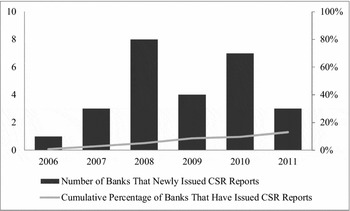
Third, China's banking industry has shown slow growth in its CSR reporting in the last decade. Because our theoretical interest is in the initial adoption of new management practices that have not yet reached critical mass, Chinese banks’ CSR reporting provides a suitable empirical setting. Shanghai Pudong Development Bank published its first CSR report in 2005. Since then, the number of banks reporting CSR has increased slowly (see Figure 1). As of 2011, only 27 banks voluntarily issued independent CSR reports, and no evidence shows that the speed of diffusion is increasing. This seems more intriguing considering that two national-level government guidelines have been established to encourage CSR reporting in the banking industry: Guidelines for Strengthening Social Responsibility among Financial Institutions by the China Banking Regulatory Commission, in 2007, and Guidelines for Corporate Social Responsibility for Banks and other Financial Institutions by the China Banking Association, in 2009. Clearly, CSR reporting as a new management practice has failed to flourish in China's banking industry. This provides a natural context for testing how local forces affect organizations’ decisions to be first movers of new management practices.
Diffusion of voluntary CSR reporting in China's banking industry

We identified a bank's local community as the city housing the headquarters. China has three types of cities: provincial-level municipalities, prefecture-level cities governed by provinces or autonomous regions, and county-level cities that are subunits of a prefecture-level administrative division. For our research, we considered communities to be provincial- and prefecture-level cities. Our definition of a local community as a unit of analysis is consistent with the extant literature (Marquis, Reference Marquis2003; Stuart & Sorenson, Reference Stuart and Sorenson2003). For instance, local communities have been defined as metropolitan areas that normally ‘include an inner city and adjacent communities that have a high degree of economic and social integration with that city’ (Marquis et al., Reference Marquis, Glynn and Davis2007: 927). More important, few banks are established in county-level cities. Those in prefectural-level cities primarily serve the companies and individuals within those cities. Prefectural cities – traditionally important administrative units since 1949 – are similar within their boundaries but differ greatly from each other.
METHOD
Sample Selection
To select the sample, we started with the bank lists compiled by the China Banking Regulatory Commission (CBRC) and performed a three-step exclusion. First, we excluded rural commercial banks, rural cooperative banks, rural credit unions, and three types of new rural financial institutions. We also excluded foreign banks and other nonbank financial institutions for the following reasons: (1) We aimed to test the local geographic community's institutional forces, whereas broad global factors clearly influence foreign banks’ strategic management. (2) We defined communities as provincial- and prefecture-level cities, because few banks locate their headquarters in county-level cities or in rural locations. (3) The total assets of nonbank financial institutions account for a very small market share (less than 3% according to the CBRC Annual Report of 2006 ), limiting their influence and leverage effect on sustainable investment.
Second, we excluded policy banks and postal savings banks because they clearly serve specific policy goals and are nonprofit oriented. Third, we excluded banks that must issue CSR reports because of mandatory regulatory requirements. In 2008, both the Shanghai Stock Exchange (SSE) and the Shenzhen Stock Exchange (SZSE) published the ‘Circular on Properly Handling the 2008 Annual Reports of Listed Companies’, requiring that banks listed in the SSE and the Shenzhen 100 Index report CSR after 2008. We excluded those banks, because they are required to issue CSR reports and cannot make their own choices.
Our sample included state-owned commercial banks, nationally joint-stock commercial banks, and city commercial banks that could choose whether to submit CSR reports during our study years. They account for nearly 75% of market share (by assets) for all financial institutions in China (CBRC, 2006). In total, our sample comprises 142 banks across 128 prefectural cities: two were state-owned commercial banks, five were national joint-stock commercial banks, and 135 were city commercial banks. In total, we have five state-owned and 12 national joint-stock commercial banks during our sample period. We excluded the other three state-owned and seven national joint-stock commercial banks, because they were publicly listed and issued their first CSR reports well after the mandatory regulation proposed by the SSE and SZSE in 2008.
Some city commercial banks are newly founded, and several city commercial banks merge with other banks every year, so the total number of city commercial banks varies over time. The 135 city commercial banks account for about 83% of all city commercial banks in China each year on average. We excluded the other 17% from our sample, because they failed to disclose bank-specific information or had no official website allowing us to obtain data for empirical analysis. Among the 142 banks in our sample, 27 voluntarily issued CSR reports, accounting for 19.01% of all commercial banks in our sample.
CSR reporting varies across communities. In cities with multiple bank headquarters, such as Beijing and Taizhou, all banks issued CSR reports; in cities such as Tianjin and Jinhua, none did. This provides a setting for, and highlights the importance of, exploring how community features drive voluntary CSR reporting in China's banking industry.
Measures
Dependent variable
CSR refers to ‘the organization's consideration of, and response to, issues beyond the narrow economic, technical, and legal requirements of the organization’ (Davis, Reference Davis1973: 312). Despite the theoretical description, CSR is difficult to empirically measure, because it covers many corporate activities such as philanthropic giving, environmental investment, and community volunteer work.
We investigated one management practice related to CSR-CSR reporting. In CSR reports, organizations present their CSR activities concisely and systematically to their stakeholders. They can disclose their socially responsible activities through various methods such as independent CSR reports, advertisements or articles, annual reports, booklets or leaflets, press releases, and websites (Jenkins & Yakovleva, Reference Jenkins and Yakovleva2006). When constructing our dependent variable, we focused only on independent CSR reports to capture organized, systematic, and professional CSR reporting rather than more ad hoc forms.
Banks issuing CSR reports do not necessarily have better CSR performance than banks not issuing reports. However, that point is irrelevant to our study; we are concerned with CSR reporting as a new management practice, not as a reflection of CSR performance. Nevertheless, CSR reporting is a reasonable indictor for CSR practices. First, organizations that report their CSR must systematically examine their CSR activities. Thus, CSR reports could signal that organizations have managerial systems that guide, monitor, and track CSR activities. Second, organizations that lack CSR activities would lack incentive to publish CSR reports. Therefore, we can reasonably assume that organizations publishing CSR reports should have better CSR performance. However, we caution against overinterpreting our results, because we have no clear evidence that CSR reporting and CSR performance are positively correlated. We address only the initial adoption of CSR reporting as a management practice.
Our dependent variable is a dummy variable equal to 1 if the bank published an independent CSR report in a particular year and 0 otherwise. We collected information on CSR reporting collaboratively from banks’ official websites and the China Sustainability Reporting Resource Center, a joint project between Syn Tao, Oxfam, and the Centre of a Network of National Environmental Education and Communication Initiatives. As mentioned, 27 banks across 23 communities completed CSR reports from 2006 to 2011: two state-owned commercial banks, three national joint-stock commercial banks, and 22 city commercial banks.
Independent variables
Our primary intent was to investigate the influence of community institutional features in explaining banks’ decisions to complete CSR reporting, so we collected community-level independent variables. We included a community peer variable to examine hypothesis 1, which specifies the community social normative institutional logics driving CSR reporting. The variable equals the number of organizations within the focal community that issued a CSR report in the previous year. In 2011, Tianjin had 46 organizations from all economic sectors reporting CSR, the highest number for a community (though no banks did any reporting). In some cities, such as Cangzhou in Hebei province, no organizations reported CSR during our sample period.
To test hypothesis 2, we included a volunteer participation rate variable to measure community cultural and cognitive institutional logics driving CSR reporting. This variable, ranging from 0 to 4, measures how actively local community residents participated in volunteer activities. This measure is a subindex of the total Community Philanthropic Performance Index developed by the China Charity & Donation Information Center (CCDIC), a nonprofit organization supported by and working closely with the Ministry of Civil Affairs. This organization developed a system to monitor and evaluate philanthropy at the city level. As of 2012, 321 cities submitted philanthropic development data to the CCDIC. We matched those cities with cities that had at least one bank headquarters; 39 had no match in the CCDIC database. Thus, we treated them as missing values and added a dummy variable missing volunteer participation rate equaling 1 if the city did not submit data. This variable captures whether cities that reported to the CCDIC are systematically different from those that did not (Allison, Reference Allison2000).
To test hypothesis 3, about Community regulatory pressures driving CSR reporting, we included a promotional guidelines variable, a dummy variable equal to 1 if the community housing a bank had promotional guidelines that encouraged CSR practices in or before the study year and 0 otherwise. We focused on guidelines published either at the city or provincial level that encouraged financial institutions, or all organizations in general within the community, to engage in CSR practices.
We collected data on the community guideline variable following a three-step process. First, we visited the official website of the local CBRC offices, the local offices of The People's Bank of China (PBC), and the local banking association websites, and searched for guidelines encouraging financial institutions to undertake and report CSR activities. Second, we visited the official website of the local government and the Chinese local law information database to search for promotional guidelines that encouraged organizations to report CSR. These regulatory guidelines foster an institutional environment that drives organizations to engage in CSR-related activities. Last, to avoid missing policies not published by the agencies, we conducted a supplementary search for keywords including CSR and community, such as CSR Beijing, in search engines such as google.com.
Age is measured by the number of years the focal bank had been established by the end of the study year and is required for testing hypotheses 4a–4c. We acquired year of establishment by visiting official websites or from annual reports.
Control variables
We included both organization- and community-level variables in the regression analyses to control for potential confounding factors. We included three organization-level control variables. City commercial bank is equal to 1 if the bank is a city commercial bank and 0 otherwise, retrieved from the CBRC official website. CEOs’ political connections affect corporate decisions about CSR reporting (Marquis & Qian, Reference Marquis and Qian2013). Thus, we included a variable to indicate whether the focal bank's CEO was a member of the National People's Congress (NPC) or Local People Congress at the city or province level during the sample period. Membership in the People's Congress in China is valid for five years, and our sample period is from 2006 to 2011, so we selected memberships from the 10th (valid 2003–2008) and 11th (valid 2008–2013) NPCs as our data pool. We searched banks’ annual reports, websites, or news reports for CEO names in each year. We examined the national and local People's Congress official websites and compared that list to the membership lists of the 10th and 11th People's Congress at the national and local city or province level. We merged the two data sets and coded the variable 1 if the CEO was a member of a national or local People's Congress in a focal year and 0 otherwise. Percentage of foreign shareholders represents the percentage of foreign shareholders in banks’ capital structures in each year, collected from banks’ annual reports or news reports.
We also included four community-level control variables. Provincial municipality indicates whether a bank is located in a provincial capital or a municipality directly under the central government. Per capita GDP represents the per capita GDP in each community in the previous year. Communities with higher economic development would arguably attach more attention to CSR activities, so we included per capita GDP, obtained from the National Bureau of Statistics of China (NBSC). Percentage of output of foreign organizations indicates the percentage of the total gross industrial output value of foreign organizations in each community in the previous year, obtained through the China Annual Survey of Industrial Organizations, published by NBSC. We classified organizations as foreign if their registered code ID type was a wholly foreign-owned enterprise (code ID 330). Percentage of output of SOE is the percentage of total gross industrial output value of state-owned enterprises (SOE) in each community in the previous year, obtained through the China Annual Survey of Industrial Organizations, published by NBSC. We classified organizations as SOE if their registered code ID type was a state-owned enterprise (code ID 110).
Analysis: Model Specification
Using a survival model, we examined a bank's decision to undertake CSR reporting. More specifically, the probability that bank i publishes a CSR report in year t, given it had not done so by year t-1, is analytically modeled as a function of various community-level institutional logics and regulatory variables, along with other controls. For estimation purposes, the relevant banks in a given year had not participated in CSR reporting at the beginning of that year. Once banks published a CSR report, they were no longer in the sample.
Because the time of reporting is intrinsically discrete (year by year), the commonly used proportional odds model is appropriate (Kiefer, Reference Kiefer1988). The model assumes that the relative odds that bank i disclosed a CSR report in year t, given it did not disclose a CSR report in previous years, is expressed as
 $$\begin{equation*}
\frac{{{P_{it}}}}{{1 - {P_{it}}}} = \left[ {\frac{{{P_0}(t)}}{{1 - {P_0}(t)}}} \right]\exp \left( {{\beta ^{\prime}}{X_{it}}} \right)
\end{equation*}$$
where Pit is the conditional probability for bank i to adopt CSR disclosure in year t, given it did not disclose CSR in previous years; Xit is a vector of explanatory variables; and P 0(t) is the baseline conditional probability of CSR disclosure when Xit = 0.
The structure can be estimated using a standard logistic estimation. The relative odds of making a transition at year t are transferred as the logistic specification:
 $$\begin{equation*}
\log \left[ {\frac{{{P_{it}}}}{{1 - {P_{it}}}}} \right] = \alpha + {\beta ^{\prime}}{X_{it}} + {\varepsilon _{it}}
\end{equation*}$$
RESULTS
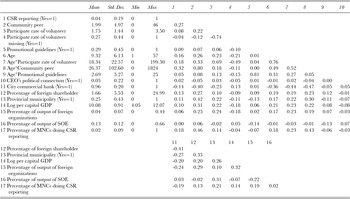
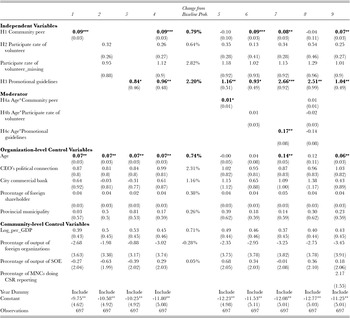
Table 1 reports the descriptive statistics of the variables and their pairwise correlations. We used logistic regression to examine the hypotheses regarding how institutional factors at the community level could influence a bank's decision to report CSR. Table 2 captures the regression results. We first separately included variables that capture the main effects of institutional logics and regulatory pressures in the regression model along with other control variables, reported in Models 1–3. Model 4 includes the full model with all three community-level pressures. The results are largely the same, so we rely on Model 4 for interpretation.
Descriptive statistics and pairwise correlations of variables

Regression results on hypotheses testing (models 1 to 8) and robust tests (model 9)

Standard errors in parentheses. *** p < 0.01; **p < 0.05; *p < 0.1
Table 2, Model 4 displays the estimated coefficients along with standard errors in parentheses. The logistic regression results are difficult to interpret, because the dependent variable is modeled as a nonlinear function of independent variables. Therefore, we rely on an odds ratio for interpretation. Meanwhile, to clarify our regression results, we examined how a change in each covariate would affect a hypothetical bank in terms of the probability of CSR reporting in 2008 (Table 2, Column 5). We assume the hypothetical bank to be a noncity commercial bank, to have a CEO who is not a member of the People's Congress at the national or local level, to be located in a nonprovincial capital or nonmunicipality, to have participated in the CCDIC survey, and to have no local CSR encouragement guidelines. All continuous variables were set equal to their mean. For our hypothetical bank, in the baseline year 2008, the probability of CSR information disclosure is 1.43%.
Consistent with our research hypothesis 1, the coefficient for community peer is positive and statistically significant. This demonstrates that banks located in communities where more organizations publish CSR reports are more likely to do the same. The odds that banks will publish CSR reports would increase by 56.35% if the number of organizations publishing CSR reports in their communities increased by one standard deviation, all else remaining equal. For our hypothetical baseline bank, if the number of organizations publishing CSR reports in its community increased by one standard deviation, the probability for this bank to publish a CSR report in 2008 would increase by 0.79%. This finding supports the usefulness of community institutional logics in explaining the variation of initial adoption of corporate strategies across communities. The regression results provided no evidence for hypothesis 2. The coefficient for volunteer participation rate is positive as expected, but not statistically significant at the conventional level.
The positive and statistically significant signs of local promotional guidelines provide supportive evidence for hypothesis 3. Specifically, banks located in communities that have published promotional guidelines encouraging CSR engagement are more likely to publish CSR reports. The odds of banks located in communities with CSR-encouragement guidelines publishing CSR reports are 2.6 times higher than for banks located in communities without CSR-encouraging guidelines. For our hypothetical case, if the bank's community published CSR-encouraging guidelines, the probability the bank would publish a CSR report in 2008 would increase by 2.2%. These findings show that community regulatory factors are important institutional pressures for understanding the heterogeneous initial adoption of corporate strategy among different communities.
In the baseline Model 4, we also found that older banks are more likely to report CSR. For our hypothetical baseline bank, the probability it would publish a CSR report would increase by 0.74% if it were six years older. Our interpretation is that banks with a longer history are more embedded in the local community and therefore may pay more attention to social concerns at the local level. This is consistent with Marquis et al. (Reference Marquis, Davis and Glynn2013) who found that cities with longer histories were more likely to have nonprofit growth, but inconsistent with Marquis & Qian (Reference Marquis and Qian2013) who also concern CSR reporting in China and argue that older organizations founded when the state controlled the economy are less attuned to newer globally diffused practices, such as CSR reports, and feel less legitimate pressure to issue them. This inconsistency may come from differences in sample selection. Marquis & Qian (Reference Marquis and Qian2013) studied China's publicly listed companies that are more susceptible to stakeholder influence in their supply chains beyond their local communities. Moreover, younger organizations that have a less-socialist imprint are less constrained by rigid administrative traditions and therefore can respond more easily to new management practices. In contrast, most banks in our sample are nonpublicly listed ones and are longstanding locals, so local concerns play a more significant role.
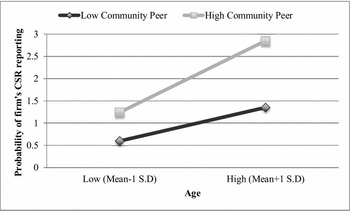
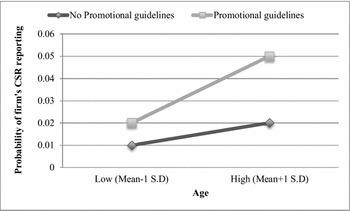
For a closer look at how age could moderate the relationship hypothesized in H4a–H4c, we further included the interaction terms between age and community peer, age and volunteer participation rate, and age and promotional guidelines in Models 5–8. As Table 2 shows, age has a positively significant moderating effect on community peer, supporting hypotheses 4a that longer community existence would enhance institutional pressure because of deeper and more extensive connections. However, the significantly negative sign on the interaction between age and promotional guidelines reveals that long-existing organizations are perhaps less vulnerable to governmental pressures, consistent with hypothesis 4c. Figures 2 and 3 show the interaction effects between age and community peer and promotional guidelines. As we can see from the patterns of Figures 2 and 3, both the effects of community peer and promotional guidelines on the probability of firm's CSR reporting are larger when a firm's age increases, consistent with hypotheses 4a and 4c.
Interaction effect between bank's firm age and local community peer on CSR reporting

Interaction effect between bank's firm age and promotional guidelines on CSR reporting

To capture globalization or foreignness influences, we included two variables to test the global exposure of banks: percentage of output of foreign organizations and percentage of foreign shareholder. Both showed no significance, indicating that globalization factors play limited roles in the initial adoption of CSR reporting. Local factors seem more important.
Robustness Test
One might suspect that organizations that have published CSR reports and are thus included in community peers may be predominately multinational companies (MNCs). As such, the coefficient of community peers may reflect an impact coming more from globalization than from local communities. To address that concern, we looked at organizations that have published CSR reports in China and found that MNCs account for only 14.16%. As a robustness test, we added a variable indicating the percentage of MNCs among all organizations that reported CSR in each city. The results are shown in Table 2, Model 9 and are very similar to those in Model 4. In addition, to test the robustness of our results, rather than using the subindex of participation rate of volunteers, we use the overall philanthropic index to indicate social normative community features. The results still show no change.
DISCUSSION
Institutional theory has been widely used to explain the diffusion of new management practices (Guler, Guillén, & Macpherson, Reference Guler, Guillén and Macpherson2002; Kennedy & Fiss, Reference Kennedy and Fiss2009; Tolbert & Zucker, Reference Tolbert and Zucker1983), but it is less useful for explaining why organizations are first movers in the early stages of legitimacy. The extant literature relies predominately on economic benefit, cost calculations, or the personal idiosyncratic preference of corporate CEOs to explain why some companies are willing to pioneer new management practices while others lag behind (Davis & Greve, Reference Davis and Greve1997; Tolbert & Zucker, Reference Tolbert and Zucker1983; Young, Charns, & Shortell, Reference Young, Charns and Shortell2001). This theoretical account has merits, but falls short in providing a systematic explanation regarding adoption of new practices that cannot promise technical or economic advantages in the near term. Practitioners interested in promoting socially or environmentally responsible management practices find it particularly frustrating that practices such as China Environmental Certification (Yin & Ma, Reference Yin and Ma2009), Eco-labeling (Sun, Yin, & Wang, Reference Sun, Yin and Wang2014; Wang, Cui, & Liang, 2015), and CSR reporting (Marquis & Qian, Reference Marquis and Qian2013) encounter such difficulty. Nevertheless, some first movers still adopt those practices. Our core objective here is to develop and investigate a theoretical account of why companies would choose to be first movers of management practices that are vaguely connected to economic benefits.
We argue that institutional theory is insufficient for explaining the motivation to be first movers of new management practices. Institutional theory displays ‘one of the prominent limitations of institutional research’ (Marquis et al., Reference Marquis, Davis and Glynn2013: 15) by focusing on a single industry or sector. We look at geographic communities as institutional fields where companies strive for social legitimacy and study how local community institutions could affect the initial adoption of CSR reporting within the Chinese banking industry.
We find that banks located in communities where more companies publish CSR reports or where the government issues CSR promotional guidelines are more likely to be first movers of CSR reporting. The longer a bank is embedded in its community, the deeper and more extensive connections it has with other organizations in the community, and the more enhanced are the institutional logics pressures. However, older organizations are less vulnerable than younger ones to governmental pressures. In contrast, variables attempting to capture the impact of globalization or foreignness show no significance. We believe our study contributes to the literature of institutional theory and suggests methods to promote socially and environmentally responsible practices among Chinese organizations.
Dynamic Organizational Fields and Corporate Strategy
Institutional theory conceptualizes organizational fields as areas where organizations strive for legitimacy (Dimaggio & Powell, Reference Dimaggio and Powell1983; Scott, Reference Scott1995). Organizational fields have two features. First, the organizational field concept directs attention to the totality of relevant actors, not only to industrial sectors where they compete for profits. The geographic community is an important organizational field that determines corporate strategies and behaviors (Marquis et al., Reference Marquis, Davis and Glynn2013; Marquis et al., Reference Marquis, Glynn and Davis2007). For example, in the case of the practice of granting golden parachutes, geographic proximity was the diffusion medium; that is, organizations pursued the practice ‘to the extent that other organizations in the same metropolitan area had done so’ (Davis & Greve, Reference Davis and Greve1997: 29). Second, organizational fields are dynamic, not static (Bansal, Reference Bansal2005; Hoffman, Reference Hoffman1999). For example, from 1960 to 1993, the institutional changes in the U.S. chemical industry dynamically correlated with the organizational field changes regarding corporate environmentalism (Hoffman, Reference Hoffman1999).
When applying institutional theory to understand the S-curve diffusion process of new management practices, we must consider those two features for a more complete and dynamic model of institutional fields. We find that institutional pressures at the community level are important forces driving China's commercial banks to be first movers in pursuing CSR reporting. However, as more and more banks issue CSR reports and reach a critical mass along the S-shaped diffusion curve, institutional pressure in the industry may play a more significant role. That is, in the initial diffusion stage, the community-based organizational field may be relatively more influential, but then may shift to an industry base later in the diffusion stage.
There are some studies addressing this phenomenon from different views. For example, Zhang (Reference Zhang2012) explored the forces that promote the diffusion of the land banking system in China and showed that rational calculations and an indigenous impetus for innovations seem to be more effective in the early diffusion period, but their effects diminish later. More recently, Liu, Feng, and Li (2015) provided evidence that powerful and profit-seeking stakeholders can force firms to suspend CSR activities. Our study could be a starting point to develop such a model from a community lens. In future research, we will follow the diffusion process and attempt to discover which factors play more important roles at different stages of diffusion.
In this study, globalization played no significant role in decisions about CSR reporting, which is inconsistent with earlier studies finding international trade to be the most significant factor driving diffusion of the ISO 14001 environmental management system (Corbett & Kirsch, Reference Corbett and Kirsch2001; Yin & Ma, Reference Yin and Ma2009). This is likely true for two main reasons. First, ISO 14001 was already popular. Second, the supply chain is the most relevant organizational field for organizations considering ISO 14001 certification. Potential consumers need to see the certification as a symbol of better environmental management. But CSR reporting is less visible than certification and might not offer a competitive advantage. Instead, it is still in its initial stages and is primarily used to gain legitimacy from local stakeholders, especially in the banking industry, which primarily relies on local customers and has various connections with local governments, again highlighting the importance of constructing an organizational field at the community level when using institutional theory to understand new management practice diffusion.
Limitations and Future Research Directions
Future research could study more thoroughly how local communities affect corporate decisions on social and environmental practices and the mechanisms in operation. In this study, we fail to reveal the exact channels through which community normative and cultural factors affect corporate CSR reporting. Local communities may have a stronger influence than distant stakeholders. China's general public is becoming increasingly aware of social and environmental problems as personal income grows. Studies on the role of local communities may prove useful for practitioners who want to promote socially and environmentally responsible practices.
Managerial and Policy Implications
Because of mounting social and environmental concerns associated with industrial production (Muller, Reference Muller1988; Shafik, Reference Shafik1994; Tyree, Semyonov, & Hodge, Reference Tyree, Semyonov and Hodge1979) and the limited regulatory resources of government agencies, China has promoted voluntary socially and environmentally responsible practices including China Environment Labeling, Clean Production Audit, CSR reporting, and Environmental Information Disclosure. Observations show that the practices have grown very slowly. Although national government agencies have published two guidelines on CSR management and publicly listed companies are mandated to issue CSR reports, only a few commercial banks do so voluntarily.
We find that local institutional logics and regulatory pressure are important for organizations to become first movers of CSR reporting. More specifically, banks in cities that have more industrial companies issuing CSR reports or have published CSR promotional guidelines are more likely to publish CSR reports. In other words, some communities provide more favorable institutional conditions for CSR reporting to grow and develop. Therefore, practitioners who are interested in promoting certain socially and environmentally responsible practices should first target organizations in communities that have favorable institutional conditions.
CONCLUSION
In this study, we propose and show that institutional theory is useful for explaining why organizations are motivated to be first movers of a new management practice by defining the organizational field as a geographic community. Our research is significant for both theoretical and practical reasons. Theoretically, we complement the predominant economic explanation of early diffusion with a more social perspective based on institutional theory. We highlight the need to achieve a better understanding of the diffusion process of management practices by considering two theoretical developments. We go beyond focusing on single industry or sector and instead define an institutional field as based on geographic community, realizing that organizational fields may have shifting relative influence over time. In the initial diffusion stage, the most relevant organizational field stage may be community based, but after reaching a critical mass along the S-shaped diffusion curve, it may shift to an industry base.
Popularizing CSR reporting and other socially and environmentally responsible practices in China is difficult. We show that focusing on community institutional infrastructure development may well complement efforts focused on industry. This should prove useful not only for practitioners interested in moving China's banking industry to use CSR reporting to a critical mass, but also for those interested in introducing new socially and environmentally responsible practices.
SUPPLEMENTARY MATERIAL
To view supplementary material for this article, please visit http://dx.doi.org/10.1017/mor.2015.31