Introduction
Health in childhood has a long-lasting effect on schooling (Lawlor et al., Reference Lawlor, Clark, Smith and Leon2006; Black et al., Reference Black, Devereux and Salvanes2007; Currie & Moretti, Reference Currie and Moretti2007; Oreopoulos et al., Reference Oreopoulos, Stabile, Walld and Roos2008), future health and earning (Case et al., Reference Case, Fertig and Paxson2005; Johnson & Schoeni, Reference Johnson and Schoeni2007; Smith, Reference Smith2007). Poor health in childhood can affect schooling directly through missed school days and indirectly by affecting cognition. Thus children with poor health are likely to have lower human capital (both in terms of schooling and health), which negatively affects their productivity and income in the future. In fact, health status and school attainment are complementary. Good health and education can lead to a higher future standard of living (Schultz, Reference Schultz1999). Therefore, investment in human capital is crucial for increasing productivity, which in turn enhances economic development.
Bangladesh is a poor country in south Asia, with 41.3% of its 138 million population living on less than US$1 per day in 1990–2005. The country's infant mortality rate (per 1000 live births) and under-five mortality rate (per 1000 children) are, 46 and 69 respectively (United Nations Development Program, 2008). The 2004 Bangladesh Demographic Health Survey (BDHS) notes that 43% of Bangladeshi children under 5 years of age are short for their age or stunted, and 17% are severely stunted. Additionally, 13% of Bangladeshi children are seriously underweight for their height, or wasted, and 1% are severely wasted. Forty-eight per cent of children are considered underweight (low weight for age), and 13% are classified as severely underweight (ESCAP, 2005).
Early childhood malnutrition is widely perceived to affect various areas of child development, including cognitive achievement. This study looks at the impact of child nutrition on the educational achievements of Bangladeshi children using a regional data set from Bangladesh. A better understanding of the association between child health and schooling is essential for a rapid expansion of education and economic development in developing countries through increased human capital investment.
An extensive literature reviewed by Pollitt (Reference Pollitt1990) and Behrman (Reference Behrman1996) reported a significant positive association between child nutritional status and school performance. For example, the studies of Chutikul (Reference Chutikul1986) in Thailand, Moock & Leslie (Reference Moock and Leslie1986) in Nepal, Jamison (Reference Jamison1986) in China and Harbison & Hanushek (Reference Harbison and Hanushek1992) in Brazil found a positive association between grade attainment and child nutrition. However, most previous studies did not consider the fact that child nutrition status is endogenous. One source of the endogeneity is unobserved individual effects that create a correlation between child nutrition and the error term in regression analyses. Also, child health and schooling performance both reflect household decisions regarding investments in children's human capital, which is determined simultaneously in the household. Some studies that took into account the endogeneity of child health, such as Glewwe & Jacoby (Reference Glewwe and Jacoby1995), Behrman & Lavy (Reference Behrman1997), Glewwe et al. (Reference Glewwe, Jacoby and King2001), Alderman et al. (Reference Alderman, Behrman, Lavy and Menon2001), Grira (Reference Grira2004) and Handa & Peterman (Reference Handa and Peterman2007), found the effects of child health on schooling were considerably lower. Previous studies that controlled for the endogeneity of child health used primarily an instrumental variable approach with lags in exogenous variables such as prices being used as instrumental variables. This approach is difficult to apply in practice using cross-sectional data, like in the current study. This difficulty was overcome by exploiting the unique characteristics of a simultaneous bivariate probit model in which the likelihood function remains the same whether or not the endogeneity issue is taken into account (Greene, Reference Greene1998). This option is possible because both the dependent variable (school performance) and endogenous variable (malnutrition) are dichotomous in this study. The selected estimator is essentially a full information maximum likelihood (FIML) that is consistent with the economic theory of household and able to control the endogeneity of child nutritional status.
Methods
Economic model
The relationship between child health and schooling performance can be explained using the household production model used by Becker (Reference Becker1965), Becker & Lewis (Reference Becker and Lewis1973), Singh et al. (Reference Singh, Squire and Strauss1986) and Taylor & Adelman (Reference Taylor and Adelman2003). Essentially, in this model households are assumed to maximize their expected life time utility given the time and budget constraints. Households get utility from the consumption of goods and services (self-produced and purchased) and the enjoyment of leisure activities. Households generate income from production activities such as work on the family farm or in waged employment. Therefore, households face an optimization task that aims to achieve the highest level of utility by allocating a fixed time constraint (e.g. 24 hours a day) between production, consumption and leisure.
Education and health care are examples of services that households consume. Households get higher utility from good schooling performance and good health of their children. In order to achieve this outcome, they have to allocate some household resources towards education and health care for their children (e.g. food, clothing and school fees). Apart from common determinants such as budget constraint and other exogenous characteristics, the amount of resources that households allocate to the education and health of their children is decided by unobservable characteristics such as taste and preferences. These unobserved characteristics are the main factors causing the endogeneity of child health in schooling performance analysis.
Econometric specification
Based on the reasoning of the household economic model, the basic econometric specification to estimate the impact of childhood malnutrition on schooling is:


where Si is an indicator for child schooling; Hi is the health status of a child, measured by a dummy variable that equals one if the height-for-age of the child is less than two standard deviations compared with the reference population of the same age and sex (hereinafter this dummy variable is referred to as stunting); Xi and Zi are sets of exogenous variables that include child characteristics (age and gender), household characteristics (parental education, wealth and sanitation practice) and community characteristics (e.g. availability of schools, distance to doctors and availability of grid electricity); and εi and ηi are random errors.
A household is likely to make decisions regarding investment in child schooling and health simultaneously. Therefore, the child health variable in eqn (1) might be endogenous. One factor causing this endogeneity is unobserved individual effects that affect both child health and schooling, captured in the error term εi (i.e. εi and Hi are correlated). Therefore, the estimation of eqn (1) considering child health as an exogenous variable might provide inconsistent estimates and hence the results might be biased. One way to address this issue is the use of instrumental variables, where a set of covariates need to be found that affect child health without affecting child schooling as instrumental variables. However, finding a good instrument is often difficult in practice. In the data set of this study, no variable with that quality could be found.
Greene (Reference Greene1998) shows that in the case of a probit model with a binary endogenous variable, one can obtain a consistent estimate using the maximum likelihood approach without the need for an instrumental variable. This action is feasible because the maximum likelihood function of a bivariate probit model remains the same when the endogeneity issue is taken into account (Greene, Reference Greene1998, p. 295). Therefore, in this study eqns (1) and (2) are estimated jointly using a bivariate probit model. This approach estimates the correlation between Hi and εi in eqn (1) simultanously with parameters of both equations. The significance of this correlation coefficient can be interpreted as a test for the null hypothesis that child health is exogenous.
Data and variable selection
Data source
The data set used in this study comes from a survey entitled Micronutrient and Gender Study (MNGS) in Bangladesh, administered by the International Food Policy Research Institute (IFPRI). The MNGS was conducted using a multi-stage clustered sampling process where the first stage involved the selection of three survey sites: Saturia, Mymensingh and Jessore (IFPRI, Reference Chutikul2001). The next step involved the random selection of representive villages within sites. Finally, households were sampled randomly from each selected village. Overall, the survey sample includes 5541 individuals from 957 households in 47 villages of the three selected sites. The survey data were collected in four rounds from June 1996 to September 1997, covering demographic chracteristics, education, health and socioeconomic activities. This coverage was designd to examine the extent to which intrahousehold resource allocation processes affect development outcomes. In addition, the IFPRI aimed to make the data of this survey comparable with similar surveys they conducted in other countries.
This study restricts the sample only to the children of the first round of the survey, because other rounds included only those adult household members who were away from home at the time of the first round of the survey. These household members only account for a very small proportion of the total sample, hence it is expected that they do not affect the analysis. Also, children aged 5–17 years living in rural households in which the mother and father are both present were selected, so the final sample includes 1441 observations.
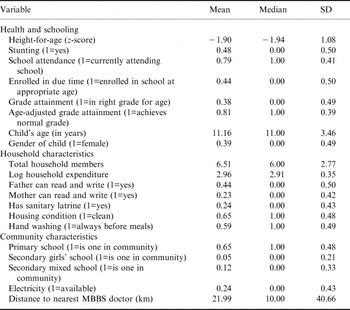
Descriptive statistics
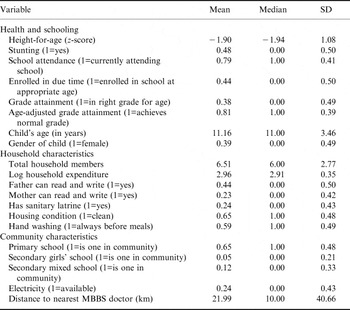
The descriptive statistics of the variables used in this study, reported in Table 1, show that children in the sample have a mean height-for-age that is slightly less than two standard deviations below that of the reference population. Table 1 also shows that 79% of the children in the sample are currently attending school but only 44% are enrolled by the due age. This is probably the main factor leading to 53% of the children in the sample not achieving the right grade for their age (after adjusted for the actual age of enrolment, the poor performance rate is only 19%). The sample also shows that only 39% of the children surveyed are girls. The low proportion of girls sampled in this study may be due to the fact that some girls, especially those around the upper bound of the age range (17 years old), could be married, and hence they are not included in the sample as household members. Also, only the son/daughter of the household head was considered, so daughters-in-law are also excluded from the sample. The household characteristics show that the proportion of fathers who can read and write is double that of mothers, although it is relatively low for both groups (44 vs 23%). The sanitary condition, which is an important factor determining child health, is rather modest. Only 24% of the households have a sanitary latrine; 65% have a clean housing condition; and 59% of the households practise washing hands before meals. The basic infrastructure of the communities surveyed is rather poor. Only 65% of the communities have a primary school, whilst the availability of secondary schools for girls and both sexes is only 5 and 12%, respectively. On average, only 24% of the communities are connected to electricity. The distance to a nearest MBBS doctor is 21 km, which seems to be distorted by some remote communities as the median distance is only 10 km.
Descriptive statistics
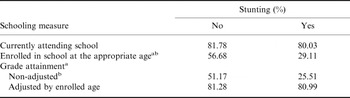
The data also show that in most measures of schooling of this study, stunted children seem to perform worse than others (see Table 2). For example, the attendance rate of children with normal height-for-age is 82%, whilst that of stunted children is only 80%. Children with normal height-for-age are about twice as likely (57 vs 29%) to enrol at the appropriate age (6 years old in Bangladesh) compared with stunted children. Finally, the rate of children who are falling behind in school progress (i.e. have lower grade than their age) is 38% for normal children, which is much lower than the 68% of stunted children. However, after adjusting for the actual age of enrolment, the proportions of poorly performing stunted and normal children are almost identical at 18.7 and 19%, respectively. A basic χ2 test revealed that only the incidence of late enrolment and unadjusted grade attainment of children in the two groups differ significantly at 1%. Note that the comparison in Table 2 did not control for characteristics of the child, household and the community, which may affect the relationship between child health and schooling. This will be investigated further using regression analyses.
Percentage of children by schooling and health status
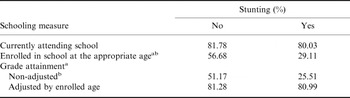
a Does not include those who never enrol.
b χ2 test for the difference of schooling measures by nutrition status shows a significance level of 1%.
Choice of variables
Child health in this study is measured by height-for-age, which is an important indicator of malnutrition (Waterlow, Reference Waterlow1972) and widely used in the literature as a measure of childhood malnutrition. The z-score method, recommended by the World Health Organization (WHO), is used to measure a child's height-for-age. The z-score measures the degree to which a child's measurements deviate from what is expected for that child, based on a WHO/NCHS international reference population. In other words, the height-for-age is expressed as a number of standard deviations above or below the corresponding reference mean for a child of the same age and sex. Based on the guideline of the WHO (de Onis & Blössner, Reference de Onis and Blössner1997), a dummy variable was constructed representing the malnutrition status that equals one if a child has a z-score of height-for-age of less than −2 (i.e. has a height or weight that falls below two standard deviations from the mean of the reference population of the same age and sex).
Three binary measures of child's schooling were examined: attendance (equals one if the child is attending school), enrolment (equal to one if the child is enrolled at school at 6 years of age) and grade attainment (equal to one if the child achieves the right grade for his/her age). Test score could be an obvious measure of schooling performance, but unfortunately this measure was not available in the data set.
With the third measure of schooling, it was hypothesized that child health not only affects his/her school enrolment or attendance, but also affects his/her grade attainment. Malnourished children might make lower progress in school because of missed school days, and lack of concentration in completing homework. Therefore, child's grade attainment at school was also measured. A commonly used measure of grade attainment is ‘schooling-for-age’ (SAGE), which measures schooling attainment relative to age (i.e. whether a child is in the right grade for his/her age). This measure also considers late enrolment. For example, children who are enrolled late will not be in the right grade for their age. This measure of school attainment is widely used in the literature (see, for example, Psacharopoulos & Patrinos, Reference Psacharopoulos and Patrinos1997; Ray & Lancaster, Reference Ray and Lancaster2005; Khanam & Ross, Reference Khanam and Ross2008) as a reliable measure of school outcome in developing countries. Psacharopoulos & Patrinos (Reference Psacharopoulos and Patrinos1997) and Ray & Lancaster (Reference Ray and Lancaster2005) defined SAGE as follows:

where E represents the country-specific usual school entry age, which is 6 years in Bangladesh. The SAGE might take values of 100 or higher (i.e. the attainment of the highest possible grade attained to date) to 0 (i.e. never attended school). A score of more than 100 indicates that the child has attended more years of school possible for his age (this is possible because although official enrolment age in Bangladesh is 6 years, some parents enrol their children earlier). A score of less than 100 indicates that the child is ‘falling behind’ in his/her education. Based on Patrinos & Psacharopoulos (Reference Psacharopoulos and Patrinos1997) and Ray & Lancaster (Reference Ray and Lancaster2005), SAGE was converted to a dichotomous variable, such as Si, which takes the value of 1 if a child has normal progress (i.e. SAGE<100), and 0 otherwise. The dummy form of SAGE is more useful than the original SAGE score as estimates found from the dummy SAGE can be intuitively interpreted as the probability of attaining the right grade or falling behind in schooling progress. It is surprising that there are only 37% of children in the data set who achieve the right grade for their age (see Table 1). The majority of this group may be due to late enrolment, as there were only 35% of children in the sample enrolled in school at the appropriate age.
As E only captures the official enrolment age (e.g. 6 years), it is obvious that those who enrol later than the official age must belong to the low-grade attainment group. The usual measure of SAGE captures both late enrolment and grade repetition. In order to separate grade repetition from late enrolment, SAGE was adjusted according to the age at initial enrolment for each child (i.e. in eqn (3), E refers to the actual enrolment age). In particular, in a second measure of SAGE, attainable grade is defined as the difference between the child's age and the age at initial enrolment. Thus, an age-adjusted performance is defined as when the actual grade is lower than this attainable grade. Using this criterion, only 19% of children in the sample performed poorly at school.
As mentioned earlier, three groups of exogenous variables were used to control for the relationship between child nutrition and school performance: child, household and community characteristics. The main variables representing child characteristics are age and gender. At the household level, information on wealth level (proxied by log of household expenditure), household size, education level of parents (proxied by their ability to read and write) and hygiene practices (proxied by housing condition, hand washing and availability of a latrine) were included. It is expected that children from wealthier households are more likely to have better health status due to the ability of their parents to afford, for example, more nutritious food and/or medicines. Similarly, it is expected that children of more hygienic households (e.g. a clean house, have latrine and practise hand washing before meals) are more likely to have better health. The effect of household size is expected to be detrimental to both health and education of children because more people are competing for the household resource pool.
At the community level, variables were selected that represent basic infrastructure for health and education (for example, availability of school and electricity and distance to nearest doctors). Availability of schools, which is widely used in the literature as a measure of schooling costs in the absence of real costs of schooling, was chosen as a proxy for cost of schooling. Note that the cost of schooling involves direct costs (e.g. school fees) and indirect costs (e.g. time required to travel to school). The availability of school captures mainly the second component of schooling costs. Likewise, the distance to nearest doctors captures accessibility of children to health services. The availability of electricity proxies accessibility to modern facilities that may lead to higher quality education and health services (e.g. computer, electric lights and fans in classrooms, refrigerators to store vaccines in health clinics). It is expected that all these community characteristics will have a positive effect on both health and education outcomes.
The education and health of children may also be affected by unobserved community characteristics (e.g. customs, attitude toward education, school quality, etc.). For example, one community may have a richer tradition or higher preferences for child education than others. In order to control for unobservable characteristics of each community that may affect both child health and schooling a dummy variable for each community was employed (choosing arbitrarily one community as a reference).
Results
This section presents the joint estimates of eqns (1) and (2), examining the relationship between child nutrition (proxied by stunting in this study) and the current school attendance, enrolment and grade attainment. As mentioned previously, it is possible that child health is endogenous in the relationship with education, because a household might take the decision to invest in child health and schooling simultaneously. This endogeneity issue can be considered without any exclusion of restriction using a bivariate probit model.
School attendance
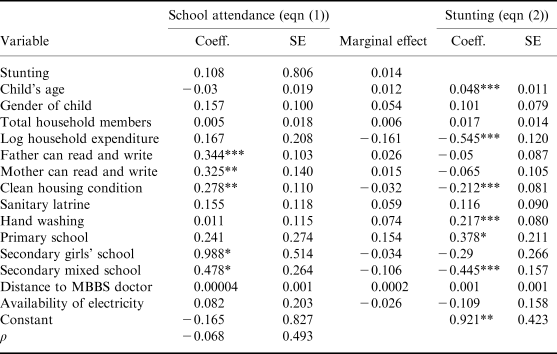
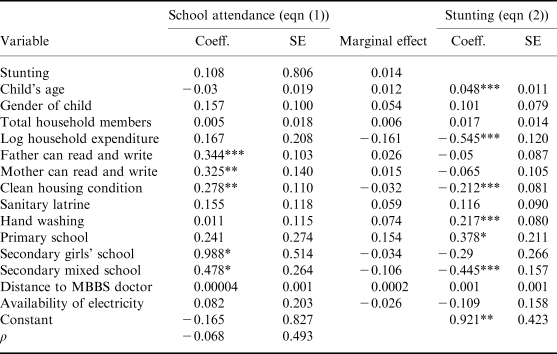
Results from the school attendance equation show that malnutrition (measured by stunting) does not affect a child's school attendance (see Table 3), which is in line with the basic comparison in Table 2. The correlation coefficient (ρ) is not statistically significant, suggesting that there is no endogeneity issue of stunting with regard to school attendance. Therefore, the results would still be consistent if eqn (1) was estimated using only a probit estimator.
The effects of childhood malnutrition on school attendance
*** 1%
** 5%
* 10% levels of significance (N=1222).
Marginal effects are only reported for the probability of due enrolment (eqn (1)); community dummies are dropped for brevity.
Factors significantly associated with school attendance are parents' education and school infrastructure, particularly the availability of a secondary girls' school in the community. The marginal effects show that children in a community, where a girls' secondary school is available, have a higher probability of attending school than those without by 51.4 percentage points. Meanwhile, the availability of a mixed school only increases the probability of enrolling by 26.4 percentage point. One possible reason is that parents may be more encouraged to send their daughters to school in a community where a girls' school is available. Also, the availability of secondary school in the community proxies for cheaper schooling cost (indirect costs), and hence parents are more encouraged to send children to school.
The results also suggest that educated parents are more likely to send their children to school. Particularly, children whose mother and father were able to read and write have an increasing probability of attending school by 14 and 10 percentage points, respectively. It is surprising to see that girls have a higher probability of attending school than boys, but this result is not significant. In contrast to expectation, household expenditure has no significant effect on school attendance, although it significantly reduces the probability of child stunting, as expected. Other household and community chracteristics also have no effect on the probability of a child being able to attend school.
School enrolment
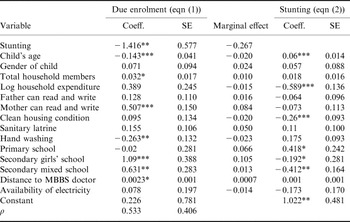
The results show that child health has a significant effect on the probability of enrolment at the due time. The insignificance of the correlation coefficient (ρ) suggests that the results may not be biased if the issue of unobserved heterogeneity is ignored. The marginal effects reveal that a stunted child has a lower probability of due enrolment by 26.7 percentage points (see Table 4). This result is in line with other cross-sectional studies such as those of Glewwe & Jacoby (Reference Glewwe and Jacoby1995) and Behrman & Lavy (Reference Behrman and Lavy1998). Parental education is again proved to be a significant determinant of children's schooling outcome. The probability of being able to enrol in school at the due age increased by 15 percentage point for those whose mothers were able to read and write. Similarly, children in communities with the availability of either a girls' secondary school or mixed-sex secondary school have a higher probability of enrolling at the due time. One possible explanation of these results is that communities with a secondary school will also have a primary school, as these are often more advanced communities. Also, the availability of a secondary school is a proxy for education infrastructure. It is expected that in these communities (with better education infrastructure) parents will have a greater incentive to enrol their children on time, because at least the indirect costs of sending children to school are cheaper. However, the magnitude of attendance at the girls' schools is almost double that of the mixed schools, which in some way reflects the effects of the dominant Muslim culture in the study areas (i.e. parents are more willing to send their daughters to girls' secondary schools than to mixed-sex schools). Regarding the stunting equation, important factors that contribute to the improvement of child nutrition are household wealth (proxied by expenditure) and hygiene environment (proxied by clean housing condition). Nevertheless, it seems that the practice of hand washing has a counter-intuitive (positive) effect on the probability of stunting, although it is only significant at 10% level.
The effects of childhood malnutrition on enrolment at due time
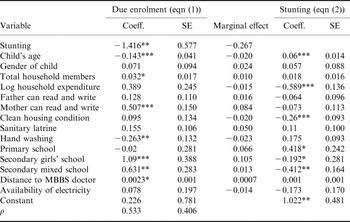
*** 1%
** 5%
* 10% levels of significance (N=985).
Marginal effects are only reported for the probability of due enrolment (eqn (1)); community dummies are dropped for brevity.
Grade attainment
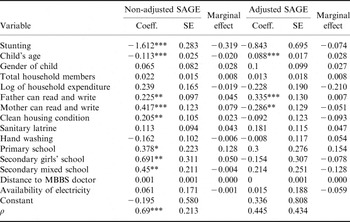
Table 5 shows that health has an expected and significant effect on grade attainment measured by SAGE. The marginal effects show that a stunted child has a lower probability of achieving an age-appropiate grade by 31.9 percentage points. The negative and significant effect of child age is not surprising in a country like Bangladesh as an older child is more likely to fall behind in grade attainment due to the increased opportunity costs of schooling. One possible reason is: an older child can earn money from outside work or by helping his/her parents in housework/agricultural activities. Other significant determinants have a similar effect as in other schooling measures: children from educated parents (i.e. proxied by being able to read and write) have a higher probability of achieving the expected grade. The availability of a girls' secondary school has a stronger effect on grade attainment than that of a mixed-sex secondary school, which also has a significantly greater effect on the achievement of an age-appropiate grade compared with communities without a secondary school.
The effects of childhood malnutrition on grade attainment
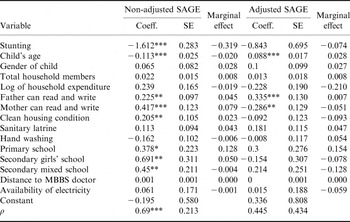
*** 1%
** 5%
* 10% levels of significance (N=985).
Results of eqn (2) (stunting) and community dummies are dropped for brevity.
As discussed earlier, this SAGE measure considers both late enrolment and grade repetition, and therefore provides a lower grade attainment for children who enrolled at school late. To separate late enrolment from grade repetition, another regression was run to consider grade attainment when adjusting actual enrolment age for each child. The aim was to look at whether malnutrition has any impact on grade repetition. The results show that stunting condition does not significantly affect school performance if late enrolment is adjusted, although it has the expected negative sign. In addition, after adjusted for late enrolment, older children are significantly more likely to perform better at school. There are almost no other significant determinants of adjusted school attainment. The only exception is parental education: children of literate fathers and mothers have a significantly higher probability of achieving an age-appropiate grade
Discussion and Policy Implications
The crucial role of human capital in economic growth and poverty alleviation has been widely investigated, but most studies have not taken into account the endogeneity of child health. This study improves our understanding of the relationship between child health and schooling in several ways. First, an estimation method is used that is consistent with the economic theory of household and takes into account the unobserved heterogeneity issues without the need for instrumental variables. Second, the authors are not aware of any study that has previously examined the impact of child health on schooling outcome in Bangladesh, apart from Grira (Reference Grira2004). However, the use of household and community variables as the instruments of child health in Grira's study may not completely control for the unobserved hetrogeneity issue. The current study overcomes this issue by using a FIML method using a comparatively new data set. Finally, in this study the effects of child health (proxied by malnutrition status) on a wide range of schooling measures – enrolment, attendance and attainment – are examined. It is hypothesized that child health affects not only enrolment probability but also school outcome. The results reveal that childhood malnutrition has significant and expected effects on school enrolment and grade attainment, although it does not affect current school attendance. Therefore, this study adds considerably to the understanding of the impact of child malnutrition on schooling.
The results indicate that malnourished children are significantly more likely to enrol in school later than the due age. In particular, stunted children have a lower probability of enrolling by the due age by 26.7 percentage points. However, no statistically significant effect of child health on current school attendance (whether a child was attending school during the survey) is found. This finding is not surprising because current school attendance reflects a current activity, which might not be affected by child health as measured by stunting (long-term chronic malnutrition). It is also found that, after adjusted for actual enrolled age, the grade attainment of children is not affected by stunting condition. Other important determinants of schooling are parents' wealth, education and the availability of a secondary school, especially a girls' secondary school, in the community. These variables affect schooling outcomes positively.
The results should be interpreted with caution, because child health in this study is measured during the survey, when the average age of the sampled children was 11 years. Without the availability of longitudinal data it was not possible to measure child health during the time of first enrolment or before the age of 6 years. However, there is a significant body of evidence that suggests that past health status is a significant predictor of current health (e.g. Murasko, Reference Murasko2008; Khanam et al., Reference Khanam, Nghiem and Connelly2009).
These findings have important policy implications. Although many factors are found to affect child schooling, the main focus is on child nutrition. Since strong evidence is found that malnourished children are more likely to enrol late in school, and fall behind in grade attainment, policymakers should take initiatives that target early nutrition programmes, increase social awareness about the importance of early child nutrition and educate parents about nutrition. In addition, development programmes that improve the livelihoods of rural households (e.g. by increasing income and consumption, and improving the literacy and numeracy of adults) may have the knock-on effect of improving child nutrition and schooling outcomes.