


Introduction
Why do parties opt for proportional representation (PR)? This question has attracted considerable attention in political science (Boix Reference Boix1999; Calvo Reference Calvo2009; Cox, Fiva, and Smith Reference Cox, Fiva and Smith2019; Cusack, Iversen, and Soskice Reference Cusack, Iversen and Soskice2007; Kreuzer Reference Kreuzer2010; Leemann and Mares Reference Leemann and Mares2014). A major point of disagreement has evolved around the question of whether established parties were able to mitigate the adverse effects of socialist party entry under majoritarian electoral systems (MR). The dominant socialist threat approach (henceforth STA) maintains that a fragmented block of non-socialist parties failed to join forces against the emerging left and thus adopted PR (Boix Reference Boix1999; Leemann and Mares Reference Leemann and Mares2014; Rokkan Reference Rokkan1970).
I show that established parties were able to coordinate under MR via electoral alliances. Such electoral alliances were facilitated by rules to solve coordination problems—most notably runoffs (Cusack, Iversen, and Soskice Reference Cusack, Iversen and Soskice2007). However, runoffs were not able to solve coordination problems because they provide a solution only if non-socialist voters were to support an established party against socialist candidates. Yet, the ranking of socialist candidates on the preference order of non-socialist voters might be dependent on the salience of other cleavages such as state versus church or free trade versus protectionism. Thus, the support of established parties’ candidates against socialist insurgents is conditional on electoral alliances—that is, the endorsement of a candidate by multiple parties.
To provide evidence, I use a natural experiment by investigating voter movements and the strategic behavior of non-socialist parties in all elections in Imperial Germany between 1890 and 1912. Imperial Germany with its highly fragmented camp of established parties, as well as electorally strong socialists, constitutes a most likely case for the STA. To obtain credible causal estimates, I compare districts in which socialist candidates gathered enough votes to enter the runoff versus districts in which they failed to do so by a narrow margin. The results show that electoral alliances between established parties are driven by socialists’ entry to runoffs. In addition, I show that the socialist entry to runoffs has a significant influence on the electoral support of the non-socialist candidate, increasing the vote share by about 6–8%. However, this increase is conditional on the endorsement of candidates by other parties.
The evidence demonstrates that electoral alliances were extensively used by the non-socialist camp and were effective in preventing advances of the Social Democratic Party (SPD). As I show below, the results speak against the approach forwarded by Rokkan (Reference Rokkan1970) and Boix (Reference Boix1999). Therefore, the findings have considerable implications for the literature on PR. By demonstrating that coordination problems of established parties were far from widespread and have been overemphasized in previous research, the paper contributes to the ongoing debate of one of the most fundamental political reforms in the twentieth-century Western World and provides micro-level evidence on the dominant theoretical approach that aims at explaining the adoption of PR.
I start by reviewing the STA before turning to the case selection strategy and research design. After that, I present the data, results, and a number of robustness tests. Lastly, I discuss the substantive significance of the results and their implications for the PR literature.
Socialist Threat, Coordination Problems, and the Introduction of PR
The rise of socialist parties is considered to be a fundamental cause of the adoption of PR (Boix Reference Boix1999; Kreuzer Reference Kreuzer2010; Leemann and Mares Reference Leemann and Mares2014; Rokkan Reference Rokkan1970). The debate started with Boix (Reference Boix1999) who, building on Rokkan (Reference Rokkan1970), put the problem of voter coordination under MR to center stage. According to his approach, two conditions have to be met for established parties to demand the adoption of PR. First, the non-socialist camp has to face an electorally strong socialist party. Second, the group of established parties has to be fragmented, meaning that the non-socialist vote is dispersed among different parties. If established parties are equally balanced in terms of vote shares, voters are unable to coordinate around a specific party to prevent a socialist victory. Only if the group of non-socialist parties is fragmented and confronted with a strong socialist party, then they opt for PR to minimize their electoral losses.
The main point of criticism voiced against Boix (Reference Boix1999) is that runoffs were in place in many pre-PR systems in Europe (Cusack, Iversen, and Soskice Reference Cusack, Iversen and Soskice2007). Along with the restriction that only the two front-running candidates were allowed to proceed to the second round, the problem of voter coordination was essentially resolved by design. Once a socialist candidate entered runoffs, voters could only support the remaining non-socialist candidate in order to prevent a socialist victory.
Despite this fundamental criticism, the STA prevails in the literature on electoral systems choice. A main concern about runoffs is that they only provide a solution to the coordination problem if liberal or conservative voters and party elites rank all non-socialist candidates higher than the socialist candidate. The salience of other cleavages such as protectionism versus free trade might prevent the non-socialist camp from supporting one candidate against the left. Recent contributions have emphasized this point but are divided on whether established parties were successful in joining forces to manage the advances of socialist parties (cf. Cox, Fiva, and Smith Reference Cox, Fiva and Smith2019; Leemann and Mares Reference Leemann and Mares2014; Schröder and Manow Reference Schröder and Manow2020).
Therefore, the question is whether established parties were able to mitigate the coordination problems via electoral alliances. The previous literature has indicated two expectations. First, the mere existence of runoffs and, thus, a lower number of candidates in runoffs should result in higher voter coordination when socialist candidates are credible competitors (Boix Reference Boix1999). Second, Rokkan (Reference Rokkan1970) focuses on interparty coordination by claiming that the non-socialist camp was unable to overcome cross-cleavage hostilities and forge electoral alliances against the emerging socialists. Even if the number of candidates was reduced by runoffs, elites and voters of established parties might be unwilling to support the remaining non-socialist candidate. To evaluate both theoretical expectations, I turn to the analysis of strategic party behavior in elections in Imperial Germany.
Electoral Competition in Imperial Germany
To investigate whether and how established parties responded to the increasing strength of the SPD, I focus on the strategic behavior of non-socialist parties in all runoffs in Imperial Germany between 1890 and 1912.Footnote 1 The case selection is motivated by three substantive reasons. First, the SPD was the front-runner in terms of membership numbers and electoral strength (under MR) in pre-WWI Europe (Boix Reference Boix1999, 623).
Second, Imperial Germany was the country with the highest effective number of non-socialist parties in Europe before the introduction of PR (Boix Reference Boix1999, 623). Parties competed along the cleavages of labor and capital (socialist vs. non-socialist camp), state and church (Center Party vs. anticlerical parties), majority versus minorities (Poles, Danes, French vs. German parties), and free tradists versus protectionists (liberal vs. conservative parties). In this multidimensional policy space, there was a clear need to forge electoral alliances. The electoral strength of the left and the fragmentation on the right make Imperial Germany a most likely case for the STA.
Third, Imperial Germany used a majoritarian runoff system. Even though scholars such as Boix (Reference Boix1999) have used plurality systems as a starting point, there is a stronger association between majoritarian runoffs and the adoption of PR. Before the end of World War II, all Western countries with runoffs adopted PR, while most countries without runoffs maintained the plurality system or introduced other electoral systems.Footnote 2 Therefore, the pattern suggests that the internal validity of the STA is more likely to hold for electoral systems with runoffs.
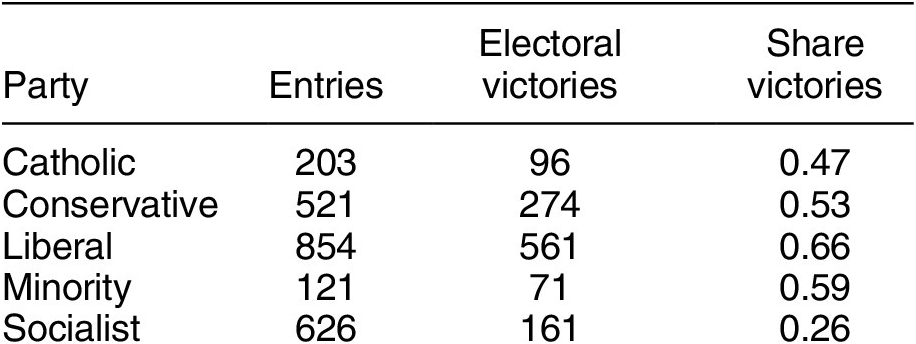
Focusing on runoffs, Table 1 shows how often parties from different ideological camps advanced to the second round as well as their total and relative number of electoral victories. While the SPD displays the second highest number of entries to runoffs, they won only 26% of the contests. In contrast, the percentage of electoral victories of the other parties ranged from 47% (Catholic parties) to 66% (liberal parties). The pattern suggests that socialist candidates had a considerably lower chance of succeeding in runoffs than other parties. Before investigating whether socialist candidates were disadvantaged by electoral alliances or the reduction of competitors, I discuss the research design, the data, and measures I employ in the following section.
Runoff Entries and Results by Party

Research Design and Data
Besides the substantive reasons outlined above, the electoral system of Imperial Germany allows the construction of a research design to generate credible estimates of causal effects. More precisely, the majority runoff system mimics a natural experiment by comparing strategic voter and party behavior between the first and second round (Indridason Reference Indridason2008). Given the short time frame between both rounds, structural influences on the formation of electoral alliances (economic development, ethnicity, religion, etc.) are essentially held constant. Therefore, only strategic behavior between rounds influences voter movements and the decision to forge alliances.
To solve the problem of nonrandom assignment, I use a regression discontinuity design (RDD) to estimate the effect of socialist entry on alliance formation of non-socialist parties. Focusing on the closeness of contests to identify the effect of election results on political outcomes has become increasingly popular in political science (de la Cuesta and Imai Reference De la Cuesta and Imai2016; Eggers et al. Reference Eggers, Fowler, Hainmueller, Hall and Snyder2015). If carefully conducted, RDDs provide credible estimates of causal effects.
To determine the treatment assignment of a district in an election, I employ the difference between the first-round vote share of the socialist candidate and the second-placed non-socialist candidate to create the running variable. If the running variable takes positive values, then a socialist candidate entered the runoffs, whereas for negative values, two non-socialist candidates competed in the runoff. I then use a mean-squared-error optimal-bandwidth estimator to determine the range of observations below and above the cutoff of the running variable to obtain the point estimates and the confidence intervals separately. I also cluster the standard errors on the district level given that I expect observations within districts to be correlated. After the main analysis, I conduct a number of falsification tests to examine the sensitivity of the results.
To investigate changes in voter movements and the formation of electoral alliances between non-socialist parties, I rely on election data for the six national elections between 1890 and 1912 from Reibel (Reference Reibel2007).Footnote 3 Electoral support of the front-running non-socialist candidate is measured as the vote-share difference between rounds. More specifically, I compare how the vote share of the electorally strongest candidate of an established party changes depending on whether he is challenged by a socialist candidate or a candidate of another established party in the runoff.
I employ two variables of electoral alliances to disentangle the mechanisms proposed by Boix (Reference Boix1999) and Rokkan (Reference Rokkan1970). I begin by constructing a measure following Rokkan’s (Reference Rokkan1970) claim that interparty hostility prevented liberals and conservatives from coordinating against socialist insurgents (denoted as “cleavage” in the following). To do so, I measure whether the strongest non-socialist candidate was supported by a party from another ideological camp in the runoff that did not support him in the first round. In line with the literature on nineteenth and early twentieth century party systems, I distinguish between liberal, conservative, Catholic, and minority parties (Rokkan Reference Rokkan1970). Therefore, the variable takes the value 1 if, for instance, the strongest liberal candidate receives the support of a conservative, Catholic, or a minority party in the runoff that did not support him in the first round. Otherwise, the dependent variable scores 0. An overview of the individual parties and their assignment to a party group can be found in Table A2 in the appendix.
Furthermore, I construct a second measure that puts more weight on the distribution of vote shares within a district than on intercleavage coordination. The measure scores 1 if the electorally strongest non-socialist party whose candidate did not proceed to the runoff supported the front-running non-socialist candidate (Cusack, Iversen, and Soskice Reference Cusack, Iversen and Soskice2007). In all other cases, the variable scores 0. This measure is denoted as “right margin.”
To increase the efficiency of the estimator, I include a number of predetermined covariates. I add a measure for the competitiveness of the first round using the vote margin between the two front-running candidates. I also measure the number of candidates competing in the first round as well as the share of parties that did not field candidates but supported candidates of other parties. To capture the fractionalization of the non-socialist vote, I use the first-round vote share of the front-running non-socialist candidate. Furthermore, I capture the potential for electoral alliances in the runoffs by using the number of interparty alliances divided by the number of parties in the first round. Lastly, I employ year, district, and party group fixed effects. A more detailed description of all variables as well as summary statistics and covariate imbalance tests can be found in Table A3 and Table A4.
Validity of the RDD
I have conducted a number of diagnostic tests to investigate whether the application of an RDD is valid. First, I compare district characteristics in which socialist candidates entered the runoff with districts in which socialist candidates did not proceed to runoff. The summary statistics in Table A4 in the appendix show the coefficients as well as p-values, adjusted for multiple comparisons, of the RDD estimations for all variables in the last two columns. Only both alliance measures, as well as the vote-share difference of the front-running non-socialist candidate, reach the 95% significance level. All other covariates are nonsignificant, suggesting no imbalances between groups. Second, I graphically examine and test for discontinuities in the density around the threshold to detect any self-selection of socialist candidates to either the treatment or control group. The results presented in Figure A1 in the appendix show that the confidence intervals above and below the cutoff strongly overlap. The result of the local polynomial density estimator suggests that the null hypothesis of no sorting cannot be rejected (p-value = 0.82). Third, I evaluate the relationship of socialist entry, electoral alliances, and the vote-share changes of the established candidate graphically in Figure A2 in the appendix. More precisely, I present RD plots of the relationships, using a third-order polynomial to smooth the regression function. In all plots, a discontinuity is visible at the cutoff point, indicating a significant difference between the regression functions above and below the threshold.
Mechanism: Socialist Entry and the Formation of Electoral Alliances
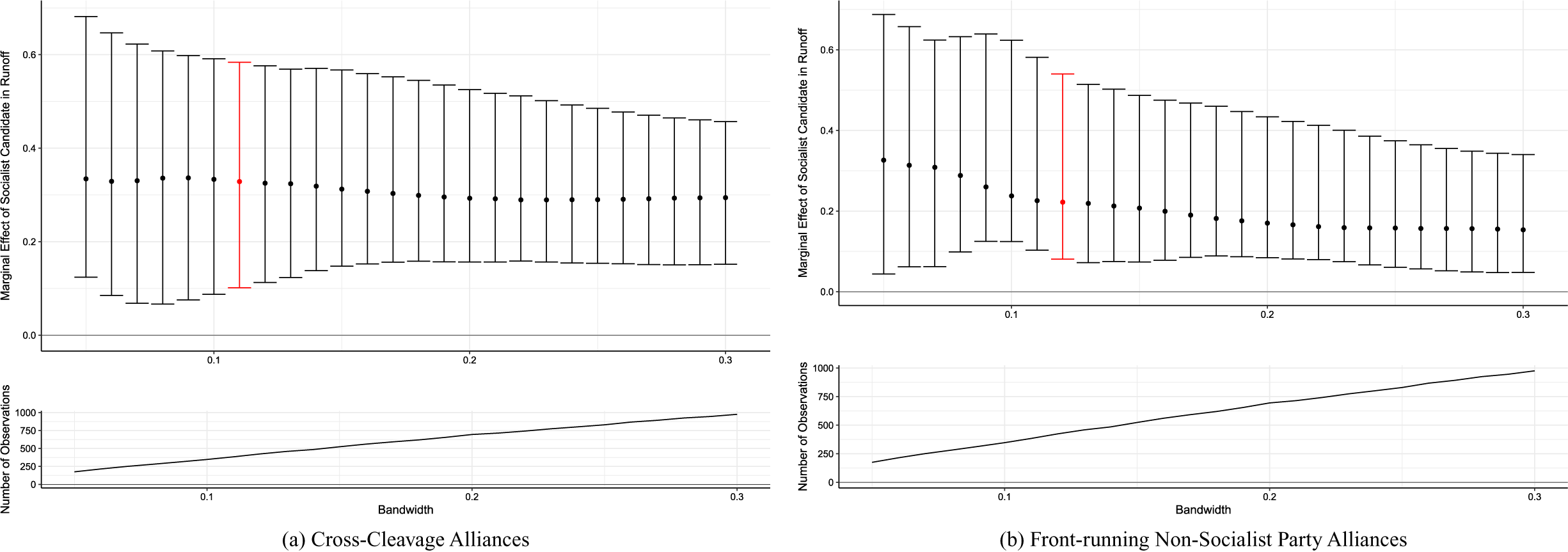
I now turn to the presentation of the results for the point estimates and 95% robust confidence intervals. In Figure 1, I use bandwidths that range from 5% to 30%, with optimal bandwidths displayed in red. The bandwidths are displayed on the x-axis and the magnitude of point estimates and confidence intervals on the y-axis. Furthermore, I have added a plot to show the number of observations that have been used for the point estimates and the confidence intervals.
Socialist Entry and the Formation of Electoral Alliances
Note: Optimal bandwidth displayed in red.

Are electoral alliances forged in response to the emergence of credible socialist candidates? In plot (a) in Figure 1, I estimate the effect of a socialist entry to runoffs on the formation of cross-cleavage alliances using different bandwidths. The results demonstrate that the effect is significant across a large number of bandwidths, with a point estimate suggesting a 32 percentage point increase in cross-cleavage alliances. Furthermore, I employ the measure for front-running non-socialist alliances (right margin) in plot (b) in Figure 1. The effect is also significant across the range of bandwidths, displaying a 22 percentage point increase in the probability of alliance formation if a socialist enters the runoffs.
The robustness tests support the findings of Figure 1. The local randomization approach in Table A8 and estimations with second-order polynomials in Table A5 provide similar results. Furthermore, placebo tests employing fake cutoffs in Table A7, lagged outcomes and running variables in Table A6, and candidates of other parties in Figure A3 and in Figure A4 return insignificant results.
The results challenge Rokkan’s claim that hostilities within the non-socialist camp prevented established parties from banding together against socialist candidates. The propensity to form alliances increased significantly and substantially when socialists entered runoffs. More precisely, the probability to forge cross-cleavage alliances increased by 32 percentage points. As a result, socialists faced this kind of alliance in every second runoff, as Table A4 shows. In addition, the right margin measure displays an increase of 22 percentage points, suggesting that the two electorally strongest established parties banded together in more than one-third of all runoffs to which socialist candidates proceeded. The correlation of both alliance measures is 0.61, suggesting that alliances of established parties were formed in the majority of cases where socialist candidates entered runoffs. Even a favorable interpretation of Rokkan’s claim of interparty coordination failure is difficult to align with these results.
Treatment Heterogeneity: Socialist Entry, Electoral Alliances, and Established Party Support
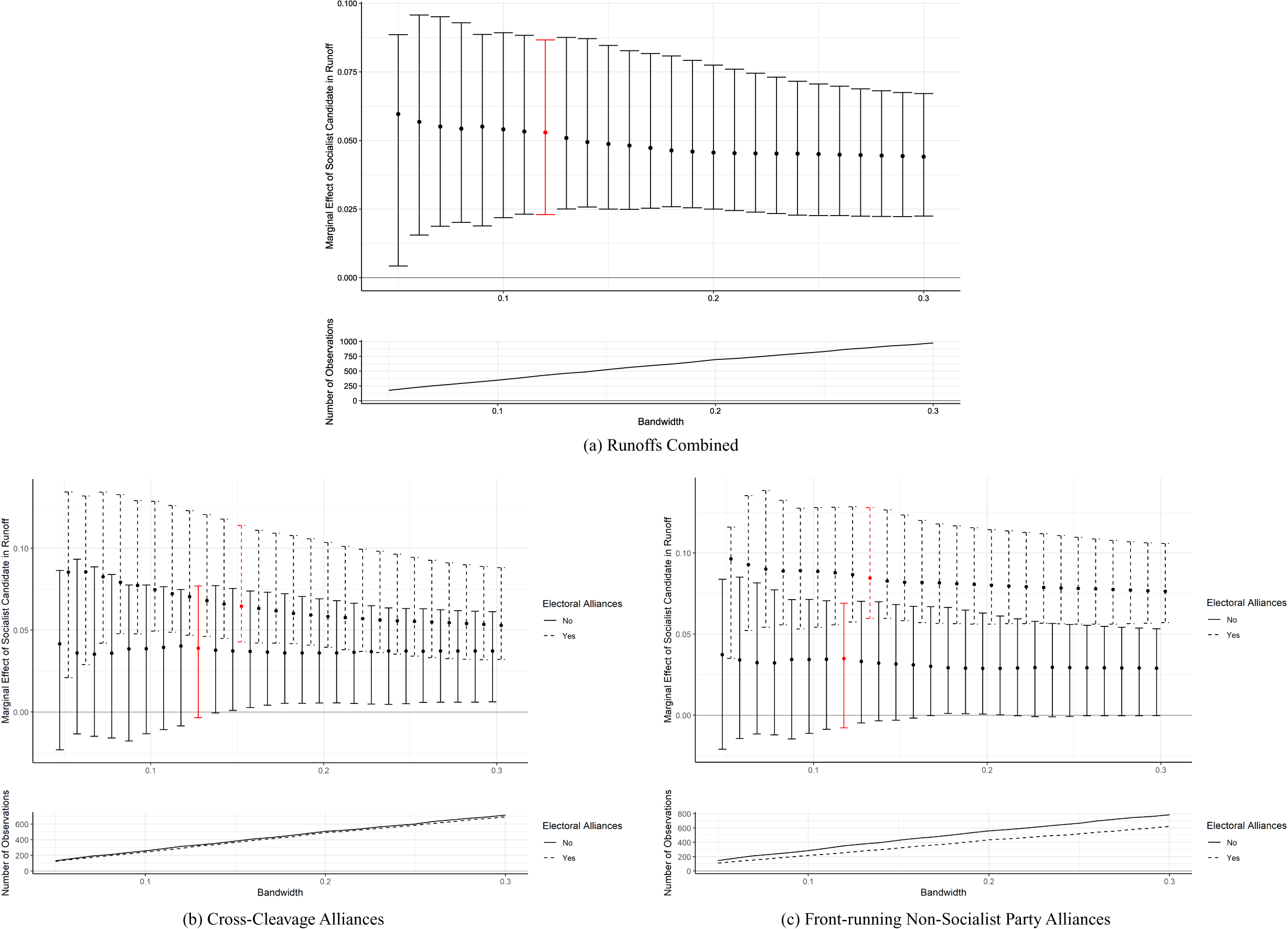
To present the overall picture on whether a socialist entry is linked to higher electoral support of the established parties’ candidate, I turn to plot (a) in Figure 2. I have estimated the effect of a socialist entering the second round on the vote-share increase of the non-socialist candidate regardless of alliance formation. The estimates across bandwidths show that the vote share increased by about 5%.
Socialist Entry, Electoral Alliances, and Established Party Support.
Note: Optimal bandwidth displayed in red.
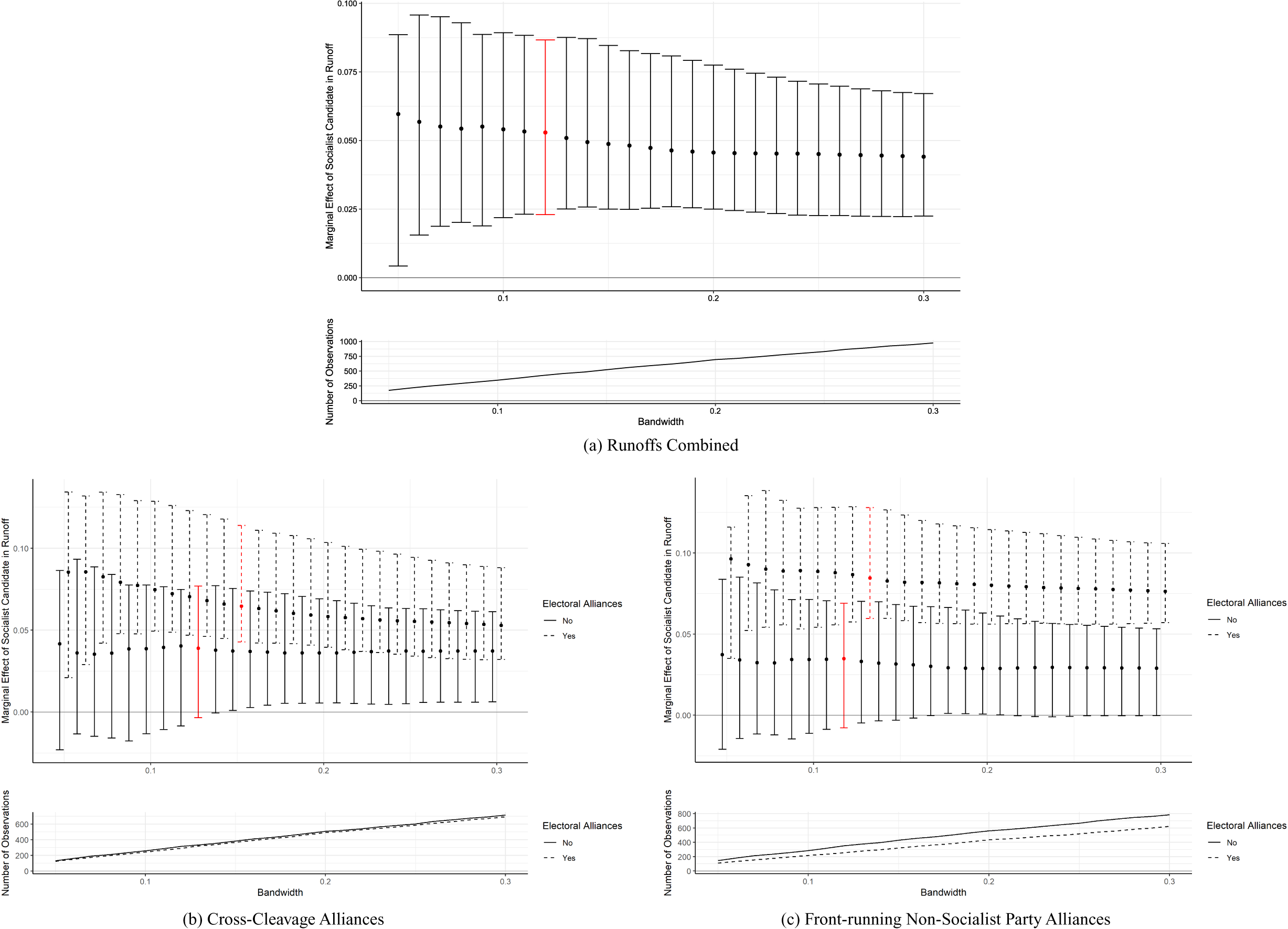
In the next step, I examine whether this higher electoral support is brought about via the reduction of competing candidatesFootnote 4 or the formation of electoral alliances. To do so, I have stratified the dataset according to whether an electoral alliance across cleavages has been forged between rounds or not when a socialist entered the runoff. I then reran the estimations with the same specification as in plot (a) using both datasets. Plot (b) displays the results. The dashed lines in the plot show that in the presence of electoral alliances, the vote share of non-socialist candidates increase by 6-8 percentage points. In contrast, the entry of a socialist candidate to the second round leads to only a 3-4 percentage point increase if the non-socialist candidate is not supported by a cross-cleavage electoral alliance (solid lines). In addition, the effect is only significant for larger bandwidths.
I have repeated the same procedure in plot (c) but used the right margin measure to stratify the sample. The point estimate for socialist entry in the presence of electoral alliances, again displayed as dashed lines, demonstrates that the vote share increases by about 8 percentage points. In contrast, the point estimates are about 3 percentage points but nonsignificant for all bandwidths if the front-running non-socialist candidate is not supported by another party, as the solid lines show.
To provide additional evidence for the robustness of my results, I conduct the same sensitivity tests as before. The local randomization approach in Table A18 and estimations with second-order polynomials in Table A11 provide similar results. Furthermore, placebo tests employing fake cutoffs in Tables A14 to A17, lagged outcomes and running variables in Tables A12 and A13, respectively, and candidates of other parties in Figure A5 returned insignificant results.
The results provide evidence that electoral alliances were decisive in mobilizing voters against socialist candidates. Without such alliances, non-socialist voters did not support just any candidate to prevent a socialist victory. Put differently, the front-running candidate of an established party did not receive more votes when competing against a socialist candidate compared with races against other non-socialist candidates. There is, thus, no evidence that a reduction of available candidates is sufficient to coordinate voters against socialist competitors (Boix Reference Boix1999). In contrast, the willingness of party elites to endorse candidates of other non-socialist parties was crucial to contain the socialists’ electoral advances.
Conclusion
The rise of socialist parties at the turn of the twentieth century has been linked to fundamental political, economic, and social reforms. The increasing electoral strength of an ideologically radicalized left, combined with a fragmented camp of bourgeois parties, has been forwarded as the main explanation for the introduction of PR in the West (Boix Reference Boix1999; Rokkan Reference Rokkan1970). In recent years, however, this argument has been questioned. In many pre-PR systems in the nineteenth and twentieth century, runoffs were a central feature (Cusack, Iversen, and Soskice Reference Cusack, Iversen and Soskice2007). This has cast doubt on the internal validity of the proposed mechanism.
To address this long-standing controversy and advance our understanding of the causes of electoral system choice, I have investigated all district-level races with runoffs in Imperial Germany. The results show that coordination worked on a large scale despite the existence of multiple competing cleavages. More precisely, the entry of socialists to runoffs is significantly and substantially linked to the formation of electoral alliances. In addition, the endorsement of non-socialist candidates by other parties resulted in a significant increase in electoral support vis-a-vis socialist challengers. Therefore, the results present evidence against the STA. Furthermore, the findings are consistent with the introduction of PR in Imperial Germany. As I demonstrate in the appendix, all parties except the SPD opposed PR until the latter assumed power in 1918 and decreed PR single-handedly (see appendix).
These findings have implications beyond the German case. Given that the highly fragmented camp of non-socialist parties was able to effectively contain advances of one of the electorally strongest and most radicalized socialist parties, there is little reason to believe that the formation of electoral alliances failed in other cases if the left was perceived as the biggest threat.
Importantly, my findings do not imply that the emergence of strong socialist parties was of no relevance for the introduction of PR. Other approaches have also linked the rise of the left to the introduction of PR but emphasized different mechanisms (Calvo Reference Calvo2009; Cox, Fiva, and Smith Reference Cox, Fiva and Smith2019; Cusack, Iversen, and Soskice Reference Cusack, Iversen and Soskice2007; Schröder and Manow Reference Schröder and Manow2020). My contribution thus adds to the literature by echoing the emphasis of previous work to explore other mechanisms that link party entry to electoral reforms.
Supplementary Materials
To view supplementary material for this article, please visit http://dx.doi.org/10.1017/S0003055420000945.
Replication materials can be found on Dataverse at: https://doi.org/10.7910/DVN/383K6K.




Comments
No Comments have been published for this article.