During the Jurassic, there was a broad tropical belt and the polar regions were only slightly cooler, so the Earth's climate was warmer and more equable than that of today (Hallam Reference Hallam1993). At that time, pterosaurs had a worldwide distribution (Wellnhofer Reference Wellnhofer1991; Unwin Reference Unwin and Morales1996). However, their known record is markedly biased toward the northern hemisphere. For example, numerous Jurassic fossil-bearing deposits have yielded a large variety of specimens representing basal and derived taxa in Europe (e.g. Wellnhofer Reference Wellnhofer and Wellnhofer1978, Reference Wellnhofer1991; Padian & Wild Reference Padian and Wild1992; Unwin Reference Unwin and Morales1996), in North America (Galton Reference Galton1981; Padian Reference Padian1984; King et al. Reference King, Foster, Scheetz, Foster and Lucas2006; Bennett Reference Bennett2007), in the Caribbean (Colbert Reference Colbert1969; Gasparini et al. Reference Gasparini, Fernández and de la Fuente2004) and in China, from the Tiaojishan Formation (e.g. Lü et al. Reference Lü, Unwin, Jin, Liu and Ji2010, Reference Lü, Unwin, Deeming, Jin, Liu and Ji2011; Wang et al. Reference Wang, Kellner and Jiang2010; Cheng et al. Reference Cheng, Wang, Shunxing and Kellner2012).
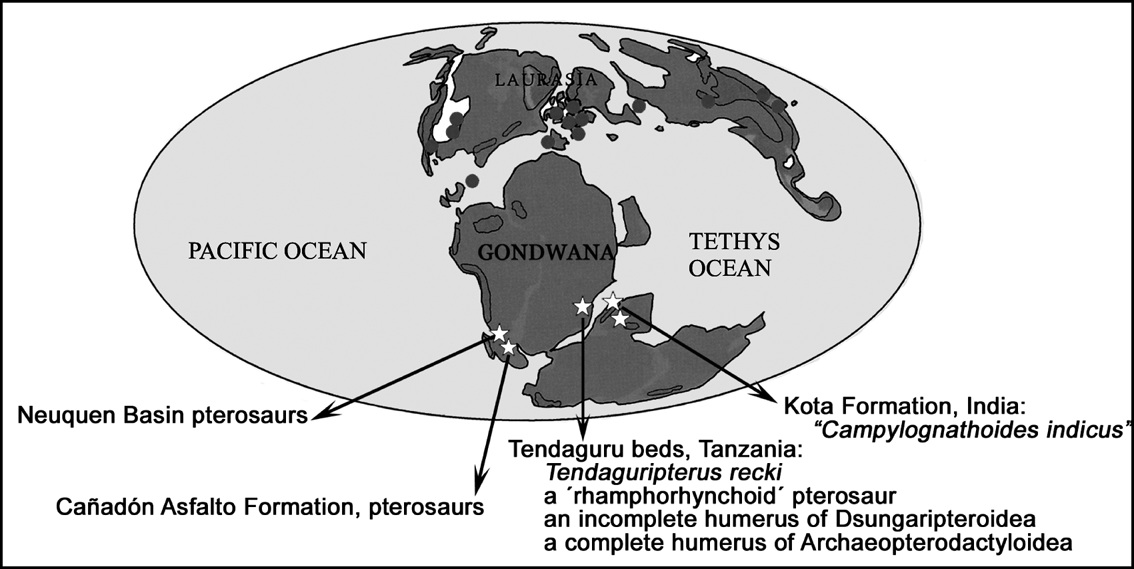
In contrast, Jurassic pterosaurs are extremely rare in the southern hemisphere (Fig. 1). The oldest record in Gondwana comes from the Middle Jurassic of Patagonia, in the Cañadón Asfalto Formation, which is mainly composed of lacustrine deposits and has provided the most diverse vertebrate fauna known from the early Middle Jurassic in the southern hemisphere. New data indicate that the lacustrine levels of the Cañadón Asfalto Formation in the vicinity of the village of Cerro Cóndor probably range from the uppermost Toarcian to the lowermost Bathonian (Cabaleri et al. Reference Cabaleri, Volkheimer, Nieto, Armella, Cagnoni, Hauser, Matteini and Pimentel2010; Cúneo & Bowring Reference Cúneo and Bowring2010). Pterosaur remains have been discovered in several localities where this unit is exposed and were briefly reported by Rauhut et al. (Reference Rauhut, López Arbarello, Puerta and Martín2001) and Unwin et al. (Reference Unwin, Rauhut and Haluza2004). Further information on these remains was reported by Codorniú et al. (Reference Codorniú, Rauhut and Pol2010, Reference Codorniú, Pol, Rauhut and Paulina–Carabajal2011) and the material is currently under study. The osteological features indicate that this assemblage contains subadult and juvenile individuals. Their wingspan was calculated on the basis of wing phalanges and was estimated at approximately 1 m for the subadult specimens. Preliminary phylogenetic analysis places the taxon in a polytomy with the recently described Darwinopterus (Lü et al. Reference Lü, Unwin, Jin, Liu and Ji2010) at the base of the Pterodactyloidea (Codorniú et al. Reference Codorniú, Rauhut and Pol2010).
Distribution of Jurassic pterosaurs in the Southern Hemisphere (modified from Unwin Reference Unwin2006). The star-shaped dots represent records of Jurassic pterosaurs in Gondwana.

Fragmentary remains are known from the finely laminated limestones of different localities from the Kota Formation of Kota, India (Rao & Shah Reference Rao and Shah1963). This Formation was previously assigned to the Early Jurassic based on semionotid (Jain Reference Jain1973) and pholidophorid fishes (Yadagiri & Prasad Reference Yadagiri and Prasad1977), but now it is regarded as late Middle Jurassic to possibly Early Cretaceous (Prasad & Manhas Reference Prasad and Manhas2007). These fossils are isolated, incomplete fragments assigned to “Campylognathoides indicus” (Jain Reference Jain1974) and consist of the anterior part of the skull and upper jaw, and a few incomplete post-cranial bones. However, the assignment of the type specimen of “C. indicus” has been questioned by Padian (Reference Padian2008a), who suggested that the jaw most likely belongs to a fish. The post-cranial bones merit re-study, given that they have no real affinity to Campylognathoides, and it is possible that this material represents a new taxon (Padian Reference Padian2008a).
Late Jurassic Gondwanan pterosaurs are known from Africa and Patagonia (Fig. 1). Most pterosaur remains from Africa have been recovered from the Upper Saurian bed and the Transitional Sand at the base of the Upper Saurian bed (Kimmeridgian to Tithonian) from Tendaguru, Tanzania (Reck Reference Reck1931; Galton Reference Galton1980). Unwin & Heinrich (Reference Unwin and Heinrich1999) re-examined these specimens and concluded that all previously named pterosaur taxa from Tendaguru (‘Rhamphorhynchus tendagurensis’, ‘Pterodactylus maximus’, ‘Pterodactylus brancai’ and ‘Pterodactylus arnigi’) should be considered nomina dubia. They also claimed that this African sample comprised two pterosaurs, a ‘rhamphorhynchoid’ and (following Galton Reference Galton1980) a dsungaripteroid pterodactyloid. They named the latter taxon Tendaguripterus recki (Unwin & Heinrich Reference Unwin and Heinrich1999), based on an incomplete short section of the small mandibular symphysis. Recently, new material from Tendaguru has been described (Costa & Kellner Reference Costa and Kellner2009): a proximal portion of a right humerus assigned to the Dsungaripteroidea and a complete, and very small humerus referred to the Archaeopterodactyloidea (Costa & Kellner Reference Costa and Kellner2009).
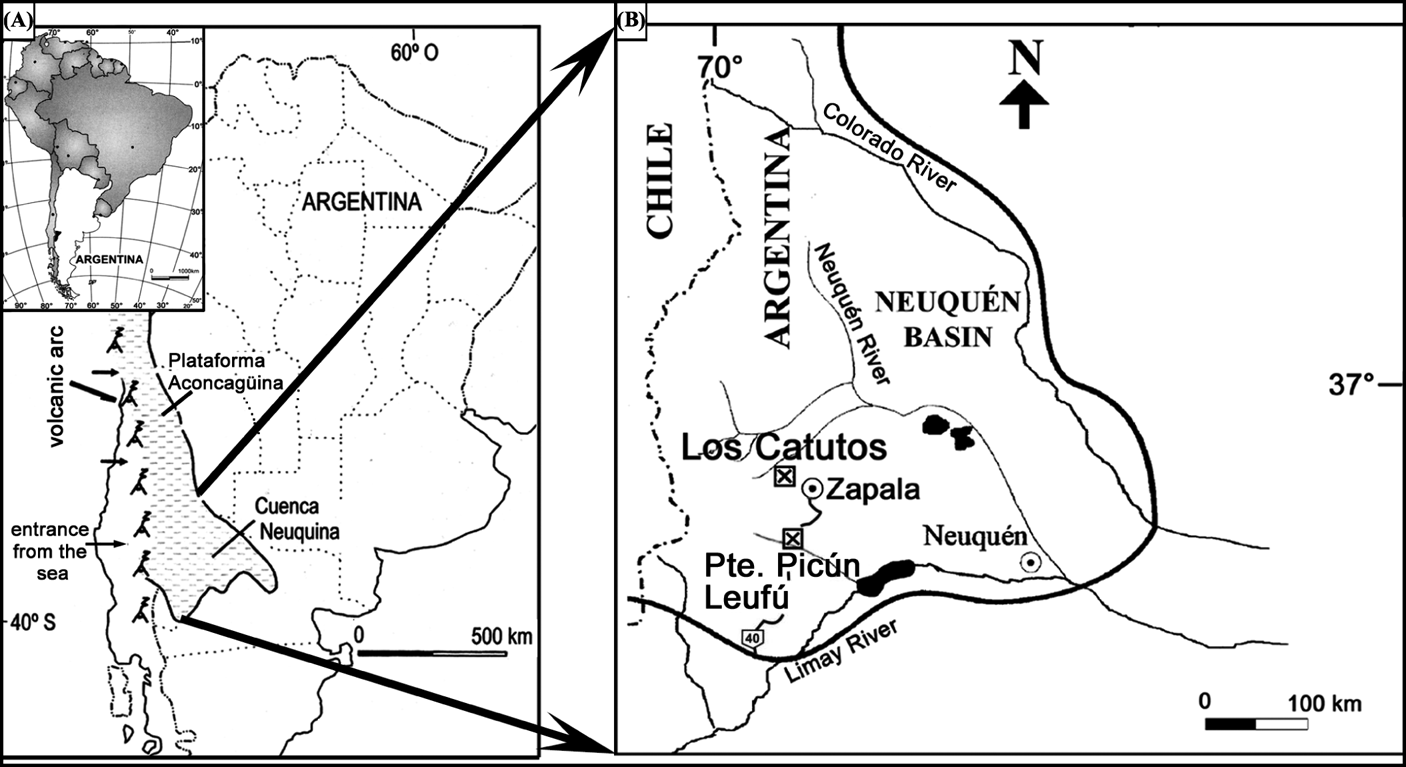
Like most marine reptiles found in the Neuquén Basin, northern Patagonia (Fig. 2), pterosaurs have been discovered in marine deposits of the Vaca Muerta Formation. This unit represents a short transgressive episode that is biostratigraphically constrained to the Tithonian–Valanginian. It entered from the Pacific Ocean and covered a large part of the basin (Spalletti et al. Reference Spalletti, Franzese, Matheos and Schwarz2000). Among the four specimens found in the Vaca Muerta Formation, the first discovered was the pterodactyloid Herbstosaurus pigmaeus Casamiquela, Reference Casamiquela1975 from Arroyo Picún Leufú and National Route 40, in Upper Tithonian rocks (Codorniú & Gasparini Reference Codorniú, Gasparini, Gasparini, Salgado and Coria2007, fig. 6.7). The other three specimens were found in the lithographic limestones from Los Catutos (Fig. 2), Los Catutos Member, Vaca Muerta Formation, referred to the Late-Middle Tithonian (Leanza & Zeiss Reference Leanza and Zeiss1990, Reference Leanza and Zeiss1992). The first of these pterosaur specimens was an isolated limb bone of a small pterodactyloid discovered in the 1980s (Gasparini et al. Reference Gasparini, Leanza and Garate Zubillaga1987). Twenty years later, an articulated skeleton was described and is the most complete pterosaur known from the Upper Jurassic of Gondwana (Codorniú et al. Reference Codorniú, Gasparini and Paulina Carabajal2006). Recently, a slab of lithographic limestone was found in Zapala city (Neuquén Province). It contained an intact impression of an isolated bone, which we identify here as a pterosaur tibiotarsus, larger than those so far known in the area (pers. obs.). These specimens from the Neuquén Basin are the only records of Pterosauria from the South American Upper Jurassic.
(A) Palaeogeography of the Neuquén Basin seas; (B) locality map of the area of Los Catutos and Arroyo Picún Leufú, Neuquén Province.
In this chapter, in homage to Prof. Emeritus Dr. Wann Langston Jr, we update the knowledge of Late Jurassic pterosaurs from northern Patagonia: we describe a new taxon, based on the preparation and study of a specimen originally described by Codorniú et al. (Reference Codorniú, Gasparini and Paulina Carabajal2006); we revise the taxonomic placement of the single isolated bony element of the first pterodactyloid found in Los Catutos (Gasparini et al. Reference Gasparini, Leanza and Garate Zubillaga1987); and we report a new specimen that shows that not only small pterosaurs flew over the Tithonian seas of the Neuquén Basin.
Institutional abbreviations. BSP, Bayerische Staatsammlung für Paläontologie und historische Geologie, Munich; CTES-PZ, Laboratorio de Paleozoología, Departamento de Biología, Facultad de Ciencias Exactas y Naturales y Agrimensura, Universidad Nacional del Nordeste, Corrientes; MOZ-PV, Museo de la Dirección Provincial de Minería “Prof. Dr. Juan Olsacher”, Zapala, Neuquén.
1. Systematic palaeontology
Pterosauria Kaup, Reference Kaup1834
Pterodactyloidea Pleininger, Reference Plieninger1901
Wenupteryx gen. nov.
(Figs 3–7)
Wenupteryx uzi, gen. et sp. nov., composite drawing of MOZ 3625P. Abbreviations: c=carpals; cl=claw; cor=coracoid; cv=cervical vertebrae; dt=distal tarsals; dv=dorsal vertebrae; fb=very fragmentary bones; fe=femur; g?=gastralia; hu=humerus; il=ilium; isq=isquion; (l)=left; mcI?=wing metacarpal I?; mc II/III?=wing metacarpal II or III; mcIV=wing metacarpal IV; mph=manual phalanges; mt=metatarsals; pph=pedal phalanges; ppu=prepubis; prcor=procoracoid; pu=pubis; pt=pteroid; (r)=right; ra=radius; ri=rib; sc=scapula; ti=tibia; ul=ulna; wph 1–3=wing phalanges 1–3.

Wenupteryx uzi, gen. et sp. nov.: (A) photograph and drawing of the mid-cervical vertebrae, preserved on the counterslab; (B) details of the pteroid bone; (C) details of the second phalanx of the wing finger, well preserved in the slab, but the distal end is better preserved on the counterslab. Abbreviations: co=cotyle; con=condyle; dis=distal; lc=centrum length; lt=total length; mhc=minimum height centrum; mhv=minimum height vertebrae; pe=posterior extension; prox=proximal; prz=prezygapophysis; pz=postzygapophysis.
Wenupteryx uzi, gen. et sp. nov., photograph and interpretive drawing of the prepubis in dorsal view. Abbreviations: pb=posterior branch; prep=prepubic plate.
Wenupteryx uzi, gen. et sp. nov., photograph of the referred material, left ulna MOZ-PV 2280: (A) anterior view; (B) posterior view.
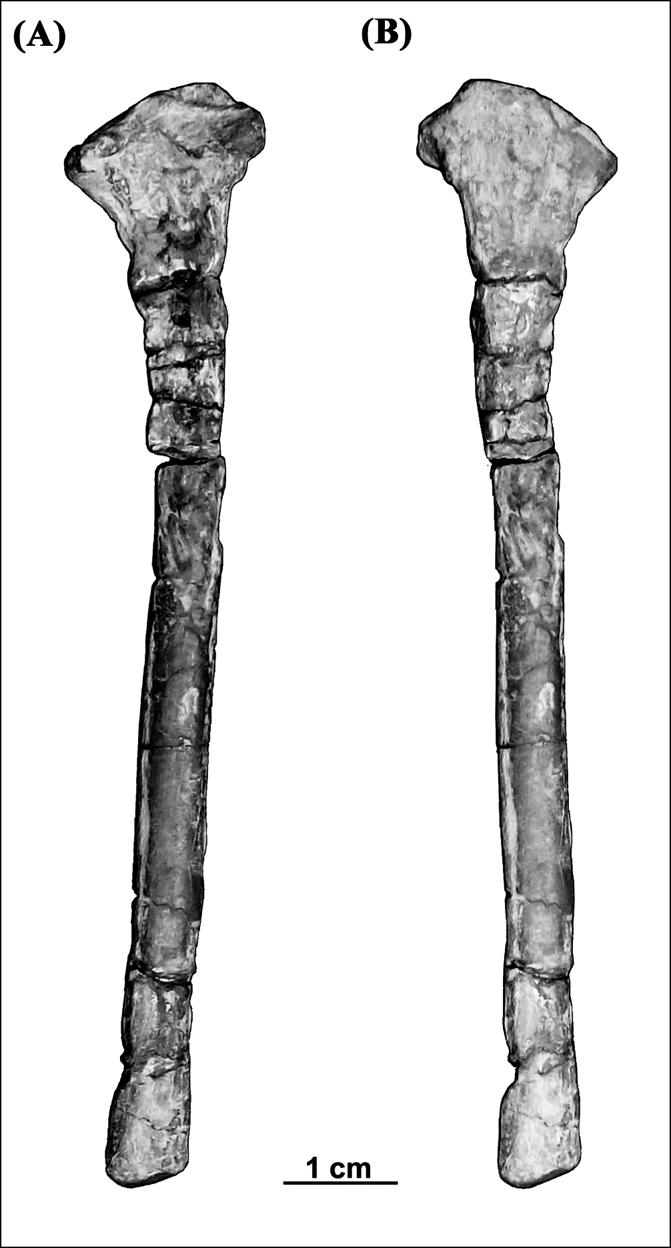
Wenupteryx uzi, gen. et sp. nov.: (A) photograph of the ulna of the counterslab of the holotype; (B) details of the proximal end of the holotype; (C) details of the proximal end of MOZ-PV 2280. Abbreviations: capc=capitular cotyle; ctb=crest for the insertion of triceps brachii; das=dorsal articular surface; ra=radius; troc=trochlear cotyle; tub=tubercle; ul=ulna.
Diagnosis. As for the species.
Type species.Wenupteryx uzi, sp. nov.
Etymology. In the Mapuche language, Wenu means ‘sky’ and pteryx is the Greek word for ‘wing’. The specific epithet uzi means ‘fast’ in the Mapuche language. Mapuches are aborigines from central Chile and central-western Argentina.
Diagnosis. Condyle of the mid-cervical vertebrae posteriorly convex at its dorsal and ventral margins, with a concave depression at its midpoint; prepubis with asymmetric distal extension, in which the lateral half is sub-rectangular and the medial half is typically fan-shaped.
Previous comments. This specimen, originally described and illustrated by Codorniú et al. (Reference Codorniú, Gasparini and Paulina Carabajal2006), has been prepared again, which permitted the identification of new elements of the post-cranium and changed the determination of others. The revision of this pterodactyloid supports the determination of a new genus and species. The new bones recognised here are the pteroid and prepubis. See Codorniú et al. (Reference Codorniú, Gasparini and Paulina Carabajal2006) for the description of other bones of the post-cranium, which remains valid.
Holotype. MOZ-PV 3625 is a nearly complete post-cranial skeleton preserved in two slabs (Fig. 3) (Codorniú et al. Reference Codorniú, Gasparini and Paulina Carabajal2006, figs 2–4, 6). It includes: some cervical and dorsal vertebrae; a few thoracic ribs; both pectoral girdles exposed in anterior view; left pelvic girdle; right prepubis; a proximal right wing (humerus, ulna and radius, right metacarpal IV, pteroid); a more complete left wing that only lacks wing-phalanx four; and hindlimb bones (both femora, left tibia and pes). Some bones are articulated, but most of them have been displaced from their original position.
Referred material. MOZ-PV 2280, here recognised as an incomplete ulna. This material comes from the same locality as the holotype of Wenupteryx, and was identified as a tibia by Gasparini et al. (Reference Gasparini, Leanza and Garate Zubillaga1987).
Horizon and locality. El Ministerio Quarry, Los Catutos, 13 km northwestern of Zapala city, Neuquén Province, Argentina (Fig. 2). The limestones of the Los Catutos Member of the Vaca Muerta Formation are assigned to the Upper–Middle Tithonian (Leanza & Zeiss Reference Leanza and Zeiss1992; Scasso & Concheyro Reference Scasso and Concheyro1999). Sedimentological and structural analyses suggest that these limestones were deposited in a shallow sea (10–30 m), no more than 100 km from the eastern coast of the Neuquén Basin (Leanza & Zeiss Reference Leanza and Zeiss1990; Scasso et al. Reference Scasso, Alonso, Lanés, Villar and Lippai2002). Marine reptiles, such as ophthalmosaurians, metriorhynchids and chelonians, were also found in the area (Gasparini & Fernández Reference Gasparini, Fernández, Veiga, Spalletti, Howell and Schwarz2005; de la Fuente & Fernández Reference De la Fuente and Fernández2011).
Description. Small pterosaur, wingspan approaching 1·10 m. The new elements described here are the pteroid and the prepubis. After the new preparation, we changed the identification of the right tibia in Codorniú et al. (Reference Codorniú, Gasparini and Paulina Carabajal2006) to wing-phalanx 2. We also include the description and figure of the cervical vertebrae as a critical structure in the diagnosis of the new taxon.
Cervical vertebrae. An isolated mid-cervical vertebra has been preserved and exposed in lateral view on the counterslab. It is relatively well-preserved, although the outer surface of the bone is slightly damaged (Fig. 4A). The mid-cervical vertebra lacks cervical ribs and has a low neural arch with a very low, blade-shaped neural spine. The neural arch and the centrum of the vertebra are completely fused to each other and there is no trace of the neurocentral suture. The prezygapophyses extend beyond the anterior margin of the centrum, and are located at the level of the base of the neural canal and the top of the centrum. The postzygapophyses are set higher than the prezygapophyses and do not extend past the posterior end of the centrum. The centrum is procoelous and lacks accessory articular processes ventrolateral to the cotyle and condyle, the pre- and postexapophysis, respectively. The ventral surface of the centrum is gently concave and its anterior end lacks a hypapophysis.
The vertebral centrum is elongated: its length is at most four times its minimum height (lc/mhc=4). Considering the total length of the vertebra, including the zygapophyses, the value of this ratio is lower, almost three (lt/mhv=2·93) (Fig. 4A).
This taxon has some unusual traits in the cotyle and condyle of the centrum. The cotyle is concave (procoelous) but has a convexity at its ventral margin. The condyle is posteriorly convex but has a central depression, so that the articular surface seems concave in lateral view. These features are considered potential autopomorphies of this taxon.
A similar morphological feature has been observed in other archosaurs. For example, the posterior condyles of the mesoeucrocodylian Pachycheilosuchus exhibits a distinct concave dimple centred on the condyle of the cervical vertebrae, which is partially filled by a secondary ossified plug (Rogers Reference Rogers2003). The presence of a concave dimple centred on the posterior vertebral condyle is rare in crocodyliform vertebrae. Known occurrences of dimpled posterior condyles in mesoeucrocodylian vertebrae appear limited to Pachycheilosuchus and Theriosuchus (Rogers Reference Rogers2003).
The presence of a centred concavity in the convex condyle of the cervical vertebrae is not known in any other pterosaur.
Pteroid. This bony splint at the anterior margin of the wing is found exclusively in pterosaurs. Its shaft is thin and straight, narrowing distally. The preserved length is 31 mm (Fig. 4B), and represents almost 48% of the humerus length (65 mm). The proximal end is widened and rounded, the width is 6 mm; this end articulates with the preaxial carpal, also named the medial carpal (Padian Reference Padian1983). The pteroid is preserved in dorsal view; hence, the angle of curvature of the proximal end that articulates with the carpal could not be measured.
Generally, in large pterosaurs such as Anhanguera piscator (Kellner & Tomida Reference Kellner and Tomida2000), Pteranodon (Bennett Reference Bennett2001) and Anhanguera robustus (Unwin et al. Reference Unwin, Frey, Martill, Clarke and Riess1996; Kellner & Tomida Reference Kellner and Tomida2000), the pteroid is pneumatic (a large pneumatic foramen lies on the ventral surface, close to the articular end). It is not known if it is also pneumatic in small pterosaurs such as Pterodactylus and Rhamphorhynchus (Unwin et al. Reference Unwin, Frey, Martill, Clarke and Riess1996). There is no evidence of pneumaticity in Wenupteryx uzi (MOZ-PV 3625).
Second wing-phalanx. The diaphysis is straight and is 94 mm long. The proximal and distal ends are expanded because of a slight projection of the posterior margin (Fig. 4C). The proximal end is subcircular, with a concave articular surface, and wider than the distal end (8 mm and 4·4 mm, respectively). The distal end is convex and not very well preserved.
Prepubis. This is preserved in dorsal view in the counterslab and corresponds to the right side of the skeleton. This bone has an antero-ventral portion, traditionally named the prepubic plate, and a thin and long posterodorsal portion named the posterior ramus (Fig. 5).
The prepubic plate is fan-shaped. It is wide lateromedially and very thin dorsoventrally. In dorsal view, it is slightly concave and asymmetric. Although the medial half is typically fan-shaped, the lateral half is wider and truncated, and the lateral margin is slightly straight. The anterior margin of the plate is wide and convex. The opening angle between the posterior ramus and the posteromedial margin is 150°, and with the posterolateral margin, approximately 120°. The central region of the plate continues with the posterior ramus of the prepubis, and both are thicker than the prepubic plate.
The posterior ramus is almost constant in width along its length, becoming a little wider when joining the prepubic plate. The length of the posterior ramus (12·5 mm) is approximately 55% of the total prepubic length (23 mm). The dorsal end of the ramus has an articular surface for the pubis; it is concave and oval.
The prepubis of Wenupteryx uzi gen. et sp. nov. is similar to those of Herbstosaurus pigmaeus (Codorniú & Gasparini Reference Codorniú, Gasparini, Gasparini, Salgado and Coria2007, fig. 6.7), Pterodactylus (P. antiquus, P. kochi, “P. longicolum”) (Wellnhofer Reference Wellnhofer1970), Ctenochasma (BSP 1935-I-24), Pterodaustro (Codorniú Reference Codorniú2007), Germanodactylus rhamphastinus (Wellnhofer Reference Wellnhofer1970), G. cristatus (BSP 1892 IV 1), the ctenochasmatoid Huanhepterus (Dong Reference Dong1982) and the “non-pterodactyloid” Dorygnathus banthensis (Wellnhofer Reference Wellnhofer and Wellnhofer1978; Padian Reference Padian2008b). In these taxa, the anteroventral region forms a wide, fan-shaped prepubic plate expanded transversely, with a curved and convex anterior margin, and a posterodorsal ramus that is thin and as long as a bar. Despite this similarity, the prepubis of Wenupteryx uzi gen. et sp. nov. is different in shape. The lateral half of the distal expansion is almost rectangular, and the medial half is typically fan-shaped. This feature is regarded here as an autapomorphy of this taxon (Fig. 5).
Ulna. MOZ-PV 2280 is preserved almost three-dimensionally; it lacks the distal end (Fig. 6). The preserved length is 95·3 mm and the proximal width is 17·6 mm. The bone belonged to an animal larger than the holotype of Wenupteryx; the length of the complete ulna of the holotype is 88 mm (for measurements, see Codorniú et al. Reference Codorniú, Gasparini and Paulina Carabajal2006).
The ulna is long, with a straight diaphysis and equally expanded ends (Fig. 7A). The diameter of the medial section of the diaphysis of Wenupteryx is only slightly larger than the diameter of the radius. The proximal end of the ulna consists of two anterior cotyles (Fig. 7B, C), the ventral (or trochlear) and the dorsal (or capitular), and a concave region behind the cotyles that was identified as a posterior crest (Bennett Reference Bennett2001).
The proximal end is D-shaped, expanded toward the ventral and dorsal margins of the diaphysis. The ventral and dorsal cotyles are anteriorly directed and articulate with the trochlear and capitular condyles of the humerus, respectively. The trochlear cotyle lies on the ventral half of the ulna and is oval; its surface is concave and it is smaller than the capitular cotyle. This latter is on the dorsal half of the ulna; it is slightly concave and larger than the trochlear cotyle. The posterior crest or tuberosity of the ulna is posterior to the cotyles, separated by a strong ridge. This crest likely acted as the insertion for the triceps muscle (Bennett Reference Bennett2001).
The distal end of the ulna is exposed in anterior view (Fig. 7A). In this view, this end shows no relevant characters. A simple projection belongs to the dorsal articular surface and another one belongs to the tubercle. Both structures are well developed on the posterior ends of the ulnae of pterosaurs. The dorsal articular surface is expanded toward the dorsal margin of the ulna and is approximately oval. The tubercle is small, convex and articulates with an articular facet (fovea) on the proximal surface of the proximal syncarpal.
Remarks. Codorniú et al. (Reference Codorniú, Gasparini and Paulina Carabajal2006) suggested that the holotype individual was relatively mature osteologically. However, the fact that the right pelvic plate appears isolated suggests that it was unfused to the sacrum when this animal died. Also, the preservation of an isolated prepubis instead of both elements (right and left) fused through the medial margins, is further evidence supporting the hypothesis that this specimen had not reached the adult stage and was subadult at time of death. The wingspan was estimated at 1·10 m (Codorniú et al. Reference Codorniú, Gasparini and Paulina Carabajal2006).
Some anatomical features, such as the elongated wing metacarpal (more than 80% of the humerus length), ulna less than twice the length of metacarpal IV and femur sub-equal to or slightly shorter than metacarpal IV, suggest the assignment of Wenupteryx uzi to the Pterodactyloidea (Codorniú et al. Reference Codorniú, Gasparini and Paulina Carabajal2006). Features, such as the relatively elongated mid-cervical vertebrae and the depressed neural arch of the mid-series cervicals with a very low neural spine, suggest a close relationship of Wenupteryx uzi to basal pterodactyloids, probably to the Archaeopterodactyloidea (Kellner Reference Kellner, Buffetaut and Mazin2003, Reference Kellner2004; Andres & Ji Reference Andres and Ji2008). According to Unwin's phylogeny (Unwin Reference Unwin, Buffetaut and Mazin2003), Wenupteryx uzi is closely related to the Euctenochasmatia based on the presence of some characters, such as the depressed neural arch of the mid-series cervicals, with a low neural spine and elongate mid-series cervicals.
Pterodactyloidea
Gen. et sp. indeterminate
Material. MOZ-PV 094 is an intact impression of an isolated limb bone preserved in a slab. A mould was made to identify positive characters; this mould shows that the bone is slightly flat anteroposteriorly (Fig. 8).
(A) Photograph of the original slab of specimen MOZ-PV 094. (B) mould showing right tibiotarsus in anterior view. (C) composite drawing of the mould. Abbreviations: dep=tibiofibular depression; fi=fibula; lc=lateral condyle; mc=medial condyle; nc=cnemial crest; ti=tibia. The quadrangular line indicates the extension of the bone alteration.
Description. The specimen is identified as a large right tibiotarsus (the fibula and proximal tarsals are fused to the tibia) that can be observed in anterior view in the mould. The tibia is a long, slender bone with a transversely elongate, suboval proximal surface and a notably straight shaft. The total length of the tibiotarsus is 214 mm; it is narrower at the proximal end (21·05 mm) than at the distal end (27 mm). Near the proximal end of the tibiotarsus, the width of the shaft slightly increases distally; this width remains constant up to approximately half the total length. From this point, it begins to narrow gradually until the minimum width of the bone is attained at about three quarters of its length. Near the distal end of the shaft, it expands again to reach the maximum width at the level of the condyles.
The portion of the shaft where the diameter remains constant is approximately 90 mm and shows alteration of the bone (Fig. 8B, C). Evidence of this deformation is most clearly seen in lateral or medial views and the bulge is well developed in the anterior surface of the bone, in the metaphysis and in part of the diaphysis. It is not possible to determine whether this apparent swelling of the bone occurred during life or is a post-mortem preservational artefact.
The proximal articular surface of the tibiotarsus is concave for the articulation of the distal condyles of the femur, and it is slightly elongated in lateromedial view. The mould, observed in proximal view, shows the facet joint of the fibula and the suboval proximal surface of the tibia. The proximal end of the fibula is suboval and occupies about a third of the total area of the proximal surface of the tibiotarsus. In anterior view, between the facet joints of fibula and tibia, there is a shallow depression that marks the contact of both bones. The anterior surface of the proximal end of the tibia has a V-shaped cnemial crest, with the apex directed anteriorly. The distal end of the tibiotarsus consists of the lateral and medial condyles, which are well fused to the tibia. The condyles formed by proximal tarsals are convex, sub-circular and the lateral condyle is slightly larger compared to the medial (Fig. 8B, C).
The great difference in size between both specimens and the degree of osteological maturity of the articulated skeleton suggest that the new specimen belongs to a new species of pterodactyloid pterosaur. Unfortunately, it has no diagnostic features.
2. Conclusions
Patagonian pterosaur remains are incomplete and fragmentary (except for Wenupteryx uzi gen. et sp. nov.) but are distributed from the early Middle Jurassic to the Late Cretaceous (Turonian–Coniacian), over approximately 85 ma.
Both localities representing the Upper Jurassic belong to Tithonian rocks of the Vaca Muerta Formation, in northern Patagonia (Fig. 9). One of them, situated in the southern sector of Arroyo Picún Leufú, yielded a single record referred to a pterodactyloid, Herbstosaurus pigmaeus (Fig. 9, locality 1). The holotype of this taxon (CTES-PZ 1709) is a subadult, small to medium-sized individual (Codorniú & Gasparini Reference Codorniú, Gasparini, Gasparini, Salgado and Coria2007). The other locality, Los Catutos (Fig. 9, locality 2), has provided a greater number of records; two of them (MOZ-PV 3625 and MOZ-PV 2280) are here referred to the new Patagonian pterodactyloid pterosaur Wenupteryx uzi gen. et sp. nov. This taxon is a small pterosaur that shows affinities with Archaeopterodactyloidea (Kellner Reference Kellner, Buffetaut and Mazin2003) or Euctenochasmatia (sensu Unwin, Reference Unwin, Buffetaut and Mazin2003). Wenupteryx uzi gen. et sp. nov. is the most complete Jurassic pterosaur so far known from the Southern Hemisphere (Figs 3, 9C–E).
(A) Reconstruction of Patagonia during the Late Jurassic (Kimmeridgian–Tithonian), from Gasparini et al. (Reference Gasparini, Salgado and Coria2007). (B) Herbstosaurus pigmaeus, Vaca Muerta Formation, from the southern sector of Arroyo Picún Leufú, Neuquén, locality 1 in (A). (C) Wenupteryx uzi, photograph of the slab (MOZ-PV 3625) Vaca Muerta Formation, from Los Catutos Member (locality 2, in A). (D) Wenupteryx uzi, reconstruction represents a hypothetical pterodactyloid in which the bones preserved in the specimens are marked in black. (E) Wenupteryx uzi, referred material (MOZ-PV 2280). (F) New discovery (MOZ-PV 094) from the same locality as Wenupteryx uzi.
The recent discovery from Los Catutos area is a large tibiotarsus of an adult individual that represents a new species of a medium-sized pterodactyloid pterosaur (Fig. 9F), whose wingspan is approximately 3 m.
These records from Los Catutos and Picún Leufú show that as many as three different lineages of pterosaurs coexisted in the marine Tithonian sediments of the Neuquén Basin. These species are two basal pterodactyloids, Herbstosaurus and Wenupteryx, and probably another pterodactyloid represented by an isolated bone (MOZ-PV 094). This specimen represents the largest pterosaur yet known from the Upper Jurassic of Gondwana.
3. Acknowledgments
We thank Drs William Parker and Ernie Lundelius for the invitation to participate in this Memoir in honour of Professor Emeritus Dr Wann Langston Jr. K. Padian and A. Kellner provided very valuable reviews that strengthened the original manuscript. The institutions mentioned in the text allowed us access to study and review the pterosaurs in their collections, particularly Alberto Garrido from Museo Olsacher of Zapala. LC thanks A. Braeckman for the illustration of the ulna MOZ PV 2280. This chapter was partially supported by Agencia Nacional de Promoción Científica y Tecnológica (PICT 1815 to L. C. and PICT 2008-0261 to Z.G). This manuscript was accomplished as part of Project N° 340103 from Ciencia y Técnica, Universidad Nacional de San Luis (LC).