Implications
Cistus ladanifer (Cistus) (rockrose) is a tanniferous shrub widespread in Mediterranean marginal lands. Tannins can modify the metabolism of unsaturated fatty acids (FA) in the rumen and increase the content of health promoting FA (vaccenic and rumenic acids) in meat. However, when diets contain substantial amounts of cereals and unsaturated FA the rumen metabolic pathways might be altered, resulting in the accumulation of undesirable FA, as the t10-18:1. In those conditions, the dietary tannin sources might exacerbate the t10-18:1 accumulation, which must be considered when tannin sources, like rockrose, are incorporated in ruminant diets.
Introduction
Ruminant edible fats are rich in saturated FA, poor in polyunsaturated fatty acids (PUFA), and have a variable content of trans FA. Therefore, they are generally regarded as unhealthier attending to the current nutritional guidelines for human health (Food and Agriculture Organization (FAO), 2010). Nevertheless, ruminant edible fats are the richest dietary source of conjugated isomers of linoleic acid (CLA), particularly of rumenic acid (c9,t11-18:2), which has been shown to possess anticancerogenic effects in several animal models (Shingfield and Wallace, Reference Shingfield and Wallace2014). Thus, nutritional strategies to increase CLA and PUFA content in ruminant edible fat have been intensively investigated in the last two decades.
Increasing PUFA intake results in larger rumen outflow of PUFA and biohydrogenation intermediates, thus promoting increased depositions of PUFA and CLA in tissues (Shingfield et al., Reference Shingfield, Bonnet and Scollan2013). However, due to the extensive diversity of rumen microbial isomerization and hydrogenation metabolism (biohydrogenation), the increase in PUFA and CLA in meat can be quite variable, stressing the need to find biohydrogenation modulators.
Tannins and tannin sources have been proposed as potential modulators of biohydrogenation, being able to disturb the last reductive step of biohydrogenation thus increasing the availability of t11-18:1 that will support the synthesis of c9,t11-18:2 through the action of stearoyl CoA desaturase (SCD, also called Δ9 desaturase) in tissues (Vasta and Bessa, Reference Vasta and Bessa2012). Moreover, it has been suggested that dietary tannins might up-regulate SCD expression levels (Vasta et al., Reference Vasta, Mele, Serra, Scerra, Luciano, Lanza and Priolo2009a; Rana et al., Reference Rana, Tyagi, Hossain and Tyagi2012).
Cistus is a tanniferous shrub, occurring abundantly in Mediterranean marginal lands (Guerreiro et al., Reference Guerreiro, Dentinho, Moreira, Guerra, Ramos, Bessa, Duarte and Jerónimo2016). Jerónimo et al. (Reference Jerónimo, Alves, Dentinho, Martins, Prates, Vasta, Santos-Silva and Bessa2010) reported a significant increase of t11-18:1 and c9,t11-18:2 in lamb meat lipids with the addition of Cistus to an oil-supplemented diet. Although promising, these results were obtained with high dietary incorporation of Cistus (25% dry matter (DM)) and vegetable oil (6% DM) into a dehydrated alfalfa basal diet. However, the effect of these dietary supplements to conventional diets (with higher starch content) for growing ruminants remains to be established.
High starch diets generally stimulate adipogenesis and lipogenesis including SCD activity, which favors CLA synthesis and tissue deposition. However, these type of diets promote distinct biohydrogenation pathways compared with those found in forage-based diets, with accumulation of t10-18:1 instead of t11-18:1. This results in decreased availability of t11-18:1 as substrate for SCD (Bessa et al., Reference Bessa, Alves, Jerónimo, Alfaia, Prates and Santos-Silva2015). We hypothesize that a basal diet with a forage-to-concentrate ratio of 1 : 1 would promote both a high availability of t11-18:1 and an up-regulation of SCD and in that conditions a lower addition of Cistus and oil would be needed to achieve high CLA content in lamb meat. Therefore, the general aim of the present study was to elucidate if the combined effects of Cistus and oil on lamb meat FA composition reported by Jerónimo et al. (Reference Jerónimo, Alves, Dentinho, Martins, Prates, Vasta, Santos-Silva and Bessa2010) could be achieved using a basal diet with 1 : 1 forage-to-concentrate ratio, and with lower dietary incorporation of Cistus or vegetable oil.
Material and methods
Experimental design and animal management
All the experimental procedures involving animals were approved by the Animal Care Committee of the National Veterinary Authority (Direção Geral de Alimentação e Veterinária, Lisbon, Portugal), following compliance guidelines of European Union (Directive 86/609/EEC).
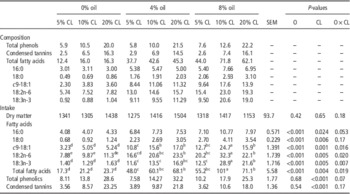
Detailed information about diets, animal handling, slaughter, sample collection and analytical procedures has been reported by Francisco et al. (Reference Francisco, Dentinho, Alves, Portugal, Fernandes, Sengo, Jerónimo, Oliveira, Costa, Sequeira, Bessa and Santos-Silva2015). Briefly, 54 Merino Branco ram lambs, weighing 16.2±2.93 kg, ageing 78±7.7 days (mean±SD), were randomly assigned to 18 pens of three lambs each, and two pens per treatment, according to a completely randomized experimental design with a 3×3 factorial arrangement of treatments. The first factor was the effect of three levels (50 v. 100 v. 200 g/kg DM) of incorporation of dried and ground Cistus leaves and soft stems in diets composed by a mixture of dehydrated lucerne, wheat, maize and soybean meal. The second factor was the effect of three levels (0 v. 40 v. 80 g/kg of DM) of oil supplementation. The nine diets resulting from the 3×3 factorial arrangement were (1) 5CL (50 g Cistus/kg DM); (2) 10CL (100 g Cistus/kg DM); (3) 20CL (200 g Cistus/kg DM); 4) 5CL4O (50 g Cistus/kg DM+40 g oil/kg DM); (5) 10CL4O (100 g Cistus/kg DM+40 g oil/kg DM); (6) 20CL4O (200 g Cistus/kg DM+40 g oil/kg DM); (7) 5CL8O (50 g Cistus/kg DM+80 g oil/kg DM); (8) 10CL8O (100 g Cistus/kg DM+80 g oil/kg DM); and (9) 20CL8O (200 g Cistus/kg DM+80 g oil/kg DM). The oil used was a blend of soybean (Glycine max) and linseed (Linum usitatissimum) oils (1 : 2 vol/vol). The FA composition of the nine diets is presented in Table 1. The formulas of the diets and their detailed chemical composition are reported in Francisco et al. (Reference Francisco, Dentinho, Alves, Portugal, Fernandes, Sengo, Jerónimo, Oliveira, Costa, Sequeira, Bessa and Santos-Silva2015).
Total phenols, condensed tannins and fatty acids composition (g/kg DM) of the dietsFootnote 1 and lambs intake (g/day)

a,b,c,d,eValues within a row with different superscripts differ significantly at P<0.05.
1 Diets resulting from the combination of the incorporation of three levels of a soybean and linseed oil blend (1 : 2 vol/vol) (O) and three levels of Cistus ladanifer (CL).
Slaughter and sample collection
The experimental trial lasted for 6 weeks, and after that time lambs were stunned and slaughtered by exsanguination in the experimental abattoir of the Instituto Nacional de Investigação Agrária e Veterinária. Average slaughter weight was 32.5±4.14 kg and it was not affected by treatments. For gene expression analysis, samples of Longissimus muscle were collected immediately after slaughter at the level of 12th vertebra, flash-frozen in liquid nitrogen and preserved at −80°C until analysis. Carcasses were chilled at 2°C until the 3rd day after slaughter, when meat samples were collected. For the determination of intramuscular fat and FA composition, longissimus muscle was isolated from the rib joint. The epimysium was removed and muscle samples were minced using a food processor (3×5s), vacuum-packed, freeze-dried and stored at −20°C until analyses.
Analytical procedures
FA methyl esters of feed lipids were obtained by a one-step extraction transesterification, with toluene and heptadecanoic acid (17 : 0) as internal standard, according to Sukhija and Palmquist (Reference Sukhija and Palmquist1988).
Intramuscular lipids were extracted using a mixture of dichloromethane and methanol as described in Bessa et al. (Reference Bessa, Santos-Silva, Ribeiro and Portugal2007). Polar (PL) and neutral (NL) lipid fractions were obtained by solid-phase extraction using dichloromethane and methanol and silica gel cartridges (3 ml/500 mg, Sep-Pack Chromabond® SiOH, Macherey-Nagel, Düren, Germany). For the separation of NL fraction the total lipids were eluted with 30 ml of dichloromethane. The PL were obtained by sequential elution with 30 ml of methanol. In both fractions, FA were transesterified with sodium methoxide (0.5 N) in methanol during 30 min at 50°C, followed by hydrochloric acid in methanol (1 : 1 v/vol) during 10 min at 50°C. For analysis of the FA composition, FA methyl esters were analyzed using a HP6890A gas chromatograph (Agilent, Avondale, PA, USA), equipped with a flame-ionization detector and a SP-2560 fused silica capillary column (100 m, 0.2 mm i.d., 0.20 µm film thickness; Supelco, Bellefonte, PA, USA). The injector and detector temperatures were 250°C and 280°C, respectively. Initial oven temperature of 100°C was held for 1 min, increased at 50°C/min to 150°C and held for 20 min, increased at 1°C/min to 190°C and held for 5 min, and then increased at 1°C/min to 200°C and held for 35 min. Helium was used as carrier gas at a flow rate of 1 ml/min, the split ratio was 1 : 30 and 1 μl of sample was injected. Non-adecanoic acid (19 : 0) was used as internal standard for FA methyl esters quantification. Identification of FA methyl esters was achieved by comparison of the FA methyl esters retention times with those of commercial standard mixtures (FAME mix 37 components from Supelco Inc., Bellefont, PA, USA) and with published chromatograms (Alves and Bessa, Reference Alves and Bessa2009 and Reference Alves and Bessa2014). Additional identification of the FA methyl esters was achieved by electron impact MS using a Shimadzu GC-MS QP2010 Plus (Shimadzu, Kyoto, Japan).
The methyl esters of CLA isomers were individually separated by triple silver-ion columns in series, using a HPLC system equipped with auto-sampler and diode array detector (DAD) adjusted to 233 nm. Regarding the quantification of the individual CLA isomers in meat, a combination of gas chromatography and three Ag+-HPLC was used, as described in Bessa et al. (Reference Bessa, Santos-Silva, Ribeiro and Portugal2007).
RNA extraction and quantitative PCR assays
Total RNA was isolated from lamb muscle samples by using QIazol reagent and further purified using the RNeasy mini kit with on column DNase I treatment based on the manufacturer’s protocol (all from Qiagen, Hilden, Germany). For each sample, 0.5 µg RNA was reversely transcribed using random primers with a High-Capacity cDNA Reverse Transcription Kit (Applied Biosystems, Foster City, CA, USA) according to the manufacturer’s instructions. Real-time qPCR analysis was performed as described by da Costa et al. (Reference da Costa, Bessa, Pires, Rolo, Pinto, Fontes and Prates2014) using specific primers for ribosomal protein P0 (Rplp0), β-actin (ACTB), fatty acid desaturase 1 (FADS1), Fatty Acid Desaturase 2 (FADS2) and SCD. Nucleotide sequence of primers pairs is shown on Supplementary Table S1. All analyses were performed in duplicate, and the relative amounts for each target gene were normalized using the geometric mean of references genes. Gene expression was normalized to Rplp0 and ACTB. Relative expression levels were corrected for variation in amplification efficiency according to Livak and Schmittgen (Reference Livak and Schmittgen2001).
Statistical analysis
Data were analyzed using the MIXED procedure of SAS (SAS Institute Inc., Cary, NC, USA) being Cistus inclusion, oil supplementation and their interaction included in the model as fixed effects. The pen was the experimental unit and lambs were considered as repeated measures (subsamples) within each pen, using a compound symmetry covariance matrix. The variance homogeneity was checked and when justified the variance heterogeneity structure was accommodated in the model. The P<0.05 was set as the level of statistical significance. As the number of experimental units for studying the combination of main factor levels was low (n=2), some selected dependent variables vectors (most relevant groups of FA) were also submitted to multivariate ANOVA (MANOVA) using the GLM procedure of SAS and the pen as experimental unit. The P-values of Wilk’s λ test of each model are presented.
It was observed a significant interaction between Cistus and oil levels for the intake of C18 unsaturated FA (Table 1) that could mask the effects of Cistus on muscle FA composition. To overcome this constraint, the FA that were significantly affected by Cistus or Cistus×oil interaction, were submitted to a complementary regression analysis with the Proc GLM of SAS, where the effects of average daily intake of C18 unsaturated FA and of condensed tannins in each pen were tested as continuous independent variables and the average meat FA composition in each pen as dependent variables. Pearson correlations among variables were conducted when necessary.
Results
Data concerning productive performance of lambs, carcass traits and meat quality results have been reported elsewhere (Francisco et al., Reference Francisco, Dentinho, Alves, Portugal, Fernandes, Sengo, Jerónimo, Oliveira, Costa, Sequeira, Bessa and Santos-Silva2015). Here, we describe the detailed FA composition of lamb meat lipids and the expression of level of desaturase genes.
Intake of fatty acid and condensed tannin
An interaction between the levels of oil and condensed tannins in the diets was observed for total FA intake and for individual FA intake, except for 16 : 0 and 18 : 0 (Table 1). For diets with 0% and 4% oil, increasing levels of Cistus increased the intake of c9-18:1, 18:2n-6 and 18:3n-3, which was more expressive for diets with 4% oil. However, for 8% oil, FA intake only increased when Cistus increased from 5% to 10%, decreasing thereafter.
The intake of total phenols and condensed tannins reflected directly the level of Cistus inclusion in the diets and condensed tannins rose from an average of 3.7 g/day, for 5% of Cistus up to 21.0 g/day for 20% of Cistus.
Muscle lipids
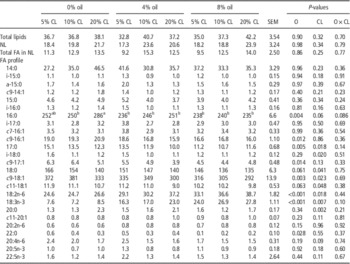
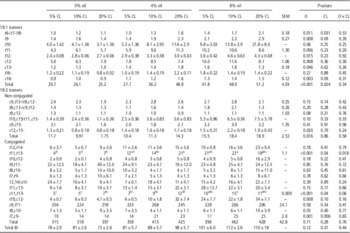
Total muscle lipids were extracted and fractionated into PL and NL and their FA composition was determined and is presented in Tables 2, 3, 4 and 5. The gravimetric contents of total lipids and NL (Table 2) and PL (Table 4) was not affected by treatments and averaged 37.3, 20.1 and 13.0 mg/g of fresh meat, respectively. The NL and PL accounted for 89% of total lipids mass. Consistently, the FA content in NL, PL and total lipids calculated from GLC internal standard method, was also not affected by treatments and averaged 12.1, 3.04, and 20.8 mg/g of fresh muscle, respectively. The sum of FA content of NL and PL fractions accounted for 73.3% of FA content of total lipids.
Effects of Cistus ladanifer (CL) and vegetable oil (O)Footnote 1 on total lipids, neutral lipid (NL) fraction, total fatty acids (FA) in NL (mg/g muscle) and fatty acid profile of NL (mg/g of total NL FA) of longissimus muscle of lambs

a,bValues within a row with different superscripts differ significantly at P<0.05.
1 Soybean and linseed oil blend (1:2 vol/vol).
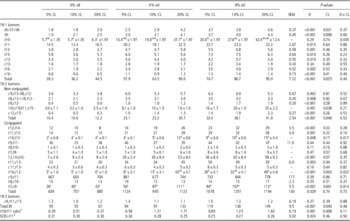
Effects of Cistus ladanifer (CL) and vegetable oil (O)Footnote 1 on biohydrogenation intermediates (mg/g of total NL FA) including CLA isomers (mg/100 g total NL FA) present on neutral lipid (NL) fraction of longissimus muscle of lambs

FA=fatty acids; Total BI=total biohydrogenation intermediates.
a,b,c,d,eValues within a row with different superscripts differ significantly at P<0.05.
1 Soybean and linseed oil blend (1 : 2 vol/vol).
2 t10-18:1/t11-18:1.
3 SCDi-t11=c9,t11-18:2/(t11-18:1+c9,t11-18:2).
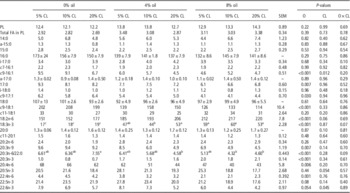
Effects of Cistus ladanifer (CL) and vegetable oil (O)Footnote 1 on polar lipid (PL) fraction, total fatty acids (FA) in PL (mg/g muscle) and fatty acid profile of PL (mg/g of total PL FA) of longissimus muscle of lambs

a,b,cValues within a row with different superscripts differ significantly at P<0.05.
1 Soybean and linseed oil blend (1 : 2 vol/vol).
Effects of Cistus ladanifer (CL) and vegetable oil (O)Footnote 1 on biohydrogenation intermediates (mg/g of total PL FA) including CLA isomers (mg/100 g PL FA) present on polar lipid (PL) fraction of longissimus muscle of lambs

FA=fatty acids; Total BI=total biohydrogenation intermediates.
a,b,c,dValues within a row with different superscripts differ significantly at P<0.05.
1 Soybean and linseed oil blend (1 : 2 vol/vol).
Fatty acid composition of muscle neutral lipids
The FA composition of NL is presented in Tables 2 and 3. The major FA in NL was c9-18:1, followed by 16:0 and 18:0. The proportion of 16:0, c9-16:1, 17:0, c9-17:1 and c9-18:1 was reduced by oil supplementation, whereas 18:2n-6 and 18:3n-3 increased 43.6% and 242%, respectively. Also, the proportions of majority of the biohydrogenation intermediates, including t11-18:1, increased with oil supplementation resulting in a higher sums of 18:1 isomers, non-conjugated and conjugated 18:2 isomers.
Cistus inclusion reduced the proportions of 17:0, iso-18:0, 18:0, c9-18:1 and c11-18:1 and increased the 18:2n-6, 18:3n-3, 20:0. In addition, Cistus increased total biohydrogenation intermediates, mainly due to its effects on increasing t9-18:1, t10-18:1 and on the unresolved peaks of t6-/t7-/t8-18:1 and of t10,c15-/t11,c15-18:2.
Significant interactions between Cistus and oil supplementation were observed for t10-18:1, t10,t12-18:2, t10,c12-18:2 and t7,c9-18:2 (Table 3). For these FA it was observed a synergic effect between Cistus and oil supplementation, that was particularly expressive for t10-18:1 and t10,c12-18:2. For t10-18:1 and t10,t12-18:2 a great individual variability was observed when animal were fed with the diet containing the highest level of Cistus and oil.
The t10-18:1/t11-18:1 ratio (t10/t11) increased with both Cistus and oil levels. The only treatments that presented a t10/t11 below one, were those non-supplemented with oil (5%, 10% and 20% of Cistus) and that with lowest Cistus level and 4% of oil (5CL4O).
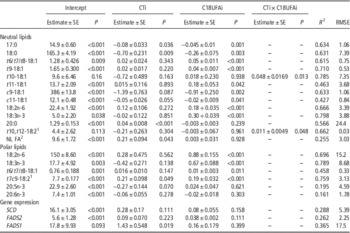
The averages for selected individual FA obtained from each pen were submitted to complementary regression analysis using the average daily intake of C18 unsaturated FA and of condensed tannins as independent variables (Table 6). The intake of condensed tannins, adjusted for the same C18 unsaturated FA, had no effect on the 18:2n-6, 18:3n-3 and c11-18:1 (Table 6), suggesting the effect observed for dietary Cistus levels was due to the confounded effect of C18 unsaturated FA intake. Increasing condensed tannins intake caused an increase of 20:0, t6-/t7-/t8-18:1, t9-18:1 and a decrease with of 17:0, 18:0, c9-18:1, even after adjustment for C18 unsaturated FA intake (Table 6). Moreover a significant interaction between FA and condensed tannins intake was observed for t10-18:1, t10,t12-18:2 and t10/t11.
Regression models of selected fatty acids (mg/g FA) and messenger RNA expression levels of desaturase genes with condensed tannins intake (CTi, g/day) and C18 unsaturated FA intake (C18UFAi, g/day)

NL=neutral lipids; SCD=stearoyl CoA desaturase; FADS2=fatty acid desaturase 2; FADS1=fatty acid desaturase 1.
1 Expressed in mg/100 g of FA.
2 Total FA in NL.
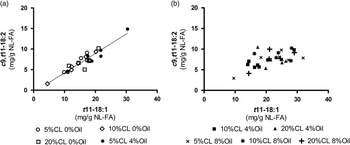
The SCDi-t11 (c9,t11-18:2/(c9,t11-18:2+t11-18:1)) decreased with the oil level and with C18 unsaturated FA intake (P=0.013). The c9,t11-18:2 in NL increased sharply and linearly with t11-18:1 for the four treatments that presented a t10/t11 below 1 (i.e. 0% oil diets and the 4% oil/5% Cistus diet) (Figure 1a, slope 0.472±0.0375, R 2=0.88, P<0.0001). For the other treatments, a large variability was observed and the general pattern (Figure 1b) suggests that as t11-18:1 increase above about 20 mg/g of total FA in NL, the c9,t11-18:2 fails to continue to increase. The SCDi-t11 decreases as t10-18:1 increase (slope,−0.08±0.027, R 2=0.36, P=0.009).
Relationship of c9,t11-18:2 and t11-18:1 concentration in muscle neutral lipids (NL). (a) – Data values from treatments that resulted in a t10-/t11-18:1 ratio in NL below 1. (b) – Data values from treatments that resulted in a t10-/t11-18:1 ratio in NL above one. FA=fatty acids; CL=Cistus ladanifer.

Fatty acid composition of muscle polar lipids
The FA composition of PL is presented in Tables 4 and 5. The main FA in PL for lambs fed with diets without oil was c9-18:1, whereas for lambs fed with diets with 4% and 8% oil was the 18:2n-6. Oil supplementation reduced the proportions of c9-16:1, 17:0, c9-17:1, c9-18:1, 20:4n-6, 22:4n-6 and 20:3n-9 and increased the proportions of 18:2n-6, 18:3n-3 and 20:3n-3 (Table 4). For biohydrogenation intermediates (Table 5), t6/t7/t8-18:1, t9-18:1, t11-18:1, t12-18:1, c12-18:1, c16-18:1, c12,c15-18:2 and the conjugated dienes t10,c12-, t7,c9-18:2 increased with oil level in the diet. Thus, the sum of total 18 : 1 isomers, and of non-conjugated 18 : 2 isomers increased in PL with oil supplementation. The inclusion of Cistus had only minor effects of FA composition of PL, decreasing the c9-16:1 and 22:6n-3 and increasing the t6/t7/t8-18:1, t11,t13-18:2, c11,t13-18:2 and t7,c9-18:2.
Complementary regression analysis was applied to selected FA, as described for NL. Independently of the C18 unsaturated FA intake, the condensed tannins intake increased the t7,c9-18:2 and tended to decrease (P=0.07) the 20:5n-3, where for all the other FA that were significantly affected by the dietary Cistus (c9-16:1, 18:2n-6, 22:6n-3, t6/t7/t8-18:1 and t11,t13-18:2) were not significantly affected by condensed tannins intake, after adjustment for the C18 unsaturated FA intake.
Gene expression of stearoyl CoA desaturase , fatty acid desaturase 1 and fatty acid desaturase 2 in muscle
Dietary level of Cistus increased SCD messenger RNA (mRNA) expression level (P=0.015), in contrast to dietary oil level, which had no effect. An interaction between the level of oil and Cistus was observed for FADS2 (P=0.018) and the same trend was observed for FADS1 (P=0.051). In both cases, the relative mRNA expression level increased with Cistus level except for the more extreme diet, with 8% of oil and 20% of Cistus, where it was depressed.
Results of regression analysis for FADS1, FADS2 and SCD mRNA expression level with condensed tannins and FA daily intake indicated that the intake of condensed tannins increased (P=0.019) FADS1 and tended (P=0.11) to increase SCD mRNA expression (Table 6).
The SCD mRNA expression correlated with the amount of total meat lipids (r=+0.36, P=0.009), NL and NL FA (r=+0.36, P=0.010) but not with SCD products (mg/g FA in NL) or product/substrate ratios, except for t7c9-18:2 (r=+0.34, P=0.014). The SCD expression was also positively correlated with t10 biohydrogenation intermediates and t10/t11 ratio in NL (r=+0.36 P=0.009). There was a positive correlation (r=+0.79, P<0.001) between mRNA expression levels of FADS1 and FADS2, suggesting that both genes are co-expressed. FADS1 was also correlated with SCD (r=+0.53, P<0.001). The FADS2 mRNA expression was positively correlated with the percentage of 18:2n-6 (r=0.34, P=0.017) and 18:3n-3 (r=0.38, P=0.007) and negatively correlated with 20:4n-6 (r=−0.31, P=0.037) and with the sum of n-6 very long PUFA (r=−0.30, P=0.042) in PL. The correlations for FADS1 mRNA expression with PUFA followed a general pattern similar to the FADS2, but did not reach significance (P>0.05).
Confirmatory multivariate ANOVA results
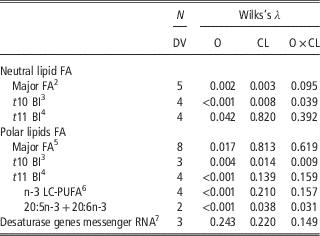
The MANOVA on the major FA confirmed the clear effect (P<0.05) of oil supplementation on both NL and PL and that Cistus dietary inclusion influenced the major FA profile of NL but not of PL (Table 7). The t11 biohydrogenation intermediates in both NL and PL were only influenced by oil supplementation (P<0.05). However, the t10 biohydrogenation intermediates presented an interaction (P<0.05) between oil and Cistus levels, confirming the findings reported in the univariate analysis. An interaction (P<0.05) between oil and Cistus levels was identified when the proportions of 20:5n-3 and 20:6n-3 in PL were analyzed together, indicating that the positive effect of oil supplementation is abolished when Cistus dietary inclusion is increased. Multivariate analysis of the mRNA expression data of the FADS1, FADS2 and SCD genes did not confirm any of the effects detected in the univariate analysis.
Effects of Cistus ladanifer (CL) and vegetable oil (O)Footnote 1 on selected dependent variables (DV) subsets analyzed by multivariate ANOVA

FA=fatty acids; BI=biohydrogenation intermediates; LC-PUFA=long chain poor in polyunsaturated fatty acids.
1 Soybean and linseed oil blend (1 : 2 vol/vol).
2 16:0; 18:0; c9-18:1; sum of all BI; 18:2n-6 plus 18:3n-3.
3 t10-18:1; t10t12-18:2; t10c12-18:2.
4 t11-18:1; t11t13-18:2; t11c13-18:2; c9,t11-18:2.
5 16:0; 18:0; c9-18:1; sum of all BI; 18:2n-6; 18:3n-3; n-6 LC-PUFA; n-3 LC-PUFA.
6 20:3n-3; 20:5n-3; 22:5n-3; 22:6n-3.
7 stearoyl CoA desaturase, fatty acid desaturase 2 and fatty acid desaturase 1.
Discussion
Our team reported previously that the inclusion of 25% of Cistus to an all-forage basal diet supplemented with 6% of a vegetable oil blend resulted in a large increase of t11-18:1 in abomasal digesta (+100%) and muscle NL (+76%), and in a milder increase (+37%) of c9,t11-18:2 in muscle NL (Jerónimo et al., Reference Jerónimo, Alves, Dentinho, Martins, Prates, Vasta, Santos-Silva and Bessa2010). Thus, in spite of large availability of substrate (t11-18:1) obtained previously with dietary inclusion of Cistus, we did not observe an equivalent increase of c9,t11-18:2 in muscle, and this could be due to a down-regulation of SCD. The large majority of c9,t11-18:2 deposited in muscle is expected to be derived from endogenous synthesis catalyzed by SCD (Palmquist et al., Reference Palmquist, St-Pierre and McClure2004; Gruffat et al., Reference Gruffat, Remond, Durand, Loreau and Bauchart2008). The SCD inhibition could be somehow due to Cistus secondary compounds. Cistus is rich in condensed tannins, which might up-regulate SCD protein expression (Vasta et al., Reference Vasta, Mele, Serra, Scerra, Luciano, Lanza and Priolo2009a) or activity (Rana et al., Reference Rana, Tyagi, Hossain and Tyagi2012). Conversely, all-forage diets are known to down-regulate SCD expression (Daniel et al., Reference Daniel, Wynn, Salter and Buttery2004) and activity (Smith et al., Reference Smith, Kawachi, Choi, Choi, Wu and Sawyer2009). Moreover, increased metabolic PUFA availability can also induce an inhibitory effect on SCD activity (Daniel et al., Reference Daniel, Wynn, Salter and Buttery2004). Thus, we hypothesized that using a basal diet containing a forage-to-concentrate ratio of 1 : 1, supplemented with vegetable oil and Cistus, would allow a high t11-18:1 metabolic availability and mitigate the forage SCD down-regulation, resulting in higher c9,t11-18:2 deposition in muscle. The present results indicated that a 1 : 1 forage-to-concentrate ratio basal diet does not increase c9,t11-18:2 with any combination of oil and Cistus levels. The reason for that were the changes in biohydrogenation pathways, resulting in the replacement of t11-18:1 by t10-18:1 as the major biohydrogenation intermediate (hereafter t10-shift), observed when the Cistus and oil increased in the diet. The occurrence of the t10-shift has been frequently reported in ruminants fed low-forage, high-oil diets (Aldai et al., Reference Aldai, de Renobales, Barron and Kramer2013) and in growing ruminants raised on pasture and supplemented with ground corn (Rosa et al., Reference Rosa, Rego, Silva, Alves, Alfaia, Prates and Bessa2014).
Polyunsaturated FA intake has a profound and well established effect on the accumulation of biohydrogenation intermediates in rumen and tissues (Shingfield et al., Reference Shingfield, Bonnet and Scollan2013; Shingfield and Wallace, Reference Shingfield and Wallace2014). Therefore, one note of caution must be made on the interpretation of the effects of dietary Cistus on deposition of biohydrogenation intermediates in meat, as the effects of dietary Cistus and C18 unsaturated FA intake might be confounded due to changes in diet ingredients and to differences of voluntary feed intake. This is clearly perceived from the interaction between both main factors (Cistus and oil) on FA intake data, particularly if we take in consideration that Cistus has a low content in PUFA (Guerreiro et al., Reference Guerreiro, Alves, Duarte, Bessa and Jerónimo2015). For this reason, whenever a significant effect of Cistus inclusion level was observed, it was confirmed by complementary regression analysis using the intake of condensed tannins and C18 unsaturated FA as independent variables.
The impact of biohydrogenation pathways on meat FA profile are better perceived in muscle NL lipids than in PL or whole muscle FA, as most of biohydrogenation intermediates are preferentially deposited in triacylglycerols and not in membrane phospholipids (Jerónimo et al., Reference Jerónimo, Alves, Alfaia, Prates, Santos-Silva and Bessa2011). In the present experiment, although t11-18:1 in NL increased linearly with unsaturated C18 FA intake, it was not affected by either condensed tannins intake or dietary Cistus level. Conversely, t10-18:1 and other t10-shift related biohydrogenation intermediates like t10,c15-18:2, t10,t12-18:2 and t10,c12-18:2 displayed a large increase in NL when oil and Cistus levels increased in the diets. The response of t10,c15-18:2 was confounded by the co-elution with t11,c15-18:2 isomer (Alves and Bessa, Reference Alves and Bessa2014). The effect of the oil level on t10-18:1 may be explained by the fairly high amount of cereals in the basal diet (Bessa et al., Reference Bessa, Portugal, Mendes and Santos-Silva2005), but the clear positive interaction between condensed tannins and C18 PUFA intake was surprising. Condensed tannins have been frequently reported to increase the trans-18:1 isomers in the rumen and tissues, as reviewed by Vasta and Bessa (Reference Vasta and Bessa2012). The reason why increased rumen concentration of condensed tannins results in induced trans-18:1 accumulation is not clear. It can be either due to the suppression of microbial community able to conduct the last reductive step of biohydrogenation (Khiaosa-Ard et al., Reference Khiaosa-Ard, Bryner, Scheeder, Wettstein, Leiber, Kreuzer and Soliva2009) or as rumen microbiota stress response (Bessa et al., Reference Bessa, Alves and Santos-Silva2000). The increase of trans-18:1 isomers in ovine digesta, tissues or milk induced by dietary tannins is mostly due to the t11-18:1 increase when basal diet allows for the predominance of the usual t11 biohydrogenation pathways (Vasta et al., Reference Vasta, Priolo, Scerra, Hallett, Wood and Doran2009b; Jerónimo et al., Reference Jerónimo, Alves, Dentinho, Martins, Prates, Vasta, Santos-Silva and Bessa2010; Buccioni et al., Reference Buccioni, Pauselli, Viti, Minieri, Pallara, Roscini, Rapaccini, Marinucci, Lupi, Conte and Mele2015). However, when dietary forage percentage decreases to about 40% of the diet, the increase of trans-18:1 induced by tannins was equally explained by both t10-18:1 and t11-18:1 (Toral et al., Reference Toral, Hervas, Belenguer, Bichi and Frutos2013). When high-concentrate diets, even if not lipid supplemented, were fed to lambs, the increase of trans-18:1 induced by tannins was due mostly to the t10-18:1 increase (Vasta et al., Reference Vasta, Priolo, Scerra, Hallett, Wood and Doran2009b). In the present experiment, despite a middle dietary forage inclusion (50%), the Cistus tannins increased mostly the t10-18:1 in NL, with no effect on t11-18:1. The synergy between PUFA and tannins intake promoting the t10-shift is undesirable, assuming that t10-18:1 has deleterious health effects to consumers, as reviewed by Aldai et al. (Reference Aldai, de Renobales, Barron and Kramer2013) and is not a substrate for endogenous CLA synthesis.
Despite the exuberant t10-18:1 increase in NL, oil supplementation also increased t11-18:1, but not c9,t11-18:2. The c9,t11-18:2 is expected to increase linearly with t11-18:1 in the tissues reflecting the SCD activity (Daniel et al., Reference Daniel, Wynn, Salter and Buttery2004; Palmquist et al., Reference Palmquist, St-Pierre and McClure2004). The low amount of c9,t11-18:2 found in abomasal digesta (data not shown) suggests that the rumen derived c9,t11-18:2 might not have a relevant contribution to the amount of c9,t11-18:2 found in NL. The failure of c9,t11-18:2 to increase linearly with the t11-18:1 concentration when the t10-shift is clearly established (Figure 1), suggests that the SCD activity is somehow blocked. It is not clear why this happened, but it could be due to the accumulation of biohydrogenation intermediates containing the t10 double bond, as it has been demonstrated that at least the t10,c12-18:2 inhibits the SCD activity in lamb tissues (Wynn et al., Reference Wynn, Daniel, Flux, Craigon, Salter and Buttery2006). We could also speculate that in the presence of high availability of t10-18:1, the substrate binding sites of SCD might be transiently occupied by the t10-18:1, hampering the binding of SCD substrates.
The SCD mRNA level in muscle was not related with any SCD products or SCD activity indices computed by product to substrate ratios. Due to its qualitative nature, gene expression data can only indicate possible changes in regulation of metabolic pathways. Moreover, postmortem SCD mRNA expression levels in muscle might not be the best predictor of the SCD products content in meat and of the sustained SCD activity during the finishing period, as was discussed by Bessa et al. (Reference Bessa, Alves, Jerónimo, Alfaia, Prates and Santos-Silva2015). In the present experiment SCD mRNA expression levels apparently increased with Cistus level, although this was not confirmed by neither the MANOVA nor regression analysis with condensed tannins intake. Others have reported an increase in SCD protein expression (Vasta et al., Reference Vasta, Mele, Serra, Scerra, Luciano, Lanza and Priolo2009a), or in SCD activity (Rana et al., Reference Rana, Tyagi, Hossain and Tyagi2012) associated with dietary tannins intake. The mode how condensed tannins could modulate gene expression is not clear at present.
In ruminants, the dietary PUFA escaping the biohydrogenation and absorbed are preferentially incorporated in PL and cholesterol esters of intestinal lipoproteins in order to more easily supply the plastic PUFA requirements of the body membranes (Moore and Christie, Reference Moore and Christie1984). Thus, the accumulation of C18 PUFA in meat NL (mostly triacylglycerols) should reflect their availability beyond the mandatory requirements for incorporation in membrane PL and thus can provide an indirect indication of the extent of PUFA rumen biohydrogenation. Our data suggests that the inclusion of Cistus increases the C18 PUFA availability, as its concentrations increased in NL. This could be explained by an inhibition of C18 PUFA rumen biohydrogenation mediated by condensed tannins, similarly to what was described by others (Kronberg et al., Reference Kronberg, Scholljegerdes, Barcelo-Coblijn and Murphy2007; Buccioni et al., Reference Buccioni, Pauselli, Viti, Minieri, Pallara, Roscini, Rapaccini, Marinucci, Lupi, Conte and Mele2015). However, the linear increase of C18 PUFA in NL with condensed tannins intake was not confirmed by the regression analysis adjusted also for C18 unsaturated FA intake, indicating that Cistus tannins probably did not reduce the extent of C18 PUFA biohydrogenation in the rumen.
The FA composition of PL is under strong regulatory control in order to maintain the functionality of cellular membranes (Bessa et al., Reference Bessa, Alves, Jerónimo, Alfaia, Prates and Santos-Silva2015) but even so, changing dietary PUFA supply induce an extensive remodeling of PUFA in PL (Jerónimo et al., Reference Jerónimo, Alves, Alfaia, Prates, Santos-Silva and Bessa2011; Rosa et al., Reference Rosa, Rego, Silva, Alves, Alfaia, Prates and Bessa2014). Consistently to this, increasing oil in the diet resulted in an extensive replacement of c9-18:1 by both 18:2n-6 and 18:3n-3. The biohydrogenation intermediates were incorporated in much less extent in PL than in NL although the same general pattern found in NL can also be recognized in PL, which confirms previous observations (Jerónimo et al., Reference Jerónimo, Alves, Alfaia, Prates, Santos-Silva and Bessa2011; Rosa et al., Reference Rosa, Rego, Silva, Alves, Alfaia, Prates and Bessa2014).
In ruminant muscle, the very long chain PUFA (LC-PUFA) are located almost exclusively in membrane phospholipids (Bessa et al., Reference Bessa, Alves, Jerónimo, Alfaia, Prates and Santos-Silva2015). In mammals the LC-PUFA are formed by elongation and desaturation (via Δ6 and Δ5 desaturases) of C18 PUFA (Alvarenga et al., Reference Alvarenga, Chen, Furusho-Garcia, Perez and Hopkins2015). Increasing the n-3 LC-PUFA in meat is highly desirable, considering its beneficial health effects and the large dependence of marine foods sources to meet the nutritional requirement of humans (Alvarenga et al., Reference Alvarenga, Chen, Furusho-Garcia, Perez and Hopkins2015). Thus, the decrease of 20:5n-3 and 22:6n-3 in muscle PL associated with dietary Cistus incorporation is negative. The complementary regression analysis with condensed tannins and C18 UFA intakes, only weakly (P=0.07) confirmed the decrease of the 20:5n-3 with condensed tannins intake. Nevertheless, the depression of n-3 LC-PUFA with Cistus is small and was not present in the other experiment where Cistus were fed to lambs (Jerónimo et al., Reference Jerónimo, Alves, Dentinho, Martins, Prates, Vasta, Santos-Silva and Bessa2010), thus it might not be a consistent and a biologically relevant effect.
Concluding, the inclusion of Cistus in oil-supplemented lamb diets containing 50% of concentrate has a negative effect on lamb meat FA profile, mainly due to the exacerbation of ruminal t10-shift, with a strong accumulation of t10-18:1 and no increase on c9,t11-18:2. Moreover, the inclusion of Cistus in these diets results in a slight reduction on the n-3 LC-PUFA in lamb meat, which is an undesirable nutritional effect, due to the importance of these FA for human health.
Acknowledgements
Financial support through the grant (PTDC/CVT/103934/2008) and (PTDC/CVT/120122/2010) and individual fellowships to A. Francisco (SFRH/BD/68773/2010), S.P. Alves (SFRH/BPD/76836/2011), E. Jerónimo (SFRH/BPD/74527/2010) and V. M. R. Pires (2013 FCT Investigator – Starting Grant) from Fundação para a Ciência e Tecnologia (FCT) are acknowledged.
Supplementary Material
To view supplementary material for this article, please visit http://dx.doi.org/10.1017/S1751731116001129