Improvements in the management and monitoring of patients with congenital heart disease have brought an increasing focus on long-term outcomes, including health-related quality of life.Reference Uzark, Jones, Burwinkle and Varni 1 , Reference Mattera, De Leon, Wackers, Williams, Wang and Krumholz 2 The corresponding literature suggests that “cardiac” interventions can have consequences far beyond the cardiovascular system – on the child's subsequent behaviour, anxieties, cognitive capacity, and family functioning. This, with the additional evidence that patients’ estimates of their physical functioning poorly predicts their objectively measured exercise capacity,Reference Gratz, Hess and Hager 3 may go some way to explaining the finding that for both adults and children with congenital heart disease the correlation between patients’ reporting of their quality of life and the severity of their congenital heart disease as stratified by their cardiologists is weak at best.Reference Moons, Van Deyk and De Geest 4 , Reference Kwon, Mussatto, Simpson, Brosig, Nugent and Samyn 5
A proportion of children, adolescents, and adults who have survived cardiac surgery have well-documented difficulties with self-esteem, anxiety, and depressionReference Cohen, Mansoor, Langut and Lorber 6 – Reference Chen, Liao and Wang 8 and it is possible that the way we conduct their medical care or negotiate with their families exacerbates these. Resilience is a construct that captures the sense of an individual's capacity to negotiate, manage, and adapt to significant sources of stress or trauma including hospitalisation. Resources within the individual, their family, and environment promote resilience and help them “bounce back” in the face of adversity. In other illness groups, such as cancer, resilience has been identified as a correlate of health-related quality of life and coping,Reference Strauss, Brix and Fischer 9 and there is interest in interventions that might foster childhood resilience.
Surgical repair of tetralogy of Fallot has transformed an otherwise fatal condition into one for which most patients are operated on in early childhood and expect to reach adult life.Reference Perloff 10 , Reference Webb and Williams 11 However, after their initial surgery, patients are often left with residual lesions, most commonly pulmonary regurgitation. For a proportion, re-interventions, most commonly pulmonary valve replacement, are necessary later in life to avoid deleterious effects such as progressive ventricular dilatation and dysfunction, arrhythmias, and sudden death.Reference Discigil, Dearani and Puga 12 – Reference Gatzoulis, Balaji and Webber 14
To explore the relationships between subjectively and objectively measured exercise capacity, health-related quality of life, and resilience, we studied a cohort of patients with a narrow diagnostic range and a wide age range. For patients with repaired tetralogy of Fallot who had not undergone subsequent pulmonary valve replacement, we hypothesised that their health-related quality of life would be impaired compared with that of age-matched controls but that the impairment would be primarily in the psychosocial rather than the physical domain. We expected a significant positive correlation between health-related quality of life and resilience. We further hypothesised that older patients, many of whom had been old enough to remember the experience of their childhood operation in the 1960s and 1970s and who were presumptively at risk from subsequent psychopathology, would be less resilient than the younger patients who would have been too young to remember the surgical challenge, although their parents undoubtedly would.
Methods
Using a random number generator, 50 patients were selected from a consecutive list (n = 1085) of patients who had repair of tetralogy of Fallot at Great Ormond Street Hospital between February, 1964 and January, 2009. Of the 1085 patients, 148 have died and 188 have undergone pulmonary valve replacement to date. Patients were eligible for selection if they were free from subsequent pulmonary valve replacement. Based on our previous work,Reference Frigiola, Tsang and Bull 15 we calculated that a sample of 50 patients, 10 patients in each of five surgical decades would be sufficient to detect a change in VE/VCO2 of 1.68/decade with 80% power (two-sided with 5% level of significance).
Selected patients were sent a letter of invitation to participate in the study, and if they expressed an interest they received further information. Participants spent a day at Great Ormond Street Hospital, during which time they underwent cardiopulmonary exercise testing and other investigations and completed health-related quality of life and resilience questionnaires. The presence of additional medical conditions, including neurologic and neuro-developmental issues, was assessed through interview and clinical examination, as these can affect quality of life. New York Heart Association class was recorded as part of their clinical assessment.
The Great Ormond Street Hospital Research Ethics Committee approved the study. Informed consent was obtained from all adult participants; children were asked to assent and their parents to consent.
Cardiopulmonary exercise testing
Exercise stress testing was performed on an electronically braked bicycle ergometer (Ergoline, Bitz, Germany) with respiratory gas exchange analysis as previously described.Reference Giardini, Odendaal, Khambadkone and Derrick 16 Briefly, peak VO2 was measured as the average value in the last 30 seconds of exercise, and VE/VCO2 slope was measured using data until respiratory compensation, excluding the non-linear part of the relationship. All patients studied had normal saturation at rest and throughout the exercise test, and baseline lung function was within normal limits in all subjects. Owing to the fact that we were dealing with a wide age range of volunteers, we compared the values obtained for each patient with healthy age- and gender-matched controls from the published literature,Reference Neder, Nery, Peres and Whipp 17 – Reference Upton, Eiser and Cheung 19 thus generating z-values that could be summarised across the studied population.
Questionnaires
Health-related quality of life of children
The UK version of the Pediatric Quality of Life Inventory Generic Core Scale version 4.0 was used to assess the health-related quality of life in the children. This 23-item questionnaire comprises four domains assessing physical functioning (eight items), emotional functioning (five items), social functioning (five items) and school functioning (five items), with the possible scores on each subscale ranging from 0 to 100. A psychosocial summary score and total score can be calculated. The scales exist in child and parent-proxy formats for the age groups 5–7, 8–12, and 13–18 years. Reliability and validity are excellent, and the scales have been widely used with healthy and ill populations, including children with congenital heart disease.Reference Upton, Eiser and Cheung 19 , Reference Varni, Seid and Kurtin 20 A deficit of 4.4 on the total child self-report scale was inferred to be a minimally clinically important difference in a US sample investigated by Varni et al.Reference Varni, Seid and Kurtin 20
Health-related quality of life of adults
Health-related quality of life of the adults was measured using the World Health Organization Quality of Life-BREF (WHOQoL-BREF),Reference Hawthorne, Herrman and Murphy 21 a generic 26-item questionnaire, which assesses functioning in four domains: physical health (seven items), psychological (six items), social relationships (three items), and environment (eight items), with the possible scores on each subscale ranging from 0 to 100. The measure also includes one facet on overall quality of life and general health. The measure has good discriminant validity, content validity, internal consistency, and test–retest reliability, and has been used in other studies of chronic illness, including congenital heart disease.Reference Rose, Köhler, Köhler, Sawitzky, Fliege and Klapp 7 , Reference Silva, Vaz and Areias 22 , Reference Teixeira, Coelho and Proença 23 Minimally clinically important differences are rarely reported for WHOQoL-BREF, but values of 5.5–8 have been recorded in another context.Reference Thakar, Christopher and Rajshekhar 24
Resilience
Resilience was measured using the RS-14™ (Wagnild and Young, Seattle, Washington, United States of America), a 14-item questionnaire. This instrument captures the constructs of resilience: meaningful life, persistence, self-reliance, equanimity, and “existential aloneness”. A total score can be calculated, with a range of 14–98, and validity and reliability have been reported to be good.Reference Wagnild 25 The domains of the RS-14™ were generated by a formal process involving adults, but four teenagers were given the RS-14™ questionnaires as they were judged able to understand and answer the questions.
Statistical analysis
Statistical analysis was performed using SPSS version 18.0 (SPSS, Chicago, Illinois, United States of America).
Paired-sample t-tests were used to compare parent and child ratings of health-related quality of life. One-sample t-tests were used to compare the health-related quality of life scores of our sample (children and adults) with published norms. In order to make comparison of results possible among patients of different ages and genders, health-related quality of life values were normalised against those published in the literature for healthy children and parent proxies and for adults.Reference Varni, Seid and Kurtin 20 , Reference Hawthorne, Herrman and Murphy 21 Pearson or Spearman tests were used as appropriate to measure correlations between demographic and medical variables and z-scored health-related quality of life values. Values are expressed as mean ± standard deviation unless otherwise specified. A p-value < 0.05 was selected to determine statistical significance.
Results
A total of 112 patients were initially contacted, of whom 69 (62%) agreed to participate. However, subsequently, 19 had to be excluded on medical or logistical grounds. In the majority of these 19 cases, it was not possible to schedule appointments at a mutually convenient time, but in two cases the parents and their children were not in agreement about participating; one patient had very recently undergone a pulmonary valve replacement and another patient was due to undergo a valve replacement imminently. The reasons given for not wanting to participate (n = 43) included lack of interest/time and a fear of returning to the hospital where they had had their surgery. There were no differences in gender, age at primary repair or years since operation between patients who agreed to participate and those who did not.
Demographic and functional results
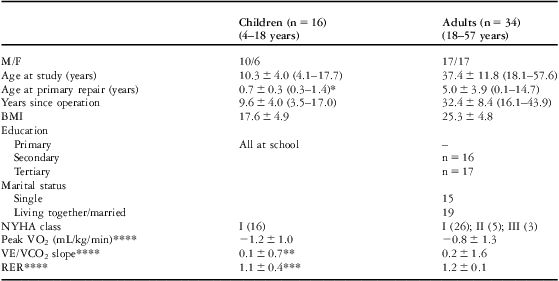
Of the 50 patients studied, 16 were <18 years of age, all of whom were attending school, and 34 were adults ranging in age from 18.1 to 57.6 years. Patients rated themselves as generally well, apart from one who classified herself as currently ill. Of the studied patients, two underwent pulmonary valve replacement within 3 months from the study date. The median New York Heart Association class was I for both children and adults. None of the assessed patients had evidence of significant neurological disorder; two patients were affected by asthma, three were on medication for hypercholesterolaemia, one was diabetic, two suffered from hypertension, and one patient suffered from vertigo of unknown origin. In all, six of the children were too small to manage the exercise bicycle, but exercise capacity for those tested was generally well preserved. All patients performed a maximum test. Two of the 10 children and six out of 34 adults had a peak VO2 that was more than 2 standard deviations below normal. With regard to ventilatory efficiency, VE/VCO2 slope was abnormal in seven out of 34 adults and in none of the 10 of the children. Demographic and functional parameters are reported in Table 1.
Demographics and clinical characteristics of the ToF patients.

BMI = body mass index; NYHA = New York Heart Association; RER = respiratory exchange ratio; ToF = tetralogy of Fallot
*Statistical significance <0.0001
**Statistical significance <0.005
***Statistical significance <0.05
****n = 10 in the children group
Health-related quality of life and correlations with demographic and functional parameters
Children
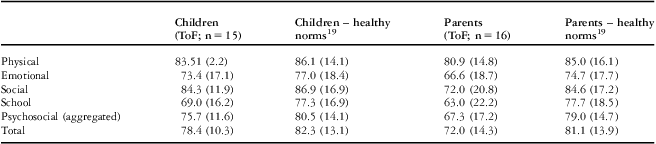
Children reported an overall health-related quality of life similar to that of their healthy peers, although for every domain their scores were a little lower than healthy children, suggesting that our study may be underpowered to detect a small but systematic deficit, with the difference only reaching significance on the school subscale (t = −2.633; p = 0.025) Corresponding parental scores in all domains were lower than the children's self-assessed scores, and these differences were significant (p < 0.05) on the emotional and social subscales. Scores were lower than the parental scores for healthy norms; deficits were more striking in the psychosocial than the physical domain (Table 2).
Child and parent mean scores (standard deviation) on the PedsQL scales.

PedsQL = Pediatric Quality of Life Inventory; ToF = tetralogy of Fallot
It should be noted that UK norms are only available for children of 8–18 years; comparisons with UK norms therefore only included the 11 children from our population aged 8 years and above and these data are not shown in this table
For the 10 children with health-related quality of life and exercise measurements, for neither children nor their parents was there a discernible correlation between ratings of the physical domain of the Pediatric Quality of Life Inventory and objectively measured exercise capacity (peak VO2 and VE/VCO2), although the ranges of both are limited.
Adults
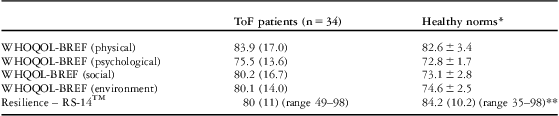
WHOQOL-BREF results indicated that adults with repaired tetralogy of Fallot perceived their health-related quality of life to be good, with better-perceived health-related quality of life than healthy norms in the social and environment domains (t = 2.465; p = 0.019 and t = 2.285; p = 0.029, respectively). The only significant association between any functional or demographic parameter and WHOQoL scores was between marital status and scores on the social domain, where those who lived with a partner had a better-perceived social quality of life compared with those who were single (p = 0.048). There was no correlation between objectively measured exercise capacity (peak VO2 and VE/VCO2) and the subjective WHOQOL-BREF total score or the physical domain score.
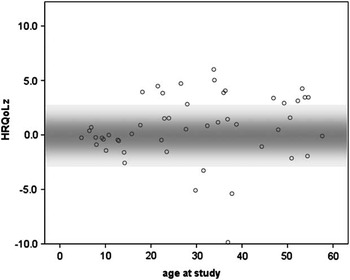
Figure 1 summarises the health-related quality of life status of the whole group using z-scores obtained from the normal ranges available for the Pediatric Quality of Life Inventory and WHOQL-BREF instruments.
Relation of age to HRQoL (assessed using PEDSQL for the children and WHOQOL-BREF for the adults) expressed as a z-score in relation to corresponding normal ranges. HRQoL = Health-Related Quality of Life; PEDSQL = Pediatric Quality of Life Inventory; WHOQOL-BREF = the World Health Organization Quality of Life.

Resilience
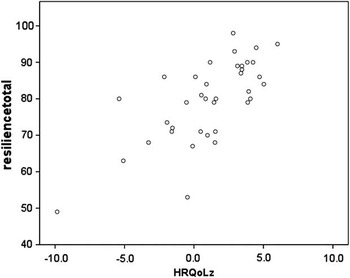
Scores on the RS-14™ resilience scale were available for 34 adults and four adolescents (aged 0.1–14.1 years at initial surgery) and indicated high levels of resilience (Table 3). Figure 2 shows that the measured resilience correlated well with the overall health-related quality of life score expressed as a z-score (r = 0.70, p < 0.01). Later age at operation was not associated with a lower resilience score on bivariate analysis (r = 0.1, ns).
Mean scores (standard deviation) of the WHOQOL-BREF and Resilience Scales (RS-14™).

WHOQOL-BREF = World Health Organization Quality of Life-BREF; ToF = tetralogy of Fallot
RS-14™ includes four adolescents, n = 38
*Quality of life values are derived from published data for healthy normsReference Hawthorne, Herrman and Murphy 21
**Normal data from WagnildReference Wagnild 25
Relationship of resilience score to health-related quality of life (assessed using PEDSQL for the children and WHOQOL-Bref for the adults) expressed as a z-score in relation to corresponding normal ranges. PEDSQL = Pediatric Quality of Life Inventory; WHOQOL-Bref = World Health Organization Quality of Life.

Discussion
This report complements other studies of patients with tetralogy of Fallot and confirms that repair can offer a good objectively measured exercise capacity and a good subjectively estimated quality of life during childhood and adult life. Our initial hypothesis that patients would score at a lower level than healthy peers in the psychosocial domain of health-related quality of life was not borne out. Our study is unusual in addressing a very wide age range by using patients chosen by a formal random selection process to “represent” survivors who have not (yet) had to face revision of their original repair; this contrasts with other papers that have focused on patients facing reoperation.
Other studies assessing quality of life of patients with tetralogy of Fallot have shown broadly similar results to those reported here. Kwon et alReference Kwon, Mussatto, Simpson, Brosig, Nugent and Samyn 5 examined 20 tetralogy of Fallot child/parent pairs at a median age of 10 years and Walker et alReference Walker, Temple, Gnanapragasam, Goddard and Brown 27 documented health-related quality of life in 87 survivors aged 16–40 years. Larger studies of more heterogeneous groups of patients with congenital heart disease including tetralogy of Fallot also exist.Reference Uzark, Jones, Slusher, Limbers, Burwinkle and Varni 28 , Reference Varni, Limbers and Burwinkle 29 With the exception of performance in the school domain, where differences with the healthy population were significant, our patients assessed themselves as functioning as well as their peers. The poorer performance in the school domain may reflect the fact that children with tetralogy of Fallot are at higher risk of cognitive impairment than healthy childrenReference Hövels-Gürich, Konrad and Skorzenski 30 and perform less well on tests of academic achievement,Reference Wright and Nolan 31 all of which may have an impact on their perceived health-related quality of life in the school environment.
As found previously,Reference Kwon, Mussatto, Simpson, Brosig, Nugent and Samyn 5 parents’ ratings of their children's health-related quality of life were lower than those of the children themselves and it has been suggested that this may be related to parents’ own anxieties and experiences of caring for their children. Understanding parents’ anxieties and providing appropriate interventions to support parents at times of particular stress may help parents to have a more positive view of their child's health-related quality of life in the longer term, which in turn may have a positive impact on their child.
Our adult volunteers who were free of reoperation also reported good long-term health-related quality of life, with social and environmental scores that appear better than healthy norms. Although some authors have documented poorer health-related quality of life, particularly in the physical domain, in patients with congenital heart disease, including those with tetralogy of Fallot,Reference Lane, Lip and Millane 32 others have reported excellent health-related quality of life.Reference Loup, von Weissenfluh, Gahl, Schwerzmann, Carrel and Kadner 33
For almost all of our subjects objectively measured exercise capacity was within the normal range for age, and thus it is perhaps not surprising that neither the children's, their parents’ nor the adults’ subjective perceptions of their physical health-related quality of life correlated well with peak VO2 and VE/VCO2. For both children and adults with tetralogy of Fallot, any deficit in health-related quality of life appears to be in the psychosocial than in the physical domain.
We report for the first time a strong positive correlation between health-related quality of life and resilience in a cohort of patients with congenital heart disease, supporting our hypothesis. With no tool available to evaluate resilience in young children – who generally had surgery at a very young age – we could not establish whether or not the adults who could recollect the stresses and challenges of their childhood surgery were more or less resilient than others whose operation happened before they could remember; we did not evaluate their parents’ resilience. The role of resilience in promoting adaptive coping and reducing depression, stress and anxiety is receiving increasing attention in both paediatric and adult populations,Reference Kim and Yoo 34 , Reference Burton, Pakenham and Brown 35 and our results suggest that evaluating the potential of interventions to foster resilience in both children and their parents might improve later quality of life and reduce the psychosocial morbidity in some patients in the short and long term. Some interventions evaluated as improving childhood resilience or coping have been targeted at the children and adolescents themselves; these include educational interventionsReference Hinds, Quargnenti and Bush 36 and summer camps.Reference Hunter, Rosnov, Koontz and Roberts 37 Other interventions are aimed at parents of babies at high risk of developing disease-related or treatment-related psychopathology and have included home-visit schemes to parents of low birth weight babies.Reference McCormick, Brooks-Gunn and Buka 38 Such programmes are usually targeted to subsets of the population at particular risk.
The study does have some limitations. First, patients were volunteers who offered a day of their time and may not be fully representative of tetralogy of Fallot survivors, although demographic data of patients who declined to participate did not differ from those who volunteered. Second, like other studies of patients with specific defects, our sample size is relatively small and the study design is cross-sectional, although over a broad age range. Third, we did not test for 22q11 deletion, which has a higher incidence among patients with tetralogy of Fallot, and thus we are unable to infer the possible impact of this condition on health-related quality of life. Another limitation relates to the inability of six of the youngest volunteers to complete the cardiopulmonary exercise testing owing to size issues, thus preventing us from performing any correlation analysis between health-related quality of life and measured exercise capacity in the youngest volunteers of our sample. Finally, evaluation of the Resilience RS-14™ scale has been carried out in adult patient groups, although it has been used elsewhere with adolescents.Reference Damásio, Borsa and da Silva 26
Conclusions about health-related quality of life in congenital heart disease are difficult to draw. This is partly because homogeneous groups of patients with congenital heart disease are necessarily small and studies often underpowered, whereas larger groups contain too much diagnostic heterogeneity to easily generalise. More importantly, although statistically significant differences have been widely found by us and others between one subgroup of patients and another or between a group of patients and normal controls, the issue of what is a clinically significant difference in health-related quality of life has not yet been widely addressed in this field.Reference Wyrwich, Bullinger and Aaronson 39 Assessment of the effectiveness of interventions aiming to ameliorate the psychosocial consequences of our patients’ disease and treatment should therefore be based on clinically significant differences in health-related quality of life.
Our findings are encouraging and indicate that we can tell the parents of children currently anticipating surgery that, in the absence of re-interventions, patients with repaired tetralogy of Fallot report a health-related quality of life that is generally comparable to that of their healthy peers.
Acknowledgements
Contributorship: J.W. contributed to the conception, design, analysis and interpretation of data, as well as drafting and approval of the final version. She is the guarantor of the research. A.F. and C.B. contributed to the design, analysis and interpretation of the data, as well as drafting and approval of the final version. Source funding: A Frigiola was funded by Great Ormond Street Hospital Children's Charity.