INTRODUCTION
While the data from stated preference surveys are intended to generate reliable statistical estimates of willingness to pay (WTP) or willingness to accept (WTA) compensation for the target population, concerns have been raised that interviews or mail-out surveys may not provide respondents with sufficient information or time for deliberation to fully consider their preferences (Davis & Whittington Reference Davis and Whittington1998; Sagoff Reference Sagoff1998; MacMillan et al. Reference MacMillan, Hanley and Lienhoop2005; Christie et al. Reference Christie, Hanley, Warren, Murphy, Wright and Hyde2006). Environmental goods and services are complex, and the community's understanding, particularly with respect to non-marketed non-use values such as water quality services, is generally poor. WTP responses from people with an imperfect understanding of what they are being asked to value could be seen as a poor basis for policymaking (Kenyon et al. Reference Kenyon, Hanley and Nevin2001; Álvarez-Farizo & Hanley Reference Álvarez-Farizo and Hanley2006; Christie et al. Reference Christie, Hanley, Warren, Murphy, Wright and Hyde2006). This suggests that delivery of information and time for deliberation is particularly important to come to a reasoned and rational decision about individual WTP.
Previous studies (for example MacMillan et al. Reference MacMillan, Philip, Hanley and Álvarez-Farizo2002, Reference MacMillan, Hanley and Lienhoop2005; McDaniels et al. Reference McDaniels, Gregory, Arvai and Cheunpagdee2003; Fischer & Hanley Reference Fischer and Hanley2007) have found that survey participants may have well defined preferences, and require little in the way of additional information to indicate their WTP for familiar goods such as recreational use of a waterway. However, for less familiar goods such as water quality services, participants require more information and benefit from discussions in group settings (Wilson & Howarth Reference Wilson and Howarth2002; MacMillan et al. Reference MacMillan, Hanley and Lienhoop2005; Hanley et al. Reference Hanley, Wright and Álvarez-Farizo2006).
An improvement in the water quality of the river systems, including the Bremer River, flowing into Moreton Bay (Queensland, Australia) has been identified by the SEQ (south-east Queensland) Healthy Waterways Partnership (2007) as essential for the management of the waterways of SEQ. Local and state government authorities have endorsed this position, having committed already over US$ 105 million (A$ 1 = $US 0.85, November 2006) for wastewater treatment upgrades. Considerably more resources will be required if substantial improvements are to be realized in the near future.
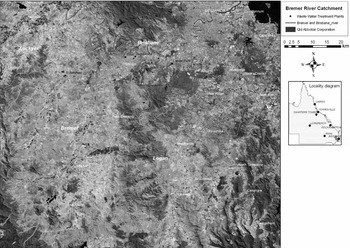
The Bremer River (Fig. 1) has been subject to a long history of chronic nutrient enrichment owing to agricultural run-off and discharge from wastewater treatment plants and abattoirs located along the waterway throughout the catchment (Chaloupka et al. Reference Chaloupka, Robinson, Asafu-Adjaye, Ghassemi, Post, Sivapalan and Vertessy2001). The development history of the Bremer River is not uncommon to many river systems sited in growing urban and industrial areas worldwide, hence the water quality problems of the Bremer are a familiar environmental problem. By 2006, the point sources of discharge to the Bremer, including the wastewater treatment plants and industry, had upgraded their treatment facilities and engaged in wastewater recycling. To date, the impact of these improvements on water quality indicators has been minimal. Attention is now being directed towards reducing the diffuse loads of nutrients from the catchment, some of which has been sourced from urban storm water run-off. Management of diffuse sources of nutrient discharge to the waterways will require a considerable monetary contribution from the Bremer catchment community to enable actions, such as storm water retrofitting, to be implemented, and information about the WTP of the Bremer catchment community is timely.
Bremer River catchment.

We conducted a citizens' jury in order to first deliver information about water quality in the Bremer River and then determine citizens' WTP for scenarios of improved water quality. The citizens' jury is a deliberative form of public participation which has been used in a number of situations (Aldred & Jacobs Reference Aldred and Jacobs2000; Kenyon et al. Reference Kenyon, Hanley and Nevin2001; Álvarez-Farizo & Hanley Reference Álvarez-Farizo and Hanley2006; Hanley et al. Reference Hanley, Wright and Álvarez-Farizo2006) to involve the community in informed decision-making, and is based on the model used in Western-style criminal court proceedings. The great advantage of the jury process is that it yields input to decision-making from an informed group of participants who are expected to respond as citizens rather than as individual consumers (Jacobs Reference Jacobs and Foster1997; Sagoff Reference Sagoff1998). Wilson and Howarth (Reference Wilson and Howarth2002) and Niemeyer and Spash (Reference Niemeyer and Spash2001) took a strong social equity position in their claims about the importance of discursive techniques generally and of discourse-based valuation specifically. They argued that these techniques elicit meaningful consensus-based value statements that are persuasive and, moreover, that they provide a constructive forum for discussing social value with consideration to equity, eliciting economic value judgments for complex environmental issues.
The quantity and quality of information provided to respondents, together with time for deliberation and opportunity for further investigation, are important elements of jury proceedings. Expert witnesses are required who are authorities on current water quality issues in the catchment and who can provide information to jurors clarifying the attributes of water quality and future options for management. Jurors are given time for deliberation and the opportunity to ask questions of the experts for clarification of information (an opportunity not traditionally provided in Western-style courts of law or in standard environmental valuation surveys).
Choice modelling, a form of stated preference valuation, was used in this study to estimate a demand function for water quality improvements and part-worths (implicit prices) for marginal change in environmental attributes of water quality (Bateman et al. Reference Bateman, Carson, Day, Hanemann, Hanley, Hett, Jones-Lee, Loomes, Mourato, Ozdemiroglu, Pearce, Sugden and Swanson2002). Choice modelling was chosen because the implicit prices for components of water quality would provide valuable information for the design of water management policies and for possible benefit transfer (Robinson Reference Robinson2001). By using repeated experiments and statistical analysis of the data, the researcher is able to estimate the influence of the different attributes on choices and hence utility and, by including price as one of the attributes, WTP for water quality improvements per se can be indirectly estimated from the choices made by survey respondents.
Choice modelling surveys suffer from many of the criticisms that have been levelled at stated preference surveys generally (Bateman et al. Reference Bateman, Carson, Day, Hanemann, Hanley, Hett, Jones-Lee, Loomes, Mourato, Ozdemiroglu, Pearce, Sugden and Swanson2002). Blamey et al. (Reference Blamey, James, Smith and Niemeyer2000) acknowledged two important shortcomings that could lead to biased results, namely undertaking valuations when the respondents have limited information, and distinguishing between respondents who respond as citizens and those who respond as consumers. It is suggested that referenda-type surveys be replaced with citizens' juries, where jurors act as citizens representing the interests of others and are provided with credible information and the opportunity to deliberate, are assumed to make well-informed and deliberated decisions (Sagoff Reference Sagoff1998; Blamey et al. Reference Blamey, James, Smith and Niemeyer2000). Stated preference valuations may be biased due to framing effects where the context for stating preferences differs from the setting that would occur under normal decision processes (Rolfe et al. Reference Rolfe, Bennett and Louviere2002). Deliberative decision approaches such as the citizens' jury provide opportunities for framing the good or service within a policy context and reduce this source of bias.
Our objective was to test the value of a citizens' jury, as a discursive tool for informed decision-making, in environmental valuation. A choice modelling survey, conducted before and after the jury proceedings, was used to determine the effect of information and deliberation on juror preferences. This study was particularly concerned with inclusion of ecological attributes of water quality, such as riparian and aquatic vegetation (Christie et al. Reference Christie, Hanley, Warren, Murphy, Wright and Hyde2006). The inclusion of water quality attributes unfamiliar to the Bremer catchment community within a stated preference survey was expected to test the impact of the jury process on WTP for water quality improvements.
METHODS
Study area
The Bremer River is a tidally influenced freshwater system that flows into the Brisbane River and then into Moreton Bay. Ipswich is a major provincial centre for the Bremer River catchment, located approximately 15 km upstream from the junction of the Bremer and Brisbane Rivers (see Fig. 1).
A review of Australian Bureau of Statistics (ABS) data reveals that the economy of the Bremer River catchment is growing, putting increasing pressure on the condition of environmental resources in the catchment. Between 1986 and 2001 the estimated resident population in the Bremer River catchment increased by approximately 17% to a little over 138 000 people, and is projected to increase to approximately 160 000 people by 2011 (Department of Local Government & Planning 2001). Storm water run-off from urban areas, particularly from new sub-divisions, has contributed substantially to non-point discharge to the waterways.
In 2001, employment in the catchment was primarily in manufacturing industries, a situation expected to continue into the foreseeable future (Robinson & Mangan Reference Robinson and Mangan2007). These industries are dominated by a number of abattoirs that are licensed to discharge treated effluent into the Bremer River. Licensed and point-source discharge accounts currently for only 40% of the discharge to the waterways.
A recent study on water quality in the Bremer River demonstrated that the water quality has deteriorated from an autotrophic condition (where the production of oxygen within the system meets the demand), to a heterotrophic system where the consumption of oxygen in the system is greater than production and has resulted in a loss of ecosystem services, including loss of native fish habitat and amenity value (Chaloupka et al. Reference Chaloupka, Robinson, Asafu-Adjaye, Ghassemi, Post, Sivapalan and Vertessy2001). Currently, the water quality is unsafe for human consumption, unsuitable for swimming and any fish caught are not considered safe for human consumption. In short, the consumptive uses for the river are severely limited by the poor water quality. If nothing is done to manage run-off or wastewater discharged directly or indirectly into the river (the ‘do-nothing’ scenario), then it is likely that the river will continue to deteriorate and become increasingly heterotrophic. In the Ipswich city precinct, even without reference to the scientific reports on water quality, the Bremer River is deep brown with sediment and carries substantial amounts of floating debris, including discarded rubbish.
Citizens' jury
The jury selected for the Bremer study was recruited through an advertisement in the local newspaper. The circulation of the newspaper was limited (circulation 80 000), but the additional cost of advertising in a newspaper with greater circulation was not warranted. The advertisement called for an expression of interest to participate in a citizens' jury ‘to be held on a matter of public importance’. In brief, there was no indication at the time of recruitment that the issue to be addressed was one of water quality in the Bremer River catchment. Although a quota sampling approach to juror selection was intended, the final selection was reliant on an initial self selection process rather than random sampling of the target population. The problems encountered by Aldred and Jacobs (Reference Aldred and Jacobs2000) in identifying a representative jury, specifically statistically-based recruiting and jurors representing all relevant perspectives, were also encountered during the selection of the jury for the Bremer study. It is acknowledged from the outset that the selection of the jury in this study was restricted to those expressing an interest in involvement in an innovative approach to community involvement in decision-making, which may have resulted in some bias in the final outcomes.
Twelve male and 11 female jurors were selected from 42 responses to the advertisement. We selected jurors who were available to attend the proceedings and not currently involved in public sector decision-making with respect to the catchment area. Jurors were excluded if involved in community organizations or local action groups that might have a vested interest in the outcome or, and more importantly, likely to use the outcomes from the jury process for rent-seeking activities. The jurors were aged between 16 and 69 years old and came from a range of income and education levels representative of the socioeconomic profile of the local population (ABS 2003) as far as practicable for this small sample size.
The jury was convened for two full days. Jurors were resident at a conference centre and were paid a nominal fee for their participation. The programme for jurors included an initial ice-breaker session, presentations from expert witnesses, group discussion periods and time for questions from jurors directed towards witnesses. Jurors were also provided with the opportunity for informal discussion with expert witnesses. The restricted number of jurors enabled the facilitator of the proceedings to involve all jurors in discussion, to encourage them to express their opinion and to question witnesses. In short, jurors were provided with the opportunity to seek all of the information they required to help them to determine their preferences.
The initial ice-breaker session was important. During this session, on the first evening and in a relatively relaxed atmosphere following dinner, respondents were introduced to the water quality issues they would be deliberating over the proceeding two days. During this session two important points were discussed with jurors. This first was that each juror was a citizen of his/her community and that the outcomes of the jury proceedings were highly likely to impact on the community as a whole. The second point, the outcome of discussion initiated by jurors, was that the findings from the jury proceedings were to be presented to local and state water quality managers to be acted upon as they saw fit.
Selection of the expert witnesses was an important consideration. Time constraints permitted only six witnesses to be called, though jurors were encouraged to request additional witnesses where they required additional information or a different point of view. Witnesses included state and local government personnel involved in projects associated with improvements in water quality in the Bremer River catchment or in south-east Queensland generally, scientists involved in research projects on water quality issues as well as representatives of industry, both manufacturing and agriculture, located in the catchment. Witnesses provided information about the regulation of point sources of discharge to the waterway and the action affected industries were currently taking, including associated costs; the difficulties associated with regulating non-point sources of discharge (including urban storm water as well as rural run-off) and the actions, costs and role of individual industries, government agencies and catchment organizations in the quest to improve water quality.
To help jurors improve their understanding of water quality improvements, a good which jurors were unlikely to be familiar with, considerable information was provided about the ecosystem attributes of water quality, particularly about the role of riparian vegetation and the significance of quality aquatic vegetation. The information the experts provided was based on scientific research regarded by their peers as reliable and credible. Throughout the jury proceedings, jurors were encouraged to ask questions and to identify additional information needs or to request additional expert witnesses. By exposing jurors to extensive information, it was possible to facilitate an informed and discursive approach to the estimation of WTP.
Development of the choice modelling questionnaire
To determine the extent to which information has an impact on responses from respondents, jurors were requested to complete a choice modelling survey before and after the jury proceedings. The surveys were identical. In both instances, jurors were seated separately to minimize the possibility of consulting with each other while completing the questionnaires.
To complete the survey prior to the jury proceedings, jurors were provided with a written description about the water quality problems in the catchment and a description of each attribute. This information was consistent with the level of information ordinarily provided to survey respondents answering surveys via other avenues of survey delivery such as postal survey. Each juror was presented with a booklet containing the background information and 27 choice sets. Preliminary questions were designed to frame the survey within a wider context of public expenditure. Attitudinal questions and questions about respondents' socioeconomic characteristics were also included.
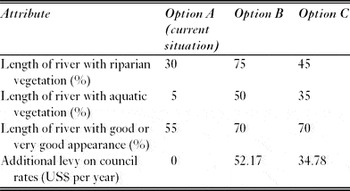
The design of the choice sets includes selection of attributes and levels, the options to be presented and the experimental design. Jurors were presented with choice sets, each containing a ‘do-nothing’ or status quo option and two options or alternatives (Table 1). The options or alternatives offered were generic, describing specified improvements in water quality attributes rather than a specified policy mechanism or course of action.
An example of a choice set presented to respondents. Respondents were asked to indicate the option they preferred.

Scientific experts have identified the attributes of a healthy freshwater ecosystem habitat to include an abundance of submerged aquatic vegetation comprised of macrophytes (aquatic plants), an abundance of emergent aquatic vegetation comprised of grasses, sedges and reeds, as well as riparian vegetation, sandy beaches and clear water (NRW [Natural Resources and Water] 1997). For the purpose of this study, three ecosystem attributes were selected, namely riparian vegetation, aquatic vegetation and appearance. Appearance was defined for this study as an absence of floating rubbish, oil, grease and substances from effluent and storm water run-off that produce an undesirable muddy colour and foaming. The appropriate levels that these attributes could be offered to survey respondents were determined from extensive research on the state of the Bremer River (NRW 1997) and following discussion with scientists from the SEQ Healthy Waterways Partnership. The ecosystem attributes and levels these were offered to respondents were discussed with the SEQ Healthy Waterways Partnership and were considered appropriate and consistent with the most recent waterways strategy for south-east Queensland (SEQ Healthy Waterways Partnership 2007). In addition, the attributes, the levels assigned across options and the plausibility of the monetary attribute and its acceptance, particularly with respect to the payment vehicle (an annual levy on council rates), were assessed through a focus group who were members of the Rural Consultative Committee supported by the local council.
Jurors selected the option they preferred within each choice set. Each option within a choice set was presented as a series of levels of specific attributes of water quality, where one attribute was the cost of implementation to the householder. The levels of the attributes describing the options were designed to vary in accordance with an experimental design that allowed estimates of the relative importance of each attribute describing the options to be calculated (Lazari & Anderson Reference Lazari and Anderson1993). The assignment of attribute levels to options for valuation of water quality in the Bremer River catchment was designed to be consistent with an orthogonal experimental design (Lazari & Anderson Reference Lazari and Anderson1993; Bateman et al. Reference Bateman, Carson, Day, Hanemann, Hanley, Hett, Jones-Lee, Loomes, Mourato, Ozdemiroglu, Pearce, Sugden and Swanson2002). Orthogonality ensures that the separate importance of all attributes can be estimated through the choice model. A fractional factorial sampling scheme (Cochran & Cox Reference Cochran and Cox1957) that comprised a sub-set of the large number of attribute level combinations was then used to enable the survey to be feasible given the number of respondents. Under this scheme all main effects can be estimated but not the interaction terms (Cochran & Cox Reference Cochran and Cox1957). The four attributes (including the levy) were set at four levels across three options. Each choice set presented to jurors consisted of the status quo and two generic options.
The status quo (option A) was described as having:
• 30% of the total length of the streams and rivers in the catchment with riparian vegetation in moderate or better condition;
• 5% of the total length of the streams and rivers in the catchment with aquatic vegetation in moderate condition;
• 55% of the total length of the river with good or very good visual appearance; and
• A$ 0 annual levy on council rates.
The adoption of the jury approach to conduct the survey restricted the number of attributes and levels of attributes that could be included in the choice sets. It was considered that a questionnaire comprised of 27 choice sets was the upper limit of tolerance by individual jurors.
Statistical analysis
The statistical model adopted to estimate the relationship between jurors' choices and the attributes of the options presented to the jurors, was that the probability a given option would be chosen would be a function of the expected utility, V, derived from the option in question and each of the other options in the choice set. The option offering the highest expected utility has the highest choice probability. For the purposes of this study, a nested logit model (McFadden Reference McFadden1986) was adopted, as this more closely represented the structure of the decision that jurors were likely to make. Specifically, respondents were seen to choose between ‘doing something’ and ‘doing nothing’. The status quo option (option A) was the ‘do nothing’ alternative. If the respondent chose the ‘do something’ branch of the nest, then they could choose one of two alternatives, option B or option C. Once a choice was made to ‘do something’, their subsequent choice between options B and C was based on the level of the attributes describing the options.
The attributes included as variables determining utility in the nested logit model were RIPARIAN VEGETATION, AQUATIC VEGETATION, and APPEARANCE. The levy attribute was included as the variable DOLLAR. In addition, an alternative specific constant was included in the utility functions for options B and C (Morrison et al. Reference Morrison, Bennett and Blamey1999).
Equivalence test of the two models
The equivalence test of the two models to determine the equivalence of the models prior to and at the conclusion of the jury proceedings followed the work of Swait and Louviere (Reference Swait and Louviere1993) and Morrison et al. (Reference Morrison, Bennett, Blamey and Louviere2002). Following Swait and Louviere (Reference Swait and Louviere1993), it is possible to test the hypothesis that the two data sets are equal, except for differences in variance. The hypothesis to be tested is:

where βp and βf are the taste parameter vectors corresponding to the preliminary and final datasets, and λ represents the ratio of scale parameters. The scale parameter is inversely related to the variance, but is confounded by the vector of utility parameters (Swait & Louviere Reference Swait and Louviere1993). The equivalence of the overall models is tested after allowing for differences in variance. Although it is not possible to estimate the scale parameter directly, a method has been devised to identify the ratio of the scale parameter between two data sets. Morrison et al. (Reference Morrison, Bennett, Blamey and Louviere2002) suggested that the ratio can be estimated by stacking the two datasets and conducting a one-dimensional grid search using a range of values for the scale parameter. The value of the scale parameter is found when the log-likelihood of the nested logit model, using the stacked data, is maximized.
To establish the effect of socioeconomic characteristics of jurors on choice of option, education level (EDUCATION) and work status (WORK) were included in the model (Morrison et al. Reference Morrison, Bennett, Blamey and Louviere2002).
Implicit prices
The coefficients estimated from the logit models for each survey were used to estimate the implicit prices for percentage changes in individual attributes of water quality improvement.
To derive the implicit prices for individual attributes, the coefficient of each variable is divided by the coefficient of the DOLLAR variable (the levy). Implicit prices provide a point estimate of the value of a one unit change in the level of an attribute. They are marginal values in the sense that they represent the value of a small change in one of the attributes. The implicit price for each attribute is based on the assumptions that all other attributes are held constant except for the attribute for which the implicit price is being calculated, and that the marginal utility of each attribute remains at the same level. Thus, implicit prices represent the average amount that an individual is willing to pay for an additional unit of the attribute.
Implicit prices are useful for management decisions where information is required about the relative importance people place on the various attributes and can assist policy-makers to devise management regimes that best meet the preferences of the community.
WTP for water quality improvements
The results of the logit models enabled the estimation of WTP for a number of distinct scenarios for improving water quality. Estimation of the overall WTP for a change from the current to an alternative situation represents the change in consumer surplus. Thus, the consumer surplus (CS) can be estimated by:

where bM is the coefficient of DOLLARS; VC represents the utility of the current situation and VN represents the utility of the new option (Hanemann Reference Hanemann1984; Morrison et al. Reference Morrison, Bennett and Blamey1999).
RESULTS
Statistical results
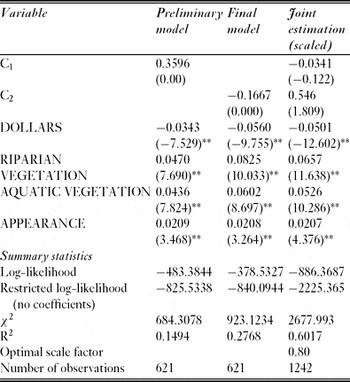
A conditional logit model at one level was run but the adjusted R2 improved using a conditional logit model nested at two levels from the preliminary and final models derived from the preliminary and final surveys; this nested model was retained for the further analysis (Table 2). We tested to ensure that the assumption of independently and identically distributed (IID or Gumbell) errors was not violated.
Estimated coefficients of nested logit models derived from preliminary and final surveys. The numbers in parentheses are t-statistics.** p < 0.05.

For the preliminary model, the likelihood ratio test produced a χ2 value of 0.8104. There were four degrees of freedom, and the critical value of the χ2 statistic at the 5% significance level was 9.488. Similarly, for the final model, the likelihood ratio test produced a χ2 value of 3.3751. Again, there were four degrees of freedom and the critical value of the χ2 statistic at the 5% significance level was 9.488. Thus, the assumption of IID was not violated in either case.
There was an improvement in the adjusted R2 value in the final survey (Table 2). Values of R2 between 0.2 and 0.4 are considered to be good fits for logit regression analysis (Morrison et al. Reference Morrison, Bennett and Blamey1999).
Equivalence of models
The Swait and Louviere (Reference Swait and Louviere1993) test was used to determine whether the hypothesis that the models derived from the preliminary and final surveys are equivalent should be rejected. The test statistic is:

where LR is the log-likelihood scale ratio, Lλ is the log-likelihood calculated using the combined data set that has been rescaled, Lp is the log-likelihood using the preliminary data set and Lf is the log-likelihood calculated using the final data set. Here, LR = −2[−886.3687 – (−483.3844 + −378.5327)] = 48.9032 (Table 2).
The critical value of the χ2 statistic at the 5% significance level was 7.81 with three degrees of freedom. The hypothesis of equality of the models was rejected, and we concluded that the models differ from each other.
Significance of socioeconomic and attitudinal interactions
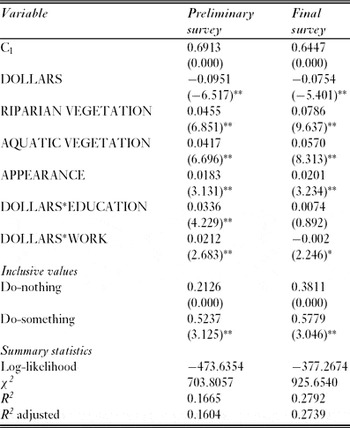
Variables EDUCATION and WORK were initially included and interacted with DOLLARS (Table 3). While this proved the best fit for the preliminary model, EDUCATION was no longer significant at the 5% level in the final model and the statistical significance of WORK declined in the final model.
Nested logit models derived from preliminary and final surveys, including interaction of EDUCATION and WORK with DOLLARS. The numbers in parentheses are t-statistics. *p < 0.05, **p < 0.01.

EDUCATION does not appear to affect the DOLLAR attribute in the final model.
WTP for water quality improvements
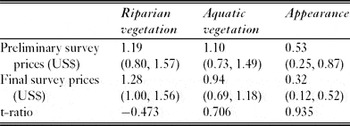
The implicit prices for the preliminary and final models derived from the two surveys represent the estimated WTP for a 1% increase in one of the attributes (Table 4). Estimates of the implicit prices for the attributes differed between the preliminary and final surveys. The highest WTP was for an increase in RIPARIAN VEGETATION with a value of US$ 1.19 in the preliminary survey and US$ 1.28 in the final survey. APPEARANCE was the least important of the attributes presented in the final model. The value for APPEARANCE per 1% change dropped from US$ 0.53 in the initial survey to US$ 0.32 in the survey following the jury.
Implicit prices (US$) and confidence intervals of the attributes derived from the preliminary and final surveys. Numbers in parenthesis are lower and upper 95% confidence bounds.

Estimation of willingness-to-pay for hypothetical scenarios
We assessed jurors' WTP for four hypothetical scenarios ranging from the current condition to a substantial improvement in water quality (Table 5). The WTP represents the estimated benefits in monetary terms to the jurors of an improvement in water quality and does not take into account the costs of achieving the improvements. Nevertheless, the WTP for the scenarios provides information for decision-makers on the worth of the improvements, which can be weighed against the costs.
Willingness to pay to improve water quality in the Bremer River, derived from final survey. Numbers in parenthesis are lower and upper 95% confidence bounds.

For example, a hypothetical moderate improvement in the health of the Bremer River is described as:
• 50% of the total length of the streams and rivers in the catchment with riparian vegetation in moderate or better condition (a 20% increase);
• 10% of the total length of the streams and rivers in the catchment with aquatic vegetation in moderate condition (a 5% increase); and
• 65% of the total length of the river with good or very good visual appearance (a 10% increase).
• The estimated benefit to the jurors for this scenario is US$ 33.50 per household per year. This is the amount that they would be willing to pay per year to achieve the improvement from the current situation.
DISCUSSION
The citizens' jury is one possible approach to discursive communication. The citizens' jury was used here to disseminate information to a group of people from the Bremer River catchment. The research findings described here support the conclusions of Davis and Whittington (Reference Davis and Whittington1998); MacMillan et al. (Reference MacMillan, Hanley and Lienhoop2005); Álvarez-Farizo and Hanley (Reference Álvarez-Farizo and Hanley2006); Hanley et al. (Reference Hanley, Wright and Álvarez-Farizo2006) and Fischer and Hanley (Reference Fischer and Hanley2007), suggesting that deliberative valuation approaches provide survey participants with more time to absorb sometimes complex information and deliberate over issues, to reduce the variability of stated preference valuation estimates.
The improved statistical reliability of the final model, greater emphasis on RIPARIAN VEGETATION reflected in the increase in the implicit price, together with the reduced statistical significance of EDUCATION suggest that jurors based their choices in the final survey on the information provided through the jury proceedings. This finding is important and supports the claims that survey respondents require more information and benefit from discussions in group settings for less familiar goods such as water quality services (MacMillan et al. Reference MacMillan, Hanley and Lienhoop2005; Christie et al. Reference Christie, Hanley, Warren, Murphy, Wright and Hyde2006).
In addition, the reduced statistical significance of WORK in the final model might be interpreted as jurors responding with the whole community in mind (as citizens) rather than as individual consumers, however, this is conjecture. Nor is it possible, for this study at least, to separate the effect of information on formation of preferences from the effect of small group decision-making (Álvarez-Farizo et al. Reference Álvarez-Farizo, Hanley, Barberán and Lázaro2007). However, the findings from the final model are more convincing for policy-makers. From a management perspective, the results from the final model provide decision-makers with statistically reliable information on which they could develop management actions that would best meet the preferences of jurors (as representatives of the catchment community). This supports the claims of Sagoff (Reference Sagoff1998) that citizen groups convened to assess proposed policies enhance the perceived quality and legitimacy of policy decisions.
A valuable role for the proceedings of the jury, with respect to estimation of the WTP was framing the valuation of water quality in the catchment in the context of how authorities are currently directing expenditure and the opportunity cost associated with changes to expenditure. One of the concerns expressed by jurors during the proceedings was the extent to which more resources devoted to the environment would affect resources available to meet other needs such as health and education. The citizens' jury increased the level of awareness of jurors about the context for the valuation and in particular about the substitute options for public monies and the trade-offs implicit in their choice of option.
Although the objective of conducting a citizens' jury to determine the effect of information on juror preferences, the enthusiasm with which jurors participated in the proceedings, asking questions of experts and deliberating the issues between themselves, demonstrated that participants enjoyed this form of public participation in decision making. Moreover, in accordance with jurors' request, the findings from the proceedings were presented to local authorities and were well received. Management actions to improve water quality have been increased and greater emphasis has been placed on restoration of riparian vegetation.
This approach is not without limitations; for example only a limited number of attributes were included in the choice sets. As the number of attributes increases, so does the number of choice sets provided to respondents (Bateman et al. Reference Bateman, Carson, Day, Hanemann, Hanley, Hett, Jones-Lee, Loomes, Mourato, Ozdemiroglu, Pearce, Sugden and Swanson2002). If the survey had been conducted on the population of the Bremer catchment as a whole, then a blocked factorial would have been appropriate. Multiple citizens' juries conducted on the same issue with the same expert witnesses was an alternative that was not considered due to logistical problems associated with assembling the expert witnesses. More time to call additional witnesses might have further increased the information provided to jurors, however the jury was convened for two full days and two nights and any further call on juror time would have reduced the pool of jurors available and/or substantially increased the costs.
Another limitation of this approach is the difficulty of selecting a jury that could confidently be described as a stratified random sample of the relevant population. The approach used in this study may have resulted in a degree of bias, as those who responded to the advertisement were those who received the local newspaper.
Finally, using a citizens' jury to conduct the valuation survey means that owing to the small number of respondents it would be misleading to extrapolate the results to the population as a whole; however, it is possible to make inferences about how the population might value water quality improvements. In short, the information provided from a citizens' jury should not be used in situations where compensation issues are involved, but would be an appropriate tool in policy formation.
The role of citizens' juries, or more specifically deliberative valuation techniques, is summarized by Aldred and Jacobs (Reference Aldred and Jacobs2000) and Niemeyer and Spash (Reference Niemeyer and Spash2001) who considered that citizens' juries potentially enable policy-makers to build public trust and acknowledge the potential of citizens to make careful informed judgments on complex questions. Howarth and Wilson (Reference Howarth and Wilson2006) took the role of group deliberation, such as citizens' juries, further, suggesting that the decision made by reasoned discussion results in a value function which is representative of the whole group.
In conclusion, what can realistically be claimed about using a citizens' jury to conduct an environmental survey? Valuation surveys are expensive exercises in term of research resources, both time and money. The citizens' jury in this study cost c. US$ 13 043 and, from inception to the presentation of initial results, took a total of three months. Although the results can only be used to infer how the population would value water quality improvements, they provide a valuable source of information for policy formation. The importance of this information should not be trivialized. In a climate of transparency and accountability of decision making, policy makers are seeking avenues to engage the community. The citizens' jury in this study is demonstrated to have provided a forum for credible information about an unfamiliar good to be delivered in an environment where participants had the opportunity to engage in discussion and to respond as citizens. Kenyon et al. (Reference Kenyon, Hanley and Nevin2001) and Howarth and Wilson (Reference Howarth and Wilson2006) describe citizens' juries as allowing deliberation on an environmental issue in terms of what is best for society. Howarth and Wilson (Reference Howarth and Wilson2006) take this even further suggesting that the findings from a citizens' jury approach to environmental valuation address many of the biases associated with cost-benefit analysis. The survey results after the jury proceedings in this study are demonstrated to be more credible than prior to the proceedings, and policy makers should be confident about implementing improvements in water quality based on this information.
ACKNOWLEDGEMENTS
We would like to acknowledge the financial support of the Coastal CRC in this project and the support of Roger Shaw (Coastal CRC). In addition, we acknowledge the valuable advice provided by Rosemary James (CRES, ANU) in setting up the citizens' jury, as well as the contribution of Jan Tilden (Coastal CRC) who designed the advertisement calling for expressions of interest to sit on the jury. We would like to thank members of the focus group for their input, as well as the jurors and the expert witnesses whose participation in the proceedings of the jury was invaluable. Finally we would like to thank three anonymous referees for their constructive comments which have greatly enhanced the quality of this paper.