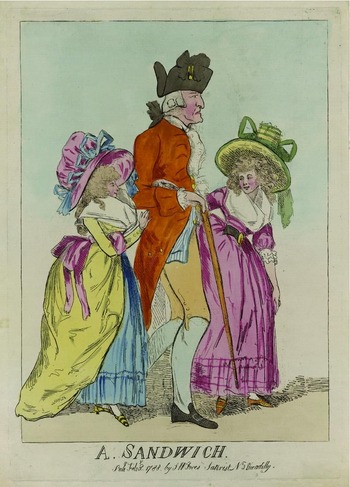
Let us begin with two sandwiches. These are two versions of a caricature from 1788 depicting John Montagu the earl of Sandwich, literally ‘sandwiched’ by two young women (Figures 1 and 2). Sandwich was one of the most prominent statesmen of his day, but nowadays tends to be remembered for three things: first, for the snack that he supposedly invented; second, for running the Admiralty during the disastrous American War; and third, for his scandalous lifestyle. He lived openly with his mistresses, one of whom was publicly murdered by an admirer. As we will see, his shortcomings as a public man were commonly related to those in his private morality – and, as such, he was one of the most caricatured people of his day. Caricature plays on appearance in order to exemplify personality, and Sandwich provided promising material for this since his defining physical feature was that he was very tall. The artist here is trying to make a comic point about the ageing libertine consorting with two young singers: Sandwich was a patron of music who was known to take singers for mistresses, and the print contains an obvious sexual innuendo. As we can see, in the first version they are of equivalent height, but the artist has redrawn the image in order to exaggerate the height difference. Why did the artist do this and what point were they trying to make? In order to explain this, we have to attend to the wider historical significance of male height, and to think critically about how historians have studied masculinity and the body. We will return to Sandwich at the end of this article, since he provides a telling case-study for why tallness was so rich in meaning in Georgian Britain.
‘A Sandwich’ (1 Jan. 1788). British Museum Satires 7421. © The Trustees of the British Museum.

‘A Sandwich’ (8 Feb. 1788). British Museum Satires 7421.A. © The Trustees of the British Museum.

I
Tallness is part of our everyday parlance for talking about men. This often carries implied moral evaluations, suggesting pride (to ‘walk tall’), rectitude (‘upright’) or greatness (someone ‘to look up to’). As Fanny Burney remarked of the duke of Wellington before Waterloo: ‘He looked remarkably well. . .Since his return to military command, he has an Air the most commanding, a high, superior port, & a look of animated spirit. I think he is grown taller!’Footnote 1 By contrast, Wellington's adversary Napoleon Bonaparte epitomises the negative associations of male shortness, being probably the most famous example of ‘short man syndrome’. In reality, Napoleon was about five feet six, which was average for the time and not much shorter than Wellington, but the symbolism was more important than the reality here. British caricaturists consistently mocked ‘little Boney’, suggesting that he was an ambitious usurper, whose aggressiveness overcompensated for this stature.Footnote 2 Lilliputian caricatures of Napoleon served to puncture his Romantic image as an epic warrior, reassuring Britons that this was a threat that could be defeated.
Given these strong associations, it is notable that historians rarely talk about height. It is part of the shorthand of the biographer, as we will see, but is not taken seriously in scholarly studies. In archaeological studies of the body, height is discussed only as a biological fact that relates to evolutionary changes or big shifts in the organisation in human society, such as the shift from hunting to farming.Footnote 3 The history of the body posits that the cultural meanings and the lived experience of bodies are contextually specific and loaded with political importance, but height plays little role in key sociological studies of the body.Footnote 4 Given its strong gendered associations, its absence from the histories of women and masculinity is striking, and epitomises gender historians’ neglect of the actual fabric of body in general.Footnote 5 Sabine Geiske's article on the height differential between men and women in heterosexual couples is a fascinating exception here: she argues that it was only in the eighteenth century that a tall woman being with a short man became an object of mockery, hinting at wider shifts in the power relations between the sexes.Footnote 6 On the other hand, we will see that height did not just signify dominance, and this is also an example of where masculinity is defined most powerfully in relation to other men, rather than to women.
The one branch of history that takes height seriously is demography. The eighteenth century is very significant for this field, since for the first time the modern state started to collect biometric data from institutionalised populations such as soldiers, convicts and the poor.Footnote 7 Demographers do not study height in its own right, but for what it indicates. Roderick Floud and others have made the case for an ‘anthropometric history’, where height is a key statistical marker of health and nutrition in a large population over a long period. Poor health and nutrition have a depressive effect upon height, and dips in average height occurred during periods of deprivation in Britain, such as the 1790s and the later nineteenth century.Footnote 8 In particular, age is an important variable here, as nutrition affects the growing years. People who are healthy and well fed reach their potential height sooner: nowadays it is typically age sixteen in girls and eighteen in boys, but in the eighteenth century, plebeian men continued to grow into their early twenties.Footnote 9 The eighteenth-century military continued to measure men's heights into their early twenties, as they recognised that their young recruits continued to grow. More could be said about the cultural significance of the growing lifecycle: it is striking, for example, that men reach their age of ‘majority’ when they attain their full height – twenty-one in the eighteenth century, and eighteen today. Maturity equals height: we all ‘grow up’.
Archaeological and demographic studies of height therefore have their limitations. On the other hand, they should remind us that we are dealing with a corporeal fact here, rather than just a facet of representation. People's height can relate in very real ways to their access to nutrition, and thence to their social class. Furthermore, height is a lived experience: the world looks different from different vantage points, and bodies of different sizes and shapes are different to inhabit and coordinate. As Floud notes, ‘height is a salient characteristic, one of our primary means of identification, one of the features of the body which it is most difficult to disguise’Footnote 10 – but men do try to disguise it, by wearing elevator shoes or altering their posture. The Gentleman's Magazine of 1798 contained an obituary of a schoolmaster who measured seven feet eight inches: ‘His breadth was in proportion to his length; but he was not athletic, nor, upon the whole, healthy. He died under 30 years of age, and a bachelor. Till within these last few years he appeared ashamed of his height, and contrived to stoop, that the disparity might not be seen.’Footnote 11 Very tall or short people alike can be subject to ridicule or social disadvantage, and bear the psychological weight of that.Footnote 12 Slang dictionaries from the eighteenth century contained numerous insults for tall men, including ‘gawkey’, ‘Jack of Legs’, ‘Gilly Gaupus’ and ‘Duke of Limbs’, the latter meaning ‘a tall awkward ill made fellow’.Footnote 13
Where the history of masculinity is concerned, therefore, the study of height presents an opportunity to reconnect the representation of gender with lived experience and bodily practice.Footnote 14 There are, unfortunately, a frustrating lack of sources where men reflect on their own experience of being tall or short: I have not found many for the eighteenth century, and this may be a classic case of an aspect of human life that was not written down, with all of the methodological challenges that this implies. Nevertheless, the use of more public and biometric sources can give us an insight into the significance that height had for eighteenth-century men.
As this brief survey shows, the history of height has largely been ignored. The obvious contrast here is with the history of weight, since there is a wealth of work on this by historians of medicine, gender and social policy. This is a hugely politicised area: fat is a feminist issue,Footnote 15 but also one that relates in important ways to class, race and corporate power.Footnote 16 In contrast with the history of weight, the history of height is currently written as quantitative rather than qualitative, natural rather than political, and biological rather than moral. As a corrective to this, this study will attempt to demonstrate that tallness is a facet of masculinity that has historically had a peculiar cultural significance.
II
Tall people have been recorded since ancient times. The Bible contains numerous giants of mythical heights, although some modern scholars put Goliath at a realistic six feet nine inches.Footnote 17 In the eighteenth century, it was generally believed that men had roughly been of the same height since the Creation, so giants were ‘Rarities and Wonders’.Footnote 18 There are numerous recorded instances of exceptionally tall people in Britain in the seventeenth and eighteenth centuries, some of whom lived normal lives and others who were exhibited for money.Footnote 19 One such was Charles Byrne, the famous ‘Irish Giant’, who was so concerned that his body would be acquired by surgeons for dissection that he requested a burial at sea. His wishes were not carried out and his skeleton (measuring seven feet seven inches) is still on display at the Royal College of Surgeons.Footnote 20
Up to the early modern period, height could be understood in terms of the humoral body. Whereas the phlegmatic person was ‘short and thick’ and the sanguine was ‘naturally fat’, height was identified with the choleric type. As the much-reprinted Sanitatis Salerni put it:
Within the humoral scheme, all bodies contained the four humours in different proportion, which combined physical attributes with personality types. Differences within and between genders were on a sliding scale: women possessed some choler, but it is notable that this ‘tall’ humour was primarily associated with masculinity.Footnote 22 A healthy body maintained a balance between the humours, so excessive height could be a sign of unhealthiness. Indeed, anxieties about the healthiness of the tall male continued throughout the eighteenth century.Footnote 23 And with good reason: tall bodies are inefficient, fragile, weaker and more prone to disease than shorter ones.Footnote 24
Aspects of the humoral body continued to coexist with its modern anatomical equivalent. Eighteenth-century physiology located the vital fluid for life in the semen, so excessive loss of semen was physically depletive.Footnote 25 The contemporary panic about masturbation therefore concerned bodily health as well as morality.Footnote 26 The anti-masturbation tract Onania of 1716 relates a letter from a young man who ‘learned the vicious Practice of self-pollution’ at the age of fifteen, and who physically suffered for it: ‘I han't grown either in Strength or Stature since I was about 17. I suppose by my cruelty to my self, I crush'd my before flourishing Nature.’Footnote 27 In a period when men would continue to grow into their twenties, this was stunting indeed.
The emerging body of the Enlightenment was conceived of more mechanistically, and the location of personality was shifting away from the guts – the repository of humoral fluids – and towards the brain and the nerves.Footnote 28 Nevertheless, the physical body was still linked to inner character in the eighteenth-century mind. The Sandwich cartoons show how caricature sought to ridicule individuals by exaggerating aspects of their appearance that were suggestive of their personality. As Amelia Rauser has argued, caricature was ‘a kind of personality x-ray machine. . .to look deep beneath the surface of a man and avoid the dangers of entrapment by a deceptive, artificial character’.Footnote 29 In this context, male height could retain its humoral associations with ambition, covetousness, boldness and craftiness: the language of the humours persisted as a way to describe personality. The satire ‘The Levee’ of 1783 mocked the Fox–North ministry, but singled out the tall earl of Hertford (Figure 3). His height here alludes to his reputation for avarice: the earl of Bristol noted that Hertford ‘has a constant appetite for all preferments for himself and family’.Footnote 30 As we will see, the humoral associations of tallness were remarkably enduring. A political handbill of 1820 cast aspersions on the character of the candidate for Newcastle: ‘He is a tall, thin, hungry-looking Young Man, apparently well calculated for filling a good sinecure Place.’Footnote 31 A lean figure suggested ravenousness, which was highly suspect in a political culture that prided independence and disinterestedness.
Edward Topham, ‘The Levee’ (21 Apr. 1783). British Museum Satires 6218. © The Trustees of the British Museum.

Nevertheless, male height was bound up with social class and political power. Economic historians have aggregated archaeological evidence of male height, charting the extent of height differences at any one time as an indicator of health inequality, and therefore social inequality. This accelerates after the early Middle Ages until it is much more pronounced during the early modern period.Footnote 32 This also had a geographic dimension: during the industrial revolution, the English urban working-class male was notably shorter than his rural counterpart.Footnote 33 Roy Porter notes that ‘the upper classes of society were literally taller – superiority of height enshrined and blazoned forth superiority of spirit: the lower classes were meant to look up to their betters’.Footnote 34 Their higher station in life was confirmed by their bodies. Being better fed and above manual labour, men of the aristocracy grew taller and did so younger, and their bodies were deliberately cultivated to develop an elegant and elongated frame.Footnote 35
Height was not just a matter of actual stature, since the elite had access to a range of strategies to emphasise a ‘tall’ body shape. Tailored clothing encourages the wearer to stand up straight, and since the medieval period men's clothes had become increasingly fitted, emphasising the shapeliness of the leg in particular.Footnote 36 In the eighteenth century, the three-piece suit became the uniform of the upper-class Englishman, embodying their moral and political authority in a particular silhouette.Footnote 37 Elite men wore heeled shoes, aping Louis XIV whose talons rouge symbolised his ability to trample his opponents. Heeled mules and equestrian boots gave men of the upper classes a significant height advantage over their inferiors, so linked masculinity to class in a material way.Footnote 38 (High heels – and the body shape, distinctive walk and impracticality that come with wearing them – would not acquire their current association with femininity until the Victorian period.Footnote 39 ) Finally, height could be enhanced by posture. Conduct literature emphasised the importance of ‘mien’ and ‘a good air’ as signs of good breeding. David Turner notes that this ‘combined dignity, ease, grace, and a lack of affectation’.Footnote 40 Although the intended effect was to appear ‘natural’, this could paradoxically only be achieved through careful cultivation. As Jane Desmond has argued, ‘the postural and gestural maintenance of class distinction was a necessary skill to be learned’.Footnote 41
The fact that it could be learned, however, potentially opened up the status associated with bodily refinement to humbler groups of people. The vogue for ‘politeness’ sought to refine manners beyond the world of the court, in order to promote social harmony and rational discourse. Bodily comportment was central to this project, since a pleasing exterior would facilitate refined interaction, and would present an individual's real virtues to their best advantage. As Stephen Philpot wrote in 1747, ‘Learning is, without doubt, absolutely necessary to qualify a Person designed for any Profession or genteel Employment. . .But, in order to give this valuable Accomplishment its proper Lustre, there must be added to it a polite and graceful Behaviour.’ Outer refinement should therefore be synchronised with inner virtue. He argued that parents should engage a dancing master for boys at an early age:
For if their Children have any Aukwardness in their Gait, or otherwise, when they are grown pretty large, it may be difficult to break them from such contracted ill Habits; or at least they will never be able to perform those graceful Actions of the Body, with that Ease and Unaffectedness as they would otherwise have done, had they begun sooner; but their Motions will always appear stiff and unnatural. Besides, when they are grown pretty big, they are apt to be ashamed to learn; and perhaps their Aukwardness will be so settled and fixed, that it may not be in the Power of any Master to alter them.
Philpot considered that English boys were characterised by ‘excessive Bashfulness’ and fail to ‘hold up their heads, keep themselves upright, walk so, look at People who speak to them, or pay them a compliment’ for fear of being considered ‘proud or impudent’: his regime of dance and comportment sought to correct these failings in character and stature.Footnote 42
Philpot was not alone in focusing on the young, since medical treatises ‘advocated firmness but tenderness with infants’ bodies’ so as to promote straightness.Footnote 43 Much of this focused on the spine. Nicholas Andry's Orthopædia: Or, the Art of Correcting and Preventing Deformities in Children (1743) argued: ‘When the Spine is straight, well set, and finely turned, it makes a handsome Body; and when it is crooked and ill turned, the Body is deformed.’Footnote 44 Alun Withey argues that, whereas the correction of bodily shape could formerly be condemned as vanity or interfering with God's work, from the second half of the eighteenth century the practice was not only acceptable but desirable. A range of postural devices were commercially available, from stays and trusses, to steel ‘monitors’ that painfully corrected the slouch. Precisely what bodily ideal they were aiming for is unclear, since this was not explicitly defined,Footnote 45 but eighteenth-century aesthetics tended to emphasise classical proportion and symmetry. Andry, for one, suggested that ‘The Body, when it is neither too fat nor too thin, is five times as tall as it is broad.’Footnote 46 A tall body should therefore be appropriately proportioned: if caricature is a guide to deviance, then tall bodies that were too fat or (more usually) too thin were not ideal.
One of the most notorious proponents of polite behaviour was Lord Chesterfield, who famously instructed his illegitimate son Philip in the minutiae of refinement with a view to easing his progress into society. Chesterfield had himself laboured under the disadvantages of a ‘short stature, large head, and unprepossessing figure’, which hindered his progress at court as a young man, and he wished better for his son.Footnote 47 Chesterfield's 400 letters often dwelt on the bodily aspects of politeness and he took a close interest in his son's height. When his son was sixteen, he wrote: ‘The messenger told me, you were much grown, and, to the best of his guess, within two inches as tall as I am; that you were plump, and looked healthy and strong.’Footnote 48 And the following year: ‘He tells me that you are taller than I am, which I am very glad of: I desire that you may excel me in everything else too.’Footnote 49 This was not just a father's pride in a growing lad, since a tall body was a polite body, suited to refined comportment and to impressing in company.
When these private letters were published in 1774, they caused a storm. Towards the end of the eighteenth century, politeness fell from vogue. Chesterfield's letters – which would have been more acceptable when they were written in the 1740s – now appeared to be cynical and self-serving, and to epitomise the superficiality of politeness in general. The new fashion for ‘feeling’ emphasised that men should be sincere, straightforward and independent.Footnote 50 This was commonly bound up with a critique of the ruling class, whom radicals and ‘patriots’ alleged were effeminate and culturally foreign. The rash of ‘macaroni’ caricatures, depicting tall, stooped and spindly bodies, therefore had a political edge. As we will see, this later-Georgian suspicion of exterior polish would have implications for the tall body.
III
Height in the English civilian man also took on connotations from other spheres, and the most important of these was the military. Historians of war have shown how the military and civilian society had shared values and experiences in the eighteenth century, to the extent that they were not yet regarded as being separate spheres.Footnote 51 The military carefully recorded the height of its recruits and this data is essential for modern demographic studies of the century. It is worth noting, however, that this data does have certain flaws for deducing the height of the civilian population as a whole.Footnote 52 Clearly, this only provides data for males, creating a ‘false universal’ for anthropometric history. The military had minimum height requirements, so shorter men do not appear in the returns, and furthermore the height standard varied according to the fluctuating demands for manpower. As a circular from the Adjutant General's Office put it when Britain was gearing up for war in December 1792:
His M[ajesty] having thought it proper to order an augmentation of 10 private men per company in the Regts of Foot on the British Estabt. to take place immediately, it is His M's further Pleasure, that the Standard for Recruiting on the present occasion, is to be lowered to 5 feet 6 inches for Men not exceeding 30 years of Age; Growing, well made Lads may be taken as low as 5 feet 5 inches.Footnote 53
These changing demands undermine demographers’ attempts to use this data to chart long-term changes in the height of the population. Furthermore, the military was highly selective in who it recruited as it was anxious to maximise the height of its recruits. Indeed, the fact that Irishmen and Scotsmen were taller than Englishmen in the eighteenth century may provide a biometric explanation for their disproportionate representation in the British army.Footnote 54
Military historians have long noted the eighteenth-century military's obsession with height.Footnote 55 There were good practical reasons for this. Regiments required men of broadly equivalent height in order to deploy volley fire on the battlefield. Tall men were better able to push a bayonet, throw a grenade, ‘jump a ditch, climb a breastwork and engage in other exertions’ required of eighteenth-century warfare.Footnote 56 Furthermore, the complex physical manoeuvres required to load a musket and to march in geometric formations required a body that was elongated and supple as well as disciplined and strong. As well as recruiting tall men, the army improved the stature of the men it already had through exercise, a protein-heavy diet and tailored clothing that forced them to stand up straight: humble redcoats had the famous upright bearing that their social betters would have to engage an expensive dancing master to acquire.Footnote 57
Tall soldiers were therefore prestigious and commanders jealously eyed the height of rival regiments. Taller recruits would serve in grenadier companies, who would flank the regiment at parade in their elaborate, towering hats. In part, tall soldiers were for show, since they showed off the tailored uniform to better effect (in a similar way to tall male servants, who were similarly sought-after as impressive footmen). As a manual from the 1770s noted:
A Soldier's Coat should be always tight over the breast (without restraint) for the sake of shewing his figure to more advantage. . .nothing more effectually exposes an ungraceful figure, than not having the hip buttons considerably lower than the upper part of the hip-bone: a long-waisted coat is in general allowed an addition to the genteelest shape, therefore should always be the military mode.Footnote 58
Military dress did change in line with civilian fashions, however. The end of the eighteenth century witnessed a shift from long to short coats, which in turn changed the proportion of the male body from short- to long-legged.Footnote 59 This more classical style served to emphasise the shapeliness of the leg, the prominence of the genitals and the overall height of the wearer. By the Napoleonic Wars, the British redcoat was sporting the short coatee, which sat above the waist. This was both more comely and more practical than long skirts – something the British army learned to their cost in the bushfighting of the American War. The Napoleonic redcoat also wore a tall cylindrical shako rather than the flat tricorne hat, further emphasising his height.
This preoccupation with tallness was taken to a ludicrous extreme by Frederick William of Prussia who, according to the British ambassador to Berlin, had an ‘unaccountable passion for great wellmade men’. He collected tall men from all over Europe for his Potsdam Lifeguards, which boasted grenadiers of seven feet tall. Neighbouring states could curry favour with Frederick William by sending him presents of tall men: in 1721, the British government sent him fifteen huge Irishmen which, the ambassador noted, was well received, ‘tho’ they are not of a size with some of the monsters there’.Footnote 60 Reputedly, Frederick William dressed his soldiers in coats, hats and breeches that were deliberately too small, in order to emphasise the visual impression of their height. It was not as if these were particularly effective soldiers, since they were known for being slow and feeble, so he never risked them in battle: indeed, this was one of the most peaceable periods in Prussia's history. In Britain, his obsession with tall soldiers came in for critical comment, since it appeared to epitomise the worst excesses of German absolutism and militarism (and was therefore implicitly critical of Britain's own military-obsessed Hanoverian monarchs). As a correspondent to the London Magazine put it:
His passion for tall men was extravagant, beyond belief; to recruit his great useless regiment of giants, he spared no expence, although covetous to excess, in his own disposition; nor in order to inveigle, or even kidnap a tall man, did his officers stick at fraud, perfidy or the grossest violations of the laws of society and of nations. . .But he exerted the natural roughness, and unfeelingness of his disposition, in breaking his troops to an obedience, and severity of discipline, unheard of before in Europe; which transformed men in to mere machines.Footnote 61
This epitomised the popular image of the German soldier – and, indeed, the German in general given their close association with professional soldiering. Caricatures of German soldiers were invariably of tall, marionette-like automatons, broken to obedience by absolutism, poverty and harsh discipline.Footnote 62
There is a further sense in which tallness could be associated with foreignness and unmanliness in Georgian Britain. Castrati from Italy were popular on London's operatic stage in the mid-century. Boys with promising voices were castrated so as to retain their soprano vocal range, and stars such as Farinelli and Tenducci had famously brilliant voices. Castration also had other physical effects: it disrupted the endochrine system which affected physical development and often resulted in them growing very tall.Footnote 63 Lack of testosterone also prevented bone joints hardening, so their ribcage continued to grow and their lungs were abnormally large: this helped them to perform their vocal acrobatics, but contributed to their distinctive physical appearance, which also included long limbs and small heads.Footnote 64 This is truly an example of where the body is plastic rather than being a biological constant. Farinelli was famously tall and clumsy with it: for all his vocal talents, he was a poor actor. As one commentator noted: ‘What Extasy to the Ear! But, Heavens! What Clumsiness! What Stupidity! What Offence to the Eye!’Footnote 65 The physical shape of the castrato was seized upon by caricaturists, who tapped into the ‘patriot’ charge that Italian opera was a popish foreign import, patronised by an unpatriotic and degenerate ruling class.Footnote 66
The question of whether castrati were unmasculine is more complex. They usually played heroic male roles on the stage, and they exuded a unique erotic appeal (which is dwelt upon in the 1994 feature film Farinelli). In the early modern period, the castrato arguably occupied a middle ground between men and women, within the sliding scale of ‘one sex’ gender difference.Footnote 67 As the century wore on, however, the castrato was an anomaly in a world that defined male citizenship in terms of domestic patriarchy and virile heterosexuality. The proceedings to annul Tenducci's marriage in the London courts in 1775 hinged on the question of whether a castrato could be a husband and, by extension, a man.Footnote 68 The tallness of the castrato became an increasingly jarring visual sign of their foreignness and gender deviance.
Male height in the eighteenth century was therefore a complex business. On the one hand, it had its familiar associations with dominance and power, although this was much more bound up with class difference than it is today.Footnote 69 On the other hand, excessive height could also take on much more negative character associations, within a political discourse that was suspicious of foreignness, despotism, militarism, luxury and popery. Nor were these merely representations: there were hundreds of castrati in Europe and thousands of German troops based in Britain, not to mention the tens of thousands of tall men who lived in a culture that was frequently hostile to them.
IV
With all this in mind, let us return to the earl of Sandwich. By taking his height seriously, it is possible to understand why he was such a controversial character at the time, and also why his reputation in the historiography has been so chequered. As his biographer N. A. M. Rodger has noted, Sandwich got a very rough deal from the Whig historians. For the Victorian constitutional historians, Sandwich did everything wrong. He was a government man and a career politician, at a time when public men were supposed to be politically and financially independent. He ran the Admiralty during one of Britain's most humiliating military defeats, a tenure that one Victorian biographer described as ‘disastrous’:
He now held this office for eleven years, during which time his conduct was as great a scandal to the public as it had all along been to private morality. Throughout his long administration he rendered the business of the admiralty subservient to the interests of his party, and employed the vast patronage of the office as an engine for bribery and political jobbery.Footnote 70
Moreover, he persecuted John Wilkes, the darling of the Whig historians. Sandwich led Wilkes's prosecution for obscene libel for the publication of his pornographic Essay on Woman. This led to charges of treachery and hypocrisy, as Wilkes and Sandwich were acquaintances and members of the libertine club the Monks of Medmenham, and Sandwich's domestic arrangements were hardly conventional.Footnote 71 Sandwich was therefore a gift to the Victorian Whig historians, who required politicians to be virtuous in both public and private, and who wished to distract from the unpromising moralities of their heroes Wilkes and Charles James Fox.Footnote 72
This is not the place to reevaluate Sandwich's political record, as Rodger and others have already done so: in particular, he is now regarded as a very capable naval administrator. What is striking, however, is how systematically Sandwich's height has been emphasised by people trying to describe his character, both at the time and since. Victorian biographers alluded to his ‘uncouth’, ‘shambling’ and ‘not prepossessing’ appearance.Footnote 73 His contemporary Horace Walpole was characteristically unkind, and linked his awkwardness (a common metonym for height) to his public conduct:
Lord Sandwich was rapacious, but extravagant when it was to promote his own designs. His industry to carry any point he had in view was so remarkable, that for a long time the world mistook it for abilities; but as his manner was most awkward and unpolished, so his talents were but slight, when it was necessary to exert them in any higher light than in art and intrigue.Footnote 74
Even affectionate portrayals, such as that by his friend John Cradock, dwell on his height and clumsiness:
Lord Sandwich, when dressed, had a dignified appearance, but to see him in the street, he had an awkward, careless gait. Two gentlemen observing him when at Leicester, one of them remarked, ‘I think it is Lord Sandwich coming;’ the other replied that he thought he was mistaken. ‘Nay,’ says the gentleman, ‘I am sure it is Lord Sandwich; for, if you observe, he is walking down both sides of the street at once.’
Sandwich himself was typically good humoured about this. He often related the anecdote about his dancing master in Paris, who requested that he should never tell anyone who taught him to dance.Footnote 75
Sandwich may have been ungainly but he was not shy about his height. He was known for being physically exuberant: ‘Stretching out his strong legs and arms, whilst playing at skittles, Lord Sandwich would exult amazingly, if by chance he was able to knock down all nine.’Footnote 76 He was a keen sportsman and was particularly enthusiastic about cricket. Caricatures of Sandwich often identify him with a cricket bat. One of his political enemies was Sir George Townshend, who was a talented caricaturist as well as a leading opposition politician. He sketched Sandwich as skinny and hunched, with a cricket bat over his shoulder (Figure 4). Tellingly, Sandwich is dressed in the uniform and pointed hat of a Hanoverian grenadier: his tallness is here equated with German militarism. There was a political point to this, since Townshend was the champion of the New Militia, which sought to create a citizen army as an alternative to the standing army and the unpopular policy of deploying Hanoverian soldiers within England. Townshend's sketch was later incorporated into the satirical print, ‘The Recruiting Sergeant: Or Britannia's Happy Prospect’ (1757), which was one of the most famous anti-government caricatures of the day.Footnote 77 Sandwich is a browbeaten ‘recruit’ to the government, which is parading past a statue of a belligerent duke of Cumberland. Oddly, Sandwich here is not very tall in relation to the other figures: the print was assembled by the printseller from Townshend's sketches, and scale is rarely realistic in the early, emblematic tradition of caricature. But his physical build, small head, posture and military dress still signal his tallness.
George Townshend, sketch of John Montagu, 4th earl of Sandwich (1750s). National Portrait Gallery 4855(23). © National Portrait Gallery, London.

Most caricatures of Sandwich were hostile, as they tended to be towards government figures. Predictably, portraits that Sandwich commissioned of himself were more sympathetic, but even these made no attempt to conceal his height. Portraits of Sandwich in his robes of state are imperious and imposing, but Sandwich's physical build is rendered more realistically in Zoffany's informal portrait. Here, we see his elongated frame and sloping shoulders, but he still appears ‘the public man, suave and self-assured’.Footnote 78 He is portrayed here at his desk: he was very diligent and this is apparently how he wanted to be remembered. The story of the invention of the sandwich is relevant here. The story used to go that during a marathon gaming session he did not wish to leave the table, so requested a slice of beef between two pieces of toast.Footnote 79 An alternative explanation is that he snacked at his desk at the Admiralty, where he worked very long hours.Footnote 80 This encapsulates how his masculinity has played out in the historiography: Whig history portrays him as a debauchee, whereas Tory history portrays him as the original workaholic. His very industry, however, made him a problematic figure in Georgian public life. Sandwich inherited some parlous family finances, so the life of an independent statesman was not an option for him: he had to get by on his talents and seek paid administrative posts in government. Critics of Sandwich's status as a public man often highlighted his physical build: contemporaries and biographers alike allude to his ‘lean and hungry look’ in order to insinuate his ambition and dependence, harking back to the humoral associations of the ‘choleric’ man.Footnote 81
Sandwich's public reputation was further compromised by his reputation as a libertine.Footnote 82 John Wilkes, who was hardly one to talk, attacked his private life when he took his revenge in the North Briton in 1763:
His conduct, with respect to women, was not only loose and barefaced, but perfidious, mean, and tricking. He was restrained by no considerations of private character, nor checked by any regard to public decorum. Frauds of the lowest nature, enforced by perjuries and falshoods, were his only arts. With respect to men, he had early lost every sentiment of honour, and was grown exceedingly necessitous from the variety of his vices, as well as rapacious from the lust of gratifying them. Nature denied him wit, but gave him a species of buffoonery of the lowest kind, which was ridiculous in a man of fashion.Footnote 83
Here, we have the ‘patriot’ critique of Sandwich in a nutshell: avaricious, dependent, oppressive and clownish – all features that symbolically relate to his height. The reality of Sandwich's personal life was rather different. He had been happily married, but his wife suffered from mental illness so they lived apart while she was nursed by her sister. Subsequently, he lived with the singer Martha Ray, in a public and quasi-marital arrangement. Famously, Ray was murdered by a jealous suitor in the crowded foyer of the Royal Opera House. This sensational event served to define Sandwich thereafter,Footnote 84 and reinforced his reputation for libertinism at a time when private vice was becoming more problematic in public men. In the 1760s, Wilkes could flaunt his sexual freedom as a libertarian statement, but even he had to reinvent himself as a ‘reformed rake’ in the more sober 1780s.Footnote 85
Let us finally return to our opening question of how Sandwich was caricatured alongside women. In ‘The Contrast – A Park Scene’ of c. 1780, he towers over his unidentified female companion, who barely comes up to his belly. Sandwich is here the polite man at a time when politeness was becoming problematic. He is elegant but elongated, charming but somewhat sinister, aristocratic but a bit of an anachronism.Footnote 86 He is, though, portrayed more flatteringly here than in ‘A Sandwich’ of 1788. An older Sandwich appears hunched and haggard, his phallic walking cane drooping downwards. The original version (Figure 1) is the more realistic of the two, since in the redrawn image (Figure 2) the women's heads and torsos have been shrunk out of proportion, whereas he appears huge.
In the light of what we have discussed here, however, it is comprehensible why the artist should have chosen to do this. It is not just a question of underlining men's ‘natural’ dominance over women, to follow Geiske's argument: indeed, male height here serves to criticise character and undermine status.Footnote 87 Sandwich's height was shorthand for many of his supposed personality traits, in a culture where excessive male height was loaded with political, national and gendered meaning. When Sandwich started his political career in the 1740s, his tall frame may have been an asset in the polite world of Westminster, but by the time of the American War, it fell foul of an opposition political culture that was increasingly hostile to the manners and morals of the traditional ruling class. By then, the ‘polite’ frame of the tall man suggested a superficial public front: men were increasingly expected to be virtuous in both their public and their private lives, ushering in the Victorian morality that would be so unforgiving to men like Sandwich.
The Victorians expected men to possess moral manliness, rather than polished gentlemanliness, and had quite different ideals of the male body.Footnote 88 Whereas the Georgians prided elegance and proportion, Victorians valorised muscular power. Manly bodies were ‘robust, stout, hard bodies’,Footnote 89 emphasising the industrious arm rather than the shapely leg. The ideal military body changed in line with this, at a time when imperial militarism pervaded social values as never before. Whereas eighteenth-century warfare required elongated bodies that could move swiftly and elegantly on open ground, the nineteenth century saw the rise of light infantry tactics, where soldiers used individual initiative and took advantage of the terrain. Seven foot grenadiers were now a liability, whereas compact and tough bodies would be able to take cover and survive in the field. A military manual of 1901 warned recruiters that ‘the effectiveness of a force depends on its vigor rather than its size’. ‘It is a demonstrated fact that very tall men cannot for long support the fatigues of arduous military service’, and worse still, they ‘require proportionately more food than do those of smaller stature, besides presenting a larger surface to the bullet of the enemy’. The author therefore wondered whether the infantry should follow the cavalry in introducing maximum height requirements, turning the priorities of eighteenth-century recruiters on their head.Footnote 90
The tall male body could therefore be problematic in the nineteenth century as well as in the eighteenth, but for subtly different reasons. We therefore have to study carefully the specific meanings and physical experiences of the body in its particular era. Some historians of masculinity have recently expressed the concern that the field has become too preoccupied with representation, and that it has lost its ability to engage with real ‘events and experiences’.Footnote 91 Histories of embodiment therefore promise to re-ground the history of masculinity in the material, the physical and the personal. This article has shown how the experience of living in a tall body is qualitatively distinct from that of a shorter one, and that Georgians actively moulded the body through exercise, posture and material appurtenances. On the other hand, the case of male height also suggests that the cultural meanings attributed to bodies could change almost irrespective of the nature of bodies themselves. Frankly, few things could be more ‘corporeal’ than tallness, so this provides wider lessons for the field. Gender historians need to attend both to the representational and the corporeal, not least because Georgians were prone to tell tall stories about height.