Introduction
The sexual interaction among organisms plays a crucial role in determining their decisions of resource allocation and altering their lifetime fitness (Holt-Lunstad et al., Reference Holt-Lunstad, Smith and Layton2010; Amdam, Reference Amdam2011; Zhou et al., Reference Zhou, He and Wang2018; Bretman and Fricke, Reference Bretman and Fricke2019). An individual can influence its partner directly by sexual interaction or indirectly through sexual pheromones (Gendron et al., Reference Gendron, Kuo, Harvanek, Chung, Yew, Dierick and Pletcher2014; Shi and Murphy, Reference Shi and Murphy2014), especially for the sexually matured individuals who may engage in frequent sexual interactions with the opposite sex. For example, the males can trigger the earlier onset of female reproduction by transferring seminal fluids and sperm to the female (Avila et al., Reference Avila, Sirot, LaFlamme, Rubinstein and Wolfner2011) and shift the resource allocation of the female from somatic maintenance to egg production. This may accelerate the ageing rate and shorten the lifespan of the female, well-known as the cost of reproduction.
The cost of reproduction mainly derived from the different interests of the male and female in the sexual interaction, namely sexual conflict (Arnqvist and Rowe, Reference Arnqvist and Rowe2005). It arises when the female and male have a different optimal schedule of reproduction and optimal frequency of mating. Males and females sometimes employ different strategies to increase their own fitness and realize maximum reproductive success at the expense of the opposite sex (Chapman, Reference Chapman2001). On the one hand, males gain greater reproductive success through an earlier time of first mating. Hence, it is stated that selection favours males that ‘live fast, die young’ whereby they sacrifice longevity for mating opportunities (Carranza and Pérez-Barbería, Reference Carranza and Pérez-Barbería2007; Bonduriansky et al., Reference Bonduriansky, Maklakov, Zajitschek and Brooks2008). This idea is supported by the evidence that males reduced longevity when invested intensively in seeking partners early in life to gain advantages over the other competitors by secondary sexual trait expression (Partridge and Prowse, Reference Partridge and Prowse1997; Bonduriansky and Brassil, Reference Bonduriansky and Brassil2005). The males also increase early reproductive rates of their partners and reduce their sexual receptivity after mating (Arnqvist and Rowe, Reference Arnqvist and Rowe2005) to ensure their own paternity. This is especially true for animals that one successful mating is enough for female lifetime fertilization and first fertilization is advantageous in sperm competition. However, the earlier onset of offspring production can reduce future reproduction and survivorship of females (Chapman, Reference Chapman2001). On the other hand, males may be eager to mate multiply and repeatedly to sire as many as offspring as possible to pass their genes to the next generation. In contrast, it is possible for females to maximize their reproductive success by only one mating or a few mating (Arnqvist and Nilsson, Reference Arnqvist and Nilsson2000), because there is a limitation of the number of eggs female can produce and one mating or a few mating is sufficient for them to fertilize all the eggs. The excessive mating attempts from males towards females can turn out to be sexual harassment for them (Arnqvist and Rowe, Reference Arnqvist and Rowe2005).
The cost of social interaction mainly stems from four stages according to when they incurred: courtship/sexual harassment, copulation, egg production, and parental care (Kotiaho and Simmons, Reference Kotiaho and Simmons2003; Scharf et al., Reference Scharf, Peter and Martin2013). Among these costs, the cost associated with egg production is the most frequently addressed in previous studies because of the well-established methodology for measuring the female fecundity. Generally, it was accepted as the most severe cost for females compared with other costs (Partridge et al., Reference Partridge, Green and Fowler1987; Chapman et al., Reference Chapman, Takahisa, Smith and Partridge1998). There is also high cost for courtship, sexual harassment and copulation owing to the increased risk of physical injury, predation, sexually transmitted diseases and the reduced time for other activities such as feeding and oviposition (Rowe, Reference Rowe1992; Cordts and Partridge, Reference Cordts and Partridge1996; Réale et al., Reference Réale, Boussès and Chapuis1996; Shine et al., Reference Shine, O'Connor and Mason2000; Thrall et al., Reference Thrall, Antonovics and Dobson2000; Sakurai and Kasuya, Reference Sakurai and Kasuya2008). Finally, parental care can also lead to costs. For example, a study on dung beetles Onthophagus taurus, which offers provisions for their offspring growth, found that females with assistance from partners when provisioned broods lived longer than females did it alone (Hunt et al., Reference Hunt, Simmons and Kotiaho2002).
Although a wealth of documents examined the cost of sexual interaction, few reports have clarified the cost and benefit for both sexes (Lehmann, Reference Lehmann2012). The vast majority of them focused on females (Cocco et al., Reference Cocco, Muscas, Mura, Iodice, Savino and Lentini2018; Gerken and Campbell, Reference Gerken and Campbell2018; Lentini et al., Reference Lentini, Mura, Muscas, Nuvoli and Cocco2018; Wu et al., Reference Wu, Liu, Di and Yang2018) because their fitness traits such as lifespan and reproduction can be easily measured. It is traditionally assumed that reproduction incurs no cost for males as they only invest in the offspring by providing gene via the cheap sperms (Simmons, Reference Simmons2001). However, much evidence has been accumulating that cost can be imposed to males during pre-copulation guarding, fighting with rivals (Bretman et al., Reference Bretman, Westmancoat, Gage and Chapman2013), gametes production (Van Voorhies, Reference Van Voorhies1992), searching and signalling for females (Scharf et al., Reference Scharf, Peter and Martin2013). This emphasizes the need to investigate both sexes and to take the social environment as a contributing factor to fitness components.
Additionally, previous studies determining the cost of reproduction for both sex always failed to evaluate separately the costs of different stages, for example, copulation and sexual harassment. In polyandrous organisms such as fruit fly, a classic model species with the sexual reproductive system, females require several successful mating to achieve their maximum reproductive potential. Consequently, during the experiment, the females are always kept together with males throughout their life and thus experienced copulation and sexual harassment at the same time (e.g. Davies et al., Reference Davies, Kattel, Bhatia, Petherwick and Chapman2005; Zajitschek et al., Reference Zajitschek, Zajitschek, Friberg and Maklakov2013). Therefore, it is challenging to decouple the cost of copulation and sexual harassment. In this study, the two-spotted spider mites do not need multiple-mating; only one successful mating is enough to fertilize all the eggs. However, the males always coerce females to mate with them to maximize their reproductive output when no virgin females are available (Oku, Reference Oku2010). Therefore, it provides an ideal opportunity to study the cost of copulation and sexual harassment by only exposing females to males for only 24 h to allow for mating and avoid unnecessary sexual harassment later in life.
In this study, we investigated female and male fitness of arrhenotokous Tetranychus urticae under different mating statuses and regimes to clarify the fitness consequence of sexual interaction. Firstly, the effects of delayed mating were determined by comparing the life-history traits of mites mated at the 1-day-old and at 7-day-old. Secondly, we compared the fitness of mites exposed to their partners throughout the life with those who were separately reared mites after allowing to mate for 24 h to investigate the influence of repeated mating.
Materials and methods
Mite colony
T. urticae was obtained from Bioforce Ltd, Auckland, New Zealand, and a population of spider mites was established by releasing hundreds of females on young potted beans (Phaseolus vulgaris) in their two-leaf stage. This population was maintained in the greenhouse, Landcare Research, Auckland, New Zealand (see Li and Zhang, Reference Li and Zhang2016 for details).
Plant material
The common beans (P. vulgaris) were used in this experiment. They were all planted under the same conditions as above for the mite population but at another block free of insects. To make sure there were enough new plants at their two leaf-stages for the experiment, a new batch of beans was planted each week.
Rearing unit
The rearing unit consists of a piece of foam cube, 2.5 cm × 1.5 cm bean leaf disc with its upside down, plexiglass slide and film from bottom to top. The foam cube of 10 mm thick was placed on the bottom layer of leaf disc to keep leaf fresh. It was kept wet by adding 3–5 ml water twice every day. Then a plexiglass slide with a round hole in the centre (1.6 cm in diameter) was placed on the upper layer of the detached bean leaf disc; therefore the area of leaf disc available for mites was 200.9 mm2. The leaf necrotic area/individual eaten by spider mite was 0.92 mm2 every 5 days (Clotuche et al., Reference Clotuche, Mailleux, Deneubourg, Le Goff, Hance and Detrain2010), much smaller than the leaf area we provided. By offering excess food and room, we aimed to ensure spider mites in our experiment are free from competition with conspecifics. Some previous studies showed that the performance of spider mites such as survival and daily reproductive rates was independent of density even at a much higher density than this study (Li and Harmsen, Reference Li and Harmsen1993; Clotuche et al., Reference Clotuche, Mailleux, Deneubourg, Le Goff, Hance and Detrain2010). The round hole on the top was covered with a transparent clean film to form a cell for the mite. The unit was fixed together by an elastic band. The film was punctured with a fine insect pin to maintain suitable relative humidity without causing condensation. The experiment units were kept in a room at 25 ± 1°C, 12L:12D photoperiod and 60 ± 10% RH.
Experimental protocol
Before the experiment, newly emerged males and females were prepared. To obtain virgin males, females from the lab population in their last moulting stages were transferred onto fresh bean leaves and allowed to oviposit after they moulted. All these eggs would develop into males because the females were un-inseminated, whereas the virgin females were produced by the inseminated mothers. When the virgin males and females emerged, we randomly assigned them to one of the five treatments within 24 h. These treatments consisted of unmated male and female as control, and a fully crossed treatments with mating time (mated at 1-day-old/mated at 7-day-old) and time exposure to males (separated with male after paired for 24 h/together with male for the rest of life after paired), abbreviated as Unmated, Mated1S, Mated1T, Mated7S, and Mated7T in this paper hereafter.
During the experiment, the leaf discs were replaced with new ones regularly to ensure that the mites always had access to fresh food. The survival of each female and male was checked each day until their death. The number of eggs produced by each female was also recorded daily. Other female reproductive parameters such as their pre-reproductive lifespan, reproductive lifespan, post-reproductive lifespan were calculated. On the 10th day of adult emergence, eggs laid by the females in all treatments were collected and allowed to hatch on different fresh bean leaves. The offspring sex ratio was determined when they developed into adults. We removed from data analysis those females that had cohabited with males but were not successfully mated (i.e. produced only male offspring). Although 36 females and males were arranged in each mating treatment at the start of this experiment, only individuals that made it to the 7th-day post-emergence ‘cut-off’ were finally included in the data. Thus, the final sample sizes ranged from 16 to 26 for each treatment due to the missing mites and accidental death.
Data analysis
The survival of mites under different mating statuses was firstly analysed in a full model with sex and treatment as main factors (LLR = 7.31, df = 2, P = 0.026). The results indicated that there is a significant difference in survival between two sexes (Z = −2.628, P = 0.009). We then performed the pairwise comparison for survival curve among different treatments for each sex respectively to further explore the effects of mating status on survival by using the log-rank test of the Kaplan–Meier test. One-way analysis of variance was conducted to explore the effects of different mating regimes including unmated/mated, delayed mating and repeated mating on the longevity of both sexes, as well as on the reproductive parameters of females, for example, reproductive rate, lifetime fecundity. When the F test was significant for a parameter, post-hoc comparison was done with Tukey's honestly significant difference post-hoc tests to clarify the differences between treatments. To explore whether there is any significant interaction between delayed mating and repeated mating, two-way analysis of variance (ANOVA) was conducted with the control treatment (unmated males and females) removed in the model. The offspring sex ratio was calculated as the proportion of male offspring in the total number of offspring. For the unmated the females, no female offspring was observed, so it was removed from the final comparison. The male offspring ratio among the other four treatments were analysed by pairwise comparisons without adjusted P-values using the R function pairwise.prop.test at a significant level of P = 0.05. All data analyses were performed with R version 3.4.3 (R Core Team 2017).
Results
Effects of mating regimes on the survival and lifespan of female and male
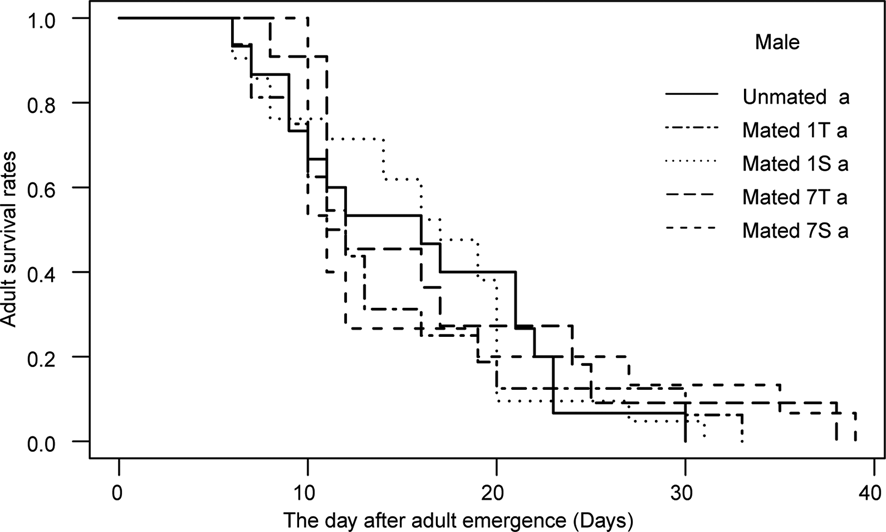
Females in different mating regimes differed significantly in their survival (χ2 = 16, df = 4, P = 0.00308; fig. 1) but not males (χ2 = 1.9, df = 4, P = 0.76; fig. 2). For females, both the females that mated at 1-day-old kept with and separated from male partner had significantly lower survival than the unmated females (Mated1T vs. Unmated, χ2 = 13.3, df = 1, P < 0.001, Mated1S vs. Unmated, χ2 = 7.9, df = 1, P = 0.005; fig. 1). The females that mated at adult emergence kept together with the male also has a lower survival than the delayed mating females without repeated mating (Mated1T vs. Mated7S, χ2 = 7.8, df = 1, P = 0.005; fig. 1). The survival rates of unmated females didn't differ with the females which had access to males when 7-day-old (Unmated vs. Mated7T and Unmated vs. Mated7S; P > 0.05; fig. 1). However, the males displayed non-significant response to delayed mating or repeated mating as indicated by the results that males in different groups have similar survivorship (χ2 = 1.9, df = 4, P = 0.76; fig. 2). These results indicated that mating regimes were an influential factor with regard to change the survival pattern of females.
Survivorship of female T. urticae in different mating regimes: unmated, mated at 1-day-old with repeated mating, mated at 1-day-old without repeated mating, mated at 7-day-old with repeated mating, mated at 7-day-old without repeated mating. Unmated, Mated1T, Mated1S, Mated7T, and Mated7S denote virgin females, females that mated at 1-day-old and kept together with male, females that mated at 1-day-old but separated with male, females that mated at 7-day-old and kept together with male, females that mated at 7-day-old but separated with male, respectively. The different letters following each treatment in the legends indicate the significant difference in survival rates.

Survivorship of male T. urticae in different mating regimes: unmated, mated at 1-day-old with repeated mating, mated at 1-day-old without repeated mating, mated at 7-day-old with repeated mating, mated at 7-day-old without repeated mating. Unmated, Mated1T, Mated1S, Mated7T, and Mated7S denote virgin males, males mated at 1-day-old and kept together with female, males mated at 1-day-old but separated with female, males mated at 7-day-old and kept together with female, males mated at 7-day-old but separated with female, respectively. The same letter following each treatment in the legends indicates that there was no significant difference across treatments.

The mean adult lifespan of females was longest in unmated females (22.0 days), followed by the females that mated 7-day-old regardless of repeated mating (20.7 days for Mated7S and 19.8 days for Mated7T; table 1). Within these three treatments, female longevity didn't differ significantly. However, they all outlived these that mated at 1-day-old. Moreover, compared with females cohabited with males along their life and experienced repeated mating, the females separated from males after mating for only 1 day lived significantly longer when they mated at 1-day-old (17.2 days for Mated1S vs. 15.8 days for Mated1T; table 1), but similar effects of repeated mating were not observed between females that mated 7-day-old (20.7 days for Mated7S vs. 19.8 days for Mated7T; table 1). The two-way ANOVA analysis indicated that delayed mating showed significant influence on female longevity (F = 5.972, P = 0.017) but not repeated mating (F = 0.586, P = 0.447; table 2). The males in different treatments did not differ in their average longevity, and further analysis also suggested that both delayed mating (F = 0.251, P = 0.618) and repeated mating (F = 0.051, P = 0.882; table 2) had no marked effects on male adult lifespan.
Effects of mating status: unmated, delayed mating and repeated mating on the female and male lifespan, maximum reproductive rate and post-reproductive lifespan of female T. urticae

Note: Mated1T and Mated1S denote spider mites mated at 1-day-old together and separated with their partner after 24 h. Mated7T and Mated7S denote spider mites mated at 7-day-old together and separated with their partner after 24 h.
Data (mean ± SE) presented in the same column with different letters are significantly different at the level of P = 0.05.
Two-way ANOVA of the effects of the delayed mating (mated at 1-day-old or 7-day-old) and repeated mating (cohabitating with a male for 1 day or all life-long) on lifespan of male and female spider mites T. urticae

Effects of mating regimes on female reproductive parameters
The differences in the mating status of spider mites also resulted in variation in reproductive parameters in females, especially for daily reproductive rates, maximum reproductive rates and reproductive lifespan. The daily reproductive rate was significantly higher with females that mated 1-day-old without repeated mating, followed by those mated 1-day-old experiencing repeated mating, lower for unmated females and delayed mating females (fig. 3A and table 3). Similarly, the highest maximum reproductive rates were also observed in females that mated 1-day-old without repeated mating (table 1). However, females in other treatments didn't differ significantly. The reproductive lifespan of females was much shorter in females that mated 1-day-old experiencing repeated mating with comparison to the unmated (F = 5.710, P = 0.010), delayed mating and repeated mating females, of which reproductive life span didn't differ within these treatments (P > 0.05, fig. 3B). The post-reproductive lifespan was lower in females mated 1-day-old irrespective of repeated mating, but didn't differ with that of unmated females and delayed mating females (F = 1.33, P = 0.260; table 1). In contrast, the total fecundity of females was not significantly affected by the mating status (F = 0.818, P = 0.516; fig. 3C and table 3). Additionally, the females didn't show difference in the male offspring ratio (χ2 = 2.540, df = 3, P = 0.468; fig. 3D) except that the offspring of unmated females were all males.
Effects of mating status: unmated, delayed mating and repeated mating on the reproductive parameters including mean daily reproductive rates (A), reproductive lifespan (B), lifetime fecundity (C) and male offspring ratio (D) of female T. urticae. Data are presented as mean ± SE. The bars with different letters are significantly different at the level of P = 0.05.

Analysis of variance of the effects of the delayed mating (mated at 1-day-old or 7-day-old) and repeated mating (cohabitating with a male for 1 day or all life-long) on reproductive parameters of female spider mites T. urticae

Discussion
In this study, we determined the effects of mating regimes in a spider mite which males and females have different mating regimes. Our results revealed that unmated females outlived the mated one. The females delayed mating for 7 days lived longer than that mated 1-day-old. The females that mated at 1-day-old were significantly affected by repeated mating, whereby the females kept together with males after mating had a shorter lifespan than the counterparts that were kept alone after mating for 1 day. However, for the females that mated at 7-day-old, the impact of repeated mating was not significant. In comparison with females, mating status didn't show significant influence on the survival and longevity of males. Our results suggested that differential optimal mating regime is one of the driving forces for sex-specific plasticity of longevity in this spider mite. Additionally, the non-significant difference in reproduction between females across treatments was observed as the reduction in daily reproductive rates of delayed mating females was compensated by increasing their reproductive lifespan.
Effects of mating and delayed mating on female longevity
The virgin females outlived females that mated at adult emergence. Similar results were also reported in other four species in this family, including Tetranychus marianae, Tetranychus neocaledonicus, Tetranychus fijiensis and Tetranychus lambi (Bonato and Gutierrez, Reference Bonato and Gutierrez1999). This may suggest the cost of reproduction to survival is substantial to females. Similar results also were reported in life-history studies with other organisms such as fruit fly (Flatt, Reference Flatt2011). This is in line with the fundamental theory of life history, survival trade-off against reproduction within constraints of limited resources (Kirkwood, Reference Kirkwood1977; Atwood and Bowen, Reference Atwood and Bowen2011). Our study further showed that the trade-off of resource allocation could be shifted by delayed mating. When the female spider mites delayed mating by 7 days, their lifespan was prolonged compared with that mated at adult emergence, but was not significantly different from those of the virgins. This might indicate that mating per se is not costly, but the cost of sexual harassment and egg production is high for female spider mites.
Results in our study indicated that females that mated at adult emergence cohabiting with males lived shorter than the females being reared isolated after mating for 1 day, supporting that sexual harassment has adverse effects on female longevity. Fitness cost of continual exposure of females to males was also reported in other polyandrous insects. Consistent with this study, females fly Drosophila simulans showed a decrease in lifespan when they were continuously exposed to males (Taylor et al., Reference Taylor, Wigmore, Hodgson, Wedell and Hosken2008). Some studies also documented sexual harassment lead to a decrease in female's oviposition (Li et al., Reference Li, Fail and Shelton2015). For instance, female Thrips tabaci with a male companion produced fewer eggs even they have similar longevity to those without a male partner throughout their lifetime (Li et al., Reference Li, Fail and Shelton2015). The entailed cost of repeated mating on survival and reproduction may be a consequence of reduced time for feeding (Heubel and Plath, Reference Heubel and Plath2008; Köhler et al., Reference Köhler, Hildenbrand, Schleucher, Riesch, Arias-Rodriguez, Streit and Plath2011).
The entailed cost on the survival of mated females can also be attributed to much more energy and nutrient investment on egg production. Although the females across treatments produced a similar number of eggs, the total amount of reproductive investment of unmated females is lower than those of mated females, given that the eggs produced by virgin females were much smaller in size than the mated females and the eggs for daughters are larger eggs for sons according to Macke et al. (Reference Macke, Magalhães, Khan, Luciano, Frantz, Facon and Olivieri2011 and Reference Macke, Magalhães, Do-Thi Khanh, Frantz, Facon and Olivieri2012). However, the delayed mating females and the unmated females had a similar lifespan. This suggested the negligible effects of repeated mating and egg production on lifespan. The steep decrease in daily reproductive rate after females being 5-day-old is a likely explanation. The number of eggs produced in the first 7 days accounts for around 60% of lifetime fecundity (summarized from our raw data). Therefore, the delayed mating females suffered less physiological cost compared with that mated at adult emergence.
Another important finding is that repeated mating reduced female lifespan when individuals exposed to sexual interaction at adult emergence but not these delayed mating females. This can be explained by the decrease in the attractiveness of aged females to males (Rasmy and Hussein, Reference Rasmy and Hussein1994) and less frequency of copulatory activity of males. In a previous study, it was demonstrated that 1-day-old virgin male could copulate on average 15.5 times per day, ranging from 2 to 31 times. By comparison, 8-day-old male copulated for only 3.5 times per day when virgin females were offered ad libitum (Krainacker and Carey, Reference Krainacker and Carey1989). Thus, our results demonstrated that the influence of repeated mating diminished in late age with the decrease in the physical cost of sexual interaction and physiological cost of egg production.
Effects of delayed mating and repeated mating on the reproduction of females
The total number of eggs produced by females across treatments did not differ, because the females that mated at adult emergence were observed to have a higher daily reproductive rate even their reproductive lifespan was shorter. Repeated mating only decreased mean daily reproductive rates of females that mated at adult emergence (10.5 for Mated1S vs. 8.88 for Mated1T), but not that of delayed mating females (7.84 for Mated7S vs. 7.42 for Mated7T). Previous studies also documented that sexual harassment decreased the oviposition rate of females (Oku, Reference Oku2010) in a shorter-term investigation. A possible explanation for the non-significant effects of repeated mating on the delayed mating female is the decrease in sexual harassment with the increasing of age (Krainacker and Carey, Reference Krainacker and Carey1989), similar to other organisms (e.g. Li et al., Reference Li, Jiang, Zhang, Shelton and Feng2014).
The male offspring ratio didn't differ between the mated females irrespective of their mating regimes. These results indicated that successful mating on the first day of adulthood can provide the female with a sufficient number of sperms to inseminate eggs. Males can transfer several hundreds of sperms to female at one time (Drenth-Diephuis and Pijnacker, Reference Drenth-Diephuis and Pijnacker1972), which is several times the number of eggs female can produce. Additionally, repeated mating is ineffective and could not increase the proportion of daughters produced. Altogether, males seem unlikely to benefit from mating repeatedly with females. Therefore, it comes surprisingly that males are willing to engage in repeated mating in the light that they are capable of distinguishing the mated female from virgin (Oku, Reference Oku2010; Rodrigues et al., Reference Rodrigues, Figueiredo, Varela, Olivieri and Magalhães2017), which is of interest for further research.
Effects of mating regimes on male longevity
In contrast to the females, there were no detectable effects of delayed mating and repeated mating on the adult lifespan of males. This result is consistent with our previous study that mated males kept together with a female throughout life has a similar lifespan to the unmated males (Li and Zhang, Reference Li and Zhang2020), indicating that there is a negligible cost of copulation, sexual harassment and ejaculation on male longevity. In light of the result of this study and our previous study, where males cohoused with males were reported to show decreased longevity (Li and Zhang, Reference Li and Zhang2020), it can be concluded that the cost of sexual interaction was less intensive than the inter-sexual interaction. The cost of inter-sexual interaction mainly comes at the earlier life mites when the competition and fighting for newly emerged females were fierce (Oku, Reference Oku2014). It will be interesting in the future to identify the potential cost in the pre-copulatory mating stage.
It is worth noting that the mating regimes investigated in this study showed distinctly different influences on males and females; similar results were also reported in model species fruit fly Drosophila melanogaster, which shows sex difference in response of lifespan to the social environment when reared in separate-sex and mixed-sex groups (Zajitschek et al., Reference Zajitschek, Zajitschek, Friberg and Maklakov2013). This may be attributed to the higher cost of reproduction in females than in males in case of spider mites in this study. Female spider mites suffered great cost from egg production and male sexual harassment during the experiment, whereas there is little cost of ejaculation and sexual attempts for males. Moreover, in our study the males are free from the cost in pre-copulatory mating stage since they were never exposed to any competitors throughout their life. Another potential reason for the sex difference in response to social interaction is their difference in energy demand, as generally the female has a higher investment in eggs than the males in sperm.
Conclusion
In conclusion, we showed that delayed mating and repeated mating have a remarkable influence on the fitness of spider mites. However, these effects were sex-specific, with only females being affected, but not males. The females lived longer when they were unmated and when mating is delayed owing to the reduced sexual harassment. We did not detect any substantial cost of mating on males, this confirmed that for male spider mites, copulation and sperm-producing were not costly. These results suggested that for females, superfluous sexual interactions were deleterious for them. Furthermore, the differential optimal mating regime is one of the explanations for the sex-specific plasticity of longevity.
Acknowledgements
We are thankful to Chris Winks of Landcare Research for general help in the greenhouse, Kevin Chang from Statistical Consulting Centre of the University of Auckland for advice on statistical analyses and anonymous reviewers for their valuable comments and suggestions. This research was supported by the PhD scholarship from China Scholarship Council to GYL and New Zealand Government core funding for Crown Research Institutes from the Ministry of Business, Innovation and Employment's Science and Innovation Group to ZQZ.
Author contributions
ZQZ and GYL conceived the idea and were responsible for the designing of the experiment. GYL carried out experiments, collected data, and conducted statistical analysis under the supervision of ZQZ. All authors discussed the analyses, results, contributed to the writing and approved this manuscript.
Conflict of interest
The authors declare that they have no conflict of interest.