Implications
Today, ensuring food safety in livestock production systems is a major concern. Regarding the exposure of free range livestock to persistent organic pollutants, such as chlordecone in the French West Indies, ingestion of polluted soils by farm animals has to be considered as a major contributor to their contamination. Indeed, herbivores at pasture are shown to transfer such pollutants since they can ingest significant amounts of soil in addition to herbage. This work allowed an evaluation of the soil intake of tethered cattle grazing in tropical conditions to identify agronomical practices for reducing soil intake and to establishing recommendations for grazing management.
Introduction
Feeding management of pasture for domestic herbivores presents lots of nutritional, economic and environmental advantages. These include grass being a well-balanced and cheap source of nutrients (Peyraud and Delaby, Reference Peyraud and Delaby2001), maintaining natural and marginal grasslands, and contributing to animal welfare (Burow et al., Reference Burow, Rousing, Thomsen, Otten and Sørensen2013). However, grazing also enhances soil intake by herbivores (soil particles on vegetation, root intake, Abrahams and Steigmajer, Reference Abrahams and Steigmajer2003) resulting in an increased exposure to gastrointestinal parasites (Stromberg, Reference Stromberg1997) and environmental contaminants (Laurent et al., Reference Laurent, Feidt and Laurent2005). Although ingested soil may be a source of mineral nutrients for animals (Thornton and Abrahams, Reference Thornton and Abrahams1983), several studies pointed out soil as being one of the main matrices for pollutants transfer to outside-reared animals (Beresford and Howard, Reference Beresford and Howard1991; Fries, Reference Fries1995; Matscheko et al., Reference Matscheko, Tysklind, de Wit, Bergek, Andersson and Sellström2002). Lipophilic properties of the persistent organic pollutants are responsible for their adsorption on soil components, which enables soil to retain and accumulate pollutants in the horizon surface longer than the other matrices (also called memory effect) (Jones et al., Reference Jones, Stratford, Waterhouse and Vogt1989; Duarte-Davidson and Jones, Reference Duarte-Davidson and Jones1996). Therefore, the exposure of free range animals to pollutants is closely linked to the amount of soil ingested which can be particularly high for some ruminants, up to 14% of the daily dry matter intake (DMI) in cattle (Fries et al., Reference Fries, Marrow and Snow1982), and up to 30% of DMI in sheep (Thornton and Abrahams, Reference Thornton and Abrahams1983) reported on pastures in very extensive temperate systems. Several authors reported that soil-bound persistent organic pollutants such as polychlorinated biphenyls in lactating goats (Feidt et al., Reference Feidt, Ounnas, Julien-David, Jurjanz, Toussaint, Jondreville and Rychen2013) and piglets (Delannoy et al., Reference Delannoy, Fournier, Tankari Dan-Badjo, Schwarz, Lerch, Rychen and Feidt2015), but also for chlordecone (CLD) in piglets (Bouveret et al., Reference Bouveret, Rychen, Lerch, Jondreville and Feidt2013) and growing lambs (Jurjanz et al., Reference Jurjanz, Jondreville, Mahieu, Fournier, Archimède, Rychen and Feidt2014) are highly bioavailable and fully absorbed in the digestive tract. Consequently, an accurate quantification of soil intake is required to evaluate the risk for food safety.
The French West Indies suffer from extensive pollution with CLD, a polycyclic ketone pesticide used until 1993 to fight against banana black weevil (Cosmopolites sordidus). The transfer of this pesticide into the food chain may engender severe damages on human health (Cabidoche et al., Reference Cabidoche, Achard, Cattan, Clermont-Dauphin, Massat and Sansoulet2009; Multigner et al., Reference Multigner, Kadhel, Rouget, Blanchet and Cordier2016). Post-tethered grazing is a practice commonly used in Caribbean Islands where 20% to 30% of animal producers manage a limited number of animals which are grazing on non-standard pasture areas (e.g. tethered at roadsides, on cane or banana field borders, in fallow areas or in orchards). However, when these practices are carried out on a limited area they can result in limited daily herbage allowance (DHA) and herbage losses due to trampling and deposition of faeces. Such reduced herbage offer would usually result in animals grazing closer to the soil, favouring greater soil intake. Most studies on soil intake by domestic herbivores were performed in temperate grazing conditions (Healy Reference Healy1968; Fries et al., Reference Fries, Marrow and Snow1982; Jurjanz et al., Reference Jurjanz, Feidt, Pérez-Prieto, Ribeiro Filho, Rychen and Delagarde2012). Meanwhile, no data are available for humid tropical Caribbean conditions or for post-tethered cattle to evaluate soil intake in these specific grazing systems. Indeed, the high grass production enhanced usually high stocking rates which could increase the risk of soil intake. This is a real difference to studies on soil intake in more or less extensive strip grazing systems in temperate (Fries et al., Reference Fries, Marrow and Snow1982; Jurjanz et al., Reference Jurjanz, Feidt, Pérez-Prieto, Ribeiro Filho, Rychen and Delagarde2012) or arid regions (Kirby and Stuth, Reference Kirby and Stuth1980). These studies identified in temperate conditions sward height and herbage allowance as main variation factors of soil intake. These farm-like factors are probably also relevant for tropical conditions even if the precise effect on soil intake of reduced herbage offer by tethered grazing and high stocking rates remains unknown.
The following trial aimed to evaluate the soil intake of post-tethered growing Creole bulls grazed in tropical conditions in order to evaluate the risk for exposure to soil-bound pollutants in these systems. Feed allowance was the variation factor studied using two contrasted levels of DHA (restrictive (RES) and non-restrictive (NRES)). These two DHA levels were achieved adapting daily surface area (DSA) offered to the animals according to pre-grazing sward surface height (SSH) (controlled factor). Daily herbage allowance and DSA variations were obtained by different chain lengths between the post and animal’s neck. The assumption can be made that the restrictive DHA could result in a higher soil intake for RES than NRES animals grazing a non-restrictive DHA. The first hypothesis is that the restrictive DHA could make that RES animals graze closer to the ground which would increase direct or indirect soil intake. The second hypothesis is that the low DSA associated to the restrictive DHA could favour trampling and intake of dirty herbage by RES animals. Finally, the third hypothesis assumes that the NRES level would lead to similar soil intakes than those reported in temperate conditions but RES level would increase this intake in an extent to be determined.
Material and methods
The experiment was conducted in farm-like conditions in accordance to the European Union and national legislation on animal care.
Treatments and experimental design
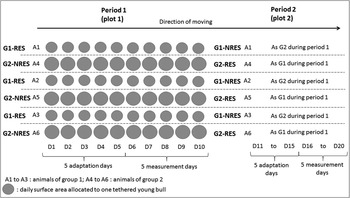
The experiment was performed at the Experimental Station ‘Duclos’ of the French INRA Institute (Petit-Bourg, Guadeloupe, France) (16°12'04.8'N, 61°39'53.4'W; altitude: 111 m) from 25 February to 5 April 2015). Six weaned bulls of the breed Creole of Guadeloupe (Bos taurus) alternatively received either a restrictive DHA of 71 g DM/kg BW0.75 or a higher daily herbage allowance of 128 g DM/kg BW0.75. These DHA measured 2 cm above the ground level, corresponded to less than, or a satisfying level in respect to the requirements of moderate cattle growth (INRA, 2010). These two treatments were tested in a cross-over design during two successive 10-days periods (Period 1 from 18 to 27 March, Period 2 from 27 March to 5 April 2015) (Figure 1). Samples of herbage and faeces were taken during the last 5 days of each period. Animals were post-tethered and constrained by a chain from their neck to a post to graze in a limited circular area. Minimum and maximum temperature was on average 19.6±0.2 and 28.1±0.2°C during period 1, and 20.3±0.4 and 27.9±0.2°C during period 2 (mean±SE). Mean daily rainfall was 2.15±0.75 and 6.80±2.85 mm for periods 1 and 2, respectively (mean±SE).
Cross-over design and main measurements. RES=restrictive treatment, NRES=non-restrictive treatment, DHA=daily herbage allowance, DSA=daily surface area.

Animals and pre-experimental period
The six bulls were born between 5 May and 9 July 2014 at the INRA station ‘Gardel’ (Le Moule, Guadeloupe, France). After weaning, the animals were accustomed on a neighbouring plot covered by the same herbage type to tethered grazing in a pre-experimental period from 25 February to 17 March 2015. This period allowed estimation of the daily herbage allowances for RES and NRES treatments and to calibrate surfaces offered to the animals at the experimental conditions. The young bulls were divided into two groups (G1 and G2) depending on age (G1: 9.0±0.1 and G2: 9.3±0.7 months old; mean±SE) and body weight (BW) determined by a barymetric ribbon (G1: 174.7±11.3 kg; G2: 152.3±15.8 kg; mean±SE). The first group was assigned to the RES treatment in period 1 and to the NRES treatment in period 2, and vice versa for the second group.
Grazing management
Animals were tethered grazed on a Para grass pasture (Brachiaria mutica) divided into two plots for each experimental period. The two plots were mown beforehand to 3 cm on two different dates to ensure the same time of regrowth and identical vegetation stage for measurements. A mineral fertilization of 100 kg/ha (NPK 27-9-18) was applied on both plots after the mowing. Every morning at 0800 h, each young bull was offered fresh herbage by moving its post on a new area to control daily herbage allowance and limit intake fluctuations (Figure 2). Posts were spaced 9.20 m from each other to avoid any contamination of a grazing circle by faeces of another individual (for intake measurements). The two contrasted levels of DHA (RES: 71 g DM/kg BW0.75; NRES: 128 g DM/kg BW0.75) were attained by variation of the daily surface offered to the animals, modulated by animal neck-to-post chain length. Daily surface allowance was individually calculated using the average SSH and a regression of the corresponding SSH–herbage mass. Sward surface height was measured in the next circle to be grazed by animals, every day before moving them into this circle. Sward surface height herbage regression between SSH and herbage mass was realized during the pre-experimental period using a large range of SSH, to estimate the available herbage mass in grazing circles (see ‘Vegetation characteristics’ section).
Grazing management of the two groups of tethered young bulls (G1: animals A1 to A3, and G2: animals A4 to A6) during the ten days (period 1: D1 to D10, period 2: D11 to D20) of each experimental period.

Vegetation characteristics
Sward surface height and herbage mass were simultaneously recorded from 6 to 31 March 2015 in several 30×30 cm quadrats (900 cm2), randomly selected in both plots in a large range of SSH (3.5 to 27.5 cm) out of areas reserved for grazing circle in order to establish the SSH–herbage mass regression. One measure of SSH per quadrat was measured using a herbometer (Herbometre®, Arvalis, Paris, France), following which herbage inside each quadrat was cut with a lawn-mower (Isio, Lithium-Ion Technology; Bosch, Renningen, Germany) to 2 cm above ground level. Herbage was weighed and one sample per quadrat was dried for 48 h at 60°C to determine herbage DM content and then calculate herbage mass and establish the SSH–herbage mass regression. Fifteen pre-grazing SSH measurements were made in each grazing circle before the animals entered so that chain length could be determined using the SSH–herbage mass regression according to the targeted restrictive and normal DHA. Post-grazing SSH was also measured every day from 15 random points per circle. Herbage was sampled twice daily during the last 5 days of each period near each grazing circle in order to not interfere with the herbage allowance provided by the circle, using the previously described methodology (cutting at 2 cm of the ground level with a lawn-mower). Samples were washed in water at 30°C with detergent (TFD4 at 3%) to remove soil particles, then weighed and dried at 60°C until constant weight to determine DM content. These DM values allowed to calculate a posteriori the estimate the daily herbage mass offered to each animal. The 10 samples for each animal and period were combined in equal proportions to form one per animal and per period for analysis of organic matter (OM), ash (incineration at 550°C during 6 h) and CP contents (Dumas method, AOAC Official Method 990.03, AOAC International, 2005) by URZ laboratory (INRA Guadeloupe, France, using a ‘Rapid N Cube’ by Elementar Analysensysteme GmbH) and for titanium (Ti) content (Inductively Coupled Plasma Mass Spectrometry method, Limit of quantification LOQ=5 mg Ti/kg DM; see ‘Soil intake’ section) by laboratory UT2A (Ultra Traces Analyses d’Aquitaine, Pau, France).
Dry matter intake
Daily DMI was estimated for each animal for the last 5 days of each period (23 to 27 March for period 1 and 1 to 5 April for period 2) as:
 $${\rm DMI{\,\equals\,}OMI}{\times}{\rm 100/OMh}$$
where OMh is the OM content (in %) of ingested herbage, and OMI the OM intake calculated as follows:
 $${\rm OMI{\,\equals\,}FO/}\left( {{\rm 1-OMD}} \right)$$
where FO is the faecal output over 24 h expressed in OM, calculated with the dry weight of faeces over 24 h and the faecal OM content, and OMD the OM digestibility of the diet expressed as a decimal value. The proportion of ingested soil can reduce the estimated DM digestibility of the diet and can affect the corresponding daily DMI (Jurjanz et al., Reference Jurjanz, Feidt, Pérez-Prieto, Ribeiro Filho, Rychen and Delagarde2012). To avoid this bias we first calculated the daily OMI, then added the proportion of ash ingested to obtain the daily DMI for each cattle. Faeces were collected once a day every morning after animals moved into a new grazing circle. One faecal sample was taken from each individual, taking care to avoid vegetal or soil contamination. Remaining daily faecal samples were collected from each animal and weighed for faecal output estimation. The five daily faecal samples of each animal were pooled in identical proportions to one sample per animal and per period, each of which were weighed and dried at 60°C (until constant weight) to determine contents of DM, OM, ash, CP and Ti using the methods described above for grass samples. Organic matter digestibility was estimated from faecal CP content according to Boval et al. (Reference Boval, Peyraud, Xande, Aumont, Coppry and Saminadin1996):
 $$\eqalignno{{\rm OMD{\,\equals\,}0}{\rm .983-4}{\rm .002/faecal}\,{\rm CP,}\,{\rm in}\,{\rm which}\,{\rm faecal} \cr \,{\rm CP}\,{\rm is}\,{\rm expressed}\,{\rm in}\,{\rm g/kg}\,{\rm DM}$$
Intense rain prevented the collect of faeces the 3rd April so daily intake was measured during only 4 days at the second period.
Soil intake
During each of the 5 measurement days of each period, three soil samples (top 5 cm depth) were carried out with an auger in each grazing circle. In order to avoid damage to herbage before grazing which could favour soil intake, this sampling was carried out when animals had left the circle. Gravel and pieces of vegetation were removed from samples and the three daily samples were pooled to an individual daily pool. Then, 300 g of each daily sample were pooled to form one soil sample per animal and per period, which was wet sieved, dried at 60°C (until constant weight) to determine DM and Ti content (method previously described for herbage samples). Soil intake rate (SiR) was calculated as a percentage of DMI according to Beyer et al. (Reference Beyer, Connor and Gerould1994):
 $$\eqalignno{{\rm SiR}\,\left( {{\rm \,\%\,}\,{\rm of}\,{\rm thetotally}\,{\rm ingested}\,{\rm DM}} \right){\rm {\,\equals\,}}\cr\left( {{\rm Tih-Tif{\plus}DMD{\times}Tif}} \right){\rm /}\left( {{\rm DMD{\times}Tif-Tis{\plus}Tih}} \right)$$
where Tih, Tif and Tis are the Ti contents in herbage, faeces and soil, respectively. DMD is the DM digestibility of the diet estimated as follows:
 $${\rm DMD{\,\equals\,}}\left( {{\rm OMD{\times}qOM}} \right){\rm {\plus}}\left( {{\rm 0}{\rm .57{\times}qMM}} \right)$$
where OMD is the previously calculated value with the Boval et al. (Reference Boval, Peyraud, Xande, Aumont, Coppry and Saminadin1996) equation, qOM and qMM are the faecal proportions of organic and mineral matter, respectively, expressed as decimal values, and 0.57 is the average ash digestibility in beef cattle according to Wagner et al. (Reference Wagner, Ackerson and Johnson1977). Soil intake amount (SiA) was then individually calculated using DMI and the proportion of soil in the DM. Beyer et al.’s equation (Reference Beyer, Connor and Gerould1994) stresses the necessity of a high marker content ratio soil/herbage. Therefore, Ti, abundant in soils (several grams per kg; Abrahams and Blackwell, Reference Abrahams and Blackwell2013) but present only in small concentrations in herbage (usually <10 mg/kg; Abrahams and Blackwell, Reference Abrahams and Blackwell2013) is a suitable indigestible marker in accordance with literature (Healy, Reference Healy1968; Smith et al., Reference Smith, Abrahams, Dagleish and Steigmajer2009; Abrahams and Blackwell, Reference Abrahams and Blackwell2013). As Ti absorption in animals is negligible, any faecal Ti can be attributed to ingested soil.
Statistical analyses
Statistical analyses were performed using R software (version 3.2.3) (R Development Core Team, 2016). Herbage (grazing management, herbage quality), soil (Ti content) and animal (OMI and DMI, soil intake) variables were tested using linear mixed models with treatment and period as fixed effects, and individual as a random effect. Individual animals were used as the experimental unit. Normality of residuals was checked using Shapiro–Wilk tests. The levels of studied factors were compared by the means using the ‘glht’ function of ‘multcomp’ package (Tukey’s correction) (P<0.05).
Results
Vegetation characteristics
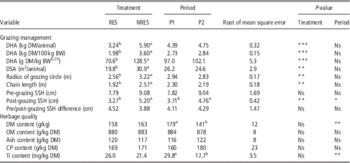
The treatment effect of the DSA per animal (RES: 19.8 m2 v. NRES: 30.9 m2; P<0.01) was reached using different individually chain lengths (RES: 1.92 m v. NRES: 2.57 m; P<0.01). As expected, this resulted in significantly different daily herbage allowances between RES and NRES treatments (3.24 v. 5.90 kg DM/animal; 1.98 v. 3.60 kg DM/100 kg BW; 71 v. 128 g DM/kg BW0.75; P<0.001) meaning that animals on RES treatment were offered a lower DHA than those on NRES treatment. The period did not affect the DSA nor DHA (Table 1).
Grazing management and sward characteristics for both treatments (RES, NRES) and periods (P1, P2)

RES=restricted; NRES=non-restricted; P1=period 1; P2=period 2; DHA=daily herbage allowance; DSA=daily surface area; SSH=sward surface height; OM=organic matter; Ti=titanium.
a,bValues within a row with different superscripts differ significantly at P<0.05.
Signification of P-values for tested effects was *0.05, **0.01 and ***0.001.
The six animals of the two treatments were entered into grazing circles that contained the same pre-grazing SSH (8.44 cm; P>0.05). The post-grazing SSH were significantly higher for NRES than RES treatment (5.20 v. 3.27 cm; P<0.01), but also for second v. first period (respectively 4.76 and 3.71 cm; P<0.05). On the contrary, the pre/post-grazing SSH differential did not differ whatever treatment or period was considered (4.20 cm; P>0.05; Table 1).
Sward quality was similar between treatments (DM: 161 g/kg, OM: 882 g/kg DM, ash: 119 g/kg DM, CP: 170 g/kg DM) and periods, except for DM and Ti contents which were higher in period 1 than in period 2 (P<0.01; Table 1).
Herbage intake
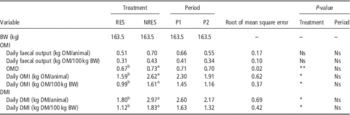
Daily faecal output, expressed in OM, did not significantly differ between RES and NRES animals (0.61 kg OM/animal, 0.37 kg OM/100 kg BW). On the contrary, OMD of the diet was significantly higher in the NRES treatment in comparison with the RES treatment (0.73 v. 0.67; P<0.01). As expected, daily OMI was significantly higher for NRES than for RES treatment (2.62 v. 1.59 kg OM/animal, 1.61 v. 0.99 kg OM/100 kg BW; P<0.05; Table 2) and the daily DMI presents the same variations with a significant difference according to the treatment (2.97 v. 1.80 kg DM/animal, 1.83 v. 1.12 kg DM/100 kg BW; P<0.05; Table 2).
Body weight, daily organic matter intake (OMI) and dry matter intake (DMI) for both treatments (RES, NRES) and periods (P1, P2)

RES=restricted; NRES=non-restricted; P1=period 1; P2=period 2; OM=organic matter; OMD=organic matter digestibility.
a,bValues within a row with different superscripts differ significantly at P<0.05.
Signification of P-values for tested effects was *0.05 and **0.01.
Soil intake
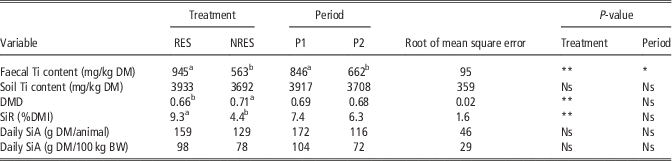
The Ti content in soil did not vary significantly whatever the treatment and the period (3813 mg/kg DM; P>0.05; Table 3) even if animals progressed every day to a new grazing circle. The Ti content in faeces from RES bulls was nearly double in comparison with samples from NRES ones (945 v. 563 mg/kg DM; P<0.01), and was higher in period 1 than in period 2 (846 v. 662 mg/kg DM; P<0.05).
Soil intake rate (SiR) and daily soil intake amount (SiA) for both treatments (RES, NRES) and periods (P1, P2)

Ti=titanium; DMD=dry matter digestibility; DMI=dry matter intake.a,bValues within a row with different superscripts differ significantly at P<0.05.
Signification of P-values for tested effects was *0.05 and **0.01.
Restrictive animals presented a lower DMD than NRES bulls (0.66 v. 0.71; P<0.01). The low DHA level (71 g/kg BW0.75) offered to RES animals resulted in a more than two times higher SiR (9.3 v. 4.4% DM; P<0.01) than the one obtained with the higher DHA level (128 g/kg BW0.75) offered to NRES animals. This strong effect of the tested treatment on the proportion of ingested soil was not significant when the SiA was considered (P=0.14), regardless of the way of expression that is per animal or per 100 kg of BW (144 g DM/animal, 88 g DM/100 kg BW; P>0.05; Table 3).
Discussion
Daily dry matter intake and variation factors
Restrictive animals showed a lower DMI than animals on NRES treatment regardless of the period. This result should be considered with the significantly higher DHA for NRES than RES animals (+1.62 kg DM/100 kg BW, Table 1) and also with their higher OMD (+0.06, Table 2), as there was no faecal output difference between RES and NRES animals (Table 2). Dry matter intake represents 57% and 51% of the offered DM (i.e. at 2 cm over the ground level) for RES and NRES bulls, respectively. Post-grazing SSH was shorter for RES than NRES treatment but in line with the ones reported in temperate conditions in dairy cows (Jurjanz et al., Reference Jurjanz, Feidt, Pérez-Prieto, Ribeiro Filho, Rychen and Delagarde2012). The pre/post-grazing SSH differential did not differ significantly between the two treatments because of the relatively high mean square error. Therefore, the DMI differential observed between treatments is mainly due to differences in the offered DSA. However, these post-grazing SSH differences could partially explain the OMD difference between the two treatments. Contrary to NRES animals, RES bulls ingested a part of the plants closer to the ground which is a more fibrous and less digestible part of the Para grass with a relatively high stem proportion.
Soil intake
The SiR was significantly higher for RES than NRES animals, but this effect was not significant regarding the daily SiA as DMI is significantly lower for RES than NRES animals (RES: 9.3% of 1.8 kg DMI/day; NRES: 4.4% of 2.97 kg DMI/day).
The lack of knowledge on soil intake by tethered young bulls in tropical grazing systems limits comparison of these results with those of literature. Some studies were performed in temperate grazing systems with different types of animals (breed, physiological state, etc.). In lactating dairy cows in intensive strip grazing systems, Jurjanz et al. (Reference Jurjanz, Feidt, Pérez-Prieto, Ribeiro Filho, Rychen and Delagarde2012) reported a significant interaction between DHA and sward type with higher soil intake for dairy cows which were offered a low (20 kg DM/cow per day above ground level; pure perennial ryegrass: 3% of 14.7 kg DMI/day, perennial ryegrass-white clover mixture: 5.8% of 14.1 kg DMI/day) compared with a medium DHA (35 kg DM/cow per day above ground level; 1% of 17 kg DMI/day for both sward types). Soil intake rate that we observed for NRES growing bulls in our experiment (4.4% DMI) is close to the rate for dairy cows grazing a high DHA without any supplement (4.9% DMI), but also similar to the average soil intake by dairy cows grazing a low DHA (4.4% DMI) compared with the results of Jurjanz et al. (Reference Jurjanz, Feidt, Pérez-Prieto, Ribeiro Filho, Rychen and Delagarde2012). On the contrary, SiR in DMI that we observed for RES growing animals in our experiment (9.3% DMI) is higher than all the rates reported by Jurjanz et al. (Reference Jurjanz, Feidt, Pérez-Prieto, Ribeiro Filho, Rychen and Delagarde2012) whatever the treatment. This difference outlined the originality of this study which can be explained by the used animal type (meat v. dairy breed), physiological state (growing v. lactating), sward type (specific leaf area, sward structure, digestibility), grazing management (post v. strip) and pedoclimatic conditions (tropical v. temperate). Fries et al. (Reference Fries, Marrow and Snow1982) reported generally lower soil intakes for heifers and dry cows which ingested from 1.38±0.33% to 2.43±0.50% of soil in their DMI (mean±SE) when they were on pasture with a feed supply. Thus, soil intakes measured in our experiment were higher but experimental conditions were different as our growing bulls did not receive any supplementation at pasture. When ruminants are grazing closer to the ground surface and when high stocking rates are used, much higher SiR have been reported. These practices are mainly reported in sheep. Field and Purves (Reference Field and Purves1964) reported from 0.4% to 14% DMI, Green et al. (Reference Green, Johnson and Wilkins1996) up to 13% and even up to 30% DMI by Thornton (Reference Thornton1983). Abrahams and Blackwell (Reference Abrahams and Blackwell2013) evidenced the greatest amounts of soil ingested (in sheep) by slow herbage growth, high appetite (i.e. nutritional needs) of animals and higher rainfall. Indeed climate and temperature influence several factors as pasture allowance and quality but also the amount of soil adhered on plants by raindrop splashing or animal trampling (Green et al., Reference Green, Johnson and Wilkins1996; Smith et al., Reference Smith, Abrahams, Dagleish and Steigmajer2009). The grazing management, decided by the farmer, would determine stocking rate and grazing intensity (i.e. the percentage of leaves removed or eaten). This may increase soil loading on plants and plant covering and in this way influence the amount of soil in the diet (Rafferty et al., Reference Rafferty, Dawson and Colgan1994; Hinton et al., Reference Hinton, Stoll and Tobler1995; Abrahams and Steigmajer, Reference Abrahams and Steigmajer2003).
Shorter post-grazing SSH for RES than NRES treatment highlights a closely to the ground grazing for RES animals which implies increased soil intake in comparison with higher SSH. Plants are exposed to soil particles deposition onto their surface by wind transport in arid conditions (Sehmel, Reference Sehmel1980), raindrop splash (Mazurak and Mosher, Reference Mazurak and Mosher1968) or soil disturbance by mechanical equipment or livestock activities as trampling (Li et al., Reference Li, Gerzabek and Mück1994; Rafferty et al., Reference Rafferty, Dawson and Colgan1994). In our conditions, trampling seems to be very relevant, especially on ferrosol present on the experimental site, as this clay-rich soil can easily take up humidity and adhere on plants. Thus, young bulls with the shorter chains ingested more soil, in proportion to their DMI, than animals with longer chains. Consequently, the daily allocated surface influences herbage losses or contamination due to trampling or deposition of faeces.
Implications for rearing and exposure risk to environmental pollutants
RES animals received 55% of the amount of herbage daily allocated to NRES ones, which was designed to allow the satisfaction of NRES animals’ nutritional needs and avoid a close to the ground grazing which can favour soil intake. Consequently, RES animals could not completely satisfy their requirements, due to a lower daily DMI, and would have to stay longer in these restrictive grazing conditions (i.e. 71 g DM/kg BW0.75) to achieve their growth and attain their completion BW. This extended rearing duration exposes them to an absolute soil intake higher than for NRES animals. Based on literature (Bouveret et al., Reference Bouveret, Rychen, Lerch, Jondreville and Feidt2013; Jurjanz et al., Reference Jurjanz, Jondreville, Mahieu, Fournier, Archimède, Rychen and Feidt2014) soil intake by animals observed during our experiment would result in CLD contamination when the animals would have grazed on polluted areas.
Our study confirmed that herbage allowance is a major determinant under the experimental conditions imposed. It would be interesting to deal with herbage allowance effect in depth to determine the type of relation (linear, quadratic) between soil intake and herbage availability. This determination would allow the herbage threshold to be established in order to minimize soil intake in Caribbean conditions and thereby also the risk of exposure to soil-bound contaminants. Moreover, this relationship would allow the quantification of the increase in soil intake enhanced by less optimal grazing conditions. Thus, these results suggest to avoid practicing a restricted DHA for Creole cattle reared in contaminated areas in order to reduce their risk of CLD exposure. Hinton et al. (Reference Hinton, Stoll and Tobler1995) developed a mathematical model to predict how practices of grazing management can decrease soil ingestion by animals on pastures in Switzerland. They predicted that a reduction of soil intake of 50% needs to reduce grazing pressure of 2.5 times. In our conditions, soil intake was reduced by 19% (from 159 to 129 g/day) by increasing DHA up to 182% (70.6 v. 128.5 kg DM per kg BW0.75) and DSA up to 156% (from 19.8 to 30.9 m2).
Regarding grazing management, a SSH higher than 5 cm is proposed by Jurjanz et al. (Reference Jurjanz, Feidt, Pérez-Prieto, Ribeiro Filho, Rychen and Delagarde2012) to prevent a close-to-the-ground grazing on temperate pastures. Although unusual in Caribbean conditions, a feed supply at pasture is another way to reduce soil intake (Fries et al., Reference Fries, Marrow and Snow1982; Jurjanz et al., Reference Jurjanz, Feidt, Pérez-Prieto, Ribeiro Filho, Rychen and Delagarde2012).
Thus, the high soil intake shown in this study, especially under a restrictive DHA can be – and should be – reduced by different management factors available. The quantification of their effects need further studies to improve knowledge and finally to limit as much as possible soil intake.
Acknowledgements
The experiment was partially funded by Plan National Chlordécone 3 (CHLORDEL project). The authors thank warmly J. Fleury, F. Pommier, F. Nimir and F. Labirin from INRA PTEA, S. Calif and T. Silou from INRA URZ, as well as Y. Le Roux from UR AFPA for statistical advice and D. J. Beriro from British Geological Survey for English proofreading.