



%20--%3e%3c!DOCTYPE%20svg%20PUBLIC%20'-//W3C//DTD%20SVG%201.0//EN'%20'http://www.w3.org/TR/2001/REC-SVG-20010904/DTD/svg10.dtd'%3e%3csvg%20version='1.0'%20id='Layer_1'%20xmlns='http://www.w3.org/2000/svg'%20xmlns:xlink='http://www.w3.org/1999/xlink'%20x='0px'%20y='0px'%20width='64px'%20height='64px'%20viewBox='5.5%20-3.5%2064%2064'%20enable-background='new%205.5%20-3.5%2064%2064'%20xml:space='preserve'%3e%3cg%3e%3ccircle%20fill='%23FFFFFF'%20fill-opacity='0'%20cx='37.785'%20cy='28.501'%20r='28.836'/%3e%3cpath%20fill='%23595959'%20d='M37.441-3.5c8.951,0,16.572,3.125,22.857,9.372c3.008,3.009,5.295,6.448,6.857,10.314%20c1.561,3.867,2.344,7.971,2.344,12.314c0,4.381-0.773,8.486-2.314,12.313c-1.543,3.828-3.82,7.21-6.828,10.143%20c-3.123,3.085-6.666,5.448-10.629,7.086c-3.961,1.638-8.057,2.457-12.285,2.457s-8.276-0.808-12.143-2.429%20c-3.866-1.618-7.333-3.961-10.4-7.027c-3.067-3.066-5.4-6.524-7-10.372S5.5,32.767,5.5,28.5c0-4.229,0.809-8.295,2.428-12.2%20c1.619-3.905,3.972-7.4,7.057-10.486C21.08-0.394,28.565-3.5,37.441-3.5z%20M37.557,2.272c-7.314,0-13.467,2.553-18.458,7.657%20c-2.515,2.553-4.448,5.419-5.8,8.6c-1.354,3.181-2.029,6.505-2.029,9.972c0,3.429,0.675,6.734,2.029,9.913%20c1.353,3.183,3.285,6.021,5.8,8.516c2.514,2.496,5.351,4.399,8.515,5.715c3.161,1.314,6.476,1.971,9.943,1.971%20c3.428,0,6.75-0.665,9.973-1.999c3.219-1.335,6.121-3.257,8.713-5.771c4.99-4.876,7.484-10.99,7.484-18.344%20c0-3.543-0.648-6.895-1.943-10.057c-1.293-3.162-3.18-5.98-5.654-8.458C50.984,4.844,44.795,2.272,37.557,2.272z%20M37.156,23.187%20l-4.287,2.229c-0.458-0.951-1.019-1.619-1.685-2c-0.667-0.38-1.286-0.571-1.858-0.571c-2.856,0-4.286,1.885-4.286,5.657%20c0,1.714,0.362,3.084,1.085,4.113c0.724,1.029,1.791,1.544,3.201,1.544c1.867,0,3.181-0.915,3.944-2.743l3.942,2%20c-0.838,1.563-2,2.791-3.486,3.686c-1.484,0.896-3.123,1.343-4.914,1.343c-2.857,0-5.163-0.875-6.915-2.629%20c-1.752-1.752-2.628-4.19-2.628-7.313c0-3.048,0.886-5.466,2.657-7.257c1.771-1.79,4.009-2.686,6.715-2.686%20C32.604,18.558,35.441,20.101,37.156,23.187z%20M55.613,23.187l-4.229,2.229c-0.457-0.951-1.02-1.619-1.686-2%20c-0.668-0.38-1.307-0.571-1.914-0.571c-2.857,0-4.287,1.885-4.287,5.657c0,1.714,0.363,3.084,1.086,4.113%20c0.723,1.029,1.789,1.544,3.201,1.544c1.865,0,3.18-0.915,3.941-2.743l4,2c-0.875,1.563-2.057,2.791-3.541,3.686%20c-1.486,0.896-3.105,1.343-4.857,1.343c-2.896,0-5.209-0.875-6.941-2.629c-1.736-1.752-2.602-4.19-2.602-7.313%20c0-3.048,0.885-5.466,2.658-7.257c1.77-1.79,4.008-2.686,6.713-2.686C51.117,18.558,53.938,20.101,55.613,23.187z'/%3e%3c/g%3e%3c/svg%3e)
%20--%3e%3c!DOCTYPE%20svg%20PUBLIC%20'-//W3C//DTD%20SVG%201.0//EN'%20'http://www.w3.org/TR/2001/REC-SVG-20010904/DTD/svg10.dtd'%3e%3csvg%20version='1.0'%20id='Layer_1'%20xmlns='http://www.w3.org/2000/svg'%20xmlns:xlink='http://www.w3.org/1999/xlink'%20x='0px'%20y='0px'%20width='64px'%20height='64px'%20viewBox='5.5%20-3.5%2064%2064'%20enable-background='new%205.5%20-3.5%2064%2064'%20xml:space='preserve'%3e%3cg%3e%3ccircle%20fill='%23FFFFFF'%20fill-opacity='0'%20cx='37.637'%20cy='28.806'%20r='28.276'/%3e%3cg%3e%3cpath%20fill='%23595959'%20d='M37.443-3.5c8.988,0,16.57,3.085,22.742,9.257C66.393,11.967,69.5,19.548,69.5,28.5c0,8.991-3.049,16.476-9.145,22.456%20C53.879,57.319,46.242,60.5,37.443,60.5c-8.649,0-16.153-3.144-22.514-9.43C8.644,44.784,5.5,37.262,5.5,28.5%20c0-8.761,3.144-16.342,9.429-22.742C21.101-0.415,28.604-3.5,37.443-3.5z%20M37.557,2.272c-7.276,0-13.428,2.553-18.457,7.657%20c-5.22,5.334-7.829,11.525-7.829,18.572c0,7.086,2.59,13.22,7.77,18.398c5.181,5.182,11.352,7.771,18.514,7.771%20c7.123,0,13.334-2.607,18.629-7.828c5.029-4.838,7.543-10.952,7.543-18.343c0-7.276-2.553-13.465-7.656-18.571%20C50.967,4.824,44.795,2.272,37.557,2.272z%20M46.129,20.557v13.085h-3.656v15.542h-9.944V33.643h-3.656V20.557%20c0-0.572,0.2-1.057,0.599-1.457c0.401-0.399,0.887-0.6,1.457-0.6h13.144c0.533,0,1.01,0.2,1.428,0.6%20C45.918,19.5,46.129,19.986,46.129,20.557z%20M33.042,12.329c0-3.008,1.485-4.514,4.458-4.514s4.457,1.504,4.457,4.514%20c0,2.971-1.486,4.457-4.457,4.457S33.042,15.3,33.042,12.329z'/%3e%3c/g%3e%3c/g%3e%3c/svg%3e)
%20--%3e%3c!DOCTYPE%20svg%20PUBLIC%20'-//W3C//DTD%20SVG%201.0//EN'%20'http://www.w3.org/TR/2001/REC-SVG-20010904/DTD/svg10.dtd'%3e%3csvg%20version='1.0'%20id='Layer_1'%20xmlns='http://www.w3.org/2000/svg'%20xmlns:xlink='http://www.w3.org/1999/xlink'%20x='0px'%20y='0px'%20width='64px'%20height='64px'%20viewBox='5.5%20-3.5%2064%2064'%20enable-background='new%205.5%20-3.5%2064%2064'%20xml:space='preserve'%3e%3cg%3e%3ccircle%20fill='%23FFFFFF'%20fill-opacity='0'%20cx='36.924'%20cy='28.403'%20r='28.895'/%3e%3cpath%20fill='%23595959'%20d='M37.442-3.5c8.99,0,16.571,3.085,22.743,9.256C66.393,11.928,69.5,19.509,69.5,28.5c0,8.992-3.048,16.476-9.145,22.458%20C53.88,57.32,46.241,60.5,37.442,60.5c-8.686,0-16.19-3.162-22.513-9.485C8.644,44.728,5.5,37.225,5.5,28.5%20c0-8.762,3.144-16.343,9.429-22.743C21.1-0.414,28.604-3.5,37.442-3.5z%20M12.7,19.872c-0.952,2.628-1.429,5.505-1.429,8.629%20c0,7.086,2.59,13.22,7.77,18.4c5.219,5.144,11.391,7.715,18.514,7.715c7.201,0,13.409-2.608,18.63-7.829%20c1.867-1.79,3.332-3.657,4.398-5.602l-12.056-5.371c-0.421,2.02-1.439,3.667-3.057,4.942c-1.622,1.276-3.535,2.011-5.744,2.2%20v4.915h-3.714v-4.915c-3.543-0.036-6.782-1.312-9.714-3.827l4.4-4.457c2.094,1.942,4.476,2.913,7.143,2.913%20c1.104,0,2.048-0.246,2.83-0.743c0.78-0.494,1.172-1.312,1.172-2.457c0-0.801-0.287-1.448-0.858-1.943l-3.085-1.315l-3.771-1.715%20l-5.086-2.229L12.7,19.872z%20M37.557,2.214c-7.276,0-13.428,2.571-18.457,7.714c-1.258,1.258-2.439,2.686-3.543,4.287L27.786,19.7%20c0.533-1.676,1.542-3.019,3.029-4.028c1.484-1.009,3.218-1.571,5.2-1.686V9.071h3.715v4.915c2.934,0.153,5.6,1.143,8,2.971%20l-4.172,4.286c-1.793-1.257-3.619-1.885-5.486-1.885c-0.991,0-1.876,0.191-2.656,0.571c-0.781,0.381-1.172,1.029-1.172,1.943%20c0,0.267,0.095,0.533,0.285,0.8l4.057,1.83l2.8,1.257l5.144,2.285l16.397,7.314c0.535-2.248,0.801-4.533,0.801-6.857%20c0-7.353-2.552-13.543-7.656-18.573C51.005,4.785,44.831,2.214,37.557,2.214z'/%3e%3c/g%3e%3c/svg%3e)
%20--%3e%3c!DOCTYPE%20svg%20PUBLIC%20'-//W3C//DTD%20SVG%201.1//EN'%20'http://www.w3.org/Graphics/SVG/1.1/DTD/svg11.dtd'%3e%3csvg%20version='1.1'%20id='Layer_1'%20xmlns='http://www.w3.org/2000/svg'%20xmlns:xlink='http://www.w3.org/1999/xlink'%20x='0px'%20y='0px'%20width='64.000977px'%20height='64px'%20viewBox='0%200%2064.000977%2064'%20enable-background='new%200%200%2064.000977%2064'%20xml:space='preserve'%3e%3cg%3e%3ccircle%20fill='%23FFFFFF'%20fill-opacity='0'%20cx='32.064453'%20cy='31.788086'%20r='29.012695'/%3e%3cg%3e%3cpath%20fill='%23595959'%20d='M31.943848,0C40.896484,0,48.476562,3.105469,54.6875,9.314453C60.894531,15.486328,64.000977,23.045898,64.000977,32%20s-3.048828,16.457031-9.145508,22.513672C48.417969,60.837891,40.779297,64,31.942871,64%20c-8.648926,0-16.152832-3.142578-22.513672-9.429688C3.144043,48.286133,0,40.761719,0,32.000977%20c0-8.723633,3.144043-16.285156,9.429199-22.68457C15.640137,3.105469,23.14502,0,31.943848,0z%20M32.060547,5.771484%20c-7.275391,0-13.429688,2.570312-18.458496,7.714844C8.381836,18.783203,5.772949,24.954102,5.772949,32%20c0,7.125,2.589844,13.256836,7.77002,18.400391c5.181152,5.181641,11.352051,7.770508,18.515625,7.770508%20c7.123047,0,13.332031-2.608398,18.626953-7.828125C55.713867,45.466797,58.228516,39.353516,58.228516,32%20c0-7.3125-2.553711-13.484375-7.65625-18.513672C45.504883,8.341797,39.333984,5.771484,32.060547,5.771484z%20M44.117188,24.456055%20v5.485352H20.859863v-5.485352H44.117188z%20M44.117188,34.743164v5.481445H20.859863v-5.481445H44.117188z'/%3e%3c/g%3e%3c/g%3e%3c/svg%3e)
Contemporary populist radical right parties (PRRPs) are among the most influential political actors in their countries. Once perceived as political pariahs, over the past decades they have gradually improved their electoral performances and entered governments (Mudde Reference Mudde2019). Moreover, PRRPs are not so isolated anymore. Since the 2014 European Parliament (EP) elections, in particular, they have started to cooperate internationally. The literature has explored these European alliances (McDonnell and Werner Reference McDonnell and Werner2019; Treib Reference Treib2020) and the theoretical implications of populist actors attempting to build a transnational people (de Cleen Reference de Cleen and Rovira Kaltwasser2017; Moffitt Reference Moffitt2017). At the same time, social media have been identified as key arenas of transnational contacts and discourse sharing among PRR actors, though much of the existing research on this is again confined to the European context (Froio and Ganesh Reference Froio and Ganesh2019; Heft, Reinhardt and Pfetsch Reference Heft, Reinhardt and Pfetsch2023). While most studies focus on leaders and parties, little attention has been given, however, to the public consuming PRR communications, especially online, and the transnational activities they perform on social media. In this article, I therefore focus on the digital publics who engage with, and amplify, the increasingly transnational messages of PRRPs and their leaders across three continents (America, Europe, and Oceania). I examine their cross-border engagement with PRR contents on a mainstream platform, YouTube, to understand their contribution to the emerging transnational network of radical right populists. Specifically, I ask: Which factors explain transnational online engagement with PRR communications?
Digital technologies enable a vast array of political participation acts. Citizens can mobilise, advertise their support for a cause, and promote political organisations through digital platforms (Lilleker and Koc-Michalska Reference Lilleker and Koc-Michalska2017). Moreover, unlike traditional media, online spaces are not tied to national boundaries and are thus considered a key arena for the transnationalisation of populism (Moffitt Reference Moffitt2017; Heft, Reinhardt and Pfetsch Reference Heft, Reinhardt and Pfetsch2023). In this context, the digital publics of PRR actors – those who comment on their posts and videos – can engage with political content across countries and in different languages. While these transnational publics do not constitute an electoral constituency, they matter to PRRPs in at least three ways. First, they function as a visibility asset: engagement by transnational publics amplifies party content and allows posts and videos to travel further on platforms that reward popular content. For PRR parties, which have often relied on digital spaces in contraposition to mainstream media to gain visibility, any additional exposure, even when coming from non-national audiences, is particularly valuable (Ernst, Engesser, Büchel et al. Reference Ernst, Engesser, Büchel, Blassnig and Esser2017; Davidson and Enos Reference Davidson and Enos2024). Second, engagement by transnational publics represents a symbolic resource: it signals that PRR claims are legitimised or ‘accepted’ also among a broader, less conventional audience (Moffitt Reference Moffitt2016: 107). Third, transnational publics extend parties’ organisational infrastructures: in a context of increasingly blurred forms of political affiliation, even low-threshold forms of online acts – such as following, commenting, or sharing – can strengthen parties’ networks and increase their capacity to disseminate key messages (Scarrow Reference Scarrow2014: 30).
Transnational engagement by digital publics can be conceptualised as part of a tripartite relationship between political actors producing content, the users who interact with it, and the platform architectures that mediate these interactions (Van Aelst, Strömbäck, Aalberg et al. Reference Van Aelst, Strömbäck, Aalberg, Esser, de Vreese, Matthes, Hopmann, Salgado, Hubé, Stępińska, Papathanassopoulos, Berganza, Legnante, Reinemann, Sheafer and Stanyer2017). I envisage that transnational engagement will thus vary according to factors pertaining to PRRPs’ communicative strategies and international alliances, platform logics, as well as contextual factors such as language and geographical proximity. I test these expectations on YouTube, a platform that has been less studied in research on PRR communication compared to Twitter (X) and Facebook (e.g., Heiss and Matthes Reference Heiss and Matthes2019; Davidson and Enos Reference Davidson and Enos2024). This is despite the fact that YouTube is one of the world’s most active platforms, with 2.53 billion users (We Are Social and Meltwater 2024).
To answer my research question, I analyse fifteen official YouTube channels belonging to nine PRRPs from eight countries: Pauline Hanson’s One Nation (Australia), Nuevas Ideas (New Ideas, NI – El Salvador), Rassemblement National (National Rally, RN – France), Fidesz (Civic Alliance – Hungary), Fratelli d’Italia (Brothers of Italy, FdI – Italy), Lega (League – Italy), Chega (Enough – Portugal), Vox (Voice – Spain), and the Republican Party (GOP – United States). These are all PRRPs with a demonstrated interest in transnational linkages. Notably, they have all recently participated in various editions of the Conservative Political Action Conference (CPAC) – the main transnational event for PRR parties from across the globe.Footnote 1 My dataset comprises 4 million comments posted by approximately 864,000 unique users on over 27,000 videos between 2016 and 2024. Based on it, I use a two-step hurdle regression model and social network analysis to analyse transnational engagement, defined as the commenting activity of the same user – labelled a ‘transnational user’ – on PRR videos and channels from at least two different countries.
I find that videos featuring transnational performances – namely, international PRR events or joint appearances by PRR leaders from different countries – significantly increase the intensity of transnational engagement, more so than video content alone. I show that, between 2019 and 2024, transnational engagement has been particularly high between channels affiliated with the European Conservatives and Reformists (ECR) but weaker among channels of Identity and Democracy (ID) parties. In addition, my study reveals that videos with more likes and views and channels with more subscribers tend to attract more transnational engagement and that language facilitates cross-border interactions but also that transnational activity is not necessarily stronger within the European Union (EU) than outside it.
The article makes several theoretical and empirical contributions to the study of contemporary PRRPs and their online milieux. Theoretically, it broadens the focus of PRR transnationalisation studies – largely centred on ties between parties – to look at the role of digital publics and how their activities increasingly connect distinct national arenas. Furthermore, it offers a theoretical framework for analysing online transnational engagement, which is shaped by party strategies and linguistic factors, but also by platform algorithms. Empirically, the article extends the analysis beyond Europe to the Americas and Oceania, drawing on a rich, eight-year dataset, combining quantitative methods with qualitative content analysis, and studying YouTube, a platform which has received comparatively less attention in PRR research. Overall, my research contributes to the characterisation of the contemporary PRR as a global, interconnected phenomenon, demonstrating that transnational networks within the PRR are not only driven by elite coordination. Rather, they are sustained and amplified both by grassroots interactions among regular citizens, who actively shape and circulate PRR narratives, and by the digital platform’s algorithmic architectures that enhance their reach and visibility.
In the next section, I outline the background to my study, elaborate on the theoretical framework, and set out my hypotheses. I then explain the case selection, data, and research design. Thereafter, I present and discuss the findings and their implications.
Transnational populist publics for transnational populist parties
Transnationalisation generally refers to processes involving the flow of people and ideas across borders (Remennick Reference Remennick and Ritzer2007). When applied to political movements, it encompasses cross-national mobilisation, common issues, targets, and organisational practices, which create a supranational identity and a collective opposition to common enemies (Rucht Reference Rucht, Della Porta, Kriesi and Rucht1999; della Porta, Andretta and Mosca et al. Reference Della Porta, Andretta and Mosca2006). For PRRPs, issues like immigration and shared opposition to supranational bodies such as the European Union increasingly favour transnational connections. Transnational PRR cooperation was long seen as unlikely, historically limited by competing agendas, personal animosities, and conflicting ideological positions (Fieschi Reference Fieschi2000; Minkenberg and Perrineau Reference Minkenberg and Perrineau2007). Nonetheless, recent years have seen more sustained interactions (Zuquete Reference Zúquete2015; McDonnell and Werner Reference McDonnell and Werner2019), including international gatherings like CPAC, and initiatives linking party youth wings (Abrahamsen and Williams Reference Abrahamsen and Williams2023; Semonsen Reference Semonsen2023). Radical right populists, beyond just learning ideas and practices from one another (Rydgren Reference Rydgren2005), now cast themselves as a global political wave (McDonnell and Werner Reference McDonnell and Werner2019: 219), redefining nationalist identities along transnational lines in opposition to multiculturalism and global elites (de Cleen Reference de Cleen and Rovira Kaltwasser2017; Moffitt Reference Moffitt2017).
While previous research on PRR transnationalisation has mostly focused on parties and leaders, we know little about the contribution of their digital publics – those unorganised individuals who interact with PRR content online (i.e., by commenting or sharing). In this article, I argue that digital publics play a role in the transnationalisation of the PRR that is, to some extent, independent of PRRPs. This rests on two assumptions. First, digital spaces provide the fastest and most cost-effective means for populist claims to cross borders (Moffitt Reference Moffitt2017: 419). They offer users the infrastructure for global engagement, allowing them to connect with content and like-minded people through actions like commenting (Bennett and Segerberg Reference Bennett and Segerberg2012). Second, social media platforms empower the publics as active participants rather than passive listeners: people can continuously reshare and reshape the political message crafted by parties and leaders (Van Aelst, Strömbäck, Aalberg et al. Reference Van Aelst, Strömbäck, Aalberg, Esser, de Vreese, Matthes, Hopmann, Salgado, Hubé, Stępińska, Papathanassopoulos, Berganza, Legnante, Reinemann, Sheafer and Stanyer2017).
Acting as reactors, re-makers, and re-distributors of political content (Ito Reference Ito and Vernelis2008; Papakyriakopulos, Shahrezaye, Serrano et al. Reference Papakyriakopoulos, Shahrezaye, Serrano and Hegelich2019), individuals can engage in political discussions across borders. These practices complement traditional offline political participation at a lower cost (Di Gennaro and Dutton Reference Di Gennaro and Dutton2006; Gibson and Cantijoch Reference Gibson and Cantijoch2013). Indeed, social media enable both faster versions of traditional political acts – e.g., contacting public officials – and entirely new forms, such as following politicians, posting comments, and sharing political news (Theocharis, Boulianne, Koc-Michalska et al. Reference Theocharis, Boulianne, Koc-Michalska and Bimber2023).
Active audiences – or publics – form around specific media content, such as political parties’ YouTube videos, and include diverse user engagement levels, from casual followers to highly active users who co-produce content and even mobilise offline (Livingstone Reference Livingstone2005; Bruns Reference Bruns2023). Participation follows a long-tail distribution. While most users remain passive consumers, a small minority engages intensively and exerts a disproportionate influence on the visibility and interpretation of political information in digital environments (Bruns, Highfield and Burgess Reference Bruns, Highfield and Burgess2013; Papakyriakopulos, Shahrezaye, Serrano et al. Reference Papakyriakopoulos, Shahrezaye, Serrano and Hegelich2019).
Commenting plays a key role in sustaining digital publics. Present across major platforms like Facebook, YouTube, and TikTok, comments represent a distinct form of political expression that allows users to applaud or contest elite messages and connect around shared content, fostering mutual awareness and collective participation (Marwick and boyd Reference Marwick and Boyd2011; Gibson and Cantijoch Reference Gibson and Cantijoch2013; Gil de Zúñiga, Molyneux and Zheng Reference Gil de Zúñiga, Molyneux and Zheng2014; Theocharis Reference Theocharis2015).Footnote 2 Comments allow users to challenge mainstream discourses and act as counterpublics,Footnote 3 as seen, for example, with Eurosceptic commenters defending the AfD in Germany (Toepfl and Piwoni Reference Toepfl and Piwoni2015). Comments are associated with higher levels of offline activism, political efficacy, and political learning, as they encourage users to clarify their views and engage in reflection and deliberation (Vaccari, Chadwick and O’Loughlin Reference Vaccari, Chadwick and O’Loughlin2015; Kim, Weeks, Lane et al. Reference Kim, Weeks, Lane, Hahn and Kwak2021). At the same time, comments can also become superficial or irrelevant (Boyd Reference boyd and Papacharissi2010; Erzikova and McLean Reference Erzikova and McLean2020), be manipulated by inauthentic actors such as bots (Murero Reference Murero2023; Na, Cho and Shin Reference Na, Cho and Shin2023), and display incivility or misinformation (Coe, Kenski and Rains Reference Coe, Kenski and Rains2014; Anspach and Carlson Reference Anspach and Carlson2020). Notwithstanding these shortcomings, comments significantly influence audience perceptions, affecting moral reactions and engagement with content (Krämer, Neubaum, Winter et al. Reference Krämer, Neubaum, Winter, Schaewitz, Eimler and Oliver2021; Dutceac Segesten, Bossetta, Holmberg et al. Reference Dutceac Segesten, Bossetta, Holmberg and Niehorster2022).
Online interactions, including comments, can occur across national borders. While language and cultural boundaries continue to shape engagement (Cammaerts and Van Audenhove Reference Cammaerts and Audenhove2005), transnational connections emerge when users share grievances or goals, as seen in global movements and protests like the Arab Spring, #MeToo, Black Lives Matter, and the stop Transatlantic Trade and Investment Partnership (TTIP) campaign in Europe (della Porta, Andretta and Mosca Reference Della Porta, Andretta and Mosca2006; Rane and Salem Reference Rane and Salem2012; Caiani and Graziano Reference Caiani and Graziano2018; Sorce and Dumitrica Reference Sorce and Dumitrica2022). Research on the far-right has identified unsystematic repertoires of transnational grassroots online mobilisation, from the circulation of memes to more structured contestation campaigns (Doerr Reference Doerr2017; Knüpfer et al. Reference Knüpfer, Hoffmann and Voskresenskii2022; McSwiney, Vaughan, Heft et al. Reference McSwiney, Vaughan, Heft and Hoffmann2021). However, it has mainly focused on extreme-right movementsFootnote 4 (e.g., O’Callaghan, Greene, Conway et al. Reference O’Callaghan, Greene, Conway, Carthy and Cunningham2013, Caiani and Kröll Reference Caiani and Kröll2015) and on Europe (e.g., Froio and Ganesh Reference Froio and Ganesh2019; Ganesh and Froio Reference Ganesh and Froio2020). Most importantly, we still know little about how the transnationalisation of the PRR unfolds within spaces where audience members directly respond to political elites. Practices like commenting link users directly to party content and elites (Gibson, Greffet and Cunill Reference Gibson, Greffet and Cunill2016; Gauja and Grömping Reference Gauja and Grömping2020). Thus, they offer a unique lens to observe and explain grassroots transnational engagement precisely among the digital publics of PRRPs’ content.
I contend that such transnational engagement can be understood as a tripartite relationship, emerging from the interplay between party strategies, platform architectures, and users’ decisions to engage with political content across borders. In today’s media environment – characterised by mobile media, content abundance, and fragmented audiences (Blumler Reference Blumler2016) – any account of political communication phenomena must consider the content diffusion by party elites, the technological infrastructures that mediate access, and the active role of digital publics, who collaboratively shape and circulate content (Bruns Reference Bruns2008).
I conceptualise transnational engagement as the demand for PRR communications across countries and argue that this is shaped by three sets of factors: (a) parties’ strategic and communicative choices (party supply); (b) platform logics and affordances (technological supply); and (c) contextual factors, such as language and geographical proximity. These are discussed below.
First, strategies of PRRPs might foster transnational engagement. What I term as the party supply includes the organisational and strategic choices behind the creation of political content. On social media channels, political parties communicate to broadcast issues, promote candidates, and mobilise audiences (Albertazzi and Bonasinga Reference Albertazzi and Bonansinga2023: 3). While party communication remains embedded in national contexts, PRRPs increasingly operate in a transnational space, connecting with likeminded foreign actors (Stier, Froio and Schünemann Reference Stier, Froio and Schünemann2021). This opens up opportunities for cross-border engagement. PRRPs have increasingly become unashamed to project a transnational image by parading their commonalities (McDonnell and Werner Reference McDonnell and Werner2019). In doing so, they leverage a ‘transnational brand’ in their communication, a set of policy positions and symbols signalling belonging to a broader ideological family (Nonnemacher Reference Nonnemacher2025). Because populist communication always combines form and content (Wodak Reference Wodak2020: 8; see also de Vreese, Esser, Aalberg et al. Reference de Vreese, Esser, Aalberg, Reinemann and Stanyer2018), this transnational orientation may be expressed through both discursive content (what PRRPs say) and performative staging (how it is visually represented). I therefore argue that the party supply may drive cross-border engagement through both transnational frames and performative cues.
Frames shape problem definitions, interpretations, and policy responses (Entman Reference Entman1993). When shared across borders, they can foster a common identity and facilitate transnational linkages among political movements, including PRRPs (Snow and Benford Reference Snow, Benford, Morris and Mueller1992; Froio and Ganesh Reference Froio and Ganesh2019). PRRPs employ transnational frames when they situate national themes within broader supranational arenas (e.g., by blaming the UN or the EU) and construct a transnational ‘people’, or a broader ‘us’, opposed to threats like immigration, globalisation, terrorism, or ‘woke’ cultureFootnote 5 (Hafez Reference Hafez2014; Moffitt Reference Moffitt2017; Miller-Idriss Reference Miller-Idriss2019; Feffer Reference Feffer2021; Cerrone Reference Cerrone2023). Islamophobia and anti-immigration – the core, cross-national narratives of the PRR (Van der Brug, Fennema and Tillie Reference Van Der Brug, Fennema and Tillie2000) – have long been regarded as the ‘transnational glue of the far right’ (Froio and Ganesh Reference Froio and Ganesh2019: 531). Similarly, broader critiques of globalisation frame elites as undermining cultural identity, democracy, and economic security across multiple countries (Miller-Idriss Reference Miller-Idriss2019: 24). By mobilising these common grievances through transnational frames, PRRPs are more likely to appeal to a transnational public than when addressing strictly domestic issues. This gives rise to my first hypothesis.
H1: Transnational engagement on YouTube videos is higher when the content adopts a transnational frame.
Beyond framing, PRRPs can signal their transnational political brand through performance, particularly by appearing alongside prominent international figures of the PRR (Nonnemacher Reference Nonnemacher2025: 6).Footnote 6 For example, when AfD leaders share a stage with Marine Le Pen, or when Viktor Orbán appears at CPAC, the event itself functions as a symbolic cue of ideological affinity, and as an indicator of a shared identity. As these events are mediatised and disseminated by PRRPs on social media (Moffitt Reference Moffitt2016; Bast Reference Bast2024), their online diffusion can attract transnational publics. I therefore expect transnational engagement with PRRP content to increase when parties promote their transnational brand using performative cues on social media. This leads to my second hypothesis.
H2: Transnational engagement is higher when PRRPs reference or appear with international allies in their communications.
In Europe, parties’ transnational brands are institutionalised through alliances in the European Parliament (Nonnemacher Reference Nonnemacher2025), and this can structure patterns of transnational engagement. The growing strength and unity of PRR groups within the EP has increased the visibility of these alliances (McDonnell and Werner Reference McDonnell and Werner2019; Mudde Reference Mudde2024). While PRRPs were fragmented across three groups in 2014, the creation of the ID group in 2019 marked a significant consolidation, alongside the continued presence of the ECR. In the 2019–2024 legislature, ID and ECR were the two main PRRP alliances.Footnote 7 Parties within the same EP groups tend to share ideological profiles and policy positions (McElroy and Benoit Reference McElroy and Benoit2010). Beyond pragmatic benefits such as accessing office resources, these alliances function as strategic signals for PRRPs. They allow them to demonstrate they are recognised and legitimised within a broader European ideological family (McDonnell and Werner Reference McDonnell and Werner2019), and they can be seen by audiences as champions of broader ideological fights (Nonnemacher Reference Nonnemacher2025: 18). PRRPs may signal these institutional ties in their social media communication, for instance by publicising EP group events. As a result, I expect stronger transnational engagement among the digital publics of PRRPs belonging to the same EP alliance. This leads to my third hypothesis.
H3: Transnational engagement increases between parties from the same European Parliament group.
Technological factors can also shape transnational engagement. What I refer to as the technological supply includes the infrastructure and affordances that mediate interactions between political content producers and their publics. Social media platforms are complex systems where information circulates through the interplay of interfaces, algorithms, moderation policies, and user behaviour (Narayanan Reference Narayanan2023). Algorithms, as coded instructions, structure content visibility and relational activity (Van Dijk and Poell Reference van Dijck and Poell2013), making platforms active gatekeepers rather than neutral intermediaries (Gillespie Reference Gillespie2010). These systems enable transnational communications, supporting the formation of transient networks and stable communities of likeminded users, even across national boundaries (Lilleker and Koc-Michalska Reference Lilleker and Koc-Michalska2017).
What users see on social media depends on whom they follow, what their network shares, and what algorithms predict they will engage with (Narayanan Reference Narayanan2023). Because sustained engagement is central to social media logics, platforms like YouTube prioritise content which is most likely to generate interaction (Van Dijck and Poell Reference van Dijck and Poell2013; Narayanan Reference Narayanan2023). Through ‘algorithm curation’, they recommend content based on what users saw and liked in the past (Thorson and Welles Reference Thorson and Wells2016: 317). In doing so, they foster the growth of ‘political ecosystems’ (Munger and Phillips Reference Munger and Phillips2022: 196): the more a user views PRR contents, the more likely the platform will show them similar videos in the future (Röchert, Weitzel and Ross Reference Röchert, Weitzel and Ross2020: 252). A key driver of this process is content popularity. Metrics such as a channel’s subscriber count, views, and likes (Chatzopoulou, Sheng and Faloutsos Reference Chatzopoulou, Sheng and Faloutsos2010; Hoiles, Aprem and Krishnamurthy Reference Hoiles, Aprem and Krishnamurthy2017) increase a video’s visibility on YouTube and can facilitate its cross-border diffusion. These dynamics often engender a rich-get-richer effect, where popular content and creators are ranked higher and increase their reach (Castaldo, Frasca, Venturini et al. Reference Castaldo, Frasca, Venturini and Gargiulo2024: 2; see also Boulianne and Larsson Reference Boulianne and Larsson2023). I therefore hypothesise that the popularity bias on YouTube influences transnational engagement with PRR content in two ways:
H4a: The greater the popularity of a YouTube video, the higher its transnational engagement.
H4b: The higher the number of subscribers to a YouTube channel, the higher its transnational engagement.
Finally, alongside political and technological factors, I expect some contextual factors – especially language – to independently shape transnational engagement. Among the vast amount of political content on a platform, users engage with only a fraction, guided not only by its likeability or by ideological affinities, but also by linguistic and cultural proximity (Munger and Phillips Reference Munger and Phillips2022: 192; see also Ribeiro, Ottoni, West et al. Reference Ribeiro, Ottoni, West, Almeida and Meira2020). Language is deeply embedded in transnationalisation processes, including within the far right: language proximity facilitates international ties, while visual communication helps to overcome language barriers and spread narratives across borders (O’Callaghan, Greene, Conway et al. Reference O’Callaghan, Greene, Conway, Carthy and Cunningham2013; Doerr Reference Doerr2017). Although YouTube’s visual nature (Hokka and Nelimarka Reference Hokka and Nelimarkka2020) and automatic translation features may help mitigate some obstacles, commenting remains largely a textual activity. I therefore expect language differences to hinder transnational engagement, while shared language facilitates cross-border interactions (e.g., between English language channels in Australia and the United States). This leads to my fifth hypothesis.
H5: Transnational engagement of PRR digital publics is higher between YouTube channels of the same language than between channels of different languages.
While linguistic boundaries often limit transnational exchanges, regional, and institutional settings can facilitate them (Fraser Reference Fraser2007; O’Callaghan, Greene, Conway et al. Reference O’Callaghan, Greene, Conway, Carthy and Cunningham2013). In particular, the EU provides political actors with new discursive opportunities and resources to influence public debates (Koopmans Reference Koopmans2007: 205) and offers digital publics a privileged space for interactions. As Tarrow (Reference Tarrow2001: 15) puts it, international institutions can function as ‘a kind of ‘coral reef’, helping to form horizontal connections among activists with similar claims across boundaries’. Additionally, European PRRPs themselves mobilise audiences around the idea that a ‘European cultural identity’ is in crisis (Ganesh and Froio Reference Ganesh and Froio2020). They position themselves as the defenders of Europe’s Christian heritage against the threats posed by Muslim immigration (Brubaker Reference Brubaker2017). Europe thus serves as a transnational space for identity construction and contention for the PRR. Consequently, my sixth hypothesis envisages that the digital publics of European PRRPs will be more transnationally active within the continent than outside it.
H6: Transnational engagement of PRR digital publics is higher among European YouTube channels than among non-European ones.
Cases, data, and methods
My empirical analysis is based on a dataset of YouTube comments published on channels of PRRPs from eight countries between January 2016 and July 2024. I focused on nine prominent cases of contemporary PRRPs from three continents – America, Europe, and Oceania – that are actively involved in PRR transnationalisation. Case selection was guided by participation in recent CPAC events. Originally an annual meeting for U.S. conservatives, CPAC has evolved into ‘a series of global festivals, a circuit for radical conservative ideas, policies, and personalities’ (Abrahamsen and Williams Reference Abrahamsen and Williams2023: 29). With its recent global shift, CPAC is a prime example of the unification of distinct PRR strands across countries (Sanders and Jenkins Reference Sanders and Jenkins2023) and provides substantial media exposure for participants. As regards the aims of my study, participation in CPAC signals the desire of a PRRP to engage transnationally.
I first selected the U.S. Republicans, the main promoter of CPAC, whose representatives – including Donald Trump – have featured prominently across international editions (GPAHE 2024). I then included Hungary’s Fidesz, host of the most successful transnational edition of CPAC in Budapest since 2022, which has become a recurring hub for the transnational PRR (Abrahamsen and Williams Reference Abrahamsen and Williams2023: 29). From Europe, I added the Italian League, Brothers of Italy,Footnote 8 and Spain’s Vox – parties whose leaders and representatives participated in both CPAC Hungary and U.S. between 2022 and 2025. I also chose Portugal’s Chega, present at CPAC Hungary and Brazil, and the French National Rally, which has participated consistently in Budapest from 2022 to 2025. Finally, I included two non-European cases: El Salvador’s Nuevas Ideas, led by Nayib Bukele, and Australia’s One Nation, led by Pauline Hanson. Bukele has emerged as a prominent reference point for the Latin American PRR and he has also established direct ties with U.S. Republicans (Rovira Kaltwasser Reference Rovira Kaltwasser2024; Swindle Reference Swindle2025), culminating in his appearance as a speaker at CPAC U.S. in 2024. Although electorally more marginal, One Nation has likewise pursued transnational visibility through its leader: Pauline Hanson spoke at CPAC Australia in 2023 and 2025 and at a CPAC-hosted gala at Donald Trump’s Mar-a-Lago residence in November 2025.
The analysis of these parties’ publics focuses on YouTube, a platform on which right-wing content is among the most influential political genres (Lewis Reference Lewis2020; Munger and Phillips Reference Munger and Phillips2022: 191). On YouTube, users interact through comments, which constitute a more active form of engagement than simply watching or liking a video. For this reason, commenting activity has often been used as a proxy for audience engagement in YouTube studies, given the lack of user-level data on views and likes (Rauchfleisch and Kaiser Reference Rauchfleisch and Kaiser2020). Assessing transnational activities through comments thus represents a conservative – and the only possible – estimate of the overall transnationalisation of PRR digital publics.
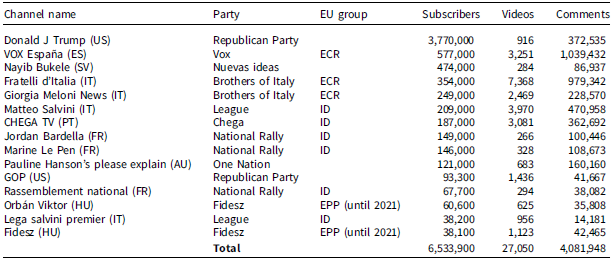
Data were collected in November 2024 using the YouTube Application Programming Interface (API) v3, gathering video titles, descriptions, comments, and commenter usernames for all videos published within the time period. For each case, I focused on the official YouTube channels of the party and its leader, when available, since both can function as key venues for engagement by their digital publics.Footnote 9 The fifteen YouTube PRRP channels cover a broad geographical distribution and incorporate comment data in at least six different languages, adding complexity to the detection of transnational engagement. They vary greatly in terms of subscriptions – from the 38,100 followers of Fidesz’s channel to the 3.7 million of Trump’s – and therefore in their potential reach.
To account for inauthentic behaviourFootnote 10 in the data – given the likely presence of bots (Na, Cho and Shin Reference Na, Cho and Shin2023) – I removed users exhibiting potential spam activity, such as posting duplicate content or displaying unusually high levels of activity (Hussain, Tokdemir, Agarwal et al. Reference Hussain, Tokdemir, Agarwal and Al-Khateeb2018; Godoy Reference Godoy2024). Through an automated procedure in Python, I flagged users who posted the exact same comment five times in a row or had 90% duplicate comments, as well as those ranking in the top 0.1% by daily or hourly activity. This removed 3,996 suspicious users (0.46 % of the original 868,091) responsible for 355,623 comments (8% of the total), leaving 4,082,526 comments for analysis. Table 1 summarises the dataset.
YouTube data from 1 January 2016 to 31 July 2024, collected from PRR actors’ channels, including the number of videos and associated comments

Table 1. Long description
The table presents data on YouTube channels associated with various political parties and groups. It includes columns for channel name, party, EU group, subscribers, videos, and comments. The table has 16 rows and 6 columns. Row 1: Donald J Trump (US), Republican Party,, 3,770,000, 916, 372,535. Row 2: VOX Espana (ES), Vox, ECR, 577,000, 3,251, 1,039,432. Row 3: Nayib Bukele (SV), Nuevas ideas, ECR, 474,000, 284, 86,937. Row 4: Fratelli d’Italia (IT), Brothers of Italy, ECR, 354,000, 7,368, 979,342. Row 5: Giorgia Meloni News (IT), Brothers of Italy, ECR, 249,000, 2,469, 228,570. Row 6: Matteo Salvini (IT), League, ID, 209,000, 3,970, 470,958. Row 7: CHEGA TV (PT), Chega, ID, 187,000, 3,081, 362,692. Row 8: Jordan Bardella (FR), National Rally, ID, 149,000, 266, 100,446. Row 9: Marine Le Pen (FR), National Rally, ID, 146,000, 328, 108,673. Row 10: Pauline Hanson’s please explain (AU), One Nation,, 121,000, 683, 160,160. Row 11: GOP (US), Republican Party,, 93,300, 1,436, 41,667. Row 12: Rassemblement national (FR), National Rally, ID, 67,700, 294, 38,082. Row 13: Orban Viktor (HU), Fidesz, EPP (until 2021), 60,600, 625, 35,808. Row 14: Lega salvini premier (IT), League, ID, 38,200, 956, 14,181. Row 15: Fidesz (HU), Fidesz, EPP (until 2021), 38,100, 1,123, 42,465. Row 16: Total,, , 6,533,900, 27,050, 4,081,948.
Note: Subscriber counts were retrieved in December 2024 and are displayed as approximations in accordance with YouTube’s public data policies. The EU Group column reports parties’ group affiliations in the 2019–2024 European Parliament. For Fidesz, the table indicates membership in the European People’s Party (EPP) until 2021. The party is excluded from analyses comparing PRRP European Parliament groups, which focus exclusively on ECR and ID parties.
The empirical analysis focuses on two aspects: 1) transnational users, defined as those who commented on two channels from two different countries; and 2) their activity, labelled as transnational engagement. The general measure of transnational engagement refers to the overlaps between commenting users across channels and videos from different countries, following Rauchfleisch and Kaiser’s (Reference Rauchfleisch and Kaiser2020) study of the German far right (see also Xu, Park, Kim et al. Reference Xu, Park, Kim and Park2016). Specifically, I calculated these overlaps at both the video and channel levels by identifying (a) how many transnational users commented on each video and (b) how many commenters are shared between each pair of channels from different countries.
To test my hypotheses, I employed a two-step approach. At the video level, I estimated transnational engagement as the share of comments posted by transnational users out of a video’s total comments. To test whether framing, performative setting, or popularity of a video explains transnational engagement (H1, H2, and H4a), I applied a hurdle modelling strategy, combining a logistic regression (predicting whether a video received any transnational comment) and a fractional logit modelFootnote 11 (predicting the share of transnational comments among those that did). For H1 and H2, I conducted the analysis on a stratified sample of 1,000 manually annotated videos. All videos were divided into four strata based on their level of transnational engagement: zero, low (below the median), medium (below the 75th percentile), and high. 250 videos were then randomly selected from each stratum. The sample was coded for framing and performance type (transnational vs. non-transnational) and weighted using inverse probability weights to reflect the distribution of transnational engagement in the full dataset (Horvitz and Thompson Reference Horvitz and Thompson1952).Footnote 12 The main predictors were binary indicators of: (1) transnational framing, that is whether a video situates national themes within broader international or supranational contexts (e.g., references to the UN or the EU), or posits a transnational ‘us’ against shared global threats (Moffitt Reference Moffitt2017);Footnote 13 and (2) transnational performance, defined as the concurrent presence of PRR actors from different countries, such as at international PRR events (e.g., CPAC) or bilateral meetings.
For H4a, I applied the same two-step model to the full set of 27,050 videos. Key predictors included views and like counts as proxies for video popularity, alongside controls for duration, time period (pre-, during, post-Covid 19 pandemic), and channel fixed effects. Table 2 reports descriptive statistics for the full video dataset.
Descriptive statistics of video-level engagement and metadata in the full dataset (N = 27,050)

Table 2. Long description
A table with descriptive statistics of video-level engagement and metadata for a dataset of 27,051 videos. The table has 5 rows and 6 columns. The columns are labeled Mean, SD, Minimum, Median, and Maximum. The rows are labeled Transnational engagement, Total comments, Duration (in seconds), Likes, and Views. Row 1: Transnational engagement, Mean 0.07, SD 0.10, Minimum 0, Median 0.04, Maximum 1. Row 2: Total comments, Mean 150.91, SD 446.57, Minimum 1, Median 44, Maximum 31,368. Row 3: Duration (in seconds), Mean 666.97, SD 1686.40, Minimum 2, Median 168, Maximum 42,901. Row 4: Likes, Mean 2158.57, SD 7613.97, Minimum 0, Median 549, Maximum 399,319. Row 5: Views, Mean 60793.10, SD 544542.97, Minimum 15, Median 7,342, Maximum 34,962,498.
Note: Transnational engagement is estimated here as the proportion of comments by transnational users on the total number of comments for each video.
At the channel level, I estimated transnational engagement using social network analysis. I modelled connections between YouTube channels so that two channels (the nodes) from different countries are linked when they share at least one commenting user. Multiple channels within the same country (e.g., Le Pen’s and Bardella’s) are treated independently and do not increase the likelihood of transnational ties. The resulting undirected network built in Python with the igraph package was weighted according to the proportion of shared commenters relative to the audience size of the smaller channel in each pair. This way, connection (or edge) weights directly quantify the intensity of transnational engagement between channels, as is standard practice (see Rauchfleisch and Kaiser Reference Rauchfleisch and Kaiser2020: 380).
To test whether transnational engagement is stronger between party channels in the same EP alliance (H3) and whether language (H5) or the European context (H6) facilitates transnational activities, I used average edge weights as the dependent variable. To assess whether more popular channels attract greater transnational engagement (H4b), I relied on the weighted degree of each node, which reflects the total strength of its connections and thus the cumulative volume of transnational users it shares with others.Footnote 14 I then correlated edge weights and weighted degrees with channel characteristics: primary language, geographical location, subscriber count, and the party’s EP alliance. The next section proceeds as follows: first, I present the video-level results addressing H1, H2, and H4a; second, I turn to the channel-level network analysis addressing H3, H4b, H5, and H6.
The factors driving transnational engagement
Transnational users – those who commented on YouTube channels from at least two different countries – are a small but engaged segment of PRR publics. They account for about 1.6% of commenters (13,813 individuals) yet accumulate over four times as many total comments and remain active for longer periods than single-country users.Footnote 15 Not all are multilingual: using the langdetect package in Python (Nakatani Reference Nakatani2010; Verhoeven, Daelemans and Plank Reference Verhoeven, Daelemans and Plank2016), I found that about one third (4,619; 33.4 %) use a single language – mostly English or Spanish – and primarily move between same-language channels across countries. The remaining two-thirds (9,194; 66.6%) switch languages to adapt to the channels they comment on, posting in the channel’s main language about 70% of the time. Together, these patterns indicate that shared language facilitates cross-border engagement, in line with H5. But the ability to overcome language barriers – e.g., by being bilingual or using automated translation – characterises a substantial subset of transnational users.
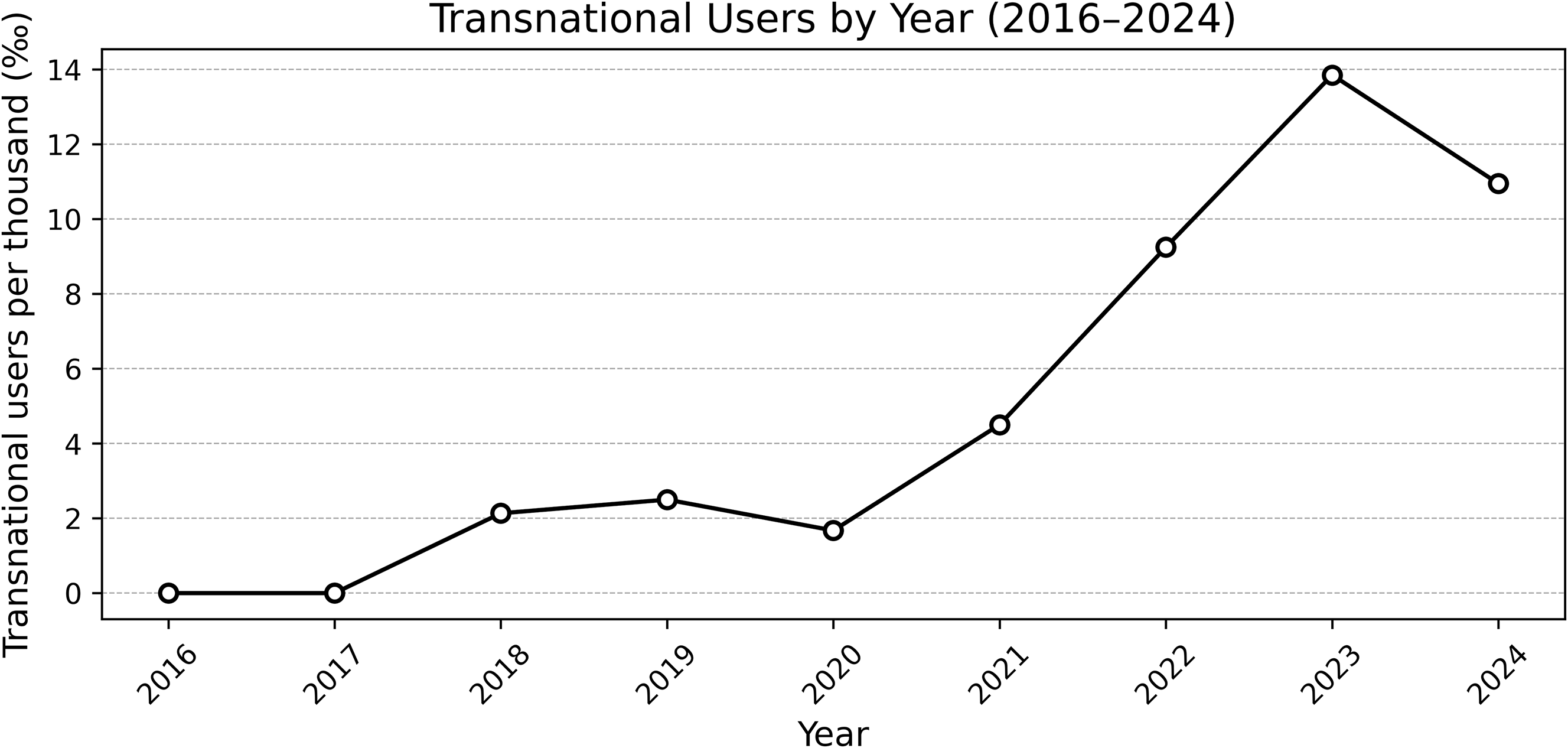
Over time, transnational users rose from virtually 0‰ (per thousand) of all commenters in 2016–2017 to around 2‰ in 2018–2019, climbing to 8.8‰ by 2022 and peaking at 13.6‰ in 2023. The 10.7‰ for 2024 reflects only data from January to July, likely understating the full extent of transnational engagement during that year. This trend is reported in Figure 1.Footnote 16 This finding expands those of the study looking at Twitter by Froio and Ganesh (Reference Froio and Ganesh2019), which found limited transnationalisation based on data from 2016 and 2017. YouTube data from the subsequent eight years suggest increasing transnational activity among PRR digital publics.
Proportion of transnational users per year between January 2016 and July 2024.
Note: Transnational users are those who commented on channels based in at least two different countries; for each calendar year, their count is divided by the total number of unique commenters that year.

Transnational engagement at the video level
To understand the factors driving transnational engagement at the video level, I used a two-step hurdle model, given the skewed distribution of transnational engagement (mean = 0.07, median = 0.04) and the large share of videos receiving no transnational comments. The first step is a logistic regression predicting whether a video receives any transnational engagement. The second is a fractional logit model predicting the magnitude of transnational engagement among videos that received at least one transnational comment. To test whether transnational engagement is higher on videos adopting a transnational frame (H1) or showing a transnational performance (H2), I focused on a stratified sample of 1,000 videos. All models included controls for video duration and setting, as well as fixed effects for the year of publication and channels, to ensure that results are not driven by systematic differences across PRR creators.Footnote 17 To account for the effects of the Covid-19 pandemic on patterns of transnational engagement, years are grouped into three periods: pre-Covid (2016–2019, baseline), Covid (2020–2021), and post-Covid (2022–2024).Footnote 18
Videos were annotated to record whether they have a transnational framing or show a transnational performance.Footnote 19 Transnational framing indicates that the video situates national issues within broader international or supranational contexts, for instance by referencing supranational actors, international policy agendas, or shared cross-national threats (Miller-Idriss Reference Miller-Idriss2019; Cerrone Reference Cerrone2023). Examples include a Vox video titled ‘O Agenda España de VOX o Agenda 2030, no hay más opciones’ which justaxposes the party’s platform with the UN’s 2030 Agenda, and Jordan Bardella’s video – ‘Il n’existe pas de « droit à l’Europe », qui nous obligerait à accueillir sans condition’Footnote 20 – that frames the European Union as imposing supranational immigration obligations that undermine national sovereignty. Transnational performance, by contrast, describes content in which transnationalism is not necessarily articulated discursively but shown, such as videos displaying PRR leaders from different countries appearing together, meeting in person, or participating in each other’s rallies and international events. Further details on the coding process are available in online Appendix A.
Within the sample, the use of transnational framing increased over time, rising from roughly 10% of videos in 2016–2017 to over 25% by 2024 (see Appendix A). This suggests that PRR parties increasingly articulate messages in ways that may help make their content more accessible across borders. Bivariate tests confirmed that transnationally framed videos are significantly more likely to receive transnational comments than those without such framing (z = −2.71; χ 2 = 6.83; p < .05), providing preliminary support for Hypothesis 1. When the same tests were applied to transnational performative cues, the estimated differences were weaker and not statistically significant, pointing to a more limited role for performance.Footnote 21
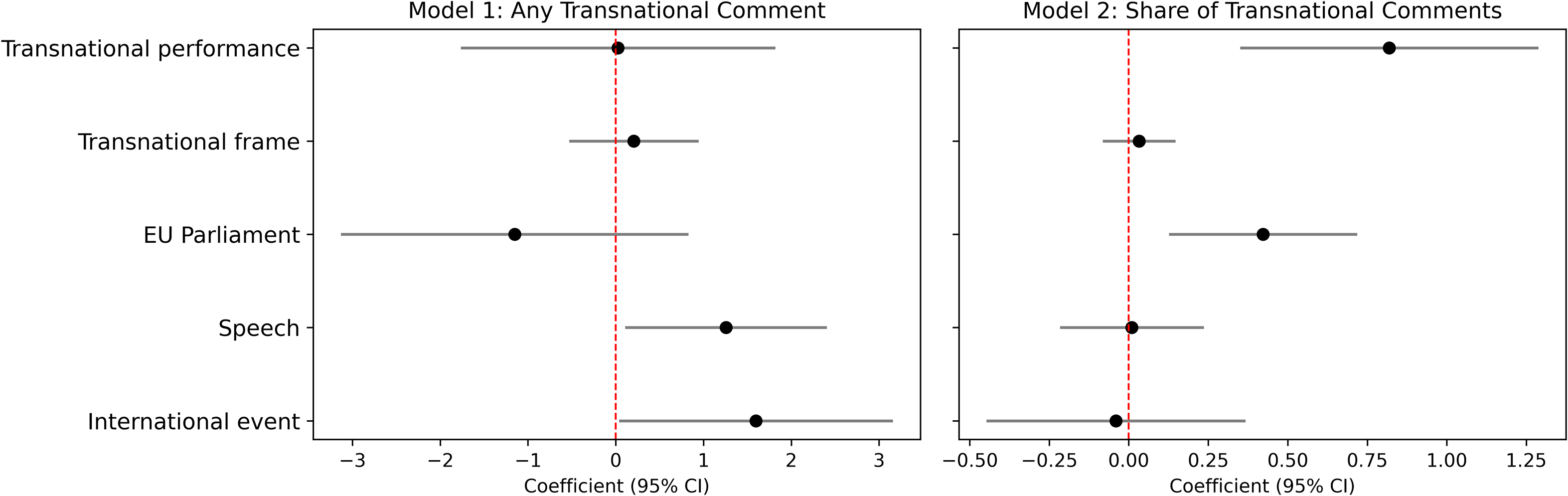
The bivariate associations did not hold, however, once I estimated the two-part hurdle model.Footnote 22 In the multivariate setting, transnational framing was not independently associated with either the probability or the intensity of transnational engagement. H1 is therefore not supported. Performative cues tell a different story. While transnational performance does not significantly predict whether a video attracts transnational engagement (Figure 2, Model 1), it does help explain its intensity. As shown in Figure 2 (Model 2), videos featuring transnational performances by PRRPs are associated with significantly higher shares of transnational commenters (β = 0.82; p < .005). H2 is therefore partly supported: once transnational users are engaged, their presence increases on videos showing transnational performances.
Effects of video framing and setting on transnational engagement (95% CIs): (Model 1) odds of any transnational comment (logistic regression); (Model 2) share of transnational engagement (fractional logit).
Note: Channel fixed effects are included in the models but omitted from the plots for readability. Panel (1): N = 1,000; Pseudo-R 2 = 0.49. Panel (2): N = 750; Pseudo-R 2 = 0.03. Pseudo-R2 values in fractional logit models are typically lower than those in binary logistic regressions due to the continuous nature of proportional dependent variables: their greater variability is more difficult to explain than binary outcomes (Papke and Wooldridge Reference Papke and Wooldridge1996).

Among the control variables, some video settings emerged as meaningful predictors. In the first step (Model 1, Figure 2), videos featuring leaders’ speeches on domestic stages or covering general international events – not necessarily involving PRR actors, such as G20 or bilateral meetings with non-PRR leaders – are marginally more likely to attract transnational commenters. In the second step (Model 2, Figure 2), videos set in the European Parliament are associated with significantly higher transnational shares. Overall, these findings suggest that, contrary to H1 but in line with H2, transnational engagement is shaped less by the content itself than by performative cues. In other words, it is less driven by what is said than by whom and where. The joint presence of PRR leaders from different countries, as well as their participation in each other’s rallies or in international PRR gatherings such as CPAC or Viva, helps make PRR online publics more transnational. Figure 2 reports the estimated coefficients for both models.
To test the robustness of my findings, I ran a series of alternative model specifications.Footnote 23 The results of these largely support the null effect of transnational framing and the positive association of transnational performances with the intensity of transnational engagement. Re-estimating the hurdle model without inverse probability weights and fitting a binomial hurdle model on raw counts of comments by transnational users led to substantively identical conclusions. While negative binomial regressions on the raw count of comments show a significant effect of framing, this likely reflects the broader tendency for videos with more comments overall to also attract more transnational ones, rather than a meaningful effect. Finally, I modelled videos’ specific topics (e.g., immigration, economy) as random intercepts in both steps of the hurdle model: this produces minimal variance and no meaningful deviations, reinforcing the idea that transnational engagement is not primarily driven by the issue or framing of the video.
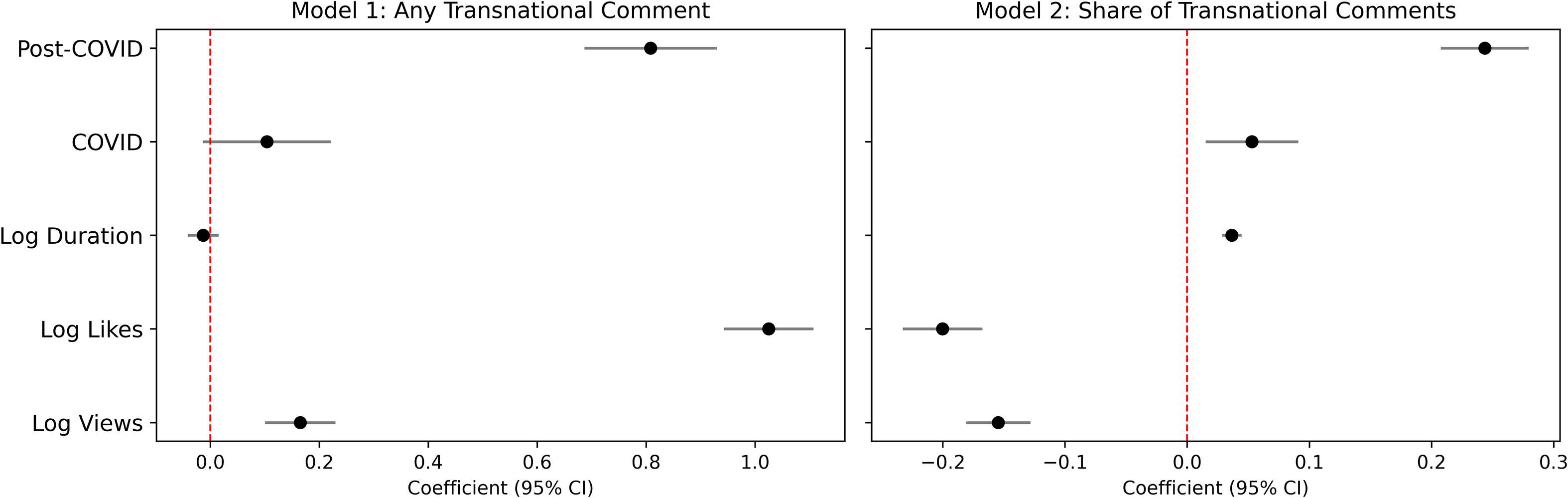
To estimate the effect of video popularity on transnational engagement (H4a), I applied the same two-step hurdle model to the full dataset of 27,050 videos.Footnote 24 Video popularity is estimated by likes and views count, both log-transformed given their skewed distribution.Footnote 25 Average marginal effects were also calculated to facilitate interpretation. The first step (Model 1, Figure 3) shows that video popularity matters: more views and especially more likes significantly increase the odds of attracting transnational engagement. All else being equal, increasing the number of likes on a video from 550 (the median) to around 1,500 (a 1-unit increase in log scale) raises the probability of receiving transnational comments by 11.3 percentage points. This represents a modest growth in popularity: 1,500 likes is below the dataset’s mean of 2,159, suggesting that even moderately liked videos can experience a meaningful increase in transnational reach. Views show a similar but weaker effect. A 1-unit increase in the log of views – from approximately 7,000 (the median) to 20,000 views – is associated with a 1.8 percentage point increase in the probability of any transnational engagement.
Effects of video popularity and period on transnational engagement (95% CIs): (Model 1) odds of any transnational comment (logistic regression); (Model 2) share of transnational engagement (fractional logit).
Note: Channel fixed effects are included in the models but omitted from the plots for readability. Panel (1): N = 23,457; Pseudo-R 2 = 0.38. Panel (2): N = 17,798; Pseudo-R 2 = 0.03.

Figure 3. Long description
Two separate graphs depict the effects of video popularity and period on transnational engagement. Panel A: Model 1 shows the odds of any transnational comment using logistic regression. The x-axis represents the coefficient with a 95 percent confidence interval, and the y-axis lists factors including Post-COVID, COVID, Log Duration, Log Likes, and Log Views. Each factor is represented by a dot with a horizontal line indicating the confidence interval. Post-COVID and Log Likes show positive coefficients, while COVID, Log Duration, and Log Views show varying effects. Panel B: Model 2 illustrates the share of transnational engagement using fractional logit. The x-axis represents the coefficient with a 95 percent confidence interval, and the y-axis lists the same factors. Post-COVID and Log Likes again show positive coefficients, while COVID, Log Duration, and Log Views display different effects.
Interestingly, in the second step (Model 2, Figure 3), the effects of likes and views remain significant but shrink in size and switch sign. More popular videos are associated with slightly lower proportions of transnational comments. A one-unit increase in likes or views is associated with, respectively, a 1.7 and 1.3 percentage point decrease in the share of transnational comments. Overall, the results offer partial support for H4a. Popularity increases the likelihood that a video attracts transnational users, but the relative weight of transnational engagement is diluted in more mainstream or widely viewed content.
The controls yielded meaningful results. Channel-level fixed effects revealed substantial variation, indicating that transnational engagement depends greatly on who publishes the video. The channels of Vox, National Rally, and Chega consistently exhibit higher levels of transnational engagement, both in the likelihood of receiving any transnational comments and in their overall share. Trump’s channel, conversely, is less likely to receive any transnational comments, but when it does, it shows the highest share of transnational engagement among all observed channels. Finally, the post-Covid period is positively associated with transnational engagement across both stages of the model (with the Covid period significant only in Model 2), indicating that videos published after the pandemic are more likely to receive, and contain a higher share of, cross-border participation. This underlines the increase in transnational engagement on YouTube between 2016 and 2024, and particularly from 2022 onwards. Figure 3 displays the coefficient plots for the two models.
Transnational engagement at the channel level
To understand the factors driving transnational engagement at the channel level, I constructed a network in which PRRPs’ YouTube channels are the nodes, while the edges indicate the presence of shared transnational commenters between them (Figure 4). The edges are weighted by the volume of shared transnational users, while the size of the channels corresponds to their weighted degree (strength): the larger the nodes are, the stronger is their transnational connectivity. Within this network, actors like Donald Trump and Vox – and, to a lesser extent, Pauline Hanson, Nayib Bukele, and Giorgia Meloni – exhibit higher strength. This indicates that their publics are more likely to engage transnationally with other PRR channels and that publics of other PRR channels are more likely to engage with them. Conversely, channels like those of the League, Jordan Bardella, and Fidesz display weaker connections. While Donald Trump’s prominence is unsurprising, the centrality of actors such as Vox, Hanson, and Bukele was less expected. The structure of the network does not simply mirror a country’s size – El Salvador’s population is fifty-three times smaller than that of the US – nor the party’s political standing, as both One Nation and Vox have not accessed national government during the time period. As the hypothesis testing below shows, this has to do primarily with language and platform architectures.
Channel-to-channel network with commenter overlaps as edges based on YouTube data from nine PRRPs between 2016 and 2024.
Note: Edge colour gradient and thickness according to weight. Node sizes according to weighted degree (strength). Larger nodes denote channels with stronger connections across the network, while edge weights reflect the intensity of transnational engagement between pairs of channels. Visualised in Gephi using Force Atlas 2.

European Parliament groups
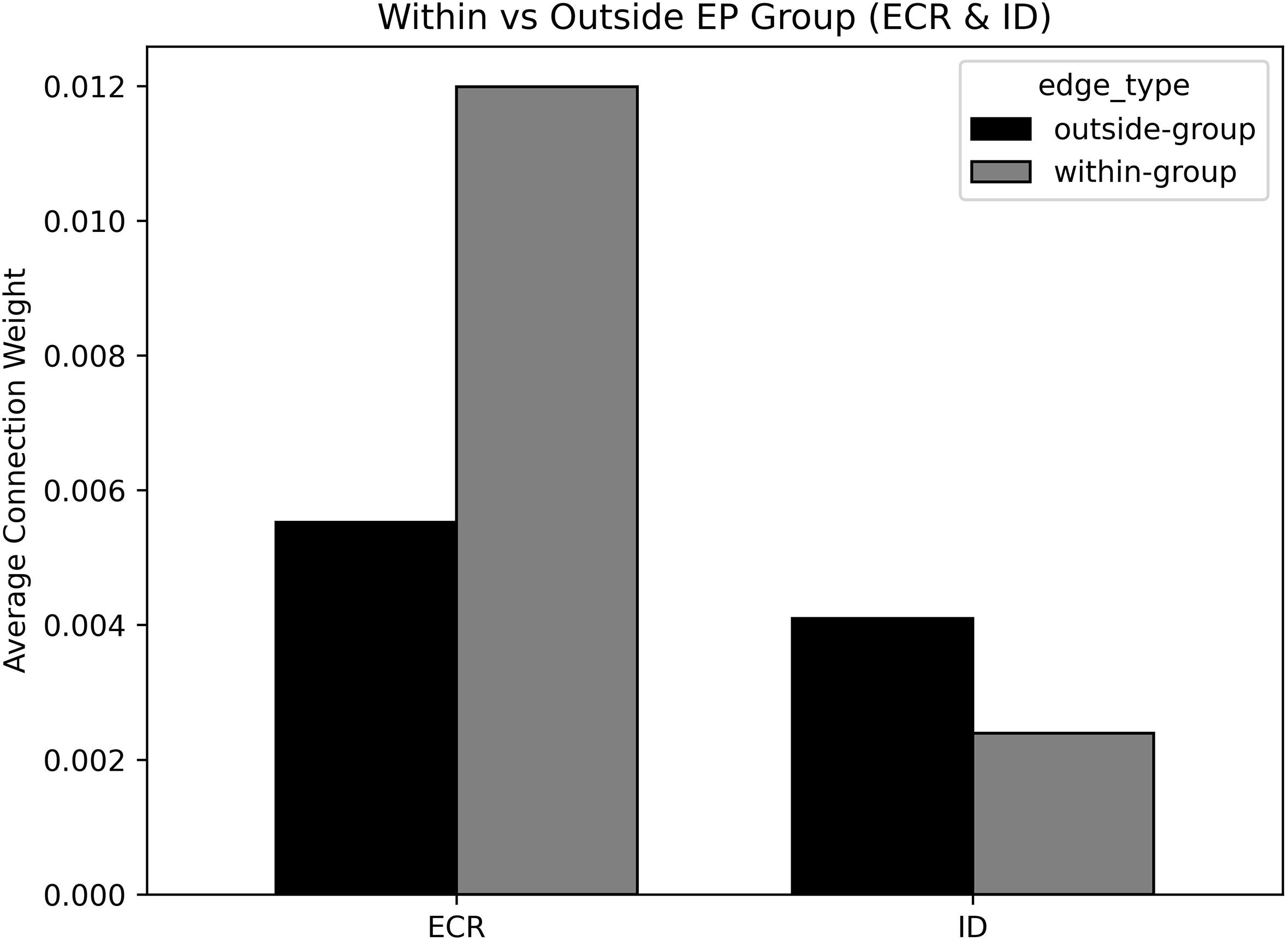
To test whether transnational engagement is higher between channels of the same EP group (H3), I compared each group’s mean transnational overlap among its own members versus that with channels outside the group. As shown in Figure 5, ECR channels share more of their audience with one another than with outsiders, whereas ID channels exhibit stronger overlaps with channels outside their group than within it. Specifically, ECR channels overlap internally by about 117% more than they do with non-ECR channels, confirming a tight, cohesive ECR network. By contrast, ID channels overlap 71% more with outsiders than with fellow ID members. H3 is therefore not supported for the ID group. Even after excluding Vox, the strongest European node in the network, ID’s external ties remain about 40% stronger than its within-group connections.Footnote 26
Average connection weights for EU groups (2019–2024): comparison of the average edge weights for ECR and ID within their political group and outside.

These findings indicate a strong overlap between the digital publics of Vox and Brothers of Italy (ECR) on YouTube. During the analysed period, the two parties frequently referenced one another, with their leaders often appearing together. Sixteen video titles on Brothers of Italy’s channels explicitly refer to Vox, while eleven videos on Vox’s channels mention Giorgia Meloni. Not only did Vox celebrate Brothers of Italy’s victory at the 2022 Italian general election,Footnote 27 but Meloni regularly participated in Vox’s annual event, VIVA. This has likely strengthened overlaps between the two parties’ digital publics. By contrast, this dynamic is less evident among ID party’s channels: between 2019 and 2024, the League mentioned European allies six times, Chega four times, and National Rally only once.
Channel popularity
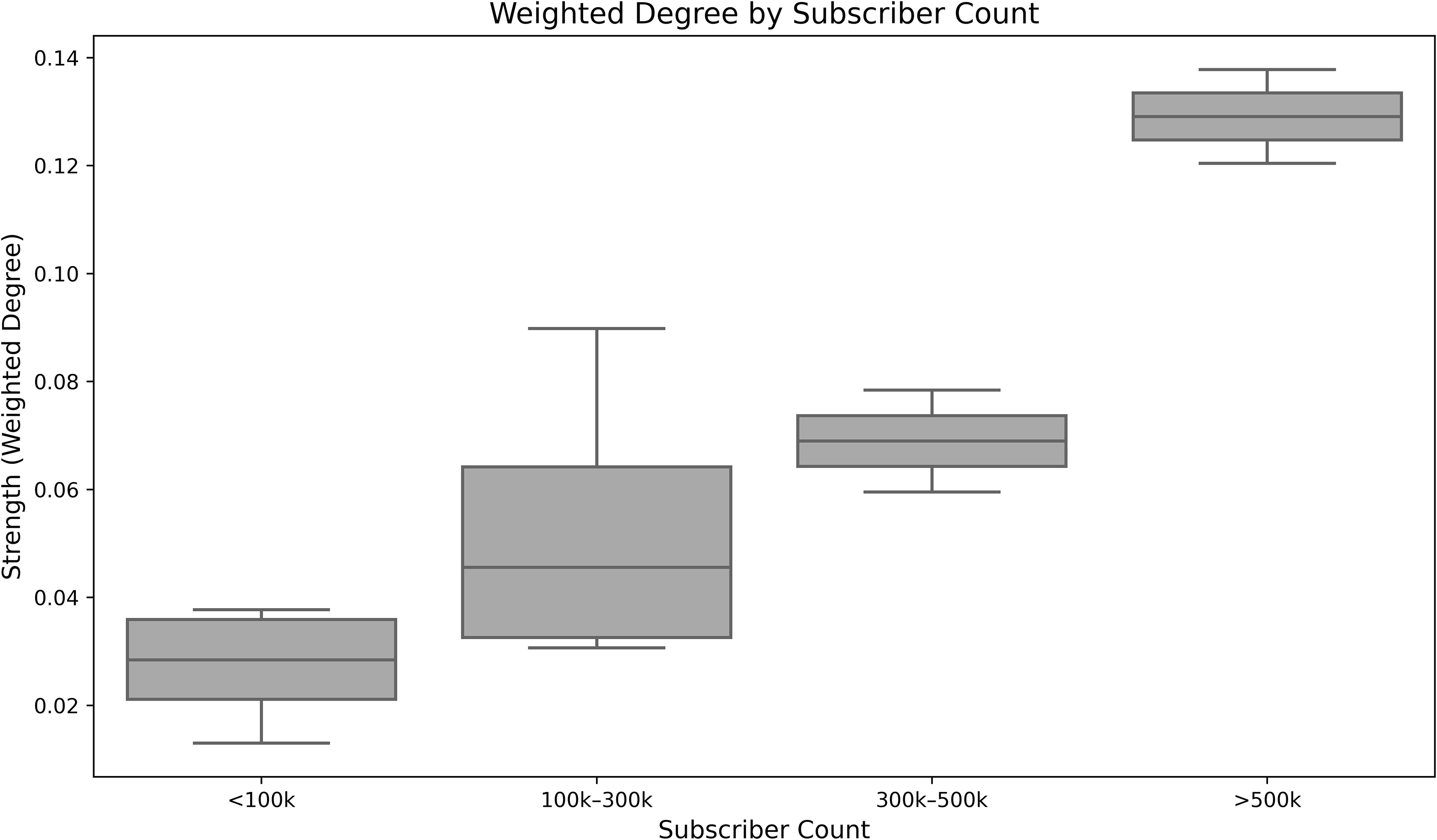
To test whether transnational engagement is higher for channels with more subscribers (H4b), I examined the relationship between each channel’s weighted degree (strength) and its subscriber count. As highlighted by Figure 6, channels with more subscribers tend to exhibit greater transnational connectivity. The two strongest channels in terms of transnational engagement – Trump and Vox – also have the highest subscriber counts. Weaker channels, such as those of Fidesz and the League, have lower subscription numbers. Hypothesis 4b is thus supported.Footnote 28 As expected, channel popularity on YouTube is correlated with higher transnational appeal. This likely reflects the rich-get-richer dynamic (Castaldo, Frasca, Venturini et al. Reference Castaldo, Frasca, Venturini and Gargiulo2024), whereby more popular creators tend to expand their reach in the platform, also across borders.
Popularity of channels according to the following base.
Note: Pearson’s r: 0.71; p < .005.

Language and geographical proximity
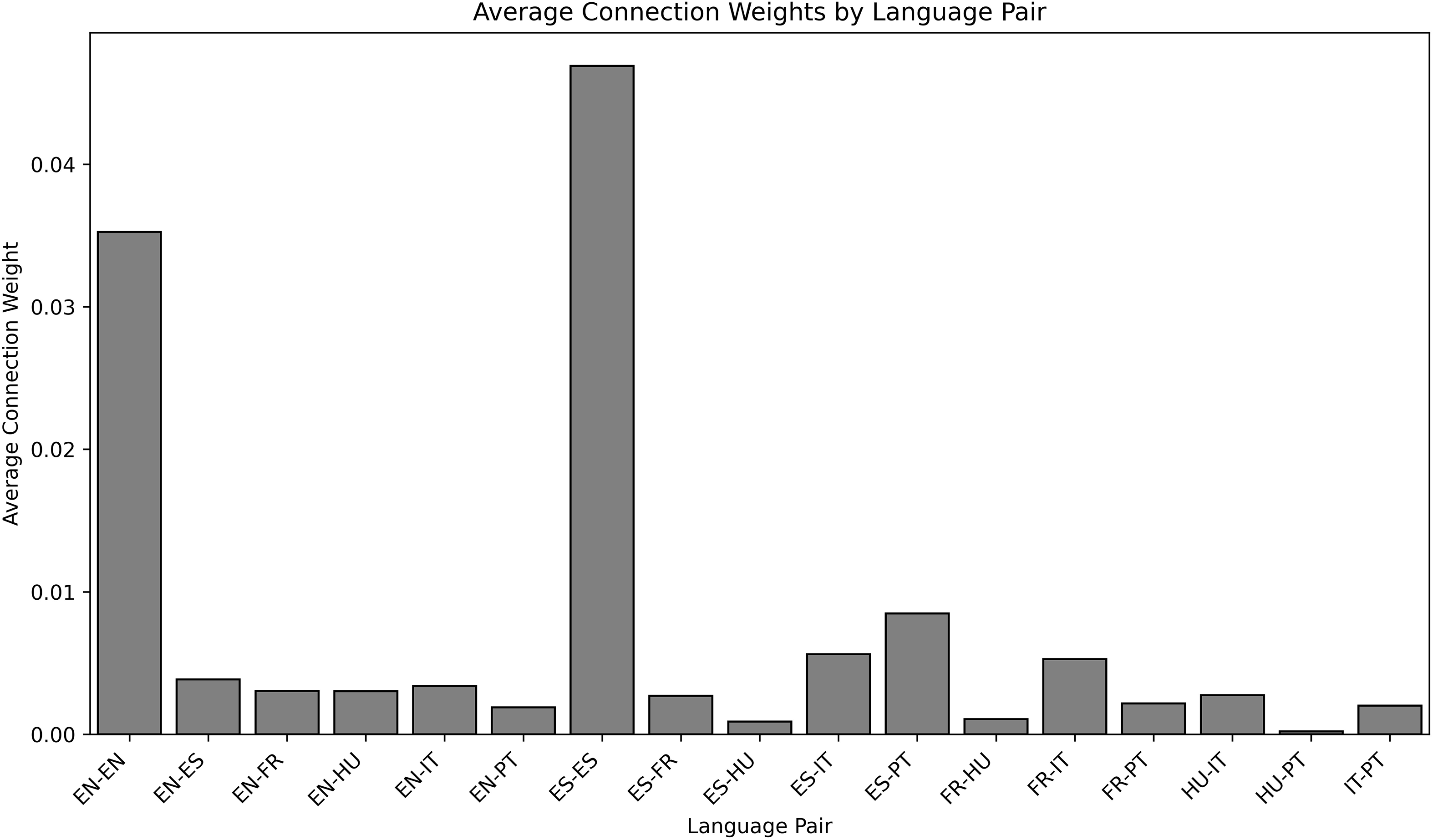
To test whether shared language between two channels facilitates transnational engagement (H5), I compared average edge weights for pairs of channels belonging to the same versus different language groups in the network. As summarised in Figure 7, user flows are stronger between channels of the same language group – e.g., between Trump and Hanson – than across language groups. In particular, Spanish–Spanish channels share on average 4.7% of their audiences – over five times the 0.9% seen for Spanish–Portuguese links, the third-largest pair – while English–English ties average 3.5%, over four times that benchmark. Nonetheless, some cross-language pairs do stand out: transnational activities are relatively high between Spanish and Italian, Spanish and Portuguese, and Italian and French-speaking channels. This suggests that language similarity – and, possibly, geographical proximity – can favour transnational exchanges among PRR publics (see O’Callaghan, Greene, Conway et al. Reference O’Callaghan, Greene, Conway, Carthy and Cunningham2013 for similar findings regarding extreme-right transnational networks). This strongly supports H5.
Average connection weights by language pairs.
Note: For each language pair, this is the mean of all the normalised overlap scores across every channel pair in that language combination.

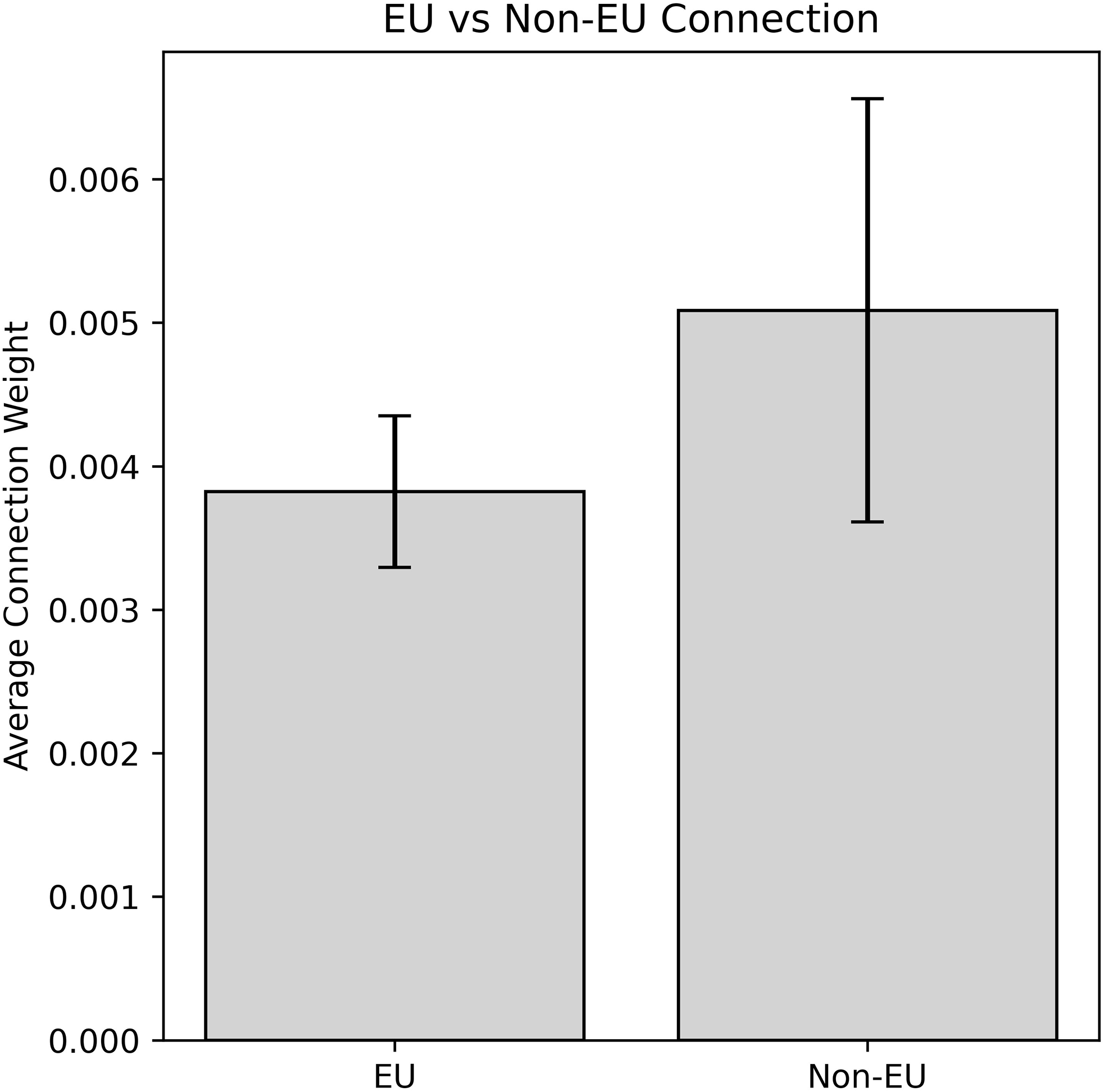
To assess whether transnational engagement is higher within the European context than among non-European YouTube channels (H6), I compared average edge weights between pairs of European channels and those involving at least one non-European channel. As shown in Figure 8, the results do not support my expectations: connections between European channels are weaker than those linking European and non-European channels, or those between two non-European channels. Statistically, the difference between the two groups is not significant, given the high variability of connections involving non-European channels. This finding suggests that the network of transnational engagement across PRR YouTube channels is inherently global, with no clear European sub-network emerging.
Comparison of average connection weights between EU and non-EU connections in the channel-to-channel network.
Note: Each bar’s height is the average normalised audience overlap, with 95% confidence intervals.

This result is surprising, since European PRRPs are linked together by stronger cooperation within the European Union. To further test these results, I re-ran the model while excluding the strongest of both the non-European and European nodes: Trump and Vox. In this scenario, European connections did become stronger than non-European ones, underscoring the crucial role the two excluded actors play in bridging audiences across continents: publics of PRRPs in Europe are likely to engage with Trump, while Vox’s publics are likely to overlap with Spanish-speaking audiences in Latin America.
Conclusion
The populist radical right, and its publics, are increasingly transnational. While research has recently begun to explore the transnational dimension of the PRR (de Cleen Reference de Cleen and Rovira Kaltwasser2017; McDonnell and Werner Reference McDonnell and Werner2019), the transnationalisation of PRR publics has remained an understudied phenomenon, especially beyond Europe. In this article, drawing upon a large dataset of YouTube comments, I analysed the factors shaping transnational engagement among digital publics of nine PRRPs from eight countries. I found that what parties say matters less than their performances. Indeed, while transnational framing does not significantly predict engagement, performative cues – i.e., joint appearances by PRR actors from different countries – are associated with higher shares of transnational participation. Shared language and content popularity also emerged as key predictors of transnational engagement. Contrary to my expectations, European cross-national interactions were not stronger than elsewhere – something that is likely influenced by two prominent actors, Trump and Vox, who serve as bridges across Europe and the Americas. Moreover, I found that parties affiliated to the ECR group in the 2019–2024 European Parliament – specifically, Brothers of Italy and Vox – shared a significant portion of their publics, in contrast to what I observed for the ID group. Finally, I showed that transnational engagement on YouTube increased significantly in the post-Covid period compared to pre-pandemic years.
My research has several implications for the study of the PRR party family, its digital communications, and the role of parties’ online publics. First, it provides empirical corroboration for, and expands upon, the assumption that digital platforms are a key arena for the transnationalisation of populism. As Moffitt (Reference Moffitt2017: 420) notes, online spaces indeed offer the opportunity for populist actors to reach beyond their usual audiences and spread their claims more broadly. But who is listening, and why? My study shows that the efforts of party actors to represent a transnational people and foster international links are increasingly accompanied by a transnationalisation from below on digital platforms. This process involves the agentic power of everyday active users, who ultimately choose whom to engage with for reasons often falling outside the parties’ control. Second, my findings indicate that platforms have a central role in shaping transnational engagement. Far from being neutral actors, digital spaces reward popular content and creators as well as promoting material aligned with users’ preferences (Gillespie Reference Gillespie2010; Thorson and Welles Reference Thorson and Wells2016). These dynamics likely influence how users encounter certain PRR content – rather than others – beyond their national spheres. In this respect, my findings also challenge a longstanding view in PRR research: that social media allow PRRPs to reach their audience directly, circumventing the gatekeeping role of traditional media (Moffitt Reference Moffitt2016; Mudde Reference Mudde2019). While disseminating the message is indeed less costly on digital media, audience reception is not that straightforward. Platforms may either help or obstruct message circulation, according to their architecture and rules. Thus, similar to traditional media, they can be both friends and foes for PRR actors. Third, going beyond the PRR, my findings suggest that digital platforms create space for different forms of partisan engagement. Recent research has identified ‘social media partisans’, namely users who signal exclusive affiliation with a single party through their online behaviour, resembling traditional members (Kosiara-Pedersen, van Haute and Scarrow Reference Kosiara-Pedersen, van Haute and Scarrow2025). However, my study suggests that partisan publics may also emerge around an entire party family, and not just single parties. These users remain within a shared worldview but provide visibility and legitimation to the whole party family through their engagement across multiple countries. This points to a promising direction for future research on the existence and relevance of transnational partisan sympathisers.
These findings do come with some limitations. First, the regression estimating the effect of transnational framing and performance was based on 1,000 observations, which may reduce generalisability. Second, my data collection focused on the official YouTube channels of PRRPs, excluding other right-wing actors like fringe creators and political influencers. As a result, this study captures only part of the broader digital transnationalisation of the right (albeit a very significant and coherent one). Although these actors can play an important role in circulating PRR narratives, their relevance and organisational form vary substantially across countries, and they are less clearly aligned with specific political families. These limitations aside, my findings point to several avenues for further research. For example, scholars could investigate the rising trend of transnational engagement over time by comparing PRRPs with left-wing parties to determine whether a similar temporal increase occurred among them or whether transnational interactions grew more significantly within the PRR. Moreover, future studies could extend my approach by analysing content from non-party actors – for example, those participating in events like CPAC – to assess whether similar patterns of transnational engagement emerge. The relative importance of transnational performances for audience bridging also warrants further investigation. Future research could look at international PRR events in particular and assess whether some venues generate stronger cross-border engagement than others and examine whether joint appearances primarily mobilise the visiting leader’s supporters or increase transnational attention tout court among PRR publics.
Overall, my study shows that a complex network of cross-border interactions among digital publics complements international PRRP alliances. The transnational arena is neither discredited nor ignored by PRR actors. On the contrary, they openly perform their commonalities and receive transnational visibility in return. PRRPs are often seeking abroad what they cannot easily secure at home: friends (Fieschi Reference Fieschi2000). In the transnational space, they can establish political ties that are more difficult to pursue domestically, where stigma and suspicion frequently constrain cooperation. For the PRR, more than for other party families, international collaboration is thus an additional way to achieve recognition and respectability beyond navigating often hostile national political and media systems. Over the longer term, being not only electorally solid but also transnationally united may enhance PRRPs’ capacity to imprint a radical right turn to liberal democratic systems, particularly within the EU – especially when these efforts are sustained from below. When the mobilisation of PRRPs around ‘shared missions’ (McDonnell and Werner Reference McDonnell and Werner2019: 197) is embraced by everyday citizens across countries, transnational cooperation gains a broader foundation. Consequently, to deepen our understanding of transnational politics within the PRR, a holistic approach is beneficial. As this article has shown, the study of digital spaces, where party figures, aligned news organisations, media personalities, and everyday users interact across borders, can complement and expand the analysis of political networking and help illuminate its wider effects.
Supplementary material
The supplementary material for this article can be found at https://doi.org/10.1017/S1475676526101571.
Data availability statement
The data supporting the findings are openly available in the Harvard Dataverse: https://doi.org/10.7910/DVN/GEXDGU.
Acknowledgements
I am very grateful to my colleagues at Griffith University, Sofia Ammassari, Ferran Martinez i Coma, and Duncan McDonnell, for their continuous support and advice and to the other participants of the ‘Peppers’ workshop – Sarah Cameron, Fernando Freitosa, Max Grömping, and Lee Morgenbesser – for their generous feedback on an earlier draft of this article. I would also like to thank the editors, particularly Caterina Froio, the anonymous reviewers, and participants at the 2024 ECPR General Conference in Dublin and the SISP conferences in Trieste and Naples for their comments and suggestions.
Funding statment
This study is part of a wider project ‘The internationalisation of nationalist populism’, which is led by Duncan McDonnell (Griffith University) and is funded by the Australian Research Council (FT210100617).
Competing interests
The author declares no competing interests.




 Open access

