It is well known that for a very general class of preference profiles a Majority Rule Equilibrium (MRE) does not exist in settings with a minimally complex set of political alternatives.Footnote 1 More specifically, when voters have smooth preferences over outcomes in multidimensional choice spaces, for any given outcome there will almost always exist some majority of agents that prefers some other outcome. Normatively, these results suggest that there is no privileged outcome that democratic institutions ‘ought’ to select.Footnote 2 Substantively, though these results do not in themselves predict cycling, they do render the prediction of voting outcomes more difficult in complex environments.
Theorists have responded to the absence of a majority-rule policy prediction in general multi-dimensional settings in a variety of ways. Some have used a form of institutionally structured equilibrium to identify equilibria.Footnote 3 Others have turned their attention to non-cooperative models that do generate majority-rule equilibria in n-dimensional outcome spaces. However, since these models require strong assumptions about the institutional form of the decision-making process, there is often a concomitant loss in generality.Footnote 4 In some models, for example, outcome prediction depends entirely on the identity of an exogenously determined ‘agenda setter’, yet in many real-world settings there is no unambiguous exogenous assignment of agenda-setting powers.Footnote 5 Many other scholars effectively sidestep the theoretical problem by assuming that the set of feasible political outcomes can be described as points in a one-dimensional space.Footnote 6
The various trade-offs made by these different approaches are especially important in situations in which an MRE does not exist. Different modelling choices produce different predictions; yet the modelling choices themselves often rest on weak support. In contrast, in cases where there is a well-defined equilibrium – for example, in cases where the median voter result applies – the MRE can be supported for a wide class of games not only as a cooperative equilibrium but also as a non-cooperative equilibrium.Footnote 7 For this reason, knowing when there is indeed a well-defined majority-rule equilibrium is important for researchers in both traditions.
In this article we show that, classic non-existence results notwithstanding, there may be a well-defined majority-rule equilibrium, even in an outcome space of many dimensions, if agents employ a ‘city block’ metric to measure similarities and differences between political outcomes. City block preferences (defined formally below) fall within the class of convex preferences. However, standard results do not apply, since these rely fundamentally on analytical techniques that assume human preferences to be smooth, while city block preferences are not smooth. Under the assumption of city block preferences, we retrieve, strengthen, and generalize an older and largely neglected analytical result due to Rae and Taylor.Footnote 8 The Rae and Taylor result was subsequently constrained to two-dimensional spaces by Kats and NitzanFootnote 9 and was generated, independently, for two-dimensional spaces by Wendell and Thorson.Footnote 10 McKelvey and Wendell further identified sufficient conditions for equilibrium in higher dimensional settings.Footnote 11 This line of research did not, however, identify necessary and sufficient conditions for the existence of equilibrium in n-dimensional settings. In this article, we identify these conditions for the first time. This, in turn, allows us both to characterize conditions for equilibrium and to quantify the likelihood of equilibrium existence.
Our results are constructive in the following sense. We not only show that equilibria can exist in high-dimensional spaces but we also fully characterize the equilibrium whenever it exists. The set of equilibrium outcomes is in fact point valued and is equivalent to the dimension-by-dimension median (DDM) of agent ideal points. Thus the model generates a clear equilibrium prediction about the outcome of majority-rule decision making that is closely analogous to the median voter result for one-dimensional settings. This equilibrium, though identified in a social choice theoretic environment, can also be sustained in a variety of non-cooperative settings.
The substantive significance of our results clearly depends on the validity of the assumptions that underlie them, specifically on whether real humans do in fact evaluate political similarity and difference using city block distances. The city block assumption is considerably less general than the assumption of smooth preferences; nonetheless, there are grounds for believing that humans do in practice employ metrics that are either city block or approximate city block. Thus, the city block metric is widely used by cognitive scientists, who analyse human perceptions of similarity and difference in terms of distances in some cognitive space. Empirical findings in this field have led to a received wisdom that, when differences between stimuli are constructed in terms of ‘separable’Footnote 12 features or dimensions, spatial representations using the city block metric best fit empirical data on human perceptions of similarity and difference.Footnote 13
There is less work on cognitive distance metrics in political decision making, but such work as there is comports with the findings of cognitive scientists. Comparing the city block with the Euclidean norm (the most common alternative used in empirical modelling), Enelow, Mendell and Ramesh find across a range of diagnostic tests that models using a city block metric are better specified than those that assume Euclidean preferences.Footnote 14 Westholm sees strong a priori reasons to choose a city block metric when predicting Norwegian survey respondents’ party thermometer scores from their multi-dimensional issue positions; in addition he finds that a city block specification has a better empirical fit than alternative linear and quadratic Euclidean specifications.Footnote 15 More recently, Grynaviski and Corrigan find the city block metric better predicts voter attitudes to US presidential candidates across a range of specifications.Footnote 16 In general, while empirical research findings are sparse, these tend to favour choice of city block over Euclidean metric. Moreover recent theoretic work demonstrates that under some circumstances risk neutrality can provide foundations for city block preferences.Footnote 17 An honest summary of these results, however, is that metric assumptions for models of policy-based political decision making are under-researched, and which distance metric – if any – is appropriate for modelling human political preferences remains an open question.
In what follows, we first distinguish between classes of spatial model in terms of whether or not the analyst requires cognitive assumptions about how real humans perceive political similarity and difference. If the analyst must make a cognitive assumption that agents calculate political distances, we have just noted that the city block metric is a plausible candidate assumption. The central argument in the article is that, if agents do indeed think in city block terms, then the DDM (and only the DDM) emerges as a majority-rule equilibrium. We also show that the likelihood that the DDM is an equilibrium can be high, at least for low numbers of agents and in a low number of dimensions. We construct our main existence argument analytically, and then use simulations to show the probability of an MRE may be much higher if, as often happens in practice, agent ideal points are correlated across dimensions and/or if agents have different voting weights. Finally, we discuss the robustness of our results by considering implications for equilibrium of ‘nearly city block’ preferences.
Taken together, our results imply that if city block distances are a reasonable way to characterize how real humans compare possible political outcomes then, subject to conditions identified below, the DDM emerges as a policy prediction even in complex environments.
Spatial Models And Cognitive Metrics
The term ‘spatial model’ is informally used to cover a wide class of models in which political agents have rational preferences over sets of outcomes that can be characterized as points in a space. However, although this is not always appreciated, there is an important epistemological distinction between the analyst’s mathematical description of a set of outcomes as points in a space, and a human agent’s cognitive perception of these same outcomes in spatial terms. This distinction leads us to distinguish two types of spatial model.
In a weakly spatial model, the set of outcomes, W, can be represented as a space, for example, a vector space, a smooth manifold or, most commonly, a Euclidean space. Agents are assumed to have a rational (complete, reflexive and transitive) binary preference relation –  – over all pairs of elements in this set. But it is not required that agents cognitively perceive the relative utilities of outcomes in terms of relative distances in the underlying mathematical space. Commonly, agent preferences are characterized simply by an abstract agent-specific utility function
 with the property that, for any pair of outcomes y, y′, we have y
 y′⇔ui(y)≥ui(y′).
In a strongly spatial model, the set of outcomes is characterized as being located in a space, but human agents’ evaluations of these same outcomes are also assumed to be ‘spatial’, in the sense that each agent locates the set of outcomes, as well as his/her most-preferred outcome (ideal point), yi, in a cognitive space and ranks outcomes using some distance measure di(.,.) defined over the entire space.Footnote 18 This means that, given preference relation  , we have x
 x′⇔di(yi, x)≤di(yi, x′). Commonly, these preferences are represented by an agent-specific utility function
 with the property that for any two points x, x′ we have x
 x′⇔ui(x)≥ui(x′), where ui(.) is itself a composition of a loss function f and the distance function di; hence, ui(x) = fi(di(yi, x)). Political theorists often assume the function f to be either a linear or quadratic function of distance from the ideal point. Psychologists and cognitive scientists, by contrast, typically assume that the perceived similarity of two points is an exponentially decaying function of the distance between them.Footnote 19 For the questions of concern to us here, we do not need to impose any structure on f, other than that it be strictly decreasing in d(.,.).
Many of the models that yield non-existence results are weakly spatial models that seek to characterize agent preferences in the most general and abstract form.Footnote 20 Most spatial models of party competition in the classic Downsian tradition are strongly spatial, in our sense, since they assume each voter to evaluate the set of potential outcomes in terms of each potential outcome’s relative ‘closeness’ to the voter’s ideal point. The class of strongly spatial models extends, for essentially the same reason, to many spatial models of probabilistic voting, with or without valence parameters.Footnote 21
Strongly spatial models of political choice generally require a much stronger cognitive assumption about real agents than do weakly spatial models, since they require information about the perceptual geometry used (consciously or not) by agents to measure the distance between two stimuli in the assumed cognitive space. Any assumption about the cognitive metric used to measure such distances contains crucial psychological assumptions about how agents trade off perceived differences on one dimension of difference against perceived differences on another dimension. Using the Euclidean metric involves assuming that agents measure the psychological distance between two points in cognitive space using the same Pythagorean Theorem they use to measure the distance between two points in local physical space.Footnote 22 Using a city block metric assumes that agents sum or average distances along each dimension, which, as we have seen, is what many cognitive scientists have found that humans tend to do when dimensions of perceived difference are separable.Footnote 23
Our purpose in what follows is to build on the admittedly limited empirical research noted in the previous section, which, at the very least, identifies the city block metric as a strong candidate for the most appropriate cognitive assumption to make in rational choice models of political decision making. Given this, we demonstrate that majority-rule equilibria in settings in which agents have city block preferences differ significantly from those derived from models that assume strictly convex preferences.
Equilibrium With Uniform City Block Preference Profiles
The Model
Consider a set of agents given by N = {1,2,…,n}, n odd, an outcome space given by  and player-specific rational preference relations over elements of
 ,
 i ∈N. Let ≻ denote the asymmetric part of
 . In this context, define city block preferences as follows:
DEFINITION 1: An agent, i∈N, has ‘city block preferences’ if there exists a  and positive scalars (αi ,j)j = 1,2,…,m such that for any
 :

The weighting parameters, (αi ,j)j = 1,2,…,m, depend on how the space itself is defined. Conditions can be imposed upon these weights if agents are seen to view the space in similar ways. In what follows we use such a condition to define a ‘uniform city block preference profile’.
DEFINITION 2: A collection of agents, N = {1,2,…,n}, has a ‘uniform city block preference profile’ if there exists for each i∈N a vector  and positive scalars (αi ,j)j = 1,2,…,m such that for any
 :

and for any two agents i and h and any two dimensions j and k,  .
In words, there is a uniform city block preference profile when all agents have city block preferences and all attach the same (relative) weights to the different dimensions. This is a strong assumption, although we note that it is one that is made explicitly or implicitly in many strongly spatial models. In particular, models in which all agents have circular, or spherical, indifference curves assume common (relative) weights.
Now, consider a strongly spatial model in which a set of agents N = {1,2,…,n}, n odd, has a uniform city block preference profile.
We are interested in conditions under which a point  is a Majority Rule Equilibrium (MRE) point, in the sense that there is no other point
 such that at least
 agents strictly prefer it to x. Note that if an MRE exists it is a Condorcet winner and is in the core.Footnote 24
Without loss of generality, we label axes such that the dimension-by-dimension median (DDM) is at the origin. We assume, furthermore, that agents have ideals in ‘general position’,Footnote 25 and in particular that only one agent is median on each dimension. Finally, when we study uniform city block preference profiles, we normalize such that αi ,j = 1 for all agents i, and dimensions, j.
The discussion that follows focuses on the DDM (the origin under our normalization) as a candidate MRE. We do this because under city block preferences no point other than the DDM can be an MRE. To see this, assume that x is an MRE but that x is not at the origin; that is, for some dimension j, xj ≠ 0. Consider now a rival policy, x′ that differs from x only in that x′j = 0. Clearly, we then have x  x′⇔|yi ,j − xj|≤|yi ,j − x′j| and hence x′Pix⇔|yi ,j − x′j|<|yi ,j − xj|. Since x′j is the median on dimension j, there is a majority, including the dimension j median, for whom |yi ,j − x′j|<|yi ,j − xj| and hence a majority that prefers x′ to x. Hence, a necessary condition for a point x to be an equilibrium is that it is at the DDM, or, under our normalization, that x = 0.
For a point to be the DDM is not, however, a sufficient condition for it to be an MRE and, indeed, cases in which the DDM is not an MRE can easily be found.Footnote 26
Standard sufficiency conditions for the existence of an MRE use information on the gradient vectors of agents’ utility functions around the equilibrium point to construct relations of opposition. We say that agent i is opposed to agent k in relation to an outcome at the origin if the gradient vectors, ▽i(0) and ▽k(0) are well defined and for some scalar β <0, ▽i(0) = β▽k(0). Informally, agents are opposed if any movement that is acceptable to one is opposed by the other. However, utility functions that represent city block preferences cannot be differentiated everywhere (the problem arises when an outcome on some dimension is equal to an agent’s ideal on that dimension). This prevents us from using conditions such as those found by Plott or McKelvey and Schofield, at the candidate equilibrium point,Footnote 27 though symmetry conditions that are analogous to Plott’s can be used.
In the next section we provide such symmetry conditions. The necessary and sufficient condition for the existence of an MRE that we identify is akin to the result for Euclidean preferences that a point, x, is an MRE if and only if for every supporting hyperplane, H of x each closed halfspace of H contains a majority of voter ideals.Footnote 28 When agents have city block preferences, as we shall see, this condition is considerably less restrictive.
Results
Our main result relies on the fact that, with a uniform city block preference profile, all agents with ideal points in a given (open) orthant have similar preferences over small movements away from the origin. Given this feature, in order to locate the equilibrium, we require a language to talk about collections of orthants in which agent ideal points may lie. We do this as follows:
Let  denote the collection of 2m open orthants of
 and define X ≡ {−1,1}m. Clearly, there is a one-to-one correspondence between the set of orthants and the elements of X: the set X contains 2m points with each point lying in one of the 2m orthants of
 . Specifically, let the function
 , choose the (open) orthant in which x∈X lies: f(x) = {z∈
 sgn(zj) = xj for j = 1,2,…,m}. And let g denote the inverse of f, that is,
 , g(O) = {x∈X:xj = sgn(oj) for all o∈O and j = 1,2,…,m}. With this mapping, for a collection of orthants C, we can without ambiguity denote the corresponding subset of points in X by XC.
We use g to define the following family of subsets of  that will prove central to our analysis.
DEFINITION 3: A set of points is a ‘rugged halfspace’ if it is the closure of a collection, C, of 2m − 1 (open) orthants having the property that there exists a vector  such that for every orthant O∈C, v.g(O) > 0
It is easy to see that the set of rugged halfspaces is non-empty (any v for which v.x≠0 for all x∈X induces a rugged halfspace, including all vectors that have a zero in all but one entry); further for every rugged halfspace with ‘normal’ vector v, there exists an opposite rugged halfspace with normal −v; finally rugged halfspaces are halfspaces in the sense that the union of two opposite rugged halfspaces is the set  . Other features of rugged halfspaces will prove important.
First, since a rugged halfspace is the closure of a collection of (open) orthants, it includes all boundary points of the orthants; in particular, since the origin is in the boundary of each orthant it is contained in every rugged halfspace. More generally, if a point x is in a rugged halfspace, so is any point x′ that differs from x only in that for some dimension j, x′j = 0 but xj ≠ 0.
Secondly, rugged halfspaces differ from the standard notion of a halfspace generated by a hyperplane through the origin. Conventionally, such a halfspace is given by a set of points  for which there exists a normal vector
 with v.z≥0 for all z∈Z. However, whereas in
 and
 all rugged halfspaces are also halfspaces in this standard sense, this is not generally the case. In
 , the vectors XC = {{1,1,1}, {−1,1,1}, {1,−1,1}, {1,1,−1} induce a rugged halfspace (with a normal given by v = {1,1,1}) but the rugged halfspace, being blocky, cannot be described as the halfspace lying above a hyperplane. This rugged halfspace is illustrated in Figure 1. With v = {1,1,1} the upper right rugged halfspace is generated by the set of elements of X with x.v > 0; the lower left rugged half space is generated by the vectors in X for which x(−v) > 0
Illustration of two rugged halfspaces in  .

We now state and prove our main result:
PROPOSITION 1: With a uniform city block preference profile and an odd number of voters, an MRE exists (and corresponds to the dimension by dimension median) if and only if every rugged halfspace contains a majority of ideal points.
proof: See Appendix.
A crucial feature of Proposition 1 is that conditions for equilibrium do not depend on non-generic distributions of ideal points. Informally, a set of preference profiles, A is generic, if, whether or not a given profile, P, is in A, some small perturbation of P, P′ will be in A; that is, the set A is open and dense in the set of admissible profiles. The set of distributions of ideal points that do not satisfy radial symmetry is generic, and so an equilibrium that depends on radial symmetry holds only for preferences that are not generic. In contrast, conditions identified in Proposition 1 are much weaker. We can fully characterize conditions for MRE existence using only information about the distribution of agent ideal points across orthants. Since the set of profiles that do not satisfy the conditions in Proposition 1 is not generic, the non-existence of an MRE is not generic under uniform city block preference profiles. Informally, under city block preferences, if an MRE exists, then it will continue to exist even if locations of ideal points are subjected to small shocks.
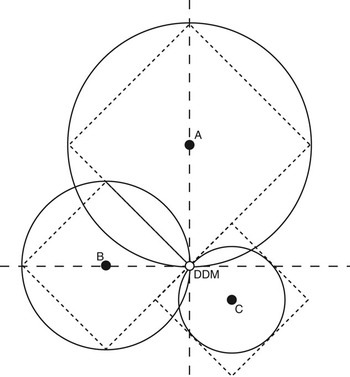
The intuition behind Proposition 1 is illustrated in Figure 2. Figure 2 shows the positions of three voters with ideal points at A, B and C, all elements of  . The dimension-by-dimension median of the voter positions is marked as DDM – re-scaled without loss of generality to the origin of the space. The dashed axes thus contain the median voter on each dimension.
Majority- rule equilibrium at the dimension-by-dimension median with city block preferences.

The circles in Figure 2 show Euclidean indifference curves for each voter with respect to the DDM. The three lens-shaped intersections of these indifference curves show the ‘winset’ of the DDM – the set of points in the policy space that are majority preferred to the DDM. The DDM will lose in a majority vote to any point in this set and therefore is not an equilibrium outcome. The non-existence results imply that with Euclidean preferences the winset of any arbitrary point in this space, and the DDM in particular, is ‘generically’ non-empty under majority rule in multi-dimensional policy spaces.
The rotated squares in the figure show the city block indifference curves for each voter with respect to the DDM. These curves do not intersect and thus the DDM has an empty winset. It is therefore a majority-rule equilibrium. In terms of Proposition 1, it can be seen that each rugged halfspace contains the ideal points of two of the three voters; a movement in any direction will be opposed by some such pair of voters.
Intuitively, the difference between the two cases arises because of two features of uniform city block preference profiles. The first is that the indifference curves of agents that are median on some dimension are kinked at the origin. To generate an improvement in policy for an agent with such a kink is as difficult as it is to generate an improvement for two non-median agents with ideals in distinct (but not opposite) orthants – in Figure 2, for example, agents A and B are each willing to accept only one quarter of all possible directions of movement from the origin, whereas agent C – who is median on no dimension – will accept one half. With strictly convex preferences, agents that are median on one dimension do not hold such privileged positions.
The second feature of city block preferences is that all agents with ideal points in the interior of a given orthant have indifference curves of the same slope (a) as each other and (b) as agents in opposite orthants. An implication of (b) is that the condition for opposition with another agent is relatively weak, all that is required is that there is an agent in the opposite orthant. An implication of (a) is that a small change in the location of an agent’s ideal point – consider, for example, voter C in the figure – does not induce a change in shape of the voter’s indifference curve at the equilibrium point. This local invariance of the shape of indifference curves to the location of ideal points explains why ‘radial symmetry’ exceptions to non-existence results (identified, for example, by Plott) require less demanding conditions. In this important sense, the class of preference profiles (within the set of uniform city block preference profiles) for which the DDM has a non-empty winset is not non-generic.
Qualitative Implications
Proposition 1 has four implications of interest.
A first implication of the proposition is that with uniform city block preferences an equilibrium always exists if there are only three agents. This follows from the fact that with only three agents, a majority of ideal points (two) necessarily lies in every rugged halfspace.
A second implication is that with uniform city block preferences an equilibrium always exists if there are only two dimensions. This result, given also by Rae and Taylor and Wendell and Thorson follows directly from the proposition, since with only two dimensions a majority of ideals necessarily lies in each rugged halfspace.Footnote 29 In two dimensions, the only rugged halfspaces are composed of the pairs of adjacent orthants either above or below the horizontal axis or to the left or the right of the vertical axis. The origin is defined, however, such that there is a majority on or to one side of each axis.Footnote 30
A third implication is that Proposition 1 extends Plott’s results (conditional upon our restriction to city block preferences) on radial symmetry, since the conditions of the proposition are implied by Plott’s proposition whenever this can be applied. To see this, consider a situation in which one agent has an ideal at the DDM, and all other agents can be divided into pairs that are opposed in the sense described above. Assuming a smooth loss function, all agents other than the one with yi = 0 have well-defined gradients that are proportional to [sgn(yi ,1),sgn(yi ,2),…,sgn(yi ,m)]. Hence, two agents are opposed if their ideals lie in opposite orthants. With all remaining agents divided into pairs with ideals in opposite orthants, Plott’s conditions are satisfied, and we necessarily have a majority in every rugged halfspace. One implication of this is that the conditions for symmetry under city block preferences – that players can be paired such that they have ideals in opposite orthants – are considerably less onerous under city block preferences than they are with strictly convex preferences.
A fourth implication is that even if Plott conditions do not hold and there is no agent ideal point at the MRE, there may still exist classes of cases where an MRE exists at the DDM, in any number of dimensions. For an example, consider a case with three voters in three dimensions with ideals with a corresponding sign ordering, s (with si ,j = sgn(yi ,j)) given by

This class of sign orderings can be readily extended to any odd number of dimensions, m, with m voters such that, for each i, yi ,j = 0, and, for k∈1,2,…m − 1, yi ,(i + k )(mod (m )) < 0 if k is odd and yi ,(i + k )(mod (m )) > 0 if k is even. To see that this set of sign patterns satisfies the condition of Proposition 1 note that for each pair of neighbouring points, yi and y (i + 1)(mod (m )), one belongs in one rugged half space and the other belongs in the opposite rugged half space.Footnote 31 This guarantees that there is a majority in every rugged halfspace.Footnote 32 For n > m voters such classes can obtain if the remaining n − m voters can be divided into pairs with ideals in opposite orthants.
Probability of Equilibrium
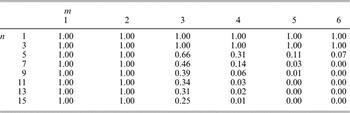
Having established the possibility of majority-rule voting equilibria under city block preferences in spaces of any dimension, we now move on to consider the probability of these. To generate a baseline estimate of the frequency of MRE existence, we employ simulation techniques to estimate the likelihood of MRE existence given a random distribution of ideal points, as the number of voters and dimensions increases.Footnote 33 The results are reported in Table 1.
The Estimated Probability of Observing an MRE in m Dimensions when n Players Have Ideals Drawn from a Multivariate Normal Distribution with a Diagonal Variance Covariance Matrix

Note: Estimates are based on 500 independent draws of n person polities. For each estimate, p, the standard error is given by  .
The results in Table 1 confirm that an MRE exists with probability 1 for dimensions 1 and 2 and for committees with 1 and 3 voters, but the probability of MRE existence declines rapidly thereafter, falling below 1 % with eleven voters in five dimensions. Hence, although even in high-dimensional space there is no generic absence of an MRE, the existence of an equilibrium point may be very unlikely, at least if agent ideal points are distributed randomly.
We close this section by considering two important ways in which distributions of the ideal points of human agents are likely to be non-random in ways that increase the likelihood of equilibrium existence in higher dimensional settings.
The first has to do with correlations of agents’ positions on different dimensions – so that an agent’s position on stem cell research, for example, can be predicted from her position on gay marriage. If positions on issues are correlated in this way, it becomes more likely that pairs of voters have ideals located in opposing orthants of the space. For this reason, configurations of ideal points yielding majority-rule equilibria under city block preferences are more likely with correlated ideals than they are with random ideals. This is not true, for example, of Euclidean preferences where correlations short of perfect correlation have no qualitative implications for equilibrium existence. Note that non-independence of ideals across dimensions is unrelated to the question of whether players have separable preferences; the former relates to the location of ideal points, the latter to the shape of indifference curves given a particular ideal point.
To assess the importance of this effect, we recalculated Table 1 under the assumption that agents have ideal points drawn from a multivariate normal distribution with m × m variance covariance matrix 1 on the diagonal and 0.9 off the diagonal otherwise. In this case, the probability of a MRE rises substantially in all cases in which the MRE was not already guaranteed. In the n = 7, m = 6 case, for example, the probability rises from below 1% to above 5%; the probability eventually declines, however, as m and n continue to rise, and we estimate the probability of an MRE at 6 per cent for m = 6 and n = 15.
A second source of structure in the set of ideal points that can increase the probability of equilibrium under city block preferences arises in weighted voting games, such as those played in a legislature by well-disciplined political parties. In such games, each party has weight that reflects a situation in which a subset of voters belong to the same party and behave in a disciplined manner, ‘as if’ they share the same ideal point. Two things happen in this setting. First, a large number of agents coalesce into a small number of disciplined parties with different voting weights; the number of effective agents is reduced and the above arguments apply. Secondly, weighted voting changes the probability that a large voting weight is located at the DDM and hence is contained in every rugged halfspace. This is because the probability that a party will be median on some dimension is strongly conditioned by that party’s weight, as well as by its position in the ordering of parties on the dimension in question.
Trivially, a party with a majority weight will be median on every dimension and that the party’s ideal point will be a majority-rule equilibrium in a space of any dimension under any conceivable assumption about preferences. Extending work on ‘dominant players’ in majority voting games with non-uniform weights, define a ‘system-dominant’ party in a weighted voting game with four or more parties as a party which does not itself control a majority, but which can form a majority with any other single party, even the smallest.Footnote 34 This implies no other two-party coalition can form a majority.Footnote 35 Given Proposition 1 this further implies that a sufficient condition for an equilibrium under a uniform city block preference profile is that a system-dominant party is at the dimension-by-dimension median (which, we argue below, is ‘likely’) and at least one party other than the system-dominant party is in each rugged halfspace – a distribution that could obtain, for example, if any two non-dominant parties had ideals in opposite orthants.
Since it can form a winning coalition with any other party, it is easy to see that a system-dominant party occupies the median position on every dimension for which it is not at one of the two extreme positions in the ordering. Thus, for example, in an eight-party system with random party positions, the probability a system-dominant party is median on an arbitrary dimension is 0.75. More generally, the probability that a system-dominant party is at the DDM of an n-party m-dimensional space is  .Footnote 36 If we combine this with the Downsian intuition in relation to majority voting in legislatures that the largest party is less likely than others to be at an extreme position on salient policy dimensions, then this probability will increase in real-world policy spaces. More generally, in weighted voting games the probability a largest party with a random ideal point is at the median on an arbitrary dimension, and hence at the DDM, is greater than the probability an arbitrary voter is at the DDM in an unweighted voting game with random ideal points. In this sense the baseline probability of a majority-rule equilibrium under city block preferences increases in weighted voting games.
Note that none of the above enhancements in the probability of majority-rule equilibria applies under the classical non-existence results with smooth preferences, since such equilibria generically do not obtain.
Non-Uniform City Block Preference Profiles
Proposition 1 depends not only on agents having city block preferences but also on them having a uniform city block preference profile. When agents differ in the weights they attach to each dimension, conditions for equilibrium are more severe. In this case a non-median voter i’s gradient vector, evaluated at yj = 0, is proportional to:

In the case where there is a single satiated voter at the DDM, we can apply Plott’s theorem for necessary conditions for MRE existence. In this instance, since each voter’s gradient vector depends on the m scalars, (αi ,j)j = 1,2,…,m, the space of all agents’ gradients is given by  . However, the set of profiles of α vectors in
 that do not satisfy Plott’s conditions is open and dense, and hence we return to a problem of generic non-existence of equilibria (with Plott points). The essential problem in this setting is that agents with ideals in opposite orthants are not necessarily opposed, in the sense of having opposing gradients.
Recall we noted equilibrium is more likely under city block preferences for two reasons. First, agents median on some dimension have kinked indifference curves and accept, as a result, changes in the status quo in fewer directions than agents with smooth indifference curves (at the equilibrium point). Secondly, parallel indifference curves render relations of opposition much more common. Relaxing the uniformity constraint on agent weights removes the second but not the first of these effects. The result is that, while equilibrium is much less likely with non-uniform than with uniform city block preferences, it is not generically absent in dimensions greater than 1 and can obtain in situations where multiple agents are median on different dimensions.
Given a random distribution of ideals, the chances of an MRE obtaining with three agents in  is
 .Footnote 37 For an example of such a situation in
 , consider a case of three agents with ideal points that have a sign structure given by: s 1 = (0,1,−1), s 2 = (−1,0,1), s 3 = (1,−1,0). Assume further that each agent i places weights on loss in these dimensions given by (αi ,j)j = 1,2,3 with
 ,
 , and
 .Footnote 38 In this case the origin is an MRE.Footnote 39
Such possibilities exist then in two and three dimensions. They are, however, rare. We can identify a stable MRE with five agents in three dimensions, but the conditions for this are very restrictive and our simulation work suggests that they obtain for a random polity with probability close to 0. Finally, it is easy to see analytically that there is generically no MRE in four dimensions with only three agents. To see this, note that in such cases there will always be some pair of agents for whom there are two dimensions on which neither of the two are median.Footnote 40 With random weights this pair (a majority) will find some trade-off mutually beneficial on these two dimensions.
The importance of these results lies in the fact that, if non-uniform weights are empirically appropriate, then we may discount our results based on the assumption of uniform weights outright; in the combined set of uniform and non-uniform preference profiles, the set of non-uniform profiles is generic.
Robustness
We have shown that strong results found for uniform city block preferences are substantially weakened for non-uniform city block preferences. Furthermore, we know from classic results that, for strictly convex preferences that are arbitrarily close to city block preferences, no MRE exists. These results suggest a sharp discontinuity between city block preferences and preferences ‘close’ to city block. Under conditions described in Proposition 1, the set of points that beat an equilibrium status quo is empty when preferences are city block but non-empty when they are not. This is of concern, since a reliable prediction should not depend on a strong assumption about preferences. To address this concern, we now consider whether metrics that are ‘close’ to city block produce outcomes that are close to the outcomes produced by city block.
We use simulation techniques to examine this matter for the class of strongly spatial preferences based on a family of Minkowski distance functions.Footnote 41 Letting p denote the Minkowski exponent, we consider the sequence  . The first element in this sequence, p 1 corresponds to the Euclidean case (p 1 = 2) and the city block metric (p = 1) obtains as the limit of the sequence
 . We examine settings in which the preferences of three players are given by the Minkowski norm and player ideal points are selected randomly from unit hypercubes of dimensions 2, 3 and 4. For each element in pn, we estimate the measure of the set of points in the hypercube that are majority-preferred to the DDM. We know from Proposition 1 that in the three-player case, the measure of the set of majority-preferred points is 0 in the limit case. The question now is whether the measure approaches 0 as p approaches 1.
The results in Figure 3 suggest that it does: the measure of the set of points that beat the DDM approaches 0 as the Minkowski exponent approaches unity: when preferences are nearly city block the DDM is ‘nearly’ in equilibrium.
The measure of the set of points that are majority-preferred to the DDM when ideal points of a three-member committee are drawn randomly from a hypercube of dimensions 2–4 Note: Results for each point are based on simulations with 2,000 rival policies in each of 2,000 randomly drawn polities. Results reported for Minkowski metrics,  for n∈{1,2,…8}.

In some contexts it is reasonable to question whether it is helpful to talk of equilibria that ‘nearly’ exist. In some multistage games, for example, small initial policy changes can lead to larger subsequent changes. However, a substantial literature suggests that, in some settings, points that can be beaten only by a small set of similar points (we call these ‘ε–equilibrium points’) may be reasonable policy predictions. The arguments in this literature focus on constraints on the set of feasible outcomes, or on various constraints on human behaviour and cognition. The set of feasible outcomes may well be a finite subset of the real space within which agent preferences are described. For example, actual policy outputs may be denominated in discrete units (dollars, space shuttle launches, legalization or not of gay marriage, invasion or not of a foreign country), rather than being points in a real space. In such settings, for sufficiently small deviations from city block preferences, no majority preferred feasible alternative will exist to the DDM, which in our terms will be an ε−equilibrium arising from the exogenously finite nature of the set of feasible outcomes. Other restrictions on the set of feasible outcomes may arise endogenously within the process of political competition itself. Thus Koehler, for example, considers the possibility that proposals are only made from the set of ideal points of committee members.Footnote 42 Laver and Shepsle model government formation in terms of a finite set of strategically credible policy proposals, comprising only those proposals that can be underwritten by an allocation of policy jurisdictions between cabinet ministers with known ideal points.Footnote 43 Other rationales for restricting theoretical attention to a finite set of potential outcomes arise from restrictions on player cognition. McKelvey, for example, suggested that real humans cannot make arbitrarily fine distinctions between policy positions, inducing de facto indifference over a set of theoretically distinct outcomes.Footnote 44 Other behavioural arguments emphasize transaction costs arising from changes in the status quo. Classically, these costs are measured on a utility scale,Footnote 45 although other work considers ‘minimal spatial distances’ that are required as a result of transaction costs.Footnote 46
While much of the work noted above aims to determine the minimum ε for which an equilibrium exists,Footnote 47 or to consider how the set of stable points varies with changes in ε,Footnote 48 the underlying rationale has clear implications for our results. If for some family of preferences the measure of the set of points that beats the DDM is monotonic and continuous in preferences around the city block norm, then, for arbitrarily small ε, if the DDM is an equilibrium point for city block preferences it is also an ε-equilibrium for some non-city block preferences that are arbitrarily close to city block preferences. If there are barriers to trivial changes in policy, then the implication for our results is that the empirical relevance of Proposition 1 depends not on whether agents have city block preferences but rather on how closely their preferences approximate city block.Footnote 49
Conclusion
For a very general class of smooth preference profiles, long-standing results show that majority-rule equilibrium fails to exist whenever policy choices are defined in a space of dimension greater than one. However, we have shown here that if agents have a uniform city block preference profile the non-existence of equilibrium is not generic: equilibrium is possible in spaces with an arbitrarily large number of dimensions and ‘likely’ in situations with relatively few dimensions and agents. These results extend in part to non-uniform city block preference profiles, but only under more restrictive conditions. Hence, city block preference profiles, though ‘close’ to a smooth preference profile for which generic non-existence of equilibrium obtains, are different in crucial ways.
These differences allow analysts to predict an outcome – the dimension-by-dimension median – that is robust across a range of institutional settings. In addition, they provide the building blocks for richer non-cooperative models. In many such models, equilibria of voting games (for example, inside legislative parties or houses of a legislature) are often required as inputs to some more complex process under investigation. Given the difficulty in predicting voting outcomes in policy spaces of more than one dimension, such models have often restricted their analysis, and resulting intuitions, to sparse and unrealistic one-dimensional settings. Our results provide a rationale – and conditions – for using an analogue of the median voter result as part of a larger model capable of analysing higher dimensional settings.
The significance of our results depends ultimately on the extent to which real humans do in fact act as if they employ a city block metric in political settings, and do so uniformly. Experimental results suggest that, once endowed with a city block metric, voters choose the DDM.Footnote 50 But whether (or when) they have such preferences in the first place is an open empirical question. A long tradition of experimental research in cognitive science suggests real humans use city block metrics when analysing similarities and differences between non-political objects. A much more limited and recent research programme in political science finds that the city block norm provides a model fit better than, or at least as good as, the more commonly used Euclidean norm when predicting political choices in multi-dimensional attitude spaces. But we know of no more general research that establishes whether or not people act as if they employ city block metrics when evaluating similarities and differences between potential political outcomes. We have shown, however, that the implications of such research are important. If cognitive science results on human perceptions of similarity and difference do indeed extend to perceptions of political stimuli, then the possibility of equilibrium under majority rule can provide a basis for policy predictions in multi-dimensional settings that are invariant across a wide variety of different institutional assumptions.
Appendix: Proof of Proposition 1
RESTATEMENT OF PROPOSITION 1: With a uniform city block preference profile and an odd number of agents, an MRE exists (and corresponds to the dimension-by-dimension median) if and only if a majority of ideal points lies in every rugged halfspace.
PROOF
(i) Necessity: To see that an MRE exists only if a majority of ideal points lies in every rugged halfspace assume, contrary to the claim, that 0 is an MRE but there exists some rugged halfspace  – corresponding to a collection C of orthants – that does not contain a majority of agent ideal points. Let X C denote the elements of X corresponding to the orthants in C and let X′ = X
 denote the elements of X not in
 .
Note that, since  is a rugged halfspace, there exists an (arbitrarily short) vector v with x.v > 0 for each x in
 . Fix such a v. Note, that for all x′∈X′, x′.v < 0 and hence x′.(−v) > 0. We aim to show that all agents with ideal points in
 prefer −v to 0; since a majority of agents have ideals in
 , we have then that 0 is not an MRE.
Consider an arbitrary agent i with ideal point y in  and let y′ denote the element of X given by:

Since y is an element of the closure of f(y′) but lies outside of  , we have that y′ is in X′ and in particular that y′.v < 0. For sufficiently short v (such that for yj≠0, sgn(yj ± vj) = sgn(yj)), we have:

But since, by construction, sgn(yj) = y′j whenever yj ≠ 0, and |vj| = sgn(vj)vj = y′j vj whenever yj = 0, we have −v  i0⇔y′.v≥0, and conversely:
 . Since by construction, y′.v < 0 we then have that −v is preferred to 0 for all i with ideals in
 .
(ii) Sufficiency: To see that an MRE exists if a majority of ideal points lies in every rugged halfspace assume, contrary to the claim, that a majority lies in every rugged halfspace but that a movement v ≠ 0 is preferred by some majority. Assume without loss of generality that for no x∈X, x.v = 0 (to see that this is without loss of generality note that since each agent’s preferred-to set is open, the intersection of these preferred-to sets is also open and hence the set of points that beat 0 is open; hence if x.v = 0 we can freely select a v′ arbitrarily close to v that also beats 0 but for which x.v ≠ 0). Since for no x∈X, x.v = 0, there exists a collection of 2m − 1 orthants,  , and a corresponding subset of X,
 for which x.v < 0 for all
 . Since for this collection x.(−v) > 0, the closure of the union of the elements of
 (or, equivalently, the union of the closure of these orthants),
 , constitutes a rugged halfspace and hence, by assumption contains a majority of elements.
Consider such an  . We now show that since x.v < 0,
 for all i with ideals in the closure of each orthant in C. From a similar argument to that given in part (i), for sufficiently small v we have:

If y∈clos(f(x)), then we have sgn(yj) = xj whenever sgn(yj)≠0; in cases where sgn(yj)=0, we have |vj| = xjvj if sgn(xj) = sgn(vj) and |vj| = −xjvj otherwise. Hence

and so we have:

and hence, the converse:

Since the term  is positive we have
 and hence x.v < 0
 .
But this implies that every agent i with ideal in the rugged half space  , opposes the movement in direction v. Since this group constitutes a majority, 0 cannot be beaten by v. This establishes sufficiency.
 that has the properties that for points a, b and c in W: d(a, b) = 0⇔a = b, d(a, b) = d(b, a) and d(a, b) + d(b, c) ≥ d(a, c).
 if there exists an
 and a semipositive definite matrix Ai such that for all
 , x
 x′⇔(yi − x)′A(yi − x)≤(yi − x′)′A(yi − x′). Euclidean preferences (with uniform weights) obtain if A = In × n.
 is in ‘general position’ if, for any k≤m, no more than m ideal points lie on any m − 1 dimensional affine manifold.
 and
 for j = 1,2,…,m by
 and
 . Note that
 and
 are elements of x, moreover, yi∈closure
 and yk∈closure
 but that
 . Hence
 implies
 , and so yi and yk lie in opposite halfspaces.
 contained only a minority of ideal points, then a majority of ideals would lie in the interior of
 . But such a majority would contain two (neighbouring) points that are not in opposite halfspaces.
 for p≥1 The Euclidean and city block metrics are special cases with p = 2 and p = 1 respectively. The ∞− norm distance between two stimuli is the distance between them on the dimension on which they are farthest apart.
 , (1,0) and (0,1). Now consider the set P = {(x,x):x∈(0,1)}. With Minkowski exponent p = 1, no point in P is preferred by both players to the origin. But for any p∈(1,2), all points in P are preferred to the origin.