Fall-related injuries represent a major problem among community-dwelling older people, occurring annually in up to one third of individuals over age 75. Most falls do not result in serious injuries, but they may lead to psychological distress, such as fear of falling (FOF), which constitutes an important risk factor for subsequent loss of mobility and disability, increased dependency, and impaired quality of life. FOF describes the psychological distress directly related to falling or to the risk of falling. Higher intensity of FOF may lead to restrictions on leaving home alone or to reduced performance of some activities of daily living (Reference Myers, Powell, Maki, Holliday, Brawley and Sherk1). However, it is not clear why falls restrict the activities for some older people but not others.
Fear of falling has been reported in 12 per cent to 65 per cent of independent, community-dwelling older subjects with no prior history of falls (Reference Howland, Walker, Levin, Fried, Pordon and Bak2–Reference Tinetti, Mendes de Leon, Doucette and Baker7), and in 29 per cent to 92 per cent of older subjects who sustain falls (Reference Howland, Walker, Levin, Fried, Pordon and Bak2,Reference Burker, Wong, Sloane, Mattingly, Preisser and Mitchell8,Reference Aoyagi, Ross, Davis, Wasnich, Hayashi and Takemoto9).
Few data have been reported about the occurrence of FOF among older subjects with dizziness and syncope (Reference Burker, Wong, Sloane, Mattingly, Preisser and Mitchell8), and there are even fewer data from tilt table studies in this population. The tilt table test may identify diseases such as orthostatic hypotension or vasovagal syncope in older people with dizziness and syncope.
The main purposes of this study were to estimate the prevalence of FOF in an elderly population attending a specific clinic for the management of dizziness and syncope, and to determine whether the results obtained from tilt table tests or other factors were associated with FOF. An additional purpose was to estimate the proportion of subjects in whom FOF causes restriction in activities (first, leaving home alone and, second, performing basic activities of daily living).
Materials and Methods
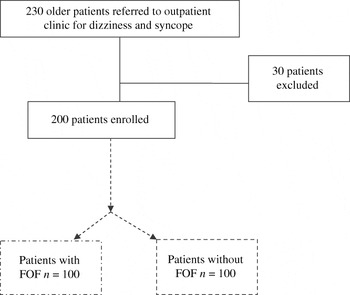
This cross-sectional study, conducted from April 2000 to October 2004, enrolled 200 patients over 60 years of age from the Ponferrada Leon region of Spain who were referred to a clinic for the elderly that specializes in syncope, recurrent dizziness, or falls. Patients were referred directly from the emergency room, primary care clinics, or from other medical specialties. They were assessed by a single geriatrician with a particular interest in dizziness and syncope.
Of the initial 230 patients, 30 were excluded from the study: 3 subjects were younger than 60 years of age, 16 refused to undergo all protocol tests, 2 patients had no further symptoms, 3 patients had severe acute medical conditions such as gastrointestinal bleeding or severe anemia which prevented adequate testing, and 6 patients did not require additional tests after the initial interview (Figure 1).
Selection of study population

Legters has defined FOF as the specific fear that one might fall (Reference Legters10). In order to determine FOF in each subject, the following question was asked: Are you fearful or worried about falling? (Yes or no) Patients who gave a positive response for FOF were then asked: (a) Have you stopped going outside home alone because of your fear of falling? (Yes or no) (b) Have you given up doing your basic activities of daily living because of your fear of falling? (Yes or no) Patients who gave a positive response to either of the last two questions were considered to have activity restriction due to FOF. No standardized scales to measure FOF in elderly subjects were validated in the Spanish language at the time of this study. Scales evaluating FOF with multiple or complex questions, that were developed later, are difficult for illiterate older people to answer and require longer time than was available in a busy out-patient dizziness/syncope clinic. The study population resides mostly in rural areas around the Hospital del Bierzo, and rural older people have illiteracy rates up to 50 per cent. Although we chose the simplest questions of the yes-or-no type to determine FOF in our population, illiteracy may have affected our results. New scales such as Falls Efficacy Scale-International, which have more comprehensive questions and easier to understand and fill because is Likert scale for the evaluating FOF, were not available for us to use because they were published after the design of this study.
All patients underwent a structured interview, a physical examination (including Dix-Hallpike maneuver), and cognitive and psychological testing. The geriatric assessment included a search for symptoms of cognitive impairment and depression. When the clinical history indicated these symptoms, the Short Portable Mental Status Questionnaire (Reference Pfeiffer11) for cognitive evaluation (three or more errors is abnormal) and the 15-item Geriatric Depression Scale (Reference Sheik and Yesavage12) for psychological evaluation (more than five positive responses suggests depression) were used to document clinical diagnoses. The interview was followed by routine laboratory tests, electrocardiogram, and chest X-rays, if they had not recently already been performed in the emergency room. A tilt table test was then performed (with nitroglycerin challenge where indicated) and carotid sinus massage. Tests to investigate structural and electrical heart diseases, such as ambulatory cardiac monitoring, echocardiogram, stress test, or electrophysiological studies, were also requested when considered appropriate. Other tests were ordered as indicated, including CT or MRI imaging of the head, Doppler ultrasound scans of the carotid arteries, and electroencephalography.
The tilt table test was performed following the Newcastle protocol (Reference Kenny, O’Shea and Parry13) on an electrically powered tilt table that allowed for a rapid change of the patient’s position from supine to a calibrated tilt angle of 70º. Patients were asked to fast for 2 hours before the test. Blood pressure was measured using a sphygmomanometer at intervals ranging from 18 seconds to 2 minutes. ECG was continuously monitored. A passive tilt table test was conducted after the patient lay for 20 minutes in the supine position followed by 30–40 minutes at a tilt angle of 70º. Carotid sinus massage was performed in consenting patients who had experienced more than one syncopal event or severe syncope. Carotid massage was performed after 5 minutes in the supine position, on the area of greatest pulsation intensity, first on the right and then on the left. When there was a history of severe or frequent syncope, massage was repeated in the standing position at a 70º angle. The head-up tilt table test was considered positive if syncope or presyncopal symptoms that reproduced the presenting symptoms of the patient were associated with hypotension and/or bradycardia. A positive carotid sinus massage was defined as the occurrence of asystole lasting longer than 3 seconds and associated with symptoms. Hypotensive carotid sinus hypersensitivity could not be determined. Other diagnoses in the study population included peripheral vestibular disorder, orthostatic hypotension, arrhythmia, situational syncope (micturition, cough, or a frigore), anemia, cerebral diseases such as epilepsy, stroke, cerebral hemorrhage, gait disorders, and psychiatric conditions.
Statistical Methods
The analyses were performed using a chi-square test for categorical variables; a student’s t test for normally distributed continuous variables, or Mann-Whitney’s U test for non-normally distributed continuous variables. A logistic regression model was used for the multivariate analysis. Variables that were significant at a p ≤ 0.05 level were included in the regression logistic model, and variables with a value of p < 0.08 were analyzed for inclusion in the logistic regression model.
Results
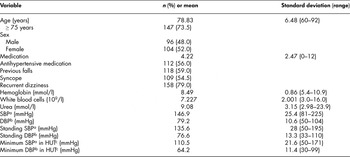
Table 1 shows the sample characteristics. The mean age was 79 years and about half were male; 79 per cent of patients had dizziness, 54 per cent had syncope, and 59 per cent had a history of previous falls. FOF occurred in 50 per cent of this population (100 out of 200 patients). Forty-four of these patients (44%) had restricted their activity by giving up going out alone, and 10 patients (10%) had stopped doing basic activities of daily living.
Characteristics of the study population

a SBP < systolic blood pressure
b DBP < diastolic blood pressure
c HUT < head-up-tilt test
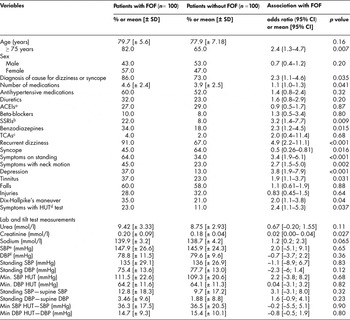
Variables associated with the occurrence of FOF are shown in Table 2. These include (a) diagnosis of cause of dizziness or syncope, (b) age over 75, (c) number of medications, (d) SSRIs, (e) benzodiazepines, (f) recurrent dizziness, (g) syncope, (h) symptoms on standing, (i) symptoms with neck motion, (j) depression, (k) tinnitus, (l) Dix-Hallpike’s maneuver, (m) symptoms with HUT test, and (n) creatinine. In patients assessed by Romberg’s test (n < 55), a positive test was associated with FOF.
Variables associated with bivariate analysis

a ACEI < angiotensin-converting-enzyme inhibitors
b SSRI < selective serotonin reuptake inhibitors
c TCA < tricyclic antidepressant
d HUT < head-up-tilt test
e SBP < systolic blood pressure
f DBP < diastolic blood pressure
CI < confidence interval
FOF < fear of falling
SD < standard deviation
Multivariate Analysis
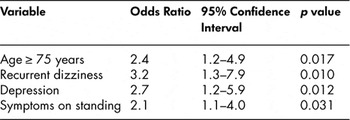
A subsequent analysis using logistic regression was performed with the eight variables considered to have the most important clinical relevance: (a) diagnosis of syncope or dizziness, (b) age 75 years and older, (c) depression, (d) recurrent dizziness, (e) syncope, (f) tinnitus, (g) number of medications, (h) Dix-Hallpike’s maneuver, and (i) serum creatinine levels. Due to the number of missing serum creatinine results, serum creatinine was replaced by serum urea levels because both were highly correlated. Analysis was also adjusted for age and gender (Table 3). Factors significantly associated with FOF were (a) age 75 and older, (b) depression, (c) recurrent dizziness, and (d) orthostatic symptoms on standing.
Variables associated with fear of falling (FOF), multiple logistic regression analysisFootnote *

* Adjusted also for gender, number of medications, history of previous falls, syncope, tinnitus, injuries (caused by falls), urea levels, Dix-Hallpike’s maneuver, and symptoms with head-up-tilt test
Discussion
Fear of falling is highly prevalent in this population, occurring in half of the patients studied. This is a similar prevalence to that reported by Burker et al. (47%) (Reference Burker, Wong, Sloane, Mattingly, Preisser and Mitchell8). FOF has serious social implications; indeed, it caused 44 per cent of subjects to cease going out alone, while 10 per cent stopped performing basic activities of daily living. These data agree with those reported by Burker et al. (Reference Burker, Wong, Sloane, Mattingly, Preisser and Mitchell8).
Most authors measure fear of falling with scales such as FES (Falls Efficacy Scale), (Reference Tinetti, Richman and Powell14) MFES (Modified Falls Efficacy Scale), (Reference Hill, Schwarz, Kelogeropoulos and Gibson15) FOF (Fear of Falling scale) (Reference Burker, Wong, Sloane, Mattingly, Preisser and Mitchell8), ABC (Activity-Specific Balance Confidence) (Reference Powell and Myers16), and others (Reference Lachman, Howland, Tennstedt, Jette, Assmann and Peterson5,Reference Shumway-Cook, Gruber, Baldwin and Liao17,Reference Franzoni, Rozzini, Boffelli, Frisoni and Trabucchi18). None of these scales existed in a validated Spanish version when this study was designed. Furthermore, there is controversy about the value of these scales in older people with low educational status or cognitive impairment. A large proportion of our patients were illiterate yet understood yes-or-no questions about being fearful of falling, but found it more difficult to answer questions on a numerical scale (e.g., a 1-to-10-point scale). As these more complex scales require a longer time to complete, they are less applicable for frail older patients in clinical settings (Reference Arfken, Lach, Birge and Miller19). New scales that can be adapted much better for an elderly population have been developed for falls efficacy and fear of falling, but they were unavailable at the time that this study was conceived (Reference Cumming, Salkeld, Thomas and Szonyi20). The lack of a complex scale to evaluate FOF in our study may have rendered the measure of FOF less precise, but for the reasons stated earlier, we preferred to use a simple-question scale.
Depending on the type of population studied, several factors associated with FOF have been reported. These include low gait and balance scores (Reference Franzoni, Rozzini, Boffelli, Frisoni and Trabucchi18), self-perceived bad health (Reference Evitt and Quigley21), poorer functional status (Reference Lawrence, Tennstedt, Kasten, Shih, Howland and Jette4,Reference Franzoni, Rozzini, Boffelli, Frisoni and Trabucchi18,Reference Yardley, Beyer, Hauer, Kempen, Piot-Ziegler and Todd22), poor cognitive and financial or social status (Reference Howland, Lachman, Peterson, Cote, Kasten and Jette3,Reference Kressig, Wolf, Sattin, O’Grade, Greenspan and Curns23), age (Reference Lawrence, Tennstedt, Kasten, Shih, Howland and Jette4), female sex (Reference Howland, Lachman, Peterson, Cote, Kasten and Jette3), use of more than four drugs and psychotropic drugs (Reference Franzoni, Rozzini, Boffelli, Frisoni and Trabucchi18), prior falls (Reference Howland, Walker, Levin, Fried, Pordon and Bak2,Reference Howland, Lachman, Peterson, Cote, Kasten and Jette3,Reference Evitt and Quigley21), falls resulting in fractures (21), poor score on the General Health Questionnaire or SF-36 (Reference Yardley, Beyer, Hauer, Kempen, Piot-Ziegler and Todd22), having depression (Reference Aoyagi, Ross, Davis, Wasnich, Hayashi and Takemoto9,Reference Kressig, Wolf, Sattin, O’Grade, Greenspan and Curns23–Reference Austin, Devine, Dick, Prince and Bruce25), anxiety disorders (Reference Austin, Devine, Dick, Prince and Bruce25), use of a cane or walker (Reference Howland, Walker, Levin, Fried, Pordon and Bak2,Reference Gagnon, Flint, Naglie and Devins24), slow gait speed (Reference Gagnon, Flint, Naglie and Devins24), poor vision limiting ambulation (Reference Evitt and Quigley21), and being African American (Reference Gagnon, Flint, Naglie and Devins24).
Factors reported to be associated with activity restriction due to FOF include fear of losing personal functional independence, a history of previous falls with injuries, two or more chronic diseases, and depression. We found only one study on an older population with dizziness, where factors associated with FOF included depression, recurrent dizziness, and a positive Romberg’s test (Reference Burker, Wong, Sloane, Mattingly, Preisser and Mitchell8).
The results of this study suggest that older people with recurrent dizziness and depression have a greater probability of developing FOF. Recurrent dizziness is in turn associated with certain actions, such as standing up from the sitting or lying position or neck movements. Other variables associated with recurrent dizziness include depression, taking benzodiazepines, and the presence of syncope, although an inverse relationship exists with this latter variable. Recurrent dizziness continued to show a positive statistically significant relationship with FOF after multivariate analysis. Higher frequency and greater severity of dizziness is suspected to increase the probability of developing FOF. Orthostatic symptoms on standing were also associated with fear of falling.
Depression is also associated with FOF. This association has been reported by Burker et al. (Reference Burker, Wong, Sloane, Mattingly, Preisser and Mitchell8) and in other studies in the general older population (Reference Kressig, Wolf, Sattin, O’Grade, Greenspan and Curns23).
One of the more interesting results reported in earlier studies was the lack of association between FOF and previous falls (Reference Rosso-Henao, Reyes-Ortiz, Gómez, Curcio, Ottenbacher and Markides26). No relationship was seen in our study between previous falls and FOF, even when more severe falls causing injuries and fractures were considered. We therefore concluded that in this population, falls did not lead to FOF. This surprising lack of association between FOF and previous falls in our study contrasts with other studies with different designs or other sample characteristics, where an association between FOF and previous falls has been found, but not in all (Reference Arfken, Lach, Birge and Miller19,Reference Rosso-Henao, Reyes-Ortiz, Gómez, Curcio, Ottenbacher and Markides26). Unlike results found in other studies, being female was not found to be related to FOF in our study. However, the association between older age (75+) and FOF is in agreement with other studies.
An association was found between serum creatinine levels and FOF in a bivariate analysis. Serum sodium levels were also higher in the group of patients with FOF, but statistical differences were not reached. These data were not significant in multivariate analyses. However, renal failure has been associated with falls (Reference Bischoff, Stähelin, Dick, Akos, Knecht and Salis27), but no studies have been found associated with FOF. To explain the association between serum creatinine levels and FOF, the first potential mechanism is the relationship between the number of medications and the levels of creatinine in our study (Pearson’s r < 0.28, p < 0.001). In our study, there was an association between a larger number of medications and FOF in bivariate analyses. This association may be explained by higher creatinine levels with drugs such as ACE inhibitors, or diuretics that we found associated with FOF. Taking more than four medications, especially benzodiazepines, has also been associated with FOF in a previous study (Reference Franzoni, Rozzini, Boffelli, Frisoni and Trabucchi18).
A second potential mechanism to explain the association between serum creatinine levels and FOF is that reduced levels of activated vitamin D found in renal failure (Reference Gonzalez, Sachdeva, Oliver and Martin28) may affect muscle strength and facilitate FOF. Muscle weakness and its associated gait and balance disturbances have been associated with FOF in older people (Reference Kressig, Wolf, Sattin, O’Grade, Greenspan and Curns23). Yet another potential mechanism is psychological. Patients with renal failure may develop FOF due to a lack of strength and a feeling of insecurity in performing daily activities (Reference Heiwe and Dahlgren29).
Interestingly, in bivariate analyses, the presence of syncope was inversely associated with the probability of FOF. In subset analysis, we found that patients with syncope had significantly fewer orthostatic symptoms on standing (p < 0.001) than those who did not experience syncope. This correspondence may explain this counterintuitive finding, as the relationship between syncope and FOF was no longer significant after adjusting for orthostatic symptoms.
The differences seen in blood pressure changes in the tilt table test or on standing were not associated with FOF. Symptoms reproduced in the tilt table test and on standing were associated in the bivariate analysis, but not in the multivariate analysis.
This study did not analyze factors such as socioeconomic conditions, functional status, or the use of a cane or walker. As previously stated, a positive Romberg’s test was one of the factors associated with FOF in the Burker et al. study (Reference Burker, Wong, Sloane, Mattingly, Preisser and Mitchell8), but was included only late in this study. Although the number of cases where the Romberg test was performed was small (n < 55), a higher proportion of subjects with FOF (5/5, 100%) in this study had a positive Romberg test compared to those without FOF (24/50, 48%; p < 0.05).
The association between recurrent dizziness and FOF suggests a potential clinical application of our findings to test in further studies. If recurrent dizziness causes FOF, treating the dizziness may control the onset of FOF, decrease activity restriction, or improve quality of life related to FOF. Treating dizziness may also improve quality of life among elderly patients with FOF.
Conclusion
This study showed a very high prevalence of FOF among the older population attending a specialized clinic for dizziness and syncope. A strong association between FOF and both recurrent dizziness and depression was also seen. In contrast, no relationship was found between FOF and previous falls in this population of older patients with dizziness and syncope. Future research should establish whether and how dizziness causes FOF and whether more frequent and severe dizziness is associated with an increased FOF that leads to greater activity restriction. Future research should also explore whether the treatment of dizziness or syncope decreases FOF. The use of more-comprehensive scales for evaluating FOF in further studies may help researchers to better understand the relationship of FOF with falls, chronic dizziness, and other geriatric syndromes.