1. INTRODUCTION
For the past decades, stimulated Brillouin scattering (SBS) has been a focus of theoretical and experimental investigation, due to its application on compensating for the thermally induced phase distortion in high power laser systems (Yoshida et al., Reference Yoshida, Hatae, Fujita, Nakatsuka and Kitamura2009; Shin et al., Reference Shin, Park, Kong and Yoon2010; Bai et al., Reference Bai, Shi, Ouyang, Chen, Gong, Jing, Liu and Liu2008). Many researches demonstrate that the medium has great impact on the SBS performance, especially under high power pump conditions, thus seeking ideal medium has great importance to improve the SBS performance. Despite the variety of SBS liquid media, they are mostly confined to a limited application, either due to a large AC (Andreev et al., Reference Andreev, Khazanov and Pasmanik1992), which lowers the energy reflectivity significantly; or due to low power-load capacity, which would induce optical breakdown to exacerbate the energy reflectivity stability and phase conjugation fidelity (Papernyi et al., Reference Papernyi, Petrov, Serevrtakov and Startsev1983; Hasi et al., Reference Hasi, Lu, Li and He2007; Ostermeyer et al., Reference Ostermeyer, Kong, Kovalev, Harrison, Fotiadi, Mégret, Kalal, Slezak, Yoon, Shin, Beak, Lee, Lü, Wang, Lin, Knight, Kotova, Sträßer, Scheikh-Obeid, Riesbeck, Meister, Eichler, Wang, He, Yoshida, Fujita, Nakatsuka, Hatae, Park, Lim, Omatsu, Nawata, Shiba, Antipov, Kuznetsov and Zakharov2008). Thus, the exploration of an SBS medium with small absorption coefficient and high power-load capacity has became a foremost issue, not only in the course of improving the SBS performance, but also in the realization of SBS phase conjugation mirror (PCM) in the high-power laser system.
Currently, PFCs and PFPE series medium are most widely used in SBS experiment, due to their excellent optical quality, low absorption in wide spectral range, high OBT and desirable physical and chemical stability (Park et al., Reference Park, Lim, Yoshida and Nakatsuka2006; Yoshida et al., Reference Yoshida, Kmetik, Fujita, Nakatsuka, Yamanaka and Yoshida1997; Hasi et al., Reference Hasi, Lu, Gong, Liu, Li and He2008a, Reference Hasi, Lu, Gong, He, Lin and Zhang2008b; Gao et al., Reference Gao, Lu, Wang, He and Hasi2010). However in our experiments, we find different type mediums have significant difference on absorption coefficient and OBT when used as SBS medium. This phenomenon would bring us much inconvenience in high power SBS system, so it is necessary to study the differences between different types PFCs and PFPE to obtain SBS mediums with high loading capacity and their selection principle.
2. CHEMICAL STRUCTURE AND PHYSICAL PROPERTIES OF THE PFCS AND PEPE
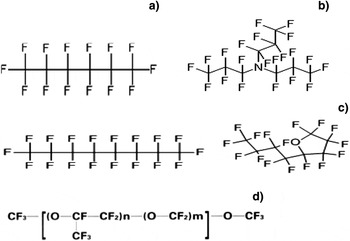
The PFCs are new types of hydrocarbons, ethers, and amines, in which the hydrogen connected with carbon atoms are all replaced by fluorine atoms (that is the C-H bonds of molecules are all converted to the C-F bond). Their molecular structures are shown in Figure 1a–1c. For the PFCs mediums we selected in our experiment, FC-72 belongs to perfluorinated hydrocarbons, whose molecular formula is C6F14; the molecular formula of FC-3283 and FC-70 are respectively (C3F7)3N and (C5F11)3N, which all belong to perfluorinated amines; FC-40 is composed of (C4F9)3N and (C4F9)2NCF3, which also can be classified as perfluorinated amines; FC-75 belongs to perfluorinated ethers, which is the mixture of C8F18 and C8F16O, just like shown in the Figure 1c (Hasi et al., Reference Hasi, Lu, Gong, Liu, Li and He2008a, Reference Hasi, Lu, Gong, He, Lin and Zhang2008b; Barthel-Rosa & Gladysz, Reference Barthel-Rosa and Gladysz1999; Chalus & Diels, Reference Chalus and Diels2007).
The molecular structures of some PFCs and PFPE medium: (a) FC-72, (b) FC-3283, (c) FC-75, (d) DET.

The PFPE are polyether in which the C-H bonds of molecules are all converted to the C-F bond. The PFPE have two different kinds of structures: straight-chain and side-chain. Currently, the Galden series of PFPE medium we used in SBS system (such as DET, HT-70, HT-135, D03, HT-230, HS-260, and HT-270) all belonged to side-chain, which is shown in Figure 1d. For different types of Galden series PFPE medium, they all have the same molecular structures; just the values of n, m are different, which would lead to the change of molecular chain length.
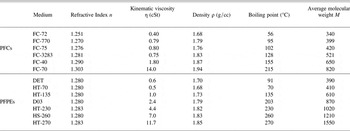
Experiments show that PFCs and PFPE have excellent durability, chemical stability, and excellent surface properties, except for the characteristics of tasteless, colorless, non-toxic, non-irritating, and transparency and so on. Table 1 lists their physical and chemical properties. The molecular structure is the primary factor affecting the absorption coefficient and OBT of the medium. The molecular absorption in the near-infrared regime mainly corresponds to the double frequency or combined acoustic frequency of the X-H bond (X stands for C, N, O, S, P) (Wang et al., Reference Wang, Sowa, Ahmed and Mantsch1994). Thereby PFCs and PFPE mediums comparatively have small absorption coefficient to the infrared light owing to their lack of X-H bonds. In addition, fluorine processes the least atomic radius and its Van der Waals radius is merely 0.135 nm, so in the perfluorocarbon molecules the carbon chain skeleton is tightly wrapped by the fluorine atoms, which make the C-F has larger bond energy (449.0 kJ/mol) than the C-H bond (414.0 kJ/mol). The fluorine atom plays a good protective effect for the carbon chain skeleton (Xia & Luo, Reference Xia and Luo2005), so the PFCs and PFPE have high OBT.
The physical and chemical properties of the PFCs and PFPE medium

3. RESEARCH ON THE SBS PROPERTIES OF THE PROPERTIES OF THE PFC AND PFPE
To measure the OBT of the PFCs and PFPE medium more accurately, we designed an experiment adopting He-Ne vertical scanning method to judge the occurrence of the breakdown. Schematic diagram of the experimental set-up is shown in Figure 2. We have used a single mode injection seeded Q-switched Continuum Nd: YAG laser with TEM00 mode at fundamental wavelength 1.064 µm. The work repetition is 2 Hz, the pulse width is 7.6 ns, and the divergence angle is 1.29 mrad. The generated s-polarized light was turned into p-polarized by the 1/2 wave plate, and then became circularly polarized after through 1/4 wave plate. The circularly polarized pump light was finally incident into the SBS system. The pump beam is focused into the generator cell (cell length is 80 cm) by lens (focal length is 15 cm) to generate the backward Stokes light. The backward Stokes light, through the 1/4 wave plate, becomes s-polarized light, and then is reflected by the polarizer P. The polarizer P and 1/4 plate were operated as an optical isolator to prevent the backward Stokes to return to the laser oscillator for protecting the optical damage. We added a beam splitter (Beam splitting ratio is 0.01) to realize the simultaneous measurement for the energy of the incident and transmitted light. The energy of the incident and transmitted light are detected by MIN-E1000 energy meter.
Schematic diagram of the experimental set-up for measuring the OBT.

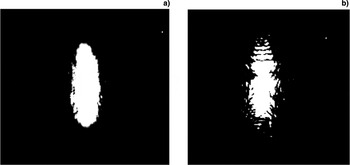
The OBT is defined as the average of the highest incident power density in the focus position without occurrence optical breakdown phenomenon and the minimum incident power density in the focus position when the optical breakdown appears. Adopting He-Ne laser vertical scanning method to judge the occurrence of optical breakdown, we adjust the frame of the He-Ne laser to make the continuous light just go through the focus position of the convex lens, where it has the highest power density and the breakdown occurs most frequently. The transmitted light beam is detected by a changed-coupled device after attenuator without deformation. Comparing the changes of the transmitted light graph we can determine whether the optical breakdown phenomenon occurs in the medium. The incident light spot does not appear the phenomenon of stripe when there is no breakdown, as shown in Figure 3a (SBS media cell is a cylindrical structure, so the transmitted light spot is elongated in the radical direction, showing oval-shaped); However, when the optical breakdown occurs in the medium, the transmitted light spot will appear stripe phenomena, such as shown in Figure 3b, which may be caused by the vibration waves generated during the progress of optical breakdown.
The transmitted light graph of the He-Ne of different conditions: (a) transmitted light graph without breakdown occurrence, (b) transmitted light graph when breakdown occurs.

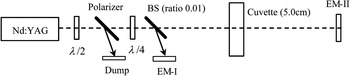
To measure the AC, we use the setup shown in Figure 4, which just need to make a little change based on the schematic diagram for measuring the OBT. We can remove the focusing lens and use cuvette (thickness of 5.0 cm) replacing the SBS cell in the optical path. The sample medium needing to be tested is placed in the cuvette for 2 hours under the room temperature before measurement, to make sure there is no bubble cell in the cuvette. During the experiment, first we standard the entire loss of the whole optical system, then adopt the beam splitter (beam splitting ratio is 0.01) to record the energy of the incident and transmitted light simultaneously. The AC can be derived from the math formula of E 0 = E ie −al. To eliminate the effect of the impurity particles, we filter the medium with the 0.1 µm filter (Hasi et al., Reference Hasi, Lu, He, Wang and Liu2004).
Schematic diagram of the experimental set-up for measuring the AC.

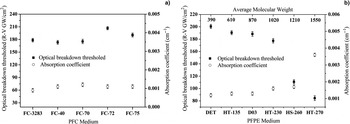
From Figure 5a we can see that, the PFCs medium (such as FC-3283, FC-40, FC-70, FC-72, and FC-75) generally have small AC and high OBT. Meanwhile there are also differences between these medium, the FC-72 have the highest OBT.
The OBT and AC of different SBS medium: (a) PFC, (b) PFPE.

To verify the effect of the chemical structure on the AC and OBT, we use the fluorinated HFE-7100 to compare with the PFCs in the experiment. The chemical structure of HFE-7100 can be described by C4F9OCH3, having a methyl group in which existing three H atoms not being replaced by F atoms, that is why HFE-7100 consists the C-H bond, which has strong absorption for near-infrared light (Bravo et al., Reference Bravo, Diaz-De-Mera, Aranda, Smith, Shinec and Marstond2010). Using the schematic diagram shown in Figures 2 and 4 we measured the OBT and AC of HFE-7100 were 118 GW/cm2 (related value) and 0.003 cm−1. Compared with the PFCs with same AMW, the AC significantly becomes larger and the OBT is significantly reduced. This result also shows that the molecular structure is the primary factor affecting the AC and OBT of the medium.
For PFPE, the medium with AMW less than 1000, such as DET, HT-70, HT-135, and D03 have small AC and high OBT, but when AMW is greater than 1000, such as HT-230, HS-260, and HT-270, the AC become high and OBT become low. It shows that, for PFPE series SBS medium, the AC increases and the OBT decreases gradually with the increasing of AMW.
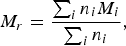
To study how the AMW affects the AC and OBT of the PFPE medium, we designed another experiment in this paper. For polymers having similar molecular structure, but different molecular chain length, the average molecular weight can be calculated by following the below formula:
 $$M_r = \displaystyle{{\sum\nolimits_i n_i M_i \over \sum\nolimits_i n_i}}\comma \;$$
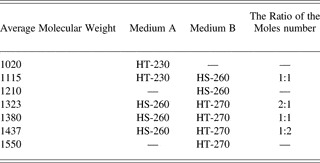
where n i represents the moles number of the material, M i represents the AMW of the different monomer, M r represents the AMW of the compound polymers. So by mixing the HT-230, HS-260, and HT-270 under different ratio, we can obtain new types PFPE medium with different AMW. The details are listed in the Table 2.
The average molecular weight of compound PFPE

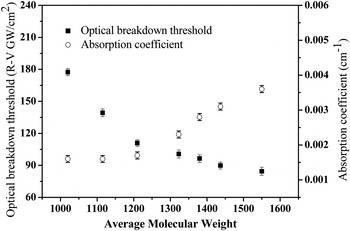
Figure 6 is the experimental curve of the AC and OBT for the mixed PFPE media PFPE of different AMW. From Figure 6 we can see that, with AMW increasing, the AC becomes larger and the OBT decreases. This is because except for the chemical structure, other physical quantities such as the medium molecular weight, kinematic viscosity and phase behavior, and other also have a certain impact on the AC and OBT. With the increase of AMW, the molecular interaction forces become larger and larger, and lead to the kinematic viscosity and the ionizing anion increases (Guarini et al., Reference Guarini, Guglielmetti, Vincenti, Guarda and Marchionni1993), which are the main factors leading to the change of AC and OBT.
The OBT and absorption coefficient of the compound PFPE.

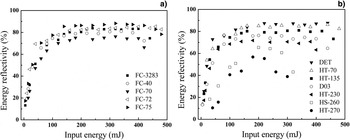
Figure 7 is the energy reflectivity of PFCs and PFPE medium under different input pump energy. From the figure we can see that, PFCs medium have close energy reflectivity. For PFCs, the energy reflectivity of FC-70 is relatively low, because of its small gain coefficient. The energy reflectivity of different PFPE medium has large differences. The energy reflectivity of DET, HT-70, HT-135, D03, and HT-230 are very close (between 70%–90%); but HS-260 and HT-270 are significantly low, and with the pump energy increases (greater than 200 mJ), the energy reflectivity decreases gradually, which is because of the emergence of the optical breakdown.
The energy reflectivity of SBS medium under different input pump energy: (a) PFCs, (b) PFPE.

4. CONCLUSION
In this paper, the correlations between chemical structure and loading capacity of PFCs and PFPE have been analyzed and a new accurate method to determine the occurrence of breakdown is proposed. We measured the OBT and AC of some PFCs and PFPE medium, and proposed the selection principle of SBS medium which can be used in the high power laser system. Results show that, for PFCs, the FC-72 has the highest OBT; for the PFPE, the AC increases and the OBT decrease gradually with the increasing of AMW.
ACKNOWLEDGEMENTS
This work is supported by the National Natural Science Foundation of China (Grant No. 61138005), the Program for New Century Excellent Talents in University (Grant No. NCET-08-0173) and the Fundamental Research Funds for Central Universities (Grant No. HIT.BRET2.20100/2).