INTRODUCTION
Fortified coastal sites are a common feature in several regions of the central and western Mediterranean during Late Prehistory (e.g. Cazzella and Recchia Reference Cazzella and Recchia2013). In the Balearic Islands, settlements situated close to the seashore had existed throughout the late 3rd and 2nd millennia cal BC. Nevertheless, a new type of coastal settlement seems to have developed in the archipelago in an imprecise time during the Bronze Age. It can best be described as coastal promontory forts defended by inland-facing walls. The purpose of these settlements, situated in sheer places and with a defensive construction in a lot of occasions, is still unknown. They have been tentatively considered as part of a maritime network in the late 2nd and early 1st millennia cal BC (e.g. Guerrero Reference Guerrero2008; Calvo et al. Reference Calvo, Javaloyas, Albero, Garcia-Rosselló and Guerrero2011), despite very limited available evidence. They are known in Mallorca and Menorca, but most have not been excavated. The exception is Cap de Forma in the South of Menorca (Plantalamor et al. Reference Plantalamor, Tanda, Tore, Baldaccini, Del Vais, Depalmas, Marras, Mameli, Mulè, Oggiano and Spano1999), where radiocarbon (14C) dating indicates a chronology between 13th and 10th centuries cal BC for the site occupation (Depalmas Reference Depalmas2014).
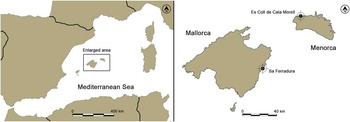
A new research project was initiated in 2011 to study one of these sites on each of the two major islands of the archipelago: Es Coll de Cala Morell in Menorca and Sa Ferradura in Mallorca (Figure 1). In this paper, the authors aim to elaborate a chronological sequence for the occupation of both sites, placing them in their precise cultural context.
Locations of the two prehistoric coastal capes studied in this work.

The Sites: Es Coll De Cala Morell and Sa Ferradura
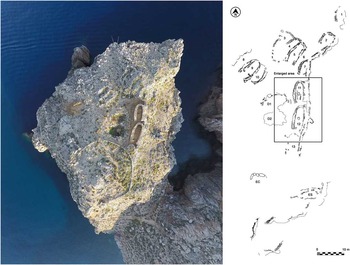
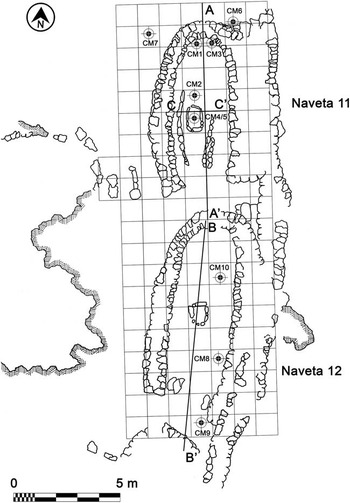
Es Coll de Cala Morell, in the north of Menorca, is a walled coastal promontory with a relatively large plateau. The cape is a small peninsula with a very narrow connection to the mainland. The slope of the promontory facing inland is walled, while the cliffs make the fortification of the rest of the perimeter unnecessary. On top of the plateau, 13 horseshoe-shaped architectonic structures, known as navetes, have been identified (Figure 2). These are the typical houses of the Balearic Bronze Age, prior to the Talayotic period. There are two probable water deposits in the center of the site, which are currently being excavated. A last and enigmatic element of the site is a singular small building with an unknown function, built with a special wall of very large flagstones and placed at the highest point of the promontory. Two of the navetes (11 and 12) have been excavated at Es Coll de Cala Morell, both of them attached to the inner side of the enclosure wall (Figure 3). They feature a domestic space with a central hearth in both cases (Anglada et al. Reference Anglada, Ferrer, Ramis and Salas2015). In naveta 11, two small benches surround the hearth and, in front of the façade, there is a large millstone on top of a stone structure. The materials found in the navetes have a domestic character. Pottery includes fragments of large containers, cooking pots, and vessels for consumption. Some hand mills, hammer stones, and bone awls represent the bone and lithic industries. The bone assemblage is moderate and nearly all remains belong to domestic mammals. The excavation showed that both navetes had been peacefully abandoned.
Aerial view and plan of the site of Es coll de Cala Morell (Photo by Carles Mascaró), after Juan and Plantalamor (Reference Juan and Plantalamor1996).

Plan of navetes 11 and 12 from Es Coll de Cala Morell with the approximate position of the dated samples and longitudinal cross-sections indicated.

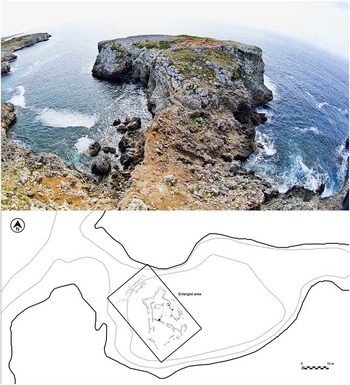
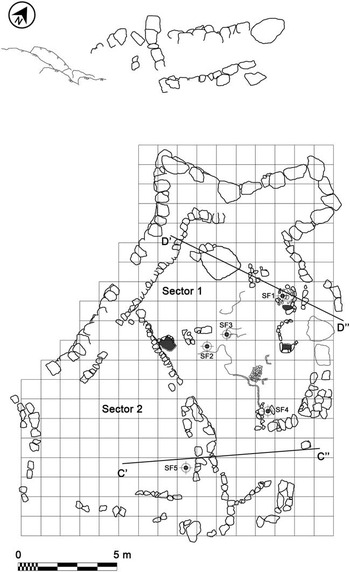
Sa Ferradura, in eastern Mallorca, can be described as a coastal cape connected to the island through a narrow land bridge. This is the only possible access, which is protected with an inland-facing wall (Figure 4). The entrance is a narrow space between the northern end of this wall and the cliff. The inner area of the promontory is smaller than the former one in Cala Morell. It has a different spatial planning as well, with only two large built-up sectors, both attached to the enclosure wall (Figure 5). Sector 1 is interpreted as an open-air space where the main feature consists of seven hearths in the same area, some of them very close to one another (Anglada et al. Reference Anglada, Ferrer, Ramis and Salas2015). Sector 2 seems to be a covered domestic space. The excavation of the inner area of this promontory is nearly finished. All the evidence fits with domestic activities: cooking pots, some bone awls and hammer stones, hand mills and a large faunal assemblage mostly represented by domestic mammals. No material indicates that this site could be related to maritime trade. Finally, there are no traces of violence in the abandonment of this place.
Aerial view and plan of the coastal cape at Sa Ferradura. (Photo by Isaac Garcia Gundin.)

Plan of the architectonic structures of Sa Ferradura, with the approximate position of the dated samples and cross-sections indicated.

MATERIALS AND METHODS
A sampling strategy was applied to navetes 11 and 12 of Es Coll de Cala Morell and Sectors 1 and 2 from Sa Ferradura in order to obtain a chronological sequence of the human occupation in the two coastal capes. As for the contexts, the main interest was dating the occupation horizons of both sites. Consequently, samples from the different identified habitation layers were selected for analysis. Ash and charcoal layers associated to the hearths are particularly interesting because they are informative of the last moment of use of that space. The samples selected were domestic herbivore bones in all cases.
One of the main difficulties in establishing the chronology of prehistoric buildings in the Balearic Islands is to define a date for the construction of those monuments. Soil tends to be very thin and walls are usually set on the bedrock. A potential strategy consists of trying to obtain organic samples from inside the walls. Prehistoric walls in the Balearic Islands are built with two faces, with the outer one being very monumental, and an inner filling in between. This strategy had been used, for example, in the attempt to date the wall of naveta 3 of S’Hospitalet Vell, but the obtained result showed that it had to be necessarily a latter repair (Ramis and Salas Reference Ramis and Salas2014). Given the difficulty to record archaeologically the repair of prehistoric dry stonewalls, or the possibility that organic samples have filtered in the wall filling after its construction, this strategy has not been used here.
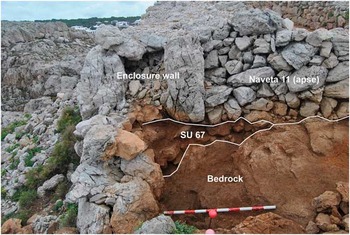
Nevertheless, the excavation in the area of the apse of naveta 11 of Es Coll de Cala Morell showed an exceptional stratigraphy because the wall was partially built on a stone and sand layer (SU 67) deposited to level a natural depression of the bedrock (Figure 6). A bone sample from this context was selected for analysis.
Detail of the stratigraphic unit SU 67, on which the inner face of the enclosure wall and the apse of naveta 11 are set.

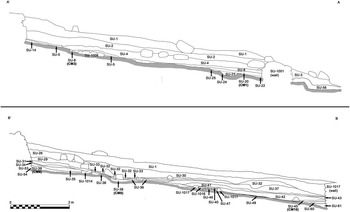
Six more samples from naveta 11 were selected for 14C dating from Cala Morell: two from the occupation layers, three from the hearth, and the last one from the exterior (Figure 7).
Cross-sections A-A’ of naveta 11 and B-B’ of naveta 12 of Es Coll de Cala Morell.

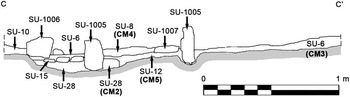
Two overlying occupation layers were identified inside this building. The upper one (SU 6) covered nearly all the inner space, while the inferior one (SU 20) was only found in the lower part of the naveta (the apse area). It could have been used to level this lower area. A bone sample from each context was analyzed. Three bone samples associated with the fireplace were selected as well (Figure 8): one from the ashy layer on top of the hearth (SU 8), a second one underneath the slabs of the pavement in the base of the hearth (SU 12), and a last one from the clay layer that filled a hole in the bedrock that was used to fix the blocks of the hearth (SU 28). Finally, the last selected sample from naveta 11 came from an exterior occupation layer attached to its west wall (SU57).
Cross-section C-C’ of the heath of naveta 11 of Es Coll de Cala Morell.

In naveta 12, the ash layer associated to the inner hearth did not contain animal bones or any other short-life samples suitable for dating. Three bone samples from different occupation layers were selected for 14C dating: SU 38 was found between the entrance and the hearth, SU 45 between the hearth and the apse, and SU 39 was on the bedrock in front of the façade of naveta 12 (Figure 7). All these layers probably belong to a single occupation horizon recorded inside the structure and in front of the entrance.
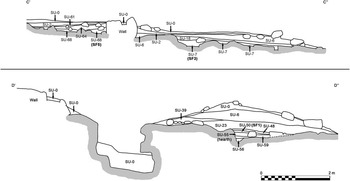
Five more samples were selected for 14C dating from different occupation layers of Sa Ferradura (Figure 9). Four of them come from Sector 1, interpreted as an open area. At this place seven fireplaces of different typologies were located. This phenomenon was interpreted as a discontinuous use of the settlement. The samples come from archaeological contexts directly associated to four of these fireplaces (SU 5, 7, 22, and 50). Another sample was recovered from an occupation layer in Sector 2, interpreted as a dwelling domestic structure (SU 68).
Cross-sections C’-C” and D-D” of Sa Ferradura.

All bone samples were pretreated using the Longin (Reference Longin1971) method supplemented with a NaOH wash to remove humic acids. All bones contained enough good quality collagen to perform the analysis. After pretreatment, samples were combusted and transformed into graphite (Van Strydonck and van der Borg 1990–Reference Van Strydonck and van der Borg1991) and dated by accelerator mass spectrometry (AMS) (Boudin et al. Reference Boudin, Van Strydonck, van den Brande, Synal and Wacker2015).
RESULTS
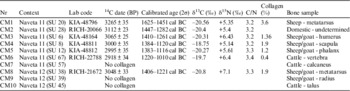
The 14C dating results from navetes 11 and 12 of Es Coll de Cala Morell are presented in Table 1, and those from Sa Ferradura in Table 2.
14C evidence from navetes 11 and 12 of Es Coll de Cala Morell.

14C evidence from Sa Ferradura.

DISCUSSION AND CONCLUSION
A date for the initial occupation could not be established in either of the two analyzed coastal capes. The only attempt to obtain a terminus post quem for the construction of one of the navetes failed: the sample from the layer underneath the apse of naveta 11 has proven to be intrusive, as its result (1220–1010 cal BC) is later than the abandonment of this structure. Nevertheless, dating from the occupation layers and hearths let the proposal of a chronological sequence for the habitation of both sites.
The dates obtained for naveta 11 of Es Coll de Cala Morell place its occupation roughly between 1600/1500 cal BC and 1300/1200 cal BC. The lower occupation layer is dated to 1630–1450 cal BC, while the age for the construction of the hearth is between 1450 and 1280 cal BC. Therefore, the hearth must be associated to the upper occupation layer, dated to 1410–1260 cal BC. The two samples recovered inside the hearth, one from the ash layer and the second covered by the slab floor, gave roughly the same age of 1390–1110 cal BC. The bone sample from the exterior occupation layer attached to naveta 11 did not contain collagen. Samples from naveta 12 of this site did not work so well because of the lack of collagen. Only one dating could be obtained from the occupation layer, with a result of 1410–1220 cal BC. Consequently, based on the obtained results from these two structures, it can be established that the site of Es Coll de Cala Morell was occupied at least since around 1600/1500 cal BC, and abandoned in an indeterminate moment of the 13th century cal BC.
In Sa Ferradura, two of the dated contexts from Sector 1 show nearly identical intervals (1110–900 cal BC), with a third one close to it (1030–840 cal BC). These three results overlap widely in the range 1030–900 cal BC. The ash and charcoal layer associated to the fourth hearth has been dated to 1210–1000 cal BC. This date overlaps with the previous ones, but could indicate a slightly earlier chronology for this hearth (12th century cal BC). Unfortunately, the stratigraphic relationship of these contexts does not allow any additional refinement of the chronological data from Sector 1. The only identified occupation layer inside Sector 2 was dated to 1110–910 cal BC. Thus, the period of occupation in Sa Ferradura can be roughly placed between 1200/1100–900 cal BC. But this interval could have been shorter, because all the obtained data for Sa Ferradura clusters in the 11th century cal BC.
The 14C dates suggest that the fortified settlements located on coastal promontories in the Balearic Islands are not a unitary phenomenon, from a chronological point of view. Es Coll de Cala Morell has shown an earlier occupation, in the mid-2nd millennium cal BC, and, on the other hand, the two excavated navetes are abandoned just before the earliest chronological evidence in Sa Ferradura. On the other side, Sa Ferradura (Mallorca) and Cap de Forma (Menorca) are widely contemporary, possibly with a slightly later abandonment of the former. These last two sites could be interpreted as product of similar social dynamics in both islands in the same period.
The evidence recovered so far in Es Coll de Cala Morell and Sa Ferradura leaves no doubt about the functional interpretation of the excavated structures: they are domestic spaces, similar to those found inland with contemporary chronologies. It fits well with the functional interpretation of Cap de Forma as a domestic space (Depalmas Reference Depalmas2014). Currently, there is no evidence for a relationship of these fortified promontories with maritime contacts, as had been previously suggested. This shows that the occupation of coastal sites for a defensive purpose occurred in different moments of the prehistory of the Balearic Islands.
The naveta village is the typical settlement in the Balearic mid-2nd millennium cal BC, with a temporal range of about 1700–1200 cal BC (e.g. Ramis and Salas Reference Ramis and Salas2014). In Menorca, the dated examples of Clariana and Cala Blanca (Plantalamor and Van Strydonck Reference Plantalamor and Van Strydonck1997) have a last occupation and abandonment roughly contemporary to Es Coll de Cala Morell. Nevertheless, the settlement pattern is rather different, as villages are usually in the lowlands and at a distance to the sea (e.g. Pons Reference Pons1999; López Pons Reference López Pons2001). In addition, they are situated in open areas without defensive significance. The location of the site of Es Coll de Cala Morell seems determined by its defensive properties. A fortified settlement in such an early time of Balearic prehistory is unexpected, as the Pretalayotic society used to be considered pacific. This is probably the earliest evidence of social conflicts among Menorcan communities. The coexistence of this fortified village with some others without defensive protection remains unexplained and is a matter for future research.
The naveta villages became progressively abandoned in Mallorca and Menorca since about 1200 cal BC (Ramis and Salas Reference Ramis and Salas2014) in parallel with the cultural transformation that led to the beginning of the Talaiotic culture, characterized by the emergence of the public tower-like monuments called talayots. In Mallorca, new villages arose with the concentration of houses surrounding a main structure, like one of these cyclopean towers or a building on top of a natural elevation (e.g. Coll Reference Coll1997). The early Talayotic villages are poorly known in Menorca, but the evidence from Cornia Nou suggests a settlement on top of a fortified hill (Anglada et al. Reference Anglada, Ferrer, Plantalamor, Ramis and Van Strydonck2013). In this process of spatial reorganization some coastal capes were occupied and fortified again, as proven by Cap de Forma and Sa Ferradura. From a functional point of view, some differences can be established between the two sites. Cap de Forma can be interpreted as a more permanent settlement with an inner cistern and well-defined domestic spaces (Depalmas Reference Depalmas2014). Sa Ferradura seems to be the product of more intermittent and short-term occupations. However, both cases show the need for a protected refuge and are helpful examples to illustrate the cultural transformations that led to this new social reality in the Balearic Islands in the Late Bronze Age.
ACKNOWLEDGMENTS
The research and excavation project in Sa Ferradura and Cala Morell is supported by Associació d’Amics del Museu de Manacor, Ajuntament de Manacor, Ajuntament de Ciutadella, Consell Insular de Menorca, Consell de Mallorca and the Belgian Royal Institute for Cultural Heritage.