Introduction
Sensitivity of human growth and development to environmental factors, and thus also to socio-economic modifiers, has been demonstrated in many studies (Eveleth & Tanner, Reference Eveleth and Tanner1976; Komlos & Baten, Reference Komlos and Baten2004; Perkins et al., Reference Perkins, Subramanian, Smith and Zaltin2016). Thus, different environmental factors are mirrored in changing proportions, size and tissue composition of the body of children and adolescents, in subsequent generations. They are therefore also reflected in the form of secular trends regarding Body Mass Index (BMI) and adiposity (Kowal et al., Reference Kowal, Kryst, Woronkowicz and Sobiecki2014; Kryst et al., Reference Kryst, Kowal, Woronkowicz, Sobiecki and Cichocka2012; Marques-Vidal et al., Reference Marques-Vidal, Madeleine, Romain, Gabriel and Bovet2008).
Regrettably, considerable progress of civilisation, and thus improvement of the living conditions, is also one of the primary causes of the growing prevalence of overweight and obesity, as well as excess adiposity (Hales et al., Reference Hales, Carroll, Fryar and Ogden2017; Johansson et al., Reference Johansson, Brissman, Morinder, Westerståhl and Marcus2020; Kalies et al., Reference Kalies, Lenz and von Kries2002; Skinner et al., Reference Skinner, Perrin and Skelton2016; Vijayakumar et al., Reference Vijayakumar, Wheelock, Kobes, Nelson, Hanson, Knowler and Sinha2018; Wedderkopp et al., Reference Wedderkopp, Froberg, Hansen and Andersen2004; World Health Organisation [WHO], 2017). This problem was documented in many countries and concerned also the Polish population. Unfortunately, Poland, in comparison to other European countries, was recently characterised as having moderate to high levels of overweight and obesity among children and adolescents (Huang et al., Reference Huang, Reinehr and Roth2020; Kułaga et al., Reference Kułaga, Grajda, Gurzkowska, Wojtyło, Góźdź and Litwin2016). Mentioned secular increase in the prevalence of excess body mass was also noted, for example, in a population of 14-17-year-olds from New Delhi. Importantly, in the same group, there was also a decrease in the prevalence of underweight (Gupta et al., Reference Gupta, Shah, Misra, Bharadwaj, Gulati, Gupta, Sharma, Pandey and Goel2011). Furthermore, a similar tendency was noted among Chinese children and adolescents, where the prevalence of overweight increased from 4.3% in 1995 to 18.4% in 2014. It should also be mentioned, that this change coexisted with a secular increase in the incidence of high blood pressure (Dong et al., Reference Dong, Ma, Song, Ma, Dong, Zou and Prochaska2018). Continued, linear, intergenerational increase of the prevalence of excess body mass was noted also in three states of Australia, with the highest observed percentages of 30.2% and 24.3% for overweight and obesity respectively (Ho et al., Reference Ho, Olds, Schranz and Maher2017). Additionally, in Italy, across 20 years, there was a positive trend regarding the body weight of children (Costa de Miranda et al., Reference Costa de Miranda, Di Renzo, Cupertino, Romano, De Lorenzo, Salimei and De Lorenzo2019).
At the same time, in a recent study regarding intergenerational changes in the prevalence of excess body mass and adiposity among preschoolers from Kraków, there was a secular decrease in the prevalence of both of the mentioned problems. Moreover, the prevalence of underweight and low adiposity was also reduced in the more contemporary cohort. Described tendencies were also mirrored by a secular increase in the percentage of preschoolers in the category of normal BMI and body fat ratio (Żegleń et al., Reference Żegleń, Kryst, Kowal, Woronkowicz and Sobiecki2019). Obviously, such phenomena seem to be extremely favourable, thus, it will be beneficial to investigate, if they are present also in older age groups. Especially, as the secular trends noted in preschoolers often differ, either in size or direction, from those noted for in older children and adolescents (Pavlica et al., Reference Pavlica, Rakić, Popović, Puškaš and Božić-Krstić2018).
Additionally, studies concerning issues of body mass and tissue composition among children and adolescents are crucial. It is due to the fact, that excess body mass, as well as adiposity, is associated with an increased risk of dyslipidemia, hypertension, non-alcoholic fatty liver disease, obstructive sleep apnea, polycystic ovarian syndrome, and psychological problems in childhood (Kim & Moon, Reference Kim and Moon2020). Moreover, the presence of excess weight as well as body fat can have a significant influence on the pubertal development in girls, as well as boys, which adds to the importance of exploring mentioned topics among adolescents (Colmenares et al., Reference Colmenares, Gunczler and Lanes2014; Huang et al., Reference Huang, Reinehr and Roth2020).
Similar studies are also crucial for assessing the effectiveness of prevention and intervention programs that, in recent years, were applied in many countries, to battle or prevent the incidence of excess body mass and adiposity among youth (Salanave et al., Reference Salanave, Peneau, Rolland-Cachera, Hercberg and Castetbon2009; Shirasawa et al., Reference Shirasawa, Ochiai, Nanri, Nishimura, Ohtsu, Hoshino, Tajima and Kokaze2015; Xiao et al., Reference Xiao, Qiao, Pan, Liu, Zhang, Li, Liu, Wang, Liu, Liu, Huang and Hu2015). In 2016 such program was introduced also in Poland. The “National Health Program” has the main goal of fighting against overweight and obesity in children and adolescents by focusing mainly on the promotion of physical activity and a healthy lifestyle (Ministry of Health, 2016).
The aim of this study was to assess the changes in the prevalence of overweight and obesity, as well as high adiposity in children and adolescents (8-15 years of age) from Kraków (Poland), between the years 2010 and 2020.
Material and methods
Children and adolescents included in the study group were examined during two cross-sectional surveys carried (in 2010 and 2020). Both of the surveys were carried out in randomly selected primary schools in Kraków (Poland), located in four of the traditional residential districts: Śródmieście, Podgórze, Krowodrza and Nowa Huta, with the consent of the school’s management. Inclusion to the study group was based on the written consent of the parents/legal guardians as well as verbal consent of the participants themselves.
The range of the exact calendar age of the subjects was7.50 to 15.49 years. It was calculated as a difference between the date of the survey and the birth date and expressed as a decimal fraction. The exact calendar age was a basis for classifying each participant into one of 8 age groups (i.e. the category of 11-year-olds included children whose calendar age ranged from 10.50 to 11.49 years).
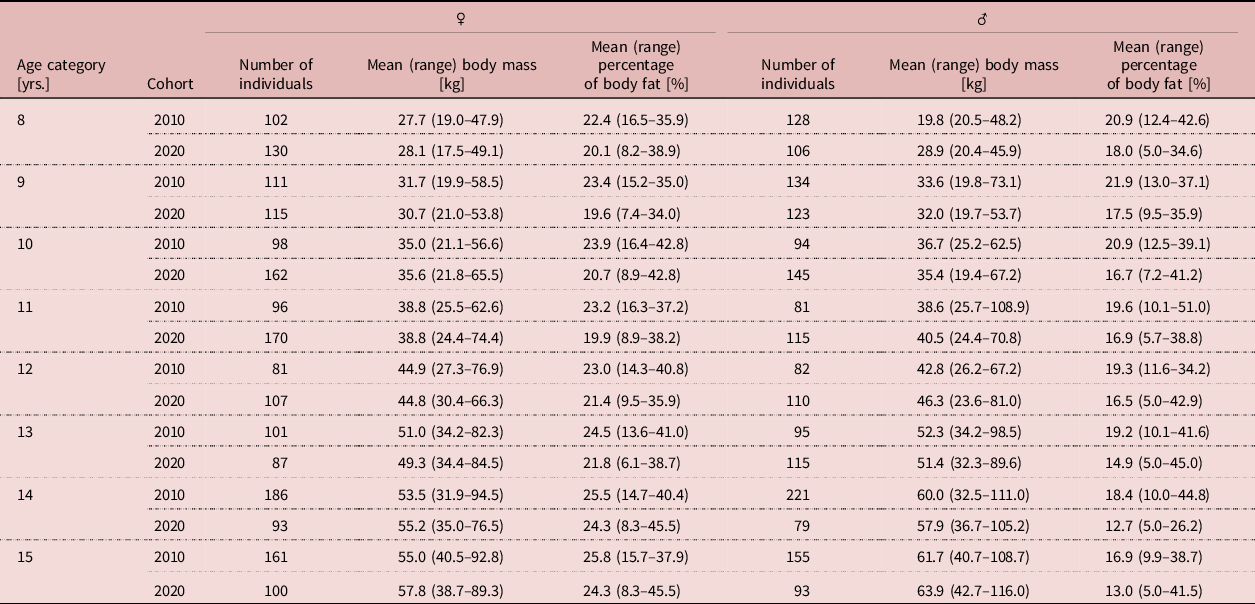
The 2010 series consisted of 1926 individuals (990 boys and 936 girls) and the one from 2020 included 1850 children and adolescents (886 boys and 964 girls) (Tab.1). Data for the project was collected between 2019-20 and the measurements were completed before the lockdown associated with COVID-19 pandemic began. Similarly, earlier data was collected in 2009-10.
Selected characteristics of the examined group

Body height was obtained using an anthropometer (accuracy 1 mm; GPM, Switzerland) and body weight was measured with an electronic scale manufactured by Tanita (Japan) (accuracy 0.1 kg, model BC-418, with adiposity measurement corrected for age). BMI (Body Mass Index) was calculated according to the following formula: body weight /body height2, where body weight was expressed in kilograms and body height in meters. Participants were categorised as having underweight, normal weight, overweight or obesity according to Cole’s cut off points (Cole et al., Reference Cole, Bellizzi, Flegal and Dietz2000, Reference Cole, Flegal, Nicholls and Jackson2007).
The percentage of body fat was measured by the bioimpedance method, using the previously mentioned electronic scale (Tanita; Japan; accuracy 0.1%). The subjects were then categorised according to their body fat ratio, as characterized by low (≤ -1 z-score), normal (-1-1 z-score) or high (≥ 1 z-score) adiposity.
Intergenerational changes regarding the prevalence of each bodyweight and adiposity category, within the age groups, were analyzed by using the Chi2 test.
Statistical analyses were performed using Statistica 13.0 and StatsDirect 3.
This study was conducted according to the guidelines laid down in the Declaration of Helsinki and all procedures involving research study participants were approved by the Bioethics Committee of the Regional Medical Association in Kraków (5/KBL/OIL/2019).
Results
Girls
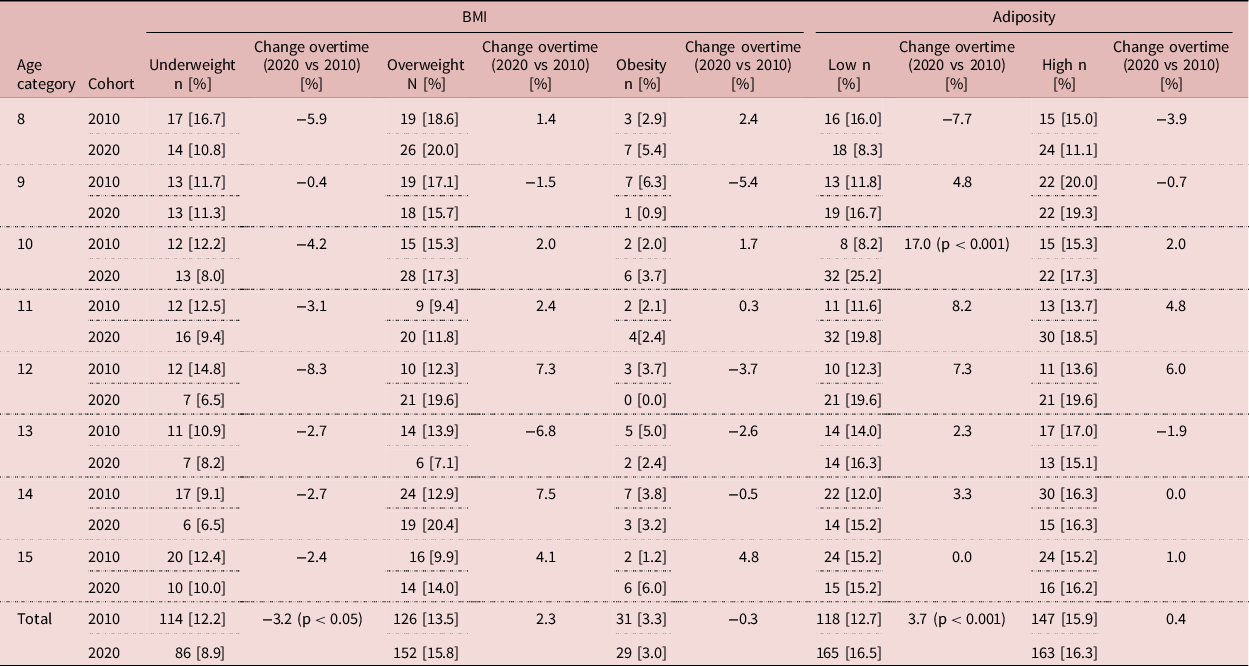
Among girls, there was a decrease in the prevalence of underweight in all of the age categories, as well as the entire group (Table 2). However the change was only statistically significant for the whole group, regardless of age. On the other hand, in the majority of the age groups, except for 9 and 13-year-olds, there was an increase in the prevalence of overweight. In half of the age groups, there also was a decrease in the prevalence of obesity, but there was an increase among 8, 10, 11 and 14-year-olds. In the case of adiposity, besides the youngest age category, there was an increase in the prevalence of low body fat. The observed change differences was statistically significant among 10-year-olds, as well as in the whole group, regardless of age. Contemporary girls were also generally characterised by a slightly higher prevalence of high adiposity, in comparison to their peers examined in 2010. Exceptions to this tendency were noted at 8, 9 and 13 years of age.
Percentages of children of each BMI and adiposity statuses in 2010 and 2020 cohorts and their differences (girls)

Boys
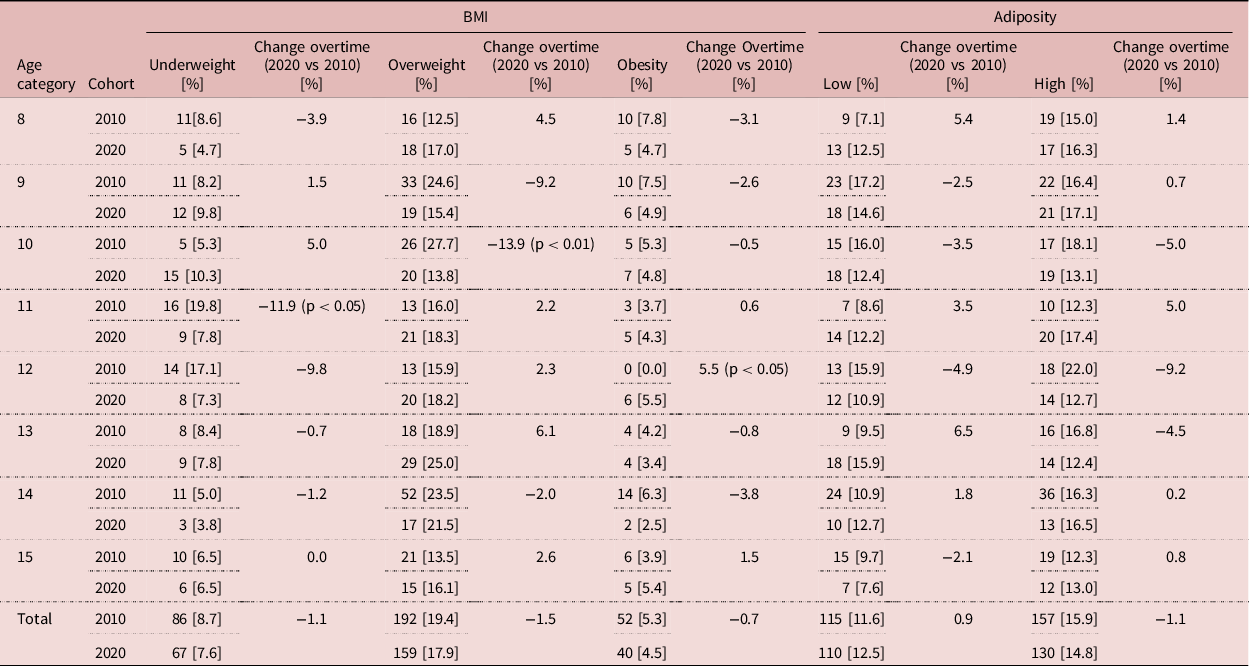
Similarly to what was observed among girls, contemporary boys were overall characterised by a lower prevalence of underweight than their counterparts from 2010 (Table 3). The change was statistically significant only at 11 years of age. Once again, there was also an increase in the prevalence of overweight, which concerned all age groups apart from 9, 10 and 14-year olds. However there was a substantial and statistically significant decrease in the prevalence of overweight at age 10. In the majority of the boys’ age categories, there was a decrease in the prevalence of obesity. The same tendency was also noted regardless of age. However there was an increase among 12 year olds. There was an increase in the prevalence of low adiposity among 8, 11, 13 and 14 year old boys (as well as overall), and a decrease in the prevalence of high adiposity among 10, 12 and 13 year old boys (as well as overall).
Percentages of children of each BMI and adiposity statuses in 2010 and 2020 cohorts and their differences (boys)

Discussion
In the present study, there was a generally increasing secular trend regarding the prevalence of overweight for girls, which was slightly higher in children and adolescents examined in 2020 in comparison to their peers measured in 2010. In the case of boys, however, there was a reduction in the prevalence of overweight. There was a trend towards decreasing prevalence of obesity in the case of both girls and boys, though, it should also be mentioned that observed differences, for the most part, were not statistically significant. This may suggest stabilization of intergenerational changes previously noted among children and adolescents from Kraków (Kowal et al., Reference Kowal, Kryst, Sobiecki and Woronkowicz2013, Reference Kowal, Kryst, Woronkowicz, Brudecki and Sobiecki2015). This, at least to some extent, is in line with secular changes observed recently among preschoolers (3-7 years of age) from the same population (Żegleń et al., Reference Żegleń, Kryst, Kowal, Woronkowicz and Sobiecki2019). This is an interesting observation, especially considering the fact that it has been suggested in the literature, that secular trends observed among preschool children usually have different magnitude and directions in comparison to older age categories (Pavlica et al., Reference Pavlica, Rakić, Popović, Puškaš and Božić-Krstić2018; Żegleń et al., Reference Żegleń, Kryst, Kowal and Woronkowicz2020).
The stabilisation of secular trends regarding the prevalence of excess body weight was noted also in the USA (Ryu et al., Reference Ryu, Frith, Pedisic, Kang and Loprinzi2019). The intergenerational decrease in childhood overnutrition, which particularly corresponds to the presently noted declining secular trend in the prevalence of obesity, was observed also in the Mediterranean area of Southeast Spain (Pastor-Fajardo et al., Reference Pastor-Fajardo, Bosch-Giménez, Larqué, Solano Navarro, Fuentes-Castelló and Pastor-Rosado2020). Moreover, similar findings were presented in other European countries participating in the Childhood Obesity Surveillance Initiative (COSI), as well as the Spanish ALADINO study (Ministerio de Sanidad, Reference de Sanidad2016; Pastor-Fajardo et al., Reference Pastor-Fajardo, Bosch-Giménez, Larqué, Solano Navarro, Fuentes-Castelló and Pastor-Rosado2020; Spinelli & Nardone, Reference Spinelli and Nardone2018; WHO, 2018; Wijnhoven et al., Reference Wijnhoven, Van Raaij, Spinelli, Starc, Hassapidou, Spiroski, Rutter, Martos, Rito, Hovengen, Pérez-Farinós, Petrauskiene, Eldin, Braeckevelt, Pudule, Kunešová and Breda2014).
These findings are in line with results of other studies, where the overnutrition was more prevalent in boys, in comparison to girls (NCD RiskFactor Collaboration, 2017; Miqueleiz et al., Reference Miqueleiz, Lostao and Regidor2016; Ministerio de Sanidad, Reference de Sanidad2016; Ng et al., Reference Ng, Fleming, Robinson, Thomson, Graetz, Margono, Mullany, Biryukov, Abbafati, Abera, Abraham, Abu-Rmeileh, Achoki, Albuhairan, Alemu, Alfonso, Ali, Ali, Guzman and Gakidou2014; Pastor-Fajardo et al., Reference Pastor-Fajardo, Bosch-Giménez, Larqué, Solano Navarro, Fuentes-Castelló and Pastor-Rosado2020; Wijnhoven et al., Reference Wijnhoven, Van Raaij, Spinelli, Starc, Hassapidou, Spiroski, Rutter, Martos, Rito, Hovengen, Pérez-Farinós, Petrauskiene, Eldin, Braeckevelt, Pudule, Kunešová and Breda2014). In literature, the occurrence of such a phenomenon has been attributed to differences in body composition, particularly in muscle mass. Additionally, said discrepancies have been suggested to be influenced by a different perception of weight observed in both sexes (Ramiro-González et al., Reference Ramiro-González, Sanz-Barbero and Royo-Bordonada2017; Salcedo et al., Reference Salcedo, Gutiérrez-Fisac, Guallar-Castillón and Rodríguez-Artalejo2010).
Presently noted trends regarding the body mass, especially those observed for underweight and overweight, were mirrored in the intergenerational changes regarding the prevalence of high and low adiposity. However, similarly to what was observed in the case of body mass, said discrepancies between both cohorts were, for the most part, statistically insignificant, which may suggest stabilization of prior trends (Kowal et al., Reference Kowal, Kryst, Sobiecki and Woronkowicz2013, Reference Kowal, Kryst, Woronkowicz and Sobiecki2014; Kryst et al., Reference Kryst, Woronkowicz, Kowal and Sobiecki2018). Conversely, in recent years, in other studies concerning the Polish population, there was a significant tendency toward an increasing prevalence of high adiposity, which was particularly evident among girls (Durda-Masny et al., Reference Durda-Masny, Hanć, Czapla and Szwed2019; Saczuk et al., Reference Saczuk, Wasiluk and Wilczewski2018).A secular increase of adiposity, especially in the waist area, has also been noted in a population from the United Kingdom. Interestingly, it was observed independently of the changes noted for the BMI. However, it is also worth noting that it coexisted with the rise in low high-density lipoprotein cholesterol prevalence (Johnson et al., Reference Johnson, Norris and Hamer2020). Additionally, similar tendencies, also regarding especially the subcutaneous fat tissue allocated in the abdominal area, were also observed among adolescents from Russia (Godina et al., Reference Godina, Khomyakova and Zadorozhnaya2016).
It has been suggested in the literature that stabilization of previous, increasing secular trends regarding the prevalence of excess body mass and adiposity may be associated with the implementation of public health measures aimed to prevent pediatric obesity (Ministerio de Sanidad, Reference de Sanidad2016; Pastor-Fajardo et al., Reference Pastor-Fajardo, Bosch-Giménez, Larqué, Solano Navarro, Fuentes-Castelló and Pastor-Rosado2020; Salanave et al., Reference Salanave, Peneau, Rolland-Cachera, Hercberg and Castetbon2009; Shirasawa et al., Reference Shirasawa, Ochiai, Nanri, Nishimura, Ohtsu, Hoshino, Tajima and Kokaze2015; Xiao et al., Reference Xiao, Qiao, Pan, Liu, Zhang, Li, Liu, Wang, Liu, Liu, Huang and Hu2015). In 2016 such program has been introduced also in Poland by the Ministry of Health. The National Health Program focuses mainly on the promotion of physical activity among children and adolescents (Ministry of Health, 2016). Thus, it is quite possible that currently noted secular changes may be among the benefits of said program. Other possible explanations of the mentioned stabilisation of intergenerational trends may be associated with saturation levels and reaching the population balance (Bygdell et al., Reference Bygdell, Ohlsson, Célind, Saternus, Sondén and Kindblom2017). On the other hand, it should also be stressed, that current findings may be a part of the transitory phase which can be the beginning of a future trend. Especially, as the presence of alternating phases of decrease, stabilization and increase concerning particular features has been demonstrated in previous research (Pastor-Fajardo et al., Reference Pastor-Fajardo, Bosch-Giménez, Larqué, Solano Navarro, Fuentes-Castelló and Pastor-Rosado2020; Salcedo et al., Reference Salcedo, Gutiérrez-Fisac, Guallar-Castillón and Rodríguez-Artalejo2010). Lastly, presently noted results may be associated with socioeconomic changes occurring over the last decade in Polish society. Between the years 2010 and 2020, there was a decrease in the unemployment rate (from around 9% to about 6%) as well as in the at-risk-of poverty rate (from 20.5% in 2005 to 17.3%). Moreover, there was an increase in average salaries, GDP (Gross Domestic Product), as well as general education rate in society (Główny Urząd Statystyczny, 2018).
The findings of this study are particularly significant due to the fact, that detailed knowledge of the prevalence of overweight/obesity in childhood and adolescence is crucial for the future health of entire populations. It is due to the fact, that excess body mass and adiposity at an early age significantly increase the risk of developing disorders related to excessive weight in adulthood (de Onis et al., Reference de Onis, Blössner and Borghi2010; Dietz, Reference Dietz1998; Epstein, Reference Epstein1996; Piekorz et al., 2016; WHO, 2017). It should also be stressed, that changes regarding body mass, occurring in subsequent generations, should be investigated in the context of body composition. Further studies should also take into account the levels of physical fitness and activity of the examined population
Acknowledgements
The study has been sponsored by the University of Physical Education in Kraków (grant 189/BS/INB/2018).
Conflicts of Interest
The authors have no conflicts of interest to declare.
Ethical Approval
This study was conducted according to the guidelines laid down in the Declaration of Helsinki and all procedures involving research study participants were approved by the Bioethics Committee of the Regional Medical Association in Kraków (5/KBL/OIL/2019). Written informed consent was obtained from parents/ legal guardians of the subjects.