Introduction
Psychological jurisprudence (PJ) is a relatively recent perspective at the law–psychology interface whose intellectual identity continues to evolve, remaining mostly in process and in search of an overarching and integrative conceptual schema (Arrigo, Reference Arrigo2003b; Arrigo and Fox, Reference Arrigo, Fox, Fox, Prilleltensky and Austin2009; Small, Reference Small1993). This notwithstanding, three strains of analysis are discernible in the relevant literature. Each PJ framework is summarily presented below.
The first is dignity-focused PJ. Its premise is that the values and insights of psychology can enable legal institutions and decision-makers to undertake actions that advance the aims of human welfare, communal justice and societal accord (Melton, Reference Melton1990; Melton and Saks, Reference Melton, Saks and Melton1986; Small, Reference Small1993). Dignity-focused PJ assumes that the law can establish socially desirable outcomes rather than promote citizen control that furthers state authority or governance by elites (Melton, Reference Melton1992).
The second type of PJ is traceable to the therapeutic jurisprudence movement. Its premise is that the law can function as a healing agent, pro-socially impacting the lives of those whom it serves, provided the therapeutic and anti-therapeutic effects of relying on legal rules, procedures, policies and programmes are steadfastly evaluated (Winick and Wexler, Reference winick and wexler2003). Therapeutic jurisprudence assumes that this infusion of clinical reasoning and acumen can yield a quality of justice in which courts (and other tribunals) function much like mental health professionals (Wexler and Winick, Reference Wexler and Winick1996).
The third variation of PJ is the critical paradigm. Its premise is that the exercise of power is not so much an effect of the law as it is a cause, especially since this power is embedded within and conveyed through the very construction of legal language and as sourced within legal texts (Arrigo, Reference Arrigo2002b; Reference Arrigo2004b; Williams and Arrigo, Reference Williams and Arrigo2002). PJ’s critical paradigm assumes that the possibility of achieving citizen justice and communal good requires a careful (re)reading of the concealed values, unspoken interests and hidden assumptions lodged within various legal documents, including those texts affecting vulnerable and marginalised individuals and/or collectives (Arrigo, Reference Arrigo2002a; Reference Arrigo2003a; Reference Arrigo2004a; Shon and Arrigo, Reference Shon and Arrigo2006).
This article focuses on the critical paradigm in psychological jurisprudence. At issues is how the conceptual integration of a radicalised PJ can contribute to its wholesale political agenda of social change, collective wellbeing and human welfare. To address these prescient concerns, three substantive matters are reviewed. First, the underlying social philosophy that informs radicalised PJ is presented. This includes some summary observations of the work of Jacques Lacan, Jacques Derrida, Michel Foucault, Jean Baudrillard and Erich Fromm. The overall insights gleaned from these commentators demonstrate how symbolic, linguistic, material and cultural realms of inquiry are foundational for, yet seldom connected to, PJ’s critical reformist agenda. Second, the theoretical assumptions of four prominent variants of radicalised PJ are summarily delineated. These variants include the disputations put forth by anarchism, feminist jurisprudence, critical legal studies and complex systems science. Third, a conceptual synthesis is proposed that fits radicalised PJ’s underlying social philosophy with its theoretical strains of analysis. This integrative framing further demonstrates the dynamic (and underdeveloped) political potential of the critical paradigm in psychological jurisprudence.
Critical psychological jurisprudence: underlying social philosophy
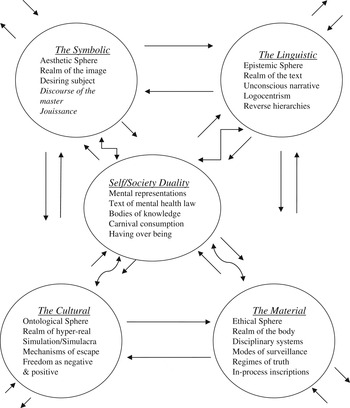
(Adapted from Arrigo and Milovanovic (Reference Arrigo, Milovanovic, Arrigo and Milovanovic2010, p. xiv).
Figure 1 visually depicts the interplay of underlying forces that contribute to the various schools of thought representing the critical perspective in psychological jurisprudence. Depending on the prevailing state of these forces, a particular type of aesthetic, epistemology, ethic and ontology will be imagined, told, embodied and reproduced at the law–psychology divide. The interplay of forces consists of several spheres of interdependent and overlapping influence. Each of these spheres of influence is briefly described and is correspondingly linked to those social theorists who illuminate their respective meanings.
De/reconstructing critical psychological jurisprudence

The symbolic: contributions from Jacques Lacan
The symbolic is the domain of the unconscious image. This unconscious image or mental representation conveys aesthetic significance and is saturated in a restricted view of the self, the social and their mutuality mediated by mundane language. For Lacan (Reference Lacan1977; Reference Lacan1981; Reference Lacan1985; Reference Lacan1991), this mundane language was synonymous with circumscribed desire. Among other meanings for the term, Lacan understood desire to represent that part of the more authentic and fully human (though concealed) self that struggled to find recognition, acceptance and legitimacy within dominant systems of communication. He was to refer to these dominant systems of communication as master discourses (Lacan, Reference Lacan1991). Law, medicine and science are three examples of master discourses that dominate through their monotony. In order to convey conventionally accepted and shared meaning in a court of law, a clinical treatment venue or a research setting, one must speak from within the self-referential parameters that define that system of communication in use. The particular narrative in use coheres only under these very rigidly co-ordinated contexts. However, through this tightly scripted meaning making/generating process, the ‘truer’ self – whether as lawyer or client, physician or patient, scientist or citizen – remains covert, dormant and often denied. Under these conditions, the self is divided, split, and exists as ‘lack’ or not-all. Thus, the unconscious images one has about such matters as psychiatric illness, mental health fitness to stand trial, competency restoration for execution, sexually violent predators, substance abuse recovery and community re-entry, are reduced to the dominant discourses (by way of their institutional agents) that define and sustain these law–psychology phenomena. As such, much of the unexamined potential for understanding (and growing) the self, the social and their interdependent duality is rendered silent (repressed unconsciously) in this choreographed process of image-making and speech production. This potential is the ‘excess’ (Lacan’s jouissance) that insists on its retrieval, longs to be spoken, seeks embodiment and awaits replication. This excess, also residing as dormant but felt in the unconscious, is the vast and untapped reservoir of recognition, insight and (aesthetical) change.
The linguistic: contributions from Derrida
The activation of a circumscribed mental representation about the self, the social and their mutual interconnectedness gives rise to a particular ‘text’ about the same. This text (e.g. mental health law) becomes an unconsciously lived (i.e. reified) narrative through the act of speaking or writing it (e.g. codes, procedures, policies, practices). Derrida (Reference Derrida1973; Reference Derrida1977; Reference Derrida1978; Reference Derrida1991) described the logic behind this text-making process as logocentrism. What we typically take to be true, just, ethical or good emerges from that which is most instantly recognisable to or most immediately accessible for us. This recognition and accessibility is traceable to the conviction that stable, clear and absolute meaning resides in texts. Thus, for example, if law is based on fact and if psychology is based on science, then the union of legal psychology must advance scientifically derived facts or truths. For Derrida, however, while this logic offers narrative content that coheres and reveals, the tendency of this text is to obfuscate and conceal. This is because the epistemology that anchors logocentrism is wedded to the ‘metaphysics of presence’ (Derrida, Reference Derrida1973; see also Balkin, Reference Balkin1987, pp. 746–51). Derrida described the metaphysics of presence as privileging one term in a hierarchical opposition over its deferred or devalued other term. To illustrate, the expression ‘competency to stand trial’ defers or postpones its binary opposite ‘incompetency to stand trial’. The legal construct of ‘sanity’ conceals and displaces its binary opposite ‘insanity’. The phrase ‘right to psychiatric treatment’ devalues or renders as absent its binary opposite, ‘right to psychiatric non-treatment’. In each instance, rather than cultivating an epistemology that grows meaning through the mutual interdependence of both terms/values that constitute a hierarchical opposition, meaning (and knowledge about the self, the social and their interconnectedness) is reduced to the activity of esteeming one term/value in a binary over and against its other term/value. As such, the metaphysics of presence prefers logocentric assumptions, ideas and truths at the expense of potentially worthwhile, though often unexamined, alternatives. More problematic, the decision to instantly recognise and immediately access prioritised meanings despite the status of contested binaries, displaces and undoes the interconnectedness of such oppositions understood to be more fully constitutive of the meaning-making/generating process. Thus, for Derrida, in order to forge a radical politics that conditionally (though incompletely) signified a ‘unity of opposites’ (Arrigo, Milovanovic and Schehr, Reference Arrigo, Milovanovic and Schehr2005 p. 24), temporarily reversing the hierarchy (e.g. insanity over sanity) represented a strategy that made possible a rereading of a binary opposition’s mutual interdependence and untapped meaning-making potential.
The material: contributions from Foucault
The unconsciously lived narrative that forms the text of mental health law privileges certain terms/values for an array of its hierarchical oppositions. Objective or evidence-based science displaces subjective or lived experience; risk or threat assessment postpones safety or security evaluations; clinical disease, illness and depression defers clinical health, wellness and happiness; correctional punishment for psychiatrically disordered offenders conceals correctional reward for the same. This hierarchical text produces bodies of knowledge about the self, the social and their interrelatedness. For Foucault (e.g. Reference Foucault1965; Reference Foucault1972; Reference Foucault1973; Reference Foucault1977; Reference Foucault1980), these bodies of knowledge operate as material expressions of power whose force instantiates a corresponding ethic. As he explained, these bodies of knowledge give way to disciplinary systems (e.g. the systems of law, psychiatry and penology). These systems inventively and productively function by way of surveillance techniques (e.g. electronic home monitoring of adult/juvenile parolees or probationers; solitary confinement) and control mechanisms (e.g. death by lethal injection; involuntary out-patient commitment) that panoptically police cognitions (neuroscience and the law), emotions (anti-psychotic medications) and behaviour (court-ordered community treatment). In this way, the narrative of power as knowledge that is materially produced by such disciplinary systems promulgates regimes of truth and regimens of human–social existence. These truths inscribe and render docile all dissenting self and social bodies: they vanquish difference, territorialise knowledge, homogenise identity and sanitise community. For Foucault, overcoming such normalisation requires a proliferation of inscriptions that are more in process; subject to change; open to contradictions and inconsistencies; and provisional, positional and fragmented in their manifold and embodied meanings.
The cultural: contributions from Baudrillard and Fromm
The bodies of knowledge that discipline the self, the social and their mutuality in mental health law are technologically reproduced and culturally consumed over and over again. To illustrate, sensationalised images of serial offenders, mind hunters, crazed psychotic killers, clinical forensic specialists and crime scene experts routinely populate the print and electronic media. The wholesale production and carnival consumption of these images fuels an industry of fictionalised or representational reality. However, this industry repeatedly passes through its fading authentic complement; the counterpart on which such illusions themselves are ostensibly anchored. Prime examples of this fuzzy authenticity at the law–psychology interface include mass-marketed functional magnetic resonance imaging (FMRI technology) used to determine competency (to stand trial and/or to be executed) and criminal responsibility; drug company advertisements promising pharmaceutical symptom relief from all clinically diagnosed discomforts or disorders; the corporatised model of corrections (i.e. prison privatisation); and the diversion trade that aims to therapeutically heal and restore by way of mental health, domestic violence, family and related courts. For Baurdillard (1972; 1976; 1983a; 1983b), when image-object displaces object as manufactured derivative reality, it signifies a hyper-real state of existence. This is the intangible, other-worldly realm where form and formlessness, fact and facade, the visceral and the virtual all collapse and implode. This implosion gives way to replicas of the real ad infinitum, culturally disseminated by way of You-Tube sites, DVD games or reality television shows that dramatise (even glamorise) the psychology crime, forensic courtroom proceedings and their counterfeit re-enactments. For Bauldrillard, these inexhaustible imitations are no more than simulations (pseudo-realities) whose meanings (simulacra) mutate and morph endlessly in order to support the conspicuous consumption of technologised culture for its own sake. Under these conditions, the grounding of the self, the social and their duality becomes vapid. This emptiness is a kind of liquid or digitised reality (Bauman, Reference Bauman2000; Pribán, Reference Pribán2007), absent any true ontological firmness, aesthetical significance, epistemological stability and ethical foundation.
The omnipresence of digitised culture in mental health law (the liquid industry of psychiatric justice), has steadily proliferated in the mass-mediated information age. Emerging and/or novel applications of forensic assessment instrumentation, actuarial models of dangerousness prediction, victim–offender mediation programming and cognitive neuroscience technologies are illustrative dimensions of this industry’s enduring and stylised commerce. However, according to Fromm (Reference Fromm1941/1994; Reference Fromm1955/2003; Reference Fromm1976/2005), the sustainability of such an industry nurtures a quality of human–social existence that seeks to escape the burden that capitalist freedom signifies. Passively succumbing to authority (evidence-based science, clinical forensic expertise); willingly engaging in destructiveness (waiving developmentally immature juveniles to adult criminal court, executing the mentally ill); and uncritically behaving like automaton conformists (educational socialisation of law students and psychiatric residents that affirms and accepts the status quo), are mechanisms employed to remove the fear and desperation that otherwise would engulf one’s own humanity. For the law–psychology interface, this fear and desperation stem from an acquisitive desire: the need to have rather than to be, the need to consume rather than to create. For Fromm, this acquisitive and devouring desire is a kind of social/systemic pathology that unreflectively seeks mastery over (power and control) as opposed to acceptance of (trust and respect) difference. Fromm defined the logic of this culturalised pathology as pseudo-thinking. Pseudo-thinking sustains negative freedom and reproduces a diminished ontology (pseudo-selves). The result is a society of captives (Arrigo and Milovanovic, Reference Arrigo and Milovanovic2009) whose images, narratives, inscriptions and reproductions reduce being and repress becoming.
Critical theoretical perspectives in psychological jurisprudence
The previous section briefly canvassed the social philosophy that underscores and informs the radicalised perspective in psychological jurisprudence. As a point of analytical reference, the symbolic, linguistic, material and cultural dimensions of the pertinent critical theory were enumerated. When provisionally delineated, this framing raises important and provocative questions about PJ’s underinvestigated aesthetical, epistemological, ethical and ontological footing. The following section extends and deepens this commentary. Of particular relevance are those efforts that challenge the constructed reality of mental health law. These efforts are understood as strategies of resistance. Additionally, the ensuing remarks identify and/or describe where these undertakings have been applied in specific and relevant contexts. These endeavours are understood as struggles for justice. Delineating the activities of resistance and justice in critical psychological jurisprudence begins to forge a radical political shift in relation to de/reconstructing the contemporary law–psychology interface.
Anarchism: theory and assumptions
The approaches to anarchist thought are diverse and manifold (e.g. Amster, DeLeon, Fernandez, Nocella and Shannon, Reference Amster, Deleon, Fernandez, Nocella and Shannon2009; Sartwell, Reference Sartwell2008). However, one approach that has garnered both critical and popular attention is the mutual aid variation as developed by Peter Kropotkin (e.g. Reference Kropotkin1902; Reference Kropotkin1912). What makes this orientation so provocative are its ‘scathing and sophisticated attacks against the state and its apparatus of legal control’ (Ferrell, Reference Ferrell and Arrigo1999, p. 94; Williams and Arrigo, Reference Williams and Arrigo2001). This critique is not merely a denunciation of institutionalised authority through destructive political efforts for the sake of negation or chaos alone. Instead, the anarchist assault on legal and state-sanctioned regulation is merely ‘a transitional phase in which the old [is] destroyed so that the new might emerge, [leading to] a better social order’ (Shatz, Reference Shatz1972, p. xii; see also Sartwell, Reference Sartwell2008).
With these preliminary observations in mind, it becomes somewhat self-evident why the anarchist agenda has ‘much to say about the social psychology of law, social organization, and the centralized state’ (Fox, Reference Fox1993a, p. 98). However, in order to understand the perspective and how it endeavours to promote resistance and justice in mental health law, a review of the theory’s underlying assumptions are warranted.Footnote 1 In brief, these presuppositions maintain that: (1) change, ambiguity and difference are to be celebrated; and (2) mutual aid and shared responsibility are integral to the fabric of our everyday human social existences. These suppositions dramatically recast the law and human behaviour relationship. They suggest that how the self/society duality is framed (de/reconstructed) yields a vastly different set of psycho-legal questions to explore in research, policy and pedagogy than presently found within this domain of academic and practical inquiry.
Rethinking change, ambiguity and difference
Kropotkin (e.g. Reference Kropotkin1902; Reference Kropotkin1912) celebrated the virtue of change, believing that individual freedom and, thus, civic consciousness, were lodged within its liberating grip. As the Russian anarchist Bakunin (Reference Bakunin1974) observed, endorsing Kropotkin’s vision, ‘let us put our trust in the eternal spirit which destroys and annihilates because it is the. . .creative source of life: The passion for destruction is a creative passion, too’ (p. 58). Anarchists recognise that this ‘creative passion’ produces life-affirming opportunities. The value of change rests in ‘its unlimited capacity to [establish] new vistas of meaning in work, leisure, religious preoccupation, political action, or other expressions of human social interaction” (Arrigo, Reference Arrigo2000, p. 20; see also Williams, Reference Williams and Arrigo2004). In the philosophy of anarchism, the seamless thread of change is wedded to ambiguity and difference. Ambiguity or unpredictability ‘constitute[s] fertile ground for new ideas and identities and, at their best, overwhelm any attempts to achieve final solutions or final authority’ (Ferrell, Reference Ferrell and Arrigo1999, p. 96). Difference represents a state of existence that ‘allows people to be who and how they are in their communities, freed from the normalizing and external constraints of regulatory and disciplinary regimes (e.g., the mental health system, the criminal justice apparatus)’ (Arrigo, Reference Arrigo2000, p. 12; Williams and Arrigo, Reference Williams and Arrigo2001).
The assumptions of change, ambiguity and difference – integral to the anarchist perspective – fundamentally challenge the role of psychological jurisprudence in society. Commenting on the limits of the conventional paradigm, Arrigo and Fox (Reference Arrigo, Fox, Fox, Prilleltensky and Austin2009) aptly summarised the problems that both users of mental health services confront, and treatment systems and community-based organisations struggle to manage. As they noted:
‘[M]ainstream psychology and the law hold assumptions that weaken ambiguity and difference and thus harden rather than disrupt status quo dynamics. These include an emphasis on procedural rather than substantive justice, an acceptance of the “rule of law’s” application of general principles despite unfair results in actual cases, and an endorsement of policies that enhance rather than challenge the law’s homogenizing and bureaucratizing legitimacy.’ (p. 168; see also Fox, Reference Fox1993b, p. 237)
Not only does this logic foster the lived experience of injustice for the sake of law’s omnipotence, it dismisses as incidental or as ‘noise in the system’ the uniqueness of individual identities, with all their ambiguities, inconsistencies, anomalies and differences. Thus, as Fox (Reference Fox1993b) urged, espousing the virtues of the anarchist plea for radical structural reform:
‘In seeking a liberating identity instead, psycho-legal scholars should re-examine their assumption that law is sufficiently redeemable and should concentrate on replacing law with non-legal solutions to human problems. . .Instead of searching the law for values congruent with our own, we should find our values in our psychological theory, political ideology, and personal and organizational ethics. Law is simply irrelevant to conceptions of what is psychologically desirable.’ (p. 239, emphasis added)
The mindfulness of mutual aid and shared responsibility
Anarchists accept and celebrate, rather than tolerate and dismiss, people as they are. The different identities borne of anarchism increase prospects for reciprocal awareness, and these associations make community not only possible but sustainable (Sartwell, Reference Sartwell2008; Williams and Arrigo, Reference Williams and Arrigo2001). Indeed, in anarchist communities people are ‘more free to be themselves, and at the same time, [are] more directly responsible for themselves and others, than they are in situations regulated by external authority’ (Ferrell, Reference Ferrell and Arrigo1999, p. 97; see also Amster et al., Reference Amster, Deleon, Fernandez, Nocella and Shannon2009). Thus, the psychological sense of community anarchists envision is one that is based on mutual aid and shared responsibility (Kropotkin, Reference Kropotkin1902; Reference Kropotkin1912).
Mutual aid implies localism, regionalism and decentralization wherein people participate actively and directly in imagining and re-imagining, crafting, and re-crafting, disassembling and reassembling the identity of their neighbourhood or locale (Morland, Reference Morland1997; Sonn, Reference Sonn1992; Tifft and Sullivan, Reference Tifft and Sullivan1980). As an anarchist assumption, mutual aid ‘grants the best chance of survival to those who best support each other in the struggle for life’ (Kropotkin, Reference Kropotkin1902, p. 115). It follows, then, that shared responsibility entails the recognition that meaningfully living in a community is an intricate tapestry of vital social relations; one that is ‘woven tightly enough to care for others but loosely enough to preserve [individual] differences’ (Ferrell, Reference Ferrell and Arrigo1999, p. 97; Sonn, Reference Sonn1992; Morland, Reference Morland1997).
Proponents of the anarchist perspective recognise that the legal system cannot ensure the optimal quality of individual life and social wellbeing intrinsic to this radical agenda (e.g. Bankowski, Reference Bankowski and Sugarman1983; Godwin, Reference Godwin and Carter1971; Goldman, Reference Goldman1969; Sonn, Reference Sonn1992). Moreover, critical psychological researchers, supportive of the anarchist critique, have demonstrated how legal principles or state-mandated practices limit prospects for social justice and thwart basic human needs and values (e.g. Sarason, Reference Sarason and Sarason1982; Fox, Reference Fox1991; Williams, Reference Williams and Arrigo2004)
For example, Fox (Reference Fox1993a) examined three areas ‘where legal doctrine seems especially ambivalent from an anarchist perspective’ (p. 102). These included the law versus equity distinction, jury nullification and the Ninth Amendment to the United States Constitution. What makes each of these phenomena ambivalent is the extent to which they more or less function to neutralise law’s dominance in the lives of people, as citizens balance their need to exist autonomously and freely against a psychological sense of community. Indeed, equity manifests itself, at times, outside the confines of law; jury nullification subverts or, at least, recasts the rule of law doctrine in the interest of justice; and the Ninth Amendment attempts to curtail constitutional rights that may infringe on other rights retained, but not enumerated, by people.Footnote 2
The dismantling of state-sponsored authority implied in each of the above-cited legal doctrines demonstrates how ‘trends toward legalism, centralization, hierarchy, and authority are dangerous to human beings who would be better off in a vastly different society’ (Fox, Reference Fox1993a, p. 106). The anarchist assumption of mutual aid and shared responsibility, so integral to the communal nature of our existences, renounces law’s dominance over people (Tifft and Sullivan, Reference Tifft and Sullivan1980; Morland, Reference Morland1997). Thus, as Fox (Reference Fox1993a) concluded in his assessment of psychological jurisprudence and the anarchist perspective, ‘looking to the law for justice is looking in the wrong place, because even when short-term victories may be obtained. . .in the long run the trend is in the other direction. . .[L]aw is not healthy for people’ (p. 106, emphasis added).
Critical Legal Studies: theory and assumptions
The Critical Legal Studies (CLS) movement emerged in the early 1970s, informed by neo-Marxian analysis (e.g. Gramsci, Reference Gramsci1971) and Frankfurt School social theory (e.g. Habermas, Reference Habermas1975). Although a product of various developmental stages focused on an internal evaluation of jurisprudential theory and method, as well as systematic case analysis, the movement has recently been persuaded mostly by French deconstructive inquiry (e.g. Derrida, Reference Derrida, Cornell, Rosenfeld and Carlson1992; Reference Derrida and Kaufman1994).Footnote 3 This includes the emergence of feminist legal thought (MacKinnon, Reference Mackinnon, Bartlett and Kennedy1991a; Reference Mackinnon, Bartlett and Kennedy1991b; West, Reference West1989; Reference West, Bartlett and Kennedy1991), critical race theory (Delgado and Stefancic, Reference Delgado and Stefancic2001), the ‘Lat-Crit’ perspective (Carrasco, Reference Carrasco1996; Valdes, Reference Valdes1996), Asian American jurisprudence (Matsuda, Reference Matsuda1996; Chang and Gotanda, Reference Chang and Gotanda2007), and the queer-crit reformist agenda (Romero, Reference Romero2007; Valdes, Reference Valdes1995). Collectively, these philosophical orientations address what Matsuda (Reference Matsuda, Matsuda, Lawrence, Delgado and Crenshaw1993, p. 18) termed ‘outsider jurisprudence’. It is in this current climate of engaged commentary that CLS offers a sophisticated critique of ‘underlying, unstated assumptions that inhere in case opinion [traceable] to particular interest groups’ (Milovanovic, Reference Milovanovic2003, p. 122). Admittedly, the underpinnings of the CLS movement consist of a series of assumptions. However, in order to demonstrate the relevance of the CLS approach in promoting resistance and justice in mental health law, the most prominent of these presuppositions will be discussed. In particular, this includes a critique of law’s legitimacy function.Footnote 4
Law’s legitimacy function
Although Marx (Reference Marx1844/1974; 1859/1984) did not develop a detailed theory of law or of judicial decision-making, much of his work has been appropriated as a worthwhile backdrop for describing a unique perspective on law (Pashukanis, Reference Pashukanis1924/2002) and the society of which it is a part (Althusser, Reference Althusser1963; Reference Althusser1971). More pointedly, Marxist jurisprudence ‘manifest[s] the legitimizing functions of law as a contributor to ideological distortion and as a solidifier of the political status quo. . .unmasking. . .law’s. . .participation in domination and oppression’ (Belliotti, Reference Belliotti, Caudill and Gold1995, p. 3).
One school of thought sympathetic to this enterprise is structural Marxism.Footnote 5 Structural Marxism is generally of two kinds: commodity exchange (Pashukanis, Reference Pashukanis1924/2002)Footnote 6 and structural interpellation (Althusser, Reference Althusser1971). The latter perspective identifies ‘relatively independent forces’ in society (political, legal, moral and other ideological determinants) as specifying ‘economic relations and forms of consciousness’ (Arrigo, Reference Arrigo and Ross1998, p. 43). These forms ‘interpellate’, name or otherwise constitute the subject – whether in law, medicine, penology or elsewhere. In short, following structural interpellation, one is either inserted within or situates oneself into a decisive system of communication. The discourse of law is but one example. Subjects, seeking resolution to a given case, speak and are spoken to through this compelling sphere of influence.
Pivotal to the structural interpellation perspective, particularly in the context of the CLS movement, is the notion of legitimacy. One of law’s functions is to legitimise domination by power elites (e.g. Kelman, Reference Kelman1990; Hunt, Reference Hunt1986). Borrowing from Gramsci (Reference Gramsci1971), CLS theorists contend that this legitimation occurs through reification and hegemony (e.g. Kairys, Reference Kairys1992). Reification is a process in which people or groups, knowingly or not, ‘help create the very structures and institutions that dominate them’ (Milovanovic, Reference Milovanovic2003, p. 121). These structures and institutions (e.g. the system of corrections, the institution of medicine) are esteemed, with the help of the law, by the public who assign objective-like value to these ideological apparatuses (Tushnet, Reference Tushnet1991). The psychiatric courtroom functions as a reified, state-supported apparatus (Arrigo, Reference Arrigo1996). Hegemony, or the dialectics of struggle (Henry and Milovanovic, Reference Henry and Milovanovic1991; Laclau and Mouffe, Reference Laclau and Mouffe2001; Milovanovic and Thomas, Reference Milovanovic and Thomas1989), is a process in which ruling elites govern by the willing and active, though often unconscious, consent of those who are oppressed (e.g. Bergeron, Reference Bergeron1996). Psychiatric consumers who petition the mental health court system for release from sustained institutional confinement experience the hegemonic effects of their appeal (Cheliotis, Reference Cheliotis2005), even when the court grants their request (Arrigo, Reference Arrigo2002b).
CLS scholars argue that the legitimacy function of law is problematic because, following late capitalism, the state increasingly intervenes to address fiscal crises that can often lead subjects to withdraw their support from the economic system and the rule of law (Habermas, Reference Habermas1975). Indeed, given the structurual Marxist approach as delineated above and in order to stave off these legitimation crises, the state actively formulates rules to some specific end. In the realm of the courts, this amounts to interest-balancing (McCubbin and Weisstub, Reference Mccubbin and Weisstub1998); a process in which the citizen’s liberty (e.g. the right to be free from civil commitment) is weighed against a state objective (e.g. protection against future harm from persons identified as mentally ill and dangerous) (Arrigo, Reference Arrigo2002b; see Sellers and Arrigo (Reference Sellers and Arrigo2009) for applications regarding juveniles).
It is this activity of interest-balancing that is itself problematic. With the advanced form of capitalism, one’s status as prisoner, mental patient, juvenile, labourer, teacher, etc. and one’s membership in and allegiance to an identified (interest) group, represents ‘the paradigmatic legal relationship [one has with] the corporate state’ (Fraser, Reference Fraser1997, pp. 165–66). In other words, with late capitalism, rights-claiming is less a function of contractual arrangements and more a function of identification with and participation in officially sanctioned groups. To maintain this relationship, ‘the state and its functionaries, particularly the judiciary, must increasingly create myths that justify existing exploitative socioeconomic relations’ (Milovanovic, Reference Milovanovic2003, p. 96). The myths of mental illness (Bullock and Arrigo, Reference Bullock, Arrigo, Bohm and Walker2006) and the media-manufactured harms caused by portrayals of persons with psychiatric disorders (Shon and Arrigo, Reference Shon and Arrigo2006; Wahl, Reference Wahl1998) are vivid illustrations. Under these conditions, hegemony (i.e. persons or groups already oppressed actively advancing their own oppression, consciously or unconsciously) takes on increasingly subtle, inventive and hidden forms. Ideological distortion and false consciousness prevail!
Applications of the Marxist-informed CLS agenda regarding law’s (misplaced) legitimacy function, hegemony and interest-balancing are abundant in the realm of critical psychological jurisprudence. For example, opponents of medico-legal practices draw attention to the power disparities between clients and psychiatry (McCubbin and Cohen, Reference Mccubbin and Cohen1996), the political economy of tardive dyskinesia (Cohen and McCubbin, Reference Cohen and Mccubbin1990), the treatment–control paradigm underscoring civil commitment determinations (Dallaire, McCubbin, Morin and Cohen, Reference Dallaire, Mccubbin, Morin and Cohen2000), the ethic of proxy decision-making for incompetent mentally ill patients (McCubbin and Weisstub, Reference Mccubbin and Weisstub1998), the evolving dynamics of power (the oppression/empowerment dichotomy) operating within and throughout the mental health movement (McCubbin, Reference Mccubbin, Fox, Prilleltensky and Austin2009) and the hegemonic discourse of psychiatry that renders users of mental health services ideological (and then sociological) prisoners of civil and criminal confinement (Arrigo, Reference Arrigo2001). In instances such as these, ‘the interests of clients diverge from the interests of other actors involved in the mental health system. . .[and] the personal and political power of clients to advance their interests is small compared to the power wielded by other actors’ (McCubbin and Cohen, Reference Mccubbin and Cohen1996, p. 1). According to the Marxist-based CLS perspective, what lurks behind these situations of differential or unequal power is the state apparatus (e.g. the psychiatric hospital, the prison, the legislature) grappling with its increasingly complex and contradictory role in the economic system where legitimation crises are manifold, where the competitive pressures of differing groups are intense and where the values underscoring the capitalist system nevertheless must be sustained (Cresswell, Reference Cresswell2009; Tighe, Reference Tighe1986). Thus, it follows that those who exercise political and economic power in the mental health and justice systems establish the form, frequency, quality and duration of citizen justice and social wellbeing found within the psycho-legal domain. These activities further the political and/or ideological ends of circumscribed psychiatric justice (Arrigo and Fox, Reference Arrigo, Fox, Fox, Prilleltensky and Austin2009).
Feminist jurisprudence: theory and assumptions
The ontology and epistemology of feminist jurisprudence (e.g. Smith, Reference Smith, Caudill and Gold1995) is not to be confused with that of gender and law studies (e.g. Frazier and Hunt, Reference Frazier and Hunt1998). The former perspective questions and probes the social construction of these philosophical categories, arguing that ‘gender is what you do, rather than something you have or are’ (Bohan, Reference Bohan, Gergen and Davis1997, p. 40, emphasis added). The latter perspective attributes gender to nature (‘what you are’) or to nurture (‘what you have’) (Clarke and Braun, Reference Clarke, Braun, Fox, Prilleltensky and Austin2009, pp. 235–36). Feminist legal criticism and its agenda of radical reform emerged in the late 1980s (e.g. MacKinnon, Reference Mackinnon1987; Reference Mackinnon1989; Menkel-Meadow, Reference Menkel-meadow1988; Rhode, Reference Rhode, Bartlett and Kennedy1991). At the core of the ‘fem-crit’ assault was the conviction that the assumptions of conventional legal thought and logic (including the wisdom of the Critical Legal Studies movement) inadequately accounted for the lived experiences of women in society (e.g. Goldfarb, 1992; Frug, Reference Frug1992). To substantiate this perspective, radical feminist theory offered a sophisticated critique of knowledge and identity, ushering in a formidable challenge to the established ‘malestream’ method of legal analysis (e.g. Abrams, Reference Abrams2006; Bartlett, Reference Bartlett1989; Beaman-Hall, Reference Beaman-hall1996; Mossman, Reference Mossman1986).
As previously mentioned, the emergence of the CLS movement spawned incisive vitriol from radical scholars advancing types of outsider jurisprudence (Matsuda, Reference Matsuda, Matsuda, Lawrence, Delgado and Crenshaw1993). However, feminist-inspired socio-legal views on standpoint epistemologies (Bartlett, Reference Bartlett1989) and contingent universalities (Butler, Reference Butler, Butler and Scott1992) promoted a reformist agenda in law that is generally (although not exclusively) consistent with the ‘crit’ assault waged by subsequent legal scholars. In order to address how this post-CLS critique is pertinent to strategies of resistance and struggles for justice in mental health law, some assessment of the underlying assumptions of feminist (and outsider) jurisprudence is warranted. Of particular concern is the critique of knowledge and identity.
Rethinking epistemology
The maxim ‘the personal is empirical’ (McDermott, Reference Mcdermott1992, p.237), summarises the liberal feminist (gender and law) approach to knowledge. Women’s experiences (who they are and what they have) can be retrieved, recorded and counted; they are statistical variables that can be used, among other things, to convey clearly and compellingly ‘the magnitude and implications of any gender difference[s]’ (Frazier and Hunt, Reference Frazier and Hunt1998, p. 8; see also Eagly, Reference Eagly1995) found in a given dataset. However, critics of mainstream legal thought assert that the empirical is personal; it is ‘the site of power and therefore [it] may also advance the subordination of those who experience differently’ (Arrigo, Reference Arrigo, Caudill and Gold1995b, p. 461; Arrigo and Fox, Reference Arrigo, Fox, Fox, Prilleltensky and Austin2009, p. 166). Thus, for example, radical scholars of feminist jurisprudence question the values embedded within the logic of quantitative law and social science inquiry (e.g. Bartlett and Kennedy, Reference Bartlett, Kennedy, Bartlett and Kennedy1991), as well as the standard method of legal analysis (Abrams, Reference Abrams2006; Mossman, Reference Mossman1986). Some have argued that both are so male-dominated that ‘any issue brought before the court that substantially deviates from this body of knowledge is less likely to attain a hearing and a favorable resolution’ (Milovanovic, Reference Milovanovic2003, p. 139).Footnote 7
The presence of malestream thought in legal analyses, juridical doctrines and courtroom practices is pervasive (Bartlett, Reference Bartlett1989; Smart, Reference Smart1989; MacKinnon, Reference Mackinnon1983; Smith, Reference Smith, Caudill and Gold1995). Examples include the near-exhaustive reliance on burdens of proof, expert testimonials, evidence-based science and actuarial justice. As a jurisprudential approach to legal decision-making, this method ‘celebrates the logical, rational, sequential, and, by its proponents’ own deductive reasoning, therefore reliable and ethical form of judgments’ (Arrigo, Reference Arrigo, Caudill and Gold1995a, p. 89). Consistent with this line of analysis, Abrams (Reference Abrams2006) asserted that these masculine claims to sense-making are veiled statements about power, conveying circumscribed truths that dismiss or neglect other ways of experiencing and knowing, including the perspective of women.Footnote 8 Indeed, as Bottomley (Reference Bottomley and McLaughlin1987) concluded, the question is not whether ‘the law oppresses women’s styles of existence and conversely privileges those of men, but whether the very construction. . .of legal discourse [and the] representation of the discourse in the academy. . .[are] the product[s] of patriarchal relations at the root of society’ (p. 48).
Rethinking identity
Radical proponents of feminist jurisprudence recognise that working within the legal apparatus can produce some positive change (e.g. Williams, Reference Williams1987; Coombe, Reference Coombe1992; Crenshaw, Reference Crenshaw1988). However, juridical categories reinforce the ‘legitimacy of the legal apparatus, the rule of law ideology, and, in the end, the rule of men’ (Milovanovic, Reference Milovanovic2003, p. 142). This dilemma has led some feminist jurisprudential scholars to consider whether women are formally equal to men under the law, wherein they receive identical rights. But the issue of identical rights is itself vexing for women. ‘Equality doctrine requires comparisons, and the standard for comparison tends strongly to reflect societal norms. Thus, equality for women has come to mean equality with men – usually white, middle class men’ (Bartlett and Kennedy, Reference Bartlett, Kennedy, Bartlett and Kennedy1991, p. 5; see also Naffine, Reference Naffine1990). Smith (Reference Smith, Caudill and Gold1995) provocatively described this dynamic. As she pondered it, the question is:
‘. . .whether women, being different, should argue for equal rights or for special rights. Equal rights (i.e., identical rights). . .disadvantage women sometimes (e.g., as to pregnancy benefits). . .and special rights accommodate women’s special needs and circumstances. [However], only equal (i.e., identical) rights should be claimed because any special needs or differences acknowledged by women are always used to limit women in the long run, and special rights will be viewed as special favors that accommodate women’s deficiencies. The problem is that if that is the way the issue is formulated, then women lose either way because the (unstated) norm is male. After all, who is it that women are different from? Whose rights (if equality is the standard) should women’s rights be equal to? And if women’s rights should sometimes be different from men’s, why is it women’s rights that are characterized as special? Why not formulate rights in terms of women’s needs and characterize men’s rights as special? One way makes as much sense as the other. The question is: who is the norm?’ (p. 281, note 16)
The problem identified above is intensified when race and ethnicity are factored into the equation (e.g. Crenshaw, Reference Crenshaw1988; Harris, Reference Harris, Bartlett and Kennedy1991; Howe, Reference Howe1994; Matsuda, Reference Matsuda, Matsuda, Lawrence, Delgado and Crenshaw1993). In other words, for example, does an Asian female use the standard of white women for reasonableness in arguing her battered women’s syndrome defence in a case where she is accused of murder (e.g. Bartlett, Reference Bartlett, Bartlett and Kennedy1991; Russell-Brown, Reference Russell-brown2008)? Would it matter if the Asian woman was a third-generation Korean-American, fully acclimated to the social norms of life in the United States? Questions such as these draw attention to one of the most contentious issue facing radical feminist legal theory today. In short, the concern is that of essentialism and the ‘underlying basis of the legal subject’ (Milovanovic, Reference Milovanovic2003, p. 143). Is there something to which we can turn to that constitutes an ‘essential “woman” beneath the realities of differences between women’ (Harris, Reference Harris, Bartlett and Kennedy1991, p. 242)? Or, would it be more consistent with feminine ways of experiencing to acknowledge the multiplicity of a woman’s existence, implying, then, that ‘differences [between them] are always relational rather than inherent’ (i.e. an anti-essentialist perspective) (Harris, Reference Harris, Bartlett and Kennedy1991, p. 250; Collins, Reference Collins1990).
This latter approach – popular among several critical feminist legal scholars – produces knowledge that is ‘situated, contingent, and partial’ (Bartlett, Reference Bartlett, Bartlett and Kennedy1991, p. 389; Butler, Reference Butler, Butler and Scott1992). In this model, identity is a function of epistemological standpoints (e.g. Bartlett, Reference Bartlett2000). Describing the juridic subject entails locating ‘where and how women and minorities with their differential statuses in society continue to experience exclusion in. . .legal practices’ (Arrigo, Reference Arrigo1995b, p. 455), and then privileging these statuses conditionally because they ‘give [us] access to oppression that others cannot have’ (Bartlett, Reference Bartlett, Bartlett and Kennedy1991, p. 395).Footnote 9
Critical application studies in psychological jurisprudence embracing radical feminist theory have drawn on the insights of Gilligan (Reference Gilligan1982) and Gilligan, Lyons and Hanmer (Reference Gilligan, Lyons and Hammer1990) to articulate a radical vision of gendered justice (Fraser, Reference Fraser1997). Selected works describe how the law can embody the unique concrete experiences of woman in juridical reasoning (Arrigo, Reference Arrigo1992); in the articulation of sexual violence (Coker, Reference Coker2001), including rape (Arrigo, Reference Arrigo1993); in the development of psychological theories of women’s equality (Wilkinson, Reference Wilkinson, Fox and Prilleltensky1997) and interpretations of gender more generally (Clarke and Braun, Reference Clarke, Braun, Fox, Prilleltensky and Austin2009); and in the integration of feminist theorising, especially with respect to science and epistemology (Anderson, 2002). In addition, researchers persuaded by the work of MacKinnon (Reference Mackinnon1983; Reference Mackinnon1987; Reference Mackinnon1989), have appropriated the psychological values of consciousness-raising, narrativity and interpersonal truth (e.g. Abrams, Reference Abrams2006; Littleton, Reference Littleton1987, Lahey, Reference Lahey1985; Mossman, Reference Mossman1986; Smart, Reference Smart1995), in order to establish a feminist legal method and a critical legal psychology (Coombes, Morgan, Tuffin and Johnson, Reference Coombes, Morgan, Tuffin and Johnson2004). Collectively, these investigations re-frame our understanding of woman in juridical thought and, consequently, in legal practice. Indeed, the model of feminist (psychological) jurisprudence envisioned here calls for the reconstitution of human social interaction and the communities that we all inhabit (Arrigo and Fox, Reference Arrigo, Fox, Fox, Prilleltensky and Austin2009). This entails:
‘. . .a rediscovery of ritual, not law, constituted by neighbors, not judges, informs this “village” aesthetic as personally meaningful. The metaphors of experience and storytelling displace the language of rules and facts. A communal gathering of residents preempts the calculated courtroom trial. The concernful search for “authentic” justice replaces the mental exercise of legal manipulation.’ (Arrigo, Reference Arrigo, Caudill and Gold1995a, p. 91)
Complex systems science: theory and assumptions
The field of chaos and complexity theory emerged in the natural sciences, initially in the domain of physics and mathematics (Smith, Reference Smith2007). Chaology, or non-linear dynamical systems theory,Footnote 10 empirically questions the researcher’s ability to forecast accurately over time (i.e. phase-space) the behaviour of complex systems (Briggs and Peat, Reference Briggs and Peat1989; Cohen and Stewart, Reference Cohen and Stewart1994; Stewart, Reference Stewart1989). Systems (including people) are thought to be complex if they behave in ways that are unpredictable, discontinuous, unstable or anomalous (Butz, Reference Butz1992; Barton, Reference Barton1994). Much like the other critical perspectives identified in this article, chaos theory is based on a number of assumptions about human conduct and social interaction. For the purposes of understanding how chaos theory advances strategies of resistance and struggles for justice in mental health law, two presuppositions warrant review. These include the critique of order within chaos and the critique of order out of chaos.
Order within chaos
The assumption that order lurks within supposed randomness entails the operation of several chaos theory principles; however, the most significant of these concepts is the attractor. Attactors ‘are patterns of stability that a system settles into over time’ (Goerner, Reference Goerner1994, p. 39). Attractors function in the way that their name suggests. They ‘exert a “magnetic” appeal for a system, seemingly pulling the system toward it’ (Briggs and Peat, Reference Briggs and Peat1989, p. 36). It is this attraction or pull that produces order and stability in an otherwise disorderly, complex system (Stewart, Reference Stewart1989; Williams and Arrigo, Reference Williams and Arrigo2002). This order represents a certain end point or point of stasis.
Attractors can also encourage systems to settle into seemingly non-fixed, disorganised patterns. Behaviour governed by this type of magnetic pull is called strange or ‘butterfly’ attraction (Kellert, Reference Kellert1994). The dynamics of the strange attractor is such that the activity of the system never traces the same path twice. In other words, plotting the pattern out over time reveals order within apparent randomness (Barton, Reference Barton1994; Prigogine and Stengers, Reference Prigogine and Stengers1984). The butterfly attractor is ‘the epitome of contradiction, never repeating, yet always resembling, itself: infinitely recognizable, never predictable’ (Van Eenwyk, Reference Van eenwyk1991, p. 7).
Critical scholars in the field of (psychological) jurisprudence have examined the manner in which the system of law behaves as a point (and potentially a strange) attractor. For example, Brion (Reference Brion1993) explained how community hysteria associated with false reports of child sexual abuse is endorsed by ‘legal processes and institutions . . . . . functioning in various ways to initiate and maintain social hysteria’ (as cited in Caudill, Reference Caudill1997, p. 99; see also Gardner, Reference Gardner1992). In this instance, the legal apparatus relies on its own, limited system of communication (i.e. legalese) to ascertain the facts, to filter these facts through the narrow prism of a court or other legal tribunal, and to restrict the focus of the dispute (i.e. What happened? Was there harm?), declaring these judgments to be final and the source of truth and justice.
Relatedly, Arrigo and Schehr (Reference Arrigo and Schehr1998) examined the victim offender mediation process in juvenile cases, arguing that the restoration dialogue fails to produce optimal prospects for justice. As they noted:
‘The choreography [of speech] is especially problematic for juveniles. They are made to conform to procedural and organizational strictures which already represent certain values about how to interact with others (i.e., their victims). Although not spoken, these rules are unconsciously organized to produce limited outcomes consistent with the. . .coordinates of meaning representing the discourse of victim offender reconciliation. . .[T]he flow of communication is pre-configured. It is designed to result in definable, self-referential outcomes. These outcomes are to be consistent with the language of restoration and reconciliation as ensured, as much as is possible, by the mediator who, by definition, only speaks to clarify, moderate, reconcile.’ (p. 647)
In instances such as these, the magnetic pull of the formal and informal justice system harnesses individual behaviour, confining it to repetitive patterns of interaction, wherein legal identities become fixed, settled and predictable. Lost in this process are opportunities for sense-making and understanding beyond the limits of that which the legal point attractor imposes upon its subjects.
Order out of chaos
Barton (Reference Barton1994) describes self-organisation as ‘a process by which a structure or pattern emerges in an open system without specifications from the outside environment’ (p. 7). In other words, a system may be able to display an order which is generated from within, largely independent of influences from without (Williams and Arrigo, Reference Williams and Arrigo2002). Researchers have varyingly referred to this phenomenon as ‘the spontaneous emergence of order’ and ‘antichaos’ (Kauffman, Reference Kauffman1991, p. 79). In brief, the position states that when a system experiences a critical level of disorder, it will ‘spontaneously self-organize into a new, more complex order’ (Butz, Reference Butz1992, p. 1052). In this instance, chaos assumes an important role, enabling a system to transition from a non-adaptive state of order to one that is conducive to the demands of contemporary life (Goerner, Reference Goerner1994; Smith, Reference Smith2007). Indeed, this disorder compels an orderly but stagnant system into a new, more adaptive and organic pattern (i.e. predictable unpredictability) so that the system can meet the changing pushes and pulls exerted upon it in relation to the system’s external and internal environment (Williams and Arrigo, Reference Williams and Arrigo2002).
Radical scholars have examined how the mental health (e.g. Barton, Reference Barton1994; Butz, Reference Butz1997; Williams, Reference Williams and Arrigo2004), justice (e.g. Arrigo, Reference Arrigo2004a; Arrigo and Barrett, Reference Arrigo and Barrett2008; Milovanovic, 1997) and substance abuse (e.g. Sobell, Ellingstad and Sobell, Reference Sobell, Ellingstad and Sobell2000; Walters, Reference Walters2002; Williams and Arrigo, Reference Williams and Arrigo2007) systems function as instruments of social control that impede or deny natural adaptation. For example, Butz (Reference Butz1994) explained how psychopharmacological intervention is antithetical to the logic of self-organisation. Psychotropic medication is ‘the portent of mechanistic linearity with its self-ascribed ability to control and predict human behavior through drug intervention’ (p. 692). Extending this logic to the matter of treatment refusal for persons with psychiatric disorders, Williams and Arrigo (Reference Williams and Arrigo2002) noted that ‘pushing through’ chaos (Chamberlain, Reference Chamberlain1994, p. 48) to restore order relegates people to the status of machines that occasionally need fixing. And, in their discussion of civil commitment, Arrigo and Williams (Reference Arrigo and Williams1999) delineated how involuntary hospitalisation decisions essentially operate to police public hygiene (Foucault, Reference Foucault1965; Reference Foucault1977). Confinement most often prohibits people from organically adjusting to the changing conditions of their environment, in their own way and on their own terms.Footnote 11 This artificial remedy is potentially counter-productive, especially since the individual is not given the chance to adapt to his or her circumstances as part of ‘one’s continual evolutionary process’ (Williams and Arrigo, Reference Williams and Arrigo2002, p. 175).
Each of the above-cited instances dismisses the human potential for self-healing, self-organisation and personal growth. Instead, forced interventions are favoured that control behaviour in ways that are mostly consistent with prevailing standards of acceptable comportment (i.e. human conduct and social interaction). Proponents of chaos theory and the notion of order-from-chaos observe, however, that this strategy of containment, regulation and compliance is extremely dangerous, often producing deleterious consequences. Indeed, Barton (Reference Barton1994) summarised these dangers in his assessment of drug treatment rather than self-organisation as the preferred method of efficacious intervention. As he perceptively cautioned:
‘If one [administers] a psychopharmacological agent and it does stop chaotic patterns, have we not also wiped out the seeds of a more adaptive psychological order – an order that may have taken days, weeks, months, or even years to develop in the complex electrochemical organization of the brain?’ (Barton, Reference Barton1994, p. 695)
Thus, as critical scholars sympathetic to the perspective of chaos theory note, justice demands that all forms of medico-legal care be re-evaluated, especially when treatment masquerades as cure (Arrigo, Reference Arrigo2002b). This is intervention that can prevent citizens from enjoying their self-actualised autonomy, dignity and humanity (Williams and Arrigo, Reference Williams and Arrigo2002).
Critical psychological jurisprudence: towards conceptual integration
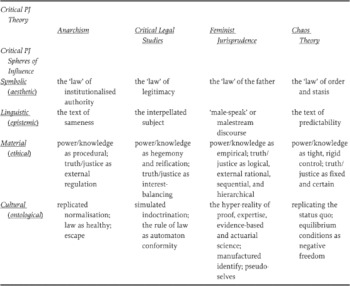
Table 1 synoptically integrates the underlying social philosophy that informs radicalised psychological jurisprudence (mindful of its symbolic, linguistic, material and cultural spheres of influence) along with the four critical standpoints previously described. These associations create a four-by-four matrix. As the table highlights, each standpoint’s efforts at resistance and justice draws attention to the questionable character of the self/society mutuality that currently engulfs mental health law, especially in relation to its aesthetic, epistemic, ethical and ontological grounding. This grounding suggests a probing, though vastly underdeveloped, political project of reform awaiting further integrative conceptualisation and programmatic implementation at the law–psychology interface.

Anarchism, critical psychological jurisprudence and politics
As a strain of critical inquiry within psychological jurisprudence, anarchism signifies a meditation in resistance and justice. It begins in Lacan’s symbolic domain, the realm of the unconscious saturated by mundane language and concealed subjectivity wherein circumscribed desire is communicated. Anarchist desire is a response to such circumscription. It emerges in opposition to a mental representation or to a prevailing cultural/aesthetic image. When spoken of as such, anarchist desire is a response to an incomplete but felt (i.e. alienating) truth. And when this inadequate truth is harnessed productively in speech, it possesses the force of law; or, in this instance, it signifies the ‘law’ of institutionalised authority.
Anarchists resist the law of external constraint and regulation and its promise of stability, control and security as pathways to freedom, progress and prosperity. A psychological jurisprudence informed by anarchist theory interprets material expressions of institutionalised authority (e.g. the prison industrial complex, the medico-legal edifice, the mental health court, forensic treatment units in jails or in juvenile detention facilities) as the machinations of a hierarchical and rule-bound government. This includes its logic of bureaucratic rationality and routinisation, as well as its administrative teleology of order maintenance.
The anarchist position on the law of institutionalised authority resonates with Lacan’s discourse of the master. This discourse is informed by a constellation of ‘truths’ (e.g. ‘mental illness is a disease’; ‘drug treatment is therapeutic’; ‘recovery is a “12-step” programme’) that support the character of knowledge communicated to others (e.g. law and medical students; mental health professionals; judges and lawyers; police, court and correctional officials; patients and inmates; the general public). However, this episteme, this tightly scripted reasoning, leaves little room for alternative images of and interpretations for everyday experience. As such, this incomplete, circumscribed and privileged reality construction fosters alternating forms of exclusion and normalisation when confronted with any expression of difference. Thus, not only do a constellation of truths function to support a limited type of law–psychology knowledge, these truths are the very source of the subject’s profound experience of lack in desire, of lack in discourse (ways of communicating, knowing or feeling) and subjectivity (ways of being/becoming).
The law of institutionalised authority, as the discourse of the master, can be mobilised as a text, as an unconsciously lived narrative. When retold, this text is consistent with Derrida’s perspective on logocentrism. This perspective holds that what is taken to be most real, true and foundational is that which is deemed most apparent to consciousness (e.g. immediately recognisable, instantly accessible). A critical psychological jurisprudence guided by the insights of anarchism interprets such availability, such facility, as the presence of sameness. Its metaphysics conceals, postpones and/or defers difference in its manifold forms. However, for anarchists, this difference is what gives rise to unity of purposeful change, to shared responsibility and to mutual aid as vital portals for conceiving of a more liberating psychological sense of community and a more emancipating sociological sense of identity.
The presence of sameness, as the stifling linguistic mapping for anarchists, is conveyed through the countless texts of institutionalised authority. These narratives (e.g. case and statutory mental health law; correctional policies and procedures; medical rules and regulations) and their corresponding epistemology displace difference for the sake of sameness. For example, discharge and release plans for patients and inmates respectively often lack innovation and experimentation. Instead, surveillance, compliance, inspection, repetition, conformity and disciplining are its valued hierarchies.Footnote 12
And when a reversal of a manifest arrangement is proposed (e.g. rehabilitation over retribution, community over institutional programming, out-patient over in-patient treatment, self rather than forced medication), the trace of the term that is deferred lingers and makes its presence felt. On whose terms (un/stated values) must rehabilitation proceed? The system’s terms. On whose terms is community programming deemed warranted? The system’s terms. On whose recommendation can out-patient treatment be ordered? On the recommendation of the system’s agents (e.g. psychiatrists, mental health professionals, judges). On whose definition of ‘wellness’, ‘dangerousness’, ‘knowing’, ‘voluntary’ and ‘informed consent’ is self rather than forced medication based? It is based on definitions put forth by the system’s representatives (e.g. hospital and correctional personnel, forensic psychology experts, clinical and psychometric specialists, academic researchers). The epistemology of these narratives quells, that much more insidiously, the desperation of those citizens seeking recognition and accessibility (inclusion) through replacement texts that are, sui generis, provisional and proliferating in their embodied meanings. In the theory of anarchism, especially as a dimension of critical psychological jurisprudence, the texts of ambiguity, change and difference are postponed and/or concealed through the established narratives that constitute the law–psychology divide. Identity is normalised; knowledge is territorialised; community is homogenised.
The texts of institutional authority that proponents of an anarchist-derived psychological jurisprudence identify are resisted because their material power inscribes self/society bodies. Following Foucault’s thesis, this power as knowledge includes its disciplinary systems (e.g. the criminal justice and mental health apparatuses), modes of surveillance (e.g. sex offender registries, therapeutic courts) and regimes of truth (e.g. evidence-based research, actuarial justice). The ethic of such productive mechanisms celebrates procedures (e.g. fixed rules, plans and protocols) as the panacea for all forms of psychic disequilibrium and social disorganisation. But for anarchists, such predictability stifles creativity. It hinders self-expression, diminishes emergent forms of interaction and quashes risk-taking behaviour that might otherwise seed ingenuity and nurture possibility. Instead, the embodied and panoptic text of mental health law ensures the presence of docility and compliance. Indeed, self/social bodies are made to do the bidding of the state: they function to establish justice as emanating from external (system-enforced), rather than internal (self-directed) regulation; from the formal and fixed rule of law, rather than from the informal and fluid rituals of community.
The hyper-real inscription of self/social bodies is located in the proliferating multimedia manifestations of the law-of-institutionalised-authority, and their corresponding non-real mutating meanings. This is a reference to Baudrillard’s position on technologised culture. Cascading images of police officers; lawyers and judges; users of mental health services; clinicians and other treatment personnel; hospital and correctional administrators; and suspects, defendants, inmates and psychiatric patients are vividly reproduced through film, television, cable, the Internet, DVD games and other expressions of digitised informational capitalism. These images are ravenously consumed by an insatiable public in search of instantaneous meaning to devour unreflectively.
Consider, for example, the popularised and syndicated ‘reality’ television show, COPS. Law-enforcement personnel are typically portrayed as diligently working to solve a case, or sensitively endeavouring to assist a distressed citizen, or steadfastly promoting the public’s general welfare, or vigilantly keeping communities free of crime and delinquency. However, when persons with psychological disorders are featured on the show, they are regularly depicted as objects of ridicule and scorn warranting antipathy (they are framed as diseased, deviant and dangerous), or as objects of curiosity and amusement warranting apathy (they are framed as silly, strange and freakish). Both sets of representations – including the assorted characterisations for police officers – communicate entertainment value; mere carnival utility. Definitions of the self (as police officer; as user of mental health services) and of the social (acceptable police–mental health citizen interactions) are transformed into smartly crafted edits that establish choices for viewers about another’s humanity but only those choices that these illusionists allow.Footnote 13 This is how normalisation and sameness are replicated over and again.
Cultural manifestations of institutionalised authority replicated and devoured ad infinitum engender a quality of human–social existence that Fromm argued led to pseudo-thinking and to pseudo-selves. The industry of institutionalised authority, as mass-marketed reproduction or as stylised counterfeit reality, endorses as healthy, natural and inevitable the consumption of materialist having rather than existentialist being/becoming. Following anarchist theory as a critical framework for advancing psychological jurisprudence, it is this addictive having (technologised culture) that is anathema to the self, the social and their mutual interdependence. Emblematic of this political–economic disease, this systemic pathology, is the circulation of images concerning the law of institutionalised authority that simply yield artificial choices and programmed differences. In the final analysis, the joint logics of bureaucratic rationality and routinisation, the administrative teleology of order maintenance, the subject’s experience of ‘lack’ in discourse, the metaphysics of privileged (rather than interdependent) values/terms in opposition, the panoptic disciplining of self/social bodies, and the other-worldly simulations of the real and their mutating meanings all prevail in proliferating numbers in these relentless acquisitive efforts. This is why anarchists regard the law of institutionalised authority as simply unhealthy and undesirable. It limits being and denies becoming; it fosters captivity for one and all.
CLS, critical psychological jurisprudence and politics
As a standpoint from which to promote theory-sensitive psychological jurisprudence, Critical Legal Studies is a strategy of resistance and a struggle for justice. It originates in Lacan’s symbolic realm, the sphere of unconscious desire where language and subjectivity are inextricably (though incompletely) connected. CLS desire is a response to this incompleteness. The embodiment of CLS desire, simultaneously communicated in speech and through identity, is a reaction to a core cognitive schema or to a dominant cultural representation (an aesthetic sensibility) that is, itself, a partial (and therefore deficient) truth. And when this flawed truth is mobilised productively through the written and/or spoken word, it possesses the force of law; or, in this case, it signifies the ‘law’ of legitimacy.
Proponents of the CLS agenda resist (and debunk) the legitimacy function of law, arguing that the legal apparatus fosters ideological distortions and promotes specialised interests, often to the material detriment of the powerless. A psychological jurisprudence guided by the insights of CLS theory interprets tangible facets of law’s legitimacy function (e.g. pre-trial mental health fitness hearings, civil commitment proceedings; post-conviction competency to execute determinations) as manifestations of an increasingly global and corporate-minded capitalist political economy (i.e. the industry of mental health law). This includes its maintenance of false consciousness, the twin logics of hegemony and reification, and the utilitarian practice of interest-balancing.
The CLS perspective on law’s legitimacy reverberates with Lacan’s discourse of the master. This discourse is constituted by an assemblage of truths (e.g. due process, procedural justice, proprietorship, equal protection) that supports the nature of law–psychology knowledge conveyed to others (e.g. petitioners in the psychiatric courtroom; mental health law judges; clinical forensic experts). However, this episteme as a constellation of truths, this narrowly conceived and executed logic, forestalls the possibility for imagining and articulating replacement renditions of everyday experience. Consequently, this deficient, incomplete and scripted version of reality can only be successful if the illusion of justice, fairness, equity, reasonableness, etc., is manufactured, as defined within the self-referential confines of legal language. In this instance, these confines are the meaning-making contours of psychiatric justice. But the communication and dissemination of these sense-making co-ordinates fosters false consciousness wherein the citizen is led to believe that because the rule of law was observed and established procedures were followed, the result (e.g. finding one in/competent to stand trial; determining that sustained institutional care is/not warranted; concluding that one is/not psychiatrically fit to be executed) is, de facto, valid. Thus, the false consciousness communicated through the truths that constitute law’s legitimacy, nurtures and sustains a circumscribed reality that denies as justiciable alternative versions (images) of reality in mental health law. Consequently, not only does this assemblage of truths function to endorse a limited type of knowledge, these truths are the source of the subject’s felt, although often unspoken, lack in desire. This is desire whose ways of communicating, knowing or experiencing, and whose ways of being, becoming and communalising, are silenced by the force of law, by law’s (illusory) legitimacy.
Law’s legitimacy, as the discourse of the master, can be activated as a text, as an unwitting manifestation of one’s storied biography. When this narrative unfolds, it is akin to Derrida’s notion of logocentrism. Logocentrism maintains that what is regarded as most basic or real is that which is considered most apparent, explicit or certain. A CLS-informed psychological jurisprudence interprets such accessibility or immediacy as the presence of the interpellated subject. Its metaphysics defers, postpones or disguises false consciousness by cleansing different (alternate) renditions of clinico-legal reality so that they fit the prescribed meaning-making contours of psychiatric justice. In other words, for a decision to be reached by a tribunal, subjects must situate themselves or must be inserted within the discourse and logic of (mental health) law. Any message that falls outside the established parameters of this knowledge will be declared, among other things, to be ‘irrelevant’, ‘immaterial’ or ‘prejudicial’.
The presence of the interpellated subject, as the encoded and ideologically derived landscape objected to by CLS adherents, saturates the manifold texts of mental health law. Case and statutory law as well as psychiatric courtroom parlance and practice are some of its more obvious exemplars. These narratives sanitise the subject (whether as petitioner/defendant, lawyer/advocate or clinician/expert) so that one’s speech is made compatible with the discourse of the law. Even when activist attorneys and psychologists, jailhouse lawyers or patients who pro se their cases endeavour to communicate in their own voices, such authorship cannot occur without objection unless it is filtered through the language of the law. What one says and how one speaks must be consistent with the meaning-making co-ordinates of psychiatric justice; otherwise, it is not hailed as legitimate (Arrigo, Reference Arrigo2002b).
Moreover, when an inversion of an established hierarchy is proposed (e.g. the patient’s right to treatment; the patient’s right to refuse treatment; the patient’s subsequent rejection of a Ulysses contract or an advance directive), the trace of the term that is postponed or concealed is not altogether displaced. On whose terms (un/spoken values) is a right to treatment, a right to refuse treatment and a subsequent rejection of a previously established Ulysses contract based? On the terms set forth by the psycho-legal establishment. However, the epistemology of such reality construction diminishes that much more ominously, the felt longing of those seeking recognition, voice and understanding through sense-making practices that more intimately, more uniquely, embody their own subjectivities. This longing includes the contradictions, anomalies, inconsistencies, absurdities and ambiguities that are (under)valued dimensions of the non-sterilised (the messy, though more complete) human condition. Following the CLS critique, then, especially as a basis by which to advance the philosophy of psychological jurisprudence, diverse expressions of outsider jurisprudence are deferred and made absent through the established texts of mental health law. These privileged narratives cleanse speech, normalise identity, territorialise knowledge and vanquish difference.
The interpellated subject, as an extension of law’s legitimacy, is problematic from the perspective of a CLS-informed psychological jurisprudence. The ideological distortions that the interpellated subject promulgates constitute material expressions of power that inscribe extant self/society bodies. Consistent with Foucault, this power as knowledge includes its disciplinary systems (e.g. mental health, substance abuse and domestic violence courts); modes of surveillance (e.g. out-patient commitment; court-ordered treatment); and regimes of truth (e.g. the rule of law; value-neutrality, objectivity and impartiality; scientific and psychiatric expertise) that reify legal institutions, practices and programmes. This reification process occurs because those who are oppressed by these ideological apparatuses often unwittingly help to assign objective-like status to such fictions, thereby contributing to their own victimisation, marginalisation or alienation. Moreover, these disciplinary systems, modes of surveillance and regimes of truth are assented to, mostly unknowingly and unreflectively, by the kept, their keepers, their managers and their watchers (i.e. the general public). This consent ensures that law’s legitimacy, as a panoptic ethic, will triumph. However, for proponents of psychological jurisprudence guided by the insights of the CLS agenda, such reification and hegemony annul the possibility for alternative texts to emerge that are more compatible with expressions of outsider jurisprudence. Moreover, the power/knowledge circulated by this ethic renders self/society bodies docile. Indeed, state compliance prevails. As such, prospects for justice are lodged in the politics of the law and the moral entrepreneurship of its law–psychology progenitors. Managing this adherence entails the weighing of competing and conflicting interests – consistent with the images, narratives and embodiments of the law – wherein status quo dynamics (existing political-economic arrangements) are protected and equilibrium conditions (existing power relationships) are promoted.
The hyper-real inscription of docile self/society bodies is traceable to the effusive multimedia simulations of law’s legitimacy, and their corresponding meanings. Baudrillard’s thesis suggests that technologised culture provides a plethora of images about law and trials, prosecutors and defence attorneys, judges and juries from an array of fast-paced informational outlets. Fictionalised and non-fictionalised accounts of psychological profiling, ‘wo/man hunting’, criminal investigating, cyber-stalking, serial psychotic killing abound as forms of carnival capitalism. These sites and sounds are devoured incessantly and conspicuously by a voracious public seeking gratification through the consumption of reality’s images (and law’s corresponding illusions) that are taken to be more real than the reality on which such representations are based. But these summary representations communicate more than just entertainment utility. Through the consumption of such mass-marketed fabrications, definitions about the self/social mutuality are subtly reconceptualised. While choices about mental wellness and illness, diagnostics and treatment, prevention and programming, law and psychology, healing and helping are disseminated, these options are, at best, circumscribed. The choreographed or staged options made available and disseminated by such dramatists (including those who anchor and edit the nightly news!), are shaped to fit a socially constructed (and presumably desirable) reality. This is how law’s illusion remains unscathed.
A psychological jurisprudence grounded in the theory of Critical Legal Studies acknowledges that cultural manifestations of law’s legitimacy support a disturbing quality of human–social existence. Following Fromm, such media-crafted performances engulf society, fostering mostly unreflective thought and action. The industry of law’s legitimacy, particularly as a consumable and mass-marketed counterfeit reality, nurtures the inauthentic need to have rather than the more genuine intention to be or become. The CLS agenda, as a critical standpoint from which to further the philosophy of psychological jurisprudence, indicates that technologised culture is destructive to the self, the social and their mutual interconnectedness. Symptomatic of this debilitating political–economic affliction is the distribution of images regarding the rule of law and its legitimacy that reduce their meanings to programmed and narrow, though certainly digestible, choices. These choices – artificial reproductions that are ravenously devoured as a hyper-real text – constitute the indoctrination process that sustains law’s legitimacy. Unsurprisingly, then, Fromm’s notion of automaton conformity becomes the preferred mechanism of escape. False consciousness, the twin logics of reification and hegemony, and the utilitarian practice of interest-balancing are similarly re-enacted over and over again ad infinitum. Correspondingly, the subject’s experience of incompleteness by way of interpellation, the presence of hierarchical values/terms that defer difference in identity, the material inscription of bodies (of knowledge) that discipline and the circulation of proliferating simulations about the self/social that digititally undo the authenticity of both, all remain intact through such acquiescence. This is why psychologists of law persuaded by the CLS critique resist law’s legitimacy: It forestalls justice. Philosophically, law’s legitimacy reduces and represses the possibility of growing humanness for one and all.
Feminist jurisprudence, critical psychological jurisprudence and politics
When fitted to the philosophy of psychological jurisprudence, the radical feminist critique of legal thought and language (including law’s method) is a meditation in resistance and justice. This disassembling and reassembling reflection begins in Lacan’s symbolic domain; the locus of unconscious desire in which subjectivity and language are immersed and from which (circumscribed) meaning unfolds. The fem-crit assault is a response to such circumscription. It surfaces in opposition to what is pictured in one’s mind, especially those images that dominate cultural reality. When moving from the symbolic to the linguistic sphere, feminist desire is a response to an incomplete but lived (i.e. oppressive) image-truth. When this debilitating image-truth is mobilised productively in speech, it communicates the force of law; or, in this instance, it signifies the ‘law’ of-the-father.
Proponents of a radically inspired feminist jurisprudence resist (and dismantle) the prevailing imagery of the law because its logic endorses an epistemology and its language celebrates a sense of identity that discount forms of consciousness, styles of existence and modes of interaction that are consistent with the divergent experiences of women. Psychologists of law influenced by a critically animated feminist jurisprudence interpret material expressions of law’s symbols (e.g. the medico-legal complex, the psychiatric courtroom and the texts of mental health law) as manifestations of the masculine register. This includes its political aesthetics, anchored in the waters of malestream power (e.g. as accumulation and acquisition), progress (e.g. as predictable, quantifiable, controllable) and possibility (e.g. as linear, unambiguous, static).
The radical feminist position on the law-of-the-father resonates with Lacan’s critique concerning the discourse of the master. This discourse is composed of a collection of truths (e.g. gendered differences among female psychiatric patients and/or female prison inmates are retrievable, knowable and correctable through sophisticated statistical models of analyses). These truths support the character of law–psychology knowledge communicated to others (e.g. hospital and correctional personnel, mental health treatment specialists, policy and programming experts). However, this episteme, this carefully crafted and replicated ‘scientific’ accounting, leaves minimal and inadequate space for replacement renditions (images) of everyday experience. Consequently, this circumscribed, oppressive and dominant reality construction often subtends the interiorised experiences of women (and minorities) that know, feel and act differently. As such, not only do a collection of truths operate to affirm a narrow and finite type of knowledge, these truths are themselves the locus of the subject’s (a woman’s) devastating sense of lack in desire, of lack in discourse (alternative ways of communicating) and subjectivity (alternative ways of being/becoming).
The law-of-the-father harnessed as the discourse of the master can be mobilised as a coherent, though unconscious, narrative that the subject (including women) embodies. When this story is retold (in classrooms, in courtrooms, in psychiatric wards, in correctional units), this text is consistent with Derrida’s assessment of logocentrism. Logocentrism maintains that what is taken to be most foundational, real or true is that which is most apparent, recognisable and accessible to consciousness. A psychology of law guided by the insights of a radical feminist jurisprudence regards such triteness as the presence of male-speak. The metaphysics of this text postpones, conceals and/or defers difference, including the multiple voices and ways of knowing for women. For critical feminist social-legal scholars, articulating these differences is what gives rise to standpoint epistemologies, contingent universalities and poly-vocal identities.
The presence of male-speak as the omniscient and omnipotent voice that encodes the texts of mental health law is omnipresent. These narratives – from case and statutory law to hospital and correctional policies; from the psychiatric courtroom to the in-patient evaluation unit – promote hierarchies: order maintenance, rule management, cause-effect logic, rational and sequential decision-making, planned programming and routinised compliance are some of its more prominent themes. And when an inversion of a manifest arrangement is proposed (e.g. legal rights and psychological treatment responsive to the unique needs of diverse women), the texts of mental health law are mostly silent. Women exist in their absence; that is, they exist in ways defined for and about them by and through the masculine register. The unconscious epistemology of these narratives diminishes, that much more resolutely, the possibility of different voices (different biographies) finding fuller recognition and, therefore, fuller expression in mental health law. A critical feminist socio-legal analysis – especially one that grows the philosophy of psychological jurisprudence – perceives the privileged standpoint and the identity construction of psychiatric justice as dismissing or disregarding multiple standpoints and divergent identities that are more consistent with the manifold ways of knowing and being/becoming for various women.
The texts of the law-of-the-father in mental health law that advocates of a feminist jurisprudence resist are renounced because their material power inscribes the bodies of women. Mindful of Foucault’s thesis, this power as knowledge includes its disciplinary systems (e.g. the legal method; the scientific method), modes of surveillance (e.g. burdens of proof, expert testimonials) and regimes of truth (e.g. evidenced-based science, actuarial justice) that esteem certainty, facts, precision and rightness (i.e. the absolutism of empirical quantification) as solutions for all forms of psychic turmoil and social discord. However, for radical fem-crits, such linear, reductionistic and patriarchal value-preferencing quashes sense-making that occurs differently. The conventionally embodied law–psychology divide rejects such differences, especially when situated, contingent, relational, subjective and partial. However, these values are more consistent with feminist standpoints and identities, and, as such, may constitute novel forms of experiencing and knowing that are relevant to emergent or additional approaches to psychiatric justice. This logic is amplified when considering the plight of the kept (those confined), their keepers (hospital and prison workers), their managers (lawyers/judges, clinicians and treatment personnel) and their watchers (the government, the general public). Moreover, existing inscriptions – as texts of ethical surveillance and inspection – guarantee that those self/society phenomena located within their panoptic gaze will be rendered docile, bodies of utility, and functionaries of the state. In support of such disciplining, justice is defined as that which is sequential, logical, deductive, rational and hierarchical. Interpersonal truth, narrativity, relational knowing, connectedness, auto-ethnography, care ethics and other dimensions of feminist experience are mostly relegated to the status of legal fictions to be discounted. Such routine status-making authorially and authoritatively confirms the law-of-the-father.
The hyper-real encoding of self/society bodies occurs vis-à-vis the seemingly endless media-based images that communicate malestream knowledge and identity, along with their concomitant significations. Following Baudrillard’s thesis on technologised culture, the position of women as lawyers/judges, police/correctional officers, psychiatrists/psychologists, patients/inmates are reproduced incessantly through proliferating outlets of informational capitalism. These images are voraciously consumed by an insatiable citizenry longing for immediately gratifying meaning to digest superficially. However, prevailing representations of women as no-nonsense judges (from television), as action-oriented crime fighters (from DVDs), as tough-love therapists (from radio) and as psychotic serial killers (from newspapers) convey more than mere entertainment or carnival utility. Instead, programmed choices and staged options are disseminated for conspicuous consumption. These choices and options become stand-ins or substitutes for deliberative thought about the unique and divergent standpoints and identities of women in psychiatric justice and in society more generally. In far too many instances, these simulations replicated continuously as fictions of the real, outpace and undo more genuine experience and more authentic knowing about the self, the social and their interrelated duality. As smartly crafted and corporate-savvy reproductions of still other reproductions, these propagating images and their commutating meanings ensure that the law-of-the-father maintains its mantle of authority when it comes to such clinical-forensic matters as definitions of proof, expertise, evidence and the nature of ‘legal’ and ‘scientific’ knowledge.
Cultural manifestations of the law-of-the-father – replicated ad infinitum through print, electronic or digitised media sources – seed a quality of human social existence that Fromm argued nurtured pseudo-thinking and pseudo-selves. The industry of the law-of-the-father, of male-speak, as mass-marketed and proliferating pseudo- (and, therefore, incomplete) reality, celebrates the desperate need to have (to acquire) rather than the human search for being/becoming. A critical feminist legal theory as a framework for furthering the philosophy of psychological jurisprudence questions the social and systemic pathology such addictive having engenders. Technologised culture, as a pivotal dimension of the political economy, circulates images of the feminine defined mostly by and for men. This type of information flow yields artificial and inadequate choices about the range of differences that more completely signify the diverse experiences of a woman’s subjectivity. This is what it means to posit that women exist in their absence. Thus, she is the embodiment of the pseudo-self, constituted and constrained by the law-of the-father. In the final analysis, malestream power (as the acquisition and accumulation of women), progress (as phallocentric ideology about women) and possibility (as violence against women) saturate and therefore disguise the standpoints and identities of various women and their assorted multiplicities. Her experience of ‘lack’ in discourse; the metaphysics of male-speak; the panopticism and disciplining of the body through masculine rules, facts and science; and the simulated counterfeit reproduction of (feminine) knowledge and identity endure in countless ways. This is why proponents of the fem-crit agenda argue that doing gender – by way of the father’s law – cannot survive amidst such acquisitive and conspicuous consumption. Law’s incompleteness undermines possibilities for being and becoming; its injustices reduce and repress the humanity of (wo)men.
Chaos theory, critical psychological jurisprudence and politics
As a perspective from which to advance a critical psychological jurisprudence, chaos theory (complex systems science or CSS) is a strategy of resistance, a struggle for justice. It originates in Lacan’s symbolic realm, the sphere of the unconscious immersed in language and subjectivity whose embodiment communicates (bounded) desire. Chaology’s desire is a response to such boundedness or finiteness. It emerges in contrast to a mental representation or to a prevailing cultural image/aesthetic. When spoken of as such, CSS desire is a reply to a linear and inadequate (i.e. static) truth. And when this fixed truth is harnessed productively in speech, it possesses the force of law; or, in this instance, it signifies the ‘law’ of order and stasis.
Advocates of chaos theory resist the law of order and stasis and its promise of stability, control and equilibrium as guarantors of human progress and collective wellbeing. A philosophy of psychological jurisprudence informed by the theory of CSS interprets material expressions of order and stasis (e.g. definitions of mental illness and dangerousness; the practices of civil/criminal confinement; the administration of drug therapy) as the prescriptions of a closed and contrived, rather than open and organic, non-adaptive system. This includes its aesthetic sensibilities as based on point and limit attractors, the twin logics of expectancy and permanence and the organisational teleology of (psychiatric) disorder reduction.
The position of chaos theory on the law of order and stasis is consistent with Lacan’s discourse of the master. This discourse is informed by a constellation of truths (e.g. external mental health treatments therapeutically reduce symptoms of dangerousness to self/others; psychiatric neuro-imaging yields medically relevant findings about one’s trial fitness or one’s competency for execution; substance abuse self-healing and natural adaptation lack sufficiently replicated scientific evidence). These truths support the nature of psycho-legal knowledge communicated to others (e.g. students, allied health practitioners, criminal justice personnel and the general public). However, this episteme, this rigid and tightly controlled rationale, ignores and/or discounts alternative explanations for everyday experience. As such, this linear, static and fixed reality construction interprets as ‘noise in the system’ most expressions of far-from-equilibrium conditions, endeavouring to control, contain or otherwise correct them. Consequently, not only do a constellation of truths function to support a finite type of forensic psychological knowledge, these truths are the very locus of the subject’s profound sense of lack in desire, of lack in discourse (ways of communication, knowing and feeling) and subjectivity (ways of being/becoming).
The law of order and stasis, as the discourse of the master, can be mobilised as a text, as an unconsciously lived narrative. When restated and revivified, this text is akin to Derrida’s view on logocentrism. This view holds that what is taken to be most foundational, true or real is that which is deemed most apparent, recognisable and accessible to consciousness. A critical psychological jurisprudence guided by the insights of chaos theory, regards such availability and retrievability as the presence of predictability. Its metaphysics conceals, postpones and/or defers noise in the system (difference as disarray or discontinuity) and its sundry manifestations. For proponents of CSS, this difference gives rise to the natural adaptation of complex systems (including people), to their spontaneous self-organisation and to non-linear dynamics as contributory features of health and wellness more generally.
The presence of predictability, as the artificial and forced linguistic mapping CSS scholars resist, is conveyed through scores of texts that describe the law of order and stasis. These narratives (e.g. psychiatric hospital rules and procedures, correctional facility codes of conduct and decorum, courtroom parlance and practice) corral or disregard anomalies (difference) for the sake of certainty, stability and management. For example, the psychiatric courtroom determines whether individuals are or are not mentally ill, are or are not in need of involuntary treatment, are or are not competent to stand trial or to be executed. And when an inversion of a manifest arrangement is proposed (e.g. diversion through the mental health or drug court systems, community re-engagement through victim–offender reconciliation programming, alternative rationales or treatments prescribed by judges exercising the tenets of therapeutic jurisprudence) the trace of the term that is suspended endures, making its presence felt. On whose terms (un/stated values) does diversion proceed? The system’s terms. On whose terms does victim–offender mediation take place? The system’s terms. On whose terms is a recommended alternative rationale or treatment permissible? The system’s terms. The epistemology of these limit-setting narratives ensures, that much more exhaustively, the marginalisation and alienation of citizens who seek greater recognition, accessibility and participation, (i.e. inclusion) through replacement texts. These alternative narratives are, sui generis, generated by the pull of strange attractors, grounded in the push of far-from-equilibrium conditions and governed by the logic of order within and out of chaos. In the theory of CSS, the texts of unpredictability, discontinuity, instability, irregularity, spontaneity and absurdity are postponed and/or obscured through the conventional narratives that constitute psychiatric justice. Identity is normalised; knowledge is territorialised; and self-organisation is pathologised.
The texts of predictability that adherents of a CSS-derived psychological jurisprudence specify are resisted because their material power inscribes self/society bodies. Consistent with Foucault’s thesis, these inscriptions as expressions of power/knowledge comprise disciplinary systems (e.g. the mental health and criminal justice apparatuses); modes of surveillance (e.g. clinical forensic assessments, diagnostics and treatments); and regimes of truth (e.g. the psychiatric courtroom). The ethic of this power/knowledge extols external controls (fixed and static rules, procedures and programming), and regards these exogenous forces as remedies for perceived personal discord, family disruption or social disequilibrium. However, chaos theory interprets such external constraints as quieting the noise (the difference) of the complex adaptive self. Such regulation stifles innovation, creativity, experimentation, recovery and healing that might otherwise emerge more organically. This critique of exogenous control resonates for the kept, their keepers, their managers and their watchers. Moreover, as a disciplinary text, the site of one’s adaptation to a more complex order directed by outside influences assures the emergence of docility: self/society bodies that are useful in their compliance. These are bodies disciplined to serve the interests of the state, wherein external (system-reinforcing) rather than internal (self-organising) regulation prevails.
The hyper-real inscription of such disciplining is located within the effusive multimedia images of the law of order and stasis, as well as their corresponding and ubiquitous significations. This is a reference to Baudrillard’s notion of technologised culture. Images of psychiatric hospitals, forensic prisons, mental patients, offender treatment staff and psychiatric courtroom personnel are digitally captured, reproduced and mass-marketed as colourful manifestations of informational capitalism. These sights and sounds are conspicuously consumed by a ravenous public in search of instantaneous meaning to devour hastily. But these representations as simulations of fabricated reality sell the message that replicating the status quo is healthy, natural and inevitable. Social anxiety disorder or ‘shyness’, restless leg syndrome or ‘fidgetiness’ and attention deficit (hyperactivity) disorder or (male) ‘adolescence’ are diagnostic forms of mental illness treatable (and therefore controllable) through psychopharmacological therapies sanctioned by and regulated through the law. Television commercials, radio talk-show programmes and tell-all books on CD repetitively remind us of our unstable and debilitating diseases. But such carnival capitalism communicates more than prurient and voyeuristic appeal. These replicated renditions of reality are dramatised reproductions, yielding fictionalised choices about the self, the social and their co-productive mutuality. Lost in this scripted process are the visceral and sensual dimensions of existence for the sake of the virtual and the sensational dynamics of entertainment. Indeed, options are manufactured but only those that these corporate-minded prestidigitators permit. This is how the law of order and stasis maintains its privileged status from the realm of the symbolic and the linguistic to the sphere of the material and the cultural.
Cultural depictions of order and stasis repackaged and disseminated ad infinitum engender a quality of human social existence that Fromm argued led to pseudo-thinking and pseudo-selves. The industry that the law of order and stasis signifies as mass-marketed consumable commodity, celebrates the materialist quest to have rather than the existentialist pursuit to be/become. Following the theory of complex systems science as a protean framework by which to advance a critical psychological jurisprudence, such having is an affliction when expressed through technologised culture. It erodes and undoes more authentic definitions of the self, the social and their constitutive duality. Emblematic of this destabilising political–economic pathology is the circulation of images (sights and sounds) that nurture equilibrium conditions in which superficial options and artificial choices are incessantly manufactured. These options and choices grow negative freedom in which destructive escape (i.e. controlled, linear, static, fixed) follows. In the final analysis, point and limit attractors, the twin logics of expectancy and permanence and the organisational teleology of (psychiatric) disorder reduction steadfastly endure. The subject’s experience of ‘lack’ in discourse; the metaphysics of predictability; the panopticism of docility through external regulation, inspection and surveillance; and the other-worldly simulation/simulacra of the self, the social and their mutuality triumph in propagating numbers, given such relentless acquisitiveness. This is why advocates of chaos theory regard the law of order and stasis as harmful to the complex adaptive capabilities of naturally self-organising citizens. As such, resistance here is a humanising strategy; the search for justice an evolving struggle.
Summary and conclusions
This article addressed three focal concerns. First, the underlying social philosophy that informs a critically animated psychological jurisprudence was enumerated. This included several suggestive and provocative insights derived from the works of Lacan, Derrida, Foucault, Baudrillard and Fromm. These insights drew attention to the underexamined forces that interdependently contribute to the self/society mutuality at the crossroads of law and psychology. These forces consisted of four spheres of influence: the symbolic, linguistic, material and cultural. It was argued that the state or condition of these forces yielded a type of aesthetic, epistemology, ethic and ontology that grounded mental health law. This is a reference to the images, narratives, inscriptions and reproductions that currently engulf the law–psychology interface, expressed through the self/society duality.
Second, four well-rehearsed standpoints developed as theoretical extensions of radicalised PJ were delineated. These standpoints included anarchism, critical legal studies, feminist jurisprudence and complex systems science. Individually, these frameworks were understood as developing strategies of resistance and struggles for justice. Although several assumptions for each were identified and examined, no attempt was made exhaustively to review them or the respective frameworks themselves. Rather, the purpose of this section was to reorient the field of mental health law to its untapped political promise, with relevant amplification from selected application studies.
Third, the contexts in which each of the four critical standpoints could be fitted to radical PJ’s underinvestigated social philosophy were speculatively reviewed. As a provisional exercise in conceptual integration, the de/reconstructive possibilities for political praxis by way of critical PJ were enumerated. This section indicated that an agenda of reform situated within a synthetic and critical psychological jurisprudence necessitates the dis/reassembling of prevailing images, narratives, embodiments and reproductions that form the basis of contemporary mental health law. Indeed, change in theory construction, applied research, classroom pedagogy and institutional and community programming are the anticipated products of such aesthetical, epistemological, ethical and ontological reworking. However, in order more fully to realise this potential, this promise, further philosophical analyses and integrative conceptualisations must follow. As this article has proposed, these deracinating efforts signal a novel path to growing citizen justice, collective wellbeing and social accord. Pursuing such a humanising and evolving course, then, is critical. This is especially the case given the manner in which the current law–psychology divide profoundly and problematically impacts the lives of individuals, society and its institutions, and the underdeveloped, though dynamic, mutuality that would otherwise inhabit both.