Introduction
Many livestock species apply methodology for morphological characterization with the aim of comparing their various breeds. In fowls, not many measures have been taken from live birds; a few studies have been done on wild (undomesticated) fowls. Some measurements reported include: length or ornithological measurement, wingspan, beak length, comb length (Scott, Reference Scott and Omega1982; Ceballos et al., Reference Ceballos, Molina, Franco and Palacios1989), apparent size (Scott, Reference Scott and Omega1982), folded wing length (Scott, Reference Scott and Omega1982; Ceballos et al., Reference Ceballos, Molina, Franco and Palacios1989; Ralph et al., Reference Ralph, Geupel, Geoffrey, Pyle, Meter, Thomas and Desante1993; SEO, 2000), tarsus length (Scott, Reference Scott and Omega1982; Ceballos et al., Reference Ceballos, Molina, Franco and Palacios1989; SEO, 2000) and third primary length (SEO, 2000).
In this study, additional measurements have been defined in fowl species, based on parallelism with other animal species but taking ease of measurement into when measuring chickens. Also, some corporal indexes have been defined.
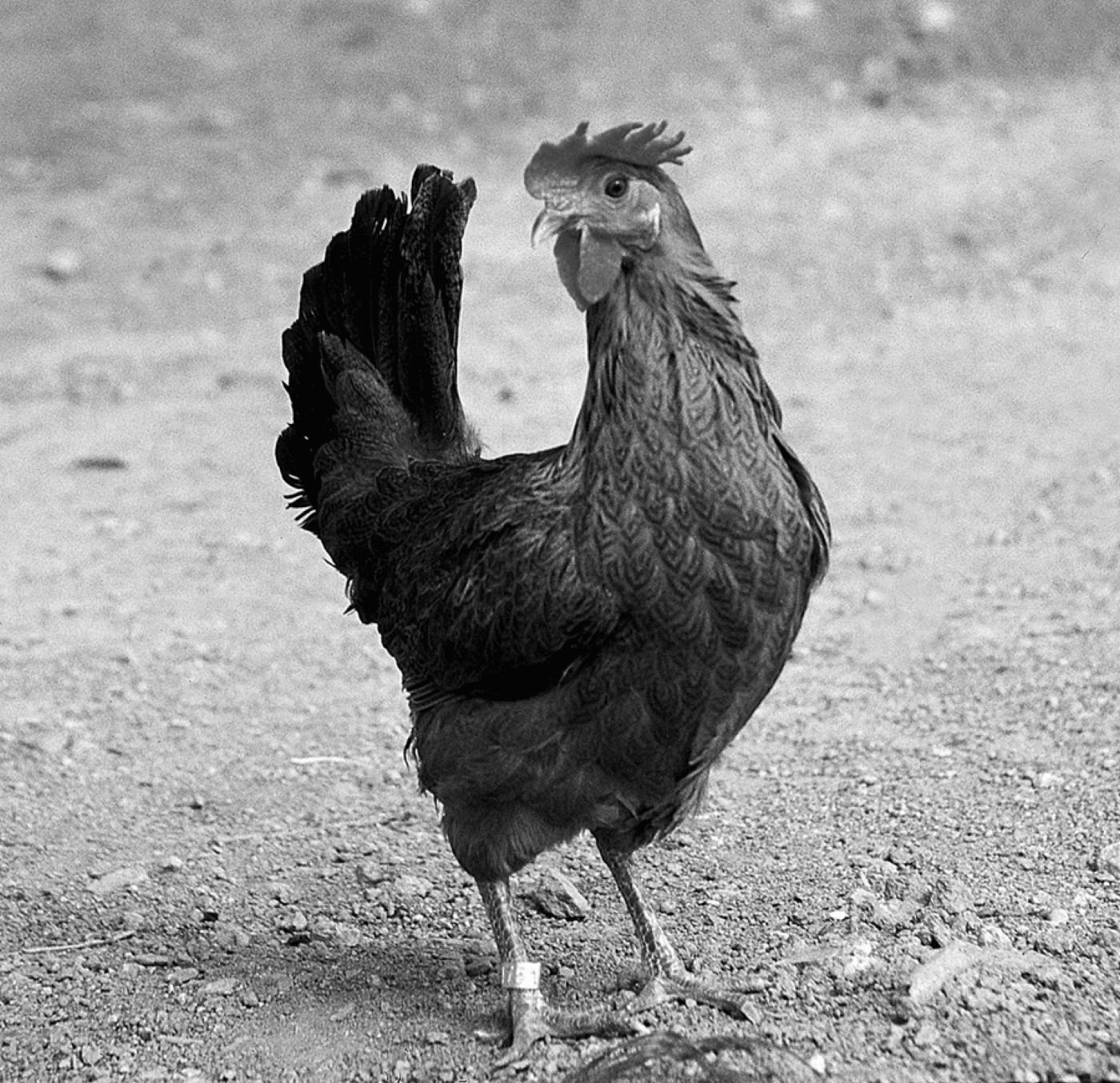
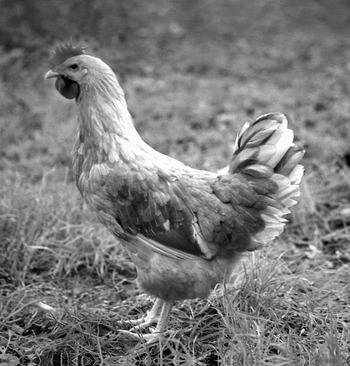
The study was carried out with Catalonian autochthonous chicken breeds (Figure 1), partridge Penedesenca (Figure 2, Francesch and Jordá, Reference Francesch and Jordá1988) and blond Empordanesa (Figure 3; Francesch, Reference Francesch1994). These breeds are kept in a conservation program that was established in Mas de Bover Center of IRTA in 1982 (Francesch, Reference Francesch1997). The standards were presented by Francesch (Reference Francesch2006).
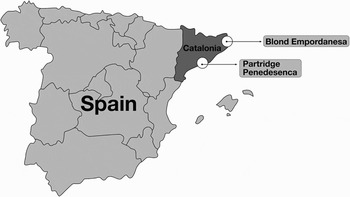
Geographical origin of Blond Empordanesa and Partridge Penedesenca hens in Catalonia (Spain).

Partridge Pendesenca hen.
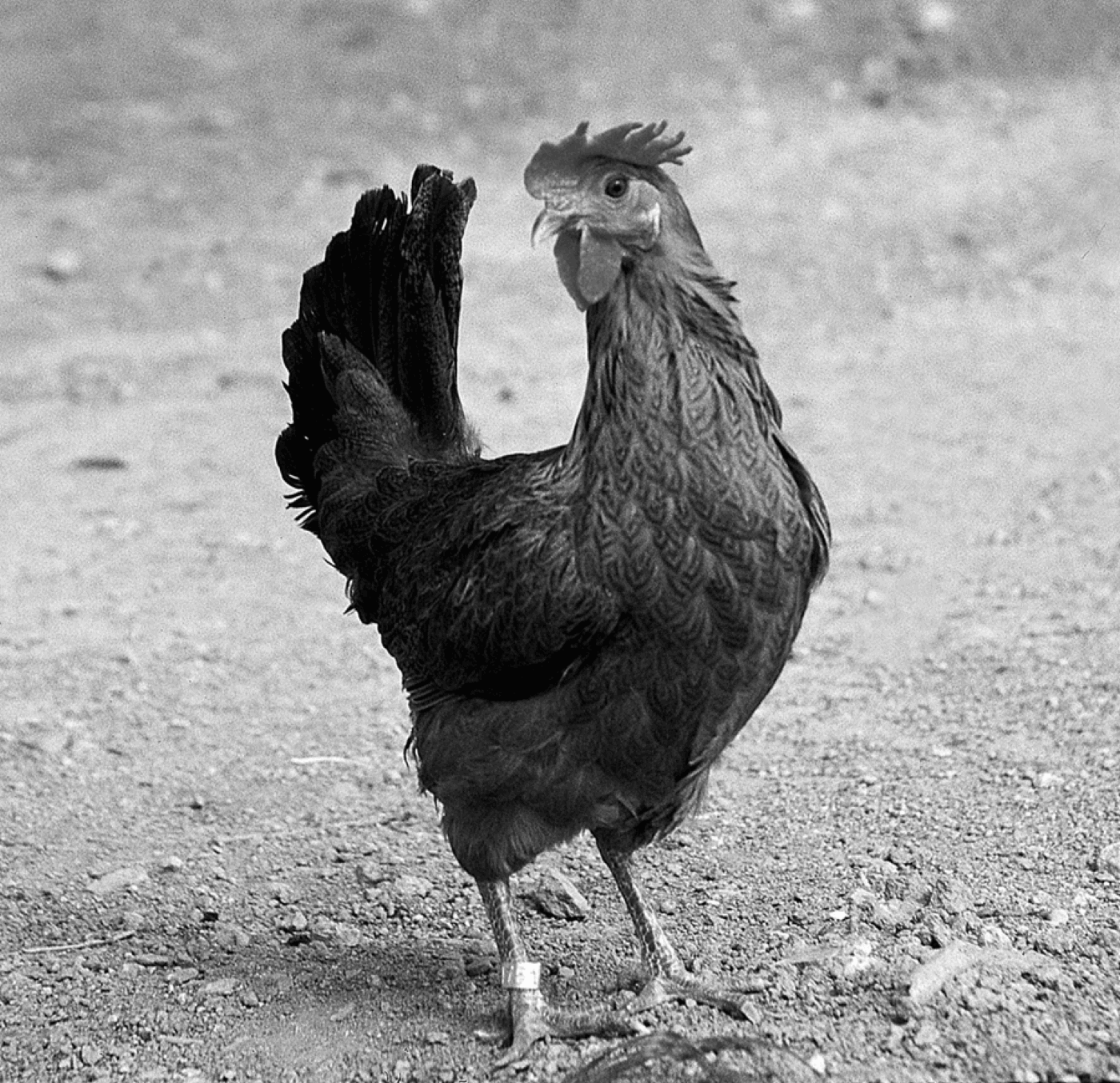
Blond Empordanesa hen.

The aim of this study was to propose a morphological characterization method of various chicken breeds by describing some zoometric measures and corporal indexes, and to validate it in two Catalonian autochthonous chicken breeds.
Material and methods
Zoometric variables
There were 25 variables selected and divided into four categories depending on avian corporal region: head, neck, body, extremities and general characteristics. All of them are the parts described in a racial standard. All measurements of organ pairs were taken on the right-hand side of the birds.
General characteristics
1. Weight: The birds were weighed on the same day by the same operator.
2. Ornithological measurement (Scott, Reference Scott and Omega1982): Measuring from the tip of the beak to the end of the tail when the bird was laid down on its back.
3. Wingspan (Pettingill, Reference Pettingill1985): Distance between the ends of the longest primaries with wings stretched. On the work table, maintain the joints of the wings as stretched as possible.
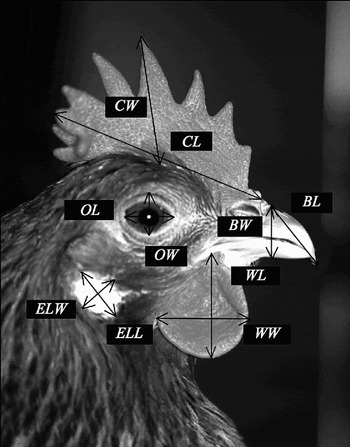
Head (see Figure 4)
4. Skull length: Was measured as the distance between the occipital bone to the insertion of the beak into the skull (where the plumage starts).
5. Skull width: Measured at eyes level.
6. Comb length: Distance between the insertion of the comb in the beak and the end of the comb's lobe.
7. Comb width: Distance from the tip of the central spike until insertion of the comb in the skull. If the number of spikes is even, the highest must be chosen.
8. Ocular length: Distance between eyelids corners.
9. Ocular width: Second ocular dimension, perpendicular to the length, including the folds of the eyelid.
10. Beak length: Length from the tip of the beak until insertion of the beak into the skull (Ceballos et al., Reference Ceballos, Molina, Franco and Palacios1989).
11. Beak width: Measured from the insertion of the beak in the skull and perpendicular until the end of the inferior mandible.
12. Ear lobes length: Maximum length, keeping the head of the bird perpendicular to the neck. Person holding the bird should catch the bird's legs with one hand and with the other hand hold the neck on the middle height and with index finger keeping the bird's head perpendicular to the neck's line.
13. Ear lobes width: As in the previous measure, measured the second-largest dimension.
14. Wattles length: Length from insertion of the right wattle into the beak, holding the wattle with one hand and drawing a straight line to the end of the wattle.
15. Wattles width: Measurement of the second maximum dimension of the wattle perpendicular to the length.
Details of a Patridge Penedesenca hen head with its corresponding measures. CL, comb length; CW, comb width; OL, ocular length; OW, ocular width; BL, beak length; BW, beak width; ELL, ear lobe length; ELW, ear lobe width; WL, wattle length; WW, wattle width.

Neck
16. Neck length: The bird had to be immobilized on its left-hand side on the work table by an operator, stretching legs with one hand and the neck with the other hand, another operator measured the distance between the nape and the insertion of the neck into the body.
Body
17. Back length: Length from insertion of the neck into the body to the saddle.
18. Keel of sternum length: Distance between both vertices of the sternum (pocessus carinae and processus xiphoideus) leaning the bird on its back.
19. Tail length: Length from the tip of a central rectrix to the point where it emerges from the skin (Pettingill, Reference Pettingill1985).
20. Breast angle: A goniometer was placed at 1 cm from the extreme of the keel (processus carinae) of the sternum. The fixed arm of the tool had to be adjusted on the left breast and the mobile arm, on the right breast.
Extremities
21. Thigh length: Length from shinbone––femur joint, to shinbone–tarsus joint.
22. Folding wing length: The length was taken according to Pettingill's method (1985) along the wing chord. Wing had to be folded and closed to the body, and it corresponds to the length from carpal joint until the end of the longest primary.
23. Tarsus length: Length from the notch of the shinbone–tarsus joint until the other end, taking the toes forward 90° respect tarsus.
24. Tarsus diameter: Diameter from back to the front, on the middle of the metatarsus bone, without pressuring the skin.
25. Central toe length: Extending the toes on the table, length from the central toe – metatarsus joint until the insertion of the nail.
Corporal indexes
In the absence of indexes used previously and after achieving the linear measurements, we decided to test the relation between length and width of the structures of which both measurements were taken:
1. Skull index = skull length/skull width
2. Ocular index = ocular length/ocular width
3. Comb index = comb length/comb width
4. Ear lobes index = ear lobes length/ear lobes width
5. Wattle index = wattle length/wattle width
Biological material and maintenance
The data were collected using 60 adult hens, 30 belonging to partridge Penedesenca (A) and 30 belonging to blond Empordanesa (S), all of them were 30 weeks old.
Chickens were reared on the floor, combining natural and artificial light. At the beginning of the rearing there were 19 h of light and each week it was reduced in 15 min until 14 h when hens started laying; at this moment they were housed in individual cages in the same room.
Until 8 weeks of age feeding consisted of a diet with 18 percent of protein and 2800 kcal/kg metabolizable energy (ME). Between 8 and 20 weeks feeding consisted of a diet with 15 percent of protein and 2700 kcal/kg (ME), and during laying 16 percent of protein and 2700 kcal/kg (ME).
Measuring instruments
Hens were weighed using an electronic scale (precision = 1 g), and the breast angle was measured with a goniometer. The ornithological measurement, wingspan, neck length, back length, tail length and folding wings length were measured with a tape measure (±1 mm). To measure skull length and width, comb width and length, thigh length, ocular width and length, beak width and length, ear lobes width and length, wattles width and length, keel of sternum length, tarsus diameter and central's toe length a calliper (±0.01 mm) was used.
Data collection
Measures were taken with the collaboration of two operators, one holding the bird and other one taking the measurement.
Measures were taken by two operators with the aim of checking differences between operators. Each operator measured 15 hens of each breed.
Statistical analysis
After checking the normality of data distribution and the equality of variances the 25 zoometric measurements were treated statistically like independent variables, breed factor, with two levels (A and S), operator with two levels (I and L) and the interaction between the two factors. The values of each variable and each corporal index were analysed using GLM procedures of SAS 9.1(SAS, 2002–2003).
The linear model for the response of independent variables was:

where Y ijk is the response expected in the dependent variable, μ is the average of population, α i is the effect of breed factor for level i, β j is the effect of operator factor for level j, (αβ)ij is the effect of interaction between two factors and e ijk is the random error.
Results and discussion
Zoometric variables
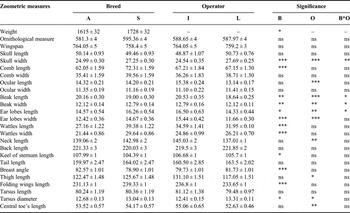
Table 1 shows Least Squares Means (LSM)-means for the 25 zoometric variables that were measured on each bird. Although the Penedesenca and Empordanesa breeds are very similar morphologically, there were significant (P ≤ 0.05) differences between the two breeds for nine of the variables. Empordanesa was heavier than Penedesenca. For the head variables, wattles length and width, ear lobes length and comb length, measures were higher in Empordanesa breed. For corporal measures, the folding wing length and tarsus diameter, they were higher in the Empordanesa compared with the Penedesenca, whereas Penedesenca breed had a longer length of the keel and a greater breast angle.
LSM means ± standard error of zoometric measurements of adult hens depending on race and operator, and significance of the average difference between both factors and their interaction.

A, Penedesenca partridge; S, Empordanesa blond; B, breed; O, Operator; B*O, breed operator interaction; ns non significant.
*0.05 > P > 0.01, **0.01 > P > 0.001, ***P < 0.001
On the other hand, for six parameters, there were significant differences between operators: ocular length, ear lobes length, neck length, thigh length, tarsus diameter and central toe's length. Differences between operators indicated that these measurements are difficult and there is a need to improve the methodology.
In four variables, there was significant interaction between breed and operator. These included beak length and width, ear lobes length and neck width. Therefore, at present, we cannot inform about the differences between breeds for these variables. These results show that in these variables the operators have to take measures more carefully.
Corporal indexes
Five zoometric indexes were analysed with the aim of studying the ratio between the two principal dimensions of five structures and to learn about how the structure is. Its utility derived from an interpretation of the structure's shape or the relation between length and width.
Table 2 shows statistic analysis of the zoometric indexes. In the analysis, the significance of breed factor, operator factor and the interaction between them were studied.
LSM means ± standard error of the corporal indexes of hens depending on breed and operator and significance of the average difference between both factors and their interaction.

A, Partridge Penedesenca; S, Blond Empordanesa; B, breed; O, operator; B*O, breed operator interaction; ns, non significant.
*0.05 > P>0.01, **0.01 > P > 0.001, ***P < 0.001
We did not observe significant differences between the two breeds independently of the interaction with the operator factor. Significant differences (see Table 1) were found for the operator factor in two indexes: ocular index and wattles index. Interaction between the operator and breed was significant in the cephalic index and in the wattles index; these statistically significant interactions do not allow us to draw conclusions about the differences between the corporal indexes in the two breeds and probably it is because the interaction in the measures was already accounted for in the model.